MINITABLETS OF RISPERIDONE Dissertation submitted to
THE TAMILNADU DR. M.G.R. MEDICAL UNIVERSITY, CHENNAI – 600 032
In partial fulfillment for the award of the degree of MASTER OF PHARMACY
IN
PHARMACEUTICS Submitted by Reg. No. 26101003 Under the guidance of
Dr.U. UBAIDULLA,M.Pharm.,Ph.D Mr .G.V.D.PHANINDRA M. Pharm,.
(Institutional Guide) (Industrial Guide)
Assistant Professor, symetlabspvt.limited,
Department of pharmaceutics, FR &D, Pharma Research,
C.L. BaidMetha College of Pharmacy, Hyderabad,
Chennai – 600 097.
DEPARTMENT OF PHARMACEUTICS C.L.BAID METHA COLLEGE OF PHARMACY
(An ISO 9001-2000 certified institution) THORAIPAKKAM, CHENNAI-600097
This is to certify that the dissertation work entitled “FORMULATION AND EVALUATION OF EXTENDED RELEASE MINITABLETS OF RISPERIDONE” has been carried out by Register No. 26101003 in partial fulfilment of the requirement for the award of degree Master of Pharmacy in Pharmaceutics under The TamilnaduDr. M.G.R. Medical University, Chennai – 32 under my guidance in the Department of Pharmaceutics, C.L. BaidMetha College of Pharmacy, Chennai – 97 during the academic year2011-2012.
Place : Chennai – 97 Dr. U. UBAIDULLA, M. Pharm.,Ph.D
Date : Assistant Professor,
Dr. GRACE RATHNAM, M. Pharm., Ph.D., Principal,
Head- Department of Pharmaceutics,
CERTIFICATE
This is to certify that the dissertation work entitled
“FORMULATION AND EVALUATION OF EXTENDED RELEASE MINITABLETS OF RISPERIDONE” has been carried out by Register No. 26101003 in partial fulfilment of the requirement for the award of degree Master of Pharmacy in Pharmaceutics under The TamilnaduDr. M.G.R. Medical University, Chennai – 32 under the guidance of Dr.U. UBAIDULLA,M.Pharm.,Ph.D, Assistant Professor, Department of Pharmaceutics, C.L. BaidMetha College of Pharmacy, Chennai – 97 during the academic year2011-2012.
Place : Chennai – 97 Dr. GRACE RATHNAM, M. Pharm., Ph.D.,
Date : Principal,
I Register No. 26101003 hereby declare that this dissertation work
entitled “FORMULATION AND EVALUATION OF EXTENDED
RELEASE MINITABLETS OF RISPERIDONE” has been originally carried out by me under the supervision and guidance of
Mr.G.V.D.PHANINDRA, M.Pharm. (industrial guide) and Dr.U.UBAIDULLA, M.Pharm.,Ph.D, (institutional guide), Department of Pharmaceutics, C.L. BaidMetha College of Pharmacy, Chennai – 97 during academic year of 2011 – 2012. This work has not been submitted for any other degree at any other university.
Place : Chennai – 97 [Register No. 26101003]
Behind every achievement and success of this project work lies an Unfathomable sea of gratitude to those who activated it, without whom it would ever have come in to existence to them we lay the words of gratitude imprinted with in us. Firstly it was dedicated my lovable parents.
I am deeply indebted to my respective guide Dr. U. UBAIDULLA, M.Pharm.,Ph.D.,Department of Pharmaceutics for his valuable suggestions and personal encouragement were of great importance to improve the outcome of the project.
I consider myself lucky to work under the guidance of Dr. GRACE RATNAM, M.Pharm., Ph.D, Director& Head, Department of Pharmaceutics, C.L.BaidMetha College of Pharmacy, Chennai – 96, for her supportand valuable suggestion during my project work.
I mostly thankful to my Industrial guideG.V.D.PHANINDRA,FR&D Research,SYMET LABS PVT. LIMITED for his help and support through out the project work.
I thank all myclassmates,all myM.Pharm friends for helping me in all times. I would like to thank B. MURALI KRISHINA and my parents who motivated me to complete the project work successfully.
S.No Table Page no. 1. Pharmacokinetic Characteristics 23
2. Typical viscosity values for 2% (w/v) aqueous solutions of
methocel (Dow Chemical Co.). viscosities measured at 20°C 27
3. List of drug materials 32
4. List of chemicals and reagents 32
5. List of equipments 33
6. Limits for angle of repose according to I.P. 35 7. Limits for Hausners ratio according to I.P. 36
8. Limits for Carr’s index according to I.P. 37 9. Formula table for Risperidone mini-tablets 39
10. Physical Characters of Risperidone 43
11. Calibration curve for Risperidone in Phosphate buffer pH
6.8 at 280nm 44
12. Drug-exciepient compatibility ratio:- 45
13. Preformulation parameters of powder blend 46 14. Parameters of Risperidone mini tablets 47
17. In -vitrorelease data of formulations F2 50
18. In -vitrorelease data of formulations F3 51
19. In -vitrorelease data of formulations F4 52
20. In -vitrorelease data of formulations F5 53
21 In -vitrorelease data of formulations F6 54
Abbreviated as Expanded form API Active pharmaceutical ingredient BCS Biopharmaceutical classification.
BP British Pharmacopoeia
gm/cc Grams/ cubic centimeter
HPMC Hydroxy Propyl Methyl Cellulose
hrs Hours
IP Indian Pharmacopoeia
IR Infrared
min Minutes
mm millimeters
mcg Microgram
RPM Revolutions per minute
sec Seconds
USP United States Pharmacopoeia
U.V Ultraviolet
w/v Weight by volume
SR. NO. TITLE PAGE NO.
1 Introduction 1-14
2 Literature Review 15-18
3 Aim & Objective 19-20
4 Plan of work 21
5 Drug & Excipients profile 22-31
6 Materials & Methods 32-42
7 Results & Discussion 43-58
8 Summary & Conclusion 59-60
1. INTRODUCTION
A tablet is a pharmaceutical dosage form. It comprises a mixture of active substances and excipients, usually in powder form, pressed or compacted from a powder into a solid dose. The excipients can include diluents, binders or granulating agents, glidants (flow aids) and lubricants to ensure efficient tableting ; disintegrants to promote tablet break-up in the digestive tract; sweeteners or flavours to enhance taste; and pigments to make the tablets visually attractive. A polymer coating is often applied to make the tablet smoother and easier to swallow, to control the release rate of the active ingredient, to make it more resistant to the environment (extending its shelf life), or to enhance the tablet's appearance.
1.1 Properties of tablets:
The attributes of an acceptable tablets are as follows:
· The tablet must be sufficiently strong and resistance to shock and abration and to withstand handling during manufacturing, packing, shipping and use. Hardness and friability tests measure this property.
· Tablet must be uniform in weight and in drug content of the individual tablet. This is measured by the weight variation and content uniformity tests.
· The drug content of the tablet must be bioavailable. This property is measured by dissolution test. Accurate bioavailability can be obtained from the drug levels of the drug after administration.
· Tablets must be elegant in appearance and must have characteristic shape, color, and other markings necessary to identify the product.
1.2 Advantages of tablets
· They are easy to administered
· They are a unit dosage form, and they offer the greater capabilities of all oral dosage forms for the greatest dose precision and the least content variability · Their cost is lowest of oral dosage forms
· They are the lightest and most compact of all oral dosage forms
· Product identification is potentially the simplest and cheapest, requiring no additional processing steps when employing an embossed or monogrammed punch face
· They are in general the easiest and cheapest to package and ship of all oral dosage forms
· They may provide the greatest ease of swallowing with the least tendency for “hang-up” above the stomach. Especially when coated ,provided the tablet disintegration is not excessively rapid
· They lend themselves to certain special release profile products, such as enteric or delayed release product.
· They are better suited to large-scale production than other unit oral forms
· They have the best-combined properties of chemical, mechanical and microbiological stability of all oral forms.
· One of the major advantages of tablet over capsules is that the tablet is essentially “tamperproof dosage form”.
1.3 Disadvantages of Tablets
· Some drugs resist compression into dense compacts, owing to their amorphous nature or flocculent, low-density character.
combination of these features may be difficult or impossible to formulate and manufacture as a tablet that will still provide adequate or full drug bioavailability.
· Bitter taste drugs with objectionable odour or drugs that the sensitive to oxygen or atmosphere moisture may require encapsulation or a special type of coating which may increase the most of the finished tablets.
· A major disadvantage of capsules over tablets is their higher cost.
1.4 Types of tablets
Tablets are classified according to their route of administration or function. The following are the four main classification groups
1.4.1 Tablets ingested orally
· Compressed tablets
· Multiple compressed tablets · Multi layered tablets
· Sustained action tablets · Enteric coated tablets · Sugar coated tablets · Film coated tablets · Chewable tablets
a)Compressed tablets:
b)Multiple compressed tablets(MCT):
These tablets are prepared to separate physically or chemically incompatible ingredients or to repeat action prolonged action products .To avoid incompatibility, the ingredients of the formulation except the incompatible materials are compressed into a tablet then incompatible substance along with necessary excipients are compressed as tablets.
c)Multilayered tablets:
These tablets consists of two or more layer of materials compressed successively in the same tablets. The color of each layer may be same or different. The tablets having layers are of different colors are known as “Multicolored tablets”
d)Sustained action tablets:
These tablets are used to get a sustained action of medicament. These tablets when taken orally release the medicament in a sufficient quantity as and when required maintaining the maximum effective concentration of the drug in the blood throughout the period of treatment.
e)Enteric-coated tablets:
These are compressed tablets meant for administration by swallowing and are design to by ass the stomach and get disintegrated in the intestine only. These tablets are made to release drug undiluted and in the highest concentration possible in the intestine eg. The tablets containing antihelmenthics and amoebiacides.
f)Sugar coated tablets(SCT):
g)Film coated tablets(FCT):
These are compressed tablets that are covered with a thin layer or a film of water soluble materials. A number of polymeric substances with film forming properties may be used. Film coating imparts the same general characteristics as sugar coating, with the added advantage of greatly reduced time period required for the coating operation and reduced thickness of coating, these compressed tablets having some polymer substances, such as hydroxyl propyl cellulose, hydroxyl propyl methyl cellulose.
h)Chewable tablets:
These tablets are chewed in the mouth and broken into small pieces. In this way, the disintegration time is reduced as the rate of medicament is increased. E.g: aluminum hydroxide tablets, phenolphthalein tablets.
i)Buccal tablets
These tablets are to be placed in the buccal mouth or between the gums and lips or cheek where they dissolve or disintegrate slowly and are absorbed directly without passing into the alimentary canal. e.g: tablets of Ethisterone.
j)Sublingual tablets
These tablets are to be placed under the tongue where they dissolve or disintegrate quickly and are absorbed directly without passing into GIT. E.g: Tablets of glyceryltrinitrites,
k)Lozenges and Torches
l)Implantation tablets
These tablets are placed under the skin or inserted subcutaneous by means of minor surgical operation and are slowly absorbed .These implants must be sterile and should be packed individually in sterile condition .Impants are mainly used for administration of hormone such as testorone, and deoxycorticosterone etc.
m)Vaginal tablets
These tablets are meant to dissolve slowly in the vaginal cavity.These tablets are typically ovoid or pear shaped to facilitate retention steroids,antibacterial agents,antiseptics, or astringents to treat vaginal infections.
n)Effervescent tablets
In addition to the drug substance, these contain sodium bicarbonate and an organic acid such as tartaric acid or citric acid. In the presence of water, these additives react, liberating carbon dioxide that acts as disintegrator and produces effervescence. Except for small quantities of lubricants present, effervescent are soluble.
o)Hypodermic tablets
These are soft, readily soluble tablets and originally were used for the preparation of solutions to be injected. Since stable parental solutions are now available for most new drug substances, there is no justification for the hypodermic tablets for injection. Their use in this manner should be discouraged, since the resulting solution are no sterile. Large quantities of these tablets continue to be made, but for oral administration. No hypodermic tablets ever have been recognized by the official compendia.
1.4.2 Tablets used in the oral cavity
· Trouches · Dental cones
1.4.3 Tablets administered by other routes · Implantation tablets
· Vaginal tablets
1.4.4 Tablets used to prepare solutions
· Effervescent tablets
· Molded tablets or tablet triturates (TT) · Dispensing tablets(DT)
· Hypodermic tablets(HT)
1.5 Excipients:
Pharmaceutical dosage forms contain both pharmacologically active compounds and excipients added to aid the formulation and manufacture of the subsequent dosage form for administration to patients. Indeed, the properties of the final dosage form (i.e. its bioavailability and stability) are, for the most part highly dependent on the excipient choosen, their concentration and interaction with both the active compound and each other.
Excipients are inert substances used as diluents or vehicles for a drug. In the pharmaceutical industry it is a catch all term which includes various sub groups comprising diluents or fillers, binders or adhesives, disintegrants, lubricants, glidants or to flow promoters, colors, flavors, fragrances and sweetners.
Tablet excipients must meet certain criteria information as follows:
· They must be acceptable to regulatory agencies
· They must be physically & chemically stable by themselves and in combination with the drugs and other tablet component.
· They must be free of any bacteria considered to be pathogenic or otherwise objectionable.
· They must not interfere with the bioavailability of the drug.
· They must be commercially available in form & purity commensurate to pharmaceutical standards.
· For drug products that are classified as food, such as vitamins, other dietary aids, and so on, the excipients must be approved as food additives.
· Cost must be relatively inexpensive.(Lachmann L.,et al.,1991)
1.6 Tablet Manufacturing
a) Dispensing (Weighing and measuring)
Dispensing is the first step in any pharmaceutical manufacturing process. Dispensing is one of the most critical steps in pharmaceutical manufacturing: as during this step, the weight of each ingredient in the mixture is determined according to dose.
Dispensing may be done by purely manual by hand scooping from primary containers and weighing each ingredient by hand on a weigh scale ,manual weighing with material lifting assistance like vacuum transfer and bag filters ,manual or assisted lifting of loss-in weight dispensing system ,automated dispensaries with mechanical devices such as vacuum loading system and screw feed system.
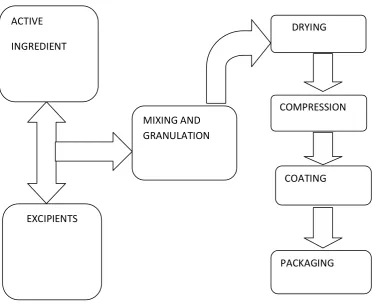
Fig .1 Various Unit operation sequences in Tablet Manufacturing
b) Manufacturing of powder blend
In the tablet pressing process the main guideline is to ensure that the appropriate amount of active ingredient is in each tablet .Hence, all the ingredients should be well –mixed .If a sufficiently homogenous mixture of the components cannot be obtained with simple blending processes, the ingredients must be granulated prior to compression to assure an even distribution of the active compound in the final tablet. Two basic techniques are used to granulate powders for compression into a tablet. :wet granulation and dry granulation. Powders that can be mixed well do not require granulation and can be compressed into tablets through direct compression.
ACTIVE
INGREDIENT
EXCIPIENTS
MIXING AND GRANULATION
DRYING
COMPRESSION
COATING
c)Granulation techniques:
1) Direct compression
The method consists of compressing tablets directly from powdered material without modifying the physical nature of the material itself .Direct compression method of tablet making is of special interest for small group of crystalline chemicals having all the physical characteristics necessary for the formulation of a good tablet .Examples include chloride , chlorate, bromide ,iodine, nitrate, ammonium chloride which posses cohesive and flow properties that makes direct compression possible .Tablets in this category are usually intended to provide rapid disintegration and drug release.
Some of the advantages of this method are simplicity of the process ,absence of granulating step, avoidance of moisture and drying steps, minimum material handling ,and rapidity of total process and optimum bioavailability of the drug.
2)Wet granulation
Wet granulation is a process of using a liquid binder to lightly agglomerate the powder mixture .The amount of liquid has to be properly controlled,as over-wetting cause the granules to be too hard and under –wetting will cause them to be too soft and friable .Aqueous solutions have the advantage of being faster to deal with an solvent –based systems.
Procedure:
Step 1: The active ingredient and excipients are weighed and mixed.
aqueous preparations of cornstarch ,natural gums such as acasia ,cellulose derivatives such as methyl cellulose and povidone .
Step 3: Screening the damp mass through mesh to fom pellets or granules.
Step 4:Drying the granulation .A conventional tray-dryer or fluid-bed dryer are most commonly used.
Step 5 : After the granules are dried ,they are passed through a screen of smaller size than the one used for the wet mass to create granules of uniform size.
Low shear wet granulation process use very simple equipment ,and can take a considerable time to achieve a uniformly mixed state .High shear wet granulation process use equipment that mixes the powder and liquid at a very fast rate. Fluid bed granulation is a multiple-step wet granulation process performed in the same vessel to pre-heat ,granulate ,and dry the powders.
3)Dry granulation
Dry granulation process is also known as ‘slugging’, ‘double compression’ or ‘recompression’ method. This process can be used when the tablet ingredient are sensitive to moisture or are unable to withstand elevated temperature during drying. Essential steps in this method include weighing, mixing, slugging, dry screening, lubrication and compression.
Dry granulation process creates new granules by light compaction of the powder blend under low pressures.The compacts so formed are broken up gently to produce granules(agglomerates).This process is often used when the product to be granulated is sensitive to moisture and heat .Dry granulation can be conducted on a tablet press using slugging tooling or on a roll press called a roll compacter.
percentage of fine granules, which can compromise the quality or create yield problems for the tablet .Dry granulation requires drugs or excipients with cohesive properties ,and a ‘dry binder’ may need to be added to the formulation to facilitate the formation of granules.
d)Granules lubrication
After granuation, a final lubrication step is used to ensure that the tableting blend does not stick to the equipment during the tableting process. This usually involves low shear blending of the granules with a powdered lubricant, such as magnesium stearate or stearic acid.
e)Compression
After preparation of the granules (in case of wet granuation) or sized slugs (in case of dry granulation) or mixing of ingradients (in case of direct compression), they are compressed to get final product. The compression is done either by single punch machine (stamping press) or by multi station machine.(rotary press).
The tablet press is a high speed mechanical device. It ‘squeezes’ the ingredients into the required tablet shape with extreme precision. It can make the tablet in many shapes, although they are usually round or oval. Also, it can press the name of the manufacturer or the product into the top of the tablet. Each tablet is made by pressing the granules inside a die, made up of hardened steel. The die is a disc shape with a hole cut through its centre. The powder is compressed in the centre of the die by two hardened steel punches that fit into the top and bottom of the die.
The punches and dies are fixed to a turret that spins round. As it spins, the punches are driven together by two fixed cams – an upper cam and lower cam. The top of the upper punch (the punch head) sits on the upper cam edge. The bottom of the lower punch sits on the lower cam edge.
ensures that each tablet is perfectly formed. Because of the high speeds, they need very sophisticated lubrication systems. The lubricating oil is recycled and filtered to ensure a continuous supply7,8
1.7 Common stages occurring during compression:
Stage 1:
Top punch is withdrawn from the die by the upper cam bottom punch is low in the die so powder falls in through the hole and fills the die.
Stage 2:
Bottom punch moves up to adjust the powder weight-it raises and expels some powder.
Stage 3:
Top punch is driven into the die by upper cam bottom punch is raised by lower cam . Both punch heads pass between heavy rollers to compress the powder
Stage 4:
Top punch is withdrawn by the upper cam lower punch is pushed up and expels the tablet. Tablet is removed from the die surface by surface plate.
1.8 MINI-TABLETS:
Mini-tablets are small tablets with a diameter typically equal to or less than 2.5 mm that are typically filled into a capsule, or occasionally, further compressed into larger tablets. It is possible to incorporate many different mini-tablets, each one formulated individually and programmed to release drug at different sites within the gastrointestinal tract, into one capsule. These combinations may include immediate release, delayed release, and/or controlled release mini-tablets. It is also possible to incorporate mini-tabs of different drugs to treat concurrent diseases or combinations of drugs to improve overall therapeutic outcome, while delivering distinct release rates of each according to disease requirements.
1.8.1 Advantages:
Mini-tablets combine the advantages of multiparticulate dosage forms with the established manufacturing techniques of tableting.
Ø Mini-tablets include excellent size uniformity, regular shape and a smooth surface, thereby offering an excellent substrate for coating with modified release polymeric systems.
Ø There is a less risk of dose dumping, less inter and intra-subject variability, high degree of dispersion in the digestive tract thus minimising the risk of high local drug concentrations.
Ø Mini tablets also offer an alternative for pellets because of their relative ease of manufacturing and because dosage form of equal dimensions and weight with smooth regular are produced in a reproducible and continuous way.
2.LITERATURE REVIEW
Goole J ,et al., relates to the development and the in vitro evaluation of sustained-release minitablets (MT), prepared by melt granulation and subsequent compression which are designed to float over an extended period of time. Levodopa was used as a model drug. The importance of the composition and manufacturing parameters of the MT on their floating and dissolution properties was then examined. The investigation showed that MT composition and MT diameter had the greatest influence on drug release, which was sustained for more than 8 h. By using the formulation, the best floating properties were obtained with 3mm MT prepared at low compression forces ranging between 50 and 100 N. Their resultant-weight (RW) values were always higher than those obtained with a marketed HBS dosage form within 13 h.By evaluating the dissolution profiles of levodopa at different pH values, it was found that dissolution profiles depend more on the prolonged-release ability of Methocel® K15M than on the pH-dependent solubility of levodopa. Finally, the robustness of the floating MT was assessed by testing the drug release variability in function of the stirring conditions during dissolution tests.
Gohel M and Saraviya K, formulated the enteric mini tablets of isoniazid by cold extrusion method. The mini tablets were prepared by using isoniazid ,HPMC phthalate and dibasic calcium phosphate .Mini tablets were coated using HPMC phthalate.The drug release were resisted in 0.1N HCL for 2hrs from the optimized batch.It showed more than 90% of drug release in phosphate buffer in 15min .Capsules containing rifampicin powder and enteric isoniazid mini tablets showed complete drug release in acidic and alkaline media respectively.(Gohel M and Saraviya K,2010).
method, Stirred (paddle) method and Rotating Vial method. . Finding correlation co-efficients and plotting a scatter diagram established invitro-invivo relationship. The Rotating vial method matched best with invivo results Specific hydrodynamic and volume showed high invitro-invivo correlation. The work identified a suitable invitro method of drug release from Ocular minitablets (MT). (Paresh Prajapati A.,et al.2010)
Shiva kumar Y,et al. investigated Sumatriptan Nasal Mucoadhesive Minitablets
using different mucoadhesive polymers Chitosan,Carbopol 971P and Gum copal along with Methocel. Mucoadhesive minitablets of Sumatriptan were prepared by direct compression method. The minitablets were evaluated for thickness, hardness, swelling index, mucoadhesion and in vitro drug release. All postcompressional parameters were found to be within acceptable standard limits. It was observed that mucoadhesive minitablets contained polymer blend of Carbopol, Carbopol/ Chitosan , Carbopol/ Gum copal were successfully controlled the release of drug up to 7 days. Optimum formulation was obtained based on evaluation studies.(Shiva kumar Y,et al.2010)
Seyed Alireza,et al. studied the preparation and evaluation of
Lingam M.,et al. developed a gastro retentive floating drug delivery system with multiple-unit minitab’s based on gas formation technique in order to prolong the gastric residence time and to increase the overall bioavailability of the drug. The system consists of the drug-containing core units prepared by direct compression process, which are coated with three successive layers of an inner seal coat,effervescent layer (sodium bicarbonate) and an outer gas-entrapped polymeric membrane of an polymethacrylates (Eudragit RL30D, RS30D, and combinations of them). Only the system using Eudragit RL30D and combination of them as a gas-entrapped polymeric membrane could float. The time to float decreased as amount of the effervescent agent increased and coating level of gas-entrapped polymeric membrane decreased. The optimum system floated completely within 3 min and maintained the buoyancy over a period of 12 h. Increasing coating level of gas-entrapped polymeric membrane decreased the drug release. Both the rapid floating and the controlled release properties were achieved in the multiple-unit floating drug delivery system developed in this present study. The analysis of the parameter dissolution data after storage at 40 °C and 75% RH for 3 months showed, no significant change indicating the two dissolution profiles were considered to be similar (f2 value is more than 50).(Lingam .,et a.2008)
Shiva kumar HN,et al. studied pH-sensitive tablet in capsule system which
3. AIM AND OBJECTIVE
OBJECTIVE:
Psychosis is a special type of mental disorder that effects about 2-3% of the global population and has a strong genetic basis. Group of diseases are present such as schizophrenia, bipolar disorder, major depressive disorder. The conventional tablet may be difficult to take by the patient without missing the dose and it’s also produced more side effects due to high dose. It is necessary to choose alternative dosage forms for the treatment of psychosis with better patience compliance. The best alternative dosage forms may be Extended Release Risperidone Minitablets.
Minitablets may enhance oral absorption due to more surface area and also possible to extended release of the drug. Mini tablets are smaller and it can be filled in to the hard gelatin capsules. The system has specific advantages over conventional single unit dosage forms. The advantage of the system include low risk of dose dumping, less intra and inter variability and high degree of dispersion in the digestive tract thus minimizing the risk of high local drug concentration .Extended release minitablets systems are capable of providing the desired concentration of the drug plasma levels over an extended period of time within the therapeutic range.
4. PLAN OF WORK
· To collect the relevant literature regarding the drug · .Study of the drug and excipients compatibility.
· To prepare different formulations of Risperidone minitablets.
· To evaluate physical properties of minitablets like thickness, hardness, friability etc.
· To evaluate the in-vitro drug release of minitablets.
5. DRUG & EXCIPIENT PROFILE
Name of Drug Risperidone
Chemical Name
3-[2-[4-(6-fluoro-1,2-benzisoxazol-3-yl)1-piperidinyl]ethyl]- 6,7,8,9-tetrahydro- 2-methyl-4H-pyrido[1,2-a]pyrimidin-4-one.
Formula C23H27FN4O2
Structure
Physicochemical properties
Molecular Mass 410.49.gm/mol
Description White to slightly beige powder.
Solubility Insoluble in water, freely soluble in methylene
chloride and soluble in methanol and 0.1N HCL.
Pharmacology
Category Antipsychotic
Dose 2-4mg/day.
Dosage form Mini tablets filled in hard gelatin capsules.
Storage Stored below 30
0c in dry place and protected from
MECHANISM OF ACTION
Risperidone is an antipsychotic of the benzisoxazol derivatives.It is a selectve monoaminergic antagonist.Risperidone has affinity for serotonin5HT2, dopamine-D2,H1-histamine,alpha1-and alpha2-adrenergic receptors.Risperidone has no affinity for cholinergic receptors.It is a potent D2-antagonist.
Pharmacokinetics
Risperidone is rapidly and very well absorbed after oral administration.Peak plasma concentrations are attained within 1-2hrs.Risperidone is 90% plasma protein bound.It is metabolized by cytochrome P-450 IID6 to 9-hydroxy-risperidone.The Elimination half-life was found to be about 3-20hrs.
The pharmacokinetic characteristics are given in below table.1
Pharmacokinetic characters
Oral bioavailability 70%(oral)
Plasma protein binding 90%
Metabolism Hepatic
Excretion Urinary
Elimination t1/2 (hr) 3-5hrs
INDICATIONS:
Risperidone is indicated in the treatment of :
a) acute and chronic schizophrenic psychosis and related psychosis.
b)Behavioural disturbances in patients with dementia.
CONTRAINDICATIONS:
1. Risperidone is contra-indicated in patients with known sensitivity to the medicine.
2. Women receiving Risperidone should not breast feed.
3. Not for children under 5 years as efficacy and safety in children under 5 years have not been demonstrated.
PRECAUTIONS:
· Patients are advised not to drive as risperidone may impair mental alertness. · Dose should be reduced to halve in geriatric and patients with renal or liver
insufficiency
· Hypotension may occur during initial dose titration period due to alpha blocking activity, dose reduction should be considered during hypotension · Parkinson disease patients should be cautious while taking risperidone.
DRUG INTERACTIONS:
Risperidone should be used with caution in combination with alcohol and other centrally acting medicines. It may antagonize the effect of levodopa and other dopamine agonist
Tricyclic anti depressants, phenothiazines, and beta blockers may increase the plasma concentration of risperidone.
ADVERSE EFFECTS:
Risperidone has been associated with weight gain, akathisia, sedation, dysphoria, insomnia, sexual dysfunction, low blood pressure, high blood pressure, muscle stiffness, muscle pain, tremors, increase salivation, constipation
EXCIPIENT PROFILE
Hydroxy propyl methyl cellulose
Chemical name Cellulose 2- hydroxy propyl methyl ether
Synonym Cellulose, Hypromellose, 2 – Hydroxypropylmethyl
ether, Methyl hydroxy propyl cellulose, Methocel, Pharmacoat, Metolose.
Description It is a white, yellowish white or grayish white,
practically odorless, fibrous powder or granules.
Solubility Soluble in cold water, forming a colloidal solution,
practically insoluble in hot water, dehydrated alcohol, chloroform and ether.
pH A 1% w/w solution has a pH of 5.5 - 8.0
Melting point Browns at 190-2000C, chars at 225-2300C, Tg is at 170-1800C
Autoingnition temperature 3600C
Bulk density 0.341 gm/cm3
Tapped density 0.557 gm/cm3
Gel formation Undergoes a reversible transformation from solution to gel upon heating and cooling respectively.
Gel point 50 – 900C depending upon the grade
Ash value 1.5 – 3 % depending upon the grade
Surface activity Provides some surfactancy in solutions, surface tension for such solutions range from 42 – 56 dynes/cm.
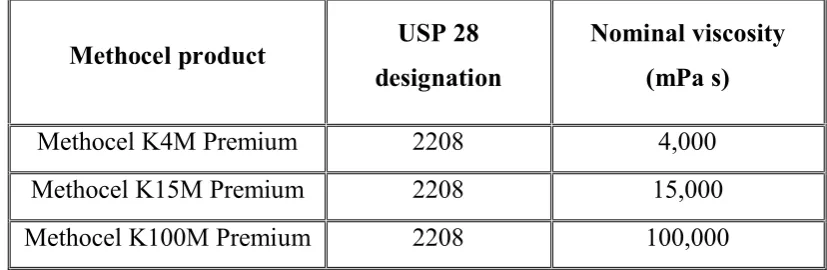
Table 2. Typical viscosity values for 2% (w/v) aqueous solutions of methocel (Dow Chemical Co.). viscosities measured at 20°C
Incompatibilities: Hypromellose is incompatible with some oxidizing agents. Since it is nonionic, hypromellose will not complex with metallic salts or ionic organics to form insoluble precipitates.
Safety: Hydroxypropyl methylcellulose is generally regarded as a nontoxic and nonirritant material although excessive oral consumption may have a laxative effect.
Pharmaceutical uses: HPMC is widely used in oral and topical pharmaceutical formulations. It is used as tablet binder, for film coating and in sustained release preparations. Hypromellose is also used as a suspending and thickening agent in topical formulations, particularly ophthalmic preparations. It is also used as an emulsifier, suspending agent and stabilizing agent in topical gel and ointments. [Raymond CR et al., 2003]
Methocel product USP 28
designation
Nominal viscosity (mPa s)
Methocel K4M Premium 2208 4,000
Methocel K15M Premium 2208 15,000
Lactose
Lactose monohydrate as a natural disaccharide, obtained from milk, which consists of one galactose and one glucose moiety.
Synonyms Lactochem, Pharmatose, NF Lactose, Capsulac, Granulac, Tablettose, Inhalac, Prismalac, Sachelac
Description White to off-white crystalline particles or powder, odorless and slightly sweet-tasting; α-lactose is approximately 20% as sweet as sucrose, while β-lactose is 40% as sweet.
Functional Category Binding agent; diluent for dry-powder inhalers; tablet binder; tablet and capsule diluent.
Grades Lactochem powder, coarse powder, fine powder; Pharmatose 50M, 80M, 90M, 100M, Inhalac 70, 120, 230; Lactose monohydrate NF 80M.
Solubility Soluble in water (1 in 5.24), practically insoluble in chloroform, ethanol and ether.
Angle of repose 33° for Pharmatose DCL 15; 32° for Tablettose 70 and Tablettose 80.
Melting point 201–202°C (for dehydrated α-lactose monohydrate)
Density (true) 1.545 g/cm3 (α-lactose monohydrate)
Incompatibilities A Maillard-type condensation reaction is likely to occur between lactose and compounds with a primary amine group to form brown, or yellow-brown-colored products. Lactose is also incompatible with amino acids, aminophylline, amfetamines, and lisinopril.
Stability Mold growth may occur under humid conditions (80% relative humidity and above). Lactose may develop a brown coloration on storage, the reaction being accelerated by warm, damp conditions.
Storage It should be stored in a well-closed container in a cool, dry place.
Magnesium stearate
Chemical name Octadecanoic acid magnesium salt
Synonym Magnesium octadecanoate, octadecanoic acid,
magnesium salt, stearic acid, magnesium salt.
Description Magnesium stearate is a very fine, light white,
precipitated or milled, impalpable powder of low bulk density, having a faint odor of stearic acid and a characteristic taste. The powder is greasy to the touch and readily adheres to the skin.
Solubility practically insoluble in ethanol, ethanol (95%), ether and water; slightly soluble in warm benzene and warm ethanol (95%).
Bulk density 0.159 g/cm3
Specific surface area 1.6–14.8 m2/g
Tapped density 0.286 g/cm3
Melting range 117°C –150°C
Incompatibilities Incompatible with strong acids, alkalis, and iron salts. Avoid mixing with strong oxidizing materials. Magnesium stearate cannot be used in products containing aspirin, some vitamins, and most alkaloidal salts.
Colloidal silicon dioxide
Chemical name Talc
Synonym Aerosil, Cab-O-Sil, Cab-O-Sil M-5P, colloidal silica,
fumed silica, light anhydrous silicic acid, silicic anhydride, silicon dioxide fumed, Wacker HDK.
Description Talc is a very fine, white to grayish-white, odorless, impalpable, unctuous, crystalline powder. It adheres readily to the skin and is soft to the touch and free from grittiness
Solubility practically insoluble in organic solvents, water, and acids, except hydrofluoric acid; soluble in hot solutions of alkali hydroxide. Forms a colloidal dispersion with water
pH 3.5–5.5
Bulk density 0.029–0.042 g/cm3
Specific surface area 200–400 m2/g (Stroehlein apparatus, single point), 50–380 m2/g (BET method)
Tapped density 0.5–1.2 g/cm3
Incompatibilities Incompatible with diethylstilbestrol preparations
6
6.. EExxppeerriimmeennttaallwwoorrkk
L
[image:42.595.85.534.178.487.2]Liissttooffeexxcciippiieennttssaannddeeqquuiippmmeennttss
Table 3. List of drug and materials
Sr. No. Materials Use Manufactured/Supplied by
1 Risperidone Anti-pyschotic agent
Kopalle Pharma chemicals (P)Ltd
2 HPMC(K100M) polymer Colorcon Asia Pvt. Ltd., Goa
3 Lactose filler Sri Jindutt Pharma .Pvt.Ltd
4 Magnesium
stearate lubricant
S.D. fine chemicals, Mumbai
5 Aerosil glidant S.D. fine chemicals,
Mumbai
Table 4. List of chemicals and reagents
Sr. No. Materials Manufactured/Supplied by
1 Potassium di hydrogen
phosphate Thomas Baker, Mumbai
2 Sodium hydroxide AR grade Merck Limited, Mumbai
3 Hydrochloric acid Thomas Baker, Mumbai
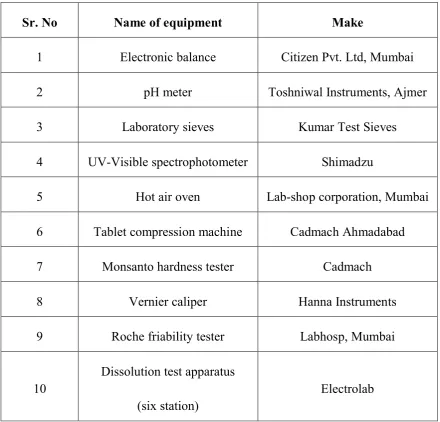
[image:42.595.96.537.535.738.2]Table 5. List of equipments
Sr. No Name of equipment Make
1 Electronic balance Citizen Pvt. Ltd, Mumbai
2 pH meter Toshniwal Instruments, Ajmer
3 Laboratory sieves Kumar Test Sieves
4 UV-Visible spectrophotometer Shimadzu
5 Hot air oven Lab-shop corporation, Mumbai
6 Tablet compression machine Cadmach Ahmadabad
7 Monsanto hardness tester Cadmach
8 Vernier caliper Hanna Instruments
9 Roche friability tester Labhosp, Mumbai
10
Dissolution test apparatus
(six station)
[image:43.595.96.537.126.548.2]6.1 Preformulation studies: A preformulation activity ranges from supporting discovery’s identification of new active agents to characterizing physical properties necessary for the design of dosage form. Critical information provided during Preformulation can enhance the rapid and successful introduction of new therapeutics entities for humans. Preformulation testing is an investigation of physical and chemical properties of a drug substance.
The overall objective of preformulation testing is to generate information useful in developing the formulation which is stable and bio-available. Further the use of Preformulation parameters maximizes the chances in formulating an acceptable, safe, efficacious and stable product. For any drug substances to formulate into a dosage form, it is necessary to study the physicochemical properties of the bulk drug like physical appearance, solubility, bulk density, tapped density, compressibility, melting point, molecular weight, sieve analysis.
The following pre-formulation studies were performed for the Risperidone mini tablet formulations are as follows:
a).Angle of
Angle of repose is defined as the maximum angle possible between the surface of pile of powder and the horizontal plane. The granule mass should allowed to flow out of the funnel orifice on a plane paper kept on the horizontal surface .This forms a pile of granules on the paper.
Where,
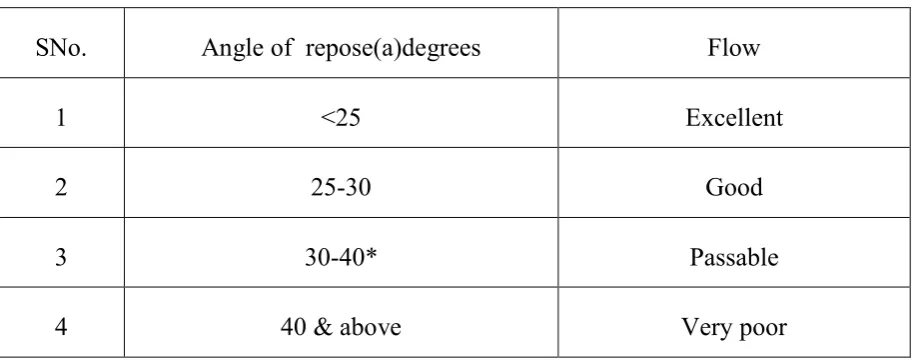
Table 6:Limits for angle of repose according to I.P..
SNo. Angle of repose(a)degrees Flow
1 <25 Excellent
2 25-30 Good
3 30-40* Passable
4 40 & above Very poor
b) Bulk
It is the ratio between a given mass of powder and its bulk volume. Mass of powder
Bulk density =
Total weight of the powder
A given quantity of the powder is transferred to the measuring cylinder and it is tapped mechanically either manually or mechanical device till a constant volume is obtained .This volume is bulk volume(v) and it includes the true volume of the powder and void space among the powder particles.
c)Tapped
Tapped density is defined as the ratio between weight of the sample powder taken and the tapped volume.
Tapped density( t)= M/Vf Where, M= weight of sample powder taken
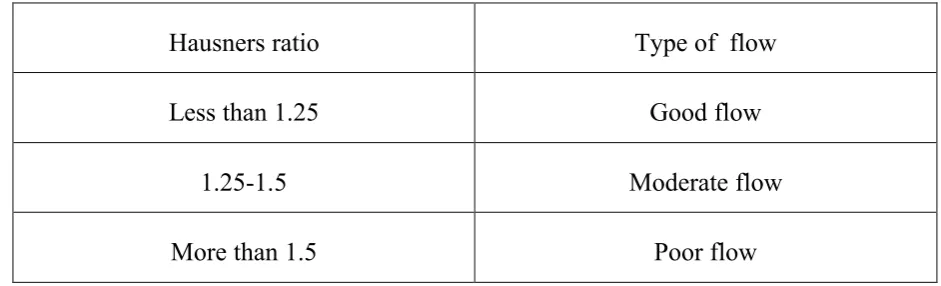
d)Hausners ratio:
By using following formula ,the Hausners ratio can be calculated. Tapped density Hausner ratio =
[image:46.595.78.549.299.442.2]Bulk density
Table 7:Limits for Hausners ratio according to I.P.
Hausners ratio Type of flow
Less than 1.25 Good flow
1.25-1.5 Moderate flow
More than 1.5 Poor flow
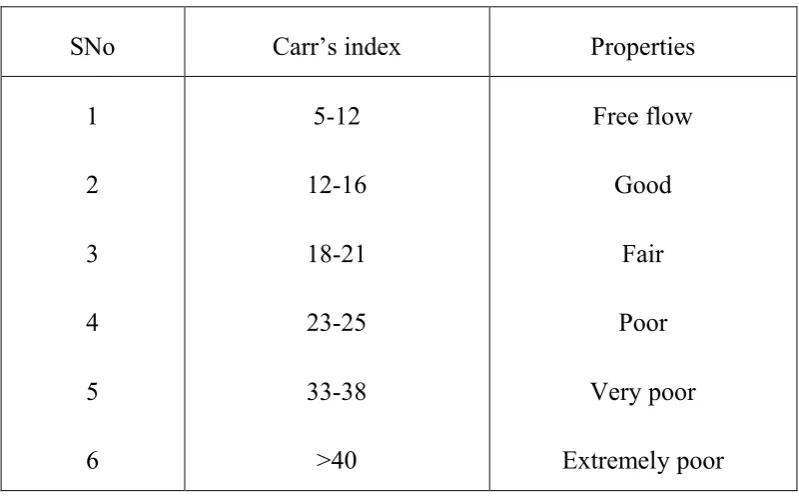
Compressability Index: It is an important measurement that can be obtained from bulk and tapped density.
Bulk density – Tapped density
Carr’s index = x 100
Table 8:Limits for Carr’s index according to I.P.
SNo Carr’s index Properties
1 2 3 4 5 6 5-12 12-16 18-21 23-25 33-38 >40 Free flow Good Fair Poor Very poor Extremely poor
e). Drug – Excipients compatibility study:
As a part of the product development, the compatibility of various excipients with active was evaluated.
According to the functional category these excipients were mixed in different ratio with drug. These mixtures were kept in 40°C / 75 %RH, and 60°C, in a 2-ml glass vial in exposed condition for 1 month. Excipients are mixed with the drug quantity in following ratio.
At the interval of 2 weeks and 4 weeks, the samples were withdrawn and given to analytical development for analysis of following parameters:
Ø Moisture content
6.2Method for preparation of minitablets
Development of extended release minitablets by direct compression method
Extended release mini tablets were prepared using risperidone ,HPMCK100M, HPMCK 15M, lactose, Aerosol ,magnesium stearate .Variable concentration of drug polymer ratio and other excipients are weighed and mixed as per formulation batches. The powder blends are lubricated with aerosil and magnesium stearate ,and passed through sieve no.60 and then directly compressed using mini punches.
Direct compression method consists of compressing tablets directly from powdered material with out modifying the physical nature of the material. In direct compression method the drug along with suitable ingredients are mixed. These are directly compressed into mini tablets.
Main Steps Involved in the direct compression method is:
Milling of drugs and excipients
Mixing of excipients
Table 9: Formula table for Risperidone minitablets
S.
No
Trial
Ingradients
F1 F2 F3 F4 F5 F6
1 Risperidone(gms) 4 4 4 4 4 4
2 HPMCK100M
(gms)
50 37.5 75 - - 75
3 HPMCK15M - - - 75 100
-4 Lactose (gms) 25 50 25 25 25 50
5 Aerosil(gms) 1 1 1 1 1 1
6 Magnesium Stearate (gms)
0.5 0.5 0.5 0.5 0.5 0.5
6.3 Evaluation of tablets
The important parameters in the evaluation of tablets can be divided into physical and chemical parameters.
1.Physical appearance
The general appearance of tablets its visual identity and over all elegance is essential for consumer acceptance. The control of general appearance of tablet involves measurement of number of attributes such as tablet size, shape, color presence or absence of odour, taste ,surface texture and consistency of any identification marks.
2.Tablet size and thickness:
Control of physical dimensions of the tablets such as size and thickness is essential for consumer acceptance and tablet-tablet uniformity .The diameter size and punch size of tablets depends on the die and punches selected for making the tablets. The thickness of tablet is measured by Vernier Calipers scale. The thickness of the tablet related to the tablet hardness and can be used an initial control parameter .Tablet thickness should be controlled within a +or -5%. In addition thickness must be controlled to facilitate packaging.
3.Average weight of tablets:
Take randomly 20 tablets and weigh accurately 20 tablets and calculate the average weight.
Weight of 20 tablets Average weight =
4. Hardness
test:-This is the force required to break a tablet in diametric compression. Hardness of the tablet is determined by Stock’s Mosanto hardness tester which consists of a barrel with a compressible spring. The pointer moving along the guaze in the barrel which the tablet fractures. Hardness of 5 kg considered as suitable for handling the tablet.
5.Uniformity of dosage units (by weight variation method)
Take randomly 30 tablets ,weigh collectivey and individually 30 tablets and calculate average weight of the tablets and % assay of individual dosage units by using formula
Assay x Individual weight =
Average weight
6.In-Vitro drug release:
In-vitro release of the drug was determined by estimating the dissolution profile.
Dissolution test for Risperidone:
Parameter for dissolution test:
Apparatus : USP 1 (Basket apparatus) Revolution per minute : 100rpm
Dissolution medium : 6.8 phosphate buffer Temperature : 37±0.50C
7. RESULTS AND DISCUSSION
7.1. Preformulation results of selected Drug:
[image:53.595.90.540.208.778.2]7.1.1 Physical characters of Risperidone were found as:
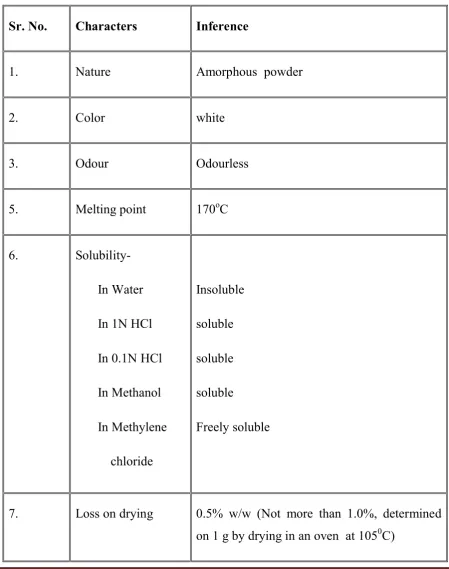
Table 10: Physical Characters of Risperidone
Sr. No. Characters Inference
1. Nature Amorphous powder
2. Color white
3. Odour Odourless
5. Melting point 170οC
6.
In Water
In 1N HCl
In 0.1N HCl
In Methanol
In Methylene
chloride
Insoluble
soluble
soluble
soluble
Freely soluble
7. Loss on drying 0.5% w/w (Not more than 1.0%, determined
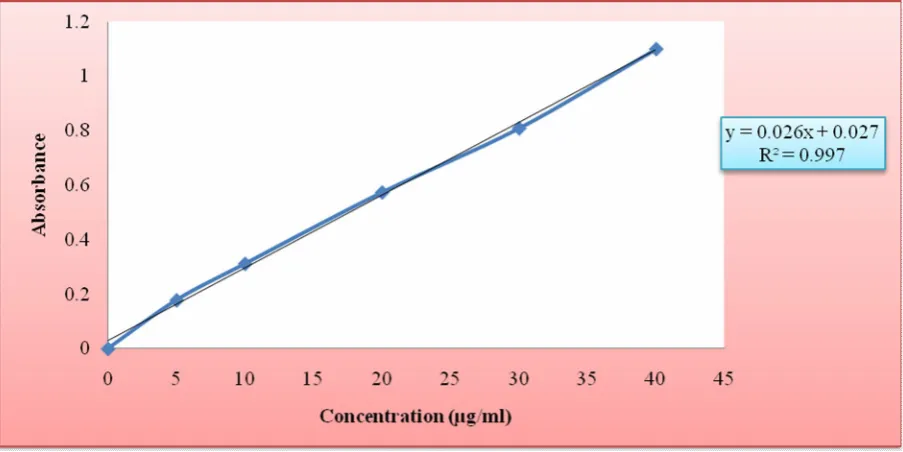
7.1.2:Calibration curve was drawn in Phosphate buffer (pH 6.8), which follows beer’s Lambert law.
7.1.3: Assay was performed to analyze the percentage purity and was found to be 101%w/w.
Conclusion: On the basis of the above tests, it was confirmed that the drug sample of Risperidone can be used for further study.
7.2. Preparation of Standard calibration curves:
7.2.1 Standard calibration curves of Risperidone:
[image:54.595.191.453.494.744.2]In Phosphate buffer pH 6.8. The curve follows Beer’s lambert law.
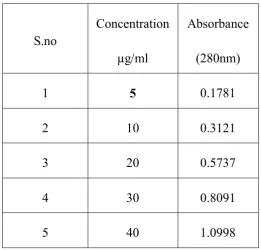
Table 11: Calibration curve for Risperidone in Phosphate buffer pH 6.8 at 280nm
The standard curve of risperidone was obtained by taking the absorbance at 280nm,the values are shown in the table below and it shows that the values complies the Beer’s law.
S.no
Concentration
µg/ml
Absorbance
(280nm)
1 5 0.1781
2 10 0.3121
3 20 0.5737
4 30 0.8091
The standard curve of the Risperidone is plotted by taking concentration on the x-axis and absorbance on the y-axis.
Fig:1 Standard calibration curve of Risperidone in Phosphate buffer at pH 6.8 at 280nm
Table:12 Drug-exciepients compatibility
ratio:-Drug-Excipients
Combination D:E Ratio Initial
40ºc 75%
RH(1month) 60ºc(1 month)
API alone - White to half white NCC NCC
API+HPMCK100M 1:10 White to half white NCC NCC
API+HPMCK15M 1:10 White to half white NCC NCC
API+ lactose 1:10 White to half white NCC NCC
API+Magnesium
stearate 1:5 White to half white NCC NCC
API+ Aerosil 1:5 White to half white NCC NCC
Conclusion:
[image:55.595.87.558.454.674.2]Table 13. Preformulation parameters of powder blend
[image:56.595.85.549.205.492.2]The Risperidone powder blend was evaluated for bulk density, tapped density, angle of repose, Carr’s ratio and Hausner ratio. The results for Risperidone are shown in the table 13.
Formulation
Code
Bulk density(g/ml)
Tapped density(gm/ml)
Angle of reposeº
Carr’s index (%)
Hausner ratio
F1 0.526 0.612 26.76 14.0 1.16
F2 0.662 0.763 27.54 13.23 1.15
F3 0.695 0.823 24.65 15.5 1.18
F4 0.782 0.869 28.68 11.0 1.11
F5 0.560 0.631 24.68 11.25 1.12
F6 0.628 0.714 25.16 14.27 1.17
Conclusion:
Table 14: Parameters of Risperidone mini tablets
S.No Parameters F1 F2 F3 F4 F5 F6
1 Average weight of
tablets(mg) 80.2 92.1 104.8 104.5 129.2 129.6
2 Thickness(mm) 3.94 3.92 3.93 3.91 3.90 3.94
3 Hardness(kg/cm2) 3.58 3.52 3.47 3.32 3.20 3.38
4 Avg Uniformity
of content(%) 99 98.5 99.2 98.3 99.1 98.4
CONCLUSION:
Risperidone minitablets showed the average weight in the range of 80.2 mg –
129.6mg, thickness in the range of 3.90mm – 3.94mm, hardness in the range of 3.20
kg/cm2- 3.58kg/cm2 and average uniformity of content was found 98.3 – 99.2%.
[image:57.595.86.547.118.350.2]In -vitrorelease study
Table :15In -vitrorelease data of formulations F1, F2, F3, F4, F5, F6 .
Cumulative % drug release Time in hrs
F1 F2 F3 F4 F5 F6
1 15 25 10 21 12 15
2 21 36 15 30 24 22
4 27 45 20 42 32 30
8 42 68 37 65 51 45
10 55 82 50 80 60 58
12 70 82 66 92 73 74
16 85 82 80 92 88 87
20 90 83 86 93 94 94
0 10 20 30 40 50 60 70 80 90 100
0 1 2 4 6 8 10 12 16 20
% c um m ula ti ve drug re le ase
Time in Hr
[image:58.595.134.509.275.561.2]F1 F 2 F 3 F 4 F5 F 6
Fig : 2In -vitrorelease data of formulations F1,F2,F3,F4,F5,F6
CONCLUSION:
Table 16:In -vitrorelease data of formulations F1
The percentage drug release of formulation batch F1 is shown below :
Time in hrs % drug release
1 15
2 21
4 27
6 35
8 42
10 55
12 70
16 85
20 90
[image:59.595.119.453.506.696.2]The curve for percentage release for F1 is shown in the graph given below by taking time on x-axis and percentage drug release on y-axis.
Table: 17 In -vitrorelease data of formulations F2
The percentage drug release of formulation batch F2 is shown below :
Time in hrs % drug release
1 25
2 36
4 45
6 54
8 66
10 82
12 82
16 82
20 83
The curve for percentage drug release for F2 is shown in the graph given below by taking time on x-axis and percentage drug release on y-axis
[image:60.595.157.486.510.688.2]Table: 18 In -vitrorelease data of formulations F3
The percentage drug release of formulation batch F3 is shown below :
Time in hrs % drug release
1 10
2 1
4 20
6 30
8 37
10 50
12 66
16 80
20 86
The curve for percentage release for F3 is shown in the graph given below by taking time on x-axis and percentage drug release on the y-axis.
[image:61.595.151.476.507.690.2]Table :19 In -vitrorelease data of formulations F4
The percentage drug release of formulation batch F4 is shown below :
Time in hrs % drug release
1 21
2 30
4 42
6 53
8 65
10 80
12 92
16 92
20 93
The curve for percentage drug release for F4 is shown in the graph given below by taking time on x-axis and percentage drug release on the y-axis.
[image:62.595.109.441.514.693.2]Table: 20In -vitrorelease data of formulations F5
The percentage drug release of formulation batch F5 is shown below :
Time in hrs % drug release
1 12
2 24
4 32
6 43
8 51
10 60
12 73
16 88
20 94
The curve for percentage drug release for F5 is shown in the graph given below by taking time on x- axis and percentage drug release on the y-axis.
[image:63.595.156.493.544.727.2]Table:21 In -vitrorelease data of formulations F6
The percentage drug release of formulation batch F6 is shown below :
Time in hrs % drug release
1 15
2 22
4 30
6 36
8 45
10 58
12 74
16 87
20 92
The curve for percentage drug release for F6 is shown in the graph given below nd by taking time on x-axis and percentage drug release on y-axis.
[image:64.595.150.489.517.709.2]Kinetics Study
One of the proposed mechanisms for drug release from hydrophilic matrices implies water penetration in the matrix hydration and swelling of the polymer (with its expansion), diffusion of the dissolved drug and erosion of gelatinous polymer layer. Drug release from a matrix is controlled by diffusion through the polymeric matrix obeying fick's law. The drug release mechanism is dependent on the pH, the drug and its own polymeric support. In order to investigate the model of release from tablets, the release data of selected formulations was analyzed with the following mathematical models
Zero order equation…….Q = K0t
First order equation……..In (100- Q) = InQ-K1t
Korsmeyer and Peppas equation ……..Q = Kp tn
Where Q, is the percent of the drug release at time t and K0 and Kt are the constants of the equations. Kp is the constant incorporating structural and geometric characteristic of the release device, Ks is a constant incorporating the surface volume relation and n is the release exponent indicative of mechanism of release.
[image:65.595.99.538.574.768.2]The dissolution data were examined for models of first order, zero order, Higuchi, Korsmeyer-Peppas .
Table 22: Kinetic models of optimized batch
Release kinetics Correlation Coefficient(R2)
Zero order equation 0.970
First order equation 0.586
Higuchi(diffusion)co-efficient 0.95
Fig :9 Zero order plot of optimized formulation F1
Fig :11 Higuchi (diffusion)co-efficient plot of optimized formulation F
[image:67.595.250.488.391.580.2]CONCLUSION:
From the kinetic study of the optimized formulation F1 was shown correlation coefficient of Zero order kinetics (R2=0.97), First order kinetics (R2=0.586), Higuchi
(R2=0.95) and Korsmeyer peppas equation (R2=0.718). Further n value of peppas
8.SUMMARY AND CONCLUSION
Minitablets are small tablets with diameter equal or less than 2.5mm that are filled into a capsule, or occasionally compressed into larger tablets. Combinations of different modified relese minitablets like immediate release, delayed release and / or controlled release may include in the dosage forms. It is also possible to incorporate minitablets of different drugs to treat concurrent diseases or combinations of drugs to improve over all therapeutic outcome, while delivering distinct release rates of each according to disease requirements.
The present study was carried out to formulate Risperidone minitablets filled into hard gelatin capsule for the treatment of psychotic disorder.
The precompression parameters revealed that all the 6 formulations powder blends was found good flow property.
Risperidone is formulated with different concentration of polymers like HPMCK100M, HPMCK15M and filler like lactose and with other excipients. A total number of 6 formulations (F1, F2, F3, F4, F5, F6) were prepared and evaluated.
In all the formulation thickness of the tablets varies between 3.90-3.94mm and the hardness of the optimized batch was found to be 3.18kg/cm2
. No variation in the
hardness was found in the optimized formulation that showed powder blend was uniform.
Among 6 formulations, f1, f2, f3, f6 batches were done using HPMC K100M polymer and f4, f5 with HPMC K15M polymer using optimized quantity of lactose. The best batch among those was found F1 because it had 90% drug release and it also sustained its action until 20th hr.
The optimized formulation of Risperidone was filled in the capsule and evaluation were carried out according to the I.P. procedure.
REFERENCES
1. AultonM.E.,The science of dosage form design,International student edition :619.
2. Banker and Chistopher T Rhodes.,1996, Modern Pharmaceutics, Marcel Decker,INC,New – York,III edition:830-840.
3. Bently s., Text Book Of Pharmaceutics, AITBS Publishers, New delhi,III edition:269
4. BrabanerC.De., Vervaet C.,Fiermans L Remon ,Matrix mini-tablets based onstarch/microcrystalline wax mixtures,2000,Int .J.Pharm,193-203.
5. Goole J., Vanderbist F.,Amighi k.,2006.’Development and evaluation of new multiple-Unit levodopa sustained-release floating dosage forms’.Int.J.Pharm 334:35-41.
6. Gupta A.K and Bajaj S.S., A textbook of professional pharmacy, Vallabhprakashan,vol-II edition:142.
7. Jain N.K., Sharma S..N.,A textbook of professional pharmacy,Vallabhprakashan,IVedition:295-297,300,303.
8. Lachmann L.,LibermanH.A,KanigJ.L.,The Theory And Practice of IndustrialPharmacy,Varghese Publishing House,New delhi,1991,III edition:132.
9. Leon Lachmann.,Herbert A Libermann.,Joseph L Kaing.,The Theory and Practice ofIndustrial Pharmacy,III edition:303-310,332.
10. LibermannH,Lachmann L., Pharmaceutical Dosage Forms,TabletsVol I to III,Marcel Decker Inc.,New-York,85-143
11. Lingam .,et al.2008.’Preparation of a Matrix Type Multiple-Unit Gastro RetentiveFloating Drug Delivery System for Captopril Based on Gas Formation Technique: InVitro Evaluation’.AAPS Pharm9-21.
12. MehthaR.M.,Pharmaceutics, VallabhPrakashanPublishers,Newdelhi, Vol- I & II, III Edition:67-244.
14. Ocular Ciprofloxacin-Containing Minitablets Prepared With Different Combination Carbopol 974P and Various Cellulose Derivatives. ’Iranian.J.Pharm,9:107-114.
15. PareshPrajapatiA.,et al.2010.’Evaluation of controlled release ophthalmic minitabletsPrepared by direct compression’.Int.J.Pharm,2-30.
16. SeyedAlirezaMortazavia.,Zahra J., ElnazD.,’Formulation and In- Vitro Evaluation ofCiprofloxacin-Containing Minitablets Prepared With Different Combinations of Carbopol974P and Various Cellulose Derivatives.
17. Shiva kumarY.,et al,2010.’Design and in vitro evaluation of Mucoadhesiveminitablets For nasal drug delivery of Sumatriptan’. Asian .J.Pharm 3-31.