A QUASI EXPERIMENTAL STUDY TO ASSESS THE
EFFECTIVENESS OF VIDEO ASSISTED TEACHING
ON HOME CARE MANAGEMENT OF PRETERM
BABIES AMONG MOTHERS IN SELECTED
HOSPITALS AT CHENNAI.
By
Arifa Bee.S
A dissertation submitted to
THE TAMILNADU DR.MGR MEDICAL UNIVERSITY,
CHENNAI.
In partial fulfillment of the
REQUIREMENT FOR THE AWARD OF THE DEGREE OF
MASTER OF SCIENCE IN CHILD HEALTH NURSING,
A QUASI EXPERIMENTAL STUDY TO ASSESS THE
EFFECTIVENESS OF VIDEO ASSISTED TEACHING
ON HOME CARE MANAGEMENT OF PRETERM
BABIES AMONG MOTHERS IN SELECTED
HOSPITALS AT CHENNAI.
Approved by dissertation committee on 10.01.2011Professor in nursing research ……….. Prof.Mrs.R.RAMA SAMBASIVAN, M.SC.(N).,PH.D.,
Principal,
Mohamed Sathak A.J.College of Nursing, No.180, Thambu Chetty Street,
Chennai –600 001, Tamil Nadu.
Clinical Speciality Expert ……….. Mrs.DEEPA, M.SC.(N).,
Head of the Department in child health nursing. Mohamed Sathak A.J.College of Nursing, No.180, Thambu chetty street, Parrys Chennai –600 001, Tamil Nadu.
Medical Expert ………..
Dr.R.A.RAHUL YADAV, M.B.B.S., D.M, (Neonatology) Consultant Neonatologist,
KKCTH, Nungambakkam, Chennai-600034, Tamil Nadu.
A dissertation submitted to
THE TAMILNADU DR.MGR MEDICAL UNIVERSITY,
CHENNAI.
In partial fulfillment of the
REQUIREMENT FOR THE AWARD OF THE DEGREE OF
MASTER OF SCIENCE IN CHILD HEALTH NURSING,
A QUASI EXPERIMENTAL STUDY TO ASSESS THE
EFFECTIVENESS OF VIDEO ASSISTED TEACHING
ON HOME CARE MANAGEMENT OF PRETERM
BABIES AMONG MOTHERS IN SELECTED
HOSPITALS AT CHENNAI.
Certified that this is the bonafied work of
Miss.Arifa Bee.S.
Mohamed Sathak A.J College of Nursing,
Chennai-01.
Signature: ……….
Prof.Mrs.R.RAMA SAMBASIVAN, M.SC.(N).,PH.D., Principal,
Mohamed Sathak A.J.College of Nursing, No.180, Thambu Chetty Street, Parrys, Chennai –600 001, Tamil Nadu.
College seal:
A dissertation submitted to
THE TAMILNADU DR.MGR MEDICAL UNIVERSITY,
CHENNAI.
In partial fulfillment of the
REQUIREMENT FOR THE AWARD OF THE DEGREE OF
MASTER OF SCIENCE IN CHILD HEALTH NURSING,
ACKNOWLEDGEMENT
I am extremely grateful to GOD ALMIGHTY for his strength, courage, wisdom, guidance and support from the beginning to the end of the dissertation.
My sincere and heartful gratitude to Prof.Mrs.Ramasambasivan, M.Sc.,(N), Ph.D, Principal, College of Nursing, Mohamed Sathak A.J.College of Nursing, Chennai, for her elegant direction and worthful suggestions in completing this project.
I feel extremely grateful to Mrs. Safreena, M.Sc., (N) Vice Principal, Mohamed Sathak A.J.College Of Nursing, Chennai for her guidance and suggestions.
I acknowledge my heartful thanks to Mrs. Deepa, B.Sc., (N), M.Sc., (N) Reader & Head of the department in Pediatric Nursing, Mohamed Sathak A.J.College of Nursing, Chennai for her encouragement and guidance to carryout this dissertation.
I am privileged to acknowledge my gratitude to Dr.R.A.Rahul Yadav, DM, (Neonatology), Consultant Neonatologist, KKCTH, Nungambakkam.
I wish to express my sincere thanks to Dr.R.Shanmuga Sundharam, MD., DCH., Consultant Neonatologist, Dr.Mehta’s hospital, chetpet.
I offer my gratitude to Mr.G.K. Venkataraman, Biostatistician, for his guidance in statistical analysis and computing my dissertation.
I express my thanks to all the faculty members, Mohamed Sathak A.J.College of Nursing, Chennai for their co-operation & support in completing this study.
I extend my thanks to all the mothers of preterm babies in KKCTH, Nungambakkam & Dr.Mehta’s hospital, Chetpet for their participation, co-operation & interest in the study.
I wish to acknowledge my thanks to Mr.K.Zakir Hussain for his co-operation & patience in computing my dissertation.
I extend my thanks to Mrs.Anuradha and her child, Mr. A. Abdul Kafoor and Mohammed Azeessudeen.
CONTENT
CHAPTER TITLE PAGE NO
I Introduction 1
Background of the Study 3
Need for the study 4
Statement of the Problem 7
Objectives 7 Hypothesis 7
Operational definitions 8
Assumptions 8
Limitations of the study 9
Projected out Come 9
Conceptual framework 10
II Review of literature 14
III Methodology 26
Research approach 26
Research design 26
Setting 26 Population 27 Sample 27 Criteria for sample selection 28
Instrument 28
Score interpretation 29
Pilot Study 30
Data Collection Procedure 31
CHAPTER TITLE PAGE NO
IV Data analysis and Interpretation 34
V Discussion 58
LIST OF TABLES
TABLE TITLE PAGE
No
1
Frequency and percentage distribution of demographic variables of mothers of preterm babies in the experimental and control group
35
2
Frequency and percentage distribution of pretest level of knowledge on home care management of preterm babies among the mothers in the experimental group
39
3
Frequency and percentage distribution of post test level of knowledge on home care management of preterm babies among mothers in the experimental group.
42
4
Frequency and percentage distribution of pretest level of knowledge on home care management of preterm babies among mothers in the control group.
44
5
Frequency and percentage distribution of post test level of knowledge on home care management of preterm babies among mothers in the control group
46
6
Mean and standard deviation of pretest and post test level of knowledge in the experimental group
48
7
Mean and standard deviation of pretest and post test level of knowledge in the control group
50
8
Comparison of mean score of pretest and post test level of knowledge on home care management of preterm babies among mothers in the experimental group and control group
52
9 Comparison of pretest and post test level of knowledge on home care management of preterm babies among mothers in the control group
53
10 Comparison of post test level of knowledge on home care management of preterm babies among mothers between the experimental and control group
54
11 Association of post test level of knowledge on home care management of preterm babies among mothers with their demographic variables in the experimental group.
LIST OF FIGURES
FIGURE
NO
FIGURE
PAGE
NO
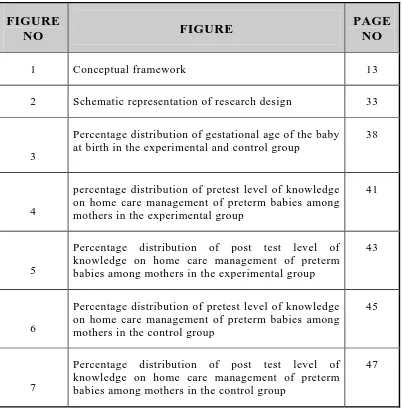
1 Conceptual framework 13
2 Schematic representation of research design 33
3
Percentage distribution of gestational age of the baby at birth in the experimental and control group
38
4
percentage distribution of pretest level of knowledge on home care management of preterm babies among mothers in the experimental group
41
5
Percentage distribution of post test level of knowledge on home care management of preterm babies among mothers in the experimental group
43
6
Percentage distribution of pretest level of knowledge on home care management of preterm babies among mothers in the control group
45
7
Percentage distribution of post test level of knowledge on home care management of preterm babies among mothers in the control group
APPENDICES
S.NO
TITLE
APPENDIX
1 Self structured Questionnaire- a)Tamil
b)English
I
2 STP II
3 Handout III
I
R
R
e
e
v
v
i
i
e
e
w
w
o
o
f
f
L
M
D
D
a
a
t
t
a
a
A
A
n
n
a
a
l
l
y
y
s
s
i
i
s
s
&
&
I
D
S
S
u
u
m
m
m
m
a
a
r
r
y
y
&
&
R
R
A
A
A
A
A
ABSTRACT
Introduction:-
Preterm babies are vulnerable to many kind of problems so home care
management of preterm babies most which includes thermoregulation, breast feeding,
immunization, umbilical cord care, growth & development & prevention of infection.
Aims:
(a) To assess the knowledge of home care management of preterm babies. (b) To
determine the video assisted teaching on home care management of video assisted
teaching or home care management of preterm babies. (c) To associate the knowledge
with demographic variables.
Methodology:
A quasi experimental study was conducted to assess the effectiveness of video
assisted teaching on home care management of preterm babies among mothers in which
pretest – posttest only design was used. Samples were selected by non probability
convenient sampling as per inclusion criteria at KKCTH at Nungambakkam and Dr.
Mehta’s hospital at chetpet and assigned as experimental & control group. The data was
collected using a self structured questionnaire by the investigator and analysed using
mean, standard deviation, paired ‘t’ test, chi- square test.
Results:
A total of 60 samples (mothers) were included in the study, out of which 27
(90%) had adequate knowledge. The calculated ‘t’ value 15. 402 shows statistically
experimental and control group and only the educational status of the mothers showed
association with the knowledge.
Conclusion:
There by the investigator concludes that the video assisted teaching o home care
management of preterm babies as an effective method for improving knowledge of
mothers. Thus it encompasses commitment by Paediatric nurse creating a wonder in
` 1
CHAPTER – I
INTRODUCTION
“A baby will make love stronger, days shorter, nights longer, bankall smaller, home happier, clothes Shabbier, the past forgotten, and the future worth living for”.
(-GeorgeCarlin. 1937) The shorter the term of pregnancy the greater the risks of mortality and morbidity for the baby. Premature – Preterm babies (“Preemies” or premmies”) have an increased risk of death in the first year of life (infant mortality) with most of that occuring in the first month of life (neonatal mortality). World wide, prematurity accounts for 10% of neonatal mortality, or around 5, 00,000 deaths per year. 25% Prematurely born infants are at greater risk for having subsequent serious chronic health problems.
Less than 37 weeks gestation, a “premature” infant is one that has not yet reached the level of fetal development that generally allows life outside the womb. Over the last 40 years the NICU care has improved,so the viability has reduced to approximately 24 weeks, although rare survivors have been documented as early as 21 weeks. Risk for preterm birth includes low BMI, poor nutritional status in diabetes, uterine malformations, and hypertension. Women with a previous preterm birth area at higher risk rate of 15-50%.
` 2
Premature babies often have problems on latching. Colostrum is the first milk which is thick, rich and concentrated.
Babies born very early may have disorganized sucking patterns and they are easily fatigued, posing breastfeeding problems. Breast milk provides many important nutrients with human milk fortifiers. When the mother is feeding breast milk, it will help to develop immunity faster. Mother should wipe the breast with boiled water before each feed which prevent infection in the preterm baby.
The umbilical cord usually falls off in 10 days to 3 weeks. Pus draining umbilicus indicates omphalitis because of the application of turmeric powder & cowdung on the umbilicus of the preterm baby.
Maturation of immune response begins with exposition to environmental antigens. Premature infants have an increased risk of experiencing infectious diseases. Premature infants must be vaccinated at 2 months of age, whatever the gestational age. Acellular pertussis vaccine and pneumococcal conjugate vaccine must be given as early as possible, at two months of age.
` 3
time growing, skills such as sitting, walking, running, and talking may develop later.
The infant is very vulnerable to infection because the skin is immature and easily traumatized, thus weakening the defense against pathogens. The baby also has a lower resistance to infection because of a white blood cell count that is lower than the term infant.
BACKGROUND OF THE STUDY
Karen M. Edmond et al., (2011)
states that Promotion of early initiation of breastfeeding has the potential to make a major contribution to the achievement of the child survival. 16% of neonatal deaths could be saved when infants were breastfed from 1st day. Breastfeeding- promotion programs should emphasize early initiation as well as exclusive breastfeedingAimin Chen and Walter J. Rogan. (2004)
states that breastfed infant in the United States have lower rates of morbidity, especially from infectious disease. Longer breastfeeding was associated with lower risk of infectious diseases. Breastfeeding is associated with a reduction in post neonatal death.` 4
and head circumferences less than the 10th percentile. Growth failure is associated with an increased risk of poor neurodevelopment outcome.
Cesar G.Victora et al., (1999)
states that in premature babies lack of breast-feeding appear to be important risk factors for childhood pneumonia, and nutritional interventions may have an effect in reducing deaths from pneumonia.S.L.Kaushik et al., (1995)
states that preterm babies accounted for 13.2% of the live births and 69.9% of neonatal deaths. The cause of neonatal deaths found were infections(23.3%), immaturity (17.8%), hypothermia (9.6%).Home care management of preterm babies includes thermoregulation, breast feeding, umbilical cord care, immunization, growth and development and prevention of infection.
NEED FOR THE STUDY
` 5
preterm babies. Infection play a major role in the genesis of preterm birth and may account for 25 – 40% of events.
Robert M.Kliegman et.al.,-(2006)
states that IUGR is the most common cause of LBW. Prematurity may be caused by spontaneous labour (50%), spontaneous rupture of membranes (25%), or premature delivery for maternal or fetal indications (25%). Immaturity and infection are common cause for death in preterm babies.Advances in Neonatal care - (2011)
states that Cold stress is morecommon cause of death in neonate. 46.6% having less than 36 °C temperature. It is essential that preterm infants should be cared in environment that prevent heat loss to improve thermoregulation.
Jay E Lawn et al., (2003)
states that KMC substantially reducesneonatal mortality amongst preterm babies (birth weight < 2000 g) in hospital, and is highly effective in reducing severe morbidity, particularly from infection.
Australian breast feeding Association (2011)
states that thekangaroo care is the method of interaction with a premature baby to increase the mother’s expressed breast milk supply by an average of 50%. The baby also shows an improved suckling ability, which is due to the stimulation of being near to mother’s breasts.
Jack Newman and Edith Kernerman (2009)
states that factors` 6
incubators, need of fortifiers, and exclusive breast milk till they attain 34 weeks of gestation.
Kelly Evens (2004)
states that natural drying is a safe and effective means of umbilical cord care in preterm infants.Aygun. C. Subatfi (2005)
states that the effect of antibiotic, phototherapy and parental nutrition affect the umbilical cord separation. But the dry cord care will not increase the risk of omphalitis in preterm babies.C.Marry Healy (2010)
states that the development of a safe and effective childhood immunization schedule has effectively reduced morbidity and mortality from vaccine-preventable diseases (VPDs). VPDs are particularly severe in young infants, especially preterm (gestational age <37 weeks) or low birth weight (<2,500 g) infants. Studies demonstrate that vaccines are safe and immunogenic in preterm infants.The children’s Hospital of Philadelphia- (2010)
states thatvaccines should be given according to a baby’s chronologic age. At 2-month babies require vaccination against diphtheria, tetanus, pretussis, polio, haemophilus influenza type b, pneumococcus, and rotavirus.
` 7
The investigator felt that there is inadequate knowledge for mothers of preterm babies at home. Because of false beliefs and unhygienic practices the preterm is prone to many diseases. So the investigator was interested in conducting a study for improving the knowledge of mothers on home care management of preterm babies.
STATEMENT OF THE PROBLEM
“A quasi experimental study to assess the effectiveness of Video Assisted Teaching on home care management of preterm babies among mothers in selected hospitals at Chennai.”
OBJECTIVES
1) To assess the level of knowledge on home care management of preterm babies before video assisted teaching in experimental and control group
2) To determine the effectiveness of video assisted teaching on home care management of preterm babies in experimental group.
3) To find out the association between the level of post test knowledge
scores on homecare management of preterm babies with selected demographic variables between experimental group.
HYPOTHESIS
` 8
2) There is significance association between post test level of knowledge in experimental and control group with the selected demographic variables.
OPERATIONAL DEFINITIONS
1)
Effectiveness:
It refers to the outcome of video assisted teaching interms of home care management of preterm babies.
2)
Video Assisted Teaching:
The teaching material designed to impartknowledge regarding home care management of preterm babies
3)
Home care Management:
It includes thermo regulation, breastfeeding, umbilical cord care, immunization, growth and development and prevention of infection to preterm babies.
4)
Preterm babies:
A baby born before 37 completed weeks ofgestation.
5)
Mother:
The mother who delivered the baby less than 37weeks ofgestation.
ASSUMPTIONS
The study assumes that:
1) The mothers of preterm babies have inadequate knowledge regarding home care management of preterm babies.
` 9
3) The knowledge of the mothers of preterm babies is influenced by their demographic variable like, birth weight, gestational age of the baby at birth and order of preterm baby, age, educational status, type of family, income, occupation, place of residence, previous exposure to care of preterm babies.
LIMITATIONS
The study is limited to:-
1) Data collection period is limited to six weeks. 2) Sample size is limited to 30.
PROJECTED OUT COME
1) The results of this study will help the mothers of preterm babies to gain adequate knowledge in home care management of preterm babies & produce healthy infants to the world.
2) The video assisted teaching programme will be the most beneficial to mothers in caring preterm babies, improving skills in maintaining thermoregulation, breast feeding, immunization, umbilical cord care, growth and development and prevention of infection.
HUMAN RIGHTS PROTECTION
1) Ethical clearance was obtained to conduct the study from ethical committee.
` 10
CONCEPTUAL FRAMEWORK
The conceptual framework selected for this study is based upon the general systems theory developed by Von Ludwig bertalanfy (1968).
According to general system theory a system is a set of components or units interacting with each other within a boundary that filter the kind and the safe of blow of inputs and outputs to and from the system.
Systems can be open or closed. Open system are open for exchanges of matter, energy and information with their environment from which the system recover input & gives back output in the from of matter, energy and information.
Systems theory is concerned with the changes due to interaction between the various factors in a situation. The 5 components of system theory is
Input
Throughput
Output
Evaluation and
Feed back.
INPUT
` 11
knowledge of mother on home care management of preterm babies that includes thermo regulatation, breast feeding , umbilical cord care, immunization, growth and development and prevention of infection
THROUGHPUT
It is a process that allows the input to be charged so that it is useful to the system. In the study the throughput is providing information through video assisted teaching on home care management (thermoregulation, breast feeding, and umbilical cord care, immunization, growth and development and prevention of infection) to the mothers of preterm babies.
OUTPUT
It is any information, energy and material that leave the system and enters the environment through system boundaries. It is varying widely depending on the type and purpose of the system and effectiveness of actual input. In this study, the output is giving post test given to mothers of preterm babies on home care management of preterm babies.
EVALUATION
` 12
FEEDBACK
` 13
fig.1: Conceptual frame work – modified Ludwig von bertalanfy general system theory
INPUT
THROUGHPUT
OUTPUT
EVALUATION
DEMOGRAPHIC VARIABLES Birth weight, Gestational age of the baby,
Order of preterm , Age of the mother, Education of the mother,
Occupation, Type of family, Family income, Place of residence,
Pretest On, Assesment of knowledge on homecare, management of preterm babies among mothers.
VIDEO
ASSISTED
TEACHING ON
Thermo
regulation
Breast feeding
Umbilical cord
care
Immunization
Growth &
development
Prevention of
infection.
POST TEST ON
` 14
CHAPTER-II
REVIEW OF LITERATURE
Review of literature is one of the major content of the research study. A literature review in the present study was not documented on a bigger scale. However, an attempt made to bring out the available literature related to research process.
REVIEW OF LITERATURE CONTAINS TWO PARTS
Part 1:- Literature related to the home care management of preterm babies.
Part 2:- Studies related to preterm care
PART-1: LITERATURE RELATED TO THE HOME CARE
MANAGEMENT OF PRETERM BABIES.
Part-1:- The delivery of a baby prior to full term is called preterm baby. A birth is generally considered premature if it occurs more than three weeks before the due date but after the period of viability (20 weeks or 500g). A premature birth reduces the amount of time to survive. So a proper home care management is need to take care of the preterm baby.
` 15
THERMOREGULATION
Kangaroo care
Kangaroo care is offered to a stable premature baby, usually few hours a day, and sometimes for much longer period of time. It is called skin-to-skin contact. The baby, wearing only a nappy and a hat, is placed against the mother’s skin underneath her clothing, as it has unrestricted access to the mothers breasts. A baby cared for in this way maintains its body temperature, conserves energy (because these babies cry less & sleep more), and can often begin breast feeding much earlier than a baby cared for in the traditional manner. Father can also be involved in kangaroo care by this skin-to-skin contact with their premature baby.
Mummifying the baby
Mummifying the baby promote warmth a wet diaper causes hypothermia and urinary tract infection.
Bath
Long term exposure of preterm baby during bath leads to chills. Sponge bath can be given daily until;
The umbilical cord falls of (10 days to 3 weeks)
The circumcision heals (1-2weeks)
The naval heals completely (1-4weeks).
Complications of hypothermia
` 16
Hypoxia.
Weight loss.
Metabolic acidosis.
Peripheral vasoconstriction.
CNS depression.
Potential cold stress (36°C - 36.5°C)
Temperatures more than 37.5°C may lead to vasodilatation, tachycardia, lethargy & apnea.
BREAST FEEDING
Feeding is an important aspect in life. It must meet the psychological, nutritional and emotional needs of the preterm baby. Human milk is the best milk for feeding preterm babies. Breast feeding should be recommended for the first 6 months to 12 month.
Advantages of breast milk
Colostrum consist of more antibodies, proteins and immunoglobulin that protects against infection.
Breast milk protect against gastroenteritis.
Breast milk fed babies have less chances of allergy.
It is available at right temperature.
` 17
It is readymade, fresh and pure requiring no preparations.
It is economic and inexpensive to the individual, family and community.
Helps to establish mother child relationship.
Helps the mother as a temporary family planning measure.
Duration of breast feeding
Generally, babies need to eat 8 to 12 times within 24-hour period,
The mother should feed the baby immediately the baby wakes upon.
The mother should give a demand feeding.
Urination for more than six times perday, weight gain and good sleeping indicates the adequacy of breast milk supply.
Expressed breast milk
Expressed breast milk can be spoonfed to the baby if the baby is having low sucking and swallowing reflex.
` 18
Burping
Babies often swallow air during feeding, which can make them furry. It can be prevented by burping baby.
The mother should burp the baby every 2-3 hours and each time after feeding.
Positions for breast feeding
Cradle position
Pillow two should be placed in mothers lap to support baby so its head is with the mother’s nipple. Head resting on the mother’s forearm near the elbow and hand holding the bottom. The mother uses the opposite hand to support the breast.
Cross-cradle position
Raise baby’s head up with the nipple. The hand closest to head supports the breast in a U shape. The opposite hand supports baby’s neck; the fingers and thumb make a “hammock” for baby’s ears and neck, mothers palm rests between his shoulder blades.
Foot ball / Clutch position
A pillow placed at the side of the mother to support mothers arm and the baby. Baby’s bottom rests on the pillow, and legs are tucked up, so the baby can’t push off of the back of the chair while the mother nurse. .
` 19
Side-lying
The mother should lie on the side with a pillow on her back.
Vary position
Changing positions will help the mother to build the best milk supply
& will help avoid clogged ducts & sore nipples.
IMMUNIZATION
Polio, measles, pestussis, diphtheria, tuberculosis & tetanus are diseases preventable by vaccine.
(AAP-2011)According to the standard schedule created by the American academy of pediatrics and other medical organizations worried that whether the recommendation were made with full term , normal weight babies in mind and whether the same guidelines apply to preterm’s.
The hepatitis B vaccine should be given in the first hours or days of life. But if the baby weighs less than 2.2pounds(2000 grams) at birth, the paediatrician should decide to charge the timetable for the hepatitis B vaccine.
UMBILICAL CORD CARE
The preterm babies naval area should not be submerged in water until the cord stump falls off and the area is healed. The cord stump will change colour from yellow to brown or black.
` 20
GROWTH AND DEVELOPMENT
Bonding, is one of the pleasurable aspects of infant care. Bonding and soothing technique promotes intelligence, physical and psychological growth.
Preterm babies mostly affected with attention deficit hyperactive disorder.
Intrauterine growth restriction may be very important in terms of early growth of the brain, leading to poor IQ and developmental skill
Milestones of premature babies:-
1 Month : Makes fists.
3 Month : Imitates sounds.
7Month : Sits up, responds to name.
1st year : crawls, says “mama”
2nd year : walks, uses simple phrases.
PREVENTION OF INFECTION
Restriction of Visitors
Restrict visitors from meeting the preterm child until it is two or three month old.
Hygiene
` 21
Sterilization
All feeding equipment should be well sterilized before use. The feeding equipment should be boiled for 15-20min in boiled water. The feeding bottle and breast pump should be sterilized under boiling water.
PART-II: STUDIES RELATED TO MANAGEMENT OF
PRETERM CARE
Waiswa.P, et al., (2010)
reported about perceptions and care ofpreterm babies in eastern Uganda. Community members and community health workers accepted for skin-to-skin contact. The gaps in the community care is largely influenced by beliefs, perceptions & lack of awareness.
Lawn.JE. et al., (2010)
reported about KMC to prevent neonataldeaths due to preterm birth complications. The study states hat KMC reduces neonatal mortality amongst preterm babies (birth weight less than 2000g) in hospital, & is highly effective in reducing severe morbidity, particularly from infections.
Suman.R.P, et al., (2008)
reported about KMC for low birth weightinfant . In low birth weight babies KMC reduces morbidities and improves growth. It can be continued by the mothers at home.
Ogunlesi.T.A, et al., (2008)
reported about admission on` 22
Ramanathan.K.et al., (2001)
reported about KMC in very LBW babies. The babies managed under KMC had gained better weight, earlier hospital discharge & higher exclusive breast-feeding rates. Kangaroo mother care is an adjunct to the routine preterm care in nursery.Wagener.S. et al., (2009)
reported about premature babies receiving fortified expressed breast milk. The milk curd obstruction should be considered in all premature infants with signs of bowel obstruction who were fed expressed breast milk with caloric fortification.Ogechi.A.A, et al., (2007)
reported about weight gain by hind milk in preterm and low birth weight babies. The hind milk had a higher rate in improving weight gain compared with those babies fed with composite milk. The duration of hospital stay of preterm low birth weight babies shortened because of the predominant use of hind milk.Walker.M. (2008)
reported about breast feeding to the late preterm infant. Late preterm will have disadvantages of feeding skills, stamina, risk to get hypoglycemia, hyperbilirubinemia and slow weight gain. Breast feeding of these babies are frustrating & difficult .Breast feeding management guidelines for late preterm infants will be beneficial.Elliott.S.Reimer.C.(2006)
reported about post discharge telephone follow-up program for breast feeding preterm infants is beneficial one after discharging them from a special care nursery` 23
longer. Antenatal corticosteroid & antibiotic use did not affect umbilical cord detachment time. Cord separation delayed in preterm babies because of the use of phototherapy, parenteral nutrition and postpartum antibiotics. Among these the most effective factor is antibiotic treatment. The risk of omphalitis is not increased by dry cord care in NICU patients.
Tavares.E.C, et al., (2005)
reported about active & passiveimmunization in the extremely preterm infant. As the BCG vaccination, the tendency to maintain the same active immunization program as like babies born full term, irrespective of gestational age & weight at birth. Passive immunization merits special attention, with more liberal indications in this type of newborn babies.
Sood.A, et al., (2002)
reported about Hepatitis B vaccine response inpreterm babies. The birth weight of the baby had no independent influence on the antibody response. But the gestational age of the baby influence the antibody response.Hence, it is advisable to check antibody titers in preterm babies one month after the third dose of hepatitis B vaccine to assess the need for booster dose.
Amess.P, et al., (2010)
reported about developmental outcome of` 24
Clarke.P. (2010) reported about vitamin k Prophylaxis for preterm infants .As vitamin k the most common ‘drug’ administered to babies born in the western countries. For the past many decades vit K prophylaxis has been a routine treatment at birth for preterm babies. Current regimens of prophylaxis used for preterm infants vary widely in terms of dose, route of administration, and formulations used.
Bertino.E, et al., (2010)
reported about postnatal growth of pretermbabies with reference charts. At present in clinical practice the available charts are fetal growth charts, neonatal anthropometric charts and postnatal growth charts. In Italy new Italian Neonatal study charts up to term, International longitudinal charts WHO 2006 or CDC 2002 from term to two years: & then the Italian society for paediatric endocrinology & diabetes 2006 growth charts are suitable for monitoring the growth of preterm babies from 2 years to 20 years of age.
Johnson.S, et al., (2005)
reported about parental support for familieswith preterm children. The study indicates that the preterm babies have poorer cognitive, behavioral and motor functions at 5 years compared to their term peers.
Ganesan.K, et al., (2009)
reported about the oral nystatinprophylactic administration for preterm infant under 33weeks of gestation decreases invasive fungaemia and fungal colonization.
Nuijlen.M.J, et al., (2007)
reported about cost effectiveness of` 25
` 26
CHAPTER-III
RESEARCH METHODOLOGY
This chapter provides a brief description of the method adopted by the investigator to assess the effectiveness of video assisted teaching on home care management of preterm babies among mothers in selected hospitals at Chennai.
RESEARCH APPROACH
Quantitative approach
RESEARCH DESIGN
The research design is the over all plan for obtaining answers to the questions being studied and for handling various challenges to the worth of the study evidence.
In this study quasi experimental pretest - post test research design was used.
SETTING OF THE STUDY
The investigator conducted the study in NICU:-
` 27
2) Dr.Mehta’s hospital is situated 6 km away from MSAJ College of Nursing. The total bed strength of the hospital is 200. Facilities available are clinical lab, radiology, USG, labour room, OT. The NICU contains totally 30beds. The total bed strength of the preterm baby is 9. Monthly census of preterm babies is 20-30 babies.
3) Both the NICU has the facilities of ventilator, incubator, warmer, pulseoxymeter, suction apparatus.
This study was conducted among the mothers of preterm babies (born 32 - 37 weeks of gestation). The mothers were from christian, hindu and muslim religions.
POPULATION
All the mothers of preterm babies admitted in NICU of KKCTH and Dr.Metha hospital were the population of this study
SAMPLES
The total size of the study was 60 samples. Out of 60 samples; 30 mothers from KKCTH as experimental group & 30 mothers from Dr.Mehta hospital as control group.
SAMPLING TECHNIQUE
The investigator used non-probability convenient sampling technique for this study.
METHOD OF SAMPLE SELECTION
` 28
sampling technique. Each day three mothers of preterm babies who fulfilled the inclusion criteria were selected for the study.
CRITERIA FOR SAMPLE SELECTION
Inclusion Criteria
1) Mothers of preterm babies who were admitted in the NICU of the KKCTH and Dr.Mehta’s Hospital.
2) Mothers who can converse in English or Tamil.
Exclusion Criteria
1) Mentally disturbed mothers. 2) Care givers
3) Mothers who have previous knowledge about care of preterm babies. 4) Mothers who are not willing to participate.
5) Surrogate mothers
6) Mothers with post partum psychosis.
DESCRIPTION OF INSTRUMENT
A self structured questionnaire was used to assess the level of knowledge of mothers with preterm babies.
The research instrument consists of two sections.
` 29
Part- A:
Preterm baby consists of age of the baby, weight of the baby & order of the birth.Part-B:
Mother consists of age of the mother, educational status of the mother, occupation, income of the family, type of family, place of residence and previous knowledge of mothers about home care management of preterm babiesSection 2:
Assessment of knowledge was done by using self structured questionnaire which consist of thirty questions. The questions were related to thermoregulation, breast feeding, umbilical cord care, immunization, growth and development and prevention of infection.THE TOOL AND SCORE INTERPRETATION
The self structured questionnaire consist of thirty multiple choice questions which has six components. The correct answers were given a score of ‘one’ and the wrong answers were marked as ‘zero’. Data collection was done by using interview technique. Content validity was obtained from medical and nursing experts.
The scores were interpreted as follows:-
<50% Inadequate Knowledge
` 30
VALIDITY AND RELIABILITY
Based on the review of literature and expert guidance the self structured questionnaire was developed by the investigator.
For the content validity the tool was evaluated by the experts. By the test retest method the reliability of the instrument was established. In the test retest method positive significant was there {r=1}, that shows tool is highly reliable.
PILOT STUDY
Pilot study was conducted in KKCTH at Nungambakkam and Dr.Mehta’s hospital at chetpet for a period of seven days from 7/3/2011 to 21/3/2011. The study was conducted among six mothers of preterm babies. Three mothers from KKTCH selected as experimental group and three mothers from Dr.Mehta’s hospital as control group, who fulfilled the inclusion criteria, by using convenience sampling technique. Approximately 35-40 minutes were spent to collect data from each mother. Pretest was conducted, following that video assisted teaching program was given to the experimental group. Pretest was conducted but intervention not given to the control group. At that fifth day post test was conducted to both experimental and control group. Pamphlets containing home care management of preterm babies were distributed. The content validity was obtained from expert professors of college of nursing and consultant neonatologist.
` 31
1) In the demographic data the previous knowledge of mothers about homecare management of preterm babies was included.
2) In questions No. 6 -all of the above changed in to minerals & question No. 26 -all of the above changed in to muscle growth.
DATA COLLECTION PROCEDURE
The objectives of the study were explained to nursing personnel. Data was collected for a period of 20-30 minutes. The main study was conducted from 04.06.2011 to 15.07.2011. To collect data a convenience sampling technique was used. Among 60 mothers of preterm babies, 30 from KKCTH and 30 from Dr.Mehta’s hospital, who fulfill the inclusion criteria were selected for this study. Every day five mothers were selected for data collection. For each mother approximately 35 – 40 minutes spent to collect the data. A video assisted teaching programme was given for 30 minutes by using laptop in the mothers room. Comfortable seats were provided for the mothers to observe the video assisted teaching programme. Seventh day post test was conducted. At the end of the post test pamphlets on home care management of preterm babies were distributed to both experimental and control group. Twenty minutes was allotted for discussion. All the mothers of preterm babies were interested & co-operated well.
PLAN FOR DATA ANALYSIS
The responses were tabulated and each item was scored after pretest and post test.
` 32
DATA ANALYSIS AND STATISTICAL METHOD USED
Data was collected, tabulated and analyzed using statistical methods such as numbers, percentage, mean, standard deviation, paired ‘t’ test, student ‘t’ test and chi-square test.
S.
No. Objectives Statistical Methods
1. To assess the level of knowledge in mothers of preterm babies on home care management.
Descriptive Statistics - Numbers, Percentage, Mean and standard deviation.
2. To evaluate the effectiveness between pre and post test knowledge in experimental and control group
Inferential statistics - Paired ‘t’ test, student ‘t’ test
To analysis association between level of knowledge and demographic variables.
Inferential statistics - Chi-Square test
` 33
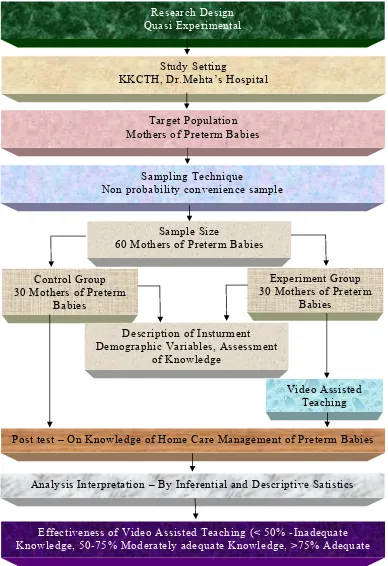
FIG-2: SCHEMATIC REPRESENTATION OF
RESEARCH DESIGN
Research Design Quasi Experimental
Study Setting
KKCTH, Dr.Mehta’s Hospital Target Population Mothers of Preterm Babies
Sampling Technique
Non probability convenience sample
Control Group 30 Mothers of Preterm
Babies
Experiment Group 30 Mothers of Preterm
Babies
Video Assisted Teaching Post test – On Knowledge of Home Care Management of Preterm Babies
Analysis Interpretation – By Inferential and Descriptive Satistics
Effectiveness of Video Assisted Teaching (< 50% -Inadequate Knowledge, 50-75% Moderately adequate Knowledge, >75% Adequate
Sample Size
60 Mothers of Preterm Babies
Description of Insturment Demographic Variables, Assessment
` 34
CHAPTER – IV
DATA ANALYSIS AND INTERPRETATION
This chapter deals with the data analysis and interpretation to assess the effectiveness of video assisted teaching on home care management of preterm babies among mothers in selected hospitals at Chennai.
Descriptive and inferential statistics were used for the analysis of the data. According to the study objectives the interpretation has been tabulated and organized as follows:
ORGANIZATION OF DATA
Section-A:
Description of demographic variables of mothers of pretermbabies in the experimental and control group.
Section-B:
Assessment of pre and post test level of knowledge on homecare management of preterm babies among mothers in the experimental and control group.
Section-C:
Comparison of effectiveness of video assisted teaching onhome care management of preterm babies among mothers in the experimental and control group.
Section-D:
Association between the post test level of knowledge score` 35
SECTION-A
Table-1: Frequency and percentage distribution of demographic
variables of mothers of preterm babies in the experimental and control
group.
N = (30)
S.
No Demographic Variables
Experimental Group
Control Group No.
n=30 %
No.
n=30 %
1. Birth Weight
2kg-2.5kg 19 63.33 18 60.00 1kg-2kg 11 36.67 12 40.00 2. Gestational age of the baby at
birth 32 - 35 weeks 12 40.00 11 36.67 36 - 37 weeks 18 60.00 19 63.33 3. Order of Preterm
First 30 100.00 26 86.67 Second 0 0.00 4 13.33 Third and above 0 0.00 0 0.00
4. Age of mother in years
<20 yrs 5 16.67 1 3.33 21 - 30 yrs 23 76.67 21 70.00
>30 yrs 2 6.66 8 26.67 5. Educational Status of the mother
` 36
S.
No Demographic Variables
Experimental Group
Control Group No.
n=30 %
No.
n=30 %
Homemaker 13 43.33 16 53.33 Employed 17 56.67 14 46.67 7. Type of family
Joint family 9 30.00 11 36.67 Nuclear family 21 70.00 19 63.33 8. Family Income
<Rs.3000 0 0.00 0 0.00 Rs.3000 – 5000 0 0.00 0 0.00
>Rs.5000 30 100.0
0 30
100.0 0 9. Place of residence
Rural 10 33.33 4 13.33 Urban 20 66.67 26 86.67 Semi urban 0 0.00 0 0.00 10
. Previous exposure
Yes 0 0.00 1 3.33 No 30
100.0
` 37
experimental group whereas in the control group majority 19(63.33%) were between 36 – 37 weeks.
Considering the order of preterm babies in the experimental group, almost all 30(100%) were of first order and in the control group, majority 26(86.67%) were of first order of birth. The age of mothers in the experimental group, majority 23(76.67%) were in the age group of 21 – 30 yrs and in the control group, majority 21(70%) were in the age group of 21 – 30 yrs. On considering the educational status of the mother in the experimental group, majority 15(50%) had higher secondary education whereas in the control group, majority 18(60%) were graduates.
With Regard to occupation of the mother in the experimental group, majority 17(56.67%) were employed whereas in the control group, majority 16(53.33%) were homemakers. With regard to type of family in the experimental group, majority 21(70%) were from nuclear family and in the control group also majority 19(63.33%) were from nuclear family. Regarding the family income of the mothers, almost all 30 (100%) were earning >Rs.5,000 both in the experimental and control group. Regarding the place of residence, mothers in the experimental group and control group majority are from urban area.
0 10 20 30 40 50 60 70 80P e r c e n t a g e 0 0 0 0 0 0 0 0 0 P Fig.3: P
32 - 35 week 40 ercentage dis Ex Co ks 36.6 Ges
stribution of g
xperimental Gro ontrol Group ` 39
36 67 stational Age gestational ag and control oup
6 - 37 weeks 6
of the Baby
ge of the baby group
60
y at birth in th 63.33
` 40
[image:65.612.105.509.176.503.2]SECTION B
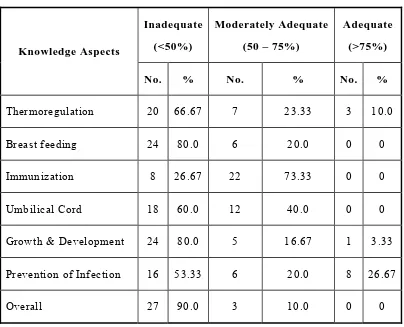
Table-2: Frequency and percentage distribution of pretest level of
knowledge on home care management of preterm babies among
mothers in the experimental group.
n = 30
Knowledge Aspects
Inadequate (<50%)
Moderately Adequate (50 – 75%)
Adequate (>75%)
No. % No. % No. %
Thermoregulation 20 66.67 7 23.33 3 10.0 Breast feeding 24 80.0 6 20.0 0 0
Immunization 8 26.67 22 73.33 0 0 Umbilical Cord 18 60.0 12 40.0 0 0
Growth & Development 24 80.0 5 16.67 1 3.33 Prevention of Infection 16 53.33 6 20.0 8 26.67
Overall 27 90.0 3 10.0 0 0 The table 2 depicts the frequency and percentage distribution of pretest
level of various aspects of knowledge on home care management of preterm babies among mothers in the experimental group. With regard to thermoregulation, majority 20(66.67%) had inadequate knowledge on home care management of preterm babies.
` 41
1 2 3 4 5 6 7 8 9 10 P e r c e n t a g e 0 0 20 30 40 50 60 70 80 90 00 Ina 66.67 80 Fig.4: adequate (<50%) 26.67 60 Percentage distr M 23 80 53.33
ribution of pretes
` 42 Moderately Adequ 3.33 20 73.33
Level of Kno
st level of knowle mothers in the e
uate (50 - 75%) 40
16.67 20
owledge
edge on home ca experimental grou
Ade 10
0
re management o up
equate (>75%) 0
0
3.3
of preterm babies Thermo Breast f Immuni Umbilic Growth Prevent 3 26.67 s among oregulation feeding ization cal cord
h & development
` 43
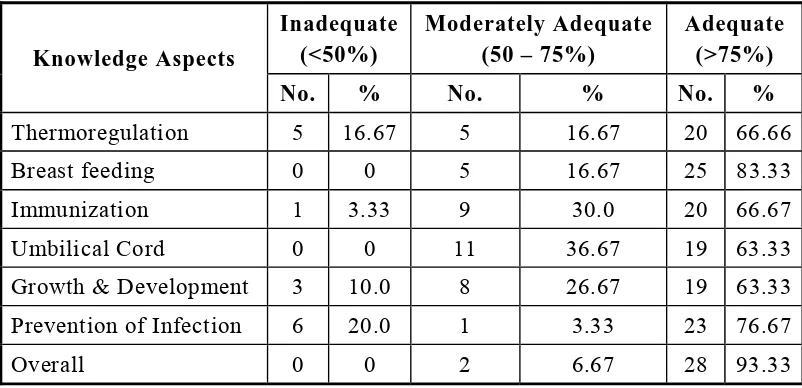
Table-3 : Frequency and percentage distribution of post test level of
knowledge on home care management of preterm babies among
mothers in the experimental group.
n = 30
Knowledge Aspects
Inadequate (<50%)
Moderately Adequate (50 – 75%)
Adequate (>75%)
No. % No. % No. %
Thermoregulation 5 16.67 5 16.67 20 66.66 Breast feeding 0 0 5 16.67 25 83.33 Immunization 1 3.33 9 30.0 20 66.67 Umbilical Cord 0 0 11 36.67 19 63.33 Growth & Development 3 10.0 8 26.67 19 63.33 Prevention of Infection 6 20.0 1 3.33 23 76.67
Overall 0 0 2 6.67 28 93.33 The table 3 depicts the frequency and percentage distribution of post
test level of various aspects of knowledge on home care management of preterm babies among mothers in the experimental group. Regarding thermoregulation, majority 20(66.67%) had adequate knowledge, in breastfeeding, majority 25(83.33%) had adequate knowledge. Considering the knowledge on immunization, majority 20(66.67%) had adequate knowledge in the post test.
1 2 3 4 5 6 7 8 9 10 P e r c e n t a g e 0 0 0 0 0 0 0 0 0 0 0 Ina 16.67 0 Fig.5: P adequate (<50%) 3.33 0 Percentage distri M 16 10 20
ibution of post te Therm Breas Immu Umbil Growt Preve ` 44 oderately Adequ 6.67 16.67 30 3
Level of Kno
est level of knowl mothers in the e moregulation
st feeding
nization lical cord
th & development
ention of infecton
uate (50 - 75%) 36.67
26.67
3.33
owledge
ledge on home ca experimental grou Ade 66.67 83.3 are management up equate (>75%) 33 66.67 63.33 63.3
t of preterm babie 3
76.67
` 45
Table-4: Frequency and percentage distribution of pretest level of
knowledge on home care management of preterm babies among
mothers in the control group.
n = 30
Knowledge Aspects
Inadequate (<50%)
Moderately Adequate (50 – 75%)
Adequate (>75%)
No. % No. % No. %
Thermoregulation 25 83.33 2 6.67 3 10.0 Breast feeding 25 83.33 4 13.33 1 3.34
Immunization 17 56.67 6 20.0 7 23.33 Umbilical Cord 18 60.0 12 40.0 0 0 Growth & Development 23 76.67 3 10.0 4 13.33 Prevention of Infection 16 53.33 4 13.34 10 33.33
Overall 27 90.0 2 6.67 1 3.33 The table 4 depicts the frequency and percentage distribution of pretest
level of various aspects of knowledge on home care management of preterm babies among mothers in the control group. With regard to thermoregulation, majority 25(83.33%) had inadequate knowledge, in breastfeeding, majority 25(83.33%) had inadequate knowledge.
Considering the knowledge on immunization, majority 17(56.67%) had inadequate knowledge.
1 2 3 4 5 6 7 8 9 10 P e r c e n t a g e 0 0 0 0 0 0 0 0 0 0 0 Ina 83.33 8 Fig.6 adequate (<50%) 83.33 56.67 60 7
6: Percentage di
) M
76.67
53.33
stribution of pre
` 46 Moderately Adeq 6.67 13.33 20
Level of Kno
etest level of know mothers in
quate (50 - 75%) 40
10 13.3
owledge
wledge on home n the control gro
A 10
3 33
e care manageme oup Adequate (>75%) 3.33 23.33 0 13.3
ent of preterm ba Therm Breas Immu Umbi Grow Preve 33 33.33 abies among moregulation st feeding unization ilical cord
wth & developmen
ention of infection nt
[image:71.612.86.724.134.424.2]` 47
Table-5:Frequency and percentage distribution of post test level of
knowledge on home care management of preterm babies among
mothers in the control group.
n = 30
Knowledge Aspects
Inadequate (<50%)
Moderately Adequate (50 – 75%)
Adequate (>75%)
No. % No. % No. %
Thermoregulation 21 70.0 6 20.0 3 10.0 Breast feeding 27 90.0 3 10.0 0 0
Immunization 22 73.33 6 20.0 2 6.67 Umbilical Cord 23 76.67 5 16.66 2 6.67
Growth & Development 24 80.0 4 13.33 2 6.67 Prevention of Infection 11 36.67 7 23.33 12 40.0
Overall 27 90.0 2 6.67 1 3.33 The table 5 depicts the frequency and percentage distribution of post
test level of various aspects of knowledge on home care management of preterm babies among mothers in the control group. Regarding
thermoregulation, majority 21(70.0%) had inadequate knowledge, in breastfeeding, majority 27(90.0%) had inadequate knowledge. Considering the knowledge on immunization, majority 22(73.33%) had inadequate knowledge in the post test.
1 2 3 4 5 6 7 8 9 10 P e r c e n t a g e 0 0 0 0 0 0 0 0 0 0 0 Ina 70 Fig.7: P adequate (<50%) 90 73.33 76.67 Percentage distri M 80 36.67
ibution of post te
` 48 oderately Adequ 20 10 20
Level of Kno
est level of knowl mothers in th
uate (50 - 75%) 16.67
13.33 23.33
owledge
ledge on home ca he control group
Ade 10 0 are management equate (>75%) 6.67 6.67 6.67
t of preterm babie Thermo Breast f Immuniz Umbilica Growth Prevent 7 40 es among regulation feeding zation al cord & development
`
49
Table-6: Mean and standard deviation of overall knowledge in the experimental
group.
n = 30
Knowledge Aspects
Pretest Post
Test
Mean S.D Mean S.D
Thermoregulation
1.73 1.34 3.90 1.30
Breast feeding
3.40
2.14
10.97
1.45
Immunization
2.10 0.96 3.50 0.90
Umbilical Cord
1.20 1.06 3.47 0.78
Growth
&
Development
1.03 0.72 2.53 0.68
Prevention of Infection
0.73 0.87 1.57 0.82
Overall
10.20 3.71 25.93 2.63
The table 6 depicts the mean and standard deviation of pretest and post test level
of knowledge in the experimental group.
Thermoregulation
In the pretest, mean score was 1.73 with S.D 1.34 and in the post test the mean
score was 3.90 with S.D 1.30.
Breast Feeding
In the pretest, mean score was 3.40 with S.D 2.14 and in the post test the mean
score was 10.97 with S.D 1.45.
Immunization
In the pretest, mean score was 2.10 with S.D 0.96 and in the post test the mean
`
50
Umbilical Cord
In the pretest, mean score was 1.20 with S.D 1.06 and in the post test the mean
score was 3.47 with S.D 0.78.
Growth and Development
In the pretest, mean score was 1.03 with S.D 0.72 and in the post test the mean
score was 2.53 with S.D 0.68.
Prevention of Infection
In the pretest, mean score was 0.73 with S.D 0.87 and in the post test the mean
score was 1.57 with S.D 0.82.
The overall analysis shows that the pretest mean score was 10.20 with S.D 3.71
and the post mean score was 25.93 with S.D 2.63. The mean value in post test 25.93
reveals that the mothers gained adequate knowledge in thermo regulation,
breastfeeding, immunization, umbilical cord care, growth and development, prevention
`
51
Table-7: Mean and standard deviation of overall knowledge in the control
group.
n = 30
Knowledge Aspects
Existing Post
Test
Mean S.D Mean S.D
Thermoregulation 1.20
1.47
1.70
1.37
Breast feeding
3.47
2.61
3.63
1.67
Immunization 1.50
1.59
1.07
1.26
Umbilical Cord
1.27 0.94
1.10 1.03
Growth & Development
1.03
1.00
0.93
0.87
Prevention of Infection
0.80
0.92
1.03
0.89
Overall 9.27
4.24
9.47
4.18
The table 7 depicts the mean and standard deviation of pretest and post test level
of knowledge in the control group.
Thermoregulation
In the pretest, mean score was 1.20 with S.D 1.47 and in the post test the mean
score was 1.70 with S.D 1.37.
Breast Feeding
In the pretest, mean score was 3.47 with S.D 2.61 and in the post test the mean
score was 3.63 with S.D 1.67.
Immunization
In the pretest, mean score was 1.50 with S.D 1.59 and in the post test the mean
`
52
Umbilical Cord
In the pretest, mean score was 1.27 with S.D 0.94 and in the post test the mean
score was 1.10 with S.D 1.03.
Growth and Development
In the pretest, mean score was 1.03 with S.D 1.00 and in the post test the mean
score was 0.93 with S.D 0.87.
Prevention of Infection
In the pretest, mean score was 0.80 with S.D 0.92 and in the post test the mean
score was 1.03 with S.D 0.89.
The overall analysis shows that the pretest mean score was 9.27 with S.D 4.24
and the post mean score was 9.47 with S.D 4.18. The mean value in post test score 9.47
`
53
[image:78.612.67.549.175.286.2]SECTION C
Table-8 : Over all mean score of overall knowledge on home care management
of preterm babies among mothers in the experimental group.
n = 30
Knowledge Mean
S.D
‘t’
Value
Pretest 10.20
3.71
15.402***
p = 0.000 (S)
Post Test
25.93
2.63
***p<0.001, S - Significant
The table 8 shows that the pretest mean score was 10.20 with S.D 3.71 and the
post test mean score was 25.93 with S.D 2.63. The calculated ‘t’ value of 15.402 was
found to be statistically highly significant at p<0.001 level. This implies that the video
assisted teaching on home care management of preterm babies given to mothers in the
experimental group had significant improvement in their knowledge. increased in the.
Since, the obtained “t” value was higher than the table value, the above findings
`
54
Table-9: Comparison of over all knowledge on home care management of
preterm
babies among mothers in the control group.
n = 30
Knowledge Mean
S.D
‘t’
Value
Pretest 9.27
4.24
-1.989
p = 0.056, (N.S)
Post Test
9.47
4.18
N.S – Not Significant
The table 9 depicts that the pretest mean score of knowledge was 9.27 with SD
4.24 and the post test mean score was 9.47 with S.D 4.18. The calculated ‘t’ value of
-1.989 was not found to be statistically significant. This implies that there is no
`
55
Table-10: Comparison of post test level of knowledge on home care
management of preterm babies among mothers between the experimental and
control group.
N = 60
Group
Mean
S.D
Unpaired ‘t’ Value
Experimental Group
25.93
2.63
18.262***
p = 0.000, (S)
Control Group
9.47
4.18
***p<0.001, S – Significant
The table 10 depicts that in the experimental group the post test mean score of
knowledge was 25.93 with S.D 2.63 and in the control group the post test mean score
was 9.47 with S.D 4.18. The calculated ‘t’ value of 18.262 was found to be statistically
highly significant at p<0.001 level. This shows that the video assisted teaching on home
care management of preterm babies given to mothers in the experimental group had
`
56
[image:81.612.71.548.191.709.2]SECTION D
Table-11: Association of post test level of knowledge on home care management
of preterm babies among mothers with their demographic variables in the
experimental group.
n = 30
S.
No
Demographic
Variables
Inadequate
(<50%)
Moderately
Adequate
(50 – 75%)
Adequate
(>75%)
Chi-Square
Value
No. % No. % No. %
1, Birth
Weight
χ
2=
1.241
d.f = 1
p =
0.265
N.S
2kg-2.5kg
- - 2 6.7
17
56.7
1kg-2kg
- - 0 0 11
36.7
2. Gestational
age of the
baby at birth
χ
2
=
1.429
d.f = 1
p =
0.232
N.S
32 - 35 weeks
-
-
0
0
12 40.0
36 - 37 weeks
-
-
2
6.7
16 53.3
3. Order
of
Preterm
-
First
- - 2 6.7
28
93.3
Second
- - - - - -
Third and above
-
-
-
-
-
-
4.
Age of mother in years
χ
2=
0.852
d.f = 2
p =
0.722
N.S
<20
yrs
- - 0 0 5
16.7
21 - 30 yrs
-
-
2
6.7
21 70.0
>30
yrs
- - 0 0 2 6.7
5. Educational
Status
of the Mother
χ
2
=
`
57
S.
No
Demographic
Variables
Inadequate
(<50%)
Moderately
Adequate
(50 – 75%)
Adequate
(>75%)
Chi-Square
Value
No. % No. % No. %
Primary
- - 2 6.7 2 6.7
p =
0.001
S***
Higher
Sec.
- - 0 0 15
50.0
Graduate
- - 0 0 11
36.7
6. Occupation
χ
2=
1.639
d.f = 1
p =
0.201
N.S
Homemaker
- - 0 0 13
43.3
Employed
- - 2 6.7
15
50.0
7.
Type of family
χ
2=
0.918
d.f = 1
p =
0.338
N.S
Joint
family
- - 0 0 9
30.0
Nuclear
family
- - 2 6.7
19
63.3
8. Family
Income
-
<3000
- - - - - -
3000
–
5000
- - - - - -
>5000
- - 2 6.7
28
93.3
9.
Place of residence
χ
2=
1.071
d.f = 1
p =
0.301
N.S
Rural
- - 0 0 10
33.3
Urban
- - 2 6.7
18
60.0
Semi
urban
- - - - - -
10. Previous exposure
-
Yes
- - - - - -
No
- - 2 6.7
28
93.3
`
58
The table 11 shows that the demographic variable educational status of Mother is
statistically significant p<0.001 level and the other demographic variables had not
shown any statistically significant association with the post test level of knowledge.
The table 11 shows that there was no association with selected demographic
variables such as birth weight, gestational age of the baby at birth, age of mother in
years, occupation, type of family, place of residence. Only educational status of the
`
59
CHAPTER-V
DISCUSSION
This study was performed to assess the effectiveness of video assisted teaching
programme on homecare management of preterm babies among mothers in selected
hospitals a