EFFECTIVENESS OF INHIBITORY CASTING WITH ELECTRICAL STIMULATION ON IMPROVING THE HAND FUNCTION IN PATIENTS WITH MIDDLE CEREBRAL ARTERY
STROKE
Dissertation work submitted to
THE TAMIL NADU DR. M. G. R. MEDICAL UNIVERSITY, Chennai-32
towards partial fulfillment of the requirements of MASTER OF PHYSIOTHERAPY
Degree programme Submitted by Reg no:27102320
P.P.G. COLLEGE OF PHYSIOTHERAPY
THE DISSERTATION ENTITLED
EFFECTIVENESS OF INHIBITORY CASTING WITH ELECTRICAL STIMULATION ON IMPROVING THE HAND FUNCTION IN PATIENTS WITH MIDDLE CEREBRAL ARTERY
STROKE
Submitted by Reg no:27102320 Under the guidance of
Asso.Prof. Mrs.UMA.M.P.T(NEURO).
Dissertation submitted to
THE TAMILNADU DR. M. G. R. MEDICAL UNIVERSITY, CHENNAI-32.
Dissertation evaluated on ---
CERTIFICATE I
This is to certify that the dissertation entitled EFFECTIVENESS OF INHIBITORY CASTING WITH ELECTRICAL STIMULATION ON IMPROVING THE HAND FUNCTION IN PATIENTS WITH MIDDLE CEREBRAL ARTERY STROKEwas carried out by Reg.No.27102320 P.P.G College of physiotherapy, Coimbatore-35, affiliated to the Tamilnadu Dr. M.G.R medical university, Chennai-32, under the guidance ofAsso.Prof.Mrs. UMA. M.P.T (NEURO).
Prof. K. RAJA SENTHIL M.P.T (Cardio-Resp).,MIAP.,Ph.d
CERTIFICATE II
This is to certify that the dissertation entitledEFFECTIVENESS OF INHIBITORY CASTING WITH ELECTRICAL STIMULATION ON IMPROVING THE HAND FUNCTION IN PATIENTS WITH MIDDLE CEREBRAL ARTERY STROKEwas carried out by Reg.No. 27102320 P.P.G College of physiotherapy, Coimbatore-35, affiliated to the Tamilnadu Dr. M.G.R medical university, Chennai-32, under my guidance and direct supervision.
Asso.Prof. Mrs. UMA. M.P.T (NEURO).., MIAP
ACKNOWLEDGEMENT
I give my thanks to GOD ALMIGHTY for providing me the wisdom and knowledge to complete my study successfully.
It is my bounded duty to express at the outset heartiest gratitude to my parents and family for their strong support and encouragement that enabled me to turn this idea into a reality. I am very grateful to her throughout my life.
I express my sincere gratefulness to Dr.L.P.THANGA VELU, M.S., F.R.C.S., Chairman and Mrs. SHANTHI THANGAVELU, M.A., correspondent, P.P.G group of institutions, Coimbatore, for their encouragement and providing the source for the successful of the study.
I express my sincere thanks to my principal Prof. K.RAJA SENTHIL M.P.T(Cardio-Resp).,MIAP., Principal of P.P.G.College of physiotherapy who extend his guidance and encouragement throughout this project.
I express my special thanks to my Guide AssoProf. Mrs. UMA. M.P.T (NEURO).,MIAP., for offering me perceptive inputs and guiding me entirely through the course of my work and without her tiredless guidance, support, and constant encouragement this project would not have come through.
I express my heartful thanks to class co ordinatorAsst Prof Mr K.RajeshKannan MPT MIAP
My heartful thanks to PHYSIOTHERAPY FACULTY members for their guidance and encouragement for my studies.
I express my thanks to each and every PATIENT who co-operated to fulfill this dissertation work possible.
CONTENTS
CHAPTER TITLE PAGE NO.
I INTRODUCTION
1.1 Introduction 1.2 Need for the study
1.3 Aim of the study 1.4 Objectives of the study 1.5 Hypothesis
1.6 Operational definitions
1 1 3 4 4 5 6
II REVIEW OF LITERATURE 8
III MATERIALS AND METHODOLOGY
3.1 Materials Required 3.2 Methodology 3.2.1.Study design 3.2.2 Sampling design 3.2.3.population 3.2.4 sample
3.2.9.Treatment Duration 3.2.10.Parameter
3.2.11.Statistical Tools 3.2.12Treatment Technique. 3.2.13.Procedure
18 18 18 19 19
IV DATA PRESENTATION 22
V DATA ANALYSIS AND INTERPRETATION 31
VI RESULTS 32
VII DISCUSSION 34
VIII SUMMARY AND CONCLUSION 35
IX LIMITATIONS AND SUGGESTIONS 36
X BIBLIOGRAPHY 37
XI REFERENCES 38
ABSTRACT
Subject objective :It is an experimental study design to determine the effectiveness of inhibitory casting with electrical stimulation on improving the hand function in MCA stroke patients . Design: The study was Pre-test and post-test experimental group design.
Participants: A sample of 40 MCA stroke patients were divided in to 2 groups : Group A
:Experimental group :Treated with inhibitory casting and electrical stimulation and Brunnstorm’s approach. Group B : Control group :Treated with traditional stretching and mat activities .
Outcome measures :Spasticity, hand function and Brunnstorm’s approach were measured using modified ashworthscale,wolf motor function test and Brunnstorm,s recovery scale
Results :Statistically group A was significant when compared to group B which received inhibitory casting ,electrical stimulation and Brunnstorm,s approach.
1
CHAPTER I
1.1 INTRODUCTION
Nervous system is the chief controlling and co-ordinating system of the body. Brain is the major organ of the central nervous system controlling body’s voluntary & involuntary activities. Adult brain weighs 1.4 kg consumes about 17 % of cardiac output and about 20 % of O2 used by the body.
Brain is highly sensitive to ischaemia .with CNS artery obstruction of sufficient duration produces tissue death within minutes. How ever changes with in neurons themselves are not evident for 12 to 24 hrs. An inflammatory reaction takes place with in brain tissue resulting in infarction. The damaged neurons will not be replaced and original function of the area will be lost.
Spasticity,is defined here in as a velocity dependent response to passive stretching, most commonly acknowledged sequelae of central nervous system lesions.
Stroke or brain attack is the sudden loss of neurological function caused by an interruption of the blood flow to the brain. Ischaemic stroke is the most common type, affecting about 80 % of individuals with stroke and results when a clot blocks or impairs blood flow, depriving the brain of essential oxygen and nutrients.
*The middle cerebral artery divides in to a right middle cerebral artery and a left cerebral artery .Damage most often can cause changes in :
• Movement and sensation
• Attention, memory and judgement • Vision, speech
• Global aphasia and perceptual deficits
* In an attempt to improve function in patients with spasticity, clinicians prescribed inhibitory casting for many years.The use of electrical stimulation to treat spasticity is not a new concept as early as in 1995,LEVINE ET AL,reported that stimulation of the antagonist to a spastic muscle, followed by vigorous ROM exercises ,led to a dramatic decrease in muscle tone.
2
stroke 56.9 per 1000 population .Five and half million survivors of stroke are living in world today.Stroke is second leading cause of death in world next to cardio vascular disease and cancer.
Inhibitory casting produce an effective extrinsic stretch shortening of the extensor musculature,and strengthening of the intrinsic musculature.Electrical stimulation applied to antagonists would reduce agonist muscle tone and increase strength of antagonist muscles and improves the hand function.
In patients with MCA stroke upper limb is commonly affected.Casts provide low load,long duration force by maintaining the affecting extremity in a reflex –inhibiting positions.Casts may cause thermal and tactile receptors to turn-off,thus decreasing motor neuron excitability.
A study by YASUKAMA (1999) found that the use of inhibitory upper extremity casting can enhance function and improves arm-hand position in patients with hemiplegia.Some benefits of casting includes the maintanence of a prolonged,gentle stretch to spastic or contracted muscles.
Brunnstorm a Swedish physical therapist emphasisting the synergistic pattern of movement which develops during recovery from hemiplegia.after these techniques recovery is checked by BRUNNSTORM stages of recovery.
The management of stroke varies from medical to physiotherapy.New techniques were applied accordingly which improves the functional activity in patients with stroke.The progression of the treatment is felt by measuring the spasticity grade and hand function scored by wolf motor function test,finally brunnstorm approach is applied and recovery of the patient is described.Casting with electrical stimulation decreases the spasticity and improves hand function in patients with MCA stroke. Physiotherapy plays a vital role in the rehabilitation of stroke patients.It includes various techniques in which reduction of spasticity and improvement in hand function plays a major role in upper limb.It helps them in doing various ADL activities .It improves the functional activity and the patients adaptation to environment and social awareness .There are various sensory and motor integration to evaluate the progression and improves safety awareness and prevent the individuals.
3
1.2 NEED FOR THE STUDY
The prevalence of stroke is the most common disease in the decade after 50 yrs of age.28 % of stroke occur in individuals younger than 65 yrs of age.1.25 times greater in males than females.The early treatment program focuses on to reduce spasticity and increases the range of motion alone.New evolving techniques grades on improvement in hand functional activities showing better recovery.
4
1.3 AIM OF THE STUDY
The aim of the study is to find out The Effectiveness Of Inhibitory Casting With Electrical Stimulation On Improving The Hand Function In Patients With Middle Cerebral Artery Stroke.
1.4 OBJECTIVES OF THE STUDY
To determine the effectiveness of application of an inhibitory casting to patients with MCA stroke in reducing spasticity.
5
1.5 HYPOTHESIS
(a) ALTERNATE HYPOTHESIS
There is significant difference on improvement of hand function of treating the MCA stroke patients with inhibitory casting and electrical stimulation.
(b) NULL HYPOTHESIS
There is no significant difference on improvement of hand function of treating the MCA stroke patients with inhibitory casting and electrical stimulation
.
6
1.6 OPERATIONAL DEFINITIONS
Susan O SullivanA stroke, previously known medically as a cerebrovascular accident (CVA), is the rapid loss of brain function(s) due to disturbance in the blood supply to the brain. This can be due to ischemia (lack of blood flow) caused by blockage (thrombosis, arterial embolism), or a hemorrhage (leakage of blood).[1] As a result, the affected area of the brain cannot function, which might result in an inability to move one or more limbs on one side of the body, inability to understand or formulate speech, or an inability to see one side of the visual field.
Fowler Et Al
A stroke is a medical emergency and can cause permanent neurological damage, complications, and death. It is the leading cause of adult disability in the United States and Europe and the second leading cause of death worldwide.
Brunnstorm
A silent stroke is a stroke that does not have any outward symptoms, and the patients are typically unaware they have suffered a stroke. Despite not causing identifiable symptoms, a silent stroke still causes damage to the brain, and places the patient at increased risk for both transient ischemic attack and major stroke in the future. Conversely, those who have suffered a major stroke are at risk of having silent strokes.
Smith
7 Ashworth
Spasm is ajump or twitching of the muscle or limb without control.can be a shooting part of body part in to a position with out control.
Martin
8
CHAPTER II
REVIEW OF LITERATURE
1.BAKER ET AL: 1995
Reported an increase in wrist and finger extension in 16 adult hemiplegic patients with unilateral flexor spasticity by combining electrical stimulation with inhibitory casting to increase and maintain gain in length of flexors.Range of motion also has improved in wrist flexors and extensors.Position is maintained in reflex-inhibiting position which helps in improving the functional activities.
2.ALFERI : 1995
States that long-term reduction of muscle tone by administering multiple treatment sessions with inhibitory casting for various small joints .Casting facilitates improved motor function and provides proper stability to the joint being applied for eg,fiber glass cast applied to hand maintains the wrist joint in proper position.it is often used to reduce the mnuscle tone.
3.TONKIN : 1996
Describes serial inhibitory casting causes soft tissue changes whish has viscoelastic properties of muscle and connective tissue.Provide low load ,prolonged stretch and physiological changes and involves remodeling .Remodeling is mediated by fibroblasts in reponse to the physical forces due to the casting.He also establishes proper precautions before casting as the patients needs proper sensation to discriminate with other techniques.
4.BRIN MF,ABANY : 1996
9 5. YASUKAMA : 1996
Found that the use of inhibitory upper extremity casting can enhance function and improves arm-hand position in patients with hemiplegia.Some benefits of casting was well established in study of about 30 subjects.The study approves its
Alternate hypothesis that casting improve shand function and decreases the hand function significantly.Control group was treated with other integrated neuro approaches.
6.CUCCURULLO S:1997
Describes that spasticity is a velocity dependent resistance to movement felt by examiner during stretching a muscle group across a joint,resulting from hyperexcitability of stretch reflex.There is a catch and release which is improved through combination therapy.one such new technique is using casting to the affected limbs and measuring the reduction in spasticity and improvement in hand function.
7.STEVEN L.WOLF :1997
Describes WMFT as a quantitative measure of upper extremity motor ability through timed and functional tasks.The widely used version of WMFT consists of 17 items.Includes 15 function –based tasks and 2 strength based tasks.He first tested the less affected upper extremity followed by the most affected side.Randomized with about 75 subjects with all types of spasticity.
8.DE WEERDT W,HARRISON M :1998
10 9.LINCOLN,N PARRY H. : 1999
Brunnstorm approach is a neurological approach which measures the agonist and antagonist activity during voluntary upper limb movement in patients with stroke.These techniques improve function of the arm and hand in chronic hemiplegia.Describes various stages of its rexcovery in patients with MCA stroke.From initial stage of flaccidity is being explained in the approach and its stages of recovery.
10.LEVINE ET AL : 1999
Reported that stimulation of the antagonist to a spastic muscle,followed by vigorous ROM exercises ,led to a dramatic decrease in muscle tone.He studied in about 40 subjects and treated in various other conditions involving spasticity and found that electrical stimulation is effective in reducing the spasticity and improves the hand function.
11.GLIMAN AND NEW MAN : 1999
Investigated a therapeutic regimen using electrical stimulation and dynamic bracing with cats to assess their effectiveness in reducing upper-extremity spasticity in patients with hemiplegia.19 patients between age group 40-55 yrs with diagnoses of stroke were included and found the efficacy in the treatment regimen.
12.DOMISSEE: 2000
11 13.LAW ET AL : 2000
States that there are two types of cating namely serial and inhibitory casting in that only a single static cast is used and purpose of both is to reduce the tone than lengthening of the muscles.Static cast worn for 48 hrs found a temporary decrease in spasticity and it allowed active strengthening of the wrist extensors and resultant stability for grasp and release activities.
14.PAPPE ET AL : 2001
Applied electrical stimulation to wrist extensors and triceps of 26 hemiplegic patients but there was a measurable decrease in tone and improves the functional activity in hand .Each patient was treated with electrical stimulation for 30 minutes for 4 weeks in his study.Data concluded decrease in muscle tone and increase in ROM of wrist extensors especially.
15.SUSAN O SULLIVAN : 2001
Stroke is the second leading cause of death and its motor recovery is well described by BRUNNSTORM in his various 6 stages of recovery.Initial stage of flaccidity occurs in acute episode of stroke and is the first stage.He mainly emphasizes on synergy pattern of movement and concentrating on synergy during its recovery.
16.BOHANNON RW,SMITH MB : 2002
Describes spasm is a jumping or twitching of the muscle or limb without control and it can a shooting of the body part in to a position with out control and a rapid series of spasms without significant pausing /resting is defined as one spasm.and the grades were described and the progression is measured.medical research council has also supported the establishment of the scale.
17.SAWNER K LAVGNE : 2003
12 18.KING .T :2004
Reported the existing contractures in specific hemiplegic stroke patients is significantly reduced by casting and stimulation as it improves the reflex inhibiting position in joints and provides stability and improves upper extremity hand function mainly as in MCA stroke patients.Also stimulation causes hyper excitability of stretch reflex.
19.DEMATTEO .C 2005
His study was to improve hand function in hemiplegic patients who included about 20 subjects and measured using WMFT which provided him in sight in to joint-specific of total limb movements for patients with hemiplegia.The reliability of the scale was well established by the statistical analysis.
20.WOOD-DAUPHINE .S : 2006
Included 36 subjects with upper limb spasticity and included treatment of casting and various other combined motor control approaches were applied .There was go There was an improvement in statistical comparison of the values with the study.This shows that casting can used as technique used in treating patients with spasticity.
21.MERVILLE O PETRI : 2006
Describes to test the hypothesis by application of inhibitory casting to spastic upper limb affected with stroke.outcome measure used by him was spasticity grading scale and its improvement of hand function was well established.
Baseline improvement in decrease of spasticity was observed.
22.KRISTY STEWART :2007
13 23.S.RAMIREZ : 2008
Investigated the effectiveness of using electrical stimulation using faradic current and shows improvement in hand function in patients with stroke especially in middle cerebral artery stroke.He measured the parameter and resulted that there is a significant improvement in using the above mentioned parameter.
24.AURI BRUNO PETRINA :2009
Co-worker in measuring BRUNNSTORM’S APPROACH in measuring the recovery in patients with stroke.Various techniques have been established whish particularly measures the spasticity affecting the the upper limb in patients with middle cerebral artery.
25.SWATHI BISWAS : 2010
Randomised controlled trial of 30 subjects with middle cerebral artery was done .his work demonstrated the effect of using inhibitory casting as in reflex inhibiting positions provide significant improvement in decreasing the spasticity.
14
CHAPTER III
MATERIALS AND METHODOLOGY
3.1
MATERIALS REQUIRED
• Fiber glass cast • Table, chairs
• Electrical stimulator
• Grading scale assessment sheets • Stool
• Glass of water, soap and towel
3.2 METHODOLOGY
3.2.1 STUDY DESIGN
- The study was an experimental study design with pretest and post test evaluation both in experimental and control group.
3.2.2 SAMPLING DESIGN
The subjects are selected by non-probability purposive sampling technique. 3.2.3
Population
The sample size consist of 40 subjects with MCA stroke were selected and assigned in to Group A experimental group and Group B control group.
Experimental group: Consist of 20 MCA stroke subjects treated with inhibitory casting, electrical stimulation and Brunnstorm’s approach.
15 3.2.4 SAMPLE
40 Subjects were included in the study. 3.2.5 SELECTION CRITERIA
Inclusion Criteria
• Both males and females
• Patients with upper limb spasticity
• Patients with middle cerebral artery stroke • Age group between 45 to 60 yrs
• Patients with normal sensation in affected extremities. Exclusion criteria
• Loss of sensation
• Usage of orthotic devices • Hypersensitive patients • Brain tumors
• History of diseases like vertigo or vestibular dysfunction • Cognitive impairment
• Traumatic brain injury .
3.2.6 STUDY SETTING
This is proposed to be carried out in the ASHWIN multispecialty hospital Coimbatore
3.2.7 STUDY METHOD
16 CONTROL GROUP
20 Subjects were treated with traditional stretching and mat activities EXPERIMENTAL GROUP
20 subjects were treated with inhibitory casting with electrical stimulation and Brunnstorm,s approach
3.2.8 STUDY DURATION
The study is proposed to be carried out for the period of 6 months.
3.2.9 TREATMENT DURATION
The study was done for 16 weeks duration for each subject receving three sessions for a
week
3.2.10 PARAMETER
¾ Modified ashworth spasticity grading scale
¾ Wolf motor function test
¾ Brunnstorm’s stages of recovery scale.
3.2.11 STATISTICAL TOOLS Paired‘t’ – test
The intra group analysis of results were done with paired ‘t’ test with 5% level of significance. Statistical analysis is done by using dependent ‘t’ test
17
s
=1
)
(
2 2−
−
∑
∑
n
n
d
d
d = difference between the pre-test Vs post test d = mean difference
n= number of observations s = standard deviation
To compare control Group and Experimental Group Statistical analysis is done by using independent ‘t’ test
t =
(
2 2)
2 1 2 1 n n n n S X X + −
S =
2 2 1 2 2 2 1 − + +
∑
∑
n n d d WhereS = Combined standard deviation
d1 and d2 = Difference between initial and final readings in control group
and experimental group respectively.
n1 = No. of patients in control group
n2 = No. of patients in experimental group
2 1 X
18 3.2.12 TREATMENT TECHNIQUES
General instructions about the procedure was explained to the patient . Warm up exercise were given for a duration of 5 minutes.
Cast was taken in hot water for 2 minutes to bring its softness.
Cast was applied over the affected limb and electrical stimulation was given 12-15 min for a period of 16 weeks.
Electrical stimulation was given with faradic current
Cast was removed and then Brunnstorm approach was given and the recovery of the patient is being checked and the significance is measured.
3.2.13 PROCEDURE
Written consent was being obtained from the patient.Each patient will undergo formal evaluation of inclusion in to the study.Before starting the treatment the complete procedure was explained to the patient.Subjects were advised not to under go any other exercise or treatment during the study period.At the beginning of the study the patients spasticity was measured by modified ashworth scale,WMFT and brunnstorm’s recovery stages. The samples were collected randomly,40 patients were randomly assigned in to 2 groups,the study population included only those met the inclusive criteria.40 subjects were divided in to 2 groups ; Experimental group: Consist of 20 mCA stroke subjects treated with inhibitory casting,electrical stimulation and Brunnstorm’s approach.
Control group : Consist of 20 MCA stroke subjects treated with traditional stretching and functional mat activities.
Both group were undergone pretest were the patient under experimental group (GROUP A ) are treated for 20-30 minutes in alternate days 3 times per week for 16 weeks and was supervised by the physiotherapist.The patients will undergo initial 5 min of general warm up excercises. The patients under control group (GROUP B) were treated with traditional stretching and functional mat activities .Subjects were advised not to undergo any other exercise or treatment during the study period and were supervised by the physiotherapist.
Data were collected on the first day of treatment and also at end of the treatment.Both groups underwent pretest and post test assessments at regular intervals.
19
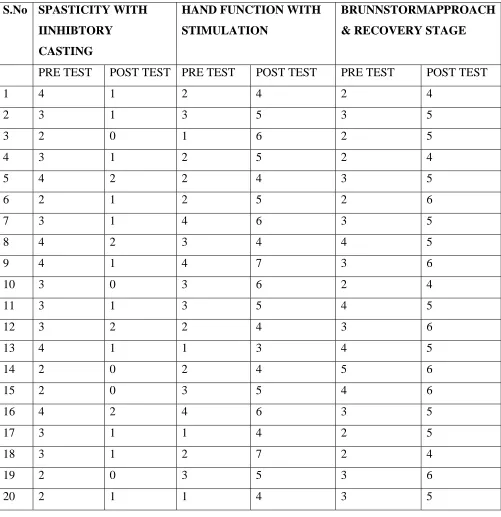
TABLE -1
EXPERIMENTAL GROUP (GROUP-A)
S.No SPASTICITY WITH IINHIBTORY
CASTING
HAND FUNCTION WITH STIMULATION
BRUNNSTORMAPPROACH & RECOVERY STAGE
PRE TEST POST TEST PRE TEST POST TEST PRE TEST POST TEST
1 4 1 2 4 2 4
2 3 1 3 5 3 5
3 2 0 1 6 2 5
4 3 1 2 5 2 4
5 4 2 2 4 3 5
6 2 1 2 5 2 6
7 3 1 4 6 3 5
8 4 2 3 4 4 5
9 4 1 4 7 3 6
10 3 0 3 6 2 4
11 3 1 3 5 4 5
12 3 2 2 4 3 6
13 4 1 1 3 4 5
14 2 0 2 4 5 6
15 2 0 3 5 4 6
16 4 2 4 6 3 5
17 3 1 1 4 2 5
18 3 1 2 7 2 4
19 2 0 3 5 3 6
20
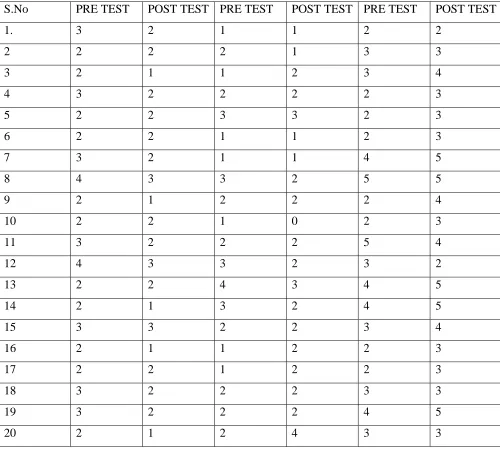
S.No PRE TEST POST TEST PRE TEST POST TEST PRE TEST POST TEST 1. 3 2 1 1 2 2 2 2 2 2 1 3 3 3 2 1 1 2 3 4 4 3 2 2 2 2 3 5 2 2 3 3 2 3 6 2 2 1 1 2 3 7 3 2 1 1 4 5 8 4 3 3 2 5 5 9 2 1 2 2 2 4
10 2 2 1 0 2 3
11 3 2 2 2 5 4
12 4 3 3 2 3 2
13 2 2 4 3 4 5
14 2 1 3 2 4 5
15 3 3 2 2 3 4
16 2 1 1 2 2 3
17 2 2 1 2 2 3
18 3 2 2 2 3 3
19 3 2 2 2 4 5
[image:28.612.68.568.144.596.2]20 2 1 2 4 3 3
TABLE – 2
21
TABLE-3
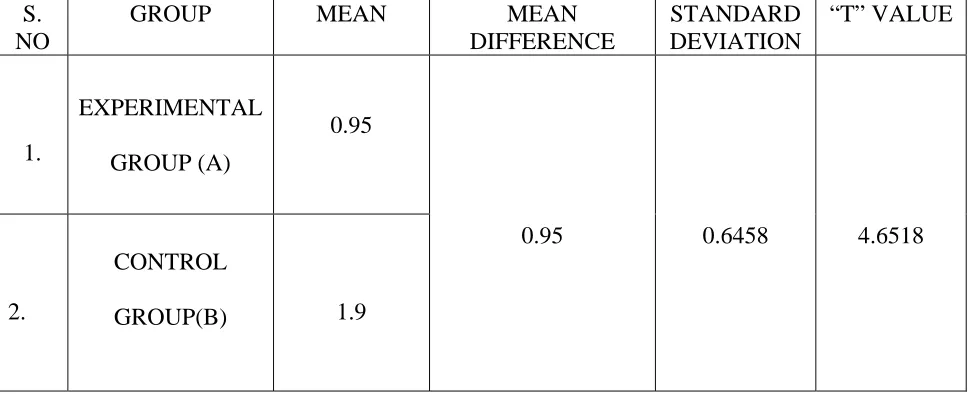
POST TEST VALUES OF SPASTICITY BETWEEN
EXPERIMENTAL AND CONTROL GROUP
For 38 degrees of freedom at 5% level of significance,the calculated post test ‘t’ values between control and experimental group in spasticity was 4.6518 and the critical value was 2.021 which states that there is significant difference between 2 groups.
S. NO
GROUP MEAN MEAN DIFFERENCE
STANDARD DEVIATION
“T” VALUE
1.
EXPERIMENTAL GROUP (A)
0.95
0.95 0.6458 4.6518
2.
CONTROL
22
TABLE-4
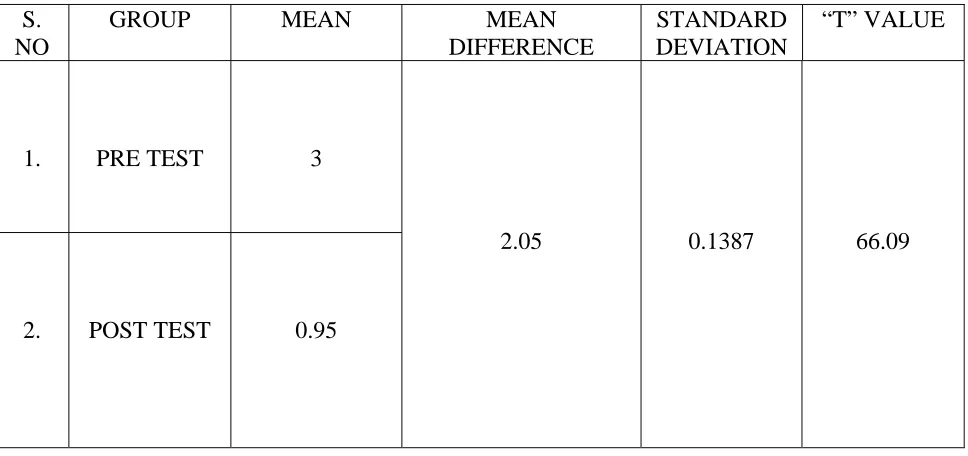
PRE AND POST TEST VALUES OF SPASTICITY IN
EXPERIMENTAL GROUP
S. NO
GROUP MEAN MEAN
DIFFERENCE
STANDARD DEVIATION
“T” VALUE
1. PRE TEST 3
2.05 0.1387 66.09
2. POST TEST 0.95
23
TABLE-5
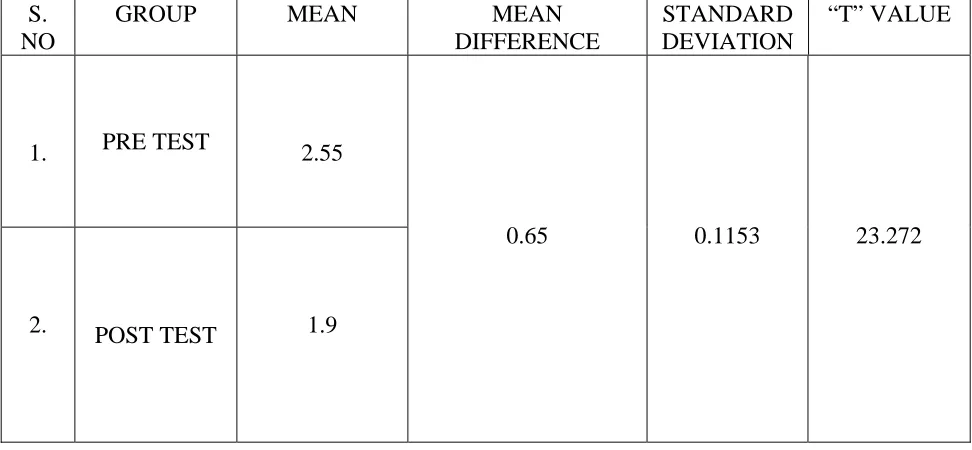
PRE AND POST TEST VALUES OF SPASTICITY IN
CONTROL GROUP
For 19 degrees of freedom at 5% level of significance,the calculated pre & post values of control group in spasticity was 23.272 and critical value was 2.093,which states that there exists a significant difference between the groups.
S. NO
GROUP MEAN MEAN
DIFFERENCE
STANDARD DEVIATION
“T” VALUE
1. PRE TEST 2.55
0.65 0.1153 23.272
24
TABLE-6
POST TEST VALUES OF HAND FUNCTIONS BETWEEN
EXPERIMENTAL AND CONTROL GROUP
For 38 degrees of freedom at 5% level of significance,the calculated post test ‘t’ values between control and experimental group in hand function was 12.384 and the critical value was 2.021 which states that there is significant difference between 2 groups.
S. NO
GROUP MEAN MEAN DIFFERENCE
STANDARD DEVIATION
“T” VALUE
1.
A
4.95
3.05 0.7788 12.384
25
TABLE-7
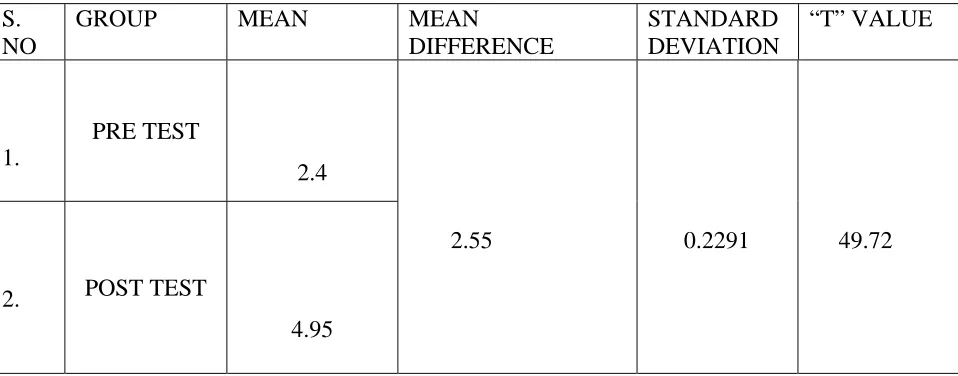
PRE AND POST TEST VALUES OF HAND FUNCTION IN
EXPERIMENTAL GROUP
For 19 degrees of freedom at 5% level of significance ,the calculated pre test & post test values of experimental group in hand function was 49.72 and the critical values was 2.093,which states that there exists a significant difference between the groups.
S. NO
GROUP MEAN MEAN DIFFERENCE
STANDARD DEVIATION
“T” VALUE
1.
PRE TEST
2.4
2.55 0.2291 49.72 2. POST TEST
26
TABLE-8
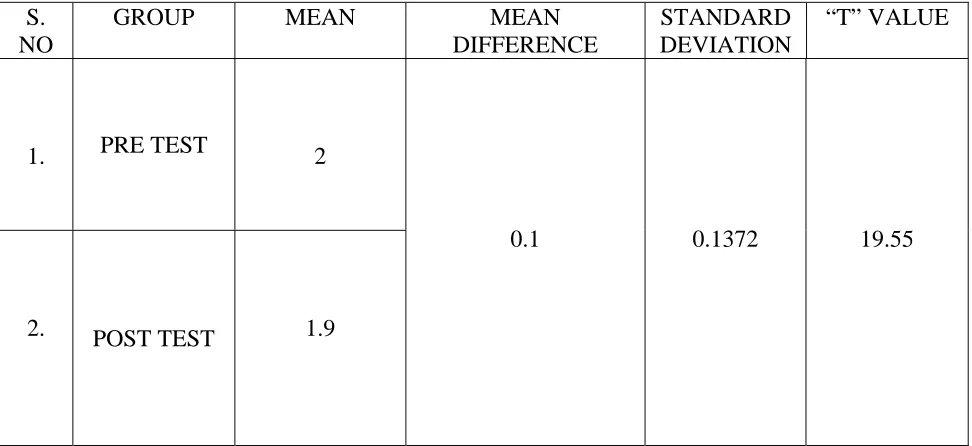
PRE AND POST TEST VALUES OF HAND FUNCTION IN
CONTROL GROUP
For 19 degrees of freedom at 5% level of significance,the calculated pre & post values of control group in hand function was 19.55 and critical value was 2.093,which states that there exists a significant difference between the groups.
S. NO
GROUP MEAN MEAN
DIFFERENCE
STANDARD DEVIATION
“T” VALUE
1. PRE TEST 2
0.1 0.1372 19.55
27
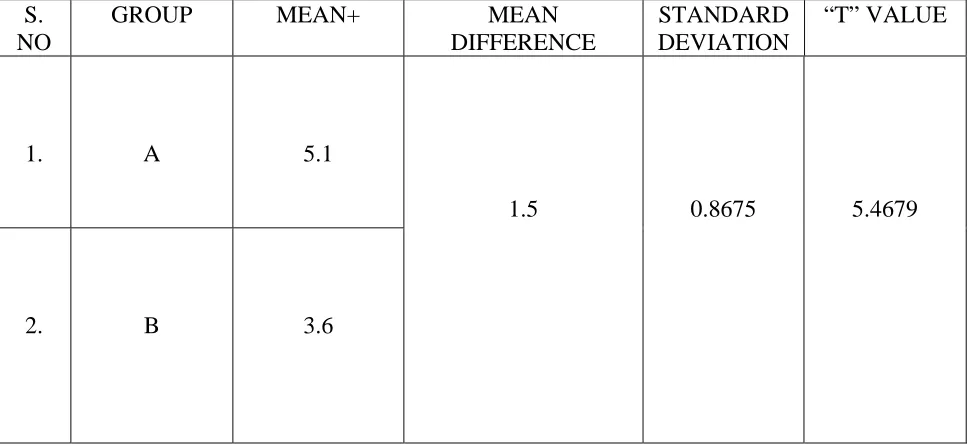
TABLE-9
POST TEST VALUES OF BRUNNSTORM’S RECOVERY STAGE
BETWEEN
EXPERIMENTAL AND CONTROL GROUP
For 38 degrees of freedom at 5% level of significance,the calculated post test ‘t’ values between control and experimental group in Brunnstorm’s recovery stages was 5.4679 and the critical value was 2.021 which states that there is significant difference between 2 groups.
S. NO
GROUP MEAN+ MEAN
DIFFERENCE
STANDARD DEVIATION
“T” VALUE
1. A 5.1
1.5 0.8675 5.4679
28
TABLE-10
PRE AND POST TEST VALUES OF BRUNNSTORM’S RECOVERY
STAGE IN
EXPERIMENTAL GROUP
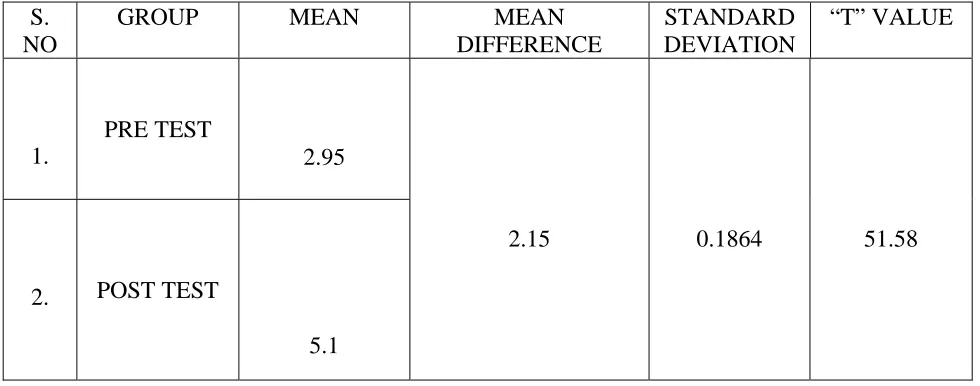
For 19 degrees of freedom at 5% level of significance ,the calculated pre test & post test values of experimental group in Brunnstorm’s recovery stages was 51.58 and the critical values was 2.093,which states that there exists a significant difference between the groups.
S. NO
GROUP MEAN MEAN
DIFFERENCE
STANDARD DEVIATION
“T” VALUE
1.
PRE TEST
2.95
2.15 0.1864 51.58
2. POST TEST
29
TABLE-11
PRE AND POST TEST VALUES OF BRUNNSTORM’S RECOVERY
STAGE IN
CONTROL GROUP
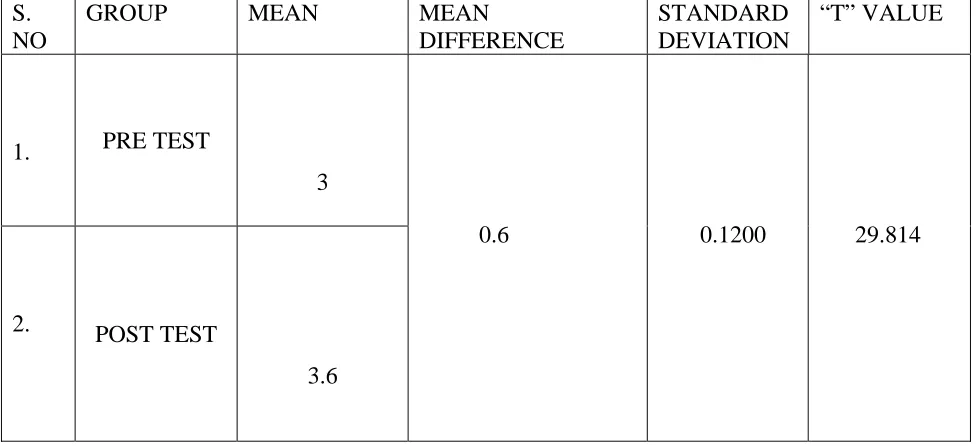
For 19 degrees of freedom at 5% level of significance,the calculated pre & post values of control group in Brunnstorm’s recovery stages was 29.814 and critical value was 2.093,which states that there exists a significant difference between the groups.
S. NO
GROUP MEAN MEAN DIFFERENCE
STANDARD DEVIATION
“T” VALUE
1. PRE TEST
3
0.6 0.1200 29.814
2. POST TEST
30
CHAPTER VI
RESULTS
Effectiveness of control group was measured by comparing pre test and post test values in spasticity ,hand function and checked by using Brunnstorm’s recovery stages.The calculated ‘t’ values is greater than the critical value 2.093 which states that there is significant difference in between the groups.
Effectiveness of experimental group was measured by comparing pre-test &post-test values in spasticity,hand function and checked by using Brunnstorm’s recovery stages.The calculated ‘t’ value is greater than the critical value 2.093 which states that there is significant difference between the groups.
By comparing the ‘t’ values of experimental and control group ‘t’ value of experimental group is greater than ‘t’ value of control group which states there exists a significant difference in improvement between two groups.
Stroke is a major neurological disorder and its management varies from one stage to another.This study focuses on improving the hand function and shows better recovery according to Brunnstorm.
31
CHAPTER VII
DISCUSSION
Inhibitory casting and electrical stimulation program adds to growing evidence of management of spasticity and impairment of hand function in patients with MCA stroke which is proved by outcome measures confirmed by many randomized control trials.
Stroke is a major neurological disorder in adults over 50 yrs of age and ceases the functional activity.In this study ,the effectiveness of inhibitory casting and electrical stimulation program on spasticity and hand function was found out as evidenced by outcome measures modified ashworth spasticity scale,WMFT and Brunnstorm’s stages of recovery.The results of this study culd yield greater understanding of new techniques performed as a part of stroke rehabilitation program by the patients with MCA stroke.
Group a (20 subjects ) who fulfill the inclusive criteria received inhibitory casting with electrical stimulation and brunnstorm’s approach were given.
Group B (20 subjects ) who fulfill the inclisive criteria received traditional stretching and functional mat activities.The results were analysed using ‘t’tests.The results showed that there is significant improvement in reduction of spasticity,improvement in hand function and better recovery in group A compared to Group B.
This improvement is due to the fact that inhibitory maintains a position that reduces spasticity and facilitates improved motor function and the position is called reflex-inhibiting position and it normalizes the proprioceptive input,alignment and weight bearing position of the joint.Electrical stimulation to wrist extensors improves the passive range of wrist extension and releases the muscles and improves the functional activities of hand .Brunnstorm’s approach finally given enhances the recovery of the patient.
BAKER ET AL: 1999
Reported an increase in wrist and finger extension in 16 adult hemiplegic patients with unilateral flexor spasticity by combining electrical stimulation with inhibitory casting to increase and maintain gain in length of flexors.
32 TONKIN : 1995
Describes serial inhibitory casting causes soft tissue changes whish has viscoelastic properties of muscle and connective tissue.Provide low load ,prolonged stretch and physiological changes and involves remodeling .Remodeling is mediated by fibroblasts in reponse to the physical forces due to the casting.
33
CHAPTER VIII
CONCLUSION
The pre test and post test scores are noted and analysis was done using independent ‘t’ test which favored the alternate hypothesis.
The intra group analysis was done and results were analysed using paid ‘t’ test, which favored the alternative hypothesis.
The statistical analysis shows there is significant improvement in reduction of spasticity and improvement in hand function and shows better recovery in patients with affected side as dominant site.
34
CHAPTER IX
LIMITATIONS & SUGGESTIONS
• The period of time allotted for the study was found to be insufficient for the inclusion of greater number of subjects. The time allotted for the study per day can be increased to get prognosis. • Influence of drug, nutritional ,psychological state and climate cannot be controlled
• Study focuses on patients reduction in spasticity and hand function only .Further study ca be done for voluntary control and dual task movements.
• Patients were not instructed for home exercises program. Study can be done with prescribing home exercises.
• Though MAS&WMFT were administered, bias is possible.
• The time allotted for the study per day can be increased to get better prognosis
• My study was done with out follow up further study can be done with follow up program can be included to know the long term effect of treatment
35
CHAPTER X
BIBLIOGRAPHY
1. Lance JW ;symposium synopsis ;Spasticity disorderd motor control :page 485 1995
2. Jones ,Mulley :The measurement of spasticity .In rose FC Advances in stroke therapy : page 187-197 1996
3. Bobath :Adult hemiplegia : Ealuation and treatment page : 195 -203 1998
4. Knutson E,Martensson A Dynamic motor capacity in spastic paresis and its relation to prime mover dysfunction ,spastic reflexes and antagonist activation :page 96-106 2008
5. Mackenzie CR Charison :Standards for use of ordinal scales in clinical trials .:page 102-122 2004
6. Ashworth B : Preliminary trial of electrical stimulation to decrease spasticity and hand function. :page 402-486 2002
7. Brown ET :Non parametric methods in measuring spasticity .:page 75-105 2006 8. Alferi V : Electrical treatment of spasticity Rehab medicine :page 177-188 2005 9. Copley j Watson ;Upper limb cating for stroke clients :page 25-55 2004
10. Chapparo C.J : Upper limb orthotics in treating stroke.page 46-81 2008 11. Kitson A : Plaster casting as a means to reduce spasticity :page 78-92 2009 12. TONA : Casting to decrease spasticity page : 25-51 2007
36
CHAPTER XI
REFERENCES
Biochimica et Biophysica Acta
1802
(1): 80–91.
doi:10.1016/j.bbadis.2009.09.003. PMID 19751827.
Donnan GA, Fisher M, Macleod M, Davis SM (May 2008). "Stroke".
Lancet
371
(9624): 1612–23. doi:10.1016/S0140-6736(08)60694-7. PMID 18468545.
Feigin VL (2005). "Stroke epidemiology in the developing world".
Lancet
365
(9478): 2160–1. doi:10.1016/S0140-6736(05)66755-4. PMID 15978910.
Miwa K, Hoshi T, Hougaku H,
et al.
(2010). "Silent cerebral infarction is
associated with incident stroke and TIA independent of carotid intima-media
thickness".
Intern. Med.
49
(9): 817–22. doi:10.2169/internalmedicine.49.3211.
PMID 20453400.
http://joi.jlc.jst.go.jp/JST.JSTAGE/internalmedicine/49.3211?from=PubMed.
Herderscheê D, Hijdra A, Algra A, Koudstaal PJ, Kappelle LJ, van Gijn J
(September 1992). "Silent stroke in patients with transient ischemic attack or minor
ischemic stroke. The Dutch TIA Trial Study Group".
Stroke
23
(9): 1220–4.
doi:10.1161/01.STR.23.9.1220.PMID 1519274.
37
Leary MC, Saver JL (2003). "Annual incidence of first silent stroke in the United
States: a preliminary estimate".
Cerebrovasc. Dis.
16
(3): 280–5.
doi:10.1159/000071128DPMID 12865617.
http://content.karger.com/produktedb/produkte.asp?DOI=71128&typ=pdf.
Vermeer SE, Koudstaal PJ, Oudkerk M, Hofman A, Breteler MM (January 2002).
"Prevalence and risk factors of silent brain infarcts in the population-based
Rotterdam Scan Study".
Stroke
33
(1): 21–5. doi:10.1161/hs0102.101629.
PMID 11779883.
http://stroke.ahajournals.org/cgi/pmidlookup?view=long&pmid=11779883.
World Health Organisation (1978).
Cerebrovascular Disorders (Offset
Publications)
. Geneva: World Health Organization. ISBN
9241700432.
OCLC 4757533.
Kidwell CS, Warach S (December 2003). "Acute ischemic cerebrovascular
syndrome: diagnostic criteria".
Stroke
34
(12): 2995–8.
doi:10.1161/01.STR.0000098902.69855.A9. PMID 14605325.
"Brain Basics: Preventing Stroke". National Institute of Neurological Disorders
and Stroke. http://www.ninds.nih.gov/disorders/stroke/preventing_stroke.htm.
38
CHAPTER XII
APPENDIX -1
PATIENT CONSENT FORM
TITLE : EFFECTIVENESS OF INHIBITORY CASTING WITH ELECTRICAL STIMULATION ON IMPROVING THE HAND FUNCTION IN PATIENTS WITH MIDDLE CEREBRAL ARTERY STROKE.
Investigator : ---
PURPOSE OF THE STUDY :
I ---,have been informed that this study will work towards achieving on functional activities of daily living in post stroke conditions for me and other patients.
PROCEDURE :
Each term of the study protocol has been explained to me in detail.I understand that during the procedure ,I will be receiving the treatment for one time a day .I understand that I will have to take this treatment for 16 weeks.
39 CONFIDENTIALITY :
I understand that medical information provided by this study will be confidential. If the data are used for publication in the medical literature or for teaching purposes, no names will be used and other literature such as audio or video tapes will be used only with permission.
RISK AND DISCOMFORT :
I understand that there are no potential risks associated with this procedure ,and understand that investigator will accompany me during this procedure..There is no known hazards associated with this procedure.
REFUSAL OR WITHDRAWAL OF PARTICIPATION :
I understand that the decision my participation is wholly voluntary and I may refuse participate, may withdraw consent at any time during the study .
I also understand that the investigator may terminate my participation in the study at any time after researcher has explained me the reasons to do so.
I ---have explained the purpose of the research ,the procedures required and the possible risks and benefits, to the best of my ability,I have read and understood this consent to participate we as a subject in this research project.
Signature of the witness : DATE :
40
APPENDIX-2
PATIENT PROFILE NAME :
AGE :
SEX :
OCCUPATION :
DATE OF ASSESSMENT :
CHIEF COMPLAINTS :
SUBJECTIVE a)History
Present medical history Past medical history b)Surgical history
c)Drug history d) Personel history e)Family history ON OBSERVATION a)Built
b)Swelling
c)Soft tissue contours
41 EXAMINATION ;
1. Higher functions 2. Mental status 3. Speech
4. Hearing Sensory system 5. Vision
6. Cranial nerves 7. Sensory system 8. sensation 9. Motor system 10. Reflexes 11. Co-ordination
12. Involuntary movements 13. Balance
14. Gait analysis 15. hand function 16. Assistive devices
17.Functional assessment
PROBLEM LIST
42
APPENDIX-3
MODIFIED ASHWORTH GRADING SCALE 0 -No increase in muscle tone
• 1 -Slight increase in muscle tone, manifested by a catch and release or by minimal resistance at the end of the range of motion when the affected part(s) is moved in flexion or extension • 1+ -Slight increase in muscle tone, manifested by a catch, followed by minimal resistance
throughout the remainder (less than half) of the ROM
• 2 -More marked increase in muscle tone through most of the ROM, but affected part(s) easily moved
43
APPENDIX -4
Wolf Motor Function Scale
44
APPENDIX -5
Flaccidity no voluntary movements in the affected limb
Hyperflexia: emergence of spasticity and synergies, Min. Voluntary movement in the affected limbs Voluntary movement within synergy, spasticity increases to peak level
45
APPENDIX -6
TECHNIQUES :
• General instructions about the procedure was explained to the patient . • Warm up exercise were given for a duration of 5 minutes.
• Cast was taken in hot water for 2 minutes to bring its softness.
• Cast was applied over the affected limb and electrical stimulation was given 12‐15 min for a
period of 16 weeks.
• Cast was removed and then Brunnstorm approach was given and the recovery of the patient is
LIST OF TABLES
TABLE NO CONTENTS PAGE NO
1
EXPERIMENTAL GROUP (GROUP -A)20
2
CONTROL GROUP (GROUP - B)21
3
POST TEST VALUES OF SPASTICITY BETWEEN EXPERIMENTAL AND CONTROL GROUP22
4
PRE AND POST TEST VALUES OF SPASTICITY IN EXPERIMENTAL GROUP23
5
PRE AND POST TEST VALUES OF SPASTICITY IN CONTROL GROUP24
6
POST TEST VALUES OF HAND FUNCTIONS BETWEENEXPERIMENTAL AND CONTROL GROUP
25
7
PRE AND POST TEST VALUES OF HAND FUNCTION INEXPERIMENTAL GROUP
26
8
PRE AND POST TEST VALUES OF HAND FUNCTION INCONTROL GROUP
27
9
POST TEST VALUES OF BRUNNSTORM’S RECOVERY STAGE BETWEENEXPERIMENTAL AND CONTROL GROUP
28
10
PRE ANDPOST TEST VALUES OF BRUNNSTORM’S RECOVERY STAGE BETWEENEXPERIMENTAL GROUP
29
11
PRE ANDPOST TEST VALUES OF BRUNNSTORM’S RECOVERY STAGE BETWEENCONTROL GROUP
LIST OF GRAPHS
GRAPH.NO
CONTENTS
PAGE.NO
1. COMPARISON OF PRE TEST VALUE AND POST TEST VALUE IN SPASTICITY
26
2. COMPARISON OF PRE TEST AND POST TEST VALUE IN HAND FUNCTION
29
3. COMPARISON OF PRE TEST AND POST TEST VALUE BRUNNSTORM RECOVERY STAGE OF STROKE.