Resilience in High-Level Parallel
Programming Languages
Sara S. Hamouda
A thesis submitted for the degree of
Doctor of Philosophy at
The Australian National University
Except where otherwise indicated, this thesis is my own original work.
Acknowledgements
I grant all my gratitude to Almighty Allah, for blessing me with this wonderful learning journey and giving me the strength to complete it.
Crossing the finish line would not have been possible without the great support and assistance of a group of wonderful people. First of all, my supervisors, Josh Milthorpe, Peter Strazdins and Steve Blackburn, who offered their ultimate guidance and support to remove every obstacle in the way and enable me to achieve my goals. I wish to express my deepest appreciation to my primary supervisor, Josh Milthorpe, who dedicated many hours for discussing my work, refining my ideas, connecting me to collaborators, and challenging me with difficult questions sometimes to help me learn more. Thank you, Josh, for all the favors you showed me during these years. Without your encouragement and generous support, this thesis would not have been possible.
I am very grateful to the X10 team; David Grove, Olivier Tardieu, Vijay Saraswat, Benjamin Herta, Louis Mandel, and Arun Iyengar, for giving me the opportunity to collaborate with them in the Resilient X10 project, and for the invaluable experience I gained from this collaboration. I am also very grateful to the computer systems group in the research school of computer science at the ANU for the valuable feedback and recommendations given during the PhD monitoring sessions. I would like to thank J. Eliot B. Moss for valuable discussions about transactional memory systems during his visit to the ANU, and Peter Strazdins for valuable discussions that led to the design of the resilience taxonomy described in this thesis.
I am grateful to the Australian National University for providing me the HDR merit and stipend scholarship. This research was undertaken with the assistance of resources and services from the National Computational Infrastructure (NCI), which is supported by the Australian Government.
Finally, I would to thank my family and friends for the continuous encouragement and the happy moments they favored me with. My nephews, Nour Eldeen, Omar, and Eyad, are now too young to read these words, but I hope one day they will open my thesis and read this line to know how much I love them and how much chatting with them on a regular basis was my main source of happiness during my remote study years. To my dear family; Hoda, Salem, Mai, Ahmed and Esraa, thanks for supporting me every step of the way.
Abstract
The consistent trends of increasing core counts and decreasing mean-time-to-failure in supercomputers make supporting task parallelism and resilience a necessity in HPC programming models. Given the complexity of managing multi-threaded distributed execution in the presence of failures, there is a critical need for task-parallel ab-stractions that simplify writing efficient, modular, and understandable fault-tolerant applications.
MPI User-Level Failure Mitigation (MPI-ULFM) is an emerging fault-tolerant specification of MPI. It supports failure detection by returning special error codes and provides new interfaces for failure mitigation. Unfortunately, the unstructured form of failure reporting provided by MPI-ULFM hinders the composability and the clarity of the fault-tolerant programs. The low-level programming model of MPI and the simplistic failure reporting mechanism adopted by MPI-ULFM make MPI-ULFM more suitable as a low-level communication layer for resilient high-level languages, rather than a direct programming model for application development.
The asynchronous partitioned global address space model is a high-level pro-gramming model designed to improve the productivity of developing large-scale applications. It represents a computation as a global control flow of nested parallel tasks that use global data partitioned among processes. Recent advances in the AP-GAS model supported control flow recovery by adding failure awareness to the nested parallelism model — async-finish — and by providing structured failure reporting through exceptions. Unfortunately, the current implementation of the resilient async-finish model results in a high performance overhead that can restrict the scalability of applications. Moreover, the lack of data resilience support limits the productivity of the model as it shifts the challenges of handling data availability and atomicity under failure to the programmer.
In this thesis, we demonstrate that resilient APGAS languages can achieve scalable performance under failure by exploiting fault tolerance features in emerging com-munication libraries such as MPI-ULFM. We propose multi-resolution resilience, in which high-level resilient constructs are composed from efficient lower-level resilient constructs, as an approach for bridging the gap between the efficiency of user-level fault tolerance and the productivity of system-level fault tolerance. To address the limited resilience efficiency of the async-finish model, we propose ‘optimistic finish’ — a message-optimal resilient termination detection protocol for the finish construct. To improve programmer productivity, we augment the APGAS model with resilient
data stores that can simplify preserving critical application data in the presence of failure. In addition, we propose the ‘transactional finish’ construct as a productive mechanism for handling atomic updates on resilient data. Finally, we demonstrate the multi-resolution resilience approach by designing high-level resilient application frameworks based on the async-finish model.
Contents
Acknowledgements vii
Abstract ix
1 Introduction 1
1.1 Background and Motivation . . . 1
1.2 Multi-Resolution Resilience . . . 4
1.3 Problem Statement . . . 5
1.4 Research Questions . . . 6
1.5 Thesis Statement . . . 6
1.6 Contributions . . . 6
1.7 Thesis Outline . . . 7
2 Background and Related Work 9 2.1 Resilience Definition . . . 9
2.2 Taxonomy of Resilient Programming Models . . . 10
2.2.1 Adaptability . . . 10
2.2.1.1 Resource Allocation . . . 10
2.2.1.2 Resource Mapping. . . 11
2.2.2 Fault Tolerance . . . 12
2.2.2.1 Fault Type . . . 12
2.2.2.2 Fault Level . . . 13
2.2.2.3 Recovery Level . . . 13
2.2.2.4 Fault Detection. . . 14
2.2.2.5 Fault Tolerance Technique . . . 15
2.2.3 Performance. . . 17
2.2.3.1 Performance Recovery . . . 17
2.3 Resilience Support in Distributed Programming Models . . . 19
2.3.1 Message-Passing Model . . . 19
2.3.1.1 MPICH-V . . . 20
2.3.1.2 FMI . . . 20
2.3.1.3 rMPI . . . 21
2.3.1.4 RedMPI . . . 21
2.3.1.5 FT-MPI . . . 21
2.3.1.6 MPI-ULFM . . . 22
2.3.1.7 FA-MPI . . . 22
2.3.2 The Partitioned Global Address Space Model . . . 23
2.3.2.1 GASNet . . . 23
2.3.2.2 UPC . . . 23
2.3.2.3 Fortran Coarrays. . . 24
2.3.2.4 GASPI . . . 24
2.3.2.5 OpenSHMEM . . . 25
2.3.2.6 Global Arrays . . . 25
2.3.2.7 Global View Resilience . . . 25
2.3.3 The Asynchronous Partitioned Global Address Space Model . . 25
2.3.3.1 Chapel . . . 26
2.3.3.2 X10 . . . 27
2.3.4 The Actor Model . . . 28
2.3.4.1 Charm++ . . . 28
2.3.4.2 Erlang . . . 29
2.3.4.3 Akka. . . 29
2.3.4.4 Orleans . . . 29
2.3.5 The Dataflow Programming Model . . . 29
2.3.5.1 OCR . . . 30
2.3.5.2 Legion. . . 30
2.3.5.3 NABBIT and PaRSEC . . . 31
2.3.5.4 Spark . . . 31
2.3.6 Review Conclusions . . . 31
2.4 The X10 Programming Model . . . 34
2.4.1 Task Parallelism. . . 34
2.4.2 The Happens-Before Constraint . . . 34
2.4.3 Global Data . . . 35
2.4.4 Resilient X10 . . . 36
2.4.5 Elastic X10 . . . 37
2.4.5.1 The PlaceManager API . . . 37
2.4.5.2 Place Virtualization . . . 39
2.5 Summary . . . 39
3 Improving Resilient X10 Portability and Scalability Using MPI-ULFM 41 3.1 Introduction . . . 41
3.2 X10 over MPI . . . 43
3.2.1 Initialization. . . 43
3.2.2 Active Messages . . . 44
3.2.3 Team Collectives . . . 45
3.2.3.1 The Emulated Implementation . . . 47
3.2.3.2 The Native Implementation . . . 47
3.3 MPI-ULFM Overview . . . 48
Contents xiii
3.3.2 Failure Notification. . . 49
3.3.3 Failure Mitigation . . . 49
3.4 Resilient X10 over MPI-ULFM. . . 52
3.4.1 Resilient X10 Transport Requirements . . . 52
3.4.2 Global Failure Detection . . . 53
3.4.3 Identifying Dead Places . . . 53
3.4.4 Native Team Collectives . . . 54
3.4.4.1 Team Construction . . . 54
3.4.4.2 Team Failure Notification. . . 55
3.4.4.3 Team Agreement. . . 56
3.4.5 Non-Shrinking Recovery . . . 57
3.5 Performance Evaluation . . . 58
3.5.1 Experimental Setup . . . 58
3.5.2 Performance Factors . . . 59
3.5.2.1 The Immediate Thread . . . 59
3.5.2.2 Emulated Team versus Native Team . . . 59
3.5.3 MPI-ULFM Failure-Free Resilience Overhead . . . 60
3.5.4 Resilient X10 over MPI-ULFM versus TCP Sockets . . . 62
3.5.5 Team Construction Performance . . . 63
3.5.6 Team Collectives Performance . . . 64
3.6 Related Work . . . 67
3.7 Summary . . . 68
4 An Optimistic Protocol for Resilient Finish 69 4.1 Introduction . . . 69
4.2 Nested Task Parallelism Models . . . 71
4.3 Related Work . . . 72
4.4 Resilient Async-Finish Optimality Limit . . . 73
4.5 Async-Finish Termination Detection Under Failure . . . 75
4.5.1 Failure Model . . . 75
4.5.2 Recovery Challenges . . . 75
4.6 Distributed Task Tracking . . . 77
4.6.1 Finish and LocalFinish Objects . . . 78
4.6.2 Task Events . . . 78
4.7 Non-Resilient Finish Protocol . . . 79
4.7.1 Garbage Collection . . . 80
4.8 Resilient Pessimistic Finish . . . 80
4.8.1 Adopting Orphan Tasks . . . 81
4.8.2 Excluding Lost Tasks. . . 81
4.8.3 Garbage Collection . . . 81
4.9 Resilient Optimistic Finish . . . 83
4.9.1 Adopting Orphan Tasks . . . 84
4.9.2 Excluding Lost Tasks. . . 85
4.9.4 Optimistic Finish TLA Specification . . . 87
4.10 Finish Resilient Store Implementations . . . 89
4.10.1 Reviving the Distributed Finish Store . . . 90
4.11 Performance Evaluation . . . 90
4.11.1 Experimental Setup . . . 91
4.11.2 BenchMicro . . . 91
4.11.2.1 Performance Factors. . . 92
4.11.2.2 Performance Results . . . 93
4.11.3 Conclusions . . . 102
4.12 Summary. . . 103
5 Towards Data Resilience in X10 105 5.1 A Resilient Data Store for the APGAS Model . . . 106
5.1.1 Strong Locality . . . 107
5.1.2 Double In-Memory Replication. . . 107
5.1.3 Non-Shrinking Recovery . . . 108
5.1.4 Distributed Transactions . . . 111
5.2 From Finish to Transaction . . . 112
5.2.1 Transactional Finish Construct . . . 113
5.2.1.1 Nesting Semantics . . . 113
5.2.1.2 Error Reporting Semantics . . . 114
5.2.1.3 Compiler-Free Implementation . . . 115
5.2.2 Finish Atomicity Awareness . . . 115
5.2.2.1 The Join Signal . . . 115
5.2.2.2 The Merge Signal . . . 116
5.2.2.3 Extended Finish Protocols . . . 117
5.2.3 Implementation Details . . . 117
5.2.3.1 Transaction Identifier and Log . . . 117
5.2.3.2 Lock Specification . . . 117
5.2.3.3 Concurrency Control Mechanism . . . 118
5.2.3.4 Two Phase Commit . . . 119
5.2.3.5 Transaction Termination Guarantee . . . 126
5.3 Resilient Application Frameworks . . . 127
5.3.1 Application Resilient Stores . . . 127
5.3.1.1 Place Local Store. . . 127
5.3.1.2 Transactional Store . . . 129
5.3.2 Resilient Iterative Framework. . . 134
5.3.2.1 The Global Iterative Executor . . . 136
5.3.2.2 The SPMD Iterative Executor . . . 137
5.3.3 Resilient Parallel Workers Framework . . . 139
5.3.3.1 Parallel Workers Executor . . . 140
5.4 Performance Evaluation . . . 142
5.4.1 Experimental Setup . . . 142
Contents xv
5.4.2.1 ResilientTxBench . . . 142
5.4.2.2 Graph Clustering: SSCA2 Kernel-4 . . . 145
5.4.3 Iterative Applications Benchmarking . . . 150
5.4.3.1 X10 Global Matrix Library . . . 152
5.4.3.2 Linear Regression . . . 153
5.4.3.3 Logistic Regression . . . 154
5.4.3.4 PageRank . . . 158
5.4.3.5 LULESH . . . 158
5.4.4 Summary of Performance Results . . . 162
5.5 Summary . . . 163
6 Conclusion 165 6.1 Answering the Research Questions . . . 166
6.2 Future Work . . . 168
6.2.1 Fault-Tolerant One-Sided Communication . . . 168
6.2.2 Hardware Support for Distributed Transactions . . . 169
6.2.3 Beyond X10 . . . 169
Appendices 171
A Evaluation Platforms 173
B TLA+ Specification of the Optimistic Finish Protocol 175
C TLA+ Specification of the Distributed Finish Replication Protocol 205
List of Abbreviations 221
List of Figures
1.1 APGAS multi-resolution resilience (MRR). . . 4
2.1 Taxonomy of resilient programming models. . . 10
2.2 A sample X10 program and the corresponding task graph. . . 35
2.3 Place management with Place.places(). . . 37
2.4 Place management with the PlaceManager class. . . 38
3.1 X10 layered architecture. . . 42
3.2 X10 active messages implementation over MPI. . . 44
3.3 Team API implementation options. . . 46
3.4 MPI-ULFM failure detection and acknowledgement. . . 50
3.5 MPI-ULFM communicator shrinking recovery. . . 51
3.6 Team construction performance. . . 64
3.7 Team.Barrier performance.. . . 66
3.8 Team.Broadcast performance. . . 66
3.9 Team.Allreduce performance. . . 66
3.10 Team.Agree performance. . . 66
4.1 Dynamic computation models. . . 71
4.2 Message-optimal async-finish TD protocols. . . 74
4.3 Task tracking under failure. . . 76
4.4 Tracking remote task creation.. . . 78
4.5 Task tracking events as task c transitions to place 3. . . 81
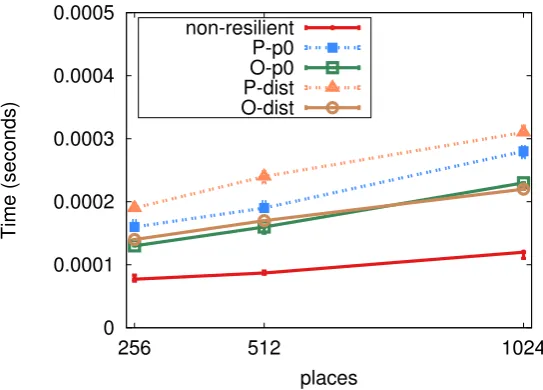
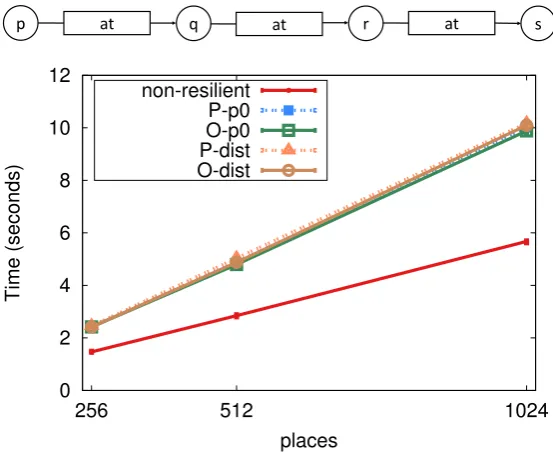
4.6 BenchMicro: local finish performance. . . 93
4.7 BenchMicro: single remote task performance. . . 95
4.8 BenchMicro: flat fan-out performance. . . 96
4.9 BenchMicro: flat fan-out message back performance. . . 97
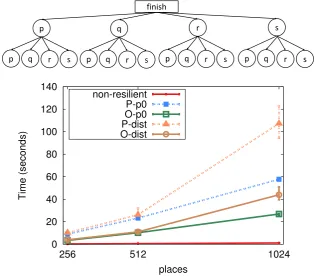
4.10 BenchMicro: tree fan-out performance. . . 98
4.11 BenchMicro: all-to-all performance. . . 99
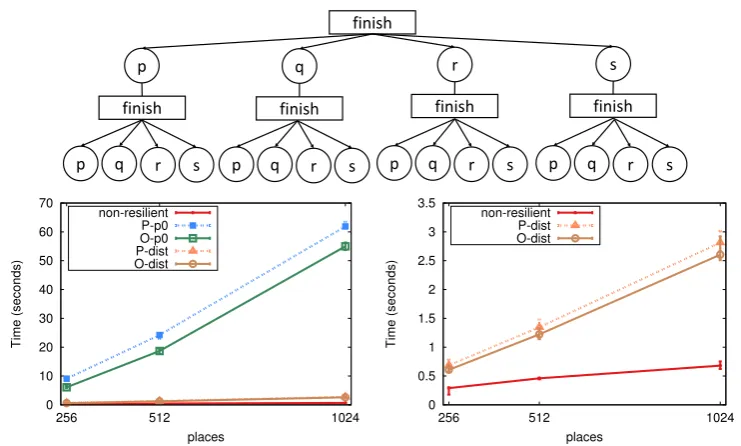
4.12 BenchMicro: all-to-all with nested finish performance. . . 100
4.13 BenchMicro: ring around via at performance. . . 101
5.1 Resilient store replication. . . 108
5.2 Shrinking recovery versus non-shrinking recovery for a 2-dimensional
data grid. . . 109
5.3 Weak scaling performance for three GML benchmarks. . . 110
5.4 Resilient store recovery. . . 110
5.5 Distributed graph clustering example. . . 111
5.6 Two-phase commit: a committing transaction. . . 120
5.7 Two-phase commit: an aborting transaction. . . 120
5.8 Resilient two-phase commit: a committing write transaction. . . 123
5.9 Resilient two-phase commit: an aborting write transaction.. . . 123
5.10 Master replica and slave replica state diagrams. . . 132
5.11 ResilientTxBench transaction throughput with 0% update. . . 146
5.12 ResilientTxBench transaction throughput with 50% update. . . 147
5.13 SSCA2-k4 strong scaling performance under failure. . . 151
5.14 Linear regression weak scaling performance. . . 155
5.15 Logistic regression weak scaling performance. . . 157
5.16 PageRank weak scaling performance. . . 159
List of Tables
2.1 Distributed processing systems resilience characteristics. . . 32
3.1 MPI-ULFM failure mitigation functions. . . 50
3.2 Performance of Team collectives with different MPI implementations. . 61
3.3 Performance of Team collectives with sockets and MPI-ULFM . . . 62
3.4 Team construction performance on Raijin with ULFM. . . 63
3.5 Team.Barrier performance.. . . 64
3.6 Team.Broadcast performance. . . 65
3.7 Team.Allreduce performance. . . 65
3.8 Team.Agree performance. . . 65
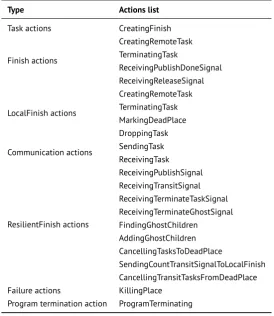
4.1 TLA+ actions describing the optimistic finish protocol. . . 88
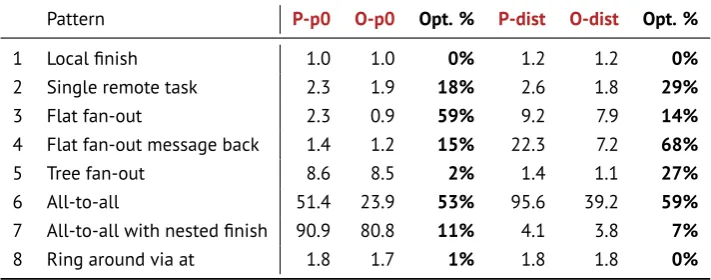
4.2 Execution time in seconds for BenchMicro patterns with 1024 places. . . 102
4.3 Slowdown factor versus non-resilient finish with 1024 places. . . 102
5.1 Comparison between finish and transactional finish. . . 116
5.2 The PlaceManager APIs. . . 127
5.3 The PlaceLocalStore APIs. . . 128
5.4 The TxStore APIs. . . 129
5.5 The resilient iterative application framework APIs. . . 135
5.6 The parallel workers application framework APIs. . . 139
5.7 ResilientTxBench parameters. . . 143
5.8 Transaction throughput results. . . 145
5.9 SSCA2-k4 performance with different concurrency control mechanisms.150 5.10 SSCA2-k4 strong scaling performance under failure. . . 151
5.15 Changed LOC for adding resilience using the iterative framework. . . . 162
Chapter 1
Introduction
This thesis studies the challenges of supporting productive and efficient resilience support in high-level parallel programming languages. In particular, it consid-ers the Asynchronous Partitioned Global Address Space (APGAS) programming model [Saraswat et al.,2010] exemplified by the X10 programming language [Charles et al.,2005].
1.1
Background and Motivation
Recent advances in High Performance Computing (HPC) systems have resulted in greatly increased parallelism, with both larger numbers of nodes and larger numbers of computing cores within each node. With this increased system size and complex-ity comes an increase in the expected rate of failures [Schroeder and Gibson, 2007; Bergman et al., 2008; Cappello et al., 2009; Shalf et al., 2010; Ferreira et al., 2011; Dongarra et al.,2011]. Programmers ofHPCsystems must therefore address the twin challenges of efficiently exploiting available parallelism, while ensuring resilience to component failures. As more industrial and scientific communities rely onHPC as a driving power for their innovation, the need for productive programming models that simplify the development of scalable resilient applications continues to grow.
The Message Passing Interface (MPI), the de facto standard programming model for HPC applications, is carefully designed for performance scalability rather than resilience or productivity. It does not provide native task-parallel abstractions; how-ever, users handle this limitation by integrating MPI programs with other tasking libraries at the expense of increased programming effort and integration complexi-ties [Chamberlain et al.,2007;Hayashi et al.,2017]. In light of the criticality of failures on large-scale computations, theMPIFault Tolerance Working Group (FTWG) was formed to study different proposals for extending MPI with fault tolerance inter-faces. After developing three proposals, FT-MPI [Fagg and Dongarra, 2000], Run Through Stabilization (RTS) [Hursey et al., 2011], and MPI User Level Failure Miti-gation (MPI-ULFM) [Bland et al.,2012b], theMPI FTWGhas converged towards the
MPI-ULFMspecification.
MPI-ULFMis currently the only active proposal for adding fault tolerance seman-tics to the coming MPI-4 standard. It enables applications to recover from fail-stop process failures by providing failure detection and failure mitigation interfaces in
MPI. Failure reporting is done by returning special error codes from a subset of
MPI interfaces. To avoid altering the whole code with conditional checking for er-rors, a cleaner option for handling failures is by registering a global error handling function. However, using a global error handler isolates failure recovery from the piece of code where the failure was detected, which complicates failure identification and recovery [Laguna et al.,2016; Fang et al., 2016]1. This simplistic unstructured form of failure reporting harms the modularity and the clarity of MPI-ULFM pro-grams and complicates composing multiple fault tolerance techniques. Because of the low-level programming model ofMPIand the above programmability challenges of MPI-ULFM, we argue that MPI-ULFM can be more useful as a low-level com-munication base for resilient high-level programming models rather than a direct programming model for application development.
The difficulties involved in developing distributed multi-threaded applications using low-level programming models, such as MPI, motivated the development of productivity-oriented programming models forHPC. The most influential project in that direction is DARPA’s High Productivity Computing Systems project, which re-sulted in the emergence of theAPGASprogramming model and its earliest examples: X10 [Charles et al.,2005] and Chapel [Chamberlain et al.,2007].
TheAPGASmodel avoids the main productivity barriers ofMPI— a fragmented memory model and lack of task parallelism support — by providing a global view for distributed memory and supporting nested task parallelism. The async-finish task model emerged in APGAS languages as a more flexible nested parallelism model than the fork-join model [Guo et al., 2009]. The words async and fork represent constructs for spawning asynchronous tasks, and the words finish and join represent synchronization constructs. While finish can track asynchronous tasks spawned directly or transitively by the current task, join can only track asynchronous tasks spawned directly by the current task. Hence, the async-finish model can express not only fork-join task graphs but also other task graphs with arbitrary synchronization patterns. Unfortunately, most of the research onAPGAS programming models has focused on its performance and productivity and ignored issues related to resilience.
To address this limitation, the X10 team has recently developed Resilient X10 (RX10), which extends the APGAS model with user-level fault tolerance [Cunning-ham et al.,2014;Crafa et al.,2014]. Fault tolerance is added by extending async-finish with failure awareness and structured failure reporting through exceptions. A re-silient finish can detect the loss of any of its tasks due to a process failure and consequently raises an exception. Unlike MPI-ULFM, adopting a structured form of failure reporting in RX10 enables adding fault tolerance to existing codes in a clear and understandable way. It also facilitates the hierarchical composition of fault tolerance strategies. For example, see Listing1.1.
§1.1 Background and Motivation 3
Listing 1.1: Structured failure handling using the resilient async-finish model. A place represents an operating system process in X10. The statementasync S;spawns an asynchronous task to executeS. The statementat (p) S;executesSat placep. The statementfinish S;blocks the current task until all asynchronous tasks spawned by Sterminate. The lines with a gray background are those added for fault tolerance.
1 def local_iteration(i:Int) {
2 try {
3 finish compute_using_neighbor();
4 } catch (ex:DeadPlaceException) { // neighbor died
5 //local recovery using approximation
6 val success = estimate_without_neighbor(); 7 if (!success) throw new ApproximationFailure();
8 }
9 }
10 def global_iteration(i:Int) {
11 try {
12 finish for (p in places) at (p) async {
13 local_iteration(i);
14 }
15 checkpoint();
16 } catch(ex:ApproximationFailure) {
17 //restart this iteration
18 i--;
19 //global recovery using checkpoint/restart
20 val success = load_last_checkpoint(); 21 if (!success) throw new FatalException();
22 }
23 }
24 def main () {
25 try {
26 for (var i:Int = 1; i < 10; i++) {
27 global_iteration(i);
28 }
29 } catch(ex:FatalException) {
30 print("fatal error occurred");
31 }
32 }
Despite the advantages of the resilient async-finish model, RX10 has had major practicality issues. First, adding failure awareness while maintaining the flexibility of the async-finish model added a significant performance overhead to common appli-cation patterns. Second,RX10did not leverage recent fault tolerant MPI implementa-tions for inter-process communication, which limited its portability to supercomputer platforms. Finally,RX10 shifted the whole burden of failure handling to program-mers, as it did not provide any support for commonly used fault tolerance techniques or any mechanism for protecting application data. We address these issues in this thesis aiming to provide a productive efficient programming model for developing resilientHPCapplications.
1.2
Multi-Resolution Resilience
When designing resilient applications, the choice of the resilience approach directly impacts performance and productivity. System-level resilience provides fault toler-ance to applications transparently using a generic fault tolertoler-ance technique. This approach is attractive for productivity; however, no fault tolerance technique is uni-versally efficient for all applications. On the other hand, user-level resilience allows users to customize fault tolerance to specific application characteristics. This approach is attractive for performance; however, it incurs a high productivity cost.
We argue that a balance between the efficiency of user-level fault tolerance and the productivity of system-level fault tolerance can be achieved by supporting multi-resolution resilience. Multi-multi-resolution resilience is a special type of user-level resilience that requires the programming model to provide efficient and composable resilient constructs that can be used for building resilient frameworks at different levels of abstraction. We recognize that both efficiency and composability are necessary fea-tures for a practical implementation of multi-resolution resilience. The absence of efficiency harms performance, while the absence of composability harms productivity as it complicates building higher-level frameworks.
Resilience Productivity
Performance
User-level resilience
(for MRR: efficient & composable resilient constructs)
System-level resilience
(for MRR: resilient application frameworks)
APGAS
MPI-ULFM Hadoop
Chapel
MPI
[image:24.595.153.362.549.693.2]MRR
§1.3 Problem Statement 5
Figure1.1shows how multi-resolution resilience can enableAPGASlanguages to reconcile performance, resilience, and productivity. The Venn diagram highlights that each of the priorities ofAPGAS, user-level resilience, and system-level resilience is concerned with only two of the three features. ForAPGAS, reconciling performance and productivity is a key design objective. In addition, composable synchronization constructs are already available for supporting nested task parallelism. By extending these constructs with failure awareness,APGASlanguages can gain the performance advantages of user-level resilience. They can also gain the productivity advantage of system-level resilience by using these constructs for building resilient application frameworks that handle fault tolerance on behalf of programmers. However, realizing this ambitious goal is challenging. Taking RX10 as an example implementation of multi-resolution resilience, we investigate performance and productivity problems that can hinder achieving this goal. We describe these problems in the next section.
1.3
Problem Statement
The composable async-finish model is a suitable base for multi-resolution resilience. However, adding failure awareness to the async-finish model does not come for free. It requires the runtime system to perform additional book-keeping activities for tracking the control flow of the computation. Our early experience withRX10 demon-strated that the composability of the async-finish model did not result in performance efficiency due to the high resilience overhead imposed by the book-keeping activities of the runtime system [Hamouda et al., 2015]. The main source of the overhead is due to the use of a resilient termination detection protocol for thefinishconstruct that pessimistically tracks every state transition of remote tasks. In this thesis, we investigate the possibility of designing an optimistic finish protocol that reduces the resilience overhead in failure-free executions by allowing some uncertainty about the states of remote tasks. Such a protocol must be able to correctly resolve any uncertainties at failure recovery time.
Although an optimistic finish protocol may succeed in reducing the resilience overhead in failure-free scenarios, it cannot eliminate the resilience overhead entirely. In this thesis, we investigate the possibility of eliminating the resilience overhead for certain classes of applications by exploiting resilience capabilities in emerging fault-tolerant message-passing libraries. In particular, we focus on the MPI-ULFM
library and evaluate its suitability to theRX10programming model. To the best of our knowledge, our work is the first to evaluateMPI-ULFMin the context of a high-level parallel programming language.
1.4
Research Questions
The objective of this thesis has been to answer the following questions:
• How to improve the resilience efficiency of the async-finish task model?
• How to exploit the fault tolerance capabilities of MPI-ULFM to improve the scalability of resilientAPGASlanguages?
• How to improve the productivity of resilientAPGAS languages that support user-level fault tolerance?
1.5
Thesis Statement
High-level programming models can bridge the gap between resilience, productiv-ity and performance by supporting multi-resolution resilience through efficient and composable resilient abstractions.
1.6
Contributions
This thesis focuses on software mechanisms for tolerating fail-stop process failures. It contributes multiple enhancements to the X10 language to provide practical support for multi-resolution resilience based on the async-finish task model. The following are the main contributions of my thesis:
• A taxonomy of resilient programming models.
• A detailed semantic mapping between X10’s resilient asynchronous execution model and ULFM’s failure reporting and recovery semantics.
• A novel message-optimal resilient termination detection protocol, named ‘opti-mistic finish’, that improves the efficiency of the resilient finish construct.
• A novel extension to the async-finish model to support resilient transactions that simplify handling distributed data atomicity in non-resilient and resilient applications.
• ExtendingRX10with data resilience support by designing two resilient stores that shift the burden of handling data availability and consistency from the programmer to the runtime system and standard library.
§1.7 Thesis Outline 7
• An empirical performance evaluation of the above enhancements using micro-benchmarks and applications with up to 1024 cores.
Contributions of the thesis are presented in the following publications: [Hamouda et al.,2015], [Hamouda et al.,2016], [Grove et al.,2019], and [Hamouda and Milthorpe, 2019].
1.7
Thesis Outline
The thesis follows the following structure:
• Chapter2 describes a taxonomy of resilience characteristics, provides a broad overview of resilience features in different programming models, and describes the X10 programming model in detail.
• Chapter 3 describes the details of the integration between MPI-ULFM and
RX10 and evaluates the resulting performance optimizations (related publi-cation: [Hamouda et al.,2016]).
• Chapter4describes the optimistic finish protocol — our proposed protocol for improving the efficiency of resilient nested parallelism inAPGAS languages — and evaluates the protocol in different computation patterns (related publica-tion [Hamouda and Milthorpe,2019]).
• Chapter 5 describes multiple extensions to X10 that aim at reducing the com-plexity of handling data resilience in X10 applications. It describes a pro-posed transactional finish construct for handling distributed data atomicity. It also describes multiple productive application frameworks. The value of these frameworks is demonstrated by developing a suite of transactional and non-transactional resilient applications. The chapter concludes with a detailed analysis of the performance of these applications with up to 1024 cores (re-lated publications: [Hamouda et al.,2015], [Hamouda et al.,2016], [Grove et al., 2019]).
Chapter 2
Background and Related Work
In this chapter, we review the foundational concepts of resilience and their imple-mentation in a wide range of programming models. The objective of our review is to identify not only the common approaches but also the neglected approaches in the area of resilience research. We also aim to identify the most suitable program-ming model for providing multi-resolution resilience — our proposed approach to user-level resilience which aims to combine productivity and performance scalability. After defining resilience in Section 2.1, we describe a taxonomy of resilient pro-gramming models in Section2.2. In Section2.3, we use the taxonomy as a basis for describing the resilience characteristics of a wide range of programming models. The conclusions derived from our review are summarized in Section2.3.6. Because we use X10 as a basis for our research, we dedicate Section 2.4 to describing the X10 programming model and its resilience features in detail.
2.1
Resilience Definition
Although resilience is sometimes used as a synonym for fault tolerance, there are other broader definitions. Almeida et al.[2013] reviewed a number of definitions of resilience and concluded with this quite inclusive definition:
[resilience is] the emerging property of a system that is effective and effi-cient in accommodating to and recovering from changes in a broad sense with minimal impact on the quality of the service provided (avoiding fail-ures as much as possible and performing as close as possible to its defined goals). [Almeida et al.,2013]
Almeida et al. consider fault tolerance as a necessary but not a sufficient property for resilience, because the impact on performance after recovery is an important factor that should not be ignored. They also consider resilience as a dynamic system property that requires the system to be able to recognize changes and adapt to them.
Resilience Characteristics
Adaptability Fault Tolerance Performance
Resource Allocation - Fixed
- Dynamic
Resource Mapping - Implicit
- Explicit
Fault Type - Hard Fault - Soft Fault
Fault Detection - Heart-beating - Communication Error - Failure Prediction - Data Inspection
Recovery Level - User
- System
FT Technique - Checkpoint/Restart - Replication - Migration - Task restart - Transaction - ABFT
Performance Recovery
- Shrinking recovery - Non-shrinking recovery - Global load balancing - Speculative execution Fault Level
- Task - Process
Figure 2.1:Taxonomy of resilient programming models.
2.2
Taxonomy of Resilient Programming Models
Based on Almeida et al.’s definition, we developed a taxonomy of resilient program-ming models that considers features in three broad categories: adaptability, fault toler-ance, and performance management. Although the literature is rich with reviews for the different fault tolerance approaches and their implementations [Elnozahy et al., 2002; Cappello, 2009; Maloney and Goscinski, 2009; Egwutuoha et al., 2013; Bland et al.,2013], our review is unique in classifying programming models according to features in all three categories. The taxonomy framework enables us to zoom-in on the internal implementations of the different programming models and to identify missing properties in certain programming models that can provide more efficient support for resilience. This section provides a brief description of the taxonomy pre-sented in Figure2.1. The two features in our taxonomy, resource mapping and fault level, are adapted from the taxonomy in [Thoman et al.,2017].
2.2.1 Adaptability
A system’s adaptability describes its ability to dynamically adjust the execution envi-ronment in response to resource failure. The taxonomy dissects adaptability into two properties: resource allocation and resource mapping.
2.2.1.1 Resource Allocation
§2.2 Taxonomy of Resilient Programming Models 11
Fixed Allocation
A runtime system in this category allocates a fixed-size pool of resources for the ap-plication. It requires specifying the number of processes at startup time and does not provide the capability of starting new processes during execution. When a process fails, the application can only use the remaining processes to continue processing. Some applications can easily adapt to a shrinking set of resources by redistributing the workload among the remaining resources. In contrast, it is challenging for appli-cations that use static workload partitioning to tolerate the loss of resources. These applications may compensate the fixed allocation policy by allocating spare processes in advance to be used for recovery. However, this method results in wasting resources as the spare processes may remain idle for most or all of the processing time.
Dynamic Allocation
A runtime system in this category is capable of expanding its resource allocation dur-ing execution. Rather than allocatdur-ing spare resources in advance, the runtime system can dynamically allocate new resources to compensate for failed ones. In program-ming models in which the processes are tightly coupled, such as MPIandAPGAS, dynamic process allocation may impose global synchronization on the applications to reach a consistent view on the available set of processes. If a globally consistent view is not required, the runtime system can employ an asynchronous handshaking protocol that eventually propagates the identity of the new processes to the rest of the world.
2.2.1.2 Resource Mapping
In distributed computing, coarse-grained execution units (i.e. processes) collaborate on processing the computation’s work units. The resource mapping property de-scribes the level of user control over mapping the work units to the execution units. It also implies the level of coupling between the logical work units and the hardware resources that support them. The term “work unit” maps to different concepts in different programming models. For example, it maps to an actor in the Charm++ programming model, an entire process in MPI, and a task in task-based programming models. In the following, we explain how the resource mapping policy is crucial in determining the resilience model a programming model can support.
Explicit Mapping
require explicit resource mapping are therefore flexible to supporting generic as well as application-specific fault tolerance techniques.
Implicit Mapping
Programming models in this category decouple the work units from the physical resources that execute them by hiding coarse-grain parallelism from the program-ming abstraction. The programmer expresses the computation as a graph of process-independent work units and relies on the runtime system to implicitly map the work units to the available processes to achieve the best performance. The runtime system can employ locality-aware scheduling or enable the programmer to provide local-ity hints [Mattson et al., 2016] to improve its decisions regarding work placement. Because the work-to-process mapping knowledge is mainly owned by the runtime system rather than the programmer, recovering from process failure may only be fea-sible at the runtime level. Consequently, programming models that provide implicit resource mapping are often not adequate for user-level recovery and the application of algorithmic-based fault tolerance techniques for handling process failures.
2.2.2 Fault Tolerance
The fault tolerance part of the taxonomy covers the types of faults, the common fault detection mechanisms, the common fault tolerance techniques, and the different fault levels and recovery levels that runtime systems can support.
2.2.2.1 Fault Type
Faults are generally classified into hard faults or soft faults. The frequency of both fault types is expected to rise on future exascale supercomputers. That is due to the increasing parallelism and transistor density on these systems and the reducing redundancy and component voltage for power saving purposes [Feng et al.,2010].
Hard Faults
A hard fault occurs when a certain component unexpectedly stops operating; the resulting failures are called fail-stop failures. A crashed process due to a hardware or a software error is an example of a fail-stop failure. Fail-stop failures are the most common type of failures in distributed systems [Du et al.,2012].
Soft Faults
§2.2 Taxonomy of Resilient Programming Models 13
makes them more difficult to detect. If not detected, they can lead the impacted programs to silently generate wrong results or eventually terminate catastrophically.
2.2.2.2 Fault Level
In the single-core processor era, parallel processing was mainly achieved by executing multiple sequential processes in parallel at different nodes. The advent of multi-core and heterogeneous architectures demanded finer granularity of parallelism at the application level to utilize the available hardware parallelism more efficiently. Nowa-days, a typical parallel application is expected to execute multiple tasks in parallel within each process by mapping the tasks to the available CPUs and accelerators in the node. Adding new levels of parallelism introduces new levels of faults that the application can experience. In this category, we classify the faults that a runtime system can recover into task faults and process faults.
Task Faults
Individual tasks within a process may fail due to soft faults, hard faults, or program-ming errors. The process in which the task executes is responsible for detecting and recovering the failed task.
Process Faults
An entire process can also fail, resulting in immediate loss of the data and the tasks it owns. Other processes communicating with the failed process can detect its failure and trigger the recovery procedure.
2.2.2.3 Recovery Level
This property classifies the resilient programming models according to the level at which faults are handled. The two main categories are system-level fault tolerance and user-level fault tolerance.
System Level
System-level fault tolerance refers to embedding an application-oblivious failure re-covery mechanism in the runtime which can be leveraged by applications transpar-ently or semi-transpartranspar-ently. It is favored for programming productivity since it shifts the burden of handling failures away from the user. However, adopting a one-size-fits-all approach for handling failures may impose expensive overheads on certain applications that can take advantage of algorithmic-based fault tolerance techniques.
User Level
that users rely on to implement application-specific recovery mechanisms. The main advantage of user-level fault tolerance over system-level fault tolerance is that the former allows users to tailor more efficient recovery methods based on their expert knowledge of the underlying algorithmic properties.
2.2.2.4 Fault Detection
In this property, we describe the common fault detection techniques applied in dis-tributed programming models.
Heartbeat
Heartbeating is an active failure detection mechanism. A process observes the status of another process by exchanging periodic heartbeat messages with this process. A process is considered alive as long as it continues acknowledging the heartbeat messages, otherwise, it is considered dead.
Communication Errors
In this mechanism, a process is considered dead when communication actions with it fail to complete successfully. It is a passive mechanism for failure detection.
External Notifications
This category describes runtime systems that rely on external components to detect failures and notify the live processes about them. For example, some distributed systems create a daemon process at each node to monitor and propagate the status of the application processes, other systems use third-party Reliability, Availability, and Serviceability (RAS) services to achieve the same goal.
Failure Prediction
Proactive fault tolerance techniques, such as process migration, rely on failure pre-dictors to notify the runtime system of possible failures. When an imminent fault is detected, the predictor sends a warning signal to the runtime system to enable it to take failure avoidance actions. Failure prediction models are often designed based the history of failures on a particular system using itsRAS log files [Gainaru et al., 2012;Liang et al.,2006;Sahoo et al.,2002].
Data Inspection
§2.2 Taxonomy of Resilient Programming Models 15
detect and even correct data corruption errors. A more general approach for data inspection is by using computation replication. By invoking multiple instances of the same computation, data corruption can be detected by comparing the results of the different instances [Ni et al.,2013].
2.2.2.5 Fault Tolerance Technique
In the following, we describe the common fault tolerance techniques used for han-dling soft faults and hard faults.
Checkpoint/Restart
Checkpoint/Restart is the most widely used fault tolerance technique in HPC. It prepares the application to face failures by capturing snapshots of the application state during execution. Checkpoint/restart is a rollback-recovery mechanism — when failures occur, the application is restarted from an old state using the latest saved checkpoint. In a distributed execution, capturing a consistent state across several processes in the absence of a global clock is challenging. Many protocols have been investigated in the literature for tackling this challenge [Elnozahy et al.,2002;Maloney and Goscinski,2009], where the protocols are generally classified into: coordinated protocols and uncoordinated protocols.
Coordinated checkpointing: In a coordinated protocol, checkpointing is performed as a collective operation between all the processes. At the start of a checkpointing phase, each process pauses executing application actions, completes any pending communications with the other processes, then saves its local state to a reliable storage. Because application-level communications are stopped, checkpointing does not require capturing the communication state between the processes. A failure of one or more processes requires restarting all the processes from the latest checkpoint.
Uncoordinated checkpointing with message logging: An uncoordinated protocol avoids synchronizing the processes globally for checkpointing or restarting. Each process decides the checkpointing time independently from the other processes. Upon a failure, only the failed process is restarted using its latest checkpoint. In order to bring the restarted process to a state that is consistent with the rest of the processes, the other processes replay the communication events that were performed since the checkpoint time of the restarting process. Because of that, most uncoordinated checkpointing protocols require the processes to log the communication messages and to store them as part of their checkpoint.
Replication
that ensure that changes to the application state are applied on all of the replicas in the correct order. The main drawback of process replication is introducing high resource utilization overhead. Despite that, replication is being investigated as a more practical fault tolerance technique for exascale systems than checkpoint/restart [Bougeret et al., 2014;Ropars et al.,2015]. Some studies suggest that global checkpoint/restart may not be feasible on exascale systems because checkpointing the state of an exascale machine is likely to exceed its Mean Time Between Failures (MTBF) [Cappello et al., 2009;Dongarra et al.,2011].
In addition to replicating processes, replication may also be performed for fine-grained work units (e.g. actors, tasks) for failure recovery or load balancing.
Migration
Migration [Wang et al.,2008;Meneses et al.,2014] is a proactive fault tolerance tech-nique that aims to avoid failures by predicting imminent faults and migrating the work units (e.g. actors, tasks or processes) from nodes that are likely to fail to other healthier nodes. The accuracy of the prediction model used is a determining factor for the performance overhead imposed by migration and for the level of protection it can deliver to applications. False positives lead to unnecessary migrations, while false negatives lead to crashed executions. To mitigate for false negatives, migration is often used with another fault tolerance technique, such as checkpoint/restart [Egwu-tuoha et al.,2013]. The ability to predict some of the failures enables the application to checkpoint its state less frequently, thereby enhancing the overall execution perfor-mance.
Transactions
A distributed transaction provides atomic execution of multiple distributed actions, such that either all the actions take effect (i.e. the transaction commits) or none of them do (i.e. the transaction aborts). Atomic commit protocols are employed behind the scenes to track the issued actions, acquire the needed locks, detect conflicts with other transactions, and finalize the transaction properly by either committing or aborting it. Handling process failure during transaction execution has been widely studied by the database community [Skeen,1981;Bernstein and Goodman,1984].
§2.2 Taxonomy of Resilient Programming Models 17
Task Restart
Task restart is a popular fault tolerance mechanism for dataflow systems that are represented by various big-data systems [Isard et al.,2007;Dean and Ghemawat,2008; Zaharia et al.,2010] andHPCtask-based runtime systems [Aiken et al.,2014;Mattson et al., 2016]. In these systems, the computation is expressed as a graph of inter-dependent tasks. The dependencies between the tasks are explicitly defined at the program level and passed to the runtime system. Process failures result in losing tasks and data objects that other tasks may depend on. From the task-dependence graph, the runtime system can identify and re-execute the set of tasks that can regenerate the lost data in order to satisfy the dependencies of the pending tasks to direct the execution towards successful termination. Checkpointing can be used in conjunction with task restart to avoid restarting long-running tasks from the beginning.
Algorithmic-Based Fault Tolerance
Algorithmic-Based Fault Tolerance (ABFT) was first introduced byHuang and Abra-ham[1984]. They designed methods for detecting and correcting soft errors in matrix operations by adding checksum information into matrix data. The same idea has been used later on for tolerating fail-stop failures in distributed matrix computa-tions [Chen and Dongarra, 2008; Hakkarinen and Chen, 2010; Davies et al., 2011; Du et al.,2012]. Such algorithmic recovery methods often outperform generic fault tolerance techniques such as checkpoint/restart [Graham et al.,2012]. More naturally fault tolerant algorithms can be found in the approximate computing domain. For example, monte-carlo methods generate approximate answers using a huge number of random samples. A process failure that causes the loss of some of these samples can be tolerated by either ignoring the lost samples and producing a less accurate result or replacing lost samples with new ones. Checkpointing or replication would be unnecessarily expensive for these algorithms.
2.2.3 Performance
An ideal resilient runtime system is described by Meneses et al.[2014] as "one that keeps the same execution speed despite the failures in the system". In the performance part of the taxonomy, we describe common mechanisms for minimizing the impact of failures on the overall system performance.
2.2.3.1 Performance Recovery
Shrinking and Non-Shrinking Recovery
The failure of a process demands shifting the work of this process to one or more other processes. Non-shrinking recovery avoids overloading the remaining processes with additional tasks by adding new processes to compensate for the failed ones. On the other hand, shrinking recovery continues the computation using the remaining processes. Non-shrinking recovery is a highly favorable mechanism for statically balanced applications, not only for achieving better performance, but also because it relieves the programmer from the complexities of distributing the workload over an arbitrary number of processes [Laguna et al., 2014]. However, allocating new resources at runtime may be costly and even not required for certain applications. A master-worker application, for example, can use shrinking recovery and rely on its intrinsic dynamic load balancing property to achieve sustainable performance in the presence of failures, without suffering the overhead of dynamic resource allocation.
Global Load Balancing
An unbalanced distribution of the workload has negative implications on perfor-mance and resource utilization. For example, a process performing double the work performed by its peers can double the execution time of the computation while caus-ing most of the resources to remain idle. Overloaded processes not only take longer time to compute but can also take longer time to checkpoint their state. While load balancing is essential for achieving good performance, it comes with performance overhead when performed dynamically. For that reason, multiple research efforts have targeted the design of efficient load balancing techniques [Saraswat et al.,2011; Lifflander et al.,2012;Fohry et al.,2017].
In this property of our taxonomy, we describe the programming models that provide transparent support for global load balancing — that is done by automatically migrating the work units from overloaded processes to underloaded processes.
Speculative Execution
§2.3 Resilience Support in Distributed Programming Models 19
2.3
Resilience Support in Distributed Programming Models
In this section, we review multiple parallel programming models and their resilience support. We start with two programming models that are based mainly on coarse-grained parallelism:
• the message-passing model (Section2.3.1) and
• the Partitioned Global Address Space (PGAS) model (Section2.3.2)
Then, we move to a programming model that exposes both coarse-grained and fine-grained parallelism:
• the Asynchronous Partitioned Global Address Space (APGAS) model (Sec-tion2.3.3).
Then, we move to programming models that are based mainly on fine-grained paral-lelism:
• the actor model (Section2.3.4) and • the dataflow model (Section2.3.5)
Table2.1summarizes the characteristics of the different implementations of the above models according to our taxonomy.
2.3.1 Message-Passing Model
The message-passing model is a widely-used programming model for high perfor-mance computing. It is based on the Single Program Multiple Data (SPMD) model, which offers coarse-grain parallelism by executing multiple copies of the same pro-gram, each having a separate process and address space. Communication between the processes for data sharing and synchronization is performed by message pass-ing. The standardization efforts that started in the early 1990s resulted in the MPI
standard, which now has a unique portability advantage that can hardly be found in other runtime systems. The generality of the model has been proven by the diverse styles of algorithms that have been implemented using it for more than two decades. The two main open-source implementations ofMPIare OpenMPI [OpenMPI,2018] and MPICH [MPICH,2018].
A communicator in MPI refers to a specific group of processes that are allowed to communicate with each other. A collective operation is a global communication function that involves all the processes in the communicator.
from MPI-2, new functions have been added to support dynamic process creation and one-sided communication. More advanced features have been added to MPI-3 including support for non-blocking collectives, neighborhood collectives, and an improved one-sided communication interface.
Unfortunately, the MPI standard still lacks support for process-level fault tolerance. By default, all errors are fatal, and they leave the runtime system in an undetermined state. The lack of fault tolerance in MPI has captured the interest of many research groups, and different methods have been proposed to support system-level and user-level fault tolerance. Despite the simplicity advantage of providing fault tolerance transparently without application changes, this approach has clear limitations. First, it forces one fault tolerance technique on all applications, and second, it prevents the use of algorithmic-based fault tolerance techniques. Meanwhile, the MPI programming model is well-suited for user-level fault tolerance. That is because of adopting an explicit resource mapping policy that makes reasoning about the lost parts of the computation easy for the programmer.
In the following, we start by reviewing four representative frameworks that pro-vide system-level fault tolerance for MPI applications: MPICH-V, FMI, rMPI, and RedMPI. After that, we review three approaches for extending MPI with user-level fault tolerance: FT-MPI, MPI-ULFM, and FA-MPI.
2.3.1.1 MPICH-V
MPICH-V is a research framework designed for studying different protocols for sup-porting fault tolerance in MPI without requiring any application changes [Bosilca et al.,2002]. It has been used for comparing coordinated and non-coordinated check-pointing [Lemarinier et al., 2004], as well as comparing blocking and non-blocking implementations of coordinated checkpointing [Coti et al.,2006]. Process failure is detected by a heartbeat mechanism at the TCP communication layer, which can be configured by specialkeep-aliveparameters. Because MPICH-V is based on MPI-2, dynamic process creation is supported; however, the application is not required to use this capability for fault tolerance. While checkpointing is done automatically, recovering the application requires a manual restart.
2.3.1.2 FMI
§2.3 Resilience Support in Distributed Programming Models 21
non-shrinking recovery by replacing a failed process with a spare process allocated in advance. Shrinking recovery is not supported by FMI.
2.3.1.3 rMPI
Process replication was attempted for MPI for its potential to achieve better forward progress than checkpoint/restart for highly unreliable systems and also for its ability to tolerate both fail-stop and soft errors. rMPI [Ferreira et al.,2011] uses replication to target fail-stop process failure. It implements a replication framework that creates two replicas of each MPI rank, ensures the sequential consistency of the replicas, and performs forward recovery by restarting failed replicas on pre-allocated spare nodes using the state of the corresponding active replicas. rMPI assumes the availability of aRASservice that notifies the active ranks when other ranks fail. Ropars et al.[2015] propose a user-level replication scheme for MPI that aims to achieve more than 50% resource utilization by allowing the replicas to share work rather than performing the same work twice. Application programming interfaces are provided to enable the programmer to define segments of the code that are eligible for work sharing.
2.3.1.4 RedMPI
RedMPI [Fiala et al.,2012] uses replication to detect and even correct soft faults cor-rupting the MPI messages. Each send request at the application level is transparently forwarded to all the replicas of the receiver. The receiver compares the received mes-sages to detect data corruption. If three or more replicas per process are available, voting is applied to discover and drop the corrupted message. Otherwise, RedMPI terminates the application once a soft fault is detected.
2.3.1.5 FT-MPI
criticized due to introducing significant semantic changes to MPI’s functions which leads to difficult library composition [Gropp and Lusk,2004;Bland et al.,2012b].
2.3.1.6 MPI-ULFM
Driven by the increasing demand for a standard fault tolerant specification for MPI, the MPI Fault Tolerance Working Group (FTWG) was formed to meet this objective. The FTWGstudied two proposals: Run Through Stabilization (RTS) [Hursey et al., 2011] and MPI User Level Failure Mitigation (MPI-ULFM) [Bland et al.,2012b]. In both proposals, failure reporting is done on a per-operation basis using special error codes as in FT-MPI. Unlike FT-MPI, both proposals avoid propagating the failures implicitly and do not guarantee uniform failure reporting in collective operations. The
RTSproposal has been rejected by the MPI Forum citing implementation complexities imposed by resuming communications on failed communicators [Bland et al.,2012b]. Therefore, MPI-ULFMis currently the only active fault tolerance proposal for MPI-4. MPI-ULFM specifies the behavior of an MPI runtime in cases of process failure and adds a minimal set of functions to provide failure propagation, process agree-ment, and communicator recovery services. The specification covers all MPI functions (blocking/non-blocking, point-to-point/collectives, one-sided/two-sided); however, support for one-sided communication is still lacking in the currently released refer-ence implementation ULFM-2. Failure detection in the referrefer-ence implementation of MPI-ULFM is based on heartbeating and communication timeout errors as detailed in [Bosilca et al.,2016]. The new communicator recovery operationMPI_COMM_SHRINK is added to facilitate shrinking recovery. By combining this operation with the ex-isting standard functionMPI_COMM_SPAWN, applications can implement non-shrinking recovery using dynamically created processes.
2.3.1.7 FA-MPI
§2.3 Resilience Support in Distributed Programming Models 23
2.3.2 The Partitioned Global Address Space Model
Message-passing is an effective programming paradigm for exploiting locality which is necessary for achieving scalability and good performance. However, it lacks the simplicity of direct memory access provided by shared-memory programming mod-els. The Partitioned Global Address Space (PGAS) model emerged from interest in designing locality-aware shared memory programming models [Coarfa et al.,2005]. To achieve this goal, the PGASmodel provides a SPMD model augmented with a global address space that enables inter-process communication without explicit mes-sage passing. The global address space is explicitly partitioned into local segments each owned by a process, which gives the programmer the same control over the locality of the data and its associated computation as given byMPI.
2.3.2.1 GASNet
Implementations of thePGASmodel rely heavily on low-level networking libraries that provide efficient and portable support for one-sided communication and active messages, such as Global Address Space Networking (GASNet) [GASNet, 2018], the Aggregate Remote Memory Copy Interface (ARMCI) [Nieplocha et al., 2006], and ComEx [Daily et al.,2014]. The increasing criticality of fault tolerance inHPC
programming models has attracted multiple research efforts to extend these libraries with fault tolerance support.
GASNet[GASNet,2018] is widely used in manyPGASprogramming models. De-spite its popularity, GASNet still lacks support for resilience against fail-stop process failures. GASNet-Ex is an ongoing project that aims to deliver performance and fault tolerance enhancements to GASNet. A first step towards fault tolerance has involved integrating GASNet with the Berkeley Lab Checkpoint/Restart (BLCR) system to enable transparent checkpointing forPGASapplications. Dynamic process creation and support for user-level fault tolerance are among the planned features for GASNet in the context of the GASNet-Ex project.
2.3.2.2 UPC
such as broadcastandallreduce. However, it lacks support for multidimensional arrays and dynamic task parallelism. Zheng et al.[2014] address these limitation by designing the UPC++ library, which provides the basic UPC features in addition to supporting multidimensional arrays and dynamic task parallelism. The task model is based on a restricted form of the async-finish task model of the X10 language. Other methods for supporting dynamic task parallelism in UPC have been proposed in [Shet et al.,2009; Min et al.,2011]. UPC does not provide any resilience support against process failures.
2.3.2.3 Fortran Coarrays
Coarrays started as an extension to Fortran to support parallel processing by applying thePGASmodel [Numrich and Reid,1998;Numrich,2018]. It is now a core feature of the Fortran 2008 and the Fortran 2018 standards. This model enables parallel exe-cution using a fixed number of images (i.e. processes) that can share data in the form ofcoarrays. A coarray is a global variable partitioned among images. Unlike UPC, which provides uniform abstractions for accessing local and remote date, Coarrays makes partitioning explicit in the program. To access a particular coarray item, the dimensions of the item and the image number must be specified in the program.
The Fortran 2018 standard added the concept of failed imagesas a means for sup-porting user-level fault tolerance. Programmers detect image failures by inspecting error codes returned from coarray operations. The new interfacefailed_imageswas added to assist programmers in identifying the failed images. Fanfarillo et al.[2019] added these features to OpenCoarrays [OpenCoarrays,2019] usingMPI-ULFM.
2.3.2.4 GASPI
§2.3 Resilience Support in Distributed Programming Models 25
2.3.2.5 OpenSHMEM
OpenSHMEM [OpenSHMEM,2017] is an effort to provide a standard programming interface for implementing thePGASmodel. The execution model is based on a group of processing elements (PEs), each having a private memory space for allocating non-shared variables, and a so-called symmetric heap for allocating non-shared variables that can be accessed by any PE. Allocating a shared variable is performed by allocating an image of the variable in the symmetric heap of each PE. A variety of interfaces are provided for memory management, synchronization, one-sided put/get operations, and atomic operations. Different research groups have proposed fault tolerance exten-sions for OpenSHMEM.Bouteiller et al.[2016] propose extensions to OpenSHMEM to support the same user-level fault tolerance mechanism applied in MPI-ULFM.Garg et al.[2016] use the Distributed MultiThreaded CheckPointing (DMTCP) [Ansel et al., 2009] system to provide transparent system-level checkpointing with offline recovery. Hao et al.[2014a] support coordinated in-memory checkpointing by adding the new collective operationshmem_checkpoint_all, which stores a replica of each symmetric heap at the neighboring PE and raises an error if any of the PEs is dead. The program can respond to a reported failure by shrinking the application to the remaining PEs or create new PEs dynamically using the proposedshmem_restart_pesoperation.
2.3.2.6 Global Arrays
In addition to general-purpose programming languages, thePGASmodel has been used in libraries of distributed data structures. Global Arrays (GA) [Nieplocha et al., 1996] extends MPI with shared array abstractions. Fault tolerance for GA applications has been explored using checkpoint/restart [Tipparaju et al.,2008], matrix encoding techniques [Ali et al.,2011b], and data replication [Ali et al.,2011a].
2.3.2.7 Global View Resilience
Global View Resilience (GVR) [Chien et al., 2015] is another library that provides the same global array functionalities of the GA library. Moreover, it provides data versioning API that supports a wider spectrum of recovery options compared to coordinated single-version checkpointing. Users control when to create new versions and how to use the available versions to recover the application state after a failure, thus it provides a flexible foundation forABFT.
2.3.3 The Asynchronous Partitioned Global Address Space Model
The coarse-grain parallelism model provided by MPI and PGAS, although suited for many regular HPC applications, is highly limited in exploiting the available fine-grain parallelism in mainstream architectures. The Asynchronous Partitioned Global Address Space (APGAS) model addresses this limitation by extending the
initially emerged as part of DARPA’s High Productivity Computing Systems (HPCS) project, which aimed to advance the performance, programmability, portability and robustness of high-end computing systems.
2.3.3.1 Chapel
Chapel [Chamberlain et al., 2007] is an object-orientedAPGASlanguage developed by Cray Inc. It provides a uniform programming model for programming shared-memory systems and distributed-shared-memory systems. For the latter, it supports a num-ber of communication libraries, such asGASNetand Cray’s user Generic Network Interface (uGNI), for performing data and active-message transfer operations.
Chapel’s execution model is organized around a group of multithreadedLocales, on which tasks and global data structures can be created. It provides thedomaindata type for describing the index set of an array, which can be dense, sparse, or in any other user-defined format. Adomain mapdescribes how the domain is mapped to a group of locales. Assignment statements involving remote data translate implicitly to one-sided get/put operations. For locality control, the on construct is provided to determine the locale on which a particular active message should execute. In addition to locality control and global-view data-parallelism, Chapel provides simple abstractions for expressing task-parallelism.
Task parallelism is supported by the following constructs, which can be composed flexibility to express nested parallelism:
• begin: spawns a new task that can execute in parallel with the current task. • cobegin: spawns a group of tasks, one for each statement in the cobegin scope,
and waits for their termination.
• (co)forall: spawns a group of parallel tasks for processing the iterations of a loop, and waits for their termination.