
“The Little Architects” workshop an active
learning and teaching method for children in
need
Cristina Maria Povian1,*
1Center for Research and Sustainable Development, Faculty of Architecture and Urbanism, Politehnica University of Timișoara, Traian Lalescu Street, No. 2, 300223, Timișoara, Romania
Abstract. One of the European Commission's priorities in education is to reduce early school leaving to less than 10% across European countries by 2020. If, in some Member States, progress in effective policies is satisfactory in 2018, many countries are still far from achieving goal. Unfortunately, Romania is in the category which still has problems with this situation. The aim of this article is to analyze a case of educational program that uses active learning and teaching methods with children in need from rural areas of Romania. For almost ten years, the non-governmental association "Alternative Education" organized summer schools for children in Timiș County. The paper describes and analyzes the creative workshop "The Little Architects", used by this association for the first time in the activities of the summer school in 2018, and presents the benefits of using active learning methodology in order to attract children to school and improve the percentage of early school leavers.
1 Introduction
The rural environment is a priority of the European Union strategy in terms of investment, infrastructure development, raising the standard of living, but also in terms of the quality of the educational system since 2011. (Council of the European Union, 2011)[1] Unfortunately in the field of education even if some improvements have been made, in the context of the European Semester 2018, the Council of European Union asked Romania “to improve access to quality general education, especially for Roma children and children in rural areas.” [2]
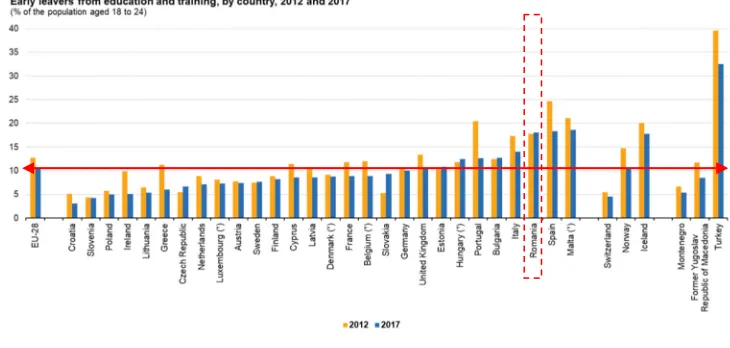
Among the European Union Member States, according to EUROSTAT- Analysis by degree of urbanisation, the highest proportion of early leavers was reported mostly in rural areas in countries like: Bulgaria, Denmark, Greece, Croatia, Latvia, Hungary, Portugal, Romania, Slovakia, Finland and Sweden. In Romania according to the same source the percentage of early leavers from education and training of population with the age between 18-24 which had completed at most a lower secondary education and were not in further education or training is far from been achieved. Even if the early school dropout rate slightly decreased from 19,1% in 2015 to 18,3% in 2017 the percentage raised from 2012 as
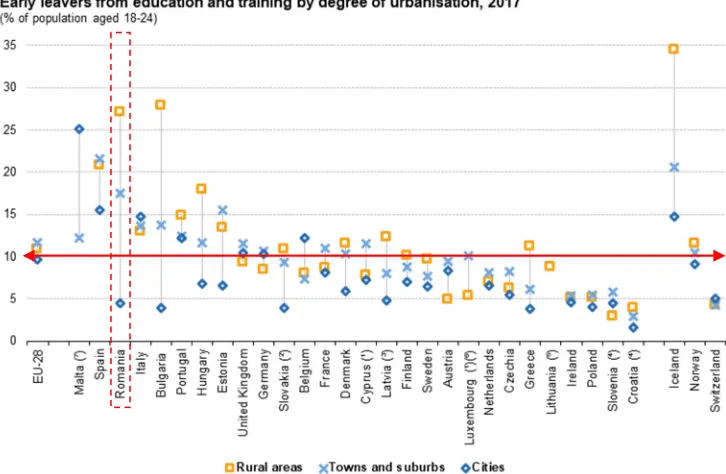
it can be seen in Figure. 1 and the goal of maximum 10% proposed in the Strategic framework for European cooperation in education and training (ET 2020) it is hardly to believe that Romania will realize. Even if in Romania the rate of early school leaving required by the European Union for 2020 is met in the cities where the percentage was 6,2% in 2017, but in small towns and suburbs it increases to 17,4% and reached 26,6% in rural areas. (Figure 2.)[3]
The European Union uses the term “Early leaver from education and training”, previously named early school leaver, to refer to a person aged between 18 to 24 years who has completed at most lower secondary education and is not involved in further education or training. [3]
Fig. 1. The evolution of early leavers from education and training in Romania and other countries, from 2012 to 2017 [3]
Many studies have been carried out to identify the situation of state education and its quality, many problems being identified such as: the social situation and environment of children, the material basis of the schools, the lack of technological equipment and means of communication, the endowment of libraries and laboratories, qualification of the teachers and staff, difficult living conditions of children from poor families, parental education level, human resource and school resilience [4, 5].
Many of these studies have highlighted the large discrepancies between urban and rural areas. The study „A look at participation in education using cohort analysis” revealed a significant difference between children participating in the urban and rural education system between 2010 and 2016. The share of children in education is kept in favor of the city starting with preschool, continuing with primary and secondary education where only three quarters of children of 11 years old are in education and about 80% of the 12-13 years old [5].
The graduation rate of the baccalaureate exam grew significantly from 2014 to 2018 both in urban and rural areas. If in 2014, in the urban area, the rate of advancement was 75.07% and in the rural one was 64.71%; in 2018 the percentage reached 93.55% in urban areas and 88.87% in rural areas. The 10.36% gap between urban and rural areas in 2014 declined to 4.68% in 2018. Even if the numbers seem to be encouraging, given that the
number of high school students in rural areas is much lower than in the urban areas, the disparity and the need to improve the rural education system remains a topical issue that is still being unsolved [6].
[image:2.482.57.422.201.375.2]The degree of enrolment in education, which can be explained largely by the economic gaps between the two residence environments (rural and urban), does not depend mainly on endowment with modern systems and technology of schools or the number of teachers, but rather depends on: the income of the population and the degree of parenthood education, on how the parents are encouraging their children to have good results in learning and on the patterns that children and young people have in their environment [7, 8].
Fig. 2. The situation of early leavers from education and training in Romania 2017 comparing with other countries, by degree of urbanisation [9]
From this statistics and studies we can realize that the children from rural areas need a special attention and special strategies must be created and implemented in order to improve this situation. The importance of decreasing the rate of early school dropout in rural areas is important because it generates major individual social costs linked to lost development opportunities, unemployment, social exclusion and poverty. Short and long term strategies must be implemented for the rural Romanian context combining prevention, intervention and compensation measures.
2 Methodology
2.1 Premises and assumptions
it can be seen in Figure. 1 and the goal of maximum 10% proposed in the Strategic framework for European cooperation in education and training (ET 2020) it is hardly to believe that Romania will realize. Even if in Romania the rate of early school leaving required by the European Union for 2020 is met in the cities where the percentage was 6,2% in 2017, but in small towns and suburbs it increases to 17,4% and reached 26,6% in rural areas. (Figure 2.)[3]
[image:3.482.63.426.184.421.2]The European Union uses the term “Early leaver from education and training”, previously named early school leaver, to refer to a person aged between 18 to 24 years who has completed at most lower secondary education and is not involved in further education or training. [3]
Fig. 1. The evolution of early leavers from education and training in Romania and other countries, from 2012 to 2017 [3]
Many studies have been carried out to identify the situation of state education and its quality, many problems being identified such as: the social situation and environment of children, the material basis of the schools, the lack of technological equipment and means of communication, the endowment of libraries and laboratories, qualification of the teachers and staff, difficult living conditions of children from poor families, parental education level, human resource and school resilience [4, 5].
Many of these studies have highlighted the large discrepancies between urban and rural areas. The study „A look at participation in education using cohort analysis” revealed a significant difference between children participating in the urban and rural education system between 2010 and 2016. The share of children in education is kept in favor of the city starting with preschool, continuing with primary and secondary education where only three quarters of children of 11 years old are in education and about 80% of the 12-13 years old [5].
The graduation rate of the baccalaureate exam grew significantly from 2014 to 2018 both in urban and rural areas. If in 2014, in the urban area, the rate of advancement was 75.07% and in the rural one was 64.71%; in 2018 the percentage reached 93.55% in urban areas and 88.87% in rural areas. The 10.36% gap between urban and rural areas in 2014 declined to 4.68% in 2018. Even if the numbers seem to be encouraging, given that the
number of high school students in rural areas is much lower than in the urban areas, the disparity and the need to improve the rural education system remains a topical issue that is still being unsolved [6].
The degree of enrolment in education, which can be explained largely by the economic gaps between the two residence environments (rural and urban), does not depend mainly on endowment with modern systems and technology of schools or the number of teachers, but rather depends on: the income of the population and the degree of parenthood education, on how the parents are encouraging their children to have good results in learning and on the patterns that children and young people have in their environment [7, 8].
Fig. 2. The situation of early leavers from education and training in Romania 2017 comparing with other countries, by degree of urbanisation [9]
From this statistics and studies we can realize that the children from rural areas need a special attention and special strategies must be created and implemented in order to improve this situation. The importance of decreasing the rate of early school dropout in rural areas is important because it generates major individual social costs linked to lost development opportunities, unemployment, social exclusion and poverty. Short and long term strategies must be implemented for the rural Romanian context combining prevention, intervention and compensation measures.
2 Methodology
2.1 Premises and assumptions
(1782-1852), known as the father of pre-school education and the inventor of the term “kindergarten” has introduced for the first time the concept of “learning by play”, a concept which make the difference between the normal school and “summer schools” and this is the reason why the last ones are more attractive for the children than the state education.
Active learning approaches help students learn more effectively than traditional methods that rely on "teaching by telling", and this concept has been used and promoted more than thirty years ago by Piaget. It is also defined as „Instructional activities involving students in doing things and thinking about what they are doing” [10].
Taking into account the new active learning approaches, the aim of this article is to present a case study on the summer schools’ workshop „Little Architects” organized by the association Alterantive Education Lugoj, in 5 villages and in a Children’s centre who are in risk of School dropout in Lugoj. The focus is on how this alternative education workshop can be used in order to prevent new cases of school dropout and how it can be used for attracting and maintaining them as much as possible in the educational system and even to create a path for them in the university education.
In 2011, in Romania, there were 3.283.663 children between 3 to 17 years old who weren’t attending any form of education and the situation it is not improving because in 2015 there were 3.093.608 children according to the statistics of Ministry of National Education, even if one of the main rights of children, according to the "Convention of the Rights of the Child" article 28, is the right to education [11].
2.2 Subjects and methods
For almost ten years the nongovernmental association “Alternative Education” organized summer schools for children in Lugoj, a small city in Timiş County, and in different villages from the same County in Romania. The summer schools are dedicated to children between 5 and 12 years old. Starting with 2013 these summer-schools were organized in the countryside too, and with each passing year the number of villages and children increased. In 2013 the association started the activities in the village Petroasa Mare with 50 children and in 2014, in the same village, 70 children participated to the summer school activities. In 2016 the activities were organize in Criciova countryside (the villages: Jdioara and Cireșu) for 50 children and in 2017 in the same villages the number of participants increased to 70. In the 2018 the summer school was organized in two countrysides: Criciova (the villages: Jdioara and Cireșu ) and Balinț (the villages: Târgoviște and Fădimac) with almost 200 children participating to the activities.
During these years approximately 300 children from the rural region of Timis County participated in different non-formal educational workshops with the involvement of the teachers from the villages, 5 members of Alternativ Education association and more than 50 volunteers [12].
2.3 Case study on the workshop “The Little Architects”
In 2018 Alternativ Education association in partnership with Faculty of Architecture and Urbanism from “Politehnica” Timișoara organized the workshop “The little architects” during the Summer school „The Non-formal Comes to the Village”. The workshop was realized first in Lugoj, a small city from Timis County, with 37 children from Educational Centre Sait Nicholas, a day centre for children on risk of school dropout, and after that in two different days at Criciova and Balinț, two villages from the same County. Two hundred small cardboard houses were decorated during the 3 days of educational activities with the help of 30 volunteers of the association AlternativEd Lugoj, 12 students from the Faculty of Architecture and Urbanism and the coordinator teachers.
This workshop was only one of the many events organized by this association during the two weeks of summer school, where they realized creative activities, educational and recreational workshops: like English, craft, general knowledge, theatre, dance, culinary workshop, entertainment, gardening and movie projections etc.
The workshop was divided in two parts: a presentation and a practical activity.
In the first part the students from the Faculty of Architecture and Urbanism presented to them movies about the main architectural masterpieces all over the world and about how architects define a house and a home. The children had to complete a questionnaire about what does a home means to them, and to choose from different types of architectural styles three buildings that they perceive the most as a home.
In the second part they had to decorate small cardboard models of a simple house, which had as inspirational source “Casa all’italiana”, the work of Anila Rubiku born in Albania, a small house akin to the naive schemes in children’s drawings. (Fig. 3.)
At the beginning they explored the cardboard house by playing and discovered their potential. After that starting from the same prototype, they had to decorate his own cardboard house transforming it according to their perception of a home and decorating it as creative as they could using architectural elements they know or they heard about in the presentation: chimney, shutters, roof cover, fences, etc; personalizing them by using different colours, characters, cars, trees or even using fantastic elements like fairies. (Fig.4.)
Fig. 3. The first interaction of the children with the cardboard models which they had to decorate and transform in the house of their dreams [13]
Fig. 4. The inside and outside perception of the initial model and the final result of the cardboard houses decorated [13, 14]
This workshop was only one of the many events organized by this association during the two weeks of summer school, where they realized creative activities, educational and recreational workshops: like English, craft, general knowledge, theatre, dance, culinary workshop, entertainment, gardening and movie projections etc.
The workshop was divided in two parts: a presentation and a practical activity.
In the first part the students from the Faculty of Architecture and Urbanism presented to them movies about the main architectural masterpieces all over the world and about how architects define a house and a home. The children had to complete a questionnaire about what does a home means to them, and to choose from different types of architectural styles three buildings that they perceive the most as a home.
In the second part they had to decorate small cardboard models of a simple house, which had as inspirational source “Casa all’italiana”, the work of Anila Rubiku born in Albania, a small house akin to the naive schemes in children’s drawings. (Fig. 3.)
[image:5.482.140.345.299.385.2]At the beginning they explored the cardboard house by playing and discovered their potential. After that starting from the same prototype, they had to decorate his own cardboard house transforming it according to their perception of a home and decorating it as creative as they could using architectural elements they know or they heard about in the presentation: chimney, shutters, roof cover, fences, etc; personalizing them by using different colours, characters, cars, trees or even using fantastic elements like fairies. (Fig.4.)
Fig. 3. The first interaction of the children with the cardboard models which they had to decorate and transform in the house of their dreams [13]
Fig. 4. The inside and outside perception of the initial model and the final result of the cardboard houses decorated [13, 14]
[image:5.482.121.364.417.504.2]Fig. 5. The final result from the activity realized in one village: all cardboard houses putted together in a random way [13]
Fig. 6. The neighbourhood created by placing, by children, all the decorated cardboard houses in order to create an imaginary community [13]
3 Results and discussions
The main objectives and results of the workshop “Little Architects” were:
- Acquiring new knowledge related to architecture, society, environment, after watching animation movies and documentaries meant to arouse their curiosity in education;
- Working with students from the Faculty of Architecture and Urbanism was a beneficial experiment for the both parts. For children because they could find role models in young people with which they can communicate easier, and for students because they had the chance to present their knowledge in a way which can be understood, interactive and attractive for children from different ages. At the workshop participated children form 3 years old till 12.
- Increasing the interest for knowledge and personal development among children through educational activities that combine games and passing on new concepts. In this way they can feel more attracted to go to school and they can improve their opinion about what school means.
- All the activities were developed in the school yards and in this way they can associate the school environment with educational activities but also manifesting joy during learning and feeling free to collaborate in a creative way with other children and teachers. (Fig.7)
[image:6.482.115.370.178.278.2] [image:6.482.122.363.531.639.2]- Developing the capacity of principle relationship and communication with other children of the same age but also with different age and educational level in order to stimulate their development and creativity.
- Acquiring communication and socialization skills through creative work and team work when they had to put all the small houses together and to create their own neighbourhood. -The purpose of the workshop and of the summer school was to stimulate the voluntary involvement of children in educational but also recreational activities, where children had to work separately but in the end each individual work created a village through a state of acceptance, negotiation, cooperation and solidarity.
The analysis of the process and the results indicates that it is needed to encourage the young population, since there childhood, to discover their own potential and passion. This is needed in order to determine this category of children in risk, to fight against the poverty, the environment and all the unfavourable elements of the current Romanian educational system in order to follow a higher-education program.
4 Conclusions
Analyzing the evolution and the results of the summer schools organized by “AlternativEd Lugoj” over the years, we could notice that not only the number of children increased with each year that passed, but also the numbers of schools from the villages who have requested to participate at the summer schools also increased and the most important thing is that the percentage of children who attended again the summer school in the next year is 90%.
This article proves that Alternative education through workshop and active learning and teaching methods are efficient in order to sustain the European strategies for preventing the school drop-out and also a method of rehabilitation for children who are already on risk. The “Little Architects” Workshop helps children with a high risk of school dropout, or of those who are not attending at all the school, to connect with: the school environment, with other children of the same or different age and level of education; and teaches them that respecting some rules can be fun and educative too. The interaction with the association volunteers and “Politehnica” University’s students helps them to find some role models in them and to determine them to struggle through all the problems in order to succeed. These strategies are important not only because European Union recommends it but also because increasing investment in education can be a long-term solution to prevent poverty and social exclusion.
Research realized during the internship at „Instituto Romeno di Cultura e Ricerca Umanistica di Venezia”, obtained with the support of the Romanian state through the national scholarship program „Nicolae Iorga”.
References
1. Council of the European Union, European Comision, Education and Training- Policies, (2011); Source: https://ec.europa.eu/education/policy/strategic-framework/et-monitor_en -Consulted in 22.04.2019
2. European Commission, Education and Training Monitor 2018; Source: https://ec.europa.eu/education/sites/education/files/document-library-docs/et-monitor-report-2018-romania_ro.pdf -Consulted in 22.04.2019
4.
Source:https://ec.europa.eu/eurostat/statistics-explained/images/6/62/Early_leavers_from_education_and_training%2C_by_country %2C_2012_and_2017_%28%25_of_the_population_aged_18_to_24%29.png
5. C. Novak, Ș. Iosifescu, Investiţie în educaţia copiilor din mediul rural (2017), Source:
https://fundatia-vodafone.ro/wp-content/uploads/2017/09/Investitie-in-educatia-copiilor-din-mediul-rural.pdf, Consulted in 20.04.2019
6. I. Horga, M. Jigău, O. Apostu, C. Fartușnic, UNICEF coordinator- L. Costache La Școala- O privire asupra participărrii la educație folosind analiza pe cohortă, (Editura Alpha MDN, București, 2017)
7. Ministerul Educației, Culturii și Cercetării, Raportul Examene și Evaluări Naționale 2018, Source: https://mecc.gov.md/sites/default/files/bac_2018_site.pdf, Consulted in 20.04.2019
8. M. R. Stanef, Sistemul educaţional din România, disparităţi dintre mediul urban şi cel rural, Economie teoretică şi aplicată, XX, No. 1(578), pp. 83-93, (2013)
9. R. Pricopie, V. Frunzariu, N. Corbu, I. Loredana, A. Bârgăoanu, Acces și echitate în învățământul superior din România- Dialog cu elevii și studenții, Editura Comunicare.ro, (2011)
10. EUROSTAT, Consulted in 20.04.2019 11.
Source:https://ec.europa.eu/eurostat/statistics-explained/images/5/56/Early_leavers_from_education_and_training_by_degree_of_urb anisation%2C_2017_%28%25_of_population_aged_18-24%29_ET18.png
12. C.C. Bonwell, J.A. Eison, Activelearning:creatingexcitementintheclassroom. ASH#-ERIC Higher Education Report No. 1, Washington, D.C.: The George Washington University, School of Education and Human Development, (1991)
13. United Nations, Human Rights, Convention on the Rights of the Child. New York, (1989), Source: http://www.ohchr.org/en/professionalinterest/pages/crc.aspx Consulted in 20.04.2019
14. C.M. Povian, C.Popescu, Alternative Methotods of Learning during the Summer Schools for Children from Diffrent Environments, New Trends and Issues Proceedings on Humanities and Social Sciences, Vol 4 No 3, pp: 194-198 , (2017)
15. Personal photos, (2018)
![Fig. 3. The first interaction of the children with the cardboard models which they had to decorate and transform in the house of their dreams [13]](https://thumb-us.123doks.com/thumbv2/123dok_us/8220176.265674/5.482.121.364.417.504/interaction-children-cardboard-models-decorate-transform-house-dreams.webp)
![Fig. 5. The final result from the activity realized in one village: all cardboard houses putted together in a random way [13]](https://thumb-us.123doks.com/thumbv2/123dok_us/8220176.265674/6.482.122.363.531.639/result-activity-realized-village-cardboard-houses-putted-random.webp)
