International Journal of Innovative Technology and Exploring Engineering (IJITEE) ISSN: 2278-3075, Volume-8 Issue-7, May, 2019
Abstract: The MANET is mainly consists of a mobile or sensor node that transfers data through the cluster heads to the base station. In this paper, the main approach is to improve the network’s lifetime because they have inbuilt non-rechargeable batteries and die in the network cycle. Firstly we discuss about the cluster and how a cluster is formed. Then will see that there are some flaws in the LEACH model to overcome that we use the extended model or approach called the FSBCA model wherein the most important feature is, it considers the Expected Residual Energy (ERE) and distributes the workload evenly. And also the fuzzy member function factor is considered wherein the numbers of nodes dead in network are less compared to the LEACH model. This paper deals with the fuzzy score based clustering algorithm with an energy predication extension to increase network lifetime. Later at the end we see that in the stimulated results the approached model i.e. concentrated algorithms has more efficiency than the other algorithms. This is a basic approach in which it is for the stationary nodes in the MANET’S which can be later accomplished to a larger-scale Mobile Ad-hoc network.
Index Terms: Fuzzy Logic, LEACH, Lifetime of network, MANET, Residual Energy
I. INTRODUCTION
Exclusive research has been carried out in the fields of analog and digital electronics, wireless communication and manufacturing of semiconductors in recent years, thus giving us low - power consumables, feasible and relatively small - sized equipment with embedded sensors, processing and communication capabilities. A MANET consists of "nodes" ranging from a few hundred or even thousands of sensors in which there are many, Such as an internal antenna radio transceiver or sometimes an external antenna, a microcontroller and a sensor interface electronic circuit. They also have embedded batteries which are not so efficient and hence research is taking place in that field in order to increase their lifetime and also in the energy efficiency of Mobile Ad-hoc network [1, 2, 3, 4, 5].
II. RELATED WORK
Cluster mechanism is the new energy efficiency approach for sensor devices. Because only few nodes are allowed to transfer the message or communicate with the base station,
Revised Manuscript Received on May 06, 2019
Prasad A.Y, Research Scholar, Dept CSE, Rajarajeshwari College of Engineering, Bangalore-560074, India
DR R. Balakrishna, Principal, Rajarajeshwari College of Engineering, Bangalore-560074, India.
known as the cluster heads (CH). The cluster heads receive the message from every node alone, then combine it and then send the aggregated messages to the base stations. The LEACH protocol is a probabilistic model for choosing the best optimum cluster head and rotates it to balance energy consumption at regular intervals. At times an inefficient CH is selected because LEACH selects on probabilistic design such that the CH can be very near to each other or so on, whereas these CH can’t maximize the efficiency [6, 7]. The proper selection of the CH can Reduce energy efficiency and extend the network's lifetime. To handle the uncertainties of the WSN we employ the fuzzy-logic algorithm. Often the fuzzy-logic algorithms use fuzzy logic to select CH. To overcome the flaws in LEACH we use 3 descriptors such as the residual energy, concentration and centrality. Here Concentration here means that number of nodes that are present next to the CH, Centrality means the cluster's central node. At every interval the node pass on the received message to the base station and in that the CH is selected. Whereas this mechanism is centralized approach on the other hand we have the CHEF: Cluster Head Election Mechanism In this mechanism we see reduced overhead collection and calculation and prolonged the lifetime of the MANET. Here we are mainly using 2 descriptors of residual energy and local distance. Local distance in the sense of the distance in the prescribed radius between the CH and the nodes. This approach reduces the burden on the base station because all nodes do not need to collect information. Well we have seen that selection of the CH is not easy all the time [8]. Well this approach was later taken by the approach in which different parameters were included such as the battery power, number of neighboring nodes, distance from the cluster centeroid, network traffics and based on all these they evaluated the performance. They observed that the sensor nodes closer to the base station consumed more power or energy due to increased network traffic in that zone so evidently the sensor nodes closer to the base station lost power. Hence when this drawback had to rectify they considered the fuzzy descriptor wherein the nodes would have unequal sizes and mainly the cluster sizes would decrease when nearing to the base station.
As of the LEACH designing the present clustering techniques considered the residual energy of the nodes during the selection of the CH’S. They all failed to discuss about the remaining power when the CH has been selected and running around. Here running around means the successive time between the formations of clusters. The paper's purpose is to discuss
the fuzzy score based clustering algorithm with an
Optimized Energy Efficient Routing Protocol for
MANET using Fuzzy score based clustering
algorithm
energy predication extension to increase lifetime of the MANET's by distributing the workload evenly [9, 10]. Till now we discussed about the descriptor as residual energy being used but now we are using Expected Residual Energy (ERE). To estimate the ERE we also need EEC: Expected Energy Consumption. Now that we have the new approaches we have the LEACH approach extended with the IEE approach with fuzzy logic hence the combined approach is called the IEE-LEACH approach. As we discussed above that the remaining energy is not used or discussed here in this approach the remaining energy is used.
OBJECTIVE OF THE PROPOSED SYSTEM
The routing approach based on the energy is interesting due to the energy aware along with the prediction of the mobility is important whereas the working of nodes nature is mobile ad-hoc. The review of literature shows that the energy aware routing is given by the LEACH in TDMA. It efficiently makes use of the mobile sensor node communication in a dependable method. The objective concerned in the research work is the achievement of dependable communication along with less energy and also less cost based routing in the MANET [11].
The following objectives are achieved in the research work.
a) Low energy adaptive classified clustering delivers enhanced energy application in MANET. b) It periodically switches the cluster head, thus
maximum node cover in radio range.
c) It is node mobility founded route selection approaches so that dependable path is revealed from source to destination.
d) It rises the network lifetime, throughput, live nodes number, End to End Delay plus packet delivery ratio of the network.
III. LEACHCLUSTERINGALGORITHM
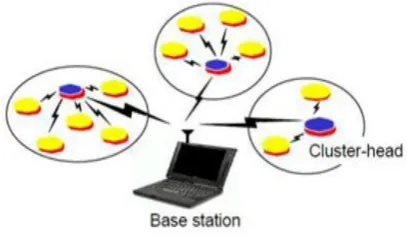
[image:2.595.66.270.563.681.2]The Leach protocol architecture is presented in the below figure 2.1.
Figure 2.1: Leach Protocol Architecture
Heinzelman[12] proposed the LEACH protocol for WSN. Its process is biforcated into rounds. Every round starts with a new setup-phase in which the organization of the clusters is done. In the phase of steady state, many data frames get transferred to the CH by the nodes and towards the station of the base. Its core objectives are increase in network life time,
decreased energy consumption; use data aggregation to decrease the communication massages number.
(1) In the Equation (1),
p = possibility of the node being nominated as a cluster-head node
r = total number of rounds-passed G = ordinary nodes collected mod = modulo operator
T (n) = cluster head selected threshold value in every round The CH formed based on the equation in which sensor node create the random number from 0 to 1. If the created number is less than the T (n) threshold, then the node is chosen as the CH. From the Figure 2.1, the higher energy node becomes the CH if its energy is greater in comparison with the remaining nodes energy. It gives the joining bid to remaining nodes in the cluster. The remaining node takes decision either to be with the CH or not. The assignment of the TDMA to the nodes is done after obtaining the acknowledgement. The CH after collecting the information from other nodes, it is sent to the BS. So it requires larger quantity of energy in comparison with the other nodes. The choice of the CH is based on the nodes possessing more energy. Whenever the CH is made as fixed, it takes more energy and perishes at the earliest. Whenever the CH becomes failure in the network the entire cluster is not reachable. In the LEACH protocol [13], the CH is changed amongst the nodes in the network. The energy consumption by every node is consistently scattered. It enhances the network lifetime. By using the TDMA technique, the allocation of time is done to every node in the CH. The CH groups the collected data from all the remaining nodes.
A. Leach Operation
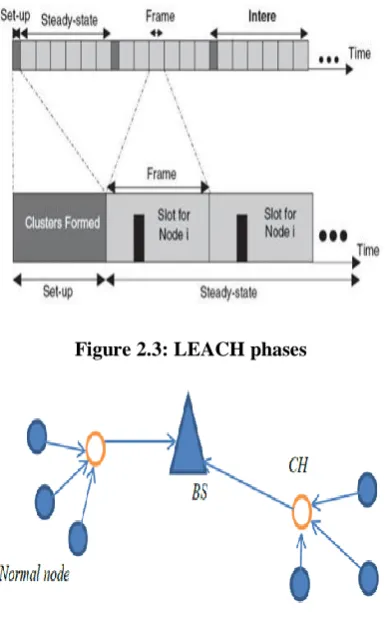
The simple actions of LEACH are ordered in two separate stages as shown in figure 2.3. In LEACH the nodes gets arranged to form the clusters on their own. The cluster head receive the data starting from the non-cluster heads. The cluster head performs the function of signal processing on the data. The cluster head makes TDMA and informs the each member of the cluster where to send the data.
(1) Setup phase –In this the cluster heads are created. The cluster head must inform the remaining nodes about its selection as the cluster head. Next the broadcasting by the cluster head the members chooses which cluster head to choose in the particular communication.
(2) Steady-state phase – collection of the data, accumulation, and distribution to the BS occurs in this phase. The data is sent by the nodes to the cluster head. TDMA is applied for transferring the data in terms of frames. Every node has specific time to transmit the data in
International Journal of Innovative Technology and Exploring Engineering (IJITEE) ISSN: 2278-3075, Volume-8 Issue-7, May, 2019
[image:3.595.73.268.78.394.2]be done for further transmission to BS. It is presented in the figure 2.4.
Figure 2.3: LEACH phases
Figure 2.4: LEACH routing protocol
LEACH practices a TDMA centred MAC protocol, and in the direction to retain stable energy consumption [14, 15, 16, 17, 18, 19].
IV. PROPOSEDFUZZYSCOREBASED
CLUSTERINGALGORITHM
The proposed architecture of the system includes simulation, monitor agent, detection of node failure, and management of node failure and set of Fuzzy rules. Simulation is limiting the operation of a process or system in the real world over time. It can be done by hand or computer. Fuzzy rule set is a set of rules that allow or deny network traffic to resources that is connected with virtual networks. The proposed system assumes that all sensor nodes in the area are distributed randomly and it is assumed that each node knows its own position, neighbors and sink.
All nodes have the same maximum range of transmission and the same initial amount of energy. Energy is distributed among all nodes. Monitoring agent collects data from specific data source and it is used to observe or track the nodes activity. Whenever node runs out of energy, connections between other nodes and the base station will break due to the end of this network's lifetime.
To overcome the use of this fuzzy score based clustering approach to predict the mobility and energy of the sensor node, this will help extend the network's lifetime. If nodes energy is high and mobility of nodes also high, then the chances of selecting the cluster head is less. If energy is low and mobility is also low then chances of selecting the node as cluster head is also low.
[image:3.595.316.535.125.264.2]Fuzzy approach selects the node with high energy and low mobility and nearest distance node as the cluster head. Selecting a proper cluster head will increase the path stability. Stability of the path improves routing protocol performance and then automatically life time of network also will increase.
Fig.4.1.Architecture diagram
We use Fuzzy Interface Systems (FIS) to handle uncertainties, for the computation of chance in each node. For the computation of Chance we need to give inputs here the inputs are RE:Eresidual and ERE: Eexpresidual the output is a single one and that is the Chance.
The Fuzzy set is HIGH, rather HIGH, Medium, rather low, low and very low for the residual energy. The trapezoidal membership function is used here for high and low linguistic variables and the triangular function is used for the rest and the residual energy is the second input.
The following linguistic variables, such as HIGH, MEDIUM and LOW, are the fuzzy set for the expected residual energy. Trapezoidal membership is used for low and high membership, while triangular membership is used for medium membership alone. These were the inputs and the only output given is a CH candidate's chance.
The linguistic variables VERY HIGH, HIGH, RATHER HIGH, MEDIUM, RAHTER LOW, LOW AND VERY LOW give the fuzzy set for the output of a chance. The trapezoidal function is VERY HIGH, VERY LOW in these and the remaining are the triangular membership functions. For efficiency and feasibility the triangular membership functions are used.
To handle the uncertainties the Chance is calculated by the if-then mapping rules. The if-then mapping rules have 2 inputs and 18 rules by employing these rules we can get the Chance. For defuzzification of chance we employ the Centre Of Area method. To generate the fuzzy rules we employ the Heuristics fuzzy rule it states that the node which has to become a CH is decided by the high residual energy and the expected residual energy.
A. EXPECTED RESIDUAL ENERGY
The number of clusters is not known without the formation of the cluster. But the numbers of neighbors are known hence we can find the amount of energy consumption in the selection of a CH. Now that the cluster formation process is over and the CH is selected we need to transfer data from the nodes to the base station via the CH but the operation is not a fully fledged one the
Suppose a CH has k nodes and the CH receives K messages it compresses them into one and then send to the base station. To decide the number of frames we use the following equation 2:
(2)
Where is the operation time. is slotted time for transmitting messages from the nodes to the CH, tCHtoBS is the time for sending the compressed from CH to base station. The expected amount of energy a node consumes to be a C H is given by equation 3:
Where in transmits all the sensor nodes and receives the same amount of data bits. The received signal strength is used to calculate the distance between the base station and the nodes. The energy for a node to become a CH is given by equation 3.
[3] Where is a node's residual energy prior to selecting CH.
B. FSBCA
The IEECH-LEACH method is the extension of the LEACH method. The FSBCA methods forms clusters in every round. We have discussed the algorithm as follows:
[image:4.595.54.280.513.616.2]Each sensor node generates a particular number form 0-1 in every clustering round. To become a CH the random number of the node should be bigger than the threshold value d0, that is the percentage of the desired tentative CH. The Chance is calculated by the FIS discussed above. The broadcasted candidate -message states the node of CH and the value of the Chance. Now that one nodes Candidate- Message is broadcasted every node should do the same now when all the Candidate-messages are displayed the node can check if it has the bigger value of the CH then it can display a Candidate-message saying that it s Chance number is the biggest and declare itself the CH. if the node which is not a CH receives a Candidate-message then the message is passed on to the nearest cluster head and the Join-Req is passed.
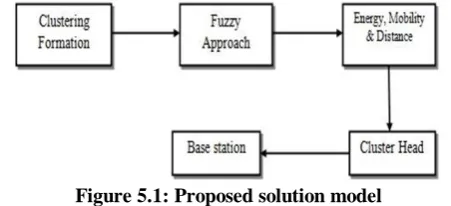
Figure 5.1: Proposed solution model
Figure 5.1 illustrates a solution model to a given problem. The proposed system consists of 10, 25, 50, 75, 100, 150
nodes. Without any fixed infrastructure, all nodes are distributed randomly.
All nodes are then grouped together to form a cluster based on similarity between all nodes and energy is randomly transmitted between all nodes.
After the cluster formation, fuzzy logic approach is applied to predict nodes energy, distance and nodes mobility.
After applying energy, mobility and distance to the cluster, the cluster-head will be detected.
Based on high energy, low mobility and nearest distance nodes, the cluster head is chosen.
After the cluster head has been found, all nodes transfer packets or data to the CH in turn CH will send data to the base station.
The path is finally discovered. Path stability improves lifetime of the battery.
C. ALGORITHM
Create clusters and select cluster heads based on high energy and low node mobility. Do it for every cluster. Source nodes forward data to the cluster head. Cluster head aggregates data received over a certain
period of time from nodes.
The data is compressed by the cluster head and the data is sent to the base station.
If existing cluster heads haven't spent much energy during their process and have more energy than needed.
Continue with the current cluster and cluster head. Else
Use fuzzy clustering approach to select new cluster heads.
end for End.
V. PERFORMANCEEAVALUTION
This section involves the results of the above analysis. When we compare the LEACH, IEECH-LEACH, FSBCA, model,
the FSBCA model comprised of LEACH, IEECH-LEACH.
The results have shown this approach revealed better or efficient results compared to the other algorithms.
A. SIMULATION SETUP
Simulation settings for Fuzzy Score Based Clustering Algorithm (FSBCA) protocol implementation are shown below. The simulation parameters for the evaluation of the energy efficient cluster head selection shown in table 3. Fixed network size is 1000 X 1000 m2 and 150 nodes created. The initial energy of every node was set to 10 Joules. Energy for data aggregation is 2nJ. The data packet size is 780 bits and data transmission time is 10. Here Fuzzy Score Based Clustering Algorithm (FSBCA) routing protocol is used.
Table 1: Simulation parameter
Parameter Value
Propagation Two ray ground
Field size 1000m X 1000m
Number of nodes 150
Channel Type Wireless Channel
Antenna Type Omni
Link Type LL
Initial energy of MANET node
10J
Data packet size 780
Simulation time 50
Transmission time (ms)
10,20,30,40,50
International Journal of Innovative Technology and Exploring Engineering (IJITEE) ISSN: 2278-3075, Volume-8 Issue-7, May, 2019
Observation Parameters
Packet Delivery Ratio, End to End Delay, Routing Overhead, Energy Consumption.
B. SIMULATION RESULT
The results of FSBCA model were more than LEACH, IEECH-LEACH.
1. Packet delivery ratio
[image:5.595.312.545.73.389.2]Here from the comparison of Packet Delivery Ratio of FSBCA protocol with LEACH, IEE-LEACH protocol as shown in figure 6.1, results obtained from simulation are tabulated in Table 2. The FSBCA attains higher value of packet delivery ratio in comparison to LEACH by 19.30%, IEE-LEACH by 19.19%.Simulation results have shown that Packet Delivery Ratio is high FSBCA protocol and LEACH shows less packet delivery ratio.
Table 2: Measures of Packet Delivery Ratio of LEACH vs IEE-LEACH vs FSBCA
Number of nodes LEAC H
IEE-LEAC H
FSBCA
10 72.14 72.44 91.21
25 71.21 72.56 92.81
50 73.02 73.98 94.12
75 74.03 74.16 94.89
100 74.12 74.23 93.12
150 75.92 76.02 94.08
Figure 6.1: Comparison of Packet Delivery Ratio vs Number of Nodes
2. End to End Delay
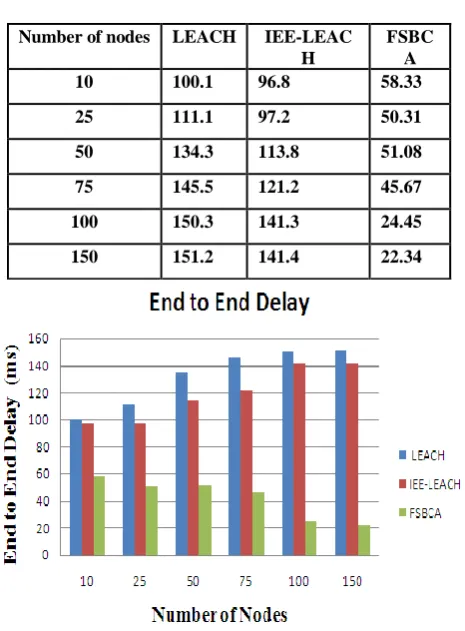
Here from the comparison of End to End delay of FSBCA protocol with LEACH and IEE-LEACH protocol as shown in figure 6.2, results obtained from simulation are tabulated in Table 3. The FSBCA gives lower value of End to End Delay in comparison to LEACH by 85.22%, IEE-LEACH by 84.20%. The FLGA gives Simulation results have shown that End to End Delay is lesser in FSBCA protocol and LEACH shows high End to End Delay
Table 3: Measures of End to End Delay of LEACH vs IEE-LEACH vs FSBCA
Number of nodes LEACH IEE-LEAC
H
FSBC A
10 100.1 96.8 58.33
25 111.1 97.2 50.31
50 134.3 113.8 51.08
75 145.5 121.2 45.67
100 150.3 141.3 24.45
150 151.2 141.4 22.34
Figure 6.2: Comparison of End to End Delay vs Number of Nodes
3. Routing Overhead.
Here from the comparison of Routing Overhead of FSBCA protocol with LEACH and IEE-LEACH protocol as shown in figure 6.3, results obtained from simulation are tabulated in Table 4. The FSBCA gives lesser value of routing overhead in comparison to LEACH by 35.72% and IEE-LEACH by 30.87% .Simulation results have shown that Routing Overhead is less FSBCA protocol and LEACH shows high Routing Overhead.
Table 4: Measures of Routing Overhead of LEACH vs IEE-LEACH vs FSBCA
[image:5.595.46.292.339.640.2]Figure 6.3: Comparison of Routing Overhead vs Number of Nodes
4. Energy Consumption
[image:6.595.55.301.398.707.2]Here from the comparison of Energy Consumption of FSBCA protocol with LEACH and IEE-LEACH protocol as shown in figure 6.4, results obtained from simulation are tabulated in Table 5. The FSBCA gives decreased in energy consumed in comparison to LEACH by 86.67%, IEELEACH by 85.96% Simulation results have shown that Energy Consumption is less in FSBCA protocol and LEACH shows Energy Consumption.
Table 5: Measures of Routing Overhead of LEACH vs IEE-LEACH vs FSBCA
Number of nodes LEACH IEE-LEAC
H
FSBC A
10 58.01 56.12 3.33
25 61.11 60.03 4.55
50 62.35 61.11 4.88
75 68.9 67.12 5.02
100 72.11 68.98 5.45
150 75.92 72.1 10.12
Figure 6.4: Comparison of Energy Consumption vs Number of Nodes
VI. CONCLUSION
The research work is concerned with the application of genetic algorithm to choose optimal number of CHs along with chromosome fitness value for giving CH optimal number, and the fuzzy logic method reduces the energy consumption of network. The CH uses the multi-hop routing based on Djikstra’s algorithm for sending the collected data to base station (BS) which also performs the load balancing. The result is estimated as the number of packets received at the base station. The FSBCA has the best results since it is receiving more data from the nodes to the base station in the network cycle. On the other hand even FSBCA has better results when compared to the LEACH, IEECH-LEACH approaches. By the comparison of LEACH, IEE-LEACH, protocol, the proposed FSBCA is better in performance. The packet delivery ratio is improved, decreased end to end delay, routing overhead is increased and consumption of energy is decreased.
ACKNOWLEDGMENT
The author would like to express sincere thanks for encouragement and constant support provided by the Management RRGI, Principal of RajaRajeswari College of Engineering, and HOD, Department of computer science and engineering, ACS College of engineering, Bangalore-74, India during this research work.
REFERENCES
1. Li, Xu, et al. Optimized multicast routing algorithm based on the tree
structure in MANETs, China Communications, 11(2), 90–99, 2014.
2. Jain, Aaditya, and Bala Buksh. Solutions for Secure Routing in
Mobile Ad Hoc Network (MANET): A Survey, Imperial Journal of
Interdisciplinary Research, 2(4), 2016.
3. Sarkar, Sajal, and Raja Datta. A secure and energy-efficient stochastic
multipath routing for self-organized mobile ad hoc networks, Ad Hoc
Networks, 37(1), 209–227, 2016.
4. Yan, Zheng, Peng Zhang, and Athanasios V. Vasilakos. A security and
trust framework for virtualized networks and software-defined
networking, Security and communication networks, 9(16),
3059–3069, 2016.
5. Yadav, Ajay Kumar, and Sachin Tripathi. Qmrprns: Design of qos
multicast routing protocol using reliable node selection scheme for
Manets, Peer-to- Peer Networking and Applications, 10(4), 897–909,
2017.
6. Singh, Tejpreet, Jaswinder Singh, and Sandeep Sharma. Energy
efficient secured routing protocol for MANETs, Wireless Networks,
23(4), 1001–1009, 2017.
7. Das, Santosh Kumar, Ajay Kumar Yadav, and Sachin Tripathi. IE2M:
Design of intellectual energy efficient multicast routing protocol for
ad-hoc network, Peer-to-Peer Networking and Applications, 10(3),
International Journal of Innovative Technology and Exploring Engineering (IJITEE) ISSN: 2278-3075, Volume-8 Issue-7, May, 2019
8. Acharya, Priyanka, and Jayesh Surana. A weighted clustering
algorithm for optimizing the energy consumption in MANET,
International Journal of Contemporary Technology and Management
5(7), 2016.
9. Arora, Saurabh. Minimization of Energy Consumption Using
EPAR-DSR Protocol in Manet, International Research Journal of
Engineering and Technology (IRJET) e-ISSN: 2395-0056, 4(6),
2017.
10. Rout, Umesh Prasad, and Puspamitra Panda. Performance Evaluation
of Power Efficient Protocol in MANET, Performance Evaluation,
1(1), 263–267, 2017.
11. Srinivas, K., and A. A. Chari. A Random Congestion Routing Protocol
Based on Queue Latency and Link Reliability Estimation in
MANETs, Indian Journal of Science and Technology, 9(33), 2016.
12. Heinzelman. W.R.,Chandrakasan: A, “Energy efficient
Communication Protocol for Wireless Microsensor Networks. In:
IEEE Computer Society Proceedings of the 33rd Hawaii International
Conference on System Sciences (HICSS '00), Vol. 8, pp. 8020,
Januarury, 2000.
13. Prasad A.Y & DR R. Balakrishna , An Optimized Solution For
Measures Of Network Life Time And Energy Consumption Using
Improved Energy Efficient Leach Protocol In MANET, Global
Journal Of engineering Science And Researches, Vol. 5 Issues. 8-
August, 2018
14. Yang.J and Zhang.D:An Energy-Balancing Unequal Clustering
Protocol for WSNs. In:Information Technology Journal, 57-63, 2009
15. Rajendra Prasad Mahapatra and Rakesh Kumar Yadav, Descendant of
LEACH Based Routing Protocols in Wireless Sensor Networks,
Procedia Computer Science 57 (2015) 1005 – 1014.
16. Kong, Hyung Yun. "Energy efficient cooperative LEACH protocol for
wireless sensor networks." Journal of Communications and
Networks 12, no. 4 (2010): 358-365.
17. Fuzhe Zhao, You Xu, and Ru Li, Improved LEACH Routing
Communication Protocol for a Wireless Sensor Network ,
International Journal of Distributed Sensor Networks, Volume 2012,
Article ID 649609, 6 pages.
18. Prasad A.Y & DR R. Balakrishna, Prolong the lifetime of the MANET
based on Genetic algorithm and simulated annealing optimization,
International Journal of Research in Electronics and Computer
Engineering (IJRECE), ISSN: 2348-2281, Vol. 6 Issues. 3- PP
2252-2257, July-September, 2018
19. Quality of Service (QoS) Provisions in Wireless Sensor Networks and
Related Challenges‖ by Bhaskar Bhuyan1, NityanandaSarma,
AvijitKar, Rajib Mall, Scientific Research, (October 2010).
20. Pooja L. Popat ,Maulik D. Trivedi, Optimization of cluster Head
Selection Technique in LEACH Protocol, International Journal of
Computer Application (2250-1797), Volume 5– No. 4, June2015.
21. JyotiRathi, M S Dagar, Improving LEACH Protocol in Wireless
Sensor Networks, IJSETR, ISSN: 2278- 7798 Volume 5, Issue 5,
May 2016.
AUTHORSPROFILE
Mr. Prasad A Y is pursuing Ph. D from Visvesvaraya Technologic University, Belagavi. He received M Tech master degree from SJC Institute of technology, Chickballapur- VTU, Karnataka and obtained his B.E. degree in CSE from East West Institute of Technology, Visvesvaraya Technological University, Belagavi. Currently, He is working as an Asst. Professor in CSE dept, at A C S College of Engineering, Bangalore, India. His research area of interests is in the field of wireless sensor networks, data mining, operation research, and computer architecture.