International Journal of Innovative Technology and Exploring Engineering (IJITEE) ISSN: 2278-3075, Volume-8 Issue-6C, April 2019
Abstract: A steady high throughput and energy efficient wireless body area network(WBAN) is created in this paper. WBAN is quite helpful in medical health care service for early detection of human health problems. Heterogeneous sensor nodes are deployed on human body to quantify physiological parameters like blood glucose, pulse, EMG and so on. Sensor nodes data are transmitted to a sink node forwarded through intermediate nodes. The information available in the sink node can be accessed by end users for further analysis. Minimization of energy consumption by sensor nodes is one of the important parameter in the design of WBAN protocols therefore multi-bounce method of correspondence is used. In this paper a new cost function is characterized to choose a forwarder node; a node with high residual energy and least separation to sink. Residual energy parameter settles vitality utilization among the sensor node while least separation enhances successful delivery to sink. The simulation results demonstrated the proposed protocol in contrast to contemporary schemes, maximizes the packets received at the sink node i.e. the throughput of the network.
Index Terms: Wireless body area network; energy efficient; Throughput; Cost function; Path loss.
I. INTRODUCTION
A Wireless Body Area Network (WBAN) is a developing innovation, a sub-field of wireless sensor network (WSN), specifically designed for monitoring and collecting data through wireless sensors. It is based on IEEE P802.15.6-2012 standard [1]. The technology is quite promising which has application in many diverse areas such as habitat monitoring, agriculture field monitoring, smart homes, battle fields etc. One of the important application of WBAN is in the healthcare sector [2],[3] where human health is continuously monitored automatically and information shared to an end user or a server.
In order to monitor the crucial parameters for example pulse, blood pressure, glucose level, body temperature, etc., health monitoring sensors are either attached or implanted on the human body. The benefits of human health habitat monitoring through the use of today's WBAN technology undoubtedly reduce inpatient expenditure [4]. With the help
Revised Manuscript Received on December 22, 2018.
Moirangthem Romesh Singh, Electronics and Communication
Engineering, Manipur Institute of Technology, Imphal, India,
Romesh Laishram, Electronics and Communication Engineering,
Manipur Institute of Technology, Imphal, India,
Pheiga Gangmei Thaitngam, Electronics and communication
Engineering, MIT, Imphal, India,
Czenita Oinam, Electronics & Comunication Engineering, Manipur
Institute of Technology, Imphal, India,
Ghaneshwori Thingbaijam, Electronics and communication
Engineering, MIT, Imphal, India,
of WBAN technology, patients are monitored by the physician from the hospital. In the event of a serious condition, the data is immediately sent to the hospital via MAN, LAN, etc. so that the patient is brought to the hospital on time. It is now quite easy with the help of WBAN to remotely monitor the activities and send important information of a human body through internet [5].
The main concern with WBAN is the limited energy resources of the wireless sensors. Energy is consumed while data packets are moved from secondary sensor nodes to a sink node, a node from where data is transmitted to a server, through forwarder nodes transmitted in multi-hop propagation mode. The selection of forwarder node is done based on routing protocol. Therefore, an energy efficient routing protocol is an important criteria in the design of WBAN. There are different energy efficient routing protocols for WSN [6] yet WBAN is compositionally extraordinary and therefore WSN routing protocols cannot be straightforwardly executed in WBAN.
In this paper, a WBAN routing protocol is proposed for efficient energy consumption based on a new cost function. The cost function value decides which node should be selected as forwarder node. Energy efficient routing protocol ultimately improves other quality of service (QOS) parameters like network stability and throughput. The issue of minimum energy consumption and high throughput are reformulated as a whole number direct program.
The rest of the paper is sorted out as follows: Section 2 gives a brief review of the related works. Section 3 gives the detail of the system model utilized in the paper. Section 4 gives the detail of the proposed work. Simulation results and analysis are given in Section 5 and the conclusion is given in Section 6 of the paper.
II. RELATEDWORKS
A lot of dedicated research has done and still continuing in the design effective WBAN routing protocol. In this section a brief review of popular research works on WBAN is presented.
The authors in [7] proposed a thermal aware routing protocol. The node with a minimum hop or a distance to the sink is selected.
When this node, i.e. the parent node, is thermally heated, the child node selects the optimal route for the connection to the sink and this parent node goes idle until it returns to normal and that a connection is again established.
A highly low delay Wireless Body Area Networks for multi-hop communication
was proposed [8]
Development of Efficient Multi-Hop Protocols
for Wireless Body Area Network (WBAN)
in which the routing technique has a spanning tree protocol structure. TDMA (Time Division Multiple Access) is used here to route the node for transmission. A node near the root acts as a parent or forwarder node and collects information from the child node. However due to overload of information from child node to parent node, the energy of parent node depletes very quickly. A reliable protocol called A Self-organization Protocol for Body Area Networks (ANYBODY) was proposed in[9]. This protocol operates in two phases, namely a setup phase and a steady state phase. In the setup phase, The nodes form a cluster and a routing path is setup. In the next phase it consists of two sub operations i.e. scheduling phase and data transmission phase. The concept of this protocol is to restrict direct transmission of data from the sensor node to the sink.
The authors in [5] introduced DTN(delay tolerant network) routing for postural partitioning in body sensor network. Here store-and-forward protocols are developed with its algorithm for frequent postural positioning changes. A single hop communication scheme is utilized here to send information from the sensor node to the sink. The biggest advantage was energy efficiency because it works on single hop communication. Whereas method proposed in [10] incorporates extra energy for non-sensitive nodes. The proposed technique tolerates the energy consumption of the nodes and improves the lifetime of the network.
A convention like store and forward component is proposed in [11] however they integrate transmit power adaption scheme in the strong instance of WBAN multi-hop. To monitor energy consumption for transmission, each node must know its neighbor. Data transmission is done with stable link quality and minimal power consumption. A similar transmission power control scheme is proposed by authors in [12] which is a packet forwarding scheme with minimal power consumption in body area sensor network. By incorporating automatic repeat request (ARR) an increase in network throughput with minimal power consumption is achieved as lower power is required to retransmit the drop packets. The literatures in [13]and [14] analyzed the amount of data delay as they operate in a heterogeneous platform in WBAN comparative analysis for different medium access control (MAC) protocols for WBAN.
In [15], the authors proposed a thermal aware routing protocol where each node tries to obtain a minimum hop to sink node. In this protocol if temperature of a forwarder node is increased then an alternate route is taken which is longer that will consume more power hence nodes die early in this protocol.
The authors in [16] proposed a very popular protocol called SIMPLE: Stable Increased-throughput Multi-hop Protocol for Link Efficiency, protocol for WBAN. The SIMPLE protocol uses a cost function to decide which nodes work well in terms of the highest stability and throughput period. This protocol provides better network stability and longer network
lifetime compared to M-ATTEMPT protocol. An
improvement of SIMPLE protocol is proposed in [17] where effect of mobility is considered in the performance of the network. A protocol which performs better than SIMPLE, called NEW-ATTEMPT [18] is proposed by defining a new cost function that modifies and improve M-ATTEMPT protocol.
Recently the authors in [19] presented selection criteria for WBAN protocols for healthcare applications. Other recent
work on the development of WBAN protocols can be found in the literatures [20]-[22]. Authors in [21] proposed a routing protocol for throughput improvement in BANs. The cost function for selecting forwarding node is evaluated using the residual energy of each node and the distance of sink from all the nodes in the network. It is shown that network throughput is affected by distance significantly and residual energy has little effect. The recent works in [22] is based on the cost function defined based on distance, residual energy, failure probability and communication count parameters.
It can be inferred from the above literatures that the design of an effective cost function is one of the important factors that affect the performance of WBAN. In this paper we proposed a new cost function for improving the routing protocol in WBAN for healthcare applications.
III. SYSTEMMODEL
This section briefly describes the overall system model used in the analysis of the proposed protocol. It includes network setup, radio model and the path loss model used in wireless transmission of data packets.
A. Network model
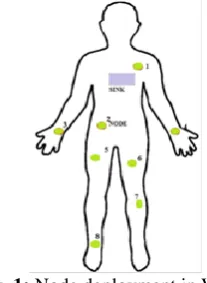
[image:2.595.367.471.516.658.2]The WBAN is setup for health monitoring system application therefore sensors have to be chosen such that all the essential indications of a patient can be estimated and data transmitted adequately. Generally eight sensors can be sufficient to monitor important parameters of a patient. In our work we have also chosen eight sensors that has to be attached to the body of a patient; these sensors are namely ECG, EMG, glucose, blood pressure, temperature, lactic acid, acceleration and position. The locations of these sensors are as shown in Figure 1. The circle dots represents sensor node while the rectangular dot represents sink node. It is assume that each node has the same power handling capabilities. The data from ECG and glucose sensor (node 1 and node 2 respectively) are transmitted specifically to the sink node with single hop propagation.
Fig. 1: Node deployment in WBAN
B. Radio model
International Journal of Innovative Technology and Exploring Engineering (IJITEE) ISSN: 2278-3075, Volume-8 Issue-6C, April 2019
Fig. 2: Radio model
According to the radio model the equations describing the energy relations between the transmitter and the receiver for transmitting 'n' bits size data packet over a distance 'd' is defined in (1)- (2).
2 _
_
*
*
*
)
,
(
n
d
E
n
E
n
d
E
TX
TX Elec
TX Amp (1)n
E
d
n
E
RX(
,
)
RX_Elec*
(2) Where ETXis the energy consumed by the transmitter andRX
E is the energy consumed during receiving the data packets. ETX_Elec ,ETX_Amp and ERX_Elec are the energy consumption of the transmitter electronic circuit, transmitter amplifier section and the receiver electronics circuit respectively. ‘n’ is the number of bits in a data packet and 'd' is the distance between a transmitter and a receiver.
The signal suffers attenuation in the transmission path and its influence can be incorporated by including the path loss coefficient parameter 'm ' and (1) can be modified as in (3).
p Amp
TX Elec
TX
TX
n
d
E
n
E
m
L
d
E
(
,
)
_*
_*
*
*
(3) The energy parameters defined in (3) depends on the hardware used in the design of the sensors. Two most frequently used transceivers are Nordic nRF2401A and Chipcon CC2420. In our work we have use the parameters defined for Nordic nRF2401A because this transceiver consumes less energy than the Chipcon CC2420. Table 2 features the energy parameters of the two transceivers.Table 1: Transceiver Parameters
Parameters nRF
2401A
CC2420 Unit
Elec TX
E _ 16.7 96.9 nJ/bit
Elec RX
E _ 36.1 172.8 nJ/bit
Amp TX
E _ 1.97 2.71 nJ/bit
D.C. current (TX)
10.5 17.4 mA
D.C. current (Rx)
18 19.7 mA
Min. supply 1.9 2.1 V
C.Path loss model
The decrease of power level when the signal is routed from the source to the destination as a factor of signal lessening is known as Path loss (measured in dB). There are several factors that results in path loss like the changes in propagation surface of the wave front, refraction, reflection during the transmission of the signal or the presence of an obstacle in the path. In the WBAN, the propagation environment is not static and factors such as human postures, body motion and clothing may affect the transmission. A simple path loss model[20]. that depends on distance and frequency is given in (4)-(5).
) ( * ) ( ) ,
(f d PL f PLd
PL (4)
X d d m PL d f
PL
0 10 0 10 log )
,
( (5)
where 'PL' is the received power, 'd0' is the reference
distance and 'm' is the path loss coefficient parameter whose value depends on the network environment. 'X' is a Gaussian random variable and 'σ' is the standard deviation. 'PL0' is the
power received at the reference distance 'd0' and it is given by
the expression in (6).
2 0 10 0 4 log 10 d
PL (6)
IV. PROPOSEDWORK
The main objective of this work is towards improvement of the overall performance of WBAN for healthcare system. The proposed work is an improvement over NEW ATTEMPT protocol. We called the proposed WBAN protocol as Enhanced ATTEMPT(EN-ATTEMPT).
The proposed protocol employed both single hop and multi-hop propagation scheme for exchange of data. In this protocol a forwarder node is chosen dependent on a new proposed cost function which rely upon the separation and the dissipated energy.
The different stages of working of EN-ATTEMPT protocol is depicted in the accompanying subsections.
A. Initialization phase
In the initialization phase the location of the sink node is shared to all the nodes by broadcasting a short duration message. every sensor nodes in the network also broadcast a packet containing an information about node ID, location of the node and the energy status. This process updates all the sensor nodes with respect to the area of neighbors and sink node.
B. Routing phase
The routing of data packets from a sensor node to the receiver node is done through multi-hop communication in order to maximize performance of the network. The consideration is to create a balance between the energy consumption of the different sensors in the system. In WBAN with multi-hop propagation, choosing a forwarder node is one of the vital factor that chooses the overall performance of the network. The selection of forwarder node from amongst the sensor is done at the sink node by evaluating a cost function. The sensor nodes for monitoring critical information, in our case, ECG sensor and glucose sensor cannot become forwarder node as they transmit data directly to sink node using single hop.
The cost function that we proposed for our scheme is defined in (7). The cost function is depending on the distance and the dissipated energy. In this function we considered energy loss as the difference between initial energy and left over energy i.e. residual energy after each round.
p i E R i E i d i Cost ) .( . ) ( ) ( 1 ) (
(7)
where
Cost(i) : cost function of ith node
d(i) : distance between ith node and sink node
[image:3.595.68.270.469.591.2]C.Scheduling and data transmission phase
When the selection of forwarder node is completed all the remaining nodes transmit their acquired data to the forwarder node. This is accomplished by utilizing time division multiple access (TDMA) conspire by the forwarder node. Therefore all other nodes transmit to forwarder node in their assigned scheduled time slot. If a node does not have any data to send then it enters into idle state and wait for the next time slot. In this scheduling process the energy dissipation of the individual sensor nodes are minimized.
V. SIMULATIONRESULTS
In this area we present the simulation result of the proposed En-ATTEMPT protocol. The performance of the protocol is eassessed through standard performance metrics which are defined below.
Network lifetime: It is the time duration of the network operation until the last node terminates or die.
Residual energy: Residual energy is the total remaining average energy of a network after each round . This is important for evaluating the energy consumption in the network.
Stability period: The duration of the network till the first node dies is called stability period. After the first node radically dies it goes to unstable state, and this period is called unstable period.
Throughput: The total number of successful packet that is received at the sink is regard as throughput.
[image:4.595.311.541.253.428.2]Path loss: The reduction of power level when the signal is passed from the source to the destination due to attenuation of signal is referred as Path loss.
Fig. 3: Network Life time: Number of dead nodes Vs. Rounds
To demonstrate the effectiveness of the proposed protocol a comparative analysis is performed on three standard WBAN protocols i.e. M-ATTEMPT, SIMPLE and NEW-ATTEMPT. The network model and the radio model for the simulation study is as given in Section 3. The cost function of the proposed scheme defined in (7) is evaluated for p=2, which is an Euclidean norm. The simulation results for the different performance metrics are shown in Figure 3, Figure 4, Figure 5 and Figure 6.
[image:4.595.49.256.445.625.2]The network life time in terms of the number of dead nodes as the number of round increases is shown in Figure 3. It reveals the average network life time of the network till the last node dies. It can be observed that at round 2161 the number of dead nodes is 3 for M-ATTEMPT. For SIMPLE protocols, till round 4436 the number of dead node is zero. With SIMPLE protocol the number of dead node increases to 6 nodes at round 5944. In NEW-ATTEMPT protocol till round 2767, number of dead node remains zero. From 2768 to 7214 rounds the number of dead node is only 1. From rounds 7289 to 7447 numbers of dead node is 5. Thereafter it catches other protocol. In EN-ATTEMPT protocol till round 2938 the number of dead node is zero. From round 2939 to 5470 the number of dead node is 1. From round 5471 to 7222 the number of dead node is 2, after that it is similar to other protocols.
Fig. 4: Residual Energy (J) vs Rounds
International Journal of Innovative Technology and Exploring Engineering (IJITEE) ISSN: 2278-3075, Volume-8 Issue-6C, April 2019
Fig. 5: Packets received at sink Vs Rounds
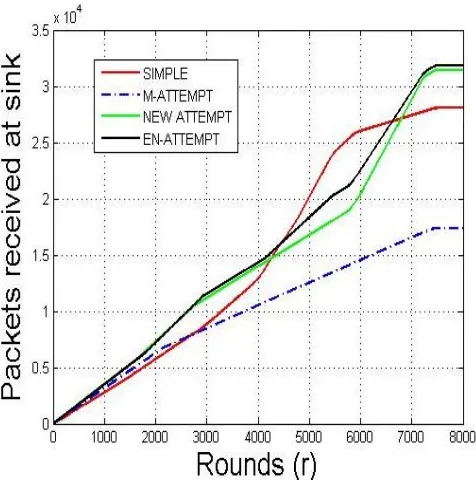
The throughput of the network as the total number of packets successfully received at the sink is depicted in Figure 5. It can be clearly observed that the proposed EN-ATTEMPT protocol has most elevated throughput compared to other protocols although SIMPLE has overtaken for few rounds.
The number of packets successfully sent to the sink relies upon the number of alive nodes. More alive nodes send more packets to the sink, increasing network throughput. Hence, a shorter period of stability is the main cause of the decrease in throughput. Till 3000 rounds the packet received remains the same for M-ATTEMPT and SIMPLE protocol but after that there is a huge difference in the packets received between these two protocols. In the case of M-ATTEMPT, the total number of received packets is 1.74 × 10⁴, while that of SIMPLE is 2.8 × 10⁴. However, in the case of NEW-ATTEMPT and EN-ATTEMPT up to at 2200, the received packet remains the same. In the case of NEW-ATTEMPT, the total number of packets received is 3.13 × 10⁴ and for EN-ATTEMPT it is 3.18 × 10⁴. Therefore it is very evident from this result that EN-ATTEMPT protocol is much better as compared to other protocol. Comparatively,
EN-ATTEMPT Protocol is 45.28% better than
M-ATTEMPT Protocol, 12.46% better than SIMPLE Protocol and 1.57% better than NEW-ATTEMPT Protocol. Thus the proposed protocol EN-ATTEMPT selects the forwarding node more efficiently which leads to longer network lifetime and higher throughput.
The path loss behaviour of different sensor nodes is shown in Figure 6. For the simulation study standard frequency of 2.4 GHz is chosen to calculate the path loss of each sensor, path loss coefficient of 3.38 and 4.1 as the standard deviation. Initially we can see that SIMPLE, NEW-ATTEMPT and EN-ATTEMPT performs well till 2000 rounds after that M-ATTEMPT significantly decreases because some of the M-ATTEMPT topology dies sooner. The protocols with longer stability period has more live nodes hence it is quite obvious that the aggregate path loss is high.
Fig. 6:Path loss (dB) Vs Rounds
VI. CONCLUSION
An effective energy efficient with high throughput routing protocol wireless body area network for healthcare application is displayed in this work. The paper focus on the design of routing protocol for selecting a forwarder node in the multi-hop communication based WBAN. It is accomplished by characterizing a new cost function that relies upon the separation on the distance between a node and the dissipated energy of a node.
We can summarized that the proposed EN-ATTEMPT protocol has better performance and stability period as compared to three other popular protocols. The proposed protocol showed best performance in terms of the throughput of the network which is 45.28 % better than M-ATTEMPT Protocol,12.46 % better than SIMPLE Protocol and 1.57 % better than NEW-ATTEMPT Protocol.
Finally, we can presume that EN-ATTEMPT is the best decision routing protocol for WBAN as compared to other protocols in terms of longer stability and high throughput without compromising the energy consumption of the network.
REFERENCES
1. IEEE P802.15.6-2012 Standard for Wireless Body Area Networks. 2.A. Salehi, M. A. Razzaque, I. Tomeo-Reyes and N. Hussain, "IEEE
802.15.6 standard in wireless body area networks from a healthcare point of view," 2016 22nd Asia-Pacific Conference on Communications (APCC), Yogyakarta, 2016, pp. 523-528, https://doi.org/10.1109/APCC.2016.7581523.
3.M. M. Alam and E. B. Hamida , “Surveying wearable human assistive technology for life and safety critical applications: Standards, challenges and opportunities,” Sensors, vol. 14 , no. 5, (2014), pp. 9153–9209, http://doi.org/10.3390/s140509153.
4.
5.Mainwaring A., Culler D., Polastre J., Szewczyk R. and Anderson, J., " Wireless sensor networks for habitat monitoring", In: Proc. of the 1st ACM Int. Workshop on Wireless sensor networks and applications, (2002), pp.88–97, https://doi.org/10.1145/570738.570751.
[image:5.595.310.541.53.231.2]7.N. A. Pantazis, S. A. Nikolidakis and D. D. Vergados, "Energy-Efficient Routing Protocols in Wireless Sensor Networks: A Survey," in IEEE Communications Surveys & Tutorials, vol. 15, no. 2, (2013),pp.551-591, https://doi.org/10.1109/SURV.2012.062612.00084.
8.Tang Q., Tummala N., Gupta S.K.S., Schwiebert L.," TARA: Thermal-Aware Routing Algorithm for Implanted Sensor Networks", International Conference on Distributed Computing in Sensor Systems , Springer, Berlin, Heidelberg , (2005), pp. 206-217, https://doi.org/10.1007/11502593_17.
9.B. Latre et al., "A Low-delay Protocol for Multihop Wireless Body Area Networks", Fourth Annual International Conference on Mobile and Ubiquitous Systems: Networking & Services (MobiQuitous),
Philadelphia, PA, (2007), pp. 1-8,
https://doi: 10.1109/MOBIQ.2007.4451060.
10. T. Watteyne, S. Augé-Blum, M. Dohler, D. Barthel, "Anybody: A self-organization protocol for body area networks", Proc. Bodynets, Jun. 2007.
11. A. Ehyaie, M. Hashemi and P. Khadivi, "Using relay network to increase life time in wireless body area sensor networks," 2009 IEEE International Symposium on a World of Wireless, Mobile and Multimedia Networks & Workshops, Kos, 2009, pp. 1-6. https://doi: 10.1109/WOWMOM.2009.5282405.
12. Nabi, Majid et al., “A robust protocol stack for multi-hop wireless body area networks with transmit power adaptation.” Proceedings of the Fifth International Conference on Body Area Networks, ACM, (2010), pp. 77-83.
13. C. Guo, R. V. Prasad and M. Jacobsson, "Packet Forwarding with Minimum Energy Consumption in Body Area Sensor Networks", 2010 7th IEEE Consumer Communications and Networking Conference, 2010, pp. 1-6, https://doi: 10.1109/CCNC.2010.5421768.
14. N. Javaid, M. Yaqoob, M. Y. Khan, M. A. Khan, A. Javaid and Z.A.Khan, "Analyzing Delay in Wireless Multi-hop Heterogeneous Body Area Networks", Research Journal of Applied Sciences, Engineering and Technology, vol. 7, no.1, (2013), pp.123-136.
15. N. Javaid, I. Israr, M. Khan, A. Javaid, S. H. Bouk, and Z. Khan, "Analyzing medium access techniques in wireless body area networks", Research journal of applied Science, engineering and technology, Vol. 7 No.3, 2013.
16. N. Javaid, Z. Abbas, M.S. Fareed, Z.A. Khan, N. Alrajeh, "M-ATTEMPT: A New Energy-Efficient Routing Protocol for Wireless Body Area Sensor Networks", Procedia Computer Science, Vol.19, (2013),pp. 224-231, https://doi.org/10.1016/j.procs.2013.06.033. 17. Q. Nadeem , N. Javaid , S. N. Mohammad , M. Y. Khan , S. Sarfraz
and M. Gull, "SIMPLE: Stable Increased-Throughput Multi-hop Protocol for Link Efficiency in Wireless Body Area Networks", Proceedings of the 2013 Eighth International Conference on Broadband and Wireless Computing, Communication and Applications, 2013, pp.221-226, https://doi.org/10.1109/BWCCA.2013.42.
18. Javaid N, Ahmad A, Nadeem Q, Imran MA, Haider N., "iM-SIMPLE: iMproved stable increased -through-put multi-hop link efficient routing protocol for wireless body area networks", Comput Hum Behav , (2015); 1003-11.
19. S. Singh, S. Negi, A. Uniyal and S. K. Verma, "Modified new-attempt routing protocol for wireless body area network", 2016 2nd International Conference on Advances in Computing, Communication, & Automation (ICACCA) (Fall), Bareilly, 2016, pp. 1-5. https://doi.org/10.1109/ICACCAF.2016.7748966.
20. Bhanumathi, V. & Sangeetha, "A guide for the selection of routing protocols in WBAN for healthcare applications" C.P. Hum. Cent. Comput. Inf. Sci. (2017) 7: 24. https://doi.org/10.1186/s13673-017-0105-6. 21. M. Roy, C. Chowdhury and N. Aslam, "Designing an energy efficient
WBAN routing protocol", 2017 9th International Conference on Communication Systems and Networks (COMSNETS), (2017), pp. 298-305, https://doi.org/10.1109/COMSNETS.2017.7945390. 22. Sharma N, Singh K and Singh BM. , "An enhanced - simple protocol
for wireless body area networks.", Journal of Engineering Science and Technology, vol.13,no.1,(2018);pp.196-210.
23. Sangwan Aarti and Bhattacharya Partha P., "Reliable Energy Efficient Multi-hop Routing Protocol for Heterogeneous Body Area Networks", International Journal of Sensors Wireless Communications and Control,
vol. 8,no.1, (2018), pp. 47-56,
https://doi.org/10.2174/2210327908666180517075536.
24. W. R. Heinzelman, A. Chandrakasan and H. Balakrishnan, "Energy-efficient communication protocol for wireless microsensor networks," Proceedings of the 33rd Annual Hawaii International Conference on System Sciences, 2000, pp. 10. https://doi.org/10.1109/HICSS.2000.926982.