Evaluation of innovative risks when choosing the innovative
strategy at the enterprise
Sergey Chernogorskiy1,*, Konstantin Shvetsov1
1
Peter the Great St. Petersburg Polytechnic University, Institute of Industrial Management, Economics and Trade, 195251 St. Petersburg, Russia
Abstract. The tensor model of innovative risk of an enterprise is developed in the paper. It is
proposed to introduce an integral innovative enterprise risk index. The result is formation of the selection matrix Innovative strategies.
1 Introduction
Innovation is a prerequisite for economic development in industrialized countries, and therefore it has one of the leading roles in the implementation of innovation policies of states and businesses [1], [2]. Active policy in scientific and technical spheres determines the growth rate of the national economy as a whole, as well as the competitiveness of selected industries and clusters. It also develops, produces and promotes technological innovations and products to the market [3].
Currently, the specificity of the Russian entrepreneurship does not allow full implementation of the existing in the developed countries techniques to assess the innovation potential [4]. Some adaptation is needed, since many of the innovative activity indicators, such as R&D expenditures (both for external and internal research), patent-licensing strategies, cost of the obtained licenses and structure of the license payments, coverage dynamics of the main and auxiliary markets, etc., either generally not tracked by the enterprises, or are of secondary importance compared to the standard indicators of total costs, output, profits, etc [5], [6].
2 Problem statement
In order to make a reasonable selection of criteria for innovation of domestic enterprises, and for working out of the necessary application procedures, one should first formulate a list of problems that are more likely to influence the innovative activity [7], [8], [9].
The major problems that negatively affect the innovative activity of domestic enterprises are the following [10].
Number one in the list of priorities concerning the activities of enterprises is the task of stabilization and optimization of the production process, but not bringing changes into it. As a consequence, the tasks of marketing, perspective technological policies, and market strategy play a relatively small role in
organizational and managerial activities within an enterprise [11].
Small and medium-sized enterprises do not have enough successful business experience on a competitive market, the management there is primarily oriented on governmental support or patronage. The senior management is not familiar enough with the existing trends, perspectives and problems of the world economy development and they often don’t realize the opportunities to participate in global production processes [12], [13].
The next priority is the staff of the enterprises, primarily the middle-level financial management and engineering specialists that in many respects turned out to be not prepared for working in the market conditions [14]. The specialists are dominated by an active orientation on the commercial prospects of the R&D results, on the diversity and dynamics of funding, on the existing of highly ramified cooperative links and on high rate of renewal of both the activity areas and the products. This very fact stipulates the lack of entrepreneurial activity and initiative for mastering of a true market attitude.
The third problem in the list consists of organizational structures and technological base of many businesses that do not comply with the characteristics of modern production facilities [15]. The production lines of these businesses have become both technologically and physically obsolete. The vast majority of enterprises do not have international quality certificates. The technology advance available in the manufacturing sector (new technologies), in the most cases do not have the properties of a product in the modern sense. The goods are usually not provided with legal protection and do not comply with international industrial standards. The problem can be compounded with the absence of sound cost estimations, lack of standard services, etc.
bringing the product to the market even more complicated and costly, even if the price advantage is available [16].
The fourth problem is the market activity of domestic enterprises. Mainly it boils down to the attempts to promote traditional products and to restore familiar industrial cooperation links. Along with this companies prefer to compete alone without giving due attention to the development of networks, including the ones in the newly open niches [17]. The lack of investments needed for the technical modernization and for implementing of new technologies is caused not only by objective reasons such as high interest rates, but also by inability to raise funds on favourable terms [18].
The slow pace of renovation of fixed assets and high capital intensity of the industrial upgrade within the domestic enterprises can also be explained with the fact that most major productions were designed and launched in the Soviet times with no regard to frequent product renovation [19]. This marks the fifth problem.
Due to the novelty of the issue of the innovation potential estimation there is a need to develop evaluation criteria, the implementation procedures and innovative strategies for many businesses. All these points should correspond to the development of the Russian economy.
3 Methodology description
Also innovative activity is characterized by high degree of uncertainty of business processes. Hence, some greater attention to the analysis and evaluation of innovative risk of an enterprise should be paid. This necessitates the development of methodological approaches to the assessment of the innovative risk of a company [20].
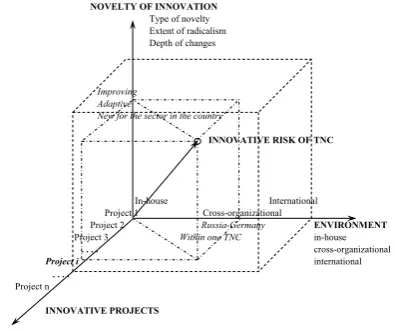
The tensor model of innovative risk of an enterprise considers innovative business risk as a vector in the space of three groups of factors. The three axes of the model are the innovative projects of a company, the novelty of the underlying innovation and the project environment. The novelty of the innovation characterizes the innovation by three classification features: the type of novelty, the extent of radicalism and the depth of the introduced changes. Herewith it becomes evident that higher novelty, higher radicalism and greater depth of the changes brought in by the innovation means increasing innovative uncertainty and, hence, increasing innovative risk.
The term “environment” means the space where the project is being realized: the in-house (back-office) environment, the national and the international environment.
The environment refers to the level of innovation. The environmental risk grows as the level of complexity increases (from in-house to international).
The tensor model of innovative risk of a company is presented in Fig. 1.
NOVELTY OF INNOVATION Type of novelty Extent of radicalism Depth of changes
Improving Adaptive
New for the sector in the country
INNOVATIVE RISK OF TNC
In-house International Project 1 Cross-organizational
Project 2 Russia-Germany ENVIRONMENT Project 3 Within one TNC in-house
. . . . cross-organizational
Project i international
. . . . Project n
[image:2.595.324.522.71.237.2]INNOVATIVE PROJECTS
Fig. 1. Tensor model of innovative enterprise risk.
We assume, that on the basis of strategic and SWOT-analysis the innovation matrix is built and a list of innovative projects that are consistent with the business objectives of the company is obtained. The challenge is to determine which of the proposed projects are to be included in the business plan, i.e. a portfolio of innovative projects should be created [21].
The technique consists of the following steps.
1. Determining of the rankings of the innovative projects (by the impact on the business objectives). The “problem factor” of a business objective is being determined. It is calculated as the ratio of the importance of this objective for achieving of the general goal of the company (the numerical coefficient) to reachability of this goal through the implementation of this specific project.
Projects
Business objectives of a firm
Objective 1
Objective 2
Objective m
Ra
-ti
ng
…
Innovative
project 1 11 11 12 12 … 1m 1m 1
Innovative
project 2 21 21 22 22 … 2m 2m 2
… … … … … …
Innovative
project n n1 n1 n2 n2 … nm nm n
w - the problem factor;
- K - correlation of the project and the general goal in points. It can be +9, +3, 0, -3, -9, i.e. strong positive, weak positive, zero, weak negative and strong negative. The question that experts are to answer in determining the correlation reads as follows: “How the realization of this project will influence the achievement of the general goal?” The possible answers are: “will strongly improve” (+9 points), will improve "(+3), “in no way” (0), “will worsen” (-3) and “severely worsen” (-9);
- coefficient equal to the product of the correlation and the problem factor.
2. Determining of the time needed for realization of each of the innovative projects.
3. Determining of the cost of the project. If it’s impossible to calculate the project cost, the expert estimation can be applied.
[image:3.595.307.538.153.615.2]4. Building of the chart with the projects and objectives. The bubble chart is built with three variables: the rating of the project, the implementation time and cost of the project [22]. An example of the chart is given in Fig. 2.
Fig. 2. Project ranking chart.
The chart data visualize the main aspects of the ranking process:
- the higher is a chart element that corresponds to the project, the more the project contributes to the achievement of the objectives;
- the more an element is shifted to the right, the less time it takes to implement the project;
- the larger the element, the greater is the cost of the project.
The intersection points of the axes are the arithmetic averages of the corresponding parameters. Thus, four quadrants are obtained. The projects are distributed among the quadrants.
Risk assessment of innovation activity of an enterprise is proposed to make by calculating the integral innovation risk index. The basis for calculation is the innovative risk model described above.
4 Key results
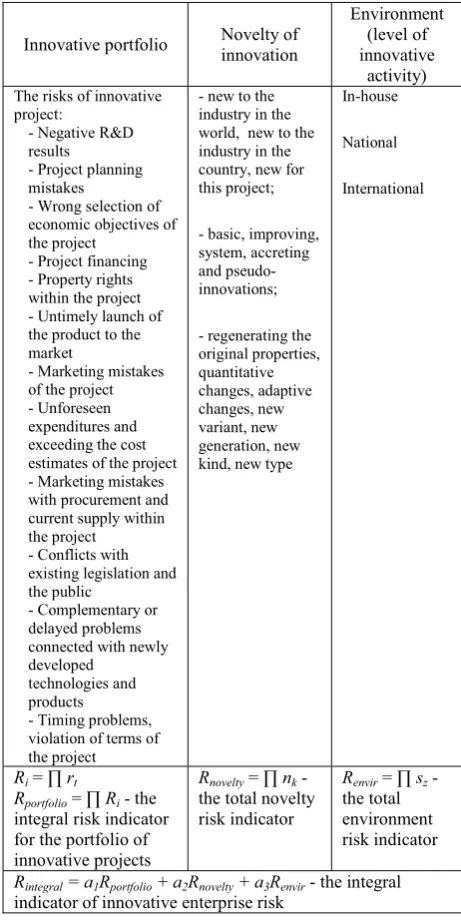
It is proposed to introduce an integral innovative enterprise risk index. The structure of the index is represented in Table 1, where a1, a2, a3 - coefficients
(weights) of importance of risk aspects for the enterprise: the project portfolio risk, the risk of innovation novelty and risk of the environment;
Rportfolio, Rnovelty, Renvir - indicators of the total risk of
the project portfolio, the total risk of innovation novelty and overall risk of the environment respectively.
Rportfolio = Ri, where Ri is the total risk indicator of
the innovation project.
Ri = rt, where rt is partial innovative risk of the
project.
Rnovelty nk, where nk is partial innovation novelty
risk (estimated for three parameters – the novelty type,
the radicalism type and the level of implemented changes).
Renvir = sz, where sz is private risk of the
environment (estimated for the in-house, national and international environment).
Table 1. Structure of integral innovative risk index.
Innovative portfolio Novelty of innovation
Environment (level of innovative
activity) The risks of innovative
project:
- Negative R&D results
- Project planning mistakes
- Wrong selection of economic objectives of the project
- Project financing - Property rights within the project - Untimely launch of the product to the market
- Marketing mistakes of the project - Unforeseen expenditures and exceeding the cost estimates of the project - Marketing mistakes with procurement and current supply within the project
- Conflicts with existing legislation and the public
- Complementary or delayed problems connected with newly developed
technologies and products
- Timing problems, violation of terms of the project
- new to the industry in the world, new to the industry in the country, new for this project;
- basic, improving, system, accreting and pseudo-innovations;
- regenerating the original properties, quantitative changes, adaptive changes, new variant, new generation, new kind, new type
In-house
National
International
Ri rt
Rportfolio Ri - the
integral risk indicator for the portfolio of innovative projects
Rnovelty nk -
the total novelty risk indicator
Renvir sz -
the total environment risk indicator
Rintegral = a1Rportfolio + a2Rnovelty + a3Renvir - the integral
indicator of innovative enterprise risk
The main steps of the calculation of the integral innovation risk indicator of an enterprise are to be mentioned [23].
1. Selection of the modules that constitute the integral indicator.
2. Determining of the partial risks for each module. 3. Expert estimations of the partial risks.
4. Calculation of the total risk for each module. 5. Determining of the coefficients a1, a2, a3 through expert appraisals.
6. Calculation of the integral innovation risk indicator for the enterprise.
[image:3.595.57.288.194.338.2]the innovative risk level of an enterprise. If the level of innovation risk is acceptable, then the enterprise implements its innovative portfolio [24]. If the level of risk is unacceptable, the innovative portfolio is being reconsidered and the value of the integral innovation risk indicator is calculated anew.
The innovation strategy of an enterprise can be selected according to the proposed procedure presented in Fig. 3.
Formulation of alternative innovation strategies
Economic methods: - interest rate adjustments with respect to the risk level; - sensitivity analysis Expert evaluation
technique
Simulation modeling
[image:4.595.70.281.184.279.2]Matrix of selection
Fig. 3. Procedure of innovation strategy selection.
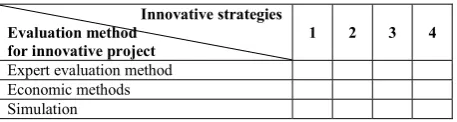
The result is formation of the selection matrix presented in Table 2. The columns of a matrix are innovative strategies that are applicable to the enterprise, the rows consist the calculated data on a strategy for a specific innovative project or program. The matrix will help to compare the estimates and identify a reliable strategy.
Table 2. Selection matrix.
Innovative strategies
Evaluation method 1 2 3 4
Expert evaluation method
Economic methods
Simulation
Innovative strategies are divided into 3-4 groups according to their compatibility with the competitive strategies:
1. Absolute cost advantage - functional advantage: a group of defensive strategies, namely, traditional, residual and defensive [25].
2. Specialization - a leading position on products: a group of offensive strategies, namely an opportunistic strategy, creating a new market, sharp offensive and medium offensive strategy [26].
3. Concentration - a close relationship with the consumer: a group of simulation strategies, namely simulation, dependent and intermediate strategies.
5
Conclusion
1. The analysis and evaluation of innovation potential and innovation strategy relies on multiple sources of economic information. The reliability of forecasts is much more dependent on the quality of the input data than on the methods of analysis. Even simplified methods of strategic decision making based on accurate input data provide more accurate predictions than complex methods of analysis carried out on the basis of approximate data. The database is formed in accordance with the purposes and objectives of the analysis,
combining the data from external and internal sources. However, given the strategic focus of innovations and lack of experience of employing such activities for managerial decision-making, information from external sources turns out to be the predominant both by volume and by value. Managers should give a careful consideration to the formation of the decision-making database, whereas analytics should spend more time and effort for collecting the needed data than on the other stages of analysis.
Thus, the proper formation, rapid updating and control of reliability of the database are the necessary conditions for effective and high-quality analysis and evaluation of innovation potential and innovation strategy as a whole.
2. While selecting a competitive innovation strategy a company, as a rule, follows only one of them, otherwise it will not be a success. When choosing one of these competitive strategies the company is facing a choice of 3-4 innovative strategies. Here the company needs to use the proposed matrix to identify the most profitable innovation strategy within the selected competitive one.
Each of the strategies within the competitive group has its own features. In accordance with these differences the cost estimations, the marketing program and the program of implementation (including the organizational costs) for the selected innovation strategy is elaborated. After the calculations the results are set in a matrix, where they are compared with the proposed procedure. Thereafter the managerial decision is made.
3. Nowadays in Russia only a low level of innovation activity of enterprises can be reported [27]. The problem with this very low resulting indicator of implemented innovations in many respects can be explained with a shortage of qualified personnel, capable to realize innovative projects.
Therefore, management training program should include a subject, revealing completely the process of involvement of new technologies in economic activities. Future managers need to possess a comprehensive knowledge and skills for managing the innovative development.
References
1. J. Tan, J. Bus, Venturing, 16(4), 359-376 (2001) 2. A. Madrid-Guijarro, D. Garcia, H. Van Auken, J.
Small Bus. Manage, 47(4), 465-488 (2009)
3. A.B. Radnejad, H. Vredenburg, IJEIM, 19(1-2), 77-98 (2015)
4. R. Agarwal, M. Thiel, IJEIM, 18(5-6), 397-408 (2014)
5. P. Herzog, J. Leker, Int. J. Technol. Manage, 52(3-4), 322-343 (2010)
6. I.M. Golova, A.F. Sukhovey, Economy of Region, (1), 155-164 (2014)
[image:4.595.59.288.410.471.2]8. K.-H. Tsai, J.-C. Wang, IJTG, 1(2), 239-257 (2005) 9. K.-H. Tsai, J.-C. Wang, Problems and Perspectives
in Management, 2(1), 62-75 (2004) 10. C. Herstatt, IJEIM, 2(6), 473-484 (2002)
11. T. Pihkala, H. Ylinenpää, J. Vesalainen, IJEIM, 2(6), 520-536 (2002)
12. O.J. Borch, E.L. Madsen, IJTE, 1(1), 109-125 (2007)
13. V. Ramaswamy, Strategy & Leadership, 38(2), 22-29 (2010)
14. C. Gray, J. Allan, IJEIM, 2(4-5), 373-389 (2002) 15. C. Camelo-Ordaz, A. Pérez-Luño, E. Sousa-Ginel,
IJEIM, 10(3-4), 243-265 (2009)
16. I.A. Bayev, M.V. Podshivalova, Economy of Region, (1), 189-198 (2013)
17. P. Davis, O. Brady, Innovation, 28(3), 324-343 (2015)
18. T.I. Tovt, Actual Probl. of Econ., 152(2), 211-218 (2014)
19. A. Jantunen, P. Hurmelinna-Laukkanen, IJLIC, 3(2), 153-166 (2006)
20. M. Squicciarini, Small Bus. Econ., 48(2), 273-278 (2017)
21. D. Endovitsky, S. Komendenko, Investment in Russia, 3, 39-46 (2001)
22. P.N. Zavlin, A.V. Vassilyev, Estimation of the innovation efficiency (Publishing House “Business press”, St. Petersburg, 1998)
23. P.S. Semyanov, Financial problems of the Russian Federation and their solutions: theory and practice. Proceedings of the IVth international scientific-practical conference (1998)
24. J. Wonglimpiyarat, Journal of High Technology Management Research, 26(2), 186-195 (2015)
25. E. Petuskiene, R. Glinskiene, Engineering Economics, 22(1), 69-77 (2011)
26. T. Kuznetsova, V. Rud, Questions of Economics, 11, 86-108 (2013)