Abstract:Block chain is of rising innovation for building and therapeutic applications crosswise over hierarchical settings that maintain a strategic distance from confided in focal outsiders, rather than customary databases or administrations we can utilization of block chain that is a compositional decision in the advancement of a product or applications. In this paper, we propose an administration of square chain innovation through cloud, it might help to the two clients and budgetary segments, this empowers an administration through cloud for all the conveyed applications in secure way called Block chain As A Service, and we propose a dispersed and confided in cloud information starting point engineering utilizing square chain innovation. Block chain-based information wellspring can give sealed records, empower the straightforwardness of information risk in the cloud, it upgrades the security and accessibility of the provenance information.
Keywords: Block chain, cloud computing, ledger, minors, Block chain Services.
I. INTRODUCTION
A blockchain is integrally a scattered database of records, or public record among all proceedings or advanced happenings that have been executed and shared among engaged parties. Every exchange in the public record is confirmed by award of a highest share of the members in the framework. Once entered data can never be deleted. The blockchain contains a certain and unquestionable record of each exchange at any point made. Bitcoin was the main application that presented Blockchain innovation. Bitcoin made a decentralized area for cryptographic cash, where the individuals can buy and exchange items with mechanized money. Blockchain gives off an impression of being a fitting outcome for overseeing trades by using digital money, it has still some challenges and requirements that ought to be considered and tended to. High ideals of trades and security, along with insurance of center points are required to stop attacks and attempts to trouble trades in Blockchain. Although, asserting trades in the Blockchain requires a computational power. Among the blockchains' promising applications are arrange watching and
security administrations including confirmation, protection, coordination, provenance and classification. By and by, these administrations are given by trusted outcast specialists or not using scattered procedures. Hence, security is a noteworthy test for current applications. Of course, the blockchain
Revised Manuscript Received on April 06, 2019.
P. Tejaswi, CSE, Koneru Lakshmaiah Educational Foundation, Guntur, India.
P. Nikitha, CSE, Koneru Lakshmaiah Educational Foundation, Guntur, India.
A. Vijay Kumar, CSE, Koneru Lakshmaiah Educational Foundation, Guntur, India.
advancement can give security guarantees that settle various standard troubles not withstanding giving a totally appropriated, secure, and understanding arrangement. A comparable thought can be associated with the following security guarantees. This review premise around the usage of the blockchain development to give arrange programming administrations and applications. We present the usage of these administrations in the present applications, talk about the ordinary strategies that give these security advantages, and diagram their troubles and issues. By then, we present how the blockchain development can be used to decide the related troubles and highlight a couple proposed blockchain-based strategies that give the perfect security administrations.
Fig1: Blockchain Database
In the next section, we furnish an over view of cloud computing environment. Section III includes blockchain systems, separating them into public, private, federated and ledgers in Blockchain. Section IV includes concepts in Blockchain. Section V concludes.
II. CLOUD COMPUTING ENVIRONMENT
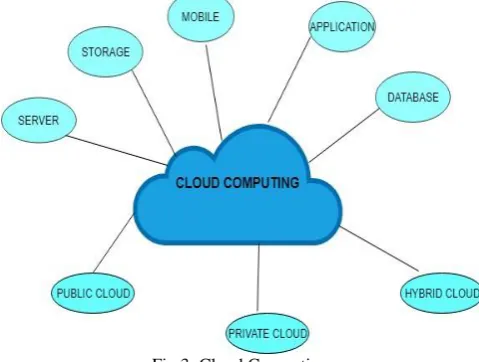
A model for connecting generally, advantageous, on-request sort out access to a typical pool of configurable dealing with assets (e.g.,
servers, collecting,
structures, applications, and
An Efficient Blockchain Security for
Distributed System
associations) that can be quickly provisioned and discharged with Insignificant association exertion or master focus collaboration.
[image:2.595.47.287.92.273.2]Fig 3: Cloud Computing.
A. ESSESNTIAL CHARACTERISTICS OF CLOUD COMPUTING
A.ON-DEMAND AND SELF-SERVICE
The on-demand and self-service parts of Cloud Computing imply that a consumer can use Cloud benefits as required, with no human interconnection with the Cloud service provider. By using oneself service interface, consumers can receive Cloud benefits by referencing for the basic IT assets from the service list.
To be gainful and agreeable to the customer, oneself administration interface must be straightforward by the consumer.
B.BROAD NETWORK ACCESS SPECIFIERS Cloud associations are gotten to through the structure, for most of the part in web, from a broad scope of customer stages, for a case in point, PC, workstation, remote, and thin customer. Generally, programming adventures, for instance, Microsoft Word or Microsoft PowerPoint Presentation, have been provided as customer-based programming. Clients need to exhibit the thing on their PCs with the genuine target to utilize this application. It is unimaginable to expect to get to this thing if the client is far from the PC where the thing is displayed.
Today, an unbelievable bit of the thing utilized can be gotten to over the web. For a case in point, Google Docs, a Web based report maker and boss engages clients to get to and alter records from any contraption with a web alliance, getting out the need access to a specific customer stage to modify documents
C.RAPID ELASTICITY CLOUD ENVIRONMENT Rapid Elasticity generally refers to as the ability of the system to expand or contract dedicated resources according to its functionality. There are different possible ways to gain elasticity cloud environment such as manually where a person will be observing the system usage and the resources. Semi-Automated systems where customers can buy such systems from the specific service supplier. But the customer
must know his/her system thresholds. Fully-Automated systems, in this the systems threshold. Fully-Automated systems, in this the systems threshold must be determined by using some basic algorithms.
The Cloud engages to create and get these advantages capably and empowers the relationship to pay on a utilization premise.
D.RESOURCE POOLING
Resource pooling usually consists of hundreds and thousands of servers, routers, switches, load balances. As per workloads and client’s needs resource pooling works. Based on the client need and usage the resources like storage, compute can be accessed from cloud computing resource pooling. In a Cloud, a customer can be a client, a client gathering, or an organization. For a case in point, various VMs from various customers can run all the while on a similar server with hypervisor support. There is a sense of location autonomy, in that the customers for the most part has no learning about the accurate location of the resources given.
E.MEASURED SERVICES
Measured service is a transparent service in cloud computing. Resources that can be used in a measured manner. Transparency is maintained in both servers and customers. It is a model of “Pay-as-you-use” model.
B. CLOUD COMPUTING SERVICE MODELS Cloud service models can be classified in to three types:
• Software as a Service cloud Model • Platform as a Service cloud Model • Infrastructure as a Service cloud Model
A.SOFTWARE AS-A-SERVICE CLOUD MODEL Services that are provides by software as a service can accessed by end user interface through web access. Now-a-days most of the customers are using these online applications without installing the software in their computers. By using this service internal memory can be saved. Cloud storage memory will be utilized by working in this online service model.
The capacity given to the consumer is to utilize the supplier’s applications running on a cloud infrastructure, for example, a web access browser (e.g., electronic email), or a program interface, salesforce, Google Apps.
B.PLATFORM AS-A-SERVICE CLOUD MODEL Platform as-a-Service which offers a high level of concept which makes cloud easily programmable.it is a foundational platform to develop new form of applications. It allows customers to use the computing environment over a cloud computing platform. In this service customer can create and run the applications no matter how many applications are running in same platform or how much memory is being used. More number of special services and new programming models are used for developing new applications. In general platform as a service provides design, development, deployment and hosting an application. In platform as a service, once application is
implemented in only one language.
Change of programming language is not possible. when buyers make their applications to continue running over the PaaS provider's item stage, flexibility and versatility is guaranteed direct by the PaaS organize.
For example: Amazon web Service, Google Application Engine, Heroku, Windows Azure.
C.INFRASTRUCTURE AS-A-SERVICE CLOUD MODEL
Conceptualizing resources like storage, communication and computation are known as Infrastructure as a service. In cloud computing systems, Infrastructure as a service is the last layer. It will not provide any applications to user.
Infrastructure as a service helps you to borrow some resources like memory, storage area, CPU cycles, network interface, servers etc., infrastructure can be moved top and bottom based on the resources used in the application. Infrastructure as-a-Service which fulfills as an establishment for the other two layers for their execution. This is a paid service based on their usage resources. It mainly focuses on storage and database used in the application. Scaling and flexibility are the obligations of the client, not the provider. For instance: Amazon web service (EC2).
III. BLOCKCHAIN BACKGROUND
In this section, a brief introduction based on types of blockchains, following that properties of blockchain are explained. The appealing characteristics of blockchains and brief explanation about cloud computing and their service models are discussed. The objective of this section is to introduce the readers to the blockchain technology and its key principles.
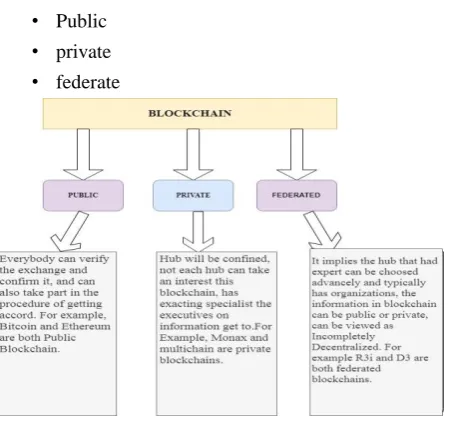
A. TYPES OF BLOCK CHAINS They are basically three types:
[image:3.595.302.553.49.579.2]• Public • private • federate
Fig 2: Blockchain
B. PROPERTIES
Table I: Key properties of blockchain systems
Properties Public Private and
federate
Access Everyone has
access to read and write
Requires permission to access read and write
Asset It is native asset It is of any asset
Identity It identifies whether anonymous or pseudonymous
It identifies everything
Security It has proof of work, proof of stake and other consensus techniques
It has already approved participants
Speed It is slower It is faster
Ownership It is of public ownership
It is of private ownership
Worthy It is not trust
worthy
It is trust worthy
Transaction approval
Long Short
Consensus mechanisms
Large energy consumption, no finality and 51 percent attacks
Lighter, faster, low energy
consumption, enable finality
USP Disruptive means
there will be no involvement of third party
Cost cutting means randomly reduces the costs
Examples Bitcoin, Dash,
Litecoin, Dodgecoin, Ethereum, Monero and so on
R3, B3i, EWF, Corda, Monax, Multichain
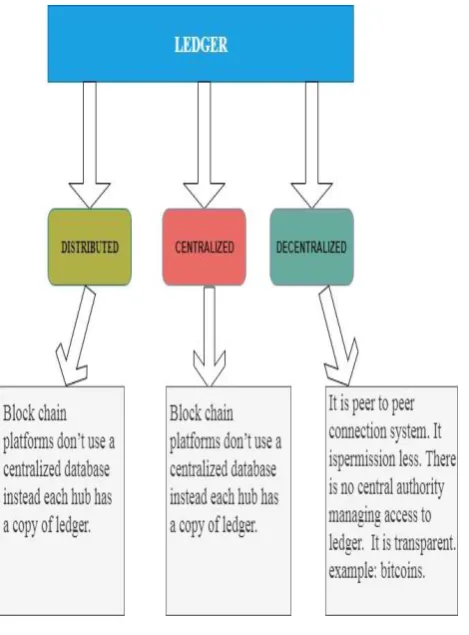
C. LEDGERS PRESENT IN BLOCKCHAIN ledger is a kind of database where confirmed data happenings can be extracted. Ledger contains only specified information recorded data. Usually ledgers are handled by group of people. Ledgers are physical records for storing information. ledgers can be edited and modified any time.
Ledgers can be stored in format. There are three types of ledgers
[image:3.595.49.274.506.720.2]Fig 4: Ledgers in Blockchain.
IV. CONCEPTS IN BLOCKCHAIN A.DISTRIBUTED LEDGER IN BLOCKCHAIN Blockchain platforms don’t use a centralized database instead each hub has a copy of ledgers. Cryptocurrencies such as Bitcoin only store information in Distributed Ledger. Blockchain platforms such as Ethereum can store any kind of information, such as identity information patient information and so on in this ledger.
Fig 5: Distributed Ledger
B.CONSENSUS IN BLOCKCHAIN
A consensus is a process in computer science which is used to achieve agreement among distributed processes or systems. In this algorithm they agree on one result among a group of participants. Some algorithms are paxos (family of protocols for solving consensus), Google have been implemented a distributed lock service library called as chubby (based on paxos). Mining
[image:4.595.307.549.197.424.2]Mining means combining several valid transactions. When hubs that are there to create blocks are called mining hubs.
Table II: Mining techniques
C.CRYPTOGRAPHY IN BLOCKCHAIN
[image:4.595.49.294.532.738.2]Cryptography is used to create public and private keys for encrypting and decrypting the data. It also uses cryptographic hash functions in encryption which are essential for transparency and privacy management. Cryptography helps in secure communication between parties with specific authentication.
Fig 6: Cryptography
D.SMART CONTRACTS IN BLOCKCHAIN A smart contract implies the
general be a secured strategy summoned upon a trade. The information sources, yields additionally, states impacted by the splendid contract execution are agreed on by every center point. All blockchains have worked in splendid contracts that complete their trade bases. In computerized monetary forms, for point of reference, the certain sagacious contract at first affirms trade commitments by checking their imprints. Next, it affirms that the equality of the yield tends to match that of the sources of info. In the end, it applies changes to the states.
V. CONCLUSION
A Blockchain-based decentralized frameworks in Cloud will permit on-request, secure and minimal effort can fit in to the most aggressive figuring situations. The decentralized open record framework in budgetary segments gives more security than brought together open record framework. Due to the property’s straightforwardness and decentralization, the square chain innovation should use in the cloud and give it as a support of requested clients. Distinctive organizations of their diverse items are given to end clients through Blockchain As A Service, if those items are given through cloud, it is more anchored. At last, I worry that all cloud suppliers ought to likewise give their items by another administration.
REFERENCES
1. Crosby, M., Pattanayak, P., Verma, S. and Kalyanaraman, V., 2016.
Blockchain technology: Beyond bitcoin. Applied Innovation, 2(6-10),
p.71.
2. Yli-Huumo, J., Ko, D., Choi, S., Park, S. and Smolander, K., 2016. Where is current research on blockchain technology? A systematic review. PloS one, 11(10), p. e0163477.
3. Amazon Web Services," Overview of
SecurityProcesses”http://aws.typepad.com/aws/2oo9/08/introducing-amazonvirt ualprivate-cloud-vpc.html, September 2009.
4. Leavitt, N., “Is Cloud Computing Really Ready for Prime Time?” Computer, Vol.42, No.1, pp.15-20, 2009
5. Zaharia M. A view of cloud computing. 6. Communications of the ACM 2010; 53(4):50–58.
7. [6] Basta A, Halton W. Computer security and penetration testing. Delmar Cengage Learning 2007.
8. M. Armbrust, A. Fox, R. Griffith, A. D. Joseph, R. H. Katz, A. Konwinski, G. Lee, D.A. Patterson, A. Rabkin, I. Stoica, and M. Zaharia, Above the clouds: A Berkeley view of cloud computing, University of California, Berkeley, Tech. Rep. UCBEECS-2009-28, Feb 2009.
9. Geethu Thomas et al., Intrusion Tolerance: Enhancement of safety in Cloud Computing,International Journal of Advanced Research in Computer and
10.Communication Engineering” Vol. 1, Issue 4, June 2012 11.K.S. Suresh, K.V. Prasad, Security issues and security