International Journal of Innovative Technology and Exploring Engineering (IJITEE) ISSN: 2278-3075, Volume-8 Issue-10, August 2019
Determining the Effectiveness of ‘Cloud
Computing’ on Human Resource Management by
Structural Equation Modeling (SEM) in
Manufacturing Sector of West Bengal, India
Pradip Paul, Arunangshu Giri, Satakshi Chatterjee, Swatee Biswas
Abstract: The manufacturing industry is very much crucial for driving the economy of the nation. It has a direct impact on the GDP of any nation and also, it is very beneficial for a country to be strong in the manufacturing industry. This is also the case for a developing nation such as India. Hence, it is imperative for the organization to effectively manage their human resources to optimally utilize them as they are the non-perishable resources of the company. This could be done with the help of Cloud-Computing which is one of the advanced fields of elastic IT (Information Technology). This technology is continuously gaining momentum as it is relatively easier to use in E-HRM (Electronic-Human Resource Management) and also contains less initial investment. The objective of the study is to identify the factors that have an impact on the effectiveness of Human Resource Management by the help of Cloud computing. Various statistical tools like Exploratory Factor Analysis and Structural Equation Modeling have been executed in this study by SPSS 21 and AMOS 21 software.
Keywords: Cloud Computing; Manufacturing Industry; Information Technology; Electronic-Human Resource Management
I. INTRODUCTION
Information Technology has caused a revolution in the 21st century. This is the era which is marked by the development of computers and other technologies which are innovative and more advanced. These technologies help mankind to get the work done in a faster and an efficient manner. One of the technologies which have inculcated a paradigm change in the world of elastic IT is Cloud Computing. Industry experts believe that Cloud Computing is one of the top most talked about topics in the organizations across the world today. Major commercial as well as individual players of the industry are investing in this particular technology. Such organisations are Google, Amazon, Microsoft and others (Jaeger, et al., 2009).
Cloud Computing refers to those advanced technological features which allow the data to be stored as well as processed in certain machines whose location remains unknown to the users. Thus, huge amounts of data of the enterprise could be dealt with without any restrictions. The computing power is also increased significantly in this manner and it can prove to be a huge competitive advantage for that particular company in the long run. The applications
Revised Manuscript Received on August 05, 2019.
Dr. Pradip Paul, Senior Manager (Retail Sales), Haldia Divisional Office,Indian Oil Corporation Ltd., Haldia, West Bengal, India.
Dr. Arunangshu Giri, Associate Professor, School of Management & Social Science,Haldia Institute of Technology, MAKAUT, West Bengal.
Satakshi Chatterjee, Assistant Professor, Department of Pharmaceutical Management,Haldia Institute of Management, MAKAUT, West Bengal.
Swatee Biswas, Officer in Charge, Administration Department, Haldia Institute of Management, MAKAUT, West Bengal.
of Cloud Computing are extremely proficient in the handling of various kinds of customer applications and the organizations have an option of investing in them as per their consumption levels (Staten, 2008). Thus, this technology is referred to as scalable as well as abstract. Human Resources are regarded as a very important asset of the organization and they are regarded as non-perishable (Becker, 1964). Thus, the companies invest in the human resources so as to develop their productivity as it has a direct impact on the profitability of the firms. Moreover, human capital management is also responsible for the spontaneous generation of a competitive advantage of the firms and also helps in raising the organizational performance significantly (Hitt, et al., 2001 & Jiang, et al., 2012). However, Human Capital Management is only possible through the adoption of technological software such as Cloud Computing. The HRIS system which was used in the 1980s has become obsolete and it would not be able to cater to the needs of the organization today. Cloud Computing has created its position in the market as it caters to various core and subsidiary HR functions such as recruitment and selection, training and development, compensation management, absence management, etc. (Bhadani, 2014). According to the International Data Corporation (IDC), in the year 2013, companies have spent approximately $47.4 billion on public IT cloud service and this is expected to reach $107 billion by the year 2017 (IDC, 2013). Cloud computing allows the companies to access the various computer resources through the use of a network or the internet (Fan, et al., 2013). There are three service models of Cloud Computing which have been given as follows:
SaaS: The Cloud software is focused on giving services to the firms. The consumers do not have the control over the management of the Cloud software; however, they are responsible for using the applications only.
PaaS: The Cloud Platform is served as a service to the firms. In this set up, the user can use as well as manage all the functions of the system.
IaaS: The Cloud infrastructure is given as a service. In this type of set up, the user has access to the complete configuration of the system provided by the provider such as the network, storage, operating systems, etc.
Equation Modeling (SEM) in Manufacturing Sector of West Bengal, India
Cloud Computing helps the manufacturing industry tostrengthen its stronghold across the nation. Thus, for the manufacturing industry to produce fruitful results, the human resources of this industry have some needs that must be addressed immediately by the management of the organization. These needs are related to training and development, compensation management, performance appraisal and so on (Wright, et al., 1997). These needs can be taken care of by the firms through the adoption of Cloud Computing technology specifically. Thus, Cloud Computing together with Human Capital Management could increase the intellectual capital embedded within an organization which would result in increasing profitability of the firms.
II. LITERATURE REVIEW
Cloud Technology helps the employees of the organisations to cater to their job requirements within a stipulated period of time. The database which consists of reliable and useful data could be updated by the individual heads of the departments of the organisations without any direct intervention from the HR department, thus, gathering the data from the multiple sources over a short amount of time. Also, at the same time, the skills of the HR department could be enhanced by equipping them with various tools to focus on the core functions of the organisation as compared to other subsidiary tasks. The resultant decision making would be much faster. Thus, flexibility of the entire process can be further developed with the help of the cloud technology (Nazir, 2012). The work done by the HR department would be much more accurate and efficient comparatively. The data which is saved in the cloud will be secure as compared to the other paper documents which tend to get lost and then it becomes extremely difficult to retrieve the records rendering faster decision making possible from the management side as the information is available at a moment’s notice. It has become increasingly easier to procure cloud technology and implement it across multiple organizations as it is made available by many vendors who are available across the globe. The system is configured within a matter of a few seconds and then the information is stored in the cloud. No particular hardware is required for the setting up of this system. Also, in case any problems arise, it can be handled by the IT department with the help of a computer only having access to the internet. The feasibility checking is done beforehand which further
contributes towards easier implementation of this technology and also its ease of use (Asniar & Budhiawan, 2016). The technology is also favourable to the multiple users as it is very easy to understand without any complexities as it relies on very basic technical knowledge. Cloud Computing could also help in optimally using the talents of the human resources available with the organization. The performance of the employees could be recorded in the cloud by the HR department for later use. The employees will be having access to these records and thus, they will be able to track their development as well. This can serve as a self motivating technique as more development on their part could lead to good results for their career in the long run. This will ultimately lead to increase in the productivity of the organisation as a whole. Oracle is known for providing such services through Cloud which helps in career planning as well as succession planning (Kumar, 2017). Also, it helps the HR department to go through the data and correctly place the employees in their respective fields. This would enable the organization to increase their productivity as well. Companies are undergoing diversification as they are crossing the boundaries of their respective nations as globalization has become the key to survival for the companies. Also, the workforce in the companies is also diversified belonging from different parts of the world working towards a common goal. A wide range of users from different genres can log into the system to gain access to the information being stored within a common platform (Sharma & Banga, 2013). It would be tedious for the organization to maintain the information pertaining to the employees in different parts of the world. In doing so, the safety of the data as well as the data privacy is also put at risk. Hence, Cloud Computing helps in bringing together this data into a common platform which would be accessible from any part of the world at the time of need and there is no fear of the data in getting lost also. The problems and queries of the employees could be solved from any part of the world with the help of the availability of this data. This technology has also helped in the improvement of the skills of the employees such as analyzing as well as reporting skills. Global mobility is also strengthened which has become the need of the hour of the present situation (Hill, 2014). Globalization leads to large chunks of data are generated across all organizations today. It is very much expensive to store this data and analyze it through the use of certain in house software.
This problem is solved with the help of Cloud Computing. Cloud Computing is not expensive at all and by the adoption of this; the costs could be cut down significantly, at the same time, without compromising with the required functions of the firm. Time is also saved as uploading the data takes minimal amount of time. Supervision of the entire process is also not required as it is automatic and hence, this also helps in cutting down the costs. There is no requirement to install any particular hardware also (Kumar, 2017). The performance of the human resources need to improved with the changing technological advancements. Performance appraisal helps the employees to assess their skill level and to also mark their development level as well. Cloud Computing can help in the process of performance appraisal of the employees. The job description of the employees could be stored in Cloud. The potential of the individual
International Journal of Innovative Technology and Exploring Engineering (IJITEE) ISSN: 2278-3075, Volume-8 Issue-10, August 2019
They have diversified needs which must be catered to by the organization as the productivity as well as the profitability of the organizations depends on them. Thus, the job of the HR department is very critical. Cloud Computing helps the HR department in the identification of the needs of each and every employee of the particular organization within a stipulated period of time so that their individual contribution towards the organization is not stilted under any circumstances (Odun-Ayo, et al., 2017).
III. HYPOTHESES AND RESEARCH MODEL
H1: ‘Faster Decision Making Process’ via Cloud-Computing positively influences ‘HRM Efficiency’ in Manufacturing Companies.
H2: ‘Ease of Use and Implementation’ via Cloud-Computing positively influences ‘HRM Efficiency’ in Manufacturing Companies.
H3: ‘Talent Optimization’ via Cloud-Computing positively influences ‘HRM Efficiency’ in Manufacturing Companies. H4: ‘Global Accessibility’ via Cloud-Computing positively influences ‘HRM Efficiency’ in Manufacturing Companies. H5: ‘Cost Effectiveness’ via Cloud-Computing positively influences ‘HRM Efficiency’ in Manufacturing Companies. H6: ‘Effective Performance Appraisal’ via Cloud-Computing positively influences ‘HRM Efficiency’ in Manufacturing Companies.
[image:3.595.359.495.243.289.2]H7: ‘HRM Efficiency’ via Cloud-Computing positively influences ‘Organizational Development’ in Manufacturing Companies.
Figure 1: Hypothesized Research Model
IV. RESEARCH METHODOLOGY
Data Sources Secondary and Primary data Survey tool with
Scaling Technique
Structured questionnaire with 5 Point Likert Scale
Targeted Segment Manufacturing Companies Type of
Manufacturing Companies
1. Electronic & Electrical Equipment Companies 2. Petroleum Refining & Chemical Companies 3. Food & Beverage Companies
4.Textile & Apparel Companies
Sampling Method Convenience Sampling Sampling Elements HR Managers
Sample Size 150
Period of Study March 2019 – June 2019 Statistical Tools &
Software
Exploratory Factor Analysis (EFA) & Multiple Regression Analysis executed by SPSS-21
V. DATA ANALYSIS AND RESULTS
A. Reliability Testing:
Internal consistency of collected dataset has been determined through reliability testing by Cronbach’s Alpha value. If it is more than 0.70 then we can say dataset is under tolerable range of reliability. The following table supports the tolerable range of reliability for dataset in this study.
Table1: Reliability Statistics Cronbach's
Alpha
N of Items
.865 16
B. Validity Testing:
Now we have to execute Exploratory Factor Analysis (EFA) for validation of our primary data. The following table (Table: 2) shows the acceptable KMO value (0.828) and significant Bartlett's Test of Sphericity (<0.01) which supports Sampling Adequacy for factor analysis and adequate correlations among variables respectively. For supportive KMO and Bartlett's Test value, we can execute EFA (Table: 3). 8 factors with ‘factor loadings’ more than 0.5 have been extracted by using Rotated Component Matrix (RCM) in this process.
Table 2: KMO Measure of Sampling Adequacy and Bartlett's Test
Kaiser-Meyer-Olkin Measure of Sampling Adequacy.
0.828 Bartlett's Test of
Sphericity
Significance Level
<0.001
Table 3: Exploratory Factor Analysis by RCM
Factors Questions Factor Loading (>0.50)
% of Variance Explained Cost Effectiveness q3 .947 12.051
q4 .933 Faster Decision
Making Process
q12 .925 11.317 q11 .904
Ease of Use and Implementation
q6 .924 11.214 q5 .861
HRM Efficiency q10 .909 11.013 q9 .889
Talent Optimization
q2 .916 10.967 q1 .899
Global Accessibility q8 .916 10.815 q7 .857
Effective Performance Appraisal
q14 .856 9.434 q13 .813
Organizational Development
q16 .809
9.208 q15 .798
[image:3.595.48.278.418.787.2] [image:3.595.304.527.442.719.2]Equation Modeling (SEM) in Manufacturing Sector of West Bengal, India
For checking Multi-co-linearity of independent factors, [image:4.595.307.546.50.323.2]‘Variance Inflation Factor’ (VIF) values which should be less than 3, were calculated and the following table shows that all independent factors are free from Multi-co-linearity. Table 4: Co-linearity Statistics for Different Independent Factors
‘HRM Efficiency via Cloud Computing’ as dependent factor
Tolerance VIF Ease of Use and
Implementation .535 1.868 Talent Optimization .543 1.840 Faster Decision Making
Process .694 1.440
Cost Effectiveness .541 1.847 Effective Performance
Appraisal .597 1.676
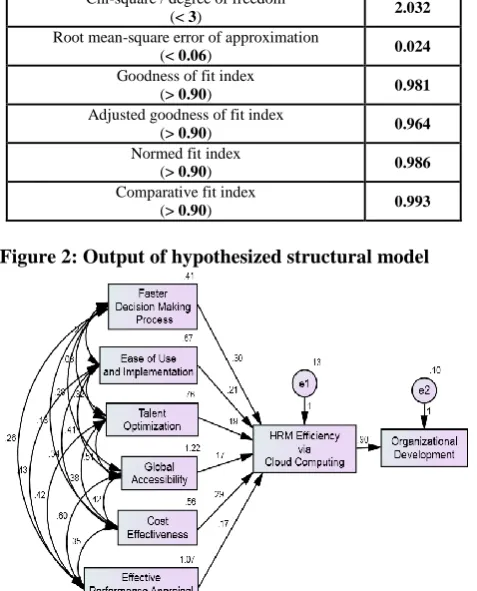
Global Accessibility .553 1.808 The appropriateness of the research model was evaluated by fitness indices (Table 5).
Table 5: Fit indices for Structural Model
Fit Index
with Acceptable Threshold Levels
Structural Model Values
Chi-square / degree of freedom
(< 3) 2.032 Root mean-square error of approximation
(< 0.06) 0.024 Goodness of fit index
(> 0.90) 0.981 Adjusted goodness of fit index
(> 0.90) 0.964 Normed fit index
(> 0.90) 0.986 Comparative fit index
(> 0.90) 0.993 Figure 2: Output of hypothesized structural model
Path Analysis was executed for determining the impact of the factors related to cloud computing on HRM efficiency in Manufacturing Companies of West Bengal.
Table 6: Path analysis of Structural Model for Hypothesis Testing
Measurement Path
Hypo- thesis Testing
Regre-ssion Estimat
e
P-Value
Measurement Path
Hypo- thesis Testing
Regre-ssion Estimat
e
P-Value
HRM Efficienc
y
← Faster Decision Making Process
H1 (S) .297 <0.01*
HRM Efficienc
y
← Performance Effective Appraisal
H6 (S) .173 <0.01*
HRM Efficienc
y
← Cost
Effectiveness H5 (S) .294 <0.01* HRM
Efficienc y
← ImplementatioEase of Use n
H2 (S) .212 <0.01*
HRM Efficienc
y
← Talent
Optimization H3 (S) .190 <0.01* HRM
Efficienc y
← Global
Accessibility H4 (S) .169 <0.01* Organizat
ional Develop
ment
← HRM
Efficiency H7 (S) .897 <0.01*
Note: * indicates 1% level of significance (S) indicates Hypothesis Supported
VI. HYPOTHESIS TESTING AND FINDINGS
H1: ‘Faster Decision Making Process’ via Cloud-Computing positively influences ‘HRM Efficiency’ in Manufacturing Companies.
Significant P-value (<0.01) with positive (+.297) path co-efficient supported the hypothesis. While delivering the products to the customers, the human resources must do it as fast as possible. Faster decision making process by the employees could result in faster services being delivered which could further improve their satisfaction levels and can develop brand loyalty. This positively influences the HRM efficiency as well.
H2: ‘Ease of Use and Implementation’ via Cloud-Computing positively influences ‘HRM Efficiency’ in Manufacturing Companies.
Significant P-value (<0.01) with positive (+.212) path co-efficient supported the hypothesis. Cloud computing can assist in making the core HR processes being carried out in an easier and faster manner. This can increase the efficiency levels of the department as a whole and because of hassle free implementation procedures; it will be easier for the employees to adapt to the entire system.
H3: ‘Talent Optimization’ via Cloud-Computing positively influences ‘HRM Efficiency’ in Manufacturing Companies.
[image:4.595.67.272.120.265.2] [image:4.595.47.286.366.662.2]International Journal of Innovative Technology and Exploring Engineering (IJITEE) ISSN: 2278-3075, Volume-8 Issue-10, August 2019
H4: ‘Global Accessibility’ via Cloud-Computing positively influences ‘HRM Efficiency’ in Manufacturing Companies.
Significant P-value (<0.01) with positive (+.169) path co-efficient supported the hypothesis. Through the use of advanced technology, the organizations are connected across the globe. Cloud computing helps in this function immensely and also affects the HRM efficiency in a positive manner.
H5: ‘Cost Effectiveness’ via Cloud-Computing positively influences ‘HRM Efficiency’ in Manufacturing Companies.
Significant P-value (<0.01) with positive (+.294) path co-efficient supported the hypothesis. The cost of implementing cloud technology is minimal, while the outcome of using this technology is very high. Hence, it has a positive effect on the HRM efficiency as the results obtained are very high as compared to the investment if the technology is utilized in a correct manner.
H6: ‘Effective Performance Appraisal’ via Cloud-Computing positively influences ‘HRM Efficiency’ in Manufacturing Companies.
Significant P-value (<0.01) with positive (+.173) path co-efficient supported the hypothesis. The technology is evolving daily and hence the human resources need to be trained accordingly to cater to the changing demands. Cloud computing help in the performance appraisal of the employees which further has a positive effect on the HRM efficiency of the organization as a whole.
H7: ‘HRM Efficiency’ via Cloud-Computing positively influences ‘Organizational Development’ in Manufacturing Companies.
Significant P-value (<0.01) with positive (+.897) path co-efficient supported the hypothesis. Organizational development is a planned and strategic effort of human resources, managed by efficient leadership. For enhancing organizational effectiveness and maintain the pace of development, the contribution of human resource management via cloud computing is inevitable.
VII. IMPLICATION OF THE STUDY
Cloud Computing is a technology which is easily being adopted across many organizations. It is price efficient and it possesses minimal working hassles. Thus, the companies in the manufacturing industry want to implement this technology as soon as possible. The requirements for using this particular technology are also minimal as advanced hardware is not required.
Data is stored and processed in an easier manner and it could be accessed from multiple locations at a time. With the help of this technology, human resource training and development has been made very easy as the training needs are customized according to the requirements of the individual employees. Humans are complex and their training needs varies from person to person. This technology helps the organization to identify the needs and further categorize the persons having similar needs. This helps the organizations to increase the performance index of the employees which results in a marked increase in their profitability as well. Optimal use of the human resources is the need of the hour and cloud computing helps the organizations to achieve them, especially in the manufacturing industry, where all the processes are more or
less fully automated or partially automated and the employees must also be trained enough in order to detect any kind of hitches in the system as soon as possible. The demand of the market must be met and so cloud computing can help in that as well. Manufacturing industry is responsible for providing products to the nation which is considered very important as they could generate an income source for that particular nation. Without this, the working of the nation may come to a standstill. Increase in their productivity could benefit the country immensely. It would increase the economical condition of the country as it would not have to depend on the imports from other nations, thus saving costs. The nation could become self independent. Also, the data stored in cloud could be analyzed in order to bring up with certain innovative strategies which would focus on increasing the yield from the entire system as well wherein human resources play a very important role.
VIII. CONCLUSION
Human Capital Development is a raging issue amongst the manufacturing firms nowadays as it is the factor which can alter the growth index of the organizations. Cloud Computing has many interfaces which can aid the HR managers in the development of the workplace in the manufacturing industry. Many core as well as subsidiary HR function could be addressed by them through the help of Cloud Computing. Job mining could be done in an easier manner and it could be found out the job roles which are directly contributing to the development of the organization. Those employees could be focused on and their productivity could be developed by giving training. The cultivation of the human resource development could be done with the help of Cloud technology. Retention of the workforce could also be emphasized as trained employees are better suited to this industry as it minimises the number of errors. This paper has shed some light on some of the factors brought on by the implementation of Cloud technology which would increase the effectiveness of the HR managers. This would further lead to the incubation of definite service processes which would immensely help in meeting the demand of the customers in the manufacturing industry of India. Thus, Cloud Computing could bring about an evolution across this industry if it is utilized in a correct manner.
ANNEXURE: 1
Factors Structure Questionnaire with Different Variables
Talent Optimization
q1: Cloud computing helps in scouting the talent in Manufacturing sector as well as utilizing them.
q2: Talent optimization helps to increase the HR efficiency.
Cost Effectiveness
q3: As compared to the benefits, Cloud computing has minimal investment to perform certain core and subsidiary HR functions. q4: Cost effectiveness helps to increase the HR efficiency.
Ease of Use and Implementation
q5: Cloud computing is extremely easy to operate.
q6: Ease of use and implementation helps to increase the efficiency of the HR managers.
Global Accessibility
Equation Modeling (SEM) in Manufacturing Sector of West Bengal, India
HRM Efficiency
q9: Increased HR efficiency has a positive impact on the employee productivity of an organization.
q10: Increased HR efficiency has a positive impact on the organizational profitability.
Faster Decision Making Process
q11: Cloud computing helps HR managers in faster decision making as the process is very flexible.
q12: Faster decision making process helps HR managers to increase their efficiency levels.
Effective Performance
Appraisal
q13: Cloud computing helps in performance appraisal of the employees.
q14: Effective performance appraisal helps the HR managers to increase their efficiency.
Organizational Development
q15: Efficient HRM via Cloud computing is required for increasing
organizational effectiveness.
q16: Planned and strategic efforts of HRM via cloud computing can accelerate the pace of organizational development.
REFERENCES
1. Andrew Hill, J. M. (2014, March 7). Race to the cloud. Deloitte University Press. Retrieved from http://dupress.com/articles/hc-trends-2014-race-to-the-cloud.
2. Asniar & Budiawan, R. (2016). Implementation of cloud computing in higher education. International Conference on Innovation in Engineering and Vocational Education IOP Publishing. 128(2016). DOI: 10.1088/1757-899X/128/1/012022.
3. Becker, G. S. (1964). Human Capital, New York: Columbia University Press.
4. Bhadani, R. (2014). A new dimension in HRM: Cloud Computing. International Journal of Business and Management Invention. 3(7). 13-15. ISSN: 2319-8028.
5. Fan, Y. W., Wu, C. C., Chen, C. D., & Chang, C. C. (2013). A Delphi study on cloud computing adoption. Web Journal of Chinese Management Review, 16(1), 1-17.
6. Hitt, M. A., Bierman, L., Shimizu, K., & Kochhar, R. (2001). Direct and moderating effects of human capital on strategy and performance in professional service firms: a resource-based perspective. Academy
of Management Journal, 44(1), 13-28.
http://dx.doi.org/10.2307/3069334.
7. IDC (2013). IDC forecasts worldwide public IT cloud services spending to reach nearly $108 billion by 2017 as focus shifts from
savings to innovation. Retrieved from
http://www.idc.com/getdoc.jsp?containerId=prUS24298013. 8. Jaeger P. T., Lin J. and Grimes M. (2009) “Cloud computing and
information policy: Computing in a policy cloud?” Journal of Information Technology and politics, 5(3).
9. Jiang, K., Lepak, D. P., Hu, J., & Baer, J. C. (2012). How does human resource management influence organizational outcomes? A meta-analysis investigation of mediating mechanisms. Academy of
Management Journal, 55(6), 1264-1294.
http://dx.doi.org/10.5465/amj.2011.0088.
10. Khanghahi, N. & Ravanmehr, R. (2013). Cloud Computing Performance Evaluation: Issues and Challenges. International Journal on Cloud Computing: Services and Architecture. 3(5). DOI: 10.5121/ijccsa.2013.3503.
11. Kumar, R. (2017). Cloud Technology and Human Resource Management. Annual Research Journal of SCMS, Pune. 5(2017). 82-91. ISSN: 2348-0661.
12. Kumar, R. (2017). Cloud Technology and Human Resource Management. Annual Research Journal of Symbiosis Centre for Management Studies, Pune. 5(2017). 82-91. ISSN: 2348-0661. 13. Nazir, M. (2012). Cloud Computing: Overview and current research
challenges. IOSR Journal of Computer Engineering. 8(1). 14-22. ISSN: 2278-0661.
14. Odun-Ayo, I., Misra, S., Omoregbe, N., Onebere, E., Bulama, Y. & Damasevicius, R. (2017). Cloud based security driven human resource management system. Advances in Digital Technologies. DOI: 10.3233/978-1-61499-773-3-96.
15. Sharma, T. & Banga, V.K. (2013). Efficient and enhanced algorithm in Cloud Computing. International Journal of Soft Computing and Engineering. 3(1). 385-390. ISSN: 2231-2307.
16. Staten, J. (2008) “Is Cloud Computing Ready for the Enterprise?” Technical report, Forrester Research, Inc., Cambridge, USA. 17. Wright, P.M., McCormick, B., Sherman, W.S. & McMahan, G.C.
(1997). The role of human resource practices in Petro Chemical
Refinery Performance. CAHRS Working Paper Series. DOI: http://digitalcommons.ilr.cornell.edu/cahrswp/153.
AUTHORS’ BIO-SKETCH
Dr. Pradip Paul ([email protected]) has over 14 years of experience in Petroleum Industry. , research and teaching. He is presently serving as Sr. Manager, Indian Oil Corporation Ltd at Haldia, West Bengal. He has expertise in probabilistic analysis of structural failure under seismic load. He has been appreciated for taking different challenging initiative in Operation and sales in Indian Oil Corporation Ltd, a fortune 500 public sector undertaking of Govt. Of India. He looks after different statutory and developmental requirement of channel partners management, customer centric initiative and having experience of business development of petroleum products in Highways, Urban and Rural areas.
Dr. Arunangshu Giri ([email protected]) has over 10 years of experience in Industry, research and teaching. He is presently serving as an Associate Professor in the School of Management and Social Science, Haldia Institute of Technology, West Bengal. He is also acting as visiting professor at Vidyasagar University and study counsellor at Indira Gandhi National Open University (IGNOU). He teaches courses on Marketing, Marketing Research and Statistics. He has 47 research publications in peer-reviewed national and international journals including Scopus indexed. He has authored two books titled
1.“Research Methodology for social Science”, Sage Publications, (ISBN -978-93-528-0757-4); 2. “Agribusiness Management”, Himalaya Publishing House, (ISBN 978-93-5299-595-0). He also received Best Business Academic of the Year Award -2016 (Gold Medal) at the 69th All India Commerce Conference, organized by Lucknow University, Lucknow on November, 2016.
Satakshi Chatterjee ([email protected]) has over 4 years of experience in research and teaching. Her areas of teaching are Pharmaceutical Management, Operations Research, Production Management and Bio-Statistics. She is the university topper for her post graduation degree in the year 2016 from the University of Mysore, Karnataka. She has authored 10 research papers in various National and International journals of repute including Scopus indexed. She has also authored 1 book on mutual funds and also worked as a technical editor for another book regarding healthcare management. She has also received the best paper presenter award in a conference partly organised by a foreign university, Lincoln University College, Malaysia. She has also acquired the Best Young Researcher Award at the 7th Global Research Dimensions conducted by the University of Mysore and State Planning Board, Karnataka.