International Journal of Innovative Technology and Exploring Engineering (IJITEE) ISSN: 2278-3075, Volume-9 Issue-2, December 2019
An Improved Algorithm for Handover in LTE
Heterogeneous Networks
Manoj, Sanjeev Kumar
Abstract—The transition from 3G to 4G has been a gradual process all these years and in developing countries like India, the change has to span even longer. Eventually, at lot of places while moving we come across signal variations which force the handoff to be decided. The handoff may be vertical or horizontal but it has to be seamless and service continuity cant be ignored anytime. This research proposes a handoff mechanism which takes certain parameters like RSS, node-speed, network cost, network latency, bandwidth and throughput before deciding the handover. This research does a simulation in MATLAB to analyze the effect of these parameters on handover decision both in homogenous and heterogeneous networks. The simulation virtualizes a scenario where a node moving in a geographical region experiences multiple handoffs both vertical and horizontal, based on the above-mentioned parameters. The simulation successfully proves that the proposed methodology performs seamless vertical and horizontal handoffs. The simulation is performed on two different scenarios where the former does handoff between 3G and 4G networks (vertical handoff) and the latter takes a WIMAX and 4G LTE network into consideration. The results are presented in terms of RSSI, throughput and bandwidth and performance of LTE is compared with 3G & WIMAX technique. The performance of the technique has been represented graphically each graph showing variation in handoff decisions for different values of a particular parameter.
Keywords- Handoff Techniques, LTE, Heterogeneous Networks etc.
I. INTRODUCTION
Wireless communication is an important requirement in every area in today's technology era. First generation had started with communication with analog facility. After some development in technology, second generation had GSM standards. The packet switching technology is clubbed in GSM for development in these standards. The 20th century had 3G technology after GSM limitations. Then 4G becomes a need in every area due to large data rate requirements. 4G has a capability to connect at a very fast rate even in small village areas. LTE was first proposed by Japan Company in year 2004. After this, Siemens showed great interest in LTE after collaboration with Nomor Research. Now, Long Term Evolution (LTE) becomes an important part or standard in communication sector specially for broadband communication. It helps to increase data rate as well as the system capacity. The 4G LTE was first demonstrated by Sri Lanka in South Asia in 2011. They received a data rate of 96 Mbit/sec.
Revised Manuscript Received on December 05, 2019.
Manoj, Assistant Professor, Department of Computer Science and
Engineering, Guru Jambheshwar University of Science and
Technology(GJUS&T),Haryana
Dr Sanjeev Kumar, Associate Professor, Department of Computer Science and Engineering, Guru Jambheshwar University of Science and
Technology(GJUS&T),Haryana
LTE gives straightforwardness in engineering when contrasted with past frameworks that advanced this design while in transit to less complex and powerful level framework. The primary point of LTE is to give enhancement to parcel exchanging administrations. There is likewise thought of streamlining of between systems administration with other stage like diverse access systems. Advanced UMTS Terrestrial Radio Access Network (E-UTRAN) is utilized at base station level that comprises of savvy base stations called developed Node B (eNodeB). E-UTRAN compares to a straightforward framework of eNodeBs sorted out by the X2 interface [2].
[image:1.595.306.556.416.615.2]There are basically four abnormal state spaces: User Equipment (UE), Evolved Packet Core Network (EPC), E-UTRAN, and Services. The initial three frame the Internet Protocol Connectivity Layer which is utilized to make IP based availability. It is exceptionally enhanced and offering all administrations over IP and furthermore expels the prerequisite of circuit exchanged hubs and interfaces present in past 3GPP frameworks. UEs, more often than not alluded to as portable terminal, interrelate with eNodeBs by means of LTE-Uu interface.
Fig. 1: Network Architecture Extracted from 3GPP [1] The Network contains different components: MME in charge of insurance and approval, versatility administration, and membership profile administration and availability; Serving Gateway (S-GW), subject for UP passage administration and exchanging, performing activity gating and separating capacities, and by and large going about as the IP purpose of connection for the User Equipment, building choices on the most proficient method to deal with administrations in Terms of QoS; and the Home Subscription Server (HSS), which is the membership information storehouse for all
lasting client information as shown in fig 1.
eN
B
eN
B
eN
B
MM
E
All interchanges among EPC and E-UTRAN are performed by S1 interface. While associating an eNodeB to MME, the interface is called S1-MME and if there should be an occurrence of an association among eNodeB and S-GW it is S1-U.
This intermediate step is justified by the demand for higher data rates, that at the same time made affordable the creation of other services such as the MMS (Multimedia Message
Service). The third generation of mobile
[image:2.595.33.278.234.479.2]telecommunications technology is based on the standards designed around the specifications of the IMT-2000, a group specifically created by the ITU for this purpose. 3G uses W-CDMA as it most widespread technology providing better spectral efficiency with a bigger range of services.
Fig 2: Mechanism of Handoff in Mobile
Handoff is a mechanism to transfer the one call from one channel to another in cellular network. Basically, it is the process of transferring calls to one another. During movement of user, if it enters from one coverage area to another during call, then it triggers the handoff process. Capacity is defined for each cell, it means each cell has predefined users that can use for communication purpose. If a call may interfere by any means, then handoff is also occurred as shown in fig 2. During conversation, if call is actually breaks then it shows the hard handoff process and if one link is still connected then it shows the soft handoff technique. For better communication in LTE network, system has to be kept various parameters in mind and also able to design the network on behalf of it.
Basically, this papers works on study of 3G & LTE heterogeneous network based on Handoff schemes. Various parameters are need to be monitored for analysis of its performance. For improving the system performance in terms of capacity, various techniques are discussed. Rest of the paper is discussed as follows. In section II, it provides literature of various authors. In Section III, It defines the description of the requirement of the 5g system. Section IV describes the problem definition of system. Finally, the Section V provides the main conclusion of system.
II. RELATED WORK
In the base research, I.Kustiawan et al in proposed a fuzzy inference system that took into account various parameters like RSS value, Rx sensitivity level, velocity and path loss. The four input parameters were fed into the fuzzy system and certain rules were defined in the system to decide the handoff. The decision for handoff was made on the fuzzy factor generated wherein the factor>6 meant handoff initiated to the new network otherwise stay with the same network. The technique doesn’t consider some important parameters like bandwidth, data-rate and network cost. The output graphs don’t clearly portray the effect of change of these parameters on handoff decisions.
C. Lin et al. [1] proposed presented in URTS plot, a moved client chooses a reasonable non dynamic client as transfer client to forward flag, in this way upgrading the connection nature of the moved client. Since the client handing-off model expends hand-off client's vitality, an utility capacity is structured in transfer determination to achieve an exchange off between the moved client's connection quality enhancement and the hand-off client's vitality utilization. C. Chung Lin et al. [2] investigated the usefulness of relaying. In this, they compared the transmission rates of direct transmission (DT) with relaying. It was shown that relaying was much better in Terms of SNR gain as compared to direct transmission. Relaying provided lower transmit power and also required high outage. Results were applied to LTE-A network.
X. Zhang et al. [3] proposed some solutions of those problems that come from deployment of the relay node (RN) technology in LTE-A networks. Here Vienna Simulator was used to implement & observe these problems and their solutions. In this, it reduced interference sub-frames that reduced transmission opportunities. The main observations were: i) some steps are required for management of time varying interference, ii) Trade-off between the multi-user diversity and time-division constraints of relaying.
S. Thiagarajah et al. [4] proposed a 3-Step resource allotment scheme that enabled buffering function at RSs. In LTE-Advanced, Type I relay is generally used. In this, the schedule and resource allocation was done by relay station and Node B. For fairness and network throughput, optimization was designed. They also conducted simulations for evaluating the performance of system. Results showed that this system improved the network throughput as compared to existing techniques.
J. Xu et al. [5] proposed focused on Type-1 half-duplex in system. These frames were dynamically adjusted that considered the demand of traffic of user. The main aim was to achieve resource fairness using frequency reuse schemes. It reduced the ICI problem and also minimized the bandwidth accessibility of macro cell users thus improved the throughput value.
Jean Avocanh et al. [6] analyzed the performance of carrier aggregation and then compared with LTE system. It was used to achieve high data rates in system. Carrier aggregation is a technique where component carriers are combined.
Base Station
Subscriber Station Base Station
International Journal of Innovative Technology and Exploring Engineering (IJITEE) ISSN: 2278-3075, Volume-9 Issue-2, December 2019
Shengjie Zhao et al. [7] proposed a component carrier selection algorithm for utilizing radio resources while balancing total load. Carrier aggregation is a technique where component carriers are combined & extended the bandwidth for achieving the high data rates. The results provided the efficiency of algorithm. It optimized the system capacity without affecting the QOS of system.
Xuanli Wu et al. [8] introduced the spectrum aggregation in LTE-A by 3GPP. It allowed carrier component aggregation within and across different bands. Spectrum Aggregation provided powerful boost to throughput of user in LTE System. In this work, they provided a review on spectrum aggregation followed by radio resource management function. In this, they surveyed different algorithms to support carrier aggregation in LTE. Technical challenges are also outlined.
Lexi Xu et al. [9] presented in URTS plot, a moved client chooses a reasonable non dynamic client as transfer client to forward flag, in this way upgrading the connection nature of the moved client. Since the client handing-off model expends hand-off client's vitality, an utility capacity is structured in transfer determination to achieve an exchange off between the moved client's connection quality enhancement and the hand-off client's vitality utilization. The proposed outcomes demonstrated that the URTS plan can show signs of improvement SINR and limit of moved clients. The CLB with utility capacity client transfer plan, and the CLB with WTS client hand-off plan can augmentation the limit by 35%, less than 700 clients' situation.
III.PROPOSEDMETHODOLOGYOFSYSTEM
[image:3.595.312.537.59.253.2]In this work, it presents a work on performance analysis of LTE system with 3G and WIMAX technologies. It performs load balancing in LTE networks by doing seamless handover in both horizontal and vertical handoffs. As we know that 3G is a standard for mobile communication and named as Third Generation. This helped to connect mobiles with internet and much faster as compared to 2G in terms of user speed and data rate. Users had taken a lot of time while using 2G. After this, LTE came into existence during requirement of large data rate signals. LTE is faster in terms of every performance parameter as compared to 3G network. WIMAX is a mobile broadband which is a fourth Generation technology that works on IEEE 802.16 Protocol. It helps to provide fast access for internet in compatible devices. It can provide a range for 30 miles in broadband wireless internet. LTE uses both OFDMA and SCFDMA in Downlink and uplink respectively while WIMAX uses SOFDMA in both links. In LTE, mobile speed is far better than WIMAX and 3G which is generally max 500 km/hr. Both LTE and WIMAX have MIMO capabilities for data transfer. Limited spectrum is available in WIMAX that makes difficult to operate. So, LTE is far better than 3G and WIMAX for providing higher data rate to users.
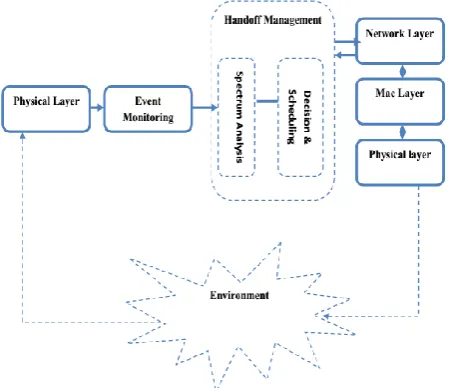
Fig. 3: Functional Diagram of Handoff Management The fig. 3 shows the functional diagram of Handoff management in LTE systems. It is based on unpredictable events and provides a decision quickly for transmission of data and not involving in further interference. In this process, it presents a concept of Handoff technique and performance comparison of 3G, LTE and WIMAX. The system to transfer of a request from serving to adjacent station under ongoing process is called handoff. This process is done without any disruption. The wireless access known as IEEE 802.16 or WIMAX, is a worldwide broadband standard. There are large no. of operators in the world who are moving from 3G to LTE now a days due to high speed network. The market for LTE has improved and grown in rapid way.
The proposed methodology performs both vertical and horizontal-offs based on different parameters like RSS value, bandwidth, network latency, node speed, user preference and network cost. Two different simulations are created to analyze the effect of variations of these parameters on handoff decision making for both vertical and horizontal handoffs each. The simulations are run for different values of these parameters and the effect of variation is analyzed on the decision making. The following summarizes the steps involved in doing these simulations.
Algorithm
Step1: Create a LTE Network
Step 2: Initialise simulation parameters like node-speed, location of base stations, frequencies of both networks and initial location of mobile node.
Step3: Repeat steps 4 to 7 for a specified duration of time. Step4: Call [RSS_LTE, rate, cost, BW_LTE,
pref=linkagent(nodexy,nodespeed,'LTE',timer1,Tc);
Step5:
if Network_type==0 && (pref==1 || RSS_4G<RSS_3G || BW_LTE<BW_3G) then
Perform handoff as per requirement Else
Increment time End If
Step6: Collect RSS value, user preference, bandwidth and network cost values for the current network at this time. Step7: Move mobile node to a
[End of loop at step 2]
Step8: Plot different parameters for the simulation against time recorded
Step 9: Modify the parameters values and plot the changes in handoff decision to identify the effect of each parameter. The system performance can be measured by various performance parameters like throughput, radiation strength, reliability etc. The main advantage of wireless LTE is fast and do not require any breakdown of signal or connectivity issues. It allows large spectrum coverage under low speeds and also supports large no. of users at a time that helps to improve throughput of system. Interference can affect the wireless performance but it can handle it in clear way.
IV. RESULTS OF SYSTEM
[image:4.595.306.549.122.327.2]The proposed methodology was implemented in MATLAB and the result variations were plotted against time for the different parameters into consideration. The simulations were created for both vertical handover and horizontal handover and were multiple times executed for different parameter variations. The results were plotted against time and the graphs have been explained below. The following graphs show different parameters vs time graph for initial value node-speed=5 and 10 one after the other, for vertical handover. The figure 4 shows the throughput comparison of 3G and LTE system and results shows the peak value of LTE is better than 3G. LTE provides higher data rate as compared to 3G because of large bandwidth.
[image:4.595.305.550.359.573.2]Fig. 4: Throughput Comparison of 3G & LTE for Node Speed =5 m/sec
Fig. 5: Throughput Comparison of 3G & LTE for Node Speed =10 m/sec
The above two figures 4& 5 show the comparisons of throughput of the two networks for two different speeds 5 and 10 mps. The throughput values are generated for every 5 seconds, and the comparison reveals that throughput of 4G exceeds 3G most time and is directly dependent on network state for that node at particular moment.
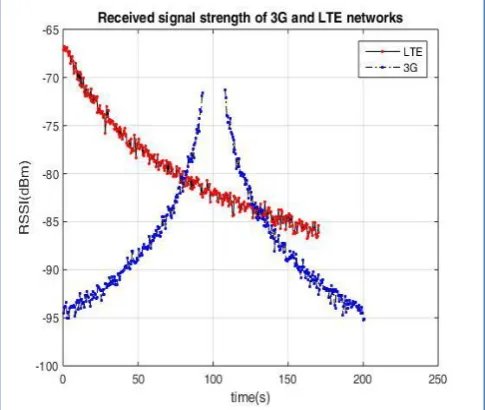
Fig. 6: RSS Comparison of 3G & LTE for Node Speed =5 m/sec
Fig. 7: RSS Comparison of 3G & LTE for Node Speed =10 m/sec
[image:4.595.49.287.393.573.2] [image:4.595.48.290.396.775.2]International Journal of Innovative Technology and Exploring Engineering (IJITEE) ISSN: 2278-3075, Volume-9 Issue-2, December 2019
Fig. 8: Bandwidth Comparison of 3G & LTE for Node Speed =5 m/sec
Fig. 9: Bandwidth Comparison of 3G & LTE for Node Speed =10 m/sec
[image:5.595.41.295.51.449.2]The above two graphs 8 & 9 plot bandwidth against time spanned. The similarity in two graphs owes to the constant speed and linear movement of node towards the second base station. So, as we see, the increase in bandwidth of network 2 as the node moves away from base station 1. In above figures, Bandwidth peak curve is high for large interval of time in LTE as compared to 3G system. 3G shows the U shaped bandwidth response and drop in mid interval of time.
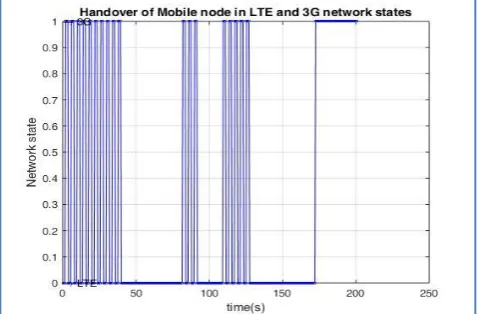
[image:5.595.47.293.51.224.2]Fig. 10: Handover Comparison of 3G & LTE for Node Speed =5 m/sec
Fig. 11: Handover Comparison of 3G & LTE for Node Speed =10 m/sec
[image:5.595.47.291.257.449.2]The above graphs 10 & 11 show the handover made by mobile node while travelling from one location to another and when it relates the handover happening at different moments to the variations happening in other parameters with different node speeds. 3G shows the peak handover problem as compared to LTE because of low data rate. LTE shows better stability in system as compared to 3G.
Fig. 12: Cost Comparison of 3G & LTE for Node Speed =5 m/sec
Fig. 13: Cost Comparison of 3G & LTE for Node Speed =10 m/sec
The above two graphs show changes in network costs as the node transits from one network state to another. The cost of network for LTE and 3G
[image:5.595.49.289.582.739.2]The following graphs show different parameters vs time graph for initial value node-speed=5 and 10 one after the other, for horizontal handover. For higher speed, network cost will be higher because of advancement in technology.
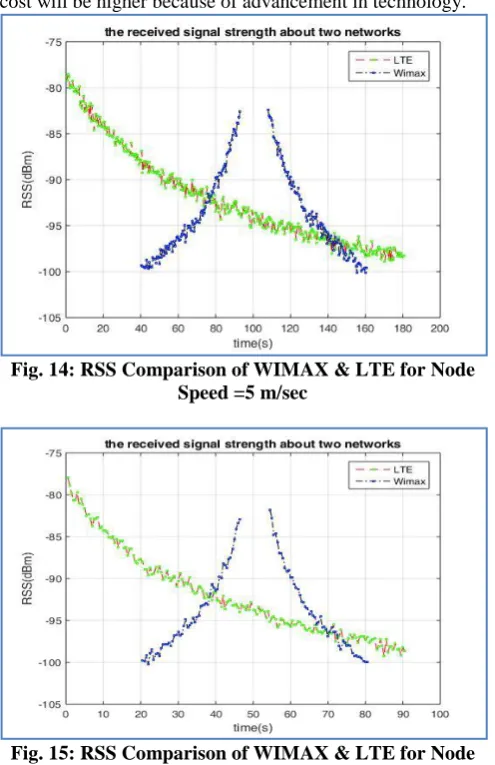
[image:6.595.47.295.90.473.2]Fig. 14: RSS Comparison of WIMAX & LTE for Node Speed =5 m/sec
Fig. 15: RSS Comparison of WIMAX & LTE for Node Speed =10 m/sec
[image:6.595.48.292.99.268.2]These graphs 14 & 15 present the variation of RSS value for the WIMAX and LTE networks during the simulation time. The two graphs are for node-speed of 5 and 10 mps respectively. The variation in RSS directly effects the decision making for handover which can be seen in the following two graphs for network state vs time. WIMAX shows the irregular curve same as that of 3G because of limited available sources while LTE shows better smooth variation of RSS.
Fig. 16: State Comparison of WIMAX & LTE for Node Speed =5 m/sec
Fig. 17: State Comparison of WIMAX & LTE for Node Speed =10 m/sec
These graphs 16 & 17 show the change in network state as the node moves through the network area. The handover can be directly associated with the RSS variations. In figures, state of WIMAX is wide as compared to LTE that shows it provides some delay response in WIMAX as compared to LTE system. Hence, LTE is better in terms of performance as compared to 3G and WIMAX.
V. CONCLUSION
The growth of cellular networks in the past few years has enhanced the importance of self-organizing networks to improve the performance of automated operations in cellular networks. So, load balancing plays an important role in such huge demand industry. In this paper, it performs load balancing in LTE networks by doing seamless handover in both horizontal and vertical handoffs. It performs the comparative analysis of LTE with 3G and WIMAX technologies. A simulation is performed in MATLAB to analyze the effect of these parameters on handover decision both in homogenous and heterogeneous networks. The simulation performs handoffs for a mobile node moving in a geographical region based on many parameters like RSS value, Bandwidth, network cost, user preference and data throughput. The simulation is performed on two different scenarios where the former does handoff between 3G and LTE networks (vertical handoff) and the latter takes a WIMAX and 4G LTE (horizontal handoff) network into consideration. The performance of the technique has been represented graphically each graph showing variation in handoff decisions for different values of a particular parameter. The result shows better improvement in LTE as compared to 3G and WIMAX system.
REFFERENCES
1. C. Lin, K. Sandrasegaran, “On the performance of capacity integrated
CoMP handover algorithm in LTE-Advanced”, 18th Asia-Pacific Conference on Communications, pp. 871-876, October 2012.
2. C. Lin, K. Sandrasegaran and S. Reeves, “Handover Algorithm with
Joint Processing in LTE-Advanced”, IEEE International Conference on Electrical Engineering/Electronics, Computer, Telecommunications and Information Technology, pp. 978-981, May 2012.
3. X. Zhang, X. Gu, “The Study of Load Balancing Based on the Network
Flow Theory in LTE-A systems”, IEEE 24th International Symposium on Personal, Indoor and Mobile Radio Communications, pp. 91-95, September 2013.
4. S Thiagarajah, A. Ting, “User
[image:6.595.47.287.590.757.2]International Journal of Innovative Technology and Exploring Engineering (IJITEE) ISSN: 2278-3075, Volume-9 Issue-2, December 2019
Heterogeneous LTE-802.11n Offloading in Urban Domain”, IEEE Symposium on Wireless Technology and Applications, pp.11-16, September 2013.
5. J Xu, L. Tang, Q. Chen, “Study on Based Reinforcement Q-Learning
for Mobile Load Balancing Techniques in LTE-A Het Nets”, IEEE 17th International Conference on Computational Science and Engineering, pp. 1766-1771, Dec 2014.
6. J. Avocanh, M. Abdennebi, “A New Two-Level Scheduling Algorithm
for the Downlink of LTE Networks”, IEEE Global Communications Conference, pp. 4519-4523, Dec 2013.
7. S. Zhao, B. Zhou, “A Novel Frequency Selective Sounding Scheme
for TDD LTE-Advanced Systems”, IEEE Global Communications Conference, pp. 1364-1369, Dec 2014.
8. X. Wu, L. Sun, “User-Satisfaction-Based Weighted SLNR Beam
forming in TD-LTE-A System”, IEEE International Conference on Communications, pp. 1284-1289, June 2014
9. L. Xu, Y. Chen, “User Relay assisted Traffic Shifting in
LTE-Advanced Systems”, IEEE 77th Vehicular Technology Conference, pp. 6337-6342, June 2013.
10. S. H. Song, Ali F. Almutairi, “Outage-Capacity Based Adaptive
Relaying in LTE-Advanced Networks”, IEEE Transactions on Wireless Communications, Vol. 12, No. 9, pp. 4778-4787, 2013.
11. F. Cuba, F. Castno, “Improving Third-Party Relaying for LTE-A: A
Realistic Simulation Approach”, IEEE Conference on Communications, pp. 2344-2350, June 2014.
AUTHORS PROFILE
Manoj, Assistant Professor, Department of
Computer Science and Engineering, Guru
Jambheshwar University of Science and
Technology(GJUS&T), Hisar, Haryana. Research Interest areas are Wireless Networks and Mobile Computing. Presented many papers in Conferences and Seminars, and published a lot of papers in National and International Journals.
![Fig. 1: Network Architecture Extracted from 3GPP [1] The Network contains different components: MME in charge of insurance and approval, versatility administration, lasting client information as information storehouse for all Subscription Server (HSS), whi](https://thumb-us.123doks.com/thumbv2/123dok_us/8153432.247823/1.595.306.556.416.615/architecture-extracted-versatility-administration-information-information-storehouse-subscription.webp)