International Journal of Innovative Technology and Exploring Engineering (IJITEE) ISSN: 2278-3075, Volume-9 Issue-2, December 2019
Abstract: In this paper, the load and line variations are analyzed for Sliding Mode reaching laws. Mathematical modeling has been done for all proposed sliding mode reaching laws, they are Exponential reaching law, Sigmoid reaching law, Tan hyperbolic, Robust reaching law, Improved tan hyperbolic reaching law and Double power reaching law. SMC has less sensitive for load and line disturbances. SMC (Sliding Mode Control) gives sensitive for load and line mutations due to chattering phenomenon. The comparative analyses for these reaching laws have been tested in buck converter. Chattering of all reaching laws are depicted. Among these reaching laws, tan hyperbolic reaching law gives efficient and insensitive for line and load mutations, even for parametric uncertainties and simulation results are validated through MATLAB/Simulink
Keywords: Tanhyperbolic reaching law, buck converter, Double power reaching law, Robust reaching law, Sigmoid reaching law
I. INTRODUCTION
Variables structure system is applied for nonlinear circuits.SMC(sliding mode control) is part of the variables structure system[1].DC-DC buck converter is implemented and controlled by SMC, because SMC is suitable for power electric systems[2] and the fastest switching operation has been done in power electronics systems[3]. Know days usage of electronic gadgets are more. The chattering is the undesirable phenomenon occurs in the power converters due to switching operation and lack of designing closed-loop systems[4]. The DC-DC power converters to obtain smooth and fast operation and less steady error, it requires a dynamic controller for efficient operations [2, 5]. In some research work dc-dc buck converter controlled by classical SMC, chattering is not focused. The chattering is minimized to some extent [6]. The steady-state error is minimized effectively. Global SMC minimized the steady-state error and chattering minimized considerably. Reaching law is implemented but chattering existing on the sliding line, so that steady state error not accurate using reaching law[7]. In some researchers modified SMC functional to dc-dc power converter to obtain a smooth and less steady-state error even for external disturbances occurs [8,9]. To overcome the drawbacks of the chattering in SMC, and minimizing the steady-state errors and a stable output voltage. Proposed techniques are adopted buck converter and among them, tan hyperbolic reaching law gives steady-state output voltage even for external disturbances.
Revised Manuscript Received on December 05, 2019.
K.B.Siddesh, ECE department, SJMIT,VTU,Chitradurga,India Dr.Basavaraja Banakara, EEE department,UBDTCE,Davangere,VTU India
R.Shivarudraswamy, EEE Department,MIT,Manipal,MAHE,India
II. SLIDINGMODECONTROLFORBUCK
CONVERTER
The sliding mode controlled buck converter as shown in figure [10].
Figure1. A Circuit diagram of SMC for converter. State equations
X1 = Vref - βVo
X1
βVo βVo - βViU
Xbuck = X2 = X2 = + dt
RLC LC
X3
X3 = X1dt
[10]
X = AX + BU + D (1) X1 is the error, X2 is the derivative of the error and X3 is the integral error.
The sliding surface is given by
S
1X1
2X2
3X3 (2) The derivative of the sliding surface asS
1X1
2X2
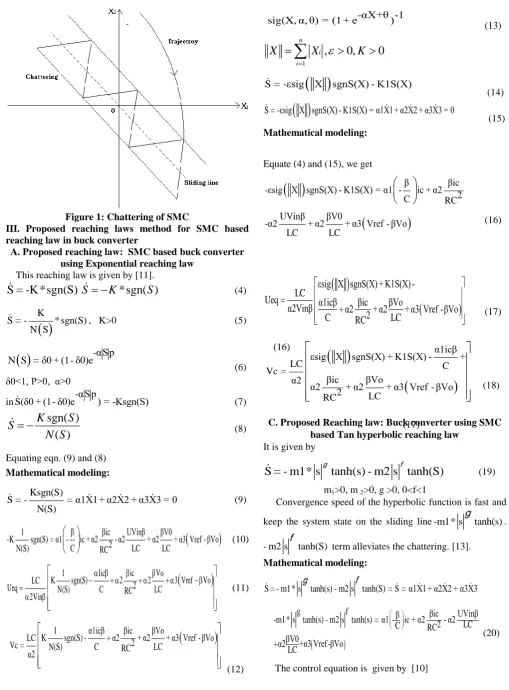
3X3 0 [10] (3) Where α1 α2 & α3 are constants.Chattering: It is undesirable or unwanted oscillation occurs in the sliding surface of SMC.Fig.1 depicts the chattering of SMC.
Mathematical Modeling of Sliding Mode
Reaching Laws for Buck Converter
[image:1.595.308.550.256.398.2]Figure 1: Chattering of SMC
III. Proposed reaching laws method for SMC based reaching law in buck converter
A. Proposed reaching law: SMC based buck converter using Exponential reaching law
This reaching law is given by [11].
S = -K *sgn(S)
S
K
*sgn( )
S
(4)
K
S = - * sgn(S) N S
, K>0 (5)
-αSpN S = δ0 + (1- δ0)e
(6) δ0<1, P>0, α>0
inS(δ0 + (1- δ0)e -αSp) = -Ksgn(S) (7)
sgn( )
( )
K
S
S
N S
(8)
Equating eqn. (9) and (8) Mathematical modeling:
Ksgn(S)
S = - = α1X1 + α2X2 + α3X3 = 0 N(S)
(9)
1 β βic UVinβ βV0
-K sgn(S) = α1 - ic + α2 2- α2 + α2 + α3 Vref -βVo
N(S) C RC LC LC
(10)
1 1ic ic Vo
K sgn(S) 2 2 3 Vref Vo
LC
2
Ueq N(S) C RC LC
2Vin
(11)
1 α1icβ βic βVo
K sgn(S) - + α2 + α2 + α3 Vref -βVo
LC 2
Vc = N(S) C RC LC
α2
(12)(12)
B.Proposed Reaching Law: Buck converter using SMC based Sigmoid Variable Reaching Law
This reaching law is given by [12].
-αX+θ -1
sig(X, α, θ) = (1 + e ) (13)
1
,
0,
0
n
i i
X
X
K
S = -εsig X sgnS(X) - K1S(X)
(14)
S = -εsig X sgnS(X) - K1S(X) = α1X1+ α2X2 + α3X3 = 0
(15) Mathematical modeling:
Equate (4) and (15), we get
β βic
-εsig X sgnS(X) - K1S(X) = α1 - ic + α2 2
C RC
UVinβ βV0
-α2 + α2 + α3 Vref - βVo
LC LC
(16)
εsig X sgnS(X) +
K1S(X)-LC
Ueq =
α1icβ
βic
βVo
α2Vinβ
+ α2
+α2
+α3 Vref -βVo
2
C
RC
LC
(17)(16)
α1icβ εsig X sgnS(X) + K1S(X) - +
LC C
Vc =
βic βVo
α2
α2 + α2 + α3 Vref - βVo
2 LC
RC
(18)(17)
C. Proposed Reaching law: Buck converter using SMC based Tan hyperbolic reaching law
It is given by
S = - m1* s tanh(s) - m2 s tanh(S)
g f(19) m1>0, m 2>0, g >0, 0<f<1
Convergence speed of the hyperbolic function is fast and keep the system state on the sliding line-m1* s
g
tanh(s). - m2 sf tanh(S) term alleviates the chattering. [13].Mathematical modeling:
S = - m1* s gtanh(s) - m2 s tanh(S) = S = α1X1 + α2X2 + α3X3f
g f β βic UVinβ
-m1* s tanh(s) - m2 s tanh(s) = α1 - ic + α2 2- α2 LC
C RC
βV0
+α2 +α3 Vref-βVo LC
(20)
International Journal of Innovative Technology and Exploring Engineering (IJITEE) ISSN: 2278-3075, Volume-9 Issue-2, December 2019
f α1icβ βic -m1* s tanh(s) - m2 s tanh(s) - + α2 +
LC C RC
Ueq =
α2Vinβ βVo
α2 + α3 Vref - βVo LC
g
(21)
D. Proposed Reaching Law: Robust Reaching law: buck converter using SMC based Robust Reaching law The robust reaching law is given by
h1 h2
S = - d1* s sat(s) - d2 s sat(s) (22) d1>0, d2>0, h1>0, 0>h2>1
sgn(s), s > Δ sat(s) = s
, s <= Δ Δ
S is a sliding mode variable, where Δ is the length of the sat(s) plus-minus symmetric linear section near the origin, 0< Δ< 1[14]. Apart from this a boundary layer approach is followed. Instead of sgn(s), sat(s) is used such that switching from -1 to 1 or vice versa is followed through a linear path.
h1
-d1* s
sat(s)
, Here d1 is a constant, by proper selectingthe h1, the system arrives on the phase plane quickly,
2 2
h
d s
sat(s)
d2 is a constant. Selecting a optimistic valueof h2, it alleviates the chattering [14, 17, 18]. Mathematical modelling:
h1 h2
- 1* s sat(s) - 2 s sat(s) = S = α1X1 + α2X2 + α3X3 (23)
h1 h2 β βic UVinβ
-d1* s sat(s) - d2 s sat(s) = α1 - ic + α2 - α2
2 LC
C RC
βV0
+α2 +α3 Vref-βVo LC
(24)
The control equation given by after equating with proposed reaching law
h1 h2 1icβ βic
- 1* s sat(s) - 2 s sat(s) - + α2 +
LC C RC
Ueq =
α2Vinβ βVo
α2 + α3 Vref - βVo LC
(25)
E. Proposed Improved Tan Hyperbolic Reaching Law: Buck Converter Using improved Tan hyperbolic
Reaching Law
The tan hyperbolic reaching law is given by [15, 19, 20]
a b
S = - k1* s tanh(s) - k2 s tanh(s) - Ts k1 > 0, k2 > 0, a > 0, b > 0, T > 0
(26)
The Equation (25)in the improved tan hyperbolic reaching law the bigger the value of b, the greater the velocity of the system state trajectory far the sliding mode surface (s>1) and the smaller the velocity of the system state path near the sliding mode surface (s<1). Correspondingly, the larger the rate of „a‟, the lesser the velocity of the method state path near
the sliding mode surface. It can be known from Eq. (1) that when s=0, S = 0 =0. The first two terms in Eq. (1) are corresponding to the phased control useful to the system. The third term -Ts is added to mitigate the discontinuity of the system at the separation point, exponentially attenuates the system chattering and ensures the stability of the system.The equation (26) equated with equation (3),
a b
-k1* s tanh(s) - k2 s tanh(s) - Ts = S = d1X1+ d2X2 + d3X3 (27)
control equation given by after equating with proposed reaching law
d1ic ic
a b
-k1* s tanh(s) - k2 s tanh(s) - Ts d2
LC C RC
Ueq
d2Vin Vo
d2 d3 Vref Vo
LC
(28)
F.Proposed Double Power Reaching Law: buck converter using double power reaching law
2 1
1 2
F
S = - R * s
F
sgn(s) - R s sgn(s) (29) F1 > 1, 0 < F2 < 1, R1 > 0, R2 > 0.The Equation (29), The double power reaching law, It has two terms, the first term makes the system bringing into wherever, the initial conditions on to sliding manifold and reach to equilibrium point. [13, 14, 16, 21]
Mathematical modelling:
1 2
1 2 1 1 2 2 3 3
F F
-R * s sgn(s) - R s sgn(s) = S = X + X + X
1 1
1 2
2 3
ic ic
F F2
-R * s sgn(s) - R2 s sgn(s)
LC C RC
Ueq
2Vin Vo
Vref Vo LC
(30)
IV. RESULTS AND DISCUSSIONS: A. Comparison of all proposed methods:
Table-1 shows the parameters of buck converter and reaching laws.
Sl.No. Parameter Symbol Value
1
Input
voltage Vi 24Volts
2 Capacitance C 220μF
3 Inductance L 69µH
5
Maximum load
resistance RL(max) 10 Ohm
6
Desired Output
voltage Vod 12V
7
Reference
voltage Vref 12V
8
m1 &m2
(Parameters) 2,3
9
Feedback
10
sliding
coefficients, α1, α2, α3 3,25,2000
11
F1,F2,R1,R
2 1, 0.5, 0.7,1 12 k1, k2 ,a ,b,T 1, 0.5 ,0.7, 0.4,1
13 m1,m2,g f 0.5, 1
14 K, 0.02,3
[image:4.595.48.286.47.172.2]15 d1,d2,h1 ,h2 1, 0.5,0.8,1
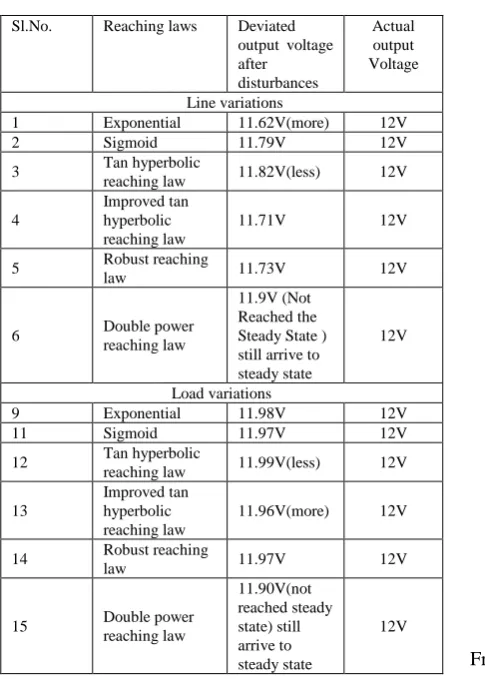
Table-2 Comparative analysis of output voltage of reaching laws
[image:4.595.317.522.186.322.2]Fro m table-2 it is observed that tan hyperbolic reaching law give a smaller amount deviated output voltage as of the actual output voltage, among all the reaching laws. The recovery time of tan hyperbolic reaching law is less, it reaches steady state very quickly even after the disturbances of both load and line variations.
1 2 3 4 5 6 7 8 9 10
x 10-4 11.6
11.7 11.8 11.9 12
Time in Secs
Ou
t
p
u
t
V
Ol
t
a
g
e
V
o
C B A E D F
Figure 3: Output voltage of line variations occurred at 0.4mSecs from 24V to 5V and 0.7mSecs from 5V to 24V. SMC Reaching laws: 1) A (Exponential Reaching law 2) B (sigmoid Variable Reaching law) 3) C (Tan hyperbolic Reaching law) 4) D (Robust reaching law) 5) E (Improved tan hyperbolic reaching law) 6) F (Double power reaching law).From fig.3 depicts the output voltage versus of tan hyperbolic reaching law and it gives a better response than other reaching laws. Output voltage recovered very quickly from 24V to 5V at 0.4mSecs and 5V to 24V at 0.7mSecs.When compared to other reaching laws.
1 2 3 4 5 6 7 8 9 10
x 10-4 11.8
11.9 12 12.1
Time in Secs
Ou
t
p
u
t
V
olt
age
V
o
A B C D E F
Figure 4: Shows the output voltage of load variations occurred at 0.4mSecs from 10Ω to 2Ω and 0.7mSecs from 2Ω to 10Ω. SMC Reaching laws 1) A (Exponential Reaching law 2) B (sigmoid Variable Reaching law) 3) C (Tan hyperbolic Reaching law) 4) D (Robust reaching law) 5) E (Improved reaching law) 6) F (Double power reaching law).From the figure 4 it is observed that output voltage versus time in secs. Tan hyperbolic reaching law gives a better response than other reaching laws. Output voltage is recovered very quickly from 10Ω to 2Ω, disturbances occur at o.4mSecs and 2Ω to 10Ω, disturbances occurs at 0.7 msec. When compared to other reaching laws, tan hyperbolic reaching law gives better results.
0 2 4 6 8 10 12 14
-25 -20 -15 -10 -5 0
Error(Vref-Beta*Vo)
D
e
r
avat
ive
of
E
r
r
or
(
I
c
)
-0.2 -0.1 0 0.1 -4 -2 0
Double power reaching law Novel reaching law Sigmoid reaching law Improveds reaching law Tan hyperbolic reaching law Robust reaching law Chattering
Figure 5 : shows derivative of error v/s error of chattering of Sigmoid, Novel, Improved tan hyperbolic reaching law, Tanhyperbolic reaching law, Double power reaching law and Robust reaching law.
Figure 5 depicts the chattering being on the phase plane trajectory. The double power reaching law gives a error length of 0.240 and reaching time for steady state of 0.340msecs, Novel reaching
law gives error length of 0.217 and reaching time of 0.310,
Sl.No. Reaching laws Deviated output voltage after disturbances
Actual output Voltage
Line variations
1 Exponential 11.62V(more) 12V
2 Sigmoid 11.79V 12V
3 Tan hyperbolic
reaching law 11.82V(less) 12V
4
Improved tan hyperbolic reaching law
11.71V 12V
5 Robust reaching
law 11.73V 12V
6 Double power reaching law
11.9V (Not Reached the Steady State ) still arrive to steady state
12V
Load variations
9 Exponential 11.98V 12V
11 Sigmoid 11.97V 12V
12 Tan hyperbolic
reaching law 11.99V(less) 12V
13
Improved tan hyperbolic reaching law
11.96V(more) 12V
14 Robust reaching
law 11.97V 12V
15 Double power reaching law
11.90V(not reached steady state) still arrive to steady state
[image:4.595.41.284.212.552.2] [image:4.595.320.542.500.662.2] [image:4.595.61.283.638.763.2]International Journal of Innovative Technology and Exploring Engineering (IJITEE) ISSN: 2278-3075, Volume-9 Issue-2, December 2019
Sigmoid reaching law gives a error length of 0.140 and
reaching time of 0.372msecs,Robust reaching law gives a error length of 0.130 and reaching time of 0.320msecs,Improved reaching law gives a error length of 0.050 and reaching time of 0.270msecs and tan hyperbolic reaching law gives a error length of 0.20 and reaching time of 0.275msecs respectively. As the error length decreases, reaching time also decreases .Effect of chattering existence on the error length causes a delay in approaching the steady state and switching losses in the switching devices in the buck converter
.
V. CONCLUSION
In this article, a relative scrutiny has been done for load and line variations for proposed reaching laws. Among all other reaching laws, tan hyperbolic reaching gives dynamic and robustness response even for parametric uncertainties. Hence the chattering in the system reduced. The tan hyperbolic reaching law adapts the switching system very quickly and covers the sliding mode portion phase plane, it exhibits the property of the SMC, due to less chattering that provides a less sensitive for external disturbances.
REFERENCES
1. Weibing Gao, et al, "Variable Structure Control of Nonlinear Systems:A New Approach” IEEE Transactions on Industrial Electronics, vol.40, no.1, pp. 1234-1241. Feb.1993.
2. Brijesh Bhagirath Naik “Sliding Mode Control For Power Converters With Modified Sliding Function for Improved Performance” A Thesis, Gujarat Technological UniversityAhmedabad September – 2018.
3. G. Spiazzi P. Mattavelli, L. Rossetto, “Sliding Mode Control of DC-DC Converters” Power on 20-24th June 1993.U.K.
4. Y.He F.L.Luo. “Design and Analysis of Adaptive Sliding-Mode-Like Controller for DC–DC converter”. The Institution of Engineering and Technology.IEE Proceedings online no. 20050222. IEE Proc.-Electr.Power Appl.Vol. 153, No. 3, pp-125-132, May 2006. 5. Shrey Kasera,Amit Kumar L. B. Prasad, “Analysis of chattering free
improved sliding mode control” Innovations and Information Embedded and Communication Systems” (ICIIECS), 2017 International Conference. Date of Conference Pages. 617-622, 18-20th March 2017.Coimbatore, India.
6. YuNi,Jianping Xu, “Global Sliding Mode Controller for Buck Converter Based on Reaching Law” 978-1-4244-2064-3/08/$25.00 ©2008 IEEE
7. Yiwen Hey, "A Novel Scheme for Sliding-Mode Control of DC-DC Buck converters with a Constant Frequency Based on the Averaging Model" Journal of Power Electronics, Vol. 10, No. 1, January 2010, JPE 10-1-1.
8. Mustafa A. Fadel Al-Qaisi, Mohanad A. Shehab, Ammar Al-Gizi, Mohammed Al-Saadi, “High-performance DC/DC buck converter using sliding mode Controller” International Journal of Power Electronics and Drive System (IJPEDS) Vol. 10, No. 4, December 2019, pp. 1806~1814.
9. Yazan M. Alsmadi, Vadim Utkin, Mohammed A. Haj-Ahmed & Longya Xu, " Sliding mode control of power converters: DC/DC converters" International Journal of Control2018, Vol. 91, NO. 11, 2472–2493.
10. Siew-Chong Tan, Y. M. Lai, Chi K. Tse, and Martin K. H. Cheung, “A Fixed-Frequency Pulse width Modulation Based Quasi-Sliding-Mode Controller for Buck Converter” IEEE Transactions on Power Electronics, Vol. 20, No. 6, pp-1234-1241,Nov.2005.
11. Charles J.Fullaaha, Maarouf saad, Youssef kannan and Kamal AL-Haddad "Sliding mode Robot control with exponential reaching law” IEEE transactions. on Industrial Electronics. Vol 58, No. 2 Feb. 2011.
12. Yun-long Liu, Cun-Chen Gao, and Xiao Liang, "Variable Structure Control for Affine Systems Based on Sigmoid Variable Rate
Reaching Law” Proceedings of the 8th World Congress on Intelligent Control and Automation July 6-9 2010, Jinan, China.
13. Liang Tao, Qiang Chen, Yurong Nan. Chun W, “Double Hyperbolic Reaching Law With Chattering-Free and Fast Convergence” IEEE Access Multidisciplinary journal digital Object identifier 0.1109/ACCESS.2017.DOI.2018.
14. Hongtao Ye,Mengmeng Li, Wenguang Luo, “A novel reaching law of sliding mode control design and analysis” 20-22nd Oct. 2017, Pages 1803 – 1807, 2017 Chinese Automation Congress (CAC). Jinan, China.
15. Zhang He-Xin, Fan Jin-Suo, Meng Fei, Huang Jin-feng, “Double power reaching law for sliding mode control” Control and Decision,2013Vol. 28 No. 2.
16. Qian Xu, J. L. Song, T. H. Yan, H. P. Du, B. He, and W. H. Li, “Novel Exponential Reaching Law for Sliding Mode Control of Discrete-time System with Disturbance” 2018 .Australian & New Zealand Control Conference (ANZCC) Swinburne University of Technology Melbourne, Australia, Dec 7-8, 2018.
17. Yazan M. Alsmadi, Vadim Utkin, Mohammed A. Haj-ahmed & Longya Xu, “Sliding mode control of power converters: DC/DC converters” International Journal of Control 2018, VOL. 91, NO. 11, 2472–2493
18. Pranav.J.Kumar,V. Kumar.K.P, S. Rana, “Efficient Reaching Law for SMC with PID Surface Applied to a Manipulator” 978-1-4673-9080-4/16/$31.00 ©2016 IEEE.
19. Yu-Xin Zhao, "A Double Power Reaching Law of Sliding Mode Control Based on Neural Network" Hindawi Publishing Corporation Mathematical Problems in Engineering Article ID 408272, 9 pages Vol.No.1, 2013.
20. Haifeng Ma, “Sliding-Mode Control With Enhanced Power Reaching Law” IEEE Transactions On Industrial Electronics, Vol. 66, No. 6, June 2019.
![figure [10]. The sliding mode controlled buck converter as shown in](https://thumb-us.123doks.com/thumbv2/123dok_us/8154154.247994/1.595.308.550.256.398/figure-sliding-mode-controlled-buck-converter-shown.webp)