International Journal of Innovative Technology and Exploring Engineering (IJITEE) ISSN: 2278-3075, Volume-9 Issue-2, December 2019
Abstract: This article is written about improving the design methods of training based on the proposed pedagogical technologies, the content of the discipline "Methods of teaching mathematics" (the sequence of actions of a teacher in the development of modern educational technologies) and the development of a modern concept for the design of teaching in the discipline of mathematics, the use of elements of practice, integrity, independence, action, drawing up the "large", "medium" and "small" stages of the module of design proposals concerning the content of the sequence of the trajectory of the functional operations. In particular, the practical results of the study are in the process of designing the teaching process for the discipline “Methods of Teaching Mathematics” in higher educational institutions, the methodology for introducing theoretical and practical lessons into practice has activated the students' knowledge, and has made it possible to develop a design model that helps to improve the quality of discipline learning. During the study for students studying in the field of education "Methods of teaching mathematics" developed the same manual. Keywords: mathematics, teaching methods, class design, practice elements, case studies, problem-based learning.
I. INTRODUCTION
In the world, special attention is paid to the technologization of learning processes, the achievement of educational effectiveness through information and communication technologies, the implementation of a quality management paradigm. At leading higher educational institutions, trends, that provide for the role and importance of natural and exact disciplines, in particular, mathematics in the context of globalization, the use of design aspects based on a block-modular system, as one from innovative forms of teacher training in this area.
The leading scientific centers of the world conduct research on the problems of designing and organizing educational technologies, the educational process and bring their positive results. These studies are gaining importance by developing a theory of the technological process of the educational process, criteria for designing classes based on modern pedagogical technologies and trends, as well as the fact that they are aimed at improving the quality of teaching the discipline of mathematics.
Reforms carried out in our country to ensure the integration of the educational process and production, the development of the higher education system, the
Revised Manuscript Received on December 05, 2019.
D.M.Makhmudova, Faculty of Social Science, Department of Education, The National University of Uzbekistan after named Mirzo Ulugbek, Tashkent, Uzbekistan. Email: [email protected]; [email protected].
A.J.Khurramov, Department of Methods of teaching computer science, Chirchik State Pedagogical Institute, Tashkent region, Uzbekistan. Email: [email protected].
strengthening of its material and technical base, and the improvement of the forms and content of education expand the possibilities for introducing advanced pedagogical technologies into the educational process. At the same time, there is a lack of a systematic approach related to increasing the effectiveness of training future teachers in the discipline of mathematics, a mechanism for ensuring the positive results of classes in the discipline "Methodology of Teaching Mathematics". The Strategy for the Further Development of the Republic of Uzbekistan defines priority tasks such as “continuing the course of further improving the system of continuing education, increasing the availability of high-quality educational services, and training highly qualified personnel in accordance with modern needs of the labor market, improving the quality of education of higher educational institutions, in-depth study of such important and sought-after subjects as mathematics [9]. In this regard, the definition of the modern concept of designing training sessions, innovative modeling of the technology for organizing teaching, improving methodological support in the discipline "Methods of teaching mathematics" is gaining importance.
II. METHODOLOGY
The purpose of the study is to improve the design of teaching in the discipline "Methods of teaching mathematics" in higher educational institutions.
Research Objectives:
analysis of national and foreign literature on the design of teaching classes of the discipline "Methods of teaching mathematics" in higher educational institutions, improving the design of teaching and developing methodological foundations (purpose, content, methods, and means) of design;
development of an innovative model of educational technology for the organization of teaching on the basis of improving the modern concept of designing teaching in the discipline "Methods of teaching mathematics";
improving the concept of teaching the discipline "Methods of teaching mathematics", based on the projects of training sessions;
improving the design methodology for teaching the discipline "Methods of teaching mathematics", the organization of experimental work to identify effectiveness, mathematical and statistical analysis of the results and development of recommendations.
Improvement of Technique of Designing and
Teaching Learning Process in the course
Teaching Mathematics”
The object of the study is the design process for teaching teaching in the discipline "Methods of Teaching Mathematics" at Tashkent State Pedagogical University, Gulistan State University, and Navoi State Pedagogical Institute, 520 respondents were involved in experimental work.
The subject of the study is the content, forms, methods and design tools for teaching teaching in the discipline "Methods of teaching mathematics."
Research Methods. In the research process, methods of comparative critical study, analysis, and generalization of pedagogical, psychological and methodological literature, curricula, textbooks, teaching aids related to the research topic were used; observation, analysis, conversation, questionnaires, test surveys, experimental work, mathematical and statistical analysis of the results of the educational process in the discipline "Methods of teaching mathematics" in higher educational institutions.
The scientific novelty of the study is as follows:
a modern conceptual program (based on the use of activating, developing, new information tools) for designing teaching teaching in the discipline of mathematics is developed on the basis of the priority of practice, integrity, independence, proportionality of action elements (orientation to the individual, individual work, freedom of action) in the pedagogical process;
training sessions are determined on the basis of a phased content path (purpose and concepts, criteria, means, text) of the functional actions of the “large”, “medium” and “small” stages of modular design (project algorithm, text script, evaluation);
the technology for designing classes is improved based on the allocation of general and private methodology, the disclosure of processes (planning, the stage of cooperation, organizational and didactic support) and the content (phased actions of the teacher in the development of modern educational technology) integration of educational modules and educational activities;
methodological support aimed at the block-modular approach to teaching the discipline "Methods of teaching mathematics" is improved on the basis of the development of interactive teaching materials and a complex of creative and intellectual tasks (predictive, critical evaluations, revealing creativity).
The practical results of the study are as follows:
in the process of designing the teaching process for the discipline "Methods of teaching mathematics" in higher educational institutions of Uzbekistan, the methodology for introducing theoretical and practical lessons into practice has activated the students' knowledge, and has allowed the development of a design model that helps to improve the quality of mastering the discipline;
for students studying in the direction of education "Methods of teaching mathematics" developed the same manual.
III. LITERATURE SURVEY
Methodological aspects (content, purpose, methods, and means) of the taught disciplines relating to the training of educational specialists in higher educational institutions, pedagogy, mathematics teaching and the study of problems aimed at drawing up training projects are considered in studies of scientists of the republic such as Ikramov Zh.I.[5],
Tozhiev M. [8], Zlotsky G.V.[13], and others, as well as CIS countries Kolyagin Yu.I.[6], Stolyar [7].
The content, nature, purpose, and objectives of educational technologies based on the design of teaching teaching lessons and the results of their implementation in the educational process are reflected in the studies of scientists of the republic such as Azizkhuzhayeva NN [1], Zhuraev R.Kh.[11], Yuldoshev Zh.G [10], Hasanov S.[10]. Issues of solving problems associated with improving the implementation of pedagogical technologies are considered in studies of foreign scientists such as Bloom BS [2], Cobb CW.[3], and others.
Theoretical and practical foundations of the use of pedagogical technologies, designing the content of the educational process are considered in the works of Ziyomukhamedov B.[12], Golish L.V.[4], Fayzullaeva D.M.[4], and others.
An analysis of the literature and scientific developments showed that special studies related to design based on educational technologies and educational trends in the discipline "Methods of teaching mathematics" were not conducted.
IV. THEORYANDDISCUSSION
When the question “The state and analysis of the design of classes in mathematical disciplines in higher educational institutions” was studied, the activity of compiling projects for the educational process of organizations of a number of developed countries carrying out research on the problems of educational technologies was considered. In this regard, an analysis of studies on the formation of knowledge and skills in relation to the design of the educational process of innovation centers at leading educational institutions and faculty of HEU.
International Journal of Innovative Technology and Exploring Engineering (IJITEE) ISSN: 2278-3075, Volume-9 Issue-2, December 2019
In particular, the activities of scientific schools on the design of the educational process based on innovative educational technologies are highlighted.
The term "Project" means an idea, the practical development of plans. Its main meaning is understood as a holistic image of a promising pedagogical process or organizational and practical work on the preparation of any product. The organization in a certain direction and subject of educational work, for example, a weekly, sports holiday, the activities of the "Small Schools" of the discipline of mathematics can also be considered as design. However, it is necessary to observe the design method.
Design method - technology for identifying, identifying and developing problems to achieve didactic goals. Design activities are the most common form of organizing work with students. And projects of training sessions can be described as an expanded technological map.
Initially, the design was inherent in areas such as manufacturing, construction, architecture. In the future, starting from the middle XX century began the transition from technical to sociotechnical design, social, psychological and human factors, which are on a par with technical, technological and economic factors. Today, design is developing intensively in the educational process. The design of the educational process is considered a type of future social and humanitarian design. In the modern educational process, perspective planning and designing of the educational process, in particular in the discipline of mathematics, is important; designing requires a technological approach.
Planning a class when the teacher reaches a certain goal in the preparation process, i.e. the correct choice of educational forms, means, methods, technologies allows you to get a complete picture of the expected results. The planning of the educational process includes such stages of theoretical and practical training as: for the entire period of study, the academic year, semesters (in quarters), month, week, day and every hour. Designing is the most modern way of organizing and developing the educational process based on innovative technologies.
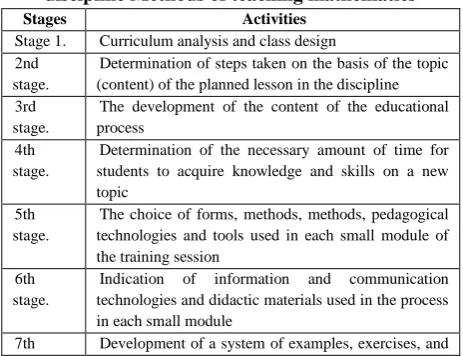
[image:3.595.53.285.604.782.2]In accordance with this, a project of training sessions in the discipline "Methods of teaching mathematics" was compiled and divided into 9 stages (Table 1).
Table 1. Stages of drafting training sessions in the discipline Methods of teaching mathematics
Stages Activities
Stage 1. Curriculum analysis and class design 2nd
stage.
Determination of steps taken on the basis of the topic (content) of the planned lesson in the discipline 3rd
stage.
The development of the content of the educational process
4th stage.
Determination of the necessary amount of time for students to acquire knowledge and skills on a new topic
5th stage.
The choice of forms, methods, methods, pedagogical technologies and tools used in each small module of the training session
6th stage.
Indication of information and communication technologies and didactic materials used in the process in each small module
7th Development of a system of examples, exercises, and
stage. assignments 8th
stage.
Writing a scenario for the implementation of the training process based on the content of the project 9th
stage.
Development of a system of wide electronic control of students
Despite the fact that in recent years effective work has been carried out to introduce modern pedagogical and information and communication technologies into the educational process, shortcomings in the content and application of certain concepts are allowed in the issue of introducing a modern design concept for teaching teaching of mathematical disciplines. In this issue, from a scientific point of view, clarity has been clarified in controversial issues and a comprehensive consideration has been given to the modern concept of designing teaching as an innovation in the discipline "Methods of teaching mathematics." For example, when describing such concepts as “methodology” and “educational technology” that are widely used in pedagogical practice, there are various approaches, and they, in turn, create barriers at a certain level for the effective organization of the educational process.
When indicating the conceptual foundations of these problems, the drafting of training sessions in mathematical disciplines and the organization of the teaching process on this basis is an important criterion. In particular, the term "methodology" in the general sense is understood as a set of methods and methods necessary to carry out any work or instruction on the application of methods and measures to achieve educational goals.
In turn, educational technology is a system of perfectly working components of a pre-designed process to provide evidence-based and guaranteed results for achieving the goal. This term, in comparison with the term “pedagogical technology”, has a broader meaning. Because it, in addition to education and pedagogy, includes such areas as social, socio-political, managerial, cultural, psychological and pedagogical, medical and pedagogical, economic and others. Also, the term "pedagogical technology" refers to all sections of pedagogy. Among educational technologies, an important place is taken by the technological approach, which guarantees high-quality management and achievement of goals in the educational process. Based on the foregoing, it can be concluded that educational technology is becoming important to create a strong connection between previously acquired and new theoretical knowledge.
Teaching Mathematics”
In this regard, as a conceptual basis for the organization of the design of training sessions, a conceptual approach is defined regarding the implementation of the design of the educational process by the choice of methods and means of training, communication, information, and management.
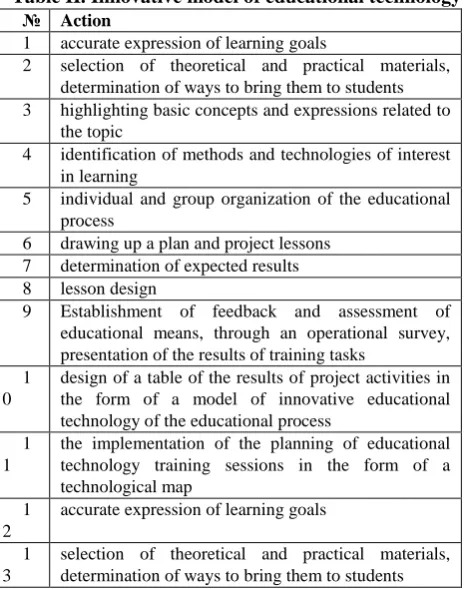
[image:4.595.45.286.176.475.2] [image:4.595.51.285.179.474.2]In connection with this issue, the "Methodology of Teaching Mathematics" was designed to consider the modern concept of teaching the discipline and issues of improving the methodology of teaching design as follow:
Table II. Innovative model of educational technology № Action
1 accurate expression of learning goals
2 selection of theoretical and practical materials, determination of ways to bring them to students 3 highlighting basic concepts and expressions related to
the topic
4 identification of methods and technologies of interest in learning
5 individual and group organization of the educational process
6 drawing up a plan and project lessons 7 determination of expected results 8 lesson design
9 Establishment of feedback and assessment of educational means, through an operational survey, presentation of the results of training tasks
1 0
design of a table of the results of project activities in the form of a model of innovative educational technology of the educational process
1 1
the implementation of the planning of educational technology training sessions in the form of a technological map
1 2
accurate expression of learning goals
1 3
selection of theoretical and practical materials, determination of ways to bring them to students
The discipline "Methods of teaching mathematics" (formerly "Mathematics"), intended for students of pedagogical higher educational institutions, is substantively divided into general, private, exact sections of methods and serves to develop new generation curricula, determine the necessary qualification requirements, implement, develop and improve mathematical education while bringing students to the required level of knowledge. Based on this, the solution of the following issues are relevant for the discipline "Methodology of teaching mathematics":
• didactic conditions for the preparation of teachers of mathematics;
• theoretical and practical aspects of the methodological training of future mathematics teachers;
• system update and methodological foundations of the theoretical development of mathematics teaching methods;
• the role of modern pedagogical and information and communication technologies in the effective organization of the teaching of mathematics;
• methodological system of teaching the discipline: form, content, goal, means, methods, and technologies;
• effective aspects of creating training projects and others.
In this part, the methodology for preparing training
projects is given in the form of a model (Fig. 3). In the formation of this model, the “instruction for designing training sessions” was used as a guide by B. Ziyukhamedov [12] and M. Tozhiev [8].
At the same time, at the beginning, the curriculum is conditionally adopted as a “Big module” of no hierarchical level. Educational and educational goals are defined and are given in the form of the first table. The general objectives of the discipline are formed on the basis of the State educational standard and qualification requirements. In determining the general objectives of the discipline, the above-mentioned general and particular methodological foundations are used. This process on the computer is carried out in the following order:
First, as indicated above, the requirements for the education system by the state and society, the dialectics, the tendency and the laws of a systematic approach to education are entered as a general methodological basis.
Secondly, didactic principles, the psychology of age and the rules of psychoanalysis, as well as the trends of pedagogical technologies are noted.
When drawing up a project of classes, files were created, the suitability of the goal was studied in terms of the level of requirements for teachers from the state and society, didactics and approach - the requirements of laws and regulations. In addition, didactic laws, principles, developmental psychology and the rules of psychoanalysis are adapted to certain goals.
Secondly, academic discipline, i.e. training material based on the completeness of thoughts and the logical connection of knowledge in a large module is divided into large parts. They received the name "Big Module". After that, the goals of each large module are determined, the allocated hours are shown and the design is made in the form of a table. She got the name of the second table. In determining the objectives of large modules was guided by the largest module. The set of allocated hours for each module should be equal to the total number of hours allocated to the academic discipline. In formulating the objectives of large modules, general and particular methodological foundations were also provided.
Thirdly, from each large module, the logically related knowledge necessary to bring students through one-pair training sessions is allocated. As the "Middle module" indicated educational goals and are shown in the form of a third table. The objectives of each middle module reflect general and particular methodologies. At the same time, for each pair of training sessions, private tables of the middle module are created. This work was carried out in the following order:
International Journal of Innovative Technology and Exploring Engineering (IJITEE) ISSN: 2278-3075, Volume-9 Issue-2, December 2019
In the second work, basic concepts are selected from the knowledge provided through medium modules. Based on them, control questions were drawn up regarding the assessment of students' knowledge and skills, types and criteria of assessment were determined. Of course, all didactic laws were provided for.
In the third work, the type, form, and stages of classes used in each small module are determined.
The fourth paper shows the methods and tools used in each small module.
The fifth work defines information and communication technologies and didactic materials used in each small module of classes in the discipline "Methods of teaching mathematics."
In the sixth work, the script of the educational process is written according to the order indicated in the private tables of the project. At the same time, the knowledge given in each module is expressed, attention is paid to the importance of the type of classes, pedagogical methods, information and communication technologies, and didactic materials while increasing students' knowledge.
When writing the script text was guided by the requirements entered in the computer's memory. In the text, students are recommended to write with the allocation of the necessary places to which they should pay attention. The script is implemented in the form of a dialogue between teacher and student. This technique can be used not only in the design of the training session in the discipline of mathematics but also in other disciplines.
V. EXPERIMENTALRESULTSANDDISCUSSION
[image:5.595.305.551.115.234.2]Experimental work was carried out in the period from 2014 to 2018 years in three higher educational institutions of the republic, in particular, Gulistan State University (GSU) and Navoi State Pedagogical Institute (NSPI), Tashkent State Pedagogical University named after Nizami (TSPU) (table III).
Table III. The number of professors, teachers, and students from higher educational institutions who took
part in the experimental work
№ HEU Number of participans teachers students
1. TSPU 12 288
2. NSPI 7 269
3. GSU 10 250
Total: 29 807
In order to strictly observe the chosen path, only methodological aspects inherent in information support and assessment technologies were considered, and selective statistical methods were used. The principle of majorant (superiority) representativeness is used.
In accordance with the ideas put forward in some mathematical and statistical methods relating to the reanalysis of the research results, an assessment is made of the effectiveness of the study by the difference in the performance indicators of students who took part in the experimental work. For this purpose, in accordance with the method -
2, the total indicators of the first stage of thestudents of the experimental and control groups were compared with the indicators of the second, third and final stages.
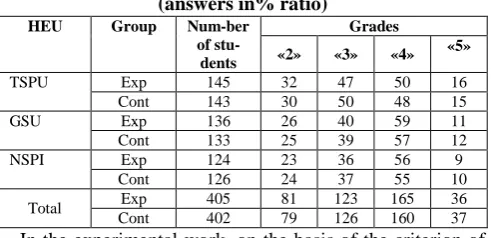
Table IV. Test results for the discipline "Methods of teaching mathematics." The result of the final test
(answers in% ratio) HEU Group Num-ber
of stu-dents
Grades
«2» «3» «4» «5»
TSPU Exp 145 32 47 50 16
Cont 143 30 50 48 15
GSU Exp 136 26 40 59 11
Cont 133 25 39 57 12
NSPI Exp 124 23 36 56 9
Cont 126 24 37 55 10
Total Exp 405 81 123 165 36
Cont 402 79 126 160 37
In the experimental work, on the basis of the criterion of the proximity of the level of knowledge, 405 students were selected from the number of students studying in the field of education “Mathematics” and the results of 402 students in the control group were analyzed.
Table V. General results of the analysis of experimental work in selected HEU
Experimental group Т=405
Control group N=402
Grades 2 3 4 5 2 3 4 5
Number of
relevant ratings 35 59 248 63 77 87 201 37
The arithmetic mean of the
estimates х3,9 у3,57
Performance ratio
/ 1,10
х y
Reliability
Probability Gap 3,83 x 3,9 3, 48 y 3,5
The analysis showed that at the final stage of the experimental work, the level of academic performance of students in the experimental and control group in the discipline of mathematics increased significantly, i.e. academic performance increased by 10%.
In conclusion, we can conclude that the results obtained at the final stage of the experimental work is effective.
VI. RECOMMENDATIONANDCONCLUSION
At the end of the experiment on the topic "Methods of teaching mathematics" we can draw the following conclusions:
[image:5.595.59.281.541.619.2]Teaching Mathematics”
2. The scientific substantiation of the planning and design of training sessions in the discipline "Methods of teaching mathematics" was made, the stages of designing were developed.
The future social design guarantees the quality of education by planning, designing and organizing the educational process.
3. As one of the factors for the effective organization of teaching, a modern concept for the design of teaching teaching classes in mathematical disciplines has been developed and a model for designing the teacher's activity has been created. As a result, a scientific justification was made that in order to achieve the goal it is necessary to design classes and apply them in practice on the basis of didactic goals of mathematical education.
4. A methodology has been developed for drafting training sessions in the discipline "Methods of teaching mathematics." The widespread introduction of innovative educational technologies made it possible to value the learner as a person, achieve critical thinking, and determine the basis for the development of independent knowledge acquisition, taking into account individual properties and capabilities.
5. The procedure for drafting training sessions in the discipline "Methods of teaching mathematics" is shown in practice, an example of the sample. This sample served to develop independent thinking and increase the effectiveness of students' learning activities.
6. By processing on the basis of the mathematical-statistical method, the results of the pedagogical experimental work proved that when designing training sessions in the discipline "Methods of teaching mathematics", the effectiveness of the results compared to traditional teaching increased by 10% and this had a positive impact on the creative and cognitive activity of students.
REFERENCES
1. Azizxojayeva N.N. Pedagogik texnologiya va pedagogik mahorat. – T.: TDPU, 2003. –pp.133-234.
2. Bloom B.S. (ed) et al. A taxonomy of Educational objectives: Handbook 1: The Cognitive Domain. Harvow, 1956.
3. Cobb C.W., Douglas P.H. A theory of production. – American Economi Review, 1928, v.18. – № 1.
4. Golish L.V., Fayzullayeva D. Kasb-hunar kollejlarida moduli dastur asosida ta‟lim berish // Kasb-hunar ta‟limi. – T., 2002. – № 4. – pp. 19-24.
5. Ikromov J. “Maktab matematika tili”. – Tashkent: Oqituvchi, 1977, pp.163-195.
6. Kolyagin Yu.M., Oganesyan V.A. Uchis reshat zadachi. // Posobiye dlya uchashihsya 7-8 klassov. –Moscow, Prosvesheniye, 1980, pp. 96-105.
7. Stolyar A.A. Rol matematiki v gumanizatsii obrazovaniya // Matematika v shkole. 1990. – № 6. – pp. 5-7.
8. Tojiyev M., Barakayev M., Xurramov A., Matematika oqitish metodikasi. //Oquv qollanma.Fan va texnologiyalar, Tashkent, 2017, pp. 276-328.
9. Uzbekiston Respublikasi Prezidentining 2017 yil 7 fevraldagi PF-4947 son “Uzbekiston Respublikasini yanada rivojlantirish bo„yicha Harakatlar strategiyasi tugrisida”gi Farmoni. Aviable: www.lex.uz. 10. Yuldoshev Zh. Hasanov S. Pedagogik texnologiyalar / Oquv
qollanma. – T.: Iqtisod-Moliya, 2009. – pp. 546-652.
11. Zhuraev R.Kh., Jurayev R.X. Teoriya i praktika intensifikatsii professionalnoy podgotovki uchashihsya proftehkolledjey. – T.: Fan, 1992. – pp. 212-259.
12. Ziyomuhamedov B. “Ta‟lim texnologiyalari” oquv predmeti bitta mavzusi nazariy va amaliy mashgulotlarning ozbek modeli asosida tuzilgan loyihalari // Metodik qollanma. – T.: 2012. – pp. 46-60.
13. Zlotskiy G.V. O psixologo-pedagogicheskoy i metodiko-matematicheskoy podgotovke studentov matematikov universitetov k professionalno-pedagogicheskoy deyatelnosti. //Ta‟lim muammolari. – Tashkent, 2000, Volume №2, pp.28-30.
AUTHORSPROFILE
Makhmudova Dilfuza Melievna obtained her Bachelors and Master‟s Degree in Mechanics & Mathematics from The Tashkent State University. She received her Ph.D degree from National university of Uzbekistan, Uzbekistan, 2017. She has published more than 29 Journals and 23 papers in both national and international conferences.