HPJava: Towards Programming Support for High-Performance
Grid-Enabled Applications
Han-Ku Lee, Bryan Carpenter, Geoffrey Fox, Sang Boem Lim
{
hkl, dbc, gcf, slim
}
@grids.ucs.indiana.edu
Pervasive Technology Labs at Indiana University
Bloomington, IN 47404-3730
Computational Science and Information Technology at Florida State University
Tallahassee, FL 32306
Abstract
We start seeing the authors’ HPspmd Programming Model 1 towards the programming support for High-Performance Grid-Enabled Environments since the fu-ture grid computing systems will need to provide pro-gramming models. As a proper propro-gramming model for grid-enabled environments and applications, high per-formance on multi-processor systems is critical issue. We argue with simple experiments that we can in fact hope to achieve high performance in a similar ballpark to more traditional HPC languages.
Keywords: HPspmd Programming Model, HPJava, High-Performance Grid-Enabled Environment, Java
1
Introduction
In the earlier publications such as [7, 6], we argued that HPJava should ultimately provide acceptable per-formance to make it a practical tool for HPC. More-over, from [18], we proved that HPJava node perfor-mance is quite acceptable, compared with C, FOR-TRAN, and ordinary Java: especially Java is no longer much slower than C and FORTRAN; The performance is becoming comparable. Thus, we verified our library-based HPspmd programming language extensions can be implemented efficiently in the context of Java.
1This work was supported in part by the National Science Foundation Division of Advanced Computational Infrastructure and Research, contract number 9872125.
The next step is to start viewing our HPspmd pro-gramming model as Programming Support for High-Performance Grid-Enabled Environments.
In this paper, first, we will see what grid comput-ing is, why we need grid computcomput-ing, and how our HP-spmd programming model can be adapted for high-performance grid-enabled environments. Through this approach, we can gradually change our dimension for viewing HPspmd programming from high-performance computing to high-performance grid-enabled environ-ments.
Secondly, we will review some features, run-time li-brary, and compilation strategies including optimiza-tion schemes for HPJava. Moreover, we will experi-ment on simple HPJava programs comparing against FORTRAN and Java programs.
2
High-Performance Grid-Enabled
Environments
2.1
Grid Computing
Grid computing can be defined as computing envi-ronments that are fundamentally distributed, hetero-geneous, and dynamic for resources and performance. As inspired by [10], the Grid will establish an huge en-vironment, connected by global computer systems such as end-computers, databases, and instruments, to make a World-Wide-Web-like distributed system for science and engineering.
heavily depends on grid computing for efficient and powerful computing by improving legacy technol-ogy, increasing demand-driven access to computational power, increasing utilization of idle capacity, sharing computational results, and providing new problem-solving techniques and tools. Of course, substan-tially powerful Grids can be established using high-performance networking, computing, and program-ming support regardless of the location resources and users.
Then, what will be the biggest potential issues in terms of programming supports we have to concen-trate on grid computing and its environments, which wants to simplify distributed heterogeneous comput-ing in the same way that the World-Wide-Web simpli-fied information sharing over the internet? The high-performanceis one possible answer since a slow system which has a clever motivation is useless. The other an-swer could be the thirst for grid-enabled applications, hiding the “heterogeneity” and “complexity” of grid environments without losing performance.
2.2
HPspmd Programming Model
Towards Grid-Enabled Applications
To support “high-performance grid-enabled applica-tions”, the future grid computing systems will need to provide programming models[10]. The main thrust of programming models is to hide and simplify complexity and details of implementing the system, while focusing on the application design that have a significant impact on program performance or correctness.
Generally, we can see different programming mod-els in sequential programming and parallel program-ming. For instance, in sequential programming, com-monly used programming models for modern high-level languages furnish applications with inheritance, encap-sulation, and scoping. Moreover, in parallel program-ming, distributed arrays, message-passing, threads, condition variables, and so on. Thus, using each model’s significant charateristics, sequential and par-allel programmings must maximize their performance and correctness.
But, there is no clarity about what programming model is appropriate for a grid environment, although it seems clear that many programming models will be used.
One approach to grid programming is to adapt pro-gramming models that have already proved success-ful in sequential or parallel environments. For exam-ple, the data-parallel language model such as HPspmd Programming Model might be an ideal programming
model for supporting and developing high-performance grid-enabled applications, allowing programmers to specify parallelism in terms of process groups and dis-tributed array operations. A grid-enabled MPI – cur-rently our HPJava project team provides a Java im-plementation of MPI, called mpiJava – would extend the popular message-passing models. Java new I/O API’s dramatic performance improvement encourages us to focus on grids-enabled MPI implementations as well. Moreover, high-performance grid-enabled appli-cations and run-time systems demand “adaptability”, “security”, and “ultra-portability”, which can be sply supported by the HPJava language since it is im-plemented in the context of Java.
Despite tremendous potential, enthusiasm, and com-mitment to Grid, few software tools and programming models exist for high-performance grid-enabled appli-cations. Thus, to make prospective high-performance grid-enabled environments, we need nifty compilation techniques, high-performance grid-enabled program-ming models, applications, and components, and a bet-ter and improved base language (i.e. Java).
We believe that the success of HPJava would make our HPspmd Programming Model a promising can-didate for constructing high-performance grid-enabled applications and components.
3
The HPJava Language
3.1
HPspmd Programming Model
HPJava [13] is an implementation of what we call the HPspmd programming language model. HP-spmd programming language model is a flexible hy-brid of HPF-like data-parallel features and the popu-lar, library-oriented, SPMD style, omitting some basic assumptions of the HPF [12] model.
To facilitate programming of massively parallel, dis-tributed memory systems, it extends the Java language with some additional syntax and some pre-defined classes for handling distributed arrays, and with Adlib
[8], the run-time communication library. HPJava sup-ports a true multi-dimensional array, which is a modest extension to the standard Java language, and which is a subset of our syntax for distributed arrays. HPJava in-troduces some new control constructs such asoverall,
at, andonstatements.
Procs2 p = new Procs2(P, P) ; on(p) {
Range x = new BlockRange(N, p.dim(0)) ; Range y = new BlockRange(N, p.dim(1)) ;
double [[-,-]] c = new double [[x, y]] on p ;
double [[-,*]] a = new double [[x, N]] on p ; double [[*,-]] b = new double [[N, y]] on p ;
... initialize ‘a’, ‘b’
overall(i = x for :) overall(j = y for :) {
double sum = 0 ;
for(int k = 0 ; k < N ; k++) sum += a [i, k] * b [k, j] ;
c [i, j] = sum ; }
}
Figure 1. Matrix Multiplication in HPJava.
3.2
Features
Figure 1 is a basic HPJava program for a matrix multiplication. It includes much of the HPJava special syntax, so we will take the opportunity to briefly re-view the featues of the HPJava language. The program starts by creating an instance p of the class Procs2. This is a subclass of the special base class Group, and describes 2-dimensional grids of processes. When the instance of Procs2 is created, P×Pprocesses are se-lected from the set of processes in which the SPMD program is executing, and labelled as a grid.
TheGroupclass, representing an arbitrary HPJava process group, and closely analogous to an MPI group, has a special status in the HPJava language. For ex-ample the group object p can parametrize an on(p)
construct. Theonconstruct limits control to processes in its parameter group. The code in the onconstruct isonly executed by processes that belong top. Theon
construct fixes pas theactive process groupwithin its body.
The Range class describes a distributed index range. There are subclasses describing index ranges with different properties. In this example, we use theBlockRangeclass, describing block-distributed in-dexes. The first argument of the constructor is the global size of the range; the second argument is a pro-cess dimension—the dimension over which the range is distributed. Thus, rangesxandyare distributed over
the first dimension (i.e. p.dim(0)) and second dimen-sion (i.e. p.dim(1)) ofp, and both haveNelements.
The most important feature HPJava adds to Java is thedistributed array. A distributed array is a collective object shared by a number of processes. Like an ordi-nary array, a distributed array has some index space and stores a collection of elements of fixed type. Un-like an ordinary array, the index space and associated elements are scattered across the processes that share the array. There are some similarities and differences between HPJava distributed arrays and the ordinary Java arrays. Aside from the way that elements of a distributed array are distributed, the distributed array of HPJava is a true multi-dimensional array like that of FORTRAN. Like in FORTRAN, one can form a reg-ular section of an array. These features of FORTRAN arrays have adapted and evolved to support scientific and parallel algorithms.
With a process group and a suitable set of ranges, we can declare distributed arrays. The type signature of a distributed array is clearly told by double brackets. In the type signature of a distributed array, each slot holding a hypen,-, stands for a distributed dimension, and a astrisk, *, a sequential dimension. The arrayc
is distributed in both its dimensions. Besides, Arrays
a and b are also distributed arrays, but now each of them has one distributed dimension and onesequential dimension.
Theoverallconstruct is another control construct of HPJava. It represents a distributed parallel loop, sharing some characteristics of the forall construct of HPF. The symbol iscoped by the overallconstruct is called a distributed index. Its value is a location, rather an abstract element of a distributed range than an integer value. The indexes iterate over all locations. It is important to note that (with a few special ex-ceptions) the subscript of a distributed array must be a distributed index, and the location should be an ele-ment of the range associated with the array dimension. This unusual restriction is an important feature of the model, ensuring that referenced array elements are lo-cally held.
void matmul(double [[-,-]] c,
double [[-,-]] a, double [[-,-]] b) {
Group p = c.grp() ;
Range x = c.rng(0) ; Range y = c.rng(1) ;
int N = a.rng(1).size() ;
double [[-,*]] ta = new double [[x, N]] on p ; double [[*,-]] tb = new double [[N, y]] on p ;
Adlib.remap(ta, a) ; Adlib.remap(tb, b) ;
on(p)
overall(i = x for :) overall(j = y for :) {
double sum = 0 ;
for(int k = 0 ; k < N ; k++) sum += ta [i, k] * tb [k, j] ;
c [i, j] = sum ; }
}
Figure 2. General matrix multiplication.
is determined from cby using DAD inquiry functions
grp()and rng() to fetch the distribution group and index ranges of a distributed array. Adlib.remap()
does the actual communication to remap.
This implementation has some performance issues associated with its memory usage. These issues can be patched up—see [7] for more details. Meanwhile the simple version given here encapsulates some interest-ing principles of library construction with HPJava—in particular how arrays can be created and manipulated, even though the distribution formats are only deter-mined at run-time.
We will give another old favorite program, red-black relaxation. It is still interesting since it is a kernel in some practical solvers (for example we have an HPJava version of a multigrid solver in which relaxation it is a dominantly time-consuming part). Also it conveniently exemplifies a whole family of similar, local, grid-based algorithms and simulations.
We can see an HPJava version of red-black relax-ation of the two dimensional Laplace equrelax-ation in Fig-ure 3. Here we use a different class of distributed range. The class ExtBlockRange adds ghost-regions
[11] to distributed arrays that use them. A library function called Adlib.writeHaloupdates the cached
Procs2 p = new Procs2(2, 3) ; on(p) {
Range x = new ExtBlockRange(N, p.dim(0)) ; Range y = new ExtBlockRange(N, p.dim(1)) ;
double [[-,-]] a = new double [[x, y]] on p ;
... initialization for ‘a’
for(int iter=0; iter<count; iter++){
Adlib.writeHalo(a, wlo, whi);
overall(i=x for 1 : N - 2)
overall(j=y for 1+(i‘+iter)%2 : N-2 : 2) { a[i,j] = 0.25F * (a [i-1,j] + a [i+1,j] +
a [i,j-1] + a [i,j+1]); }
} }
Figure 3. Red-black iteration.
values in the ghost regions with proper element values from neighboring processes.
There are a few additional pieces of syntax here. The range of iteration of the overall construct can be restricted by adding a general triplet after thefor key-word. The i‘ is read “i-primed”, and yields the integer
global index value for the distributed loop (iitself does not have a numeric value—it is a symbolic subscript). Finally, if the array ranges have ghost regions, the gen-eral policy that an array subscript must be a simple distributed index is relaxed slightly—a subscript can be a shifted index, as here. The value of the numeric shift—symbolically added to or subtracted from the index—must not exceed the width of the ghost regions, and the index that is shifted must be a location in the distributed range of the array, as before.
3.3
Run-time Communication Library
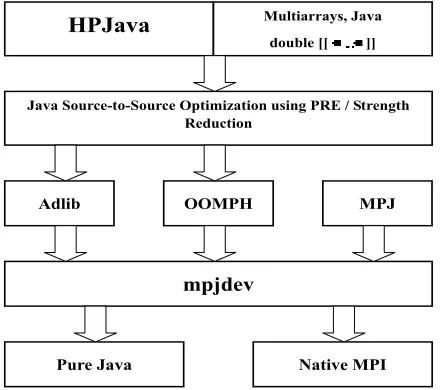
In this section, we mention Adlib, the HPJava run-time communication library, and the mpjdevAPI [19], which is designed with the goal that it can be imple-mented portably on network platforms and efficiently on parallel hardware. It needs to support communica-tion of intrinsic Java types, including primitive types, and objects. It should transfer data between the Java program and the network while keeping the overheads of the Java Native Interface as low as practical.
! "
#
$
[image:5.595.59.279.108.303.2]% &
Figure 4. HPJava Architecture.
version of Adlib, or MPJ [5] might be implemented on top of mpjdev. mpjdev itself may be implemented on top of Java sockets in a portable network implementa-tion, or—on HPC platforms—through a JNI interface to a subset of MPI. The positioning of the mpjdev API is illustrated in Figure 4.
The initial version of the mpjdev has been targeted to HPC platforms—through a JNI interface to a sub-set of MPI. A Java sockets version that provides more portable network implementation is included in HP-Java 1.0.
4
Compilation Strategies for HPJava
In this section, we will see efficient compilation strategies for HPJava. The HPJava compilation system consist of three parts; Parser, Type-Analyzer, Transla-tor, and Optimizer. HPJava adopted JavaCC [15] as a parser generator. Type-Analyzer, Translator, and Op-timizer are reviewed in following subsections. Figure 4 is the overall HPJava hierarchy.
4.1
Type-Analysis and Translation
The implementation of type-analysis (i.e. type-checking) system for the HPJava language has been the most time-consuming part of implementing the en-tire system. Since the HPJava language is a superset of ordinary Java language, HPJava fully supports the
Java Language Specification[16].
In stark distinction to HPF, the HPJava translation schemedoes notrequire insertion of compiler-generated
communications, making it relatively straightforward. The most complicated part is ensuring that node code works independently of the distribution format of ar-rays. The current translation schemes is documented in detail in the HPJava manual, called Programming in HPJava[7], and translation scheme [4].
4.2
Optimization
For common parallel algorithms, where HPJava is likely to be successful, distributed element access is generally located inside distributed overall loops. One main issue optimization strategies must address is the complexity of the associated terms in the subscript expressions for addressing local element for distributed arrays. Optimization strategies should remove over-heads of the naive translation scheme (especially for
overall construct), and speed up HPJava, i.e. pro-duce a Java-based environment competitive in perfor-mance with existing FORTRAN programming environ-ments.
To eliminate complicated distributed index sub-script expressions in the inner loops, the HPJava com-piler will adopt both of Partial Redundancy Elimina-tion(PRE) algorithm from [17] andStrength Reduction
(SR) algorithm from [2].
PRE is a very important optimization technique to remove partial redundancies in the program by ana-lyzing data flow graph that solves code replacements. PRE is a powerful and proper algorithm for HPJava compiler optimization sinceoverallloops are the right locations which have the complexity of the associated terms in the subscript expressions for addressing local element for distributed arrays, and since loop invari-ants, which are naturally partially redundant, are gen-erally located in the subscript expression of distributed arrays. Moreover, PRE should be applied to a general orStatic Single Assignment(SSA) [9] formed data flow graph after addinglanding pads[20], representing entry to the loop from outside.
SR replaces expensive and slow operations by equiv-alent, efficient, cheaper, and fast ones on the target machine. SR is effective to be used to replace computa-tions involving multiplicacomputa-tions and addicomputa-tions with ones involving only additions. The combination of complex multiplications and additions are natural to the sub-script expression of distributed arrays.
Figure 5. Experiment for matrix multiplication in HPJava with PRE/SR.
optimization strategies to HPJava.
5
Experiments
As we mentioned earlier, we proved that HPJava individual node performance is quite acceptable, and proved that Java itself can get 70 – 75% of the perfor-mance of C and FORTRAN from the previous publica-tion [18]. Moreover, from Figure 5, we can see the dra-matic result after applyingPRE/SR. The results use the IBM Developer Kit 1.3 (JIT) with-Oflag on Pentium4 1.5GHz Red Hat 7.2 Linux machines. Thus, now, we expect that the HPJava results will scale on suitable parallel platforms, so amodestpenalty in node perfor-mance is considered acceptable.
5.1
Laplace Equation with Red-Black Relaxation
First, we experiment HPJava with a simple Laplace Equation with red-black relaxation on the Sun Solaris 9 with 8 UltraSPARC III Cu 900MHz Processors and 16GB of main memory.
Figure 6 shows the result of four different versions (HPJava withPRE/SRoptimization, HPJava with naive translation, FORTRAN, and Java) of red-black relax-ation of the two dimensional Laplace equrelax-ation. After applyingPRE/SRfor the naive translation, HPJava can be improved up to 170% of the performance.
Second, The results of our benchmarks use an IBM SP3 running with four Power3 375MHz CPUs and 2GB of memory on each node. This machine uses AIX ver-sion 4.3 operating system and the IBM Developer Kit 1.3.1 (JIT) for the Java system. We are using the shared “css0” adapter with User Space(US)
communi-!
"
[image:6.595.320.538.112.251.2]# " $ % & ' %
Figure 6. Laplace Equation with red-black re-laxation with size of 512 x 512 on Sun Solaris 9 with 8 UltraSPARC III processors.
cation mode for MPI setting and -O compiler command for Java. For comparison, we also have completed ex-periments for sequential Java, Fortran and HPF ver-sion of the HPJava programs. For the HPF verver-sion of program, it uses IBM XL HPF version 1.4 withxlhpf95
compiler commend and -O3 and -qhot flag. And XL Fortran for AIX with -O5 flag is used for Fortran ver-sion.
Figure 7 shows result of four different versions (HP-Java, sequential (HP-Java, HPF and Fortran) of red-black relaxation of the two dimensional Laplace equation with size of 512 by 512. In our runs HPJava can out-perform sequential Java by up to 17 times. On 36 pro-cessors HPJava can get about 78% of the performance of HPF. It is not very bad performance for the ini-tial benchmark result. Scaling behavior of HPJava is slightly better then HPF. Probably, this mainly reflects the low performance of a single Java node compare to FORTRAN. We do not believe that the current com-munication library of HPJava is faster than the HPF libray because our communication library is built on top of the portablity layers, mpjdev and MPI, while IBM HPF is likely to use a platform specific commu-nication library. But clearly future versions of Adlib could be optimized for the platform.
!
"
#
[image:7.595.51.289.114.286.2]$ % $ & ' %( ) * & '
Figure 7. Laplace Equation with red-black re-laxation with size of 512 x 512 on IBM SP3.
6
Related Works
HPJava is an instance of what we call the HPspmd model: arguably it is not exactly a high-level paral-lel programming language in the ordinary sense, but rather a tool to assist parallel programmers in writing SPMD code. In this respect the closest recent language we are familiar with is probably Co-Array FORTRAN [21], but HPJava and Co-Array FORTRAN have many obvious differences. In Co-Array FORTRAN, array subscripting is local by default, or involves a combina-tion of local subscripts and explicit process ids. There is no analogue of global subscripts, or HPF-like distri-bution formats. In Co-Array FORTRAN the logical model of communication is built into the language— remote memory access with intrinsics for synchroniza-tion. In HPJava, there are no communication primi-tives in the language itself. We follow the MPI phi-losophy of providing communication through separate libraries.
In grid computing, theGrADS Project[3] is to sim-plify distributed computing in the same way that the World Wide Web simplified information sharing over internet. To that end, the project is exploring the sci-etific users to develop, execute, and tune application on the Grid. Even though the project shares the same purpose with our high-performance grid-enabled appli-cation using HPspmd programming model, it doesn’t adapt programming models that have already proved successful in sequential or parallel environments.
! " ! # $ "%&'&( # $
Figure 8. Three dimensional Diffusion equa-tion with size of 128 x 128 x 128 on IBM SP3.
7
Conclusions
The main purpose of this paper was to verify if our library-based HPspmd Programming Model can be ef-ficiently adapted into and implemented for the pro-gramming support for high-performance grid-enabled applications in the context of Java. Though thr exper-iments, we proved that HPJava has quite acceptable performance on scientific and engineering (matrix) al-gorithms, which plays very important asset in high-performance grid-enabled applications such as search engines, using “parameter searching”.
Now, the first fully functional HPJava is operational and can be downloaded from [13]. The system fully supports the Java Language Specification [16], and has tested and debugged against the HPJava test suites and jacks [14], an Automated Compiler Killing Suite. The current score is comparable to that of Sun jdk 1.4 and IBM Developer Kit 1.3.1. This means that the HPJava front-end is very conformant with Java. The HPJava test suites includes simple HPJava programs, and complex scientific algorithms and applications such as a multigrid solver, adapted from an existing FOR-TRAN program (called PDE2), taken from the Gene-sis parallel benchmark suite [1]. The whole of this pro-gram has been ported to HPJava (it is about 800 lines). A research application for fluid flow problems, CFD 2
[image:7.595.311.547.117.287.2]HPJava (it is about 1300 lines) as well.
References
[1] C. Addison, V. Getov, A. Hey, R. Hockney, and I. Wolton. The Genesis Distributed-Memory Bench-marks. Elsevier Science B.V., North-Holland, Ams-terdam, 1993.
[2] A. V. Aho, R. Sethi, and J. D. Ullman. Compilers: Principles, Techniques, and Tools. Addison-Wesley Pub Co, 1986.
[3] F. Berman, A. Chien, K. Cooper, J. Dongarra, I. Fos-ter, D. Gannon, L. Johnsson, K. Kennedy, C. Kessel-man, J. Mellor-Crummey, D. Reed, L. Torczon, and R. Wolski. The GrADS Project: Software Support for High-Level Grid Application Development. The In-ternational Journal of High Performance Computing Applications, 15(4):327–344, 2001.
[4] B. Carpenter, G. Fox, H.-K. Lee, and S. B. Lim. Trans-lation Schemes for the HPJava Parallel Programming Language. In 11th International Workshop on Lan-guages and Compilers for Parallel Computing 2001, 2001.
[5] B. Carpenter, V. Getov, G. Judd, A. Skjellum, and G. Fox. MPJ: MPI-like message passing for Java. Con-currency: Practice and Experience, 12(11):1019–1038, 2000.
[6] B. Carpenter, G. Zhang, G. Fox, X. Li, X. Li, and Y. Wen. Towards a Java environment for SPMD pro-gramming. In D. Pritchard and J. Reeve, editors,
4th International Europar Conference, volume 1470 of
Lecture Notes in Computer Science. Springer, 1998. [7] B. Carpenter, G. Zhang, H.-K. Lee, and S. Lim.
Parallel Programming in HPJava. Draft, 2001. http://www.hpjava.org.
[8] B. Carpenter, G. Zhang, and Y. Wen. NPAC
PCRC Runtime Kernel Definition. Technical Re-port CRPC-TR97726, Center for Research on Parallel Computation, 1997. Up-to-date version maintained at http://www.npac.syr.edu/projects/pcrc/doc.
[9] R. Cytron, J. Ferrante, B. K. Rosen, M. N. Wegman, and F. K. Zadeck. Efficient Computing Static Single Assignment Form and the Control Dependence Grapg.
ACM Transactions on Programming Languages and Systems, pages 451–490, 1991.
[10] I. Foster and C. Kesselman. The Grid: Blueprint for a New Computing Infrastructure. Morgan Kaufmann Publishers, 1999.
[11] M. Gerndt. Updating Distributed Variables in Lo-cal Computations. Concurrency: Practice and Expe-rience, 2(3):171–193, 1990.
[12] High Performance Fortran Forum. High Performance Fortran Language Specification. Scientific Program-ming, Special Issue, 2, 1993.
[13] HPJava Home Page. htt://www.hpjava.org.
any shock wave that would reside in the nozzle. Also, the code finds the steady state solution to the 2-D Euler equations.
[14] Jacks (Java Automated Compiler Killing Suite). http://www-124.ibm.com/developerworks/oss/cvs/ jikes/∼checkout∼/jacks/jacks.html.
[15] JavaCC – Java Compiler Compiler (Parser Genera-tor). http://www.webgain.com/products/java cc/. [16] B. Joy, G. Steele, J. Gosling, and G. Bracha.The Java
Language Specification, Second Edition. Addison-Wesley Pub Co, 2000.
[17] R. Kennedy, S. Chan, S.-M. Liu, R. Lo, P. Tu, and F. Chow. Partial Redundancy Elimination in SSA Form.ACM Transactions on Programming Languages and Systems, 21(3):627–676, 1999.
[18] H.-K. Lee, B. Carpenter, G. Fox, and S. B. Lim. Benchmarking HPJava: Prospects for Performance. In Sixth Workshop on Languages, Compilers, and Run-time Systems for Scalable Computers(LCR2002), Lecture Notes in Computer Science. Springer, March 2002.
[19] S. B. Lim, B. Carpenter, G. Fox, and H.-K. Lee. Col-lective Communication for the HPJava Programming Language. To appear Concurrency: Practice and Ex-perience, 2003.
[20] B. K. Rosen, M. N. Wegman, and F. K. Zadeck. Global Value Numbers and Redundant Computations. ACM SIGACT-SIGPLAN Symposium on Principles of Pro-gramming Languages, 1988.