This is a repository copy of
A framework for constraint based local search using
ESSENCE
.
White Rose Research Online URL for this paper:
http://eprints.whiterose.ac.uk/141508/
Version: Accepted Version
Proceedings Paper:
Akgun, Ozgur, Attieh, Saad Wasim A, Gent, Ian Philip et al. (6 more authors) (2018) A
framework for constraint based local search using ESSENCE. In: Lang, Jérôme, (ed.)
Proceedings of the Twenty-Seventh International Joint Conference on Artificial Intelligence.
International Joint Conferences on Artificial Intelligence , pp. 1242-1248.
10.24963/ijcai.2018/173
[email protected] https://eprints.whiterose.ac.uk/ Reuse
Items deposited in White Rose Research Online are protected by copyright, with all rights reserved unless indicated otherwise. They may be downloaded and/or printed for private study, or other acts as permitted by national copyright laws. The publisher or other rights holders may allow further reproduction and re-use of the full text version. This is indicated by the licence information on the White Rose Research Online record for the item.
Takedown
If you consider content in White Rose Research Online to be in breach of UK law, please notify us by
A Framework for Constraint Based Local Search using E
SSENCE
¨
Ozg ¨ur Akg ¨un, Saad Attieh, Ian P. Gent, Christopher Jefferson, Ian Miguel,
Peter Nightingale, Andr´as Z. Salamon, Patrick Spracklen, James Wetter
School of Computer Science, University of St Andrews, UK
{
ozgur.akgun, sa74, ian.gent, caj21, ijm, pwn1, Andras.Salamon, jlps
}
@st-andrews.ac.uk
Abstract
Structured Neighbourhood Search (SNS) is a framework for constraint-based local search for problems expressed in the ESSENCE abstract con-straint specification language. The local search explores a structured neighbourhood, where each state in the neighbourhood preserves a high level structural feature of the problem. SNS derives highly structured problem-specific neighbourhoods automatically and directly from the features of the ESSENCEspecification of the problem. Hence,
neighbourhoods can represent important structural features of the problem, such as partitions of sets, even if that structure is obscured in the low-level in-put format required by a constraint solver. SNS ex-presses each neighbourhood as a constrained opti-misation problem, which is solved with a constraint solver. We have implemented SNS, together with automatic generation of neighbourhoods for high level structures, and report high quality results for several optimisation problems.
1
Introduction
Constraint Programming (CP) offers an efficient means of solving complex constrained optimisation problems. A sys-tematic search through the space of partial assignments may be employed to achieve this. In local search methods [Hoos and St¨utzle, 2004], a complete assignment is iteratively mod-ified in an effort to reach a satisfying or optimal solution. At each iteration a modification is selected from a neighbour-hood of available candidates. Local search sacrifices com-pleteness for the ability to explore neighbourhoods rapidly.
Constraint-based local search (CBLS) [Codognet and Diaz, 2001; Van Hentenryck and Michel, 2005] has applied local search to CP. Neighbourhoods are specified by the user as part of the model, or generated from the constraints and variables in the model [Benoistet al., 2011; Bj¨ordalet al., 2015]. A potential weakness of this approach is that a constraint model typically represents the abstract structure of a given problem as a collection of primitive variables and constraints. Focus-ing on variables and constraints individually may produce weaker neighbourhoods than if the original problem struc-ture were apparent. This observation motivates our work: by
allowing neighbourhoods to exploit the original problem’s combinatorial structure, we expect local search to attain bet-ter performance than when problem structure is not available. The technique of Large Neighbourhood Search (LNS) originated in the constraint community [Shaw, 1998], where it has been further refined to exploit propagation [Perronet al., 2004] and explanations [Prud’hommeet al., 2014]. There are also customisable and hybrid LNS approaches [Rendlet al., 2015; Ciprianoet al., 2013]. Pesant and Gendreou extended LNS to support meaningful neighbourhoods (e.g. exchang-ing two cities in the Travellexchang-ing Salesperson Problem) [1999]. The advance we present here is that SNS is able to automati-cally generate neighbourhoods from a high level specification which are semantically meaningful in the original problem.
For high level problem expression we use the ESSENCE
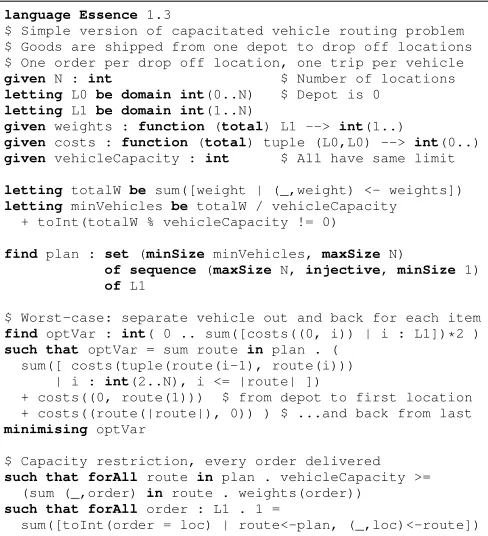
constraint specification language [Frischet al., 2005; 2007; 2008]. Space precludes a detailed presentation, but Fig. 1 shows an illustrative specification of the capacitated vehicle routing problem (CVRP). An ESSENCE specification iden-tifies: the input parameters of the problem class (given), whose values define an instance; the combinatorial objects to be found (find); the constraints the objects must sat-isfy (such that); identifiers declared (letting); and an (optional) objective function (min/maximising). Here, the combinatorial object to be found is represented by a single abstract variable whose type isset of sequence of int. This is a considerably higher level of description than pre-vious work on CBLS described as working from high-level models [Van Hentenryck and Michel, 2007]. ˚Agren et al. ex-tend local search to support sets of integers directly [2009]. We improve over this by supporting arbitrarily nested types. Furthermore, we avoid having to add explicit support for these types to the underlying constraint solver.
ESSENCE is situated at the top of a constraint mod-elling pipeline, which automatically models and solves an ESSENCEspecification. The CONJUREautomated modelling system [Akg¨un et al., 2011; 2013] employs refinement rules to convert an ESSENCE specification into a lower-level but generic language ESSENCE PRIME [Rendl, 2010].
This model is automatically prepared for a given constraint solver while performing solver-specific model optimisations by SAVILEROW[Nightingaleet al., 2014; 2015; 2017].
diffi-language Essence 1.3
$ Simple version of capacitated vehicle routing problem $ Goods are shipped from one depot to drop off locations $ One order per drop off location, one trip per vehicle
given N : int $ Number of locations
letting L0 be domain int(0..N) $ Depot is 0
letting L1 be domain int(1..N)
given weights : function (total) L1 --> int(1..)
given costs : function (total) tuple (L0,L0) --> int(0..)
given vehicleCapacity : int $ All have same limit
letting totalW be sum([weight | (_,weight) <- weights])
letting minVehicles betotalW / vehicleCapacity + toInt(totalW % vehicleCapacity != 0)
find plan : set (minSize minVehicles, maxSize N)
of sequence (maxSize N, injective, minSize 1)
of L1
$ Worst-case: separate vehicle out and back for each item
find optVar : int( 0 .. sum([costs((0, i)) | i : L1])*2 )
such that optVar = sum route in plan . ( sum([ costs(tuple(route(i-1), route(i)))
| i : int(2..N), i <= |route| ])
+ costs((0, route(1))) $ from depot to first location + costs((route(|route|), 0)) ) $ ...and back from last
minimising optVar
$ Capacity restriction, every order delivered
such that forAll route in plan . vehicleCapacity >= (sum (_,order) in route . weights(order))
such that forAll order : L1 . 1 =
[image:3.612.52.296.56.324.2]sum([toInt(order = loc) | route<-plan, (_,loc)<-route])
Figure 1: Capacitated vehicle routing in ESSENCE
cult task of identifying that structure in an equivalent con-straint model. Neighbourhoods are automatically generated as constraint problems describing transformations of mem-bers of ESSENCE domains via a library of domain specific operations that encapsulate expert knowledge. The resulting method, which we call Structured Neighbourhood Search, re-tains the advantages of specifying problems in ESSENCE — concision, abstraction from modelling details and blackbox search — while actuallyimprovingthe quality of the neigh-bourhoods we can generate for constraint-based local search.
2
An Overview of SNS
To help the reader follow our exposition we start with a high-level overview of Structured Neighbourhood Search. The key point is that the use of ESSENCEallows neighbourhoods ex-plored by the low-level search to besemantically meaning-fulin the high-level specification of the problem. For exam-ple, in a problem concerning sets, SNS can ensure that con-secutive states in the local search represent valid sets, even using a low-level solver which is not aware of the structure of sets. To achieve this, CONJURE analyses a specification and automatically generates semantically meaningful bourhoods (Sec. 3). The pipeline then refines these neigh-bourhoods so that they can be used by the SNS solver. The SNS solver (Sec. 4) then performs a relatively standard local search, selecting appropriate neighbourhoods automatically using a multi-armed bandit algorithm (Sec. 4.4). Within each neighbourhood, a complete constraint solver is used to ensure that the structural constraints defining the neighbourhood are obeyed. As a result, SNS combines the large neighbourhoods of LNS, the high-level semantic structure (without the need
for a specially-written search procedure), and the efficiency of modern constraint solvers at the low-level.
3
Automatic Neighbourhood Generation
To date, our pipeline has targeted systematic constraint and SAT solvers as output [Nightingaleet al., 2017]. In this pa-per we describe modifications to the pipeline to support SNS. Our main contribution is that for each abstract decision vari-able in the original specification, a set of neighbourhoods is generated automatically according to a set of neighbourhood generation rules. The strength of these neighbourhoods is that they encode powerful operations derived from the structure of the abstract variable, which provide strong guidance for the SNS search process. These neighbourhoods would be both difficult and costly to generate from the equivalent collection of primitive variables and constraints if a constraint model were the starting point because the abstract structure (e.g. a sequence, set or function) would have to be recognised.
The CVRP specification in Fig. 1 uses a single abstract variableplan, modelled as a set of sequence of int. Neighbourhoods we generate for this variable include: add or remove sequences to/from the set; select a sequence from the set and reverse a contiguous subsequence; select two se-quencess1ands2and for a range of indices, swap the values contained bys1at those indices with the values contained by
s2at the same indices. This example illustrates the advantage of SNS: theset of sequence of inttype is explicit in the ESSENCEspecification, and can be exploited to automat-ically generate high quality neighbourhoods.
A neighbourhood specification extends the original ESSENCEspecification of a problem with additional abstract variables and constraints to express each of the hoods to be explored for this problem. Each such neighbour-hood is generated automatically by CONJURE. We illustrate this process by means of a concrete example, focusing on the variable typeset of sequence of intand the neigh-bourhood mentioned above: select a sequence from the set and reverse a contiguous subsequence.
We refer to the abstract variables in the original ESSENCE
specification as primary variables. Each neighbourhood is expressed as a set of constraints relating these primary vari-ables to anactive solution, which is a feasible solution to the problem. The first step in neighbourhood generation is for each primary variable to introduce a correspondingactive variableto store the currently active solution. For the exam-ple given in Fig. 1, CONJUREintroduces a new active variable
active plancorresponding to the primary variableplan:
find active_plan : set (minSize minVehicles, maxSize N)
of sequence (maxSize N,injective, minSize 1)
of L1
The next step is to add variables local to each neighbour-hood. All neighbourhoods have an associatedsize variable, which control the size of the neighbourhood explored. Further variables may be introduced to control other such parameters. In our example, an additional variable is introduced to indi-cate the starting index of the subsequence to be reversed:
find revSubSize : int(1..N)
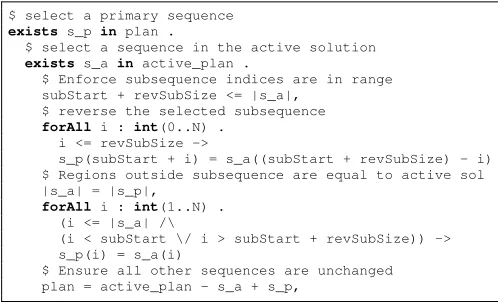
The final step is to express each neighbourhood by adding constraints between primary and active variables. In our ex-ample below, CONJUREadds constraints to the specification constraining the value of the primary variableplanto be the same as that held byactive planexcept that one of the se-quences inplanmust have a contiguous portion reversed.
$ select a primary sequence
exists s_p in plan .
$ select a sequence in the active solution
existss_a inactive_plan .
$ Enforce subsequence indices are in range subStart + revSubSize <= |s_a|,
$ reverse the selected subsequence
forAll i : int(0..N) . i <= revSubSize ->
[image:4.612.50.299.125.276.2]s_p(subStart + i) = s_a((subStart + revSubSize) - i) $ Regions outside subsequence are equal to active sol |s_a| = |s_p|,
forAll i : int(1..N) . (i <= |s_a| /\
(i < subStart \/ i > subStart + revSubSize)) -> s_p(i) = s_a(i)
$ Ensure all other sequences are unchanged plan = active_plan - s_a + s_p,
There are typically a variety of neighbourhoods in each neighbourhood specification. In order that the SNS search process can choose which to employ at any particular time, each is enabled with a Booleanactivatorvariable.
3.1
Neighbourhood Generation Rules
Our neighbourhood generation rules are driven by the high-level nested structure of ESSENCE types. Direct rules (Ta-ble 1) are concerned solely with the outer structure of an ESSENCE decision variable. For instance, we might wish to reverse a contiguous subsequence of asequence of τ, whereτis any ESSENCEtype.Liftedrules are parameterised by other neighbourhood generation rules. They allow us to reach inside a containing abstract structure and apply other rules to manipulate individual parts of that structure. This was illustrated in our example, where we selected and reversed a subsequence of a single sequence from a set of sequences.
Lifted rules can themselves be lifted, allowing us to gener-ate a large variety of neighbourhoods by composing a small number of neighbourhood generation rules in multiple ways. Powerful neighbourhoods can be constructed to make mul-tiple simultaneous changes, which must be coordinated so that the modifications made are valid. For example, given a set of sequences we may wish to exchange elements be-tween sequences, hence modifying the value of two se-quences within the set simultaneously. These Synchronised rules (Table 2) can both operate directly or be lifted.
4
Structured Neighbourhood Search
The process described in the previous section generates a neighbourhood specification, which is automatically refined by CONJUREinto a constraint model in ESSENCE PRIME. ESSENCE PRIME is a solver-independent constraint mod-elling language offering features similar to those of Mini-Zinc [Nethercote et al., 2007] or OPL [Van Hentenryck et al., 1999], with support for Boolean and integer decision variables together with arithmetic, logical and global con-straints. This model is annotated by CONJUREto indicate the
set
(andmultiset
)Removeselements from set.
Addselements to set.
Exchangeselements for values not currently in set.
ExchangeOrRemovea total ofselements from set.
ExchangeOrAdda total ofselements to set.
sequence
Reversecontiguous subsequence of lengths.
Exchangethe positions ofselements with anothers.
Relaxdomains of contiguous subsequence, lengths.
CycleL/Relements of a sequencespositions left/right.
RemoveE/Sselements from the end/start of a sequence.
AddE/Sselements to the end/start of a sequence.
function
Definevalues forsmore elements of the function domain.
UnDefinevalues forselements of the function domain.
Injective-Select2selements from the image of a function: reduce toselements by constraining pairs of elements in the preimage to be equal.
Injective+Selectselements from the image of a function: increase to2selements by constraining pairs of elements in the preimage to be distinct.
Permutethe images ofsinputs to the function.
Table 1:Directneighbourhood generations rules for sizes. Each of these can beLiftedto operate on nested types.
set
(andmultiset
)Moveselements from one set to another.
Exchangeselements between two sets.
Mergea set with another set of sizes.
Splitselements from a set to create a new set.
sequence
Concatenateone sequence with another.
Exchangeselements between two sequences.
Splitselements from a sequence to create a new sequence.
CrossOverExchangescontiguous elements between two sequences at the same indices.
MoveRemoveselements from the end of a sequence; add those elements to the start or end of another sequence.
function
CrossOverExchangeselements from the image of one function withselements from the image of another.
Table 2:Synchronisedneighbourhood generation rules for sizes. These rules can be used directly on a single variable or can be lifted to operate on parts of an abstract structure.
Algorithm 1SNS()
$ι: the incumbent (best solution found so far)
ι←SNS-Improve(SNS-FindRandSoln()) $Each neighbourhood has an associated size
s←1
whiletruedo
forn∈neighbourhoodsin random orderdo
Set size ofntos
σ←SNS-Neighbourhood-Search(ι, n,Explore)
σ←SNS-Improve(σ)
ifσimproves uponιthen
s←1,ι←σ
Continue while loop
if2∗s≤maximum neighbourhood sizethen
s←2∗s
else repeat
σ←SNS-Improve(SNS-FindRandSoln())
untilσimproves uponι s←1,ι←σ
returnιon timeout
4.1
The SNS Search Procedure
Algorithm 1 summarises the SNS search procedure. The first step is to find a random feasible solution (§4.2). The random feasible solution is improved by applyingSNS-Improve()and it becomes the first incumbent solutionι. The variables rep-resents the neighbourhood size used for diversification, and
s= 1initially. The first part of the main loop picks a neigh-bourhood and applies it toι(with sizes) to move away from
ι, creating a new active solutionσthat may be worse thanι. SNS-Improve()is applied to improveσ. If the result is better thanιit is accepted as the new incumbent, andsis reset to 1. In the case where the set of neighbourhoods is exhausted,
sis increased and each neighbourhood is applied again. The diversification process is repeated untilscannot be increased further. Finally, the algorithm will generate new random fea-sible solutions (unrelated toι), applySNS-Improve()to each one, and accept the first that improves onι. In the following subsections we describe the constituent parts of the algorithm.
4.2
Finding Random Feasible Solutions
At two pointsSNS()requires the production of random feasi-ble solutions (functionSNS-FindRandSoln()): to find the ini-tial incumbent and to escape local optima when the maximum neighbourhood size has been reached. For this purpose, we employ the MINIONconstraint solver [Gentet al., 2006] with the dom/wdeg variable ordering [Boussemart et al., 2004], a random value ordering and random restarts, beginning at 100ms and increasing by a multiple of 1.5 each iteration.
4.3
Finding Improved Solutions
Algorithm 2SNS-Improve()is called with a feasible solution
σ, the active solution. We select a neighbourhood (§4.4) and run the neighbourhood search procedure (§4.5) in optimisa-tion mode. If a soluoptimisa-tion σ′ that is at least as good as σ is
found,σ′ is made the new active solution and the process is
repeated. If noσ′of sufficient quality is found within a given
Algorithm 2SNS-Improve(Active solutionσ) peakThreshold←α
increment←β× 1
number of neighbourhoods
while RandomValueIn({0. . .1})≥peakThresholddo
n←SNS-Select-Neighbourhood()
σ′←SNS-Neighbourhood-Search(σ, n,Optimise) ifσ′is not worse thanσthen
peakThreshold←α σ←σ′
else
peakThreshold←peakThreshold+increment returnσ
timeout, we add anincrementto thepeakThreshold, which is used to decide probabilistically if we have reached a local op-timum. In this paper we setαto0.001andβ to 1
16. Future work will explore tuning these parameters.
4.4
Neighbourhood Selection
TheSNS-Select-Neighbourhood()procedure (called from Al-gorithm 2) is used to find the most promising neighbourhood at any point during search. For a given problem there may be many generated neighbourhoods for which we have no prior knowledge of their reward distributions, determined by how much the application of each neighbourhood improves the ob-jective. As we have no prior knowledge of the suitabilities of particular neighbourhoods to a particular problem class, during search we have to carefully balance the time taken ex-ploring and identifying a neighbourhood’s performance while exploiting those that allow us to rapidly improve. Represent-ing this as a multi-armed bandit problem allows us to employ well known regret minimising algorithms to deal with the ex-ploration/exploitation dilemma. This can be seen as a form of ‘Adaptive LNS’ [Ropke and Pisinger, 2006].
The multi-armed bandit can be seen as a set of real distribu-tions, each distribution being associated with the rewards de-livered by one of theKlevers. In our case this is theK gener-ated neighbourhoods. On each iteration ofSNS-Improve()one neighbourhood is selected to locally search the problem space and a reward is observed based upon the improvement to the active solution. Our aim is at each iteration to apply the opti-mal neighbourhood, where optiopti-mality is defined as producing the largest increase in the value of the objective. The regretρ
afterT rounds is defined as the expected difference between the reward sum associated with an optimal strategy and the sum of the collected rewards observed. The UCB1 [Aueret al., 2002] algorithm was chosen to solve the multi-armed ban-dit problem as first and foremost its regret grows logarithmi-cally in line with the number of actions taken. For each neigh-bourhoodkwe record the average rewardxkand the number
of timeskhas been tried in the search procedurenj out of
a total ofniterations. On each iteration a neighbourhood is chosen that maximisesxj+
p
2 log(n)/nj.
found that using UCB1 gives good results. Future work could investigate the use of Upper Confidence Bound policies for non-stationary bandit problems, such as the family of Exp3 algorithms [Kocsis and Szepesv´ari, 2006; Munos, 2014].
4.5
Neighbourhood Search
SNS-Neighbourhood-Search(σ, n, Mode) is responsible for searching the neighbourhood n of the active solution σ. It can be run in twoModes. The first (Explore) accepts the first solution of any objective value. This is used bySNS()in Al-gorithm 1. The second mode (Optimise, employed by SNS-Improve()) treats the neighbourhood as a constrained optimi-sation problem, accepting only those solutions with an ob-jective value at least as good as that of the active solution
σ. OnceOptimisefinds a solution, it will continue to search for a solution with better objective value, until the time limit of 500ms is reached. In preliminary experiments we found a time limit more effective than a search node limit as the latter penalises simple neighbourhoods that have high node rates.
Neighbourhood search is performed using the systematic MINIONsolver in a carefully controlled manner. The annota-tions supplied by CONJUREare used to identify the primary and active variables involved in neighbourhoodn. The pri-mary variables are unassigned preparatory to search, and the activator variable for neighbourhoodnis set to true, remov-ing the guard on the neighbourhood constraints.
We construct a variable ordering as follows. First is the neighbourhood size variable forn, which is given an ascend-ing value orderascend-ing. This forces the exploration to begin close to the current active solutionσbefore systematically expand-ing out. Next are placed the variables that control the neigh-bourhood parameters, e.g. subStart in our example. A random value ordering is used so that different portions of the neigh-bourhood are searched on each activation. Finally come the primary variables upon which the neighbourhood is operat-ing, that is the representation of a partition, set, sequence, etc. These variables are searched using adom/wdegordering with the aim of finding solutions as quickly as possible once the neighbourhood parameters have been chosen.
5
Experimental Evaluation
Our hypothesis is that the structure in abstract ESSENCE spec-ifications can be exploited to automatically generate effec-tive neighbourhoods for constraint-based local search. The most natural comparison is with methods that generate neigh-bourhoods from the constraint model. Therefore we com-pare SNS with OscaR/CBLS [Bj¨ordalet al., 2015], a mod-ern implementation of CBLS, propagation-guided LNS (LNS PG) [Perronet al., 2004], and explanation-based LNS (LNS EB) [Prud’hommeet al., 2014] (which are automatic large neighbourhood search algorithms). LocalSolver [Benoist et al., 2011] is another possible point of comparison, but this commercial solver incorporates a complex mix of technolo-gies that make it unsuitable to test our hypothesis. We use Chuffed (via its free search option), a systematic lazy clause generation solver [Chu, 2016], as a performance baseline.
We compare SNS to the other solvers on 5 problem classes: Capacitated Vehicle-Routing Problem (CVRP); Progressive
Party Problem (PPP, CSPLib 13); Minimum Energy Broad-cast (MEB, CSPLib 48); SONET (CSPLib 56); Rack Config-uration Problem (RackConf, CSPLib 31).
For SNS, each problem class and a set of instances is spec-ified in ESSENCE. An extended version of CONJUREis ap-plied once per problem class to generate a model in ESSENCE
PRIME with SNS neighbourhoods. An extended version of SAVILEROW[Nightingaleet al., 2017] is applied for each in-stance to instantiate the model and specialise it in two ways: SNS (including neighbourhoods) and MiniZinc (with neigh-bourhoods removed). The MiniZinc instance is then spe-cialised via MiniZinc 2.1.7 for OscaR/CBLS and Chuffed.
For the LNS methods, each problem class was imple-mented in Choco 4.0.6, with great care taken to match the ESSENCEPRIMEmodel as closely as possible. For the search within each LNS neighbourhood we usedom/wdegvariable ordering [Boussemartet al., 2004], ascending value ordering and a limit of 50 backtracks (a value found to be good in pre-liminary experiments). To find the first solution we replicate the method in§4.2 in Choco, except that the time limit is ini-tially 1 second rather than 100 ms.
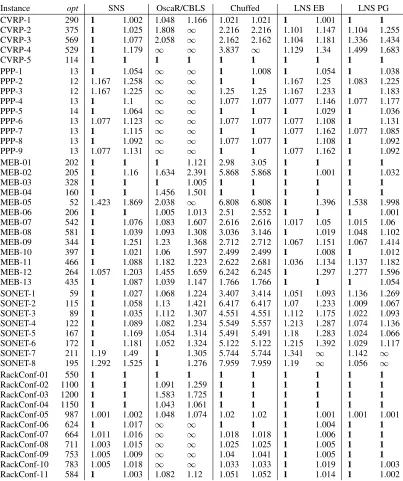
SNS, OscaR/CBLS and the LNS methods are randomised while Chuffed is deterministic. For each solver and instance we perform 10 runs each with a 10 minute time limit. Experi-ments were run on an Intel Xeon E5-2640 v4 at 2.40GHz with 20 cores (40 hyper-threads) with 20 processes run in parallel. Table 3 summarises our results. SNS is extremely effective: this is indicated by the proliferation of ‘1’ entries in the first column of SNS results, indicating that SNS found the best results (or tied) of any competing solver on those instances. Also, SNS was the only solver to successfully find a solution in every run (indicated by the absence of∞’s in the second column). The two LNS variants are also effective, but SNS is more effective overall. SNS outperforms the LNS variants on all CVRP and SONET instances. On mean best score found, for CVRP the wins are by 6.7% (EB) and 19% (PG), while for SONET the wins are by 10% (EB) and 0.2% (PG). On PPP, SNS is 0.4% better than LNS EB, and 3.4% worse than LNS PG. On the MEB instances, SNS is 2.7% worse than LNS EB, and 4.5% better than LNS PG. Both LNS variants outperform SNS on the RackConf instances, although by only 0.2%.
The problem with the most structure in the variables, CVRP, is one where SNS performs particularly well. CVRP is specified with a single decision variable, but it has a nested type: a set of sequences of integers. SNS generates both lifted and direct neighbourhoods of sequences and it substantially outperforms all other solvers. Our results bear out our hypoth-esis: specifications can be exploited to automatically generate effective neighbourhoods for constraint-based local search.
6
Conclusion and Further Work
Instance opt SNS OscaR/CBLS Chuffed LNS EB LNS PG
CVRP-1 290 1 1.002 1.048 1.166 1.021 1.021 1 1.001 1 1
CVRP-2 375 1 1.025 1.808 ∞ 2.216 2.216 1.101 1.147 1.104 1.255 CVRP-3 569 1 1.077 2.058 ∞ 2.162 2.162 1.104 1.181 1.336 1.434
CVRP-4 529 1 1.179 ∞ ∞ 3.837 ∞ 1.129 1.34 1.499 1.683
CVRP-5 114 1 1 1 1 1 1 1 1 1 1
PPP-1 13 1 1.054 ∞ ∞ 1 1.008 1 1.054 1 1.038
PPP-2 12 1.167 1.258 ∞ ∞ 1 1 1.167 1.25 1.083 1.225
PPP-3 12 1.167 1.225 ∞ ∞ 1.25 1.25 1.167 1.233 1 1.183
PPP-4 13 1 1.1 ∞ ∞ 1.077 1.077 1.077 1.146 1.077 1.177
PPP-5 14 1 1.064 ∞ ∞ 1 1 1 1.029 1 1.036
PPP-6 13 1.077 1.123 ∞ ∞ 1.077 1.077 1.077 1.108 1 1.131
PPP-7 13 1 1.115 ∞ ∞ 1 1 1.077 1.162 1.077 1.085
PPP-8 13 1 1.092 ∞ ∞ 1.077 1.077 1 1.108 1 1.092
PPP-9 13 1.077 1.131 ∞ ∞ 1 1 1.077 1.162 1 1.092
MEB-01 202 1 1 1 1.121 2.98 3.05 1 1 1 1
MEB-02 205 1 1.16 1.634 2.391 5.868 5.868 1 1.001 1 1.032
MEB-03 328 1 1 1 1.005 1 1 1 1 1 1
MEB-04 160 1 1 1.456 1.501 1 1 1 1 1 1
MEB-05 52 1.423 1.869 2.038 ∞ 6.808 6.808 1 1.396 1.538 1.998
MEB-06 206 1 1 1.005 1.013 2.51 2.552 1 1 1 1.001
MEB-07 542 1 1.076 1.083 1.607 2.616 2.616 1.017 1.05 1.015 1.06 MEB-08 581 1 1.039 1.093 1.308 3.036 3.146 1 1.019 1.048 1.102 MEB-09 344 1 1.251 1.23 1.368 2.712 2.712 1.067 1.151 1.067 1.414
MEB-10 397 1 1.021 1.06 1.597 2.499 2.499 1 1.008 1 1.012
MEB-11 466 1 1.088 1.182 1.223 2.622 2.681 1.036 1.134 1.137 1.182 MEB-12 264 1.057 1.203 1.455 1.659 6.242 6.245 1 1.297 1.277 1.596
MEB-13 435 1 1.087 1.039 1.147 1.766 1.766 1 1 1 1.054
SONET-1 59 1 1.027 1.068 1.224 3.407 3.414 1.051 1.093 1.136 1.269 SONET-2 115 1 1.058 1.13 1.421 6.417 6.417 1.07 1.233 1.009 1.067 SONET-3 89 1 1.035 1.112 1.307 4.551 4.551 1.112 1.175 1.022 1.093 SONET-4 122 1 1.089 1.082 1.234 5.549 5.557 1.213 1.287 1.074 1.136 SONET-5 167 1 1.169 1.054 1.314 5.491 5.491 1.18 1.283 1.024 1.066 SONET-6 172 1 1.181 1.052 1.324 5.122 5.122 1.215 1.392 1.029 1.117 SONET-7 211 1.19 1.49 1 1.305 5.744 5.744 1.341 ∞ 1.142 ∞ SONET-8 195 1.292 1.525 1 1.276 7.959 7.959 1.19 ∞ 1.056 ∞
RackConf-01 550 1 1 1 1 1 1 1 1 1 1
RackConf-02 1100 1 1 1.091 1.259 1 1 1 1 1 1
RackConf-03 1200 1 1 1.583 1.725 1 1 1 1 1 1
RackConf-04 1150 1 1 1.043 1.061 1 1 1 1 1 1
RackConf-05 987 1.001 1.002 1.048 1.074 1.02 1.02 1 1.001 1.001 1.001
RackConf-06 624 1 1.017 ∞ ∞ 1 1 1 1.004 1 1
RackConf-07 664 1.011 1.016 ∞ ∞ 1.018 1.018 1 1.006 1 1
RackConf-08 711 1.003 1.015 ∞ ∞ 1.025 1.025 1 1.005 1 1
RackConf-09 753 1.005 1.009 ∞ ∞ 1.04 1.041 1 1.005 1 1
[image:7.612.103.506.50.531.2]RackConf-10 783 1.005 1.018 ∞ ∞ 1.033 1.033 1 1.019 1 1.003 RackConf-11 584 1 1.003 1.082 1.12 1.051 1.052 1 1.014 1 1.002
Table 3: Columnoptlists the best value found by any solver. For each algorithm, the first column gives the ratio of the best value found toopt
(lower is better with 1 best possible);∞indicates that no run yielded a solution. The second column gives the ratio of the mean of the best values found at the end of each run toopt(lower is better);∞indicates at least one run during which no solution was found.
the automatic generation of neighbourhoods from a very high level specification of a constraint problem. Future research includes optimising SNS parameters, or investigating more efficient exploration of the automatically constructed neigh-bourhoods.
Acknowledgements
We thank Nguyen Dang for her assistance with the experi-ments, and EPSRC grants EP/P015638/1 and EP/P026842/1
for funding. Christopher Jefferson is supported by a Royal Society University Research Fellowship.
References
[Akg¨unet al., 2011] ¨Ozg¨ur Akg¨un, Ian Miguel, Chris Jeffer-son, Alan M. Frisch, and Brahim Hnich. Extensible auto-mated constraint modelling. InAAAI, pages 4–11, 2011. [Akg¨unet al., 2013] ¨Ozg¨ur Akg¨un, Alan M. Frisch, Ian P.
Ian Miguel, and Peter Nightingale. Automated symme-try breaking and model selection in Conjure. InCP, pages 107–116, 2013.
[Aueret al., 2002] Peter Auer, Nicol`o Cesa-Bianchi, and Paul Fischer. Finite-time analysis of the multiarmed bandit problem.Machine Learning, 47(2):235–256, May 2002. [Benoistet al., 2011] Thierry Benoist, Bertrand Estellon,
Fr´ed´eric Gardi, Romain Megel, and Karim Nouioua. Lo-calSolver 1.x: a black-box local-search solver for 0-1 pro-gramming. 4OR, 9(3):299–316, 2011.
[Bj¨ordalet al., 2015] Gustav Bj¨ordal, Jean-No¨el Monette, Pierre Flener, and Justin Pearson. A constraint-based local search backend for MiniZinc.Constraints, 20(3):325–345, 2015.
[Boussemartet al., 2004] Fr´ed´eric Boussemart, Fred Hemery, Christophe Lecoutre, and Lakhdar Sais. Boost-ing systematic search by weightBoost-ing constraints. InECAI, pages 146–150, 2004.
[Chu, 2016] Geoffrey Chu. Chuffed, a lazy clause generation solver, 2016. Available from https://github.com/chuffed/chuffed. [Ciprianoet al., 2013] Raffaele Cipriano, Luca Di Gaspero,
and Agostino Dovier. A multi-paradigm tool for large neighborhood search. In Hybrid Metaheuristics, pages 389–414, 2013.
[Codognet and Diaz, 2001] Philippe Codognet and Daniel Diaz. Yet another local search method for constraint solv-ing. InSAGA, LNCS 2264, pages 73–90. Springer, 2001. [Frischet al., 2005] Alan M. Frisch, Matthew Grum, Chris
Jefferson, Bernadette M. Hern´andez, and Ian Miguel. The Essence of Essence. Modelling and Reformulating Con-straint Satisfaction Problems, pages 73–88, 2005. [Frischet al., 2007] Alan M. Frisch, Matthew Grum, Chris
Jefferson, Bernadette M. Hern´andez, and Ian Miguel. The design of Essence: A constraint language for specifying combinatorial problems. InIJCAI, pages 80–87, 2007. [Frischet al., 2008] A. M. Frisch, W. Harvey, C. Jefferson,
B. Mart´ınez-Hern´andez, and I. Miguel. Essence: A con-straint language for specifying combinatorial problems. Constraints 13(3), pages 268–306, 2008.
[Gentet al., 2006] Ian P. Gent, Chris Jefferson, and Ian Miguel. Minion: A fast, scalable, constraint solver. In ECAI, pages 98–102, 2006.
[Hoos and St¨utzle, 2004] Holger H. Hoos and Thomas St¨utzle. Stochastic local search: Foundations & applica-tions. Elsevier, 2004.
[Kocsis and Szepesv´ari, 2006] Levente Kocsis and Csaba Szepesv´ari. Bandit based Monte-Carlo planning. In ECML, LNCS 4212, pages 282–293. Springer, 2006. [Munos, 2014] R´emi Munos. From bandits to Monte-Carlo
tree search: The optimistic principle applied to optimiza-tion and planning. FTML, 7(1):1–129, 2014.
[Nethercoteet al., 2007] Nicholas Nethercote, Peter J. Stuckey, Ralph Becket, Sebastian Brand, Gregory J.
Duck, and Guido Tack. MiniZinc: Towards a standard CP modelling language. InCP, LNCS 4741, pages 529–543. Springer, 2007.
[Nightingaleet al., 2014] Peter Nightingale, ¨Ozg¨ur Akg¨un, Ian P. Gent, Chris Jefferson, and Ian Miguel. Automati-cally improving constraint models in Savile Row through associative-commutative common subexpression elimina-tion. InCP, LNCS 8656, pages 590–605. Springer, 2014. [Nightingaleet al., 2015] Peter Nightingale, Patrick
Spracklen, and Ian Miguel. Automatically improv-ing SAT encodimprov-ing of constraint problems through common subexpression elimination in Savile Row. InCP, LNCS 9255, pages 330–340. Springer, 2015.
[Nightingaleet al., 2017] Peter Nightingale, ¨Ozg¨ur Akg¨un, Ian P. Gent, Christopher Jefferson, Ian Miguel, and Patrick Spracklen. Automatically improving constraint models in Savile Row. Artificial Intelligence, 251:35–61, 2017. [Perronet al., 2004] Laurent Perron, Paul Shaw, and Vincent
Furnon. Propagation guided large neighborhood search. In CP, LNCS 3258, pages 468–481. Springer, 2004.
[Pesant and Gendreau, 1999] Gilles Pesant and Michel Gen-dreau. A constraint programming framework for local search methods. Journal of Heuristics, 5(3):255–279, 1999.
[Prud’hommeet al., 2014] Charles Prud’homme, Xavier Lorca, and Narendra Jussien. Explanation-based large neighborhood search.Constraints, 19(4):339–379, 2014. [Rendlet al., 2015] Andrea Rendl, Tias Guns, Peter J.
Stuckey, and Guido Tack. MiniSearch: A solver-independent meta-search language for MiniZinc. InCP, LNCS 9255, pages 376–392. Springer, 2015.
[Rendl, 2010] Andrea Rendl. Effective Compilation of Con-straint Models. Ph.D. Thesis, Univ. of St Andrews, 2010. [Ropke and Pisinger, 2006] Stefan Ropke and David
Pisinger. An adaptive large neighborhood search heuristic for the pickup and delivery problem with time windows. Transportation Science, 40(4):455–472, 2006.
[Shaw, 1998] Paul Shaw. Using constraint programming and local search methods to solve vehicle routing problems. In CP, LNCS 1520, pages 417–431. Springer, 1998.
[Van Hentenryck and Michel, 2005] Pascal Van Hentenryck and Laurent Michel. Constraint-based local search. MIT Press, 2005.
[Van Hentenryck and Michel, 2007] Pascal Van Hentenryck and Laurent Michel. Synthesis of constraint-based local search algorithms from high-level models. InAAAI, pages 273–278. AAAI Press, 2007.
[Van Hentenrycket al., 1999] Pascal Van Hentenryck, Lau-rent Michel, LauLau-rent Perron, and Jean-Charles R´egin. Constraint programming in OPL. InPPDP, LNCS 1702, pages 98–116, 1999.