Int. J. Electrochem. Sci., 7 (2012) 11477 - 11487
International Journal of
ELECTROCHEMICAL
SCIENCE
www.electrochemsci.org
An Enzymatic Biofuel cell Based On Electrochemically Reduced
Graphene Oxide and Multiwalled Carbon nanotubes/Zinc oxide
Modified Electrode
Selvakumar Palanisamy, Srikanth Cheemalapati, Shen-Ming Chen*
Department of Chemical Engineering and Biotechnology, National Taipei University of Technology, No. 1, Section 3, Chung-Hsiao East Road, Taipei 106, Taiwan, ROC
*
E-mail: [email protected]
Received: 1 October 2012 / Accepted: 20 October 2012 / Published: 1 November 2012
Here we present the design and study of a simple biofuel cell consisting of a glucose oxidase (GOx)-based bioanode and a laccase (GOx)-based bio cathode. Ferrocene monocarboxilic acid (FMCA) was used as a mediator for the bio anode to enhancing the electron transfer at the glassy carbon electrode (GCE) surface. GOx was co immobilized at electrochemically reduced graphene oxide (ERGO) by simple electrochemical approach, and the Laccase was incorporated in multiwalled carbon nanotube/Zinc oxide composite modified GCE. The morphological studies of the bio anode and bio cathode have been investigated by scanning electron microscope (SEM). The electroanalytical properties of each modified bioelectrodes have been investigated by the cyclic voltammetry. The redox potential of the each enzyme as used to set up the open circuit potential. The fabricated biofuel cell delivers a power density up to 54 nW cm − 2 and an open circuit voltage of 0.055 V, under the physiological conditions (pH 7).
Keywords: ERGO/GOx biocomposite, MWCNT/ZnO, Laccase, FMCA, electrocatalysis, glucose, O2
reduction, Bioelectrochemistry.
1. INTRODUCTION
the direct oxidation of glucose by GOx at electrode surface [7-11]. Though, the direct electron transfer of GOx at bare electrode is too poor, because of the deeply buried active sides of GOx. Nowadays, nanomaterials have been used for achieve the DET of GOx by different modifications, such as covalent linkage or entrapment, physical absorption, etc [12-13]. Among various nanomaterials, reduced graphene oxide (RGO) as the hottest material for past one decade in many enzyme based biosensor and biofuel cell applications [14]. GOx has been immobilized at RGO surface by using cross linkers or binders and it has been used in the biofuel cell applications. However, in this report, we present the single step electrochemical fabrication of electrochemically reduced graphene oxide (ERGO)/ GOx biocomposite without any binders and cross linkers by reported early [15]. The fabricated (ERGO)/ GOx has been used with ferrocene mono carboxylic acid (FMCA) mediator as a bioanode for glucose oxidation in the biofuel cell.
On the other hand, multi walled carbon nanotube (MWCNT) is an emerging material for the immobilization of various enzymes because of its unique properties such as large surface area and high electron communication [16-24]. Laccase has been used as a biocathode material in the biofuel cell for the reduction of O2. In this report, the biocathode has been constructed by immobilizing laccase at
multiwalled carbon nanotubes (MWCNT)/ zinc oxide (ZnO) composite. In our previous literature reports proved that, MWCNT/ZnO composite has been used as a potential candidate for immobilizing the negative charged enzymes at the electrode surface [25-28].
In this article, we present a simple enzymatic biofuel cell consisting of ERGO/GOx based bioanode and MWCNT/ZnO/laccase based biocathode for glucose/oxygen biofuel cell. The fabricated ERGO/GOx biocomposite shows, the enhanced oxidation of glucose in the presence of FMCA mediator. MWCNT/ZnO/laccase shows, superior cathodic reduction of molecular oxygen at the bioanode in ambient conditions. The unique properties of the bioanode and biocathode have been used to construct the efficient glucose/O2 enzymatic biofuel cell.
2. EXPERIMENTAL 2.1 Chemicals
Graphite powder was purchased from Sigma-Aldrich. MWCNTs with the lengths of 0.1-10 µm were obtained from Aldrich. Zinc nitrate hexa hydrate, (Zn (NO3)2. 6H2O, 99 % pure) and potassium
nitrate (KNO3)were obtained from Sigma-Aldrich. GOx was obtained from Sigma-Aldrich and used as received without any further purification. Laccase was received from Trametes versicolor and stored in the -20°C. The supporting electrolyte used for all experiments was pH 7 phosphate buffer solution (PBS), which was prepared by using 0.05 M Na2HPO4 and NaH2PO4 solutions. All aqueous solutions
2.2. Apparatus
Electrochemical measurements were performed on a computer-controlled electrochemical analyzer (CHI 750 A, CH instruments). Surface morphological studies were carried out using Hitachi S-3000 H scanning electron microscope (SEM). Cell current and voltage were measured with a precision multimeter (Keithley instruments; model 2400). Electrochemical experiments were performed in three electrode system with Ag/AgCl (Sat. KCl) as the reference electrode, platinum foil as the counter electrode and glassy carbon electrode (GCE) was used as working electrode. All electrochemical measurements were conducted at ambient temperature.
2.3 Fabrication of the bioanode and biocathode
The fabrication of GOx immobilized ERGO at GCE by simple electrochemical approach by our method reported previously [15]. The ERGO/GOx modified electrode was further used to construct a bioanode. Before modification of GCE (active surface area = 0.07 mm), electrode was first polished with alumina slurry then sonicated in the ethanol in distilled water for 3 min. The fabricated ERGO/GOx electrode was rinsed with distilled water, dried in room temperature, and modified electrode was used as a bioanode for the oxidation of glucose in FMCA containing pH 7 solution at glucose BFC.
The biocathode for glucose BFC was prepared by laccase immobilized onto the MWCNT/ZnO modified GCE. MWCNT/ZnO was prepared by according to our method previously reported [24-27]. Fresh laccase enzyme was prepared by using (pH 5) phosphate buffer solution. About 8 µl of laccase was drop coated on MWCNT/ZnO modified GCE. After that, it was rinsed with doubly distilled water and dried in an air oven. MWCNT/ZnO/lac modified GCE was used as a biocathode for the reduction of O2 in pH 7 solution in glucose BFC.
3. RESULTS AND DISCUSSION
3.1. Formation mechanism of ERGO/GOx biocomposite and MWCNT/ZnO composite
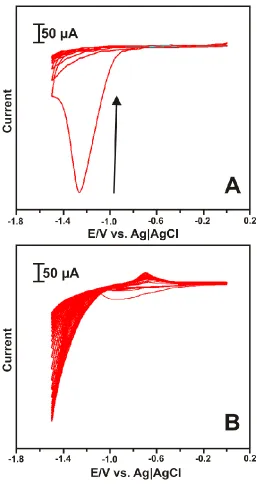
Figure 1. A) Cyclic voltammogram obtained at electrochemical reduction of GO–GOx modified GCE in N2 saturated PBS (pH 5) at the scan rate of 50 mV s-1. B) 30 consecutive cyclic
voltammograms recorded at a MWCNT modified GCE in 0.5 mM (ZnNO3)2. 6 H2O and 0.5
mM KNO3 containing N2 saturated 0.05 M PBS (pH 7) at the scan rate of 50 mV s-1.
MWCNT/ZnO composite was prepared by MWCNT modified GC electrode immersed in an electrochemical cell containing 0.05 M (ZnNO3)2.6H2O and KNO3 solution in an anaerobic condition.
30 successive cycles of cyclic voltammograms were performed in the potential range between 0 and -1.5 V at the scan rate of 50 mVs-1 in 0.5 mM ZnNO3.6 (H2O) and 0.5 M KNO3 in pH 7 solution. As
shown in fig.1B, a small anodic hump appears at -0.66 V at the first cycle, representing the formation of Zn2+ ions from the ZnNO3.6 (H2O) solution [29]. During the further scans at more negative potential
[image:4.596.169.426.65.559.2]
oxygen. Meanwhile, the released oxygen was captured by the anchored Zn2+ ions, resulting in the formation of MWCNT/ZnO composite as we mentioned early in our reports.
3.2. Surface characterization of bioanode and biocathode
Surface characterization of bioanode has been characterized by SEM analysis. As fabricated ERGO/GOx biocomposite as shown in fig.2A, the GOx spheres are appeared above the ERGO sheets after the electrochemical reduction of GO/GOx composite. Moreover, electrochemically reduced GO has several sheets are folded together to form the typical structure to retained the ERGO. From the SEM results clearly indicate that, the GOx was well immobilized on the ERGO.
Figure 2. SEM images of ERGO/GOx biocomposite (A), MWCNT/ZnO composite (B)
[image:5.596.160.434.265.637.2][image:6.596.194.405.95.454.2]
3.3. Electrochemical studies of bioanode
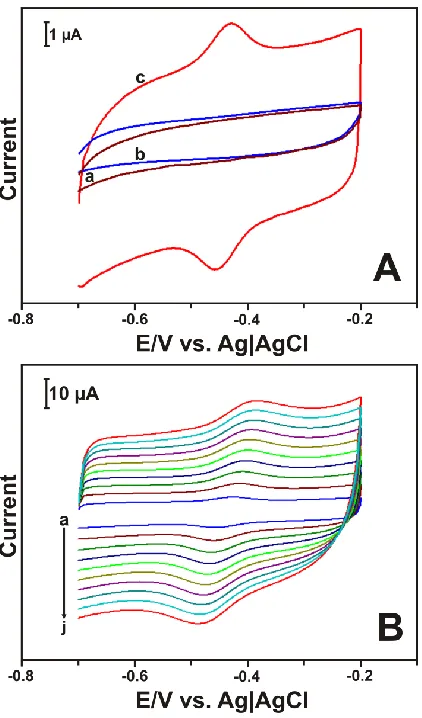
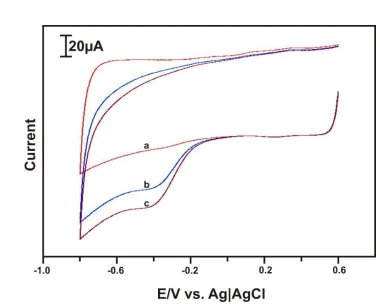
Figure 3. (A) Cyclic voltammograms obtained at bare GCE/GOx (a), GO/GOx (b), and ERGO/GOx (c) film modified GCEs in deoxygenated PBS at 50 mV s−1scan rate. (B) Cyclic voltammograms of ERGO/GOx bio composite film modified GCE in deoxygenated PBS at different scan rates.
The immobilization of GOx at ERGO/GOx biocomposite modified GCE was confirmed by using cyclic voltammetry studies. In fig.3A shows that different modified electrodes at pH 7 in anaerobic condition. In fig. 3c, ERGO/GOx modified electrodes showed a pair of well defined redox peaks -0.458 and -0.413 V for GOx at electrode surface. However, GO/GOX (b) and GCE/GOx (a) modified electrodes does not show any electrochemical peaks for GOx. These results suggest that, electrochemically prepared ERGO/GOx biocomposite has the ability for efficient electron transfer at the electrode surface.
The effect of different scan rate at ERGO/GOx biocomposite modified GCE also been studied by varying the scan rates from 0.1 V to 1.0 V in N2 saturated pH 7 solution. As shown in Fig.3B, the
3.4. Electrochemical studies of biocathode
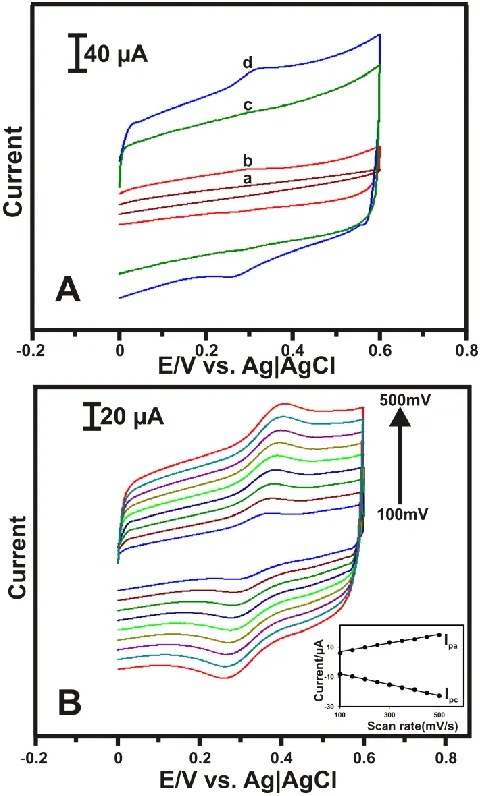
In order to confirm the immobilization of laccase at MWCNT/ZnO, the cyclic voltammetry was performed at MWCNT/ZnO modified GC electrode in pH 7 solution at the scan rate of 50 mV s-1. Fig.4A shows that, the different type of modified electrodes at the potential range from 0 to 0.6 V. From the figure, well defined redox peaks were observed at 0.373 V and 0.284 for laccase at MWCNT/ZnO modified GCE (d). In that same case, only ZnO (b) and bare GC (a) modified electrodes does not give any electrochemical signal for laccase. Moreover, MWCNT modified GCE (c) has lower background current than that of MWCNT/ZnO composite modified electrode. From those results confirmed that, laccase was stably immobilized at the composite electrode and also it used to construct the biocathode.
[image:7.596.178.418.278.676.2]
The different scan rates study of laccase immobilized MWCNT/ZnO composite electrode have been shown in Fig. 4B. The cathodic and anodic peak current was linearly increased with increasing the scan rates from 100 mV to 500 mV. The scan rate has the linear dependence with the peak current of laccase modified electrode and the linear dependence as shown in Fig. 4B (inset).
3.5. Electrocatalysis of glucose by FMCA at ERGO/GOx biocomposite
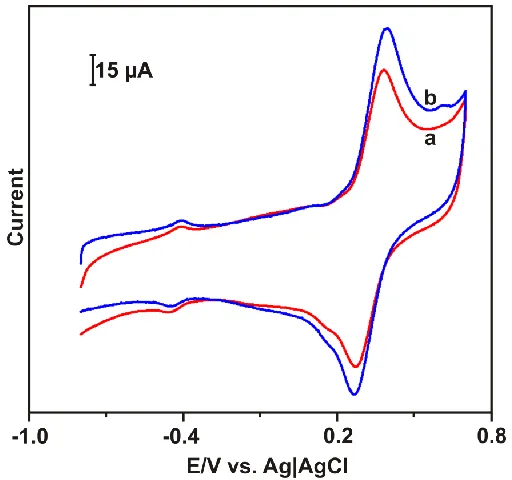
The electrocatalytic ability of ERGO/GOx biocomposite towards glucose by FMCA has been investigated by cyclic voltammetry in N2 saturated 0.05 M PBS (pH 7) containing 0.5 mM FMCA in
the absence of glucose (a) and presence of 10 mM glucose (b) with the scan rate of 50 mVs-1 as shown in Fig.5. The well defied redox peaks were observed at 0.265 and 0.384 for FMCA in the absence of glucose with the onset potential of 0.155 V (a). The oxidation peak current was increased significantly in the addition of 10 mM glucose solution (b). The lower onset potential of FMCA which helps to achieved a good performance towards glucose oxidation in the glucose biofuel cell. These results confirmed that, the glucose was oxidized efficiently by FMCA at ERGO/GOx biocomposite modified electrode and it could be used to construct the mediated glucose biofuel cell.
Figure 5. (A) Cyclic voltammograms recorded at ERGO/GOx biocomposite film modified GCE without (a) and with (b) 10 mM glucose containing deoxygenated PBS with 5 mM FMCA.
3.6. Electrocatalytic reduction of oxygen at ERGO/GOx biocomposite
[image:8.596.170.426.372.612.2]
exhibits more cathodic current than air saturated PBS solution. Moreover, the composite modified electrode has more cathodic current in the presence of oxygen at ~ -0.1 V. These results indicate that, the Cu active site of laccase has been efficiently reduced the molecular O2 to H2O as shown in Equ.1.
[29]
O2 + 4H+ + 4 e-→ H2O (1)
Figure 6. (A) Cyclic voltammograms recorded at MWCNT/ZnO/laccase film modified GCE in N2
(a), air (b), and oxygen (c) saturated PBS.
3.7. The performance of bioanode and biocathode in Biofuel cell
[image:9.596.98.478.175.479.2]
Figure 7. The Polarization curves of the constructed biofuel cell with ERGO/GOx biocomposite and MWCNT/ZnO/laccase modified GCE electrodes in the presence of 10 mM glucose.
4. CONCLUSIONS
The simple biofuel cell consisting of the ERGO/GOx based bioanode and MWCNT/ZnO/laccase based biocathode has been presented. From the SEM results clearly indicate that, the GOx was well immobilized at the ERGO surface. ERGO/GOx biocomposite modified electrode has potential for the effective oxidation of glucose in the presence of FMCA. Moreover, MWCNT/ZnO/laccase modified electrodes have been used as a potential candidate for the molecular oxygen reduction. The constructed biofuel cell delivers a power density up to 54 nW cm − 2 under the physiological conditions (pH 7). As the future prospective, these composite materials could be used to construct the biofuel cell by immobilization of various enzymes.
ACKNOWLEDGEMENT
This work was supported by the National Science Council and the Ministry of Education of Taiwan (Republic of China).
References
1. A.Heller, A., Chem. Phys. 6 (2004) 209 – 216.
2. A.Heller, B. Feldman, Chem. Rev. 108 (2008)2482 – 2505.
3. J. Kim, H. Jia, P. Wang, Biotechnology Advances 24 (2006) 296 – 308.
8. G.T.R. Palmore, G.M. Whitesides, ACS Symp Ser. 566 (1994) 271 – 90.
9. R.A. Bullen, T.C. Arnot, J.B. Lakemanc, F.C. Walsh, Biosens. Bioelectron., 21 (2006) 2015. 10.J. Kim, J. Parkey, C.Rhodes, A.G. Martin, J. Solid State Electrochem., 13 (2009) 1043. 11.J. Shim, G.-Y. Kim, S-H. Moon, J. Electroanal. Chem., 653 (2011) 14.
12.L. Liu, D. Yu, C. Zeng, Z. Miao, L. Dai, Langmuir 26 (2010) 6158–6160.
13.Z. Wang, X. Zhou, J. Zhang, F. Boey, H. Zhang, J. Phys. Chem. C 113 (2009) 14071-14075. 14.M.H. Yang, B.G. Choi, H. Park, W.H. Hong, S.Y. Lee, T.J. Park, Electroanalysis 22 (2010) 1223–
1228.
15.B. Unnikrishnan, S. Palanisamy, S.M. Chen, Biosens. Bioelectron., 39 (2013) 70–75. 16.Y. Li, Y. Umasankar, S.M. Chen, Talanta 79 (2009) 486–492.
17.Y. Li, Y. Umasankar, S.M. Chen, Anal. Biochem. 388 (2009) 288–295.
18.Y. Umasankar, Y. Li, S.M. Chen, J. Electrochem. Soc. 157 (2010) K187-K193. 19.W. Chen, J. Zhao, J.Y. Lee, Z. Liu, Mater. Chem. Phys. 91 (2005) 124–129.
20.W. Li, C. Liang, J. Qiu, W. Zhou, H. Han, Z. Wei, G. Sun, Q. Xin, Carbon 40 (2002) 791–794. 21.Z. Liu, X. Lin, J.Y. Lee, W. Zhang, M. Han, L.M. Gan, Langmuir 18 (2002) 4054–4060. 22.X. Sun, R. Li, D. Villers, J.P. Dodelet, S. Desilets, Chem. Phys. Lett. 379 (2003) 99-104. 23.C. Wang, M. Waje, X. Wang, J.M. Tang, R.C. Haddon, Y. Yan, Nano Lett. 4 (2004) 345–348. 24.A. P. Periasamy, Y. H. Ho, S. M. Chen, Biosens. Bioelectron., 29(2011) 151-158.
25.S. Palanisamy, S. Cheemalapati, S.M. Chen, Int. J. Electrochem. Sci., 7 (2012) 8394 -8407. 26.S. Palanisamy, S. Cheemalapati, S.M. Chen, Anal. Biochem. 429 (2012) 108–115.
27.S. Palanisamy, A.T. Ezhil Vilian, S. M. Chen,, Int. J. Electrochem. Sci.. 7(2012) 2153-2163. 28.V. Mani, B. Devadas, S. M. Chen, Biosens. Bioelectron.
http://dx.doi.org/10.1016/j.bios.2012.08.045.
29.M.S. Thorum, C.A. Anderson, J.J. Hatch, A.S. Campbell, N.M. Marshall, S.C. Zimmerman, Y. Lu, A.A. Gewirth, J. Phys. Chem. Lett. 1 (2010) 2251–2254.