This is a repository copy of
Developing and validating a decision support tool for media
selection to mitigate drainage waters
.
White Rose Research Online URL for this paper:
http://eprints.whiterose.ac.uk/152292/
Version: Published Version
Article:
Ezzati, G., Healy, M.G., Christianson, L. et al. (4 more authors) (2019) Developing and
validating a decision support tool for media selection to mitigate drainage waters.
Ecological Engineering: X, 2. 100010. ISSN 2590-2903
https://doi.org/10.1016/j.ecoena.2019.100010
[email protected]
https://eprints.whiterose.ac.uk/
Reuse
This article is distributed under the terms of the Creative Commons Attribution-NonCommercial-NoDerivs
(CC BY-NC-ND) licence. This licence only allows you to download this work and share it with others as long
as you credit the authors, but you can’t change the article in any way or use it commercially. More
information and the full terms of the licence here: https://creativecommons.org/licenses/
Takedown
If you consider content in White Rose Research Online to be in breach of UK law, please notify us by
Contents lists available atScienceDirect
Ecological Engineering: X
journal homepage:www.journals.elsevier.com/ecological-engineering-x
Developing and validating a decision support tool for media selection to
mitigate drainage waters
G. Ezzati
a, M.G. Healy
b, L. Christianson
c, G.W. Feyereisen
d, S. Thornton
e, K. Daly
a, O. Fenton
a,⁎aTeagasc, Environmental Research Centre, Johnstown Castle, Co. Wexford, Ireland
bCivil Engineering, College of Engineering and Informatics, National University of Ireland, Galway, Galway, Ireland c
Department of Crop Sciences, University of Illinois at Urbana-Champaign, Urbana, IL, USA
dUSDA-Agricultural Research Service (ARS), St. Paul, MN, USA
eGroundwater Protection and Restoration Group, Kroto Research Institute, University of Sheffield, Sheffield, United Kingdom
A R T I C L E I N F O
Keywords:
Drainage water Farm pollution Nitrogen Phosphorus Agriculture
A B S T R A C T
The nitrate nitrogen (NO3-N) and ammonium (NH4-N) and/or dissolved reactive phosphorus (DRP) load in
drainage water from farms can be managed by reactive or biological mediafilters. The nutrient content of the drainage water can be obtained directly from water analysis, which immediately focuses attention onfilter media selection. There are many factors that may be important before choosing a medium or media e.g. nutrient removal capacity, lifetime, hydraulic conductivity, the potential for“pollution swapping”, attenuation of non-target contaminants (e.g. pesticides, organic carbon, etc.), and local availability and transportation cost of media to site. In this study, a novel decision support tool (DST) was developed, which brought all these factors together in one place forfive nutrient scenarios. A systematic literature review was conducted to create a database containing 75 media with an associated static scoring system across seven criteria (% of nutrient concentration reduction, removal of other pollutants, lifetime, hydraulic conductivity, negative externalities) and a dynamic scoring system across two criteria (delivery cost and availability). The DST was tested using case studies from Ireland, Belgium and USA with different agricultural practices and nutrient scenarios. It was then validated by SWOT (strength, weakness, opportunities and threats) analysis. The DST provided a rapid, easily modifiable screening of many media-based treatments for specific dual or single nutrient-based water drainage problems. This provides stakeholders (farmers/regulators/advisors) with a versatile,flexible and robust yet easy-to-un-derstand framework to make informed choices on appropriate media-based mitigation measures according to users’relevant technical, economic and logistical factors.
1. Introduction
Decades of research have shown that aquatic environments are under pressure due to population growth, waste generation (FAO, 2011; Jhansi et al., 2013), excessive loading of nutrients (Billen et al., 2013; Erisman et al., 2011; Addy et al., 2016; Fenton et al., 2017), pesticides (Gramlich et al., 2018), and sediment inputs (Sherriff et al., 2015). Nutrients such as reactive nitrogen (nitrate (NO3-N) and ammonium
(NH4-N)) and dissolved reactive phosphorus (DRP) in drainage waters
from intensively farmed agricultural sites have contributed significantly to impairment of water quality (Daly et al., 2017; Fenton et al., 2017; Rosen and Christianson, 2017; Clagnan et al., 2018a,b). The intercep-tion of single pollutants along surface or near surface drainage loss pathways using in-situ engineered structuresfilled with biological (e.g. woodchip in a denitrifying bioreactor) or reactive (e.g. steel slag in a
P-sorbing structure) media is receiving increasing research attention (e.g.
Penn et al., 2017). The removal rates of nitrogen (N) and phosphorus (P) using these media can be high. For example, Hassanpour et al. (2017) measured 50%NO3removal from drainage water using wood-chip media in a denitrifying bioreactor over a 3-year period and Okello (2016) reported a 74% removal of DRP in drainage water using iron-coated sand in a reactive P-sorbingfilter. However, the simultaneous removal of these pollutants in drainage water using dual media has mostly been examined at laboratory-scale (Healy et al., 2012, 2014; Ibrahim et al. 2015; Hua et al., 2016; Christianson et al., 2017; Fenton et al., 2017). In addition, the transferability of these results to other locations due to the availability, suitability or delivered cost of media is often overlooked. An example here is the use of iron ochre to sorb P in drainage water; the availability of the ochre may not be a problem, but the form of ochre may be contaminated with heavy metals and its use
https://doi.org/10.1016/j.ecoena.2019.100010
Received 7 May 2019; Received in revised form 25 July 2019; Accepted 26 July 2019
⁎Corresponding author.
E-mail address:[email protected](O. Fenton).
Available online 26 July 2019
2590-2903/ Crown Copyright © 2019 Published by Elsevier B.V. This is an open access article under the CC BY-NC-ND license (http://creativecommons.org/licenses/BY-NC-ND/4.0/).
may therefore be prohibitive (Fenton et al., 2009b).
There is a vast catalogue of media in the literature that are reported to mitigate pollutants leaving farms. However, there is currently no decision support tool (DST) available to select a suitable medium, or a combination of media, for the targeted removal of NO3, NH4and DRP,
considered separately or together, while also considering factors other than pollutant removal capacity. These factors may include the media lifetime, hydraulic conductivity, the potential for“pollution swapping” (i.e. the creation of greenhouse gases (GHGs) or leaching of con-taminants that may occur during operation), capacity to attenuate other (non-target) contaminants (e.g. pesticides, organic carbon, etc.), and availability and local price of the media.
Decision Support Tools, usually software-based, manipulate data (often obtained through literature review or expert opinion) and re-commend management actions through clear decision stages (SIP, 2018). In a review of DSTs for use in agriculture,Rose et al. (2016)
found that in the UK 49% of farmers used some kind of DST to inform decisions whereas all advisors used DSTs, and software versions were the preferred form of DST platform. In terms of selecting media to mitigate drainage water impacts, there is no DST that provides all the relevant information in one platform. Therefore, the objectives of this study were to: (1) develop a globally-applicable, user-friendly DST to assist selection of locally sourced media, in order to reduce NO3, NH4
and DRP, as single or mixed pollutants, from drainage water at farm-scale (2) evaluate the effectiveness and practicality of the DST in two phases: (a) applying it in different geographical/farming-practice case studies, and (b) validating the framework through SWOT (strength, weakness, opportunities, and threats) analysis.
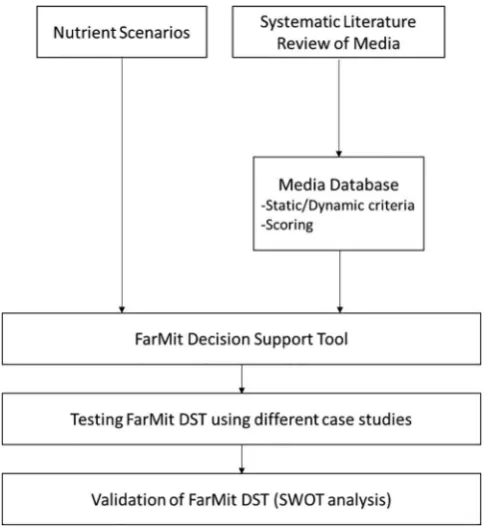
To meet these objectives, several steps were implemented to build a platform on which the DST could be developed. These included iden-tifying a number of scenarios for N and P losses from farms and com-piling a database of media for mitigation of nutrient losses.Fig. 1 il-lustrates the steps taken in developing the FarMit (FarmMitigation Tool) DST.
2. Materials and methods
2.1. Nutrient scenarios
Testing water samples for nutrients collected at the drainage dis-charge point can provide a spatial and temporal profile of single or mixed pollutants at a given site. Typically, reactive nitrogen (Nr) losses
from land drainage systems may occur as NO3-N or NH4-N, depending
on various physical and biogeochemical factors that control the trans-formation of Nr(Fenton et al., 2009a; Clagnan et al., 2018a).
Phos-phorus losses from agricultural land, which are either retained or mo-bilized, may occur in particulate and dissolved forms (McDowell and Sharpley, 2001). Based on the complexities of nutrient losses from agricultural land, a conceptual model of different possible diffuse nu-trient loss scenarios that may occur at farm-scale was developed.
The FarMit DST is based around identifying materials to treat three nutrient loss scenarios (Fig. 2). In Scenario A, mineralised Nrin the soil,
in the form of NO3, leaches to shallow pathways along low permeable
layers or artificial drainage systems (e.g.Clagnan et al., 2018a,b) or along deeper groundwater pathways. In Scenario B, subsurface condi-tions, such as limited Nrand oxygen supply, combined with high soil
carbon (C), may induce transformation of NO3to NH4(by dissimilatory
nitrate reduction to ammonium, DNRA). In Scenarios A and B, DRP losses may also occur along surface, near surface, or deeper ground-water pathways. These losses could originate from the soil/subsoil, geological strata, or media used within an engineered bioreactor used to treat water and wastewater. Therefore, site-specific conditions (soil chemistry and drainage composition) or media characteristics may lead to the retention of P losses or the mobilisation of P. Finally, Scenario C represents a farm with only loss of P, where Nrin either form does not
exceed a threshold or maximum allowable concentration (MAC). This may be due to the high attenuation capacity of the site, with conversion of Nrinto gaseous forms (e.g. di-nitrogen or nitrous oxide), isolation
from potential sources, or adaptation of perennial crop farming systems (Stanek et al., 2017).
2.2. Systematic literature review to form media database
Thefive steps of a systematic review were followed, as outlined in
Khan et al. (2003). The problem to be addressed was specified as fol-lows (Step 1): what media have been used in the literature to attenuate NO3, NH4 and DRP from drainage waters? What is the efficacy of a
medium to remove NO3, NH4and DRP, or other pollutants in drainage
waters? What is the hydraulic conductivity of the media? What is the lifetime of the media? What pollution swapping may occur using these media?
[image:3.595.42.287.465.729.2]Next (Step 2), relevant work within the literature was identified. For this purpose, several keywords were selected to ensure relevancy for the literature search of over 175 media-based water treatment studies published during the last 20 years (150 papers were considered infinal review). These included: water/wastewater treatment, water quality, agricultural waste, denitrification, denitrifying bioreactor, nutrient pollution, leaching, nutrient removal, adsorption, drainage, nitrate, phosphorus, and ammonium. The database search engines used were Google Scholar, Agricultural Research Database (AGRICOLA), International System for Agricultural Science and Technology (AGRIS), Web of Science, Scopus, American Society of Civil Engineering (ASCE), and the National Agricultural Library. To assess the quality of these relevant studies (Step 3), the following criteria were imposed: use of standard methods, and experimental design including replication and data interpretation. This enabled a database of 75 distinct media types to be assembled. Data were then synthesised (Step 4) in tables and grouped as follows: wood-based (Table S1), vegetation/phytoremedia-tion (Table S2) and inorganic materials (Table S3). Media were then assigned nine criteria (seven static and two dynamic), based on Steps 1–4, and a corresponding scoring system (Step 5 data interpretation) Fig. 1.Flowchart for the development of FarMit DST.
G. Ezzati, et al. Ecological Engineering: X 2 (2019) 100010
was developed for each criterion. In the static component, these criteria were NO3-N, NH4-N and DRP removal capacity (Static Criteria 1–3 in
the FarMit DST), removal of other pollutants of concern (Static Criterion 4), hydraulic conductivity (Static Criterion 5), lifetime of media before saturation (Static Criterion 6), and negative externalities such as emission of GHGs, contaminant leaching, or the presence of other pollutants in thefinal effluent (Static Criterion 7) (Table 1). For example, Criterion 1 (% NO3-N removal) had a score range of−1, 0, 1, 2, 3, 4 corresponding to < 10%, 10–30%, 30–50%, 50–70%, 70–85%, and > 85% reduction, respectively. Although many studies report % removal, there are other factors that affect this criterion, such as
hydraulic residence time in denitrifying bioreactors and contact time in P-sorbingfilters.
[image:4.595.39.416.55.201.2]In the dynamic component of FarMit, media were scored according to geographically-based criteria such as availability and delivery cost to the treatment site or farm. These criteria are country/region-specific and will change over time. As the amount of media needed will vary depending on the drainageflow and composition at the site of concern, local knowledge is required and only the end-user can obtain the most appropriate ranking of media by assigning scores to these two compo-nents. The score ranges for these twofinal dynamic criteria are pre-sented inTable 1.
Fig. 2.Farm pollution scenarios: A: Farm pollution with leaching of NO3-N and retention of P, or Farm
pollution with leaching of NH4-N and mobilization
of P, B: Farm pollution with leaching of NO3-N and
retention of P, or Farm pollution with leaching of NH4-N and mobilization of P, C: Farm pollution with
DRP mobilization and no leaching of N.
Table 1
Static (1–7) and dynamic (8–9) criteria and corresponding scoring ranges.
Criteria Performance within each criterion Score
Static scores based on an average performance reported1
1-NO3-N removal rate NO3-N concentration reduction > 85% 4
NO3-N concentration reduction: 70–85% 3
NO3-N concentration reduction: 50–70% 2
NO3-N concentration reduction: 30–50% 1
NO3-N concentration reduction: 10–30% 0
NO3-N concentration reduction < 10% and increase in concentration −1 2-NH4–N removal rate NH4-N concentration reduction > 85% 4
NH4-N concentration reduction: 70–85% 3
NH4-N concentration reduction: 50–70% 2
NH4-N concentration reduction: 30–50% 1
NH4-N concentration reduction: 10–30% 0
NH4-N concentration reduction < 10% and increase in concentration −1 3-DRP removal rate P concentration reduction > 85% 4
P concentration reduction: 70–85% 3
P concentration reduction: 50–70% 2
P concentration reduction: 30–50% 1
P concentration reduction: 10–30% 0
P concentration reduction < 10% and increase in concentration −1 4-Removal of other pollutants of concern Removal of other nutrient/pollutant > 80% 2
Removal of other nutrient/pollutant < 80% 1
5-Hydraulic conductivity2 Very good: > 4 cm/h 3
Good: 1.5–4 cm/h 2
Acceptable/depending on compactness: < 1.5 cm/h 1
6-Lifetime Lifetime > 10 years 2
Lifetime : 5–10 years 1
Lifetime < 5 years 0
7-Negative externalities GHG emission −3
Contaminant leaching/other pollutants in effluent −2
Expensive pre-treatment −1
Dynamic scores subject to change based on geographical region3
8-Scale ofAvailability Scale of Availability: farm scale 4
Scale of Availability: local/country scale 3
Scale of Availability: EU/continent scale 2
Scale of Availability: International scale 1
9-Cost Cost (low) 3
Cost (medium) 2
Cost (high) 1
1Extracted from the developed Media Database (Tables S2–S4) based on average performance of conducted studies. 2Required additional data from other sources.
3Scoring should be de
[image:4.595.41.561.234.592.2]The nutrient combinations identified (A, B and C) inFig. 2and the scoring system developed as part of Step 5 (Table 1) for all criteria (1–9) were combined to form the FarMit DST (Fig. 1). In order to test the DST, case studies from Ireland, Belgium (Flanders), and the USA (highlighted in grey in Table S4) were used.
2.3. Testing of FarMit DST using different case studies
Three case studies each with their own distinctive nutrient scenario from Ireland, Belgium and the USA were used to test the DST (see Table S4 for details). Nutrient losses from drainage systems are ubiquitous, but water quality regulation standards differ worldwide. For example, in an Irish dairy system, cattle are kept outdoors for most of the year with both organic and inorganic fertilizer being land spread. Studies have shown high N surpluses on dairy farms due to low N utilisation efficiencies, e.g.Clagnan et al. (2018a) found a range from 211 to 292 kg N ha−1 on heavy textured sites. As drainage waters are not governed directly by water quality legislation, other standards for surface or groundwater (e.g. drinking water standards) can be used to quantify the level of pollution. For example, in Ireland surface waters are of “high” and “good” status if their DRP is < 0.025 mg L−1 and < 0.035 mg L−1, respectively (EU, 2014; EPA, 2016). For NO
3-N,
an average drinking water concentration of 11.3 mg L−1applies for groundwater, whereas a lower standard of < 0.9 mg L−1 and < 1.8 mg L−1are indicative of surface waters with “high”and“good” status, respectively (EPA, 2016). Although a drinking water standard, and not specific to drainage waters, an indicative NH4-N concentration
of < 0.23 mg L−1may be considered to be non-polluting.
The region of Flanders in Belgium is mostly dominated by fruit production and arable farming in the east, with livestock production and production of vegetables for the frozen food market in the west (Flemish Agriculture and Fisheries, 2017). This region comprises 75% of agricultural production in Belgium, and is considered by the Government of Flanders, Investment and Trade Body to be a“global leader in intensive farming”. The water standard for NO3-N should be < 11.3 mg L−1and the same standard for NH
4-N as in Ireland
ap-plies. In terms of DRP, there is a range of concentrations for“very good” and“good”status of surface water from 0.04 to 0.06 mg DRP L−1and 0.07 to 0.14 mg DRP L−1, respectively.
Finally, the sites selected in the USA were in the states of Iowa, Minnesota, Wisconsin and Maryland, in which the dominant agri-cultural systems are corn, soybean, livestock, vegetables, fruits, and tree nuts (Hatfield, 2012). As with Ireland, NO3-N standards in the USA are
specific to drinking water, and not drainage water, but with a slightly lower standard at 10 mg NO3-N L−1, which is termed a “maximum
contaminant level”. In terms of DRP in the USA, there is a limit of 0.037 mg DRP L−1(USEPA, 2000) in surface waters.
2.4. Validation of DST (SWOT analysis)
The procedure of Andersson-Sköld et al. (2014)was followed to validate the DST. The FarMit DST was validated by running several SWOT (Strength, Weakness, Opportunity, Threat) analysis sessions with end-users. This allowed the DST to be critically reviewed by in-dependent stakeholders and external experts (researchers/scientists in thefields of water/soil quality monitoring/remediation and environ-mental protection, agricultural consultants/advisors) at the following SWOT analysis workshops:
i. PCFruit, Fruit Research Centre, Belgium (May 2018; 5 attendees) ii. Department of Environment Research Centre of Teagasc,
Agriculture and Food Development Authority of Ireland, Ireland (December 2018; 14 attendees)
iii. Water Research Group/ Groundwater Protection Group in Sheffield University, UK (February 2019; 10 attendees)
iv. Network Meeting of EU Horizon2020 Early Stage Researchers
representing different partner countries in the INSPIRATION (Managing soil and groundwater impacts from agriculture for sus-tainable Intensification) Innovative Training Network (ITN), Netherlands (March 2019; 14 attendees)
The process was carried out by presenting the FarMit DST to par-ticipants, starting with a summary of current media-based mitigation measures for removing/remediating nutrients in drainage water at farm-scale. The attendees were then divided into groups of three to four and participants were given a chart explaining each criterion. The groups were then asked to use the DST with a view to making best management decisions from a farmer/advisor point of view. The opi-nions of groups on the performance of FarMit DST with regard to its strengths and weaknesses as attributes of the DST and opportunities and threats as attributes of the environment were recorded and discussed among attendees.
3. Results
The FarMit DST is available in the supplemental Excelfile. It may be used byfirst accessing the‘INPUT’tab on thefile. The results of the three case studies are now presented.
3.1. Case studies
3.1.1. Ireland
The results of the Irish case study are presented in the supplemental Excelfile (Tab: EXAMPLES). The following steps were taken to obtain thefinal results:
1- Based on the drainage water test results (Table S4), the “Ammonium/DRP”icon in the DST user interface was selected. 2- The DST recommends the top 10 media based onstaticcriteria for
treatment of this scenario. For example, the top three media for NH4-N removal are zeolite, crushed glass and peat/sphagnum peat
with a cumulative score of 10, 9.5 and 8.5, respectively. The equivalent media for DRP removal are vetiver grass, lime and sand with cumulative scores of 10, 9 and 8, respectively.
3- Thedynamiccriteria 8 and 9 were assigned scores considering local conditions and resources available at farm-scale. For example, in Ireland sand and gravel can be delivered to site at 0.21 and 0.15€ kg−1, while zeolite, lime, and limestone cost over 0.70, 0.95, and 1.3€, respectively. Any media priced below and over 0.5€kg−1 were assigned scores of 3 and 2, respectively, while media over 2€ kg−1(e.g. andesite, charcoal, nitrolite, etc.) were assigned a score of 1. The DST sums the total scores of static and dynamic criteria. 4- After pressing“Run”, the DST presented a high to low ranking of
media for the mitigation of pollutants in the Irish case-study. These are presented graphically (by a histogram) and in table format.
The order of the topfive media for NH4-N removal was (from best to
worst): zeolite, peat/sphagnum peat, soil (no clay), sand and pea gravel. The topfive media for DRP removal were (from best to worst): sand, lime, vetiver grass, zeolite, and crushed concrete. The ranking implied the influence of wide (local) application of some media over others in the dynamic criteria scoring. For example, zeolite is highly available despite being imported, therefore it has higher availability with lower delivery cost. Similarly, the extensive peat harvest/extrac-tion from peat deposits along with the geology of Ireland, which pro-vides limestone rocks or sand with various compositions, influenced the dynamic criteria scoring and therefore thefinal ranking of media.
3.1.2. Belgium
The results of the Belgian case study are presented in the supple-mental Excel file (Tab: EXAMPLES). The following four steps were taken to obtain thefinal results:
G. Ezzati, et al. Ecological Engineering: X 2 (2019) 100010
1- Based on the drainage water test results (Table S4), the“Nitrate/ DRP”icon in the DST user interface was selected.
2- The DST recommends the top 10 media for treatment of this sce-nario. For example, the top three media based onstaticcriteria for NO3-N removal are woodchips, vetiver grass, and coco-peat, with a
cumulative score of 9, 9 and 8.5, respectively. The media for DRP
removal are similar to the Irish case study.
[image:6.595.47.555.85.634.2]3- ThedynamicCriteria 8 and 9 were assigned scores considering local conditions and resources available at farm-scale. This information was confirmed through consultation and face-to-face communica-tion with a local private soft fruit company. A medium such as woodchip costs about€15 m−3to be delivered to a farm, which is Table 2
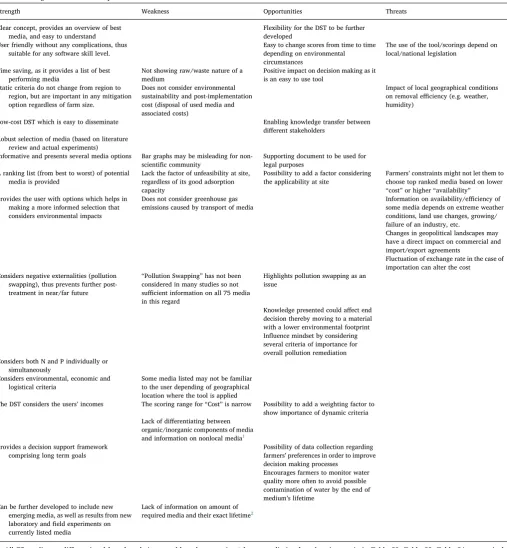
Summary of SWOT analysis results: strength and weakness (attributes of the tool), and opportunities and threats (attributes of the environment) of FarMit DST identified through different workshops.
Strength Weakness Opportunities Threats
Clear concept, provides an overview of best media, and easy to understand
Flexibility for the DST to be further developed
User friendly without any complications, thus suitable for any software skill level.
Easy to change scores from time to time depending on environmental circumstances
The use of the tool/scorings depend on local/national legislation
Time saving, as it provides a list of best performing media
Not showing raw/waste nature of a medium
Positive impact on decision making as it is an easy to use tool
Static criteria do not change from region to region, but are important in any mitigation option regardless of farm size.
Does not consider environmental sustainability and post-implementation cost (disposal of used media and associated costs)
Impact of local geographical conditions on removal efficiency (e.g. weather, humidity)
Low-cost DST which is easy to disseminate Enabling knowledge transfer between different stakeholders
Robust selection of media (based on literature review and actual experiments)
Informative and presents several media options Bar graphs may be misleading for non-scientific community
Supporting document to be used for legal purposes
A ranking list (from best to worst) of potential media is provided
Lack the factor of unfeasibility at site, regardless of its good adsorption capacity
Possibility to add a factor considering the applicability at site
Farmers’constraints might not let them to choose top ranked media based on lower “cost”or higher“availability” Provides the user with options which helps in
making a more informed selection that considers environmental impacts
Does not consider greenhouse gas emissions caused by transport of media
Information on availability/efficiency of some media depends on extreme weather conditions, land use changes, growing/ failure of an industry, etc.
Changes in geopolitical landscapes may have a direct impact on commercial and import/export agreements
Fluctuation of exchange rate in the case of importation can alter the cost Considers negative externalities (pollution
swapping), thus prevents further post-treatment in near/far future
“Pollution Swapping”has not been considered in many studies so not sufficient information on all 75 media in this regard
Highlights pollution swapping as an issue
Knowledge presented could affect end decision thereby moving to a material with a lower environmental footprint Influence mindset by considering several criteria of importance for overall pollution remediation Considers both N and P individually or
simultaneously
Considers environmental, economic and logistical criteria
Some media listed may not be familiar to the user depending of geographical location where the tool is applied
The DST considers the users’incomes The scoring range for“Cost”is narrow Possibility to add a weighting factor to show importance of dynamic criteria Lack of differentiating between
organic/inorganic components of media and information on nonlocal media1 Provides a decision support framework
comprising long term goals
Possibility of data collection regarding farmers’preferences in order to improve decision making processes
Encourages farmers to monitor water quality more often to avoid possible contamination of water by the end of medium’s lifetime
Can be further developed to include new emerging media, as well as results from new laboratory andfield experiments on currently listed media
Lack of information on amount of required media and their exact lifetime2
1All 75 media are di
fferentiated based on being wood-based, vegetation/phytoremediation based or inorganic in Table S2, Table S3, Table S4, respectively, documenting detailed list of advantages/disadvantages of media and already tested amendments to improve their efficiency.
2Acquisition of this information requires batch or column adsorption studies and modeling of adsorption capacity of selected media based on nutrient load and
considered inexpensive (i.e. Score 3) and similar to barley straw, or pea gravel. Some media such as apatite, limestone or vetiver grass are considered to be very costly, and must be imported to the site (with an associated high delivery cost). This was therefore assigned a Score of 1. The DST sums the total scores of the static and dynamic criteria.
4- After pressing“Run”, the DST presented a high to low ranking of media for the Belgian case-study.
The topfive ranked media for mitigation of NO3were (from best to
worst): woodchips, cardboard, barley straw with native soil, coco-peat and sand. Soil (no clay) together with crushed concrete, peat/ sphagnum peat, sand, and vetiver grass together with lime and zeolite, were the highest ranked media for mitigation of DRP. The feedback from face-to-face communication with farmers indicated that con-sidering the availability of resources at farm-scale, waste cellulose (combination of leaf compost, wood mulch and saw dust) could gain more interest than woodchips. In addition, availability of locally sourced barley straw and peat with high NO3removal potential could
consequently change the scores for the dynamic criteria to compensate for a low score for a static criterion (e.g. lifetime). Farmers perceived “pollution swapping”as being important and thefinal material needed to have a low pollution swapping potential. This was perceived as im-portant to avoid monetary fines in terms of water regulations in the future.
3.1.3. USA
The results of the US case study are presented in Supplement Excel Sheet (Tab: EXAMPLES). The following four steps were taken to obtain thefinal results:
1- Based on the drainage water test results as in Table S4,the“Nitrate” icon on the DST user interface was selected.
2- The DST recommends the top 10 media for treatment of NO3
pol-lution scenario (similar to Belgium Case Study for NO3-related media).
3- The dynamic Criteria 8 and 9 were assigned scores based on a comparative scale using online information in consultation with the USA stakeholder, considering local conditions and resources avail-able at farm-scale within the vicinity of case study region. The use of woodchips (to be used in denitrifying bioreactors) receivefinancial support from the government and the existence of numerous wholesale suppliers/or producers of coco-peat (coconut coir), ve-tiver grass, and zeolite made these media accessible and available. The DST then summed the total scores of static and dynamic criteria. 4- After pressing“Run”, the DST recommended a high to low ranking
of media for USA case-study.
The DST recommended woodchips, coco-peat, vetiver grass together with sand and zeolite, barley straw with native soil, as the highest ranked media from best to worst. This result supports the common use of denitrifying woodchip bioreactors in the USA as a well-established NO3remediation technology (Christianson et al., 2012a). The
installa-tion of woodchip bioreactors at the end of tile drainage systems is also financially supported by the US Department of Agriculture Natural Resources Conservation Service (USDA NRCS) (NRCS, NHCP, 2015). Such schemes, along with the major local productions, industry needs and wholesale suppliers/distributors/importers, have a direct influence on media availability and cost and, consequently, the scoring andfinal selection. The output of the FarMit DST considers only selection of a medium/media. Future research is required to test the medium/media under controlled laboratory conditions to elucidate design and opera-tional parameters.
3.2. SWOT analysis
The overall SWOT analysis results from different workshops is summarised inTable 2. It was perceived that the major strengths of the FarMit DST were its easy concept and worldwide applicability for tar-geting dual removal of nutrient pollution, regardless of farming practice and considering specific local economic conditions and media-avail-ability to individual users. Weaknesses identified included the absence of a sustainability factor (i.e. possible reusability of saturated media as a fertilizer or a soil amendment) and impracticality of using certain media regardless of their high ranking in nutrient mitigation. The major opportunity provided by FarMit was that it may be a long-term efficient decision support framework that can be implemented at the initial stage of decision making. The threats were seen as the risk of extreme weather events or social/economical/political changes that may have an impact of availability and price of media for farmers.
4. Discussion
4.1. Performance of DST in case-study applications
The DST application in different case studies representing different geographical locations and showcasing different farming practices, provided a ranking of media with high potential to remove nutrients in drainage water for various farm pollution scenarios. SWOT analysis showed the DST to be an effective tool to communicate management options to different stakeholders. It provided a list of options to the stakeholder and the results are clear enough to provide applicable in-formation.
The results were consistent with the hypothesis that the dynamic criteria (availability and delivery cost of media to site) would vary spatially and temporarily. This was due to reasons such as geopolitical situation and proximity to a national border (e.g. to the French border for Flanders in Belgium), size of the country and therefore availability of wholesale manufacturers/suppliers/distributers, local production (e.g. wood-based or corn-based media like corn cob/stover may suit farmers in USA better than Belgium or Ireland), levies on recyclable materials (e.g. glass in Ireland or cardboard in Belgium), financial support from government (e.g. installation of woodchip denitrifying bioreactors in USA), the extent of application of media according to the dominant industry/use, etc. A good example for the latter is zeolite, which is a natural mineral medium with high potential for removal of both NH4-N and DRP. Although imported in Ireland, this has wide
application in Ireland and thus higher availability with lower delivery cost compared to Belgium, for example. Conversely, coco-peat is more available in Belgium than Ireland due to the wide application of coco-based media for other purposes (e.g. coco-chips in pesticide biofilter), while this medium is readily available and may be purchased at a re-latively low cost in the USA.
4.2. SWOT analysis
Generally, the ranking of media is similar based on static (non-geographical) criteria for comparable case studies in different locations, although it is expected to change when considering the dynamic criteria (8 and 9) at specific sites. The operator may choose from 75 options (Table S5) according to their local knowledge and personal preference. This was considered as a strength in the SWOT analysis. Thisflexibility enabled the operators (farmer/adviser/engineer) to make a quick and informed medium selection based on possible future costs. This strength of the FarMit DST was welcomed in Belgium, where farmers were willing to take an active role in implementing sustainable solutions to minimize pollution caused by nutrient losses and they may opt for natural/organic media with zero pollution swapping and longer sa-turation time regardless of nutrient adsorption capacity. For example, despite the high availability of cardboard or crushed concrete at
farm-G. Ezzati, et al. Ecological Engineering: X 2 (2019) 100010
scale and their high nutrient removal efficiency, the stakeholder (farmer) was concerned about the media lifetime and potential negative externalities. Therefore, the preference was to implement a more sus-tainable, but more expensive, alternative (e.g. zeolite).
In addition, if an operator wishes to avoid expensive pre-treatment or post-treatment of media due to pollution swapping caused by, for example, leaching of heavy metals (e.g. andesite and re-used concrete), they may wish to select a medium further down the ranking that may be more expensive but which has a lower environmental footprint. In addition, after the selection and operation of an engineered treatment system, the FarMit DST can be used again to minimize the effects of pollution swapping. For example, woodchip has been shown in some studies to release DRP (e.g.Fenton et al., 2016). In these cases, the DST can be used to select a Scenario C medium instead.
Another SWOT strength, as well as opportunity of FarMit, is the flexibility to be further developed and to adjust with time of applica-tion, as the dynamic criteria may also change over time. For example, a non-native plant such as vetiver grass has a high pollutant removal efficiency (Ash and Truong, 2004; Mayorca, 2007; Donaldson and Grimshaw, 2013) and can be purchased at a relatively low cost in the USA. It was initially only available at international-scale to Ireland and Belgium (where it was imported from Asia), but now has a growing market in Europe (with ensuing lower supply costs and higher avail-ability). Here, the SWOT threats lie in the fact that changes in geopo-litical landscapes impact commercial trade directly and extreme weather might change availability (and price) of local products.
The SWOT analysis identified a lack of a criteria considering en-vironmental sustainability and post-implementation cost (e.g., disposal of used media and associated costs). This can be addressed in the future as the tool has theflexibility to be further developed.
5. Limitations and future recommendations
Phytoremediation and organic materials, presented in Table S2, have limitations (such as type of vegetation plant, geology, geo-graphical features), which may affect the results of their application (e.g. peat). Similarly, soils and sands may differ in metal content and geochemistry, which could influence their nutrient adsorption capacity. Therefore, the user can subsequently decide to test several highly ranked media in batch studies to confirm their performance in specific contexts. This would then help to screen suitable materials and identify the most efficient type or chemistry of locally sourced media (thus with highest nutrient mitigation potential or longer lifetime) to be used in the site under examination.
In terms offinal selection for an engineered structure, further media testing may be needed to elucidate on-site removal capacity, which may differ from literature or even laboratory conditions e.g. woodchip and denitrification rate. Additionally, the design of a system for dual nu-trient mitigation will usually require the user to consider the sequence of media needed to address pollution swapping (Fenton et al., 2016).
Future development of this FarMit DST should consider incorpora-tion of other factors by individual users (e.g. circular economy/agro-nomic value of saturated media) for scoring andfinalising media se-lection, as well as aligning the ranking of media for removal performance based on similar conditions, e.g. residence time, and to factor in other issues that influence the removal efficiency, e.g. atmo-spheric conditions such as temperature. Furthermore, dynamic criteria could outweigh all other components if weightings are assigned. This would exclude all media for which access is not possible (e.g. vetiver grass in some areas). Another factor which could be included in the DST at a later stage would be maintenance costs pertaining to the selected medium/media at thefield site.
Theflexibility of the FarMit DST provides a tool with the capability to be updated by adding media emerging from new studies as well as new tests on the current 75 media reviewed, but in different experi-mental settings. This would consequently update the “static
component”of the DST as new results indicate higher or lower removal rates, lifetime, or new insights into the pollution swapping potential of a media.
6. Conclusions
A decision support tool (“FarMit”) was developed and validated. This tool enables the end-user to select locally sourced media which can be used in drainage ditch structures to mitigate polluted outflows. The tool provides seven static criteria for 75 media and the operator pro-vides dynamic criteria (availability and delivery cost) to adjust thefinal ranked list for local conditions.
SWOT analysis, conducted in a series of workshops, showed the tool to be systematic, transparent and user-friendly, providing the user with a wide catalogue of options, and considers users’local economic and market conditions. Despite the fact that the tool does not provide an end-use for the saturated medium (media) or insight about re-use po-tential, it provides the opportunity of knowledge transfer between different stakeholders, and therefore can positively impact decision making.
Declaration of Competing Interest
The authors declare that they have no known competingfinancial interests or personal relationships that could have appeared to influ-ence the work reported in this paper.
Acknowledgements
This project has received funding from the European Union’s Horizon 2020 research and innovation programme under the Marie Skłodowska-Curie grant agreement No 675120.
Appendix A. Supplementary material
Supplementary data to this article can be found online athttps:// doi.org/10.1016/j.ecoena.2019.100010.
References
Addy, K., Gold, A.J., Christianson, L.E., David, M.B., Schipper, L.A., Ratigan, N.A., 2016. Denitrifying bioreactors for nitrate removal: a meta-analysis. J. Environ. Qual. 45, 873–881.
Andersson-Sköld, Y., Bardon, P., Chalot, M., Bert, V., Crutu, G., Phanthavongsa, P., Delplanque, M., Track, T., Cundy, A.B., 2014. Developing and validating a practical decision support tool (DST) for biomass selection on marginal land. J. Environ. Manage. 145, 113–121.
Ash, R., Truong, P., 2004, April 5-7 The use of vetiver grass for sewerage treatment. Proceeding of Sewage management QEPA Conference, Cairns, Australia.
Billen, G., Garnier, J., Lassaletta, L., 2013. The nitrogen cascade from agricultural soils to the sea: modelling nitrogen transfers at regional watershed and global scales. Philos. Trans. Royal Soc. B: Biol. Sci. 368 art. 20130123.
Christianson, L., Helmers, M., Bhandari, A., Kult, K., Sutphin, T., Wolf, R., 2012. Performance evaluation of fourfield-scale agricultural drainage denitrification bioreactors in Iowa. Trans. Am. Soc. Agric. Biol. Eng. 55, 2163–2174.
Christianson, L.E., Lepine, C., Sibrell, P.L., Penn, C., Summerfelt, S.T., 2017. Denitrifying woodchip bioreactor and phosphorusfilter pairing to minimize pollution swapping. Water Res. 121, 129–139.
Clagnan, E., Thornton, S.F., Rolfe, S.A., Tuohy, P., Peyton, D., Wells, N.S., Fenton, O., 2018a. Influence of artificial drainage system design on the nitrogen attenuation potential of gley soils: Evidence from hydrochemical and isotope studies underfi eld-scale conditions. J. Environ. Manage. 206, 1028–1038.
Clagnan, E., Thornton, S.F., Rolfe, S.A., Wells, N.S., Knoeller, K., Fenton, O., 2018b. Investigating“Net”provenance, N source, transformation and fate within hydro-logically isolated grassland plots. Agric. Water Manag. 203, 1–8.
Daly, K., Tuohy, P., Peyton, D., Wall, D.P., Fenton, O., 2017. Field soil and ditch sediment phosphorus dynamics from two artificially drainedfields on poorly drained soils. Agric. Water Manag. 192, 115–125.
Donaldson, A., Grimshaw, L., Treating wastewater with vetiver grass 2013 University of Washgington College of Engineering Retrieved fromhttp://www.vetiver.org/USA_ wastewater_grl.pdf.
Castle, Ireland, pp. 1–234.
EU, European Union, 2014 S.I. No. 122 of 2014, European Union (drinking water) reg-ulations 2014, arrangement of regreg-ulations.
Erisman, J.W., van Grinsven, H., Grizzetti, B., Bouraoui, F., Powlson, D., Sutton, M.A., Bleeker, A., Reis, S., 2011. The European nitrogen problem in a global perspective. In: Sutton, M.A., Howard, C.M., Erisman, J.W., Billen, G., Bleeker, A., Grennfelt, P., van Grinsven, H., Grizzetti, B. (Eds.), The European Nitrogen Assessment–Sources, Effects and Policy Perspectives. Cambridge University Press, New York, pp. 664.
FAO, 2011. The State of the World's Land and Water Resources for Food and Agriculture (SOLAW): Managing Systems at Risk. Food and Agriculture Organization of the United Nations, Rome, Italy.
Fenton, O., Richards, K.G., Kirwan, L., Khalil, M.I., Healy, M.G., 2009a. Factors affecting nitrate distribution in shallow groundwater under a beef farm in South Eastern Ireland. J. Environ. Manage. 90, 3135–3146.
Fenton, O., Healy, M.G., Rodgers, M., 2009b. Use of Ochre from an Abandoned Metal Mine in the South East of Ireland for Phosphorus Sequestration from Dairy Dirty Water. J. Environ. Qual. 38, 1120–1125.
Fenton, O., Healy, M.G., Brennan, F.P., Thornton, S.F., Lanigan, G.J., Ibrahim, T.G., 2016. Holistic evaluation offield-scale denitrifying bioreactors as a basis to improve en-vironmental sustainability. J. Environ. Qual. 4, 788–795.
Fenton, O., Mellander, P.-E., Daly, K., Wall, D.P., Jahangir, M.M.R., Jordan, P., Hennessey, D., Huebsch, M., Blum, P., Vero, S., Richars, K.G., 2017. Integrated as-sessment of agricultural nutrient pressures and legacies in karst landscapes. Agric. Ecosyst. Environ. 239, 246–256.
Gramlich, A., Stoll, S., Stamm, C., Walter, T., Prasuhn, V., 2018. Effects of artificial land drainage on hydrology, nutrient and pesticidefluxes from agriculturalfields–A re-view. Agric. Ecosyst. Environ. 266, 84–99.
Hatfield, J.L., 2012. Spatial patterns of water and nitrogen response within corn pro-ductionfields. Agric. Sci. 5, 73–96.
Healy, M.G., Ibrahim, T.G., Lanigan, G.J., Serrenho, A.J., Fenton, O., 2012. Nitrate re-moval rate, efficiency and pollution swapping potential of different organic carbon media in laboratory denitrification bioreactors. Ecol. Eng. 40, 198–209.
Healy, M.G., Barrett, M., Lanigan, G., Serrenho, A., Ibrahim, T.G., Thornton, S.F., Rolfe, S.A., Huang, W.E., Fenton, O., 2014. Optimizing nitrate removal and evaluating pollution swapping trade-offs from laboratory denitrification bioreactors. Ecol. Eng. 74, 290–301.
Hua, G.H., Salo, M.W., Schmit, C.G., Hay, C.H., 2016. Nitrate and phosphate removal from agricultural subsurface drainage using, laboratory woodchip bioreactors and
recycled steel byproductfilters. Water Res. 102, 180–189.
Ibrahim, T.G., Goutelle, A., Healy, M.G., Brennan, R., Tuohy, P., Humphreys, J., Lanigan, G.J., Brechignac, J., Fenton, O., 2015. Mixed agricultural pollutant mitigation using woodchip/pea gravel and woodchip/zeolite permeable reactive interceptors. Water Soil Air Pollut. 226, art.51.
Jhansi, S.C., Campus, M.S., Mishra, S.K., 2013. Wastewater treatment and reuse : sus-tainability options. Sustainable Dev. 10, 1–15.
Khan, K.S., Kunz, R., Kleijnen, J., Antes, G., 2003. Five steps to conducting a systematic review. J. R. Soc. Med. 96, 118–121.
Mayorca, A., 2007. Vetiver systems used in wastewater treatment. Cerveceria Polar C.A-East Plant: Empreas Polar. Barcelona, Venezuela. Retrieved fromhttp://www. vetiver.org/VEN_Beer_WW01pdf.pdf.
McDowell, R.W., Sharpley, A.N., 2001. Approximating phosphorus release from soils to surface runoffand subsurface drainage. J. Environ. Qual. 30, 508–520.
Penn, C., Chagas, I., Klimeski, A., Lyngsie, G., 2017. A review of phosphorus removal structures: How to assess and compare their performance. Water 9, 583.
Rose, D.C., Sutherland, W.J., Parker, C., Lobley, M., Winter, M., Morris, C., Twining, S., Ffoulkes, C., Amonao, T., Dicks, L.V., 2016. Decision support tools for agriculture: Towards effective design and delivery. Agric. Syst. 149, 165–174.
Rosen, T., Christianson, L., 2017. Performance of denitrifying bioreactors at reducing agricultural nitrogen pollution in a humid subtropical coastal plain climate. Water 9, art. 112.
Stanek, E.C., Lovell, S.T., Wilson, M.H., 2017. Multifunctional perennial cropping system: Planning information 2017 Department of Agriculture National Institute of Food and Agriculture, U.S Retrieved from http://www.agroforestry4food.com/assets/mpcs-design—planning-guide—july-2017.pdf.
Sherriff, S.C., Franks, S.W., Rowan, J.S., Fenton, O., Ó’hUallacháin, D, 2015. Uncertainty-based assessment of tracer selection, tracer non-conservativeness and multiple solu-tions in sedimentfingerprinting using synthetic andfield data. J. Soils Sediments 15, 2101–2116.
NRCS, 2015. Conservation Practice Standard Denitrifying Bioreactor Code 605. United States Department of Agriculture Natural Resources Conservation Service, Washington, DC.
USEPA, 2000. Ambient water quality criteria recommendations, Information supporting the development of state and tribal nutrient criteria: Lakes and reservoirs in nutrient ecoregion VI. United States Environmental Protection Agency: Office of water, Washington, D.C. Retrieved fromhttps://www.epa.gov/sites/production/files/ documents/lakes6.pdf.
G. Ezzati, et al. Ecological Engineering: X 2 (2019) 100010