SCHIZOPHRENIA
Steven Klimidis
Submitted in partial fulfilment of the requirments for the degree of Doctor of Philosophy (Clinical Psychology), in The Department of Psychology, The Australian National University,
(ii)
Declaration
I declare that this thesis reports my original work, that no part of it has been previously accepted or presented for the award of any degree or diploma by any university, and to the best of my knowledge no material previously published by another person is included, except where due acknowledgement
i s g i v e n . t
PREFACE
Disordered information processing has been suggested to
underly various 'aspects' of schizophrenic illness (e.g.,
George & Neufeld, 1985; Hemsley, 1977). At times the concept
has been recruited to explain cognitive activity during the
state of psychosis (e.g., Chapman, 1966; Frith, 1979; Hemsley,
1977; McGhie & Chapman, 1961) while at other times the
concept has gained the status of a trait variable or a marker
of the vulnerability to schizophrenic illness (e.g., Asarnow &
MacCrimmon, 1981; Braff, 1981; Meehl, 1962; Nuechterlein &
Dawson, 1984; Sterenko & Woods, 1978). However, there is no
clear evidence which links the laboratory findings of
attenuated performances with the signs and symptoms of
schizophrenia (George & Neufeld, 1985). Moreover, there has
been little success in identifying the particular cognitive
processes or levels of processing that are disordered in
s c h i z o p h r e n i a .
The present work investigates visual information
processing and is concerned with the ability of subjects who
are labelled 'schizophrenic' to perform a number of tasks
which probe specific visual processing functions. Possible
factors contributing to the disorder in visual processing are
derived from a model of perception which follows Neisser's
(1967) theory of the interplay between preattentive and
attentional processes. The second aim of the research is to
identify clinical variables that are associated with the
processing disorder.
The concept of schizophrenia is described in Chapter 1,
preliminary to the presentation of the experimental research.
(iv)
schizophrenia is abnormal and worthy of further investigation.
The
results of three kinds of studies are
presented which
suggest
that visual distortions,
an inability to assimilate
size and distance cues,
and an impairment in
smooth-pursuit
eye
movements may all have a common cause - a poor ability of
schizophrenics
to
synthesise the visual
scene efficiently
relative to controls.
In
Chapter 3 the notion of disordered figural synthesis
is
developed
further with a review of
studies
that have
attempted
to isolate the earliest level of visua1-information
processing that might be 'impaired' in schizophrenia.
It will
become apparent from the review that there is evidence for an
early processing deficit,
but the evidence does not establish
clearly which processes are disordered. Specifically, views of
the
disorder have
included disabilities
within automatic,
preattentive organization of
the visual
object and/or a
disability in attentional processing. In non-visual processing
studies
the evidence from auditory studies (e.g.,
Hemsley &
Zawada,
1976;
Oltmans, 1978; Oltmans & Neale, 1975, but see,
Berg & Leventhal, 1977; Lerner,
Nachshon & Carmon, 1977; Rund,
1983;
Schneider,
1976;
Straube
&
Germer,
1979),
Gilmore, 1980; Wells & Leventhal, 1984).
Chapter 4 presents an overview of the data collection
method along with a description of clinical measures and the
subject selection procedure. Chapter 4 also introduces the
model of processing which has guided the present studies.
Chapters 5, 6, and 7 present a series of Experiments which
collectively investigate the processing functions of stimulus
identification, selective attention, perceptual organization
of the stimulus representation and the effects of stimulus
familiarity on information processing. In Experiment 1, an
analysis of the types of report errors made during
tachistoscopic 'identification' was conducted to test whether
the processing deficit in schizophrenia is at the preattentive
or the attentional processing level. In Experiment 2,
perceptual segregation by colour was investigated in a visual
search task to test the hypothesis that schizophrenics do not
conduct preattentive analysis (Cox & Leventhal, 1978; Place &
Gilmore, 1980; Wells & Leventhal, 1984). In Experiment 3,
target-noise d i s c r i m i n a b i 1 i ty was varied to further test the
preattentive-deficit hypothesis. Experiment 4 re-assessed the
two processing levels concentrating its inquiry on whether
there is an attentional deficit in schizophrenics. The task,
in this case, was to judge whether two simultaneously
presented objects were the 'same' or 'different' under
conditions which stressed the different levels of processing.
In addition to investigating the processing levels, Experiment
4 inquired into whether schizophrenics can utilise stimulus
familiarity to facilitate processing, as normal controls have
been found to do (e.g., LaBerge, 1973). Experiment 5 followed
(vi)
paradigm. In this case it was thought that familiar or
'organized' distractors would interfere with the performance
of controls more severely than schizophrenics if
schizophrenics did not process the distractors normally.
By and large, the present Experiments have found little
evidence that any specific level of visual-information
processing is abnormal in schizophrenia. The results were not
fully consistent with either the preattentive or attentional
deficit hypotheses. There was some suggestion that
preattentive processing was impaired (esp. in Experiments 1, 2
& 5) but this hypothesis could not explain other results in
the study. With regard to the a11ent i ona 1- d e ficit hypothesis,
the bulk of the present results suggested that processing by
focal attention was normal in the present sample of
schizophrenics. In view of these results the main evidence for
the preattentive- and attentional- deficit hypotheses is r e
evaluated in Chapter 8. It was concluded that the case for the
a11ent i o n a 1- d e f i c i t hypothesis is not supported by the
literature and by the present findings in general. However,
although most of the evidence for the preattentive-deficit
hypothesis could be re-interpreted to support the
attentional-deficit hypothesis, the results of the Place and Gilmore
(1980) study remained relatively unique evidence for a
p r e a t t e n t i ve-processing deficit in schizophrenia.
Chapter 8 also reviews the findings with respect to the
correlation analysis carried out between the processing
variables and the clinical variables, concluding that, in
general, small sample studies like the present are incapable
symptom and sign or dimension of schizophrenia is related
to
poor performance in information-processing tasks. The analysis
also
indicated
that
some
of
the
performance
deficits
demonstrated
in the present series of Experiments could well
have been due to the effects of medication on
information
processing.
(On the other hand,
performance was found to be
positively correlated with medication level in Experiment 1).
( v i i i )
Acknowledgements
List of Figures
1.1. K r a e p e l i n 's description of symptoms for
'dementia praecox' 2
1.2. DSM III criteria for the diagnosis
of schizophrenia 6
1.3. Stages in the development of psychosis 11
4.1. Guiding model for information processing
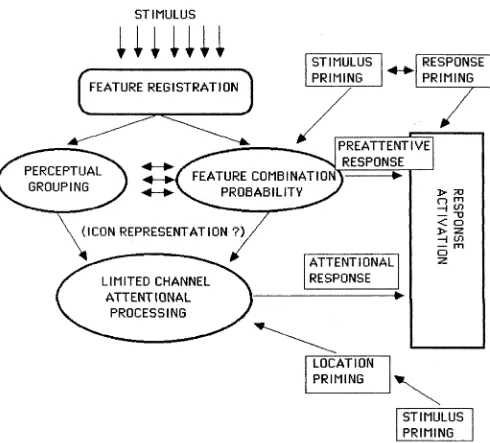
in the present work 67
4.2. Outline of the data collection process 83
4.3. Clinical measures of Collections 1 and 2 86
4.4. Syndromes and symptoms measured by
the Maine Scale 88
5.1. Examples of stimulus, masking,
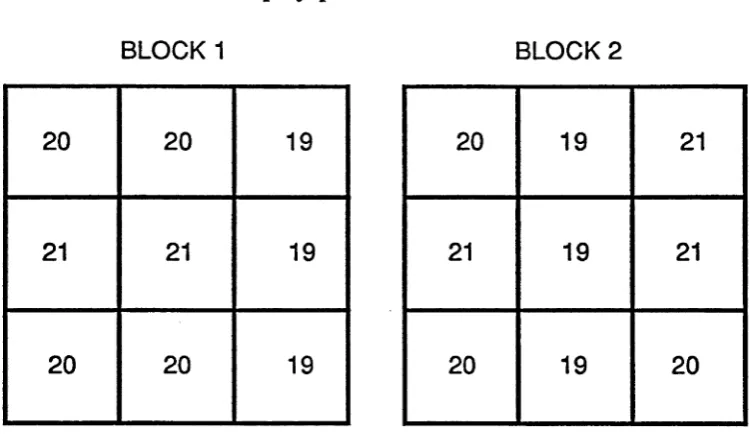
and pre-stimulus displays 130
5.2. The frequency of occurrence of letters
in the display positions for each
stimulus block 132
5.3. The frequency of occurrence of cues in
the display positions for both stimulus
blocks 132
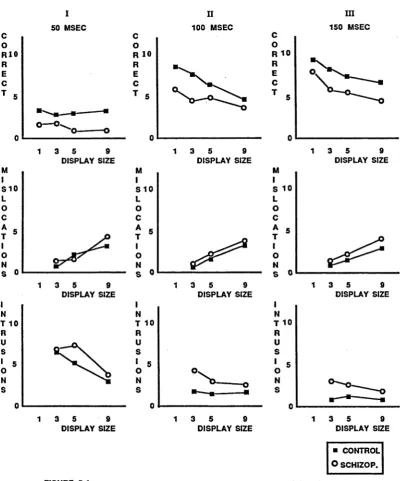
5.4. The distribution of correct responses,
mislocations and intrusions, as a function of exposure duration and display size,
in the Focused Attention Condition 136
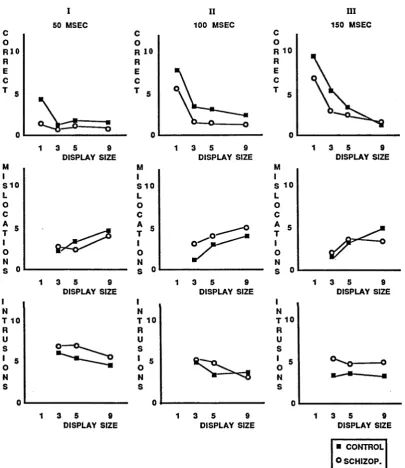
5.5. The distribution of correct responses,
mislocations and intrusions, as a function of exposure duration and display size,
in the Divided Attention Condition 140
5.6. The distribution of Pre-cueing Advantage
Scores for correct responses, mislocations and intrusions, as a function of exposure
duration and display size 143
5.7. Error probability mapped onto the
display positions 145
6.1. Mean sorting time for 'deck 1' 159
6.2. Mean decision time for sorting in
Conditions 1, 2 and 3 160
6.3. Mean log decision time for sorting in
Conditions 1, 2 and 3 160
6.4. The effect of practice on sorting time 162
6.5. The conditions and proposed
preattentive products 167
6.6. Examples of 'bilevel' stimuli presented
in the three conditions of discrimination
difficulty 171
6.7. Detection of local and global level
targets as a function of discrimination
difficulty and effective stimulus duration 178
6.8. Processing precedence as a function of
groups, discrimination difficulty and
effective stimulus duration 181
7.1. Examples of the shape pairs presented
(x)
7 . 2 . T h e s e q u e n c e o f e v e n t s f o r t h e v o i c e - o n s e t
l a t e n c y m e a s u r e m e n t 2 0 0 7 . 3 . A c c u r a c y a n d r e a c t i o n - t i m e m e a s u r e s f o r s a m e
s t i m u l i i n t h e g l o b a l p r o c e s s i n g c o n d i t i o n 2 0 3 7 . 4 . A c c u r a c y a n d r e a c t i o n - 1 i m e m e a s u r e s f o r
d i f f e r e n t s t i m u l i i n t h e g l o b a l p r o c e s s i n g
c o n d i t i o n 2 0 5
7 . 5 . A c c u r a c y a n d r e a c t i o n - t i m e m e a s u r e s f o r s a m e s t i m u l i i n t h e a t t e n t i o n a l p r o c e s s i n g
c o n d i t i o n 2 0 7
7 . 6 . A c c u r a c y a n d r e a c t i o n - t i m e m e a s u r e s f o r d i f f e r e n t s t i m u l i i n t h e a t t e n t i o n a l
p r o c e s s i n g c o n d i t i o n 2 0 9 7 . 7 . E x a m p l e s o f t h e s t i m u l u s d i s p l a y s s h o w i n g
t h e t h r e e k i n d s o f d i s t r a c t o r s 2 1 5 7 . 8 . P e r f o r m a n c e i n t h e t h r e e d i s t r a c t o r
c o n d i t i o n s 2 1 9
8 . 1 P l a c e a n d G i l m o r e ' s ( e x p e r i m e n t 2 , 1 9 8 0 )
f i n d i n g s 2 4 7
8 . 2 T h e o r e t i c a l e x t e n s i o n o f P l a c e a n d
List of Tables
4.1. Correlations between the Maine Scale
scores and other measures for
Collection 1 100
4.2. Correlations between the Maine Scale
scores and other measures for Collection 2 102
4.3. Correlations among the Classes of Personal
Illness from the DSSI, in Collection 1 105
4.4. Correlations among the Classes of Personal
Illness from the DSSI, in Collection 2 105
4.5. Self-reported pathology depicted as Classes
of Personal Illness for Collection 1 107
4.6. Self-reported pathology depicted as Classes
of Personal Illness for Collection 2 109
4.7. Details of scores on the various
instruments for the two samples 111
5.1. Means and standard deviations of the
descriptive data 128
5.2. Correlations of letter identification
performance in the two attention conditions and total score with the
clinical variables 147
6.1. Means and standard deviations of the
descriptive data 155
6.2. Correlations between the sorting latency
measures and the various clinical measures 164
6.3. Means and standard deviations of the
descriptive data 175
6.4. Correlations of performance with the
clinical measures 183
7.1. Means and standard deviations of the
descriptive data 195
7.2. Comparisons of 'naming stability scores'
and number of concepts used to describe
familiar and unfamiliar shapes 199
7.3. Correlations of performance with the
clinical measures 211
7.4. Means and standard deviations of the
descriptive data 217
7.5. Correlations of performance with the
clinical measures 221
8.1. Summary of the correlations between
processing and clinical measures in the
CONTENTS
Declaration (i i )
Preface ( i i i )
Acknowledgments (viii)
List of figures (ix)
List of tables (xi)
Chapter 1. An Overview of Schizophrenia 1
1.1. The diagnostic concept of schizophrenia 1
1.2. Age of onse t 8
1.3. The incidence of schizophrenia 8
1.4. Long-term outcome 9
1.5. The d i a t h e s i s - s t r e s s model 10
1.6. The development of psychosis 12
1.7. Chapter summary 13
Chapter 2. Visual Processing Disorder in Schizophrenia 14
2.1. Historical note 14
2.2. Visual distortions in schizophrenia 15
2.3. Experimental evidence for v i s u a 1-processing
disturbance: Experiments using general measures
o f p r o c e s s i n g 19
2.31. The impairment of perceptual constancies 19
2.32. Comments on the explanation of
constancies impairment 22
2.33. Eye-movement disorder in schizophrenia 24
2.4. Chapter summary 31
Chapter 3. Levels of Visual-Information Processing in
Schizophrenia 33
3.1. Abnormal icon decay in schizophrenia 36
3.2. Dysfunction in icon formation and quality 40
3.21. Simple thresholds and the registration
of information 41
3.22. 'Complex' thresholds and preattentive
grouping 43
3.3. Dysfunction in post-iconic selection 49
3.31. Encoding of multi-item displays 50
3.32. Studies attempting to control
icon 'quality' 57
3.33. Comments on Saccuzzo and the slow
processing hypothesis 62
Chapter 4. An Introduction to the Present Work: Aims, model, Outline, Clinical Measures
and Subject Inclusion 66
4.1. General aims of the work 66
4.2. A guiding information processing model
for the present work 68
4.3. Outline of the present experiments based on the
g u i d i n g m o d e l 73
4.4. A note on research orientation 75
4.5. Outline of the data collection procedure 84
4.6. The clinical variables 85
4.61. Collection 1: Clinical instruments
and variables 89
4.62. Collection 2: Clinical instruments
and variables 97
4.63. Additional measures 99
4.7. Observer-reported pathology 101
4.8. Subject-reported pathology 104
4.9. Subject selection 110
4.10. A general note 115
4.11. Chapter summary 115
Chapter 5. The Efficiency of Attentional and Preattentive Visual Processing
in Schizophrenia 117
5.1. Types of errors in visual processing tasks 118
5.2. Intrusion errors are diagnostic of the adequacy
of early processing of the visual stimulus 119
5.3. Mislocation errors are diagnostic of the
adequacy of attentional item-to-location
conjunction 122
5.4. Experiment 1: Intrusions and mislocation
in target reports of schizophrenics 125
5.41. Method 129
5.42. Results 137
5.43. Discussion 148
Chapter 6. Preattentive Grouping in Schizophrenia 152
6.1. Physical attributes, similarity grouping and
selection 152
6.2. Experiment 2: Perceptual segregation by
colour and visual search in schizophrenics 154
6.21. Method 156
6.22. Results 161
6.23. Discussion 165
6.3. Experiment 3: Effects of discrimination
difficulty on detection performance in
schizophrenics 172
6.31. Method 176
6.32. Results 179
CONTENTS
Chapter 7. The A t t e n t i o n a 1-Deficit Hypothesis and the Influence of Stimulus Familiarity
in Schizophrenia 187
7.1. Expectancy and familiarity effects on s t i m u l u s
processing 188
7.2. Stimulus familiarity effects in schizophrenia 190
7.3. Experiment 4: The attentional deficit
hypothesis and effects of stimulus familiarity
in schizophrenia 191
7.31. Method 196
7.32. Results 204
7.33. Discussion 212
7.4. Experiment 5: Inhibitory effects of familiar
distractors on target detection 214
7.41. Method 218
7.42 Results 220
7.43 Discussion 222
7.5. Chapter summary 222
Chapter 8. Review of the Deficit Hypotheses and
Conclusions 224
8.1 Synopsis of Previous Findings 224
8.2 Synopsis and integration of the Present
Experiments 229
8.3 Re-evaluating the prea11ent i v e - d e ficit
hypothesis 243
8.4 Re-evaluation of the a11ent i o na 1-def i c i t
hypothesis 252
8.5 Synopsis of the correlation results and
evaluation 254
8.6 Conclusions and generality 257
8.7 Future directions 259
8.8 The clinical syndromes of schizophrenia and
information-processing 263
References 266
A p pendix 1 A1
A p pendix 2 A7
CHAPTER 1. AN OVERVIEW OF SCHIZOPHRENIA 1.1 The diagnostic concept of schizophrenia
From its inception, the concept of schizophrenia has
referred to a number of apparently different psychiatric
disturbances that were grouped together on the basis of an
early onset and poor outcome or deteriorating course.
Kraepelin's concept of 'dementia praecox' included previously
defined conditions of 'hebephrenia' and 'catatonia' along with two newly defined syndromes -'paranoid disorder' and 'dementia
simplex' (Braceland, 1956; Jablensky, 1986; Klein, Gittelman,
Quitkin & Rifflin, 1980; Stromgren, 1982). Kraepelin's
description of symptoms associated with these conditions is
summarised in Figure 1.1.
B l e u l e r 's (1950; Freyhan, 1958; Raskin, 1975) concept of
schizophrenia also included a number of disorders whose
aetiology was thought to be variable:
"Under the term dementia praecox or
schizophrenia we thus subsume a group of
diseases which can be clearly distinguished from
all other types of diseases in Kraepelin's
system. They have many common symptoms and
similar prognoses. Nevertheless, their clinical
pictures may be extremely varied. " (Bleuler,
1950, p . 4 ) .
Bleuler distinguished between fundamental symptoms and
accessory symptoms of schizophrenia. Fundamental symptoms were expected in every case of schizophrenia and included: The loss
of associative connectivity; affective disorder (loss of
affective depth, presence of moodiness or inappropriate
affect); ambivalence (of affect, will, and intellect); autism
(e.g. a preoccupation with phantasy to the exclusion of
2
FIGURE 1.1;
Kraepelin's description of symptoms for 'dementia
praecox’ (compiled from Braceland, 1956; Klein et al.,
1980; Kraepelin 1920; Manschreck, 1983).
PRESENT IN DEM ENTIA PRAECOX
lack of insight and judgement
hallucinations
incoherent thinking and speech
incoherent affect and actions
misinterpretations of sensation
attachment of peculiar meanings to sensations
inappropriate mood
poor concentration
decrease in attention to the external world
a reduction in volition and goal directedness
motor disturbances (e.g. catatonic exitement)
ABSENT IN DEM ENTIA PRAECOX
impaired perception and memory
delusions, lapses In memory, poverty of ideas, and language disturbances ('word salad', neologisms, agrammatisms and the condensation of words), were regarded as common in conditions other than schizophrenia and were of lesser diagnostic value. Additionally, accessory symptoms, in contrast to the fundamental symptoms, were thought be present periodically or not at all once the disorder had developed.
Bleuler brought to the concept a further distinction, that of primary and secondary symptoms. This distinction referred to the aetiology of symptoms while by comparison, the fundamental-accessory distinction referred to the description of the disorder. Primary symptoms were regarded as expressions of a disease process while secondary symptoms were thought to reflect behavioural adaptations to the primary symptoms (Berner, 1980; Raskin, 1975).
Schneider (1957) posed two main criticisms of Bleuler's classification. First, fundamental symptoms which were regarded as central to diagnostic decisions were not ll^cessarily present in the condition:
"... in order to be recognized with confidence, they [fundamental symptoms] must 'have attained a certain degree of severity'. This means, however, that they are not 'present at all times and in every case', as Bleuler himself expressly concedes." (Schneider, 1957, p. 41).
4
"Of the basic symptoms, only disturbed
association counts as primary, and even then
there are reservations: disturbed affect,
ambivalence, autism are not primary but
secondary symptoms, disturbed affect being
listed as provisional. This and much more is
inconsistent, illogical, and unsystematic."
(Schneider, 1957, p. 42).
Schneider's rejection of Bleuler 1s classification led
him to adopt an approach which relied solely on the
description of the most common symptoms of the disorder; he
avoided theoretical inferences between the symptoms and
aetiology (Deutsch & Davis, 1983; Hoenig, 1982). Schneider
identified 'first rank' symptoms as those that were the most
diagnostically conclusive of schizophrenia in the absence of
evidence of any organic impairment. 'Second rank' symptoms
were regarded as merely suggestive of schizophrenia (Berner,
1980; Deutsch & Davis, 1983; Mel l o r , 1970). 'First rank'
symptoms included: the patient hears his thoughts aloud; the
voices comment on the patient's actions; the voices are
arguing or discussing the patient; the hallucination of
influences on the body ('somatic passivity'); delusional
interpretation of information; the experience that one's
thoughts are interfered with or withdrawn by external
influences; the experience that thoughts are inserted by
external forces; the experience that one's thoughts are
transmitted to others and can influence others' behaviour; and
experiences that affect, impulses, and motor activity are
'made' for the patient by external forces (Deutsch & Davis,
1983; Fenton, Mosher & Matthews, 1981; Hoenig, 1982; Klein et
al . , 1980; M e l l o r , 1970 ) .
More recently diagnostic criteria for schizophrenia have
diagnosis
(although whether the signs and
symptoms validly
refer to a single disease process remains an issue).
In
this
respect
the World Health Organization (1973)
sponsored
the
International Pilot Study of Schizophrenia. A sample
total of
1,121
psychiatric patients was interviewed using the Present
State Examination (Wing,
Cooper & Sartorius,
1974). Patients
were
interviewed
in nine different
countries by
local
psychiatrists
and were assigned clinical diagnoses based on
the
International Classification of Diseases.
Using half
of
the
initial
cohort data,
twelve
symptoms were
found
to
identify
the patients who were diagnosed
schizophrenic
(Bartko,
Carpenter & Strauss,
1981;
Carpenter,
Strauss &
Bartko,
1973,
1974).
These
'flexible'
symptoms
were:
restricted affect,
poor insight, hearing thoughts aloud, poor
rapport with the interviewer, widespread delusions, incoherent
speech,
unreliable information during the interview,
bizarre
delusions,
nihilistic delusions,
absence of early waking,
absence of depressed appearance, absence of elation.
The 'flexible' symptoms were applied to the rest of
the
cohort and the results indicated that 91 percent of clinically
diagnosed schizophrenics exhibited four or more symptoms
but
so did 38 percent of other diagnoses.
When the cut-off
was
specified at eight or more symptoms,
20 percent of clinically
diagnosed schizophrenics were selected but no other diagnoses
could be confused with schizophrenia.
Generally a cut-off of
six or more 'flexible' symptoms is acceptable as this includes
63 percent of clinically diagnosed
schizophrenics
and
six
percent of other disorders.
Fenton
et
al.
(1981)
pointed out,
most of
the
6
FIGURE 1.2:
DSM
III criteria for the diagnosis of schizophrenia
(adapted from
the
DSM III,
American Psychiatric
Association,
1980).
DIAGNOSTIC CRITERIA FOR A SCHIZOPHRENIC DISORDER
A. At least one of the following during a phase of the illness:
1. bizarre delusions, such as delusions of being controlled, thought
withdrawal, thought insertion, thought broadcasting
2. somatic, grandiose, religious, nihilistic, or other delusions without
persecutory or jealous ideation
3. delusions with persecutory or jealous content if accompanied by
hallucinations of any type
4. auditory hallucinations in which either a voice keeps up a running
commentary on the individual's behaviour or thoughts, or two or more
voices converse with each other
5. auditory hallucinations on several occasions with content of more than
one or two words, having no apparent relation to depression or elation
6. incoherence, marked loosening of associations, markedly illogical
thinking, or marked poverty of content of speech if associated with at
least one of the following:
a. blunted, flat, or inappropriate affect
b. delusions or hallucinations
c. catatonic or other grossly disorganised behaviour
B. Deterioration from a previous level of functioning in work, social
relations and self-care.
C. Duration: Continuous signs of the illness for 6 months with a period
which includes symptoms from A (above), with or without a prodromal or
residual phase (see below)
D. Absence of the full depressive or manic syndrome or this developed after
the other psychotic symptoms, or was relatively brief in comparison to the
other psychotic symptoms
E. Onset before the age of 45
F. No evidence of Organic Mental Disorder or Mental Retardation
PRODROMAL AND RESIDUAL SYMPTOMS
1. social isolation or withdrawal
2. impairment in vocational functioning
3. peculiar behaviour (e.g. collecting garbage)
4. reduced personal hygiene and grooming
5. blunted, flat, inappropriate affect
6. digressive, vague, circumstantial
rather than longitudinal description of the disorder. However,
the third edition of the Diagnostic and Statistical Manual
(DSM III) for the classification of mental disorders has
adopted a longitudinal criterion. The DSM III criteria are
presented in Figure 1.2. These criteria were largely derived
from the Feighner Criteria (Feighner, Robins, Guze, Woodruff,
Winokur & Munoz, 1972) which take the theoretical view that
good- and poor-prognosis schizophrenias are two distinct
disease entities (Robins & Guze, 1970) and that the poor
prognosis group is, supposedly, the 'true' schizophrenia. For
this group, the disorder develops insidiously, it is present
for at least six months and includes individuals with a poor
psychosocial adjustment prior to the 'onset' of the illness
(Spitzer, Andreasen & Endicott, 1978).
However, according to Fenton et al. (1981) validation of
these criteria has been somewhat tautological since the most
popular validation measure used was the prediction of outcome.
As Fenton et al. pointed out, a good association can be
expected between established chronicity and future chronicity
in any psychiatric disorder. Moreover, in Klein's (1982)
assessment, he indicated that the Feighner Criteria and the
DSM III criteria showed only low correlations with broad
measures of premorbid psychosocial adjustment. Interestingly,
the Flexible-Symptoms system, which does not include a
d u r a t i o n - o f - i 1 lness requirement, tended to select more chronic cases (even when a cut-off of only 5 symptoms was used).
Klein (1982) compared the following systems for
diagnosing schizophrenia: Feighner Criteria; Taylor and Abrams
[image:21.539.47.499.73.788.2]8
Symptoms; and, Schneider's First Rank Symptoms. These systems
were compared in terms of the degree to which they included
patients who were chronic, were poorly adjusted premorbidly,
or exhibited paranoid symptomatology. The results indicated no major differences between the systems in selecting patients on
these systems on the three indices. It seems that these
systems, regardless of their inclusion of chronicity criteria,
are equivalent in their ability to select chronic, poor
psychosocially-adjusted, or paranoid patients.
1.2 Age of onset
The onset of schizophrenia ranges between 16 and 25
years of age (for 75 percent of diagnoses), the number of new
cases becoming rare after the age of 40 (Torrey, 1983). Age of
onset appears to differ for the sexes. Below the age of 34,
more men are diagnosed than women, while this pattern is
reversed beyond the age of 35 (Wing, 1982). This may be a
reflection of different social and vocational pressures, and
the different opportunities for the recognition of the
disorder in the sexes. On the other hand, it has been
suggested that hormone-dopamine interactions in women may
reduce their early predisposition to the illness (Loranger,
1984) or in men these may "trigger" (Lewine, 1981, p. 440) the early onset of the disorder.
1.3 The incidence of schizophrenia
The most common measure of incidence is the number of
new cases of schizophrenia detected by a psychiatric service
within a period of time (usually one year and usually
a range of 0.17 to 0.52 (Jablensky, 1986). These figures
reflect diagnoses from seven European countries. Haffner & an
der Heiden (1986) found an average rate of 0.30 with a range
of 0.08 to 0.69 representing figures from nine countries
including the Victorian Register in Australia (incidence of
0.16, K r u p i n s k i , 1984 personal communication to Haffner & an
der Heiden, 1986).
Data published by Krupinski, Alexander and Carson (1982)
from the Victorian registry for the years 1961 to 1973 showed
a mean rate of 0.26 with a range of 0.20 to 0.31. It is
interesting that the data indicated a reduction in the
incidence rate over this period from 0.27 to 0.20 since a
similar reduction was found in the Danish National Registry
for the years 1957 to 1972 (Weeke & Stromgren, 1978). The
reason for this effect is not clear, but may reflect an
increase in the utilization of facilities outside of
psychiatric services (Jablensky, 1986). This is indeed
suggested by the data from the Victorian Registry which shows
a tendency for greater use of out-patient facilities and an
emphasis on less hospitalization over this period (Krupinski,
Alexander & Carson, 1982).
1.4 Long-term outcome
Comparison of outcome studies is difficult. Among other
sources of variability, studies show heterogeneity in samples
with respect to symptoms, variable outcome criteria, variable
length of follow-up, and varying treatment environments.
Ciompi (1984) noted that a number of factors have been found
that influence illness duration, including: personality
10
influences (e.g., social stimulation, familial environment,
life events); treatment or institution related factors (e.g.,
institutional infra-structure, the system of care, treatment
expectations of those concerned); and, cultural and economic
status. These influences suggest that the traditional
association of chronicity with schizophrenia might be
misleading (see also, Barham, 1984).
Nevertheless, generalizations about outcome have been
made in the litexaiure (e.g., Stephens, 1978; Tsuang, 1982).
Generally, 25 percent of cases can be expected to recover from
psychosis without residual defect, 40 percent can be expected
to suffer from recurrent psychotic episodes with residual
disabilities in social and vocational spheres, and the rest
can be expected to remain psychotic indefinitely (Quality
Assurance Project, 1984).
1.5 The d i a s t h e s i s -stress model
The data concerning schizophrenic illness are best
accommodated by the d i asthesis-stress model of psychopathology
(e.g. Ciompi, 1984; Davison & Neale, 1978; N u e r c h e r l e i n ,
1986; Nuercherlein & Dawson, 1984). According to this view,
schizophrenics exhibit a predisposition to psychosis but its
development is influenced by a stressful environment. There is substantial support for the notion of a genetic predisposition
to the disorder although mechanisms of inheritance are as yet
obscure (e.g. Baron, 1986; Gottesman & Shields, 1982; McGue,
Gottesman, & Rao, 1986; Rainer, 1982). On the 'environment'
side of the dias t h e s i s - stress equation, the work on the
expression of emotion in families of schizophrenics ( T a r r i e r ,
FIGURE 1.3:
STAGE 0
STAGE I
STAGE II
STAGE III
STAGE IV
STAGE V
Stages in the development of psychosis (adapted from, Docherty et al., 1978).
HOMEOSTASIS
normal adaptationOVEREXTENSION
experience of being overwhelmed,
experience of the need think faster to keep up with events,
feelings of overstim ulation, persistent decreasing efficiency and distractability
RESTRICTED CONCIOUSNESS
limitation in scope of thought, boredom, apathy, listlessness, social withdrawal, reduced activity, obsessional, phobic symptoms, somatic com plaints, feelings of hopelessness, dissatisfaction, loneliness and dependency
DISINHIBITION
im pulsive actions, uncharacteristic, risk taking, sexual promiscuity, rage attacks, unrestricted spending,
dissociative phenomena, mood elevation, ideas of reference,
repressed m aterial becomes conscious
PSYCHOTIC DISORGANIZATION
PART i. D e stru c tu rin g of thee x t e r n a l e n v ir o n m e n t
loss of figure/ground relationships, percepts assembled with concious effort, ideas of reference now prevalent,
speech disorganization,
com prehension o f external stim ulation is difficult
PA RT ii. D e stru c tu rin g o f th e self loss of self id en tity ,
loss of sense of self connectedness, actions are disconnected, intrusions
of 'primitive' sexual and aggressive images into conciousness
severe anxiety, panic, hallucinations PA R T iii. T o tal fr a g m e n ta tio n
complete loss of self control, catatonia may appear
PSYCHOTIC RESOLUTION
decreased anxiety, increased organization, development of delusional belief system, denial of unpleasant affect,
12
effect of 'specif ic ' stressors . On the other hand, a s sugges ted by Ciompi (1984,, see also, Frith , 1979 ) , non -specific stressors may have an adverse influence on schizophrenics because of their genera 1 i sed intolerance to high levels of stimulation.
For Ciompi the concept of diasthesis included more than genetic constitution. He summarised much of the evidence on the aetiology of the disorder by stating that genetically determined constitutional abnormalities, prenatal and perinatal cerebral damage, early disturbance of the mother- child relationship, ambiguous and contradictory familial patterns of communication and situational social and cultural influences, all play a role in shaping a person toward vulnerability. Ciompi identified this vulnerability as a "deficiency in information processing" and particularly, as an "abnormally low 'channel-capacity'..[in the].. information processing system" (1984, p. 638). These ideas have been expressed previously by others (e.g. Gjerde, 1983; Knight & Russell, 1978; Yates, 1966). Accordingly, psychotic symptoms can be seen as an overwhelming of a vulnerable
information-processing system (Ciompi, 1984).
1.6 The development of psychosis
The course of psychosis was summarised from the literature into a five-stage model by Docherty, Kämmen, Siris and Marder (1978). Their summary is presented in Figure 1.3. In agreement with Ciompi (1984) Docherty et al. speculated that the "progressive disturbance of psychotic decompensation reflects the levels of breakdown seen with progressive
1.7 Chapter Summary
Schizophrenia is a concept that refers to a number of
diverse disorders in behaviour having in common a severe
deterioration of personality. It is characterised by periods
of psychosis with experiences of hallucinations, delusions,
thought disorder, and emotional disorganization. The course of
schizophrenia is variable but not uncommonly it is
characterised by long- term psychosocial disability.
Schizophrenia is best described by the general model of the
interaction between two factors: vulnerability to psychosis
and stressful environment. Vulnerability may have both
psychosocial and biological aetiologies, and while there
is some evidence for the action of specific stressors in
the expression of psychotic behaviour, the more common opinion
in the literature (e.g. Callaway & Naghi, 1982; Frith, 1979:
Ciompi, 1984; Gjerde, 1983; Knight & Russell, 1978) is that
schizophrenics are vulnerable to information 'overload'.
Information 'overload' seems to be linked to psychosis by some
theorists (e.g., Docherty, et a l ., 1978) while others (e.g.,
Ciompi, 1984) regard it as an endurable characteristic of
14
CHAPTER 2. VISUAL PROCESSING DISORDER IN SCHIZOPHRENIA 2.1 Historical note
The present work is concerned with visual perception in schizophrenia and with the question as to whether specific processes within perception are abnormal. Contrary to this view, the various disturbances in perception, which will be reported below, were not featured in the diagnostic descriptions of schizophrenia by Kraepelin and Bleuler. According to Weckowycz and Blewett (1959) Kraepelin's conclusions that there are no perceptual disturbances in 'dementia praecox' were based on Wundt's concept of perception which considered the study of perception to be concerned, essentially, with the study of sensory phenomena and with the measurement of thresholds.
2.2 Visual distortions in schizophrenia
Disordered processing of visual information is suggested
by the experiential reports of schizophrenic patients. For
example, McGhie and Chapman (1961) noted disturbances of the
ability to limit attention to a subset of the stimulus field,
in the reports of schizophrenics. These patients experienced
an interruption in the stream of thought as a result of
detecting irrelevant environmental events:
"If I am talking to someone they only need to
cross their legs or scratch their heads and I am
distracted and forget what I am saying"
(McGhie & Chapman, 1961, p. 104); and ,
"I can't concentrate on television because I
can't watch the screen and listen to what is
being said at the same time. I can't seem to
take in two things like this at the same time
especially when one of them means watching and
the other listening. On the other hand I seem to
be always taking in too much at the one time and
then I can't handle it and can't make sense of
it . "
(McGhie & Chapman, 1961, p. 105).
Other patients reported more severe problems such as the
need to concentrate in order to visualise the stimulus field
c o h e r e n t l y :
"Everything is in bits. You put the picture up
bit by bit into your head. It's like a
photograph that's torn in bits and put together
again. You have to absorb it again. If you move
it's frightening. The picture you had in your
head is still there but it's broken up. If I
move there's a new picture that I have to put
together again."
(McGhie & Chapman, 1961, p.106).
Chapman (1966) reported similar experiences:
"I have to put things together in my head. If I
look at at my watch I see the watch, watchstrap,
face, hands and so on. I have to put them
16
As early as 1941 Arieti noted similar problems in the
’severely regressed' patients (Arieti, 1974). He reported that
the perceptual fragmentation of objects to their parts, which
he termed "primary awholism" (1974, p. 283), becomes more
prominent as the severity of psychosis increases. As an
explanation Arieti presented the following account. First, he
distinguished between primary and secondary perceptual
processes, suggesting that primary processes are rapid and
usually outside the observer's consciousness while secondary
processes are conscious. Primary processes are involved in
deriving the perceptual representation of parts of objects
which are then integrated by the secondary process. He went on to state that,
"what appears to us to be normal perception,
involving wholes, is only the ultimate stage of
a complicated mechanism. This microgenic
mechanism occurs in the normal subject in a
fraction of a second, and the subject is aware
only of the terminal stage, that is, when he
perceives wholes as wholes...[In schizophrenia]
perception becomes arrested at one of the
pregestaltic stages."
( A r i e t i , 1974 , p . 283 ) .
Apart from these reports, which seem to suggest failures
to select and integrate information into meaningful events,
Freedman (1974) reported changes in the sensitivity to sensory
input. There are, for example, accounts of enhanced
s e n s i t i v i t y :
"...my eyes became markedly oversensitive to
light. Ordinary colors appeared to be much too
bright and sunlight appeared dazzling in
intensity. When this happened ordinary reading
became impossible."
(Freedman, 1974, p. 101).
r e c o r d e d e x p e r i e n c e s of m u t e d s e n s o r y a w a r e n e s s - an e x p e r i e n c e that all s e n s a t i o n is d i m m e d or d u l l e d . O t h e r p a t i e n t s r e p o r t e d th a t b a c k g r o u n d s t i m u l i b e c a m e as p e r c e p t u a l l y s a l i e n t as f o r e g r o u n d s t i m u l i - f i g u r e a n d g r o u n d r e s o l u t i o n wa s d i m i n i s h e d . R e p o r t s in C h a p m a n ' s p a p e r a l l u d e d to v i s u a l d i s t o r t i o n s i n v o l v i n g s h a p e a nd d e p t h i n f o r m a t i o n :
a n d ,
"I w as s i t t i n g l i s t e n i n g to a n o t h e r p e r s o n and s u d d e n l y the o t h e r p e r s o n b e c a m e s m a l l e r a nd t h e n l a r g e r a n d t h e n he s e e m e d to g e t s m a l l e r a g a i n . . . L a s t w e e k I wa s w i t h a g i r l a nd s u d d e n l y she s e e m e d to g et b i g g e r , a n d b i g g e r , l i k e a m o n s t e r c o m i n g n e a r e r a n d n e a r e r . T h e s i t u a t i o n b e c o m e s t h r e a t e n i n g a nd I s h r i n k b a c k an d b a c k . "
( C h a p m a n , 1966, p. 229);
"I see t h i n g s flat. W h e n e v e r t h e r e is a s u d d e n c h a n g e I see t h i n g s flat. T h a t ' s w h y I'm r e l u c t a n t to go f o w a r d ... T h e r e is no d e p t h , but if I t a k e t i m e to l o o k at t h i n g s I c an p i c k out the p i e c e s l i k e a j i g s a w p u z z l e . M o v i n g is like a m o t i o n p i c t u r e . If y o u m o v e the p i c t u r e in f r o n t of y o u c h a n g e s . T h e r a t e of c h a n g e in the p i c t u r e d e p e n d s on the s p e e d of w a l k i n g . If you run y o u r e c e i v e s i g n a l s at a f a s t e r rate. The p i c t u r e I see is l i t e r a l l y m a d e up of h u n d r e d s of p i e c e s . U n t i l I see int o t h i n g s I d o n ' t k n o w w h a t d i s t a n c e t h e y a r e a w a y . "
( C h a p m a n , 1966, p. 230).
In a d d i t i o n to r e c o r d i n g s u c h e x p e r i e n c e s e a r l y in the c o u r s e of the d i s o r d e r , C h a p m a n n o t e d t he a s s o c i a t i o n of
' v i s u a l d i s t u r b a n c e s ' w i t h p o o r c l i n i c a l o u t c o m e .
M o r e r e c e n t l y , P h i l l i p s o n a n d H a r r i s ( 1 9 8 5 ) , u s i n g
s u r v e y m e t h o d o l o g y , i n v e s t i g a t e d the f r e q u e n c y of v a r i o u s v i s u a l i l l u s i o n s a n d d i s t o r t i o n s in s c h i z o p h r e n i c s . T h e s e v i s u a l d i s t u r b a n c e s i n c l u d e d c h a n g e s in the p e r c e p t i o n of
18
and emergency wards. As expected, schizophrenics reported more
visual distortions than controls and, whereas controls tended
to report singular kinds of distortions, schizophrenics
reported multiple types of disturbances (e.g. brightness and
colour and tilt disturbances). Among the various distortions
investigated, disturbances in brightness contrast were most
often reported by schizophrenics.
Within the schizophrenic group, 52 percent of patients
reported that visual disturbances occurred prior to their
seeing a doctor about their psychosis, supporting C h a p m a n ’s
observations. Noteworthy is the finding that the majority of
patients reporting disturbances concerning colour, motion
and brightness also reported that these were reduced by
medication. Curiously, this was not the case for disturbances
of depth, size, and tilt perception. Finally, visual
hallucinations were reported more often by schizophrenics who
reported other visual disturbances, compared with those who
did not, suggesting a common process for the two symptoms.
However, 40 percent of patients who reported visual
hallucinations did not report visual distortions. Phillipson
and Harris speculated that the discrepancy among the patients
might be due to the less observant patients reporting
hallucinations and ignoring visual distortions.
In summary, the literature on the experiences of
schizophrenics indicates that these patients are susceptible
to disturbances in the coding of visual information. The
visual disturbances can appear early in the course of the
disorder and seem to be most prominent among those patients
who tend to have deteriorating clinical courses. According to