This is a repository copy of L2 writing task representation in test-like and non-test-like
situations.
White Rose Research Online URL for this paper:
http://eprints.whiterose.ac.uk/150137/
Version: Accepted Version
Article:
Khuder, B. and Harwood, N. orcid.org/0000-0002-9474-4865 (2019) L2 writing task
representation in test-like and non-test-like situations. Written Communication. ISSN
0741-0883
https://doi.org/10.1177/0741088319862779
© 2019 SAGE Publications. This is an author-produced version of a paper subsequently
published in Written Communication. Uploaded in accordance with the publisher's
self-archiving policy.
[email protected] https://eprints.whiterose.ac.uk/ Reuse
Items deposited in White Rose Research Online are protected by copyright, with all rights reserved unless indicated otherwise. They may be downloaded and/or printed for private study, or other acts as permitted by national copyright laws. The publisher or other rights holders may allow further reproduction and re-use of the full text version. This is indicated by the licence information on the White Rose Research Online record for the item.
Takedown
If you consider content in White Rose Research Online to be in breach of UK law, please notify us by
L2 writing task representation in test-like and non-test-like situations
This mixed-methods study investigates writers' task representation and the factors affecting it in test-like and non-test-test-like conditions. Five advanced-level L2 writers wrote two argumentative essays each, one in test-like conditions and the other in non-test-like conditions where the participants were allowed to use all the time and on-line materials they needed. The writing was done on computers and we recorded the writing process and keystrokes using the Screen Capture Video and Inputlog programs. We audiorecorded stimulated recall interviews after each writing session, with the writers reporting and commenting on their writing strategies and their reasons for following them. The findings of this study suggest that there are several factors that play a role in task representation, such as previous education, personal beliefs, and task conditions. Although these factors were present in all participants' responses, the differences in the approaches to interpret and execute the writing were marked. The results highlight various pedagogical issues and options related to teaching writing in general and to the place of task representation on writing programmes in particular.
1. Introduction
In school and university contexts, assessed writing tasks are designed with certain expectations of how the writing will look on the part of the question setter. However, it is rare to find a writing assignment that is interpreted identically because of different task representations from student to student. Among the various definitions of task representation are those by Ruiz-Funes (2001) and Wolfersberger (2007, 2013). Ruiz-Funes (2001) speaks of task representation as the manner in which students interpret an assigned task, and therefore, the type of paper they write (p.226). For his part,
W understanding of what
skills, products, and processes the task requires (p.73). The writer thus formulates a plan of action that will lead to a written product that appropriately fulfills the writing task (Wolfersberger, 2007, p.73), and task representation will impact upon choices regarding
organization, style, use of source texts, and number of paragraphs (p.88):
representation is a mental model of the finished written product as well as the necessary steps in the process to create that product. It is what a writer believes he or she needs to do to create a written product that meets the assessment criteria and perform well on the assessment. (Wolfersberger, 2013, pp.49-50)
H
unsatisfactory
or deficient when it comes to assigning it a mark.
T
text. Flower et al.
bout what constitutes good writing and the advice of previous writing instructors can also have an impact on their task representation. For instance, do writers believe that they are permitted to use the first person pronoun in academic writing, or that they should ensure self-references are entirely absent? Have they been taught previously that an argumentative essay should only consist of five paragraphs, or been told that writers may vary the structure and organization of their argumentative prose? Writers will also factor in the constraints and resources available as their task representation evolves and unfolds: how much time do they have to compose? How much time are they prepared to invest, and what implications does this have for the number of sources they are prepared to consult and/or revisions they are prepared to make?
Task representation has been investigated in both L1 (e.g., Flower, 1990; Kirsch, 1988; Nelson, 1990) and L2 writing research (e.g., Basham, Ray, & Whalley, 1993; Cheng, 2009; Connor & Carrell, 1993; Li, 2013; Nicolás-Conesa, Roca de Larios, & Coyle, 2014; Petri & Harwood, 2013; Plakans, 2008, 2010; Ruiz-Funes, 1999, 2001; Zhang, 2006), and researchers have most commonly focused on reading-to-write tasks that require reading-to-writers to consult and incorporate sources into their writing (integrated tasks). H ntation of argumentative essays where no sources are drawn upon (non-integrated tasks) is also important, given that this type of writing is required in large-scale academic tests like the IELTS examination as well as in university placement tests, making this particular sub-genre high stakes for all associated with it. When students are required to complete non-integrated writing tasks, they are often under time constraints; yet when integrated tasks are assigned, writers are commonly given much longer to finish their texts sometimes a period of days or even weeks. Consequently, by means of a qualitative case study approach, we compare and contrast students test-like conditions (by means of a non-integrated task) and in untimed non-test-like conditions (by means of an integrated task), enabling us to explore the extent to which these representations are associated with the conditions or with other factors and their relationship with the writing product. Our research aims to help us understand how these factors affect task representation of argumentative essays and the implications for writing assessment and pedagogy.
We now review some foundational work on task representation which focuses on both L1 and L2 writers of English. This discussion also examines and illustrates in more detail the various factors
2. Studies of task representation
In L1 writing, a foundational study on reading-to-write tasks involving undergraduate junior, senior, and students in the US was conducted by Flower (1990). The participants were asked to respond to an integrated task; to self-record and transcribe the thinking-aloud protocols generated as they composed; and to do a presentation on an interesting feature they noticed associated with their writing process. The writing task included a set of notes from various sources that disagreed with each
other. W
cognitive demands they exerted on the writer: (i) summary, (ii) review and comment, (iii) free response to the topic, (iv) synthesis, and (v) interpretation with a purpose .
N influential study of task representation of untimed, integrated writing tasks highlights depressingly shining a light on how some students subvert the requirements and as a result minimize the pedagogic value, as they have little interest in deeply engaging with it. Taking a case study approach, Nelson focused on 13 US freshmen students (presumably all L1 speakers of English) over a semester who were studying various disciplines, using student writing logs, student
and l
responding to these tasks. Collecting data from students and their markers enabled Nelson to compare task representations for the essays. Only seven
essay briefs matched what their
lecturers had intended. One of the focal students, Art, is an example of a writer who knowingly
subverted his lect A
time and effort into the assignment. His lecturer had produced detailed step-by-step task instructions of what should be covered, and Art ensured all these requirements were met or appeared to be. He was required to collect data, but in fact fabricated it, and simply stopped writing once he had fulfilled
A
to help him revise and improve his text, he ignored it, as he refused to redraft and improve the work
A N A
process level, inasmuch as the lecturer required students to collect
A
product aligned sufficiently closely with what was required to achieve a passing grade (albeit containing falsified data which went undetected).
Turning now to L2 studies, Wolfersberger (2007) focuses on four Chinese
pre-experiences while working on an untimed integrated task on an English academic writing course in a New Zealand tertiary college. The students, Andy, Jason, Jenny, and Lin, were required to write an argumentative piece on whether abortion was a selfish choice or not, citing at least five sources. Students were given two articles, one pro- and the other anti-abortion, which were studied in class and which could be utilized in their writing, but were also obliged to search for additional sources to draw upon. Wolfersberger interviewed each student four times, collected drafts students wrote in class and at home, and observed the academic writing class over the three-week period that students were engaged in the task. By means of the initial writer interview, Wolfersberger sought to understand n of the argumentative essay. He subsequently interviewed students while they were working on their
on their drafts, as well as gathering information on their writing processes.
teacher feedback on his draft ( you are writing a summary of two articles rather than developing an argument , Wolfersberger, 2013, p.62), illustrating F task representations can evolve, the result of the feedback being that Andy revised 46% of his text.
Wolfersberger (2007) identified four types
representations. Historical factors encompasses both Chinese and English writing, including the things their earlier IELTS writing teachers had taught them about how to organize and what to include in argumentative writing. Teacher factors covers the
information on how closely their task representation matched what the teacher was expecting. Other people factors accounts for the influence of other parties: sometimes their classmates influenced
times, the essay and the topic of abortion were discussed with people outside of class, landlords or roommates. Finally, writing process factors
representation as they read and gained knowledge about the abortion debate, refining their texts as they interacted with their sources.
Another highly relevant study of task representation for us is Plakans (2010), given its focus on both an integrated and non- P writers were undergraduate and graduate L2 students studying at an American university from various countries and with varying levels of English proficiency. The ten writers composed while thinking aloud and were interviewed about their previous experiences of reading and writing, and also to explain their composing processes across the two tasks. The two tasks resulted in differences in , with every participant spending longer reading the integrated task instructions, presumably because of the more complex requirement to use the source texts which was absent from the non-integrated task instructions. While six of the students constructed similar task representations for the two types of tasks, the other four understood the integrated and non-integrated tasks very differently. These four writers appreciated the need to integrate the arguments and evidence from the source texts into their own writing, meaning close examination and re-reading of the texts was necessary; whereas the other six writers merely used the source texts as tools to generate their own ideas and did not re-read them. Similar to other researchers (Petri & Harwood, 2013; Ruiz-Funes, 2001; Wolfersberger, 2007, 2013), Plakans (2008, 2010) speculates that these two different task representations may have their origins
writing: the four writers who understood
the need to integrate the source texts into their own work had previous experience of this genre of writing. Furthermore, they described how they wrote for pleasure or for social purposes (e.g., letters, diaries, poems/creative writing). In contrast, the six writers who failed to differentiate between the two tasks had less experience of integrated tasks, and were much less positive about writing: none of these students reporting writing for pleasure, and some even revealed strategies they used to avoid writing (p.191).
coping strategies in the test-like condition affected their level of task engagement negatively, resulting in a focus on accuracy rather than ideas (Fan, 1993, p.75).
F task representation may alter depending on the precise nature of the test-like and non-test-like conditions. Writers in the former environment may have complete or partial constraints on the resources they are permitted to consult (e.g., grammars, dictionaries, other texts) and be limited to a certain time in which they must produce their text; whereas under non-test-like conditions, these constraints may be relaxed or not applied. As a result of these constraints and affordances, test-takers may adopt the least costly strategies in controlled environments (Hayes 1996, p.10), like choosing to plan less because of insufficient time. Reviewing studies that investigated
the effect a change in the test- H
that when the environment changes when for instance there is an increase in the task difficulty
Less
strategically savvy writers, on the other hand, may struggle to adapt their task representations to fit the conditions, and their true abilities might not be captured by their texts when writing in controlled situations (Purpura, 1999). As a result of previous instruction, writers may follow specific processes and strategies with only a vague understanding of their potential usefulness or of the situations in which they should be resorted to (Leki, 1995; Rose, 1980).
After reviewing the above literature, it would seem that the choices writers make while responding to a task might depend to some extent on the time and resources available to them. Therefore, it is important to study task representation in different situations and when writers are constrained under different conditions. In a previous study (Khuder and Harwood, 2015), we investigated writing processes and products in test-like and non-test-like situations and found significant differences related to both process and product; our participants conducted more planning and meaningful revision and scored higher in the non-test-like situation. However, because we took a primarily quantitative perspective in our previous article, we did not report writing task and on the factors affecting their interpretations. Therefore, the present study does so by means of case studies, focusin resentation, drawing retrospective accounts, screen capture videos, keystroke logs, writing scores, and stimulated recall interviews, addressing the following research questions:
RQ1: To what extent do -like situation differ from those for a writing task in a non-test-like situation?
‘Q W task representation in test-like and non-test-like situations?
We build upon the studies reviewed above (e.g., F P
task representation with reference to different tasks or different situations by utilizing stimulated recall interviews and screen capture to provide particularly rich and vivid descriptions of
task representation, adding to our understanding of this phenomenon.
3. Methodology
across test-like and non-test-like conditions, evidenced with plentiful examples from our screen capture and stimulated recall interview data. Five L UK two essays each: one in a test-like situation and one in a non-test-like situation.i The writing sessions were recorded using the screen capture program, Screen Movie Studio (http://www.mandsoft.com/), and a keystroke logging program, Inputlog (http://www.inputlog.net/), the keystroke logging program assisting in providing an accurate measurement of time spent on each writing process, helping us obtain a more complete These programs informed the stimulated recall interviews which were conducted after each session. During the interviews, participants were asked to reflect on how they interpreted the writing task at each writing stage while watching the screen-capture video (ranging between 30 minutes to two and a half hours) that had been recorded during their writing. The interview questions were also informed by the observation notes we took while writers wrote their texts; for example we observed what writers were doing while pausing (i.e., whether writers were rereading what they wrote or not looking at their texts at all). Hence these observations led to interview questions such as: You were looking away from your text here, what were you thinking about? ; and: You put your fingers on the keyboard and then took them away
several times here, why was that? O
task representation included items like: What do you think the writing task is asking you to do? .
3.1 Participants
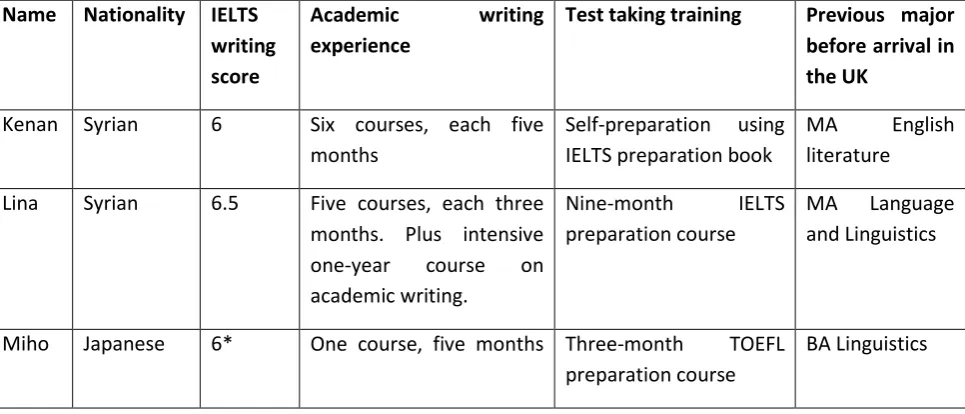
[image:7.595.64.547.560.767.2]The five participants in this study were L2 postgraduate students at a UK university from different L1 backgrounds studying linguistics. Participants were also selected on the basis of their second language writing proficiency (as evidenced by their test scores on the IELTS writing component of between 6 and 7, or equivalent, which they had taken as a university pre-entry requirement). These participants were selected from a larger study that examined ten participants writing process and products (Khuder and Harwood, 2015). We chose the five richest cases to focus on here in our study of task representation, giving us the space to look at each case in some depth. For basic information on participants, see Table 1 below. All participants' names are pseudonyms.
Table 1. Participant information
Name Nationality IELTS writing score
Academic writing experience
Test taking training Previous major before arrival in the UK
Kenan Syrian 6 Six courses, each five months
Self-preparation using IELTS preparation book
MA English literature Lina Syrian 6.5 Five courses, each three
months. Plus intensive one-year course on academic writing.
Nine-month IELTS preparation course
MA Language and Linguistics
Miho Japanese 6* One course, five months Three-month TOEFL preparation course
Reem Syrian 6.5 Five courses, each three months. Plus intensive one-year course on academic writing.
Nine-month IELTS preparation course
MA Language and Linguistics
Tala Iranian 6.5 Two courses, each three months
Two-month IELTS preparation course
BA Linguistics
* IELTS scores approximately converted from TOEFL iBT writing component for comparison. The original score for both Miho and Kenan on the TOEFL iBT writing was 20. The institute accepts both IELTS and TOEFL scores.
3.2 Writing tasks
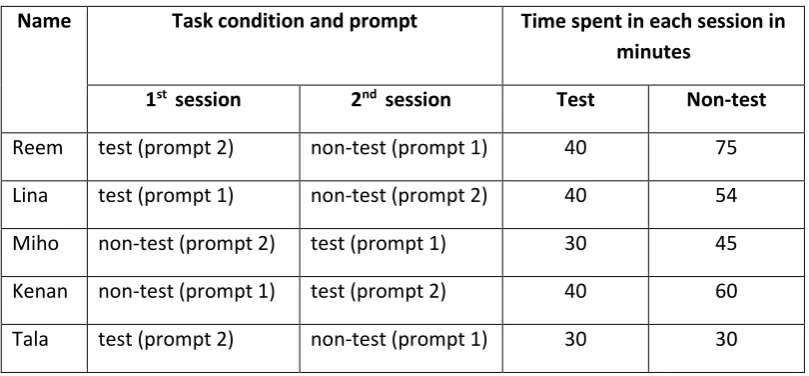
In choosing the writing tasks, we were mindful of the topic-familiarity effect. Topic familiarity is an affective factor in engaging with a task (Cumming, Kantor, and Powers, 2002) and can have a profound effect on how successful the writing is judged to be (Tedick, 1990). Thus, we chose non-academic tasks to lessen the chances that participants might be required to write about an academic topic they were highly familiar with. Since participants were studying in a foreign country having temporarily left their families to do so, the topics chosen were studying abroad and living alone (see Appendix A for prompts 1 and 2).
Table 2. Writing sessions
Name Task condition and prompt Time spent in each session in
minutes
1st session 2nd session Test Non-test
Reem test (prompt 2) non-test (prompt 1) 40 75 Lina test (prompt 1) non-test (prompt 2) 40 54 Miho non-test (prompt 2) test (prompt 1) 30 45 Kenan non-test (prompt 1) test (prompt 2) 40 60 Tala test (prompt 2) non-test (prompt 1) 30 30
3.3 Procedure
To learn about the writing strategies used in these two different situations and to probe the reasons representation, we used a principally qualitative approach, supplemented with quantitative data, where stimulated recall interviews were informed by screen capture video and observation notes, as described below.
3.3.1 Screen capture video and keystroke logging
In writing research, screen capture video has been shown to be a helpful tool to stimulate writers' retrospection. Abdel Latif (2008) cites several studies that used screen capture as a stimulus for retrospection, such as Flinn (1987), analyzing revision behaviour, and Sirc and Bridwell-Bowles (1988), investigating composing processes. Both of these studies found that using real time playback retrospection is productive. Our study looks beyond the writing process to stimulate writers to talk about the perceived reasons/factors affecting their writing behaviour. To this -capturing tool, Screen Movie Studio. The keystroke logging program Inputlog was used in this study to provide information on how much time writers spent on a certain process. Even though Inputlog has many features that enable researchers to conduct a thorou writing process, here we only report the time writers spent on writing.
3.3.2 Observation
3.3.3 Stimulated recall interviews
As our strategic behaviour and motivations while writing in two different situations, using stimulated recall interviews seemed appropriate (see Greene & Higgins, 1994). We used retrospective rather than concurrent accounts because they avoid the reactivity and the cognitive load issues associated with think aloud (Greene & Higgins, 1994, p.118). Additionally, we opted for a retrospective rather than a concurrent approach as our aim was not only to reveal the writ motivations for using these strategies as conceptualized in their task representation; and [a]lthough concurrent accounts can be useful in documenting what writers do, when they are the sole source of data they can be less helpful in explaining why (Greene and Higgins, 1994, pp.117-8). Therefore, the first author, who shared a similar profile to the participants (being, like them, an L2 L s at the time of data collection, and whose equal status may have encouraged the writers to provide full and frank accounts of their task representations), conducted the stimulated recall interviews immediately after each writing session, which were audiorecorded and subsequently transcribed. Writers were asked to watch the whole screen capture video and to stop it when they wished to discuss any issue. The first author was also able to stop the video where data seemed interesting. By choosing this procedure, we were attempting to ensure that all potentially significant episodes could be discussed, including those judged to be significant by the participants. By rooting our questions in concrete, specific composing behaviours, we were also striving to reduce the risk of faulty, incomplete, or simplified recall (see Prior, 2004; Smagorinsky, 1989; Tomlinson, 1984). Hence we made our questions text specific and task interpretation across test-like and non-test-like situations (see appendix B for sample interview questions).
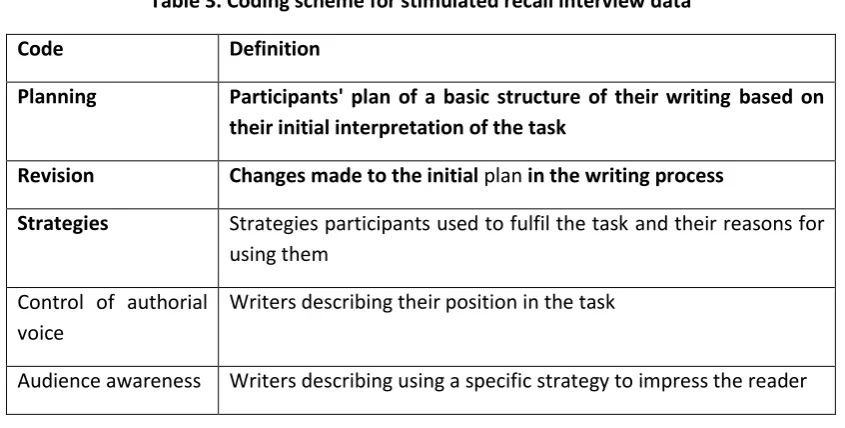
3.3.4 Coding the stimulated recall data
D
Table 3. Coding scheme for stimulated recall interview data
Code Definition
Planning Participants' plan of a basic structure of their writing based on their initial interpretation of the task
Revision Changes made to the initial plan in the writing process
Strategies Strategies participants used to fulfil the taskand their reasons for using them
Control of authorial voice
Writers describing their position in the task
Audience awareness Writers describing using a specific strategy to impress the reader
We divided interview data into units of analysis as per the coding scheme above and then asked a second rater, a PhD student in linguistics, to independently code 10% of the segmented data, resulting in a high level of inter-rater agreement (Cohen's Kappa= .93) (for a sample of the coded data, see Appendix C).
4. Results
This section reports the qualitative data derived from stimulated recall interviews, which is supported by screenshots from screen capture videos. We present our findings by organizing them around the coding scheme categories and proceeding case by case, to enable readers to compare and contrast participants in both situations, test-like and non-test-like.
4.1 Planning
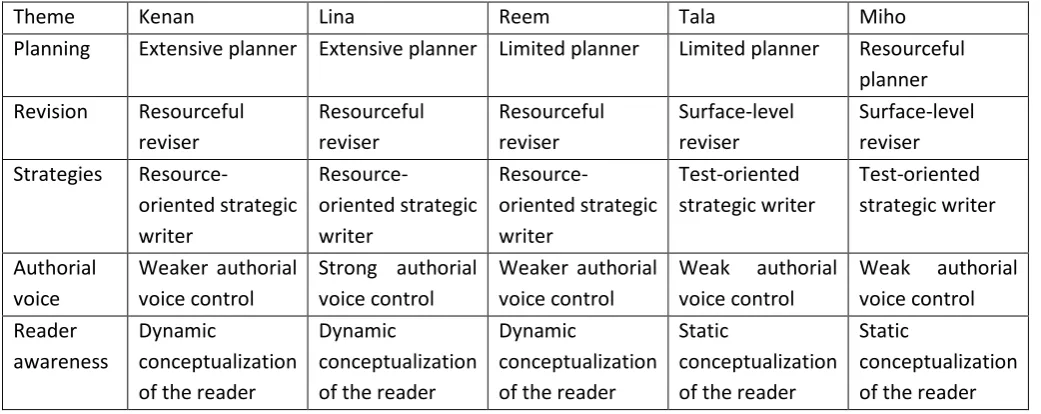
Planning is the stage writers go through before they conduct the actual writing. For some writers, the limited planners , planning was more of a straightforward process, where the differences between the test-like or non-test-like context did not have a major impact (as in, for instance, the opportunities to make use of the online resources or extra time available in the non-test-like condition). This was different for what we call the extensive planners , who planned in detail in both situations, and the resourceful planner , who planned according to what the situation permitted; i.e. extensively in the non-test-like situation and sketchily in the test-like situation. Both resourceful planners and extensive planners made use of the extra time and materials available in the non-test-like situation.
4.1.1 The extensive planners
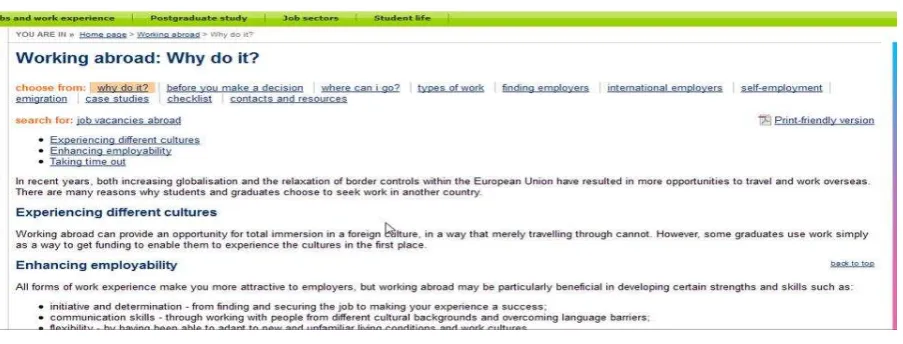
K ss situations. In the non-test-like situation, which he attempted first, because he knew he had plenty of time and online access to read about the topic, he started reading around rather than on the topic. Figure 1, which shows how he surfed the Internet in order to find interesting material, illustrates how he started reading texts related to working abroad while the main task asked him to write about studying abroad.
Figure 1. Kenan's Internet surfing behaviour
T K studying in a foreign country pretty
much immediately (9 seconds) after reading the task, he next googled why do students work abroad? in minute 8 and subsequently ended up googling working abroad: why do it? in minute 14 as the Inputlog log below shows (Figure 2).
Figure 2 K
[image:12.595.73.493.438.559.2]Figure 3. Kenan's text when responding to the 'studying abroad' task
His behaviour therefore resulted in a text that does not respond to the prompt assigned. He duly acknowledged this in the stimulated recall interview:
Kenan: When I started reading around the task, I found some interesting stuff on working abroad and, you know what, I totally forgot about the main task.
In the test- K
constrained. He ensured he addressed the task when he underlined the key parts of the prompt which, he said, helped him brainstorm some ideas , and when he outlined his ideas before starting to write as Figure 4 shows.
Lina
In the test-like situation, Lina planned her writing immediately after reading the prompt. She did not write down her plans. She stopped halfway through composing and paused for two minutes and from the observation notes we noted she was not looking at the text. When asked about this, she said:
Lina: Here I was thinking that I can say something different about studying abroad. [But] I did not think for a moment of changing my original plan. The key idea in timed texts is to get the job done. Style not sincerity is what matters here.
In the non-test-like situation, she took her time to read the task and plan it (spending 20% of her time planning in the non-test-like situation, as opposed to 10% of her time planning in the test-like situation). She jotted down some ideas and began to elaborate them. However, she changed her plan half way through. She commented on this as follows:
Lina: I have time, I can plan and re-plan. Here, I am not planning for the sake of having a better mark, because I know this idea is not better, I am re-planning because I feel better about this idea. If I did not change it, then I would go home and keep thinking about this. You know when you have an argument with someone and you go home thinking of better things you could T I bout writing, you can always change
speaking; once said, it is out there.
4.1.2 The limited planners
Tala
T s planning behaviour did not differ across situations. She read the prompt quickly (taking less than a minute) and started writing immediately. She reported the following in response to the test-like situation:
Tala: When I looked at the prompt, I immediately knew that I should be talking about advantages and disadvantages of studying abroad ... I started with the advantages and the second paragraph was about the disadvantages.
For Tala, as long as the assessment criteria used for the test-like and non-test-like tasks are the same, she would adopt the same pre-planned approach, regardless of the extra time and resources offered in the non-test-like condition; and Table 2 shows that she was the only writer who declined to take advantage of the extra time afforded by the non-test-like situation:
Tala: you said the rubric is the IELTS test one and so it is the same in both situations, so why to bother and write something different when I will be marked for what I have just written and done?
Tala: I read the prompt, paraphrase it as an introduction, write a quick sentence on how this is a difficult question that one cannot agree or disagree, then I give example of how good it is followed by an example of how bad it is ... I conclude by saying that the best thing is to put things in their context and to do what is more appropriate to the culture one is living in. This will guarantee high marks.
When asked how she knows that she will be awarded high marks for her writing, Tala explained that her teacher focused only on models of good and bad writing. Tala s teacher reportedly used these models to have students produce close copies of the good texts in their own work, until they were producing similar texts each time they wrote. The pedagogical approach is less about composing and more about ensuring students can reproduce text in a near-mechanical fashion:
Tala: my teacher gave us around six essays that we should imitate when writing ... this was our homework is to write a similar essay each time ... copy some of the sentences, such as:
I
I
writing about.
Tala: My teacher was so strict when teaching “ should . We used to be punished if not starting the way she wanted us to ... This is safe and I believe this is a good way as we only write in exams so what is the point of trying something new ... also, my teacher told us to copy what she gave us as good essays, even at school our homework used to be to complete incomplete sentences so I cannot feel like I want to try something new as this might lessen my marks.
It seems that Tala saw this writing process as highly successful and therefore saw no need to change it when constraints were loosened; it would work as well in the non-test-like as in the test-like condition.
Miho
In both situations, Miho took less than 25 seconds to start writing her text. She reported that her plan for any IELTS-type task will also be generated as quickly as this as, like Tala, she is equipped with a rigid pre-prepared structure:
Miho: look at the first sentence of the prompt [Nowadays more people are choosing to live with friends or alone rather than with their families], I should include ideas about both living alone and living with families ... I quickly say few words about each so that I can have time to recheck my grammar and the vocabulary I used.
She followed the recommended behaviour of her test-preparation home-country teacher in both situations, which does M s test training included being taught writing from teacher-produced models which broke producing the target genre down into a series of steps. M test instructions for producing an argumentative text:
as you can (passive voice) but be careful not to use grammatical structures you are not sure of (they make you lose marks); write long sentences and connect them with connectors (i.e. Wh-clauses).
4.1.3 The resourceful planner
Reem
In the test-like situation, Reem took several minutes to comprehend the writing task. She then started
writing a few general phra E
M “ plan into a text talking about her friend s negative experience of living abroad, before turning to her own, more positive experiences.
In the non-test-like situation, disturbingly, Reem chose the path of least resistance, simply googling the prompt (as can be seen in Figure 5) and copying some of the materials the search produced, passing it off as her own text. The availability of online materials therefore resulted in lessening the level of task engagement:
Int: you have read the prompt and immediately googled it, can you tell me more about this?
Reem: yeah, I need to know what is written on this to have a direct answer to your question ... it is easier to do it this way.
Int: but you used unreliable web pages, do you trust them?
Reem:I
Figure 5. Reem googling the prompt in the non-test-like situation
The following screenshot (Figure 6) shows part of the text Reem borrowed from in the non-test-like situation:
[image:17.595.102.404.547.748.2]T ‘ words are underlined:
Some people believe that living alone or with friends has a positive impact on society because living away from one's family will provide self-confidence and will enable them to live by themselves. In the future, these causes are considered vital. This is because of the fact that people will learn to cope with various, positive and negative, situations without their parents' assistance. Hence when their parents die, they can cope easily with this situation.
4.2 Revision
Revision behaviour relates to the changes writers made to their original plan. In this category we distinguish between two types of writers. The surface-level revisers mainly confined themselves to revisions of the grammatical structure and lexical choices at the end of both of their writing sessions. In contrast, the resourceful revisers made additional changes on the meaning level when time and resources permitted them to do so.
4.2.1 The surface-level revisers
Tala
In both situations, Tala focused her revisions on the grammatical level, which she made at the very end of the task; minute 30 in both situations. She used only 2% vs 3% of her time on task making revisions during the first half of her writing in the test-like and non-test-like situation respectively, as opposed to 15% and 13% of time on task making revisions in the test-like and non-test-like situation respectively during the second half of her writing. She showed an unwillingness in both situations to change her position or any of the supporting ideas:
Int.: Have you considered changing any of the examples you wrote?
Tala: Change! What change? Why to make any changes when in a writing test they will judge you for your accuracy!
A sense of how these revisions are restricted to minor changes can be seen from the example text excerpts below, where Tala changed
When living alone, students will be more independent. For example, they would be exposed to new things.
The majority of the students prefer to study abroad as it can bring more benefits.
It seems that Tala believed that she would be judged on the grammatical level, even though she was aware that the IELTS rubric states she would be judged on the meaning level, too:
Tala: I do not think it is important. I still believe that this is out there to make people think examiners use it. What, are they going to read it for every paper they grade? I think markers will focus more how each sentence is written.
Miho
Miho was preoccupied with test technique and accuracy when revising. She felt accuracy rather than ideas and content was what mattered in the end, characterizing her revision choices in terms of levels of risk:
Int: Have you tried using other strategies while writing?
Miho I I I I
not here, or in any other test situation to re-inve I know I revise a little, it is because I use the words and grammatical structures I am sure of.
Int.: But in the non-test situation, you had the chance to check any vocabs and structures you wanted.
Miho: But at the end I will be marked similarly and to be honest even in my MA assignments I do not tend to do that. I use the things I know to be safe.
She spoke of how writing for her was a task to be completed which she appears to have understood exclusively in terms of grammatical accuracy: reaching the 250-word requirement was her initial aim; only once this had been achieved would she check the writing quality.
Miho: The task asks to write more than 250 words. So my first aim is to reach that and then I will read to check grammatical things.
This can be seen clearly from our quantitative data: minute 32 and 30 in the non-like and the test-like situations was where she started rereading the text and making revisions for about 5-7 minutes. The following is taken from her texts where she changed
, exemplifying her limited revision behaviour:
As a student studying abroad, I find that studying abroad brings many advantages.
For example, when you live alone, you tend to forget about the traditions of your family which can affect the society.
4.2.2 The resourceful revisers
Kenan
point two. What had originally been the third point ended up sitting uneasily next to point one, and the text lacked cohesion and coherence. We look at his text in more detail below.
K ntages of living with
and then moving away from family members, read as follows:
A strong family forms the basis of an integrated community with all its members sharing the advantages that a united family can offer. Despite these disadvantages, living away from one's family can have its own rewards.
When talking about this extract, Kenan said that he had intended to write about the disadvantages of the breakup of families after explaining what the advantages were of having a strong family , but time pressures meant this second point was never developed and he moved immediately instead to talk of disadvantages which in its present form is incongruous. He explained his behaviour by saying: Kenan: I am not used to writing small pieces in such time limits, I tried to express the ideas in the given time but when I I I t be able to write all that I have, so I
I I
IELTS and TOEFL but then I trained myself using some TOEFL writing materials and after repeating the test three times, I did it!
Reem
Interestingly, in the test-like situation, Reem was keener on revising the paper to hand in what she called a mistakeless text (spending 20% of her time on task on revision in the test-like situation, in contrast to just 9% in the non-test-like situation):
Reem: Time constraints always make me want to give my best. I always worry when approaching the deadline and start revising really quick. In the non-test situation, and because I did not have time limits, I felt a bit loose because there is no deadline!
As expected given the above comments, Reem did not do much revision in the non-test-like situation because she did not feel the pressure to do so (7% of time on task was devoted to meaningful and surface revisions under the non-test-like condition; and 26% of time on task in the test-like situation).
Lina
Lina explained her greater willingness to revise substantively in the non-test-like situation as opposed to in the test-like situation (26% of time on task in the non-test-like situation compared to 13% in the test-like situation):
study our language there but I knew I would not be able to change this as it will take me a lot of time. ... if I had the time to change it I would say culture and new places.
Lina's reference here was to her test-like-situation paragraph which starts:
The greatest advantage of studying in foreign countries is that it provides individual students with the opportunity to contact people from other countries.
As she indicated in her interview, this message remained unrevised and unchanged; in fact her position in this text is one she did not agree with. Her text continues:
This opportunity is rarely or never available at my home country.
For Lina, writing is a discovery of meaning whether in test-like or in non-test-like situations. She indicated that she always discovered her ideas in writing, even though she might not act upon that discovery of meaning in test-like situations (as in the excerpt above). The lack of time constraints in the non-test-like situation enabled her to change her writing when she thought of a new idea that contradicted her original one. She started her non-test-like writing by completely disagreeing with the idea of people living with their friends. However, by the end of her introduction, Lina had come around to the view that in fact living with friends could be justified.
Lina: at first I was totally against the idea of people living with their friends, this is not acceptable in my society. However, writing made me realize that for some people it is OK as it is socially accepted so I had to go back to the beginning and change the whole argument. Lina's first draft of her introduction read as follows:
It has been noted recently that the social life around the world is deteriorating. One aspect of this deterioration is that young people prefer to get away from their families and lead dependent life.
She duly revised the introduction to read as follows:
4.3 Strategies
While Tala and Miho used strategies they had learned during their previous test-training experience rather than exploiting the resources available to them, the other writers took advantage of these additional affordances, for example in their planning or revising behaviour.
4.3.1 Test-oriented strategic writers
Tala
T s f TOEFL s views seem to have affected her writing strategies in both situations. These views focused on adopting a non-controversial position so as to avoid potentially antagonizing the reader/examiner:
Tala: My teacher used to say that when you have to write about a topic, try to write about the first t s mind. Try to be as general as you can so that the examiner will not be judging you while they are supposed to be judging your writing.
In the non-test-like situation, Tala adopted the same strategy of opting for the general and eschewing personal opinions or experiences:
Tala: When I read that [the prompt which asked about advantages and disadvantages of studying abroad] I thought that in general people tend to like the idea of that studying abroad has more advantages than disadvantages because they say that it helps introducing students to a new culture and these stuff .
Int: but do you think that this general belief is true?
Tala: mmm ... let me think for a while ... well, not really, if I wanted to talk about my own experience then I have to say that studying back home was better because I was taught stuff which are more related to my own context and the context that I will be teaching in [as an English language teacher] ... how would knowing a new culture be helpful for my work?! If I wanted that I would have been only a tourist here and not a student.
Miho
As part of her test-oriented strategy, Miho started composing from a pre-prepared skeleton text which she fills in with the relevant information according to the prompt. In the extract below, she expanded the following pre-prepared text to form her introduction:
When considering ..., some people say ...., while others .... One can argue that there is some truth in both points. Therefore, I personally tend to have a neutral position to this important issue that can be related to the context that it is seen in. The reasons for this will be discussed below.
the non-test-like situation vs 2% in the test-like situation) and, unlike in the test-like situation, actually
took M -test-like introduction below
that her introduction followed a similar structure to the one she was taught and the one used in the test-like situation:
As to the experience of studying abroad in a part or whole of their course, some people say it will bring advantages to the students while other people says there will be much more disadvantages. Although both views have reasonable points, I personally agree with the former idea, studying abroad brings advantages rather than disadvantages. In the following, I will argue my point.
I M -test-like situation was similar to the manner in which she composed under test-like conditions; she spent little time planning (4% of the total task time in the test-like situation vs 2% for her test-like situation) or revising (9% of total task time in the non-test-like situation vs 8% for the non-test-like situation). This reflects how she did not perceive any benefit of having extra time or online resources in the non-test-like situation. She finished the non-test-like task in less than 32 minutes, and responded as follows when questioned about this:
Int: You finish at 32 minutes and you know you are allowed all the time you need.
Miho: But this is all the time I need. There is no point of spending more time on this task as I know that what I just wrote is what the examiner needs ... I responded to the task by following what the prompt is asking me to answer step by step ... I talked about all the points included there and following the steps my teacher told me to do ... I revised for grammar and that is it ... I do not think I need to write or do anything else.
Her instrumental, test-oriented approach had been successful in the past. She thought that adopting the same approach would guarantee her a good mark in the non-test-like situation also, so saw no reason to change it.
4.3.2 Resource-oriented strategic writers
Kenan
Kenan, whose writing was off-task in the non-test-like situation (which is the session that he did first), wanted to avoid making the same mistake in the test-like situation. ii The strategy he used to keep his writing relevant to the topic was underlining what he believed to be the main points in the prompt (see Figure 6 above).
Kenan: I thought this might help me focus on the exact words that the prompt is asking me to answer ... I will avoid using these words but maybe I will try to write the outline according to them, so instead of using the exact words, I will be explaining them.
We also see a mention in the excerpt above of another strategy that Kenan reported as beneficial, which was to write an initial outline at the start of the test-like situation session:
Reem
In the test-like situation, Reem saw the retrieval of experiential information as an efficient way to get the task done:
Reem: These are examples from my own life and experiences. I am talking here about the positive experience I went through while studying abroad. The success I am having and benefits in having this huge library and the access to the academic world. I am in the centre of academia and it is so easy to talk about this ... the prompt is asking me to draw on them and so I did ... this is the easiest way for me to get the task done on time and with the lack of extra materials [i.e., online resources].
This was in reference to the following excerpt of her text:
My own experience as a foreign student in an English university is a witness for the advantages of studying abroad. The five-storey library building and the massive internet resources are facilities that cannot be provided in Middle Eastern universities. Moreover, access to world-class academics who have reputation world wide is not feasible in any country.
Her only strategy in the test-like situation was to think of her own experiences. However, in the non-test-like situation, as we have seen earlier, she googled the task prompt, accessed an online model IELTS answer, and drew upon it in an inappropriate manner to construct her answer. She explained that this was what she usually did for her MA assignments:
Reem: I usually copy the task assigned to me and see what google has to say on it. This will stop me from misinterpreting the task. I sometimes do not understand what the instructors need from the task, so I just google it. It is better than asking them in person and much easier. I sometimes google each part of the assignment aside to make sure I do not miss on anything.
Lina
In both situations, the strategy Lina used to keep her writing on track was to intentionally reproduce the exact words of the prompt in her answer:
Lina: I usually use the same words as the prompt to show the reader that I have read it carefully and to stay on the safe side as I am worried to go off point.
Her introduction in the non-test-like situation read as follows (where we underline words from the prompt)
People might prefer to live with their friends or even alone on staying with their families. This modern trend can affect the society negatively. I will argue in this essay how this saying can be true for some cases.
Lina: sometimes I like to write the main idea at the end of the paragraph and to conclude differently ... I did not do this here because the topic does not need this ... it is a simple one and one needs to focus on the time too ... so you know, what matters now is to finish the task on time ... I do not have enough time to try different ways of saying things so I just try to keep it simple in exams.
4.4 Control of authorial voice
We distinguish here between three levels of authorial voice control (strong, weaker, and weak). Lina is associated with the first level as she displayed a strong voice control in both situations, test-like and non-test-like. Other writers were not as confident as Lina; their voices were not as strong and their
L
4.4.1 Strong authorial voice control
Lina
Lina showed a control of authorial voice in both situations, describing her non-test-like and test-like composing respectively in the two excerpts below, with each one followed by the part of the text she was referring to in the excerpt:
Lina: I thought immediately about myself and about stuff that happened to me when writing this [i.e. to address the living alone/ with friends vs. living with family task] and thought what are the advantages and disadvantages. The task is asking me to draw on personal experiences and so I did.
Another advantage living alone can provide, from my personal experience, is gaining self-confidence. Knowing that no one will be there to do it for you, you will have to do things by
I
Lina: In this example, I was talking about my own experience in studying abroad and how this affected me in a negative way. I do feel comfortable when writing about my own experiences while writing because it is something that one cannot make mistakes when telling and it is easy to write the task within the time limits.
Although my experience was generally positive, it did not pass without any negative trace. At times I felt isolated because of the fact that there are not so many people form my community here. I also felt academically inferior since student from other cultures are very knowledgeable.
Lina perceived writing as a discovery of ideas that she had not thought of before beginning to compose:
Lina felt able to inject a personal tenor into the text as she was confident her writing abilities were strong, meaning that she did not need to direct all her attention to ensuring she was writing accurately:
Lina: I am looking for something beyond grades ... my teachers, which were specialists on writing, told me that my writing is excellent; the vocabulary range I have ... the complex sentences I write ... how I am able to clarify all my ideas and how well my ideas are connected makes me think beyond just getting a high mark.
4.4.2 Weaker authorial voice control
Kenan
K s lack of confidence in his own writing and ideas was reflected in his use of online resources in the non-test-like situation. While planning his writing on studying abroad, he wanted to include an
example of how linguistics
specialists in the field but then he changed his mind. He explained that by saying:
Kenan: I am not sure I am using the right example here, checking what others have to say about this is always a good idea, that is why I deleted my sentence Working abroad has a lot to offer to workers and thought I should look for what other people say... The task is in English so I will check Western opinion. I am not sure that what I am about to write makes sense to a native speaker of English and whether my ideas will convince them ... I believe the underlying question here is that, You, as a foreign language speaker, do you agree or disagree? ... so I thought I can have a look at the way Westerners think and maybe try to say something similar. Therefore, Kenan googled working abroad advantages and disadvantages . He took some time to choose the page he would read. He explained his reasoning as follows, claiming he wished to find a source written by a foreign author (as can be seen in the fact he highlighted what he believed to be the foreign name of the author in Figure 7 below) which could help him ensure his argumentation was appropriate:
Int: I can see that you did not go for the first choice google gave you, interesting! But why did you go for this one?
Kenan: actually I wanted to choose something written by an author whose name sounds more or less foreign.
Figure 7 Kenan's web surfing for a Westerner's opinion on the assigned topic
In the test-like situation, Kenan also showed a lack of confidence in his own opinions by trying to include ideas which are not from his culture:
Kenan: In writing the outline, I was thinking of examples which are taken from the Western s boyfriend or girlfriend so I attention and saying that this has some advantage I
my society but still I would still add it to attract attention. An excerpt from his text on this subject reads as follows:
Par example, young people might choose to cohabit with their girlfriends/boyfriends, and even though this might not be acceptable in some third-world countries, it has many advantages.
Kenan believed that s own voice but one should include experiences background sometimes to gain a sympathetic hearing from the reader:
do you agree or disagree? and in the Rhetorics, Aristotle suggested that we should be careful about who is asking the question and why they are asking it.
Reem
Reem personalized the task and drew on her experiences in the test-like situation. However, she retrieved information she had to hand without problematizing the issue raised:
Reem: I liked this question [talking about studying abroad] as I can easily say something about my own experience. I immediately thought of the things that made me happy and satisfied here and others which upset me and wrote them as the advantages and disadvantages. Reem drew more on her personal experience in the test-like situation as she explained how this made it easier for her to generate a text within the allocated time:
Reem: I immediately think of something that happened to me ... I guess this is the easiest way for me to finish on time ... just recall an incident and write it as an example.
In contrast, this authorial voice was less apparent in the non-test-like situation as we have seen earlier words. However, the presence of her authorial voice in the test-like situation can be seen to indicate that her concern and priority in both tasks is to complete them as quickly as possible, regardless of the time provided, because she thought that drawing on her experiences was the easiest way to do the task.
4.4.3 Weak authorial voice control
Tala
In the test-like situation, Tala wrote about living with friends, something she was experiencing at the time of the study, but when asked how she tackled the topic she generalized, rather than relating her own experiences:
Tala: I tried to think what people usually do when they live with friends. Int: But you are living with your friends!
Tala: Right, but still I cannot give examples from my own life, it is easier to draw on general examples than t s self and experiences, no one can disagree with a general, well-known example but my personal experiences might not interest or convince others.
The T s non-test-like text where she gave a general example, and the absence of specific personal experiences is very apparent:
Indeed, rather than include personal experiences of her own, Tala talked not just in very general terms, but at times in fictionalized terms. She wrote:
For instance, I was interested in posting my studies in English Literature in the UK. Living in the country which produced the literature helped me in absorbing this literature and visiting all the places that great poets had been to.
and explained why she believed this fictionalized example was more suitable than narrating her actual experiences:
Tala: here I say that I do a course in English literature although I am doing one in Linguistics because it is easier to explain how it is better to study English Literature in England rather than other countries but it cannot be the same when talking about Linguistics. One needs more specialized terms about teaching ... it sounds more complicated for me.
Miho
In the test-like situation, Miho was preoccupied with the text formal requirements, rather than with expressing her own ideas and experiences as the below interview and text excerpts illustrate:
Miho: When it comes to this example, I wanted to say something here [next to homeworks in the part of the text below] about how when someone is in trouble all the family members can go and stand by their side as this happened with one of my relatives but was not sure how the sentence structure will look like so I ignored this idea.
T M xt read as follows, with the personalized example Miho spoke of nowhere to be seen:
When family members are living together, it is more likely that their relationships are close and people around them also know one another. For instance, if there is any need for support for childcare and homeworks, someone in family or community member could give a hand.
Miho did not value writing as an expression of the personal, as a creative act. For her, writing is something that is an obligation one must fulfil to perform the role of the student; writing is mainly connected with examinations and is about giving the reader what they want in order to get good grades:
Miho: I only write in tests as I think most students in my home country do. I was educated
here [in the UK
I P
Miho: This what I was taught. I never thought of writing as something which is personal or conveys any specific idea ... I cannot recall any time where my teachers talked to me about writing ... and my reader is always the examiner, even at school when we used to write as a homework the teacher used to return it only with a grade on it ... my teacher used to say this is the only good writing and that we should start by saying this and this so I do not have the courage to start differently because then I will be risking my marks.
Rather than investing her energy into ensuring the writing captures her authentic voice, then, if additional effort is needed to ensure high grades, this is invested into performing, by, for instance,
anticipating the marker M
good marks, and not to antagonise the examiner. She apparently saw her own views on the topics as irrelevant and immaterial, given her overriding focus on the grade not the message.
4.5 Audience Awareness
All five writers showed reader awareness. However, for three of them, the reader was both an academic reader and an examiner. This group of writers held a dynamic conceptualization of the reader , while for the remaining two holding a static conceptualization of the reader , the reader was only an examiner.
4.5.1 A dynamic conceptualization of the reader
Kenan
Figure 8. Kenan consulting the dictionary for sophisticated synonyms
Here is an explanation for his behaviour:
Int: I can notice that you kept replacing your words with ones that have the same meaning, can you tell me more about this?
Kenan: Unusual words are appreciated and show higher standards ... lecturers in my university used to use these long and unusual words, they were very impressive when they used them ... no matter how much the idea is silly, it sounds convincing and important when using long words ... one should not give his ideas in a clear manner ... Edward Said said the reader has got to earn it .
In the following, we show a sample taken from the conclusion of his untimed text which featured this sophisticated vocabulary that Kenan is determined to include in his writing:
Conjointly, I would highly admonish that students be gainfully employed while studying abroad in as much as they work part time and their work positively enhances their knowledge of the field they are enrolled in.
The original conclusion was as follows:
In sum, I recommend that students work abroad during their studying as long as they work part time and positively helps their field of study.
attempted recall, rather than via online resources (which of course he was unable to access under this test-like condition). Writing on the topic of living with friends/alone vs. living with family , Figure 9 below shows how he brainstormed some vocabulary which he believed to be impressive and planned to include in his text.
Figure 9. Kenan's vocabulary brainstorming behaviour
Commenting on this episode at interview, Kenan explained:
Kenan: I am trying here to recall some of the vocabulary that can be related to the topic so that I can include them whenever seems appropriate ....
A look at an excerpt of his text gives us an idea of how he did indeed end up using some of these words (written in bold below for ease of reference):
An integrated community is one which has the gratifying sense of family life, one with everyone living and cooperating for the welfare of all its members.
Reem
‘ s goal in the non-test-like situation was to project the impression that she is a writer rather than a testee :
Reem: I am looking beyond getting a high mark. I already have this very good text [that she copied from an online resource, discussed above] and all what I have to do is to try to make it sound more elevated. I know I copied it but you will see that reproduced it in my own language and this what writers do. Ideas are there and they just put them in their own language. I copied some words from the internet page but still the writer did not invent them, he must have t I am saying, it is how you present the
In the test-like situation, Reem was confident that the reader would like her writing because of prior evaluations of her work:
write an excellent piece only ... but some pieces take me more time than others when the subject matter differs as then where I have to tell the reader something important and something that they need to know but for today s topic, I thought it is better just to copy someone as I do not think that the reader really wants to know what I think ... they just want to see a good writing style and that is it, that is what these tests are really about.
Lina
Lina showed reader awareness in the non-test-like situation when she was worried she might create a poor impression on the reader by writing the following:
However, it is worth out that people who choose to live alone should be ready to face the social and religious traditions as it is not acceptable to live alone or even with friends in some societies where the surrounding might start judging them and talk negatively about them.
She thought the reader might think I came from a closed-minded background where we do not respect other people choices . Lina duly revised this idea to make her society looks as it has many independent individuals so her text read:
However, it is worth pointing out that people who choose to live alone should be financially dependent. That is, they should be able to feed themselves and have their own work because it is not acceptable to live alone and to be reliant on their parents.
In the test-like situation, on the other hand, the reader for Lina was the examiner:
Lina: This is a test and the examiner would care about the style I use rather than the ideas. They want a good range of vocabulary and grammatical structure and this is what they will get. Honestly, if I was told that the person who is going to mark this know me then I would have written different ideas; ideas that would reflect something different about me.
The above explains why Lina decided against changing an example that she thought may project a bad image of her culture in the test-like situation. The follo L
On the other hand, it is worth mentioning here that not all people do have the ability to accept the new environment and culture to which they are thrown. This is something my friend went through at the Uni
Lina assumed that in the non-test like situation the reader would be her teacher but in the test-like situation the examiner will be unknown: like what happens in TOEFL and IELTS exams where the reader is actually a native speaker of English that we know nothing about . Commenting on the non-test-like situation, she said:
Lina: I want the reader to think that my culture is open- I less of me.
4.5.2 A Static conceptualization of the reader
Tala
The reader for Tala was the examiner in both situations. She tried to write what she imagined the examiner could not object to:
Tala: As my teacher used to tell us, in any argumentative writing you should focus on showing the examiner that you neither agree nor disagree because he can say something against you immediately. So, the safest way would be discussing both points equally.
She did not try to convince the reader by giving appropriate examples, but rather followed the template her exam preparation had suggested: to present two points, one for and one against the statement in the question, and then take a neutral position. Below is an interview extract that gives a flavour of her instrumentally-oriented behaviour:
Tala: Regardless of the situation, a test is a tes
‘ A I I I
had high marks, it is proved to be effective, so why to change it?
Miho
Similar to Tala, the reader for Miho is the examiner, and the key was to write something she anticipated the examiner would approve of:
Miho: The task can be interesting but it does not really matter. The prompt asked to write about whatever and to give examples.
Int: I remember that the prompt asked whether you agree or disagree, right?
Miho: Oh, yeah about this, I do not think about it this way. I have to make the marker feel that
I T
tell the truth, it was somehow difficult to find points against this issue [studying abroad] as you rarely find people talking about not studying abroad but I managed that.
In the non-test-like situation, she did not try to convince the reader by giving appropriate examples, but rather followed the template her exam preparation had suggested, presenting two points, one for and one against the statement in the question, and then taking a neutral position. She explained this in the following excerpt:
Miho:
I know how since my teacher told me the most proper way to do it.