Joint Annual Report 2003 Ethiopia
The National Authorizing Officer and the Delegation of the European Commission to Ethiopia
PREFACE
This joint annual report covers the period up to the end of2003. It was however issued end 2004. In a number of cases the description in this report deviates strongly from the latest developments. The most notable difference is with regard to the Border Conflict with Eritrea.
Joint Annual Report 2003 Ethiopia
Commitments Actual commitments Forecast
Macro-economic support [nstrument 2002/1 2002/2 2003/1 2003/2 2004/1 2004/2 2005/1 2005/2 2006/1 2006/2
9'" EDF
I. Budget support CSP-B (80) 95 (80) 90
2. Private sector support CSP-CB/IF (5)
3. Trade & regional integration CSP-CB (5) 5
4. Public finance management CSP-CB (3) 3.5 0.5 (2) 0.5 0.5
61
\ 71]1 and 81h EDF *
5. MSEDP (E 7 mio for 200 I)
6. IFMS (6) 9
Payments Actual payments Forecast
]nstrument 2002/1 2002/2 2003/1 2003/2 2004/1 2004/2 2005/1 2005/2 2006/1 2006/2 9'" EDF
Budget support CSP-B (30) 30 (30) 15 15 (20) 15 15 (20)
Private sector support CSP-CB/IF (I) (I) (I) (2)
Trade & regional integration CSP-CB (2) (I) (I) 0.5(1) I 2 I 0.5
Public finance management CSP-CB 0.2 0.5(1) 2.5 (I) 0.5 (I) 0.5 (0.5) 0.5(1) 0.5 (0.5)
61
\ 71h and S'h EDJ.' *
MSEDP (E 7mio for 2001) 0.1 0.2 1.1 I.2 I.2 I.2 I
IFMS 0.2 2.4 4 2 0.4
PRBS-1 10.5
..
Joint Annual Report 2003 Ethiopia
Section
1.
Executive summary
Ethiopia ranks 171st (out of 174 countries) on the Human Development Index and the reported per capita income of US$ 100 in 2000/0 I is the second lowest in the world and one-fifth of the sub-Saharan countries' average.
The year 2003 was the year during which the largest number of food insecure people ever was recorded. This partially distracted the government's and donors' attention and focus on long-term development goals.
Due to the significant cereal production decrease in 2002/03, real GOP shrank by 3.8 percent during the year. The problem was further exacerbated by the lack of properly functioning rural markets. Another shock of external origin is the sharp decline in the international coffee prices, a commodity that accounts around 35% of the merchandise exports of the country. As a result of the drought, and the subsequent downturn of the economy, revenues fell by ETB 1.3 billion, compared to the budget forecast. This mainly affected poverty-related (capital) expenditures, which were about ETB 1 billion lower than projected.
The new Coalition for Food Security, a collective effort of the government and donors, is expected to make a significant dent on food insecurity in the coming 3 to 5 years. During the High Level Retreat of October 2003, the EC reconfirmed its support to the government in its efforts to make the shift from Food Aid to Food Security. In the same HLR it was agreed for the transport sector to speed up implementation and to start the preparations for a sector wide approach that could ultimately lead to a sectoral budget support programme. The Commission will continue to provide Macro-Economic support, by means of Direct Budget Support, through multi-annual programmes in order to guarantee predictability.
While there are some encouraging results in the education sector in light of achieving the MDG targets, Ethiopia will not be able to reach most of the SDPRP targets (or the MDG's) under current performance trends. To meet the MDGs a real average GOP growth of about 7% up to 2015 is required, as well as a dramatic increase of public pro-poor spending.
One of Ethiopia's threats is its external debt, the total of which outstanding is over US$ 6 billion. Ethiopia will most likely reach HIPC Completion point early 2004. These will entitle Ethiopia to significant debt reduction. However, provisional analysis shows that HI PC, without significant topping-up, will not be enough to reduce the debt burden to sustainable levels.
Joint Annual Report 2003 Ethiopia
Finance Management support programmes, which started late or not at all. The targets as agreed upon in the CSP were partially achieved, especially the PFM targets showed underperformance.
The programming of the FS/RD focal sector was delayed by the unfavourable climatic conditions in 2003. A breakthrough was reached during the High Level Retreat. The indicators are difficult to monitor in the absence of a good monitoring system. During 2003 a record quantity of food aid was delivered under the Food Security Budget Line.
Implementation of the programme under the focal sector Transport was delayed in many instances. Design problems were at the heart of this. These design failures also resulted in serious cost overruns. Most of the indicators were met, indicating the quality of the transport programme. The government is committed to commit all the 9th EDF resources allocated for the transport sector before the end of 2004.
For the non-focal sector good progress was made in 2003 with the preparation of the project pipeline. Three important projects (Civil Society Fund, Police Cooperation and Leadership Development) have reached the stage of going to the EDF Committee. The preparations for the support to the legal sector reform programme are yet to start.
The government and the Commission are confident that the focal sectors, as identified in the Country Strategy Paper, offer a good basis for a response strategy and need not to be adjusted. For the remainder of the 9th EDF, attempts will be made to have more linkages between the focal sectors and to gradually move to budget support (e.g. Food Security Budget Support Programme and a rural roads sector budget support programme).
Section 2. The policy agenda of Ethiopia
Internally, the Government of Ethiopia' efforts, if not concentrated on the food crisis, were directed towards consolidating and implementing its reform policies. This included the preparation and discussion of white papers on the following areas i.e. Rural Development Strategy, Capacity Building Strategy and Industrial Development Strategy. Major development measures in the areas of SDPRP, Decentralization, Food Security and Private Sector Development have been taken by the GOE during the year 2003. The SDPRP Policy Matrix was further refined, and, after intensive discussions with the donor community, submitted in December. The first Annual Progress Report (APR) was presented in December 2003.
With respect to the Decentralization Process in Ethiopia, the devolution of power. accountability and responsibility to district level (woreda), introduced in 2001, was further deepened and strengthened. During 2003 studies identified gaps in for instance the legal framework. the enactment of laws and regulations. consultancy support and working manuals. These, and other, gaps are being addressed in a comprehensive five- year (US$ 400 Million) program: the World Bank led Public Sector Capacity Building Programme (PSCAP).
Joint Annual Report 2003 Ethiopia
To address the severe food insecurity problem in Ethiopia, the GOE initiated, together with partner organisations, a process leading to formation of the New Coalition for Food Security, an initiative expected to make a significant dent on food insecurity in the coming 3 to 5 years. Externally, the government could further strengthen relations with external partners but in particular with the US that considers Ethiopia as a key ally in the Horn of Africa in the fight against terrorism. However, relations with Eritrea further deteriorated and became politically tense due to Ethiopia's appeal of the border decision. The government succeeded in securing Addis Ababa as the permanent seat of the African Union within which it is determined to play a constructive role, in particular with regard to AU's increasing role in peace and stability. Reform agenda
The year 2003 was the first year of implementation of the SDPRP. The results of the first year were laid down in the Annual Progress Report that was presented to the international donor community on 1 December 2003. The main observations made at that occasion were that the government has made significant progress with implementing this ambitious reform programme, and that the policy measures of the past year broadly represent an appropriate and credible series of pro-poor structural reforms, although in some areas more could have been achieved. Furthermore, the SDPRP has become established as the framework for policy formulation, and has accelerated the shift towards a more strategic focus on poverty-reducing policies, and is increasingly forming the basis for harmonized donor support.
Areas where further improvements can be made include the following: (i) a more detailed articulation of measures to accelerate private sector and financial sector development; (ii) clearer linkages between the policies and strategies for rural development, food security, population policy, and land reforms; (iii) further rationalization of the gap between SDPRP program costs and available financing, the inclusion of the costs of new initiatives (such as food security); and (iv) a more detailed vision for further implementation of decentralization. Finally, it will be important to continue to strengthen the monitoring and evaluation system, to deepen the systems for participation of civil society and lower tiers of government in the implementation of the SDPRP, and to develop a better understanding of the link between sectoral policies and poverty.
The High Level Retreat (October) with Prime Minister Meles and a fair representation of his
Joint Annual Report 2003 Ethiopia
Food Aid to Food Security. Food insecure population will benefit from asset protection schemes, and therefore will be taken of the food appeals. To support this shift, the Commission has indicated to prepare a Food Security Budget Support Programme of about € 120 million for a period of3 years.
For the transport sector all parties agreed to speed up implementation and to start the preparations for a sector wide approach that would ultimately lead to a sectoral budget support programme. The need to strengthen the national construction, maintenance and institutional capacity was also recognized.
The Commission will continue to provide Macro-Economic support, by means of Direct Budget Support, through multi-annual programmes in order to guarantee predictability. Agreement was also reached on the need to explore ways and means to utilizing the resources earmarked under the B-envelope.
The shift from emergency Food Aid to long term Food Security will allow for enhanced agricultural production, better market linkages and higher incomes, hereby bringing closer the prospects for economic growth. The EC's strategy should be geared to supporting the government to achieving higher growth rates. This will only be possible if interventions in the focal sectors are in synergy. The main inter-linkages are the following:
Macro-economic support will contribute to macro-economic stability, thereby avoiding the negative effects of high inflation, and securing pro-poor spending levels. Macro-economic support will however not contribute to economic growth in the absence of a clear growth agenda. The food security programme is essential in unleashing the productive forces in the rural areas, by increasing purchasing power in rural areas through direct transfers and reducing transactions costs for commercialization of agriculture. A crucial element in the transaction costs is the lack of communication infrastructure. This focal sector will therefore be strengthened and supported by infrastructure investments. Improved roads will provide access to rural areas with secured water supply, and rural roads will allow for better market access. Private sector development is essential for economic growth. Private sector involvement will be encouraged in the agricultural sector (input and output markets) and for infrastructure (infrastructure to allow a more cost efficient transport of goods, thereby promoting (local) trade).
Section 3 Update on the political, economic and social situation
3,1 Results achieved
The CSP supports the government with its programme to alleviate poverty. The progress of the government's policy, and the EC contribution, can be measured by monitoring progress in meeting the MDG's.
Joint Annual Report 2003 Ethiopia
differ from the indicators as included in the JAR 2002, that was prepared before the SDPRP policy matrix was finalized. In the table below the key indicators are presented, with their targets.
T bl I K a e ey In tcators or momtonng progress on meetmg t h MDG e s
Indicator 2000/01 2001/02 2002/03 Target Target MDG
2003/4 2004/5 of2015
I. Percentage of people below the 41.9 - - - 38.0 21.0
poverty line
2. JnfE_nt mortality rate 9711000 - - - 85/1000 47/1000
3. %of stunted children under 5 57 - - - 52 30
4. Primary (1-8) Gross Enrolment 57.4 61.6 64.4 66%) 70% 100%
Ratio
5. Grade 4 Completion Rate1 25 31 34 37 40 100%
6. Gender parity index for grade 1 to 0.7 0.7 0.7 0.9 1.0
8
7. Proportion of deliveries attended 8.7% 9.9% 9.7% 20% 25% 75%
by skilled health personnel
8. Proportion of children receiving 38% 45% 46% 55% 60% 100%
DPT3 vaccination (under 1)
9. HIV prevalence among 15-24 year 7.8% 12% 11% 10%
old pregnant women
10. % of population with access to 30.9 33.7 36.6 39.9 50.0
potable water
A comprehensive household survey is carried out every five years, providing information on the people living below the poverty line. The last one was in 1999; the next one will be in 2004. This means that there are no data on the years in between these surveys. If GNI per capita is used as a proxy, it has to be concluded that the developments were negative (GNI/capita in1985 was 120, in 2002 GNI/capita was 100).
Considerable progress has been made over the past few years towards improving access to basic education and the goal of achieving universal primary education (UPE). This can be deducted from the impressive increase in enrolment ratio for primary education - a similar increase can be noted for post primary education and from the increased coverage of immunization programmes. If the current trends continue, it is not unrealistic to expect that UPE may be achieved by 2015, although important efforts will be needed to reach the disadvantaged, including pastoral communities and girls in general. This rapid expansion has however implied that the quality of education has not improved or has deteriorated. The gender gap has only very marginally narrowed in the past years and the government in this regard has recognized the need for additional efforts.
The results in the health sector are mixed. While the infant mortality rates have declined between 1990 and 1999, maternal mortality rates increased and data on birth attendance by
Joint Annual Report 2003 Ethiopia
Real HIV I AIDS prevalence has grown since the 90s and now stands at about 6. 7%. A national strategic framework to tackle the pandemic has been adopted by the GOE with the intention to reduce new infections by 25% by 2005. It may be possible to halt the prevalence rate at about 7% but the burden of HIV/AIDS on society and the economy will continue to grow for the next years, given the growing absolute number of infected people.
Total education expenditure as percentage of the GDP and to total expenditure is 5.6% and 17.2% respectively, while that of health spending during the year as a percentage of GDP and total expenditure is 1.5% and 4.6 %respectively. The expenditure to the education sector has exhibited an increase over the past year, while the spending of the health sector has declined slightly compared to the previous year. The defense expenditure was reduced to 4.2 % of GDP from that of 5% of GDP in the 2001/02.
Progress has been made with offering people better access to clean water. With particular attention to the clean water supply, the short-term target is to increase the national population coverage from 31% to 45%, a 70% real growth in population terms. By 2015 the target is increase the coverage to 75% or to 73 million people from the present figure of20 million. Concluding remarks: While there are some encouraging results in the education sector in light ofMDG targets, Ethiopia will not be able to reach most of the SDPRP targets (or the MDG's) under current performance trends. To meet the MDGs a real average GDP growth of about 7% up to 2015 is required, as well as a dramatic increase of public pro-poor spending (total annual spending would need to rise to 53% of GDP, as compared to the actual figure of 34,6%). This demonstrates the need for increased external assistance, as well as adequate absorption capacity.
3.2 Update on the political situation
Ethiopia is making gradual progress with the transition from a centrally guided society to a decentralized society; with a high degree of decision powers devolved to lower-tiers of government, and from a government controlled economy to a market oriented economy.
Civil society organisations and international observers expressed their concerns about the content of a number of new draft laws (e.g., NGO law, Press law, Labour law, Freedom of information Act, Chamber of commerce law), claiming that "they tend to strengthen control and influence of government authorities rather than translating constitutional rights and guarantees." The government is of the opinion that it has tried to incorporate the views of the different stakeholders and considers that the laws will serve to translate and secure their constitutional rights and guarantees.
Joint Annual Report 2003 Ethiopia
remained a weak interlocutor unable to present a coherently argued set of alternative policies to the EPRDF.
The issue of respecting human rights remains of key interest to the International Community. After having been postponed in July 2002, nominations of the Human Rights Commissioners and the Ombudsman were expected in July 2003, and then October 2003. It has now been confirmed by government that the nominations will be made before the end of2004.
Externally, Ethiopia could further strengthen its relations with the key ally US in the context of the war against Iraq, and the fight against terrorism in the Horn of Africa. Also the EU, its member states and the Commission confirmed its partnership with Ethiopia, many Member States announced the stepping up of their development assistance. The situation in the Horn of Africa remained fragile. Efforts to reach a peace agreement in Somalia did not bring concrete results. The relations with Eritrea are still politically tense, especially after Ethiopia had officially appealed the border decision to the UN. In neighboring Sudan an overall peace agreement became a realistic perspective, with a possible stabilizing impact for the whole regiOn.
3.3 Update on the economic and social situation Economic Situation
For fragile economies like that of Ethiopia, the impact of external shocks in major economic activities is very significant. The drought of 2003, that left a total of 13 million people in need of food assistance, demonstrates Ethiopia's vulnerability to external shocks and the severity of such shocks on the poorest and the most vulnerable segments of the society. Due to the significant cereal production decrease in 2002/03, real GDP shrank by 3.8 percent during the year. The problem was further exacerbated by the lack of properly functioning rural markets. Another shock of external origin is the sharp decline in the international coffee prices, a commodity that accounts around 35% of the merchandise exports of the country.
As a result of the drought, and the subsequent downturn of the economy, revenues fell by ETB 1.3 billion, compared to the budget forecast. This mainly affected poverty-related (capital) expenditures, which were about ETB I billion lower than projected.
Owing to the prudentjlscal and monetary policy of the country, the annual inflation rate was contained at around 15% during the year due to the significant decline in agricultural production. Despite the revenue shortfall, expenditures for poverty-targeted outlays in 2002/03 (agriculture, education, health and road) increased to 13.4 % as compared to the previous year, which was 12.9% of GDP.
Joint Annual Report 2003 Ethiopia
holding of the regular public -private Consultative forum are the major facets of the governments policy to support the private sector. The proclamation to regulate anti-competitive business practices and to protect consumers from unfair practices came into force on April 17, 2003. Despite the recognition that good measures have been taken, a more comprehensive private sector development strategy would enhance the development of this sector.
Ethiopia has difficulties in attracting, and keeping, Foreign Direct Investments (FDI). Net FDI was about € 15 million in 2003. There are still serious challenges ahead for improving the investment climate. The fact that high-level managers from the banking and private sector were jailed three years ago on the basis of corruption charges, but have not been trailed yet, is a negative image for the country.
In order to foster the growth of the export sector, measures have been taken to improve access to finance, access to inputs, and access to land and working premises. Under the newly introduced VAT system all exporters are exempted from paying VAT for inputs purchased in the local market. Due to these measures and other variables (e.g. growth in non-coffee export like meat and meat products, oil seeds, sugar, gold and chat), an improvement in total export earnings has been recorded. Export earnings rose to Birr 456 million from that of Birr 431 in the previous year. The trade deficit has however grown by II% as a Result of higher imports. Export from Ethiopia concerns only primary commodities (top 5 represents about 80%: coffee, hides and skins, chat, oil seeds and gold). Coffee now accounts for 35.3% of exports (from 69.8% in 1999). Therefore the economy remains relatively vulnerable to external shocks, and further efforts are necessary to broaden the export bundle.
In relation to measures taken to be part of the global economy, a number of activities have been carried out during the year. The Country has officially applied for accession to the WTO.
The major requirement for accession is the preparation of the memorandum on foreign trade regime, which specifies the process, pursues and the laws and regulations issued by the country to conduct foreign trade in goods and services and other trade related activities. The said document is under its final stage of preparation. Coupled with that the Diagnostic Trade Integration Study (OTIS) has been prepared. With the Commission as the lead donor, the study is a stepping-stone to the integrated Framework for trade related technical assistance for LDCs. A OTIS Technical Committee, comprised of Government, donor and private sector representatives. is now preparing a trade (capacity building) action pian. This plan, once endorsed by Government, should guide donors to further engage in trade development.
The country is in its final stage of preparation for the upcoming Economic Partnership Agreement (EPA) negotiation, which will start in February 2004 in Mauritius. A national trade and development policy forum, comprising government and non-state actors, is being organized for the negotiation. An EPA impact assessment study is ready to start under the auspices of the ACP secretariat. This coincides with the Government's consideration to join the COMESA Free Trade Area through a phased approach.
Joint Annual Report 2003 Ethiopia
This is basically due to the positive resource transfers from external creditors and the decline in the exchange rate US dollars against other currencies especially the Euro. The Net Present Value of debt service- to-export is about 230 %, which is significantly higher than what is considered sustainable (150%). Ethiopia will most likely reach
HIPC
Completion point early 2004. This will entitle Ethiopia to a debt reduction of US 1,275 billion (in NPV terms). However, the provisional Debt Sustainability Analysis shows HIPC, without significant topping-up, will not be enough to reduce the debt burden to sustainable levels. As a result, the World Bank will have great difficulties in implementing its Country Assistance Strategy ($ 1.5 billion), thereby also affecting other donor's programmes.In order to improve and strengthen the public finance expenditure policy and management, a number of reform measures are being implemented. The pace at which the different components of the reform that are being implemented under the public finance sector were rather slow. This is largely due to weak capacity at the local level. MoFED is now preparing a strategic plan to facilitate greater coordination in implementing various components of the Expenditure management and Control Program (EMCP). Financing for comprehensive capacity building in this area is foreseen under PSCAP.
Social Situation
Ethiopia ranks l7lst (out of 174 countries) on the Human Development Index and the reported per capita income of US$ 100 in 2000/01 is the second lowest in the world and one-fifth of the sub-Saharan countries' average. Life expectancy at birth is a mere 42, way below the average for low-income countries and considerably behind the average for sub-Saharan Africa. Some progress has been made to improve this situation, but the results are mixed. On education, the recent Education Sector Development Programme (ESOP) Joint Review Mission2 report underlines that while increasing access, Alternative Basic Education will need to play an increasingly important role if the marginalized groups are to be reached. The Ministry of Education is currently also looking at reducing construction costs to keep pace with increasing demand regarding classrooms. The main challenge lies however in increasing the quality of education and maintaining standards of efficiency. The availability of qualified teachers for the upper primary levels remains low. The lack of quality textbooks availability is equally recognised as a major constraint. Tackling persistent gender disparity is now a priority of the Ministry of Education. The decentralisation process to the woredas has imposed new challenges on the education system, both in terms of (managerial and technical) capacity and finance. Communities are increasingly involved in management at the school level. It has also become more and more apparent that donor requirements play a determining role in the limited absorptive capacity at decentralised levels.
Joint Annual Report 2003 Ethiopia
There has been no Joint Review Mission for the health sector in 2003 given that a Final Evaluation of the first Health Sector Development Programme (HSDP) was carried out in the beginning of 2003. The proceedings from the Annual Review Meeting of the sector (April 2003) provide some further insight in recent developments.
The Health Care Delivery and Quality of Care is the major component of the HSDP, and performance results in this area were generally satisfactory, notably with regard to progress in
HIV related actions and prevention and control of malaria. There is a growing awareness of the threat that HIV/AIDS is posing on the society. Meanwhile, the overall prevalence rate is going down (currently stands at 6.7% of the overall population), which is however only attributable to the fact that measurements are being expanded towards rural areas where prevalence has been lower. Results in TB and leprosy control on the other hand have been mixed. Similar mixed results were shown with regard to family health services (national EPI stands at 52% and 42% for DPT3 and measles respectively). The expansion of health facilities has considerably slowed down, and progress in resource development (training of health personnel) was equally slow (in 2002/3 only 52% of health personnel were trained compared to 2001/2). Generally, pharmaceutical supply and management also remained relatively weak.
Family planning remains limited. The most optimistic figures indicate that the prevalence rate is not higher than 20%, while population growth remains very high.
The limited management capacity at decentralised levels and the weak budgetary instruments and means contributed to the problems encountered. Furthermore, it has been observed that currently, HSDP does not use indicators that measure outcome and impact of the health activities but that these will be necessary to address specific areas of concern.
3.3 Update on the Food Security Situation
2003 saw the most important food security crisis ever recorded, with serious overall negative effects. Not only were huge amounts of resources engulfed by the short-term food aid effort, but also the efforts at dealing with long-term food security suffered a setback.
A total number of 13.2 million people were in need of food aid in 2003, requmng from January to December 1.8 million metric tones of food. The donor response to the various appeals was unprecedented, with contributions exceeding 98% of the required cereals, although it fell short by US$40 million on the appealed non-food items.
Joint Annual Report 2003 Ethiopia
The year 2003/2004 appears to be a record harvest. However, even with a good harvest, the predictable food insecure caseload remains and is disconnected from agricultural production. As shown by the 2004 Emergency Appeal, 7.2 million people will need about 960,000Mt of food aid during this year. Moreover, indications of a bumper harvest also carry the risk of price collapse. The narrowness of the market compounded by the distortionary effects of food aid could lead, as in 2001, to a collapse in cereal market prices, thus negatively impacting farmers' incomes. On the other hand the GOE is endeavouring to minimise this risk through encouraging the DPPC, Donors and Ethiopian grain market enterprise to purchase grain from local markets.
Section 4 Overview of past and ongoing co-operation 4.1 Focal sectors
In 2003 the government of Ethiopia and the international donor community (especially those donors providing Direct Budget Support) agreed upon a detailed and comprehensive indicator matrix, reflecting the policy measures of the SDPRP. The Commission, with other donors, agreed to accept this indicator matrix as the only document from which indicators can be selected. All indicators selected for PRBS-11 were therefore directly taken from this matrix. As a result of the decision to align behind the governments SDPRP indicator matrix, the indicators presented below follow this matrix wherever possible. This means that the indicators as included in the CSP are not always reflected. Only where the SDPRP matrix does not offer comparable indicators to the CSP indicators, it was decided to use (only for the purpose of this annual report) the CSP indicators.
This section consists of three parts: a) an assessment of results achieved at sectoral level, b) progress in activities and c) integration of crosscutting themes.
4.1.1 Macro-economic support
Overall strategy of focal sector and linkages to other focal sectors
The overall objective of macro-economic support is to contribute to the macro-economic stability of the country and to secure sufficient poverty related expenditures. Macro-economic support should help creating an enabling environment for the other focal sectors.
a) Results
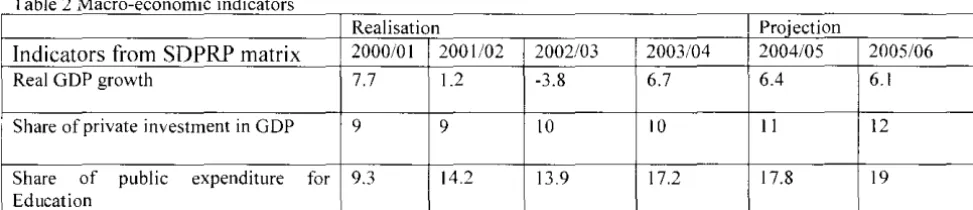
Table 2 Macro-economic indicators '
Realisation Projection
Indicators from SDPRP matrix 2000/0 I 2001/02 2002/03 2003/04 2004/05 2005/06
Real GDP growth 7.7 1.2 -3.8 6.7 6.4 6.1
[image:14.600.82.569.644.749.2]Joint Annual Report 2003 Ethiopia
Share of public expenditure for Health 3.2 4.5 5 7.2 7.3 8
Audit backlog at Federal level 2 yrs I yr I yr
(consolidated accounts)
No of regions reducing accounts
backlog to I yr or less 10 8 6
Respect of financial calendar Approved
Financial Calendar
No. of regions using the new chart of 4 9 11
accounts
No. of federal budget units completing
roll out of BIS package 6 21 all
No of regions undertaking BIS roll out 4 9 11
Consolidated federal/regional budgets, including all extra budgetary funds and accounts made (YIN\
Share of private investment in GDP ff~ II 9 9 10 II 13 Indicators from CSP
EPA negotiations EPA study EPA Active
carried out negotiation participation
position in EPA formulated negotiations Reduction of current account-deficit(% -3.6 -5.7 -4.7 -7.9 -7.4 -6.2
GDP, incl. official transfers)
Reduction of Budget Deficit (% GDP, -5.5 -9.3 -9.1 -7.1 -5.6 -3.9
incl. grants)
Revise Fmanctal Calendar and Issue Directive on Strategic Plannmg Management.
Assessment of resnlts
GOP is not growing as fast as expected (projection in CSP 7% for 2001-2003). The general trend over the last decade shows an average increase of about 2 %. Variations from one year to another are heavily linked to rainfall impacts on agricultural production. Agriculture's share in GOP is around 50 %, but gradually decreasing. This explains the poor result in 2003 (GOP decline of 3 ,8%). For services and industries, the growth is about 5% a year.
Growth in GOP per capita is affected by the high population growth (estimated 2.7%, which is about two million people per year). GOP per capita is around US$100 since 1998, indicating the massive challenge to achieve sustainable poverty a!!eviation.
The deficit on the trade balance (20 % of GOP) has been growing since \992 when a (more) open market policy was introduced. Over the three last years, the deficit increased by more than 10 % a year. This is the result of the collapse in cotree prices on the one hand, and increasing imports on the other. Imports no\\ exceed exports by a factor four, illustrating the great dependence of Ethiopia on foreign assistance. The trade balance deficit is more than compensated by both public (foreign assistance) and private transfers (foreign direct investment and Ethiopian community abroad).
Joint Annual Report 2003 Ethiopia
(from 14.6% in 2000 to 17.9% in 2003). The budget deficit is gradually being reduced from the high levels of2001/02.
The share of public expenditure for education and health are below the expectations as set in the CSP. Especially the share for health is lower than anticipated. It is unlikely that the projections for 2003/04 and further will be met.
Important progress was made with the issuance of a new financial calendar, that should allow for more predictable and timely reporting. The financial calendar was discussed with the international donor community. On the basis of this new calendar, a new sequencing of the diagnostic reviews (such as PER and CFAA) is being prepared.
Some progress was made with reducing the accounts backlog, but capacity constraints have prevented sufficient achievements. Under PSCAP ample attention will be paid to capacity building to allow for faster implementation of the required reforms.
Ethiopia introduced in 2001 a new Chart of Accounts. The roll-out to all regions and 550
woredas is a tremendous challenge. Also here PSCAP will provide for the required capacity building. The USAID and Ireland Aid funded programme - called DSA - will play a crucial role. It is the government's firm intention to introduce the New Chart as soon as possible in all regions. Progress will be closely monitored against the formulated indicators.
One of the key observations made in the CF AA and PER is the late production of a consolidated budget, also capturing the regional budgets. In 2003 good progress was made with the preparation of a consolidated budget in October, which was in time to feed into the APR. According to the IMF, the consolidated budget included a report on the extra budgetary funds. This was however not shared with other donor agencies.
The revised strategy for the Expenditure Management and Control Programme, and the support through PSCAP for capacity building at all tiers of government are expected to speed up the implementation of Action Plans as were earlier agreed upon (e.g. in the Country Financial Accountability Assessment, CF AA).
The government recognizes the private sector as an engine for economic growth and has taken a number of measures to facilitate private sector development. The results so far are modest, and could be improved with a more pronounced strategy for private sector development.
Joint Annual Report 2003 Ethiopia
a service contract for the undertaking of the EPA impact study is signed with the consultant. The findings of the consultant will be discussed with stakeholders and will be the basis for a national document to spearhead the negotiation process at the national level.
Overall conclusions: macro-economic support provided by the Commission assisted Ethiopia in maintaining fiscal stability and by increasing levels of public poverty related expenditures. Macro-economic support has, so far, not been able to increase the export or production base. The slow progress on PSD has contributed to this. Developments in PFM related indicators are modest so far. Government has realized the urgency of making progress with important PFM reforms on short notice.
b) Progress in activities
For the tables below, figures in (brackets) and Italic represent the forecast as made in the Country Strategy Paper. Figures in bold are actual commitments already made, bold and italics are new projections.
(I 0) ~forecast as per CSP
10 ~actual
Joint Annual Report 2003 Ethiopia
9'h EDF
The most important development under macro-economic support in 2003 was the development of PRBS-11. An intrinsic part ofPRBS-11 is the indicator matrix for assessment of results and calculation of the variable tranche. As mentioned earlier the Commission has decided to completely align behind the government's indicator matrix. This matrix was submitted on 12 December 2003. The final approval of PRBS-11 was therefore delayed. This will have however little consequences for the disbursement schedule, which will broadly follow the original projections. The amount made available for PRBS-11 is higher than was mentioned in the CSP (€ 95 million in stead of€ 80 million), reflecting the importance of this instrument.
As part ofPRBS-ll, € 5 million has been allocated for capacity building, mainly in the area of PFM. It is, inter alia, foreseen to make contributions to a pool fund for Monitoring and Evaluation (€ I million), and to the Public Sector Reform Programme (PSCAP, € 2 million). These programmes are essential for either the monitoring of the agreed indicators, or the further improvement of Public Finance Management in a decentralised structure.
The preparation of a trade capacity building programme (€5 million) has been delayed due to problems to
mobilise consultants for this purpose. The finalisation of the Diagnostic Trade Integration Study was equally delayed. The latter is providing the overall framework for trade development and related capacity building needs. The OTIS action plan should be finalised in March 2004- this could coincide with the identification mission for the EC support programme. This programme can become operational in the second semester of2004.
OtherEDF's
Early 2003 an assessment was made of the indicators as included in the first budget support programme (PRBS-1). The indicators related to Health, Education and PSD were only partially met. As a result the variable tranche was reduced with € 6 million.
For sustainable economic growth, a thriving private sector is indispensable. After long negotiations an agreement was reached on a Micro and Small Enterprise Development Programme (€ 7 million, from the 7th EDF). This programme started its implementation in January 2003. After some start-up problems, the programme seems now well on track. A Work Programme (with a EDF contribution of€ 1.9 million) was signed by the end of2003.
The projections shown in the CSP refer to the Investment Facility of the EIB. So far, the law in Ethiopia makes it very difficult for private entities to borrow money abroad. As a HIPC country, a prudent policy with regard to foreign loans seems indeed advisable. There seems however more space to make use of the IF than at present is being used. Negotiations with the EIB are ongoing.
During 2003 ample attention was paid to Public Finance Management issues. The Commission participated in the CF AA and the PER preparations. A contribution of € 1 million for an EMCP (Expenditure Management Control Programme) related project, funded by US AID could not be made due to administrative constraints. This money will now be used to further support the Tax Policy and Administrative Reform (TPAR) programme. This would bring the total contribution of the Commission to TPAR on €2.4 million. For the coming years further contributions to TPAR are foreseen.
Joint Annual Report 2003 Ethiopia
c) Integration of cross-cutting themes
For PRBS-II, indicators will be as much as possible gender disaggregated. The government has included in its overall indicator matrix an indicator referring to the preparation of a Gender Action Plan, aiming at streamlining gender issues in all of its policies.
4.1.2 Food Security
Overall strategy of focal sector and linkages to other focal sectors
It is now widely recognised that food insecurity is, above all, a problem of lack of access to food resulting from the weak purchasing power of poor rural and urban households. Thus, the fight against poverty and food insecurity must focus on increasing incomes of vulnerable groups. At the same time, this must be complemented with interventions aimed at promoting growth and creating greater income generating opportunities. These are both within the rural development realm, such as improving agricultural markets and fostering security of tenure, and beyond, with private sector development.
a) Results
Indicators 2000 2001 2002 2003 2004
No. of predictable food msecure population 1.5
benefiting from the FSP multi-annual safety nets, including public works, conditional transfer programs and other programs for the most vulnerable.(*)
No. of people taken out of DPPC annual 1.5
emergency appeal. (*)
Increased No. of active participants (incl. coops & To be traders) in fertilizer, grain and livestock markets deter
at retail and whole sale level.(*)(**) mined
Increase (over previous year) in the number of To be farm households with long tenn leases for their deter
land holdings. (*) (**) mined
No. of farmers adopting tested technologies 3.7 3.6 3.5 3.8 4.5
_!_million)
Percentage of people below poverty line (base 41.9 vear 1999/00~41.9) (***)
~ 0
1 urowtn m Agncunural UUPto 1 -12 I 14
* New indicators, taken from the SDPRP Policy Matrix approved in December 2003 **Targets to be developed in 2004
***Data from Household Income Expenditure Survey, available every 5 years
Assessment of results
2005 2006
3
3
6
38
Joint Annual Report 2003 Ethiopia
In terms of food security direction considerable advances were made two years ago, with government acknowledging the substantial caseload of predictable food insecure people and the need to address this through long-term development interventions rather than food aid. Agreement was reached on the need to set up food security units under a Ministry of Rural Development and develop a safety nets approach to address predictable food insecurity.
However, despite progress in policy dialogue in many areas, little has been achieved in terms of concrete actions during 2003. During the first part of the year, the food security crisis distracted policy makers from focusing on safety nets and other long-term solutions for food insecurity. From mid-2003, GoE started working, together with donors, on a "Coalition for Food Security" initiative. The objective was to open up dialogue on food security and reach a broad consensus over the set of necessary investments to improve the food security situation in the medium term. The response from donors has been overall positive and the Coalition initiative will provide, in the coming year, a clear opportunity to engage with GoE in a comprehensive dialogue on food security.
The High Level Retreat gave a new impetus to GoE-EC policy dialogue in food security and a number of mutual commitments were made, including:
• EC committed to render more flexible the implementation of the 2002 Food Security Programme and to allocate €30 million annually in 2004 and 2005, again to support safety nets. EDF resources to be provided in coherence with this decision.
• GoE accepted to reduce by 1.5 million the beneficiaries of the next DPPC appeal to be covered by a safety net system.
• All EC direct Food Aid to GoE to be provided as budget support for Food Security programmes. In the event of an emergency, GoE will have the possibility of purchasing food aid with these funds.
Overall conclusions:
Joint Annual Report 2003 Ethiopia
In the CSP an amount of€ 54 million has been allocated for FS. The programming of this amount was delayed by the unprecedented crisis of2003, which resulted in a slow-down in the policy dialogue. The High Level Retreat of October 2003 re-launched the
programming exercise. It was agreed that the full amount would be used for a € 60 million Food Security Budget Support Programme.
Other EDF programmes
Coffee (€ 15 million)
The Financing Agreement of CIP IV was signed in April 2002 for a total amount of E 15 millions (8"' EDF) and a duration of 5 years. The overall objective of the programme is to improve living standards in coffee growing areas and reducing widespread poverty. Six components are identified by the project. These include extension, nurseries, research, conservation, marketing and project management.
The project started on July I" 2002 (start-up phase of three months) and the following Work Plan (October 2002 to June 30, 2003) was endorsed in October 2002. The advance payment was released only in April 2003 and the WP has, therefore, been extended until30 September 2003.
The major constraints identified in 2003 are: (i) delays in the release of the advance payment, (ii) absence of coordination between the different stakeholders (CTA, IIBCR, EARO, Bureaux of agriculture, etc.), (iii) absence of technical assistance foreseen in the FA (iv) difficulty to settle the amount transferred to the regions, (v) reorganization of the Ministry of Agriculture and the Ministry of Rural Development and unknown future of CTA within this new structure. Consequently, many activities could not be accomplished as planned and the implemenlaliun of the project is seriously delayed.
The WP/CE year 2 (October 2003-September 2004) has been endorsed by the EC Delegation in November 2003 and the 50% advance payment (9,803,600 ETB) was released in December. Providing that CTA establish a new accounting system in order to resolve the outstanding issue of settlement of advances.
In 2003, the long delayed service contract has progressed considerably and the two long -term experts are expected in the first semester of2004. A tender for the supply of equipment is also under preparation.
CIP IV- WP/CE Year 1
(Oct 2002- Sept 2003)
22,993,656 ETB
Food Security Budget Line
31,651,220 ETB
11.496.828 ETB 50 I, I 02 ETB ( 4.36 % of the (50% advance) advance)
The most important instrument to address food security issues in Ethiopia over the past years has been the Food Aid/Food Security Budget Line. Assistance has been overwhelmingly skewed in favour of food aid. In 2003, a similar trend to previous years, € 144 million have been provided in total, and out of these, only € 25 million have gone towards govemment led long-term food security programmes. It is important to stress that these programmes have suffered !rom design problems and low absorption capacity and slow disbursement have also been chronic problems.
Joint Annual Report 2003 Ethiopia
b) Progress in activities
Commitments Actual commitments Forecast
FS Budget Line/ 91" EDF Instrument 2002/1 2002/2 2003/1 2003/2 2004/1 2004/2 2005/1
Food Security/BL
19981FSP BL 5.7
20001FSI' BL 2.9
2002 FSI' IlL 25
2002 F i\ BL 41
2003 FA BL 21
2004/5 FSP IlL
Food Security CSP-13 60
60
Payments Actual payments Forecast
FS Budget line/ 91• EDF Instrument 2002/1 2002/2 2003/1 2003/2 2004/1 2004/2 2005/1
Food Security
199S IFSP BL 4.6 l.l
20110 IFSI' BL 2.6 0.3
2002 FSI' BL 9.0**** 8.0*****
21102 FA BL 30.6 10.4
2003 FA BL
20.7 0.3
2004/5 FSI' BL
Food Security CSI'-B
10.0
**** ' Conditional disbursement depend1ng on prog1 ess on Implementation ol the pol1cy reforms matnx . , & JUstlftcatton ot tunds and of the fore1gn exchange tacJI1ty .. *****Depending on the successful implementatwn or the 2002 FSP
2005/2 200611 2006/2
2005/2 2006/1
5.0*****
10.0***** 10.0*****
10.0
Acronyms: CSP: Country Support Strategy P: Project support CB: Capacity Building B: Budget Support IF: Investment Facility BL: EC Budget Line
2006/2
Joint Annual Report 2003 Ethiopia
In response to the 2003 Emergency Appeal, the Commission pledged a total of € 119 million ( 435,000 Metric tonnes of cereals) from several sources:
Pledges
Pledges (Mt) Deliwries Official Letter 2002 for DPPC 41.00 M Euros 165,000 125,000
Official Letter 2003 for DPPC 21.00 M Euros 87,500 87,500
Otricia! Letter 2002- 2003 4,000
NGO's through EuronAid 8 00 M Euros 28,000 28,000
1CRC 5 00 M Euros 15,750 15,750
Remaining Funds from OL 2000 5_00 Meuros 19,000 14,000 Reimbursement to the EFSR from OL 2000 9.00 Meuros 31.000 31.000
NGO's I EuronAid (2) 5.00 M Euros 14,476 14,476
NGO's I EuronAid (3) 15 00 M Euros 37.883
This is the most important food aid commitment ever made by the Commission. Delivery has been adequate and made more efficient by the existence of the Ethiopia Food Security Reserve (EFSR) that fulfils the role of buffer stock. Once the financial commitment was made, loans were taken out from EFSR for immediate delivery. However, the carry over of almost l 00,000 Mt of food aid into 2004 suggests that performance was sub-optimaL In effect, a number of delays have been experienced, including:
Delays in signing MoU from both GoE and EC;
Delays in the arrival of ships fur the imported food aid; DPPC delays in starting the local purchase of food aid; EC delays in signing EuronAid € 15 million allocation.
Longer term response
FSBL
1998 and 2000 IFSP
Both 98 and 2000 Integrated Food Security programmes have experienced chronic delays in the start of the implementation as well during implementation. Due to those delays and in order to avoid the reimbursement of unspent funds back to headquarters both OLs have been extended tili 3i/12/04. In terms of execution, by the end of2003, the iFSP i998 had reached 54% of cumulated disbursements from 200 l, 2002 and 2003, while the !FSP 2000 is still on 13% execution level (see table below).
Joint Annual Report 2003 Ethiopia
2002 Food Security Programme
In October 2002, A Budget Support/Foreign Exchange Facility (€25 million- of which E 3 million for TA) was approved. Disbursement of the first € 9 million tranche was made in May 2003 to go towards strengthening food security public expenditure at regional level in 4 regions. The in-built flexibility would allow utilisation of funds for safety nets or other activities designed in response to the crisis.
Following the High Level Retreat, the EC committed to make the disbursement of funds more flexible, i.e. to waive the requirement for ex-ante workplans and cost estimates and shift to ex-post justification of expenditure. However, due to need of further clarifications by the GoE on flexibility of implementation modalities the funds had still not been disbursed to the regions by the end of2003.
i. 19981FSP 10 4.253 1.322 5.575 3.017 4.425
(54%)
Tigray 4 1.943 1.322 3.265 1.49 0.735
(45%)
Amhara 6 2.310 2.310 !.52 3.69
74%
ii. 2000 1FSP 11 2.760 3.125 5.885 0.786 5.115
(13%)
Tigray 5 2.760 2.760 0.474 2.24
(17%)
Amhara 6 3.125 3.125 0.312 2.875
(9%)
iii. 2002 FSP 22 9.000 9.000 13.0
Total 43.0 7.013 13.447 20.46 3.803 22.54
18%
* In million Euros
c) Integration of cross-cutting themes
Joint Annual Report 2003 Ethiopia
4.1.3 Transport
Overall strategy of focal sector and linkages to other focal sectors
The strategy for the transport sector is to develop the necessary infrastructure to support the development of the productive base of Ethiopia and to contribute to poverty alleviation. Good transport links either between different regions of the country or to different countries are indispensable for trade and to ensure that goods or food available in the country can reach its destination and local markets can effectively integrate.
a) Results
Indicator 2000/0 I 2001/02 2002/03 2003/04 2004/05 2005/06 2006/07
Road Density of all weather roads
-27.7 30.3 30.5 31.5 32.3 34.5 36.2
[km/km2l-{RSDP/SDPRP} Road Density of all weather roads
0.46 0.48 0.48 0.49 0.49 0.48 0.50
[km/1000 peoplel -{RSDP/SDPRP} Road Density of all roads. including
low-0.48 0.48 0.49 0.56 0.65 0.73 0.83
standard- [km/1 000 people l
% of asphalt roads in good condition 43 59 41 48 54
% of gravel roads in good condition 15 19 29 32 36
%of rural roads in good condition 29 32 35
NEW INDICATORS
Maintenance by ERA force account/private contractors
Fatalities/total accidents 0.2 0.2
Accidents/1000 vehicle-km 1.77 1.91
Note: The figures for 2000/01 and 2001/02 are as reported from the monitoring reports. SDPRP indicators are for years 2002/03-2003/04-2004/05. while for 2005-2007 are from the RSDP-1 or II docs. Figures for 2000 -2002 are as reported in RSDP or in its monitoring reports.
Assessment of results
The support of the 9th EDF to the transport sector is a continuation of similar support through the 7th and gth
EDF in the context of the road Sector Development Programme (RSDP).
The policy objectives as to the establishment and fW1ctioning of autonomous institutions in the road sector have been completed. e.g. establishment of the Ethiopian Road Authority. Road Fund with well-defined sources of revenues and reliable track·record on allocating funds on the basis of the regional needs. The revenues of the Road Fund are well defined (fuel levy, VAT and vehicle licenses) and are used exclusively for the maintenance of the road network, on the basis of maintenance needs and regional balance. The amount of maintenance work carried out by local private contractors has increased substantially, while ERA's operational branch is in the process of becoming by 2005 an autonomous profit center, separate from ERA.
The area where policy challenges still remain are a) the approval by Parliament or the Administration of the draft transport regulations, as produced mid-2002 with EC financing, and b) the implementation of action plans on road safety and axle load controls.
Joint Annual Report 2003 Ethiopia
Even more critical for achieving the 2007 targets on rural population transport accessibility and geographic coverage, a substantial programme of rural roads, even low standard at an initial stage, needs to be realized. That programme is evidently linked with the overall agricultural development programme of Ethiopia. The Ethiopian Road Travel and Transport Programme (ERTTP), being a community-based initiative and incorporating aspects of an integrated approach for rural development, offer a viable framework. The scaling-up of the programme and its implementation countrywide is not only necessary for achieving productivity growth but also for ensuring equitable regional development.
b) Progress in activities
Commitments
Actual commitments
Forecast
Transport
Instrument 2002/1 2002/2 2003/1 2003/2 2004/1 2004/2 2005/1 2005/2 2006/1 2006/2Addis – Jima Road(8th EDF) Kombolcha -Mille
Harar – Jijiga Road
Mieso – Dire Dawa – Guelile Arba Minch – Jinka Road Gonder-Humera Road ERA Capacity Building Transport policy support
CSS-P
CSS-P CSS-P CSS-P CSS-P CSS-P CSS-CB CSS-CB(PM )17
(PM) (PM)
30
(5)
(2)
(25) 11 35
6 2
(50)
Payments
Actual
Forecast
Transport
Instrument 2002/1 2002/2 2003/1 2003/2 2004/1 2004/2 2005/1 2005/2 2006/1 2006/2Addis – Jima Road(8th EDF) Kombolcha -Mille
Harar – Jijiga Road
Mieso – Dire Dawa – Guelile Arba Minch – Jinka Road Gonder-Humera Road ERA Capacity Building Transport policy support Budget Support Road Fund
CSS-P
CSS-P CSS-P CSS-P CSS-P CSS-P CSS-CB CSS-CB CSS-B(PM) 0.6 4.0 5.7
(0.5) (0.5) 0.5 (0.5) (0.5) 10 (10) (1.0) (0.5) 5 16 (10) (1.0) (0.5) 4 4 (5) (1.0) 3 6 (5)
(0.5) 0.5
0.5
10 2
(5)
(0.5) 0.5
0.5 10 1 (10) 0.5 0.5
Joint Annual Report 2003 Ethiopia
9'h EDF
The major interventions foreseen in the CSP were:
i) the rehabilitation of two existing, but degraded, roads, that are part ofRSDP's 2nd phase (Harrar-Jijiga, 102 km and Mieso-Dire Dawa, !55 km),
ii) the provision of training, technical assistance and surveys destined to strengthen ERA's capacity in managing the RSDP,
iii) support for the implementation of some transport policies, studies of which have previously been funded by EC (e.g. road safety, axle load, transport regulation).
Delays were experienced for a variety of reasons, with the main being the effort to ensure better preparation of the programmes to avoid recurrence of disruptive experiences to the implementation, as in other on-going programmes of the 7"' and 8"' EDF. That is especially the case for the programmes ofHarar- Jijiga and theTA ones. In the latter the effort is to define in a comprehensive manner the needs and resource gaps of the authorities in the transport sector in order to become by 2007 "smaller and smarter"- as agreed in the launching of the RSDP- II (March 2003).
The time taken by the EC, twenty months from submission, to decide on the FP for the design of Mieso-Dire Dawa- Guelile, impacted on the commitment and implementation of the 91h EDF transport programme.
The action taken in 2003, confirmed during the High Level Retreat of October 2003, to expedite the preparation of the projects Kombolcha Gundewein (with possible cofinancing with Italy and Sweden), Arba Minch -Jinka and Gonder- Humera attempts to:
a) improve consistency and complementarity of the 9th EDF, by focusing on actions that either have a direct food security objective by linking foodsurplus to fooddeficient areas (i.e. Kombolcha -Gundewein) or by improving the access to areas of increased potential in agricultural and
b) partly mitigate the programming effects of the delay in decision making for the study of Mieso-Dire Dawa- Guelile.
The Government of Ethiopia requested the EC financing of a Masterplan study for the Transport sector in Ethiopia.
Financing decisions were taken to complement with sources of the 9th EDF the projects of Kombolcha- Mille (addition by € 30 million to an initial 8'h EDF allocation of€ 25 million) and the Minimum Rail Safety Works for the CDE (addition by € 10 million to regional allocation of € 30 million).
Hence, despite the longer than initially anticipated time taken in the programming, by end-2003 already 20% of the amount allocated (€ 211 million) to the transport sector was committed. Due to the action taken in 2003, it is presently expected that the entire allocation could by committed by end of2004/early 2005.
Other EDF programmes
Addis Ababa -Modjo- Awassa Road Rehabilitation (265 km-t' 60 million)
Construction of the civil works started in 1998 and was substantially completed in November 2001, with the exception of a 20 km stretch for which the quality was not considered as per specifications. That prevented the issuing of full Provisional and subsequently Final Acceptance of the works. The repair of that stretch was carried out in the second half of 2003 with some works remaining for 2004.
Joint Annual Report 2003 Ethiopia
after a revtslOn of the technical solution and increasing of the available financing by € 17 million. Although some of the problems that used to hinder progress (removal of obstructions, handing over of borrow pits) are now resolved, there is still a number of issues, mainly affecting financial liquidity. By end 2003 the progress of works was behind schedule (36% against 61% planned) and the present estimate for completion of the project is not before mid/end-2006.
Addis Ababa-Dessie- Woldiya Road (51 4 krn-€ 120 million)
The project is divided into three lots, only Lot 2 (Tarma Ber-Kombolcha -187 km) was awarded at the initial tender. The work is progressing at the contractually envisaged pace, however the need to correct or update design is resulting in a 30% increase in quantities, implying a two-year extension of time with the subsequent cost increase. The position of ERA on this matter is expected by mid-February 2004, one month before the contract completion date. The physical completion of works by end-2003 was about 45%.
The works for Lot 3 (Kombolcha - Woldiya) are re-tendered, following an 18-month period of review of the tender documents. The new offers are due for 26 February 2004. The supervision of the works is also to be tendered shortly, after approval by end 2003 of the list of invited consultants.
The works for Lot 1 (Addis Ababa- Tarma Ber Tunnel) are to be re-designed before launching a new tender, as the presence of expansive soils- that caused the problems in Jima- was considered as extensive (65%) and the initial solution in need of review.
Kombo/cha-Mille Road (128 km-€ 55 million)
After reviewing the actual rehabilitation needs, the total project cost increased from € 25 million (initially approved) to € 55 million. Offers for the works tender were submitted on 7 October 2003 - exceeding the available financing by about 20%. Increasing the Financing Agreement with such an amount could be considered. The evaluation process by ERA is to be completed by mid-February 2004. In parallel, the pre-qualification for the supervision service started in November 2003, with its evaluation on-going. As the evaluation of the works tender appeared more complicated than anticipated delays may be incurred to the programme implementation.
c) Integration of cross-cutting themes
Activities in the transport sector refer extensively to poverty reduction, however, gender issues are not given direct attention.
Major works contracts in the transport sector include environmental considerations and provide for environmental impact assessments to be carried out during construction. Environment aspects of road
construction and environmental impact of road accidents is addressed. Transport sector studies address potential environmental benefits through reduction of exhaust emissions and noise, and stricter routine vehicle
inspections.
Joint Annual Report 2003 Ethiopia
4.2 Projects and programmes outside the focal sectors
a) results
The CSP identified capacity building for governance and civil society as the main target areas in the non-focal sector of governance. More specifically legal and judicial reform, civil service reform and administrative decentralization were mentioned as crucial areas. While the government has embarked on a legal and judicial reform programme, with the recruitment and training of judges and court clerks, most EC supported initiatives in the governance section are still at an early stage and are too new to be able to assess their impact. The EC support for this sector identified in the CSP is particularly difficult to assess as very few projects have reached the implementation stage. Consequently, the progress that can be witnessed in the governance sector is mainly due to the Governments efforts, with support from various donors. The latter does however include the support the EC has provided for the establishment of a law faculty at Mekelle university, which has resulted in a number of spin-offs in the legal field.
The fact that very little information has been collected in relation to the governance sector and any kind of baseline information is lacking, makes it difficult to compare results and outputs on an annual basis and make assessments on the progress. However, several studies are currently being undertaken and are expected to facilitate future data collection and to fill to information gaps.
The decentralization process has continued, several training Initiatives materialized within all governance sectors. This includes the preparation of a civil service code of conduct, a medium term pay and employment policy and a Service Delivery and Performance Improvement Plan.