COMMISSION OF THE EUROPEAN COMMUNITIES
Brussels, 26.10.2004 SEC(2004) 1326
COMMISSION STAFF WORKING DOCUMENT
Second Progress report on the EC Programme for Action: Accelerated action on HIV/AIDS, malaria and tuberculosis in the context of poverty reduction
TABLE OF CONTENT
1. Executive Summary ... 4
Acronyms and abbreviations used in this document... 6
2. Introduction ... 8
2.1. The EU policy framework and programme for action on HIV/AIDS, malaria and tuberculosis ... 8
2.2. The comprehensive policy mix needed to confront the three diseases ... 10
2.3. Objective of the document ... 11
3. Achievements of the Policy Framework and the PfA... 12
3.1. Impact... 12
3.1.1. Optimising the impact of Health, AIDS and Population interventions targeted at the three communicable diseases and poverty reduction ... 12
3.1.2. Strengthening of pharmaceutical policies and capacity building... 19
3.1.3. Developing local manufacturing capacity... 21
3.2. Affordability... 23
3.2.1. Tiered Pricing... 24
3.2.2. Tariffs and taxes... 26
3.2.3. Flexible Use of Trade-Related Aspects of Intellectual Property Rights ... 26
3.3. Research and development of new tools... 29
3.3.1. Strengthening of research in poverty-related diseases ... 30
3.3.2. European and Developing Countries Clinical Trials Partnership ... 31
3.3.3. Capacity building for research and development in developing countries ... 32
3.3.4. Indirect incentives to increase R&D investments of private sector in specific Global Public Goods ... 33
3.4. Participation in Global Partnerships: Policy and Political Dialogue ... 35
3.5. Institutional coordination and cooperation... 39
4. The Evolving Epidemiology, Geography and Demography of HIV/AIDS, malaria and TB... 40
5. Conclusions ... 43
Annex 2: Contributions by the EC and EU Member States to the Global Fund, the International Aids Vaccine Initiative, and the International Partnership for
1. EXECUTIVE SUMMARY
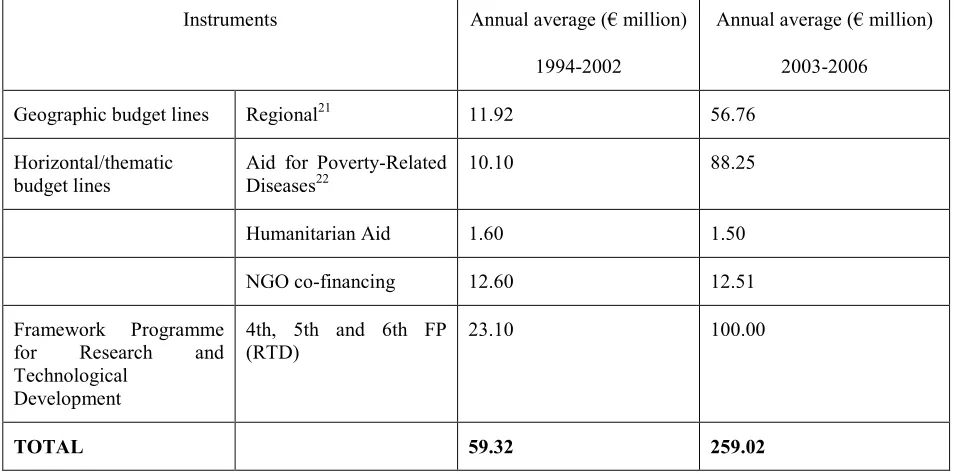
The death of more than 6 million people in the world from HIV/AIDS, malaria and tuberculosis (TB) each year constitutes a global crisis. In 2000, the European Commission (EC) redefined its role and accelerated its response in a coherent and comprehensive framework.1 In 2001, the EC adopted its Programme for Action2 (PfA) based on this framework, which defined key actions to accelerate the impact, affordability and research and development of new tools. It is now an appropriate time to assess the progress made, build on achievements and face new challenges. This progress report illustrates that the main achievement under the area for action on accelerating impact has been a four-fold increase in EC resources allocated specifically to confronting the three diseases, with an annual average of €259.02 million programmed for 2003-2006 as compared to the €59.32 million annual average committed for 1994-2002 (including a significant increase in research funds). In the action on affordability, there has been a reduction of up to 98% in the price of some key pharmaceutical products in developing countries. Under the research and development action, a key achievement has been the establishment of the European and Developing Countries Clinical Trials Partnership, which focuses on clinical trials for the development of new interventions confronting the three diseases, especially in sub-Saharan Africa. The active EC role in terms of leadership, coordinating positions and mobilising resources among the EU Member States and other donors is a key achievement under the partnership action. Examples of this include a strong European voice in the Global Fund to Fight HIV/AIDS, TB and malaria (to which the EU contributes more than half of the budget), and in international fora on key issues such as Trade-Related Aspects of Intellectual Property Rights and sexual and reproductive health and rights.
The main outstanding challenges include how to increase the prioritisation of, and resources to, health and social services in third countries; how to boost ailing health infrastructure and overburdened human capacities, especially in the current context of brain drain; how to support regulatory capacity in third countries; how to further increase affordability of key pharmaceutical products, and improve access to pharmaceutical products in general; how to develop new tools to confront the three diseases; and how to continue coordination with partners in third countries, civil society and the private sector. New challenges include how to maintain coherence and harmony in an increasingly complex and divergent global institutional set-up, and how to respond to the evolving epidemiology, geography and demography of the diseases in the context of an enlarged EU.
This progress report illustrates how the policy framework and the PfA remain valid. The overall framework of poverty reduction is still the main focus, especially in the
1
Accelerated Action Targeted at Major Communicable Diseases within the Context of Poverty Reduction
(COM(2000) 585)
2
Acronyms and abbreviations used in this document
ACP African, Caribbean and Pacific
ACT Artemisinin-based combination therapy ALA Asia and Latin America
AMANET African Malaria Network Trust ARVs Anti-retrovirals
CCM Country Coordinating Mechanism CIS Commonwealth of Independent States CLS Core Labour Standards
CSP Country Strategy Paper
DAC OECD Development Assistance Committee DFID Department for International Development (UK) DOTS Direct Observed Therapy Short-course
EC European Commission/European Community
EDCTP European and Developing Countries Clinical Trials Partnership EDF European Development Fund
EEIG European Economic Interest Grouping EMEA European Medicines Agency
EU European Union
FDA Food and Drugs Administration FDC Fixed-dose combinations
FP(RTD) Framework Programme for Research and Technological Development FTA Free Trade Agreement
GAVI Global Alliance for Vaccines and Immunizations
G8 Group of 8
IAVI International AIDS Vaccine Initiative
ICPD International Conference on Population and Development IP Integrated Project
IPM International Partnership for Microbicides IPPF International Planned Parenthood Federation ITN Insecticide-treated Nets
MEDA Mediterranean countries
MDGs Millennium Development Goals MSF Médecins Sans Frontières NGO Non-governmental Organisation NoE Network of Excellence
ODA Official Development Assistance
OECD Organisation for Economic Cooperation and Development PEPFAR US President’s Emergency Plan for AIDS Relief
PfA Programme for Action
PRSP Poverty Reduction Strategy Paper SME Small and Medium-sized Enterprise SWAps Sector-wide Approaches
TB Tuberculosis
TRIPs Trade-Related Aspects of Intellectual Property Rights UN United Nations
UNAIDS Joint United Nations Programme on HIV/AIDS UNFPA United Nations Population Fund
WIPO World Intellectual Property Organisation WHO World Health Organisation
2. INTRODUCTION
Substantial progress has been made since the groundbreaking European Commission High-Level Round Table on HIV/AIDS, malaria and tuberculosis took place in September 2000, and the adoption of the policy framework for a comprehensive and accelerated approach to confront HIV/AIDS, malaria and tuberculosis (TB). It is now time to take stock, reflect on progress made and new challenges, and to accelerate and readjust actions where needed. The coherent and comprehensive policy framework remains valid in the context of the Millennium Development Goals (MDGs) and the overarching objective of poverty reduction. The need to focus on HIV/AIDS, malaria and TB is clearly reflected in Millennium Development Goal (MDG) 6 – “Combat HIV/AIDS, malaria and other diseases” which includes associated targets and indicators – and other inter-linking MDGs on health and poverty.3 Confronting the three diseases remains high on the agenda for EU Presidencies, both current (the Netherlands) and future (Luxembourg, the UK, Austria and Finland).
However, despite efforts made and resources allocated, the number of people affected, infected and dying from HIV/AIDS, malaria and TB continues to rise. In 2003, almost 3 million people died of HIV/AIDS; this is rapidly becoming the worst infectious disease catastrophe in recorded history, surpassing in absolute numbers the bubonic plague of the fourteenth century and the influenza epidemic of 1917, each of which killed around 20 million people. Malaria kills more than one million people every year, including an African child every 30 seconds.4 TB kills about 2 million people every year.5
2.1. The EU policy framework and programme for action on HIV/AIDS, malaria and tuberculosis
A comprehensive policy framework: HIV/AIDS, malaria and TB collectively undermine global health, poverty reduction and human security. In 2000, the European Commission (EC) redefined its role and accelerated its response to the global emergency in a coherent and comprehensive framework on Accelerated Action targeted at major communicable diseases within the context of poverty reduction.6 This Communication was discussed at a High-Level Round Table with a large number of stakeholders, held in Brussels in September 2000.
Cooperation, coherence and synergy: In the policy framework, the EC highlighted the value and importance of harnessing several key policy areas and instruments to work towards a common goal. Different policy areas within the EC redirected some
3
MDG Target (7): Have halted by 2015, and begun to reverse, the spread of HIV/AIDS.
MDG Target (8): Have halted by 2015, and begun to reverse, the incidence of malaria and other major diseases. Please see web-page http://www.un.org/milleniumgoals for further information.
4
WHO “What is Malaria”, from www.rbm.who.int
5
WHO “Basic Facts on TB”, from www.stoptb.org
6
of their activities to confront the three diseases. It was recognised that the EC has a unique mandate to coherently address a range of development, humanitarian aid, trade, research, enterprise, health and education issues. This range of competences and instruments provided the potential for greater synergy across these policy areas. Description of the Programme for Action: To formulate actions for 2001-2006 within the policy framework, the EC adopted a Programme for Action on Communicable Diseases in the Context of Poverty Reduction (COM(2001) 96). Council and Parliament welcomed the Programme for Action (PfA) in their resolutions of 14 May 2001 and 4October 2001 respectively (refer to Annex 1 for further policy declarations and resolutions of relevance to the policy framework and the PfA). The PfA was later assessed and updated in a progress report adopted by the EC in February 2003.7
The vision of the policy framework is to accelerate the response to confront the three diseases. This requires intensified support to strengthen social sectors beyond the health sector to include enabling sectors such as education, transport and food security, and cross-cutting issues regarding human resources. The PfA focuses on three inter-related areas for action: to increase the impact of existing interventions, to increase the affordability of key pharmaceutical products, and to encourage research in and development of specific global public goods.
These actions are inter-related and synergistic, with each having a multiplying effect with a larger cumulative impact – one example being the interrelationship that exists between affordability of pharmaceutical products, impact through existing interventions and incentives for further research and development of new pharmaceutical products. Results are achieved by acting at two levels – through accelerating and increasing resource allocation at country level, and through advocating and adopting key policies and action at global level.
The PfA also reflects EC policy on sexual and reproductive health and rights,8 maintaining the commitments made at the International Conference on Population and Development (ICPD) in Cairo, 1994.9 The PfA is part of the overall EC Development Policy, which highlights poverty reduction as a priority goal.10
7
Update on the EC Programme for Action: Accelerated Action on HIV/AIDS, Malaria and Tuberculosis in the Context of Poverty Reduction – Outstanding Policy Issues and Future Challenges (COM(2003) 93)
8
Regulation (EC) No 1567/2003 of the European Parliament and of the Council on Aid for Policies and Actions on Reproductive and Sexual Health and Rights in Developing Countries and Accelerated action targeted at major communicable diseases within the context of poverty reduction, COM(2000) 585.
9
http://www.un.org/popin/icpd2.htm
10
The PfA is implemented using a range of instruments: geographic budget lines,11 horizontal or thematic budget lines,12 and the EU Framework Programme for Research and Technological Development (FP (RTD)).
2.2. The comprehensive policy mix needed to confront the three diseases
The PfA calls for new partnerships to strengthen policy advocacy and political dialogue. The PfA also calls for a comprehensive policy framework, taking an appropriate mix of innovative, more efficient and less costly disease responses in prevention, treatment and care. An appropriate mix depends on the nature of the disease, capacities and resources available within the country and region; but most crucially, it depends on proven best practice.
HIV/AIDS: The majority of HIV infections occur through sexual contact, and are preventable. The effectiveness of condom use in preventing transmission of HIV/AIDS through sexual contact is a proven fact. The knowledge and ability to openly discuss and negotiate an informed choice is important, and is something that many people – especially women – lack. The use of condoms by non-regular partners remains very low for several reasons, including lack of access. Gender inequalities also mean that many women in developing countries are deprived of negotiating skills to enable them to protect their own lives and the wellbeing of their families. Condoms are the only current tool available for protection from sexual transmission of HIV/AIDS, but they are controlled by men. The rapid development and introduction of effective microbicides is therefore crucial for women in developing countries and elsewhere in order for them to protect themselves against HIV/AIDS transmission. A high proportion of HIV/AIDS transmission occurs through injecting drug use. Harm reduction, through needle exchange and/or substitution therapies, is proven to reduce the transmission of HIV/AIDS through injecting drug use. However, access to harm reduction services is limited in many countries where it is most needed.
The recent price reduction in anti-retrovirals (ARVs) for treatment of HIV/AIDS has resulted in an increase in the number of people treated in developing countries. HIV/AIDS could be a chronic disease controlled by drugs instead of a life sentence, but only 2% of those in developing countries who need ARVs have access to it (and only 1% in Africa). With ARV therapy now being a significant element of an increasing number of national programmes, mobilising sufficient resources to achieve a balanced response between prevention, treatment and care in national HIV/AIDS strategies is becoming an increasing challenge. The provision of ARV therapy is also placing an increasing challenge on already ailing health infrastructures and overburdened health staff.
11
These are resources to Africa, Caribbean and Pacific (ACP) countries from the European Development Fund (EDF), including regional and intra-ACP; Asia and Latin America (ALA); Mediterranean (MEDA); and Eastern Europe and Central Asia (TACIS).
12
Fixed-dose combinations (FDCs), which combine multiple drugs in one pill, are easier to administer and use than the cocktail of drugs which imply taking 3 times more pills per day. FDCs are mainly produced by generic manufacturers. There are still no FDCs for paediatric formulations of ARVs.
TB: A person with HIV/AIDS who develops active TB has a life expectancy of just a few weeks or months. Up to half of those with HIV/AIDS in developing countries will die of TB. For those on the lengthy waiting list to receive antiretroviral treatment for AIDS, having access to TB treatment is a matter of life and death. The cost of the pharmaceutical products for a full course treatment under the DOTS (directly-observed therapy short-course) scheme has been reduced to US$10, and TB can be successfully treated and life expectancy extended by several years. It is a challenge for health systems to effectively administer DOTS given the complication and length of treatment, and the improper use of TB drugs has resulted in a growing trend of multi-drug resistant TB. In addition, TB diagnostics tools are outdated and difficult to use. Innovative initiatives are needed to increase the detection of tuberculosis and compliance with treatment, particularly amongst the poorest.
Malaria: Malaria can be prevented using vector-control (e.g. drainage of swamps and insecticide spraying of houses), or transmission to humans can be prevented in many areas using insecticide-treated bednets (ITNs)13. The development of long-lasting ITNs (which last five years, the time span that newborn children are most vulnerable to malaria) offers new potential for confronting the disease. At the current price of $5 per net, long-lasting ITNs are already more cost-effective than conventionally treated nets. Treating pregnant women with anti-malarials is particularly important because of the potentially harmful effects the disease can have on their children and themselves. Treatment with new drugs, among them artemisinin-based combination therapy (ACT) is needed because of increasing resistance to traditionally used malaria medicines like chloroquine. However, ACTs are significantly more expensive than traditionally used malaria medicines.
2.3. Objective of the document
Why this progress report? The policy framework and the PfA are major initiatives for confronting HIV/AIDS, malaria and TB. The EC has seen significant achievements in confronting the three diseases over the past few years. Globally, there has also been an increase in the amount of resources channelled towards HIV/AIDS, malaria and TB. A large number of new players have joined the scene and changed the global institutional architecture. Now is therefore an appropriate time to assess progress made on the PfA, to build on these achievements and face new challenges.
This progress report outlines implementation so far on each of the three PfA areas for action – impact, affordability, and research and development. The EC’s participation
13
in global partnerships is also discussed. The report integrates and builds on key findings of the 2003 progress report.
How will this progress report be used? This progress report provides input into an EC consultation where outstanding and new challenges are being analysed to define key actions for the EC and the EU. Later this year, the EC will continue its discussions with Council and Parliament on the Financial Perspectives (period 2007-2013) for the enlarged EU. At the same time, discussions are ongoing on the new instruments to be adopted for EC external action. The EC will also continue its dialogue with EU Member States and stakeholders regarding the updating of the EC Development Policy. The outcomes of these discussions are of primary importance given that one of the main challenges currently faced by the EC is how to ensure increased and sustainable financial commitments to the Millennium Development Goals, including MDG 6. This progress report will also provide timely input into the report on EU progress towards the MDGs, which is currently being prepared for presentation at the upcoming UN summit in September 2005.
3. ACHIEVEMENTS OF THE POLICY FRAMEWORK AND THE PFA
3.1. Impact
Rationale for action: Increased and accelerated efforts are needed both at country and at global level to confront the three diseases using existing interventions, while at the same time strengthening essential services and systems.
3.1.1. Optimising the impact of Health, AIDS and Population interventions targeted at the three communicable diseases and poverty reduction
The PfA calls for increased funding, quick disbursement and accelerated action to provide wider access to prevention, treatment and care, especially for the poor, to confront the three diseases. In general, there has been no increase in resources allocated to health since the PfA. However, there has been an accelerated disbursement of funds to health through country and macroeconomic budget support. A major achievement has been the creation of a new and innovative horizontal budget line to confront the three diseases specifically. There has also been an increase in resource allocation through regional and horizontal budget lines over time to confront the three diseases.
from macroeconomic budget support.14 Whilst this figure seems low compared to the annual EC investment through budget support, it reflects the fact that national budget allocations to health are low in many countries, and increased national allocations to health, in line with poverty reduction strategy objectives, will be needed before there can be a greater allocation of EC macroeconomic budget support to the health sector. It is difficult to compare this figure to previous macroeconomic budget support going to health.
It is also difficult to see the health outcomes due to this financial allocation. In countries where the EC provides macroeconomic budget support, health process and output indicators are included to assess overall country performance, especially relating to the MDGs (e.g. HIV prevalence, attendance of skilled birth attendants, immunisation coverage). The inclusion of such indicators can contribute to the strengthening of in-country budget allocations or country programmes on the three diseases, assuming that agreement on targets reflects agreement on national priorities for investment. All countries, regardless of their choice of focal sector, are advised to include the MDG-related outcome indicator – “HIV prevalence among 15-24 year-old pregnant women” in their monitoring and reporting systems. In the 2004 mid-term review of all the CSPs for the EC cooperation partners in ACP countries, 32 out of the 68 countries for which the data has been analysed used exactly this indicator in their core list.15 23 countries included a different indicator on HIV/AIDS, while 13 did not use any HIV/AIDS indicator at all. Analysis of this outcome indicator remains limited, and cannot yet illustrate trends over time.
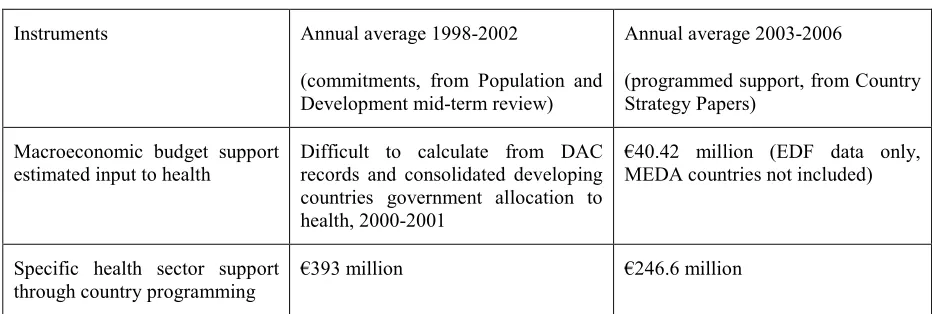
Specific health sector support: As Table 1 below illustrates, health sector support through country programming has decreased by a third from a €393 million annual average (commitments 1998-200216) to a €246.6 million annual average (programmed support 2003-200617). Although geographic support for health has decreased when comparing 1998-2002 and 2003-2006, there has been accelerated expenditure of resources through faster disbursement of money to countries This reflects a general increase in the EC disbursement rate in development coopertaion which includes a 47% increase in payments since 2000.18.
The primary mechanism for EC partnership at country level are the Country Strategy Papers (CSPs), and policy dialogue around Poverty Reduction Strategy Papers (PRSPs). Countries have been encouraged to focus on two sectors in the CSP.19 In the period 2002-2006, the EC provides specific funding for health for only 27 out of 106 countries. Reasons for countries not choosing health as a focal sector may include the traditional expertise of the EC being in other sectors (e.g. transport), the lack of health expertise in EC delegations able and willing to advise and argue for
14
The proportion of the EC macroeconomic support allocated to the health sector is calculated using the percentage of the government’s budget commitment to health as outlined in the World Health Report 2004.
15
Only 55 of the total 76 had data available
16
Source: Population and development mid-term evaluation
17
Source: Country Strategy Papers
18
health support in discussions with the government, and – in many countries – the weak position of the Ministry of Health (relative to other Ministries) in the policy dialogue. However, participation in sector support programmes makes for more intense dialogue on health policies and how to improve them and increase support for systems.
Table 1: EC support for health from geographic line items (1998-2002 compared to 2003-2006)
Instruments Annual average 1998-2002
(commitments, from Population and Development mid-term review)
Annual average 2003-2006
(programmed support, from Country Strategy Papers)
Macroeconomic budget support estimated input to health
Difficult to calculate from DAC records and consolidated developing countries government allocation to health, 2000-2001
€40.42 million (EDF data only, MEDA countries not included)
Specific health sector support through country programming
€393 million €246.6 million
[image:14.595.64.530.172.329.2]Table 2: EC financial commitments/programmed support specifically to confronting HIV/AIDS, malaria and TB (annual averages by instrument, in € million)20
Instruments Annual average (€ million)
1994-2002
Annual average (€ million)
2003-2006
Geographic budget lines Regional21 11.92 56.76
Horizontal/thematic budget lines
Aid for Poverty-Related Diseases22
10.10 88.25
Humanitarian Aid 1.60 1.50
NGO co-financing 12.60 12.51
Framework Programme
for Research and
Technological Development
4th, 5th and 6th FP (RTD)
23.10 100.00
TOTAL 59.32 259.02
Regional support: Support specifically for the three diseases has been channelled through regional or intra-ACP funds. As Table 2 illustrates, there was an increase from €11.92 million (average annual commitment, 1994-2002) to €56.76 million (average annual programmed, 2003-2006) to confront the three diseases. Another significant achievement since the PfA was adopted has been the more flexible use of this instrument, which allows for increased resources at country level, and for support for innovative partnerships. For example, part of the intra-ACP funds are used to support the Global Fund;23 to support pharmaceutical policy development in countries (with the World Health Organization); health information system development through the Health Metrics Network with WHO; and to develop malaria vaccine trial capacities in Africa through AMANET (African Malaria Network Trust). This EC-funded project (for €7 million) aims to strengthen a pan-African network that will enhance the human and institutional capacity needed for clinical development and evaluation of malaria vaccines. AMANET, which is the only registered trust composed of African public health and research institutions, will
20
Sources: (1994-2002): Population and Development Evaluation, see
http://europa.eu.int/comm/europeaid/evaluation/evinfo/sector/951649_ev.htm
(2003-2006): Programming data from DG Development, see
http://europa.eu.int/comm/development/body/theme/human_social/pol_health1_en.htm, updated from brochure http://europa.eu.int/comm/development/body/publications/descript/pub7_10_en.cfm
Breakdown by diseases from Global Fund, see progress reports by diseases:
http://www.theglobalfund.org/en/funds_raised/reports/
21
Calculated from regional programmes and intra-ACP programmes
22
Before 2003, money for HIV/AIDS came from the AIDS and Population budget line. Breakdown after 2003 is indicative, pending first selection of proposals from 2003 call.
23
[image:15.595.64.541.104.341.2]implement the project. The project will result in an operational network of efficacy evaluation centres in Burkina Faso, Mozambique and Tanzania, with properly skilled staff through short, long and on-site training. Four malaria candidate vaccines will undergo clinical trials under internationally accepted good clinical practice and ethical standards.
Another part of the intra-ACP budget is used to ensure continued reproductive health services in countries through support for the United Nations Population Fund (UNFPA) and the International Planned Parenthood Federation (IPPF). This has been done in response to the withdrawal of US funding following the US’s re-introduction of the Mexico City policy (or ‘global gag rule’), halting funding of organisations providing legal abortion services, counselling and referral for abortion, or lobbying to make abortion legal or more available in their own country.
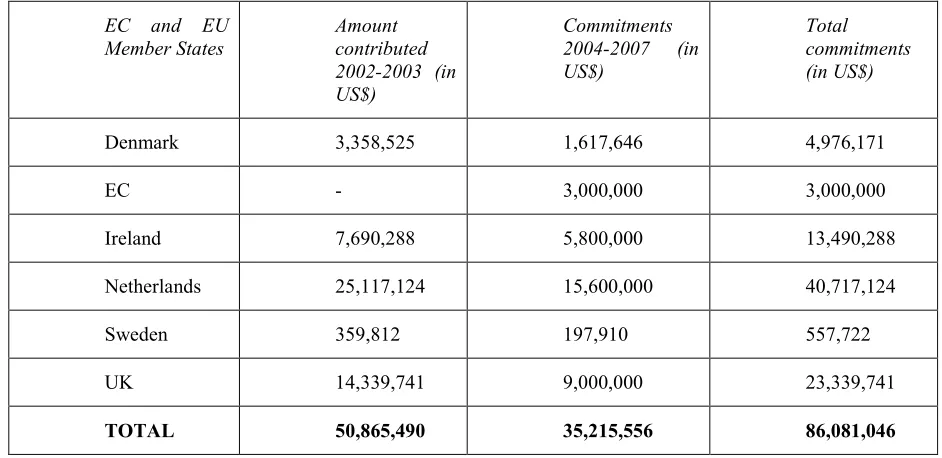
Aid for Poverty-Related Diseases: One of the main achievements of the past three years has been the adoption of the budget line on Aid for Poverty-Related Diseases24 in 2003 as a new instrument to implement the PfA with a financial framework of €351 million (2003-2006). This new instrument supports innovative initiatives and targeted actions that can later be scaled up through other financial instruments. The new instrument has been a catalyst for action to confront the three diseases. The EC has harnessed non-development resources into this budget line and thus focused additional resources into development priorities. The budget line has provided for flexibility and additional impact beyond geographic programming. While geographic programmes address health interventions at national or regional level, this budget line also ensures EU action, impact and visibility at global level, while supporting demand driven proposals put forward by various in-country stakeholders. It contributes resources to the Global Fund;25 to community preparedness initiatives for an AIDS vaccine through the International Aids Vaccine Initiative (IAVI);26 to the International Partnership for Microbicides (IPM)27 for microbicide development; and for second generation surveillance on HIV/AIDS through WHO/UNAIDS. In the calls for proposals for 2005 and 2006, EDCTP clinical trials sites proposals are encouraged.
One example of country impact from this thematic budget line is an EC-funded programme on HIV/AIDS treatment in Senegal, which has proven that highly active anti-retroviral therapy can successfully be administered in a resource-poor setting. The programme has set a precedent for the establishment of a national treatment programme planning to treat 7,000 people by 2006.
24
This Regulation (EC) No 1568/2003 of the European Parliament and of Council was adopted on 16 June 2003.
25
€6.67 million was given to the Global Fund prior to 2003
26
The International AIDS Vaccine Initiative (IAVI) was created in 1996 and is working to ensure the development of safe, effective, accessible and preventive HIV vaccines for use throughout the world.
www.iavi.org
27
Other horizontal or thematic budget lines: The Sexual and Reproductive Health and Rights, NGO Co-financing and Humanitarian Aid budget lines are partly used to confront the three diseases. The Regulation on Aid for Policies and Actions on Reproductive and Sexual Health and Rights in Developing Countries28 was adopted in 2003, and includes financial assistance to programmes on the prevention of sexual and mother-to-child transmission of HIV/AIDS, and initiatives to reduce malaria burden during pregnancy and in newborns. It sets an overall financial framework of €73.95 million for implementation during the period 2003-200629 (not included in Table 2).
One example of a successful EC-supported NGO Co-financing project is in Nepal, where the EC has contributed €1.9 million to a €5 million multi-NGO TB and leprosy project. This project provides cost-effective health education, early detection and treatment of TB, with 300,000 outpatient beneficiaries and 20,000 treated patients. An example of a successful EC-funded programme from the Humanitarian Aid budget line is the EC Humanitarian Aid Office’s action in Burundi during the 2001 malaria epidemic, and since then with the post-epidemic response.
EC and the Global Fund – support through flexible use of several budget lines and EC leadership
An important EC achievement since 2001 has been the establishment of the Global Fund to Fight AIDS, TB and malaria. The EC actively supported the early Global Fund transitional working group in Brussels 2001 and continues to be a key partner working closely together with other Board members and the Global Fund Secretariat. The EC has played a leadership role in preparing cutting-edge policies through active participation as a member of the Board and in several of the working committees advising the Board.
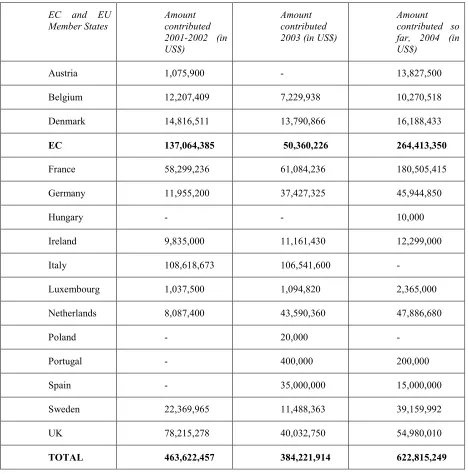
As the second largest individual donor, the EC has contributed more than 18% of the total Global Fund budget in 2004 and provides longer-term, predictable financing. The EC has committed €460.5 million from 2001 through 2006 – half from the EDF and half from the EC budget.30 Europe (EC and EU Member States) is now the largest donor, having committed more than half of the total budget for the Global Fund (€2.4 billion out of the total €4.6 billion). The financial support from Europe comes fully untied (refer to Annex 2 for details on EU Member States financial contributions to the Global Fund).
28
Regulation (EC) 1567/2003 of the European Parliament and of the Council on aid for policies and actions on reproductive and sexual health and rights in developing countries
29
The new horizontal budget line replaced two budget lines on HIV/AIDS-related operations in developing countries (AIDS and Population, and Reproductive Health).
30
The Global Fund to Fight AIDS, TB and Malaria
The Global Fund is an innovative and accountable financing mechanism, which raises, manages and disburses resources quickly to beneficiary programmes based on national plans and priorities, including PRSPs and sector-wide approaches (SWAps). Global Fund programmes are developed in an inclusive and participatory process at country level through Country Coordinating Mechanisms (CCMs) and evaluated by an independent technical review panel.
The Global Fund is an effective and innovative way of making funds available to confront the three diseases at country level. Its flexibility allows for the channelling of resources to countries which may previously not have received EC funding for the three diseases, health or macroeconomic budget support through geographic instruments.
The results of the Global Fund include:
• An allocation of 56% of the funding to HIV/AIDS, 31% to malaria and 13% to TB. Approximately 70% of the funding goes to low-income countries and a further 26% to lower middle-income countries. Africa receives 60% of the total funding.
• 51% of programme allocations is for strengthening the capacity of health systems. • The Global Fund has approved 310 programmes in 128 countries through four
rounds of calls for proposals.
• The EC has worked to ensure that the Global Fund sets up procurement policies which maintain quality standards and can make pharmaceutical products available at the lowest possible prices. Working with Global Fund procurement policies, countries such as Jamaica can save up to 50% of the costs of ARV treatment.31 The EC has achieved full transparency with regard to the prices paid for pharmaceutical products by countries.
By 2009, Global Fund programmes are expected to have achieved the following results:
HIV/AIDS: The number of people on ARV treatment will have increased six-fold to almost 1.6 million. Voluntary HIV counselling and testing services for prevention will have been provided to 52 million people. Increased access to condoms has been included in approximate 70% of all the Global Fund-approved HIV/AIDS programmes.
million TB patients will have been treated as part of the internationally-recommended TB control strategy DOTS (directly observed therapy short-course). Malaria: 108 million insecticide-treated malaria bednets will have been provided and 145 million artemisinin-based combination therapy treatments for malaria will have been delivered.
Further information on the Global Fund can be obtained from www.theglobalfund.org
The untying of aid: The untying of aid is an important measure to increase the value of ODA, and was identified as a key activity in the PfA. The decision was taken to untie aid for the first time in the PfA. The first country to benefit from untying was Zimbabwe, through an international tender for the provision of drugs and medical supplies. Drug procurement in Zimbabwe in 2002 and 2003 made under the Health Sector Support Programme managed to purchase drugs at prices around 40% below the prices estimated using the International Drug Price Indicator Guide published by WHO. The full untying of procurement through the Global Fund was a second major result of the PfA, due to pressure by the EC. This has led to significant reductions in the price of pharmaceutical products financed through Global Fund programmes. For example, Jamaica managed to reduce the cost of ARV treatment from US$1,380 to US$702 per patient/year. Honduras is another country which has reduced the price of first-line ARV from US$1,380 to US$205 per patient/year.32
3.1.2. Strengthening of pharmaceutical policies and capacity building
Capacity building: The PfA identified support to strengthen pharmaceutical policy and practice. In 2002, the EC programmed €25 million from the 9th EDF (intra-ACP funds) for support through WHO. This aims to enhance the capacity of ACP countries in various areas of pharmaceutical policy, including: the development, implementation, and monitoring of national drug policies; the negotiation and monitoring of international trade agreements on pharmaceutical products, and the development of supportive related legislation and regulations; the improved affordability and financing of essential drugs in both the public and private sectors; the establishment of more reliable and efficient pharmaceutical product supply management systems, including, where appropriate, development of regional pooled procurement; the strengthening of norms, standards and guidelines for the quality, safety and efficacy of key drugs (including the fight against counterfeit drugs); and training and monitoring the rational prescription and dispensing of drugs by health professionals. The overall objective of the programme is to close the huge gap between the potential that essential drugs have to offer and the reality that for millions of people – particularly the poor and disadvantaged – drugs are unavailable, unaffordable, unsafe or improperly used.
In addition to this regional cooperation on pharmaceutical policy, the EC provides support through its bilateral cooperation with several African countries to the
32
development of national pharmaceutical policies (e.g. in Mozambique) and essential drug supply (e.g. in Zimbabwe). In Chad and Guinea, the health programmes have specific components on pharmaceutical policies.
Enhanced partnerships: Developing countries need to be sure of the quality and safety of pharmaceutical products they intend to purchase. To support this, part of the €25 million EC allocation in 2002 goes to the WHO prequalification project (Procurement, Quality and Sourcing Project: Access to HIV/AIDS, tuberculosis and malaria products of acceptable quality). The WHO prequalification process assesses the quality, safety and efficacy of drugs submitted by participating manufacturers. It evaluates pharmaceutical manufacturers and products according to WHO recommended standards of quality and compliance with Good Manufacturing Practice. The project was originally set up in 2001 to give UN procurement agencies the choice of a range of quality drugs, which would facilitate access. Since then, the list has increasingly been used by other purchasing agencies and organisations as well as by countries. The list of pharmaceutical products pre-qualified by WHO includes FDCs for HIV/AIDS, malaria and TB. These are recommended by WHO for patients in resource-poor countries.33 However, many local production sites have not yet been assessed, and WHO recently removed five generic products (including three FDC drugs) used to treat HIV/AIDS patients from the list, referring to lack of evidence on bioequivalence with patented products. This leaves only three fixed-dose combination ARVs on the WHO list, which narrows the choice of affordable pharmaceutical products available for use in developing countries.
Regulatory issues, with the EMEA and WHO: The PfA specified the need to enhance and improve regulatory schemes. A key achievement has been the recently adopted revision of the EU pharmaceutical legislation. This lays down specific provisions enabling the European Medicines Agency (EMEA) to give a scientific opinion, upon request by WHO, for the evaluation of certain medicinal products manufactured in the EU intended for markets outside the EU.34 These provisions respond to the need to protect public health and give scientific assistance to developing countries, while at the same time allowing rapid access to those countries for important new medicinal products. It should be coordinated with a gradual strengthening of national and regional capacities to progressively reduce dependency and increase ownership.
Licensing mechanisms for pharmaceutical products outside of developing countries can still affect them, even more so because their own regulatory capacities are weak. For example, the US’s Food and Drug Administration (FDA) has marketing approval requirements for pharmaceutical products procured under the US President’s Emergency Plan for AIDS Relief (PEPFAR). These mitigate against the purchasing
33
and distribution of generic drugs in developing countries,35 which are often cheaper than drugs produced by R&D based companies.
3.1.3. Developing local manufacturing capacity
Local production: The PfA calls for increased assistance to developing countries to develop high-quality local production of key pharmaceutical products. The EC supported a feasibility study in the local production of condoms in several African countries, which demonstrated that there is clear potential for local production in several main countries.
So far, progress has been slow. Local production is now one of three priority areas in the calls for proposals 2003-2006 for the budget line on Aid for Poverty-Related Diseases. This presents the possibility of supporting innovative actions, which could then be scaled up, potentially through other instruments such as country budget lines, the European Investment Bank and the Centre for Development of Enterprise (specified by the Cotonou Agreement).
35
IMPACT
Key results:
• A four-fold increase in EC resources allocated specifically to confronting the three diseases, at a €259.02 million annual average programmed for 2003-2006 as compared to a €59.32 million annual average committed for 1994-2002, illustrating the increased commitment to confronting the three diseases. This includes a 4-fold increase in funds from the 5th to the 6th FP (RTD) (from €109 million, 1998-2002, to more than €400 million, 2002-2006) allocated to research on HIV/AIDS, malaria and TB.
• More flexibility in funding, and accelerated disbursement, to confront the three diseases. Firstly, responsive use of the intra-ACP budget line to support new partnerships and distribute greater resources at country level (this includes EC leadership and substantial support for the Global Fund). Secondly, new instruments (the budget line on Aid for Poverty-Related Diseases) to support innovative actions at global level and faster disbursement to demand-driven proposals in countries.
• EMEA now able to evaluate pharmaceutical products intended exclusively for markets outside the EU. These provisions respond to the need to protect public health and give scientific assistance to developing countries.
Key Challenges:
• To encourage countries most affected by the three diseases to prioritise health, and investment in the strengthening of the health system and sustainable long-term financing.
• To monitor health outcomes in countries where the EC provides health and/or macroeconomic budget support. Presently, it is difficult to show impact beyond resource allocation.
• To ensure, in the new EC financial perspectives, predictable and sustainable but also flexible funding targeting the three diseases, within the context of support for strengthened health and other social services.
• To strengthen the regulatory capacity of countries (possibly through WHO support).
3.2. Affordability
Rationale for action: At the time of developing the policy framework,36 prices of some key pharmaceutical products for the three diseases were unaffordable for households and countries. It would not have been the best use of ODA to support the purchasing of such expensive products. To give one example, in 2000 when the EC policy framework was adopted, the price of patented ARV was around US$10,000/person/year.
Political pressure and policy decisions: Various factors contributed to the price decrease in some key pharmaceutical products, the most important of which are discussed below. The EC has played a leading role in most, if not all, of them. Some were planned actions under the PfA, for example the promotion globally of tiered pricing, and issues relating to intellectual property. Other factors were the result of the synergy and interplay of PfA actions, for example the EC’s partnership with civil society and developing countries on issues of global advocacy, and the increase in demand for ARVs due to Global Fund funded projects in-country.
Sustained public pressure and advocacy from civil society and international organisations, and the eventual responsiveness of the corporate community in acknowledging the importance of prices, are key reasons behind the fall in prices of pharmaceutical products.
The most important area of progress in the past few years with regard to the three diseases is the dramatic reduction in price of anti-retrovirals (ARVs) to treat HIV/AIDS. In September 2000, a major announcement made by Cipla (an Indian generic pharmaceutical product manufacturer) at the EC Round Table discussion37 initiated the price reduction in ARVs to around US$500 per person per year. R&D based pharmaceutical companies also committed themselves to large price reductions (GlaxoSmithKline at the same Round Table) at around the same time.38 Today, the lowest prices for first-line ARV treatment are between $100-$350 per person per year.39
Increasing transparency: The 2003 progress report identified the need for improved transparency in prices of pharmaceutical products. It is unsatisfactory to
36
Affordable drugs are also included in the MDGs, Goal 8, Target 17 – “In cooperation with pharmaceutical companies, provide access to affordable, essential drugs in developing countries”; in the Amsterdam targets for TB – “By 2005, 70% of people with infectious TB will be diagnosed, and 85% cured”; and in the Abuja targets for malaria – “Ensure that by 2005 at least 60% of those suffering from malaria have prompt access to, and are able to correctly use, affordable and appropriate treatment within 24 hours on the onset of symptoms.”
37
This Round table was hosted by the EC to ensure broad consultation on the Communication (2000). It was organised in partnership with WHO, UNAIDS, and 170 stakeholders, including developing countries, the European parliament, civil society, and leaders of major pharmaceutical companies. Stakeholders reached a wide level of consensus.
38
rely on fragmentary data. One success of the past few years has been the gradual but slow increase in price transparency, especially from Principal Recipients buying pharmaceutical products under Global Fund-supported contracts. Some NGOs also show what prices they pay for procuring products, and some manufacturers have started to be themselves more transparent about prices. The increasing price transparency facilitates the comparison of prices, informs potential buyers and ensures that market competition contributes to reducing prices in developing countries. Exact details on prices remain hard to obtain; Annex 3 illustrates some prices of certain key ARVs, as published on the web-page of the Global Fund. The Global Fund has a Price Reporting Mechanism where Grant Recipients have to publish the prices they paid for pharmaceutical products purchased under Global Fund projects.
3.2.1. Tiered Pricing
EC Regulation on trade diversion: The concept of tiered pricing (that buyers in developing countries should have access to medicines at considerably lower prices than buyers in more well-off countries) is one that the EU has consistently emphasised. Pharmaceutical producers in developed countries need security that discounted products supplied in large volumes do actually reach the poor countries they are meant for and are not diverted back into high price markets. This will enable them to enter new markets and support the reduction of communicable diseases. In May 2003, the Council therefore adopted a Regulation to avoid trade diversion into the European Union of certain key medicines.40
The Regulation aims to encourage producers to significantly increase supplies of medicines at tiered prices in developing countries, while maintaining higher prices for the same products in the EU. Exporters are invited to register their products on a tiered price list established by the EC.41 The Regulation responds to the danger of diversion of cheap imported medicines from poor countries into high price markets, and provides an incentive to reduce prices further. It also ensures that price reductions are sustainable for the producer and predictable for the purchaser. To some extent, it also enhances transparency.
Both patented and generic products can be registered, as can donated products. In order to be added to the list, medicines have to be made available either with a price cut of at least 75% off the average ‘ex factory’ price in OECD countries, or at the cost of production plus maximum 15%. The proposed system is simple and transparent, with products on the list bearing a logo for identification purposes.42 The Regulation makes no differentiation between products sold to public authorities, NGOs, and private buyers. In developing countries, medicines frequently consume a significant proportion of private household expenditure. Therefore, the price of pharmaceutical products in the private market is as important as those sold to public authorities and a key determinant of access.
40
Regulation (EC) 953/2003. OJ L 135, 3.6.2003, p.5
41
As the 2003 progress report identified, the Regulation is the start of a successful tiered pricing policy that will contribute to increased affordability. To date, GlaxoSmithKline (a leading manufacturer of ARVs which has strongly supported the tiered pricing policy from the beginning) has registered 7 HIV/AIDS products under the Regulation to be protected against trade diversion.43 Two further applications from GlaxoSmithKline are still pending and will be processed before the end of 2004. The company is also advocating the merits of the EU Regulation to other pharmaceutical R&D based companies.44 The first annual report of the activities under the Regulation will be published in the autumn of 2004, showing the volumes of exports of tiered priced products. In accordance with the Regulation, the EC will issue a standard form by which manufacturers and exporters registered under the Regulation will report their annual volumes. Under the Regulation, the EC is also required to periodically report to the Council on the volumes exported under tiered prices.
EC advocacy of tiered pricing: The EC is encouraging other developed countries to introduce a tiered pricing policy. As specified in the PfA, the EC is currently engaged in an informal dialogue with Japan on the issue of access to medicines. The Japanese government informed the EC that Japan did not produce or export treatments for HIV/AIDS, tuberculosis or malaria and that, therefore, a tiered pricing policy was not necessary. However, the Japanese government responded positively to the possibility of extending the current dialogue to the broader issue of increasing access to medicines for developing countries. No progress with other major countries has been achieved.
The EC policy framework (2000) argued strongly that there is an inverse relationship between the price of pharmaceutical products sold in developing countries and the number of people treated (i.e. volumes sold). This relationship appears to have been borne out in practice. The increase in treatment uptake as supported by country strategies, the Global Fund, NGOs such as Médecins Sans Frontières (MSF), the Global Alliance for Vaccines and Immunization (GAVI)45 and calls such as the 3 by 5 Initiative are starting to increase the number of people being treated.46 This has only been possible through price reductions, which made increased treatment a realistic possibility.
43
Trizivir 750mg, Epivir 150 mg, Retrovir 100 mg, Retrovir 250 mg, Retrovir 300mg, Combivir 300/150mg, Epivir Oral Solution 10mg/ml 240ml
44
From DFID ‘Increasing access to essential medicines in the developing world: UK Government policy and plans’, June 2004
45
The Global Alliance for Vaccines and Immunization (GAVI) is a public-private partnership launched in 2000 which through the Vaccine Fund provides financial resources to countries to purchase vaccines and other supplies and to support the operational costs of immunisation.
http://www.vaccinealliance.org/home/index.php
46
3.2.2. Tariffs and taxes
Another activity specified in the PfA was to work towards eliminating the hurdles of tariffs, taxes and importation, distribution, and local registration fees in importing countries. This was intended to further eliminate hurdles to access to pharmaceutical products. An EC study on duties and taxes on pharmaceutical products in 57 developing countries47 showed that there is still scope for lowering tariffs and taxes in some countries. The range of duties and taxes currently varies from 55% on most pharmaceutical products in India to 0% in countries such as Cuba, Gabon, Indonesia, Iran, Malaysia, Nicaragua and Uganda. This issue is being addressed on a bilateral basis through EC trade and policy dialogue.
3.2.3. Use of flexibilities within the Agreement on Trade-Related Aspects of Intellectual Property Rights
The World Trade Organisation Agreement on Trade-Related Aspects of Intellectual Property Rights (TRIPs) defines minimum standards for intellectual property protection in WTO Member States. This is important for the development of research-based pharmaceutical products to allow a return on investment, which is reflected in the price of patented pharmaceutical products. From the outset, the EU has been at the forefront of efforts to ensure access to affordable pharmaceutical products for developing countries. In the WTO, the EC has played a lead role by acting as a bridge-builder to bring together the almost irreconcilable positions of the opposing sides. These efforts were most apparent in the results of the negotiations in Doha, where the WTO agreed on a groundbreaking Ministerial Declaration on the TRIPs Agreement and Public Health (November 2001), which reaffirmed existing flexibilities within TRIPs, including that the Agreement should not prevent countries from taking measures to improve public health and promote access to medicines. The Declaration affirms that these flexibilities comprise the use of compulsory licensing in order to serve developing countries’ markets. The Declaration also defers the obligation for Least Developed Countries to enforce patents on pharmaceutical products until 2016.
The Doha Declaration left one issue unresolved: countries with no manufacturing capacity for pharmaceutical products, which include those in greatest need of affordable drugs, would not benefit from the use of compulsory licences. To serve the needs of their markets, those countries need to import medicines. However, Article 31(f) of the TRIPs Agreement stipulates that compulsory licences must be “predominantly for the supply of the domestic market of the Member authorising such use”. Therefore, the granting of compulsory licences for the sole purpose of exportation was not allowed. The EC was strongly supportive of finding a quick solution. In this context, in April 2003, the EC organised a “Round Table on Access to Medicines”.48 One of the main objectives of the Round Table was to recommend how the G8 Summit in Evian in June 2003 could progress on this critical issue. Over 90 external participants attended, representing international organisations,
47
governments of developed and developing countries, R&D based industry, generic industry, pharmaceutical associations and NGOs.
In August 2003, the WTO General Council adopted the ‘Decision on the Implementation of Paragraph 6 of the Declaration on the TRIPs Agreement and Public Health’. Under certain conditions, WTO members with no or limited manufacturing capacity may now purchase drugs, in order to address a public health problem within their territory, produced under a compulsory licence in a WTO member with manufacturing capacity.
National patent laws in exporting countries need amendment to provide for this. Discussion on a formal amendment to the text of the TRIPs Agreement continues in the WTO TRIPs Council, with the aim of reaching agreement by June 2005. While this amendment remains in preparation, those developing countries wishing to use the mechanism to import essential medicines today will not face litigation (WTO dispute Settlement Mechanism) as a result. The EC is finalising a draft Regulation to implement this decision to be directly applicable in the EU. It contains the necessary safeguards and other conditions that are necessary when an EU Member State becomes an exporter under the new system.
The EC/EU attaches great importance to ensuring that the Doha Declaration is not undermined either in the formal amendment of the TRIPs Agreement, through bilateral negotiations, or through national legislation. Recently, some negotiating partners (particularly the US) have been criticised for seeking regional and bilateral free trade agreements (FTAs) in which developing countries are asked to refrain from using the flexibilities as provided by the Doha Declaration by more stringent provisions in the FTAs.49 Criticisms have also been levelled for delaying amendments to the TRIPs Agreement pursuant to the 30 August 2003 Decision. The EC and EU Member States have voiced criticism of the US for such actions.
Another way in which the EC has been supporting adherence to the commitments made in Doha 2001 is through the World Intellectual Property Organisation (WIPO). At the WIPO General Assembly in 2003, the EC and EU Member States made a statement that the adoption of the Doha Declaration and the decision on paragraph 6 should be reflected in WIPO’s technical assistance. In addition, the Commission has engaged in a dialogue with WHO on health and trade matters, resulting in more information exchange and reinforced cooperation in public health matters.
Beyond affordability to access: The reduction in the price of ARVs and other pharmaceutical products is necessary to increase access, but is not sufficient in itself. Lower prices can be a catalyst for change, and stimulate progress in other areas that are essential to promote access. These include effective procurement, regulatory control, transport and storage facilities and an efficiently functioning health infrastructure with referral mechanisms in place, essential logistics supply
49
mechanisms and appropriately trained, employed, remunerated and effectively managed health staff to deliver the medicines and supervise treatment.
Most of the people suffering from HIV/AIDS, malaria and TB live in the poorest countries, and belong to the poorest sectors of society. Even where there are existing and effective technologies and interventions, many people do not have access to them. Further reduction in prices would increase the number of countries and the pool of people able to afford them, especially those living in least developed countries where US$150 per person per year – the cost of a first-line ARV – is still far beyond what national health budgets or individual incomes can support.
In 2000, there were still more than 2,700,000,000 people living on less then US$2/day.50 As of June 2004, 440,000 people were estimated to have received ARVs out of a total estimated number of six million people in immediate need of treatment in developing countries (only 8%). This is an increase of 40,000 from the total number of people on treatment in 2003.51 According to the 3 by 5 Initiative Progress Report (December 2003 through June 2004), access to ARV medicines in 2002 increased by 50% globally, and by two-thirds in sub-Saharan Africa. This excludes Brazil, which still accounts for about 33% of all people on ARV therapy in developing countries.52
AFFORDABILITY
Key results:
• A reduction by up to 98% in the price of some key pharmaceutical products in developing countries.
• Global acceptance of tiered pricing as a sound principle, an established definition of what constitutes a maximum threshold for a tiered price, and anti-trade diversion measures put in place for registered products.
• Agreement reached on all aspects of the Doha Declaration on TRIPs and Public Health, including Paragraph 6, which allows countries with insufficient manufacturing capacity to import less expensive pharmaceutical products to address a public health problem.
Key challenges:
• To accelerate price reductions (i.e. make tiered pricing the norm) in developing countries, and to broaden the range of more affordable pharmaceutical products. • To reduce or eliminte import tariffs on essential pharmaceutical products to ensure
lowest possible consumer prices in developing countries.
50
Global Economic Prospects 2004, World Bank www.worldbank.org/prospects/gep2004/chapter1.pdf
51
WHO, “Treating 3 Million by 2005: Making it Happen. The WHO Strategy”, 2003
52
• To continue to improve transparency of prices of pharmaceutical products and price reductions, through the Regulation on trade diversion and through the Global Fund. Public advocacy and support for greater price transparency is an underplayed card in the affordability arena.
• To support developing countries’ capacity to use flexibilities under the Doha Declaration, and to ensure that the Doha Declaration is not eroded (through bilateral agreements).
• To go beyond affordability to promote access, primarily through developing functioning health infrastructure with appropriately trained, employed, remunerated and managed staff.
3.3. Research and development of new tools
Rationale for action: The PfA calls for continued and increased support for basic and strategic research on new tools for the three poverty diseases, with greater coordination at European and international level. The PfA calls for the creation of a European and Developing Countries Clinical Trials Partnership (EDCTP) to increase the number, efficiency and coherence of clinical trials carried out in developing countries in Africa with a high disease burden. It also calls for incentives to harness the capacity of private industry to invest in and develop new tools targeting the three diseases.
The EU’s support remains strong. In June 2004, at a conference bringing together a multitude of private and public partners held in Dublin and co-hosted by Ireland and the Netherlands, the EU endorsed the Global HIV/AIDS Vaccine Enterprise, and agreed on priority actions to improve and speed up the development of new preventive technologies such as HIV vaccines and microbicides.
The 6th FP (RTD) for 2002-2006 was adopted by the European Parliament and the Council in June 2002.53 Compared to the 5th FP (RTD) for 1998-2002, the indicative budget for poverty-related diseases under the 6th FP (RTD) is substantially higher, with more than €400 million being allocated to basic, pre-clinical and clinical research in new interventions for HIV/AIDS, malaria and TB (a 4-fold increase from €109 million). Substantial efforts have since been made to gather a critical mass of private and public partners, from developed and developing countries in a limited number of relatively large project consortia, typically handling budgets in the range of €5-20 million. The Quality of Life approaches54 have been consolidated in the 6th FP (RTD), where research in poverty-related diseases has become a specific budget item under the first priority thematic area (life sciences, genomics and biotechnology
53
Decision No 1513/2002/EC. OJ L 232, 29.8.2002, p.1
54
for health). The International Scientific Cooperation programme continues to support North-South collaborative research projects on health systems and policies, other neglected diseases, child survival, and reproductive health.
Currently, a number of highly significant research projects are under way and delivering results, funded by the 5th FP (RTD). These include a multicentre trial of shortening TB treatment to four instead of six months, a series of early clinigal tests for TB vaccination, and various projects dealing with new malaria drugs such as phosphidomycin. Another significant action is the support to a pioneering effort of HIV/AIDS vaccine research in China, based on the locally predominant C-strain of the HIV virus.
3.3.1. Strengthening of research in poverty-related diseases
The EC has made an important contribution to confronting HIV/AIDS, malaria and TB by pooling knowledge, experiences, human and financial resources from the different stakeholders in the research and development process. The 6th FP (RTD) has given increased opportunities to organising and funding large-scale research projects, with a high and lasting potential impact. The EC is now supporting a much wider range of research activities, expanding from early discovery to clinical trials and comprising an extensive pipeline of promising development projects. Since the launch of the PfA, European research in poverty-related diseases has become ever more visible, influential and effective on the global research agenda and in its priorities. Alliances have been created with foundations and industry, and closer interaction with national and international organisations has been implemented. Support for large research consortia: The significant funding allows for large consortia with diversity and critical mass to undertake complete product/intervention development projects. Development of promising drug and vaccine candidates from discovery phases to early human testing is undertaken by multidisciplinary research consortia that are organised as Integrated Projects (IPs) or Networks-of-Excellence (NoEs). So far, support has been given to 6 projects with a total budget of €160 million and an EU contribution of €73 million.The 6 projects cover malaria biology (EU contribution of €15.5 million), TB and HIV vaccine development (EU contributions of, respectively, €16.8 million, €15.5 million and €10 million), as well as microbicides (EU contributions of €3.8 million and €11.7 million). During the next two years of the 6th FP (RTD), funding will be provided to drug development projects in malaria and TB, while other projects should focus on further development of HIV/AIDS and malaria vaccine candidates.