quantitative data : a methodological assessment of systematic reviews.
White Rose Research Online URL for this paper:
http://eprints.whiterose.ac.uk/135802/
Version: Published Version
Article:
Campbell, Mhairi, Katikireddi, Srinivasa Vittal, Sowden, Amanda
orcid.org/0000-0001-9741-8427 et al. (1 more author) (2018) Lack of transparency in
reporting narrative synthesis of quantitative data : a methodological assessment of
systematic reviews. Journal of Clinical Epidemiology. pp. 1-20. ISSN 0895-4356
https://doi.org/10.1016/j.jclinepi.2018.08.019
[email protected] https://eprints.whiterose.ac.uk/ Reuse
This article is distributed under the terms of the Creative Commons Attribution-NonCommercial-NoDerivs (CC BY-NC-ND) licence. This licence only allows you to download this work and share it with others as long as you credit the authors, but you can’t change the article in any way or use it commercially. More
information and the full terms of the licence here: https://creativecommons.org/licenses/
Takedown
If you consider content in White Rose Research Online to be in breach of UK law, please notify us by
Accepted Manuscript
Lack of transparency in reporting narrative synthesis of quantitative data: a methodological assessment of systematic reviews
Mhairi Campbell, Srinivasa Vittal Katikireddi, Amanda Sowden, Hilary Thomson
PII: S0895-4356(18)30327-5 DOI: 10.1016/j.jclinepi.2018.08.019 Reference: JCE 9728
To appear in: Journal of Clinical Epidemiology
Received Date: 10 April 2018 Revised Date: 26 July 2018 Accepted Date: 31 August 2018
Please cite this article as: Campbell M, Katikireddi SV, Sowden A, Thomson H, Lack of transparency in reporting narrative synthesis of quantitative data: a methodological assessment of systematic reviews, Journal of Clinical Epidemiology (2018), doi: 10.1016/j.jclinepi.2018.08.019.
M
A
N
U
S
C
R
IP
T
A
C
C
E
P
T
E
D
1
Lack of transparency in reporting narrative synthesis of quantitative data: a methodological 1
assessment of systematic reviews 2
Authors: Mhairi Campbella, Srinivasa Vittal Katikireddia, Amanda Sowdenb, Hilary Thomsona 3
4
Affiliations: 5
a
MRC/CSO Social and Public Health Sciences Unit, University of Glasgow, 200 Renfield Street, 6
Glasgow, G2 3QB, UK 7
b
Centre for Reviews and Dissemination, University of York, York, YO10 5DD, UK 8
9
Corresponding author: Mhairi Campbell 10
Postal address: MRC/CSO Social and Public Health Sciences Unit, University of Glasgow, 200 Renfield 11
Street, Glasgow, G2 3QB. 12
Email: [email protected] Tel. 0141 353 7601 13
14
15
16
17
M
A
N
U
S
C
R
IP
T
A
C
C
E
P
T
E
D
2
Abstract
19
Objective: To assess the adequacy of reporting and conduct of narrative synthesis of quantitative 20
data (NS) in reviews evaluating the effectiveness of public health interventions. 21
Study design and setting: A retrospective comparison of a 20% (n=474/2372) random sample of 22
public health systematic reviews from the McMaster Health Evidence database (January 2010-23
October 2015) to establish the proportion of reviews using NS. From those reviews using NS, 30% 24
(n=75/251) were randomly selected and data extracted for detailed assessment of: reporting NS 25
methods; management and investigation of heterogeneity; transparency of data presentation; and 26
assessment of robustness of the synthesis. 27
Results: Most reviews used NS (56%, n=251/446), meta-analysis was the primary method of 28
synthesis for 44%. In the detailed assessment of NS: 95% (n=71/75) did not describe NS methods; 29
43% (n=32) did not provide transparent links between the synthesis data and the synthesis reported 30
in the text; of 14 reviews that identified heterogeneity in direction of effect, only one investigated 31
the heterogeneity; and 36% (n=27) did not reflect on limitations of the synthesis. 32
Conclusion: NS methods are rarely reported in systematic reviews of public health interventions and 33
many NS reviews lack transparency in how the data are presented and the conclusions are reached. 34
This threatens the validity of much of the evidence synthesis used to support public health. 35
Improved guidance on reporting and conduct of NS will contribute to improved utility of NS 36
systematic reviews. 37
38
Key words: systematic review, meta-research, methodology, narrative synthesis, evidence synthesis 39
Running title: Reporting and conduct of narrative synthesis in systematic reviews 40
M
A
N
U
S
C
R
IP
T
A
C
C
E
P
T
E
D
3
What is new? 42
Key findings
43
• Based on a sample of public health reviews, it is apparent that, despite being commonly 44
used, narrative synthesis often lacks transparency. 45
• Synthesis methods are rarely reported, and presentation of data in the review often does 46
not facilitate clear links between visual presentation of the data and the text. 47
What this adds to what was known?
48
• This is the first study to assess the adequacy of reporting of narrative synthesis of 49
quantitative data in systematic reviews. 50
What is the implication and what should change now?
51
• Substantial improvements in clarity of reporting of narrative synthesis are required. There is 52
a need for existing guidance to inform the development of a clear and concise reporting 53
guideline for narrative synthesis. 54
• Greater transparency when reporting narrative synthesis will allow end users including 55
practitioners and policy decision-makers to have greater confidence in the results of 56
systematic reviews that use narrative synthesis. 57
M
A
N
U
S
C
R
IP
T
A
C
C
E
P
T
E
D
4 1 INTRODUCTION 59Well conducted systematic reviews have an important role in supporting evidence-informed policy 60
and practice.[1, 2] The value of systematic reviews in supporting decision-making, compared with 61
other types of review, is their use of a transparent method to draw conclusions based on the best 62
available evidence. While meta-analysis is a cornerstone of many systematic reviews, statistical 63
pooling may not always be appropriate or feasible due to high levels of heterogeneity or lack of 64
available data to calculate standardised effect estimates (e.g. standardised mean difference, odds 65
ratio, risk ratio). Heterogeneity, both statistical and methodological, is a common issue for public 66
health reviews where it is typical to include diverse study designs, outcomes, contexts, populations, 67
and interventions.[3] When meta-analysis is inappropriate or not possible, data may be synthesised 68
narratively; this method is relied on heavily by those conducting reviews addressing public health 69
issues. For example, 74% of National Institute for Health and Care Excellence (NICE) public health 70
appraisals included NS.[4] 71
Concerns have been raised that Narrative Synthesis of quantitative data (NS) lacks transparency and 72
has substantial potential for bias.[5-7] Specifically, there is concern that conclusions of NS are based 73
on subjective interpretation[5, 7] with a risk of over emphasising selected results without clear 74
justification. This lack of transparency, limits assessment of the level and sources of bias in NS,[5] 75
threatens the replicability of the method, and may ultimately threaten the validity and value of 76
review findings based on NS. However, empirical evaluations of the reporting and adequacy of NS 77
are lacking. This paper presents the findings of a systematic review that aimed to establish current 78
practice, and adequacy of reporting and conduct of NS of quantitative data in public health 79
systematic reviews. 80
2 METHODS
81
To assess reporting and conduct of NS, we identified a random sample of recent public health 82
systematic reviews and systematically assessed the adequacy of reporting and conduct by 83
benchmarking against available published guidance. The methods of this review are described 84
below, further details are available in the review protocol.[8] 85
To establish existing guidance on NS, we consulted publications, textbooks and methods papers, 86
these are outlined in Box 1, along with the key elements of NS from the most comprehensive 87
guidance of provided by Popay et al.[9] For the purposes of this work, we used the definition of NS 88
as proposed by Popay et al. in the UK’s Economic and Social Research Council (ESRC) guidance: 89
“Narrative synthesis refers to an approach to the systematic review and synthesis of findings from
90
multiple studies that relies primarily on the use of words and text to summarise and explain the
91
findings of the synthesis. Whilst narrative synthesis can involve the manipulation of statistical data,
92
the defining characteristic is that it adopts a textual approach to the process of synthesis to ‘tell the
93
story’ of the findings from the included studies”.[9, page 5] 94
Box 1: Overview of ESRC guidance on narrative synthesis[9] and additional key sources consulted
95
to establish best practice in narrative synthesis
96
M
A
N
U
S
C
R
IP
T
A
C
C
E
P
T
E
D
5
1. Developing a theoretical model of how the interventions work, why and for whom
2. Developing a preliminary synthesis: develop an initial description of the results of included studies.
Tools and techniques suggested: textual descriptions of studies, groupings and clusters, tabulation, transforming data into a common rubric, vote counting, translating data thematic analysis, content analysis.
3. Exploring relationships in the data: examine emerging patterns in data to identify any explanations for differences in direction or size of effect across included studies
Tools and techniques suggested: graphs, frequency distributions, funnel plots, forest plots, moderator variables and sub group analysis, idea webbing and conceptual mapping, translation reciprocal and refutational, qualitative case descriptions, investigator/methodological triangulation, conceptual triangulation
4. Assessing the robustness of the synthesis product: trustworthiness of the synthesis, incorporating the methodological quality of the included studies and the methods used in the synthesis.
Tools and techniques suggested: weight of evidence, best evidence synthesis, use of validity assessment, reflecting critically on the synthesis process, checking the synthesis with authors of primary studies.
Additional sources consulted to develop data extraction tool:
• An introduction to systematic reviews [11]
• Systematic reviews in the social sciences: a practical guide [12]
• Synthesising qualitative and quantitative health evidence: a guide to methods [13]
• Guidelines for systematic reviews of health promotion and public health interventions [14]
• Cochrane handbook for systematic reviews of interventions [5]
• WHO Handbook for guideline development [16] 97
98
2.1 Search strategy, inclusion criteria and review selection
99
We obtained a download of systematic reviews, from the McMaster Health Evidence database 100
(http://www.healthevidence.org/), which were published between January 2010 and October 2015 101
inclusive. The Health Evidence database contains systematic reviews relevant to public health which 102
meet each of the following criteria: address questions related to promotion, protection or 103
prevention in public health or health; include participants from developed countries; examine an 104
M
A
N
U
S
C
R
IP
T
A
C
C
E
P
T
E
D
6strategy (see http://www.healthevidence.org/our-appraisal-tools.aspx). The Health Evidence 106
database uses a validated search filter which has high sensitivity, specificity and precision for 107
retrieving systematic reviews of public health interventions.[10] In addition to the database inclusion 108
criteria, we specified that reviews had to be systematic and contain synthesis; we excluded expert 109
reviews, overviews, empty reviews and reviews with no synthesis. 110
Using the Microsoft Excel© random number function, a 20% random sample was selected from the 111
full Health-Evidence database download. The Excel random number function was used to allocate a 112
number to each database entry (the results of the Health Evidence database search) and numbers 113
were sorted lowest to highest. The first 20% of the random numbers were used to identify and 114
include the corresponding Health Evidence reviews. This sample of reviews was screened (by MC, 115
HT, AS, SVK) to identify reviews using NS of quantitative data for their primary outcome. If the 116
review did not state a primary outcome, we identified the “primary outcome” of interest by the 117
review question(s). A further 30% sub-sample of reviews which used NS as the primary method of 118
synthesis was randomly selected for more detailed data extraction and analysis. 119
2.2 Data extraction
120
The data extraction form was designed to reflect key elements of good practice in the conduct and 121
reporting of NS of quantitative data. Key sources on the conduct of NS of quantitative data[11-16] 122
informed the design of the data extraction form. (See Box 1) Three members of the research team 123
(MC, HT & SVK) read the key sources independently and prepared a list of items or components that 124
were common in the key sources. The lists were then collated to prepare items for inclusion in the 125
draft data extraction form, which was then finalised in discussion with all authors (online Supporting 126
Information file, Appendix Table S1). There was little variation in recommended practice for NS 127
across the identified sources. The ESRC guidance provided the most comprehensive explanation and 128
the other sources appeared to draw heavily on this guidance.[9] The data extraction form, therefore, 129
largely reflects the core components recommended in the ESRC guidance. Five main aspects of NS 130
were identified and covered by the data extraction exercise, namely: 131
• Reporting of NS methods 132
• Use of theory (i.e. articulation of how the intervention is expected to work) 133
• Management and investigation of heterogeneity across studies 134
• Transparency of data presentation and links to narrative 135
• Assessment of robustness of the synthesis (i.e. reflection of the synthesis methods used to 136
assess the strength of the evidence from the included studies) 137
Two reviewers (MC and HT) independently piloted the data extraction form. All members of the 138
project team conducted data extraction on a selection of the same five reviews until assessments 139
were consistent across each member of the research team (MC, HT, SVK, AS). The data were entered 140
directly into a Microsoft Excel© database. Health Evidence quality assessment ratings of the reviews 141
were gathered after the data extraction exercise was complete. 142
2.3 Summarising the data
143
The extracted data were tabulated to reflect the five main aspects of NS (see above) and are 144
described narratively, with frequencies and descriptive data. Text was extracted to illustrate the 145
reporting of NS methods. 146
3 Results
M
A
N
U
S
C
R
IP
T
A
C
C
E
P
T
E
D
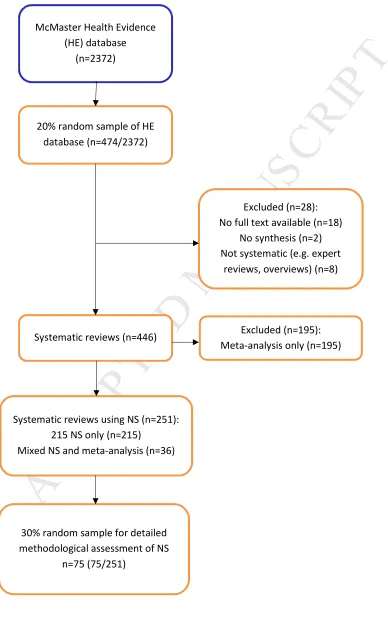
7A total of 2372 systematic reviews of public health interventions published between January 2010 148
and October 2015 were available from The McMaster Health Evidence database (see Figure 1). From 149
the initial 20% (n=474/2372) random sample of reviews, 28 (6%) were excluded as they did not fit 150
our inclusion criteria: not systematic review (expert review/overview) (n=8) or were empty reviews 151
(contained no studies) (n=2). We were unable to retrieve the full text of 18 further reviews. Of the 152
446 reviews included, 251 (56%) synthesised the data for the primary outcome narratively; of these, 153
215 (48%) used NS exclusively, and 36 (8%) used a combination of NS and meta-analysis for primary 154
outcome data (i.e. some data were included in the meta-analysis, with other data reported and 155
discussed in the narrative text). The remaining reviews (44%, n=195) used meta-analysis to 156
synthesise the primary outcome data. 157
3.1 Included reviews
158
All of the included reviews were published in international peer review journals. For a list of the 159
included reviews, see Appendix Table S2. A list of results of extracted items reported in the text of 160
this paper is provided in Appendix Table S3. The McMaster Health Evidence database provides a 161
quality assessment of each included review, this is based on a ten-item quality assessment tool that 162
covers all aspects of the systematic review process. The assessment incorporates clarity of review 163
question, appropriate search strategy, and risk of bias assessment, and two items assessing aspects 164
of synthesis (‘Was it appropriate to combine the findings of results across studies?’, ‘Were 165
appropriate methods used for combining or comparing results across studies?’) 166
(https://www.healthevidence.org/our-appraisal-tools.aspx.). We randomly selected and analysed 167
the 75 reviews in our sample blind to the Health Evidence quality assessment scores and retrieved 168
these scores after our data extraction exercise was complete. Of the reviews in our sample, 37% had 169
a strong rating (score of 8 to 10/10), 60% moderate (score of 5 to 7/10), and 3% weak (score of 1 to 170
4/10). Therefore, we are confident that the majority of the sample reviews followed good practice; 171
however that assessment process did not fully examine the synthesis processes in the systematic 172
reviews. 173
The following sections report on the detailed data extraction conducted on the 30% (n=75/251) 174
random sample of the reviews that synthesised data narratively. 175
3.2 Reporting of narrative synthesis methods
176
While 75 reviews synthesised data narratively, i.e. using text only, a description of the methods used 177
for NS was absent in 95% of the reviews (n=71). Where methods were reported, the description was 178
typically sparse, see examples in Box 2. Few review authors used the term ‘narrative synthesis’ to 179
describe their synthesis; 27% (n=20/75) described their synthesis as ‘narrative’ or ‘qualitative’, and 180
justification for using NS was rarely provided (15%, n=3/20). In around half (51%, n=38/75) of the 181
reviews using NS, the authors stated that they were unable to conduct a meta-analysis but provided 182
no further details of how the data were synthesised (Table 1, items 1.1 – 1.3). 183
Box 2: Examples of narrative synthesis description
184 185
Examples of narrative synthesis description
“A narrative synthesis was undertaken for each category of intervention to compare the effects of each on cervical screening uptake” Albrow R, Blomberg K, Kitchener H, et al. Acta Oncologica
2014; 53:445-51.
M
A
N
U
S
C
R
IP
T
A
C
C
E
P
T
E
D
8
was employed [citation provided].” Abendstern M, Harrington V, Brand C, Tucker S, Wilberforce M, Challis D. Aging Ment Health 2012; 16:861-73.
“Because of heterogeneity in outcomes and outcome assessment methodology, meta-analysis was not undertaken. Results are presented in narrative form.” Golley RK, Hendrie GA, Slater A, Corsini N. Obesity Rev 2011; 12:114-30.
“Results are presented as a narrative synthesis. Equity effect was summarised [citation provided].” Gallo MF, Nanda K, Grimes DA, Lopez LM, Schulz KF. Cochrane Database Syst Rev
2013; 2013:Art. No.: CD003989.
“Due to variability in participant and intervention characteristics, assessment tools used to diagnose frailty, and outcome measures used across studies, a meta-analysis could not be satisfactorily performed. Meta-analysis should only be considered when a group of studies have sufficient homogeneity between participants, interventions, and outcomes to provide a meaningful summary. In accordance with the Cochrane library if there is substantial clinical diversity a qualitative approach combining studies is appropriate.” Theou O, Stathokostas L, Roland KP, et al. J Aging Res 2011;2011: Art. no: 569194.
For mixed meta-analysis and narrative synthesis: "Two studies that were conducted in children were not included in the meta-analyses and are reported separately." Balk EM, Earley A, Raman G, Avendano EA, Pittas AG, Remmington PL. Ann Intern Med 2015: 437-51.
186
Table 1Reporting and conduct of narrative synthesis 187
188
Reviews which synthesised data narratively (n=75)
1 Reporting narrative synthesis (NS) methods and use of theory
1.1 Method of narrative synthesis described Yes 5% (n=4)
State did NS, no description 16% (n=12)
No mention of NS 79% (n=59)
1.2 Do authors state they will conduct narrative synthesis?
Yes 27% (n=20)
No 73% (n=55)
1.3 What justification is given for using narrative synthesis?
Cannot conduct meta-analysis 51% (n=38)
NS most appropriate method 4% (n=3)
Providing summary of data 3% (n=2)
No justification provided 5% (n=4)
M
A
N
U
S
C
R
IP
T
A
C
C
E
P
T
E
D
9 1.4 Theory/rationale for how the
intervention(s) of interest is expected to work (prior to synthesis)
Explicit 47% (n=35)
Implicit 43% (n=32)
None 10% (n=8)
2 Management and investigation of heterogeneity across studies
2.1 Were data/studies split into sub-groups for presentation of synthesis?
Yes 80% (n=60)
No 20% (n=15)
2.2 If data/studies not split into sub-groups, was there justification for this?
Yes 0% (n=0)
No 20% (n=15)
N/A (data split into sub-groups) 80% (n=60)
2.3 If studies were grouped/split, how were the studies grouped?
(multiple groupings in some reviews)
Study design (n=13)
Risk of bias (n=5)
Intervention (n=36)
Population (n=9)
Context (country, location/setting) (n=6)
Outcome (n=26)
Other (n=6)
(Other = whether replication studies available (1), mechanisms (1), theoretical basis (3), comparisons(1))
2. 4Did review authors identify heterogeneity in the direction of the primary outcome?
Yes 19% (n=14)
No 60% (n=46)
Unclear 21% (n=15)
2.5 If the authors reported heterogeneity in direction of primary outcome, was there any attempt to explain this?
To a large extent 2% (n=1)
To some extent 13% (n=10)
No 9% (n=7)
N/A 75% (n=56)
M
A
N
U
S
C
R
IP
T
A
C
C
E
P
T
E
D
10
‘unclear whether heterogeneity identified’ item )
3 Transparency of data presentation and links to narrative
3.1 Did presentation of data facilitate clear links between the text and the data for the reader?
Yes 57% (n=43)
Partially 32% (n=24)
No 5% (n=4)
No data presented in a table 5% (n=4)
3.2 The summary of characteristics table(s) provide details of:
Study design 95% (n=71)
Risk of bias 52% (n=39)
Intervention 95% (n=71)
Population 88% (n=66)
Outcome 88% (n=66)
Context (country, location/setting)
65% (n=49)
Other 47% (n=35)
(Other includes: sampling strategy, theory, follow up time, details of study control groups, brief results)
3.3 In the conclusion, are the key findings clearly referring back to evidence in results (text or table/figure)?
Yes 60% (n=45)
To some extent 33% (n=25)
Unclear 7% (n=5)
4 Robustness of synthesis
4.1 Authors’ reflections on limitations of synthesis
Free text, broadly coded:
Inclusion criteria 35% (n=26)
Heterogeneity 21% (n=16)
(study characteristics, outcomes and analysis)
Generalisability of review findings
4% (n=3)
M
A
N
U
S
C
R
IP
T
A
C
C
E
P
T
E
D
11
(alternative analysis/coding possible
lack of meta-analysis)
No mention of limitations of synthesis
36% (n=27)
4.2 Authors’ reflections on limitations of evidence
Free text, broadly coded:
Inadequate study quality 32% (n=24)
Lack of high quality evidence 13% (n=10)
Relevant/available studies 19% (n=14)
Lack of intervention details 19% (n=14)
Heterogeneity of measurement outcomes
5% (n=4)
No mention of limitations of evidence
12% (n=9)
189
Ten reviews (13%) reported the type of synthesis approach that was followed or referred to specific 190
guidance or methods texts: ESRC guidance (n=2);[9] NICE guidelines (n=1);[15] the Cochrane 191
handbook (n=2);[5] thematic synthesis (n=1);[17] integrative review (n=1);[18] ‘formative’ review 192
(n=1); ‘freeplane’ (n=1); and vote counting (n=1). 193
3.3 Use of theory
194
Nearly all (90%, n=67) of reviews reported how the intervention was expected to work or impact on 195
the primary outcome. Around half of the reviews (47%, n=35) did this explicitly, with two including a 196
visual diagram to illustrate the mechanisms of action. A further 10% (n=8) did not report any theory 197
of change. (Table 1, item 1.4) 198
3.4 Management and investigation of heterogeneity across studies
199
Diversity of study characteristics was dealt with in most (80%, n=60) reviews by creating categories, 200
usually by intervention, outcomes, or study design before conducting and presenting the synthesis 201
(Table 1, item 2.1, 2.3). Two reviews (3%) reported conducting preliminary synthesis, a component 202
of NS recommended in the ESRC guidance on NS.[9] 203
A small number of reviews (19%, n=14) reported heterogeneity in the direction of effect in the 204
reported outcomes, (positive, negative or null effect, for the primary outcome) (Table 1, item 2.4). 205
The lack of protocols for most reviews prevented recording whether investigation of heterogeneity 206
was pre-specified. This study was not assessing the appropriateness of the investigation of 207
M
A
N
U
S
C
R
IP
T
A
C
C
E
P
T
E
D
12our project team did not have. Rather, we describe how investigation of heterogeneity was 209
conducted. Only one review investigated heterogeneity in the direction of effect; specifically, the 210
authors explored differences in intervention components (treatment regimens) across studies, and 211
provided an explanation for the heterogeneity. Ten reviews provided hypothetical explanations for 212
the variance in reported effect directions and three reviews did not offer any explanation. 213
Hypothesised explanations for heterogeneity focussed on differences in the characteristics or 214
outcome measures of interventions, or the risk of bias of included studies. In one review (2%) the 215
authors linked their hypothesised explanation of heterogeneity in reported effects to a pre-specified 216
theory, suggesting that intervention adherence influenced the outcome. 217
3.5 Transparency of data presentation and links to narrative
218
Tables presenting outcome data were provided in 85% (n=64) of reviews, either alongside the text or 219
as an online appendix. While 54% (n=40) of the reviews made the full data extraction available, 220
either in the article (43%, n=32) or online (11%, n=8), the remaining 47% (n=35) of reviews did not 221
provide access to all the data incorporated into the synthesis. In 15% (n=11) of reviews, not all the 222
included studies were referred to in the narrative, leading to uncertainty as to whether the data 223
from these studies had been included. 224
Using information about the type, detail, and clarity (including grouping) of reporting of data in each 225
review, we assessed transparency; 57% (n=43) of reviews were assessed as promoting transparent 226
links between the data and the text. A summary table presenting key characteristics of included 227
studies was included in 97% (n=73) of reviews; providing information about study design, 228
intervention, population, and outcomes (Table 1, item 3.1, 3.2). 229
We also assessed the extent to which review conclusions were linked to the included data, based on 230
how clearly the conclusions referred to the reported results. We judged this to be clear, (i.e. the key 231
findings in the conclusion clearly referred back to the text or visual evidence in the results), to a large 232
extent or to some extent for most reviews (n=45 and n=25 respectively); however, in 7% (n=5) of 233
reviews there was no clear link between the conclusions and the evidence referred to in the 234
synthesis. 235
3.6 Assessment of the robustness of the synthesis
236
When considering the strengths and limitations of the evidence, review authors were more likely to 237
reflect on the limitations of the primary studies included in the review (88%, n=66), rather than 238
limitations of the synthesis they had conducted (64%, n=48). Limitations referred to risk of bias in 239
included studies, relevance and reporting of study and intervention details, and heterogeneity of 240
outcome measurements (Table 1, item 4.1). Where limitations of the synthesis were reported these 241
included search and inclusion criteria (e.g. search limited to published articles, only English language 242
text included), heterogeneity of study characteristics, outcomes, and generalisability of the review 243
findings to other settings or populations (Table 1 item 4.2). 244
Each assessor provided an overall subjective assessment of the level of trust in the results of each 245
synthesis; 44% (n=33) were considered to be trusted ‘to a large extent’, 44% (n=33) ‘to some extent’ 246
and ‘did not trust the synthesis’ in 12% (n=9) of reviews assessed. See Appendix Table S4 for 247
comparison of the project team’s level of trust of review syntheses with the Health Evidence quality 248
rating. 249
4 Discussion
M
A
N
U
S
C
R
IP
T
A
C
C
E
P
T
E
D
13Narrative synthesis is more commonly used than meta-analysis for synthesising quantitative data in 251
systematic reviews of public health interventions. Despite its popularity, our detailed assessment 252
shows that reporting of NS methods is almost totally absent, and the transparency of how NS is 253
conducted is variable and currently inadequate. In 95% of reviews relying on NS for their primary 254
outcome, all from international peer review journals, the methods used were not described. While 255
the majority of reviews did incorporate some core components of good practice (describing the 256
rationale for the intervention, transparently relating tabulated data to the text in the results, and 257
reflecting on the robustness of the synthesis), fewer than 30% of the reviews adopted each of these 258
components. Our findings support previous criticism of NS as being opaque, particularly in relation 259
to interpreting the evidence and being susceptible to selective reporting. This potential for bias is 260
important and threatens the value of systematic reviews that use NS. In public health, where NS is 261
commonly used, these are important issues undermining the role of these key resources as tools to 262
support evidence informed decision making in public health. 263
The findings of our work are based on a representative sample of reviews from the Health Evidence 264
database; a comprehensive source of systematic reviews of public health interventions.[10] 265
Limitations of our study include the lack of a gold standard with which to compare reporting of NS. 266
We used single assessors for data extraction, however this was only after good agreement in the 267
data extraction was achieved between independent assessors. Our sample of reviews allows an 268
overall assessment of current practice within public health reviews, but we are aware that the 269
sample is too small to allow robust comparison of reporting and conduct in reviews from different 270
disciplines or different health topics. Despite the focus on public health, the findings are likely to be 271
relevant to the wider field of evidence synthesis, regardless of topic. Indeed, we suspect that the 272
conduct of NS may be poorer in other topic areas where there is less familiarity with NS as a method. 273
NS will continue to be a necessary method of synthesis due to the complex nature of many 274
interventions and the need to support evidence informed decision making.[19] 275
The limited reference to available guidance on NS and the near absence of reporting of NS methods, 276
suggests that there is a general lack of familiarity with NS as a method among review authors. 277
Furthermore, the lack of justification for using NS beyond statements such as ‘it was not possible to 278
conduct meta-analysis’ suggests that review authors may not consider NS to be a discrete method of 279
synthesis. This is supported by our own informal discussions with experienced review authors who 280
have expressed uneasiness around how to conduct and assess NS, yet acknowledge that NS is an 281
important and essential method for reviews with high levels of heterogeneity and where diverse 282
types of evidence are included. 283
Despite its frequent use, development of NS methods has been scant. This is in contrast to work to 284
promote rigor in statistical synthesis or meta-analysis,(5) as well as more recent work to improve 285
synthesis of qualitative data.[17, 20, 21] Similarly, reporting guidelines for meta-analysis 286
(PRISMA),[22] meta-ethnography (EMERGE)[23] and synthesis of qualitative data (ENTREQ)(24) are 287
widely available, yet relatively little has been written on how to promote transparency in the 288
conduct and reporting of NS. This further supports the notion that NS of quantitative data is not 289
widely recognised as a discrete synthesis method. 290
Increasingly, systematic reviews need to address questions about complex interventions and go 291
beyond straightforward questions of effectiveness.[3, 4, 19, 25-28] This issue goes beyond public 292
health; the Cochrane 2020 strategy points to a move towards incorporating more diverse sources of 293
evidence and addressing complex health decision making questions.[29] NS is well placed to support 294
these types of reviews, not only as an alternative when meta-analysis is contra-indicated but as an 295
M
A
N
U
S
C
R
IP
T
A
C
C
E
P
T
E
D
14
underlying arguments and justification of claims made in the included studies of a review.(28) NS 297
enables reviewers to incorporate diversity in study designs, participants, interventions or outcomes. 298
NS is likely to remain an important method for bringing together heterogeneous evidence. The work 299
reported here shows that current practice in the conduct and in particular, the reporting of NS, is not 300
consistent with the standards of transparency expected from rigorous and reliable systematic 301
reviews. There is a need to provide support to those conducting NS and those attempting to assess 302
the reliability of NS of quantitative data. NS is used in Cochrane reviews, perhaps more often than 303
presumed. We estimated at least 20% of recent Cochrane reviews used NS to synthesise outcome 304
data.[30] We intend to contribute to the improved use of NS with The Improving the Conduct and 305
reporting Of Narrative Synthesis of Quantitative data (ICONS-Quant) project, supported by the 306
Cochrane Strategic Methods Fund which aims to produce guidance and reporting guidelines for 307
authors conducting NS of quantitative data (http://www.equator-network.org/library/reporting-308
guidelines-under-development/#74). Improved guidance has been linked to improved reporting of 309
research,[31] without which it is difficult for decision-makers to make use of research findings in the 310
real world.[32] 311
312
5 Conclusion
313
Narrative Synthesis is a valuable method for synthesising quantitative data where meta-analysis is 314
not appropriate. While NS of quantitative data is widely used, it is poorly reported and transparency 315
is often lacking, threatening the credibility and value of many systematic reviews. The poor 316
reporting suggests a lack of familiarity with, and confidence about, how to implement best practice 317
when conducting NS. Improved guidance on the conduct and reporting of NS of quantitative data is 318
required to support authors and ensure reviews using NS can be reliably used by decision makers. 319
320
Funding: MC, HT and SVK receive funding from the UK Medical Research Council (MC_UU_12017-13 321
& MC_UU_12017-15) and Scottish Government Chief Scientist Office (SPHSU13 & SPHSU15). SVK is 322
supported by a NHS Research Scotland Senior Clinical Fellowship (SCAF/15/02). 323
Authors’ contributions: HT conceived the idea of the study. HT, SVK, AS and MC designed the review 324
methodology. MC, HT, SVK and AS conducted screening of articles and data extraction. MC wrote 325
the first draft of the manuscript and all authors critically reviewed subsequent drafts. 326
Acknowledgements: We would like to thank Professor Maureen Dobbins and Heather Husson of the 327
National Collaborating Centre for Methods and Tools, McMaster University for access to Health 328
Evidence data for the project. 329
Competing interests: We declare no competing interests. HT is Joint Co-ordinating Editor of 330
Cochrane Public Health; SVK is Associate Editor with Cochrane Public Health. 331
Ethics statement: Ethical approval was not required for this study. 332
M
A
N
U
S
C
R
IP
T
A
C
C
E
P
T
E
D
15
References
334
1. Lavis JN, Posada FB, Haines A, Osei E. Use of research to inform public policymaking. Lancet.
335
2004;364:1615-21. 336
2. Ogilvie D, Craig P, Griffin S, Macintyre S, Wareham NJ. A translational framework for public health 337
research. BMC Public Health. 2009;9:116. 338
3. Petticrew M, Anderson L, Elder R, Grimshaw J, Hopkins D, Hahn R, et al. Complex interventions 339
and their implications for systematic reviews: a pragmatic approach. J Clin Epidemiol. 2013;66:1209-340
14. 341
4. Achana F, Hubbard S, Sutton A, Kendrick D, Cooper N. An exploration of synthesis methods in 342
public health evaluations of interventions concludes that the use of modern statistical methods 343
would be beneficial. J Clin Epidemiol. 2014;67:376-90. 344
5. Higgins JP, Green S, editors. Cochrane Handbook for Systematic Reviews of Interventions. Wiley 345
Online Library; 2011. 346
6. Valentine JC, Cooper H, Patall EA, Tyson D, Robinson JC. A method for evaluating research 347
syntheses: the quality, conclusions, and consensus of 12 syntheses of the effects of after-school 348
programs. Res Synth Methods. 2010;1:20-38. 349
7. Valentine JC, Wilson SJ, Rindskopf D, Lau TS, Tanner-Smith EE, Yeide M, et al. Synthesizing 350
evidence in public policy contexts. Eval Rev. 2017;41:3-26. 351
8. Campbell M, Thomson H, Katikireddi S, Sowden A. Assessing Reporting of Narrative Synthesis of
352
Quantitative Data in Public Health Systematic Reviews [protocol]. Glasgow, UK: MRC/CSO Social and 353
Public Health Sciences Unit. University of Glasgow, 2015. 354
9. Popay J, Roberts H, Sowden A, Petticrew M, Arai L, Rodgers M, et al. Guidance on the Conduct of
355
Narrative Synthesis in Systematic Reviews. Swindon: ESRC Methods Programme, 2006. 356
10. Lee E, Dobbins M, DeCorby K, McRae L, Tirilis D, Husson H. An optimal search filter for retrieving 357
systematic reviews and meta-analyses. BMC Med Res Methodol. 2012;12:1-11. 358
11. Gough D, Oliver S, Thomas J. An Introduction to Systematic Reviews. London: Sage; 2012. 359
12. Petticrew M, Roberts H. Systematic Reviews in the Social Sciences: A Practical Guide. Malden, 360
MA: Blackwell; 2006. 361
13. Pope C, Mays N, Popay J. Synthesising Qualitative and Quantitative Health Evidence: A Guide to
362
Methods. London: Open University Press; 2007. 363
14. Armstrong R, Waters E, Jackson N, Oliver S, Popay J, Shepherd J, et al. Guidelines for Systematic
364
Reviews of Health Promotion and Public Health Interventions. Version 2. Australia: Melbourne 365
University, 2007. 366
15. Popay J. Methods for the Development of NICE Public Health guidance. London: National Institute 367
M
A
N
U
S
C
R
IP
T
A
C
C
E
P
T
E
D
16
16. World Health Organization. WHO Handbook for Guideline Development. Geneva: World Health 369
Organization; 2014. 370
17. Thomas J, Harden A. Methods for the thematic synthesis of qualitative research in systematic 371
reviews. BMC Med Res Methodol. 2008;8:45. 372
18. Hedges LV, Cooper HM. The Handbook of Research Synthesis. New York: Russell Sage 373
Foundation; 1994. 374
19. Petticrew M, Rehfuess E, Noyes J, Higgins JP, Mayhew A, Pantoja T, et al. Synthesizing evidence 375
on complex interventions: how meta-analytical, qualitative, and mixed-method approaches can 376
contribute. J Clin Epidemiol. 2013;66:1230-43. 377
20. France EF, Ring N, Thomas R, Noyes J, Maxwell M, Jepson R. A methodological systematic review 378
of what's wrong with meta-ethnography reporting. BMC Med Res Methodol. 2014;14:119. 379
21. Lewin S, Glenton C, Munthe-Kaas H, Carlsen B, Colvin CJ, Gülmezoglu M, et al. Using qualitative 380
evidence in decision making for health and social interventions: an approach to assess confidence in 381
findings from qualitative evidence syntheses (GRADE-CERQual). PLoS Med. 2015;12:e1001895. 382
22. Moher D, Liberati A, Tetzlaff J, Altman DG. Preferred reporting items for systematic reviews and 383
meta-analyses: the PRISMA statement. BMJ. 2009;339:2535. 384
23. France EF, Ring N, Noyes J, Maxwell M, Jepson R, Duncan E, et al. Protocol-developing meta-385
ethnography reporting guidelines (eMERGe). BMC Med Res Methodol. 2015;15:103. 386
24. Tong A, Flemming K, McInnes E, Oliver S, Craig J. Enhancing transparency in reporting the 387
synthesis of qualitative research: ENTREQ. BMC Med Res Methodol. 2012;12:181. 388
25. Shepperd S, Lewin S, Straus S, Clarke M, Eccles MP, Fitzpatrick R, et al. Can We Systematically 389
Review Studies That Evaluate Complex Interventions? PLoS Med. 2009;6:e1000086. 390
26. Viswanathan M, McPheeters M, Murad M, Butler MB, Devine E, Dyson M, et al. AHRQ Series on 391
Complex Intervention Systematic Reviews – Paper 4: Selecting Analytic Approaches. J Clin Epidemiol.
392
2017;90:28-36. 393
27. Lorenc T, Felix L, Petticrew M, Melendez-Torres G, Thomas J, Thomas S, et al. Meta-analysis, 394
complexity, and heterogeneity: a qualitative interview study of researchers’ methodological values 395
and practices. Syst Rev. 2016;5:192. 396
28. Melendez-Torres GJ, O'Mara-Eves A, Thomas J, Brunton G, Caird J, Petticrew M. Interpretive 397
analysis of 85 systematic reviews suggests that narrative syntheses and meta-analyses are 398
incommensurate in argumentation. Res Synth Methods. 2016;8:109-18. 399
29. Cochrane Collaboration. Cochrane strategy to 2020. 2016. https://community-400
archive.cochrane.org/sites/default/files/uploads/Strategy%20to%202020_updated_Final_Feb2016.p 401
df (accessed 10 May 2017). 402
30. Thomson H, Campbell M, Katikireddi S, Sowden A. An analysis of the transparency of narrative 403
synthesis methods in systematic reviews of quantitative data. 24th Cochrane Colloquium; Seoul, 404
M
A
N
U
S
C
R
IP
T
A
C
C
E
P
T
E
D
17
31. Plint AC, Moher D, Morrison A, Schulz K, Altman DG, Hill C, et al. Does the CONSORT checklist 406
improve the quality of reports of randomised controlled trials? A systematic review. Med J Aust.
407
2006;185:263-7. 408
32.Glasziou P, Meats E, Heneghan C, Shepperd S. What is missing from descriptions of treatment in 409
M
A
N
U
S
C
R
IP
T
A
C
C
E
P
T
E
D
ACCEPTED MANUSCRIPT
[image:20.595.107.495.139.759.2]sectional comparison of systematic reviews
Figure 1 Review selection flow chart
McMaster Health Evidence (HE) database
(n=2372)
Systematic reviews using NS (n=251): 215 NS only (n=215)
Mixed NS and meta-analysis (n=36) 20% random sample of HE
database (n=474/2372)
Systematic reviews (n=446) Excluded (n=195): Meta-analysis only (n=195)
Excluded (n=28): No full text available (n=18)
No synthesis (n=2) Not systematic (e.g. expert
reviews, overviews) (n=8)
30% random sample for detailed methodological assessment of NS
M
A
N
U
S
C
R
IP
T
A
C
C
E
P
T
E
D
Transparency in the reporting and conduct of narrative synthesis of quantitative data: a cross-sectional comparison of systematic reviews
What is new?
Key findings
• Based on a sample of public health reviews, it is apparent that, despite being commonly
used, narrative synthesis often lacks transparency.
• Synthesis methods are rarely reported, and presentation of data in the review often does
not facilitate clear links between visual presentation of the data and the text.
What this adds to what was known?
• This is the first study to assess the adequacy of reporting of narrative synthesis of
quantitative data in systematic reviews.
What is the implication and what should change now?
• Substantial improvements in clarity of reporting of narrative synthesis are required. There is
a need for existing guidance to inform the development of a clear and concise reporting guideline for narrative synthesis.
• Greater transparency when reporting narrative synthesis will allow end users including