UNIVERSITI TEKNIKAL MALAYSIA MELAKA
STUDY FOR THE EFFECT OF BLOWING DIRECTION ON
HEAT TRANSFER OF COOLING TUBE BY CFD SIMULATION
AND EXPERIMENTAL PROCESS
This report is submitted in accordance with the requirement of the Universiti Teknikal Malaysia Melaka (UTeM) for the Bachelor of Mechanical Engineering
Technology (Refrigeration and Air-Conditioning Systems) with Honours.
by
MOHD NUR FITRI BIN JOHARI B071410545
951031-05-5543
DECLARATION
I hereby declare that the result of this project titled “Study for the Effect of Blowing Direction on Heat Transfer of Cooling Tube and Heat Optimization by CFD Simulation and Experimental Process” is based on my research except for the sentences as cited in references.
Signature : kkkkkkkkkkkkkkkkkkkkkkkk.
Author‟s Name : Mohd Nur Fitri Bin Johariiiii...
APPROVAL
This report is submitted to the Faculty of Engineering Technology of UTeM as a partial fulfilment of the requirements for the degree of Bachelor of Mechanical Engineering Technology (Refrigeration & Air-Conditioning Systems) with Honours. The member of the supervisory is as follow:
i
ABSTRAK
ii
ABSTRACT
iii
DEDICATION
iv
ACKNOWLEDGEMENT
I felt very grateful to have completed my final year project for bachelor degree in Universiti Teknikal Malaysia Melaka (UTeM). Thank you to my supervisor, Dr. Mohamad Haidir Bin Maslan for always keeps giving me guidance through the progress of this project and shared much knowledge to help me doing my tasks in a proper way. I could transform my basic idea into this project successfully with his assistance and encouragement.
Next, thank you too to other lecturers whose being very cooperative in teaching me about the techniques to use Computational Fluid Dynamics (CFD) software and also advise me in the construction of prototype model. Thanks to lab assistants whose always giving me opportunity for using the lab equipment and also supervise me during the experimental process.
Special thanks to my beloved family who supported me to build my passion for completing this project successfully. Their concerns boost my confidence level whenever I feel down.
v
TABLE OF CONTENT
Abstrak i
Abstract ii
Dedication iii
Acknowledgement iv
Table of Content v
List of Tables vii
List of Figures viii
List Abbreviations, Symbols and Nomenclatures ix
CHAPTER 1: INTRODUCTION 1
1.1 Background 1
1.2 Problem statement 2
1.3 Project objective 3
1.3.1 General objective 3
1.3.2 Specific objective 3
1.4 Work scope 4
1.5 Limitation 4
CHAPTER 2: LITERATURE REVIEW 5
2.1 Cooling tube 5
2.2 Heat transfer 6
2.2.1 Conduction 8
2.2.2 Convection 11
2.2.3 Radiation 14
2.3 Heat transfer of cooling tube 17
2.3.1 Equation 18
2.3.2 Modification 19
vi
CHAPTER 3: METHODOLOGY 21
3.1 Experimental study/design 22
3.2 Experimental process 23
3.2.1 Components chosen 23
3.2.2 Process of prototype construction 24
3.2.3 Experimental set up 25
3.3 Simulation process 27
3.3.1 Process of prototype sketching 27
3.3.2 Simulation set up 28
CHAPTER 4: RESULT AND DISCUSSION 30
4.1 Experimental result 30
4.1.1 Heat transfer rate for experimental study 31
4.1.2 Heat transfer effectiveness 32
4.2 Simulation result 33
4.2.1 Heat transfer rate of simulation study 34
4.2.2 Heat flow pattern 35
4.2.3 Rate of convection heat transfer on copper tube surface 38 4.3 Analysis between experimental and simulation study 39
CHAPTER 5: CONCLUSION 41
5.1 Conclusion 41
5.2 Limitations 42
5.3 Recommendations for future study 43
REFERENCES 44
APPENDICES 46
A Photo of equipment used 46
B Photo of experimental set up 47
C Table of compressed air properties 48
vii
LIST OF TABLES
2.1 Thermal conductivities of some materials at room temperature 10 2.2 Typical values of convection heat transfer coefficient 13
2.3 Emissivity of some materials at 300K 15
4.1 Result of an experimental study 31
4.2 Result of simulation study 34
viii
LIST OF FIGURES
2.1 Transfer of heat from the higher temperature to lower temperature 7
2.2 Heat conduction through a metal of rod 8
2.3 Area at which the contact surface facing towards direction 11
2.4 Heat convection from a hot metal to air 11
2.5 Heat radiation from the sun 14
3.1 Overview of sketch up prototype 23
3.2 Dimension of prototype for the side view in centimetres 24
3.3 Experimental set up 25
3.4 Location of portable mini fan 25
3.5 Record the water and air temperature 26
3.6 a) 90° b) 45° c) 0° angle of copper tube position 27
3.7 Assign of material 28
3.8 Boundary condition assigned 29
3.9 Simulation result of temperature distribution 29
4.1 a) heat transfer rate of water and (b) heat transfer rate of air 31 4.2 Heat transfer effectiveness value for three configurations 33 4.3 (c) heat transfer rate of water and (d) heat transfer rate of air 35
4.4 Temperature contours for all configurations 36
ix
LIST OF ABBREVIATIONS, SYMBOLS AND
NOMENCLATURE
CFD - Computational Fluid Dynamics
̇ - Heat transfer rate
W - Watt
k - thermal conductivity
A - area
h - convection heat transfer coefficient
T - temperature
- absorptivity value
σ - Stefan-Boltzmann constant
̇ - mass flow rate
ρ - density
̇ - volume flow rate
V - velocity
- specific heat value
atm - atmospheric pressure
MPa - megapascal
g/ - gram per cubic centimetre
W/m.K - watts per meter-kelvin
L/h - litre per hour
m/s - meter per second
psi - pounds per square inch
kg/s - kilogram per second
C - Heat capacity rate
ɛ - emissivity value / heat transfer effectiveness
K - kelvin
1
CHAPTER 1
INTRODUCTION
This chapter describes about five subtitles which are background, problem statement, project objective, work scope and limitation. Project objective has been divided into two types which are general objective and specific objective.
1.1 Background
Heat transfer played the important roles in many aspects of life. This natural phenomenon gives many advantages to the life of living things and with the application of heat transfer, people can build a machine or a devices that will makes us live in a comfortable condition and doing the daily activities more easily. One of the applications is the heating, ventilating and air conditioning system. In general, this system will control the temperature and humidity for the occupant by its counteracting to the environment condition and weather. People can achieve their thermal comfort using this system.
2
Basically, heat transfer of cooling tube occurred by the two modes which are conduction and convection. Firstly, convection heat transfer takes place on the interior surface of cooling tube between the fluid and solid surface. Fluid inside the tube will transfer its heat energy to the solid surface. Then, heat energy imparted to the solid surface will experienced conduction heat transfer between the particles through the wall of cooling tube. Lastly, convection heat transfer further takes place on the exterior surface of cooling tube between the solid surface and surrounding fluid. Heat energy from the solid surface transferred to the surrounding fluid. In the cooling device application, fluid flows inside the tube will be chilled water while fluid flows through the tube were surrounding air. Both fluids forced by the mechanical devices such as water pump and blower. In conclusion, heat energy from the chilled water transferred to the air makes the forced air leaving the cooling tube in a cold temperature.
This project is about a study on the rate of heat transfer for different angle of copper tube position towards the blowing direction of air. There will be several angle have been chosen for this case study which are 90°, 45° and 0° of copper tube position. Student need to do the experimental and simulation on this study. For the experimental, a prototype will be build up from the parts included such as copper pipe, usb aqua pump, usb fan and vinyl tubing. Then, a simulation will be doing by Computational Fluid Dynamics (CFD) software. Many parameters from the simulation of this study can be obtained through this software such as heat dissipation amount and heat transfer coefficient.
1.2 Problem statement
3
energy consumption compared to another angles of air flow towards the tube. Rate of heat transfer for the fluids involve at each configuration can be determined to analyse the effect of heat transfer on the different angle of cooling tube position.
1.3 Project objective
1.3.1 General objective
1. This project aims to study heat transfer on cooling tube with different angle of cooling tube position towards air blowing direction
1.2.2 Specific objective
1. To find out the rate of heat transfer of different angle of cooling tube position by determining the temperature difference
2. To establish an experimental study and propose a simulation which uses Computational Fluid Dynamics (CFD)
3. To compare and analyze the data between the experimental and simulation study
4. To validate Computational Fluid Dynamics (CFD) simulation model with experiment
1.4 Work scope
4
1.5 Limitation
5
CHAPTER 2
LITERATURE REVIEW
For the introduction in this chapter, commonly it will describe on the literature review related to the title which is heat transfer. There are many points and sub points that will discuss in this chapter. The points will be cooling tube, heat transfer, heat transfer of cooling tube and the effect of cooling tube orientation. Heat transfer will be converging into three sub points which are conduction, convection and radiation. Then, heat transfer of cooling tube has two sub points named modifications and the equation.
2.1 Cooling tube
6
2.2 Heat transfer
Heat transfer is the science that deals with the determination of the rates of such energy transfers (Cengel & Afshin J. Ghafar, 2015). This transfer of heat energy was always from the higher temperature to the lower temperature medium and it stops transfer when the two mediums have achieved the same temperature. From the statement above, we can conclude that the transfer of energy will be triggered when there is a difference in temperature between systems. Heat transfer can be defining as something flows from hot objects to cold ones and it is called flow of heat (Iv & Lienhard, 1986).
Heat transfer was commonly happened around us without our control and conscious. It is very important to take a detailed study as its concept and science were related to our life. As an example of heat transfer process, we can notice that cooling tube always being warm by getting the heat from the air flows that being forced by a fan. Actually, heat flows constantly from the sucked air into the surface of cooling tube. Although there is no presence of fan to the room, some small buoyancy-driven motion of the air will continue because of the density difference between the hot and cold air (Iv & Lienhard, 1986). This process occurred on all living things and in the air around us. It is naturally happens and we cannot prevent the transfer of heat but this process can be control with the application of the heat transfer study. That‟s why we need to learn about the science of heat transfer and not just concern with the thermodynamic analysis alone.
7
the subject of thermodynamics and heat transfer. This relationship was being proved from the fact that the laws of thermodynamics lay the framework for the science of heat transfer (Cengel & Afshin J. Ghafar, 2015).
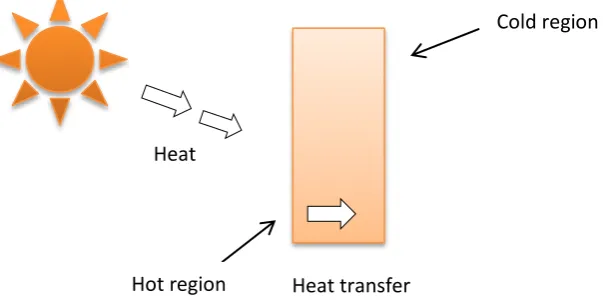
[image:19.595.225.527.501.652.2]The first law states that the rate of energy transfer into a system is equal to the rate of energy increase of that system. The second law states that the heat will be transferred from the higher temperature to the lower one (Figure 2.1). For example, this phenomenon can be seen through the mechanism of heat exchanger in air conditioning system. When cool water or refrigerant flows inside a cooling tube, apparently heat from the surface of the cooling tube will be transfer to the medium as a result of temperature difference. Heat will be transferred to the medium and the medium becomes hot. It is same with the nature of life that all the things from the higher place will move to the lower one as a result of gravity force. As stated before, heat transfer process needs a difference in temperature in order for them to occur. If there is no difference in temperature, there will be no net heat transfer between the systems. As a conclusion, temperature difference is the driving force for heat transfer. The magnitude of the temperature gradient (the temperature difference per unit length or the rate of change in temperature) affects the rate of heat transfer in a certain direction (Cengel & Afshin J. Ghafar, 2015). Higher rate of heat transfer corresponds to the larger temperature gradient.
Figure 2.1: Transfer of heat from the higher temperature to lower temperature
Heat transfer has a wide area of application in our life such as the air conditioning system that most of the climate country using it. Without the mechanism of heat transfer, air conditioning system cannot be created and works to deliver the heat from
Hot region
Cold region
8
one part to another. There were many advantages that can be applicant of this nature thing. As there are no things that completely perfect in this world, heat transfer also has disadvantages and some limitations. One of the limitations is some metal can be melt when heat supply is too high. Therefore, the study of heat transfer is important for designer and other related people. The limitations can be avoid and being control with the proper actions. Heat transfer can be divided into three modes which are conduction, convection and radiation. Different modes correspond to different mechanism and medium of heat transfer. In order for all the modes to happen, existence of temperature difference between a medium were needed. As mentioned earlier, the transfer of heat was always from the higher temperature medium to the lower temperature one.
[image:20.595.253.439.362.468.2]2.2.1 Conduction
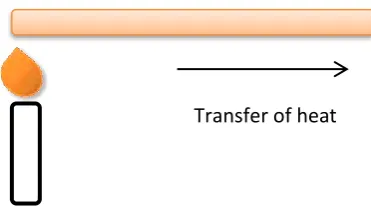
Figure 2.2: Heat conduction through a metal of rod
Conduction occurs through the interactions between particles. When particles interact, energy from the higher energy particles of a substance will transfer to the lower energy ones. The motion of molecules and electrons was the basic microscopic mechanism of conduction (Vlachopoulos & Strutt, 2002). This mechanism can occur whether in solids, liquids or gases. Through solids, heat transfer was happened due to two combinations of factors which were the vibration of molecules in lattice structure and from the energy transport by free electrons. Meanwhile, for liquids and gases cases, conduction can occurs during molecules move in random motion. They will collide between themselves and process of diffusion takes place. There are many examples of conduction mechanism occur throughout our surrounding. One of the examples is temperature of cooling tube wall will increases as the supply air flows through it as a result of heat transfer through the metal by conduction.
9
Several factors were important for their contributions to the rate of heat conduction through a medium. The factors are thickness of a medium, its geometry, the material of the medium and the temperature difference through the medium (Cengel & Afshin J. Ghafar, 2015). For example, the justification for the factor can be seen on the piping of air conditioning systems. By looking towards the piping connection, there was an insulating material wrap up the pipe. This is because the designer wants to minimize the amount of heat transfer to the pipe. The better and the thicker the insulation, the lesser the tendency for heat transfer takes place on the pipe. Next factor can be identifying through the fact that different material gives different ability to absorb and loss heat in a specific time. Usually, better material will cost highly as we known because of its ability to maximize the amount of heat transfer takes place. Larger surface area also will correspond to higher amount of heat transfer.
Besides that, another fact that can be used to justify the factor is when the temperature difference between a medium is greater, the rate of heat transfer also will be higher. Based on all the facts above, we can conclude that rate of heat transfer were inversely proportional to the thickness of a medium but directly proportional to the temperature difference across the medium and surface area of a medium (Cengel & Afshin J. Ghafar, 2015).
Rate of heat conduction ∞
From the above relationship, all the parameters can be expressed as:
̇ (W) = kA
= - kA
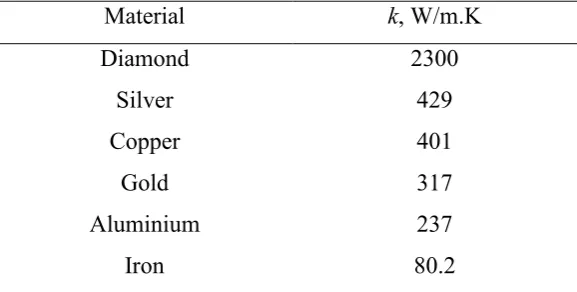
where the k above represents the value of thermal conductivity for the material (Table 2.1). Thermal conductivity is a measure on the ability of the material to conduct heat.
According to Fourier‟s law of heat conduction, equation above can be reduces when a limiting case of x were approximate to zero (Cengel & Afshin J. Ghafar, 2015). The equation is:
̇ = - kA
10
The
[image:22.595.175.464.370.516.2]above represents the temperature gradient. Temperature gradient is the slope of the temperature curve for the graph of temperature against distance between two temperature measurement points (T against x). From the equation above, it can be seen that the rate of heat conduction is directly proportional with the value of thermal conductivity. Besides that, the rate of heat conduction also can become higher when the temperature gradient is increasing. As the heat is conducted in the direction of decreasing temperature, temperature gradient will be negative because of the linear shape of graph is decreasing towards the increasing distances. So, in order to make the value of heat transfer becomes a positive value, there is a negative sign in the latest equation.
Table 2.1: Thermal conductivities of some materials at room temperature (Cengel & Afshin J. Ghafar, 2015)
Material k, W/m.K
Diamond 2300
Silver 429
Copper 401
Gold 317
Aluminium 237
Iron 80.2
11 Figure 2.3: Area at which the contact surface facing towards direction
2.2.2 Convection
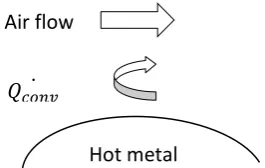
Figure 2.4: Heat convection from a hot metal to air
Convection is a process that occur when energy transfer between a solid surface with the adjacent liquid or gas that is in motion happens and also involves the combined effects of conduction and fluid motion (Cengel & Afshin J. Ghafar, 2015). The modes of energy transfer can be conduction if there is no fluid motion between the solid surface and the surrounding fluid. Meanwhile if there is a presence of fluid motion over the solid surface, the heat transfer process can be called as the combined effects of conduction and fluid motion (Figure 2.4). In addition, it also can be conclude that the change of phase of a fluid were also being assumed to be convection because this type of heat transfer process involved the motion of fluid such as the forced air through the coil of heat exchanger devices in air conditioning system called evaporator will be condense to a liquid state and the liquid droplets fall down. Same as the heat conduction, there is a temperature difference required between one area and the other in order for the convection process to occur (Annaratone, 2010).
There are two types of convection called forced convection and natural convection. This two convection types have a different mechanism and different rates of heat
Hot metal
𝑄𝑐𝑜𝑛𝑣̇
Air flow A = W x H
[image:23.595.283.416.305.389.2]12
transfer. Forced convection occurs when there is an external force pushing the fluid to flow over the solid surface such as a fan, pump or the wind. Forced convection process can be looked at the structure of the heat exchanger devices in air conditioning system. A draw through or blow through fan rotates to force air pass through the coil in order to maximize the rates of heat transfer between the medium of heat transportation to the surface of coil‟s wall and then remove the air in a certain temperature to the surrounding space. This system shows that faster fluid motion produces greater heat transfer of convection.
Natural convection occurs without an external forces but the motion of fluid happens by the density differences between the variations of temperature. A buoyancy forces triggered the motion of the fluid when there is a variation of temperature in the fluid. Different value of temperature corresponds to the different density. In the room space, hot air will move upwards and the colder air will remains downward as the hot air has low density compared to the colder air. Then, the hot air is replenished by the colder air which gets hot and rises again causing natural circulation in the room (Vlachopoulos & Strutt, 2002).
The example of combined effects can be seen through the application of heat exchanger in air conditioning system where heat transferred from the coil surface is carried away by the medium of heat transportation flowing inside the cooling tube. Heat energy is first distributed through the metal wall of the cooling tube by conduction. Another example of convection heat transfer, consider the cooling of a hot body of car by blowing cool air towards the body surface. By conduction, heat is transferred to the air moving near the car body. Then, heat is carried away from the surface by convection when there is a motion of air. The determination of heat transfer rates will be complicated for the combined effects. If the temperature difference between the air and the car body is not large enough to overcome the resistance of air to movement and for initiating natural convection currents, heat transfer between them is by conduction (Cengel & Afshin J. Ghafar, 2015).