http://eprints.whiterose.ac.uk/122829/ Version: Accepted Version
Article:
Holmes, J, Roberts, G, Geen, J et al. (6 more authors) (2018) Utility of electronic AKI alerts in intensive care: A national multicentre cohort study. Journal of Critical Care, 44. pp. 185-190. ISSN 0883-9441
https://doi.org/10.1016/j.jcrc.2017.10.024
© 2017 Published by Elsevier Inc. This manuscript version is made available under the CC-BY-NC-ND 4.0 license http://creativecommons.org/licenses/by-nc-nd/4.0/
[email protected] https://eprints.whiterose.ac.uk/
Reuse
This article is distributed under the terms of the Creative Commons Attribution-NonCommercial-NoDerivs (CC BY-NC-ND) licence. This licence only allows you to download this work and share it with others as long as you credit the authors, but you can’t change the article in any way or use it commercially. More
information and the full terms of the licence here: https://creativecommons.org/licenses/ Takedown
If you consider content in White Rose Research Online to be in breach of UK law, please notify us by
Utility of electronic AKI alerts in intensive care: A national multicentre cohort study
Jennifer Holmes, Gethin Roberts, John Geen, Alan Dodd, Nicholas M. Selby, Andrew Lewington, Gareth Scholey, John D. Williams, Aled O. Phillips, On behalf of the Welsh AKI steering group
PII: S0883-9441(17)30606-8
DOI: doi:10.1016/j.jcrc.2017.10.024
Reference: YJCRC 52736
To appear in:
Please cite this article as: Jennifer Holmes, Gethin Roberts, John Geen, Alan Dodd, Nicholas M. Selby, Andrew Lewington, Gareth Scholey, John D. Williams, Aled O. Phillips, On behalf of the Welsh AKI steering group , Utility of electronic AKI alerts in intensive care: A national multicentre cohort study. The address for the corresponding author was captured as affiliation for all authors. Please check if appropriate. Yjcrc(2017), doi:10.1016/j.jcrc.2017.10.024
ACCEPTED MANUSCRIPT
Utility of electronic AKI alerts in Intensive Care: A national
multicentre cohort study.
Jennifer Holmes MSc1, Gethin Roberts MD2, John Geen PhD3/4, Alan Dodd PhD3, Nicholas M Selby MD5, Andrew Lewington MD6, Gareth Scholey MD7, John D Williams MD8, and
Aled O Phillips MD8
On behalf of the Welsh AKI steering group.
1 Welsh Renal Clinical Network, Cwm Taf University Health Board.
2Department of Clinical Biochemistry, Hywel Dda University Health Board.
3
Department of Clinical Biochemistry, Cwm Taf University Health Board, Merthyr, U.K.
4
Faculty of Life Sciences and Education, University of South Wales, U.K.
5Centre for Kidney Research and Innovation, Division of Medical Sciences, University of
Nottingham, U.K.
6 Department of Nephrology, St James's University Hospital, Leeds U.K.
7 Department of Intensive Care, University Hospital of Wales, Cardiff, U.K.
8Institute of Nephrology, Cardiff University School of Medicine, Cardiff, U.K.
Corresponding Author; Professor Aled Phillips Institute of Nephrology
Cardiff University School of Medicine University Hospital
Heath Park Cardiff, CF14 4XN Tel: +44 2920 748467 E-mail: [email protected]
ACCEPTED MANUSCRIPT
Background: Electronic AKI alerts highlight changes in serum creatinine compared to
the patient s own baseline Our aim was to identify all AKI alerts and describe the relationship between electronic AKI alerts and outcome for AKI treated in the Intensive Care Unit (ICU) in a national multicentre cohort.
Methods: A prospective cohort study was undertaken between November 2013 and April 2016, collecting data on electronic AKI alerts issued.
Results: 10% of 47,090 incident AKI alerts were associated with ICU admission. 90-day
mortality was 38.2%. Within the ICU cohort 48.8% alerted in ICU. 51.2% were transferred to ICU within 7 days of the alert, of which 37.8% alerted in a hospital setting (HA-AKI) and 62.2% in a community setting (CA-AKI). Mortality was higher in patients transferred to ICU following the alert compared to those who had an incident alert on the ICU (p<0.001), and was higher in HA-AKI (45.3%) compared to CA-AKI (39.5%) (35.0%, p=0.01). In the surviving patients, the proportion of patient recovering renal function following, was significantly higher in HA-AKI alerting (84.2%, p=0.004) and CA-AKI alerting patients (87.6%, p<0.001) compared to patients alerting on the ICU (78.3%).
Conclusion: Using AKI e-alerts provides a centralised resource which does not rely on
clinical diagnosis of AKI or coding, resulting in a robust data set which can be used to
define the incidence and outcome of AKI in the ICU setting.
Key Words
ACCEPTED MANUSCRIPT
Background
Acute Kidney injury (AKI) is a common complication in seriously ill patients which is associated with significant morbidity and mortality. AKI in the Intensive Care Unit (ICU) has different pathophysiological mechanisms and outcomes compared to AKI in a non-ICU population. Many previously published studies characterising AKI in ICU rely on clinical diagnosis, hospital coding or retrospective review of hospital records to
identify cases (1-4).
In 2009, the National Confidential Enquiry into Patient Outcome and Death (NCEPOD) (5) report identified significant deficiencies in the management of AKI in hospitals in the U.K. This led to the development and implementation of strategies such as the use
of electronic results reporting to aid early AKI recognition (6) although to date there is no evidence that implementation of this strategy improved clinical outcome (7). An automated real time electronic (e)-alert for detection of AKI based on the Kidney Disease: Improving Global Outcomes (KDIGO) change in creatinine diagnostic criteria
has been agreed and implemented nationally across all areas of the National Health Service in Wales and England (U.K.) (8). This automatically compares measured serum creatinine (SCr) values on an individual patient against previous results on the system database. The use of a patient s own historical creatinine data although providing and accurate baseline estimation of renal function does not meet the strict diagnostic
ACCEPTED MANUSCRIPT
Methods
Setting: Data were collected across the National Health Service in Wales, serving a total
adult population of million The study was approved under Service Evaluation
Project Registration
Development of Electronic Reporting System: The previously described Welsh
electronic AKI reporting system (9), utilizes an algorithm based on changes in serum
creatinine level (Supplementary Figure 1). AKI is identified by automatically comparing measured creatinine values from an individual patient against previous results in real time. Three rules are applied to generate alerts differing in the time period from which the baseline creatinine is obtained. Rule 1 alerts represent a >26µmol/l increase
in SCr within the previous 48 hours and are issued only if rule 2 and rule 3 are not
satisfied Rule alerts represent a increase in SCr within the previous days and
a rule alert represents a increase in SCr from the median of results from the previous 8 to 365 days (8).
Data Collection: Data were collected for all cases of adult yrs of age AK) in Wales
between November 2013 and April 2016. An incident episode was defined as 90 days. For each episode the clinical location, patient age, AKI stage and the rule under which the AKI alert was generated was collected together with all measurements of renal function for up to 90 days following the AKI alert. To be included in the ICU cohort
patients had to have either alerted in ICU, or be transferred to ICU within 7 days of the alert.
Patients with an e-alert generated during a hospital admission with a baseline SCr from a hospital setting within the preceding seven days were defined as Hospital-acquired (HA)-AKI. Patients alerting in a non-inpatient setting (including Accident and
community-ACCEPTED MANUSCRIPT
acquired (CA)-AKI. Patients in whom alerts were generated in an inpatient setting but with no results available for the previous 7 days were excluded from the CA- and HA-AKI subgroup analyses. Progression of HA-AKI was defined as a peak HA-AKI stage higher than the incident e-alert or for stage alerts an increase from the SCr generating the alert.
Mortality data were collected from the Welsh Demographic Service. Patients were
censored at 27 months for survival analysis. Renal outcome analysis required patients to have 90 day follow up data. Non-recovery was defined as a SCr value measured at 90 days still consistent with AKI when compared to original baseline. Pre-existing chronic kidney disease (PeCKD) was defined as an eGFR (CKDEpi eGFR (15))
<60ml/min/1.73m2 derived from the baseline SCr.
Statistical analysis was carried out using SPSS software, version 20 (SPSS, Inc., Chicago,
)L Student s t test was used for normally distributed data. Categorical data were
compared using a Pearson chi-squared test. Multivariate Cox proportional hazard
modelling was used to analyse outcome.
Results
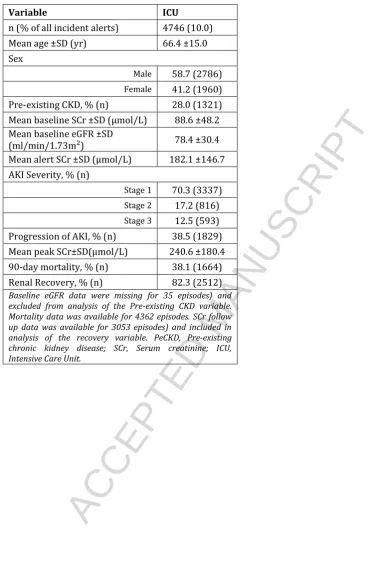
We observed a total of 146,512 alerts, representing 47,090 incident AKI alerts. 10.0% of all episodes were associated with ICU admission. Demographic data on AKI episodes
requiring ICU are shown in Table 1. Ninety-day mortality was 38.2%. Analysis of the surviving cohort demonstrated recovery from the acute episode occurred in 82.3% of all incident ICU alerts.
Comparison of AKI alerts generated in the community, in a hospital in-patient
ACCEPTED MANUSCRIPT
Demographic data on all AKI incident alerts requiring ICU by cohort are shown in Table 3. Of all patients with an e-alert requiring ICU, 2,318 (48.8%) alerted in ICU. 2,428 (51.2%) were transferred to ICU within 7 days of the alert of which 37.8% alerted in a hospital setting and 62.2% in a community setting. Although classified as CA-AKI it is of note that 23.9% of these patient had a measurement of renal function as an inpatient in the preceding 9.8±8.6days, and 20.1% had a measurement of renal function in an A&E
setting in the preceding 4.9±6.9days.
AKI severity as determined by the AKI stage of the incident alert was significantly worse for CA-AKI alerts followed by HA-AKI and AKI alerting in ICU. The proportion of patient presenting with a AKI stage 2/3 alerts at presentation was 15.5% in patients alerting on
the ICU, 25.1% in HA-AKI alerting patients and 47.8% CA-AKI alerting patients (p<0.001).
CA-AKI alerting patients were least likely to experience deterioration of renal function following its initial identification by alert, and HA-AKI alerting patients most likely
(p<0.001).
Mortality was significantly higher in patients transferred to ICU (41.7%) following the alert compared to those who had an incident alert on the ICU (35%, p<0.001), and was significantly higher in HA-AKI (45.3%) alerting patients compared to CA-AKI (39.5%) alerting patients transferred to ICU (p=0.01). Higher hazard of death was associated
ACCEPTED MANUSCRIPT
In contrast to mortality, in the surviving patients, the proportion of patients recovering renal function (i.e. death censored renal survival) following an AKI episode, was significantly higher in HA-AKI alerting (84.2%, p=0.004) and CA-AKI alerting patients (87.6%, p<0.001) compared to patients alerting on the ICU (78.3%).
Definitional e-alerts rules and ICU
Table 2 compares the characteristics of the rule 1, rule 2 and rule 3 alerting cohorts. Rule 3, accounted for 45.8%, rule 2 37.3% and rule 1 only 16.8% of all incident alerts. Rule 1 and 2 detected 77.3% of HA-AKI incident alerts whilst 85.2% of CA-AKI incident alerts were detected by rule 3. Rule 3 also identified 48.1% of all acute on chronic
kidney injury (A-CKI) alerts, although it is of note that the majority of rule 1 alerts represented A-CKI alerts (53.2%). By the definitional rules, rule 1 AKI alerts are all stage 1 AKI. Rule 3 alerts identified a significantly higher proportion of AKI stage 2 and stage 3 than rule 2 (p<0.001), with 57.7% of all AKI stage 2 and 84.3% of all AKI stage 3
being identified by rule 3 alerts.
Reflecting the level of AKI severity, 90-day mortality for AKI treated in ICU was significantly higher for rule 2 (p=0.008) and rule 3 (p<0.001) alerts than rule 1 alerts (mortality was not significantly different for rule 2 and rule 3 alerts). Similarly, the proportion of patients recovering renal function was highest following a rule 1 alert
(89.5%, p<0.001 vs. rule 2 and p=0.04).
Discussion
Although it is widely recognised that AKI is commonly associated with serious illness, there is a wide variation in reported incidence in the context of ICU (10-15). There are
ACCEPTED MANUSCRIPT
injury, with many key studies focused on severe AKI and patients requiring renal replacement therapy (16-18). In some previously published studies the diagnosis of AKI is reliant on a clinical diagnosis, hospital coding or retrospective review of hospital records (1-4). Other studies have used a creatinine based diagnosis of AKI, but in the absence of any creatinine values in the preceding 3 months (accounting for more than half of the patients in some studies) baseline estimations of renal function were made
by solving the Modification of Diet in Renal Disease (MDRD) equation (15, 19). In this study we set out to determine if a centralised data set based on electronic AKI e-alerts using the patient s own historical baseline in all cases, provides a reliable method to characterise AKI in the ICU setting.
From our data AKI requiring the services of ICU accounts for 10% of all incident episodes of AKI identified by a biochemistry based e-alert. This finding is consistent with a population-based study in Scotland in which 9.5% of patients with AKI were treated in the ICU (20), and in which a retrospective diagnosis of AKI was defined by a
change in creatinine criteria. Our overall mortality was also consistent with previous published data (19), and also confirms the association of higher mortality with AKI
severity regardless of the definitional basis of AK) staging (16, 21, 22). This agreement
with previous studies using a variety of methods to identify AKI, suggests that using AKI alerts to generate a platform from which the epidemiology of AKI can be built is valid
despite the use of baseline data on renal function which is reliant in almost half of cases on a median value of results from the preceding 365 days (rule 3).
It is of note that while increased severity of AKI in the ICU population is associated with increased mortality, for the surviving patients, non recovery of renal function only occurs in a minority of patients. This is also consistent with previously published data
ACCEPTED MANUSCRIPT
short term patient survival but does not impact longer term renal outcome, which is in contrast to non-ICU populations (23).
It is important to recognise that clinically, AKI in the setting of ICU is likely to represent a diverse patient group. In this study AKI developing in the ICU represents only half of all AKI treated in the ICU. This is consistent with published data by the NEFROINT investigators reporting of AKI incidence in ICU in Italy (15). Our data suggest that
patients in which AKI is diagnosed in the ICU and those in which AKI is identified prior to transfer to the ICU either within the hospital or in a community setting represent different cohorts, with differing AKI stages at presentation being associated with different outcomes in each cohort. There was a higher proportion of AKI stage 2 and 3 in
those transferred to ICU with AKI, from both in hospital settings and the community, compared to those developing AKI in the ICU. This suggests that AKI outside the ICU is detected later in the course of the AKI episode. Patients once admitted to the ICU are more likely to have routine surveillance of their biochemical parameters which results
in early detection of small increments in serum creatinine. These different patterns of presentation are also reflected in different outcomes with a higher mortality in both groups of patients transferred to ICU following AKI identification.
Confidence in the accurate determination of baseline kidney function is important to convince clinicians of the validity and clinical utility of an automated electronic AKI
alert. Current agreed AKI definitions such as The Acute Kidney Injury Network definition rely on a rolling 48-hour window of detection for AKI (24). The use of historical baseline values may therefore not be widely accepted by clinicians. Using strict definitions that do not take into account pre-admission biochemical results to alert AKI are however likely to severely underestimate AKI incidence (25), and result in
ACCEPTED MANUSCRIPT
automated alerts may have unintended consequences related to over-diagnosis leading to overtreatment (26). In this manuscript we have demonstrated that in the context of ICU treated AKI identified by an electronic alert, Rule 3 alerts generated by rises in creatinine from the median of results from the previous 8 to 365 days, which therefore does not conform to the strict definition of AKI, generates the largest cohort of electronic alerts, the highest proportion of stage 2 and 3 AKI, and 85% of all AKI which
develops in the community. Furthermore this rule, representing the furthest
departure from the strict definition of AK) has the highest mortality reflecting the
higher AKI severity. Suppression of this rule therefore would lead to a missed opportunity of AKI in patients presenting at the hospital front door requiring ICU
support, which may therefore lead to missed opportunities for early intervention to influence outcome. The current electronic AKI alerting system with its three rules highlights high risk patients who require additional clinical scrutiny.
Although this study is to our knowledge the first national study using an e-alert based
system to characterise AKI in the ICU its findings need to be qualified by its limitations. Whilst using the centralised data collection simplifies data collection and reduces the burden on busy clinicians, it precludes inclusion of clinical information, such as patient co-morbidity and linkage to primary care data sets, and lacks the detail of the cause of AKI and does not shed light on the cause of death. As a result, we are unable to collect
data related to clinical variables which influence both AKI pathophysiology of AKI and outcome. We are unable to report on the initiation of Renal Replacement Therapy (RRT), which impacts on the interpretation on progression of AKI stage as early initiation of RRT to manage fluid balance may result in reductions/stabilisation of creatinine resultant from RRT. Our definition of AKI whilst based on serial changes in
ACCEPTED MANUSCRIPT
results in under-reporting of the true incidence of AKI (13, 27). It should also be acknowledged that using recovery of renal function based on serum creatinine may lead to an overestimation of renal function in the critically ill as a result of muscle wasting (28). Finally, outcome data is limited to 90 days. Longer term follow-up is therefore needed to describe the association with progressive CKD. The strengths of the study are the use of a large national data set which uses electronic alerts in which AKI
diagnosis is based on the patients previous test results providing a unique and
contemporary view of AKI across a whole population, and the inclusion of the whole spectrum of AKI disease severity. Moreover, this multicentre study covers the whole of the adult population of Wales therefore avoiding any bias of centre selection. The study
ACCEPTED MANUSCRIPT
Acknowledgements: JH designed the study, collected and analysed the data and produced the figures. GR designed the study and validated the algorithm. JG and AD facilitated data collection. NMS, AL, GS and JDW designed the study, interpreted the data and wrote the report. AOP set up the program of work, designed the study, interpreted the data and wrote the report.
The work was carried out under the auspices of the Welsh AKI steering group which is sponsored by the Welsh Renal Clinical Network and Welsh Government
ACCEPTED MANUSCRIPT
Table 1. Characteristics of AKI episodes requiring the Intensive Care Unit (ICU).
Variable ICU
n (% of all incident alerts) 4746 (10.0)
Mean age ±SD (yr) 66.4 ±15.0
Sex
Male 58.7 (2786)
Female 41.2 (1960)
Pre-existing CKD, % (n) 28.0 (1321)
Mean baseline SCr ±SD (µmol/L) 88.6 ±48.2
Mean baseline eGFR ±SD
(ml/min/1.73m²) 78.4 ±30.4
Mean alert SCr ±SD (µmol/L) 182.1 ±146.7
AKI Severity, % (n)
Stage 1 70.3 (3337)
Stage 2 17.2 (816)
Stage 3 12.5 (593)
Progression of AKI, % (n) 38.5 (1829)
Mean peak SCr±SD(µmol/L) 240.6 ±180.4
90-day mortality, % (n) 38.1 (1664)
Renal Recovery, % (n) 82.3 (2512)
ACCEPTED MANUSCRIPT
Table 2. Comparison of patients whose AKI was identified in ICU vs. HA-AKI patients transferred to ICU following an AKI e-alert vs. CA-AKI patients transferred to ICU following an AKI e-alert.
Variable AKI identified in ICU HA-AKI transferred to ICU CA-AKI transferred to ICU
n (% of episodes requiring
ICU) 2318 (48.8) 835 (17.6) 1373 (28.9)
Mean age ±SD (yr) 66.9 ±14.6 68.3 ±14.5 64.2 ±15.8
Sex
Male 61.2 (1419) 58.1 (485) 55.6 (763)
Female 38.7 (899) 41.9 (350) 44.4 (610)
Pre-existing CKD, % (n) 26.0 (598) 30.1 (250) 29.5 (404)
Mean baseline SCr ±SD
(µmol/L) 86.0 ±48.7 88.3 ±46.4 92.6 ±49.4
Mean alert SCr ±SD
(µmol/L) 144.9 ±77.8 160.6 ±83.4 245.2 ±207.0
AKI Severity, % (n)
Stage 1 82.1 (1902) 73.4 (613) * 52.0 (714) * #
*P<0.001 vs. in ICU #p<0.001 vs. HA-AKI
Stage 2 13.6 (315) 18.0 (150)* 21.7 (298) ) * #
Stage 3 4.4 (101) 8.6 (72)* 26.3 (361) ) * #
AKI Rule, % (n)
Rule 1 25.8 (599) 17.5 (146) 3.7 (51)
Rule 2 51.3 (1189) 50.5 (422) 11.1 (152)
Rule 3 22.9 (530) 32.0 (267) 85.2 (1170)
Progression of AKI, % (n) 41.0 (951) 49.1 (410) * 28.7 (394) ) *# *P<0.001 vs. in ICU #p<0.001 vs. HA-AKI
Mean peak
SCr±SD(µmol/L) 204.5 ±139.2 234.3 ±142.1 294.2 ±226.8
90-day mortality, % (n) 35.0 (763) 45.3 (343)* 39.5 (484)
*P<0.001 vs. in-ICU p vs. in-ICU #p=0.01 vs. HA-AKI
Recovery, % (n) 78.3 (1204) 84.2 (410)* 87.6 (775)* *P<0.001 vs. in ICU
ACCEPTED MANUSCRIPT
Table 3. Characteristics and outcomes for the Rule 1, Rule 2 and Rule 3 cohorts for AKI episodes treated on the Intensive Care Unit (ICU).
Rule 1 Rule 2 Rule 3
n (% of ITU cohort) 798 (16.8) 1772 (37.3) 2176 (45.8)
Mean age ±SD (yr) 70.1 ±14.0 66.0 ±15.9 65.2 ±15.4
Sex, % of ICU cohort (n)
Male 69.0 (551) 55.3 (980) 57.7 (1255)
Female 31.0 (247) 44.7 (792) 42.3 (921)
Pre-existing CKD, % (n) 53.2 (413) 15.4 (272) 29.3 (636)
Mean baseline SCr ±SD
(µmol/l) 122.0 ±58.0 69.1 ±30.7 92.4 ±48.5
Mean alert SCr ±SD (µmol/l) 161.7 ±67.3 130.1 ±62.3 231.8 ±193.1
AKI Severity, % (n)
Stage 1 100.0 (798) 75.3 (1334)* 55.4 (1205)*#
*P<0.001 vs. rule 1 #p<0.001 vs. rule 2
Stage 2 19.5 (345)* 21.6 (471)*#
Stage 3 5.2 (93)* 23.0 (500)*#
ICU classification, % (n)
AKI identified in ICU 75.1 (599) 67.1 (1189) 24.4 (530)
HA-AKI transferred to ICU 18.3 (146) 23.8 (422) 12.3 (267)
CA-AKI transferred to ICU 6.4 (51) 8.6 (152) 53.8 (1170)
Progression of AKI, % (n) 32.6 (260) 47.2 (836)* 33.7 (733) *p=0.008 vs. rule1 and rule 3
Mean peak SCr ±SD (µmol/l) 227.3 ±130.9 190.8 ±134.1 286.1 ±214.4
90-day mortality, % (n) 32.5 (244) 38.2 (628)* 40.3 (792)# *p=0.008 vs. rule1 #p<0.001 vs. rule 1
Recovery, % (n) 89.5 (485) 74.2 (1136)* 86.1 (1184)
*p<0.001vs rule1 #p=0.04 vs. rule 1
p vs. rule 2
ACCEPTED MANUSCRIPT
References:
1. Bucaloiu ID, Kirchner HL, Norfolk ER, Hartle JE, 2nd, Perkins RM. Increased risk of death and
de novo chronic kidney disease following reversible acute kidney injury. Kidney Int. 2012
Mar;81(5):477-85.
2. Hsu CY, Chertow GM, McCulloch CE, Fan D, Ordonez JD, Go AS. Nonrecovery of kidney
function and death after acute on chronic renal failure. Clin J Am Soc Nephrol. 2009 May;4(5):891-8.
3. Hsu CY, McCulloch CE, Fan D, Ordonez JD, Chertow GM, Go AS. Community-based incidence
of acute renal failure. Kidney Int. 2007 Jul;72(2):208-12.
4. Liangos O, Wald R, O'Bell JW, Price L, Pereira BJ, Jaber BL. Epidemiology and outcomes of
acute renal failure in hospitalized patients: a national survey. Clin J Am Soc Nephrol. 2006
Jan;1(1):43-51.
5. National Confidential Enquiry into Patient Outcome and Death [NCEPOD] Report Acute
Kidney Injury: Adding Insult to Injury. 2009.
6. Selby NM, Crowley L, Fluck RJ, et al. Use of electronic results reporting to diagnose and
monitor AKI in hospitalized patients. Clin J Am Soc Nephrol. 2012 Apr;7(4):533-40.
7. Wilson FP, Shashaty M, Testani J, et al. Automated, electronic alerts for acute kidney injury:
a single-blind, parallel-group, randomised controlled trial. Lancet. 2015 May 16;385(9981):1966-74.
8. Available from:
https://www.england.nhs.uk/wp-content/uploads/2014/06/psa-aki-alg.pdf
9. Holmes J, Rainer T, Geen J, et al. Acute Kidney Injury in the era of the AKI e-alert: A National
ACCEPTED MANUSCRIPT
10. Bagshaw SM, George C, Bellomo R, Committe ADM. A comparison of the RIFLE and AKIN
criteria for acute kidney injury in critically ill patients. Nephrol Dial Transplant. 2008
May;23(5):1569-74.
11. Cruz DN, Bolgan I, Perazella MA, et al. North East Italian Prospective Hospital Renal Outcome
Survey on Acute Kidney Injury (NEiPHROS-AKI): targeting the problem with the RIFLE Criteria. Clin J
Am Soc Nephrol. 2007 May;2(3):418-25.
12. Hoste EA, Clermont G, Kersten A, et al. RIFLE criteria for acute kidney injury are associated
with hospital mortality in critically ill patients: a cohort analysis. Crit Care. 2006;10(3):R73.
13. Joannidis M, Metnitz B, Bauer P, et al. Acute kidney injury in critically ill patients classified by
AKIN versus RIFLE using the SAPS 3 database. Intensive Care Med. 2009 Oct;35(10):1692-702.
14. Ostermann M, Chang RW. Acute kidney injury in the intensive care unit according to RIFLE.
Crit Care Med. 2007 Aug;35(8):1837-43; quiz 52.
15. Piccinni P, Cruz DN, Gramaticopolo S, et al. Prospective multicenter study on epidemiology
of acute kidney injury in the ICU: a critical care nephrology Italian collaborative effort (NEFROINT).
Minerva Anestesiol. 2011 Nov;77(11):1072-83.
16. de Mendonca A, Vincent JL, Suter PM, et al. Acute renal failure in the ICU: risk factors and
outcome evaluated by the SOFA score. Intensive Care Med. 2000 Jul;26(7):915-21.
17. Mehta RL, Pascual MT, Soroko S, et al. Spectrum of acute renal failure in the intensive care
unit: the PICARD experience. Kidney Int. 2004 Oct;66(4):1613-21.
18. Uchino S, Kellum JA, Bellomo R, et al. Acute renal failure in critically ill patients: a
multinational, multicenter study. JAMA. 2005 Aug 17;294(7):813-8.
19. Nisula S, Kaukonen KM, Vaara ST, et al. Incidence, risk factors and 90-day mortality of
patients with acute kidney injury in Finnish intensive care units: the FINNAKI study. Intensive Care
Med. 2013 Mar;39(3):420-8.
20. Ali T, Khan I, Simpson W, et al. Incidence and outcomes in acute kidney injury: a
ACCEPTED MANUSCRIPT
21. Medve L, Antek C, Paloczi B, et al. Epidemiology of acute kidney injury in Hungarian intensive
care units: a multicenter, prospective, observational study. BMC Nephrol. 2011;12:43.
22. Odutayo A, Adhikari NK, Barton J, et al. Epidemiology of acute kidney injury in Canadian
critical care units: a prospective cohort study. Can J Anaesth. 2012 Oct;59(10):934-42.
23. Abosaif NY, Tolba YA, Heap M, Russell J, El Nahas AM. The outcome of acute renal failure in
the intensive care unit according to RIFLE: model application, sensitivity, and predictability. Am J
Kidney Dis. 2005 Dec;46(6):1038-48.
24. Mehta RL, Kellum JA, Shah SV, et al. Acute Kidney Injury Network: report of an initiative to
improve outcomes in acute kidney injury. Crit Care. 2007;11(2):R31.
25. Siew ED, Matheny ME, Ikizler TA, et al. Commonly used surrogates for baseline renal
function affect the classification and prognosis of acute kidney injury. Kidney Int. 2010
Mar;77(6):536-42.
26. Sawhney S. Automated alerts for acute kidney injury warrant caution. BMJ. 2015;350:h19.
27. Kellum JA, Sileanu FE, Murugan R, Lucko N, Shaw AD, Clermont G. Classifying AKI by Urine
Output versus Serum Creatinine Level. J Am Soc Nephrol. 2015 Sep;26(9):2231-8.
28. Schetz M, Gunst J, Van den Berghe G. The impact of using estimated GFR versus creatinine
clearance on the evaluation of recovery from acute kidney injury in the ICU. Intensive Care Med.
ACCEPTED MANUSCRIPT
Highlights
Data on epidemiology of AKI historically is reliant on coding or retrospective clinical diagnosis