This is a repository copy of
A Distributed Stream Library for Java 8
.
White Rose Research Online URL for this paper:
http://eprints.whiterose.ac.uk/112135/
Version: Accepted Version
Article:
Chan, Yu, Wellings, Andrew John orcid.org/0000-0002-3338-0623, Gray, Ian
orcid.org/0000-0003-1150-9905 et al. (1 more author) (2017) A Distributed Stream Library
for Java 8. IEEE Transactions on Big Data. pp. 1-14. ISSN 2332-7790
[email protected] https://eprints.whiterose.ac.uk/ Reuse
Items deposited in White Rose Research Online are protected by copyright, with all rights reserved unless indicated otherwise. They may be downloaded and/or printed for private study, or other acts as permitted by national copyright laws. The publisher or other rights holders may allow further reproduction and re-use of the full text version. This is indicated by the licence information on the White Rose Research Online record for the item.
Takedown
If you consider content in White Rose Research Online to be in breach of UK law, please notify us by
A Distributed Stream Library for Java 8
Yu Chan, Andy Wellings, Ian Gray and Neil Audsley
Abstract—Java 8 has introduced new capabilities such as lambda expressions and streams which simplify data-parallel computing. However, as a base language for Big Data systems, it still lacks a number of important capabilities such as processing very large datasets and distributing the computation over multiple machines. This paper gives an overview of the Java 8 Streams API and proposes extensions to allow its use in Big Data systems. It also shows how the API can be used to implement a range of standard Big Data paradigms. Finally, it compares performance with that of Hadoop and Spark. Despite being a proof-of-concept implementation, results indicate that it is a lightweight and efficient framework, comparable in performance to Hadoop and Spark, and is up to 5 times faster for the largest input sizes tested.
Index Terms—Big Data, Java, distributed computing, programming models
F
1
I
NTRODUCTIONRecently, the 8th release of Java added support for aggre-gate data operations to the language. This paper identifies a number of weaknesses that are encountered when attempt-ing to apply this to the programmattempt-ing of very large scale, and distributed, applications. It proposes a significant extension to the Java 8 streaming model to handle distributed data processing and storage.
Big Data is the term used for a collection of large and
complex applications that are difficult to process using traditional data processing techniques, either due to the sheer scale of the data being produced, or tight timing requirements placed on the processing of the data. For example, the Large Hadron Collider can output a raw data stream of approximately 1PB/s [1]. This must be filtered before storage, placing a timing requirement on the filtering and storage stages. In some domains, requests for analytics and mining of stored datasets must be serviced sufficiently fast for the end user. In these situations, faster processing allows for potentially greater accuracy (i.e. by covering a larger historical dataset).
Java is the base language for a number of popular Big Data frameworks, including Hadoop [2], Spark [3] and Storm [4]. The introduction of streams and lambda expres-sions in Java 8 has brought Big Data closer to the core language. Java 8 streams allow programmers to view data processing in terms of pipelines of operations, and comple-menting it are lambda expressions that simplify functional programming. However, this stream-based programming model is still not sufficient for Big Data for two main reasons. Firstly, streams are limited to computations within a single machine, and there is no mechanism for distribut-ing computations over multiple machines. This is due to streams being built on Java’s Executor framework, which has no concept of distribution. Secondly, Java’s default stream sources (such as collections and arrays) either store their data in-memory and thus cannot support very large datasets, or are not optimised for data-parallel computation. In this paper, we address the above-mentioned is-sues and extend the programming model with Distributed Streams (which introduce the concept of distributed com-puting on a cluster) and Distributed and/or Stored
Collec-tions (which introduce the concepts of accessing very large datasets on-demand and of datasets that are distributed over a cluster).
Section 2 gives the background and motivation of Big Data computing in Java, and outlines the Java 8 Stream API. Section 3 details the requirements of Big Data computing and how Java 8 Streams fall short of these requirements. Our proposed extensions to the existing programming model and API are presented in Section 4, and our prototype implementation is described in section 5. Section 6 shows how MapReduce can be implemented in the proposed model while section 7 covers Spark and Storm. Section 8 evaluates these approaches, section 9 discusses related work and finally, section 10 concludes.
2
B
ACKGROUNDThe most popular open-source Big Data frameworks are targeted towards Java and/or higher-level languages that run on the JVM (eg. Scala). This is mainly because of the write-once-run-anywhere nature of JVM bytecode making it easier to deploy code on heterogeneous clusters. In this sec-tion, we review the popular Big Data frameworks Hadoop, Spark and Storm, in particular comparing their respective programming models.
The recent introduction of Java 8 has brought the lan-guage a step closer to having native Big Data capabilities due to the addition of the following:
• Java 8 Streams [5] provide a new programming
model for data-parallel computation on a single ma-chine. On multicore hardware it is able to parallelise a computation over multiple threads to speed up execution.
• Lambda expressions [6] simplify functional
program-ming in Java, allowing concise instantiation of func-tional interfaces instead of using anonymous class syntax. These are used extensively in Java 8 Streams, making its code more readable.
2.1 Hadoop and MapReduce
Hadoop [2] is a prominent open source implementation of MapReduce [7], a popular batch processing model for Big Data computations. Such a model allows computations on a dataset that is typically partitioned over a cluster of nodes.
Before a MapReduce computation takes place, the re-quired data needs to be distributed over the cluster. Hadoop
achieves this with theHadoop Distributed File System(HDFS)
[8], which is overlaid on the host file system and manages the distribution of datasets across a cluster. Files in HDFS are divided into blocks (usually of 64MB) and replicated on different nodes by default. To avoid data coherency issues, files can only be written to once.
MapReduce requires programmers to implement
map-pers and reducers, each of which normally run on a node
in the cluster. With reference to Hadoop, a MapReduce computation consists of three stages:
1) Themapstage: Input data from a given file in HDFS
is processed by a set of mappers, which output key-value pairs as a result.
2) The shufflestage: The key-value pairs are collected
over a set of reducers, with the same keys sent to the same reducer. For each key, the values are collected and sorted in a key-value-listpair.
3) The reduce stage: Each reducer processes all given
key-value-listpairs and outputs the result in a local
HDFS file. The full result of the computation is the concatenation of all partial results.
The number of mappers and reducers do not have to be equal. If the dataset is spread across the mapper nodes, Hadoop can optimise execution times by having each map-per node work on its local data.
2.2 Spark, Storm and stream-based processing
Though suitable for many applications, the MapReduce model is inflexible due to the fixed stage sequence. More recently, focus has shifted to in-memory stream-based mod-els for Big Data processing, with the Spark [3] and Storm [4] frameworks being prominent examples of such models.
Spark removes some of MapReduce’s limitations by exposing a pipeline-based programming model for data processing. Instead of implementing mappers and reducers,
programmers specify a pipeline of operations on aResilient
Distributed Dataset(RDD). An operation either returns a new
RDD (atransformation, which can be chained) or returns a
value (anaction, which terminates the pipeline).
Storm executes topologies which run indefinitely on a
cluster. A topology defines a directed acyclic graph of
nodes and data streams (vertices). A stream consists of an
unbounded sequence of tuples. A node is either aspout(data
source – a Twitter feed, for example) or abolt(consumes and processes streams, and may emit new streams).
2.3 Java 8 Streams
A Java 8 stream is a sequence of data elements that can
be processed by a pipeline of operations. Streams can be
generated from several sources, including:
• Collections, by calling the stream method if
the desired stream should be sequential, or the parallelStreammethod for a parallel stream;
• Arrays, by calling theArrays.streammethod;
• Factory methods in theStreamclass;
• Files, by calling the BufferedReader.lines
method.
After retrieving the stream from a source, a pipeline of aggregate operations can be performed on it, consisting of zero or more intermediate operations followed by a terminal operation. From the programmer’s perspective, an intermediate operation returns a new stream of processed elements from the given stream, and a terminal operation returns a non-stream result.
Streams, pipelines and operations have the following properties and restrictions:
• Pipelines are evaluated lazily. The terminal operation
triggers computation of the pipeline.
• Pipelines are short-circuiting. Only enough elements
are consumed as required by the terminal operation.
• Pipelines are linear. There is a single stream source,
and there is no branching mechanism for routing elements to different downstream operations.
• Streams can be traversed at most once. To use the
data source again, a new stream has to be created.
• Operations should not change the data source if the
source does not support concurrent modification.
Java 8 Streams further classify intermediate operations as stateless and stateful, depending on whether the operation needs to hold any state as data passes through. For example,
map is a stateless operation as each element can be
pro-cessed independently of another. However, the distinct
operation (remove all duplicate elements from the Stream) is stateful because it must keep track of all encountered elements.
Details of the Java 8 Stream API can be found at [9].
2.4 Big Data example: word-count
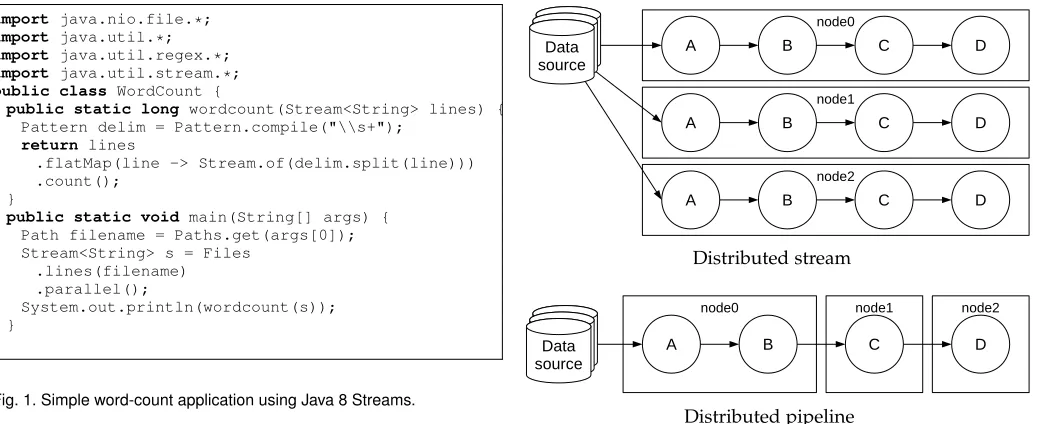
An example of a Big Data computation is word-count, which will be used throughout the paper to illustrate related concepts. The simplest form of word-count is to count the number of words in a given input file. This can be expressed in Java 8 as shown in figure 1.
3
B
IGD
ATA INJ
AVA8
In this section we identify the necessary attributes of Big Data programming models, and then discuss the short-comings of the Java 8 programming model with respect to these attributes and how these shortcomings can potentially be solved using a distributed stream model. We take an incremental approach to introducing Big Data in Java 8, as many projects start out small and realise the need for Big Data in later stages. For such cases, it may be easier to use a backward-compatible Big Data framework instead of rewriting programs using a very different programming model.
import java.nio.file.*;
import java.util.*;
import java.util.regex.*;
import java.util.stream.*;
public class WordCount {
public static long wordcount(Stream<String> lines) { Pattern delim = Pattern.compile("\\s+");
return lines
.flatMap(line -> Stream.of(delim.split(line))) .count();
}
public static void main(String[] args) { Path filename = Paths.get(args[0]); Stream<String> s = Files
.lines(filename) .parallel();
System.out.println(wordcount(s)); }
[image:4.612.52.572.42.254.2]}
Fig. 1. Simple word-count application using Java 8 Streams.
datasets. This usually implies some form of data distribution mechanism as these datasets often do not fit in a single machine. For example, Hadoop uses its HDFS file system to transparently spread large files across the cluster. Spark, on the other hand, has wider support of data sources from text files on the local filesystem to distributed filesystems (including HDFS, Cassandra and Amazon S3) [10].
Data locality is also an important Big Data attribute. Since it is expensive to move data between nodes in a cluster, data needs to be kept local as much as possible. Nevertheless, Big Data programming models also provide a mechanism for moving data for cases where this is necessary (for aggregation, for example). Hadoop, which implements the MapReduce programming model, has a shuffle stage where all key-value pairs emitted from mappers are sent to the appropriate reducer depending on the key. In Spark, the movement of data (if any) is determined by the transforma-tions and actransforma-tions specified in the pipeline. In Storm, data locality is maintained by splitting each spout or bolt into tasks, running them over the nodes in a cluster and keeping the data streams between tasks local as much as possible.
3.1 Issues with the Java 8 programming model
There are three main problems with using Java 8 Streams as a Big Data programming model:
1) Java 8 Streams exist within a single JVM, and JVMs
tend to only support individual SMP or ccNUMA machines, therefore stream computations will be limited to individual machines. There is no concept of a cluster and hence of distributing data or com-putations to other nodes in a cluster. Distribution requires the explicit use of middleware, such as MPI or an RPC framework. A difficulty of large-scale computation is that it requires support for both dis-tribution of computation and disdis-tribution of data. Both methods potentially speed up processing, de-pending on the workload. An I/O-bound workload will see a speed improvement when distributing data, whilst a CPU-bound workload will benefit more from distributed computation.
node0
A B C D
Data source
node1
A B C D
node2
A B C D
Distributed stream
node0
A B C
node1 node2
D Data
source
Distributed pipeline
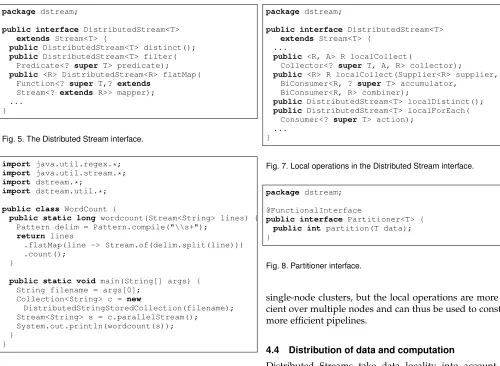
Fig. 2. Conceptual model of a distributed stream (top) and a distributed pipeline (bottom). Boxes indicate compute nodes, and the arrows indi-cate data flow from data source to pipeline operations.
2) Only in-memory datasets are well supported (by the
Java collections framework), but these are not useful for very large datasets as it implies loading the entire dataset into memory. Datasets from existing
on-disk sources (eg.BufferedReader.lines) are
not optimised for large amounts of data and are likely to cause out-of-memory errors with large files. Furthermore, there is no concept of a dataset that is distributed over a cluster.
3) Using short-circuiting evaluation in a distributed
computing model may have performance implica-tions. Nodes will need to check if each data item they are working on is required by the terminal operation which may be on another node.
When considering a distributed programming model for Java 8 Streams, it should be noted that streams and pipelines can be distributed among compute nodes independently (see figure 2). A data source in adistributed streamis spread over or accessed by multiple nodes, while operations in a
distributed pipelinespan multiple nodes. Both methods
po-tentially speed up processing, depending on the workload. An I/O-bound workload will see a speed improvement on a distributed stream, while a CPU-bound workload will benefit more on a distributed pipeline.
4
T
HED
ISTRIBUTEDS
TREAM FRAMEWORKIn order to fulfill the distributed computing requirements of Big Data programming models in Java outlined in section 3, we introduce the Distributed Stream framework.
Central to this framework is the concept of Distributed
Streams. A Distributed Stream facilitates parallelism by
hav-ing a replicated pipeline that operates on different parts of a dataset, which is usually located in multiple nodes. There are several reasons for using Distributed Streams:
package dstream;
public class ComputeNode {
public String getName();
public boolean isSelf();
public static ComputeNode getSelf();
public static ComputeNode findByName(String name); }
public class ComputeGroup extends List<ComputeNode> {
public ComputeGroup(Collection<ComputeNode> nodes);
public ComputeGroup(ComputeNode node);
public static ComputeGroup getCluster(); }
Fig. 3. TheComputeNodeandComputeGroupclasses.
• It is too slow to read the entire dataset from a single
node (due to limited I/O bandwith, for example).
• The dataset is located in storage nodes with
spe-cialised hardware, allowing fast parallel data access from a cluster.
The Distributed Stream framework does not limit an implementation to any particular programming paradigm. Thus, an implementation may run identical programs on every compute node which co-ordinate via the trans-port layer (the single-program-multiple-data or SPMD paradigm, which the prototype implementation uses), or it may utilise a driver node to distribute work to other nodes (the driver-worker or master-slave paradigm). The rest of this section describes the framework’s components in greater detail.
4.1 Compute nodes and groups
Before distribution of data and computation can be sup-ported, a method of identifying and grouping compute nodes is needed for decisions such as which node to
send data to. We therefore define theComputeNode class,
which represents a compute node in the cluster, and the ComputeGroupclass, which represents a group of compute nodes (see figure 3).
At program startup, all ComputeNode objects are
ini-tialised by the framework. Each compute node has a unique name (the model does not prescribe a node naming conven-tion). There are also methods to get the current node or a specific node by its name.
The ComputeGroup class has constructors that accept individual compute nodes or a collection of them, as well as
a static getClustermethod to retrieve the entire cluster.
Standard Java List methods can be called to modify the
group’s members.
If more functionality such as fault tolerance is needed, implementers can define new types of compute groups
which extendComputeGroup. These may monitor the
sta-tus of nodes and amend the list of compute nodes as required.
The use of compute nodes and groups is optional as in many cases, data is partitioned across the entire cluster and computation therefore has to occur on all nodes.
package dstream.util;
public interface DistributedCollection<E>
extends Collection<E> {
public ComputeGroup getComputeGroup();
public DistributedStream<E> stream();
public DistributedStream<E> parallelStream();
public static DistributedCollection<E> wrap( Collection<E> c, ComputeGroup grp);
public static DistributedCollection<E> wrap( Collection<E> c);
}
Fig. 4. The Distributed Collection interface.
4.2 Distributed Collections
While Distributed Streams handle the data processing as-pect of Big Data computing, they need to work on dis-tributed datasets. For this, we introduce the concept of
a Distributed Collection as a data source for a Distributed
Stream. A Distributed Collection encapsulates data that is partitioned across a cluster.
Previously [11], we proposed the concept of Stored Collections, which extend Java (in-memory) collections to efficiently read large datasets from a local disk. Distributed forms of in-memory collections and Stored Collections are useful for caching intermediate results from Distributed Streams. Thus, recomputing data is avoided at the expense of memory or disk space usage. To support this, it must be possible to save data to these collections from a Distributed Stream. Since it is not possible to include all the data formats that Stored Collections will read from, the interface was designed to be easily extensible.
Since maps are also part of Java’s collection framework, distributed maps will also be a necessary extension.
The Distributed Collection interface is shown in figure 4. This extends a Java collection with the following:
• The overridden stream and parallelStream
methods now return Distributed Streams.
• The getComputeGroup method returns
informa-tion about participating compute nodes.
• The wrap methods create a new Distributed
Col-lection by grouping normal (non-distributed) collec-tions across nodes together.
4.3 Drop-in replacement
To maintain compatibility, Distributed Streams are a drop-in replacement for Java 8 Streams. We propose a new DistributedStream interface that extends the existing Streaminterface, overriding methods that returnStreams
with those that return DistributedStreams. A partial
definition of the Distributed Stream interface is in figure 5. Primitive-type Stream interfaces will have
correspond-ing Distributed Stream interfaces (
DistributedInt-Stream,DistributedLongStream and Distributed-DoubleStream).
package dstream;
public interface DistributedStream<T>
extends Stream<T> {
public DistributedStream<T> distinct();
public DistributedStream<T> filter( Predicate<? super T> predicate);
public <R> DistributedStream<R> flatMap( Function<? super T,? extends
Stream<? extends R>> mapper); ...
[image:6.612.46.546.40.406.2]}
Fig. 5. The Distributed Stream interface.
import java.util.regex.*;
import java.util.stream.*;
import dstream.*;
import dstream.util.*;
public class WordCount {
public static long wordcount(Stream<String> lines) { Pattern delim = Pattern.compile("\\s+");
return lines
.flatMap(line -> Stream.of(delim.split(line))) .count();
}
public static void main(String[] args) { String filename = args[0];
Collection<String> c = new
DistributedStringStoredCollection(filename); Stream<String> s = c.parallelStream();
System.out.println(wordcount(s)); }
}
Fig. 6. Simple word-count application using Distributed Streams.
lines argument in the wordcount method will be a DistributedStream. The pipelines are also replicated on each participating compute node.
However, some operations require communication
be-tween nodes to ensure correctness of results (the count
operation in this example). This is solved by overriding these operations so that they behave as expected. Thus, the count operation in Distributed Streams additionally sums up the partial results of each participating node and
sends the total count back to the nodes. The flatMap
operation, on the other hand, does not require inter-node communication for correct results and its implementation can thus be left unchanged.
Finally, making these operations work across a compute group introduces two further issues:
• For operations such ascollect, a large result
re-quires significant network communication to repli-cate data elements on each node. This is often unde-sirable or unnecessary.
• For cases where the programmer actually intends to
obtain local results on each node (for example, to obtain a partial count for further computation), this is currently not possible.
To address the issues, we provide new local variants of these operations that handle data within a node (see figure 7 for a few of these operations). Both variants behave identically on
package dstream;
public interface DistributedStream<T>
extends Stream<T> { ...
public <R, A> R localCollect(
Collector<? super T, A, R> collector);
public <R> R localCollect(Supplier<R> supplier, BiConsumer<R, ? super T> accumulator,
BiConsumer<R, R> combiner);
public DistributedStream<T> localDistinct();
public DistributedStream<T> localForEach( Consumer<? super T> action);
... }
Fig. 7. Local operations in the Distributed Stream interface.
package dstream;
@FunctionalInterface
public interface Partitioner<T> {
public int partition(T data); }
Fig. 8. Partitioner interface.
single-node clusters, but the local operations are more effi-cient over multiple nodes and can thus be used to construct more efficient pipelines.
4.4 Distribution of data and computation
Distributed Streams take data locality into account and process local data as far as possible, to avoid moving data around the network unnecessarily. However, at certain points in the pipeline, it may be required for data to be distributed and gathered over the compute nodes to do par-titioning and aggregation, such as in the MapReduce shuffle stage. Java 8 Streams support gathering of data with the
general-purpose terminal operationscollectandreduce,
but there are currently no operations for distributing data according to a given algorithm (as there is no requirement to do this in the current Java 8 Streams). Therefore, we
intro-duce a set of operations calleddistributewhich facilitate
the transfer of data using inter-node communication. The Distributed Stream model does not require that all participating compute nodes execute exactly the same operations in the evaluation of a pipeline. For example, a pipeline can read data on a given set of input nodes, filter it on a different set of compute nodes, and then store it on
a further different set of output nodes. The distribute
operation can thus be viewed as moving the evaluation of part of the pipeline from one subset of the target cluster to another. It is also essential for splitting a stream into multiple streams.
package dstream;
public interface DistributedStream<T>
extends Stream<T> {
public DistributedStream<T> distribute();
public DistributedStream<T> distribute( Partitioner<? super T> p);
public DistributedStream<T> distribute( ComputeGroup grp);
public DistributedStream<T> distribute( ComputeGroup grp, Partitioner<? super T> p);
public DistributedStream<T> distribute( ComputeNode node);
[image:7.612.339.537.187.234.2]... }
Fig. 9. Methods for distributing data between compute groups.
The partition method accepts a data element and returns an index representing a node in the compute group. For ease of use, it is not important for the programmer to know the size of the compute group, so if the index is out of range it will be wrapped around by the framework. This makes the partitioner suitable for range partitioning if the compute group size is known, as well as load balancing methods such as hash-based partitioning.
With a method to partition data, we define several
vari-ants of thedistributemethod that transfer data from one
compute group to another, as shown in figure 9.
Parameters change the behaviour of distribute as
follows:
• If used without parameters,distributesends data
to the same compute group according to a default hash-based partitioner.
• If a partitioner is given, it is used in place of the
default hash-based partitioner.
• If a compute group/node is given, data is partitioned
and sent to that group/node instead. The nodes in the specified compute group do not have to be part of the initial compute group.
Adistributeoperation returns a new Distributed Stream consisting of the same data elements which may have been moved across nodes.
Distributed Streams inherit pipelines from Java 8 Streams, which are linear in nature. While adequate in most cases, this hinders the concise implementation of programs which are better expressed with non-linear pipelines. These limitations can be addressed by allowing the splitting and joining of pipelines. Hence, two new operations are intro-duced (see also figure 10) to support these actions:
• The split operation splits the current pipeline
into a specified number of pipelines. Each resulting pipeline receives the same stream of data elements from the current pipeline.
• Thejoin operation merges a number of pipelines
with the current pipeline. The resulting pipeline re-ceives data elements from all pipelines.
To preserve data locality, these operations do not transfer
data across nodes. However, a subsequent distribute
operation may be used to move the data to the desired locations.
package dstream;
public interface DistributedStream<T>
extends Stream<T> {
public DistributedStream<T>[] split(
int numStreams);
public DistributedStream<T> join( DistributedStream<T>... streams); ...
}
Fig. 10. The split and join operations for creating non-linear pipelines.
node0
A Data
source
node1
C distribute
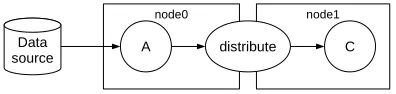
Fig. 11. A distributed pipeline to illustrate the problem of short-circuit evaluation in a distributed environment. Circles and ellipses represent pipeline operations, while arrows represent data flow.
A key property of Java 8 Streams is that they are short-circuiting, but extending this to a distributed pipeline envi-ronment impacts efficiency in the following ways:
• The pipeline has to wait for existing data items to
be fully processed before deciding if more data items are needed. This may result in idle pipeline sections in certain nodes.
• Requests for data items originate from the terminal
operation, and for distributed pipelines this has to be communicated upstream to different nodes which increases overhead. There is also the additional prob-lem of choosing the node(s) from which to retrieve data.
Figure 11 shows an example pipeline that uses a distribute operation, and where operations Aand
(ter-minal) C are on different nodes. If the entire pipeline is
short-circuiting, operation A will wait for a message from
operation C to begin processing the next data item. The
inefficiency is compounded if operationApotentially takes
a long time to let a data item through the pipeline (eg. filtering). The time spent waiting in upstream operations could have been used to process data speculatively to keep those operations better utilised.
Consequentially, the solution employed is to view the distributeoperation as terminating the current pipeline and starting another. This ensures that each section of the pipeline is on a single node and is evaluated as efficiently as possible without having to be concerned with parallelism in other pipeline sections. Therefore, this solution of restricting short-circuit evaluation to each node is simpler than enforc-ing it across nodes.
4.5 Summary
This section has detailed the four components in the Dis-tributed Stream framework:
1) Compute nodes and compute groups for identifying
2) Distributed Collections for representing distributed datasets and storing intermediate results.
3) Distributed Streams as a drop-in replacement for
Java 8 Streams.
4) New eager operations for distributing data across
nodes and support for splitting of streams.
5
P
ROTOTYPE IMPLEMENTATIONThis section gives an overview of the proof-of-concept framework we implemented. In general, it is based on the default Java 8 Stream implementation, inheriting and ex-tending several of its classes. This allows for future changes to the default implementation without affecting Distributed Streams too significantly.
5.1 Transport layer
Since there is no requirement to use any particular transport layer, a patched version of the MPJ Express [12] library was used for several reasons:
• It is based on MPI, a message-passing protocol
widely used in cluster-based parallel computing.
• It is lightweight and written in Java.
• It supports MPI in full multithreaded mode.
If required, the transport layer can be changed (e.g. to RMI) without significant modifications to the rest of the library.
Each compute node is identified by an integer identical
to its global MPI communicator (COMM_WORLD) rank. The
name of each node is the string “node” concatenated with
its rank (in other implementations, this can be read from a
configuration file, for example). TheComputeNodeclass in
our implementation is also the program’s entry point. The
mainmethod initialises MPI, discovers the other nodes in
the cluster and runs the actual program. It also cleans up after the program finishes.
As defined in section 4.1, a ComputeGroup is a List
of compute nodes. Thus it supports all List
opera-tions. The getCluster method creates a new compute
group containing all nodes in the cluster as discovered by ComputeNode.main. The first node in each group is designated as the root.
The current prototype assumes no node failures. For a more robust implementation, this can be handled by configuring a timeout interval between messages sent to and received from a node, and retrying the computation, possibly on another node, if the timeout has been exceeded.
5.2 Distributed Collections
The DistributedCollection interface overrides the
default methods stream and parallelStream. It also
implements new static wrap methods which return a
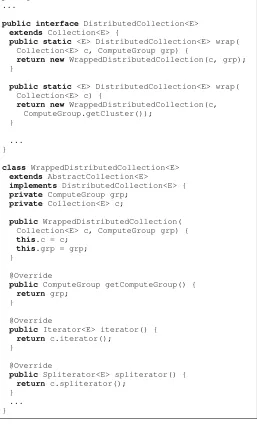
WrappedDistributedCollectionof the same data type (see figure 12 for more details). It keeps a reference to the local collection, which is used when generating iterators and spliterators, or retrieving the local size of the collection.
package dstream.util; ...
public interface DistributedCollection<E>
extends Collection<E> {
public static <E> DistributedCollection<E> wrap( Collection<E> c, ComputeGroup grp) {
return new WrappedDistributedCollection(c, grp); }
public static <E> DistributedCollection<E> wrap( Collection<E> c) {
return new WrappedDistributedCollection(c, ComputeGroup.getCluster());
}
... }
class WrappedDistributedCollection<E>
extends AbstractCollection<E>
implements DistributedCollection<E> {
private ComputeGroup grp;
private Collection<E> c;
public WrappedDistributedCollection( Collection<E> c, ComputeGroup grp) {
this.c = c;
this.grp = grp; }
@Override
public ComputeGroup getComputeGroup() {
return grp; }
@Override
public Iterator<E> iterator() {
return c.iterator(); }
@Override
public Spliterator<E> spliterator() {
return c.spliterator(); }
[image:8.612.310.567.55.484.2]... }
Fig. 12. Implementation of the WrappedDistributedCollection class and usage inDistributedCollection.wrapmethods.
5.3 Distributed Streams – Distribution of data exten-sions
As mentioned in section 4.4, the distribute operation
terminates the existing pipeline and starts a new one. The
following algorithm describes the core of all distribute
operation variants.
The existing pipeline is terminated with a
localForEach operation, which sends each element to the appropriate destination node. (The MPI implementation serialises each element. Thus, our implementation can only
send objects that implement theSerializableinterface.)
After all elements are sent, an end-of-data marker is sent to all participating nodes. We use a null object message to represent this marker.
Since stream computations block until the terminal op-erator has output a result, extra threads are created to keep the two pipelines executing concurrently.
5.4 Distributed Streams – Drop-in replacement exten-sions
We give details of how some of the Distributed Stream op-erations are implemented to satisfy the drop-in replacement requirement.
Thereduceoperation:There are a number ofreduce op-erations for each stream type, but all have implementations similar to the following:
1) A reduction is performed on local data elements
with thelocalReduceoperation.
2) The local result is sent to the first node in the
compute group.
3) The first node receives and accumulates all local
results, and sends the final result to the other nodes.
4) The other nodes receive the final result. All nodes
return the same value.
Unlike in MapReduce, where a reduce stage may output
large amounts of data, areduceoperation combines data
items into a single value. Again, with our simple prototype, we assume the nodes are reliable.
TheallMatchoperationcan be expressed as a reduction
with the result being the logical-AND of local allMatch
operations on each participating node.
Thecountoperationcan be expressed as a reduction with
the result being the sum of localcountoperations on each
participating node.
Thedistinctoperationcan be expressed in terms of the distributeoperation followed by the localDistinct
operation. Thedistributeoperation sends elements with
the same hash value (which includes all identical elements)
to the same node. The localDistinct operation then
removes duplicate elements within each node.
The forEachoperation: To be consistent with the other terminal operations, each participating node needs to per-form the specified action on every element in the Distributed Stream. Thus, each node broadcasts its local data elements to other nodes, thereby ensuring that each local stream contains elements from all nodes. However, this is
un-likely to be efficient. ThelocalForEachoperation avoids
broadcasting elements and is intended for programmers to optimise their implementations.
6
M
APR
EDUCE IND
ISTRIBUTEDS
TREAMSSection 5 described how the API extensions are imple-mented. In this section we consider how the MapReduce programming model can be expressed in terms of the Dis-tributed Stream model.
With Java 8 streams, performing MapReduce computa-tions across a cluster was not possible as the framework operated within a single node. Distributed streams solve this problem by defining operations to transfer data across nodes. In MapReduce, the shuffle stage is where data trans-fer is needed. This stage can be broken down into sub-stages and implemented with distributed streams as follows:
Map
Disk Node 0
Mapper
Shuffle
Reduce
Disk Distribute
Collect & sort
Reducer
Disk Node 1
Mapper
Disk Distribute
Collect & sort
Reducer
Disk Node 2
Mapper
Distribute
Collect & sort
[image:9.612.322.561.40.189.2]Reducer
Fig. 13. Expressing a MapReduce computation in terms of distributed streams. Arrows indicate the flow of data. The mapper, reducer, local collect and local sort may span multiple stream operations.
1) Thedistribute operation transfers data (in key-value form) between compute nodes such that those with the same key are sent to the same node. 2) The localCollect operation on each node
ac-cumulates incoming data into a collection of
key-value-listpairs. The value lists are optionally sorted.
SincelocalCollectis a terminal operation, a new
stream consisting of elements in the collection is created and passed to the reduce stage.
Figure 13 shows in general how a MapReduce computa-tion can be represented with pipeline operacomputa-tions.
Special cases such as summing, counting and collecting are built into Distributed Streams. Hence the resulting code is more concise if such operations are used.
6.1 Illustrative example
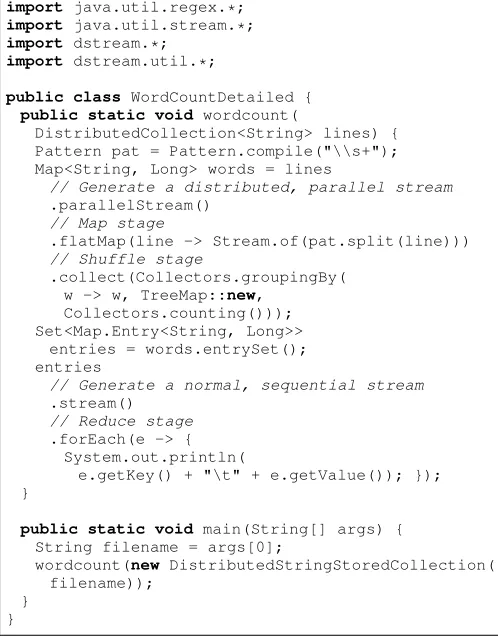
We return to the word-count example introduced in section 2.4, however with a change in the problem specification to more effectively demonstrate how Distributed Streams can be used in MapReduce computations. This time a detailed word-count, which outputs a sorted list of words together with their frequencies, is used. Since Distributed Streams and Distributed Collections are drop-in replacements, the same algorithm can be used on an input text file distributed over the cluster, and the computation also occurs cluster-wide (see figure 14).
If only a subset of nodes are needed for reduction, the pipeline can be modified to distribute the elements to the required subset. Using the example above, the user need only make a small change to the pipeline by adding a distributeoperation:
.distribute(lines.getComputeGroup().get(0))
between theflatMapandcollectoperations.
7
I
N-
MEMORY STREAMING IND
ISTRIBUTEDS
TREAMSimport java.util.regex.*;
import java.util.stream.*;
import dstream.*;
import dstream.util.*;
public class WordCountDetailed {
public static void wordcount(
DistributedCollection<String> lines) { Pattern pat = Pattern.compile("\\s+"); Map<String, Long> words = lines
// Generate a distributed, parallel stream .parallelStream()
// Map stage
.flatMap(line -> Stream.of(pat.split(line))) // Shuffle stage
.collect(Collectors.groupingBy( w -> w, TreeMap::new,
Collectors.counting())); Set<Map.Entry<String, Long>>
entries = words.entrySet(); entries
// Generate a normal, sequential stream .stream()
// Reduce stage .forEach(e -> {
System.out.println(
e.getKey() + "\t" + e.getValue()); }); }
public static void main(String[] args) { String filename = args[0];
wordcount(new DistributedStringStoredCollection( filename));
[image:10.612.45.294.48.368.2]} }
Fig. 14. Detailed word-count application using Distributed Streams.
7.1 Spark and comparisons with Distributed Streams
Since both Spark and Distributed Streams are stream-based programming models, there are some similarities. For exam-ple, Spark pipelines are also lazily evaluated, and their Java syntax resembles that of Java 8 streams. Also, transforma-tions are analogous to intermediate operatransforma-tions and actransforma-tions are equivalent to terminal operations.
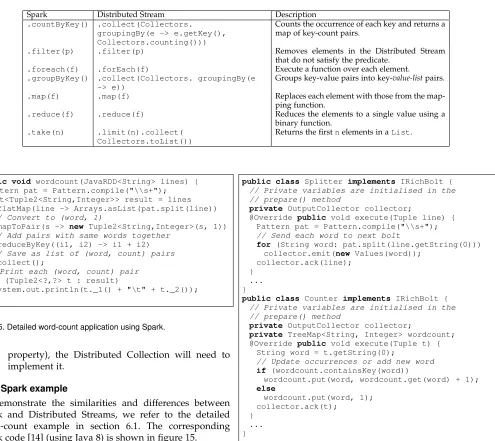
To demonstate the similarities between Spark’s trans-formations/actions and Distributed Streams’ operations, table 1 lists a number of Spark transformations/actions together with the equivalent operations in Distributed Streams.
There are also significant differences between the mod-els. Spark was designed specifically for Big Data applica-tions, whereas Distributed Streams have to maintain com-patibility with Java 8 Streams. RDDs can be reused, un-like Java 8 Streams, and Spark allows caching of data in memory for frequently-used RDDs to avoid recomputing data. Also, Java 8 Streams are conceptually separate from Java collections (which can be the source of a stream), but Spark RDDs do not have such a distinction. Depending on its position in the pipeline, an RDD may contain data from HDFS blocks, or transformed data cached in memory, or even information on how the data should be processed (to support lazy evaluation). This allows the entire pipeline to be lazy even across compute nodes.
Terminal operations in Distributed Streams use all-to-all communications by default, due to Java semantics.
How-ever, the group of nodes which receive the output of ter-minal operations can be changed from this default to any
subset through the use ofdistributeand local versions of
terminal operations. Spark’s driver-worker paradigm limits all-to-all communications to its internal shuffle operations (which are often needed).
Spark, being a high-level framework, does not have operations for distributing data according to an arbitrary
partitioner. However, it has operations such assampleand
intersectionthat are less straightforward to implement in Distributed Streams. Spark also exposes the concept of data partitions to the programmer, while Distributed Streams do not. Thus, there are no equivalents for several of
Spark’s operations such ascoalesceandmapPartitions
which are exclusively for altering the number or location of partitions in the cluster.
7.2 Distributed Stream implementation for Spark
Due to the similarities in programming models, parts of the Spark and Distributed Stream pipelines can be almost identical. However, a Distributed Stream implementation will need to be aware of the following due to differences in the programming models:
• More Distributed Stream pipelines may be needed to
implement a similar Spark pipeline. A terminal
op-eration (exceptdistribute) in Distributed Streams
waits for all data in the stream to be processed before returning, and the next pipeline will not be-gin execution until this happens. This behaviour is inherited from Java 8 Streams. This may cause under-utilisation of the nodes, and cannot be optimised by the implementation unlike Spark. To mitigate this, a separate thread can be created to execute another pipeline concurrently, but the programmer has to judge the feasibility of this (for example, to ensure that there are no data dependencies between the pipelines).
• A feature of Spark is that it can provide caching
and reuse of computed values in a pipeline. This is not currently automated by Distributed Streams. The programmer must implement this manually through
the use of localCollectand Distributed
Collec-tions.
• Since Spark has the concept of a driver program
which defines the pipeline and submits work to the
master node, actions such ascollectsend data to
the driver instead of to all processes on participating nodes. To achieve a similar effect of sending all
data to one compute node, thedistribute(node)
operation can be used.
• Like Distributed Stream operations, a number of
Spark transformations and actions require signifi-cant inter-node communication when dealing with datasets spanning multiple nodes and should be avoided if there are still many elements in the dataset.
• If the underlying data source has no redundancy
TABLE 1
Comparison of Spark Transformations/Actions and Distributed Stream Operations.
Spark Distributed Stream Description
.countByKey() .collect(Collectors. groupingBy(e -> e.getKey(), Collectors.counting()))
Counts the occurrence of each key and returns a map of key-count pairs.
.filter(p) .filter(p) Removes elements in the Distributed Stream that do not satisfy the predicate.
.foreach(f) .forEach(f) Execute a function over each element.
.groupByKey() .collect(Collectors. groupingBy(e -> e))
Groups key-value pairs into key-value-listpairs.
.map(f) .map(f) Replaces each element with those from the map-ping function.
.reduce(f) .reduce(f) Reduces the elements to a single value using a binary function.
.take(n) .limit(n).collect( Collectors.toList())
Returns the firstnelements in aList.
static void wordcount(JavaRDD<String> lines) { Pattern pat = Pattern.compile("\\s+"); List<Tuple2<String,Integer>> result = lines
.flatMap(line -> Arrays.asList(pat.split(line)) // Convert to (word, 1)
.mapToPair(s -> new Tuple2<String,Integer>(s, 1)) // Add pairs with same words together
.reduceByKey((i1, i2) -> i1 + i2) // Save as list of (word, count) pairs .collect();
// Print each (word, count) pair
for (Tuple2<?,?> t : result)
[image:11.612.70.565.71.512.2]System.out.println(t._1() + "\t" + t._2()); }
Fig. 15. Detailed word-count application using Spark.
property), the Distributed Collection will need to implement it.
7.3 Spark example
To demonstrate the similarities and differences between Spark and Distributed Streams, we refer to the detailed word-count example in section 6.1. The corresponding Spark code [14] (using Java 8) is shown in figure 15.
After replacing each line of text with the individual
words (usingflatMap), each word is converted to a(word,
1) pair. The reduceByKey transformation reduces values
(word, M) and (word, N) to (word, M + N). The collect
action ends the pipeline, saving the remaining pairs into
a List. Finally, the list contents are printed to standard
output.
7.4 Storm and comparisons with Distributed Streams
Storm is also a stream-based programming model, but it is eager and emphasises task-parallel computations, setting it apart from Distributed Streams which are mainly lazy and data-parallel. Nodes in Storm normally run different computations which are then joined together with streams. Hence it is closer to a distributed pipeline model (see section 3) where each node processes a segment of the pipeline and does not have knowledge of the entire pipeline. On the other hand, a Distributed Stream is primarily replicated pipeline-based and makes use of compute groups to partition the cluster for different data-parallel computations.
public class Splitter implements IRichBolt { // Private variables are initialised in the // prepare() method
private OutputCollector collector;
@Override public vold execute(Tuple line) { Pattern pat = Pattern.compile("\\s+"); // Send each word to next bolt
for (String word: pat.split(line.getString(0))) collector.emit(new Values(word));
collector.ack(line); }
... }
public class Counter implements IRichBolt { // Private variables are initialised in the // prepare() method
private OutputCollector collector;
private TreeMap<String, Integer> wordcount; @Override public vold execute(Tuple t) {
String word = t.getString(0);
// Update occurrences or add new word
if (wordcount.containsKey(word))
wordcount.put(word, wordcount.get(word) + 1);
else
wordcount.put(word, 1); collector.ack(t);
} ... }
Fig. 16. Detailed word-count application using Storm.
7.5 Distributed Stream implementation for Storm
Since Storm uses a distributed pipeline model, the program-mer can achieve a similar result by splitting the pipeline into
several segments and executing thedistributeoperation
at segment boundaries. For nodes that send data to
mul-tiple destinations, the distribute variant that accepts a
collection of compute groups can be used.
7.6 Storm example
For Storm, we split the pipeline into two bolts shown in figure 16. The bolts can be incorporated into a topology with the code in figure 17.
When run, the Splitter accepts lines of text and
outputs individual words. Concurrently, theCounteradds
TopologyBuilder builder = new TopologyBuilder(); builder.setSpout("input", ...);
builder.setBolt("split",
new Splitter()).shuffleGrouping("input"); builder.setBolt("count",
new Counter()).shuffleGrouping("split"); // ...
[image:12.612.50.299.189.256.2]Fig. 17. Storm topology for detailed word-count application.
TABLE 2
Evaluated Workloads, Attributes and Input Sizes.
Workload Attributes Input sizes Grep Disk-intensive 2GB – 32GB Sort Disk- & comms-intensive 2GB – 32GB Word-count (detailed) Disk-intensive 2GB – 32GB Bayes (naive) Disk-intensive 1GB – 32GB Connected components Graph, comms-intensive 210
–220 vertices PageRank Graph, comms-intensive 210
–220 vertices
its occurrence if already present. Since Spark topologies run indefinitely, an external signal, special marker or timeout is
needed to indicate the end of input and that theTreeMapis
ready to be output.
8
E
VALUATIONThe purpose of this evaluation is to demonstrate that the extended Distributed Stream APIs described in this paper allow efficient description of both map-reduce and dis-tributed streaming processing.
Direct comparisons of end-to-end execution times for Distributed Streams, Spark and Hadoop are often not ap-propriate because each system performs different styles of computation, at different times, and with different data dis-tribution, replication, and fault tolerance guarantees. There-fore this section attempts to remove initial distribution from the comparison and focus solely on the computation by pre-distributing the input data. This is how Hadoop (and Spark on HDFS) works normally, but it is not required by Storm or the Distributed Streams approach.
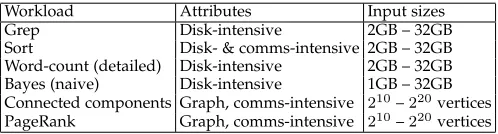
We based our evaluation on a subset of the Big-DataBench benchmark suite [15]. Table 2 lists the workloads that were evaluated, along with their attributes and the input sizes used. For each workload, a Distributed Stream application was implemented and compared against the provided Hadoop and Spark implementations. Although the input sizes are smaller than standard Big Data work-loads, we believe that they are sufficient for exploring the performance of the frameworks because the data is further broken down into smaller chunks for distribution and pro-cessing.
8.1 Experimental setup
All tests were carried out on a national, shared cluster1with the following allocation of nodes:
1. N8 High Performance Computing cluster (URL: http://n8hpc.org.uk)
1) A master node and 10 compute nodes were used,
with a total of 160 compute cores.
2) A master node and 20 compute nodes were used,
with a total of 320 compute cores.
There were two Intel E5-2670 CPUs per node (for a total of 16 cores per node). Each node had 64 GB of RAM, an attached 7200RPM hard disk, and ran CentOS 6.7 Linux. All nodes were connected with InfiniBand. Hadoop version 1.2.1, Spark version 1.3.0 and Java 8u45 were used.
Using two cluster sizes allows evaluating the frame-work’s scalability as more nodes are added. However, the shared nature of this cluster made measurements less ac-curate (there was the potential of interference from other users).
To minimise any differences in input data access, all tests read their input data from HDFS (as this was the default for the Hadoop and Spark tests) with data replication disabled. Input data was copied to HDFS before any measurements began, and the OS buffers were cleared before each test. The master node acted as the HDFS namenode as well as the jobtracker, while the compute nodes were each HDFS datanodes and tasktrackers.
In the BigDataBench suite, the Hadoop and Spark work-loads read their data from HDFS. Thus, to use the same
data source for all tests, a HDFSStringCollection was
implemented for Distributed Stream tests. It reads data from
HDFS as a DistributedCollection of lines when a
stream is obtained. Since HDFS files are already partitioned across the cluster, each compute node reads from local file blocks to preserve data locality. For writing data, we
im-plemented a HDFSStringCollectionWriter class that
writes to a new HDFS file using the add method (since
HDFS files can only be written to once).
8.2 Results and evaluation
The following metrics were obtained:
• Execution time – the elapsed time of the
computa-tion, excluding the time taken to copy data to HDFS.
• Network usage – the total volume of data transferred
over the network during the computation, again excluding the initial copying of data to HDFS.
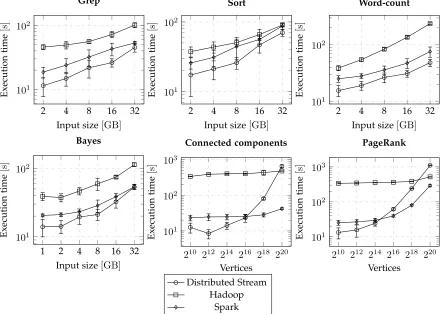
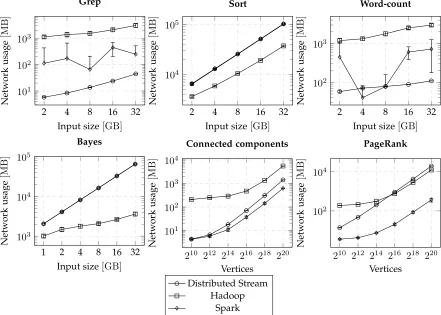
10 runs were carried out for each input size, and the average values and standard deviations were obtained. Figures 18 and 19 show the execution times and network usage for cluster 2 respectively. Distributed Streams scaled similarly well compared to Hadoop and Spark, with the results from cluster 1 following a similar pattern.
Note that even though the tests were carried out as fairly as possible, Distributed Streams are a proof-of-concept and are not heavily optimised. On the other hand, Hadoop and Spark have been under active development for several years and are thus much more optimised. Fault tolerance is also not implemented in Distributed Streams. However we have removed fault tolerance as much as possible from the other systems and so we believe such overhead is not significant.
8.2.1 Execution time
The Distributed Stream implementations of disk-intensive workloads (Bayes, Grep, Sort and Word-count) ran signifi-cantly faster than or comparable to those for Hadoop and Spark.
For graph workloads (Connected components and PageRank), execution times for Distributed Stream imple-mentations vary widely depending on the input size. Be-sides being less optimised, another reason is that Hadoop and Spark have optimised graph processing frameworks and libraries (Pegasus and GraphX) while the graph algo-rithms for Distributed Stream implementations were written from scratch. Despite these limitations, Distributed Streams were still fastest for the smallest datasets. It is likely that if more efficient graph algorithms and optimisations are used, they can scale as well as Hadoop and Spark for larger datasets.
8.2.2 Network usage
Hadoop and Spark attempt to load-balance tasks across the cluster, which may require nodes to read data on a non-local disk and have it sent across the network. Distributed Streams does not do this, except for sending data items that straddle HDFS blocks. This can be seen in results for the Grep and Word-count workloads, with network usage being higher and less predictable for Hadoop and Spark than Distributed Streams.
As previously mentioned, Distributed Streams are not heavily optimised. This is especially true of the communi-cation layer. Though network usage of Distributed Streams was generally in the high end, they still ran as fast as (if not faster than) the other frameworks for non-graph workloads. This highlights the efficiency of Distributed Streams, and especially the Java 8 Stream framework that it builds upon.
8.3 Summary
Currently, Distributed Streams do not provide any fault tolerance above that which is already provided by the underlying communication layer implementation. Yet, these results illustrate that as a thin layer, the Distributed Streams API is a suitable extension to Java 8 Streams for Big Data computations.
With Distributed Streams being proof-of-concept, we believe there is room for efficiency improvements. To sup-port larger clusters, reliability issues will also need to be addressed, and we are confident that performance will not be sacrificed as a result.
9
R
ELATED WORKBig Data research and development has been dominated by the MapReduce and streaming programming models,
which were discussed in section 2. This section gives a brief overview of other developments.
A Big Data framework which also uses Java 8 Streams has been proposed in [16]. It differs from our approach in that their extended stream model is used within other Big Data engines (such as Hadoop), while our framework proposes a new engine. Our approach does not require an existing engine for processing data, and is backward compatible with the existing model.
Other streaming models include the Cascading [17] framework, which implements a Java-based programming model with concepts borrowed from Unix pipes. Its main abstraction is the flow, which consists of pipelines of com-putation bound to data sources and sinks. This differs from Java 8 Streams in that the pipelines can be defined indepen-dent of data sources, while pipelines in Java 8 Streams must be constructed from a known data source.
There have also been attempts to improve existing pro-gramming models. For example, to address the inflexibility of the MapReduce model, frameworks such as Twister [18] have extended the model by adding iteration and caching of data across MapReduce jobs. This reduces the amount of data read during each iteration and thus speeds up execu-tion. HaLoop [19] also modifies Hadoop to make it easier to build iterative applications, something that is difficult in the basic MapReduce model. HaLoop again aggressively caches data and results to reduce recalculation. CoHadoop [20] sug-gests a lightweight extension to the Hadoop programming model to allow control over the placement of data.
A combination of the above-mentioned approaches can be found in the Stratosphere [21] platform, which includes a high-level query language, Meteor, implemented on top of a generalised MapReduce programming model, PACT [22]. PACT extends MapReduce to support more user-defined
functions (besidesmapandreduce), acyclic data flows and
arbitrary length records (as opposed to key-value pairs in MapReduce).
Hazelcast [23] implements distributed versions of Java collections. However, they are in-memory only and require populating the collections before computation can begin.
10
C
ONCLUSIONSIn this paper we have proposed and implemented a proof-of-concept version of Distributed Streams. Distributed Streams provide the following features which address the limitations of the existing Java 8 Stream model:
• It provides compute nodes and groups to support
computation across a cluster.
• It provides replicated and distributed pipelines for
distributed stream-based processing, as well as new operations for the distribution of data across a clus-ter.
• It provides Distributed Collections to encapsulate
data that is partitioned across a cluster, allowing them to be used as data sources for Distributed Streams.
• It is a drop-in replacement for Java 8 Streams,
2 4 8 16 32 101
102
Input size[GB]
Execution
time
[s
]
Grep
2 4 8 16 32
101 102
Input size[GB]
Execution
time
[s
]
Sort
2 4 8 16 32
101 102
Input size[GB]
Execution
time
[s
]
Word-count
1 2 4 8 16 32
101 102
Input size[GB]
Execution
time
[s
]
Bayes
210 212
214 216
218 220 101
102 103
Vertices
Execution
time
[s
]
Connected components
210 212
214 216
218 220 101
102 103
Vertices
Execution
time
[s
]
PageRank
Distributed Stream Hadoop
[image:14.612.88.528.50.364.2]Spark
Fig. 18. Average execution time for each workload on cluster 2 (20 nodes).
Most of the Java 8 programming model was directly applicable to distribution. However the main difficulty ob-served was that short-circuit evaluation is very inefficient when distributed. Accordingly, a new operation had to be added to the Java model to allow for this. Otherwise, the proposed framework is a drop-in replacement for existing Java 8 code. In addition, pipelines have been made more flexible in Distributed Streams, allowing for more expres-siveness in the programming model.
More generally, this work looked at taking a parallel programming model (Java 8 Streams) and making it dis-tributed. This provides backward compatibility and allows programmers to incrementally optimise sections of their code. This is in contrast to most Big Data programming models which start out as distributed models.
Our results have shown that Distributed Streams can in many cases achieve similar execution times compared to Hadoop and Spark. This indicates that Java 8 Streams may be more effective at fully utilising the resources of compute nodes of the distributed system. In the future, we plan to further optimise the performance of Distributed Streams by integrating existing research on optimising network traffic and to address reliability issues by implementing SPMD fault tolerance in the communication layer and supporting dynamically changing clusters.
A
CKNOWLEDGMENTSThis research is supported by the JUNIPER project, which has received funding from the European Union’s Seventh
Framework Programme for research, technological devel-opment and demonstration – grant number 318763. It also forms part of a PhD thesis [24]. We would like to thank the referees for their comments on earlier versions of the paper.
R
EFERENCES[1] X. C. Vidal and R. C. Manzano, “Taking a closer look at LHC,” http://www.lhc-closer.es/1/3/12/0, accessed 2014/05/05. [On-line]. Available: http://www.lhc-closer.es/1/3/12/0
[2] Apache Software Foundation, “Apache Hadoop,” http://hadoop. apache.org/, accessed 2013/09/01.
[3] ——, “Apache Spark – Lightning-Fast Cluster Computing,” http: //spark.incubator.apache.org/, accessed 2013/10/03.
[4] N. Marz, “Storm – Distributed and fault-tolerant realtime compu-tation,” http://storm-project.net/, accessed 2013/10/03. [5] Oracle Corporation, “JEP 107: Bulk Data Operations for
Collec-tions,” http://openjdk.java.net/jeps/107, accessed 2013/09/05. [Online]. Available: http://openjdk.java.net/jeps/107
[6] ——, “JSR 335: Lambda Expressions for the Java(TM) Programming Language,” https://jcp.org/en/jsr/detail?id=335, accessed 2015/06/01. [Online]. Available: https://jcp.org/en/jsr/ detail?id=335
[7] J. Dean and S. Ghemawat, “Mapreduce: simplified data processing on large clusters,”Commun. ACM, vol. 51, no. 1, pp. 107–113, Jan. 2008. [Online]. Available: http://doi.acm.org/10.1145/1327452. 1327492
[8] T. White, Hadoop: The Definitive Guide. O’Reilly Media, 2009. [Online]. Available: http://books.google.co.uk/books?id= bKPEwR-Pt6EC
[9] Oracle Corporation, “Stream (Java Platform SE 8),” https://docs. oracle.com/javase/8/docs/api/java/util/stream/Stream.html, accessed 2014/11/17.
2 4 8 16 32 101
102 103
Input size[GB]
Network
usage
[M
B
]
Grep
2 4 8 16 32
104 105
Input size[GB]
Network
usage
[M
B
]
Sort
2 4 8 16 32
102 103
Input size[GB]
Network
usage
[M
B
]
Word-count
1 2 4 8 16 32
103 104 105
Input size[GB]
Network
usage
[M
B
]
Bayes
210 212
214 216
218 220 101
102 103 104
Vertices
Network
usage
[M
B
]
Connected components
210 212
214 216
218 220 102
104
Vertices
Network
usage
[M
B
]
PageRank
Distributed Stream Hadoop
[image:15.612.87.528.49.364.2]Spark
Fig. 19. Average network usage for each workload on cluster 2 (20 nodes).
[11] Y. Chan, I. Gray, and A. Wellings, “Exploiting Multicore Architec-tures in Big Data Applications: The JUNIPER Approach,” in Pro-ceedings of 7th Workshop on Programmability Issues for Heterogeneous Multicores (MULTIPROG-2014), January 2014.
[12] B. Carpenter, A. Shafi, and M. Baker, “MPJ Express Project,” http: //www.mpjexpress.org/, accessed 2014/11/16.
[13] OpenSFS and EOFS, “Lustre,” http://lustre.org/, accessed 2015/08/24.
[14] Apache Software Foundation, “Spark Examples,” http://spark. apache.org/examples.html, accessed 2014/10/22.
[15] L. Wang, J. Zhan, C. Luo, Y. Zhu, Q. Yang, Y. He, W. Gao, Z. Jia, Y. Shi, S. Zhang, C. Zheng, G. Lu, K. Zhan, X. Li, and B. Qiu, “Bigdatabench: A big data benchmark suite from internet services,” inHigh Performance Computer Architecture (HPCA), 2014 IEEE 20th International Symposium on, Feb 2014, pp. 488–499. [16] X. Su, G. Swart, B. Goetz, B. Oliver, and P. Sandoz,
“Changing engines in midstream: A java stream computational model for big data processing,” Proc. VLDB Endow., vol. 7, no. 13, pp. 1343–1354, Aug. 2014. [Online]. Available: http: //dx.doi.org/10.14778/2733004.2733007
[17] Concurrent Inc., “Cascading — Application Platform for Enterprise Big Data,” http://www.cascading.org/, accessed 2015/09/21.
[18] J. Ekanayake, H. Li, B. Zhang, T. Gunarathne, S.-H. Bae, J. Qiu, and G. Fox, “Twister: A runtime for iterative mapreduce,” in Proceedings of the 19th ACM International Symposium on High Performance Distributed Computing, ser. HPDC ’10. New York, NY, USA: ACM, 2010, pp. 810–818. [Online]. Available: http://doi.acm.org/10.1145/1851476.1851593
[19] Y. Bu, B. Howe, M. Balazinska, and M. D. Ernst, “Haloop: efficient iterative data processing on large clusters,”Proceedings of the VLDB Endowment, vol. 3, no. 1-2, pp. 285–296, 2010.
[20] M. Y. Eltabakh, Y. Tian, F. ¨Ozcan, R. Gemulla, A. Krettek, and J. McPherson, “Cohadoop: Flexible data placement and its exploitation in hadoop,” Proc. VLDB Endow., vol. 4, no. 9, pp. 575–585, Jun. 2011. [Online]. Available: http: //dx.doi.org/10.14778/2002938.2002943
[21] A. Alexandrov, R. Bergmann, S. Ewen, J.-C. Freytag, F. Hueske, A. Heise, O. Kao, M. Leich, U. Leser, V. Markl, F. Naumann, M. Peters, A. Rheinl¨ander, M. J. Sax, S. Schelter, M. H ¨oger, K. Tzoumas, and D. Warneke, “The stratosphere platform for big data analytics,” The VLDB Journal, vol. 23, no. 6, pp. 939–964, Dec. 2014. [Online]. Available: http://dx.doi.org/10. 1007/s00778-014-0357-y
[22] D. Battr´e, S. Ewen, F. Hueske, O. Kao, V. Markl, and D. Warneke, “Nephele/pacts: A programming model and execution framework for web-scale analytical processing,” in Proceedings of the 1st ACM Symposium on Cloud Computing, ser. SoCC ’10. New York, NY, USA: ACM, 2010, pp. 119–130. [Online]. Available: http://doi.acm.org/10.1145/1807128.1807148 [23] Hazelcast, Inc., “Hazelcast.org - The Leading Open Source In-Memory Data Grid,” http://hazelcast.org/, accessed 2016/05/30. [24] Y. Chan, “A Distributed Stream Library for Java 8,” Ph.D.
disser-tation, University of York, 2016.
Yu Chan is a PhD student at the University of York, UK under the supervision of Ian Gray and Andy Wellings.
Andy Wellingsis Professor of Real-Time Systems at the University of York, UK in the Computer Science Department.
Ian Gray is a Research Fellow at the University of York, UK in the Computer Science Department.