Int. J. Electrochem. Sci., 4 (2009) 1479 - 1488
International Journal of
ELECTROCHEMICAL
SCIENCE
www.electrochemsci.orgVoltammetric Resolution of Dopamine in presence of Ascorbic
Acid at Polyvinyl Alcohol Modified Carbon Paste Electrode
Umesh Chandra1, B.E. Kumara Swamy1*, Ongera Gilbert1, M.Pandurangachar2 and B.S. Sherigara1
1
Department of P.G .Studies and Research in Industrial Chemistry, Kuvempu University, Jnana Sahyadri, Shankaraghatta – 577451, Shimoga(D), Karnataka (S), India.
*
E-mail: [email protected]
2
Department of Chemistry, SSMRV Degree College, Jayanagara 4T Block, Banglore-41, Karnataka,INDIA.
Received: 16 September 2009 / Accepted: 15 October 2009 / Published: 11 November 2009
The polyvinyl alcohol modified carbon paste electrode was prepared by grinding the 15mg of polyvinyl alcohol with the mixture of graphite powder and silicon oil of ratio 70%:30% by weight. The voltammetric response of dopamine at modified carbon paste electrode was excellent when compared to traditional carbon paste electrode at sweep rate of 100mV/s in the potential range from -250 to 600mV. The voltammogram of dopamine was reversible. The effect of scan rate showed that the electrode process was diffusion controlled. The concentration and pH effects on the voltammogram of dopamine were studied. The modified carbon paste electrode was better in simultaneous determination of dopamine in presence of large excess of ascorbic acid.
Keywords: Polyvinyl Alcohol, Dopamine, Ascorbic acid, Cyclic voltammetry, Modified carbon paste electrode
1. INTRODUCTION
However, a major problem frequently encountered in the electrochemical detection of DA is serious interferences caused by the ascorbic acid (AA), L-Ascorbic acid (Vitamin C) (AA), a water soluble vitamin, is an extremely important substance which plays a unique redox and electrochemical role [7]. AA is a compound that takes part in many important life processes [8,9]. Due to its antioxidant and pH regulator properties, this vitamin is present or added to a wide variety of food products and pharmaceuticals. Ascorbic acid is easily oxidized chemically and electrochemically to Ldehydroascorbic acid [10]. The direct redox reactions of both substances at bare carbon electrodes regularly take place at very similar potentials [11], and often suffer from a pronounced fouling effect, which results in rather poor selectivity and reproducibility. Thus, it is difficult to detect DA in the presence of a high level of AA in real biological samples.
Recently, many techniques were reported to improve the selectivity for the determination in the presence of AA. Several approaches, based on polymer-modified electrodes [12-18], nanomaterial-modified electrodes [19-22], and chemically nanomaterial-modified carbon paste electrodes [23,24] have been tried for solving this problem.
Scheme 1. Structure of Polyvinyl Alcohol.
In the present paper, the chemically modified carbon paste electrode was prepared by mixing 15mg of polyvinyl alcohol (PVA) with 70%:30% ratio of carbon paste electrode. The PVA is a water-soluble synthetic polymer (Scheme. 1). Polyvinyl alcohol is an odorless and tasteless, translucent, white or cream colored granular powder. It is used as a moisture barrier film for food supplement tablets and for foods that contain inclusions or dry food with inclusions that need to be protected from moisture uptake. The PVA modified carbon paste electrode was excellent in determination of DA in presence of AA. The probable mechanism could be explained in such a way that, the PVA was uniformly distributed in carbon paste electrode. The large number of –OH groups present in PVA could develop the electrostatic repulsion with the –OH group present in the DA, and hence increases the voltammetric response and selective determination in presence of AA.
2. EXPERIMENTAL PART
2.1. Reagent and Chemicals
solution. The phosphate buffer of pH 7 was used as supporting electrolyte. Chemicals mentioned above were all purchased from Fluka and were analytical grade used without further purification.
2.2. Apparatus and Procedure
The electrochemical experiments were carried out using a model-201 Electroanalyser (EA-201 chemilink system). All experiments were carried out in a conventional three-electrode system. The electrode system contained a working carbon paste electrode, home made cavity of 3mm diameter, a platinum wire as counter electrode and saturated calomel electrode as reference electrode. PVAMCPE was prepared by grinding the 15mg of PVA with 70% graphite powder and 30% silicon oil in an agate mortar by hand mixing for about 30 minute to get homogenous PVAMCPE. The paste was packed into the cavity CPE and smoothened on weighing paper. The bare CPE was prepared without adding modifier.
3. RESULTS AND DISCUSSION
3.1. Electrocatalytic response of DA at PVAMCPE
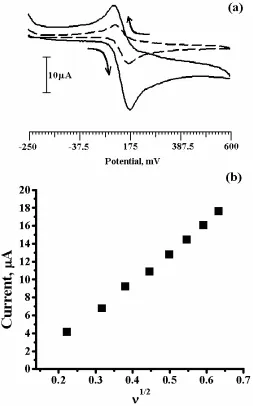
DA being an easily oxidizable catecholamine, its voltammogram was recorded in the potential range from -250 to 600mV with supporting electrolyte 0.2M PBS pH 7 at 100mVs-1 scan rate. Fig.1a showed a pair of redox peak for 0.1mM DA at bare CPE (dashed line) with anodic peak potential (Epa) at 175mV and cathodic peak potential (Epc) 109mV (vs. SCE) in 0.2M PBS of pH 7 as supporting electrolyte. The peak to peak separation (∆Ep) was found to be 66mV. However, for the PVAMCPE a pair of redox peaks is obtained with strong increase in both anodic and cathodic peak current (solid line) with small shift in redox peak potentials. The Epa was located at 176mV and the corresponding Epc was located at 107mV (vs SCE). The peak-to-peak separation was calculated as 69mV and the value of Ipa/Ipc was about 1.15. So, the voltammogram obtained for PVAMCPE was reversible with
good improvement in enhancement of oxidation and reduction peak currents. The voltammograms increased in the both Ipa and Ipc of the DA with increase in scan rate at the modified electrode. The graph of current (Ipa) square root of scan rate (ν1/2) were plotted. The graph obtained was nearly strain line (Fig. 1b). In the range from 50mV s-1- 300mV s-1 the redox peak currents were proportional to the square root of scan rate (ν1/2) with correlation coefficient 0.9991. This indicates that, the electrode transfer reaction was diffusion controlled.
3.2. Effect polyvinyl alcohol
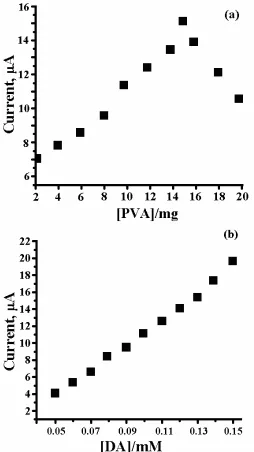
peak current was decreased (Fig. 2a). Further increase in the quantity of PVA the both Ipa and Ipcwere decreased.
Figure 1. (a) Cyclic voltammogram of 0.1mM DA in PBS of pH 7 at bare CPE (dashed line) and PVAMCPE (solid line), at 100mVs-1. (b) Graph of current vs square root of scan rate of DA.
3.3. Effect DA concentration
[image:4.612.179.432.115.521.2]
Figure 2. (a) Graph of current vs quantity of PVA in carbon paste electrode, (b) Graph of current vs concentration of DA.
3.4. Effect of pH on cyclic voltammogram of DA at PVAMCPE
[image:5.612.178.432.65.517.2]
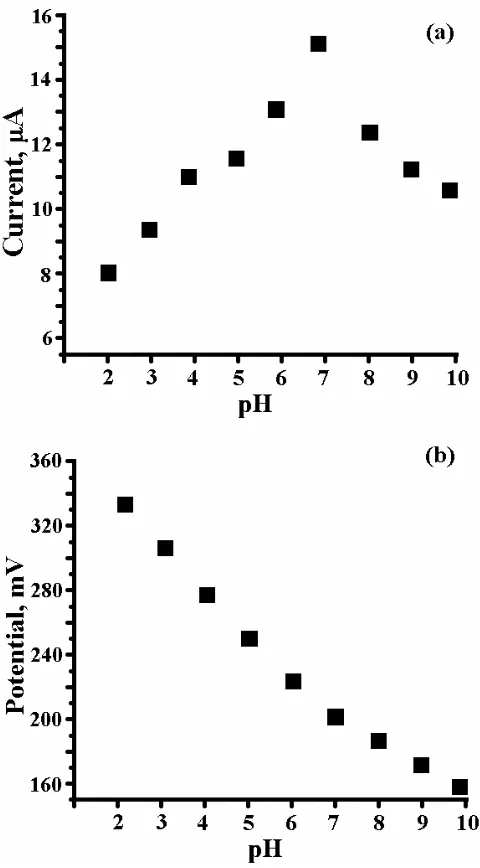
The graph has good linearity with a slope of 51mV/pH, this behaviour is nearly obeyed the Nernst Equation for two electron and two proton transfer reaction [25,26].
Figure 3. (a) Graph of Ipa vs pH, (b) Graph of Epa vs pH.
3.5. Simultaneous determination of DA and AA by cyclic voltammetry
[image:6.612.185.425.112.546.2]
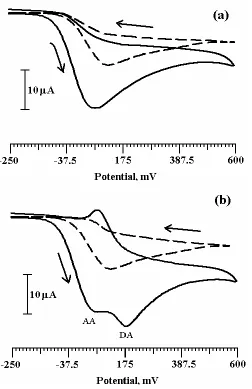
Figure 4. (a) Cyclic voltammogram of 0.5mM AA at bare CPE (dashed line) and PVAMCPE (solid line) with scan rate of 100mVs-1. (b) Cyclic voltammogram for simultaneous determination of AA and DA at bare CPE (dashed line) and PVAMCPE (solid line) with the scan rate of 100mVs-1.
The cyclic voltammogram was recorded for 0.5mM AA only in the potential range -250 to 600mV Fig. 4a. The AA shows the electrochemical anodic peak potential at 81mV in 0.2M PBS system at bare CPE (dashed line). At PVAMCPE (solid line) the AA shows the anodic peak potential at 72mV.
[image:7.612.181.433.66.455.2]
AA and DA was 104mV. The PVAMCPE shows the selective determination of DA in the presence of AA and acts as sensor for the detection of DA in low concentration.
3.6. Simultaneous determination of DA and AA by differential pulse voltammetry
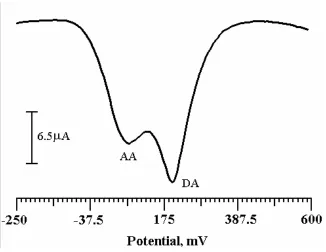
DPV was used for the determination of DA and AA at PVAMCPE because of its higher current sensitivity and better resolution than CV. The simultaneous study was carried out in the potential range form -200 to 700mV (Fig. 5a). The DPV showed the simultaneous determination of DA and AA with well separated two anodic peaks corresponding to their oxidation could be possible at PVAMCPE (solid line), where as the bare CPE showed only one oxidation peak for the mixture of DA and AA (dashed line). The 0.5mM AA showed its Epa at 60mV and 0.1mM DA was at 190mV. The peak separation between DA and AA was 130mV, which was very large when comparing to peak separation occurred by CV.
[image:8.612.143.469.419.671.2]The simultaneous determination of DA and AA in the mixture was carried out at PVAMCPE when concentration of one species changed, whereas another one remained kept constant. From the Fig. 5b, it can be seen that the peak current of DA was proportional to its concentration, which was increased from 0.05mM to 0.15mM when keeping the concentration of AA 0.5mM. There was no change in the peak current and peak potential occurred for AA. Similarly in the Fig. 5c keeping the concentration of DA constant at 0.1mM, the AA concentration was varied from 0.2mM to 1mM. The oxidation peak current of AA increases with increase in its concentrations.
4. CONCLUSIONS
The PVAMCPE was good by showing enhancement in both anodic and cathodic peak current. The increase in the concentration of DA results in greater the enhancement of electrochemical anodic and cathodic peak currents. The modification showed excellent in selective and electrocatalytic activity towards the oxidation of DA and AA in a mixed sample. The DPV results showed there is no influence of AA towards the oxidation peak of DA. Hence this electrode is very good for practical analysis of neurotransmitter.
ACKNOWLEDGEMENT
The authors are thankful to Department of Science and Technology, Ministry of Higher Education, New Delhi, for the funding given through project No. DST/TSG/2007/44, Dated 26-03-2008.
References
1. R.A. Vargas, A. Garciá, M.A. Vargas, Electrochim. Acta 43 (1988) 1271 1. H. Zhao, Y. Z. Zhang, Z. B. Yuan, Analyst 126 (2001) 358.
2. J. Li, J. Lu, Chinese J. Anal. Chem. 25 (1997) 314.
3. H. Nohta, T.Yukizawa, Y. Ohkura, M. Yoshimura, J. Ishida, M. Yamaguchi, Anal. Chim. Acta 344 (1997) 233.
4. Y. Wu, R. Fan, J. Di, Chinese J. Anal. Chem. 24 (1996) 873. 5. R. Zhu, W. T. Kok, Anal. Chem. 69 (1997) 4010.
6. L. F. Xiao, J. Chen, C. S. Cha, J. Electroanal. Chem. 495 (2000) 27. 7. R Ojani, J.-B. Raoof, S. Zamani, Electroanalysis 17 (2005) 1740.
8. T. Kleszczewski, E. J. Kleszczewska, Pharm. Biomed. Anal. 29 (2002) 755.
9. P.J. O’Connell, C. Gormally, M. Pravda, G.G. Guilbault, Anal. Chim. Acta 431 (2001) 239. 10.R.E. Sabzi, M.H. Pournaghi-Azar, Anal. Sci. 21 (2005) 689.
11.Y. L. Zeng, C. X. Li, C. R. Tang, X. B. Zhang, G. L. Shen, R. Q. Yu, Zhang, Z. B. Yuan, Electroanal. 18 (2006) 440.
12.Ongera Gilbert, B.E.Kumara Swamy, Umesh Chandra, B.S.Sherigara, Int. J. Electrochem. Sci., 4 (2009) 582.
13.Ongera Gilbert, Umesh Chandra, B.E. Kumara Swamy, M. Panduranga Char, C.Nagaraj, B.S.Sherigara, Int. J. Electrochem. Sci., 3 (2008) 1186.
14.H. Zhao, Y. Z. Zhang, Z. B. Yuan, Anal. Chim. Acta. 441 (2001) 117. 15.A. Ciszewski, G. Milczarek, Anal. Chem. 71 (1999) 1055.
16.T. F. Kang, G. L. Shen, R. Q. Yu, Anal. Chim. Acta 356 (1997) 245. 17.L. Z. Zheng, S. G. Wu, X. Q. Lin, L. Nie, L.Rui, Analyst 126 (2001) 736. 18.T. F. Kang, G. L. Shen, R. Q. Yu, Talanta 43 (1996) 2007.
19.S. B. Hocevar, J. Wang, R. P. Deo, M. Musameh, B.Ogorevc, Electroanal. 17 (2005) 417.
20.F. Valentini, S. Orlanducci, E. Tamburri, M. L. Terranova, A. Curulli, G. Palleschi, Electroanal. 17 (2005) 28.
21.R. S. Chen, W. H. Huang, H. TonÿÿÿÿÿÿL. Wanÿÿÿÿ. K. CheÿÿÿÿAnal. ÿÿem. 75 (2003ÿÿ6341. 22.Z. H. ÿÿÿÿ, Q. L. Liang,ÿÿÿÿM. Wÿÿg, G. A. Luo, J. Electroanal. Chem. 540 (2003) 129.
23.R. Raghavendra Naik, B.E. Kumara Swamy, Umesh Chandra, E. Niranjana, B.S. Sherigara and H.Jayadevappa Int. J. Electrochem. Sci., 4 (2009) 855.
25.B.D. Jones, J.D. Ingle Jr, Talanta, 55 (2001) 699.
26.M.C. Shen, H.C. Gheng, V.S. J. Vasantha, Electoanal. Chem. 588 (2006) 235.