OPTIMIZATION OF BIODIESEL PRODUCTION FROM THE WASTE COOKING OIL USING RESPONSE SURFACE METHOD
MUHAMMAD WARIS BIN JA’AFAR
OPTIMIZATION OF BIODIESEL PRODUCTION FROM THE WASTE COOKING OIL USING RESPONSE SURFACE METHOD
MUHAMMAD WARIS BIN JA’AFAR
This report is submitted
in fulfillment of the requirement for the degree of Bachelor of Mechanical Engineering (Thermal Fluid)
Faculty of Mechanical Engineering
UNIVERSITI TEKNIKAL MALAYSIA MELAKA
ii
DECLARATION
I declare that this project report entitled “Optimization of Biodiesel Production From The Waste Cooking Oil Using Response Surface Method” is the result of my own work except as cited in the references.
Signature : ...
iii APPROVAL
I hereby declare that I have read this project report and in my opinion this report is sufficient in terms of scope and quality for the award of the degree of Bachelor of Mechanical Engineering (Thermal Fluid).
iv ABSTRACT
v ABSTRAK
vi
ACKNOWLEDGEMENT
Alhamdulillah, I would like to praise to Allah Subhanahu Wa Ta’ala for His guidance and blessing because give me a spirit and make sure I can finish this final year project report within the time limit. There have been many individuals who have assisted, guiding and have become the source of inspiration and aspiration for me to accomplish in this project. My deepest appreciation goes to Mr. Md Isa bin Ali, lecturer from Faculty of Mechanical Engineering, Universiti Teknikal Malaysia Melaka (UTeM) and also my supervisor for giving me a chance to do my final year project under his supervision on the title Optimization of Biodiesel Production from Waste Cooking Oil using Response Surface Method.
vii CONTENT
CHAPTER CONTENT PAGE
SUPERVISOR’S DECLARATION ii
APPROVAL iii
ABSTRACT iv
ABSTRAK v
ACKNOWLEDGEMENT vi
TABLE OF CONTENT vii
LIST OF TABLES x
LIST OF FIGURES xi
LIST OF ABBREVIATIONS xii
CHAPTER 1 INTRODUCTION
1.1 Background 1
1.2 Problem Statement 4
1.3 Objective 5
1.4 Scope of Project 5
CHAPTER 2 LITERATURE REVIEW
2.1 Waste Cooking Oil (WCO)
2.1.1 Feed Stocks of WCO 6 2.1.2 Properties of WCO 8 2.2 Biodiesel
viii
2.3 Transesterification
2.3.1 Introduction 12
2.3.2 Factors Effecting Transesterification 2.3.2.1 Moisture and Free Fatty
Acid (FFA) Content 13 2.3.2.2 Type of Alcohol and
Molar Ratio 14
2.3.2.3 Type of Catalyst and
Concentration 14
2.3.2.4 Stirrer Speed 16 2.3.2.5 Reaction Temperature 16 2.3.2.6 Reaction Time 17 2.4 Response Surface Method (RSM) 18
CHAPTER 3 METHODOLOGY
3.1 Apparatus
3.1.1 Magnetic Stirrers 19 3.1.2 Digital Analytical Balance 20 3.2 Fuel Sampling
3.2.1 Collection of Waste Cooking
Oil (WCO) 22
3.2.2 Pre-treatment of WCO 23
3.3 Alcohol Selection 24
3.4 Catalyst Selection 25
3.5 Samples 26
3.6 Transesterification Flow Chart 27 3.7 Transesterification Process 28
3.8 Washing Process 30
3.9 Drying Process 31
3.10 Optimization Using Response Surface
ix
CHAPTER 4 RESULT AND DISCUSSION
4.1 Experimental Result 33
4.2 Optimization using Response Surface
Method (RSM) Result 34
4.2.1 Optimization of Yield Production with Related to Catalyst Concentration
and Reaction Temperature 35 4.2.2 Optimization of Yield Production
with Related to Catalyst Concentration
and Methanol to Oil Molar Ratio 37
CHAPTER 5 CONCLUSION AND FUTURE RECOMMENDATIONS
5.1 Conclusion 40
5.2 Recommendations 41
REFERENCES 42
x
LIST OF TABLES
TABLE TITLE PAGE
2.1 The Countries and Feed Stocks around the World 7 2.2 Physiochemical Properties of Used and Unused
Cooking Oil 9
2.3 Properties of Typical No. 2 Diesel and Biodiesel 10 3.1 Specifications of Magnetic Stirrers 20 3.2 Specifications of Digital Analytical Balance 21
3.3 Samples of Biodiesel Production 26
3.4 Chosen Parameter and Its Level 32
xi
LIST OF FIGURE
FIGURE TITLE PAGE
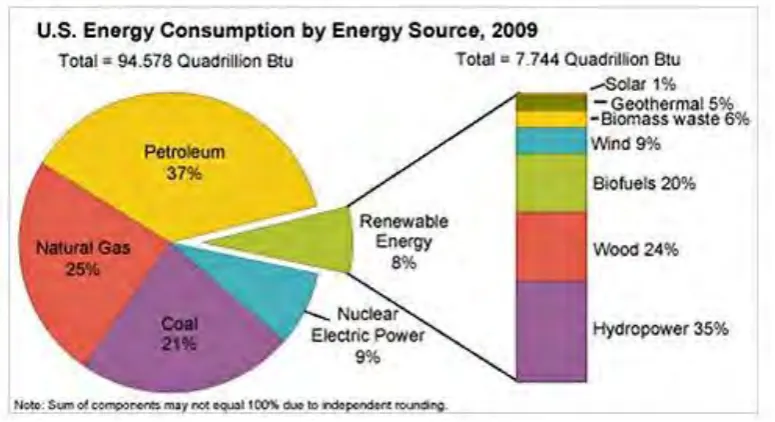
1.1 U.S. Energy Consumption by Energy Source, 2009 2 2.1 Transesterification of Vegetable Oil to Biodiesel 13 2.2 Conversion Efficiency of Ester under Different
Catalysts Concentration 15
2.3 Trend of Ester Conversion with Time 18
3.1 Magnetic Stirrers 19
3.2 Digital Analytical Balance 21
3.3 WCO Collection 22
3.4 Filtration Process 23
3.5 Liquid Methanol 24
3.6` Potassium Hydroxide 25
3.7 Flow Chart of Transesterification Process 27
3.8 Transesterification Process 28
3.9 Separation Process 29
3.10 Separation Process 30
3.11 Universal Oven 31
xii
LIST OF ABBREVIATIONS
WCO Waste Cooking Oil
UTeM Universiti Teknikal Malaysia Melaka RSM Response Surface Method
NaOH Sodium Hydroxide KOH Potassium Hydroxide LCD Liquid Crystal Display
CCRD Central Composite Rotatable Design FFA Free Fatty Acid
1 CHAPTER 1
INTRODUCTION
1.1 BACKGROUND
Non-renewable energy is a source that will not be replenished. Coal, petroleum and natural gas are an example of non-renewable energy sources. Usually, petroleum is a part of the chemical makeup of many plastics or synthetics and mostly used to power internal combustion engines. Nowadays, renewable energy such as solar energy and biofuels need to take place in industries to ensure that the petroleum sources not completely depleted for next generation.
2
Figure 1.1: U.S. Energy Consumption by Energy Source, 2009 (Source: Nancy Folbre, 2011)
For renewable energy, biofuels is a good alternative to power internal combustion engine rather than solar energy because solar system is not the best option to apply in industries. The disadvantages of solar power are the initial cost for purchasing and installing a solar system is expensive. Besides that, it uses a lot of space and stop producing electricity when sun goes down or is heavily shaded (Abhishek Shah, 2011).
3
Biodiesel consists of long chain mono-alkyl esters and do not contain sulphur or aromatics compound in its composition because of hydrocarbon chains. Biodiesel is an alternative fuel that is being appreciated all over the world because it is environmentally friendly, agriculture oriented, non-toxic and renewable fuel. Furthermore, it can also be blended with other energy sources, has a high cetane number, low volatility and presence of oxygen atoms in the fuel molecule (Demshemino et. al., 2013).
Biodiesel is having some properties similar or slightly higher than fossil diesel in term of density, viscosity, flash point, cetane number and heating value. Density of biodiesel is slightly higher than the fossil diesel and it will decreases as the temperature increases. Moreover, biodiesel is easy in the transportation due to high flash point and it also depends on the types of feedstock to have the same or high kinematic viscosity. In addition, it also has higher cetane number and less heating value (Sayyed et. al., 2013). In order to produce a biodiesel from vegetable oils or animal fats, transesterification process must be used to reduce the viscosity of the product.
4
Commonly, Response Surface Method (RSM) is used to optimize of biodiesel production in fats and oils feedstock. To illustrate with three dimensional plots, RSM must be presenting the response in function of two factors and keeping the other constant. Other than that, it will shows the effects of the main operating parameters including the alcohol to oil molar ratio, catalyst concentration and reaction temperature on the biodiesel yield.
1.2 PROBLEM STATEMENT
Petroleum is a non-renewable energy and the supplies will run out or will not be replenished. Mostly, in industries and social systems is based on oil because it has high energy density, low cost, also easy for extracting and transport due to its liquid form (Abhishek Shah, 2011). Biodiesel is an alternative energy to change the current energy and it can be done by converting waste cooking oil (WCO) into biodiesel.
Waste from cooking oil can give harmful effect to the environmental such as water and soil. It happened because people nowadays do not care about pollution effect and do not realize the benefit of recycling the waste. A preliminary survey was conducted among the community of Teluk Bahang Penang, Malaysia and it shows approximately 400 kg to 500 kg of WCO was produced by the 30 participants monthly (Hanisah, 2013). Mostly, the participants just discarded the WCO into dustbin, soil and drainage system.
5 1.3 OBJECTIVE
1. To determine the empirical equation of biodiesel production.
2. To optimize the yield production with related to catalyst concentration and reaction temperature.
3. To optimize the yield production with related to catalyst concentration and methanol to oil molar ratio.
1.4 SCOPE OF PROJECT
1. To study the process of transesterification by using WCO as feedstock. This process is used to get methyl ester from the WCO and use it as a biodiesel. All samples in this process will use different of catalyst concentration, methanol to oil molar ratio and reaction temperature with constant stir and time.
6 CHAPTER 2
LITERATURE REVIEW
2.1 WASTE COOKING OIL (WCO)
2.1.1 Feed Stocks of WCO
7
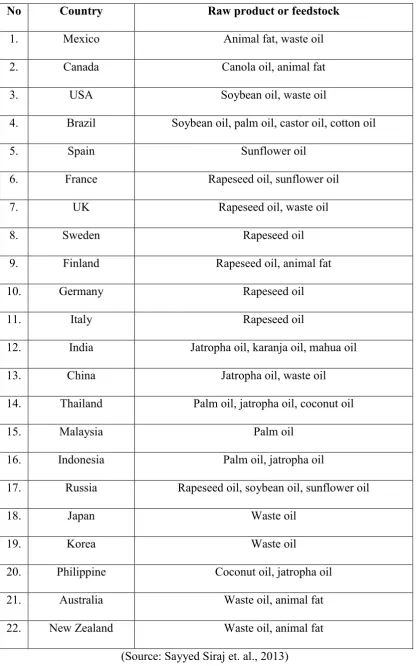
Table 2.1: The Countries and Feed Stocks around the World
No Country Raw product or feedstock
1. Mexico Animal fat, waste oil
2. Canada Canola oil, animal fat
3. USA Soybean oil, waste oil
4. Brazil Soybean oil, palm oil, castor oil, cotton oil
5. Spain Sunflower oil
6. France Rapeseed oil, sunflower oil
7. UK Rapeseed oil, waste oil
8. Sweden Rapeseed oil
9. Finland Rapeseed oil, animal fat
10. Germany Rapeseed oil
11. Italy Rapeseed oil
12. India Jatropha oil, karanja oil, mahua oil 13. China Jatropha oil, waste oil 14. Thailand Palm oil, jatropha oil, coconut oil
15. Malaysia Palm oil
16. Indonesia Palm oil, jatropha oil
17. Russia Rapeseed oil, soybean oil, sunflower oil
18. Japan Waste oil
19. Korea Waste oil
20. Philippine Coconut oil, jatropha oil 21. Australia Waste oil, animal fat 22. New Zealand Waste oil, animal fat
8
Malaysia produced 17.7 million tons of palm oil on 4.5 million hectares of land and Malaysia has become the second largest exporter of palm oil in the world (Szmigielski et. al., 2008). In order to manage the large scale of palm oil land, Malaysia was hiring employee more than 570,000 people (Chhetri et. al., 2008). Mostly, about 40% of palm oil in Malaysia was used as cooking oil, margarine, specialty fats and oleo chemicals (Szmigielski et. al., 2008). In the fast food business, a single branch can produce more than 15 litres of WCO per day (Nor Hazwani, 2013).
2.1.2 Properties of WCO
9
Table 2.2: Physicochemical Properties of Used and Unused Cooking Oil
No Properties Unused Cooking
Oil Values
Used Cooking
Oil Values
Units
1. Acid value 0.3 4.03 mg KOH/gm
2. Calorific value 39658 J/gm
3. Saponification value 194 177.97 mg KOH/gm
4. Peroxide value < 10 10 meq/kg
5. Density 0.898 0.9013 gm/cm3
6. Kinematic viscosity 39.994 44.956 mm2/s 7. Dynamic viscosity 35.920 40.519 mpa.s 8. Flash point 161 to 164 222 to 224 °C 9. Moisture content 0.101 0.140 wt.%
(Source: Zahoor Ullah et. al., 2014)
2.2 BIODIESEL
2.2.1 Properties of Biodiesel
10
Table 2.3: Properties of Typical No. 2 Diesel and Biodiesel
No Properties Diesel Biodiesel Units
1. Fuel Standard ASTM D975 ASTM D6751
2. Lower heating value ~129,050 ~118,170 Btu/gal 3. Kinematic viscosity @ 40 °C 1.3 to 4.1 1.9 to 6.0 mm2/s 4. Specific gravity @ 60 °C 0.85 0.88 kg/l
5. Density 7.079 7.328 lb/gal
6. Water and sediment 0.05 max 0.05 max % volume
7. Carbon 87 77 wt.%
8. Oxygen 0 11
9. Sulphur 0.0015 0.0 to 0.0024 wt.% 10. Boiling point 180 to 340 315 to 350 °C 11. Flash point 60 to 80 130 to 170 °C 12. Cloud point -15 to 5 -3 to 12 °C 13. Pour point -35 to -15 -15 to 10 °C 14. Cetane number 40 to 55 47 to 65
11 2.2.2 Advantages of Biodiesel
Biodiesel is a renewable energy sources that can give more advantages to the future. Biodiesel is not like fossil fuel that can run out anytime because biodiesel come from manure, corn, switch grass, soya beans, waste from corps and plants. Besides, the rate price of biodiesel is same with petroleum in the market but biodiesel produce less gas carbon emissions on burning compared to the petroleum. Mostly, biodiesel can perform very well in current engine designs and keep the engine running for longer (Jared, 2012).
In addition, biodiesel can reduce the impact of greenhouse gases up to 65 percent and global warming. Greenhouse is the phenomena where the gas likes carbon dioxide trapping sunlight and cause planet to warm, while global warming is happen because of the increasing in temperature that is come from burning of the coal and oil. Lastly, biodiesel can keep economy secure because a country can reduce its dependence on fossil fuels. It also can reduce the number of unemployed because more jobs will be created with growing biodiesel industries (Jared, 2012).