The Case for Explicit Knowledge in Documents
Leslie Carr
Intelligence, Agents,Multimedia Group University of Southampton, UK
[email protected]
Timothy Miles-Board
Intelligence, Agents,Multimedia Group University of Southampton, UK
[email protected]
Arouna Woukeu
Intelligence, Agents,Multimedia Group University of Southampton, UK
[email protected]
Gary Wills
Intelligence, Agents,Multimedia Group University of Southampton, UK
[email protected]
Wendy Hall
Intelligence, Agents,Multimedia Group University of Southampton, UK
[email protected]
ABSTRACT
The Web is full of documents which must be interpreted by human readers and by software agents (search engines, recommender systems, clustering processesetc.). Although Web standards have addressed format obfuscation by us-ing XML schemas and stylesheets to specify unambiguous structure and presentation semantics, interpretation is still hampered by the fundamental ambiguity of information in
#PCDATA text. Even the most easily distinguishable kinds of knowledge such as article citations and proper nouns (re-ferring to people, organisations, projects, products, tech-nical concepts) have to be identified by fallible, post-hoc extraction processes. The WiCK project has investigated the writing process in a Semantic Web environment where knowledge services exist and actively assist the author. In this paper we discuss the need to make knowledge an explicit part of the document representation and the advantages and disadvantages of this step.
Categories and Subject Descriptors
I.2.1 [Artificial Intelligence]: Applications and Expert Systems—office automation; I.2.4 [Artificial Intelligence]: Knowledge Representation Formalisms and Methods; I.7.2 [Document and Text Processing]: Document Prepara-tion—markup languages
General Terms
Human Factors
Permission to make digital or hard copies of all or part of this work for personal or classroom use is granted without fee provided that copies are not made or distributed for profit or commercial advantage and that copies bear this notice and the full citation on the first page. To copy otherwise, to republish, to post on servers or to redistribute to lists, requires prior specific permission and/or a fee.
DocEng’04, October 28–30, 2004, Milwaukee, Wisconsin, USA.
Copyright 2004 ACM 1-58113-938-1/04/0010 ...$5.00.
Keywords
Document Structure, Semantic Web, Knowledge Writing
1.
BACKGROUND
The initial development of the World Wide Web drew from an established body of research into document process-ing; the current development of the Semantic Web is assim-ilating work from the Artificial Intelligence and Knowledge Management communities.
1.1
Document Processing 101
The computer model of documentation has evolved from 80-column ASCII files, through various kinds of presenta-tional markup (TEX, troff) to so-called structural markup (LATEX and SGML) [2]. The aim has been to enable
com-puters to provide as rich a presentation style as possible for information (that uses fonts, graphics, colour and layout structures as effectively as possible to implement visual de-sign) and then to make that presentation specification as in-dependent of the document contents as possible. This is of-ten achieved through the use of separately stored stylesheets referred to by the attributes of content elements.
The result is a document that can be interpreted effi-ciently by human eyes. The effect of the style separation (or parameterisation) is to allow the document to be re-produced in different display contexts (with different pub-lication regimes, such as A4 report, gatefold booklet, web page, poster) or reprocessed for different information envi-ronments and databases. The use of XML on the Web re-inforces this separation between content and presentation, and allows both human authors and software agents to focus on the information that is to be communicated, rather than on the way in which it is to be delivered.
1.2
Semantic Web 101
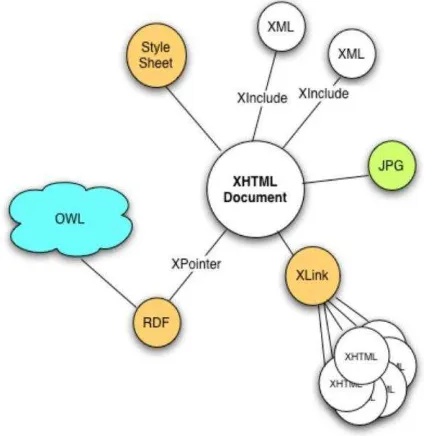
Figure 1: The context in which a document is read.
The key components of the Semantic Web are (a) agreed models (ontologies) of the objects and relationships con-tained in the documents (b) formally specified ontology lan-guages for unambiguously codifying these agreed models and (c) an annotation mechanism for identifying (parts of) Web documents with concepts from relevant ontologies.
1.3
Annotating for Semantics and Annotating
for Presentation
Presentational- and semantic- processing are not dissim-ilar. The fundamental concepts involved with independent layout and formatting processes as developed through ODA and DSSSL and which are now embodied in CSS and XSL-FO are parts of community-agreed ontologies, expressing the concepts of a page, margin, border, block, paragraph etc. The particular languages in which they are expressed (CSS, XSL) are loosely analogous to the ontology languages of the Semantic Web in that they describe the composition and useful conjunction of the (display) concepts. RDFs mecha-nism for conjoining concept and content (via structure ad-dressing and namespace reference) has one counterpart in the document processing: the external link (XLink or Hy-Time).
Stylesheets either achieve this implicitly by subverting particular content nodes (CSS usesstyleorclassattributes) or by declaring a generalised content-visiting process (XSLT). It would not be impossible to interchange mechanisms and to identify individual elements for stylesheet processing with RDF. Conversely, it would be possible to define a concept attribute for content elements to explicitly add ontological semantics to the document content. In fact, this is an ap-proach undertaken by the earliest Web ontology systems such as SHOE [14].
1.4
Adaptive and Active Documents
A document is often considered as structure plus content, and constructed at a low level from a number of different storage entities or XIncluded fragments (figure 1).
Presen-tation specifications are mapped onto structure or specified in it. Hypertext links are specified similarly, but some link semantics may affect the content inclusion (e.g. XLink’s
actuate="auto" show="embed").
All of these devices are available to the author, the visual designer or the web site manager. Typically, the author is considered to have control over the content of the doc-ument rather than its display. However, the content itself may include directives which generate or manipulate docu-ment components. These may simply add timestamps, nav-igational panels or adverts, but they can also be used to
adaptively insert or delete relevant subject material [4]. Active documents are documents which contain or are di-rectly associated with executable program code or scripts. Placeless documents [7], for example, haveactive properties
in addition to regular properties (title, author, etc.). As well as a name and value, each active property includes a third component — code, which runs in response to various actions upon the document (e.g. readContent, writeCon-tent, deleteDocument). Active properties take functionality normally associated with specific applications, such as work-flow or content conversion, and associate them directly with the document so that they travel around with it (e.g. by email). Microsoft’s “smart documents” are an example of active documents: “available in Microsoft Office Word 2003 and Microsoft Office Excel 2003, smart documents contain programming logic that defines the way documents are used, and controls the way the data in the documents can be ma-nipulated” [19].
2.
DOCUMENT PARADIGM FOR THE
SEMANTIC WEB
However a document is constructed, and whatever flexi-bility is provided in its storage and construction, the defin-ing feature of a document isan author; a document is the bounded communication of a human individual. It is the content identified at a particular time, with a particular meaning for a particular purpose. The way in which this meaning and purpose is represented within the document has a direct impact on the successful (or otherwise) inter-pretation of the content by its consumers.
In the case of traditional plain ASCII documents, although easily processable by both human and software agents, knowl-edge is represented implicitly and has to be extracted by analysing the text (e.g. by using NLP techniques); subse-quently interpretation of the document content is open to error and ambiguity. In the case of Postscript or Adobe PDF documents, software agents have to extract the textual con-tent from drawing code before processing it. LATEXmacros
and HTML markup may give software agents some clues as to the structural semantics of the text, but are ultimately ambiguous.
XML reduces ambiguity in documents by making the doc-ument structure explicit through a schema, for example Doc-Book1
. The interpretation of the document structure is therefore unambiguous, but the concepts and ideas within the text itself — the#PCDATA— are unlikely to have schematic equivalents. These need to be in place to facilitate the in-terpretation of the document at a finer granularity than its structural blocks.
1
RDF facilitates this by associating knowledge with text spans at the character level via XPointers. However, this pointing mechanism becomes a problem when the content of the target document is changed, potentially causing XPoint-ers to reference the wrong text span, or to become un-resolvable (‘broken’). This problem has been termed the
editing problem by the Open Hypermedia community [6]. A straightforward solution to this problem is toembed the knowledge markup in the content itself, at least while the documents is being authored or undergoing editorial changes, so that the knowledge survives (e.g., by moving with the text as content is inserted, deleted, or copied and pasted to a new location in the document).
SHOE and XMP are examples of formats for embedding knowledge in documents. SHOE [14] extends HTML with a handful of extra tags for describing the documentas a whole
in relation to a domain ontology. Adobe’s XMP [1], al-lows RDF constructs to be embedded in HTML, PostScript and PDF documents, as well as TIFF, JPEG, GIF, PNG and all Adobe formats (Photoshop, Illustratoretc.). XMP-compliant applications provide built-in support for a func-tional set of XMP schemas including Dublin Core, rights management, and EXIF, although new schemas can also be defined. However, the XMP portion within the document representation is separate from the content, so in the case of a PDF for example, a fragile pointer mechanism would still be required to associate knowledge with specific spans of text during authoring/editing. One solution offered by a number of knowledge writing tools is to use an ad-hoc representa-tional format for embedded knowledge during the authoring or editing of a document, which can be extracted to a formal representation (e.g. SemanticWord [21] — DAML+OIL, SemTalk [8] — RDFS/DAML) when the document is pub-lished. Such tools are the subject of the next section.
3.
CREATING SEMANTIC WEB
DOCUMENTS
For knowledge markup to become an explicit part of Se-mantic Web document representation, we also need to con-sider how this step can be supported during the process of authoring new documents.
In an attempt to make parts of the Web corpus amenable to machine-processing, much emphasis within the Semantic Web community has been on building tools for the man-ual annotation ofexisting documents [11]. However, recog-nising that post-hoc manual annotation is difficult, time-consuming, and error prone, researchers have turned to pro-ducing automatic or semi-automatic methods for adding knowledge annotations to existing documents in order to make this process more feasible [17, 23, 12]. Amilcare [5], for example, uses the generalised NLP rules learnt from an annotated test corpus to create new knowledge annotations on an unseen corpus. Amilcare has been used as a fully automatic process, and also as a ‘suggester’ where the an-notations are revised by a human annotator (these revisions may in turn fine tune the extraction rules).
However, while this post-hoc mining exercise works well as an approach for ‘enabling’ a legacy corpus, it is not a paradigm that should be used in the case of creating new
documents. Semantic annotation, overseen by the author, should be an essential and active component of the
writ-ing process itself, shiftwrit-ing the responsibility for knowledge markup from system/annotator to author.
The Writing in the Context of Knowledge (WiCK) project aims to produce tools which capture the knowledge and in-tentions of the author rather than just capturing the au-thor’s keystrokes and attempting to guess afterwards what they actually mean — in short, to facilitate the author in communicating his or her ideas clearly and unambiguously to human and machine interpreters in the Semantic Web. A number of other approaches have also investigated this
simultaneous authoring of content and semantic markup, which we describe briefly before turning to the contributions of the WiCK project itself.
CREAM [10] allows an author to build new documents by dragging and dropping knowledge fragments from an on-tology browser into a text editor — for example a dropped instance slot inserts a text rendering of the slot value; a dropped relationship slot inserts a short sentence complete with links to each of the related instances. In both cases, knowledge is embedded in the document alongside the in-serted text.
Knowledge markup at authoring-time does not preclude the use of information extraction techniques such as that demonstrated by Amilcare. Extracted knowledge can be used to offer relevant services to the author in order to assist the writing task. For example, ARIA [18] supports email or web page authoring based on a semantically annotated photo database. By continuously monitoring the text typed by the author against a domain ontology, ARIA recommends photos from the database that seem appropriate to illustrate the various facets of the unfolding narrative.
The potential research and commercial benefits of bring-ing these knowledge-aware processes into the office arena have not gone unnoticed. Microsoft Word, for example, is the most often adopted product for authoring text doc-uments [21]; authors can therefore adopt new knowledge-aware extensions without learning a new production envi-ronment and without sacrificing familiar features [22]. Se-manticWord [21], a Microsoft Word-based environment, adds several toolbars to the standard interface which support the creation of semantic annotations according to selected on-tologies (local or imported from the Semantic Web). Using these toolbars, authors can associate a text region with an instance of a class (an instance reference), or describe the content of a text region with a collection of triples — both types of annotation are embedded in the text and can be di-rectly manipulated. Annotations are “carried over” in text cut/copy and paste operations, facilitating a level of knowl-edge reuse between documents. As well as knowlknowl-edge-rich documents, the Semantic Word toolbars can also be used to createannotated templates, thus speeding up content and annotation production in frequently created documents.
SemanticWord also offers a more proactive information ex-traction feature which the author experiences through the Microsoft Smart Tags interface. As with ARIA, the author’s keystrokes are monitored by an information extraction pro-cess which relates named entities in the text to ontology instances and types, visually highlighting the recognisedd text in the document. The author can then examine the highlighted entities and convert them into instance reference annotations.
office-based knowledge writing initiatives, including SemTalk [9] and OntoOffice [20]. As with SemanticWord, recognised concepts and instances are highlighted with Smart Tags. However, the kinds of action offered differs between systems: in SemTalk, for example, the author can access and edit the underlying ontological model; in OntoOffice, a search for context-relevant documents can be initiated.
Going beyond simply supporting knowledge writing in the context of an underlying ontology, the WiCK project has attempted to build on these initiatives by considering an office environment in which several knowledge-bases and knowledge-aware services exist and actively assist the au-thor by providing targeted knowledge that would otherwise need to be searched for both manually and individually.
4.
WICKOFFICE: A KNOWLEDGE
WRITING ENVIRONMENT
As we have argued in previous sections, authors of new Se-mantic Web documents face an additional responsibility of explicitly embedding knowledge markup in their documents. However, just as author’s worries about linking responsibil-ities when writing for the Web were alleviated by search en-gines such asGoogle, the presence of such knowledge-aware services (for example, SemanticWord’s knowledge markup as-you-type) and resources (for example, OntoOffice’s search-able document store) is essential. The WiCK project has investigated the writing process in a Semantic Web environ-ment where knowledge repositories and services exist and actively assist the author in producing a document with ex-plicit embedded knowledge. In order to demonstrate our approach, we consider a business-type scenario where an author is tasked to produce a funding proposal for a project. By analysing and subsequently modelling the knowledge ‘flow’ in this scenario we can demonstrate the benefits that a knowledge-aware office environment can provide.
4.1
Scenario
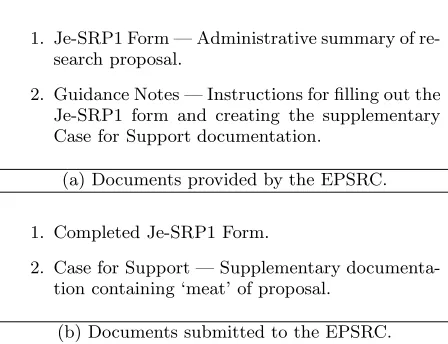
The task of writing a funding proposal is common in in-dustrial and commercial environments; here, we consider a hypothetical funding proposal for a research project in an academic environment. The proposal is directed at the UK’s Engineering and Physical Sciences Research Council (EP-SRC), which has a well-defined procedure for submitting, reviewing, and selecting proposals for funding, and provides a standard form2
(the Je-SRP1) and a comprehensive guid-ance document3
on how to fill out the form, create the sup-plementary documentation, and submit it for consideration (table 1).
The Je-SRP1 form itself serves as an administrative sum-mary of the research proposal, collecting together the rel-evant information about the hosting organisation, project investigators, project partners (for joint proposals), refer-ees, staff (including visiting researchers), and travel and equipment costs. The ‘meat’ of the proposal is contained in the supplementary document — the Case for Support — the composition of which is tightly defined in the guid-ance notes. The rules for the Case define the formatting (constraints on page length, font sizes etc.), the
informa-2
http://www.epsrc.ac.uk/website/commonpages/ downloads.aspx?CID=4482
3
http://www.epsrc.ac.uk/website/commonpages/ downloads.aspx?CID=8621
1. Je-SRP1 Form — Administrative summary of re-search proposal.
2. Guidance Notes — Instructions for filling out the Je-SRP1 form and creating the supplementary Case for Support documentation.
(a) Documents provided by the EPSRC.
1. Completed Je-SRP1 Form.
2. Case for Support — Supplementary documenta-tion containing ‘meat’ of proposal.
[image:4.612.324.548.55.227.2](b) Documents submitted to the EPSRC.
Table 1: Research proposal documents provided by, and subsequently submitted to, the EPSRC.
tion content, and the structure of parts and sections where each of these pieces of information should be placed. The content of the Case for Support includes previous research track records, proposed research programme and method-ology, proposed dissemination routes, and justifications for each of the resources requested in the Je-SRP1 form.
In order to properly model the Je-SRP1 form and Case for Support document and the knowledge they contain, and hence be able to deploy it usefully in a computational en-vironment more complex than a search engine, our scenario requires a number of ontologies. Firstly, we need to under-stand and modelwhat is being written about. To meet the re-quirements for our scenario, we propose aresearch ontology
to describe the stakeholders and activities who participate in research — the researchers, their publications, research in-terests, conferences and journals, and asubject ontology to describe the area in which we wish to conduct research, the problems that we wish to address and the methods, systems and approaches which have been described in the literature. Having modelled the subject domain of the writing task, we next need to understand the ‘design specification’ for the writing task itself —what needs to be written. We therefore propose adocument ontology to make explicit the semantic structure of the proposal documents — the pages, sections, paragraphs, forms, and fields. In order to explicity model thetypeof information that the author must enter into each part of this structure, a project ontology capturing the ac-tivity of undertaking work — the ideas of work package, budget, personnel, milestones etc. — and aproposal ontol-ogy — describing the objectives, beneficiaries, funding call, and programme of activity for the proposed project are pro-posed.
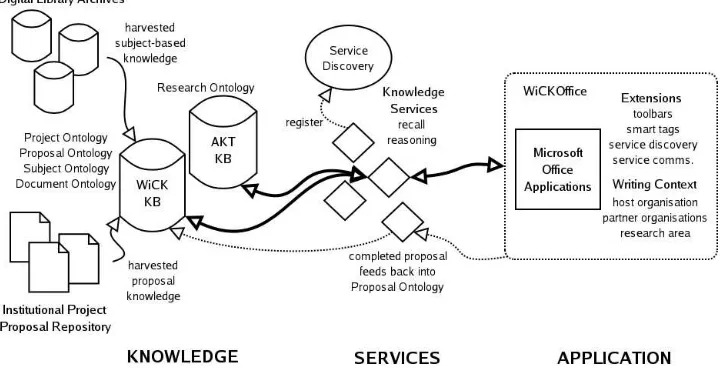
Figure 2: The proposed WiCKOffice knowledge writing environment.
long as the project lifetime). These simple constraints can easily be modelled as verification conditions on data entry, or as queries upon the knowledge-base to select an appro-priate list of choices. De-constructing the form in this way therefore provides an outline proposal ontology, with the Guidance Notes document supplying the constraints.
Creating the Case for Support document is more involved, as the author is required to construct a text, rather than enter data into clearly labelled spaces on a form. However the Guidance Notes document indicates very clearly the kind of information that is expected in each part of the document. Examining the bullet points which give instructions for Part 1 of the Case for Support, we can see what basic information is required from the knowledge-base, in addition to the kind of processing and analysis which would need to be performed on it:
Provide a summary of the results and conclusions of re-cent work in the technological/scientific area which is covered by the research proposal. Include reference to both EPSRC funded work and non-EPSRC funded work. Details of rele-vant past collaborative work with industry and/or with other beneficiaries should be given. . .This specifies a literature re-view; the knowledge is described by the subject and research ontologies. A simple query of the knowledge-base or digital library would provide a list of potentially relevant papers, but a more advanced reasoning agent would be required in order to assist the author in evaluating the relative signifi-cance of the projects and papers.
Part 2 of the Case for Support requires a different kind of knowledge support, for instance within theProgram and Methodology section: Identify the overall aims of the project and the individual measurable objectives against which you would wish the outcome of the work to be assessed. This in-formation does not exist in the knowledge-base; it is invented as an integral part of the creation of a new research under-taking. However, authors may be assisted by seeing the aims and objectives of similar, recent or successful project propos-als, especially if they do not have much experience of pro-posal writing to draw on. In other words a lack of personal experience could be supplemented by directed browsing of an institutional memory.
This brief examination of the EPSRC Guidance Notes for a project proposals shows how heavily the writing process (both apparently free-text content creation and information recall) is constrained and specified by the appropriate on-tologies, opening the possibility of substantive help from a suitably equipped knowledge environment.
4.2
Proposed Architecture
Figure 2 illustrates our proposed knowledge-aware office environment, WiCKOffice, designed in response to the op-portunities for functionality identified in the previous sec-tion. In this environment, knowledge is managed by two knowledge-bases, both based on the AKT 3Store platform [13]. The AKT knowledge-base models the UK Higher Education computer science community4
(expressed using the AKT Reference Ontology5
), and hence provides a suitable research ontology for our purposes. A WiCK knowledge-base hosts the additional ontologies. Instances for the project and pro-posal ontologies are acquired from previous EPSRC project proposals; we envision Semantic Web agents trawling digital library archives and automatically constructing and popu-lating the subject ontology.
WiCK extensions to the Microsoft Office environment (both VBA and COM-based) utilise key computational knowledge services to assist the writing task (in accordance with the ‘writing context’ ), and to update the knowledge-bases when the writing task is completed (for example, new propos-als becoming part of the “institutional memory”). Explicit knowledge representation in the proposal documents makes the latter a straightforward process.
5.
WICKOFFICE PROTOTYPE
Based on the opportunities for functionality identified in the previous section, our modelling and development efforts to date have produced a coherent WiCKOffice environment in which several knowledge services are available to authors. Aknowledge fill-in service andknowledge recall service are motivated by the need to provide timely and convenient
ac-4
http://www.hyphen.info/
5
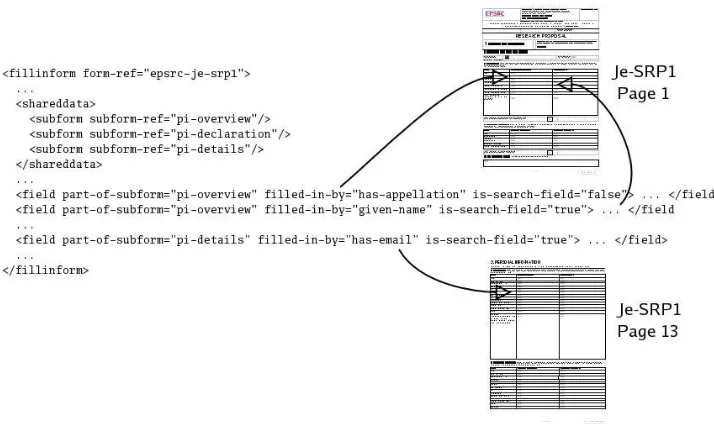
Figure 3: Augmenting Je-SRP1 template with explicit structural semantics facilitates assisted knowledge fill-in.
cess to knowledge, which would otherwise have to be manu-ally ‘looked up’ on the institutional intranet. A third service,
in-line guidelines, also assists recall by exposing guidelines and constraints captured from a design specification (in this case, the EPSRC guidance notes), that are relevant to the part of the proposal document currently being worked on, via the Microsoft Office Assistant interface.
5.1
Filling In Forms
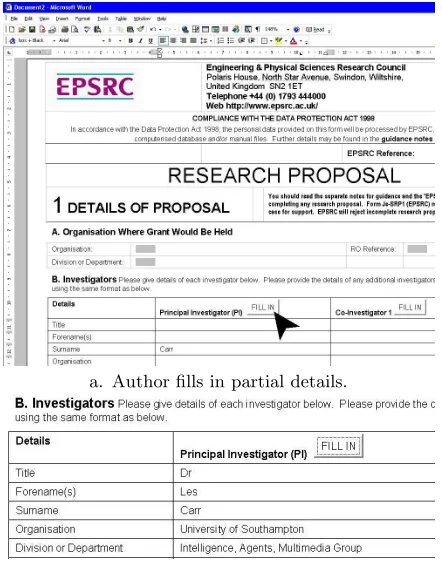
Theknowledge fill-inservice assists the author in filling in the Je-SRP1 form. For example, the author can specify the (partial) name of the Principal Investigator and instruct the service to retrieve appropriate (in context) instances from the knowledge-base to automatically fill in the remainder of the required information.
The majority of the information required to provide an assisted knowledge fill-in service for the Je-SRP1 form is already provided by the AKT Reference Ontology (the re-search ontology in our scenario). However, leveraging this service is not as simple as filling each part of the form with an appropriate instance selected from the research ontol-ogy — different parts of the Je-SRP1 form “share” data about the same concept. For example, information relating to the Principal Investigator must entered in three differ-ent locations: section 1B (page 1) requires the PI’s title, name, organisation, department, and commitments to other projects; section 2B (page 12) requires the PI’s name (for the proposal declaration); and section 3B (page 13) requires the PI’s contact telephone number, email address, fax number,
etc.
In line with our paradigm for Semantic Web documents (section 2), we have used Microsoft Office 2003’s new “smart documents” feature to addsemantic structure to the other-wise unstructured Je-SRP1 template in the form of an XML Schema derived from the document ontology. The XML Schema identifies each ‘sub-form’ of the Je-SRP1 and groups together related sub-forms (thus, for example, describing the fact that information about the PI is shared by sub-forms
1B, 2B, and 3B). Each individual form field is marked up with three attributes — the ID of the sub-form to which the field belongs, a boolean value indicating whether that field is a preferred search field (in the case of the Je-SRP1, the PI’s first name and surname are good search terms for a person instance in the research ontology; knowing the PI’s title may not so helpful), and finally afilled-in-byattribute which identifies the slot of the matching knowledge instance which should be used to actually provide a value for the field.
When the author partially fills in a sub-form (figure 4a) and presses the “Fill-In” button, the XML structure of the document is consulted to determine which fields are part of the current sub-form (and also which fields are part of other sub-forms that share data with the current sub-form). Fields in the current sub-form with anis-search-fieldattribute value of trueare then used by the knowledge fill-in service to construct an RDQL query to extract matches from the research ontology. In the case that multiple instances match the query, these instances are presented to the author who chooses the appropriate match. Finally, thefilled-in-by
attribute is used to map the slot values of the returned in-stance to each associated field (figure 4b); the URI of the matching instance from the research ontology is also embed-ded.
Recently, the EPSRC rolled out its own assisted form fill-ing system, the Je-S1 e-form6
, which provides some equiva-lent functionality to this service. Provided that each party has previously registered their details with the system, the author can select the host organisation, principal and co-investigators, referees and other staff from checklists and then download a partially completed JE-SRP1 form which contains all the required details of the selected parties, but still requires some unaided ‘mandraulic’ effort to complete in full. By contrast, we argue that the WiCKOffice approach of leveraging the functionality of multiple services operat-ing over diverse knowledge sources (including, but not re-stricted to, employee data and information harvested from
6
a. Author fills in partial details.
[image:7.612.64.285.53.336.2]b. All sub-forms sharing data with current sub-form are populated from matching instance.
Figure 4: Using the knowledge fill-in service via the WiCKOFfice toolbar.
personal webpages and directories) not only allows authors to be aided in filling in all aspects of the Je-SRP1 form but also potentially offers wider applicability (adding new types of form requires only that form’s semantic structure be elicited according the document ontology) than adata -based application.
5.2
Knowledge In The Right Place At The
Right Time
Theknowledge recallservice assists the author in quickly and conveniently recalling appropriate knowledge from the research environment. Example (contextual) queries include “what papers relevant to this proposal have been published recently?”, or “what relevant projects has this person worked on?”. In response to such queries, appropriate knowledge from the knowledge-bases is selected and inserted directly into the document in the form of ‘potted’ summaries.
As with the knowledge fill-in service, the AKT Refer-ence Ontology provides the majority of knowledge utilised by this service. In the current implementation, given the name of a recognised person, project or place, the knowl-edge recall service assists the writer in recalling facts about it. We have seen that recent incarnations of Microsoft Of-fice already provide a mechanism for recognising terms and presenting available “actions” associated with that term to the user in the form of Smart Tags. However, in Case for Support document, the author’s information requirements depend on the section or part of the document currently be-ing worked on. For example, the author might expect that typing “Les Carr” in the Previous Research section would
a. Name recognised as author types.
b. Available actions in Previous Research section.
[image:7.612.332.541.286.410.2]c. Available actions for recognised text ”Wendy Hall” in References section.
Figure 5: Using the knowledge recall service, via the WiCKOffice Smart Tag.
make available options to “auto-summarise” or browse those facets of Les Carr’s previous research history most relevant to the current proposal, whereas typing “Les Carr” in the
We therefore describe this service as providing knowledge in the rightplace (the author’s current location in the docu-ment) at the righttime(when a name of a recognised person, place or project is typed by the author). Again we antici-pate the wider applicability of this type of service beyond the specifics of our scenario; with appropriate knowledge sources, services, and discovery mechanisms in place this ’right place, right time’ writing paradigm can be applied to other writing tasks.
5.3
Planned Future Services
Two further knowledge-based services are currently un-der development within the project proposal writing sce-nario. Anaugmented experience service provides the author with access to the “institutional memory” of previous re-search proposals, thereby augmenting the author’s own ex-perience of proposal writing (“what works? what doesn’t work?”). For example, the author is assisted in evaluating the most important beneficiaries of the proposed research by being shown the beneficiaries put forward by other propos-als (with an indication as to whether those propospropos-als were subsequently approved or otherwise).
Anassisted writing service attempts to assist the author in making higher-level decisions about relevant content to include in the proposal by suggesting appropriate instances from the subject ontology (for example, relevant projects, papers, resources) based on both the writing context and the text that the author has already written. For example, this service uses an internal reasoning engine to detect that al-though the author has referred to a number ofknowledge ac-quisition-related projects in theBackground section7
of the Case for Support, one particularly ‘significant’ project has not yet been mentioned, and so offers to create a summary of the project from the relevant instances in the knowledge-base (gathering details of key personnel and publications) and inserts the knowledge-annotated information into the appropriate sections of the Case document.
6.
CONCLUSIONS AND FUTURE WORK
In order to allow documents to be unambiguously inter-preted by both human readers and software agents, knowl-edge should be an explicit part of document representation. Rather than being the result of an imprecise, after-the-fact activity, knowledge elicitation in Semantic Web documents can be an exact, author-assisted process. However, instead of manifesting this additional responsibility as an extra pro-cess of annotation, knowledge elicitation can be an indistin-guishable part of the authoring process. In fact the knowl-edge elicitation process can actually help the author (or ed-itorial staff) rather than adding an extra burden, by provid-ing a synthesis of a range of targeted background material that would otherwise need to be searched for both manually and individually. This paper has introduced our contribu-tion to this process, WiCKOffice, a knowledge-writing envi-ronment. In the context of a project proposal writing sce-nario, WiCKOffice demonstrates that with a suitable set of ontologies and a supportive knowledge-aware environment, an author can be assisted in producing explicit knowledge documents.
7
Guidance notes: “Demonstrate a knowledge and under-standing of past and current work in the subject area both in the UK and abroad.”
As well as facilitating unambiguous interpretation of its content, the knowledge-augmented document can then be intelligently processed in further ways, for example by the proposed Assisted Writing service in the WiCKOffice envi-ronment. The documents are then used to update the RDF-based knowledge services, asserting the new facts that the author has created. In our example these are particularly easy to determine by taking advantage of the explicit knowl-edge representation in the completed proposal documents. Hence making knowledge representation an explicit and sep-arate part of the document construction process makes the writing process easier to support.
Our future work plans, aside from continued implemen-tation of our integrated office environment, include a more detailed focus on the processes and mechanisms by which the knowledge provided by the AKT and WiCK knowledge-bases can be updated and maintained as more and more re-search proposals are produced. We also plan to carry out a systematic user evaluation — academics who write research proposals as part of their day-to-day work are a readily ex-ploitable human resource in our department. Lastly, we are also working on a writing methodology for creating more complex, knowledge-rich documents such as multi-faceted Web sites and hypertexts.
7.
ACKNOWLEDGEMENTS
This work has been funded in part by the EPSRC Knowl-edge Writing in Context (KWiC) project (GR/R91021/01) — now known asWriting in the Context of Knowledge (WiCK)
— and the EPSRC Advanced Knowledge Technologies IRC (GR/N15764/01) in the UK.
8.
REFERENCES
[1] Adobe Systems Incorporated. XMP Adding Intelligence to Media.http:
//www.adobe.com/products/xmp/pdfs/xmpspec.pdf, 2004.
[2] D. W. Barron. Why use SGML?Electronic PublishingOrigination, Dissemination, and Design, 2(1):3–24, Apr. 1989.
[3] T. Berners-Lee, J. Hendler, and O. Lassila. The Semantic Web.Scientific American, May 2001. [4] P. Brusilovsky. Methods and techniques of adaptive
hypermedia.User Modeling and User-Adapted Interaction, 6(2-3):87–129, 1996.
[5] F. Ciravegna and Y. Wilks. Designing Adaptive Information Extraction for the Semantic Web in Amilcare. In S. Handschuh and S. Staab, editors,
Annotation for the Semantic Web, Frontiers in Artifical Intelligence and Applications. IOS Press, Amsterdam, 2003.
[6] H. C. Davis. Referential integrity of links in open hypermedia systems. InProceedings of the ACM Hypertext ’98 Conference, Pittsburgh, USA, pages 207–216, 1998.
[7] P. Dourish, W. K. Edwards, J. Howell, A. LaMarca, J. Lamping, K. Petersen, M. Salisbury, D. Terry, and J. Thornton. A programming model for active documents. InProceedings of the 13th Annual ACM Symposium on User Interface Software and
[8] C. Fillies. On Visualizing the Semantic Web in MS Office. InProceedings of the 6th International Conference on Information Visualisation (IV’02), London, England, pages 441–446, 2002.
[9] C. Fillies, G. Wood-Albrecht, and F. Weichardt. A Pragmatic Application of the Semantic Web using SemTalk. InProceedings of the Eleventh International World Wide Web Conference, Honolulu, Hawaii, USA, pages 686–692, 2002.
[10] S. Handschuh and S. Staab. Authoring and
Annotation of Web Pages in CREAM. InProceedings of the Eleventh International World Wide Web Conference, Honolulu, Hawaii, USA, 2002.
[11] S. Handschuh, S. Staab, and A. Maedche. CREAM — Creating relational metadata with a component-based, ontology-driven annotation framework. InProceedings of the First International Conference on Knowledge Capture (KCAP 2001), Victoria, B.C., Canada, Oct. 2001.
[12] S. Handschuh, S. Stabb, and F. Ciravegna. S-CREAM - Semi-automatic CREAtion of Metadata. In
Proceedings of the 13th International Conference on Knowledge Engineering and Knowledge Management (EKAW’02), 2002.
[13] S. Harris and N. Gibbins. 3store: Efficient Bulk RDF Storage. InProceedings of the 1st International Workshop on Practical and Scalable Semantic Systems (PSSS’03), Sanibel Island, Florida, pages 1–15, 2003. [14] J. Heflin, J. Hendler, , and S. Luke. Reading Between
the Lines: Using SHOE to Discover Implicit
Knowledge from the Web. InProceedings of the 1998 Conference on Artificial Intelligence, 1998.
[15] G. Hughes and L. Carr. Microsoft Smart Tags: Support, ignore or condemn them? InProceedings of the ACM Hypertext 2002 Conference, Maryland, USA, pages 80–81, 2002.
[16] C. Kunicki. What’s New with Smart Tags in Office 2003.MSDN OfficeTalk, 2003. Available from
http://msdn.microsoft.com/library/en-us/ dnofftalk/html/office01022003.asp.
[17] T. Leonard and H. Glaser. Large scale acquisition and maintenance from the web without source access. In
Proceedings of the Knowledge Markup and Semantic Annotation Workshop (K-CAP 2001), pages 97–101, 2001.
[18] H. Lieberman and H. Liu. Adaptive Linking between Text and Photos Using Common Sense Reasoning. In
Proceedings of the Conference on Adaptive Hypermedia and Adaptive Web Systems, Malaga, Spain, pages 2–11, 2002.
[19] Microsoft Corporation. Smart Documents in Microsoft Office 2003: Summary Technical White Paper.
http://www.microsoft.com/technet/prodtechnol/ office/office2003/operate/smrtdcsy.mspx, 2003. [20] ontoprise GmbH. OntoOffice Tutorial.http://www.
ontoprise.de/documents/tutorial ontooffice.pdf, 2003.
[21] M. Tallis. Semantic Word Processing for Content Authors. InProceedings of the Knowledge Markup & Semantic Annotation Workshop, Florida, USA, 2003. Part of the Second International Conference on Knowledge Capture, K-CAP 2003.
[22] M. Tallis, N. M. Goldman, and R. M. Balzer. The Briefing Associate: Easing Authors into the Semantic Web.IEEE Intelligent Systems, 17(1), 2002.