comm
en
t
re
v
ie
w
s
re
ports
de
p
o
si
te
d r
e
se
a
rch
refer
e
e
d
re
sear
ch
interacti
o
ns
inf
o
rmation
Tandem repeat copy-number variation in protein-coding regions of
human genes
Colm T O'Dushlaine, Richard J Edwards, Stephen D Park and
Denis C Shields
Address: Bioinformatics Core, Department of Clinical Pharmacology and Institute of Biopharmaceutical Sciences, Royal College of Surgeons in Ireland, 123 St Stephen's Green, Dublin 2, Ireland.
Correspondence: Denis C Shields. E-mail: [email protected]
© 2005 O'Dushlaine et al.; licensee BioMed Central Ltd.
This is an Open Access article distributed under the terms of the Creative Commons Attribution License (http://creativecommons.org/licenses/by/2.0, which permits unrestricted use, distribution, and reproduction in any medium, provided the original work is properly cited.
Tandem repeat copy-number variation
<p>Tandem repeat polymorphisms in human proteins were characterized using the UniGene dataset. This analysis suggests that 1 in 20 proteins are likely to contain tandem repeat copy-number polymorphisms within coding regions; these were prevalent among protein-bind-ing proteins.</p>
Abstract
Background: Tandem repeat variation in protein-coding regions will alter protein length and may introduce frameshifts. Tandem repeat variants are associated with variation in pathogenicity in bacteria and with human disease. We characterized tandem repeat polymorphism in human proteins, using the UniGene database, and tested whether these were associated with host defense roles.
Results: Protein-coding tandem repeat copy-number polymorphisms were detected in 249 tandem repeats found in 218 UniGene clusters; observed length differences ranged from 2 to 144 nucleotides, with unit copy lengths ranging from 2 to 57. This corresponded to 1.59% (218/13,749) of proteins investigated carrying detectable polymorphisms in the copy-number of protein-coding tandem repeats. We found no evidence that tandem repeat copy-number polymorphism was significantly elevated in defense-response proteins (p = 0.882). An association with the Gene Ontology term 'protein-binding' remained significant after covariate adjustment and correction for multiple testing. Combining this analysis with previous experimental evaluations of tandem repeat polymorphism, we estimate the approximate mean frequency of tandem repeat polymorphisms in human proteins to be 6%. Because 13.9% of the polymorphisms were not a multiple of three nucleotides, up to 1% of proteins may contain frameshifting tandem repeat polymorphisms.
Conclusion: Around 1 in 20 human proteins are likely to contain tandem repeat copy-number polymorphisms within coding regions. Such polymorphisms are not more frequent among defense-response proteins; their prevalence among protein-binding proteins may reflect lower selective constraints on their structural modification. The impact of frameshifting and longer copy-number variants on protein function and disease merits further investigation.
Background
DNA tandem repeats are two or more adjacent and approxi-mate copies of a sequence of nucleotides. The presence of
tan-dem repeats has been associated with a number of diseases and phenotypic conditions. For instance, repeat polymor-phisms in 5' and 3' regions are known to cause diseases such Published: 28 July 2005
Genome Biology 2005, 6:R69 (doi:10.1186/gb-2005-6-8-r69)
Received: 11 February 2005 Revised: 31 May 2005 Accepted: 13 July 2005 The electronic version of this article is the complete one and can be
as Huntington's disease [1] and certain forms of Fragile X syndrome [2]. Other tandem repeat polymorphisms in non-coding regions are known to modify function through their impact on gene regulation [3,4]. These polymorphisms can arise from events such as unequal crossover, replication slip-page or double-strand break repair [5-7].
Polymorphism of tandem repeats within protein-coding sequences is known to modulate disease risks and can effect changes in the protein products of genes, leading to diseases such as myotonic dystrophy [8]. A number of diseases caused by repeat polymorphism arise from the expansion of trinucle-otide repeats [9]. Other longer repeat polymorphisms have been postulated to modify disease risk (for example, platelet
glycoprotein Ib-α (GP1BA) repeat [10], the kringle repeat in
apolipoprotein(a) (LPA) [11], and P-selectin ligand (SELPLG)
repeat [12]).
While single-nucleotide polymorphisms (SNPs) are currently the subject of extensive research, tandem repeats can exhibit high levels of length polymorphism that will potentially alter protein function. In addition, the comparatively greater mutability of certain classes of tandem repeats may lead to a different spectrum of effects on function, as mildly deleteri-ous variants of recent origin may not have had time to be eliminated. Previous studies [13,14] have predicted polymor-phism using a minimum threshold of repeating units and a minimum homogeneity criteria. The threshold refers to the minimum number of repeat units needed for a locus to be scored as likely to contain polymorphism, and the homogene-ity refers to percentage of nucleotides within a repeat that may deviate from the core repetitive unit. The criteria depended on the length of the repeat unit and were drawn from the literature on repeat polymorphisms. For instance, for a dinucleotide repeat block to be scored as a likely poly-morphism, a threshold number of eight repeat units and a minimum homogeneity of 0.9 was required.
This approach was used to predict 11,265 potentially poly-morphic tandem repeats and led to the proposal that 22% of UniGene [15] clusters contain at least one potentially poly-morphic locus [14]. Of these, 8% were predicted to be in cod-ing regions. If polymorphic, these loci could cause frameshift mutations, which would be likely to significantly alter the pro-tein product. However, these studies only analyzed a single representative sequence from each UniGene cluster, and did not investigate the observed variability among all sequences within the cluster. Additional studies predicting potentially polymorphic repeats have focused on minisatellite repeats. For instance, Denoeud and colleagues [16] were more inter-ested in highly polymorphic minisatellites and only used strict definitions of minisatellites (unit length greater than 17 nucleotides, for instance). Naslund and co-workers [17] used a logistic regression approach to predict potentially polymor-phic repeats. However, they were specifically interested in minisatellites with a minimum repeat unit length of six
nucle-otides and not the full spectrum of repeat unit lengths. Denoeud and Vergnaud have carried out genomic compari-sons of related bacteria to observe tandem repeat sequence length differences [18]. However, no such analysis has been carried out to detect human repeat polymorphism.
It has been hypothesized that an excess diversity of coding tandem repeats contributes to antigenic variation within the
prokaryotic pathogen Neisseria [19]. Variations in the
num-bers of repeats within the collagen-like region in Bacillus
anthracis correlated with variation of filament length on the
spore surface and have been proposed to affect the properties of the spores in response to various environments [20]. Indeed, repeat-mediated variation may form an integral part of the ability of many pathogens to adapt and remain adapted to their hosts and environments [21] and has been proposed as a molecular basis for the rapid adaptation of both prokary-otes and eukaryprokary-otes to environmental changes [22]. Our investigations sought to find evidence of the existence of this in humans. We proposed that repeat polymorphism within host-defense proteins in the human population might be advantageous, as previously postulated [14], and thus we would expect higher levels of tandem repeat sequence length variation in these genes. Such proteins exhibit rapid rates of evolution in interspecies comparisons, consistent with posi-tive selection for changes in response to pathogen selection pressures [23,24].
Here we report an investigation into the level of apparent pol-ymorphism in human genes within the UniGene database, and examine whether such polymorphism is elevated in host-defense genes.
Results and discussion
Protein-coding repeat distribution
Of the 106,937 UniGene [15] sequence clusters, 14,953 (14%) contained coding sequence annotation. Of these, a total of 13,749 (13%) clusters had more than one sequence overlap-ping a repeat block, enabling a search for tandem repeat copy-number variants.
comm
en
t
re
v
ie
w
s
re
ports
refer
e
e
d
re
sear
ch
de
p
o
si
te
d r
e
se
a
rch
interacti
o
ns
inf
o
rmation
still greater incidence of dimers and tetramers compared to trimers [27]. Thus, although there is an apparent mutational bias against trimer repeats in genomic sequences, within pro-tein-coding regions they are the most frequent class of tan-dem repeats. Of the detected repeats 82% were 100% homogenous. Thus, 18% of the dataset included were inexact repeats, with a higher proportion of inexact repeats among the arrays composed of longer repeat units.
Range of tandem repeat copy-number variation Detected variants were screened to ensure that they repre-sented length variation arising as copy-number differences in genomic DNA, rather than intron retention or alternative splicing. Only length variations that corresponded to a length difference that was a multiple of the repeat unit were selected. This reduced the number of clusters with variation from 4,458 (16,483 query/hit pairs) to 623 (3,111 query/hit pairs). For this set, tandem repeats were detected in the variant sequence and checked to ensure that the observed copy-number was in agreement with the expected one, given the length of the hit block and the length of the repeat unit, fur-ther reducing the dataset to 218 clusters with observations of length variation (753 query/hit pairs).
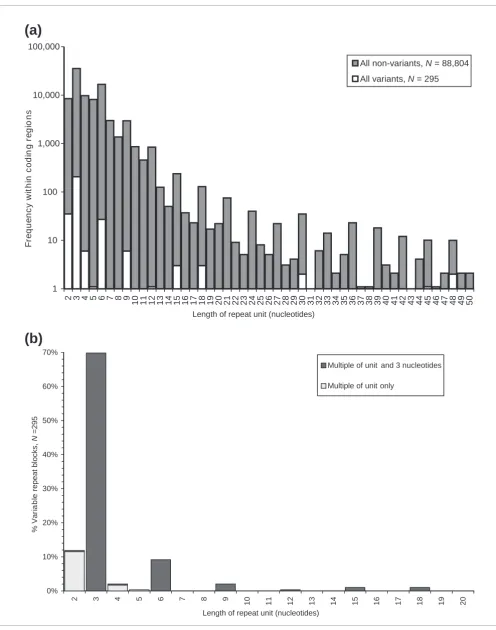
In total, 249 unique repeat blocks (spanning 218 clusters) showed variation that was consistent with a change in repeat copy-number (Figure 1). We found 295 allelic variants that differed from the UniGene representative sequence (Addi-tional data file 1) and 85.8% of these variants were a multiple of three nucleotides (253/295). Nearly 70% of variations that were a multiple of both three nucleotides and the repeat unit length arose within blocks of trinucleotide tandem repeats (Figure 1). Although some of the invariant repeats were imperfect, all the variant repeats were 100% homogenous (that is, every repeat unit was identical), and a large propor-tion were short (48% of variant repeat arrays were less than 20 nucleotides in length). The mean percentage match for repeats with array length less than 20 nucleotides was 98.52%. The mean percentage match for repeats with array length equal to or greater than 20 nucleotides was 90.50%.
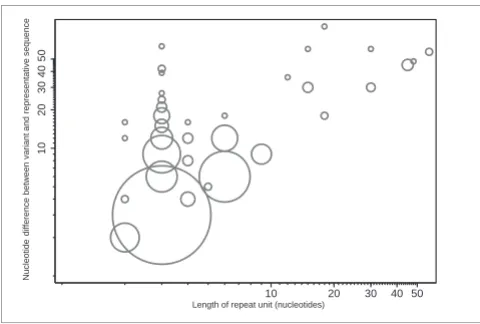
Figure 2 illustrates the length differences observed between representative and other sequences. The majority of longer base differences were observed in repeats with a long repeat unit. Also, in most cases the majority of differences for a repeat of a given length are equal to one copy of that repeat, as indicated by the size of the circles in Figure 2. Among the longer repeat units, the variant alleles typically only differ by a single repeat unit (points along the diagonal). Allelic vari-ants that differ by a larger number of repeat units are seen more often among the shorter repeats. The longest repeat units that exhibited polymorphism were 18 (3 representa-tives), 30 (2), 45 (1), 48 (2) and 57 (2) nucleotides in length (Figure 2, see also Additional data file 1). Of these large
vari-ants, the effects of the dopamine D4 receptor (DRD4) and
SELPLG polymorphism have been well investigated [28,29],
indicating probable effects on function and disease. The func-tional or clinical impact of the other variants remain to be evaluated, however. Clearly, the UniGene sampling approach is incomplete, and there are likely to be more large variant repeats in the human proteins; for example, the well known
GP1BA polymorphism, with a unit size of 39 nucleotides, and
the mucin 2 (MUC2) polymorphism [10,30]. These variants
were not identified by this study, since the UniGene cluster sizes for these genes were too low to detect the common vari-ants [31]. Three of the trimer repeats exhibited substantial length differences (39, 42 and 63 nucleotides, Figure 2), which are again likely to affect protein function. These were in the genes for the alpha 1A subunit of the voltage-dependent,
P/Q type calcium channel (CACNA1A), the TATA-box
bind-ing protein (TBP) and the translocated promoter region to the
activated MET oncogene (TPR) (Additional data file 1). While
most of the CACNA1A allelic variants were in the 'normal'
range of variation, the longest allele of 24 repeats was in the size range associated with the well studied
trinucleotide-repeat expansion disease spinocerebellar ataxia 6 (SCA6)
[32]. For TBP all eight allelic variants were below the length
associated with a form of inherited ataxia [33,34]. TPR has
not been associated with trinucleotide-repeat expansion dis-eases. A region of this oncogene has, however, been associ-ated with nonrandom chromosomal deletions [35], and the role of this polymorphism in cancer may be of interest.
Frequency of variant and invariant repeats
Figure 1 (see following page)
Figure 1 (see legend on previous page) 1
10 100 1,000 10,000 100,000
2 3 4 5 6 7 8 9
1
0
1
1
1
2
1
3
1
4
1
5
1
6
1
7
1
8
1
9
2
0
2
1
2
2
2
3
2
4
2
5
2
6
2
7
2
8
2
9
3
0
3
1
3
2
3
3
3
4
3
5
3
6
3
7
3
8
3
9
4
0
4
1
4
2
4
3
4
4
4
5
4
6
4
7
4
8
4
9
5
0
Length of repeat unit (nucleotides)
F
re
q
u
e
n
c
y
w
it
h
in
c
o
d
in
g
re
g
io
n
s
All non-variants, N = 88,804 All variants, N = 295
0% 10% 20% 30% 40% 50% 60% 70%
2 3 4 5 6 7 8 9 10 11 12 31 14 15 16 17 18 19 20
Length of repeat unit (nucleotides)
%
V
a
ria
b
le
repeat blocks,
N
=295
Multiple of unit and 3 nucleotides
Multiple of unit only
comm
en
t
re
v
ie
w
s
re
ports
refer
e
e
d
re
sear
ch
de
p
o
si
te
d r
e
se
a
rch
interacti
o
ns
inf
o
rmation
As an independent check for the completeness of our observa-tions, the Human Gene Mutation Database (HGMD) [36] was queried with a set of all official HUGO gene symbols. A total of 18 contained coding-sequence repeat polymorphisms. Of
these, eight (or 44%) were detected in our analysis - HD,
ATXN1, ATXN2, AR, CACNA1A, TBP, SELPLG, and ATN1.
Four of the remaining ten lacked coding-sequence annotation in the Hs.seq.uniq representative precluding the use of our method. One of the remaining six was a polymorphic mono-nucleotide repeat - these repeats were not included in our analysis. Two further genes contained cryptic GCN repeats. The last three had no variant hits in UniGene, either because of small cluster size (13, 170, 56), sequence error reducing the amount of hits (within-cluster alignments), or a lack of suffi-cient sequence coverage over the repeat region. Thus, in total, seven repeat variations were 'missed' either because of a lack of UniGene coding sequence annotation (4) or as a result of cluster size/sequence quality limitations (3), and three did not conform to the types of repeats considered in our analysis. Therefore, in relation to repeat variations previously associ-ated with disease and considered in our analysis, we detected variations in 53% (8/15) of the associated genes.
This analysis highlights that fact that, while UniGene is a use-ful resource for looking at polymorphism, it has its limita-tions, specifically in relation to sample size, sequence quality and annotation. Of the 218 gene clusters with repeat
varia-tion, 34 had entries on the HGMD, eight of which - HD,
ATXN1, ATXN2, AR, CACNA1A, TBP, SELPLG, and ATN1
-had coding-region repeat polymorphisms that were detected
in our analysis. One further gene - VWF - was annotated as
having a small deletion that corresponded to one of our repeat
variants. Another gene - TWIST1 - was annotated as having a
small deletion in the Saethre-Chotzen syndrome phenotype, which was detected in our analysis as a 12-nucleotide indel for a three-nucleotide repeat (GGC). While the variation
observed in VWF may have arisen from a repeat slippage
event, the variant for TWIST1 is unlikely to have done so. In
addition to these variants, three genes - NUMBL, E2F4 and
NOTCH4 - were annotated by Online Mendelian Inheritance
in Man (OMIM) [37] as exhibiting trinucleotide repeat varia-tion. Thus, 13 variants detected in our analysis were previ-ously identified.
Frequency of repeat variants
Given the likely sampling errors and biases, we did not expect frequencies of repeat variants to closely reflect true popula-tion frequencies. However, for known repeat variapopula-tions from the literature that were also detected in our analysis, we com-pared heterozygosities by querying the GDB database [38]. For a set of five genes that had heterozygosity information
and existed in the GDB database (HD, AR, TBP, ATN1, HRC),
the heterozygosity in GDB was broadly similar (values of 0.8, 0.63, 0.81, 0.79 and 0.55, respectively) to that estimated from this dataset (Additional data file 2).
Repeat copy-number and extent of variation
We compared the mean copy-number of the tandem repeats between clusters that have repeat variants and those without
and found a significant difference (Mann-Whitney, p <
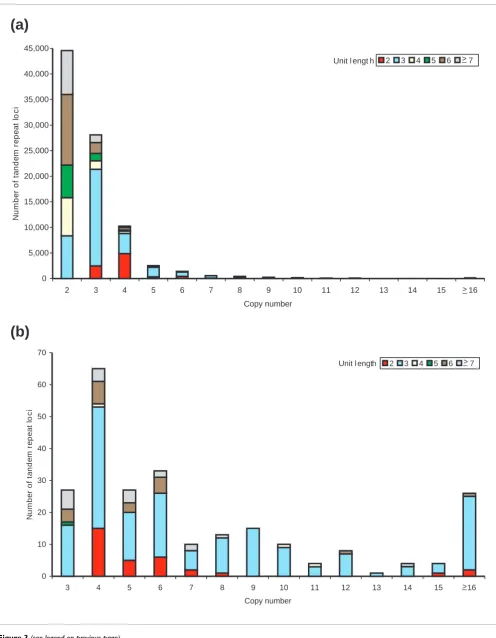
0.0001). As expected, the trend is for variant repeats to have a higher copy-number (Figure 3). This observation [39] has formed the basis of previous studies predicting repeat varia-tion [13,14]. This difference in copy-number for the trimer repeats did not simply reflect a shift in the mean copy-number; there was a substantial upper tail in the distribution, indicating that the chance of a trimer being polymorphic increases as the copy-number increases. In contrast, there was no such marked tail of variants of relatively high copy-number for dimer repeats (Figure 3). This difference between dimer and trimer variation could represent a difference in mutational mechanisms, or, alternatively, the dimers may be subject to purifying selection against expansion, as most of the dimer variants are likely to cause frameshifts.
Origin of variation
Interestingly, the vast majority of dimer, tetramer and pen-tamer copy-number variants resulted in a length difference that was not divisible by three (Figure 1b). Given the preference for repeat variation that is a multiple of three nucleotides, we had anticipated that there would be a greater proportion of copy-number variants that expand or contract dimer and tetramer repeats by exactly three copies (for exam-ple, we expected to see a larger number of dimer tandem var-iants that differed in length by six nucleotides). The observation that such variants are very rare (Figure 1b), even
[image:5.612.313.553.85.247.2]Weighted scatter-plot of the pattern of detected tandem repeat length variation
Figure 2
Weighted scatter-plot of the pattern of detected tandem repeat length variation. Length of repeat unit is plotted against the absolute difference between query and hit repeat block lengths. One variant corresponding to a length difference of 144 for a 48-nucleotide repeat has been omitted. Note that the length of repeat unit, rather than the tandem repeat array length, is plotted on the x-axis and most observed length differences are multiples of the corresponding unit length. The area of each circle is proportional to number of variants observed with a given unit length, and a given nucleotide difference between the representative and variant sequences.
10
20
30
40
50
Nucleotide
difference
between
variant
and
representative
sequence
10 20 30 40 50
though they do not disrupt the reading frame, strongly sup-ports the stepwise mutation model for microsatellite repeats [40,41], and suggests that insertion/deletion mutations of more than one unit at a time are quite unusual. It is probable that the frameshifting copy-number variants are mainly recent mutations that are selectively deleterious, reducing the chance of gradual expansion of the tandem array variant over time; trimer repeat variants could typically be much older. Thus, the majority of copy-number mutations in tandem arrays with short unit sizes are likely to arise by slippage [42], which occurs most often in homogenous repeats [43,44]. Consistent with this, the majority of observed variants for these repeats differ by a single unit.
In contrast, for a number of the larger tandem repeats (unit size of 12 and above) the observed variants in some cases dif-fer by more than one copy, with no sampling of an intermedi-ate allele (Figure 2). Such longer repeat variants may potentially arise through recombination, rather than slippage mechanisms, giving the potential for the gain or loss of more than one unit at a time. It should also be mentioned that the use of UniGene to detect variation precludes the ability to determine if the variation exists at DNA or transcriptional level. Our requirement that observed length variations had to be consistent with a change in repeat copy-number mini-mized the likelihood of detecting variation resulting from an alternative splice site arising within a repeat block. This did not, however, rule out inclusion of alternative splices where the splice sites might coincide with boundaries of tandem repeat units. Inspection of the intron/exon structure of genes in our results using EnsEMBL [45] revealed no such examples (data not shown).
Frameshifting copy-number variation
This dataset is likely to underestimate the frequency of frameshifting repeat variants, as a large number of frameshifts stimulate nonsense-mediated RNA decay, bias-ing against their chance of bebias-ing detected in UniGene. Mes-sages carrying stop codons more than 50 nucleotides upstream of an intron are typically subject to rapid mRNA decay [46]. Secondly, nonsense polymorphisms typically occur at a low frequency in human proteins [47], reflecting selection against deleterious alleles, and it is possible that frameshifting tandem copy-number variants may similarly be at a lower frequency. Given the small sample size for many of
the UniGene clusters, the incidence of frameshifting poly-morphisms is probably strongly under-represented.
A few of the observed variants may not be true frameshifts, however, owing either to errors in coding-sequence annota-tion, sequencing errors, transcriptional errors or transcribed pseudogenes in the database. While we cannot definitively rule these out, the validation of repeat variants to ensure that they represent a change in repeat copy-number would reduce that possibility of some of these errors arising. Nevertheless, for the two reasons outlined above, we believe that the obser-vation of one frameshifting tandem repeat polymorphism per 404 (34 out of 13,749) proteins surveyed (0.25%) represents
a likely lower bound of the frequency. Wren et al. [14]
pre-dicted that 0.5% of proteins are likely to contain frameshift-ing tandem repeat polymorphisms.
It is of course possible that frameshifting tandem repeats can arise from sequencing errors, transcription errors or pseudo-gene transcripts. We inspected the 34 sequences containing frameshifting dinucleotide variants, and found that, in all but one sequence, the percentage of bases that were ambiguous (denoted by base 'N') was less than 1% (the outlier was 4%). We also searched the 51 frameshifting sequences and the rep-resentative allele against the human genome, and in each case both alleles hit the same sequence; that is, there was no evi-dence for the existence of a pseudogene with greater similar-ity to the frameshifted allele.
We cannot rule out the possibility of occasional transcrip-tional slippage giving rise to a small proportion of the observed variation: an experimental screen for such tran-scriptional errors estimated their frequency at approximately 1 in 5,000 transcripts in dinucleotide tandem repeats [48]: in our survey of 5,304 sequences containing 8,449 dinucleotide repeats, we found an incidence of 36 frameshifting dinucle-otide mutations, compared with an expectation of less than two, arising from transcriptional errors. Secondly, two of the tetramer frameshifting repeats, and four of the dimer repeats, were observed in more than one sequence, which is a strong indication of a DNA, rather than a transcriptional, difference. None of the variants detected involved complete deletion of the repeat, with the lowest copy-number in the variant being 1.8 (see Additional data file 1).
Distribution of copy-numbers of tandem repeats
Figure 3 (see following page)
comm
en
t
re
v
ie
w
s
re
ports
refer
e
e
d
re
sear
ch
de
p
o
si
te
d r
e
se
a
rch
interacti
o
ns
inf
o
[image:7.612.57.553.83.721.2]rmation
Figure 3 (see legend on previous page)
0 5,000 10,000 15,000 20,000 25,000 30,000 35,000 40,000 45,000
2 3 4 5 6 7 8 9 10 11 12 13 14 15 > 16
Copy number
N
u
m
b
e
r
o
f
ta
n
d
e
m
re
p
e
a
t
lo
c
i
2 3 4 5 6 >
Unit l engt h
0 10 20 30 40 50 60 70
3 4 5 6 7 8 9 10 11 12 13 14 15 16
Copy number
N
u
m
b
e
r
o
f
ta
n
d
e
m
re
p
e
a
t
lo
c
i
2 3 4 5 6 >
Unit l ength
(b)
(a)
7 _
_ _ 7
_
Association of copy-number variation and host-defense functions
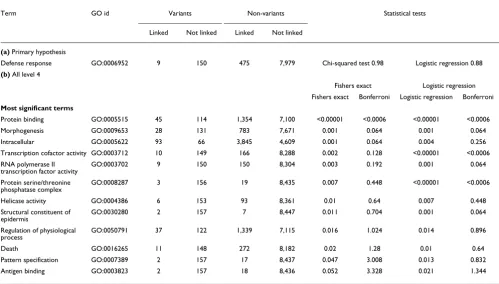
While previous work has shown clear ontological trends for repeats that exhibit variation, it was restricted to certain classes of repeats [49]. We tested whether there was an excess of tandem repeat polymorphic variation in host-defense pro-teins by comparing the frequency of polymorphic genes among those classified as being related to 'defense response' (GO:0006952) [50] or not. There were 484 UniGene clusters that mapped to defense-response proteins and 8,129 clusters that did not. The mean variation was marginally higher in the
defense-response category but this was not significant (p =
0.982, Chi-squared test) (Table 1).
The ability to detect repeat variation within a given cluster is partially dependent on both the number of sequences in which we detected tandem repeats, and the number of repeat blocks in the sequence. These are highly correlated with the number of sequences in the cluster and sequence length, respectively (data not shown). It is possible that these two variables - cluster size and sequence length - might relate to protein groupings with certain functions. In addition, cluster size may be affected by ascertainment bias for certain genes highly expressed in well sampled tissues, and there may be an ascertainment bias towards variant sequences that have been preferentially selected for sequencing. Therefore, we per-formed a logistic regression where the dependent categorical variable described whether or not the cluster contained a var-iant repeat population, and tested this against the categorical 'defense response' variable (describing whether the cluster linked to the GO term). We considered as covariates the number of sequences within each cluster as well as the length of the protein. We found that variation was not dependent on the defense-response classification when both the number of sequences and the length of the protein were considered as
covariates (p = 0.882) (Table 1).
Thus, we find no evidence that human host-defense proteins have an excess of tandem repeat variation. It is possible that the large size of human gene promoters and their innate var-iability (in SNPs, tandem repeats, indels and other polymor-phisms) provides ample opportunity in response to pathogen challenges for rapid selection of variants modulating gene function. There may therefore be no strong long-term selec-tion pressure to develop an innate reservoir of potential vari-ation within the protein sequences themselves. We anticipate that it may be more likely that such advantageous tandem repeat polymorphisms would arise in host-defense proteins of organisms that lack the adaptive immune system and have much larger population sizes.
Association of tandem repeat copy-number variation and Gene Ontology (GO) terms
We investigated whether the occurrence of copy-number pol-ymorphisms was associated with any other GO terms. Of the 362 level-4 terms in GO [50], 167 terms could be linked to our
dataset and had at least one cluster linking to the term. We tested whether or not variation was significantly associated with any of these terms using a Fisher's exact test. This found 13 terms to be significant, of which only the term 'protein-binding' (GO:0005515) remained significant after Bonferroni correction for multiple testing. Again, we wished to ensure that the UniGene cluster size and the sequence length were not confounding the associations between variability and GO terms. Therefore, we performed the logistic regression described above, for which 67 of the 167 terms had a suffi-ciently large sample size to be tested. Twelve of these terms were significant, one of which remained significant after cor-recting for multiple testing. Again, this term was 'protein binding'. To ensure that the observed significance could not be largely attributed to differences in repeat copy-number between variants and non-variants (Figure 3) we performed the logistic regression with the mean repeat copy-number per cluster as an additional covariate. The significance remained
the same under this model (p < 0.00001).
Length changes in repeats involved in protein-protein inter-actions may affect the evolution of cellular signaling pathways [51]. This process may be facilitated by an absence of selective constraint on the repeat if there are no deleterious effects on the phenotype. An elevation of sequence variability at the population level in these proteins is similarly consistent with lack of evolutionary constraint on the protein regions. Previ-ous work has shown that for polyglutamine repeats between human and mouse, there is an association between new repeats and a high nonsynonymous sequence divergence rate, corresponding to regions of low purifying selection [52]. Further investigation of the classes of repeats that are polymorphic in different groups of genes is of interest [53] but sample sizes are too limited to draw strong inferences.
comm
en
t
re
v
ie
w
s
re
ports
refer
e
e
d
re
sear
ch
de
p
o
si
te
d r
e
se
a
rch
interacti
o
ns
inf
o
rmation
mammalian orders despite high mutation rates, suggesting strong stabilizing selection acting on these loci. In addition, it has been found that morphological differences between breeds of dog correlated with variations in repeat number [61]. Thus, in the presence of strong selection, significant repeat polymorphism can arise.
Overall incidence of tandem repeat polymorphism We noted that our estimate of polymorphism was higher when only clusters with a larger sample size were used (for example, 3.06% among 3,331 tandem repeats for which the UniGene cluster size was at least 200 sequences), indicating that our overall estimate is a lower estimate of the true
fre-quency. Wren et al. [14] predicted that around 92% of
poly-morphic repeats in protein-coding regions would be a multiple of three nucleotides, which is concordant with the observation seen in Figure 1b. They experimentally confirmed 40% (17/42) of their predicted polymorphic protein-coding repeats within a sample of at least 60 chromosomes. Of the 249 unique repeat polymorphisms detected in our analysis,
56% were below the minimum threshold used by Wren et al.
to predict polymorphism. Thus, while the method of Wren et
al. is a useful prediction algorithm, it fails to predict many
observed polymorphisms in shorter tandem arrays. Predicted polymorphism reflects the consequences of mutation, while actual polymorphism reflects the combination of mutation
and subsequent selection pressures, and therefore the two approaches may well lead to different conclusions.
It is not surprising that a purely computational prediction will have false negatives, as it must protect against the problem of predicting too many false positives. We make the following
assumptions: first, the Wren et al. prediction method only
provides coverage of 44% (standard error 0.03) of tandem repeat polymorphisms, given that 56% of our variants were below their thresholds for polymorphism prediction; second, only 40% (standard error 0.08) of predicted repeats are actu-ally polymorphic; third, there is one computationactu-ally pre-dicted polymorphic tandem repeat per 23,000 nucleotides of protein-coding DNA [14]; and fourth, the average length of protein-coding DNA is 1,666 nucleotides (based on the Uni-Gene dataset analyzed here). This then implies a revised esti-mate of estiesti-mated polymorphic tandem repeat copy-number variation to 1 in 25,000 nucleotides (with a 95% confidence interval of 17,911-43,066) [62], and that the average fre-quency of polymorphic tandem repeats in human proteins is 6%. The existence of annotation and experimental error may bias this upwards, while the existence of nonsense-mediated RNA decay may bias the estimate downwards.
[image:9.612.54.553.118.402.2]Since 14.24% (42/295) of the polymorphisms were not a mul-tiple of three nucleotides, up to 1% of proteins may contain Table 1
GO analysis of repeat variants
Term GO id Variants Non-variants Statistical tests
Linked Not linked Linked Not linked
(a) Primary hypothesis
Defense response GO:0006952 9 150 475 7,979 Chi-squared test 0.98 Logistic regression 0.88
(b) All level 4
Fishers exact Logistic regression
Fishers exact Bonferroni Logistic regression Bonferroni
Most significant terms
Protein binding GO:0005515 45 114 1,354 7,100 <0.00001 <0.0006 <0.00001 <0.0006
Morphogenesis GO:0009653 28 131 783 7,671 0.001 0.064 0.001 0.064 Intracellular GO:0005622 93 66 3,845 4,609 0.001 0.064 0.004 0.256
Transcription cofactor activity GO:0003712 10 149 166 8,288 0.002 0.128 <0.00001 <0.0006
RNA polymerase II transcription factor activity
GO:0003702 9 150 150 8,304 0.003 0.192 0.001 0.064
Protein serine/threonine phosphatase complex
GO:0008287 3 156 19 8,435 0.007 0.448 <0.00001 <0.0006
Helicase activity GO:0004386 6 153 93 8,361 0.01 0.64 0.007 0.448 Structural constituent of
epidermis
GO:0030280 2 157 7 8,447 0.011 0.704 0.001 0.064
Regulation of physiological
process GO:0050791 37 122 1,339 7,115 0.016 1.024 0.014 0.896
Death GO:0016265 11 148 272 8,182 0.02 1.28 0.01 0.64
Pattern specification GO:0007389 2 157 17 8,437 0.047 3.008 0.013 0.832
frameshifting tandem repeat polymorphisms. It is likely that a much greater number of genes contain rarer frameshifting copy-number variants below the 1% frequency threshold used to define polymorphisms [63].
Our analysis confirms that tandem repeat variation is an important source of variation in many proteins. Much of this variation is of potential relevance to protein function and dis-ease. A more thorough evaluation of the frequency of coding-sequence tandem repeat polymorphism will be possible once the resequencing of human exons from a panel of individuals becomes available. This will allow an unbiased assessment of the extent of common frameshifting tandem repeat variants. However, characterization of the frequency of rarer frameshifting tandem repeats will require larger sample sizes than typical current resequencing projects, as many repeats with large biological effects, such as frameshifts, are likely to occur at low frequencies. Thus, extensive resequencing or genotyping through large cohorts of individuals will be required in order to define their true incidence and to provide a clearer picture of the balance of mutational and selection pressures acting on the generation, fixation and elimination of tandem repeat copy-number variants in human genes.
Materials and methods
Detection of tandem repeatsTwo files, Hs.seq.uniq and Hs.seq.all, from the UniGene data-base [15] build 172 were downloaded. Hs.seq.uniq was used as the template for tandem repeat detection and consisted of one sequence per UniGene cluster that contained the longest region of high-quality sequence data. Hs.seq.all consisted of a redundant set of gene-orientated sequences - that is, multiple sequences can correspond to the same gene cluster identifier. Tandem repeats detected in Hs.seq.uniq were defined as the queries. Tandem repeat blocks detected in Hs.seq.all using the queries were defined as the hits.
To ensure that there was no significant bias arising from expressed sequence tags (ESTs) of cancerous origin, we elim-inated these sequences from our results by using the Tissue-Info [64] classification of EST libraries (December 2002).
Tandem repeats are often complex patterns and it was found that repeats were often detected as smaller sub-patterns when using a lower minimum score to report a repeat. This
occurred for the 69-nucleotide repeat in MUC2 for instance,
where the repeat unit was detected as a series of six- and three-nucleotide repeat units. As we wanted to detect the largest range of repeats possible while retaining repeat pat-terns that were correct, we decided to retain all repeats detected under default parameter settings and then to search for repeats using more sensitive parameters. Only repeats detected in the latter search that did not overlap with those in the former were included.
Tandem repeats were first detected in Hs.seq.uniq using the Tandem Repeats Finder (TRF) program version 3.21 [65] with default parameters for repeat detection. A minscore of 12 instead of 50 was used the second time round, which corre-sponds to a minimum of three copies of a 2-nucleotide repeat as an example. The TRF detection cutoff of 12 was deliber-ately chosen to be low: this was motivated by the desire to determine the level of repeat variation in all repeats, regard-less of their mutational origin. Thus, of the repeats we inves-tigated, 98% (87,787/89,243) had scores below the TRF default score of 50. Of the variants detected, 67% (167/249) had a TRF score below 50. Thus, searches for variant tandem repeats need to consider low copy-number repeats, as well as those high copy-number repeats which are more likely to be variant. For shorter arrays to be reported by TRF, they will need to be 100% homogeneous to be detectable. Clearly, there may be other insertions or deletions among short inexact repeat arrays that we have not detected. Sequences lacking 25 nucleotides of flanking sequence on both sides of the detected tandem repeat block were omitted from further analysis.
We restricted our analysis to variability among protein-cod-ing repeat sequences. Definitions of codprotein-cod-ing sequence (CDS) start and stop points were taken from the sequence header of the Hs.seq.uniq sequences in UniGene. Sequences lacking CDS information and tandem repeat sequences that did not lie exclusively within coding regions were not included. Mononucleotide tandem repeats were excluded from the analysis, as we considered the probability of detecting sequence errors too great [66].
Detection of tandem repeat variation
Similarity of the tandem repeat region within the Hs.seq.uniq representative to the same region within other sequences within the cluster was assessed by matching up the corre-sponding sequences using their 25-nucleotide flanks. Length differences were detected by comparing the length of the rep-resentative tandem repeat block to that of the other sequences in the cluster.
Detected repeat blocks thus have the following properties: a 25-nucleotide flanking sequence on both sides (which is used to align repeat blocks from different sequences in the cluster), and they belong to a cluster containing more than one sequence overlapping the tandem repeat sequence block and its 25-nucleotide flanks.
comm en t re v ie w s re ports refer e e d re sear ch de p o si te d r e se a rch interacti o ns inf o rmation
We calculated the gene diversity (or heterozygosity) as
where Pi is the frequency of the ith of k repeat lengths at a
locus ([67] and see Additional data file 2).
Gene Ontology (GO) data
To test the hypothesis that the number of genes with tandem repeat variation is elevated in genes involved in defense-related processes, the term 'defense response' (GO:0006952) was selected from GO. Human UniGene clusters linked to GO terms and their hierarchies were obtained by linking LocusLink to both UniGene and GO and also by linking Uni-Gene to EMBL and then linking, via the EMBL accessions, to UniProt and thence to GO. Links were subsequently com-pleted by adding links to all parent GO terms for each GO term using the GO_GRAPH_PATH and GO_TERM tables from the Gene Ontology database (dated 1 July 2004). By cross-referencing our GO term of interest with the file linking GO to UniGene, we were able to assign a binary classification (yes/no related to our GO term of interest) to each UniGene cluster. This allowed us to statistically assess the differences in the levels of variation between genes related and not related to the defense response. Significant terms were cor-rected for multiple testing using the Bonferroni method. Sta-tistical analysis was carried out in STATA 8.
Additional data files
The following additional data is available with the online ver-sion of this paper. Additional data file 1 is a table listing the 295 repeat variants (spanning 218 UniGene clusters) detected in our analysis, with information on the repeats and a description of the cluster representative sequence. Additional data file 2 contains block lengths of repeats grouped into 249 unique repeat loci. For each locus, the heterozygosity of the repeat length allele frequencies has been calculated. Addi-tional data file 3 contains data used for Figure 3. Counts of variant and invariant repeats of different unit lengths and copy-numbers are tabulated.
Additional data file 1
Summary of repeat variants detected within coding regions in UniGene
295 repeat variants (spanning 218 UniGene clusters) detected in our analysis, with information on the repeats and a description of the cluster representative sequence.
Click here for file Additional data file 2
Repeat loci with heterozygosity information.
Block lengths of repeats grouped into 249 unique repeat loci. For each locus, the heterozygosity of the repeat length allele frequen-cies has been calculated.
Click here for file Additional data file 3
Unit lengths and copy-numbers for variant and invariant repeats. Data used for Figure 3. Counts of variant and invariant repeats of different unit lengths and copy-numbers are tabulated.
Click here for file
Acknowledgements
We thank Philip Cotter and Kate Johnston for comments and suggestions during the preparation of this manuscript, and Patrick Dicker for advice on statistical tests used. The work was supported by the Higher Education Authority of Ireland.
References
1. A novel gene containing a trinucleotide repeat that is expanded and unstable on Huntington's disease chromo-somes. The Huntington's Disease Collaborative Research Group. Cell 1993, 72:971-983.
2. Verkerk AJ, Pieretti M, Sutcliffe JS, Fu YH, Kuhl DP, Pizzuti A, Reiner O, Richards S, Victoria MF, Zhang FP, et al.: Identification of a gene (FMR-1) containing a CGG repeat coincident with a
break-point cluster region exhibiting length variation in fragile X syndrome. Cell 1991, 65:905-914.
3. Hui J, Stangl K, Lane WS, Bindereif A: HnRNP L stimulates splic-ing of the eNOS gene by bindsplic-ing to variable-length CA repeats. Nat Struct Biol 2003, 10:33-37.
4. Gebhardt F, Zanker KS, Brandt B: Modulation of epidermal growth factor receptor gene transcription by a polymorphic dinucleotide repeat in intron 1. J Biol Chem 1999,
274:13176-13180.
5. Jeffreys AJ, Royle NJ, Wilson V, Wong Z: Spontaneous mutation rates to new length alleles at tandem-repetitive hypervaria-ble loci in human DNA. Nature 1988, 332:278-281.
6. Jakupciak JP, Wells RD: Genetic instabilities in (CTG.CAG) repeats occur by recombination. J Biol Chem 1999,
274:23468-23479.
7. Richard GF, Dujon B, Haber JE: Double-strand break repair can lead to high frequencies of deletions within short CAG/CTG trinucleotide repeats. Mol Gen Genet 1999, 261:871-882. 8. La Spada AR, Wilson EM, Lubahn DB, Harding AE, Fischbeck KH:
Androgen receptor gene mutations in X-linked spinal and bulbar muscular atrophy. Nature 1991, 352:77-79.
9. Sutherland GR, Richards RI: Simple tandem DNA repeats and human genetic disease. Proc Natl Acad Sci USA 1995,
92:3636-3641.
10. Kenny D, Muckian C, Fitzgerald DJ, Cannon CP, Shields DC: Platelet glycoprotein Ib alpha receptor polymorphisms and recur-rent ischaemic events in acute coronary syndrome patients. J Thromb Thrombolysis 2002, 13:13-19.
11. Holmer SR, Hengstenberg C, Kraft HG, Mayer B, Poll M, Kurzinger S, Fischer M, Lowel H, Klein G, Riegger GA, Schunkert H: Association of polymorphisms of the apolipoprotein(a) gene with lipo-protein(a) levels and myocardial infarction. Circulation 2003,
107:696-701.
12. Bugert P, Hoffmann MM, Winkelmann BR, Vosberg M, Jahn J, Entel-mann M, Katus HA, Marz W, MansEntel-mann U, Boehm BO, et al.: The variable number of tandem repeat polymorphism in the P-selectin glycoprotein ligand-1 gene is not associated with coronary heart disease. J Mol Med 2003, 81:495-501.
13. Fondon JW 3rd, Mele GM, Brezinschek RI, Cummings D, Pande A, Wren J, O'Brien KM, Kupfer KC, Wei MH, Lerman M, et al.: Com-puterized polymorphic marker identification: experimental validation and a predicted human polymorphism catalog. Proc Natl Acad Sci USA 1998, 95:7514-7519.
14. Wren JD, Forgacs E, Fondon JW 3rd, Pertsemlidis A, Cheng SY, Gal-lardo T, Williams RS, Shohet RV, Minna JD, Garner HR: Repeat pol-ymorphisms within gene regions: phenotypic and evolutionary implications. Am J Hum Genet 2000, 67:345-356. 15. Schuler GD, Boguski MS, Stewart EA, Stein LD, Gyapay G, Rice K,
White RE, Rodriguez-Tome P, Aggarwal A, Bajorek E, et al.: A gene map of the human genome. Science 1996, 274:540-546. 16. Denoeud F, Vergnaud G, Benson G: Predicting human
minisatel-lite polymorphism. Genome Res 2003, 13:856-867.
17. Naslund K, Saetre P, von Salome J, Bergstrom TF, Jareborg N, Jazin E:
Genome-wide prediction of human VNTRs. Genomics 2005,
85:24-35.
18. Denoeud F, Vergnaud G: Identification of polymorphic tandem repeats by direct comparison of genome sequence from dif-ferent bacterial strains: a web-based resource. BMC Bioinformatics 2004, 5:4.
19. Jordon P, Snyder LA, Saunders NJ: Diversity in coding tandem repeats in related Neisseria spp. BMC Microbiol 2003, 3:23. 20. Sylvestre P, Couture-Tosi E, Mock M: Polymorphism in the
colla-gen-like region of the Bacillus anthracis BclA protein leads to variation in exosporium filament length. J Bacteriol 2003,
185:1555-1563.
21. van Belkum A, Scherer S, van Alphen L, Verbrugh H: Short-sequence DNA repeats in prokaryotic genomes. Microbiol Mol Biol Rev 1998, 62:275-293.
22. Li YC, Korol AB, Fahima T, Nevo E: Microsatellites within genes: structure, function, and evolution. Mol Biol Evol 2004,
21:991-1007.
23. Murphy PM: Molecular mimicry and the generation of host defense protein diversity. Cell 1993, 72:823-826.
24. Shields DC, Harmon DL, Whitehead AS: Evolution of hemopoi-etic ligands and their receptors. Influence of positive selec-tion on correlated replacements throughout ligand and receptor proteins. J Immunol 1996, 156:1062-1070.
25. Metzgar D, Bytof J, Wills C: Selection against frameshift
muta-HE pi2
i=1 k
tions limits microsatellite expansion in coding DNA. Genome Res 2000, 10:72-80.
26. Dokholyan NV, Buldyrev SV, Havlin S, Stanley HE: Distributions of dimeric tandem repeats in noncoding and coding DNA sequences. J Theor Biol 2000, 202:273-282.
27. Subramanian S, Mishra RK, Singh L: Genome-wide analysis of mic-rosatellite repeats in humans: their abundance and density in specific genomic regions. Genome Biol 2003, 4:R13.
28. Chang FM, Kidd JR, Livak KJ, Pakstis AJ, Kidd KK: The world-wide distribution of allele frequencies at the human dopamine D4 receptor locus. Hum Genet 1996, 98:91-101.
29. Afshar-Kharghan V, Diz-Kucukkaya R, Ludwig EH, Marian AJ, Lopez JA: Human polymorphism of P-selectin glycoprotein ligand 1 attributable to variable numbers of tandem decameric repeats in the mucinlike region. Blood 2001, 97:3306-3307. 30. Toribara NW, Gum JR Jr, Culhane PJ, Lagace RE, Hicks JW, Petersen
GM, Kim YS: MUC-2 human small intestinal mucin gene struc-ture. Repeated arrays and polymorphism. J Clin Invest 1991,
88:1005-1013.
31. Muckian C, Hillmann A, Kenny D, Shields DC: A novel variant of the platelet glycoprotein Ibalpha macroglycopeptide region lacks any copies of the 'perfect' 13 amino acid repeat. Thromb Haemost 2000, 83:513-514.
32. Matsuyama Z, Kawakami H, Maruyama H, Izumi Y, Komure O, Udaka F, Kameyama M, Nishio T, Kuroda Y, Nishimura M, Nakamura S:
Molecular features of the CAG repeats of spinocerebellar ataxia 6 (SCA6). Hum Mol Genet 1997, 6:1283-1287.
33. Koide R, Kobayashi S, Shimohata T, Ikeuchi T, Maruyama M, Saito M, Yamada M, Takahashi H, Tsuji S: A neurological disease caused by an expanded CAG trinucleotide repeat in the TATA-binding protein gene: a new polyglutamine disease? Hum Mol Genet 1999, 8:2047-2053.
34. Zuhlke C, Hellenbroich Y, Dalski A, Kononowa N, Hagenah J, Vieregge P, Riess O, Klein C, Schwinger E: Different types of repeat expansion in the TATA-binding protein gene are associated with a new form of inherited ataxia. Eur J Hum Genet 2001, 9:160-164.
35. Dean M, Park M, Le Beau MM, Robins TS, Diaz MO, Rowley JD, Blair DG, Vande Woude GF: The human met oncogene is related to the tyrosine kinase oncogenes. Nature 1985, 318:385-388. 36. Stenson PD, Ball EV, Mort M, Phillips AD, Shiel JA, Thomas NS,
Abeysinghe S, Krawczak M, Cooper DN: Human Gene Mutation Database (HGMD): 2003 update. Hum Mutat 2003, 21:577-581. 37. Hamosh A, Scott AF, Amberger JS, Bocchini CA, McKusick VA:
Online Mendelian Inheritance in Man (OMIM), a knowledge-base of human genes and genetic disorders. Nucleic Acids Res 2005, 33(Database issue):D514-D517.
38. Letovsky SI, Cottingham RW, Porter CJ, Li PW: GDB: the Human Genome Database. Nucleic Acids Res 1998, 26:94-99.
39. Charmley P, Concannon P, Hood L, Rowen L: Frequency and pol-ymorphism of simple sequence repeats in a contiguous 685-kb DNA sequence containing the human T-cell receptor beta-chain gene complex. Genomics 1995, 29:760-765. 40. Kimmel M, Chakraborty R, Stivers DN, Deka R: Dynamics of
repeat polymorphisms under a forward-backward mutation model: within- and between-population variability at micro-satellite loci. Genetics 1996, 143:549-555.
41. Ota T, Kimura M: A model of mutation appropriate to esti-mate the number of electrophoretically detectable alleles in a finite population. Genet Res 1973, 22:201-204.
42. Schlotterer C, Tautz D: Slippage synthesis of simple sequence DNA. Nucleic Acids Res 1992, 20:211-215.
43. Weber JL: Informativeness of human (dC-dA)n.(dG-dT)n polymorphisms. Genomics 1990, 7:524-530.
44. Kunst CB, Leeflang EP, Iber JC, Arnheim N, Warren ST: The effect of FMR1 CGG repeat interruptions on mutation frequency as measured by sperm typing. J Med Genet 1997, 34:627-631. 45. Hubbard T, Andrews D, Caccamo M, Cameron G, Chen Y, Clamp M,
Clarke L, Coates G, Cox T, Cunningham F, et al.: Ensembl 2005. Nucleic Acids Res 2005, 33(Database issue):D447-D453.
46. Lykke-Andersen J, Shu MD, Steitz JA: Human Upf proteins target an mRNA for nonsense-mediated decay when bound down-stream of a termination codon. Cell 2000, 103:1121-1131. 47. Hughes AL, Packer B, Welch R, Bergen AW, Chanock SJ, Yeager M:
Widespread purifying selection at polymorphic sites in human protein-coding loci. Proc Natl Acad Sci USA 2003,
100:15754-15757.
48. van Den Hurk WH, Willems HJ, Bloemen M, Martens GJ: Novel
frameshift mutations near short simple repeats. J Biol Chem 2001, 276:11496-11498.
49. Karlin S, Burge C: Trinucleotide repeats and long homopep-tides in genes and proteins associated with nervous system disease and development. Proc Natl Acad Sci USA 1996,
93:1560-1565.
50. Ashburner M, Ball CA, Blake JA, Botstein D, Butler H, Cherry JM, Davis AP, Dolinski K, Dwight SS, Eppig JT, et al.: Gene ontology: tool for the unification of biology. The Gene Ontology Consortium. Nat Genet 2000, 25:25-29.
51. Hancock JM, Simon M: Simple sequence repeats in proteins and their significance for network evolution. Gene 2005,
345:113-118.
52. Hancock JM, Worthey EA, Santibanez-Koref MF: A role for selec-tion in regulating the evoluselec-tionary emergence of disease-causing and other coding CAG repeats in humans and mice. Mol Biol Evol 2001, 18:1014-1023.
53. Alba MM, Laskowski RA, Hancock JM: Detecting cryptically sim-ple protein sequences using the SIMPLE algorithm. Bioinfor-matics 2002, 18:672-678.
54. Koide R, Ikeuchi T, Onodera O, Tanaka H, Igarashi S, Endo K, Taka-hashi H, Kondo R, Ishikawa A, Hayashi T, et al.: Unstable expansion of CAG repeat in hereditary dentatorubral-pallidoluysian atrophy (DRPLA). Nat Genet 1994, 6:9-13.
55. Kennedy WR, Alter M, Sung JH: Progressive proximal spinal and bulbar muscular atrophy of late onset. A sex-linked recessive trait. Neurology 1968, 18:671-680.
56. Hamada H, Seidman M, Howard BH, Gorman CM: Enhanced gene expression by the poly(dT-dG).poly(dC-dA) sequence. Mol Cell Biol 1984, 4:2622-2630.
57. Lu Q, Wallrath LL, Granok H, Elgin SC: (CT)n (GA)n repeats and heat shock elements have distinct roles in chromatin struc-ture and transcriptional activation of the Drosophila hsp26
gene. Mol Cell Biol 1993, 13:2802-2814.
58. Yee HA, Wong AK, van de Sande JH, Rattner JB: Identification of novel single-stranded d(TC)n binding proteins in several mammalian species. Nucleic Acids Res 1991, 19:949-953. 59. Richards RI, Holman K, Yu S, Sutherland GR: Fragile X syndrome
unstable element, p(CCG)n, and other simple tandem repeat sequences are binding sites for specific nuclear proteins. Hum Mol Genet 1993, 2:1429-1435.
60. Colafranceschi M, Colosimo A, Zbilut JP, Uversky VN, Giuliani A:
Structure-related statistical singularities along protein sequences: a correlation study. J Chem Inf Model 2005,
45:183-189.
61. Fondon JW 3rd, Garner HR: Molecular origins of rapid and con-tinuous morphological evolution. Proc Natl Acad Sci USA 2004,
101:18058-18063.
62. Armitage P, Berry G: Statistical Methods in Medical Research 3rd edi-tion. Oxford, UK: Blackwell Science; 1994.
63. Day IN, Alharbi KK, Smith M, Aldahmesh MA, Chen X, Lotery AJ, Pante-de-Sousa G, Hou G, Ye S, Eccles D, et al.: Paucimorphic alle-les versus polymorphic allealle-les and rare mutations in disease causation: theory, observation and detection. Curr Genomics 2004, 5:431-438.
64. Skrabanek L, Campagne F: TissueInfo: high-throughput identifi-cation of tissue expression profiles and specificity. Nucleic Acids Res 2001, 29:E102.
65. Benson G: Tandem repeats finder: a program to analyze DNA sequences. Nucleic Acids Res 1999, 27:573-580.
66. Weber JL, David D, Heil J, Fan Y, Zhao C, Marth G: Human diallelic insertion/deletion polymorphisms. Am J Hum Genet 2002,
71:854-862.