White Rose Research Online URL for this paper:
http://eprints.whiterose.ac.uk/82319/
Version: Accepted Version
Article:
Kleanthous, S and Dimitrova, V (2013) Adaptive notifications to support knowledge sharing
in virtual communities. User Modeling and User Adapted Interaction, 23. 287 - 343. ISSN
0924-1868
https://doi.org/10.1007/s11257-012-9127-y
[email protected] https://eprints.whiterose.ac.uk/
Reuse
Unless indicated otherwise, fulltext items are protected by copyright with all rights reserved. The copyright exception in section 29 of the Copyright, Designs and Patents Act 1988 allows the making of a single copy solely for the purpose of non-commercial research or private study within the limits of fair dealing. The publisher or other rights-holder may allow further reproduction and re-use of this version - refer to the White Rose Research Online record for this item. Where records identify the publisher as the copyright holder, users can verify any specific terms of use on the publisher’s website.
Takedown
If you consider content in White Rose Research Online to be in breach of UK law, please notify us by
Adaptive Notifications to Support Knowledge Sharing in Close-Knit
Virtual Communities
Styliani Kleanthous Loizou1 and Vania Dimitrova Cyprus University of Technology, Cyprus School of Computing, University of Leeds, UK
Email: [email protected], [email protected]
Social web-groups where people with common interests and goals communicate, share resources, and construct knowledge, are becoming a major part of today’s organisational practice. Research has shown that appropriate support for effective knowledge sharing tailored to the needs of the community is paramount. This brings a new challenge to user modelling and adaptation, which requires new techniques for gaining sufficient understanding of a virtual community and identifying areas where the community may need support. The research presented here addresses this challenge presenting a novel computational approach for community-tailored support underpinned by organisational psychology and aimed at facilitating the functioning of the community as a whole (i.e. as an entity). A framework describing how key community processes - transactive memory, shared mental models, and cognitive centrality - can be utilised to derive knowledge sharing patterns from community log data is described. The framework includes two parts: (i) extraction of a community model that represents the community based on the key processes identified and (ii) identification of knowledge sharing behaviour patterns that are used to generate adaptive notifications. Although the notifications target individual members, they aim to influence individuals’ behaviour in a way that can benefit the functioning of the community as a whole. A validation study has been performed to examine the effect of community-adapted notifications on individual members and on the community as a whole using a close-knit community of researchers sharing references. The study shows that notification messages can improve members’ awareness and perception of how they relate to other members in the community. Interesting observations have been made about the linking between the physical and the virtual community, and how this may influence members’ awareness and knowledge sharing behaviour. Broader implications for using log data to derive community models based on key community processes and generating community-adapted notifications are discussed.
Keywords: Community modelling, Adaptive support for knowledge sharing, Virtual communities. Declaration
This paper or a similar version is not currently under review by a journal or conference, nor will it be submitted to such within the next three months. This paper is void of plagiarism or self-plagiarism as defined in Section 1 of ACM's Policy and Procedures on Plagiarism.
1
IntroductionSocial environments foster interpersonal ties between people and are becoming the primary medium where humans share knowledge (Wellman, 2001). With the advancement of the internet, social environments are being built online and constitute an important part of peoples’ lives and organisational practices (Preece et al., 2003). Virtual communities (VCs) (spanning from large, loosely structured2 to small, close-knit3) are one of the most effective environments for sharing knowledge (Wenger, 2000). We focus here on close-knit virtual communities that may exist either in organisational or educational context and possess the following characteristics: common purpose, identified by the participants or a facilitator; commitment to the sharing of information and generation of new knowledge; shared resources; interaction and collaboration; equal membership inside the community. Close-knit VCs are becoming very popular because they offer opportunities for
1
The work reported here is based on the PhD studies of the author conducted at the University of Leeds, UK
2
Examples include Delicious communities: http://www.delicious.com/ 3
knowledge sharing and collaboration, and are considered to be one of the most inexpensive and successful ways of managing knowledge in an organisation (Nonaka et al., 2000). In academic settings, researchers across the globe are coming together to collaborate on large or small projects, organise academic conferences or just share resources and develop collective knowledge (Puntambekar, 2006; Paletz and Schunn, 2010).
Studies show that for VCs to be successful, more than just people and technology is needed – intelligent support for the effective functioning of the community is paramount (Fischer and Ostwald, 2001). This requires a good understanding of VCs focusing on processes that have to be supported to enable effective knowledge sharing and add value for all members (McDermott, 2000). Researchers in Computer Supported Cooperative Work have argued that organisation and psychology theories should be followed as a solid foundation for enabling effective knowledge sharing and working together in communities (Barley et al., 2004). The implication of this argument for personalisation and adaptation technologies for teams and close-knit communities drives the research presented in this paper. We explore how to utilise organisation psychology to develop a holistic community adaptation approach that gains an understanding of a close-knit virtual community and provides support tailored to the needs of the community as a whole.
Following (Mohammed and Dumville, 2001; Ilgen et al., 2005), processes that can have an impact on the collective knowledge sharing and are important for the effective functioning of teams and close-knit communities have been identified:
• Transactive Memory (TM): Members are aware how their knowledge relates to the knowledge of others;
• Shared Mental Models (SMM): Members develop a shared understanding of the key processes and the relationships that occur between them;
• Cognitive Centrality (CCen): Members who hold strong relevant expertise can be influential; members of effective communities gradually move from being peripheral to becoming more central and engaged in the community.
Based on TM, SMM and CCen, this research aims to support members of a close-knit community to answer questions like: “Who knows about subject S?”, “What are others doing in this community?”, “Who shares the most valuable resources in this community?”, “Whose knowledge is important to me?”, “Do others in this community know what I know?”, “To whom is my knowledge important?”. Studies stress that the outcome of a member’s actions in the community can influence others’ actions (Schmidt, 2002). Monitoring what others are doing and how members are related in the community is vital for knowledge sharing, collaboration and community sustainability. Explicitly making people aware of their similarities, in addition to activity awareness, can influence their actions, and thus help them engage in the community. Discovering patterns that promote the development of a TM system, the establishment of SMM, and exploit CCen, can facilitate knowledge sharing in the virtual community (VC) (Ilgen et al., 2005).
The paper presents a novel holistic personalisation approach for supporting close-knit VCs and addresses three research questions:
• How to extract a computational model to represent the functioning of a community as a whole by using semantically enhanced system log data?
• How can user modelling, adaptation and personalisation techniques be utilised to support processes which are important for the functioning of close-knit virtual communities?
• Can adaptive support, driven by community processes, affect the functioning of the community?
The research presented here contributes to an emerging trend in adaptation and personalisation developing intelligent techniques to provide adaptive support for team collaboration (Paramythis et al., 2011). ‘Traditional’ approaches of personalisation in social systems use the social context in order to enhance adaptation mechanisms aimed at benefiting individual members. In contrast, we propose an adaptation approach aimed at benefitting a close-knit community as a whole (which in turn will benefit the individual members). Such holistic personalisation approach allows for social processes to be taken into account, and the personalised support (in terms of notifications) to target individual community members, but aim at improving the knowledge sharing and functioning of the whole community as an entity.
The paper makes the following contribution to research in personalisation in social environments, focusing on adaptive support for knowledge sharing in close-knit communities:
• a novel semantic-enriched mechanism for extracting a community model based on log data analysis and underpinned by three key community processes (TM, SMM and CCen);
• an original mechanism for discovering community knowledge sharing patterns by mapping the three community processes (TM, SMM, and CCen) to properties in graphs representing community relationships; and applying this mechanism for generating community-adapted notifications;
• an experimental evaluation study which examines benefits and drawbacks of community-adapted notifications and derives implications for future work in socio-personalisation. The next section will compare our approach with related work, pointing at key differences and justifying the major contribution of the research presented in this paper. Section 3 provides an overview of the proposed computational framework for community adapted support. Section 4 presents the community model extraction mechanism. A graph-based mechanism for extracting community knowledge sharing behaviour patterns is described in Section 5, and the use of these patterns for adaptive notification generation is presented in Section 6. Section 7 presents an evaluation study describing the experimental design and the main findings, followed by a discussion on the lessons learnt and revisiting the research questions to conclude the paper.
2
Related WorkOur approach relates to existing work in three research areas. Firstly, we will compare to similar user modelling approaches. Then, a comparison will be provided to social network techniques that use graph based algorithms for identifying connections based on people’s interactions in social settings. Finally, we will discuss relevant approaches for intelligent support in social environments.
2.1
User Modelling ApproachesModelling virtual communities has recently become popular in different research areas. For the purpose of this research, approaches from both user modelling and social network areas are considered as important and discussed in this section. In user modelling, modelling a group provides the grounds for generating group recommendations (Masthoff, 2004); in social networks, community modelling aids the discovery of relationships between people or communities (Lin et al., 2008).
Modelling Interests: A different approach is followed by Tian et.al. (2001) where the community model represents the interaction activities that happened in the VC. All interactions are associated with a core lexicon which represents the interests of people in the VC. User interests are modelled according to the interactions each user is performing in the VC and associated to the core lexicon of the VC. Shared interests or relationships are also modelled based on social interaction activities of users, and are linked to the VC lexicon. The approach presented in this paper also models user interests based on resources members are uploading or downloading. However, we exploit semantic enrichment of the uploading/downloading activities by using, in addition to the resource key words, concepts extracted from an ontology. For example, we use semantically-enriched data to extract interest similarity between community members.
User interests have been extensively studied also in (Davies et al, 2003) - an approach where user interests are extracted as keywords from the user profiles and other web content shared by a user in the community is presented. An ontology is then accessed, where associations are derived with ontology concepts and further recommendations are made to users. Interests are also used in finding relationships between users or connections in social graphs. Li et al (2008) are extracting interests based on tags users ascribe to items posted online. Relationships/associations between users are derived based on their tags. This is similar to the interest relationship model used in our work - both approaches consider that members can be connected by interest similarity even when they have not read any resources uploaded by each other.
Modelling Expertise: Interests of users are usually associated with expertise, especially in social network research (Song et al., 2005; Fu et al., 2007; Lin et al., 2007; Zhang et al., 2007). Zhang et al. (2007) extract shared interests in a discussion based on posting/replying threads. Based on the discussion topics a member of the community is contributing to, his/her interests and expertise are extracted; subsequently, user interest relationships are obtained. Fu et al. (2007) are following a similar method but are mining email communication networks. Relationships are inferred according to the expertise/interests of members, which are extracted from communication recorded in their email conversations. Modelling expertise relations plotted as graphs is also explored by Song et al.(2005). A relational network is extracted according to people’s publications. The expertise/interests of a person are obtained by his/her previous publications; and two people are considered related if they have publications in the same research area. The work presented here adds to the above approaches. Our approach does not identify only expertise, but also derives a person’s influence in the VC based on the relationships he/she has developed with others, which can benefit the VC as a whole.
Community Graph Models: Existing research employed graph theory to model communities and relationships between members (Hubscher and Puntambekar, 2004; Kay et al., 2006) or members’ interactions in general (Falkowski et al., 2007; Falkowski and Spiliopoulou, 2007). In (Hubscher and Puntambekar, 2004), the individual user model represents the conceptual understanding of a user, based on which a graph network is constructed. Similarities are then extracted according to a user’s conceptual understanding, and group models are derived based on the distance between members in a graph. Kay et al. (2006) uses the notion of an interaction network to represent relationships between users in a learning community. Two members are related if they have modified the same resource; hence, they appear connected in the interaction graph. Falkowski et al. (2007) consider the exchange of messages as an interaction between two users, represented in a graph. A relationship between two users exists if they have engaged in some message exchange (Falkowski and Spiliopoulou, 2007). Our work also follows a graph-based approach to model a community. The key contribution of the approach presented here to graph community modelling is the consideration of semantic relationships in addition to the interactions between users, i.e. an edge connecting two members represents their semantic similarity to each other, and the relevance of this link to the community’s domain.
2.2
Graph-based Approaches for Social Network Analysisthat can be recognised in a network (e.g. cliques, degree centrality, structural equivalence, and structural holes). These are quantitative approaches that do not consider any semantics and thus have yet to be applied to the investigation of social “roles” (e.g. newcomers, oldtimers) or social “power” (e.g. central or peripheral members). A review of different methods used for extracting communities (sub-networks of people structurally connected together in a graph) from large networks over the web is given in (Chakrabarti and Faloutsos, 2006). These approaches focus on structural attributes of graphs which are linked to patterns that can be identified in peoples’ interactions (Khan and Shaikh, 2006; Lo and Lin, 2006; De Choudhury et al., 2007; Viermetz and Skubacz, 2007; Kunegis et al., 2009). We review them below discussing common features with our approach.
Measuring Centrality: Viermetz and Skubacz (2007) apply text mining techniques to email conversations to extract patterns/networks of people and their relationships. Keywords are extracted from email communications to form vectors, each vector represents a single message. From this, a network of email messages is built. Clusters of similar messages are found using DBScan (Ester et al., 1996). Network segmentation combines the messages for each topic cluster into a sub-graph of the messages extracted by the actors involved. The centrality of each actor is measured according to how central the topics of the messages exchanged by this actor are. Compared to our work, it can be noted that the text analysis does not consider the relevance of each email message to the overall community. Thus, the extracted centrality measure considers only the keywords associated with a user and does not take into account the importance of these keywords to the community as a whole. In addition, our approach measures centrality considering also the relevance of a resource or a relationship between two members to the rest of the community by using an ontology representing the community domain.
Extracting Patterns of Behaviour: A publication network is used in (Khan and Shaikh, 2006) to extract predefined algebraic functions that represent social relationships in a network. The patterns developed have been applied to an existing publication network to extract reviewers for a specific paper. The algebraic functions deal with structural functions of graphs and have no added semantics. For example, in the extracted network a binary 1 represents that an edge exists between two nodes and a 0 denotes no edge between the two nodes. This does not represent any semantic connection between the two nodes in the network. A different application discussed by Khan and Shaikh (2006) is to identify who will be infected from the nearest network of a person if that person is infected with some kind of virus. In order to discover who will need immunisation, algebraic functions are applied to the network of that person using structural characteristics of the social network graph (matrices and sets operations). In contrast, our approach not only takes into account structural characteristics of the graphs, but also links these characteristics to patterns related to social processes in close-knit VCs.
A recommendation tool developed in (Lo and Lin, 2006) suggests friends to community members based on exchange of messages. Sending messages to each other is the connection that exists between two community members in their network. No semantic information representing the message content is considered. In our work, semantics is taken from the keywords of the resources shared by members. In addition, we also consider different connection types between two members (e.g. if two members read, upload similar resources, or have resources shared with each other).
All the above approaches have developed some pattern algorithms and employed them to analyse people networks. Generally, we follow the same approach. However, our approach focuses on modelling semantic relationships via graphs, i.e. an edge connecting two members represents their semantic similarity to each other, and the relevance of this link to the community’s domain. This, combined with the theoretical underpinning, forms our contribution to social network analysis, i.e. a graph-based approach for qualitative analysis to automatically detect relevant interaction patterns.
2.3
Relevant Techniques for Virtual Communitiesrepresentations members may not be able to see how their contribution could be beneficial for the community as a whole and what activities they can engage in. In contrast, we analyse a community model to automatically detect problematic cases which can be used to decide when and how to intervene, offering support to improve the knowledge sharing processes in the community.
Identifying Interest Clusters: User browsing behaviour has been used as a source for identifying clusters of users with similar interests (Pierrakos and Paliouras, 2010). Such clusters play the role of community models, and can be used for personalisation by narrowing down the search space and choosing the category most related to the user’s interests. The community web directory modelling approach is applicable to a large, loosely structured community, and this enables the use of clustering and probabilistic modelling techniques. In contrast, we consider close-knit communities, where the interests are more compact (i.e. there exists a common community context, which we represent as an ontology) and relationships between users develop based on uploading and downloading of resources related to the community context. Hence, instead of machine learning techniques, we consider semantic augmentation and similarity, which allows us to model relationships at a finer granularity.
Identifying Expertise: Different tools and algorithms have been developed to support people in locating expertise on a specific subject inside groups or VCs (Shami et al., 2007; Zhang et al., 2007; Pal et al., 2011). Our work contributes to this research stream. In addition to identifying the interests and expertise of community members, we detect possible connections between members which have not been exploited in the community. This is used in notification messages to encourage cognitively central and peripheral members to engage in interactions beneficial for the VC.
Intelligent Group Interventions: The closest to our approach is research on intelligent interventions to support groups or communities, which are usually used to augment existing collaboration environments. For example, (Baghaei and Mitrovic, 2007) extend a constraint-based tutoring system with intelligent feedback, based on analysis of students’ activities and comparing them to an ideal model of collaboration, which is intended at making the collaboration process more effective. Collective bookmarking systems have been extended with algorithms for detecting and promoting cognitively central menbers (Bretzke and Vassileva, 2003; Farzan et al., 2009). Most recently, (Ardissono and Bosio, 2012) propose extending collaboration environments to improve user awareness by providing context-aware notifications delivered on the basis of the user's current activities and taking into account collaboration context. Our work is positioned in this research stream and makes a unique contribution by examining how social processes (transactive memory, shared mental models, and cognitive centrality) seen as important for the functioning of a close-knit VC can inform the generation of notification messages. The key novelty of our work is that we consider semantics between relationships and suggest community interventions aimed at improving the functioning of the VC as an entity taking into account TM, SMM, and CCen.
In the next section we will present the computational framework developed in this research and discussed its main components.
3
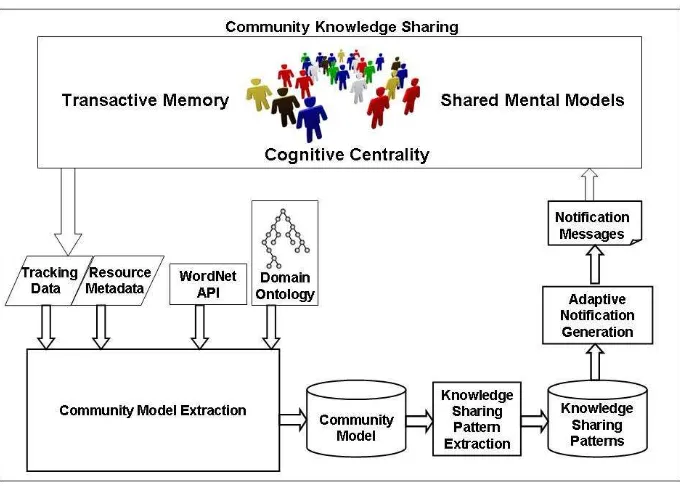
Computational framework for community adapted supportFigure 1 Computational framework to provide holistic support to close-knit VC. A Community Model is extracted from formalised system tracking (log) data. Knowledge sharing patterns are defined based on TM, SMM, and CCen. Using the extracted patterns, adaptive notifications are generated.
Community Model Extraction: Extracting a community model involves identifying the input data, formalising the input data and defining the community model components. The main input for our framework is tracking data from a knowledge management system the VC uses. We consider generic tracking data common in most knowledge management system. This includes information about: members, reading/uploading resources, folder creation/deletion, and resource rating. In addition to the tracking data, we consider metadata which can be extracted from the resources people are sharing. Metadata is an important addition to the input data since they provide the semantic information about a resource that is missing from the tracking data. Dublin Core is selected over the IEEE Metadata element set since it is much simpler in structure. To further semantically empower the community model acquisition algorithms, an ontology representing the main topics of the community is employed. The ontology represents the vocabulary relevant to the main area of interest of the community under study. Furthermore, WordNet is used to measure the semantic importance of a resource to the VC and the semantic similarity between members and resources. A description of the community model extraction mechanism is provided in Section 4.
Knowledge Sharing Patterns Extraction: In order to provide intelligent support to VC members, relevant situations/patterns have to be discovered. The extracted community model is used as an input for the mechanism for automatic detection of knowledge sharing patterns related to TM, SMM, and CCen. The community model includes several relationships represented as graphs. Graph based algorithms have been defined to automatically detect pre-defined patterns from the community relationship graphs. Detected patterns relate to lack of awareness regarding similarity or complementarity between members, as well as interesting behaviour of cognitively central or peripheral members. The detected patterns serve as an input to algorithms which generate intelligent community-tailored support. The mechanism for extracting community knowledge sharing patterns is presented in Section 5.
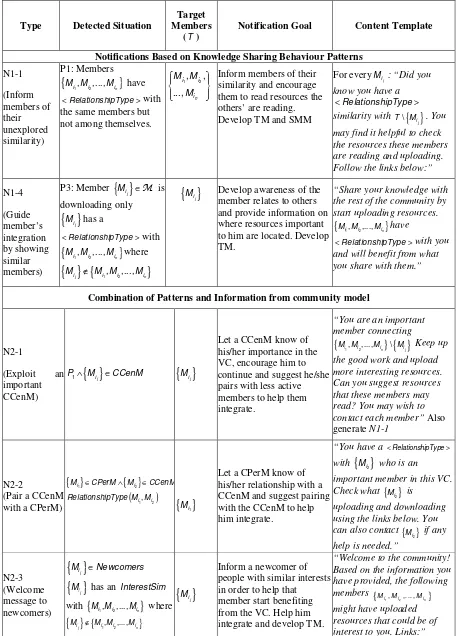
[image:8.595.125.465.72.315.2]developing SMM. The mechanism for automatic generation of community-tailored notifications is presented in Section 6.
4
Community Model ExtractionThis section will provide detail of the stages followed for extracting a community model. Firstly we will formalise the input data used for extracting the community model. Then the use of an ontology and the WordNet similarity mechanism will be described. At the end, algorithms for extracting a community model will be presented and discussed in detail.
4.1
Input FormalisationInput formalisation is the first step towards the implementation of the community model. A conventional structure of log data stored by knowledge sharing applications is considered. A community environment contains elements related to the functioning of a knowledge sharing community, and includes a list of members M, set of resources R and set of folders F organised in a hierarchical structure. The community environment E is defined asE: M,R,F . E is changing over time as a result of actions performed by community members, including a member registering to the community, a member leaving the community, creating a new folder, uploading a new resource to the environment, downloading a resource from the environment, adding a new description to a resource. These actions can cause the environment to evolve, e.g. topics to change or members to move into the periphery or the centre of the community. The actions are recorded in log data which can be analysed periodically to extract a community model and detect changes in E. A description of the tracking data is presented in Table 1. The log data also includes information about members, resources, and folders. When a memberm
(
m∈M)
joins the community, information about their name, email address and date of joining is recorded. Thus, members are represented asm: mName,mEmail,mDateJoin . The community knowledge sharing space includes resources uploaded and downloaded by community members. A resource r(
r∈R)
will be represented as tuple r: rCreatedData, rMetadata , whereta
rCreatedDa is information created by the member who uploads the resource, while rMetadatais metadata associated with this resource. The metadata provides the first semantic layer used for community modelling. Resource keywords are used for semantically comparing resources.
When a member uploads a resource r , he/she creates some metadata about this resource. We denote this data with rCreatedData: rFolder, rName, rDescription, rRating, rCreator, rDate, rAssessors, rReaders , where rFolder is the folder storing the resource; rName is the name of the resource (as given by the creator, and may be different from the original title of the resource), rDescriptiondenotes a set of resource descriptions provided by different members rDescription:
{
rd1,m1 ,rd2,m2 ,…, rdn,mn}
;rRatingis a number which is the average rating given to that resource by community members,
{
n n}
rAssessors: ra m1, 1 , ra m2, 2 ,…, ra m, represents the ratings given by members to this resource;
rCreator is a member
(
rCreator∈M)
who is the creator of the specific resource (usually the memberwho uploads the resource in the community knowledge sharing space); rDate is the date the resource was uploaded; rReadersindicates which members have read (downloaded) this resource.
In addition to the meta-data provided by the resource creator, there is existing metadata included in the resource itself. This is indicated wirhrMetadata and represent the reseource metadata following the Dublin Core4 schema (the basic and most conventional standard for online resources). The following elements have been selected from the Dublin Core metadata schema
rM etadata: rTitle, rAuthor, rSource, rKeyw ords, rDatePublish . rMetadata can be either extracted
from the uploaded resources or provided by the rCreator when he/she uploads the resource.
Table 1 Summary of tracking data and resource metadata formalisation
4
Description Formalisation
Data about a member m m: mName,mEmail,mDateJoin
The creator of a resource r rCreator∈M
Data about a resource r created by the member who uploaded the resource (rCreator)
rCreatedData: <rFolder, rName, rDescription, rRating, rCreator, rDate, rAssessors, rReaders>
Dublin Core based metadata for a resource r rMetadata rTitle, rAuthor, rSource, rKeywords, rDatePublish>
:<
Keywords of a resource r rKeywords: k1 ,k2,… ,kn
Descriptions for r provided by members m1...mn rDescription:
{
rd1,m1 ,rd2,m2 ,…,rdn,mn}
Assessments (ratings) for rprovided by members
1 n
m...m .
{
n n}
rAssessors: ra m1, 1 ,ra m2, 2 ,…,ra m,
Members who have read (downloaded) resources r rReaders: {m1...mn}
The most important metadata for our community modelling mechanism is
n 2 1 ,k , ,k
k :
rKeywords … , which is used as a source for comparing resources and users. To compare a
set of key words, we link them to an ontology which represents the community context. This enables positioning a resource within the community context, and allows enriching the keywords list with relevant concepts, as well as measuring how important a resource is for the community. The next section will provide detail about the use of the ontology for community model extraction.
4.2
Use of an OntologyThe domain in which the knowledge sharing community operates is represented as an ontology. The vocabulary composes the classes of the ontology and represents the domain topics of interest to the VC. The ontology is selected according to the subject of focus of the community. The ontology is used as a source to semantically empower the algorithms for extracting the community model. For example in the case of the VC which is used in the experimental study in Section 7, an ontology that represents the Personalisation and Knowledge Management domain has been employed. The ontology has been built using concepts extracted from the folder hierarchy of the community space. The hierarchy is modified to represent logical relations (subClassOf), between concepts; the ontology consists of 159 classes. All concepts of the ontology were transformed into nouns so they can be used as a direct input in the WordNet similarity measure algorithm (described in Section 4.3).
The relevance of an uploaded or downloaded resource to the community is checked against the domain of the particular VC by using . This is used to determine the value a resource has for the community, to identify similarity between resources, and to detect semantic similarities between members. is used to determine the value a resource uploaded by a member and read by another member has to the VC. Consequently, the value of a resource ri for the VC is defined as
( , )
i
r i
V =Sim rKeywords where Sim rKeywords( i, ) is the similarity of the list of keywords rKeywordsi of
a resource ri to the ontology . The similarity is obtained using WordNet (see Section 4.3).
The second way the ontology is used is to define the similarity between community members based on the resources they are reading, uploading, and their interests. For each member m
(
m∈M)
, a list of key words for that member (mKeywords) is composed by aggregating the key words for all resourcesm has created (uploaded). Using the ontology , the list of keywords for each member m
(mKeywords) is semantically enriched. This enables us to define member similarity based on the
community context, where similarities and relations between members which are relevant to the community are rewarded and the less relevant relations are still counted but do not have strong influence on the strength of the relationship between members.
To semantically augment the keywords for a member m
(
m∈M)
(mKeywords) using the ontology ,1. Check that k is a label for a concept in the ontology.
2. If k∈ , pull from all direct super classes, and all direct sub classes: Super k( , )∪Sub k( , ) and use them to expand the key word list mKeywords.
3. If k∉ , perform a similarity check Sim(k, )Ω by using a WordNet similarity algorithm (e.g. in the implementation we used the algorithm presented in Section 4.3), in order to get the most similar concept CSim tok from the ontology. Once a similar concept CSim is selected, go
to step 2 and perform the corresponding enrichment.
This is illustrated with the following example. Consider a member a and assume that the list of keywords for this member is aKeywords=
{
semantic web, knowledge sharing, context, collaboration}
. Takek=collaboration, which is linked to a label of a concept in the ontology, i.,e. k∈ . Then, we use the algorithm Super collaboration( , )∪Sub collaboration( , ) to extract the direct super and sub classes of collaboration from the ontology. In this example - for Collaboration based on the ontology used the classes Knowledge Management (as a super class) and Information Sharing (as a sub class) will be returned. Knowledge Management and Information Sharing will then be added into the list aKeywords to semantically enhance the list of keywords of member a. If k=net and k∉ , then we perform a similarity check Sim(net, )Ω by using the WordNet similarity algorithm and the most similar concept
Sim
C =web will be returned. Then, the super and sub classes of web will be added to aKeywords. The use of the ontology in this work is inspired by approaches followed in linked data where an existing, stable ontology is used to semantically augment and link content. In our case, this also allowed to measure similarity between resources and community members based on the concepts in the ontology. Instead of using a pre-defined ontology, the emerging community ontology could be integrated. Although the existing framework could be applied in this case (by simply taking a snapshot of the ontology at the time when the community model is being obtained as opposed to using the same ontology throughout), further research is needed to examine what similarity metrics would be appropriate when the community context changes dynamically. For instance, when the ontology changes, the importance of a resource would change, as it would be linked to a different sent of concepts at any different time. This will also affect the strength of relationships between members.
4.3
Measuring Semantic Similarity based on WordNetSemantic similarity relates to measuring the similarity between concepts which are not lexicographically similar but have similar meaning (Varelas et al., 2005). In Natural Language Processing it is commonly argued that language semantics are mostly captured by nouns so it is common to built retrieval methods based on noun representations extracted from documents and queries (Varelas et al., 2005). WordNet is the most popular method for implementing semantic similarity (Liu et al., 2004; Seco et al., 2004; Tagalakis and Keane, 2005; Varelas et al., 2005).
The community modelling algorithms (presented in Section 4.4) utilise a mechanism for measuring the similarity between two lists of terms. If L1andL2are two lists of terms, we define a similarity function Sim L L( ,1 2) which returns a number that indicates how close semantically the terms in
both lists are. For this, we adapt the algorithm presented in (Seco et al., 2004), which calculates the semantic similarity between two words based on the WordNet taxonomic structure. The algorithm by Seco, Veale and Hayes (2004) accepts nouns as input and returns a decimal number (0, no similarity – 1, the same meaning) as an output, which represents the semantic similarity between two words. Following the work of Tagalakis and Keane (2005), the original formula has been modified as follows. Having two compounds cc1 and cc2 composed of
{
i}
c1 c
1,..., 1 and
{
}
j
c1 c
2,..., 2 terms respectively,
for each term of cc1 we perform a similarity check with every term of cc2 and store the highest value returned for each term i
c1 of cc1 in an array. The same is done for every term of cc2,
i
c2 with all the
terms of cc1 and the highest value returned for each term
i
c2 is stored. All highest values for the terms
of cc1 and cc2 are added up and divided by the sum of the total number of terms appearing in cc1 and
(
)
(
)
(
)
(
)
j i j
i j i
sim c c c c sim c c c c
sim cc cc
i j
sim c c c c sim c c c c
i j
1 1 2 1 2
1 2 2 2 1 2 2 2
1 2
1 1 2 1 2
2 1 1 1 2 1 1 1
max ( ,{ , ,..., }) ... max ( , { , ,..., }) '( , )
max ( ,{ , ,..., }) ... max ( , { , ,..., })
+ + +
=
+
+ + +
+
(1)
Formula 1 is used in the algorithms presented in the next section to extract the VC model.
4.4
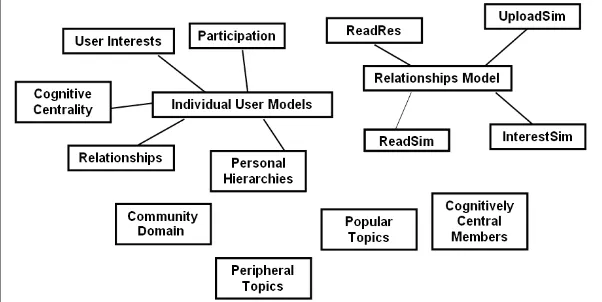
Community Model Extraction Mechanism [image:12.595.144.445.250.401.2]The community model represents the whole community, including individual members, relationships between members, topics of interest and the cognitively central members. Hence, it consists of individual user models, a relationships model, the community domain (ontology), lists of popular and peripheral topics, and a list of cognitively central members. The main components of the community model are illustrated in Figure 2.
Figure 2 The components of the community model
The benefits of having this community model are to: (i) extract and store information about individual community members, in order to design and generate personalised messages; (ii) develop a relationships model of interactions and identify semantic links between community members that can be used in personalising the notification messages; (iii) represent the community domain, as an ontology, to semantically enhance the algorithms and measure how relevant the extracted relationships are to the rest of the community; and (iv) maintain a list of the most cognitively central members based on the semantic relevance their activities have to the community, and use this list to provide more personalised support to specific members. The rest of this section will provide a detailed description for each component of the community model, together with corresponding algorithms used for its extraction.
4.4.1
Relationship ModelWe consider four types of semantic relationships between community members: ReadResrelationship indicates links based on reading resources uploaded by others, ReadSimand UploadSim relationships are based on similarity of read or uploaded resources, respectively, and InterestSim indicates relationship based on similarity of members’ interests. The above relationships exist between community members and indicate semantic connections that can be represented in a graph (more detail of graph definitions used is given in Section 5). In this work, we assume that a downloaded resource has been read by the member who downloaded it. Thus downloading and reading is used interchangeably in the following sections.
ReadRes Relationship
ReadRes a b( , ) relationship indicates that resources uploaded by member b are read by member a; the relationship strength corresponds to the number of resources and their relevance to the community domain. In other words, the closeness of the members depends not only on the quantity of the resources uploaded by one member and read by the other member, but also, and more importantly, on the relevance of these resources to the VC context. In this way, quality interactions in the community are rewarded. On the other hand, even if a relation is not very related to the community’s topic, it will still be detected but the value of this relation will be lower.
Consider a resource ri uploaded by memberband read by member a. We will denote the
keywords for resource ri with rKeywordsi. Considering the community domain which is represented
by the ontology , we define the value of rifor the community asVri =Sim rKeywords( i, ), where the
similarity is calculated based on the modified WordNet algorithm (Section 4.3). Let us denote Ζa b
r← to
be the number of resources uploaded by band read by a. The value of ReadRes a b( , ) is the sum of all values of the resources uploaded by b and read by a, based on their relevance to the community domain, i.e.:
a b
r
i
r i
ReadRes a b V
Ζ
1
( , ) ←
=
=
∑
(2)ReadSim and UploadSim Relationships
ReadSim and UploadSim relationships can also be important for discovering similarities between members. Making people aware of who else is holding knowledge similar to theirs can improve the community’s transactive memory system. This can also improve the understanding of what is happening in the community which can be related to the development of shared mental models.
ReadSim a b( , ) indicates that members a and b have read semantically similar resources, while
UploadSim a b( , ) indicates that a and b have uploaded similar resources. Here the value of a resource with respect to the ontology is not directly measured as in ReadRes, since what we are interested in the similarity of the resources that two members have uploaded or downloaded. The relevance of their relationship to the community will be reflected in the corresponding similarity calculation since the list of keywords they uploaded or downloaded is expanded based on the domain ontology.
To calculateReadSim a b( , ), we derive an extended list of keywords for each member by combining the keywords of every resource read by this member and enriching with additional keywords extracted from , as described in Section 4.2. Having the additional keywords extracted from the ontology, we then construct the extended list of keywords for each member. Let us denote these extended keyword lists as aKeywords and bKeywords.
These lists are compared to find the similarity between the two members by using the extended WordNet similarity algorithm presented in section 4.3. Consequently, ReadSim a b( , ), is calculated as:
ReadSim a b( , )=Sim aKeywords bKeywords( , ) (3)
UploadSim a b( , )is calculated in the same way by using the resources uploaded by a andb.
UploadSim a b( , )=Sim aKeywords bKeywords( , ) (4)
InterestSim Relationship
InterestSim relationship can identify interest similarities and complementarities. Making members aware how their interests relate to the others can motivate participation. Finding people with similar interests and making them aware of this similarity can indicate possibilities for collaboration. Awareness of other people’s interests can improve the shared understanding the members have about the community and help the development of shared mental models.
InterestSim a b( , ) relationship represents the similarity of interests between members aand b. To derive interests of a member, we considered the resources he/she has uploaded and downloaded. Using the keywords rKeywords for each resource uploaded or downloaded by member a
ext(a)
I is extracted. The extended lists of personal interests of member a (Iext(a)) and member b (Iext(b))
are compared using the extended WordNet similarity algorithm (Section 4.3) to calculate the interest similarity between aand b:
ext(a) ext(b)
InterestSim(a,b)=Sim(Ι ,Ι ) (5)
The use of the ontology allows us to identify broader similar and complementary topics among community members. Although the interests of a member Ia are extended with terms from the ontology to calculate similarity between members based on their interests (i.e.InterestSim), a member’s interest in his/her individual user model will not be changed. The next section will give more detail of how the individual user models are extracted.
4.4.2
Individual User ModelsCognitive Centrality
The cognitive centrality is used to identify the importance of a community model to the VC. This can be helpful to identify the central members and how they contribute to the community. It can also be useful in identifying unique knowledge held by peripheral members. This is important for the community’s sustainability and flexibility - interests might shift in time (Lave and Wenger, 1991), knowing where unique knowledge is located can facilitate the transition from one subject area to another (Wegner, 1986). Awareness of who the central and peripheral members of the VC are can also help the improvement of the community shared mental models and transactive memory.
There are different approaches to measure centrality used in the social network area, mostly inherited from graph centrality (Nieminen, 1974; Freeman, 1979; Freeman et al., 1991; Borgatti and Everett, 2006; Latora and Marchiori, 2007). Freeman (1979) describes in a general review three types of centrality as developed in social network research: degree, betweenness and closeness centrality. CCen deals with a member who holds the most valuable knowledge in the community. In our approach the importance of the knowledge a member holds depends on the relationships a member has (semantic connections) with other members. Consequently, in this research we are following and adapting the degree centrality as introduced by Nieminen (1974) where the degree centrality of a point in a graph is measured according to how many points that given point is connected to in the graph.
Here we adapt the original formula as follows: CCen a( ) of member a is calculated as the number of all relationships member a is having with any member b (adding the value of the edge connecting the two members in the graph) considering the four relationship types (ReadRes, ReadSim, UploadSim and InterestSim).
(
)
n
b
CCen a ReadRes(a,b)+ReadSim(a,b)+UploadSim(a,b)+InterestSim(a,b)
1
( )
=
=
∑
(6)where nrepresents the number of members in the community
User Interests
The interests of each user are stored in the individual user models. Interests are extracted based on the resources a member has uploaded and/or downloaded in the VC, or information users provide explicitly about their interests (if such a feature is available). The keywords (tags) of each of the resources member a is uploading or downloading are aggregated in a’s individual model. Using
rKeywordsfor each resource uploaded or downloaded by a user, his/her interests are represented as a list of keywords with weights. For example, all keywords that member a has shown any interest in are aggregated in the list Ta, where every term t∈Ta has weightw t T( , a)that indicates the frequency of
tin Ta. The use of a weight w t T( , a) allows the mechanism to be used as an input in a system and
display the keywords of a member as a tag cloud or folksonomy. If w t T( , a)≥Θ (Θis a threshold), tis added to the interests of adenoted by Ia. Iais presented as member a’s personal list of interests. Threshold Θcan be adjusted according to the size of list
a
small so keywords will be allowed to be added to the list Ia. Having Θ allows the approach to be flexible and accommodate close-knit VC of smaller or larger sizes. In the study presented in this paper (Section 7) the value of Θ was set to be 2. Not having a large number of resources, thus keywords shared within the VC, means that a value of Θ>2 was resulting in interests not being extracted for most members.
Participation, Relationships and Personal Hierarchies
In addition, the individual user model includes participation measures, relationships developed and hierarchies of folders built in the community by an individual member.
Participation: The frequency of knowledge sharing activities of a member (uploading or downloading) is stored in his/her individual user model - uRate is the number of resources uploaded, and dRate also is the number of resources downloaded.
Relationships: Each participating member in the VC is developing relationships with other members of the VC. These relationships ReadRes, ReadSim, UploadSim, InterestSim are stored for each member in his/her personal profile.
Personal Hierarchies: Folders F and resources R created by each member in the VC compose the personal hierarchies that a member is creating. The personal hierarchies can be used in extracting the resources and folders a member has created, providing information for the notification messages generated for individual members, see Section 6.
4.4.3
Popular/Peripheral Topics and Cognitively Central MembersList of Popular and Peripheral Topics
In order for the VC to be able to adapt to changes (for example the main topic of interest of the VC is shifting or a new project comes and community members need to identify what resources in the community are relevant), a list of the most popular and peripheral topics has to be maintained. This will allow exploitation of knowledge that both cognitively central members (CCenM) and cognitively peripheral members (CPerM) have to offer in the VC. These lists are extracted based on the resources people are sharing in the VC and on the assumption that shared resources correspond to topics of interest of the VC members.
Based on the keywords of the resources members are sharing in the VC, two lists of topics are extracted: LPop represent the lists of popular topics and LPer represents the list of peripheral topics.
Assuming the keywords rKeywords for each resource, a list allKeywords is constructed which consists of all the keywords of all the resources in the VC. Each keywords is assigned a weight,
( , )
w k allKeywords which represents the frequency of a keyword k in allKeywords. If
( , ) σ
Pop
w k allKeywords > (σ
Pop is a threshold), k is added to the list of popular topics LPop. If
( , ) σ
Per
w k allKeywords < (σ
Per is a threshold), k is added in the list of peripheral topics LPer. LPop and
Per
L are updated each time a new community model is extracted for the VC. Thresholdsσ
Pop and
σPer can be adjusted according to the number of keywords appearing in allKeywords. Thus, if the list of allKeywords is small, then σPop and σPer can be adjusted to let more keywords enter LPop and LPer
accordingly. This allows the approach to be applicable to close-knit VCs of different sizes. In the study presented in Section 7, after experimenting with different values, the values of thresholds were set to be σPop≥4 and σPer ≤2. Having these specific values for σPop and σPer, allowed the topics
added into the corresponding lists to represent the interests of cognitively central and peripheral members accordingly.
List of Cognitively Central Members
Having extracted the CCen for every member in the VC, a list of members with the highest CCen
information to the VC at hand. This information can also be used in triggering the intelligent support described in Section 6. CCen a( ) represents the cognitive centrality for member a and avg CCen( ) defines the average cognitive centrality for the specific VC. If the CCen a( )>avg CCen( ), then member
a is added in the list of cognitively central members for the VC under study.
5
Knowledge Sharing Patterns ExtractionThis section presents graph based algorithms that automatically extract pre-defined static patterns from the community model defined earlier. The initial validation of the following graph based pattern detection algorithm has been presented in (Kleanthous and Dimitrova, 2010).
5.1.1
Definition and Detection of Relationships in GraphsEach relationship in Section 4.4.1 defines a graph representing the corresponding links between community members: GRS(VRS,ERS) is the graph derived for ReadSim, GUS(VUS,EUS) is the UploadSim
graph, G V EIS( IS, IS) is the InterestSim graph, and GRR(VRR,ERR) is the graph for ReadRes. GRS(VRS,ERS),
US US US
G (V ,E ) and G V EIS( IS, IS) are non-directed graphs of type G V E( , ) where Vis the set of nodes
representing community members and E is the set of edges representing the existence of the corresponding relation between both members in the nodes. The weight of the edge corresponds to similarity between the members, using the algorithms presented in Section 4.4.1. An edge is present in a relationship graph only if the weight of that edge is greater than a pre-set threshold value. The value of the threshold can be adjusted according to the density of connections appearing in a graph, in such a way that the resultant graph is meaningful for the purpose for which it is constructed. For example, if only strong relationships need to be extracted the threshold value will be high so only highly weighted edges will be extracted. A neighbourhood of a node v, denoted as ΝG( )v , represents the ego
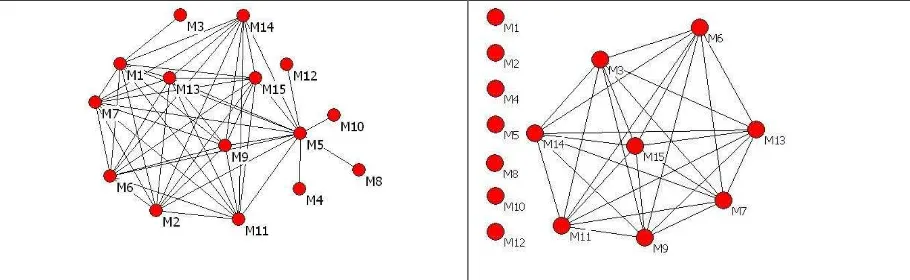
network (Degenne and Forse, 1999) of v and indicates members similar to v. Figure 3 shows example extracted graphs for InterestSim and ReadSim during the evaluation study (Section 7).
Figure 3 InterestSim relation on the left shows the similarities in terms of interests between community members at the end of the third period of the evaluation study (Section 7). In this graph, M10, M8, M4 and M12 only have an InterestSim with M5 but not among themselves. ReadSim relation on the right shows the similarities in terms of reading between the community members. On the left of that figure the disconnected dots represent the members who have not had a ReadSim with any other member in the community.
RR RR RR
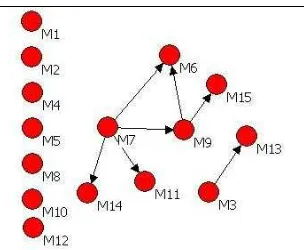
G (V ,E ) is a directed graph (Gross and Yellen, 1999), see Figure 4, where the direction of each edge represents that a member (head) has read a resource uploaded by another member (tail). Each node v has an out-neighbourhood ΝG( ) :v
{
x V G( ) :v x}
+
∈ → representing community members who
have downloaded resources uploaded by v, and in-neighbourhood,
{
}
Gv x V G x v
Ν−( ) : ( ) :
[image:16.595.70.525.439.579.2]Figure 4 ReadRes is represented in this Figure during the second period of the evaluation study (Section 7). The arrows show that members have read resources by other members. For example members M14, M11, M9 and M6 have read resources uploaded by M7. The isolated dots on the left show the members who do not have any ReadRes relation with others in the community.
Let us denote member a and memberb as members of a VC. A relation ReadSim a b( , ) exists if
ab a b
e =( ,v v ) or eba=( ,v vb a) is in the set ERS. UploadSim and InterestSim can be detected in the same
way using the respective graphs for each relationship type. ReadRes(a,b) exists if there is an edgeeab=( ,v va b), eab∈ERR, i.e. b has read resources uploaded bya.
By analyzing the community relationships model and the individual user profiles, we can identify patterns of knowledge sharing behaviour related to TM, SMM, and CCen. The corresponding algorithms are presented in the next section.
5.1.2
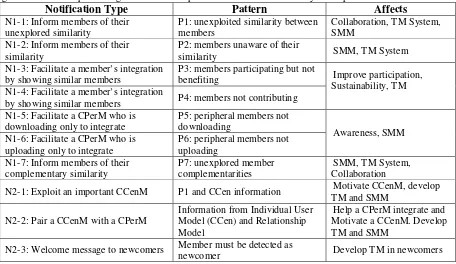
Detection of Knowledge Sharing PatternsA pattern is important if it can be detected and used in order to provide support to community members. We define seven patterns; for each pattern, we specify its relevance to TM, SMM and CCen, and describe how the pattern can be detected.
P1. Unexplored similarity between community members
Two members have ReadSim with the same members but not among themselves.
Importance: Identifying the above situation and making people aware of their unexplored similarity with others may motivate them to participate more actively, as pointed out in (Harper et al., 2007). In addition, helping members understand that they hold complementary knowledge, (they might not be working in similar but related areas), improves the community TM system (Wegner, 1986) and can promote collaboration within the community (Ilgen et al., 2005).
Detection: To detect unexploited similarity between a and b, we extract the neighbourhoods of both members from GRS(VRS,ERS). If one of the members does not belong to the other’s
neighbourhood, pattern P1 is discovered:
(
ΝRS(va)∩ΝRS(vb)≠ ∅ ∧) (
va∉ΝRS(vb))
(7)In the same way, P1 is defined for the UploadSim and InterestSim relationships.
P2. Community members may not be aware of their similarity
Two members haveReadSim with the same members and among themselves.
Importance: Community members may not be aware of how similar they are in terms of uploading, reading or interests with other members of the community. Detection of this pattern can be used to promote the development of SMM (Mohammed and Dumville, 2001) ( members will become aware of what others are working on), and enhance TM (Wegner, 1986) (members will know who they relate to in the community and how similar they are to others).
Detection: This pattern is detected by extracting the neighbourhoods of both members from
RS RS RS
G (V ,E ). If one of the members belongs to the other’s neighbourhood, pattern P2 is identified:
(
ΝRS(va)∩ΝRS(vb)≠ ∅ ∧) (
va∈ΝRS(vb))
(8)P3. Members not benefiting
A member uploads resources but does not download.
Importance: This pattern can be useful to identify members who are not downloading from the community. These members can be prompted to make the most of their time in the community.
Detection: Detection of P3 is done by using the upload and download rates of a member:
(
uRate a( )>0) (
∧ dRate a( )=0)
(9)P4. Members not contributing
A member who appears to download but not upload resources to the community can be detected similarly to P3, which can be denoted as
(
uRate a( )=0) (
∧ dRate a( )>0)
(10)P5. Important peripheral members not downloading
Members who do not download and occasionally upload resources that other members have downloaded.
Importance: We can use this pattern to motivate peripheral members (who have sporadically uploaded an important resource in the community but have not effectively engaged in other activities) to benefit from the community. Notifying them that others are interested in what they upload can motivate those members to start reading resources uploaded by the members they are similar to. This pattern may help to promote collaboration.
Detection: P5 is calculated using the upload and download rates for a and the out-neighbourhood in GRR(VRR,ERR) to check that a uploads relevant resources:
(
uRate a( ) 0) (
dRate a( ) 0)
(
ΝRR(va))
+
> ∧ = ∧ ≠ ∅ (11)
This pattern is a subset of P3. If both patterns P3 and P5 are detected, then only P5 will be considered.
P6. Important peripheral members not uploading
A member appears to download only and has InterestSim with other members.
Importance: This pattern can be used to motivate people who are only downloading from the community relevant resources to start uploading, by showing them how similar their interests are to other members. This can improve the TM system of the community since members will be aware of others’ interests (Wegner, 1986). Motivating them to upload to the community may help the community to sustain.
Detection: To detect P6, we check a member’s upload and download rates and his/her neighbourhood in G V EIS( IS, IS):
(
uRate a( )=0) (
∧ dRate a( )>0) (
∧ ΝIS(va)≠ ∅)
(12)Pattern P6 is a subset of P4. If both patterns P4 and P6 are detected, then only P6 will be considered.
P7. Unexplored complimentary similarity between members Two members have UploadSim but do not have ReadSim.
Importance: Members who upload similar resources in the community but are not reading similar resources, have similar and complimentary interests but are unaware of this. Making these people aware of their similarities and differences may improve the TM system since members will be able to identify where important knowledge, for them, is located (Ilgen et al., 2005). At the same time, this may improve the building of SMM (Mohammed and Dumville, 2001), since members can appreciate how everybody contributes to the community. Awareness of where complimentary knowledge is located may encourage collaboration.
Detection: P7 is identified using GUS(VUS,EUS) and GRS(VRS,ERS), and checking that one of the
members belongs to the other member’s neighbourhood in GUS(VUS,EUS) but does not belong to the
neighbourhood of that member inGRS(VRS,ERS):