This is a repository copy of Exploring the intra-frame energy conservation capabilities of
the horizontal simple packing algorithm in IEEE 802.16e networks: an analytical approach
.
White Rose Research Online URL for this paper:
http://eprints.whiterose.ac.uk/116441/
Version: Accepted Version
Article:
Lagkas, T. orcid.org/0000-0002-0749-9794, Sarigiannidis, P.G., Louta, M.D. et al. (1 more
author) (2013) Exploring the intra-frame energy conservation capabilities of the horizontal
simple packing algorithm in IEEE 802.16e networks: an analytical approach. Wireless
Networks, 19. 4. pp. 547-558. ISSN 1022-0038
https://doi.org/10.1007/s11276-012-0484-6
[email protected] https://eprints.whiterose.ac.uk/
Reuse
Unless indicated otherwise, fulltext items are protected by copyright with all rights reserved. The copyright exception in section 29 of the Copyright, Designs and Patents Act 1988 allows the making of a single copy solely for the purpose of non-commercial research or private study within the limits of fair dealing. The publisher or other rights-holder may allow further reproduction and re-use of this version - refer to the White Rose Research Online record for this item. Where records identify the publisher as the copyright holder, users can verify any specific terms of use on the publisher’s website.
Takedown
If you consider content in White Rose Research Online to be in breach of UK law, please notify us by
This work appears in Springer Wireless Networks, July 2012.
http://dx.doi.org/10.1007/s11276-012-0484-6
Exploring
the
Intra-frame
Energy
Conservation Capabilities of the Horizontal
Simple Packing Algorithm in IEEE 802.16e
Networks: An Analytical Approach
Thomas D. Lagkas
*, Panagiotis Sarigiannidis
*, Malamati Louta
*, and Periklis
Chatzimisios
+*
Department of Informatics and Telecommunications Engineering, University of
Western Macedonia, Kozani, Greece
E-mail:{tlagkas, psarigiannidis, louta}@uowm.gr
+
Department of Informatics, Alexander T.E.I., Thessaloniki, Greece
E-mail: [email protected]
Abstract The power saving capabilities of the mobile devices in broadband wireless
networks constitute a challenging research topic that has attracted the attention of researchers
recently, while it needs to be addressed at multiple layers. This work provides a novel analysis of
the intra-frame energy conservation potentials of the IEEE 802.16e network. Specifically, the
power saving capabilities of the WiMAX downlink sub-frame are thoroughly studied, employing
the well-known simple packing algorithm as the mapping technique of the data requests. The
accurate mathematical model, cross-validated via simulation, reveals the significant ability to
conserve energy in this intra-frame fashion under different scenarios. To the best of our
knowledge, this is the first work providing intra-frame power-saving potentials of IEEE 802.16
networks. Additionally, this is the first study following an analytic approach.
Keywords
IEEE 802.16, downlink mapping, intra-frame power saving, sleep
slots, WiMAX
1. Introduction
Worldwide Interoperability for Microwave Access (WiMAX) forms one of the most promising
wireless access technologies for metropolitan area networks. Its standardization, realized by the
original IEEE 802.16 [1], initially allowed for fixed subscribers’ communication. In the sequel, its advancement, enhanced IEEE 802.16e [2], enabled both fixed and mobile subscribers’ communication access to backbone networks and mesh inter-connectivity in an efficient way.
characteristics of the mobile device used (e.g., PDA, mobile phone, laptop etc), on the battery
longevity, power consumption issue is constituted of paramount importance. In this perspective,
the current work focuses on power management, enabling the Mobile Station (MS) to conserve its
battery resources, even during the occurrence of a single data frame.
Power management addressed by the standard at Medium Access Control (MAC) layer
provides a power saving mode (referred to as sleep mode) and an idle mode of operation [3, 4].
Under the sleep mode, the MS temporarily disrupts its connection over the air interface with the
WiMAX Base Station (BS), reducing, thus, its power consumption, being, however, unable to
send or receive data. The amount of time that an MS is set to sleep mode is called sleep window.
Upon the completion of the sleep window the MS restores its connection with BS. This period is
called listen window.
According to the specification, three different power-saving classes have been defined in
the context of the Power Saving Mode (PSM) in order to address various types of applications and
services [4]. In the first power-saving class, each listen window of fixed length is followed by a
sleep window whose length is twice the length of the previous sleep window, without however
exceeding a final sleep window size. Before entering the first power-saving class, the BS indicates
to the MS the initial sleep window size and the final sleep window size. Once the final sleep
window size is reached, all the subsequent sleep windows are of the same length [4]. The sleep
windows of power-saving class two have a fixed length and are followed by a listen window of
fixed length. Again, the BS indicates to the MS the sleep and listen window sizes. Lastly, the third
power-saving class operation, on the contrary to the other classes, involves a single sleep window.
In a similar manner to the first and second power saving class, the BS informs the MSs about the
start time and the length of the sleep window. At the end of the sleep window, the power-saving
operation becomes inactive.
Various studies have investigated power management issues based on these three classes;
indicatively see [5-7]. However, all past research efforts limit their attention to power saving
techniques in terms of frame time basis, disregarding intra-frame power saving potentials. Aiming
to cover this absence of known relevant research attempts in the literature, the contribution of our
paper lies in frame power saving investigation, studying the potential power savings of
intra-frame sleep periods. Recent studies [8-11] show that modern WiMAX transceivers [12] exhibit
analyzed in this paper. Hence, bearing in mind that the in-frame requests’ mapping process is quite important in WiMAX systems, since it affects the whole network performance (e.g., the unmapped
requests are returned to the scheduler and they should be reallocated, leading to performance
degradation) and green broadband access networks form a very hot and concurrently critical
research field, this paper constitutes an effort to contribute novel power saving related aspects to
the IEEE 802.16 wireless networks. In the light of the aforementioned, this work examines the
downlink sub-frame, adopting the simplest requests’ allocation technique, which is widely considered as one of the default WiMAX requests’ mapping schemes, and provides analytical
results concerning the average time that an MS could be set to sleep mode, considering the number
of connected MSs, the downlink load, and the given sub-frame dimensions, while the power
consumption when transiting to receive / sleep states is also taken into account.
For comparison reasons, it could be taken into consideration that the power saving mode
defined by the WiMAX standard [3, 4] in regards to inter-frame energy conservation implies
message transmission related to sleep mode switching, which constitutes a major factor when
estimating overall power consumption. On the other hand, the intra-frame power saving
perspectives analyzed in this work involve no message exchange when transiting to or from sleep
mode.
The remaining paper is organized as follows. The adopted multi-access technique and the
intra-frame bandwidth allocation are described in Section 2. Section 3 presents the environment
and the analytical approach of the proposed energy conservative mapping. Section 4 validates our
analysis via simulation and provides extensive performance results in terms of potential sleep time.
Finally, Section 5 concludes this paper and highlights our future plans.
2. OFDMA background and intra-frame allocation
Orthogonal Frequency Division Medium Access (OFDMA) constitutes the main multi-access
technique adopted by WiMAX, allowing multiple subscribers to share the time and the frequency
domain in a flexible way. The BS allocates distinct bandwidth regions to the connected MSs for
sending and receiving data, realizing two-way communication via two distinct sub-frames: the
uplink frame, responsible for carrying data streams from MSs to BS, and the downlink
sub-frame, transmitting data streams originated in the backbone from BS to MSs. Adoption of the
uplink data streams in parallel in different frequencies, while in case of the Time Division
Duplexing (TDD) technique, the uplink and the downlink sub-frame are repeated one after the
other in time in the same frequency. Here, the flexible TDD technique is adopted.
In essence, OFDMA operation takes place between the physical (PHY) and the MAC
layer. The PHY layer is responsible for the MAC framing, defining the term of slot, which is the
minimum framing structure unit. The bandwidth distribution is associated with slot assignment in
an intra-frame allocation fashion. The process of allocating available slots to the subscribers’ requests is defined as mapping. The mapping operation includes a) request gathering from the
scheduler and b) creation of a complete transmission program, defining the exact time and
frequency of transmitting (uplink stream) and receiving (downlink stream) data for each connected
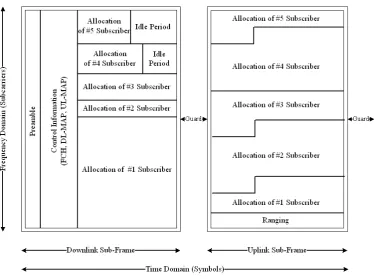
MS. The IEEE 802.16e frame structure is shown in Fig. 1. Each frame begins with a preamble, a
short control period used for synchronization and channel estimation. The downlink sub-frame
includes two control messages, the downlink map (DL-MAP) and the uplink map (UL-MAP),
which define the time duration of each burst, the modulation, and the forward error control (FEC)
coding scheme for each MS. The frame control header (FCH) field proceeds DL-MAP and
UL-MAP, as it provides frame configuration information, such as the MAPs’ length and their
corresponding PHY properties (e.g., modulation, coding scheme, and usable subcarriers). Two
guard gaps, named transmit-receive transition gap (TTG) and receive-transmit transition gap
(RTG) protect the BS from interference during switching from transmit mode to receive mode and
vice versa.
Due to the fact that each frame, based on TDD technique, has fixed length and each
sub-frame’s duration is predetermined, periods of inactivity is possible to occur. As time passes, an MS
could be inactive if its data transmission or reception finishes before the sub-frame completion. In
this case, intra-frame sleep periods could be set in order to reduce power consumption within the
sub-frame. In this letter, the potential sleep periods in intra-frame fashion are examined.
The intra-frame power conservation potentials strongly depend on the applied downlink
mapping method. The mapping process provides an assignment of the MSs requests to the
OFDMA allocation space, conforming to the shaping restriction imposed by the standard,
according to which each downlink request should form a two-dimensional rectangular. The
mapping process may result to inefficient solutions, leaving a large portion of the allocation space
mapping schemes have been proposed in related research literature [13-15], the simplest dynamic
mapping algorithm called Simple Packing Algorithm (SPA) [16] has been adopted in the context
of this study due to its simplicity, effectiveness, and broad acceptance. Our approach contributes
towards an accurate analytical approach regarding the intra-frame sleep time considering SPA,
verified by comparison against simulation outcome. Our approach inherits the advantages of
simplicity and ease-of-use from the SPA logic, fact that could easily lead to a feasible application
of a low complexity intra-frame power management component.
3. Presentation and Analysis of Energy
Conservative Mapping
3.1. Horizontal SPA and Power Saving
One of the less demanding with respect to processing time straightforward technique for mapping
user reception requests to slots provided by the 2-dimensional (time vs frequency) 802.16
downlink sub-frame is based on horizontal or vertical SPA [16]. Here we focus on the horizontal
variant of the known SPA, allocating slots on a row by row intra-frame fashion. According to its
operation each MS is assigned slots along the time axis according to the requested resources and
the adopted modulation scheme. If the number of slots that correspond to a single sub-channel is
not adequate to satisfy the MS downlink requirements, then slots of the next sub-channel are also
utilized. It should be noted that, due to PHY layer restrictions, the WiMAX standard constrains
downlink data requests’ allocation in the form of rectangular shapes, called data regions [3], as shown in Fig. 1. Hence, the examined mapping technique allocates to each MS rows of slots
beginning with the time axis (i.e., downlink sub-frame width) and then proceeding to the
frequency axis (i.e., downlink sub-frame height). This process continues until all requests are
mapped or no adequate sub-channels are left in the specific downlink sub-frame to serve the
remaining requests. The steps of the examined algorithm are described below.
- Set the number of MSs in the network equal to N
- Initiate the set of MS requests S = {Ri | i [1, N]}, measured in number of slots
- Set the downlink sub-frame width (i.e., the maximum number of slots available on the
time axis) equal to W
frequency axis) equal to H
- Initiate Res_W = W
- Initiate Res_H = H
- For each Ri S
o If Ri≤ Res_W
Set Res_W = Res_W – Ri
Set S = S – {Ri}
o Else If Ri≤ Res_H × W
Set Res_H = Res_H – R Wi
Set Res_W = W
Set S = S – {Ri}
o End when S= or (Ri > Res_W and Ri > Res_H × W, Ri S)
This mapping technique is characterized by energy conservation capabilities. To be more
specific, considering the typical scenario of data reception during the downlink sub-frame, an MS
that is allocated downlink slots on a single sub-channel may not utilize the whole sub-frame
duration for data reception. Thus, in case the MS is allocated slots on a single row of the OFDMA
allocation bin and the number of allocated slots is less than W (downlink sub-frame’s width in slots), it is able to transit to sleep mode during the slots that involve no data exchange,
constituting, thus, idle slots for the MS under consideration (i.e., W-allocated slots). When in sleep
mode within a single frame (the respective slots are referred to as sleep slots), the MS is
unavailable, not able to send or receive data, but notably low energy consumption is achieved. In
sleep mode, it is shown that an MS consumes as low as one twelfth of the energy consumed when
being in idle mode [8-12]. The fact that an MS in sleep mode cannot transmit or receive data does
not degrade network performance at all, since the examined mapping scheme involves no data
transfers that concern the specific MS during the sleep slots. At this point it should be noted that
an MS which is allocated slots in more than one sub-channel is not capable of power saving by
transiting to sleep mode, because it remains in receive mode during the whole downlink sub-frame
tuned at least at one sub-channel. Additionally, the MS can remain in the same operation mode
(sleep / idle mode) for the whole duration of a single frame, in case it is not involved in any data
An example of the slots allocation and the power saving capabilities of the horizontal
SPA mapping technique is depicted in Fig. 2. The downlink sub-frame is represented by a grid of
OFDMA slots that constitutes the available resource space. According to this example, MS1
utilizes four slots for reception and may transit to sleep mode for two slots, since the each row,
which corresponds to a sub-channel, is here assumed to be six slots long. MS2 occupies two rows,
because its request is eleven slots long. Given that MS2 must be active for the whole duration of
the downlink frame, it is not able to transit to sleep mode at all. In the example, the last slot in the
middle row remains unexploited, since it belongs to the rectangular data region occupied by MS2.
On the other hand, MS3’s request in mapped to two slots, leaving the residual four slots of the
respective sub-channel available for sleeping. Finally, MS4 starts reception right after the end of
the slots used by MS3 and it lasts for three slots. Thus, it has at its disposal for transiting to sleep
mode the first two slots as well as the last slot of the specific row.
3.2 Mathematical Analysis
In this subsection we introduce a mathematical analysis for the presented horizontal SPA aiming to
estimate the power saving capabilities of the respective mapping technique. The notations of all
variables used in this paper can be found in order of appearance in Table 1. It is assumed that
generated user requests with respect to each MS are independent identically distributed following
Poisson distribution with rate (a typical assumption for this type of analytical approaches). In
fact, an MS request could never be lower than 1 slot or exceed the total downlink frame space;
hence, it is not possible a simple MS request to be larger than the total available downlink
allocation bin. Subsequently, the number of requested slots is actually distributed according to a
variant form of the Poisson distribution, which disallows values lower than zero or higher than the
downlink sub-frame capacity. Thus, in the context of the provided analysis, the employed
equations involve the respective normalization.
Before proceeding with the analysis, Fig. 3 that depicts some key notions of the presented
work is provided in order to assist the reader better comprehend the points raised by the authors..
Specifically, on the same resource grid that was shown in Fig. 2, we highlight with thick borders
the data regions used by the four considered MSs requesting for downlink bandwidth and explain
basic magnitudes considered in the following analysis. As a first step, we consider the mapping of
sub-frame. A request occupies k rows with the probability p of involving more than (k – 1)×W slots and less or equal to k×W slots, as shown by the following expression:
( 1 ) 1 1
!
[ ] , 0, , , ,
!
i k W
i k W i W H
i
e i
p k k H k W H
e i
(1)
It is clarified that the probability p refers to the case that there are sufficient available slots to
allocate to the specific request. In fact, it concerns MSs that are eventually served and are the first
to occupy rows. The resource space limitations are considered subsequently in this analysis, in
order to estimate the total number of mapped requests. Based on (1), the mean number of rows
occupied by a mapped request is given by the weighted average:
1
[ ] ,
H k
M p k k H
(2)
Then, we calculate the probability U to have c sleep slots for the examined MS in the current
downlink sub-frame. It is derived by the probability to have W – c requested slots. Hence, it holds:
1
( ) !
[ ] , 0, 1, , ,
! W c k W H k e W c
U c c W c W H
e k
(3)
The mean number of sleep slots per MS is then resulted by the following weighted average:
1 1
[ ]
W c
s U c c W
(4)
In order to determine the total number of sleep slots, we first estimate the mean number of
MSs that are served in a downlink sub-frame, assuming that no more than one request is mapped
per row. Referring to the example provided in Fig. 3, MS1, MS2, and MS3 belong to this type of
MSs, but not MS4. Thus, we have:
, ,
H
R M H H
M
(5)
Next, we need to compute the mean number of requests that are mapped to rows already occupied
by another MS. This calculation is based on the probability Q[l] that l successive requests are
1 0 [ ] [ ] [ ], , , W l l i
Q l P W i P i l W l W
(6)
At this point, it is noted that Py[x] represents the probability that the total number of slots requested
by y MSs equals x, while the probability that the number of requested slots is higher than x is given
by Py[>x]. In this analysis, the computation of Py[x] cannot be based on the theorem that the sum
of Poisson variables follows the Poisson distribution, given that our random variables do not really
follow the Poisson distribution, as already mentioned. Taking into consideration that the respective
calculation can be recursively expressed, we end up with the equation:
( 1 )
1 1 1 [ ] [ ] [ ], , , x y y y i
P x P x i P i x y x y
(7)
According to the problem definition, Py[x] = 0, when x < y, since there are no null bandwidth
requests, and when x > y×W×H, because the scheduler never provides requests larger than the
downlink mapping area. The recursive formula in (7) is initialized by the following quantity:
1
1
!
[ ] , 0 ,
! x i W H i e x
P x x
e i
(8)
The expression Py[>x] employed in equation (6) is calculated as follows:
1
[ ] [ ] 1 [ ], , ,
x
y y y
i x i y
P x P i P i x y x y
(9)
Finally, the mean number of requests that occupy slots in a row of width W already used by
another MS is estimated as shown below:
2
[ ] ( 1),
W i
A Q i i W
(10)
Taking into account that multiple MSs per row can be served only in case that the initial request
does not demand more than a single row for mapping, the mean number of MS requests that
occupy rows already used by other MSs equals:
( 5 )
[1] H [1] ,
E p A E p A R H
M
(11)
In Fig. 3, only the request generated by MS4 is mapped in such a manner. On the grounds that
occupied by another MS, the probability that one such MS uses c sleep slots is given by:
1 1
( ) !
[ ] , 0, 1, , ,
! W c k W k e W c
V c c W c W H
e k
(12)
Therefore, each one of the E MSs uses on average z sleep slots, as shown below:
1 1
[ ]
W c
z V c c W
(13)
We can now calculate SS, which represents the mean number of all sleep slots present in a
downlink sub-frame. Considering that each one of the R MSs exploits on average s sleep slots,
whereas each one of the E MSs exploits z sleep slots, it is resulted that:
SS R s Ez
(14)
Equation (14) provides the average number of sleep slots per downlink sub-frame when
there are enough requests to occupy the resource space. At this point, we adapt this analytical
expression to suit the case of finite number of MSs that generate downlink bandwidth requests.
Specifically, when there are more than R + E requests, equation (14) holds as is. However, if there
are N MS requests, with N lower than R + E, then R/(R + E) of the MSs utilize on average s sleep
slots each, while the remaining MSs can exploit z sleep slots each. The final expression is formed
as follows:
,N
R s E z N R E
SS N N
R s E z N R E
R E
(15)
4 Analytical and Simulation Results
4.1. Numerical Outcomes
In order to cross-validate our analytical model, we developed a simulator of the described
horizontal SPA in MATLAB1. Then, we conducted simulations and mathematical calculations to
estimate the mean number of sleep slots per downlink sub-frame. The Partially Used
Channelization (PUSC) mode was adopted, which is the most common frequency diversity mode.
PUSC defines 30 sub-channels (represented by variable H). The downlink-to-uplink sub-frame
ratio can be adjusted to 1:1, 2:1, and 3:1. The frame duration is also defined as a parameter that
varies from 2ms to 20ms. In this work, the considered frame duration values are 5ms (default
value) and 10ms. Excluding the Preamble, MAP, and FCH fields, a 5ms long frame includes a
downlink sub-frame that is 9, 12, and 15 timeslots (represented by variable W) long for
downlink-to-uplink sub-frame ratios of 1:1, 2:1, and 3:1, respectively. Likewise, the downlink sub-frame of a
10ms long frame is 21, 27, and 33 timeslots long for downlink-to-uplink sub-frame ratios of 1:1,
2:1, and 3:1, respectively. The aforementioned frame modeling parameters are summarized in
Table 2.
In what follows, the analytical results are presented along with the simulations’ output. A comparison with similar mathematical analyses of the SPA or any other mapping technique is not
possible, since there are not any known in the existing related research literature.
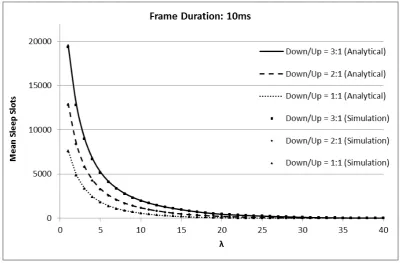
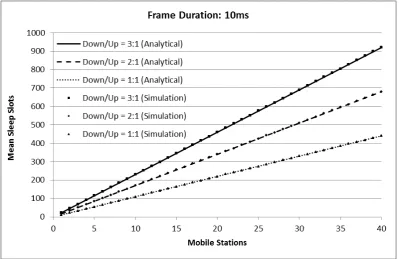
First of all, it should be noticed that all the respective graphs (Fig. 4 to Fig. 7) reveal an
almost exact match between the analytical and simulation results, which confirms that our model is
valid. Initially, the mean number of sleep slots per downlink sub-frame was estimated, varying the
mean number of requested slots (represented by the Poisson parameter ). In Fig. 4, the results for
5ms long frame are depicted. As expected, low values of and high downlink-to-uplink ratio
increase the sleep slots. It can be also seen that for high the slope of the three curves decreases
and eventually the number of sleep slots reaches zero. This may be attributed to the fact that when
large size (i.e., slot demanding) requests are mapped to a “narrow” downlink sub-frame, they
occupy more than one sub-channel, thus, constituting impossible the transition to sleep mode. In
Fig. 5, we depict the mean number of sleep slots for 10ms long frame. It is evident that the higher
the duration of the sub-frame, the more power saving capabilities are provided.
The results provided in Fig. 4 and 5 were calculated with the assumption that there are
always enough MS requests to occupy all the sub-channels of the downlink sub-frame when
mapped. Following, we present results considering variable number of MSs and a fixed mean
number of requested slots equal to 10. Note that each request corresponds to one MS, thus, the
number of requests equals to the number of MSs. Fig. 6 shows the mean number of sleep slots per
downlink sub-frame for varying number of MSs, when the frame duration is 5ms. It is obvious that
depends only on the number of slots it occupies considering a single channel. Furthermore, it can
be seen that the higher the downlink-to-uplink ratio the later the respective curve converges to a
specific value. The reason is that each downlink sub-frame size can support a limited number of
MSs. When this threshold is reached, the residual MSs are simply not served, so the number of
sleep slots remains constant. Notice that this value of convergence is equal to the respective mean
number of sleep slots that we previously estimated and depicted in Fig. 4 for =10 and unlimited
number of MSs. The results for frame duration equal to 10ms are plotted in Fig. 7. In this case, the
increased energy conservation capabilities are obvious. The downlink sub-frame is long enough to
enable the MSs transition to sleep mode, since most requests do not exceed one sub-channel.
The results presented concerning the number of sleep slots for different
downlink-to-uplink ratios and frame durations are based on the different number of slots provided for allocation
in the time and frequency domains for each considered scenario. The provided analytical approach
has already shown that the time intervals during which MSs can transit to low power sleep mode
depend on the dimensions of the resource space. Thus, for identical rectangular slot areas, the
number of sleep slots is expected to remain constant. However, the examined schemes correspond
by definition to different downlink sub-frame dimensions, hence, they cannot be considered on
exactly the same resource space without violating their characteristics. In such a case, the
differences in downlink-to-uplink ratio and frame duration would be eliminated, the schemes
would lose their unique features, and the study would not be able to provide usable information on
realistic WiMAX implementations, following the standard’s specifications. Nevertheless, a normalization of the given results for the same operation interval could lead to useful conclusions
on the power saving capabilities of the examined scenarios, considering that the involved
transmissions last for the same time duration. For instance, a downlink sub-frame which is part of
a 10ms long frame with downlink-to-uplink ratio equal to 1:1 corresponds to two downlink
sub-frames which are part of two 5ms long sub-frames considering the same downlink-to-uplink ratio.
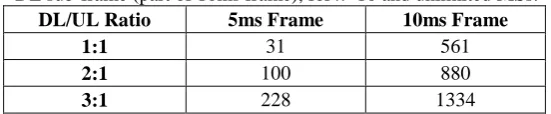
Table 3 presents the number of acquired sleep slots considering different scenarios normalized to
the duration of a 10ms long frame with downlink-to-uplink ratio equal to 1:1. The considered
value for is 10, whereas the available MSs are unlimited. The respective results confirm that
even when assuming the same operation interval, the larger the width of the resource space, the
higher the number of available sleep slots. This behavior is attributed to the fact that wide slot
SPA, which makes transition to sleep mode possible.
4.2. Feasibility Study
For reasons of accuracy and completeness, we perform at this point a feasibility study regarding
the presented intra-frame energy conservation procedure. More specifically, we examine in detail
the effect of switching from reception mode to sleep mode and vice versa. This transition between
different energy statuses is considered as overhead that may degrade power saving efficiency. The
considered power requirements when receiving, being idle, and sleeping are taken equal to
280mW, 120mW, and 10mW respectively, whereas switching is considered to consume additional
1mW. These are commonly adopted energy consumption values that come from related WiMAX
studies [8-11], which are based on the WiMAX chipset specification described in [12]. The exact
duration of switching between reception and sleep mode constitutes a highly specialized chipset
characteristic and as such it is difficult to be estimated based on existing implementations. An
approximation could come from other wireless technologies, like wireless sensors [17, 18] and
wireless local area network [19], however, the considered values vary from a few microseconds up
to a millisecond.
A complete study is performed here for a large range of switching intervals, considering
as closest approximation for the examined WiMAX case the switching duration assumed for a
wireless local area network scenario. On this ground, we estimate the maximum achievable power
reduction in order to draw conclusions on the feasibility of intra-frame energy conservation.
Carefully taking into account the exact specifications of the adopted WiMAX standard, one time
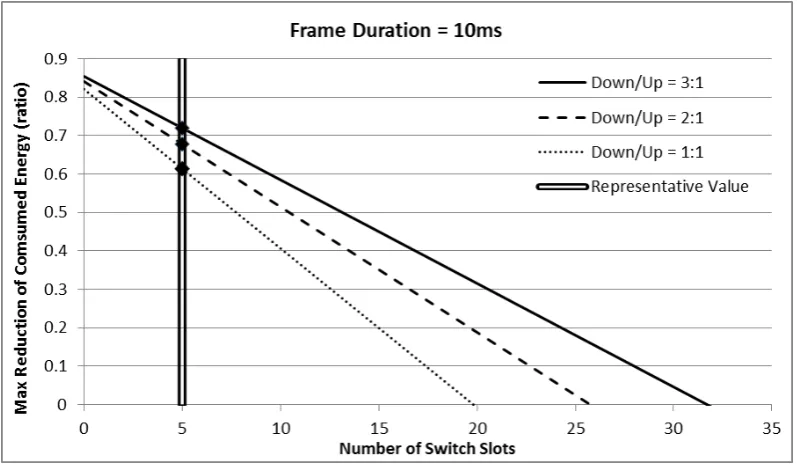
slot is considered to consist of two OFDMA symbols, each symbol lasting for 102.9µs [2]. The maximum reduction of consumed energy for low ( =1) is graphically presented in Fig. 8 and Fig.
9. It becomes evident that intra-frame power saving capabilities are notable for multiple values of
switching duration (measured in slots), especially for large frames. As the number of switch slots
reaches the downlink sub-frame length, the ability to conserve energy fades and eventually for
extreme switching duration values it disappears. The respective graphs highlight with a vertical
line the maximum reduction of consumed energy achieved for five slots switching (corresponding
to 1ms interval considered in [19]). In more specific, for this particular switching duration, which
is considered as the most representative value, the consumed power can be reduced up to 72
width (W=9).
To generalize this study on the feasibility of intra-frame power saving, it is noted that the
switching overhead can eliminate energy conservation, when the power saved during sleep is less
than the extra power consumed during switching compared to the typical no-sleep scenario. Thus,
an inequality formula can be derived to show when transiting to sleep mode is energy beneficial:
( )
SlotsIP ower I SlotsSWP ower SW SlotsI SlotsSW P ower SL
(16)
where SlotsI and SlotsSW denote the number of idle slots available for sleep and the number of
switch slots, respectively, whereas PowerI, PowerSW, and PowerSL denote the power
consumption when being idle, switching, and sleeping, respectively. Hence, based on the
aforementioned energy consumption values and considering as switching duration the
representative value of 1ms, (16) leads to the conclusion that a MS can exploit intra-frame power
saving when it has more than 1.038ms long interval available for sleeping in a single downlink
sub-frame. This finding confirms the intra-frame power saving perspectives analyzed in this paper.
5 Conclusions
This work provided a novel analysis of the power saving capabilities of the IEEE 802.16e
downlink sub-frame, when the well-known horizontal SPA mapping technique is implemented.
The respective algorithm allows transition to a low power sleep mode during the idle slots, when
an MS does not exploit more than one sub-channel. The number of sleep slots that can be
supported per frame was mathematically calculated for multiple frame sizes, varying number of
MSs, and different request sizes. The introduced analytical model was validated via simulation,
whereas the results revealed higher energy conservation potentials for larger downlink sub-frames
and the ability of saving up to a maximum of 72 percent of the consumed power (considering the
energy consumption parameters discussed in [8-12, 17-19]). In the future, we plan to provide
models for analyzing the power saving capabilities of other WiMAX mapping schemes.
References
1. IEEE 802.16 Workgroup, Part 16: Air interface for fixed broadband wireless access systems— standard for local and metropolitan area networks, (2004).
2. IEEE 802.16e Workgroup, Part 16: Air interface for mobile broadband wireless access
3. Andrews, J., Ghosh, A., Muhamed, R. (2007). Fundamentals of WiMAX, Understanding
Broadband Wireless Networking. Prentice Hall.
4. Xiao Y. (2005). Energy saving mechanism in the IEEE 802.16e wireless MAN. IEEE
Communications Letters, 9(7), 595-597.
5. Tsao, S.-L., Chen, Y.-L. (2008). Energy-efficient packet scheduling algorithms for real-time
communications in a mobile WiMAX system. Elsevier Computer Communications, 31(10),
2350-2359.
6. Baker, A. M., Ng, C. K., Noordin, N. K., Mustafa, A., Akbari, A. (2010). An optimized energy
saving mechanism in IEEE 802.16e Mobile WiMAX systems. Journal of High Speed Networks,
17(3), 147-161.
7. Kim, M.-G., Choi, J. Y., Kang, M. (2008). Adaptive power saving mechanism considering the
request period of each initiation of awakening in the IEEE 802.16e system. IEEE Communications
Letters, 12(2), 106-108.
8. Wong, G.K.W., Zhang, Q., Tsang, D.H.K. (2010). Switching cost minimization in the IEEE
802.16e mobile WiMAX sleep mode operation. Wireless Communications and Mobile
Computing, 10(12), 1576-1588.
9. Hsu, C.-H., Feng, K.-T., Chang, C.-J. (2010). Statistical Control Approach for Sleep-Mode
Operations in IEEE 802.16m Systems. IEEE Transactions on Vehicular Technology, 59(9),
4453-4466.
10. Wong, G.K.W., Zhang, Q., Tsang, D.H.K. (2009). Joint Optimization of Power Saving
Mechanism in the IEEE 802.16e Mobile WiMAX. IEEE Global Telecommunications Conference
(GLOBECOM 209), 1-6.
11. Hsu, C.-H., Feng, K.-T. (2009). A statistical power-saving mechanism for IEEE 802.16
networks. IEEE International Symposium on Personal, Indoor and Mobile Radio Communications
(PIMRC 2009), 27-31.
12. Datasheet: SQN1130 System-on-Chip (SoC) for WiMAX Mobile Stations (2007). Sequans
Communications.
13. Ben-Shimol, Y., Kitroser, I., Dinitz, Y. (2006). Two-Dimensional Mapping for Wireless
OFDMA Systems. IEEE Trans. Broadcasting, 52(3), 388-396.
14. So-In, C., Jain, R., Al Tamimi, A.-K. (2009). eOCSA: An algorithm for burst mapping with
strict QoS requirements in IEEE 802.16e Mobile WiMAX networks. 2nd IFIP Wireless Days (WD
2009), 1-5.
15. Sarigiannidis, P. G., Papadimitriou, G. I., Nicopolitidis, P., Obaidat, M. S., Pomportsis, A.
(2010). A Novel Adaptive Mapping Scheme for IEEE 802.16 Mobile Downlink Framing. IEEE
Global Telecommunications Conference (GLOBECOM 2010), 1-5.
16. Perez-Costa, X., Favaro, P., Zubow, A., Camps, D., Arauz, J. (2008). On the Challenges for
the Maximization of Radio Resources Usage in WiMAX Networks. 5th IEEE Consumer
Communications and Networking Conference (CCNC 2008), 890-896.
17. Hurni, P., Braun, T. (2008). Increasing Throughput for WiseMAC. IEEE Wireless on Demand
18. Langendoen, K., Halkes, G. (2006). Energy-Efficient Medium Access Control. In Richard
Zurawski (Eds.) Embedded Systems Handbook, Ch. 34. CRC press.
19. Chen, U., Smavatkul, N., Emeott, S. (2004). Power management for VoIP over IEEE 802.11
WLAN. IEEE Wireless Communications and Networking Conference (WCNC 2004), 3,
Fig. 1 The IEEE 802.16 TDD frame structure.
Fig. 2 Allocating downlink slots to four MSs.
D3/S4 D3/S4 D4/S3 D4/S3 D4/S3
D2 D2 D2 D2 D2
D2 D2 D2 D2 D2 D2
D1 D1 D1 D1
row occupied by a single MS (only MS1)
S1 S1
x Downlink Sub-frame
S3/S4
2 sleep slots for MS1 (mean number is “s”)
2 rows occupied by MS2 (mean number is “M”) 2 successive requests
mapped in a single row 1 request (from MS4) occupies
slots in a row already used by
MS3 (mean number is “A”) 3 sleep slots for MS4
(mean number is “z”)
Fig. 3 Example of notions adopted in the analysis.
D3/S4 D3/S4 D4/S3 D4/S3 D4/S3
D2 D2 D2 D2 D2
D2 D2 D2 D2 D2 D2
D1 D1 D1 D1
W H
Time Frequency
sub-channel
S1 S1
x
Downlink Sub-frame
D1/2/3/4: Data reception slots for MS1/2/3/4 S1/3/4: Sleep slots for MS1/3/4
x: Idle slot
[image:18.595.138.524.589.700.2]Fig. 4 Mean number of sleep slots per downlink sub-frame as a function of the mean number of requested slots , for 5ms long frame.
[image:19.595.125.529.371.634.2]Fig. 6 Mean number of sleep slots per downlink sub-frame as a function of the number of subscriber stations, for 5ms long frame.
[image:20.595.127.527.372.631.2]Fig. 8 Maximum reduction of consumed energy (expressed as ratio) as a function of the number of switch slots, for 5ms long frame.
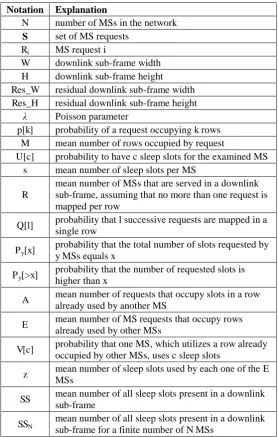
[image:21.595.127.526.351.584.2]Table 1.Notations of Variables. Notation Explanation
N number of MSs in the network S set of MS requests
Ri MS request i
W downlink sub-frame width H downlink sub-frame height Res_W residual downlink sub-frame width Res_H residual downlink sub-frame height
Poisson parameter
p[k] probability of a request occupying k rows M mean number of rows occupied by request
U[c] probability to have c sleep slots for the examined MS s mean number of sleep slots per MS
R
mean number of MSs that are served in a downlink sub-frame, assuming that no more than one request is mapped per row
Q[l] probability that l successive requests are mapped in a single row
Py[x]
probability that the total number of slots requested by y MSs equals x
Py[>x]
probability that the number of requested slots is higher than x
A mean number of requests that occupy slots in a row already used by another MS
E mean number of MS requests that occupy rows already used by other MSs
V[c] probability that one MS, which utilizes a row already occupied by other MSs, uses c sleep slots
z mean number of sleep slots used by each one of the E MSs
SS mean number of all sleep slots present in a downlink sub-frame
SSN
[image:22.595.122.484.562.713.2]mean number of all sleep slots present in a downlink sub-frame for a finite number of N MSs
Table 2.IEEE 802.16 Frame Modeling Parameters.
OFDMA PHY Mode PUSC (H = 30 sub-channels)
Frame Duration 5ms (default)
10ms
DL to UL Sub-frame Ratio
1:1 W = 9 timeslots (5ms frame) W = 21 timeslots (10ms frame)
2:1 W = 12 timeslots (5ms frame) W = 27 timeslots (10ms frame)
3:1 W = 15 timeslots (5ms frame) W = 33 timeslots (10ms frame)
Requests’ Mapping Technique Horizontal SPA
Table 3.Number of sleep slots normalized to the duration of 1:1 DL sub-frame (part of 10ms frame), for =10 and unlimited MSs.
DL/UL Ratio 5ms Frame 10ms Frame
1:1 31 561
2:1 100 880