This is a repository copy of Averaged null energy condition in a classical curved background.
White Rose Research Online URL for this paper: http://eprints.whiterose.ac.uk/130423/
Article:
Kontou, Eleni-Alexandra orcid.org/0000-0003-4409-8188 and Olum, Ken D. (2012) Averaged null energy condition in a classical curved background. Physical Review D. ISSN 2470-0010
https://doi.org/10.1103/PhysRevD.87.064009
[email protected] https://eprints.whiterose.ac.uk/
Reuse
Items deposited in White Rose Research Online are protected by copyright, with all rights reserved unless indicated otherwise. They may be downloaded and/or printed for private study, or other acts as permitted by national copyright laws. The publisher or other rights holders may allow further reproduction and re-use of the full text version. This is indicated by the licence information on the White Rose Research Online record for the item.
Takedown
If you consider content in White Rose Research Online to be in breach of UK law, please notify us by
arXiv:1212.2290v1 [gr-qc] 11 Dec 2012
Averaged null energy condition in a classical curved background
Eleni-Alexandra Kontou and Ken D. OlumInstitute of Cosmology, Department of Physics and Astronomy, Tufts University, Medford, MA 02155, USA
Abstract
The Averaged Null Energy Condition (ANEC) states that the integral along a complete null geodesic of the projection of the stress-energy tensor onto the tangent vector to the geodesic cannot be negative. Exotic spacetimes, such as those allow wormholes or the construction of time machines are possible in general relativity only if ANEC is violated along achronal geodesics. Starting from a conjecture that flat-space quantum inequalities apply with small corrections in spacetimes with small curvature, we prove that ANEC is obeyed by a minimally-coupled, free quantum scalar field on any achronal null geodesic surrounded by a tubular neighborhood whose curvature is produced by a classical source.
I. INTRODUCTION
It is always possible to invent a spacetime with exotic features, such as wormholes, super-luminal travel, or the construction of time machines, and then determine what stress-energy tensor is necessary to support the given spacetime. To rule out such exotic spacetimes we would like to prove energy conditions that restrict the stress-energy tensor that might arise from quantum fields and show that the stress-energy necessary to support an exotic space-time is impossible. We need a condition which is strong enough to rule out exotic cases while simultaneously weak enough to be proven correct, or at least to be free of known counterexamples.
The best possibility for such a condition seems to be the achronal averaged null energy condition [1], which requires the following. Let M be a manifold with Lorentzian metric g
and T be the stress-energy tensor of some fields on M. Let γ be a complete null geodesic with tangent vectorℓ. Suppose that γ is achronal, i.e., no two points ofγ can be connected by a timelike curve. Then
Z
γ
Tabℓaℓb ≥0. (1)
That is to say, we require that the projection of the stress-energy tensor along a geodesic integrate to a non-negative value, but only for geodesics that are achronal. As far as we know there are no known violations of achronal ANEC using minimally-coupled scalar fields.1
Achronal ANEC is sufficient to rule out many exotic spacetimes [1].
Reference [2] proved that the averaged null energy condition (ANEC) holds for geodesics traveling through empty, flat space, even if elsewhere in the spacetime there are boundaries or spacetime curvature, providing that these stay some minimum distance from the geodesic and do not affect the causal structure of the spacetime near the geodesic. Here we will extend this work to geodesics traveling in curved spacetime, with the restriction that the spacetime near the geodesic must obey the null convergence condition,
RabVaVb ≥0 (2)
for any null vectorVa. Equation (2) holds whenever the curvature is generated by a “classical
background” whose stress tensor obeys the null energy condition (NEC),
TabVaVb ≥0. (3)
‘We stress that Eqs. (2) and (3) need not hold in general, but only in a neighborhood of the null geodesic on which we seek to prove ANEC. Thus, for example, the results of this paper apply to any geodesic which does not encounter any material source, even if such sources exist elsewhere in the spacetime.
Reference [2] used a null-contracted timelike-averaged quantum inequality proved for flat space in Ref. [3]. Here we will conjecture that this quantum inequality holds with a small modification in spacetimes with small curvature. We will then be able to rule out ANEC violation, subject to several conditions.
In the next section we give the conditions on which our theorem depends. In Sec. III we state our theorem. In Sec. IV we discuss what it means to have small curvature and
1
state our conjecture. In Sec. V we prove the theorem, and in Sec. VI we conclude with a discussion of remaining possibilities for the generation of exotic spacetimes. We use the sign convention (+,+,+) in the classification of Misner, Thorne and Wheeler [4].
II. ASSUMPTIONS
A. Congruence of geodesics
As in Ref. [2], we will not be able to rule out ANEC violation on a single geodesic. However, a single geodesic would not lead to an exotic spacetime. It would be necessary to have ANEC violation along a finite congruence of geodesics in order to have a physical effect.
So let us suppose that our spacetime contains a null geodesic γ with tangent vectorℓand that there is a “tubular neighborhood” M′
of γ composed of a congruence of achronal null geodesics, defined as follows. Letpbe a point ofγ, and letMp be a normal neighborhood of
p. Letvbe a null vector atp, linearly independent ofℓ, and letxandybe spacelike vectors perpendicular tov and ℓ. Let q be any point in Mp such thatp can be connected toq by a geodesic whose tangent vector is in the span of {v,x,y}. Let γ(q) be the geodesic through
q whose tangent vector is the vector ℓ parallel transported from p to q. If a neighborhood
M′ of γ is composed of all geodesics γ(q) for some choice of p, M
p, v, xand y, we will say
that M′ is a tubular neighborhood of γ.
B. Coordinate system
Given the above construction, we can define Fermi-like coordinates [5] onM′ as follows. Without loss of generality we can take the vectorvto be normalized so thatv·ℓ=−1, andx andyto be unit vectors. Then we have a pseudo-orthonormal tetrad atpgiven byE(u)=ℓ,
E(v) = v, E(x) =x, and E(y) =y. The point q = (u, v, x, y) in these coordinates is found
as follows. Let q(1) be found by traveling unit affine parameter from p along the geodesic
generated by vE(v) +xE(x) +yE(y). Then q is found by traveling unit affine parameter from q(1) along the geodesic uE
(u). During this process the tetrad is parallel transported.
All vectors and tensors will be described using this transported tetrad unless otherwise specified. We will use Latin letters from the beginning of the alphabet to denote arbitrary components in the tetrad basis.
The points with u varying but other coordinates fixed form one of the null geodesics of the previous section.
C. Curvature
We suppose that the curvature inside M′
obeys the null convergence condition, Eq. (2). We will refer to this as a “classical background”, but the only way it need be classical is Eq. (2).
the curvature be bounded. In the coordinate system of Sec. II B we require
|Rabcd|< Rmax, (4)
everywhere in M′.
We will also need to bound the first and second derivatives of the Riemann tensor,
|Rabcd,e|< R′max, |Rabcd,ef|< R′′max (5)
everywhere inM′. The boundsR
max,R′maxandR′′maxare some (independent) finite numbers,
but they need not be small.
We will also assume that the curvature is smooth.
D. Causal structure
We will also require that conditions outside M′
do not affect the causal structure of the spacetime in M′ [2]2
J+(p, M)∩M′
=J+(p, M′
) (6)
for all p∈M′. Otherwise the curvature outside M′ may be arbitrary.
E. Quantum field theory
We consider a quantum scalar field inM. We will work entirely insideM′, and there we require that the field be free and minimally coupled. It may be massive or massless. Outside
M′
, however, we can allow different curvature coupling, interactions with other fields, and even boundary surfaces with specified boundary conditions.
BecauseM may not be globally hyperbolic, it is not completely straightforward to specify what we mean by a quantum field theory on M. We will use the same strategy as Ref. [2]. Our results will hold for any quantum field theory onM that reduces to the usual quantum field theory on each globally hyperbolic subspacetime of M. The states of interest will be those that reduce to Hadamard states on each globally hyperbolic subspacetime, and we will refer to any such state as “Hadamard”. See Sec. II B of Ref. [2] for further details.
III. THE THEOREM
We can now state our theorem.
Theorem 1. Let (M, g) be a (time-oriented) spacetime and let γ be a null geodesic on (M, g), and suppose that γ is surrounded by a tubular neighborhood M′ in the sense of Sec. II A, obeying the null convergence condition, Eq. (2), and that we have constructed coordinates by the procedure of Sec. II B. Suppose that the curvature in this coordinate system is smooth and obeys the bounds of Sec. II C, that the curvature in the system is localized, i.e., in the distant past and future the spacetime is flat, and that the causal structure of M′
is not affected by conditions elsewhere in M, Eq. (6).
2
Let ω be a state of the free minimally coupled quantum scalar field on M′ obeying the conditions of Sec. II E, and letT be the renormalized expectation value of the stress-energy tensor in state ω.
Under these conditions, it is impossible for the ANEC integral,
A = Z ∞
−∞
dλ Tabℓaℓb(Γ(λ)), (7)
to converge uniformly to negative values on all geodesics Γ(λ) in M′.
In the next section, we will conjecture that a known flat-space quantum inequality can be extended to spacetimes with small curvature in a particular way. From this conjecture we will be able to prove Theorem 1.
IV. QUANTUM INEQUALITY
The proof will proceed very much along the lines of Ref. [2]. That paper used the following quantum inequality for the null-projected but timelike-averaged stress-energy tensor, derived by Fewster and Roman [3, 6]. Let w(τ) be a timelike geodesic segment parameterized by proper time τ ∈ (−τ0, τ0). Let g(τ) be a smooth real function with compact support
contained in (−τ0, τ0). Let k be the tangent vector to w(τ) and let ℓ be a constant null
vector. LetT be the renormalized stress-energy tensor of a massless or massive3
minimally-coupled quantum scalar field in a Hadamard state. Then the projection of T on the null vector ℓ obeys a quantum inequality when integrated along the timelike geodesic w,
Z τ0
−τ0
dτ Tab(w(τ))ℓaℓbg(τ)2 ≥ −
(kaℓa)2
12π2
Z τ0
−τ0
dτ g′′(τ)2. (8)
Equation (8) is a consequence of the result of Ref. [6], which applies to general worldlines in curved spacetime. This more general result is in the form of a “difference inequality” that restricts the amount by which the left-hand side of Eq. (8) can be more negative than the same quantity evaluated in a reference state. We need an absolute bound, such as Eq. (8), but applicable to curved spacetime. While such a bound has not been proven, we conjecture that Eq. (8) can be extended to spacetimes of small curvature.
The basic idea was given by Ford and Roman [7]. Suppose that we want to test Eq. (8) in a laboratory on the surface of the earth. We are not in flat space, but rather in space with curvature of order GM⊕/R3⊕. Furthermore the apparatus for measuring T might not be in free fall but rather accelerating with the acceleration due to gravity at the earth’s surface,
a = GM⊕/R2⊕. But in a laboratory-scale experiment, these differences should not matter. We expect Eq. (8) to hold with a small correction for almost geodesic w(τ) in spacetimes with small curvature.
What does it mean for the curvature to be small? First of all, since the curvature has dimensions (length)−2, we have to multiply by the square of some length to get a number
that we can require to be much less than 1. The obvious length in the present example is
τ0.
3
We also face a problem that curvature is a tensor, and we would like to make coordinate-invariant statements. In a Riemannian space, we could require, for example, that the sectional curvature of each plane in the tangent space at each point be small. But in a Lorentzian spacetime this does not work: the sectional curvature is never bounded unless it is constant [8, 9]. A simple example of the problem is that the spacetime could contain a plane gravitational wave. The amplitude of such a wave is entirely dependent on the refer-ence frame; it can be made arbitrarily small or arbitrarily large by the choice of coordinates. Thus one cannot say that all components of the Riemann tensor are small without regard to coordinate system.
Fortunately, in our case, we have a privileged observer whose stress-energy tensor we want to integrate. Thus the worldline of that observer can be used to generate a preferred coordinate system.4 This works straightforwardly on that worldline, but to apply this idea
to other places in the spacetime we will have to parallel transport the observer’s 4-velocity. Fortunately, in the case where the curvature is in fact small, the precise details of this transport will not matter.
With these considerations in mind we proceed as follows. Let (N, g) be a globally hy-perbolic spacetime and let w(τ) be a timelike path in N, parameterized by proper time
τ ∈ (−τ0, τ0), with tangent vector k. In general we will only need to consider the “double
cone”N =J−(w(τ0))∩J+(w(−τ0)). Letǫ≪1. We will say that (N, g) has small curvature
ǫrelative tow ifN is a normal neighborhood of the point p=w(0) and there exists a set of three unit spacelike vectors E(i), i= 1,2,3 at p, orthogonal to each other and to E(0) = k,
such that at each pointq, every component of the Riemann tensor in the tetrad basis formed by parallel transporting the tetrad {E(a)} along the geodesic connecting p and q obeys
|Rabcd|τ02 < ǫ . (9)
Suppose (N, g) has small curvature ǫ by the above definition, and we consider the cur-vature components in a different tetrad basis resulting from a choice of E(i) other than the
one which satisfies Eq. (9). Changing to such a basis will given curvature components that are linear combinations of the ones we had before, and so may be larger than the bound of Eq. (9), but only by factors of order 1.
We could also choose a different starting point p on w. Since the curvature is small, the different parallel transport would change the Riemann tensor components only by factors of 1 +O(ǫ), so the condition would be the same at first order.
We will also require that the proper acceleration of the path on which we want the quantum inequality to hold should be small. Since acceleration has the units of inverse time, we will multiply by the time τ0 to get a dimensionless measure limiting the total
acceleration along the path of interest.
Once we are in curved spacetime, we must address ambiguities in the definition of the stress-energy tensor T. We will adopt the axiomatic definition given by Wald [10], but there remains the ambiguity of adding local curvature terms with arbitrary coefficients. These terms are the metric, the Einstein tensor, and two terms that are second order in the curvature or involve second derivatives of the curvature [11],
(1)H
ab = 2R;ab−2gabR+gabR2/2−2RRab (10a)
(2)H
ab = R;ab−Rab−gabR/2 +gabRcdRcd/2−2RcdRacbd. (10b)
4
A multiple of the the metric will not concern us here, because it vanishes when contracted with the null vector ℓ. A term proportional to the Einstein tensor can be absorbed into renormalization of Newton’s constant, and we assume that that has been done.
As it turns out, the remaining ambiguity will not affect our proof below. However, it must be taken into account in the present conjecture. Following an idea in Ref. [12], we will allow any definition of Tab and absorb the ambiguity into a local curvature term in our
bound.
We now can now conjecture that Eq. (8) holds with a modification of order ǫ and a local curvature term.
Conjecture 1. Let (N, g) be a globally hyperbolic spacetime and let w(τ) be a timelike path in N, parameterized by proper time τ ∈ (−τ0, τ0). Let k be the tangent vector to w
and letℓ be a null vector field obeying ka∇aℓb = 0. Let g(τ) be a smooth real function with compact support contained in (−τ0, τ0). Let T be any definition (obeying Wald’s axioms
[10]) of the renormalized stress-energy tensor of a massless or massive minimally-coupled quantum scalar field in a Hadamard state. If (N, g) has small curvature ǫ relative tow and
|D2wa/dτ2|τ
0 < ǫ everywhere onw, then
Z τ0
−τ0
dτ Tab(w(τ))ℓaℓbg(τ)2 ≥ −
(kaℓa)2
12π2
Z τ0
−τ0
dτ g′′(τ)2[1 +c(ǫ)] + Z τ0
−τ0
dτ g(τ)2Cabℓaℓb, (11)
where c(ǫ) is a function that goes to zero as ǫ → 0, and Cab is a linear combination of
Eqs. (10). The form of c(ǫ) and the coefficients of (1)H and (2)H in C
ab do not depend on
the spacetime or the quantum state. Note that terms in Eqs. (10) whose tensor structure is that of the metric do not contribute in Eq. (11) because ℓ is null.
We intend to prove Conjecture 1 in future work.
V. PROOF OF THE THEOREM
A. Outline of the proof
Following Ref. [2], we will prove Theorem 1 by contradiction using integrals over a paral-lelogram shown below in Fig. 2. By considering this paralparal-lelogram as made up of segments of the null geodesics ofM′
, and assuming Theorem 1 is violated, we set a negative upper bound on the integral of the null-contracted stress-energy tensor over the parallelogram. Then we consider the same set of points as being made up of timelike paths, and demonstrate that these paths obey the conditions of Conjecture 1. Thus using Eq. (11), we can set a lower bound on the same integral over the parallelogram. In the limit where the parallelogram becomes long and narrow, these bounds conflict, proving the theorem.
B. The parallelogram
We will use the (u, v, x, y) coordinates of Sec. II B. Letrbe a positive number small enough such that whenever |v|,|x|,|y| < r, the point (0, v, x, y) is inside the normal neighborhood
Np defined in Sec. II A. Then the point (u, v, x, y)∈M′ for any u.
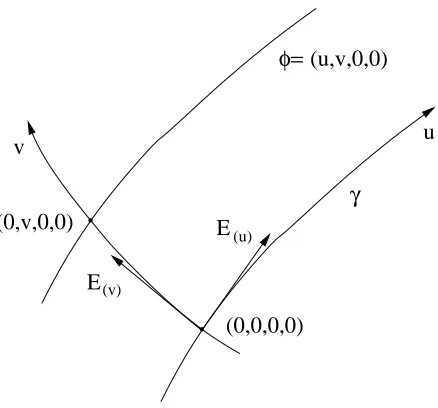
Now consider the points
φ=(u,v,0,0)
E(u)
E(v)
γ
v
(0,v,0,0)
u
[image:9.612.197.416.69.273.2](0,0,0,0)
FIG. 1: Construction of the family of null geodesics Φ using Fermi normal coordinates
With v fixed and u varying, these are null geodesics in M′. (See Fig. 1.) Write the ANEC integral
A(v) = Z ∞
−∞
du Tuu(Φ(u, v)). (13)
Suppose that, contrary to Theorem 1, Eq. (13) converges uniformly to negative values for all|v|< r. We will prove that this leads to a contradiction.
Since the convergence is uniform,A(v) is continuous. Then sinceA(v)<0 for all|v|< r, we can choose a positive number v0 < r and a negative number −A larger than all A(v)
with v ∈(−v0, v0). Then it is possible to find some number u1 large enough that
Z u+(v) u−(v)
du Tuu(Φ(u, v))<−A/2 (14)
for any v ∈(−v0, v0) as long as
u+(v) > u1 (15a)
u−(v) < −u1. (15b)
As in Ref. [2], we will define a series of parallelograms in the (u, v) plane, and derive a contradiction by integrating over each parallelogram in null and timelike directions. Each parallelogram will have the form
v ∈ (−v0, v0) (16a)
u ∈ (u−(v), u+(v)), (16b)
where u−(v), u+(v) are linear functions of v obeying Eqs. (15). On each parallelogram we
will construct a weighted integral of Eq. (14) as follows. Let f(a) be a smooth function supported only within the interval (−1,1) and normalized
Z 1 −1
Then we can write Z v0
−v0
dv f(v/v0)2
Z u+(v) u−(v)
du Tuu(Φ(u, v))<−v0A/2. (18)
We can construct this same parallelogram as follows. First choose a velocity V. Eventually we will take the limit V →1. Define the Doppler shift parameter
δ = r
1 +V
1−V . (19)
Letα be some fixed number with 0< α <1/3 and then let
τ0 =δ−αr . (20)
As V →1,δ → ∞ and τ0 →0.
Now define the set of points
ΦV(η, τ) = Φ(η+
δτ
√
2,
τ
√
2δ). (21)
We will be interested in the paths given by ΦV(η, τ) with η fixed andτ ranging from −τ0 to
τ0. In flat space, such paths would be timelike geodesic segments, parameterized by τ and
moving at velocityV with respect to the original coordinate frame. In our curved spacetime, this is nearly the case, as we will show below. Define
η0 = u1+τ0δ/
√
2 (22a)
v0 = τ0/(
√
2δ) (22b)
u±(v) = ±η0+δ2v (22c)
so that u± satisfies Eqs. (15). Then the range of points given by Eq. (12) with coordinate ranges specified by Eqs. (16) is the same as that given by Eq. (21) with coordinate ranges
−τ0 < τ < τ0 (23a)
−η0 < η < η0 (23b)
The parallelogram is shown in Fig. 2. The Jacobian
∂(u, v)
∂(η, τ)
= √1
2δ (24)
so Eq. (18) becomes Z η0
−η0
dη
Z τ0
−τ0
dτ Tuu(ΦV(η, τ))f(τ /τ0)2 <−Aτ0/2. (25)
−v0 v0
u
η, τ
[image:11.612.171.439.70.272.2]v
FIG. 2: The parallelogram Φ(u, v), v ∈ (−v0, v0), u ∈ (u−(v), u+(v)), or equivalently ΦV(η, τ), τ ∈(−τ0, τ0),η ∈(−η0, η0)
C. Transformation of the Riemann tensor
We would like to work in coordinates which bring to rest, as much as possible, the path ΦV(η, τ) withηfixed. So let us construct new Fermi coordinates by a Lorentz transformation.
We define
xα′ = Λαα′xα, (26) where Λ is diagonal with
Λu′
u = δ
−1 (27a)
Λv′
v = δ (27b)
Λxx′ = Λy
′
y = 1. (27c)
In the primed coordinates, we have
ΦV(η, τ) = (η/δ+τ /
√
2, τ /√2,0,0). (28) Equation (4) gives a bound on the components of the Riemann tensor, measured in the original tetrad. The covariant components Rabcd transform oppositely to the coordinate
components, so
Ra′b′c′d′ = Λaa′Λbb′Λcc′Λdd′Rabcd, (29)
where
Λuu′ = δ (30a)
Λvv′ = δ
−1 (30b)
Λx x′ = Λ
y
y′ = 1 (30c)
equal numbers of u’s and v’s remain the same. We want the curvature to be bounded by
Rmax in the primed coordinate system, which will be true if all components of the Riemann
tensor with moreu’s thanv’s are zero. We will now show that this is the case in our system. All points of interests are on achronal null geodesics, which thus must be free of conjugate points. Using Eq. (2) and proposition 4.4.5 of Ref. [13], each geodesic must violate the “generic condition”. That is to say, we must have
ℓcℓdℓ[aRb]cd[eℓf] = 0 (31)
everywhere in M′.
The only nonvanishing components of the metric in the tetrad basis are guv =gvu =−1
and gxx = gyy = 1. The tangent vector ℓ has only one nonvanishing component ℓu = 1,
while the covector has only one nonvanishing component ℓv =−1. Thus Eq. (31) becomes
ℓ[aRb]uu[eℓf]= 0. (32)
Let j, k, l, m and n denote indices chosen only from {x, y}. Choosing a = m, e = n, and
a=f =v we find
Rmuun= 0 (33)
for all m and n. Thus
Ruu= 0. (34)
Equation (34) also follows immediately from the fact that sinceRuu cannot be negative, any
positive Ruu would lead to conjugate points.
If we apply the null convergence condition, Eq. (2), to V = E(u)+ǫE(m)+ (ǫ2/2)E
(v),
where ǫ≪1, we get
Ruu+ 2Rmuǫ+O(ǫ2)≥0. (35)
Since Ruu = 0 from Eq. (34), in order to have Eq. (35) hold for both signs of ǫ, we must
have
Rmu= 0. (36)
Since Rmu =−Rumvu +gjkRjmku,
Rumvu =gjkRjmku. (37)
Now we use the Bianchi identity,
Rluum;n+Rlunu;m+Rlumn;u = 0. (38)
From Eq. (33),Rluum,n = 0. The correction to make the derivatives covariant involves terms
of the forms Rauum∇nE(la) and Rlaum∇nE(ua). Because of Eq. (33), the only contribution to
the first of these comes froma =v, which we can transform using Eq. (37). For the second, we observe that 0 =∇n(E(v)·E(v)) = 2∇nE(v)·E(v) = 2∇nEu(v), soa=v does not contribute.
Furthermore Rlumn;u = Rlumn,u, because the u direction is the single final direction in the
coordinate construction of Sec. II B, and so in this direction the tetrad vectors are just parallel transported. Thus we find
dRlumn
du = g
jk[R
jmku∇nE(lv)+Rjlku∇nE(mv)−Rjnku∇mE(lv)−Rjlku∇mE(nv)] (39)
Eq. (39) is a first-order differential equation in the pair of independent Riemann tensor componentsRxuxy andRyuxy. By assumption, the curvature and its derivative vanish in the
distant past, and therefore the correct solution to these equations is
Rlumn = 0. (40)
Eqs. (37) and (40) then give
Rumvu = 0. (41)
Combining Eqs. (33), (40), and (41) and their transformations under the usual Riemann tensor symmetries, we conclude that all components of the Riemann tensor with more u’s than v’s vanish as desired. It follows that
|Ra′b′c′d′|< Rmax. (42)
everywhere in M′.
A similar argument using the Bianchi identity twice more would show that Rabcd = 0
unless 2 of a, b, c, and d are v, but we will not need that result here.
D. Timelike paths
We would like to apply Eq. (11) to the paths in Eq. (28). First we show that they are timelike. Differentiating Eq. (28), we find the components of the tangent vectork=dΦV/dτ
in the primed Fermi coordinate basis (not the tetrad basis),
ku′
=kv′
= √1
2. (43)
The squared length of k in terms of these components is gα′β′kα ′
kβ′
. We showed in Ref. [5] that gα′β =ηα′β′ +hα′β′, where hα′β at some point X is a sum of a small number of terms
(6 in the present case of 2-step Fermi coordinates) each of which is a coefficient no greater than 1 times an average of
Rα′γ′δ′β′Xδ ′
Xγ′ (44)
over one of the geodesics used in the construction of the Fermi coordinate system. The summations overδ′andγ′in Eq. (44) are only over restricted sets of indices depending on the specific term under consideration. From Eqs. (28) and (22a) the points under consideration satisfy
|u′
| < u1/δ+
√
2τ0 (45a)
|v′
| < τ0/
√
2 (45b)
x′ = y′
= 0. (45c)
From Eq. (20), the first term in Eq. (45a) decreases faster than the second, so we find that all components of X are O(τ0). Using Eq. (42) we find
hα′β′ =O(Rmaxτ02) (46)
so
gα′β′kα ′
Thus for sufficiently large δ, and thus small τ0,k is timelike.
No we consider the acceleration of our paths. Reference [5] gives the affine connection
∇β′Eγ ′
(α′) as a sum of 2 averages of terms of the form
Rγ′α′δ′β′Xδ ′
=O(Rmaxτ0) (48)
just as above. Thus the acceleration is given by
|aβ′|= Dk
β′
dτ =|k
α′ ∇α′kβ
′
|=|kα′kγ′∇α′Eβ ′
(γ′)|=O(Rmaxτ0). (49)
We want to show that the components of the acceleration are small, so we will calculate the dimensionless quantity
|aβ′
|τ0 =O(Rmaxτ02). (50)
E. Causal diamond
For each η, we would like to apply Eq. (11). But what is the spacetime N in which we are to work? It must include the timelike path from p = ΦV(η,−τ0) to q = ΦV(η, τ0), and
to be globally hyperbolic it must include all points in both the future of p in the past of q, so we can let N be the “double cone” or “causal diamond”,
N =J+(p)∩J−(q). (51) We have shown that the curvature is small everywhere in the tube M′, so we must show that N ⊂M′.
From the previous section, we have that the metric in primed coordinates can be written as
gα′β′ =ηα′β′+hα′β′, (52)
where hα′β′ consists of terms of the form Rα′γ′δ′β′Xδ ′
Xγ′
. The double cone in flat space obeys
|x′
|,|y′
|,|v′
|< τ0, (53)
so the same is true at zeroth order in the Riemann tensor R. Thus at zeroth order,
hα′β′ =O(Rmaxτ02), (54)
and so at first order in R,
|x′
|,|y′
|,|v′
|< τ0(1 +O(Rmaxτ02)). (55)
Since τ0 ≪r for largeδ, we have
|x′|,|y′|,|v′|< r . (56) Now we can replace the primed coordinates,
x′
= x (57a)
y′ = y (57b)
v′
= vδ , (57c)
so
F. Quantum Inequality
We would now like to apply Eq. (11) to give a lower bound on the integral ofTuu on the
paths ΦV(η, τ). Because of the ambiguity involving local curvature terms in Conjecture 1,
we will first bound
T′
uu=Tuu−Cuu, (59)
where Cab the is the particular local curvature term for which Conjecture 1 holds. We will
then show thatCuu does not contribute.
Equation (42) shows that the curvature is small in the tetrad basis transported according to the construction of Sec. II B. These are not precisely the coordinates used in the conditions of Conjecture 1, but the difference is of no consequence, precisely because the curvature is small. Equations (47) and (50) show that, for sufficiently largeδ, ΦV(η, τ) is a timelike path
with small acceleration. The parameter τ is not exactly the proper time, but we show in Appendix A that this contributes only a correction of order Rmaxτ02. Thus Eq. (11) gives
Z τ0
−τ0
dτ T′
uu(ΦV(η, τ))f(τ /τ0)2 ≥
(ℓaka)2
12π2τ4 0
Z τ0
−τ0
dτ f′′
(τ /τ0)2[1 +c(Rmaxτ02)], (60)
where c(Rmaxτ02) vanishes as τ0 → 0. In the unprimed coordinates, the only nonvanishing
covariant component ofℓ isℓv =−1, so ℓaka =−kv =−1/(√2δ) so
(ℓaka)2 =
1
2δ2 . (61)
Let
F = Z
f′′(α)2dα= 1
τ0
Z
f′′(τ /τ0)2dτ . (62)
Then Eq. (60) becomes Z τ0
−τ0
dτ Tuu′ (ΦV(η, τ))f(τ /τ0)2 ≥ −
F
24π2δ2τ3 0
[1 +c(Rmaxτ02)]. (63)
Integrating in η gives Z η0
−η0
dη
Z τ0
−τ0
dτ T′
uu(ΦV(η, τ))f(τ /τ0)2 ≥ −
F η0
12π2δ2τ3 0
[1 +c(Rmaxτ02)]. (64)
Now consider
Z η0
−η0
dη
Z τ0
−τ0
dτ Cuu(ΦV(η, τ)). (65)
Terms from Eqs. (10) proportional to gab do not contribute, because guu = 0. Similarly
Ruu = 0 from Eq. (34). The term RcdRucud vanishes because Rucud = 0 unless c = d = v,
from Eqs. (33) and (41), while Rvv =guvguvR
uu = 0.
The remaining term is R;uu. As explained in conjunction with Eq. (38), the covariant
nature of the derivatives does not matter, andR;uu is a total derivative in u. In Eq. (65), it
is integrated dη which is just du. In the limit where η0 → ∞, the boundary term vanishes,
because the curvature is localized. Thus Cuu does not contribute and we can use Tuu in
place of T′
Now we compare Eq. (64) to Eq. (25). Equation (64) says that integral over the paral-lelogram is no more negative that something that goes to zero in theδ → ∞ limit as
η0
δ2τ3
0 ∼
δ2α−1. (66)
Equation (25) says that the same integral is more negative than something that goes to zero as τ0 ∼ δ−a. Since α < 1/3, the lower bound in Eq. (64) goes to zero more quickly than
the upper bound in Eq. (25). Thus for sufficiently large δ, the lower bound will be above the upper bound, so they cannot simultaneously be satisfied. This contradiction proves Theorem 1.
VI. DISCUSSION
As discussed in Ref. [1], to have an exotic spacetime there would have to be violation of ANEC on achronal geodesics, generated by a state of quantum fields in that same spacetime. We have proved, subject to Conjecture 1 and the various assumptions above, that minimally-coupled, free quantum scalar fields can only violate ANEC on geodesics traveling through parts of spacetime that violate the null convergence condition. Could it be that a single effect both violates ANEC and produces the curvature that allows ANEC to be violated? The following heuristic argument casts doubt on this possibility.
Suppose ANEC violation and NEC violation have the same source. We will say that they are produced by an exotic stress-energy tensor Texotic. This Texotic gives rise to an exotic
Einstein curvature tensor,
Gexotic= 8πl2PlanckTexotic, (67)
in units where c = ~ = 1. It is Gexotic that permits Texotic to arise from the quantum
field. Without Gexotic, the spacetime would obey the null convergence condition, and so,
since Texotic violates ANEC, it would have to vanish. A reasonable conjecture is that as
Gexotic→0, Texotic →0 at least linearly.5 Then we can write schematically
|Texotic|.l−2|Gexotic|, (68)
where l is a constant length obeying l ≫ lPlanck. The parameter l, needed on dimensional
grounds, might be the wavelength of some excited modes of the quantum field. Equation (68) is just schematic because we have not said anything about the places at which these tensors should be compared, or in what coordinate system they should be measured.
Combining Eqs. (67) and (68), we find
|Texotic|.(lPlanck/l)2|Texotic|, (69)
which is impossible since l ≫lPlanck.
Given the assumptions of this paper, it appears that the only remaining possibility for self-consistent achronal ANEC violation using minimally coupled free fields is to have first a quantum field that violates NEC but obeys ANEC, and then a second quantum field (or a second, weaker effect produced by the same field) that violates ANEC when propagating
5
in the spacetime generated by the first field. The stress-energy tensor of the second field would be a small correction to that of the first, but perhaps this correction might lead to ANEC violation on geodesics that were achronal (and thus obeyed ANEC only marginally) taking into account only the first field. This idea seems rather unlikely to us, and we will attempt to rule it out in future work.
If one considers quantum scalar fields with non-minimal curvature coupling, the situation is rather different. Even classical non-minimally coupled scalar fields can violate ANEC [14, 15], with large enough (Planck-scale) field values. However, as the field values increase toward such levels, the effective Newton’s constant first diverges and the becomes negative. Such situations may not be physically realizable. If one excludes such field values, some restrictions are known, but there are no quantum inequalities of the usual sort [16, 17], and there are general [18] and specific [19, 20] cases where conformally coupled quantum scalar fields violate ANEC in curved space. It may be possible to control such situations by considering only cases where a spacetime is produced self-consistently by fields propagating in that spacetime, but the status of this “self-consistent achronal ANEC” for non-minimally coupled scalar fields outside the large-field region is not known.
Appendix A: Proper time
We start with ΦV(η, τ) given by Eq. (21) with tangent vector
k = ∂
∂τΦV(η, τ) =
δ √ 2, 1 √ 2δ (A1)
in the coordinate basis. We would like to reparameterize the path ΦV(η, τ) in terms of
proper time, which we will denote τ′
. Then gabk′ak′b =−1 where k′ is the tangent vector to
the reparameterized path,
k′ = ∂
∂τ′ΦV(η, τ(τ ′
)) = k
dτ′/dτ (A2)
so
dτ′
dτ =
p
−gabkakb =
√
h (A3)
with
h = 1−habkakb. (A4)
Now the left hand side of Eq. (60) can be written Z τ0
−τ0
dτ T′
ab(ΦV(η, τ))kakbf(τ /τ0)2 =
Z τ0
−τ0
dτ′
T′
ab(ΦV(η, τ(τ′)))k′ak′b
√
hf(τ /τ0)2
= Z τ0
−τ0
dτ′
T′
ab(ΦV(η, τ′))k′ak′bg(τ′)2, (A5)
where we let
g(τ′)≡f(τ(τ′)/τ0)h1/4. (A6)
Now we can apply the quantum inequality for the function g and proper time τ′. Since the curvature and the function f are smooth, so isg. We get
Z τ0
−τ0
dτ′
T′
ab(ΦV(η, τ′))k′ak′bg(τ′)2 ≥ −
(ℓak′a)2
12π
Z τ0
−τ0
dτ′
g′′ (τ′
Now let us determine h. Since we are working only in the u-v plane, we have two-step Fermi coordinates with one index in each step. Thus we can use Eq. (27) of Ref. [5] to get
hab(X) = 2Fab = 2 Z 1
0
dλα2m(λ)(1−λ)Racdb(X(1)+λX(2))X(2)d X(2)c (A8)
where X(1) = Φ(0, v) and X(2) = Φ(u,0). Because of the symmetry of the Riemann tensor, the only nonvanishing case is
hvv = 2 Z 1
0
dλ(1−λ)Rvuuv(Φ(λu, v))u2 (A9)
and
h= 1−hvvkvkv = 1−
hvv
2δ2 (A10)
The maximum magnitude of u isu1+
√
2τ0δ, so in the limit δ→ ∞, h= 1 +O(Rmaxτ02).
We are not interested in O(Rmaxτ02) correction terms, and we will write ≈ to show that
such terms have been ignored. Thus we can take h ≈ 1, except where it is differentiated, and we will not worry about the difference between k′a and ka, and that between dτ′
and
dτ on the right hand side of Eq. (A7). We would like to write g′′
in terms of f′′
and a correction that vanishes in the limit
δ→ ∞. So we will calculate the derivatives of g,
dg dτ′ =
1
√
h dg dτ =h
−1/4df
dτ + f
4h
−5/4dh
dτ ≈ df dτ + f 4 dh dτ (A11)
d2g
dτ′2 ≈
d2f
dτ2 −
5f 16 dh dτ 2 +f 4
d2h
dτ2 (A12)
To compute the derivatives of h, we will change variables to q=λu in Eq. (A9) to get
h= 1− 1
δ2
Z u
0
dq(u−q)Rvuuv(Φ(q, v)) (A13)
Now we can calculate the first derivative,
dh dτ = k
udh
du +k
vdh dv = δ √ 2 dh du + 1 √ 2δ dh dv (A14)
= −√1 2δ
Z u
0
dq Rvuuv(Φ(q, v))−
1
√
2δ3
Z u
0
dq(u−q)Rvuuv,v(Φ(q, v)).
Using the bounds from Sec. II C, we find in the δ → ∞limit, dh dτ ≤
τ0Rmax+
τ02
√
2δR
′
max. (A15)
For sufficiently large δ the second term is negligible compared to the first. For the second derivative we can write
d2h
dτ2 =
δ2
2
d2h
du2 +
d2h
dudv +
1 2δ2
d2h
dv2 (A16)
= −1
2Rvuuv− 1
δ2
Z u
0
dq Rvuuv,v(Φ(q, v))−
1 2δ4
Z u
0
Again using the bounds from Sec. II C, we find
d2h
dτ2 ≤ 1
2Rmax+
√
2τ0
δ R
′
max+
τ2 0
2δ2R
′′
max (A17)
As before, for sufficiently largeδ, the second and third term can be neglected in comparison to the first.
Keeping only the most important corrections, we then find
d2g
dτ′2
. f ′′ τ2 0 − 5
16f R
2
maxτ02+
1
8f Rmax = 1
τ2 0
[f′′
+O(Rmaxτ02)], (A18)
which justifies ignoring the difference between τ and τ′ in Eq. (60).
A similar argument applies to the acceleration. In Sec. V D we found that the acceleration was small,
Dkβ′
dτ =O(Rmaxτ0). (A19)
Changing to the proper time τ′ means that we should consider instead
Dk′β′
dτ′ ≈
Dk′β′
dτ = D dτ kβ √ h ≈ Dk β dτ − 1 2 dh dτk β′
=O(Rmaxτ0) (A20)
from Eqs. (A19), (A15), and (43). Thus Eq. (50) holds for the proper acceleration as well.
Acknowledgments
We would like to thank Chris Fewster, Larry Ford, Tom Roman, Ben Shlaer, and Doug Urban for useful conversations. This work was supported in part by grants RFP2-06-23 and RFP3-1014 from The Foundational Questions Institute (fqxi.org)
[1] N. Graham and K. D. Olum, Phys. Rev.D76, 064001 (2007), 0705.3193.
[2] C. J. Fewster, K. D. Olum, and M. J. Pfenning, Phys. Rev. D75, 025007 (2007),
gr-qc/0609007.
[3] C. J. Fewster and T. A. Roman, Phys. Rev. D67, 044003 (2003), erratum: D80, 069903(E). [4] C. W. Misner, K. Thorne, and J. Wheeler (1973).
[5] E.-A. Kontou and K. D. Olum (2012), 1207.4493.
[6] C. J. Fewster, Class. Quant. Grav. 17, 1897 (2000), gr-qc/9910060.
[7] L. H. Ford and T. A. Roman, Phys. Rev.D53, 5496 (1996), gr-qc/9510071. [8] R. Kulkarni, Commentarii Mathematici Helvetici 54, 173 (1979).
[9] J. A. Thorpe, Journal of Mathematical Physics 10, 1 (1969).
[10] R. M. Wald, Quantum Field Theory in Curved Spacetime and Black Hole Thermodynamics
(Chicago University Press, 1994).
[11] N. D. Birrell and P. C. W. Davies, Quantum Fields in Curved Space (Cambridge University Press, 1982).
[13] S. W. Hawking and G. F. R. Ellis, The Large Scale Structure of Space-time (Cambridge University Press, London, 1973).
[14] C. Barcelo and M. Visser, Phys. Lett. B466, 127 (1999), gr-qc/9908029. [15] C. Barcelo and M. Visser, Class. Quant. Grav. 17, 3843 (2000), gr-qc/0003025. [16] C. J. Fewster and L. W. Osterbrink, Phys. Rev. D74, 044021 (2006), gr-qc/0606009. [17] C. J. Fewster and L. W. Osterbrink, J. Phys.A41, 025402 (2008), 0708.2450.
[18] M. Visser, Phys. Lett. B349, 443 (1995), gr-qc/9409043.