E
No.6
e8[
June
1981
Habitat
and
landscape
-
the
fi
rst
envinDnmenta!
film festival
':
?r
''"1"
'"!
g
:'
i \i
!
.:
+
::
.'5 i''. f*ii
S
Canaleffo
in
London
Europe's
investment
inScotland
Whathashappened
to the
deutschmark?
ArcleforEurcpe-ftomtheWestern
lsles
toZimbabwe
F,oyStemmanhasbeen in Scot1and,which
is
atthe
receiving
end
of
severaJ.
Community grants towards projects
exploring
the
possibilities
ofalternative
energy
sources.
His report starts
on
the
page
opposite.
Yflhat
are
the
prime
causes
ofthe troubles in the
textile lndustry?
Howbest
can
the Community
copewith
the
chaJlenge
ofThird World
andUS competition?
Shada
Islam examines the
difficulties whictr
besetemployers
andworkers
alike (page IO).
R
obert
Mugabe,
in
an
interriew,
outlines his plans for the
Zimbabwean economy
and
indicates the role
he
seesthere
for
the
European Community
(page
22).
Avignon in March this year was
no place
for
alitterbug
or
acasual
polluter; but
c.IohnGreenwood
was
there
to
report
ontl.e
first
European
environmental film
festival,
atwhich
British
entdes
receivedthree awards (page
I4).
l\Ie
look,
through
the
eyes of aGerman
commentator,
atwhat has
happenedto the deutschmark (page
I7),while
aFrench
correspondent tells
us
that
an
increasing number
ofhis countrXrmen
'feel
more
Breton or Basque'than French (page
12).
Canaletto
il
London: Denis Thomas
consi.ders
thework
ofthe
manwho
is
perhaps the
Italianpainter
most
enjoyedbythe
Britlsh
(page
20).
Published by the Commission of the European Communities, 20 Kensington
Palace Gardens, London
![8
4QQ.Tel: 0l-727 8090
Editor-in-Chief: George Scott
Editor: John Greenwood Associate Editor: Denis Thomas Design: Lawrence Edwards Printed by Lawrence-Allen
Ltd,
\ilfl eston-super-Mare, Avon
Europe 81 does not necessarily reflect, in all particulars, the opinions of the Community institutions. Unsigned material may be
quoted or reprinted without payment, subiect to suitable acknowledgement.
B elfust Offiee : W indsor House, 9/15 Bedford Street, Belfast BT2 7EG
Tel. (0232) 40708
C ardiff Ofi ee : 4 Cathedral Road, CardiffCFl 9SG
Tel. (0222) 37 1631
E dinburgh Offi ce : 7 Alva Street, Edinburgh EH2 4PH Tel. (03 1) 225 2058 Associated editions: Erqpe,2100M Srreer,
lM,Suite707,
Sfiashington DC 20037, USA Tel.202 8629500
Commuttity Repmt, 39 Moleswonh Street, Dublir 2, Ireland
Te|.712244
j0Jours d'Europe, 6l rue des Belle-s
Feuilles, 25782 Paris Cedex 16,
-!
France. Tel. 501 58 85
Cotntniu Euopea, Via Poli 29, 00187 Rome, Italy
Tel.67897 22
E F -avisen Gammel Torv 4,
Post Box 144, 1004 Copcnhagen K,
Denmark. Tel 14 41 40114 55 32
EGMagazin
Zitelmannstrasse 22.
5300Bonn,W. Germany
Tel. 23 80 4l
Communidad Europea, Serrano, 41 -5 a planta
Madrid-1, Spain
Tel.474II99
Europaiki Koinotis, 2 Vassilissis Sofias,
T.K. 1602, Athens 134, Greece Tel.743982/314
Eutoforum Luxembourg B5timent Jean Monnet,
Luxembourg-Kitchberg
Tel. 4301 I
AorupaToplulugu, 13 Bogaz Sokak Kavaklidere, Ankara, Turkey Tel.27 61 4576
/')
(/
,/rl-o-rq-.:."L
EUROPE
8I
Iona
is
asacred place.
It
is also
cold and damp,
which
means that its famous cathedral and other
ancient
buildings
are
rapidly
deteriorating. But
help
is
on
its
way to the
historic Hebridean island,
in the
form
of
an
ingenious heating system
which
will
halt
the
decay.
It
is
just
one
of many energy-related
proiects
which
are
receivingfinancial
aid
from
the EEC
in
Scotland,
which
is
already the largest
UK
recipient
of European grants and loans,
includinghelp from
the European
Investment Bank.
WHY
EUROPESEES
SGOTLAND
ASAGOOD
INVEI|TMENT
ROY
STEMMAN
reports
on
Community
help in
the
drive
to make
Europe
self-sufficient
in
fuel
Wp*'"i#*l'Hiliit
the tiny island off Scotland's west coast, into aplace of international religious significance.
In
time
it
becamethe burial
placefor
48Scottish
kings, including
Duncan and hismurderer, Macbeth.
Four
Irish
and eight Norwegian kings were also laid to rest there.Iona now attracts a quarter
of
a million visitors each year, mostof
them Christian pilgrims, and the island's ancient buildings-mostly of medieval origin-have been restored
to
provide accommodationfor
them.
The Iona Community, a group of clergymen and laymen, have masterminded this restoration.But their biggest problem is the climate: the granite stone stores the cold, and the mild
weather produced by the Gulf Stream creates
condensation. Large areas
of
green mouldhave appeared in the Abbey Church and most electrical fittings are rusty.
The
remedy
is
one that
St
Columbaand
his
discipleswould
doubtless havetreated with scorn: central heating. But with
the rising cost of fuel, the running costs of a
conventional heating system on Iona are
pro-hibitively
expensive. So architectsIan
G.Lindsay
&
Partners have comeup
with
a scheme that utilises the cause of theproblem-the Gulf Stream
-
to good advantage.A heat pump is to be used which
will
take the sea water (at a constant 9 degrees centi-grade) extract some ofits heat and return it to the sea. The systemwill
enable the Abbey tobe heated to 5 degrees above ambient temper-ature, and the remainder of the buildings to 12.5 degrees
-
sufficientto
provide fabric protection. It will also supply hot water for the visitors.A
grant of 133,000 has been made by the EEC to the Iona Community trustees towards the cost of the system, which should be oper-ational by the end of 1982.It will
be watched closely by other west Scottish concernsin
alnsiollotion ot Sullom Voe,
formolly
o
F
U
o
at
art J
u
d, F
I
ar, F
a
ro
G 6
o
F
o
E
A
More thon holf Briloin's offshore oil wil I
be comino oshore ol Sullom Voe (left).
Above: th-e Cothedrol on lono. sobn tb be heoted from the Gulf Streom. Rioht'
Eurooeon funds hove olso oone'inlo
Sumbruoh oiroort. on Shetl-ond's
moinlonl.
includino o terminolbuildino
(lower
piilure),
to sErviceinstollotionsl
position to dipinto the energy resources of the
Gulf
Stream;for,
although heat pumps areused quite extensively on the Continent, no otherpan ofEuropehas the samepotentid
for
using warm sea water.
Another source
of'free'
energy is the sun.But
most businesses regard solar power ashaving limited indusuial potential at present.
The domestic situation, on the other hand, may be very different. An Edinburgh
firrr
of
architects, engineers and quantity surveyors, Reiach
Hall Blyth
Partnership, has won aSpecial Commendationin the first European passive solar competition, for its design of a
group ofhouses on a south-facing slope close
to Edinburgh Castle, in the city cenue.
storing
it
in
a swimming pool and massivebrick walls, then feeding
it
to each flat. Sup-plementary electrical energy would be gener-ated by winrlmills on the roof. Using these natural sources of energy, the annud costof
heating each flat would be iust 136.
Although
it
won the special commenda-tion, the proiect is no more than a concept onpaper.
The
competition's awardsdid
not include the financeto put
such ideas intopractice.
!7ind,
wave and solar power proiects maybe important sources of energy in the future,
but the UK's fossil fuel reserves are sufficient tokeep us goingfor afewmoredecades. Large
sums of European money are being poured
into Scotland to enable coal, gas and oil to be recovered from the earth, and to provide all'
the ancillary services and facilities which such
multi-million pound industries require.
The imponance
of
coal to the EuropeanCommunity was underlined
in
1980, when the EEC inuoduced a new scheme to support developmentof
particularly important coalproduction areas and projects,
to
meet theA
f22
million 'soft' loan, and a!l
millioninterest rebate, were made
to
the National Coal Board by the European Coal and SteelCommunity (ECSC) for the development
of
new reserves and the extension
of
existingsurface facilities at the Longannet complex
in
Fife. Announcing the deal in September, last year, Mr Christopher Tugendhat, EEC com-missioner for budget and finance, said: 'Coal, sometimes
thought
of
as
dirty
and
old-fashioned, is entering a new era of develop-ment, modernisation and central importance for meeting our energy needs.' The Commis-sion, he added, has estimated that by the year 2000 coal production in the Communitywill
need to have increased by 25 per cent. The UK is a maior source of coal within the Community, accounting for 50 per cent of its
production. The Longannet complex
qual-ified
for
help becauseit
supplies fuel to the Longannet power station, which gives Scot-land threequarters of its coal-fired electricity. The reserves of Longannet's Castlehillpit
were declining,
however,and
the
NCB embarked on a f40million
project to sink anew shaft
at
Castlebridge and make other boringsto
the west, where there is an esti-mated 60 million tons of coal, to ensure that the power station's demands would continueto be met.
As well
asproviding
essential coal, thescheme also guarantees the iobs of 1,000 Fife
miners into the 2lst century.
European moneyis not given or loaned just
to increase output or open up new
opportuni-ties
-
it
is spent on human beings, too.It
isrecognised, for example, that coal mining is a
hazardous occupation that sometimes costs
lives. \tr7hen miners were killed in a
pit
acci-dent
at
Longannetin
1975,the
European Community gave a small grant to theirchil-dren.
The ECSC is also anxious to safeguard the health of miners and steelworkers. So
it
hasmade several large grants to the
Edinburgh-based Institute of Occupational Medicine so
that
it
can study working environments, andin
particular the development of pneumoco-niosis and other lung diseases in coal miners.Since it was formed I
I
years ago, theInsti-tute's main research interest has been the coal
industry, and European grants have made an
important contribution to its work.
Other energy-related projects which have been helped by EEC money
-
in the formof
loans from the European Investment Bank
-are the new Peterhead power station, which received
[10.4 million,
and
the
425-mileFrigg pipeline,
for
whichBritish
Gas Cor-poration obtained a t47.8 million loan.British Gas are also working on the most efficient way of making gas from coal, once
North
Sea supplies run out.In
January this year, the EEC announced a f3,200,000 granttowards the S30
million
proiect.The
coal gasification research is being carried out at British Gas's'!trflestfield Centre, Fife.But
it
is the oil bonanzain
theNorth
Seathat has created the greatest activity and had the greatest impact on the Scottish economy.
6
. . .
by the
yeqr 2000
coofproduction
in
the
Com-munitywill need
to
hqve increqsed
by
25per cent
To
copewith
such activity, a new terminalbuilding has been constructed at Sumburgh to deal exclusively with oil-related flights.
It
handles more flights a day than Luton, Edin-burgh, Birmingham, StanstedorGlasgowair-ports.
The Shetlands'capital is Lerwick, the most northerly town in the British Isles and now an
important oil terminal. The ferry from
Aber-deen used to tie-up in the harbourin the centre of this picturesque town; but the oil rush has changed all that.
Massive transportable roll-on/roll-off loads now arrive at Lerwick, and they go directly to the new terminal at the North Harbour,
built
with the aid of around f
I
million from EEC funds. Even thelittle
local ferry which runs between Lerwick and Bressay, an island half-a-mile away which shelters Lerwick Harbour,has been completely renewed with the help
of
Europeanmoney.
The oil that is recovered from theNorth Sea
comes ashore by pipeline at two main sites:
Sullom Voe to the north
of
Shetland-
now Britain's biggest oil port - and at Flotta, south of Orkney. An EIB loan of f 16.9 million wasmade
to
the
Shetland Islands Council forSullom Voe oil tanker harbour. But that is a
drop
in
the ocean comparedwith
the total construction costs ofthe port-
now estimatedat around f 1,200 million.
The terminal, operated by BP, was opened by the Queen in May. It is expected to receive 900,000 barrels
ofoil
a day this year, which ismore than half of Britain's offshore
oil
pro-duction. About 40 per cent
is
handled byBritish
refineries, and another 40 per cent goesto
Europe and theUnited
States. Its capacity is 1.4 million barels a day.But not only the Shetlands are involved in
the offshore oil industry . Aberdeen is bustling
with
activity,
and someof
the rigsin
the southern sector can be serviced directly fromthe granite city. An ERDF grant of f330,000
has helped Aberdeen improve its port facili-ties. Over
fl
million from
the same EECsource has also gone to Haliburton Manufac-turing and Services at Arbroath, which makes equipment for the petroleum industry.
The European Social Fund, which is con-cerned with the employment of workers, has
given a t500,000 grant towards the cost of
pilot courses in deep-sea diving at the Under-water Training Centre, Fort rU7illiam. Diving
technology has advanced rapidly as a result of off-shore
oil
explorationand
the
greater depths of water at which work needs to beperformed. As well as improving standards, the Community money has helped reduce the risk offatal accidents to divers.
Finding oil on the doorstep is all very well,
but its recovery calls for colossal investment. European grants and loans
at
preferential rates have been of enormous help, and no-wheremore sothan the Shetlands, whichhave received hefty Community investment and encouragement. The irony of the situation isthat Shetland was one of only two areas
in
Scotland which voted against Britain's mem-bership in the 1975
referendum.
E
,[.
4{
Most of the rigs are 100 miles
off
the Shet-lands, a group of over 100 islands of whichonly
15 are inhabited. Togetherwith
the Orkneys, they were settled by Norsemenin
the 9th century and ruled by Norway or
Den-mark
for
the next 500 years. ChristianI
ofNorway pawned them in lieu of a dowry on his daughter's marriage to James
III,
and theybecame part of Scotlant around I 468. Because the rigs need
to
be serviced by helicopters, which have a limited flightcapa-bility,
the Shetlands have become animpor-tant base for oil operations. A
f
1 million granthas been made
by
the European Regional Development Fund (ERDF) to enableSum-burgh
Airport
on Shetland's mainland (thelargest island) to be developed to cope with the tremendous increase
in
air traffic which has come to it literally out of the blue.Sumburgh was ideally placed to be a transit
airport and
it
has had to grow to keep pacewith the oil industry.
The scale ofthat growth can be appreciated
by
comparing aircraft movementsat
Sum-burgh over the last decade.In
1970 the tiny airport handled 2,386 landings and depar-tures: just a handful offlights a day. AII were fixed-wing aircraft-
not a single helicopterflew to the Shetlands
in
those days. Sevenyears later, aircraft movements had risen to 20,257 and Sumburgh also handled 18,496 helicopter flights to and from the island.
EUROPE
8I
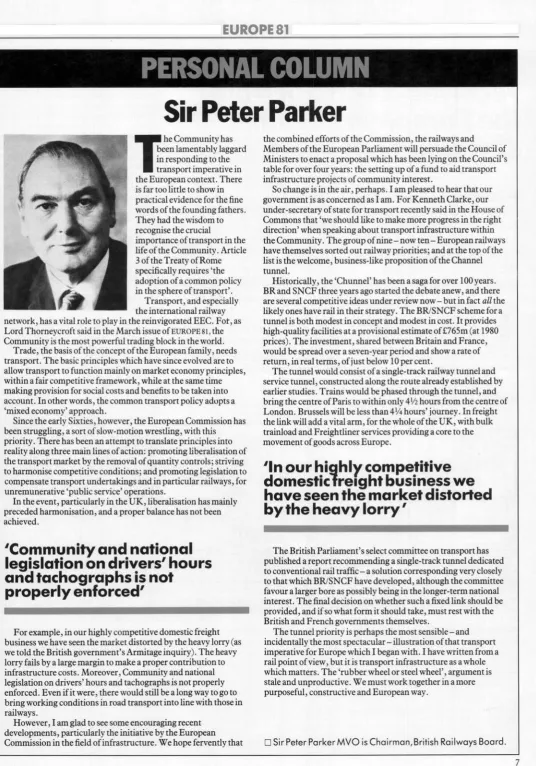
Sir Peter
Parker
I
neCommuntrvnas!
b..n,"*.nraory
laggaroI
inr.soondinstothl
I
.."rrpo..
rmperauve lnthe European context. There
is far too little to show in
practical evidence for the fine words ofthe founding fathers. They had the wisdom to
recognise the crucial
importance of transport in the life of the Community. Article
3 of the Treaty of Rome specifically requires'the adoption of a common policy in the sphere oftransport'.
Transport, and especially
the international railway network, has a vital role to play in the reinvigorated EEC. Fof, as
Lord Thorneycroft said in the March issue of guRopg at, the Community is the most powerful trading block in the world.
Trade, the basis ofthe concept ofthe European family, needs
transport. The basic principles which have since evolved are to allow transport to function mainly on market economy principles,
within a fair competitive framework, while at the same time making provision for social costs and benefits to be taken into
account. In other words, the common transport policy adopts a
'mixed economy' approach.
Since the early Sixties, however, the European Commission has been struggling, a sort of slow-motion wrestling, with this
priority. There has been an attempt to translate principles into
reality along three main lines of action: promoting liberalisation of
the transport market by the removal of quantity controls; striving
to harmonise competitive conditions; and promoting legislation to
compensate transport undertakings and in particular railways, for
unremunerative'public service' operations.
In the event, particularly in the
UK,
liberalisation has mainly preceded harmonisation, and a proper balance has not beenachieved.
For example, in our highly competitive domestic freight
business we have seen the market distorted by the healy lorry (as
we told the British government's Armitage inquiry). The heavy lorry tails by a large margin to make a proper contribution to infrastructure costs. Moreover, Community and national legislation on drivers'hours and tachographs is not properly enforced. Even if it were, there would still be a long way to go to bring working conditions in road transport into line with those
in
railways.
However, I am glad to see some encouraging recent developments, particularly the initiative by the European Commission in the field of infrastructure. We hope fervently that
the combined efforts of the Commission, the railways and Members of the European Parliament will persuade the Council
of
Ministers to enact a proposal which has been lying on the Council's
table for over four years: the setting up ofa fund to aid transport infrestructure projects of community interest.
So change is in the air, perhaps. I am pleased to hear that our government is as concerned as I am. For Kenneth Clarke, our under-secretary ofstate for transport recently said in the House of
Commons that 'we should like to make more progress in the right
direction' when speaking about transport infrastructure within
the Community. The group of nine
-
now ten-
European railwayshave themselves sorted out railway priorities; and at the top of the list is the welcome, business-like proposition of the Channel tunnel.
Historically, the'Chunnel' has been a saga for over 100 years.
BR and SNCF three years ago started the debate anew, and there
are several competitive ideas under review
now-
but in fact all the likely ones have rail in their strategy. The BR/SNCF scheme for atunnel is both modest in concept and modest in cost. It provides high-quality facilities at a provisional estimate of f 765m (at 1980
prices). The investment, shared between Britain and France, would be spread over a seven-year period and show a rate
of
return, in real terms, of just below l0 per cent.
The tunnel would consist of a single-track railway tunnel and
service tunnel, constructed along the route already established by earlier studies. Trains would be phased through the tunnel, and bring the centre ofParis to within only 472 hours from the centre of
London. Brussels will be less than 47+ hours' iourney. In freight
the link will add a vital arm, for the whole of the UK, with bulk
trainload and Freightliner services providing a core to the movement ofgoods across Europe.
'ln
our
hiqhlv compelitive
domesticlre[q
ht
birsi ness
we
hqve
seen
thdmqrker
distorted
bythe
heovy
lorry'
The British Parliament's select committee on uansport has
published a report recommending a single-track tunnel dedicated
to conventional rail traffic
-
a solution corresponding very closelyto that which BR/SNCF have developed, although the committee favour a larger bore as possibly being in the longer-term national interest. The final decision on whether such a fixed link should be
provided, and if so what form it should take, must rest with the British and French governments themselves.
The tunnel priority is perhaps the most sensible
-
and incidentally the most spectacular-
illustration of that transport imperative for Europe which I began with. I have written from arail point of view, but it is transport infrastructure as a whole
which matters. The 'rubber wheel or steel wheel', argument is
stale and unproductive. 'We must work together in a more purposeful, constructive and European way.
tr
Sir Peter PorkerMVO
is Choirmon,British Roilwoys Boord.'Commun:tv qnd
nqtionql
leqislotion
6n
drivers' hours
on?
lochoqrophs
is
not
properly
e-nforced'
[image:7.577.25.562.8.774.2]'Since
797
S,Scotla
nd has
received
E766.5mJrom
the
European Regi,onal
Development
Fund...'
YOUNGER,
Secretary
of
State
for
Scotland, points
to
the benefits
-
especially
north
of the
border
aking Britain into the European Community was a fundamental aim
of
successive governments from 1961,
yet membership remains a
political
football. Controversy should have ended in
1975, when we voted by more than two to
one to stayin the EEC.
The recent Vhich? survey, reported in the Aprilissue of Europe 81, showed a depressing
ignorance of Britain's relationship
with
our partners, which may be a commentary upon the failure, or unwillingness, of somepoliti-cians
to
movepublic
discussion about theCommunity forward
from
the arid
debate about whether Britain should be in or out.ThetVhich? survey claimed that a
substan-tial maiority thought that EEC membership
had been bad for Britain, and Scotland was the area most hostile towards the Community. But how much worse things would have been
for Britain in the Seventies, during which the world economy seemed for ever in recession,
if we had not had free access to the
Commun-ity market of 250 million consumers, and had
faced the repeated economic storms alone.
The Community, as thelargesttrading bloc
in
the world-
accounting for 37 per cent of world uadeif
intra-Community trade isin-cluded, or almost 20 per cent if trade between the Ten is excluded
-
can work effectively tolimit
trends towards protectionism, and cancombat unfair trading practices better than an
individual state.
In
international trade, the Community's common interest is far greaterthan the
marginal
sectoral disagreements which may divide us.I
am confident that the new dialoguewith
Japanwill
lead to an im-proved balance oftrade in our favour.Membership has also helped alleviate the social consequences of the decline of some of
our
major traditional industries, especiallysteel, shipbuilding
and
textiles.
Pressurefrom the
UK
led the Community to impose temporary compulsory production quotasin
the steel industry and
to
restrain steelim-ports.
Although each member has to improve the efficiency ofits own steel industry,
restructur-ing
can only be achievedwithin
an orderly European market. The Community's action ended a price-cutting war between theEuro-pean steel industries which could only have ended in disaster for us all.
There could be cash aid, too, for the Gov-ernment have applied for a contribution from the European Coal and Steel Community to-wards thef 170 million beingspentby BSC on
Hostility
to the
Community
is
saidto
be
strongest
among
EUROPE
SI
early retirement schemes and redundancy payrnents.
Community action is also helping the tex-tile industry. Well over two-thirds of imports
oftextiles and slsthing from low-cost sources
are now covered by
4l
bilateral agreementsnegotiated
by
the
European Commission under the Multi-Fibre Arrangement.*But in the face ofruthless political attaak,
it
will
not be enough in the years aheadfoi
theCommunity
to
rest on the
laurelsof
past achievements, or iust to offeris
citizenslittle
more than shelter from the extremes of the world economic climate.
Unemployment can't be cured by magic,
and weaknesses must be attacked at a national
level. Yet the Community can help create the conditions for recovery, and
it
must comple-ment national measures.All
the institutionsofthe Communityareaware that,
whilebring-ing downinllation must continue to be the top
priority,
rneasrues are needed to assist those groups hardest hit by unemployment.Ve in
Britain
get substantial assistancefrom the European Social Fund, with a num-ber ofprojects for training, retraining, reset-dement, and iob creation
-
in
fact about aquarter
of
the total aid available last year, totalling f,135 million, brinsing thec'mula-tive totalofgrants to over f,537million, much ofwhichhas been spentin Scotland.
Scotland also derives considerable benefit
from the European Regional Development Fund. Since it was established
in
1975, Scot-land has received f 166.5 million from it outof
toul
grans made to theUK
of S566 million.From the
frst
allocation of ERDF grantsfor
1981, which
amountd
totSl
million,
Scot-land received almost half .
All
of
these benefisof
membership are undeniable. Our emergingeconomy would becast down in ruins if it stood on its own in the Eighties.
Currently, over 43 per cent of our trade is within the EEC
-
up from 29 per cent in 1973.In
1980, for the first time since we ioined theCommunity, we enjoyed a trade surplus
with
our partners, and the improvement was by no
means exclusively atuibutable to our oil ex-ports.
If
we pulled out of Europe, our trade with the EEC would be severelydisruptd
at acost
of
hundredsof
thousandsof
iobsin
Britain.lTithdrawal would cripple
inves@ent from countries like tapan and.dmerica. Theyinvest here because ofthe European market.
If
free access to the much larger Communitymarket was
in
doubt, they would take theirmoney and iobs elsewhere.
t"o6-6's
highproportion of multinationals means the Scot-tish people would be particularly hard
hit.
Since 1973, nearly 50 per cent
ofall North
American investment in the EEC has been
in
the
UK.
Nissan's new plantwill
serve the whole ofVestern Europe. They are notlook-ing here because we are British, or Scots, or
\Pelsh, or Fnglish, but because we are
Euro-peans!
Opponents of membership have long said * S a special report, page I 0.
r:'
Paris and tee
Provfu;:
thepolitics
of
local
govetuent
reform
in
France.By
Peter-Nexis Gourevitch. AJlea andUnwin,f18.(X).
, :, -,., t '
",naaceover the political and adminisfirative
.
'ssene would also beto
deprive natiooalpoliticians, either
in
pwei
or hoping to,
,,attain power,of their
gift
of patronage., Ilence cxtreng reluctaoce on all
eids
to",,turrenderthemqansofprwurehabitualty
":,"€fttcisdl
by
the
metro)Flis
on
the' rpqxip|rcm1" erea$
of
France. Profe*or
'',," Gourevich tas written an interestingbk
:l
,onthis
ever requrrent subiect, though,., pe&sps he
dffi
uotrealise the deadweight ofhistory to be shufled off by reformersin-lir
area-.:
,', Spains
lXctatilship
to DemocracyBy,Raluond
&rr
and Juau PabloFusi.
::
2nd,odition.
Allen
&
Unwin,
LLZ.SL,f4,95 (paperback).
This second edition ofa standard work on
,
contempomrySpaiawaspublishedbdore,, ithe recent attempt at a corp d'€tat.
None-,
thsless, as the final words ofthe Iastchap
.
191,indislsr
rhe
authorsprceived
the approagbingdanger,cratedinlargepart,
I rprovi1ces.r':
Now,
otre
uray
suspeqt,,
althoughthe
immediarepril
hasbeeo
;r
'averted by the resolute behaviour ofKing
,r
Juan Carlos, thti army has not said its lasf word, Itisapitybecause, againstallhistor-icalprecedents, the transition todemosa-crrinspafu had
beercarriedoutwithgd
lpotiticdpanies (including Senor Santiagp
,'interet
gpoups concerned.If
only
theBasque provinces
had
behavedlike
Catalonia...
There are a
nunber
ofgood books on Spainin
Enghsh.This
in-telligent workadds to them and providec a most useful guide to even_ ts which, nlss, may quicken.
A.H.
firms trying to export to the Community.
I
believe, too, the next few years
will
see animprovement in the working of the
Commun-ity labour market, with a greater notification
of job vacancies between Community coun-tries.
I
believe we must play an assertive rolein
guiding the Community
into
new fieldsof
activity, and be prepared to take better
advan-tage ofthe incomparable oppornrnities which
ourmembershipoffers.
There is much good coming from the
Com-munity, and
I
will
encure tbat the peopleof
Scotland continue
to
benefit and are keptaware of the true exrcnt of ^tis bonus.
trAbridged fr om T lu S cotsman.
9
l .]: i'i i,] l |:l:l
i.
Ever since Jan-Francois Graviet' s Paris
a
lz dtsertfrancais-a genuinely originalbmk
in its time
-
the question of deceutralisa-tion in France has been a zubiect ofpoliti-el
controversyand
political
[ranoeu-nring. This was the issue that unseated de Gaullein
1969,an4
since then, Frenchpliticians
bave preferred to letit
alone.Infact,
to
deprive Parisof its
predomi-we have ceased to be masters of our fate.
Tdk
of 'Europe imposing things uponus'is
plainnonsense.
.No maior
pieceof
Communitylegislationcan beenactedwithout the consent
of the British Government.
In more and more areas, progress in
Euro-pean co-operation
will
havea
substantial benefit for our citizens.I
hopeto
see a liberalisationof air
fares berween the Community countries, and theGovernment
will
also,during
the
BritishPresidency, be trying to ensure a freer market
for services such as insurance.
Muchstillremains to be done in completing
the common market on goods
in
theEurope's embattled textile
industry
faces
anumber
otchallenges.
Some of these
are
being taken up
with
Third
Vorld
textile-producing
countries
in
G-eneva,
in
negotiations
for
renewal of the rules
which
have
regulated
world
trade
in
texriles since 1974.
Others
will
involve
Community
policy-makers in bilateral
trade discussions
with
the
American
administration.
Nearer home,
steps
will
be
taken to
modernise
Europe's
textile industries,
to adapt them
to
changing
requirements.
Hard
tinres
lor
Eurcpe's
textiles
Stiffcompetition
from
the
Third
World
and
America
is
forcing
European
companies to take
action,
reports
SHADA
ISLAM
he last twenty years have been
particu-larly difficult ones for Europe's textiles
industry. Competition has come from the
Third
ttrforld, where clothing and textiles manufacture requiresonly
modestcapital investment and
is
labour intensive. This has prompted the development of highlycompetitive textile and clothing industries, particulady in South-East Asia.
European Community imports from these
newly indusuialised countries grew by about 25 per cent during the period 1973
to
1976, leading to fears that they would take over theEuropean
market
almost
completely.Another challenge is from the United States,
notably
in
the man-madefibre
sector. US textile producers have adopted an aggressiveexport
policy,
making significant gainsin
The
Communitv
textile
qnd
clolhing
industry
sccounls
for
30
p6r
cent
of
womeh's iobs
European markets due to the size and
efficien-cy of their industry, aided by the US Govern-ment's policy of conuolling oil and natural gas
prices.
In
Europe itself there has been a marked slackeningin
textile demand, linkedto
thecurent
economic crisis. As a result, annualincrease in European textiles consumption is
expected to grow at arate ofonly I per cent per year, compared
with
5 per cent during the period 1970-1973.The effects
of
these maior changes havebeen felt with particular intensity in Europe.
A
study undertaken by the European Com-missionhas noted that, in the Community as awhole, about 700,000 iobs in the textile sector disappeared between 1973 and 1978. Of this
total,
422,000 jobs were lostin
the texrileindustry and 278,000
in
the clothing sector. About 4,200 European firms went out ofbusi-ness, represen 'ng a net workforce reduction
of22 per cent in the textile industry and over
20 per cent in the clothing industry. The same
l0
'Very limited olternotive oossibilities for o
predominontly femole
wbrkforce.
. .' pattern is seen in all the member statesl butareas without other industries, and with very
limited
alternative employmentopportuni-ties
for
a predominantly female workforce,were the hardest hit.
The number of such lobs lost was
particu-lary high
in
the Netherlands, Belgium andDenmark, where over 40 per cent
of
iobs disappeared between 1973 and 1978.In
theUnited Kingdom and
ltaly,
the overall loss over the same period was around 15 per cent.Employment
in
the
textile and clothingindustry
continuesto
shrink,
reports the Commission, even though the rate of iob lossin
mostof
the member states has sloweddown. The Community textile and clothing
industry still accounts for roughly 8 per cent
of manufacturing industry's contribution to the Community gross national product, 9.5 per cent of fobs
in
manufacturing industry, and 30 per cent of women's iobs.The survival
of
the sector is thereforeof
crucial importance to the European economy. Even today, ridden with crisis and difficulties
as it is, the EEC's textile and clothing industry
is still the world's foremosr export industry.
The
Commission study, however, high-lights the fact that, since I 973, the production index for textiles and clothing has followed asteady downward trend. Despite some
recov-ery in 1979, it has not managed to return to the
1973 position. The overall volume of textile
production in the Community fell by over 9
per cent betweet 1976 and 1978. Investment in the sector improved
in
1978 (when ittotd-led
224.9
million ECU)
comparedwith
figures
for
the previous years (when invest-ment fell to 186.5 million ECU in 1975).Butit
has
still
to reach the 257.2million
ECUin-vestedin the sectorin 1973.
The problems facing the textile sector were highlighted by the one-hour strike ordered by the European textiles trade union
-
Comitex-til
-
involving textile workers in all memberstates last December. The strike was called by the unions to draw attention to job losses and
to galvanise the European Community into
action against imports both from the develop-ing countries and from the United States.
The discussions in Geneva mark the
third
time that
textile producing and importingcountries from the industrialised
North
and the developing South have come togetler todiscuss ways and means of regulating interna-tional uade
in
textiles. The first Multifibres Arrangement, concluded,n
L974, had theexpress aim offostering the expansion
oftex-tiles trade, the reduction of barriers to such
trade, and the progressive liberalisation
of
world
trade.The
Agreement was also de-signedto
ensure the orderly and equitableZ
o
a
z
I
o z
u
EUROPE
8I
development of this trade and to avoid disrup-tive effects in individual markets and on
indi-vidual lines of production in both importing
and exporting countries.
ttrilhen the
MFA
cameup for
renewalin
1977, the Community's policy-makers were well aware of the crisis in their textile indus-Ey, and of the fact that the MFA would need
to be extended
-
butwith
certain modifica-tions. Their attention was drawn to the factthat, during the period 1970 to 1974, textile and clothing imports in the Community had risen by 22.5 per cent, as against 64 per cent
for
theUnited
States. Overall, the rateof
peneuation (the ratio of imports to consump-tion) in the Community was put at 20 per cent, compared
with
10 per centfor
the UnitedStates.
More effective measures essentially against imports were clearly required. The
Commun-ity told its
MFA
partners that member stateswould only renew the Agreement if a number
'As
the
EEC
counlries
see it,
the
situcrtion
requires
conlinuqtion
of
ihrport
controls'
of Third World
suppliers signed bilateral agreements limiting their exports to the EECto
levels which,in
some cases, would be adeparture from certain MFA rules. For exam-ple, the Communiry stipulated that for some
eight sensitive textile products, the import
levels set
by
the EEC could be lower than those allowed under theMFA.
These quotas were part ofthe internal global ceilings for all imports of sensitive items from the develop-ing countries, agreed to by EEC countriesin
1977.
The main long-term aim of the tightening
of imports was to give the Community's
in-dustry time to restructure and modernise.
In
the short term, the Community was lookingfor ways to'stabilise' the penetration rates
of
imports from low-cost countries in the
Third
\U7orld.
The Community's policy appears to have
been successful in meeting atleast one ofthese obiectives. A recent Commission study stres-ses that, from 1976 to 1979, imports of
MFA
textile products increased by only 4 per cent, compared
with
25 per cent during the fustthree years ofthe application of the first
MFA.
But
problems have cropped up on otherfronts. Exports to the Community have
in-creased at an annual rate of 7.4 per cent from
countries
in
the Mediterranean regionwith
which the EEC has 'preferential' relations. But the maior threat currently comes from the
industrialised countries, particularly
theUnited
States, whose exportsto
the
EEC rocketed by 74.5 per centin
1979. The Com-mission notes that 'among the reasons for thisuend are the boosting of export promotion, currency fluctuations, and the difference
in
the costs ofraw materials (feedstock and raw materials) and energy, all of which are
addi-tional
to
the advantage gainedfrom
large-scale production.'
As the EEC's industry, trade unions and governments seeit, the situation in the textiles sector requires continuation of
import
con-uols vis-i-vis
third
country suppliers.In
arecent statement, the European trade union committee
for
textiles, Comitextil, madeit
clear that a mere renewal of the
MFA
is notsufficient
to
dealwith
the
ever-increasing competition facing European textileproduc-ers. The agreement, they note, will need to be
renegotiated, so that it can take account ofthe
economic and social situation prevailing in the
Community, the fact that the EEC textiles market is over-saturated and facing
stagnat-ing demand and the reality that other world
textile markets are now closed.
A similarly'restrictive' approach has been
adopted
by
the European Parliament.In
aresolution adopted recently, the Parliament
stressed the'need to consider textile imports
from
all
low-cost sourcesin
determining acceptableimport
quantities.'The
Parlia-ment also called for the installation of a systemof review of quota ceilings at regular intervals,
so that the rate of growth of import
penetra-tion
does not exceed the rateof
growthin
Community demand for textile products.
It
underlined that'quota allocations to thenew-ly industrialised supplier countries' should be
related to 'the degree of access they allow to Community products'. The Parliament also
dealt with the problems created by increasing American exports to EEC countries, stressing that a mutually acceptable agreement should
be
concludedwith
the
Americans, who should also be persuadedto
take a greatershare of low-cost imports.
These arguments are not taken
lightly in
the Third rtr7orld. At a series of meetings held
in Geneva last year, the developing countries expressed their deep concern
that'the
com-mitment of developed importing countries to liberalise world trade in textiles and clothingremains
unfulfilled'.
Furthermore,
they added, 'the restrictive nature of the regimeunder the
MFA
has been aggravated by the unrestrained trade among developed coun-tries, which grossly discriminates againstde-veloping countries.'
Third
Vorld
nations are particularlywor-ried about the fact that, as they see
it,
de-veloped countries
restrain textiles
and clothing imports from developing countries, while continuing to expand their exports to developing countries-
not only
of
textile machinery, chemicals, fibres and related pro-ducts, but also ofnon-textile products affect-ing the overall trade balance.European Commission experts have yet to formulate the guidelines to be followed by the Community in the Geneva negotiations. But,
foreseeably, the Community has asked for a
renewal of the MFA. At the same time, action against Third ttr(orld suppliers will have to go
hand in hand with efforts to control imports from the industrialised countries.
BRITISH MEPs
SPEAKOUT
MichaelWelsh
BarrySeal In a debate in the EuropeanParliament in April on the renewal
of
the multifibre agreement, MEPs from
Lancashire and Yorkshire made
speeches on behalfofthe textile industry in their regions.
Mr Michael r0flelsh (Lancashire Central), said that, in the United Kingdom, over 60,000 people in the industry had lost their lobs in the
previous nine months. He urged that the United States should take a greater
share of low-cost imports, so as to ease
the pressure on Community textile markets. He also had a message for Third ttrTorld countries who are
building up their exports of low-price textiles: 'In your own interests, do not force us to put up protective barriers'.
Mr Barry Seal (\7est Yorkshire) called on the Commission to follow the example of the Belgian and French governments' approach to the textile industry. The level of access to the EEC, he said, should be determined only by the state of the Community market.
A report on the renewal ofthe multi-fibre agreement, drawn up by
the Committee on External Economic Relations, was agreed.
g
How
it
feels to
be
French
in
1987
Like
other
Eruopeans, the
French
are
experiencing
socid,
politicd
and
cultural
changes
which
strike
at
their
nationd
morale.
In
this article, JEAI.{
LACOUTURET
S
pro.mrnent
iotrnalist
and
corespondent,
gives
a
personal view of the 'angst' in France
today
!
have a friend from Eastern Europe who 'chosefreedom'in
1960.!
Fifteen years later he becane French. Here is what he says today:!
qWhenI
chose to become French,I
reproached myself for takingI
theeasywayout, forabandoningthetoughestfight. Now, however,I
realize that perhapsI
chose the more difficult way. Long agoit
wasappealing to be French. From now on it
will
be a test.I
do not regretanything...'
A test? To be French in 198 I is to feel on trial. A trial ofideas, a
trial
of opinion, perhaps even a trial for witchcraft, brought on as much byevents as by the world and by the very citizens of one's country.
It
is atrialinwhichlegal brlefsaremorenumerous thanlawyers, in Franceas well as abroad; in which the indictment is forever gening longer;
in
whichthewitnessesforthedefencearegettinghardertofnd.
Itisatrial
in which no verdict is expected, but in which the accused does not hope
to be completely absolved.
the international system, and of ttre western economy
-
which, for the first time in more tl.n
30 years, havedl
struck at the same time. Thegovernmental crisis is demonstrated by therecent presidential election campaign. Republicans
by
principle, monarchistsby
instinct, the French made do with a republican monarchy, which proposedsolu-thisrepublic.
As regards the economic crisis, the French are not the only ones
subjected to
it
and they probably suffer less thrn the Belgians or the Spaniards.Vhat
is serious in France is the unemplolmentproblem-less cnrel thnn in Britain and scarcely more ss than irr Germany, but
which assumes menacing tones for French denocrary if one takes into
account the exceptionally large number of foreign workers here. Any
new threaB on the emplolment scene are viewed as an aggression, and constitute an encouragement to xenophobia and racism.
Nevertheless, the anxiety which troubles the French appears to be directed toward so6sthing els€. It takes on a more encompassing form
than amere governnental crisis or social-economic threat. Should one speak
of
anidentity
crisis?Vould
the French nation, which wasformerly united, iealous of the harmony and elegance of its territorial
fouadation, of the cohesion ofits language and culture, watch it dl lose
substance, dissolve in larger and amorphous shapes, or fall into
litde
parts?
Itis
true that anincreasingnumberofsitizens feelmore Breton or Basque than French, and others more European than ProvenC orAlsatian.
However, though this phenomenon rnay now grow, it will not pose a
great risk.
It
is not expansion and contraction of'Frenchness' which would be undesirable, mutations which are aqmbol
of
life,
the breathing of history. The 'angst' in Fraoce today, this feeling of being on trial-
aswith
Kalda's heroes, knowing neither the nature of theindictnent nor the text of the
law-
springs from what could be calledthe essence ofbeing French. Allnations have apurpose, fromhavinga
mission to
fulfill
-
at any rate, a profound reason to exist-
to a mere occupation ofspace. But few peoples have believedit
as much as the French, even outside the two or three centuries when France was the dominant power abroad.It is not enough to say that today this anitude is obsolete. The issues
troubling the French are more their survival as a people, their being,
tha. their lost power, their threatened wealth, their challenged
unity,
t2
I 'i.'
their minor impact on diplomacy, their
little
appuent credibilityin
militaly
deterence. More important are issuesthat
concern theirhistory, their art, their culture, and- pompously- their civilisation.
It
is preciselyfrom
thispoint of
view that the two most recent indictments have been published, one in an article, and the other ia abook. The article was published not long ago
in
the Ne.D Yorher, amagazine for which I have a very high regard. In it one could read that thearts, the social life, andhumanrelationsinPariswerenothingmore than falsification, decadence and
futility.
One who lives inside amechanism does not always perceive
its
failures. The fact that anAmerican observer has recendy perceived in such amanner a
culturd
Iife which used to be great, and which used to be important to the world, can be upseaing.
lt
is true that, since the deaths of Frangois Mauriac, Andrf Malrauxand Jean-Paul Sartre, the French political and literary scene has been ted writer, the righter ofwrongs, the defender ofthe accused, and the
accuser of the powerfril; and it is true that the Nobel Prize for literature
has eluded us for so long. These facts force us to question the cultural fertility ofFrance.
Beyond
fertility,
a recentfuk,
L'IdeoW
Frurqaise by Bernard-Henry L€vy, deals with the very significance of French culture, in that it portrays theracistregime ofVichyas them<ist typicd expression,in
modern times, of French tradition. Everythingin French civilization that does not come from intellectual universality
-
the 'human rights'declared
in
the
Frenchrevolution,
secularism, and enlightenedphilosophy- should be attributed to racism and xenophobia.
One has to consider that such a book appeared in a country already
shaken
by
the xenophobic initiativesof
the most powerfirlof
its workers' parties.It
appearedright
after a number of racist murderattenpts had disnrpted the nation's conscience, and just as France's neighbours were accusing
it
eitherofgiving
or not giving asylum to terrorists from the Itslian Red Brigades and the military branchof theBasque independence movement. So one can see why the French ask
themselves questions. And among the
frst
is: !7hat does it meari to beFrenchtoday?
C,an apeople giveup its ownuniquerole? Shouldit, when threatsof all kinds appear, look to aliEmment, integration, or merging into a
larger community? The answerwouldbeyes, definitely, for Franceas well as for Great Britain or Italy
-
unique nations rich in history and latentfertility
-
if
this choice were not to mean abandoningrespon-sibilitv.
Like our friend from Eastern Europe who chose to become French andis realiziagtoday thathefaces atest, so toothe British, theltalians,
and the French know that their crowded history is primarily a chal-lenge,which shouldbedealtwithfintonanational, collectiveleveland
theninaglobdrealm. TobeFrenchin 1981 istofeelontrial. However,
there is no cause which cannot be defended, and no test which does not
WhatputsFranceontrialarethreecrises-ofthedomesticsystem,
of
left without this particular species, the'eternal Voltairer'thecommit-t"frkiT',n:*flJ,;or*"*r,.-gotia,med,theynorongersaw
'{n
iTrcreosing
number
what was republican in this
monarchi
*a
*n"t
*"r -oo"r"[iot
io
Of
CiliZenS fggJ
mgfe
BfgtOn
Of
Bosquethon
French...'
GTI
_t
rur
1l
\--.,
lVehave
amandate
to
overhaulthe
CAP
Important
new developments
in the European
Community
are
either
being
planned
o1are
under
way
on
several
fronts.
These
developmei&
are
important
for
the
dommunity,
and
they are
also
important
for the
UK.
principles,
is a
central
aspectof
this
mandate. Careful thought
will
have tobe devoted to
its future
ffnensing and,iir
partiorlar,
to the
relationship
be. tween market requirements and social objectives.Wendtu
considerwhether are-vmping
ofthe legislation
ofthe
1960s
will
be
adequateto
met
the
needs of the 1980s, or whether instead
we should consider the
practicabiliff of
creatingaseparatewayofhelpingpoor-er
famers
which
doesnot distort the
price mechanism and create expensive and unpopular surpluses.
We also need to look
atthe activities
ofthe Community in other fields where
new policy
initiatives,
and new financ-ing methods, may have a part to playin
creatinga more
balancd
anil.fairCom-,muaity Budget. In times
ofhigh
rurem-ployment, crisis
in
oldinduskies
andopprtunity
for
new
high
technolory
indusFies, we must
Ey
to ensurethat
Community policies
make
a
greater and mororelevant contribution
tothe
resolution of the problems whieih are
of
the greatest concem to ifs citizens.
Il,t{otry
"*,AMW,
Vice
PresidentQfe
EumpeanCommission, responsible for budget
and financial
ontrol.
Efforts are
nowbeing
madoto
im-prove co-ordination in foreign policy,
to
increase cooperation on
eonomic
and monetary matters, to reform the ffnan-cial
system ofthe Community,
andto
develop the
activities
of the Commun-ity in awaywhich makesitmorc clearly
relevant
to the
everyday concetnsof
ordinarycitizens.
Of
particular
siguificanceis the
re-sbucturingof
the Community Budgetas
agred
by the member ststes on 30Maylastyear. The
BudgetasitcuJrent-lyoperatesleads to two complaints.
the
first
is thatit
is unbalanced asbetwen
agEicultuml
and
other
Community
activities,
such asregional
policy,so-cial policy
andindushial
plicy,
Thes*ond
iEthat
its costs and benefits aredistributedhhreumemherstates
in acapricious and unfair fashion.
there
is,of
course,6
link
betwen
thesetwo
pmblems, since the domination of
agri-cultue
meansthat
those who lose onthe CAP swings cannot gain compara-ble benefitsfromthe otherpolicy
round-abouts.
the
European Commission has beenat work for seveial months now on an analysis ofthe Community Budget and
on dsvising ways of overcoming these
difficulties.
We are sommittedto
pm-ducingproposalsin
time
for theEuro-pean Council
to
behelit at the
endof
Jnne.
We weregiven
this
task
at
the
time
ofthe
settlement ofthe
so-calledBritish
bufuetary
problemjust
over ayear ago. One
ofthe
central purposesof
our
mandateis to
preventthe
recur-ence for any member state ofthe sort
of
hnacceptable
situation'
in
which the
UKfounditself.
Within
theuext
couple of yearsthe
Community
will
reachthe
limit
ofits
own resourres
-
customs duties,agri-cultnral
levies, and up to thefrst
1 percant of
VAT
levied on a common base.This
provides the catalystfor
changesand impmvements,
which are
in
any
case badly ueede4 in the way money
is
spent through the Community Budget.
Ihey
must
beinhodud
if
we areto
succed
in
persuading member statesthat
adilitional
resourcesshould
bemade
available
for the Communiffs
fi:rtherdevelopment.
It
is,in
my view,particularly in the
interests ofthose countries
that
dobad-ly
outofthe
presentsituation that the
development of tlre Community
shoulil
not be held back.
At
pnesent wesimply
do
nothavethe
fnancial
meansatour
disposal
to
build
up the
policiesthat
wouldhelpthem.
The
overhaul
and modernisationof
the
CAP,while maintaining
its
basicTATKING POINT
The neootation
olthe
Comm[nitf
s common agricultural prices lorthe cunent markeling yeartook place against abackdrop of demonstrations by farmers
masd
outside the Charlemagne building in Brussels where the Agdculture Ministers met at the beginning ol April. The farmers wanted an overall price increase ol 1 5 per cent The European Commission, mindfu Iol
its resoonsibilities to consumersaswellastothelarming
community, liavoured 7.8 per
cert.
The flnal ligure agreed was 9.5 per cent.
The Commission prcposed what it considered to be a prudent pdce increase. Ai the same time, it is
tryingbymeansof a
conesponsibility levy on
over-produc{ioi in dairying, which may be extended to other sectors, to
irlolve
farmers more closely in the managernent of the common agdcultural policy while atthesame time continuino to ofler a
guaranteed lMng