E u r o p e a n I n v e s t m e n t B a n
i-, /-] ο ^ ^ t ^ $ ^ Den europaeiske Investeringsbank
Γ Τ Π ί Ρ ΐ ^ Ι 7 Π τ ί Π / ? Π { ^ Π Γ ί ? ΐ Γ η ί ^ " Λ Ϊ ^
Europäische Investitionsbank
J I A l U W U U U l J v i ü U U w U ^ IS i ä L ®
Ευρωπαϊκή Τράπεζα Επενδύσεων
BEI EIB
N° 25 April 1981
Den europaeiske Investeringsbank
Europäische Investitionsbank
Ευρωπαϊκή Τράπεζα Επενδύσεων
Banque
Européenne d'Investissement
Banca Europea per gli Investimenti
Europese Investeringsbank
ISSN 0250-3891
From Yaounde to Lomé . . .
The EIB and economic development in Africa, the
Caribbean and the Pacific
Contents
pages | Introduction
Background to the Community's
development assistance General description of the ElB's role in
development aid
Review of operations under Yaounde 1 and 2 Lomé. . . increased funding for industry, mining and energy Investments financed by the EIB under Lomé 1 The ElB's project appraisal approach Outline of Lomé 2 and ElB's role
Lists:
Investment projects financed under Lomé 1
Tables
Breakdown of lending under the Yaounde Conventions
— by country — by sector
Breakdown of lending under Lomé 1
— by country — by sector
1-3
3-4
4-5
5-6
6-7
8-16
16-18
18-20
11-16
5 6
9 10
With the second Lomé Convention which came into force on
1 January 1981, the framework is set for European Investment
Bank financing operations over the next five years in the 60
African, Caribbean and Pacific (ACP) countries which have
signed the Convention.
This will call for a significant expansion in the ElB's work to
assist developing countries, with the Bank responsible for
different forms of investment financing which may total up to
some 1.4 billion units of account (u.a.) out of the 5.7 billion u.a.
in aid foreseen for the ACP. Identification of possible
invest-ment projects to support — mainly in the industrial,
agro-industrial, mining and energy fields — is well-advanced;
programming missions of officials from both the Commission
of the European Communities and the EIB have been sent to
almost all of the countries to discuss investment priorities with
the Governments and national financing institutions and some
of the first loans have been signed already.
This expansion follows on directly from the Bank's operations
under the first Lomé Convention, which expired on 31
De-cember 1980, and represents — with the financing operations
carried out in a number of African countries under the earlier
Yaounde Conventions — the latest stage in a flow of financing
assistance spanning the period 1963 to 1985.
The 25th issue of EIB Information is given over to a detailed
review of the operations carried out under the first Lomé
Convention.
The Bank completed the full amount of lending
envisaged in the Convention — some 500 million u.a. in loans
and risk capital, plus sums reserved for interest subsidies
— which went to investment projects in 40 countries
repre-senting, when all fully operational, 3 billion u.a. in new capital
formation and the direct creation of nearly 30 000 jobs.
The Conventions — key facts
The Lomé Conventions — ACP countries
The first Lomé Convention was signed by 46 countries and they were joined during the Convention's lifetime by a further 13. With Zimbabwe's signature, the number of countries covered by the second Lomé Convention presently stands at 60 (43 in Africa, 10 in the Caribbean and 7 in the Pacific):
West Africa: Benin, Cape Verde, Gambia, Ghana, Guinea, Guinea-Bissau, Ivory Coast, Liberia, Mali, Mauritania, Niger, Nigeria, Senegal, Sierra Leone, Togo, Upper Volta
Central Africa: Burundi, Cameroon, Central African Republic, Chad, Congo, Equatorial Guinea, Gabon, Rwanda, Sao Tome and Principe, Zaire
East Africa: The Comoros, Ethiopia, Djibouti, Kenya, Madagascar, Mauritius, Seychelles, Somalia, Sudan, Tanzania, Uganda
Southern Africa: Botswana, Lesotho, Malawi, Swaziland, Zambia, Zimbabwe
Caribbean: Bahamas, Barbados, Dominica, Grenada, Guyana, Jamaica, St Lucia, St Vincent and the Grenadines, Surinam, Trinidad and Tobago
Pacific: Fiji, Kiribati, Papua New Guinea, Solomon Islands, Tonga, Tuvalu, Western Samoa
Lomé 1 : signed in Lomé, Togo, 28 February 1975, came into force 1 April 1976, expired 31 December 1980. Provided for Community finance totalling 3 559.5 million u.a. (including 112.7 million under the Council of Minister's decision to extend aid to Overseas Countries, Territories and Departments — OCTD linked to certain Member States).
Lomé 2: signed 31 October 1979, came into force 1 January 1981, expires 28 February 1985. Provides for Community finance totalling up to 5 716 million u.a. (including 109 million u.a. for the OCT).
Lomé Conventions: Brealtdown according to forms of development finance <" (in million u.a.)
Managed by ttie EIB Managed by the Commission
Lomé 1
Loans from EIB own resources
400
700+2001='
Risk capital operations
101
287
Financed from budgetary
Grant aid for interest subsidies on EIB loans 100
175
Other grant aid
2 085
2 804
resources
Loans on special conditions
474
531
Stabilisation of export earnings (STABEX) 400
559
Special finance facility for minerals (SYSMIN) 280
( 1 ) Situation wlien going to press (end-March 1981 ) and not including adjustments still to t)e made at ttiat date to Lomé 2 to talie account of the accession of a new ACP country. Zimbabwe.
The sums include the financing provisions, under the relevant decisions of the Council of the European Communities, for Overseas Countries and Territories (OCT). (2) This line does not include the cost of Community delegations in ACP countries, financed from budgetary resources.
(3) Provision under declaration annexed to the Convention foreseeing the possibility for the EIB to lend up to 200 millipn u.a. from its own resources for mining and energy investments of joint interest to the ACP and the Community (see page 19).
The eariier Yaounde Conventions
These covered a smaller group of countries: 18 under the first Convention (together known as the Associated African States and Madagascar - AASM), 19 under the second (the Associated African States,
Madagascar and Mauritius - AASMM); all went on to sign the two Lomé Conventions.
Yaounde 1 : signed in Yaounde, Cameroon, 20 July 1963, came into force 1 June 1964, expired 31 May 1969. Provided for Community finance totalling up to 800 million u.a. (including 70 million for the OCTD). This sum comprised 680 million in grants and 50 million in loans on special conditions, both from budgetary funds, plus up to 70 million u.a. in loans from the ElB's own resources.
Yaounde 2: signed 29 July 1969, came into force 1 January 1971, expired 31 January 1975. Provided for total aid package of up to 1 000 million u.a. (of which 82 million for the OCTD). This was made up of 810 million in grants and 90 million in special loans, both from budgetary funds, and up to 100 million in loans from the ElB's own resources.
N.B.
U
nder the first Lomé Convention the European Investment Bank signed some 125 finance contracts, over half of them for investments in countries where it had never worked before.The funds went to a wide range of activities, from large industrial and energy schemes, requiring a high level of financial support, to small-scale industrial and tourism development assisted through global loans to national develop-ment banks. For example, in Kenya 10 000 smallholders will be sending their tea crops to 10 new processing factories, whose exports should have an appreciable effect on the country's balance of trade. In Fiji, an 80 MW hydroelectric power station will cover virtually all of the electricity demand on the largest and most heavily populated island. Viti Levu, hitherto met by oil-fired thermal power stations. In Botswana, a factory will produce vaccine to protect cattle against foot-and-mouth disease. In Senegal, solar energy equipment is to be manufactured, part for household use, part for powering irrigation pumps in isolated rural areas. A rice mill in Mali will help further the country's efforts to develop rice farming and thereby move closer to self-sufficiency in food. In some of the Caribbean islands, small-scale Industrial and tourism ventures are being set up with EIB support.
But apart from requiring a wide geographical and sectoral extension of the ElB's operations, the first Lomé Convention acted as a testbed for various new financing techniques, allowing a flexible and innovative approach to development problems differing widely from country to country and project to project. It also set the stage for much increased cooperation with other international development banks, aid organisations in Member Countries and sources of finance in the Arab world.
These aspects will be covered in detail in the following pages, but the starting point must be first to situate the EIB within the overall spectrum of Community development assistance and then define its roles as they began under the Yaounde Conventions and have grown under the Lomé Conven-tions.
Background to Community development assistance
The European Community has sought from the beginning to strengthen the economies of countries in the Third World. Robert Schuman in his declaration of 9 May 1950 — which laid the foundation of the European. Community — referred to how European unity could also give a new impetus to development of the African continent, one of Europe's essential tasks. The steady growth in the Community's development aid reflects a natural sense of solidarity with many countries which have long historical and cultural links with Europe.
Economic factors remain the bed-rock of the cooperation, with. an effort to promote, to the satisfaction of both sides, interests which are complementary and thus strengthen a mutually beneficial interdepend-ence.
On the one hand, the European Community is the world's biggest market for developing countries' goods. In 1979 the EEC's imports from the Third World were worth 90 billion u.a. European industries rep-resent considerable potential for in-vestment in developing countries and for technical cooperation.
At the same time, the Community economy is based to a great extent on processing raw materials and then selling the finished products.
Roughly 75% of its raw materials are imports compared with under 25% for the United States and under 10% for the USSR; the principal sources of supply are developing countries.
These same countries have become important markets for European products: 36% of the Community's exports went to Third World coun-tries in 1979, against 13% to the USA or 8% to the COMECON countries.
The EEC and its Member States are today the largest source of develop-ment assistance for the Third World with aid commitments embracing countries with economies which range from being semi-subsistent to others reaching roughly the same level as less developed regions with-in the Community.
Unit of Account
Below are the values in national cur-rencies of the unit of account used by the Bank, as at 31 December 1980:. DM 2.56556
£ 0.549110 Ffrs 5.93916 Lit 1217.30 Fl 2.79081
Bfrs Lfrs Dkr Dr IR£ US-$
41.3351 41.3351 7.88723 61.2587
0.690185 1.30963 Statistics summarising Bank ac-tivities in terms of units of account have been based on several different conversion rates applied since 1958. This, coupled with the effects of price trends, would suggest prudence in interpreting the significance of fi-gures which relate to operations ex-tending over many years.
The composition and hence value of the unit of account used by the EIB are the same as those of the ECU. Below are listed the rounded values of the unit of account in currencies of ACP countries in which the Bank had carried out operations up to end -1980:
Barbados (2.62 Barbados $), Benin (297 CFA francs), Botswana (0.97 Pula), Burundi (117.9 Burundi francs), Cameroon (297 CFA francs), Cape Verde (55.8 Cape Verde es-cudos), Chad (297 CFA francs), Com-oros (297 CFA francs), Congo (297 CFA francs), Djibouti (233 Djibouti francs), Fiji (1.04 Fiji f ) , Gabon (297 CFA francs), Gambia (2.2 Dalasis), Ghana (3.6 Cedis), Guinea (25.4 Sy-lis), Guyana (3.34 Guyana $), Ivory Coast (297 CFA francs), Jamaica (2.33 Jamaica $), Kenya (9.93 Shillings), Liberia (1.31 Liberian $), Madagascar (297 Malagasy francs), Malawi (1.08 Malawi kwacha), Mali (594 Mali francs), Mauritania (60.27 Ouguiyas), Mauritius (10.28 Mauritian rupees), Niger (297 CFA francs), Nigera (0.71 Naira), Papua New Guinea (0.85 Kina), Rwanda (122 Rwanda francs), Senegal (297 CFA francs), Seychelles (8.6 Seychelles rupees), Somalia (8.24 Somali shillings), Sudan (0.65 Sudan-ese pounds), Surinam (2.34 Surinam guilders), Swaziland (0.98 Emalangeni), Tanzania (10.72 Tan-zania shillings), Togo (297 CFA francs), Trinidad and Tobago (3.14 Trinidad & Tobago $), Upper Volta (297 CFA francs), Zaïre (3.92 Zaires), Zambia (1.05 Zambian kwachas).
This has called for diverse forms of assistance . . . food aid, preferential trading arrangements, technical and industrial cooperation, payments designed to help countries which are dependent upon exports of a few commodities to ride out the ups and downs of market prices, financial aid to help export promotion and investment finance, which is the theme of this article.
The Community as a group has es-tablished priorities to aid
— the African, Caribbean and Pacific countries and
— countries in the Mediterranean region ">.
Their links with Europe are particu-larly strong and it is within these countries and also in a small group of Overseas Countries and Ter-ritories closely connected with cer-tain Member States, that the bulk of Community development assistance is provided and where the EIB operates.
General description of the ElB's role in
development aid
The possibility for the EIB to operate outside the Community was laid down in Article 18 of the Bank's Statute, an integral part of the EEC Treaty. This stipulates that although EIB financing should normally assist investment projects carried out in the European territories of Community Member States, the Board of Governors (one Minister from each Member Country), acting unanimously on a proposal from the Board of Directors, may also authorise the Bank to lend outside the Community.
A few such authorisations have been given for financing certain specific projects outside the Community, but of direct interest to it (e.g. loans for development of oil and gas deposits in the Norwegian sector of the North Sea, a hydroelectric power station in Austria, half the output of which will go to German consumers, construc-tion in Tunisia of part of the Algeria-Italy gasline); much more important, the clause opened the way, as Com-munity aid policy evolved, for the Bank's experience as a project financing body within the Member Countries to be put to use also to the benefit of developing countries.
In effect it meant that as the Bank borrows its resources on the capital markets, funds could be mobilised for development aid additional to financial assistance provided by the Member States or the Community from budgetary resources.
Certain basic principles govern the ElB's activities outside the Com-munity:
• the Bank lends within the framework of agreements nego-tiated between the Community and the countries concerned, the terms of which (as far as they concern the EIB) must be agreed by the Bank's own Board of Governors. Each of
these agreements specifies a time-span for Bank lending (usually about 5 years) and sets a ceiiing for the total amount — i.e. a target, not a legal obligation, to be reached only if the Bank can find sufficient, good quality investment projects; certain sectoral priorities are usually laid down for the Bank
• the agreement of the authorities in the countries concerned is neces-sary before the EIB pursues finan-cing proposals; each country dis-cusses its priorities with the Bank
• every project must undergo an examination by the Bank's own staff of its likely economic impact (e.g. the benefits to the country con-cerned in terms of value added, ba-lance of payments, revenues gene-rated, jobs created etc.) with the appraisal also looking closely at fi-nancial, technical and managerial capacities of the promoter
• within the overall spectrum of Community aid, and in cooperation with the Commission of the Euro-pean Communities, the EIB disposes of different forms of financing — soft, softer and softest — and it is
necessary to determine how these are used, and in what mix, according to the countries and projects
• support may be given for invest-ment carried out by public, semi-public or private sector promoters
• the ElB's normal practice is to finance only part of the fixed asset costs involved, i.e. the funds it makes available should form part of an overall financing plan, usually including the promoter's own funds and, in most cases, finance from other banks or development agen-cies
• finance is used for equipment or services chosen, broadly speaking, on the basis of international com-petition and may cover both foreign currency and local expenditure
• adequate security must be as-sured so as to protect the ElB's standing on the capital markets where it borrows its funds.
Another general point to operations outside the Community — both in the ACP and the Mediterranean countries — is the division of re-sponsibilities between the Commis-sion and the European Investment Bank.
This has evolved in the light of ex-perience over the years and aims at structuring development aid to en-able a versatile approach with a range of different financing facilities handled by the two institu-tions. The Commission's primary concern is grant aid, the ElB's main task lies in the provision of reim-bursable assistance, although there is a limited crossover of cooperation in certain fields.
EIB financing comes under two broad headings:
— ordinary operations: these are loans from the Bank's own re-sources (i.e. essentially the sums raised as part of normal borrowing operations on the capital markets); and
— special operations: various ty-pes of financing drawn from bud-getary funds which the Bank man-ages under mandate of the Com-munity or the Member States.
Loans under the first category — ordinary operations — are pro-vided on the same conditions as the Bank's loans within the Community, that is to say on a non-profit-making basis, with the interest rates follow-ing closely movements on the mar-kets where the Bank obtains its funds. However, in the ACP, lending rates are brought down by interest subsidies paid from Member States' budgetary resources (through the European Development Fund) ;the borrowers therefore receive loans on more favourable conditions than the Bank itself could afford to give, bearing in mind that it can obtain funds on financial markets only by offering a competitive rate of inter-est to invinter-estors, and that it has to cover its own operating costs (ad-mittedly quite small, as the Bank's staff totals only about 500) and con-tribute to the margin of reserves required by its Statute.
The duration of the loan depends on the nature of the project financed and always, of course, on the Bank's own borrowing possibilities. There is a grace period on capital repay-ments always covering the construc-tion and start-up phase of a project.
Review of operations under Yaounde 1 and 2
When the Community was created, the Treaty of Rome provided for the association of dependencies of some Member States "in order to increase trade and to promote jointly economic and social development". Within a few years many of these territories had become nations in their own right and had to decide whether they wished to continue as "associates" of the Community.
Almost all chose to do so and in July 1963 a Convention was signed at Yaounde, Cameroon, associating 17 African States'" and Madagascar to the EEC (the Associated African States and Madagascar - AASM) and for the first time the Community decided to help finance productive investment in these countries, in-cluding the private sector.
Under this Convention, European Development Fund (EDF) grant aid managed by the Commission was set at 680 million u.a. The Bank was called upon to lend from its own resources (up to 70 million u.a.) and to share responsibility with the Com-mission in granting loans on special conditions from EDF resources (50 million u.a.).
The loans from the Bank's own funds went almost entirely to indust-rial or mining development aimed either at import substitution or de-veloping export capacity (e.g. vari-ous agro-industrial investments in the Ivory Coast, fertiliser production in Senegal). Special loans went ap-proximately half to industrial invest-ment of various kinds, half to infras-tructure schemes.
The experience of these operations led to two important innovations be-ing introduced in the second Ya-ounde Convention, which came into effect in 1971.
' Benin, Burundi, Cameroon, Central African Republic, Chad, Congo, Gabon, Ivory Coast. Mali, Mauritania. Niger, Rwanda, Senegal, Somalia, Togo, Upper Volta, Zaire.
Finance from budgetary resources — the special operations — means funds usually on very soft condi-tions; as the Bank's own resources are not involved, the lending does not have to reflect the costs of money on the financial markets. In the ACP this aid is provided as risk capital assistance, different forms of financing aimed for the most part at launching new industrial ventures (under the earlier Yaounde Conven-tions special opéraConven-tions were essen-tially in the form of very long-term loans with extended grace periods on repayment of principal and at nominal interest rates).
When providing funds from bud-getary resources, under Community mandate, the operations are ac-counted for separately from the Bank's other activities, off balance-sheet, in what is known as the "Spe-cial Section", formed by decision of the Board of Governors in 1963 when the first such lending took place In Turkey.
It is interesting to examine how the combination of these different forms of financing has changed over the years, from the first Yaounde Con-vention which came into effect in 1964 to the present Lomé Conven-tion.
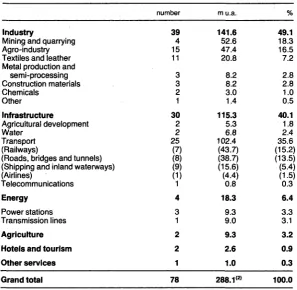
Table 1 : Finance provided by the EIB under the first and second Yaounde Conventions'^'
geographical breakdown
AASMM Benin Cameroon Chad Congo Gabon Ivory Coast Madagascar Mauritania Mauritius Senegal Togo Upper Volta Zaire OCTD French Guiana Guadeloupe Martinique
Netherlands Antilles New Caledonia Reunion Surinam Grand total
Loans from 1 m u.a.
139.1 17.3 9.0 4.4 51.2 11.0 1.8 3.9 5.9 0.4 34.2 7.0
7.0
146.1
EIB own resources
%
95.2 11.8 6.2 3.0 35.1 7.5 1.2 2.7 4.0 0.3 23.4 4.8
4.8
100.0
Special operations mounted from EDF
resources'*' m u.a. 127.8
3.3 23.9 1.2 6.7 10.3 35.6 1.9 2.7 6.6 5.0 30.6 14.2 0.4 0.7 0.6 4.4 3.4 2.8 1.9 142.0
%
90.0 2.3 16.8 0.8 4.7 7.3 25.1 1.3 1.9 4.7 3.5 21.6 10.0 0.3 0.5 0.4 3.1 2.4 2.0 1.3 100.0
m u.a.
266.9 3.3 41.2 1.2 15.7 14.7 86.8 1.9 13.7 1.8 10.5 5.9 5.4 64.8 21.2 0.4 0.7 0.6 4.4 10.4 2.8 1.9 288.1
Total
%
92.6 1.2 14.3 0.4 5.4 5.1 30.1 0.7 4.8 0.6 3.6 2.0 1.9 22.5 7;4 0.2 0.2 1.5 3.6 1.0 0.7 100.0
( 1 ) Including operations mounted in accordance with the Decisions of the Council of the European Communities on aid to the Overseas Countries, Territories and Departments
The first was the use of subsidies to reduce the interest rates on certain EIB loans. The second was the intro-duction of risk capital operations. The Convention — signed by the original AASM, later joined by Mauritius — provided for the Bank to lend up to 100 million u.a. from its own resources but allowed for inter-est subsidies, paid from the Euro-pean Development Fund grant'allo-cation (810 million u.a.), to be ap-plied to loans in the manufacturing and tourism industries (the sub-sidies were 2 or 3%, according to certain criteria laid down in the Con-vention).
This enabled the EIB to strengthen its action in favour of industrial de-velopment, helping African com-panies cut their borrowing costs and operate with better chances of suc-cess thanks to a lighter debt burden.
In the amount set aside from the EDF for loans on special conditions (90 million u.a.), provision was made to use part of the funds to provide risk capital (e.g. bolstering the capa-city of enterprises to pursue their development plans by taking a share in their equity).
Loans from the ElB's own resources again went mainly to import substi-tution or export-oriented industries (e.g. copper and cobalt mining in Zaire, cement production in Came-roon and Togo, cotton mill in the Ivory Coast), but also with a certain amount going to tourism develop-ment (hotels in Senegal and Gabon) and development of electricity pro-duction. A few risk capital opera-tions were carried out in support of different industrial Investments in Senegal, Cameroon and the Ivory Coast, while loans on special condi-tions went mainly to infrastructure works of various kinds and large agricultural schemes.
A breakdown of lending under the Yaounde Conventions, both by country and by sector, is given in tables 1 and 2.
Thus two main trends under these Conventions were
a) an Increasing concern on the part of the Community to aid indu-strial investment in the African countries, and
b) a growing involvement of the EIB both in lending from its own resour-ces (with possible application of in-terest subsidies) and in carrying out risk capital operations.
[image:6.591.234.532.97.387.2]This pattern became even clearer with the first Lomé Convention, which came into force in April 1976.
Table 2: Finance provided by the EIB under the first and second Yaounde Conventions'^'
sectoral breakdown
Industry
Mining and quarrying Agro-industry Textiles and leather Metal production and
semi-processing Construction materials Chemicals
Other Infrastructure
Agricultural development Water
Transport (Railways)
(Roads, bridges and tunnels) (Shipping and inland watenways) (Airlines)
Telecommunications Energy
Power stations Transmission lines Agriculture Hotels and tourism Other services Grand total
number
39 4 15 11 3 3 2 1 30 2 2 25 (7) (8) (9) (1) 1 4 3 1 2 2 1 78
m u.a.
141.6 52.6 47.4 20.8 8.2 8.2 3.0 1.4 115.3 5.3 6.8 102.4 (43.7) (38.7) (15.6) (4.4) 0.8 18.3 9.3 9.0 9.3 2.6 1.0 288.1«
%
49.1 18.3 16.5 7.2 2.8 2.8 1.0 0.5 40.1 1.8 2.4 35.6 (15.2) (13.5) (5.4) (1.5) 0.3 6.4 3.3 3.1 3.2 0.9 0.3 100.0
(1) Including operations mounted in accordance with the Decisions of the Council of the European Communities on aid to the Overseas Countries. Territories and Departments.
(2) Loans from EIB own resources (146,1 m u.a.) and special operations mounted from EDF resources (142.0 m u.a.)
increased funding for industry, mining and
Lomé .
energy
The Lomé Convention was hailed as a new chapter in relations with developing countries. It engaged the Community of Nine (now including Denmark, Ireland and the United Kingdom, linked to many developing countries through the Commonwealth) to cooperating in the development of virtually all of black Africa, plus a number of countries in the Caribbean and Pacific. A total of 46 countries signed the Convention in 1975 and they were joined by 13 others during the lifetime of the Convention.
Although very diverse in many ways, these countries share common ex-periences and difficulties in their economic development.
Their per capita GDP averaged 260 u.a. in 1978 and a large number of the ACP are listed among the world's least developed countries.
In many cases the population is small and sparsely distributed which makes development — particularly infrastructure, such as roads, water supplies and telecommunications — difficult and costly.
Changes in the terms of trade over the last decade have been strongly
to their disadvantage. Basically they export raw materials, for many of which world market prices have fal-len or stagnated in real terms; at the same time they have been hit severe-ly by the oil price increases (onsevere-ly a handful of the ACP are oil produc-ers) and by the inflation in the cost of imported capital goods.
Experience has shown that a policy of industrialisation at all costs is no solution: much depends on the cir-cumstances in which a particular country finds itself; its geographical situation, its raw materials endow-ment, the availability of skills, and many other factors determine the appropriate size and pattern of in-dustrialisation. But, recognising that the potential for industrialisation in different countries will be different, industrial development is an essen-tial element in promoting import saving and the diversification of ex-ports. In particular, the smaller, loc-ally based, manufacturing enter-prises have a significant role to play; they contribute to the expansion of the domestic market, and can offer important new employment oppor-tunities in countries where unem-ployment and under-emunem-ployment are extremely serious problems. In most ACP countries industry pre-sently accounts for well under 20% of Gross National Product (GNP).
The first Lomé Convention never claimed to be a complete answer to all development problems. But it did contain some important and inter-esting innovations.
In the first place, the amount of aid was set at 3.6 billion u.a. over five years, i.e. twice the amount for the two Yaounde Conventions — but obviously for a much larger number of beneficiary countries — to be used in less than half the timespan.
The division of responsibilities bet-ween the Commission and the EIB was developed so as to take account of the innovations.
The Commission-managed EDF grant aid and loans on special con-ditions — about 75% of the total — were intended chiefly to help finance agriculture, infrastructure and social development.
The ElB's role was clearly defined as the primary source of finance for industry, mining and tourism, al-though it could also help finance investment in energy and other branches of revenue-generating economic infrastructure (e.g. port works, railway modernisation).
The amount of loans from the Bank's own resources (400 million u.a.) was four times that under the second Yaounde Convention and the lending possibilities were to be
substantially widened by an ex-panded provision for interest sub-sidies. Whereas under Yaounde 2 each subsidy was granted on a case-by-case decision of the Com-mission, independently of the Bank granting its loan for a project, they became an integral part of the Bank's lending operations under Lomé 1. The amount set aside for interest subsidies out of the EDF grant allocation (100 million u.a.) was entrusted to the Bank's man-agement so that, in effect, a bor-rower could negotiate a loan with subsidy all as one package and in-deed the subsidies were to be consi-dered as standard practice (there were only a few sectoral exceptions, e.g. loans for oil development).
The subsidies were set nominally at 3% but with the proviso that borrow-ers should never pay a net interest rate of less than 5% or more than 8%. With the substantial rise of in-terest rates worldwide, particularly in the second half of the Conven-tion's lifespan, the 8% ceiling has been of increasing benefit to the ACP borrowers.
In addition the Bank was given full responsibility for handling risk capi-tal assistance (101 million u.a. from EDF resources).
Operations under this heading re-present a particularly useful form of aid in the ACP countries where dustrial investment is almost in-variably faced with special prob-lems.
In some cases, for example, invest-ment schemes could be abandoned because the company concerned has too limited a capital base . . . it cannot contract the loans it needs because it does not have the bor-rowing capacity.
Here risk capital resources can be used by the EIB to provide quasi-capital assistance to a Government or to a national development institu-tion to enable it to take a stake in a new enterprise without burdening public finance by subtracting re-sources from an already stretched budget.
In other cases, the EIB takes a direct participation, on the Community's behalf. Here, it should be
emphas-ised, the objective is to keep the holding only for as long as needed for the venture's sound launching and then afterwards to transfer it, normally to nationals or institutions of the ACP country concerned. The right may be reserved to take up a seat on the Board of Directors or to be represented In some other way, but the Bank's principle is that of maintaining a close observer rela-tionship, not to participate in the day-to-day running of a company. The EIB is not there as a convention-al shareholder motivated by the di-vidend, but simply to strengthen the capital structure of the company during its first years and give it a better chance of success.
Often a country's general economic situation (limited debt capacity, ba-lance of trade problems etc) mean that, in its own interest, loan obliga-tions should be kept as low as poss-ible and in these circumstances risk capital can be used as
— subordinated loans which are re-payable only after certain other priority debts have been reimbursed
— conditional loans, which are re-payable only after fulfilment of cer-tain conditions Indicating that the project has overcome its teething troubles and has achieved a pre-determined level of profitability.
A similar approach can be taken in countries in a less difficult position, but where there are specific risk factors linked to a given project: e.g. markets difficult to estimate; no net-work of existing enterprises to pro-vide trained labour or management calibre personnel; stocks of spare parts or intermediate products used in a manufacturing process which may inevitably be subject to difficul-ties. The range of risk capital assist-ance is very wide and the Bank uses the possibilities with the maximum flexibility. But one principle under-lines all the risk capital operations: from a technical, economic and fi-nancial point of view the project should be potentially viable in the medium or long term.
Analysis of investments financed by EIB under Lomé 1
The funds envisaged for EIB financing operations in the ACP countries under Lomé 1 were fully committed by end-1980.
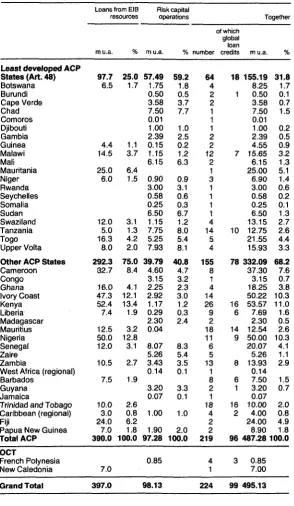
Table 3 and figure 1 give the breakdown by project location and enable an interesting comparison between the different forms of financing and the level of economic development of the countries concerned, as defined by Article 48 of the Convention which lists those countries considered as the least developed.
75% of loans from the Bank's own resources went to investment projects in countries not included in Article 48. This reflects
— the capacity of different countries to service loans repayable in the major international currencies at rates of interest between 5 and 8%;
— the division of responsibilities between the EIB and the Commission of the European Communities, whereby the latter concentrates its activities on lower income countries.
Figure 1: the first Lomé Convention
Geographical breakdown according to Article 48 of the Convention
Loans from EIB resources Risk capital operations
On the other hand, the risk capital operations, which the Bank could obviously carry out on much softer conditions, went 60% to investment in countries listed in Article 48.
This emphasises the importance of the risk capital facility in enabling the Bank to extend its financing and thus support industrial development In countries where otherwise it would be difficult to operate.
Moreover, in many cases, projects have been supported with a "mix" of loans on own resources and risk capital contributions, permitting a fine tuning of aid to the charac-teristics of a given investment.
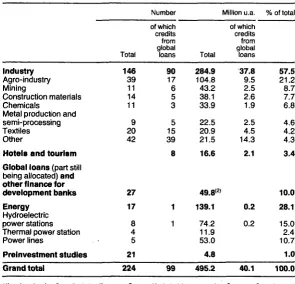
The sectoral breakdown of financing is given in Table 4 (page 10) and in the loans lists on pages 11-16, but before examining these, three gen-eral points about the Bank's opera-tions require some comment
— help for small-scale investment as well as larger projects
— assistance in preparing invest-ment projects by using some of the risk capital for feasibility studies — cooperation in co-financing with other development agencies to help the ACP.
Smaiier-scaie ventures
Industrial development cannot be achieved through large, capital-in-tensive projects alone. It also re-quires the creation of smaller-scale enterprises to cater for local markets and special needs, to provide repair services, to widen the scope for training skilled manpower and to offer increasing numbers of better educated people the chance to de-velop entrepreneurial skills. Indeed,
in a number of the ACP countries, smaller-scale ventures are the only realistically possible approach to in-dustrial development, at least in the immediate future.
There are obvious practical difficul-ties as to how a Bank operating from Europe can deal directly with the needs of small ventures in distant countries, so the EIB has channelled finance to them through develop-ment banks in ACP countries who know their potential clients and who are well equipped to assess each small investment.
The EIB has made finance available to development banks in a number of ways. In most cases it has lent funds from its own resources in the form of global loans (basically lines of credit) which the institution then splits up into a number of sub-loans for smaller-scale investments. The conditions laid down for the use of this finance (e.g. the size, nature and location of ventures to be assisted) are generally fixed in negotiating each operation, and all the ventures to be financed are chosen in agree-ment with the EIB.
Other forms of support have been to use risk capital to take participations in the equity of development banks, so strengthening their capital base, or to subscribe to bonds issued by a bank. Furthermore the EIB some-times provides risk capital enabling development banks to take partici-pations in ventures they finance.
Roughly a quarter of the ElB's total financing for industrial and tourism development in the ACP countries under Lomé 1 was carried out through such operations, which have the additional benefit that they help the development of the finan-cial/banking sectors of the countries concerned. In dealing with the EIB, and learning how to work according to its financing criteria, the staff of these banks also have a wider op-portunity to develop their profes-sional capacities; indeed it is the operational efficiency and manage-ment quality of the developmanage-ment banks which represent their best guarantee of success, not simply the total volume of funds made available to them.
Preinvestment studies
To help promote industrial and other development in the ACP on a wider basis, the EIB branched out under Lomé 1 into a new activity, using risk capital funds to finance preinvest-ment studies: 21 operations in 20 countries were carried out.
This type of financing — particularly well received by the ACP — encour-ages the thorough investigation of ideas prior to their implementation, minimising the danger of misallocat-ing resources to investment not suf-ficiently well examined. The finan-cial obligations of the borrower are waived if the study finally recom-mends abandoning the project in-vestigated as not being feasible, and hence the risk is transferred from the borrower to the Community.
Under Lomé 1, Member States' aid agencies helped to finance 31 pro-jects with the EIB with loans for a total amount of over 300 million u.a.; the World Bank and its affiliate the International Finance Corpora-tion helped to finance 17 projects for a total of some 320 million u.a. Arab funds — in particular the Saudi Fund and Kuwait Fund — came into 9 pro-jects for over 280 million u.a. (the
fact that the EIB, or World Bank, has appraised a project and found it economically sound can be an im-portant factor in the decision of Arab funds to participate in the financing) {').
(') figures do not take account of loans to, or participations in, ACP development banks which the EIB has also supported.
The financing of a study does not commit the Bank to lend for the project itself, if it eventually gets off the ground. But normally one of the aims of the study is to define the investment in such a way that the EIB, or other financing institutions, may decide on the basis of the con-clusions whether or not to provide support. For example, a study fi-nanced in Cape Verde to determine the feasibility of building a ship re-pair yard led to EIB financing for the capital expenditure on the facilities recommended by the study.
The facility has also been used to help ACP development banks ex-amine a number of potentially sound projects in specific sectors which — if the studies are positive — could then be financed using funds pro-vided by the EIB.
Thanks to these studies the EIB does not step in only when projects are well defined and getting close to implementation but is able to come in at the project preparation stage and help the promoters to design their investment to the best advan-tage for them and their country.
Cooperation with other aid agencies
The EIB has always, since the first Yaounde Convention, stressed the importance of strong links with Member States' bilateral aid organ-isations and other international len-ders; in the last few years, it has also begun to build up cooperation with the various bilateral or multilateral financial institutions in the Arab oil-producing countries.
[image:9.595.237.532.260.767.2]This has helped in the identification of possible projects for financing and in easing the complicated busi-ness of constructing financing plans for a number of the larger projects.
Table 3: Finance provided by the EIB under the first Lomé Convention geographical breakdown according to Article 48 of the Convention
Least developed ACP States (Art. 48) Botswana Burundi Cape Verde Chad Comoros Djibouti Gambia Guinea Malawi Mali Mauritania Niger Rwanda Seychelles Somalia Sudan Swaziland Tanzania Togo Upper Volta Other ACP States Cameroon Congo Ghana Ivory Coast Kenya Liberia Madagascar Mauritius Nigeria Senegal Zaire Zambia
West Africa (regional) Barbados
Guyana Jamaica
Trinidad and Tobago Caribbean (regional) Fiji
Papua New Guinea Total ACP OCT
French Polynesia New Caledonia Grand Total
Loans from EIB resources m u.a. 97.7 6.5 4.4 14.5 25.0 6.0 12.0 5.0 16.3 8.0 292.3 32.7 16.0 47.3 52.4 7.4 12.5 50.0 12.0 10.5 7.5 10.0 3.0 24.0 7.0 390.0 7.0 397.0
%
25.0 1.7 1.1 3.7 6.4 1.5 3.1 1.3 4.2 2.0 75.0 8.4 4.1 12.1 13.4 1.9 3.2 12.8 3.1 2.7 1.9 2.6 0.8 6.2 1.8 100.0 Risk capital operations m u.a. 57.49 1.75 0.50 3.58 7.50 0.01 1.00 2.39 0.15 1.15 6.15 0.90 3.00 0.58 0.25 6.50 1.15 7.75 5.25 7.93 39.79 4.60 3.15 2.25 2.92 1.17 0.29 2.30 0.04 8.07 5.26 3.43 0.14 3.20 0.07 1.00 1.90 97.28 0.85 98.13 % 1 59.2 1.8 0.5 3.7 7.7 1.0 2.5 0.2 1.2 6.3 0.9 3.1 0.6 0.3 6.7 1.2 8.0 5.4 8.1 40.8 4.7 3.2 2.3 3.0 1.2 0.3 2.4 8.3 5.4 3.5 0.1 3.3 0.1 1.0 2.0 100.0 of which lumber 64 4 2 2 1 1 1 2 2 12 2 1 3 1 1 1 1 4 14 5 4 155 8 1 4 14 26 9 2 18 11 6 5 13 1 8 2 1 18 4 2 2 219 4 1 224 global loan credits 18 1 7 10 Together m u.a. 155.19 8.25 0.50 3.58 7.50 0.01 1.00 2.39 4.55 15.65 6.15 25.00 6.90 3.00 0.58 0.25 6.50 13.15 12.75 21.55 15.93 78 332.09 16 6 14 9 8 6 1 16 2 37.30 3.15 18.25 50.22 53.57 7.69 2.30 12.54 50.00 20.07 5.26 13.93 0.14 7.50 3.20 0.07 10.00 4.00 24.00 8.90%
31.8 1.7 0.1 0.7 1.5 0.2 0.5 0.9 3.2 1.3 5.1 1.4 0.6 0.2 0.1 1.3 2.7 2.6 4.4 3.3 68.2 7.6 0.7 3.8 10.3 11.0 1.6 0.5 2.6 10.3 4.1 1.1 2.9 1.5 0.7 2.0 0.8 4.9 1.8 96 487.28 100.0Sectoral breakdown of lending under Lomé 1
Nearly 70% of total EIB financing operations in the ACP under Lomé 1 — some 335 million u.a. — went to industrial, agro-industrial and mining investment and 28% — 139 million u.a. — to energy schemes, of which the major part, principally hydroelectric, will help cut dependence upon oil imports; the remainder — 21 million u.a. — went to tourism development and the financing of studies.
Industry
Agro-industry
This was the largest single industrial sector for EIB financing, with 39 operations (including 17 credits from global loans) in 18 countries for a total of 104.8 million u.a., roughly two thirds from the Bank's own resources.
Approximately half the funds went to investment aimed primarily at mee-ting domestic consumption (e.g. ri-ce, palm oil), thus reducing food deficits which weigh on the balance of payments; the other projects were export-oriented (e.g. tea, rubber, groundnuts) with, in some cases, a major foreign currency-earning potential.
In the selection and appraisal of these projects particular attention was paid to the need to ensure that the scale and timing of factory con-struction were in line with the pro-gramme for plantation production.
Mining
Eleven financing operations (includ-ing six credits from global loans) worth 43.2 million u.a., over three quarters from the Bank's own re-sources, were carried out in six countries. More than half the total went to open-cast mining of the Guelb iron ore deposits in Mauritania (80% of the ore for sale to iron and steel concerns in Com-munity Member States), the object of a major international financing plan involving, in particular, several Arab sources of finance.
Tin and tungsten ore production in Rwanda, a pilot chrome ore dephos-phorizing plant in Madagascar and the reopening of a gold mine in Upper Volta were the other major investments. The last-mentioned shows how changes on world-mar-kets can stimulate new activity: the goldmine had been worked until 1966 when the price no longer made it worthwhile, whereas the market now seems likely to remain favour-able for the foreseefavour-able future. Even on a cautious assumption of the
future gold price, the annual exports should form a significant share of the country's total export earnings and reduce substantially its trade deficit. A total of 500 jobs are in-volved.
Also in the mining sector the Bank financed studies on exploiting bituminous deposits in Madagascar with a view to extracting petroleum products and assessing the quantity and quality of iron ore reserves in Senegal. One of the themes of the second Lomé Convention (see page 19) is the need to stimulate mining Investment and here the EIB has a particular role to play.
Construction materials
Fourteen financing operations (in-cluding five credits from global loans) worth in total 38.1 million u.a., more than 70% from the Bank's own resources, went to investments in 11 countries.
The vast majority — all the individual loans — went to modernisation, ex-tension and construction of cement plants and development of limes-tone deposits for cement produc-tion. The ACP countries are liable to find their industrialisation, infras-tructure development and rapid ur-banisation exposing them to sub-stantial foreign exchange outgoings and, because internationally traded cement is a relatively tight market, to occasional irregularity In supplies.
[image:10.596.235.531.452.736.2]All the projects assisted by the EIB are import substitution investments aimed at guaranteeing a steady, loc-al supply of cement which, given the very high transport costs of cement imports and the potential impact of
Table 4: Financing provided by the EIB under the first Lomé Convention"' Breakdown by sector
industry Agro-industry Mining
Construction materials Chemicals
Metal production and semi-processing Textiles Other
Total 146 39 11 14 11 9 20 42
Number of which credits from global loans 90 17 6 5 3 5 15 39
Total 284.9 104.8 43.2 38.1 33.9 22.5 20.9 21.5
Million u.a. of which credits from global loans 37.8 9.5 2.5 2.6 1.9 2.5 4.5 14.3
% of total
57.5 21.2 8.7 7.7 6.8 4.6 4.2 4.3
Hotels and tourism Global loans (part still being allocated) and other finance for
16.6 2.1 3.4
development banks Energy
Hydroelectric power stations Thermal power station Power lines
Prelnvestment studies Grand total
27 17 8 4 5 21 224
1 1
99
49.e<=' 139.1
74.2 11.9 53.0 4.8 495.2
0.2 0.2
40.1
10.0 28.1 15.0 2.4 10.7 1.0 100.0
(1 ) and under the Council of the European Communities' decision concerning Overseas Countries and Territories
(2) Difference between the sum of global loans and other finance granted (89.9 million u.a.) and the amount of credits (40.1 million u.a.) provided as at 31 December 1980.
high construction costs on the gen-eral rate of inflation, is important for the management of a country's de-velopment programme.
Particular mention should be made of CIMAO — Ciments de l'Afrique de l'Ouest, a project mounted by the Togo, Ghana and Ivory Coast gov-ernments and designed to cover 70% of the three countries' total cement requirements by developing limestone deposits in Togo, with Ghana offsetting part of its purch-ases of clinker by supplying hyd-roelectric power for the production. This large-scale regional project shows what is possible with closer collaboration between neighbouring countries and pooling resources and national markets.
Lomé 1 : Finance provided by the EIB
Ctiemicals
Eleven financing operations (includ-ing three credits from global loans) for a total of 33.9 million u.a., rough-ly two thirds from the Bank's own resources, were carried out in four countries.
Here again, import substitution or building up an export capacity were among the main aims, with in some cases a useful transfer of technology taking place.
In Botswana, for example, a country heavily dependent upon beef ex-ports, funds were provided for a fac-tory to produce vaccine against foot-and-mouth disease. Production will also be available for use in neigh-bouring countries, including Zim-babwe, where the same virus is found. The plant is being set up with the technical assistance of the In-stitut Mérieux (France).
In Kenya a new plant will process maize cobs to extract chemicals (furfural, used in the manufacture of lubricating oils, and furfuryl alco-hol, used in precision casting). Mechanized maize harvesting in the Western world has greatly reduced the availability of cobs and the pro-ject is receiving financing, manage-ment and marketing support from British interests. This is an interest-ing example of how technology can be profitably used to exploit a previ-ously wasted agricultural material and so raise farmers' incomes.
Million
u.a. interesti" (years) Rate of Term INDUSTRY
Agro-Industry Cameraon
Palm oil mill at Dibombari
Conditional loan to Société Camerounaise de Palmeraies — SOCAPALM
Chad
Banda sugar complex
Conditional loan to State towards financing Its majority equity participation In Société Nationale Sucrière du Tchad — SONASUT
Gambia
Modernisation of groundnut-processing facilities Conditional loan to State for Gambia Produce Marketing Board — GPMB
Ivory Coast
Coconut and palm oil mill at Abidjan Loan to PALMINDUSTRIE
New latex-processing capacities at Bongo, Ousrou and Rapides Qrah
Loan to Société Africaine de Plantations d'Hévéas — SAPH
Construction of flour mill, silos and transshipment facilities at San Pedro harbour
Loan to Moulin du Sud-Ouest — MSO Dessicated coconut factory at Jacqueville Loan to Société Ivoirienne de Coco Râpé-SICOR Equity participation In SICOR
Kenya
Development of sugar cane plantations and construc-tion of sugar mill
Loan to South Nyanza Sugar Company Ltd. Construction of 10 smallholder tea factories Loan to Kenya Tea Development Authority — KTDA
Malawi
Planting of 6 000 ha sugar cane estate and construc-tion of sugar mill
Loan to Dwangwa Sugar Corporation Limited State equity participation In Dwangwa Sugar Corporation Limited
Mall
Construction ot rice mill at DIoro Conditional loan to State Papua New Guinea
Palm oil mill near Popondetta and storage facilities at Oro Bay
Loan to Higaturu Processing Pty Ltd.
Conditional loan to State for financing its participation In capital Increase of Higaturu Processing Pty Ltd. Senegal
Modernisation and expansion of groundnut and cot-tonseed processing capacities at Ziguinchor Loan to Société Nationale de Commercialisation des Oléagineux — SONACOS
Swaziland
Planting of sugar cane estate and construction of sugar mill
Loan to Royal Swaziland Sugar Corporation Ltd. — RSSC
Togo
Palm oil mill at Agou and oil storage facilities at Lomé harbour
Loan to Société Nationale pour le Développement de la Palmeraie et des Huileries — SONAPH
Conditional loan to State towards financing Its stake in SONAPH capital increase
Upper Volta
Expansion of sugar complex at Banfora
Subordinated loan to Société Sucrière Voltäique — SOSUHV
Conditional loan to Stata for subscription of SOSUHV shares
Zaire
Palm oil mill at Gosuma
Conditional loan to State towards financing its stake In Palmeraies du Zaire
2.30*
7.50*
2.30*
7.50
4.60
3.65*
7.00 1.90*
3.00
10.00 6.5
5.95
20
20
20
13
12
3.00 1.44 0.23*
12.00 7.50
6.50 0.96*
β
5.15
5.75
8
5.875 12
13
15
12
12
20
5.65 15 2 20
10
5.05 12
2.33
3.15*
3.00*
1.43* 5.85
2
2
2
15
20
13
20
4.00* 20
(<) In the case of loans from the ElB's resources the rate indicated is after deduction of the interest subsidy paid from the resources of the European Development Fund.
NB. Risk capital operations are marked by an asterisk against the amount.
An advanced chemical plant in Senegal will process phosphate rock, and also a sludge by-product of phosphate mining, hitherto re-garded as useless, to manufacture phosphoric acid and solid fertilizers (the Ivory Coast and Nigeria are part-ners in the scheme — some of the phosphoric acid will be exported to other West African countries where it will be transformed into fertilizers — and there are also Indian inter-ests).
IVIetal production and processing
Nine financing operations (including five credits from global loans) for a total of 22.5 million u.a., roughly 90% from the Bank's own resources, were carried out in six countries.
Two of the largest loans went to expanding and modernising an aluminium plant in Cameroon. This deserves a particular mention as the project makes economic use of na-tional hydroelectric resources for the smelting, giving a good competi-tive edge in exporting the finished product, and promotes a significant flow of trade with another ACP country (alumina from Guinea to Cameroon).
The other major Investments were modernisation of a plant in Guinea transforming bauxite into alumina and improvements to cobalt produc-tion facilities in Zambia (the latter aimed at producing high grades of industrial cobalt, with good market prospects, as part of a diversifica-tion effort at a time when the coun-try's main export, copper, is com-manding low prices).
Textiles
Twenty financing operations (in-cluding 15 credits from global loans) for a total of 20.9 million u.a., over two thirds in risk capital, were car-ried out in 10 countries.
The investments which the EIB helped to finance aim basically at satisfying local demand. In some cases, they also allow for small sur-pluses which can be absorbed by intra-ACP trade.
Particular care was taken in study-ing market size and production costs to avoid excess capacity or the encouragement of inefficient
Million Rate of Term u.a. interesfi'i (years) Mining
Madagascar
Chrome ore dephosphorisatlon pilot plant at Andria-mena
Conditional loan to State Maurttania
Opening up of Iron ore deposits and construction of ore enrichment plant in Guelb El Rhein region near Zouerate
Loan to Société Nationale Industrielle et Minière
— SNIM
Rwanda
Expansion of production capacity at tin (cassiterite) and tungsten (wolfram) mines.and construction of tin smelter
Subordinated loan to Société des Mines du Rwanda —SOMIRWA
Upper Volta
Re-opening of Poura gold-mine, south-west of Ouaga-dougou
Loan to Société de recherche et d'exploitation minière — SOREMI
Conditional loan to State towards financing its equity participation in SOREMI
Construction materials Cameroon
Expansion of two cement works, at Bonabéri (Douala) and Figuil (North Cameroon)
Loan to Cimenteries du Cameroun — CIMENCAM Increasing production capacities of Bonabéri clinker crushing plant and Figuil cement works
Loan to CIMENCAM Ghana
Extraction facilities at limestone quarry and construc-tion of Tabligbo clinker plant (Togo)
Subordinated loan to State towards financing its hol-ding of preference shares in Ciments de l'Afrique de l'Ouest — CIMAO
Ivory Coast
Extraction facilities at limestone quarry and construc-tion of Tabligbo clinker plant (Togo)
Subordinated loan to State towards financing its hol-ding of preference shares in Ciments de l'Afrique de l'Ouest — CIMAO
Kenya
Expansion of cement works on Athi River near Nairobi Loan to East African Portland Cement Company Ltd. — EAPC
Togo
Extraction facilities at limestone quarry and construc-tion of clinker plant at Tabligbo, near Lomé Loan to Ciments de l'Afrique de l'Ouest — CIMAO Subordinated loan to State towards financing its hol-ding of preference shares in CIMAO
Zaire
Expansion of Shaba cement works
Subordinated loan to Société des Ciments et Ma-tériaux du Shaba, through Intermediary of Société Financière de Développement — SOFIDE
2!ambla
Modernisation ol cernent works near Lusaka Conditional loan granted to Industrial Development Corporation Ltd. — INDECO for Increasing Its stake in Chilanga Cement Company Ltd.
Ctiemicals Botswana
Laboratory at Gaborone for producing vaccine to protect cattle against foot-and-mouth disease
Loan to Botswana Vaccine Institute (Pty) Limited
Conditional loan to the State towards financing its stake in capital increase of Bovine Vaccine Institute (Pty) Limited
Ivory Coast
Expansion and rationalisation of fertiliser factory in Abidjan Industrial zone
Loan to Société Ivoirienne d'Engrais — SIVENG Equity participation in SIVENG on behalf of EEC
1.19* 6.6 12
25.00 7.4 15
3.00* 2 end 1981
6 thereafter
8.00 8 3.50* 2
15
14 15
2.00 5
1.50*
5.17 0.51*
10
6.60 7.3 10
2.00* 2
2.00* 2 20
20
3.00 5.25 8
14.00 6 14.5
2.00* 2 20
1.09* 5.5 15
2.80* 2
2.50
7.15 20
10
20
10
(') In the case of loans from the ElB's resources the rate indicated is after deduction of the interest subsidy paid from the resources of the European Development Fund.
NB. Risk capital operations are marked by an asterisk against the amount.
domestic production requiring per-manent protection by stiff customs duties.
In employment terms these projects were often of substantial im-portance, not only In direct creation of jobs in the mills but also because. In most cases, they were linked to cotton-growing schemes.
For example, in the Sudan a cooperative owned by close to 100 000 small cotton farmers is building a mill. The Sudan has tradi-tionally exported most of its cotton in its raw state and imported most of its cloth requirements. The new mill (apart from creating close on 1 000 jobs) will mean a substantial In-crease in value added in the cotton industry, will raise the farmers' in-comes and will make a strong con-tribution to improving the country's balance of payments.
Otfier industries
Forty-two financing operations (in-cluding 39 credits from global loans) for a total of 21.5 million u.a., almost two thirds from own resources, were carried out in 13 countries. Among the investments supported were a ship repair yard in Cape Verde and forestry development in Guyana — both offering substantial
employ-ment creation (over 400 jobs in the Guyana project) and good foreign exchange-earning potential — and a factory in Senegal which is buil-ding solar panels for individual and communal hot water systems as well as to power pumps in remote rural areas. This was the first time that the EIB had helped to finance solar energy development and the results could prove interesting to several other African countries.
Hotels and tourism
Thirteen financing operations (inclu-ding 8 credits from global loans) worth in total 16.6 million u.a., alm-ost two thirds from the Bank's own resources, were carried out in 11 countries.
This sector is important not only because of foreign exchange ear-ning, but also because adequate ac-commodation in the main business centres is part of the necessary in-frastructure to spur on economic growth.
Kenya
Factory producing furfural, acetic acid and formic acid Loan to Kenya Furfural Company Ltd. — KFC Equity participation in KFC on t)ehalf of the EEC Senegal
Phosphoric acid and fertiliser production complex at Taiba and Dakar
Loan to Industries chimiques du Sénégal — ICS Conditional loan to State towards financing its equity participation in ICS
Metal production and semi-processing Cameroon
Expansion and modernisation of aluminium produc-tion plant at Edéa
Loan to Compagnie Camerounaise de l'Aluminium — ALUCAM
Conditional loan to State towards Its stake In ALUCAM's capital increase
Guinea
Modernisation of installations at Fria-Kimbo alumina works
Loan to FRIGUIA company Zambia
Construction of cobalt vacuum refining plant at Chambishi
Loan to Roan Consolidated Mines Ltd. — RCM Textiles
Cameroon
Terry towelling mill at Douala
Loan to Société textile du Cameroun pour le Linge de Maison — SOLICAM
Niger
Modernisation of textile mill at Niamey
Loan to Société Nouvelle Nigérienne du Textile — SONITEXTIL
Conditional loan to State towards financing its equity participation in SONITEXTIL
Sudan
Textile mill at Wad Medani
Conditional loan to Gezira Managil Textile Company Ltd. — 6ΕΜΑΤΕΧ
Tanzania
Canvas mill near Morogoro
Conditional loan for financing National Development Corporation's equity participation in Morogoro Canvas Mill company
Other industries Cape Verde
Construction of fishing boat repair yard at Porto Grande-Mindelo
Conditional loan to State towards own funds compo nent required for financing project
Guyana
Forestry development
Conditional loan to State for financing part of its equity participation in Demerara Woods Limited
Senegal
Construction of plant to produce solar collectors and insulated tanks at Thies
Conditional loan to State for financing its stake in capital increase of Société Industrielle des
Applications de l'Energie Solaire — SINAES HOTELS & TOURISM
Cameroon
Hotel at Douala
Loan to Société Hôtelière du Littoral — SOHLI
Congo
Hotel at Brazzaville
Conditional loan to State towards its equity participa-tion in Société de l'Hôtel Maya-Maya
Ivory Coast Hotel at Abidjan
Loan to Société Immobilière de la Lagune
Million u.a.
5.88 1.07*
9.00 6.40*
Rate of interest«
5.15
6 2
Term (years)
11
15 20
5.30
2.30*
4.40
8.00
2.55
1.50
0.90*
6.50*
4.90*
3.50*
3.20*
0.50*
2.67
3.15*
1.65
6.35
2
6.3
5.2
2
5.5
6.125
12 20
10
10
10
10 20
11
20
6.5
25
20
20
13
20
13
(1) In the case of loans from the ElB's resources the rate indicated is after deduction of the interest subsidy paid from the resources of the European Development Fund.
NB. Risk capital operations are marked by an asterisk against the amount.
The larger investments supported by the Bank were hotel construction in Cameroon, Congo, Ivory Coast and Niger, mainly to cater for visiting businessmen, and construction of two holiday hotels and development of tourism circuits in Mali.
Being labour-intensive, with sub-stantial service requirements, hotel development can also make a useful contribution to creating work in urb-an areas of high unemployment.
Development banks
The means of channelling finance to small and medium-scale ventures through development banks has been outlined already on page 8.
During the first Lomé Convention 17 global loans from own resources, worth 82.5 million u.a., were made to ACP development banks, and risk capital support — including partici-pations in share capital — was provi-ded for a total of 7.4 million u.a. This assistance was given to 19 banks in all and corresponds to close on one fifth of all lending under Lomé 1, or a quarter of the lending for industrial and tourism development.
The global loan credits listed in the sectoral breakdown on page 10, almost 100 in total, are those which had been signed by end-1980; it should be borne in mind that appro-ximately half of the funds made avai-lable by the EIB to the development banks in global loans was at that date still in the process of being committed to specific investments.
Energy
17 financing operations worth 139.1 million u.a., virtually all from the ElB's own resources, went towards energy investment in 13 countries.
Most of the ACP are highly depen-dent upon oil for their energy supp-lies (70 to 100% of commercial ener-gy consumption in the majority of cases) and their needs are met main-ly, and often entiremain-ly, through im-ports.
Mall
Construction of hotel at Mopti and another at Timbuk-tu and acquisition of transport and communications équipement for setting up tour circuits
Conditional loan to State for Financing its participation in project
Niger
Hotel at Niamey
Loan to Société Propriétaire et Exploitante de l'Hôtel de Gaweye
DEVELOPMENT BANKS
Global loans for financing small and medium scale ventures
Barbados
Barbados Development Bank — BDB Burundi
Banque Nationale de Développement Economique — BNDE (for financing feasibility studies)
Caribbean
Caribbean Development Bank — CDB (for financing Investment in the CARICOM countries)
Caribbean Investment Corporation — CIC (for finan-cing in Caribbean OCT)
Ivory Coast
Compagnie Financière de Côte d'Ivoire — COFINCI Crédit de Côte d'Ivoire — CCI
Kenya
Development Finance Company of Kenya Limited — DFCK
DFCK
Industrial Development Bank Ltd. — IDB Liberia
Liberian Bank for Development and Investment — LBDI
Malawi
Investment and Development Bank of Malawi — INDEBANK
INDEBANK Mauritius
Development Bank of Mauritius — DBM Nigeria
Nigérian Industrial Development Bank Limited — NIDB Swaziland
National Industrial Development Corporation of Swaziland — NIDCS
NltX;S (Conditional loan for financing studies, equity participations and subordinated loans)
Tanzania
Tanganyika Development Finance Company Limited — TDFL
(Subscription of TDFL convertible bonds) Trinidad and Tobago
Trinidad and Tobago Development Finance Company Limited — TTDFC
TTDFC
Zambia
Development Bank of Zambia — DBZ French Polynesia
Société de Crédit et de Développement de l'Oceanie — SOCREDO (for financing studies, equity participa-tions and subordinated loans)
Other forms of finance for development banks Liberia
Equity participation, on behalf of EEC. in Liberian Bank for Development and Investment — LBDI Seyclielles
Equity participation, on behalf of EEC, in Development Bank of Seychelles — DBS
Zaire
Increase in capital of Société Financière de Développe-ment — SOFIDE (by subscription of shares) Equity participation in SOFIDE on behalf of EEC Zambia
Equity participation, on behalf of EEC, in Development Bank of Zambia — DBZ
Million u.a.
2.50*
4.51
2.50
0.50*
Rate of Term interest''' (years)
2.50
2.50
0.85*
0.29*
0.58*
0.10* 0.04*
0.55*
7.4
7.4
6.35
5.45
20
15
12
10
3.00
1.00*
3.50 3.50
5.00 2.00 5.00
6.8
2
8 8
6.3 6 5
12
25
12 12
11
13.5
11
10
5.00 3.00
3.00
25.00
2.00
1.00*
5.00
2.50*
5.00 5.00
8
5.06
5.75
5.75
8
2
5.75
5.875
5.05
7.4
12 12
15
12
12
11
11
11
12 12
12
14
(') In the case of loans from the ElB's resources the rate indicated is after deduction of the interest subsidy paid from the resources of the European Development Fund.
NB. Risk capital operations are marked by an asterisk against the amount.