Please cite as:
Sirois, F. M., & Tosti, N. (2012). Lost in the Moment? An Investigation of Procrastination, Mindfulness, and Well-being. Journal of Rational - Emotive and Cognitive - Behavior Therapy, 30(4), 237-248. doi:10.1007/s10942-012-0151-y
Lost in the Moment? An Investigation of Procrastination, Mindfulness, and Well-being
Fuschia M. Sirois and Natalia Tosti University of Windsor
Author’s Note
Fuschia M. Sirois, PhD, is now at the Department of Psychology, Bishop’s University; Natalia Tosti, Department of Psychology, University of Windsor.
This paper is based in part on data collected for Natalia Tosti’s (2010) honour’s thesis.
Correspondence concerning this article should be addressed to Fuschia M. Sirois, PhD, Department of Psychology, University of Sheffield, 309 Western Bank, Sheffield, S10 2TP, United Kingdom
Abstract
Introduction
Self-regulation, or the ability to control and regulate one’s behaviours, thoughts, and emotions, has been described as the “quintessential characteristic of human beings” (Forgas, Baumeister, & Tice, 2009, p. 1). In contrast, procrastination has been described as the quintessence of self-regulatory failure (Steel, 2007). Beyond the negative consequences of procrastination for emotional well-being (Flett, Blankstein, & Martin, 1995), there is growing evidence that procrastination can also take a toll on physical well-being and that stress may play a key role (Sirois, 2007; Sirois, Melia-Gordon, & Pychyl, 2003). Evidence from experimental studies implicate avoidance of unpleasant thoughts, feelings, and actions as contributing to both procrastination itself and the stress associated with this behavioural tendency (Sirois, 2004; Tice, Bratslavsky, & Baumeister, 2001). Approaches that focus on acceptance of unpleasant states and thoughts may therefore be beneficial for reducing stress related to procrastination. Mindfulness in particular is known to foster greater awareness of difficult thoughts and feelings, reduce stress, enhance task persistence, and improve health (Brown, Ryan, & Creswell, 2007). Whether
mindfulness may explain the links between procrastination, stress, and health has not been examined. In this study we extend previous work documenting links between procrastination, stress, and physical health by examining the potential role of mindfulness.
Procrastination, Stress, and Health
and the delay of health promoting behaviours. Tests of the procrastination-health model with both student and community-dwelling adults found that stress, and to a lesser extent health behaviours, explained the association between procrastination and poor health (Sirois, 2007; Sirois et al., 2003).
The reasons why procrastination creates unnecessary stress has received less attention, but at least one study suggests that cognitive styles linked to emotional regulation may play a role. In one experimental study, participants were asked to generate thoughts about what might have been (counterfactuals) after imagining themselves in a scenario where they delayed seeking care for possible skin cancer symptoms (Sirois, 2004). Rather than focus on how things could have been better (upward counterfactuals) had they acted in a timely manner thereby gaining insight to correct future behaviour, procrastinators tended to focus on how things could have been worse (downward counterfactuals) to minimize anxiety about their delay and its consequences. Similar to other forms of avoidance, procrastination is a strategy that brings immediate but temporary relief from difficult or distressing thoughts associated with a task (Tice et al., 2001), but may ultimately create more stress if the issues surrounding task completion are left unresolved. In the end, this can leave procrastinators feeling more stressed about their own procrastination, and lead to self-criticism, judgemental reactive thoughts, and embarrassment that perpetuates the cycle of procrastination.
present-fatalistic time orientation (Ferrari & Díaz-Morales, 2007; Jackson, Fritch, Nagasaka, & Pope, 2003). Although the temporal focus of procrastinators is the present, this focus does not appear to involve being truly “present” to the moment, and may therefore be qualitatively distinct from other forms of present-focused awareness such as mindfulness.
Mindfulness, Stress, and Well-being
Mindfulness, whether conceptualized as an activity-based practice that can be learned or as a stable tendency arising from a certain philosophy of life and/or value system, is suggested to be a key quality for successful self-regulation (Evans, Baer, & Segerstrom, 2009). Mindfulness involves a present-centered, non-reactive self-awareness and nonjudgmental acceptance of thoughts and feelings as they occur (Baer & Allen, 2004). It is known to reduce stress and enhance well-being partly because it reflects a quality of consciousness that is vivid, non-critical, yet actively engaged in the experiences, thoughts, and feelings occurring in the moment (Brown & Ryan, 2003; Brown et al., 2007).
The mindful state can be particularly beneficial for self-regulation as theory and research indicates that self-awareness is necessary for detecting discrepancies between current states and standards in order to motivate corrective behaviour (Carver & Scheier, 1998). Unlike
self-criticism, and impulsive abandonment of the task, whereas mindfulness promotes acceptance of such self-critical and negative thoughts allowing one to move past negative self talk and persist with the task.
With respect to health, there is growing evidence that mindfulness may have a salutary effect on both subjective reports of health and positive changes in physical health as assessed by markers of immune functioning (see Brown et al., 2007 for a review). Symptom reports and other self-reports of overall health are by nature subjective and affected by current mood states, stress, and individual differences in negative affect (Watson & Pennebaker, 1989). Mindfulness, however, involves a type of awareness that is similar to sensory focusing, a concrete and neutral perception of physical states without the emotional and interpretative qualities that amplify threat and discomfort. This may be one reason why mindfulness is positively associated with self-reported health.
The Current Study
Theory and research indicate that mindfulness may be an important type of present-focused awareness for understanding how procrastination is associated with stress and health. Although procrastination is associated with a present-oriented focus, it is also linked to cognitive styles favouring the avoidance of unpleasant thoughts and feelings and the indulgence of
impulses to deal with threats to self-esteem (Sirois, 2004; Tice et al., 2001), rather than being fully present. Procrastination is associated with private self-consciousness (Ferrari, 1992), a form of self-awareness known to be distinct if not negatively associated with mindfulness (Brown et al., 2007). Findings from other studies also supports the notion that procrastinators tend to evaluate themselves negatively (Flett et al., 1995).
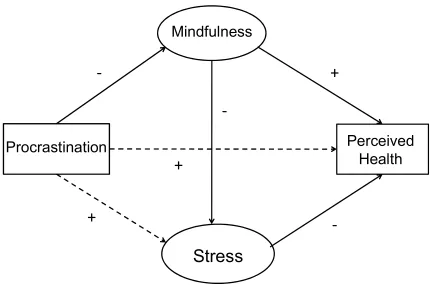
mindfulness, and that low mindfulness may also explain the higher levels of stress associated with procrastination. Given the salutary effects of mindfulness on health, it is possible that mindfulness partially explains why procrastination is associated with poor health. To test these propositions we examined the potential mediating role of mindfulness in the procrastination-health relationship using structural equation modelling. This statistical technique provides a powerful test of complex path analyses that accounts for measurement error (Bollen & Long, 1993). Structural equation modelling allowed us to test 1) whether mindfulness mediated the relationship between procrastination and stress, and 2) whether mindfulness also mediated the relationship between procrastination and health, within the same model. The proposed relations between procrastination, stress, mindfulness, and health are shown in Figure 1.
Methods
Participants and Procedure
Participants were 350 undergraduate psychology students recruited from a psychology experiment participant pool and who received extra course credit for their participation. Data from one student were discarded because of excessive missing data on the main variables of interest, and data from another 10 participants was removed because they were identified as extreme outliers. This left a final sample of 339 (81.7% female) participants, with a mean age of 21.7 (SD = 4.9).
Materials
After reading and agreeing to an online consent form, participants completed an online survey which included demographic questions and measures of procrastination, mindfulness, perceived stress, wellness behaviours, and health status.
1986) is a 20-item scale that assesses global tendencies towards procrastination across a variety of tasks. Respondents rate items on a 5-point Likert-type scale ranging from 1 (false of me) to 5 (true of me). Half of the items are reverse-scored before summing all items into a single score with high values indicating a higher tendency to procrastinate. The GPS has demonstrated good internal consistency (alpha = 0.82; Lay, 1986). In the current study the internal consistency was good (alpha = .87).
The Mindful Attention Awareness Scale (MAAS).The Mindful Attention Awareness Scale (MAAS) is a 15-item scale that assesses an individual’s general tendencies and ability to remain present during daily activities. Items such as “It seems I am ‘running on automatic’, without much awareness of what I'm doing” are rated on a 6-point scale with responses ranging from 1 (almost always) to 6 (almost never). The MAAS has a reported internal consistency of .87 (Brown & Ryan, 2003), and the Cronbach’s alpha for the current study was .88.
Kentucky Inventory of Mindfulness Skills. The Kentucky Inventory of Mindfulness Skills (KIMS; Baer & Allen, 2004) is a 29-item measure of mindfulness skills. It assesses four types of mindfulness skills: observing, describing, acting with awareness, and accepting without
judgment. Items are rated on a 5-point Likert scale ranging from 1 (never or very rarely true) to 5 (almost always or always true), with high scores reflecting more mindfulness. For the purposes of this study the only the 10-item acting with awareness (“I don't pay attention to what I'm doing because I'm daydreaming, worrying, or otherwise distracted”) and the 9-item accepting without judgment (“I criticize myself for having irrational or inappropriate emotions”) subscales were examined as they capture dimensions of mindfulness that may be most relevant for
Mindfulness practices.How often participants engaged in mindfulness practices per week was assessed with a single question designed for this study. Examples of mindfulness practices were provided – yoga, meditation, Tai Chi – and the frequency of mindfulness practices was rated on a 3-point scale ranging from 1 (0 times per week) to 3 (>2 hours per week).
Perceived Stress Scale. The Perceived Stress Scale (Cohen & Williamson, 1988) is a 10-item measure of the perceived stressfulness of events experienced within the past month . Items are rated on a 5-point scale with response options ranging from “never” to very “often”. It is a widely used empirically established index of general stress appraisal that has demonstrated adequate internal consistency. The Cronbach’s alpha for the current study was .84.
Stress ratings. The degree of stress experienced in the past 2 weeks and 6 months was assessed with two items rated on a 10-point scale ranging from 1 (not stressful at all) to 10 (extremely stressful). These items have been used in a previous study examining the
procrastination-health model (Sirois, 2007). A stress index was formed by taking the mean of the two items.
Global health rating. Self-reported health status was assessed with the general health rating item from the Medical Outcomes Survey 36 item short form (SF-36) health questionnaire (Ware & Sherbourne, 1992). The SF-36 is a widely used and well-validated measure of
subjective health and quality of life, and the general health item provides a reliable overall score of physical well-being. Respondents rated their overall health on a 5-point scale ranging from “Excellent” to “Poor” with higher values reflecting poorer perceived health.
Results
Descriptive Statistics
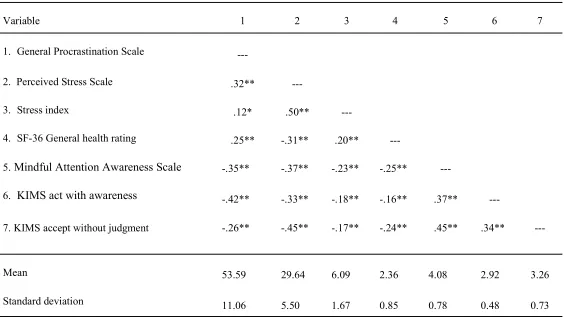
variables are presented in Table 1. Consistent with theory and previous research, procrastination was associated with high stress and poor health, and stress was correlated with poor perceived health. The expected associations with mindfulness were also found. The mindfulness measures were negatively associated with procrastination and stress, and positively associated with perceived health. Procrastination was also associated with less frequent mindfulness practices, r = -.16, p < .01.
Measurement Model of the Procrastination, Mindfulness and Health Relationship
AMOS 18.0 was used to assess the fit of the measurement model to the data. One factor loading for each latent construct was fixed to 1 and the paths among the two latent variables and the single indicator variable were allowed to correlate. Model fit was assessed with several indices suggested by Kline (2005): (i) chi-square statistic; (ii) RMSEA (root mean square error of approximation); (iii) CFI (Comparative Fit index); (iv) IFI (Incremental fit index). A very good fit of the model to the data indicated if the CFI and IFI are greater than 0.95, the RMSEA is below 0.05, and the chi-square statistic is non-significant. RMSEA values of .05 to .08 are considered to reflect adequate fit to the data (Bollen & Long, 1993). A test of the overall
measurement model indicated a good fit to the data: 2 (10, N = 339) = 29.53, p = .001; RMSEA = 0.07 (90% CI: 0.05–0.11); CFI = 0.96; IFI = 0.96.
Structural Model of the Procrastination, Mindfulness and Health Relationship
mediation is supported (Holmbeck, 1997). The direct paths from procrastination to stress ( = .31, p < .001), mindfulness ( = -.54, p < .001), and health ( = .25, p < .001), were significant in the predicted directions, as were the paths between mindfulness and stress ( = -.64, p < .001), stress and health ( = .37, p < .001), and mindfulness and health ( = -.41, p < .001).
Given that mindfulness was posited to mediate the links between procrastination and health in two ways (via its links with stress and with health), we tested each mediation model separately. First, the path between procrastination and stress was constrained to zero and this fully mediated model was compared to the partially mediated model (no path constraints). The fit of the fully mediated model was almost identical to that of the partially mediated model, 2 (10, N = 339) = 29.67, p = .002; RMSEA = 0.07 (90% CI: 0.04–0.10); CFI = 0.96; IFI = 0.96, and the chi-square difference between the two models was also non-significant, = 0.14, indicating that mindfulness fully mediated the effects of procrastination on stress. When the fully mediated model with the path between procrastination and health was constrained to zero and compared to the partially mediated model, there were minimal changes in the fit indices: 2 (10, N = 339) = 31.33, p = .002; RMSEA = 0.08 (90% CI: 0.05–0.11); CFI = 0.95; IFI = 0.95, and a non-significant change in the chi-square values, = 1.66. This indicated that mindfulness also mediated the effects of procrastination on health.
Bootstrapping Analyses of the Mediation
effects by multiplying 1000 pairs of path coefficients, the 95% CI for the estimates of the indirect effect excludes zero (Shrout & Bolger, 2002). For the current analyses 100% of the bootstrap samples converged. For the indirect effect of procrastination on stress via mindfulness, the bootstrapping analyses found that the mean mediation effect was significant ( = 0.35, 95% [CI: 0.21, 0.51]). For the indirect effect of procrastination on health via mindfulness, the mean mediation effect from the bootstrapping analyses was also significant ( = 0.17, 95% [CI: 0.07, 0.27]).
Discussion
The aim of this study was to bridge two disparate research areas relevant for self-regulation by examining the potential mediating role of mindfulness for explaining the links between procrastination, stress, and health. As expected, procrastination was associated with higher stress, poor perceived health, and low mindfulness. Procrastination was also linked to less frequent practice of mindfulness promoting activities such as yoga and meditation. Our findings are consistent with previous research and theory on the salutatory effects of mindfulness for health and well-being (Brown et al., 2007), as low mindfulness explained the association between procrastination and stress, as well as the effects of procrastination on perceived health. This is the first study that we are aware of that has noted associations between procrastination and mindfulness, and that provides evidence supporting the mediating role of mindfulness in the procrastination-health model.
not one that is truly present or accepting of current experiences. Instead, our findings with
respect to the low mindfulness of procrastinators is consistent with previous work indicating that
procrastinators evaluate themselves in a negative manner (Flett et al., 1995), and can be
self-critical (Sirois & Stout, 2011). Thus, procrastinators may take a self-critical and judgmental stance
towards a task they are struggling with which in turn can activate negative self-talk that
interferes with task persistence (Evans et al., 2009). According to the theory of metacognitive
awareness (Teasdale, Segal, & Williams, 1995), difficult tasks can activate judgemental and
reactive thoughts which promote frustration, self-criticism, and impulsive decisions to abandon
the task. In contrast, mindfulness facilitates non-reactive acknowledgment and acceptance of
these difficult thoughts, and allows them to dissipate. Because procrastinators tend to value
immediate emotional relief from distressing experiences over long term gains (Sirois, 2004; Tice
et al., 2001), low mindfulness may be another factor contributing to the avoidance commonly
associated with procrastination.
Beyond the implications for task completion, our findings indicate that procrastinators’
self-critical stance (low mindfulness) can also generate unnecessary stress, and have negative
implications for perceived health. Being non-accepting and judgemental of difficult experiences
is one route to increased stress, and if this also results in lack of task persistence to avoid these
difficulties, then further stress can result when the tasks are put off. Increased stress is one reason
for the poor health reported by procrastinators noted in previous tests of the
procrastination-health model (Sirois, 2007; Sirois et al., 2003). However, we also found a direct link between
mindfulness and health that suggests that the low mindfulness associated with procrastination
may affect health through other means. It is possible that low mindfulness may also be associated
for poor health through an indirect or behavioural route (Sirois, 2007). Given that engaging in
health promoting behaviours such as physical activity and eating healthy can be difficult tasks
for people to engage in regularly, mindfulness may promote acceptance of the difficulties
encountered while engaging in these behaviours. It is in this way that mindfulness may
contribute to persistence and success in practicing health promoting behaviours, and result in
improved health. Although we are not aware of any studies linking mindfulness to health
behaviours, this could be a fruitful area for researchers to explore that would extend research on
the salutary effects of mindfulness for health, and increase understanding of the implications of
low mindfulness for the health of procrastinators.
The current findings should be considered within the context of several limitations.
Although structural equation modelling is appropriate for the testing of models that imply causal
relationships among variables, it cannot fully establish the directionality of the causal links tested
with a cross-sectional design. Longitudinal designs provide a more robust test of the
directionality of links suggested by theory, and therefore future work testing the proposed model
over time is needed to confirm the findings from the present study. The fit indices for the model
were not within the ideal range suggesting that there is room for improvement with respect to
fitting the model to the data. The stress latent variable was only assessed with two as opposed to
the recommended three indicators (Kline, 2005), and this may be one reason for the less than
ideal model fit. Nonetheless, the sample size should be considered when evaluating the
significant chi-square, as this fit index is particularly sensitive to sample size and is almost
always significant when sample size and path coefficients are large (Kline, 2005).
The role of low mindfulness in the health and well-being of procrastinators suggested by
vis a vis low mindfulness, appear to play a central role in the emotional and physical well-being
of procrastinators, addressing these negative self-evaluative thoughts via counselling and therapy
interventions could provide far reaching benefits. Although mindfulness training appears to be an
obvious choice of intervention, the procrastinators in the current study were less likely to
dedicate time for mindfulness promoting practices on their own, and therefore other options may
be necessary. An REBT framework may be especially useful for targeting these self-critical
thoughts and the underlying irrational beliefs that may promote procrastinators’ non-acceptance
of current experiences.
In summary, the current study extends previous research on the associations between
procrastination, stress, and health by examining the potential mediating role of mindfulness using
structural equation modeling. Our results indicated that low mindfulness accounts for the
association of procrastination to stress, and also mediates the association of procrastination to
poor perceived health. We also found that procrastinators spent less time engaging in
mindfulness promoting practices such as yoga and meditation, activities which can also be
beneficial for reducing stress. For procrastinators, low mindfulness may be a risk factor for poor
emotional and physical well-being. Rather than actively experiencing the present in an accepting,
engaged, and aware manner, our findings indicate that procrastinators struggle with their own
References
Baer, R. A., & Allen, K. B. (2004). Assessment of mindfulness by self-report: The Kentucky
inventory of mindfulness skills. Assessment, 11(3), 191-206.
Bollen, K. A., & Long, J. S. (1993). Testing structural equation models. Newbury Park, CA:
Sage.
Brown, K. W., & Ryan, R. M. (2003). The benefits of being present: Mindfulness and its role in
psychological well-being. Journal of Personality and Social Psychology, 84(4), 822-848.
Brown, K. W., Ryan, R. M., & Creswell, J. D. (2007). Mindfulness: Theoretical foundations and
evidence for its salutary effects. Psychological Inquiry, 18(4), 211–237.
Carver, C. S., & Scheier, M. F. (1998). On the self-regulation of behavior. New York:
Cambridge University Press.
Cohen, S., & Williamson, G. (1988). Perceived stress in a probability sample of the United
States. In S. Spacapan & S. Oskamp (Eds.), The social psychology of health: Claremont
Symposium on applied social psychology. Newbury Park, CA: Sage.
Evans, D. R., Baer, R. A., & Segerstrom, S. C. (2009). The effects of mindfulness and
self-consciousness on persistence. Personality and Individual Differences, 47(4), 379-382.
Fenigstein, A., Scheier, M. F., & Buss, A. H. (1975). Public and private self-consciousness:
Assessment and theory. Journal of Consulting and Clinical Psychology, 43, 522–527.
Ferrari, J. R. (1992). Procrastinators and perfect behavior: An exploratory factor analysis of
self-presentation, self-awareness, and self-handicapping components. Journal of Research in
Personality, 26(1), 75-84.
Ferrari, J. R., & Díaz-Morales, J. F. (2007). Procrastination: Different time orientations reflect
Flett, G. L., Blankstein, K. R., & Martin, T. R. (1995). Procrastination, negative self-evaluation,
and stress in depression and anxiety: A review and preliminary model. In J. R. Ferrari, J.
H. Johnson & W. G. McCown (Eds.), Procrastination, and task avoidance: Theory,
research, and treatment (pp. 137-167). New York: Plenum.
Forgas, J. P., Baumeister, R. F., & Tice, D. M. (2009). The psychology of self-regulation: An
introductory review. In J. P. Forgas, R. F. Baumeister & D. M. Tice (Eds.), The
Psychology of Self-regulation (pp. 1-17). New York: Psychology Press.
Friedman, H. S. (2000). Long-term relations of personality and health: Dynamisms, mechanisms,
tropisms. Journal of Personality, 68(6), 1089-1107.
Holmbeck, G. N. (1997). Toward terminological, conceptual, and statistical clarity in the study
of mediators and moderators: examples from the child-clinical and pediatric psychology
literatures. Journal of Consulting and Clinical Psychology, 65, 599-610.
Jackson, T., Fritch, A., Nagasaka, T., & Pope, L. (2003). Procrastination and perceptions of past,
present, and future. Individual Differences Research, 1, 17–28.
Kline, R. B. (2005). Principles and practice of structural equation modeling (2nd ed.). New
York: The Guilford Press.
Lay, C. H. (1986). At last, my research article on procrastination. Journal of Research in
Personality, 20, 474-495.
Sirois, F. M. (2004). Procrastination and counterfactual thinking: Avoiding what might have
been. British Journal of Social Psychology, 43, 269-286.
Sirois, F. M. (2007). ‘‘I’ll look after my health, later’’: A replication and extension of the
procrastination–health model with community-dwelling adults. Personality and
Sirois, F. M., Melia-Gordon, M. L., & Pychyl, T. A. (2003). “I’ll look after my health, later”:
An investigation of procrastination and health. Personality and Individual Differences,
35(5), 1167-1184.
Sirois, F. M., & Stout, D. (2011). When knowing better doesn’t mean doing better:
Understanding the roles of procrastination and self-blame in the health and well-being of
nurses. Paper presented at the 7th Biennial Conference on Procrastination, Amsterdam,
The Netherelands.
Steel, P. (2007). The nature of procrastination: A meta-analytic and theoretical review of
quintessential self-regulatory failure. Psychological Bulletin, 133(1), 65–94.
Teasdale, J. D., Segal, Z. V., & Williams, M. G. (1995). How does cognitive therapy prevent
depressive relapse and why should attentional control (mindfulness training) help? .
Behaviour Research and Therapy, 33, 25-39.
Tice, D. M., & Bratslavsky, E. (2000). Giving in to feel good: The place of emotion regulation in
the context of general self-control. Psychological Inquiry, 11, 149-159.
Tice, D. M., Bratslavsky, E., & Baumeister, R. F. (2001). Emotional distress regulation takes
precedence over impulse control: If you feel bad, do it! Journal of Personality and Social
Psychology, 80(1), 53-67.
Ware, J. E. J., & Sherbourne, C. D. (1992). The MOS 36-item short-form health survey (SF-36):
I. Conceptual framework and item selection. Medical Care, 30(6), 473-483.
Watson, D., & Pennebaker, J. W. (1989). Health complaints, stress and distress: Exploring the
Figure 1: Proposed model of the meditational role of mindfulness in the procrastination-health model
Procrastination
Perceived
Health
Mindfulness
Stress
-
+
+
Figure 2: Structural model of the role of mindfulness in the procrastination-health relationship.
Note: The latent variables are enclosed in ellipses, the measured variables are enclosed in
rectangles, and the small circles reflect residual variances. Paths from residuals were fixed to 1.
PSS = Perceived Stress scale; KIMS = Kentucky inventory of Mindfulness Skills; MAAS =
Table 1: Bivariate Correlations Among Procrastination, Stress, Mindfulness, and Health.
Variable 1 2 3 4 5 6 7
1. General Procrastination Scale ---
2. Perceived Stress Scale .32** ---
3. Stress index .12* .50** ---
4. SF-36 General health rating .25** -.31** .20** ---
5. Mindful Attention Awareness Scale -.35** -.37** -.23** -.25** ---
6. KIMS act with awareness -.42** -.33** -.18** -.16** .37** ---
7. KIMS accept without judgment -.26** -.45** -.17** -.24** .45** .34** ---
Mean 53.59 29.64 6.09 2.36 4.08 2.92 3.26
Standard deviation 11.06 5.50 1.67 0.85 0.78 0.48 0.73