Report on
Social Developments
Year 1980
(Published in conjunction with the
Fourteenth General Report
on the Activities
of the European Communities in 1980
in accordance with Article 122
of the EEC Treaty)
This publication is also available in the following languages:
DA ISBN 92-825-2201-6 DE ISBN 92-825-2202-4 GR ISBN 92-825-2203-2 FR ISBN 92-825-2205-9 IT ISBN 92-825-2206-7 NL ISBN 92-825-2207-5
Cataloguing data can be found at the end of this publication
Manuscript completed: 30 January
1981-Luxembourg: Office for Official Publications of the European Communities, 1981
ISBN 92-825-2204-0
Catalogue number: CB-31-80-134-EN-C
© ECSC- EEC- EAEC, Brussels· Luxembourg, 1981
Contents
A - General and poiHical Introduction 5
B - Outline of activities by the Institutions of the European Communities In the social
field In 1980 11
C - Social developments In 1980 33
Chapter I - Employment (including migrant workers)
Chapter II - Vocational guidance and vocational training
Chapter Ill - Industrial relations
Chapter IV - Working conditions and labour law
Chapter V - Wages, incomes and asset formation
Chapter VI - Housing
Chapter VII - Family affairs
Chapter VIII - Social welfare services
Chapter IX - Social security
Chapter X - Safety, hygiene and health protection at work
Chapter XI - Health protection
List of tables Summary of contents
·SOCIAL REP. 1980
35 55 71
89 103 121
133 143
151 161
171
179
The following currency abbreviations are being used. in all language versions of the· General Report and of the other reports published in conjunction with it.
BFR Belgische frank I franc beige DKR Dansk krone
DM Deutsche Mark FF Franc franc;;ais IRL Irish pound LIT Lira italiana
LFR Franc luxembourgeois
HFL Nederlandse gulden (Hollandse florijn) UKL Pound sterling
EUA European unit of account USD United States dollar
A - General and political introduction
General and political introduction.=
1. Economic activity in the Community suffered a serious crisis during 1980. Growth-rates sagged, while unemployment swelled in all Member States, particularly in the last six months.
The number of registered unemployed on 31 December was·8 ·million, an increase of 29%. over end-1979. The situation is especially serious for women and for young people under 25 who make up respectively 43% and 40% of the total unemployed.
2. · The rate of inflation in 1980 remained both a problem in itself, and an obstacle to the re-establishment of a higher level of employment~ It became apparent that current anti-inflation policies, in so far as they have relied heavily on demand deflation and a restrictive monetary approach; were adversely affecting employment in the public sector through expenditure cut-backs, and in the private sector through the compression of demand. ·
3. The crisis was most severe in certain industrial branches, especially the iron and steel industry, where a state of manifest crisis was declared and Community production quotas imposed on enterprises. Restructuring of this sector boiled down in particular to significant reductions in the numbers employed to 600 000 persons at the end of 1980 although the figure had been more than 700 000 in 1978. The situation was particularly severe in regions where traditional industries now in
decline are predominant. · = •
4. ·These difficulties caused the Commission arid other Community institutions to intensify direct intervention to help workers face up to these problems. An examination of how to develop policies for the labour market and the adaptation of working time over the medium term took pl:ice; great efforts were made to get to grips with the problems which will be ·created for workers by thdntroduction of new technologies, from the viewpoint of employment and vocational training as
well. as ~orking conditions. · · .
5. As regards action in the short term, the-Commission considerably developed Social Fund aid for young people.
For 1980, 250 million EUA from the Social Fund were devoted to the vocational training of young people, and another 108 million EUA went on incentives to take on or employ them; in other words a quarter of all Social Fund intervention in 1980.
To help workers in the iron and steel industry, the Commission asked the Council for an exceptional budgetary aid as part of the ECSC appropriation. It would imply the Council releasing new resources - 157 million EUA - of which 112 million EUA would be for 1981 (the rest being spread over 1982 and 1983). This extra budget would enable iron and steelworkers to take early retirement or receive benefits in case of short-time work. The Council was unable to take a decision on this point in 1980. Discussions have continued in the Council at the beginning of 1981.
6. Anxious about the longer-term problems in the labour market, economic prospects and the effects of the introduction of new technologies, the Commission sent several Communications in 1980 to the Council of Ministers for Social Affairs and to the Standing Committee on Employment. Some of them deserve special attention in the light of the conclusions which have been drawn from them:.
These communications concerned:
(i) Employment and the new micro-electronic technology,
(ii) Community guidelines for a labour market policy,
(iii)temporary work,
{iv) part-time work,
(v) flexible retirement.
7. As regards the impact on employment of the introduction of new micro-electronic technology, the Commission's main concern-shared by the Standing Committee on Employment-is to do all that is necessary to prevent this new technology from aggravating the employment situation; rather the contrary, that it should help improve the situation both quantitatively and qualitatively.
Although the two sides of industry are not wholly unanimous in their overall analysis of this problem and the solutions to them, the Standing Committee on Employment agreed to request the implementation of a certain number of priority activities in the field of either generaleducation and vocational training or working conditions.
GENERAL AND POUllCAL INTRODUCTION 9
Over the next few months the Commission intends .to submit proposals, firstly concerning the implementation of a vocational training policy at .Community level capable of resolving the training problems associated with the introduction ofthese new technologies, and secondly comments and suggestions on the possible effects of these technologies on the organization of work .and on living. and working conditions.
8~ In respect of the Community guidelines for labour-market policy it should be stressed that the Standing Committee on Employ!Jlent attached great importance to the setting up of permanent consultation-procedures between the public authorities and workers' and employers' representatives with the airri of drawing up and implementing a labour market policy which would be instrumental in developing a management forecast of the labour market at local and regional level. The purpose would be to draw up such a policy within an adeq~ate fram~ of referen~;:e, ensuring the coordinated developJl1~nt of nati9nal and Community financial instrumen~s
with a view to assisting and encouraging operations designed to ensure longer-.term employment, particularly in small and medium-sized undertakings: .
9. In order to improve the quality of the labour force, such a policy needs to be underpinned by the development of a policy covering education and vocational training, job, placement and laboudorce. mobility and which.takes aq:ount of the demands made by introducing new technologies and of the growt{l of small and medium-sized undertakings. Here the role of emp.oyment agencies should be
strengthened.
-The Commission will continue its work on improving the organization of the labour market by submitting a CommuniCation on employment to the Council and the Standing Committee on Employment in the first half of 1981.
10. The Commission and the Standing Committee on Employment examined together the problems involved with temporary work, part-time work and the introduction of flexible retirement as part of the implementation of the Council's Resolution on the adaptation of working time.
11. Discussions on 'Community guidelines on temporary work' resulted in a broad convergence of opinions on the need to protect the legitimate interests of temporary workers as regards improved employment conditions and social protection while maintaining employers' operational flexibility; in respect of transfrontier temporary employment, stress was laid on the need for close and effective cooperation between the competent public authorities of the Member States.
12. In connection with voluntary part-time work, the Committee agreed broadly on the principles set out by the Council; in particular that part-time work should be voluntary, and any discrimination as regards remuneration between part-time and full-time workers should be eliminated. The Committee invited the Commission to incorporate these guidelines in proposals for·appropriate Community instruments.
13. In respect of flexible retirement, a broad consensus emerged in favour of acknowledging that all workers should gradually be given the right, as from a certain age, to choose when they want to retire. The Commission will follow through on this basis and· submit appropriate proposals in due course ..
14. In view of the disturbing trend in health costs; particularly the costs of medical and hospital treatment and medicines, the Commission intends to submit proposals to the Council aimed at intensifying the Community's activities in the field of public health. Furthermore, it believes it should intend pursuing the implementation of the Community programme of health and safety at work. In an effort to strengthen Community cooperation on social security matters, it might also submit a memorandum on the problems arising from the development of social security systems in Member States.
15. · In conformity with the instructions received' from the European Council in Venice (12 and 13 June), the Commission intends to pursue an in-depth examination of the comments and proposals· likely to strengthen concerted action on employment policies and to combat worsening unemployment. It will carry this out in dose. cooperation with the Standing Committee on Employment which will remain the Community's main instrument fo~ promoting a consensus between the two sides of industry on these matters.
B - Outline of activities by the institutions
of the European Communities in the
social field in 1980
Main developments
16. Employment problems continue to be of major concern t~ ~he Community. The worsening of unemployment makes it evttn more vital to achieve. a consensus at Community level, both among go.vernments and between both sides of industry on measures to alleviate the social' consequences of the crisis and to encourage job creation. The greater solidarity evidenced by the increqse in the Eurqpean Social Fund's resources and particularly in ECSC readaptation aid was also reflected in the fact that assistance from the Fund was concentrated in those regions which are underdeveloped ·or in difficulties, dnd particularly on measures to help young people. As regards the reorganization of working time, the Commission, on the basis of the Council Resolution of 22 November 1979, pushed for discussion, by both sides of industry as well as by the Standing Committee on Employment, that would lead to progress beyond the stage of Community diagnosis, important as it is, to agreement on the measures to be taken;
'
The Community has not meanwhile neglected its traditional.and fundamental resp9nsibilities with regard to the free movement of worke~s. On the question of removing discrimination between Community nationals, the Commission has sought to ensure not only that current Community law is effectively applied, but also to extend it as regards trade union rights and social security entitlement for
non-wage-earning migrant workers. ·
Community policy on health, social protection and living and working conditions is based primarily on the encouragement of the social dialogue· at various levels: within undertakings, by informing and consulting workers in transnational firms; within the industrial sectors; in joint committees and at meetings between the two sides of industry in the various branches; and at inter-industry level, by promoting direct contact between the European employers' and workers' organizations; particularly within the Standing Committee on Employment. ·
Employment
17. The persistence of an unemployment rate exceeding 6% of the labour force, · the problems caused by the major changes now tinder way and awareness of. the challenges presented by the introduction of new technologies impelled Community
14 II- OUTLINE SURVEY
institutions and both sides of industry to make a sustained effort throughout 1980, not only to mitigate the social consequences of the crisis, but also to evolve a positive and forward-looking course of action in the light of the employment outlook. Since this also implied that a greater measure of agreement between the two sides of industry must be sought, on the basis of a Community analysis and Community remedies, the Commission made every effort to achieve better understanding of the effect on both employment and training of the development of new technologies, especially on the basis of the conclusions adopted by the Standing Committee on Employment in February.1 In the employment field, priority was given to cooperation between the two sides of industry, 2 which would
need to be based on informatio'ri jointly studied in depth; a European pool of
studi~s would contribute to this.
18. For the same reason, the Commission'gave particular attention tp the various aspects of the process of job creation and the role of innovation, taking account of the specific part played by services and small businesses in this respect, including new forms of undertaking (cooperatives, local initiatives).
19. Work on the reorganization of working time continued with talks between the two sides of industry on annual working time and the limitation of overtime. The Commission transmitted three communications3 to the Council in July for the attention of the Standing Committee on Employment; they concerned temporary employment,4 part-time work5 and flexible retirement.6
The Committee discussed these questions at two meetings, on 30 October and 11 December.?
Labour market policy
20. The Commission sent to the Council, for the attention of the Standing Committee on Employment, a communication on guidelines for a Community labour market policy. 8 It stresses the need to improve the services of public
1 Bull. EC 2-1980, points 2.1.33 to 2.1.35. 2 Fourteenth General Repon, point 58. 3 1980 Annexed Memorandum, point 66.
4 Bull. EC 6-1980, point 2.1.43. 5 Bull. EC 7/8-1980, point 2.1.42.
· 6 Point 29; Bull. EC 7/8-1980, point 2.1.43.
7 Bull. EC 10-1980, point 2.1.34; Bull. EC 12-1980. .
8 1980 Annexed Memorandum, point 167; Bull. EC 4-1980, point 2.1.34; Bull. EC 5-1980, point 2.1.23.
employment agencies and envisages the possibility of a Community cooperation programme. The Council adopted a resolution along these lines in which it likewise stressed the need for a forward-looking approach to the management of the labour market.1 ·
21. At the same time, cooperation· developed between national employment agencies in the form of joint studies on long-term unemployment, training of agency staff and computerization of their services.
Employment of young people
22. The Community has developed two series of specific actions relating to the serious problem of unemployment among young people. The first is concerned with the vocational preparation of young people leaving school without skills, the second is based on the two specific job-creation measures·instituted in 1978.2 These actions are supported by· assistance from the European Social Furid. 3
In line with the Council Resolution on linked work· and training for young persons, 4 the Commission, with the help of the European Centre for the Development of Vocational Training (CEDEFOP), is encouraging the presentation of a series of pilot projects to the European Social Fund.
Vocational training
23. Apart from measures to promote employment for· young people, the Commission initiated two series of consultations with the help of the Advisory Committee on Vocational Training: one is concerned with the difficult question of the mutual recognition·of diplomas, in respect of which, thanks to the endeavours of CEDEFOP, a solution is beginning to emerge from consultations under way in the Member States, while the other has to do with training problems in connection with the new technologies.
1 OJ C 168, 8.7.1980; Bull. EC 6-1980, point 2.1.42.
2 OJ L 361, 23.12.1978. 3 Point 28.
4 Social Report 1979, point 23; OJ C 1, 3.1.1980.
16 B - OlJTLINE SURVEY
Exchanges of young workers
24. This was the first full year of operation of the second exchange programme. thanks to the more decentralized system instituted by the Council Decision of 16 July 1979,1 which is based on a limited number of organizing bodies, the annual rate of enrolment, which was of the order of 100 young people per year for the first programme, is now approaching 600 per year.2
Equal treatment of men and women
25. As part of the watch it keeps on the application of Co~munity law, the Commission once again initiated the procedure provided for by Article 169 of the EEC Treaty3 for non-application of the Council Directive of 9 February 1976 on the implementation of the principle of equal treatment for men and women as regards access to employment, vocational training and promotion, and working conditions. 4 The infringements in question concerned Belgium, Denmark, France, Ireland, Italy and the United Kingdom. A reasoned opinion was sent to Lu:xembourg on 28 Mar~h because of that Member State's total default in this field.
In May the Commission held a European conference in Manchester,5 bringing
together the national bodies responsible for implementing the principle of equal treatment of men and women with regard to employment, to evaluate the results of the measures taken on the employment of women, to identify the difficulties encountered and to prepare guidelines for the future.
The Commission also took part in several high-level international meetings6 on the subject of equal treatment for men and women organized by the OECD, the ILO and the United Nations.
The Commission submitted to Parliament a report on Community measures to assist women, 7 describing the sectors where action is needed.
1 Social Report 1979, point 25; OJ L 185, 21.7.1979.
2 Bull. EC 11-1980, point 2.1.27. 3 Social Report 1979, points 21 and 34. 4 OJ L 39, 14.2.1976.
5 Bull. EC 5-1980, point 2.1.24.
6 Bull. EC 4-1980, point 2.2.36; Bull. EC 6-1980, point 2.2.45; Bull. EC 7/8-1980, point 2.2.39. 7 Bull. EC 9-1980, point 2.1.28.
Freedom of movetpent for workers .
26. The Commission is not only keeping a watchful eye on the application by the Member States of Community legislation in respect of freedom of movement for workers, but is also working to make the Community vacancy Clearance system fully effective.
Since SEDOC1 is a technical instrument designed to ensure effective priority for
Community workers, the Commission maintained its efforts to make it fully operational by continuing to organize exchanges of employment service officials between Italy, France, Belgium, the Federal Republic of Germany and the United Kingdom. The Council restated its commitment in this field and its support for the Commission in the Resolution it adopted on 27 June 1980 on guidelines for a Community labour market policy.2 In this Resolution.the Council states that the national employment services should take the necessary steps to bring SEDOC into full operation.
In all its activities; which range from consultation on immigration policies vis-a-vis non-member countries and the procedures for applying the transitional measures concerning Greece to housing for migrant·workers, the Commission continued to rely on the work and opinions of the Technical Committee and the Advisory Committee on Freedom of Movement for Workers.
Readaptation of workers in ECSC industries
27. The worsening of the crisis in the steel industry led to closures affecting more than 40 000 workers. The system of aids provided for in Article 56 of the ECSC Treaty makes the granting of aid normally contingent on the productive re-employment of redundant staff; this has become a prohibitive condition in view of the general deterioration in the employment situation, partiCularly in certain steelmaking areas affected by major restructuring measures. Since 1979,3 therefore, the Commission, in line with the opinion ofParliament4 and the resolution of the ECSC Consultative Committee, 5 has been trying to obtain from the two sides of
1 European Sy_stem for the International qearing of Vacancies and Applications for Employment. 2 OJ C 168, 8.7.1980; Bull. EC 6-1980, point 2.1.42.
3 Social Report 1979, point 28.
4 OJ C 197, 4.8.1980; Bull. EC 7/8-1980, point 2.3.14; Bull. EC 9-1980, point 2.3.11.
s OJ C.292, 11.11.1980; Bull. EC 10-1980, point 2.3.37. .
18 B - OUTIJNE SURVEY
industry and the Council a consensus on procedures for new aids and on ways of financing them. 1
At its meetings on 24 and 25 November2 and 16 December3 the Council recognized the need for Community action l.n this area, but a formal decision, awaited with impatience by Parliament, 4 still has to be taken.
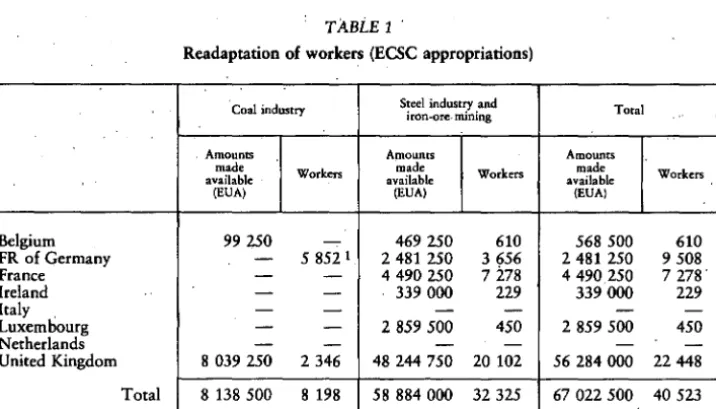
TABLE 1 .
Readaptation of workers (ECSC appropriations)
Coal industry Steel industry and iron-ore.mining Total
Amounts Amounts Amounts
made Workers made Workers made
Workers
available available available
(EUA) (EUA) (EUA)
Belgium 99 250 - 469 250 610 568 500 610
FR of Germany - 5 8521 2 481 250 3 656 2 481 250 9 508
France
-
-
4 490 250 7 2.78 4 490250 7 278'Ireland
-
- 339 000 229 339 000 229Italy - -
-
-
--Luxembourg - - 2 859 500 450 2 859 500 450
Netherlands - - -
-United Kingdom 8 039 250 2 346 48 244 750 20 102 56 284 000 22 448
Total 8 138 500 8 198 58 884 000 32 325 67 022 500 40 523
1 Since the total amount made available to Ruhrkohle AG seems sufficient for readaptation aid for the 5 852 workers mentioned, the
Commission has undertaken nor to increase it (by DM 14 350 000) except when necessary.· . · .
European Social Fund .
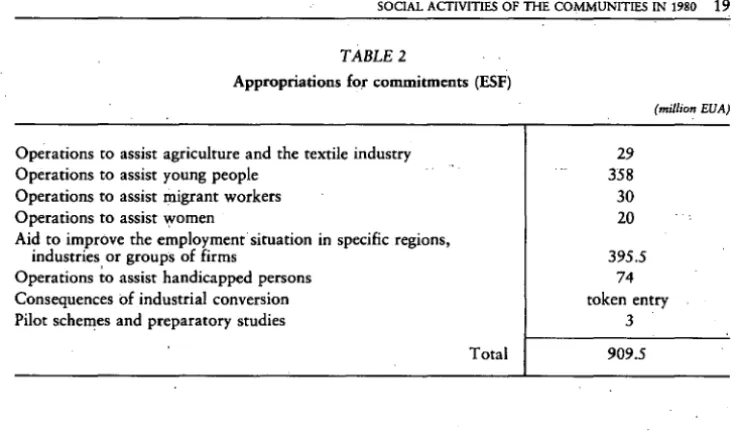
28. The appropriations for commitments authorized for 198Q-909.5 ·million EUA-were broken down as shown in Table 2.5
1 OJ C 142, 7.6.1979; Bull. EC5-1979, point 2.1.55; Bull. EC 10-1980, point 2.1.36. 2 Bull. EC 11-1980, point 2.1.29.
3 Bull. EC 12-1980.
4 Bull. EC 11-1980, point 2.3.7. . .
5 Full information on the Social Fund will be given in its Annual Report, to be published in July.
[image:16.456.56.414.160.364.2]TABLE 2
Appropriations for commitments (ESF)
Operations to assist agriculture and the textile industry Operations to assist young people
Operations to assist migrant workers Operations to assist women
Aid to improve the employment situation in specific regions, industries or groups of firms
Operations to assist handicapped persons Consequences of industrial conversion Pilot schemes and preparatory studies
Total
29 358 30 20
(million EUA)
395.5 74 token entry
3
909.5
The volume of applications approved for each Member State in 1980 was as shown in Table 3 (The figures given here include unused appropriations for commitments from the previous year which were available for reallocation; hence the total differs from t~at given in th~ table of appropriations for commitments.)
Ov~rall demand ·£or Fund assistance continued to rise, reaching a . total of 1 900 million EUA, thus exceeding by 85% the appropriations available. The greatest disparity between the volume of applications and available resources occurred in the areas of migrant workers (332%), women (245%), young ·people (80%) and regions (53%). The .Commission was therefore obliged to -apply rigorously the selection criteria laid. down in the guidelines for the management of the Fund during the period,1980-82.1
Appropriations for payment entered in the 1980 budget amounted to 374.3 mil~ lion EUA, to which should be added 230.7 million EUA carried over from 1979 and 325.4 million EUA under the supplementary budget for 1980. The total amount of payments made at 31 December 1980 is estimated at 733 million EUA (compared with 595.7 million EUA in 1979) ...
Studies and pilot schemes were undertaken with grants from the Fund. The~e mainly concerned young people, regions and training in the setting-up of small and medium-sized businesses.
I OJ C 159, 2.6.1979.
20 B - OUTLINE SURVEY
Belgium Denmark FR of Germany France Ireland Italy Luxembourg Netherlands United Kingdom
I September 1980 rates.
TABLE 3 Applications approved (ESF)
Amount
(million EUA) 1
29.1 . 19.4 108.6 195.8 82.9 328.5 0.9 18.3 229.6
Community 1 013.1
%per State
2.9 : 1.9 10.7 19.3 8.2 32.4 ,.
0.1' 1.8 22.7
100
On 29 April the Commission sent a communication to the Council setting out guidelines for the management of the European Social Fund during the period 1981 "83.1 A new departure here is that, where operations designed to assist young people are concerned, precedence is accorded within the' list of regions defined as priority in terms of youth unemployment to those areas which are affected by indu.strial conversion or restructuring problems. · ·
-. '
Operations to assist young people (Article 501 of the budget) and aid to improve the employment situation in certain regions (Article 5'10) are again allocated in 1981, as in 1980, the largest sums in absolute terms. In 'addition, some of the operations aided under other headings-may, in practice, be carried out in these same regions, thus further concentrating the impact of Social Fund aid o'n those areas which are either underdeveloped or in difficulty.
By its Decision of 4 December, the Council extended .by two years· its Decisions enabling the Social Fund to assist workers in the textile and clothing industries, migrant workers, young people under the age ·of 25 and women. 2
On 1 August the Commission put up to the Council a proposal for a Regulation designed to enable the Social Fund. to provide ~ssistance towards income support for workers in the shipbuilding industry.3
1 1980 Annexed Memorandum, point 68; OJ C 119, 14.5.1980; Bull. EC 4-1980, point 2.1.37.
2 OJ L 332, 10.12.1980; Bull. EC 11-1980, point 2.1.31. .
3 OJ C 218, 26.8.1980; Bull. EC 7/8-1980, point 2.1.50.
The list of the Greek prefectures where operations would be eligible for a higher rate of aid from the Fund was the subject of a Commission proposal sent to the Council on 20 November.l
Social protection
Social security and the fight against poverty
29. In connection with its work on the reorganization of working time,z on 17 July the Commission sent to the CounciP a communication on Community guidelines on flexible retirement for the attention of the Standing Committee on Employment. 4 The three guidelines proposed are designed to ensure a more flexible
retirement age and an opportunity for .a gradual withdrawal from working life, while taking account of the employment situation.
On
27
Noveritber the Council decided on a furtherm~a~ure
to combat poverty, lasting orie year. s · · · · ·· ·Social security for migrant workers
30. On 18 June the Commission sent to the Council a proposal for a Regulation6 amending Regulation (EEC) No 14081717 to the benefit of unemployed workers. Under. this proposal, they would n;tain the right to . unemployment benefit or allowances under early retirement schemes where they tran~fer .their res~derice tq a country oth!=!~. t~an that in ~hich they were last employed.''', ' '
On 27 November the Council adopted a Regulatiori extending Community rules to self-employed persons. s This question and that· of prote.ction 'for formerly
I Bull. EC 11-1980, point 2.1.30. 2 Point 19.
3 Bull. EC7/8-1980, point 2.1.43. 4 Bull. EC 12-1980.
5 Social Report 1979, point 30; BulL EC 11-1980, point 2.1.35. 6 OJ C 169, 9.7.1980; Bull. EC 6-1980, point 2.1.51.
7 OJ L 149, 5.7.1971.
8 Bull. EC 11-1980, point 2.1.34.
22 B - OUTUNE SURVEY
employed personsl who have withdrawn from the labour market were the subjects of a Parliam~nt resolution in June.2
On 21 October the Commission sent to the Council a proposal3 designed to render the application of the basic Regulations on social security more effective (Regulations Nos 1408/71 and 574/72). 4
The Administrative Commission and the Advisory Committee on Social Security for Migrant Worker examined various questions relating to the application of the rules currently in force. The Court of Justice delivered 15 judgments5 in cases involving references for preliminary rulings on the interpretation or validity of certain provisions enacted under Article 51 of the EEC Treaty.
Natural disasters ·
31. · In 1980 the Commission granted a total of 4.5 million EUA (of which 1.2 million were covered by the 1979 appropriations) in Community aid to the victims of hurricanes in Reunion, MartiniqQe and Guadeloupe and of floods in several regions ofthe United Kingdom (Wales), Italy,.Belgium a':ld France.
Living and working conditions--Labour law
Wages and the organization of work
32. In the course of infringement procedures initiated against certain Member States6 for failure to apply fully the Directive of 10 February 1975 on equal pay/ the Commission sent reasoned opinions on· 19 May to the governments of the Netherlands, Belgium, Luxembourg and the United Kingdom. The Netherlands and the Federal Republic of Germany subsequently adopted the necessary laws.
t OJ C 246, 17.10.1978.
2 OJ C 175, 14.7.1980; Bull. EC 6-1980, point 2.3.16. 3 OJ C 303, 20.11.1980; Bull. EC 10-1980, point 2.3.39.
4 OJ L 149, 5.7.1971; OJ L 74, 27.3.1972.
S Points 47 to 51 (Cases 41/79,53179,67179,69179, 110179, 121/79, 143/79,733/79,793/79,796/79, 807/79, 810179, 818/79, 1/80 and 4/80).
6 Social Report 1979, point 34. 7 OJ L 45, 19.2.1975.
Labour law, industrial relations
and participation of the two sides of industry
33. Cooperation between the t~o sides of industry at industry level co"utinued both in the various joint committees and through informal contacts or consultations. Thus, the Joint Committee on Social Problems in Sea I;ishing considered a draft social action programme, 1 similarly, the Joint Committee on Social Problems affecting Agricultural.Workers prepared an agreement limiting the working week in the livestock sector2 which was subsequently approved by the trade organizations. Work also continued on the harmonization of social legislation relating to road transport and inland waterways.
As regards inter-industry consultations, the Council adopted a new procedure to improve the flexibility and effectiveness of the working methods of tripartite conferences. 3
34. On 24 October the Commission sent to the Council a proposal for a Directive on procedures for informing and consulting the employees of undertakings with complex structures, in particular transnational undertakings; 4 the aim is to make it compulsory to provide information on the affairs of the undertaking as a whole and also to. consult the employees (in the event of closure, reorganization; etc.) of subsidiaries or plants employing at least 100 workers, whether the activities of the undertaking are purely national or transnational. ·
35. On 20 October the Council adopted the DirectiveS on the approximation of the laws of the Member States relating to the protection of employees in the event of the insolvency of their employer. Member States will have 36 months in which to set up guarantee institutions independent of the employer's operating capital-so that their assets cannot be seized in proceedings for insolvency~nd responsible for the payment, within .certain liQJits, of the outstanding claims of employees arising befo~e the insolvency of the employer. · ·
I Bull. EC 9-1980, point 2.1.32. 2 Bull. EC 6-1980, point 2.1.58.
3 Bull. EC 6-1980, point 2.1.57. .
4 OJ C 297, 15.11.1980; Bull. EC 10-1980, points 1.3.3 and 1.3.4; Supplement 3/80- Bull. EC. 5 OJ L 283, 28.10.1980; Bull. EC 10-1980, point 1.3.2. . .
24 B- OliTLINE SURVEY
Housing
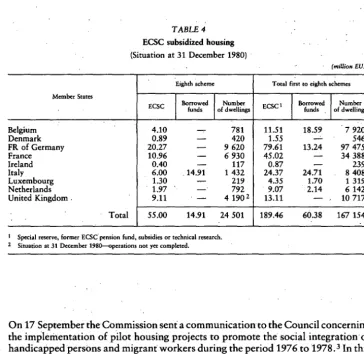
36. The Commission launched the ninth ECSC subsidized housing schemel and continued its work under preceding programmes.2
Member States
Belgium Denmark FR of Germany France Ireland Italy Luxembourg Netherlands United Kingdom .
[image:22.457.50.414.147.501.2]Total
TABLE 4 ECSC subsidized housing
(Situation at 31 December 1980) ·
Eighth scheme
ECSC
I
BorrowedI
Num bet funds of dwdlings4.10 781
0.89
-
42020.27
-
9 62010.96 - 6 930
0.40 - 117
6.00 .14.91 1432
1.30 - 219
1.97 - 792
9.11 - 4 1902
55.00 14.91 24 501
1 Special reserve, former ECSC' pension fund, subsidies or technical research. 2 Situation at 31 December 198()..-operations not yet completed.
(million EUA)
Total first to eighth schemes
ECSCl
I
BorrowedI
Number funds . of dwellings11.51 18.59 7 920
1.55
-
54679.61 13.24 97 475
45.02 - 34 388
0.87 - 239
24.37 24.71 8 408
4.35 1.70 1 319
9.07 2.14 6 142
13.11
-
10 717189.46 60.38 167 154
On 17 September the Commission sent a communication to the Council concerning the implementation of pilot housing projects to promote the social integration of handicapped persons and migrant workers during the period 1976 to 1978.3 In this connection, it financed a number of projects during 1980 concerning the housing of these categories of persons.
1 Bull. EC 7/8-1980, point 2.1.52. 2 Bull. EC 12-1980.
3 Bull. EC 9-1980, point 2.1.31.
I
$ocial services and family matters.
37. The Commission convened a meeting of the Liaison Committee for Social Workers in the European Community to examine current problems in social work in the Member States, It also published and gave wide publicity to the findings of a survey carried out in the nine Member countries of the Community, 'Europeans and their children' .1
Health and safety
38. The Commission continued its work in ·the . field of public health 2 in association with the WHO and the Council of Europe. It also held an international symposium in Luxembourg from 2 to 4 July on the role of the physician in health education3 with a view to developing a strategy for preventive behaviour by the
general public. · . · '
Radiation protection.
39. On 15 July the Council amended its Directives laying down the basic safety standards for the protection of the health of workers and the general public against the dangers arising from ionizing radiation. 4
The proposal for a Directive laying down the basic measures applicable to the radiation protection of persons undergoing medical examination or therapy,5 adopted to take ·into account the otherwise .favourable account of the Economic and Social Committee, 6 was sent to the Council on 18 December.7
1 Bull. EC 5-1980, point 2.1.29.
2 Social Report 1979, points 39 and 40; Bull. EC 11-1980, point 2.1.40. 3 Bull. EC 7/8-1980, point 2.1.58.
4 OJ L 246, 17.9.1980; Bull. EC 7/8-1980, point 2.1.54. 5 Social Report 1979, point 41.
6 OJ C 230, 8.9.1980; Bull. EC 7/8-1980, point 2.3.54. 7 Bull. EC 12-1980.
26 B - OUTLINE SURVEY
On 26 June the Commission sent to the Council a proposal fot a Directive laying down basic standards for the health protection of workers and the general public against the dangers of microwave radiation.1
Health aspects of the environment
40. In the course of the year the Commission delivered opinions pursuant. to Article 37 of the Euratom Treaty on the discharge of radioactive waste from the nuclear power stations at Bugey, Tricastin, Gravelines and Dam pierre (each power station consisting of four units of 900 MWe), from the Marcoule fission-product vitrification workshop (A VM) and from the Eurodif (France) uranium-enrichment plant. Opinions were also delivered on radioactive discharges from the Dounreay irradiated-fuel reprocessing plant, from the Heysham power station. (lJr,ited Kingdom) (two units of 625 MWe) and from the Exxon fuel-element fabrication plant at Lingen (Federal Republic of Germany). A study is being made of two other projects involving the nuclear power stations at Saint Laurent des Eaux (Bland B2) and Le Blayais- (four units).
In: September tbe Commission published the fifth. ~dition of its balance sheet 'on radioactive-waste discharges from nuclear power stations and irradiated-fuel reprocessing plants in the Community. A magnetic-tape library has been set up which can be used to calculate on a computer the radiological impact of the waste under normal operating conditions. The dispersion of effluent in the atmosphere in the case of a reactor accident was the subject of a seminar at Rise organized in conjunction with the biology, radiation protection and medical research programme.
Safety, hygiene
and health protection at work
41 . . On 27 November. the Council adopted a framework Directive for the protection of workers from harmful exposure to chemical, physical and biological agents at work.2 This Directive is based on the Council Resolution of 29 June 19783 on an action programme of the European Communities on safety and health
at work. · ·
1 OJC 249, 26.9.1980; Bull. EC 6·1980, point 2.1.59. 2 OJ L 327, 3.12.1980; Bull. EC 11-1980, point 2.1.38. 3 OJ C 165, 11.7.1978.
In this connection the Commission transmitted to the Council on 26 September a proposal for a second specific Directive, on asbestos.l The first Directive, on lead, which had been proposed by the Commission in December 1979,2 was the subject of an opinion delivered by the Economic and Social Committee in September. 3
In pursuance of the Cooperation Agreement concluded between the Commission and the United States, the Commission also organized, in collaboration with the US authorities, a joint seminar on the roles of atmospheric and biological monitoring in the assessment of toxic agents at work.
New activities have also got under way, particularly as regards safety instruction connected with accident prevention. 4
ECSC social research
42. ECSC social research (Article 55 of the Treaty of Paris), organized on the basis of multiannual programmes, went ahead s and was extended as a result of the adoption by the Commission of a new programme on ergonomics (IV), for which 13 million EUA had been allocated.
Mines Safety and Health Commission
43. The Commission held three pl~nary meetings, at which it adopted, in; addition to its annual report, various proposals to governments with special reference to the purification of gassy galleries and the construction and checking of oxygen self-rescuers. 6 The· Commission devoted special attention to the task 'of
drawing up its programme of work for the next three years. 7
A series of studies was launched on the safe operati9n of monorails, the prevention of sudden subsidence and the safety of chains used underground. In addition, a symposium on deep-sea div~ng was held in Luxembourg' on 9 and 10 October.7
1 1980 Annexed Memorandum, point77; OJ C 262, 9.10.1980; Bull. EC9-1980, point 2.1.34. 2 OJ C 324, 10.12.1979; Bull. EC 12-1979, point 2.1.70.
3 OJ C 300, 18.11.1980; Bull. EC 9-1980, point 2.3.38. 4 Bull. EC 5-1980, point 2.1.32.
5 Social Report 1979, point 45. 6 Bull. EC 5-1980, point 2.1.34.
7 Bull. EC 10-1980, points 2.1.43 and 2.1.44.
28 B - OUTI.INE SURVEY
The General Commission on Safety and Health in the Iron and Steel Industry continued its work, assisted by five working parties.l
Handicapped persons
44. The social and vocational reintegration of handicapped persons is still one of the Community's main objectives. Community action in this area is continuing to develop, backed mainly by financial aid from the European Social Fund. 2 The Commission has undertaken to cooperate in the preparations for the International Year of the Handicapped Person (1981), organized by the United Nations.
Paul Finet Foundation
45. During the 1979/80 academic year the Executive Committee of the Paul Finet Foundation examined 1 328 applications and awarded 980 scholarships totalling BFR 9 961 084 (average amount per. scholarship: BFR 10 164).
Since the Foundation was set up in 1965, some 13 855 cases have been examined and 9 787 scholarships, totalling BFR 84 888 292, have been awarded.
Interpretation and application of the social provisions
by the Court of Justice
Social security for migrant workers
46. The interpretation and application of Regulations Nos 1408/71 and 574/723 continue to give rise to numerous references for preliminary rulings. These give the Court an opportunity of affirming and amplifying its earlier decisions, which have sought to establish, on the basis of the provisions that fall to be considered, the interpretation which reflects the objectives of freedom of movement for persons and the general scheme of the rules. .
1 Bull. EC 5-1980, point 2.1.33. 2 Point 28.
3 OJ C 138, 9.6.1980 (consolidated version).
47. Notable, first of all, among the Courfs findings are those dealing with the definition of the legislative powers of Member States. The Court accepts that it is for each Member State to lay down the conditions attaching to the right or the obligation to become affiliated to a social security scheme or to a particular branch of such a scheme. The only requirement imposed by the Court is the prohibition of discrimination between nationals of the host State and nationals of the other Member States.l It is also the responsibility of the States to determine the effects of an erroneous affiliation. The Court adds that it is permissible for the Member States to provide for separate social security schemes involving special conditions for affiliation according to the nature of the risks to be covered or the benefits to be provided,2 and that Community rules do not prevent a State from granting more favourable social benefits to a worker than those it is required to provide under Community provisions. 3 In the same way it is for national law to determine how, in the context of the relationships between the institutions concerned, the allocation of the cost of the benefits payable is to be regulated. 4
48. The range of persons to whom the Community rules apply (meaning of 'worker' in Article 1(a)(ii) of Regulation No 1408/71) is to be interpreted widely. The Court held in this connection that a person who is entitled under the laws of a Member State to benefits covered by Regulation No 1408/71 by virtue of contributions he was previously required to pay does not lose his status as a worker within the meaning of the Regulation by reason only of the fact that at the time when the contingency occurred he was no longer paying contributions and was not
bound to do so. s · ·
49.
The Court was also called upon to give a ruling on the provtsions of Regulation No 1408/71 regarding the non-aggregation of benefits. The case at issue concerned family benefits for the dependent children of the recipient of a pension. In its judgment of 12 June 19806 the Court extended to the application of Article 77(2) of Regulation No 1408/71 the rule that had been established in the Rossi
1 Case 110/79 Coonan v Insurance Officer: not yet reported. Case 266/78 Brunori v Land-desversicherungsanstalt Rheinprovinz [1979) ECR 2705; see also, as regards the back-payment of contributions. to an old-age pension insurance scheme, Case 810/79 Oberschiir v Bundesversicher-ungsanstalt fiir ~ngestellte: not yet reported.
2 Case 110/79 Coonan v Insurance Officer: not yet reported.
3 Case 69/79 fordens- Vorsters v Bestuur van de Bedrijfsvereniglng voor Leder- en Lederverwerkende lndustrie [1980] ECR 75.
4 Case 818/79 Allgemeine Ortskrankenkasse Mittelfranken v Landesversicherungsanstalt Ober- und
Mittelfranken: not yet reported. .
5 Case 143/79 Walsh v National Insurance Officer: not yet reported.
6 Case 733/79 Caisse de compensation des allocations familiales v La T erza : not yet reported.
30 B - OUTLINE SURVEY
judgment1 concerning Article 79(3) of the Regulation. Unlike the latter provision
(suspension clause) the rules contained in Article 77(2) are to be understood as conflict-of-laws rules. They determine the law applicable to the granting of family benefits. It follows from this, in particular, that a worker who is entitled to a pension in more than one Member State and who resides in one of those States receives family benefits under the law of the latter State. However, basing its decision on the aims of Article 48 of the Treaty, the Court ruled that this provision must be interpreted to mean that entitlement to family benefits payable by the State in whose territory the recipient of a pension resides does not cancel a ·prior entitlement to greater benefits payable by another Member State. This was also held to apply in respect of orphans' benefits payable to the children of workers who are subject to more than one legal system (Article 78(2)).2
50. Similarly, the Court held that, while Article 8 of Regulation No 574/72 on the granting of maternity benefits took the form of a rule on the applicable law, it formed part of the provisions designed to prevent benefits being drawn concurrently. 3
·
. '
51. As regards unemployment benefits, Article 68(1) of Regulation No 1408/71 stipulates that, where they are calculated under the law of the competent State on the basis of the previous remuneration, only the remuneration earned in the last employment of the person concerned in the territory of that State must be taken into account. However, where the person concerned has been in his last employment in that territory for less than four weeks, the benefits are calculated on the basis of the normal remuneration paid at the place of residence for equivalent or similar employment.
A special problem arose in regard to unemployedfrontier workers since, by way of derogation from the general rule, the law which applies to them is not that of the country of employment but that of the country of residence (Article 71 (1) (a) (ii). Since the aim is to provide workers with unemployment benefits in proportion to the remuneration received at the time when they became unemployed, the rule should also be applied to frontier workers. The Court therefore held that Article 68 (1) must be interpreted to mean that unemployment benefits for frontier workers must be calculated with reference to the remuneration earned in the last
t Case 100/78 [1979] ECR 831.
2 Case 807/79 Gravina u Landesuersicherungsanstalt: not yet reported. 3 Case 143/79 Walsh u National Insurance Officer: not yet reported.
employment in the Member State in which the worker was employed immediately before he became unemployed.1
Equal pay for men and women
52. In its judgment in Case 129/792 the Court affirmed its findings in the Defrenne judgment of 8 April19763 on the effects of Article 119 of the Treaty. The present case, referred by the Court of Appeal in London, concerned a woman who had been engaged as a warehouse manageress by a wholesaler of medicinal products and had complained of discrimination in regard to pay on the grounds that the man who had held the job four months earlier had been paid more.
The Court reiterated that Article 119 was directly applicable, without the need for more detailed implementing measures on the part of the Community or the Member States, to all forms of direct and overt discrimination which may be identified solely with the aid of the criteria of equal work and equal pay. The Court stated that the principle of identical work was not confined to situations in which men and women contemporaneously perform the same work for the same employer.
Was it also possible for a female employee to claim, on the basis of Article 119 alone, not only the pay earned by a male employee who had previously performed the same work for her employer, but also, in more general terms, the pay to which she would be entitled if she were a man, even though no male employee was now or had been performing similar work? The Court rejected this possibility. This would fall to be classed as indirect, disguised discrimination which had to be identified on the basis of tests previously determined by the legislative bodies of the Community or Member States. Comparisons in cases which fall within the direct scope of Article 119 are limited to those which can be drawn on the basis of concrete appraisals of the work actually performed in the same establishment or service by employees. of different sex.
1 Case 67/79 Fellinger v Bundesanstalt fiir Arbeit [1980) ECR 535; Community rules on social security have also given rise to other judgments: Case 150/79 Commission v Belgium: not yet reported; Case 69179 ]ordens-Vorsters v Bestuur van de Bedrijfsvereniging voor Leder- en Lederverwerkende Industrie [1980], ECR 75; Case 53/79 ONPTS v Daminani [1980) ECR 273; Case 1/80 FNROM v Salmon: not yet reported; Case 793/79 Menzies v Bundesversicherungsanstalt fur Angestellte: not yet reported; Joined Cases 41, 121 and 796/79 Testa, Maggio and Vitale v Bundesanstalt fiir Arbeit: not yet reported; Case 4/80 d' Amico v ONPTS: not yet reported.
2 Case 129/79 Macarthys Ltd v Smith: not yet reported.
3 Case 43/74 Defrenne v Sabena [1976) ECR 455.
SOCIAL REP. 1980
C- Social developments in 1980
Employment
(including migrant workers)
Trends· within the Community
55. There was a sharp downturn in economiC activity in all the Member States in 1980. Available estimates put the Community's GOP growth-rat~ at 1.3% as against 3.5% in 1979.
The employment situation continued to deteriorate throughout 1980 with a marked rise in the unemployment level in the second half of the year (the number of jobless rose by 28.8% between December 1979 and December 1980). The steepest increases were recorded in the United Kingdom ( + 66% ), Denmark (+56%), The Netherlands ( +49%) and Ireland ( + 38% ). At the end of 1980, there were 8.0 million people out of work in the Community, i.e. 7.1% of the working population .
. In national employment policies, main emphasis was on the functioning of labour market policy. Some Member States, such as France and The Netherlands, took steps to strengthen their public employment services. Economic policies, on the other hand, were characterized by caution and even restraint in the light of worsening balance-of-payments deficits and accelerating inflation rates at the beginning of the year.
56. At Community level, efforts focused on the implications for employment of new technologies, the Community's labour market policy and the' reorganization of working time.
These problems were the subject of the four meetings which the Standing Employment Committee held in 1980 and of which the most important results are covered in the General and Political Introdi.Iction.l
1 Points 6 to 8.
36 C - SOOAL DEVELOPMENTS IN 1980
In particular, the subject of the labour market policy to be followed at Community level, after having been discussed by the Standing Employment Committee at its 18th meeting, was also discussed more thoroughly by the Council of Ministers of Employment and Social Affairs on 27 June 1980 which adopted a resolution on guidelines for a Community labour market policy .1 This resolution emphasizes the following principal guidelines and actions:
(i) strengthening of cooperation between the relevant national and Community departments to facilitate wider dissemination of statistics, studies and research available on the labour market at national and Community level;
(ii) integration of the Community labour market, which should be fostered within the framework of free movement of labour within the Community, particularly by effective implementation of the European system for the international clearing of vacancies and applications for employment (SEDOC) ,and by appropriate consultations on migration policies vis-a-vis third countries m accordance with the Council's conclusions of 22 November 1979;
(iii) strengthening and adaptation of the national vocational guidance and training systems and revival of activities designed to promote a common vocational training pol_icy. The Community will support the reforms envisaged by certain Member States to improve their .vocational training structures, i~ particular by fostering technical and administrative cooperation between Member States;
(iv) as regards placement, ensuring that appropriate structures exist, that the methods used to seek out available jobs are improved and that the services rendered are of a high quality. Community action in this area should support the implementation of the guidelines already adopted, with particular reference to the structure of placement services, and be directed towards the development of <:!ffective cooperation between national public employment services in areas such as staff training, computerization of public employment services and vocational guidance;
(v) continuation of special initiatives already undertaken at Community level to help certain categories of workers;
. .
(vi) development of forward management methods to deal with labour market problems at both undertaking and local labour market level. The Community · will lend its support by facilitating the exchange of experience and fostering an
improvement in the provision of information.
1 OJ C 168, 8.7.1980.
57. Statistics available on immigration in the first nihe months of 1980 suggest that in relation to last year, there was a slight incn!ase in the number of Community and non-Communityworkers entering. to take up employment for the first time. As regards third country workers,-however, it is to. be noted that for certain Member States a· large proportion are refugees. It should be stressed that several Member States report a shortage of skilled workers who are apparently not available within the Community. ,
Development of the situa:tion in the mem9er countri.es
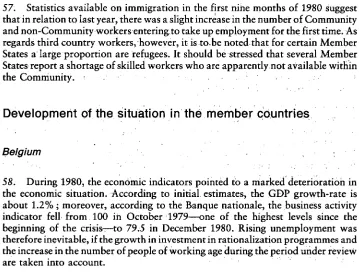
l{Jelgium
58. During 1980, the eco~omic indicators pointed to a rriarked deteri~ratioh in the economic situation. According to initial. estimates, the GDP growth-rate is . about 1.2%; moreover, according to the Banque nationale, the .business activity indicator fell from 100 in October 1979-one of the highest levels since the beginning of the crisis-,-to 79:5 in December 1980. Rising unemployment was therefore inevitable, if the growth in investment in rationalization programmes and the increase in the number of people of working age during the period under review
are taken into account. · ·
The number of job-seekers had risen to 430 500 in December 1980, a 17.4% increase compared with December 1979. In the same month, the respective shares of women, foreign workers and young people in total unemployment were as follows: women 60.1% (63.4% in 1979); foreign workers 13.2% (13.7% in_1979); young people under 25 39.0% (38.5% in 1979). Thus a decline can be seen·in the relative shares of the two first groups which has to be considered in the light of the appreciable increase in unemployment among men. The period since July 1980 has seen a. sharp rise in the riumber of job-seekers in a category w:hich had been spared for some years: unemployed Belgian male workers over25 receiving benefits. This rise could be the precursor of increases in the numbers ofjob-'seekers in the other categories.
The Government's programme to reabsorb unemployment was continued with a degree of success which may be qua~tified through the number of persons iiwolved (work programmes-training schemes-early retirerrieJ;lt~temporary special programme, etc.). According to the ONEM (National Employment OffiCe) this figure increased by 6 887, or +4.2% between November 1979 and November 1980.
[image:33.450.38.397.78.357.2]38 C - SOCIAL DEVELOPMENTS IN 1980
In addition, a Ministerial memorandum addressed to the ONEM during the summer of 1980 stressed the importance of tighter checks on the legal obligations of unemployed persons, calling for stricter supervision of the registered unemployed through the standardization of criteria for the granting of benefits, shortened procedures in the event that job offers are refused, and greater vigilance in the detection of abuses and fraud. At the same time, the memorandum emphasizes the need to improve personal relations between the authorities and job-seekers and to speed up action in individual cases.
As regards job-creation measures and recruitment premiums,1 the first available
results testify to keen interest on the part of both small and medium-sized firms and large companies. A provisional estimate, based on applications for both quarterly and annual grants under these schemes, indicates that a total of around 30 000 new jobs had been provided at the end of December 1980. As for reductions in working time, it has been estimated that at the end of 1980, 69% of wage earners in the private and public sectors were working fewer than 40 hours per week.
' ' .
In addition, a number of measures aimed adighting unemployment have still to be submitted to the two sides of industry. These include better vocational training, better organization of working time, restructuring of the relationship between education and employment and greater worker mobility._ ·
For the long-t~rm unemployed, retraining grants were also introduced for persons unemployed for more than six months.
59. The Royal Decree of 5 October 1979, which introduced certain restrictions designed to combat abuses with regard to entry permits for members of workers' families, did-not prevent the number of permits granted for genuine cases from showing a slight increase in 1980 compared with the previous year. Action against the entry and employment of clandestine workers iri Belgium is being rigorously pursued.
It is estimated that the total ~u~ber of foreigners in Belgium ~ose from 890 000 in 1979 to 900 000 in 1980. The number of foreign workers was estimated at 321 000 (including 171 000 CommU:nity nationals) at the end of 1979 and 330 OOOat the end
of 1980. ·
'
A new law, published in the Moniteur beige of 31 December 1980, commonly called 'the immigrant's statute' sets out the rules for entry, residence, establishment and' expulsion of foreigners. It also provides for the creation of an advisory committee on foreigners ~ithin the Ministry of Justice.
t Linked to a reduction .in the working week to 38 hours--see Social Report 1979, point 54.
Denmark
60.
In 1980 Denmark experienced a slowdown in economic activity: GOP, which rose by 3.5% in 1979 (at constant prices), declined by 0.9%. This was accompanied by a rise in the overall activity rate due to an increase in the number of female job-seekers. As a result, despite early retirement schemes affecting about 55 000 people, unemployment began to rise again.In December 1980 there were 221 300 jobless as against 143 200 in December 1979. The annual average, which stood at 137 500 in 1979, rose to 162 100 in 1980. In the light of current economic prospects, it is anticipated that unemployment will rise much faster between 1980 and 1981. The construction and public works sector was one of those which suffered a significant rise in unemployment in 1980. If the recession in this sector continues, it is likely to spread to related industries; measures to facilitate mortgage lending were therefore taken to alleviate the crisis.
In May 1980, an Employment Plan involving expenditure of DKR 5 400 million for 1981 and DKR 5 200 million per annum for 1982 and 1983 was adopted. This plan aims to start up a number of new initiatives contributing to improving both the balance of payp!ents and the employment situation. ·This plan extends and amplifies the 1977 employment promotion plan which was due to expire at the end of 1980. Under the new plan DKR 2 500 million has been earmarked for industrial and export promotion in 1981; it also provides for the continuation of a whole range of measures introduced under the 1977 plan (expiring at the end of 1980), notably ·some measures concerning employment and training, for which DKR 1 400 million will be made available in 1981. In addition, the rules governing job offers for the long-term unemployed and the provisions of Law No 488 of 1977, which lay down special measures to combat unemployment among young people at local and regional level (kommuner and amtskommuner) have been extended until the end of 1983. The Employment Plan also provides for initiatives in energy policy, urban renewal and redevelopment, transport and public services.
Under the Employment Plan for 1981-83, placement activities will be stepped up with a view to remedying the paradoxical situation where manpower shortages exist alongside unemployment. The National Labour Commission (land-sarbejdsnaevn), which has conducted a study of this paradox, reported that the firms under review notified about two-thirds of their vacancies to the employment services during a single week in November 1979. It emerged from the study, that job offers are frequently notified to these services at the last moment, with the result that in one-third of all cases there was only a single day-or even Iess-in which to find suitable applicants. Special skills were required for nearly three-fifths of the
40 C - SOCIAL DEVELOPMENTS IN 1980
vacancies, which did not differ as regards working time and schedules from those normally on offer on the labour market.
The number of new job offers notified to the employment services fell significantly between 1979 and 1980. However, it should be stressed that by no means all vacancies are notified, since notification is not compulsory.
Only 4% of the male working population was in part-time employment, while the corresponding figure for females was 45%. More than half of the women working part time are employed in office work, mainly in administrative departments in the public sector, and in the liberal professions. In this sector, 49% of all women work part time, while in the' commercial sector and the distributive trades the equivalent figure is 47% ; in the service and manufacturing industries the corresponding figures are 46% and 32% respectively. The proportion of women holding part-time jobs has risen from about 29% in 1?67 to 45% at the present. time. The most marked increase took place between 1967 and 1973. Over the same period, the proportion of men working part time has remained more or less static (4-6% ).
A joint report by the Ministries of Labour, Education and Home Affairs on the fight against unemployment amongst young people in 1979 reveals that 39 000 young people under the age of 25 benefited from special training· and employment measures for the young unemployed. This figure includes about· 8 000 young people who were already benefiting from such measures in 1978.
61. On 1 January 1980 there were46 317 foreign workers in Den~ark (excluding Swedish, Norwegian, Finnish and Icelandic workers), of whom 14 394 were Community nationals; this represents an increase of 2 500 over 1979 in the number of non-Community workers.
The ban on immigration affecting nationals other than those from the Nordic countries and the Community remained in force. ·
New provisions entered into force on 1 July with regard to the entry of foreigners into Denmark, residence in Denmark and the rules governing expulsion or repatriation. As regards members of workers' families, whereas foreigners used to be entitled to bring children below the age of 20 into Denmark the age-limit has now been reduced to 18.
Federal Republic of Germany
62. The general economic upswing recorded in 1979 continued into the early part of 1980, but the middle of the year saw a reversal of this trend due to a decline in