This is a repository copy of Time-frequency Signature Sparse Reconstruction using Chirp
Dictionary.
White Rose Research Online URL for this paper:
http://eprints.whiterose.ac.uk/88390/
Version: Publishers draft (with formatting)
Proceedings Paper:
Nguyen, YTH, Amin, MG, Ghogho, M et al. (1 more author) (2015) Time-frequency
Signature Sparse Reconstruction using Chirp Dictionary. In: Compressive Sensing IV.
Proceedings of Compressive Sensing IV, 22-24 April 2015, Baltimore, Maryland, United
States. Society of Photo-optical Instrumentation Engineers .
https://doi.org/10.1117/12.2180140
[email protected] https://eprints.whiterose.ac.uk/
Reuse
Unless indicated otherwise, fulltext items are protected by copyright with all rights reserved. The copyright exception in section 29 of the Copyright, Designs and Patents Act 1988 allows the making of a single copy solely for the purpose of non-commercial research or private study within the limits of fair dealing. The publisher or other rights-holder may allow further reproduction and re-use of this version - refer to the White Rose Research Online record for this item. Where records identify the publisher as the copyright holder, users can verify any specific terms of use on the publisher’s website.
Takedown
If you consider content in White Rose Research Online to be in breach of UK law, please notify us by
Time-frequency Signature Sparse Reconstruction using Chirp
Dictionary
Yen T.H. Nguyen
a,b, Moeness G. Amin
a, Mounir Ghogho
b,c, and Des McLernon
ba
Center for Advanced Communications, Villanova University, USA;
b
School of Electronic and Engineering , University of Leeds, UK;
c
International University of Rabat, Morocco
ABSTRACT
This paper considers local sparse reconstruction of time-frequency signatures of windowed non-stationary radar returns. These signals can be considered instantaneously narrow-band, thus the local time-frequency behavior can be recovered accurately with incomplete observations. The typically employed sinusoidal dictionary induces competing requirements on window length. It confronts converse requests on the number of measurements for exact recovery, and sparsity. In this paper, we use chirp dictionary for each window position to determine the signal instantaneous frequency laws. This approach can considerably mitigate the problems of sinusoidal dictionary, and enable the utilization of longer windows for accurate time-frequency representations. It also reduces the picket fence by introducing a new factor, the chirp rate α. Simulation examples are provided, demonstrating the superior performance of local chirp dictionary over its sinusoidal counterpart.
Keywords: Local sparse reconstruction, instantaneous frequency, time- frequency representation, chirp dictio-nary, sinusoid dictiodictio-nary, chirp discrete Fourier transform.
1. INTRODUCTION
Radar has for a long time been exploited to provide information about moving targets.1–4 It detects velocity
and direction of bulk motions based on Doppler frequency shift in radar returns. Besides, it can recognize micro-motions, such as vibration or rotation of structures in a target, which cause the frequency modulation on the radar return signals, commonly referred to as the micro Doppler frequencies.5–8 Therefore, spectrum estimation
of Doppler and micro-Doppler signal in specific, or non-stationary signal in general, is of paramount importance in radar applications.9–13
Time-frequency distribution (TFD) is a powerful tool for non-stationary signal analysis, revealing the time-changing local signal structures. TFDs for a large class of FM signals are commonly obtained by linear basis signal decomposition,14, 15 or quadratic time- frequency distribution, generally referred as Cohen’s class.16, 17
These methods, nevertheless, are susceptible to data missing, resulting in noisy TF representation. Data missing may be a consequence of removal of the signal parts that are contaminated by impulsive noise, or intentional under-sampling to enable wide-band signal processing. As such, accurate TFD, especially in case of missing data, is required.
Non-stationary signals can be assumed narrow-band over a short interval, which renders them locally sparse in the TF domain.18–22 Therefore, sparse reconstruction can be deployed over overlapping windows for local TF
signature reconstruction, especially with compressed observations.23–26 Greedy algorithm or convex optimization
techniques are used to find the sparsest frequency contents that describe the observation within the window.24–29
One of the most commonly used greedy algorithms is Orthogonal Matching Pursuit (OMP), which is applied in this paper. It is a kind of adaptive signal decomposition based on a dictionary that contains a family of functions called TF atoms. Motivated by short-time Fourier transform, sinusoidal atoms have been examined and shown to suffer from the trade-off between necessary measurements for recovery and sparsity level when considering
Further author information:
window size. Another drawback is the picket fence effect when there is a non-integer period in the analyzed data segment. In this paper, we use chirps as TF atoms. Together with an averaging method applied for each time-frequency point, the chirp dictionary approach considerably mitigates the above problems, providing more accurate time frequency (TF) signatures. It is shown that IF estimates from the first iteration of OMP are the same as those provided by the location of highest value in Discrete Chirp Fourier Transform (DCFT). However, signal sparsity is not a known priori, and is usually larger than one; thus many iterations are needed in the implementation, which represents an advantage of the proposed method over DCFT. It is noted that the chirp dictionaries have been used and applied to other classes of signals different from non-stationary signals.30 These
dictionaries possess attractive properties which make them good candidates for sparse reconstruction.
The paper is organized as follows. Section 2 formulates the problem and presents chirp dictionary. The improvements of chirp dictionary approach over sinusoid one are described in Section 3. Section 4 includes simulation results. The conclusion is given in Section 5.
2. PROBLEM FORMULATION
Consider a CW radar operating at frequencyf0, the equivalent transmitted radar (analytic) signal is,
stx(t) = exp(j2πf0t) (1)
The returned baseband signal reflected from the target with K (K≥1) scattering centers can be written as,
srx(t) = K X
k=1
Ak(t) exp(jφk(t) +vc(t)), 0≤t≤T, (2)
whereT is the total observation time,Ak(t) andφk(t) are time-varying amplitude and phase of thekthcomponent
of the return signal,vc(t) is white Gaussian noise. The superposition of various Doppler components is expressed
as,
fd(t) =
1 2π
K X
k=1
dφk(t)
dt , (3)
In this paper, we work with the discrete signal which is obtained by sampling the continuous radar return at Nyquist rateFs. The result is,
srx(n) = K X
k=1
Ak(nTs) exp(jφknTs) +v(n), (4)
where Ts= 1/Fs is the sampling period,n= 0,1, ...,⌊T /Ts⌋.
The proposed approach approximates the TF signature of observations within each time window, Tw, as a
chirp segment. This is contrary to spectral line approximation which is the case of sinusoid dictionary based reconstruction. In this case, the estimated frequencies are referred to a time sample corresponding to the center of the window. An advantage of the chirp dictionary is that the local sparsity level depends only on the number of chirp signal components K within the window, and is not determined by the signal bandwidth captured by the window. As a result, the local TF signature becomes highly sparse, and exact recovery can be obtained with a small number of observations using compressive sensing methods. The windowed signal is approximated as a superposition of multiple chirps,
srxm ≈ K X
k=1
Ck,mexp
j2π
αk,m
n2
2F2 s
+βk,m
n Fs
+vm(n) 0≤n < Nw−1,
(5)
where m is the window index, Ck,m, αk,m andβk,m are the complex amplitude, the chirp rate, and the initial
frequency of thekth chirp over themth window, respectively. s
withL being the shift between two consecutive windows in terms of number of samples, andNw =⌊Tw/Ts⌋.
The signal overmth window in Eq.5 in vector form can be written as,
Srxm=ΨXm+Vm, (6)
where Ψis the chirp dictionary. An atom in chirp dictionaryΨ is given by,
˜
α∈[−FmaxFs/Nw, FmaxFs/Nw]
ψi|n= exp
j2π(˜αi
n2
2F2 s
+ ˜βi
n Fs
)
Fmax=Fs/2
|˜αTw+ ˜β| ≤Fmax,
(7)
where ˜α, ˜β denotes values of chirp rate and initial frequency in the dictionary. BecauseXm is highly sparse, it can be solved by compressive sensing techniques,
ˆ
Xm= arg minkXmk1 s.t. kSrxm−ΨXmk22≤ǫ, (8)
wherekk1,kk2 denotesL1, L2 norms respectively, andǫ is the noise level. In this paper, the greedy algorithm
OMP is deployed as the reconstruction algorithm. The IF estimates from the first iteration of OMP are the same as those of highest correlation obtained by Discrete Chirp Fourier Transform (DCFT). However, when more iterations are performed, the chirp dictionary based reconstruction deviates from DCFT and provides superior result. OMP iterations stop when the residual satisfies the condition in Eq.8. The thresholdǫis discussed in.28
3. CHIRP DICTIONARY AND SINUSOID DICTIONARY
Sinusoid dictionary has been examined in sparse signal reconstruction for IF estimation for chirp signals and MicroDoppler signal.19, 20 Its drawback lies in the adverse window length- sparsity interlocking, namely, the
longer the window, the lower sparsity of local TF signature due to inclusion of larger signal bandwidth. In the case of missing samples, longer windows are required to obtain sufficient number of observations for stable recovery. This trade-off between sparsity and the required number of observations renders sinusoid dictionary ineffective for non-stationary signal reconstruction. The chirp dictionary does not suffer from this trade-off, or at least is less sensitive to it. Nevertheless, the chirp dictionary approach may give inaccurate TF signal reconstruction due to violation of chirp piece-wise approximation of the signal TF signature when applying long windows. This problem is mitigated by applying an averaging over consecutive windows. The reconstructed values at each TF point corresponding to overlapping window are added and a threshold is applied to remove small values. Accurate IF estimate would, therefore, benefit from persistent high values for a given TF point across neighboring windows. In other words, accumulation of values at (ni, fi) strengthensfi estimate, whereas
non-accumulative values are deemphasized.
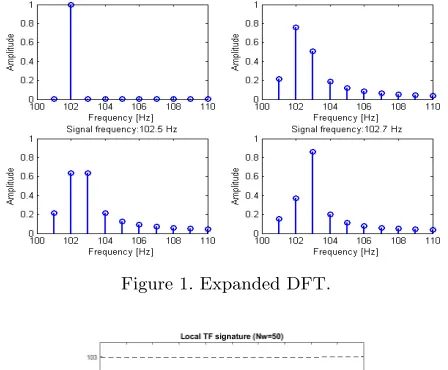
In the following example, we show that chirp dictionary provides superior performance to the sinusoid dictio-nary even for signals consisting of fixed frequency sinusoids. This becomes more evident when the signal period is non-integer due to picket pence effect, which is illustrated for a single tone in Fig.1. When the signal frequency is 102.4 Hz, 102.5 Hz, 102.7 Hz, OMP selects either the atom of 102 Hz, or 103 Hz. Due to the low correlation between the signal and the chosen atom, large residue results, and further iterations are executed, resulting in frequency contents at false locations. The chirp dictionary addresses this inaccuracy. With the inclusion of the factorα, atoms with better matching with the signal are selected, which leads to smaller residue, forcing OMP to a halt. If further iterations continue, the result would be insignificant, close to noise floor. This is illustrated in Fig. 2 when the signal frequency is 102.4 Hz. The IF estimate after using chirp dictionary better correlates to signal compared to the sinusoid dictionary.
Figure 1. Expanded DFT.
Figure 2. Local TF signature.
4. SIMULATION RESULTS
This section evaluates the performance of sparse reconstruction of the signal time frequency signature using chirp dictionary, especially in the case of missing samples. We compare the proposed approach with sinusoid atoms, and discrete chirp Fourier transform DCFT.
In following examples, the signals are sampled at Nyquist rate with sampling frequency Fs = 256Hz, the
total signal length is N = 256. The data is then randomly under-sampled to create the incomplete data to be processed. The input signal is corrupted by white Gaussian noise, and the signal-to-noise ratio is set toSN R= 30dB. Rectangular window is applied. The resulting image is normalized and transfered to energy version for display. To access the accuracy of sparse reconstruction algorithms, concentration level (ζ) is deployed, which is the ratio of sum of pixel magnitude along the ground-truth, the actual IF, and the rest of the TF values. The higherζ, the more accurate the result is.
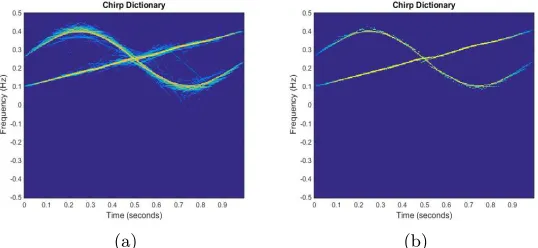
The first example illustrates the TF signature obtained by chirp atoms in the two cases with and without using averaging method. The input signal is expressed as:
x(n) = expnjh(0.15Fs) cos(2π
n
N +π) + 2π(0.25Fs) n N
io
+ exp
j2π
(0.1Fs)
n
N + (0.3Fs) n2
2N2
,
(9)
where n = 0,1, ..., N−1. We randomly discard 50% of the data. The window length is set toNw = 50. The
(a) (b)
Figure 3. Local reconstruction of a two- component signal (a) Chirp atoms without averaging, and (b)Chirp atoms, using averaging.
In the second example, with the same frequency grid, we show that the proposed approach outperforms its sinusoidal dictionary counterpart for sinusoid signals . For off-bin-center sine waves and ∆f = 1Hz, our approach obtains more accurate IF estimates, as it can alleviate the picket fence effect. The simulated signal is described as,
x(n) = expnj2πhf1
n N +f2
n N
io
, (10)
where n= 0,1, ..., Fs−1. We assign two values for eachf1, f2 , f1 = 100Hz, 102.4Hz, and f2 = 25Hz,25.6Hz.
The window length is Nw = 50, and a rectangular window is deployed for both dictionary approaches. 50% of
the signal is randomly shorted. When a full data is available, no noise, and signals’ periods are integer, both methods provide perfect frequency localization with ζ =∞, as illustrated in Fig.4 (a,d). The chirp dictionary shows clear advantage over its sinusoid counterpart with added noise and data missing. The corresponding performance measurements areζ= 180 andζ= 41, respectively, and the results are shown in Fig. 4 (b,e). With non-integer period signal, the sinusoid dictionary method significantly suffers, showing noisy time- frequency signature as depicted in Fig. 4(f) in contrast with the result of the chirp dictionary shown in Fig. 4 (c). The values ofζ of chirp and sinusoid dictionary approaches are ζ = 143 and ζ = 5. Higher resolution or smaller frequency grid helps mitigating the picket fence effect. With ∆f = 0.5 Hz, the same signal expressed in Eq.(10),
SN R = 30dB, and 50% data missing, the concentration level is ζ = 28 compared with ζ = 5 when ∆f = 1 Hz. The result is shown in Fig. 5. As bin-center signal is unlikely to occur, the chirp dictionary provides more reliable IF estimations.
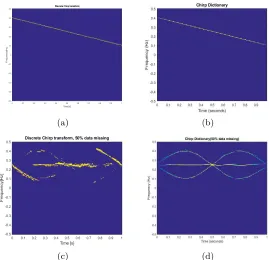
The third simulation compares the accuracy of local TF signature when the chirp dictionary and DCFT are used. Two input signalsx1(n) andx2(n) are employed,
x1(n) = exp
j2π
(0.4Fs)
n
N −(0.3Fs) n2
2N2
x2(n) = exp n
jh(0.15Fs) cos(2π
n
N) + 2π(0.25Fs) n N
io
+ expnjh(0.15Fs) cos(2π
n
N +π) + 2π(0.25Fs) n N
io
+ expnj2πh(0.25Fs)
n N
io
,
(11)
wheren= 0,1, ..., N−1. Window size is Nw = 50, rectangular window, and averaging method are utilized in
both methods. Results are shown in Fig. 6. When the input signal is mono-component x1(n), and assuming
that the signal sparsity is known, then the concentration levels of the two approach becomeζ =∞. The chirp approach provides better TF signature in the case of multi-component input x2(n) withζ= 62, compared with
ζ= 1.5 resulting from DCFT.
(a) (b) (c)
[image:7.612.97.509.70.333.2](d) (e) (f)
Figure 4. Sparse reconstruction of bin-center sine waves using chirp and sinusoid dictionaries, ∆f= 1Hz (a,d)Full data, (b,e) 50 % data missing. (c,f) Sparse reconstruction of off-bin-center sine waves using chirp and sinusoid dictionaries, 50 % data missing.
Figure 5. Sparse reconstruction of off-bin-center waves using sinusoid dictionary, and ∆f= 0.5 Hz.
window length is set toNw= 128. Rectangular window is applied for the discrete chirp transform and the chirp
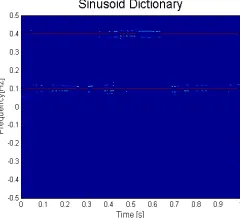
dictionary, whereas Hanning window is used for the approach sinusoid atoms. The result in Fig. 7 shows chirp dictionary approach is the best among the three methods representing the torso and limb’s micro-Doppler.
5. CONCLUSION
[image:7.612.243.363.385.494.2](a) (b)
[image:8.612.169.438.72.332.2](c) (d)
Figure 6. Time Frequency Representation ofx1(n) andx2(n) with (a)(c)DCFT , (b)(d) Chirp atoms.
(a) (b) (c)
Figure 7. Local reconstruction of a real signal returned from a human with one arm when 50% data is missing (a) Sinusoid dictionary (b) Discrete chirp Fourier transform, (c) Chirp dictionary.
REFERENCES
1. M. Skolnik, “Introduction to radar,”Radar Handbook2, 1962.
2. M. Soumekh, Synthetic aperture radar signal processing, New York: Wiley, 1999.
3. W. Melvin and J. Scheer,Principles of modern radar-advanced techniques, SciTech Publishing Inc., Edison, NJ, 2013.
4. G. Stimson, Introduction to airborne radar, SciTech Publishing Inc., Mendham, NJ, 1998. 5. V. Chen,The micro-Doppler effect in radar, Artech House, 2011.
6. V. Chen and H. Ling,Time-frequency transforms for radar imaging and signal analysis, Artech House, 2001. 7. V. Chen, “Analysis of radar micro-doppler with time-frequency transform,” inStatistical Signal and Array
[image:8.612.104.509.362.490.2]9. C. Clemente, A. Balleri, K. Woodbridge, and J. Soraghan, “Developments in target micro-doppler signatures analysis: radar imaging, ultrasound and through-the-wall radar,”EURASIP Journal on Advances in Signal Processing2013(1), pp. 1–18, 2013.
10. Y. Kim and H. Ling, “Human activity classification based on micro-doppler signatures using a support vector machine,”Geoscience and Remote Sensing, IEEE Transactions on 47(5), pp. 1328–1337, 2009. 11. G. Matz and F. Hlawatsch, “Time-varying power spectra of non-stationary random processes,”
Time-Frequency Signal Analysis and Processing: A Comprehensive Reference , pp. 400–409, B. Boashash, Ed. Oxford, U.K.: Elsevier, 2003.
12. M. Amin, “Time-frequency spectrum analysis and estimation for nonstationary random-processes,” in Time-Frequency Signal Analysis: Methods and Applications, B. Boashash, Longman Cheshire, 1992.
13. F. Ahmad, M. Amin, and P. Setlur, “Through-the-wall target localization using dual-frequency cw radars,” in Defense and Security Symposium, pp. 62010H–62010H, International Society for Optics and Photonics, 2006.
14. S. Mallat and Z.Zhang, “Matching pursuits with time-frequency dictionaries,” Signal Processing, IEEE Transactions on41(12), pp. 3397–3415, 1993.
15. S. Ghofrani, M. Amin, and Y. Zhang, “High-resolution direction finding of non-stationary signals using matching pursuit,” Signal Processing93(12), pp. 3466–3478, 2013.
16. L. Cohen,Time-frequency analysis, vol. 1406, Prentice Hall PTR Englewood Cliffs, NJ:, 1995.
17. J. Jeong and W. Williams, “Kernel design for reduced interference distributions,”Signal Processing, IEEE Transactions on40(2), pp. 402–412, 1992.
18. P. Flandrin and P. Borgnat, “Time-frequency energy distributions meet compressed sensing,”Signal Pro-cessing, IEEE Transactions on 58(6), pp. 2974–2982, 2010.
19. B. Jokanovi´c, M. Amin, and S. Stankovi´c, “Instantaneous frequency and time-frequency signature estimation using compressive sensing,” in SPIE Defense, Security, and Sensing, pp. 871418–871418, International Society for Optics and Photonics, 2013.
20. M. Amin, B. Jokanovic, and T. Dogaru, “Reconstruction of locally frequency sparse nonstationary sig-nals from random samples,” in Signal Processing Conference (EUSIPCO), 2013 Proceedings of the 22nd European, pp. 1771–1775, IEEE, 2014.
21. Y. Zhang, M. Amin, and B. Himed, “Reduced interference time-frequency representations and sparse re-construction of undersampled data,” inSignal Processing Conference (EUSIPCO), 2013 Proceedings of the 21st European, pp. 1–5, IEEE, 2013.
22. L. Stankovic, I. Orovic, S. Stankovic, and M. Amin, “Compressive sensing based separation of nonstationary and stationary signals overlapping in time-frequency,” IEEE Transactions on Signal Processing 61(18), pp. 4562–4572, 2013.
23. M. Amin and F. Ahmad, “Compressive sensing for through-the-wall radar imaging,”Journal of Electronic Imaging 22(3), pp. 030901–030901, 2013.
24. M. Amin,Compressive sensing for urban radar, CRC Press, 2014.
25. M. Herman and T. Strohmer, “High-resolution radar via compressed sensing,” Signal Processing, IEEE Transactions on57(6), pp. 2275–2284, 2009.
26. D. Donoho, “Compressed sensing,”Information Theory, IEEE Transactions on52(4), pp. 1289–1306, 2006. 27. J. Tropp and A. C. Gilbert, “Signal recovery from random measurements via orthogonal matching pursuit,”
Information Theory, IEEE Transactions on 53(12), pp. 4655–4666, 2007.
28. T. Cai and L. Wang, “Orthogonal matching pursuit for sparse signal recovery with noise,” Information Theory, IEEE Transactions on57(7), pp. 4680–4688, 2011.
29. J. Tropp, “Greed is good: Algorithmic results for sparse approximation,”IEEE Transactions on Information Theory50(10), pp. 2231–2242, 2004.