White Rose Research Online URL for this paper:
http://eprints.whiterose.ac.uk/107248/
Version: Published Version
Article:
Asaria, Miqdad orcid.org/0000-0002-3538-4417, Griffin, Susan
orcid.org/0000-0003-2188-8400, Cookson, Richard orcid.org/0000-0003-0052-996X et al.
(2 more authors) (2015) Distributional cost-effectiveness analysis of health care
programmes : A methodological case study of the UK bowel cancer screening programme.
Health Economics. pp. 742-754. ISSN 1057-9230
https://doi.org/10.1002/hec.3058
[email protected] https://eprints.whiterose.ac.uk/ Reuse
This article is distributed under the terms of the Creative Commons Attribution (CC BY) licence. This licence allows you to distribute, remix, tweak, and build upon the work, even commercially, as long as you credit the authors for the original work. More information and the full terms of the licence here:
https://creativecommons.org/licenses/
Takedown
If you consider content in White Rose Research Online to be in breach of UK law, please notify us by
DISTRIBUTIONAL COST-EFFECTIVENESS ANALYSIS OF HEALTH
CARE PROGRAMMES
–
A METHODOLOGICAL CASE STUDY OF THE
UK BOWEL CANCER SCREENING PROGRAMME
MIQDAD ASARIAa,*, SUSAN GRIFFINa
, RICHARD COOKSONa, SOPHIE WHYTEband PAUL TAPPENDENb
aCentre for Health Economics, University of York, York, UK b
School of Health and Related Research, University of Sheffield, Sheffield, UK
ABSTRACT
This paper presents an application of a new methodological framework for undertaking distributional cost-effectiveness analysis to combine the objectives of maximising health and minimising unfair variation in health when evaluating population health interventions. The National Health Service bowel cancer screening programme introduced in 2006 is expected to improve population health on average and to worsen population health inequalities associated with deprivation and ethnicity–a classic case of‘intervention-generated inequality’. We demonstrate the distributional cost-effectiveness analysis framework by examining two redesign options for the bowel cancer screening programme: (i) the introduction of an enhanced targeted reminder aimed at increasing screening uptake in deprived and ethnically diverse neighbourhoods and (ii) the introduction of a basic universal reminder aimed at increasing screening uptake across the whole population. Our analysis indicates that the universal reminder is the strategy that maximises population health, while the targeted reminder is the screening strategy that minimises unfair variation in health. The framework is used to demonstrate how these two objectives can be traded off against each other, and how alternative social value judgements influence the assessment of which strategy is best, including judgements about which dimensions of health variation are considered unfair and judgements about societal levels of inequality aversion. © 2014 The Authors.Health Economicspublished by John Wiley & Sons Ltd.
Received 22 October 2013; Revised 6 March 2014; Accepted 1 April 2014
KEY WORDS: health inequality; equity; cost-effectiveness analysis
1. INTRODUCTION
Cost-effectiveness analysis (CEA) is used to support health sector decisions about the allocation of limited resources with the objective of maximising health (Drummondet al., 2005). When dealing with population health interventions, we often have the additional objective of minimising ‘unfair’ health inequality (Cooksonet al., 2009) and to this end are also interested in the social distribution of both health gains and health opportunity costs due to the intervention. In this paper, we propose a methodology for quantifying and combining these two objectives within an economic evaluation framework that highlights the social value judgements underpinning any particular conclusion. This‘distributional CEA’(DCEA) is demonstrated through a case study comparing potential redesign options to increase uptake of the National Health Service (NHS) bowel cancer screening programme (BCSP) in England.
Colorectal cancer (CRC) is the third most common cancer in the UK with approximately 40 000 new cases diagnosed annually resulting in almost 16 000 CRC-related deaths per year (ONS, 2012). Research has shown that using screening to diagnose and treat CRC earlier can significantly reduce the number of CRC deaths (Hewitsonet al., 2008). The Department of Health launched the BCSP in 2006 and currently offers biennial
*Correspondence to: Centre for Health Economics, University of York, York, UK. E-mail: [email protected]
screening with guaiac fecal occult blood test (gFOBT) to persons aged 60–74 years. Variable uptake of screening has been observed among thefirst 2.6 million invitees to the national BCSP, with overall uptake averaging only 54% ranging from 61% in the least deprived areas to 35% in the most deprived areas, and showing a similar gradient in terms of small area-based ethnic diversity measures (Logan et al., 2012; Von Wagner et al., 2011). Furthermore, for those individuals with positive screening results, there is also evidence of inequality in the uptake of follow-up colonoscopy (Morriset al., 2012). It is reasonable to expect that these inequalities in the uptake of the screening programme will exacerbate the already unequal distribution of health in the population, with the screening programme disproportionately benefiting more advantaged groups (for whom uptake is highest)–a classic case of‘intervention-generated inequality’(Lorencet al., 2012).
Prior to the introduction of the BCSP, a number of possible screening options were evaluated to help NHS decision makers determine whether a screening programme was worthwhile and if so the form that it should take. To that end, a model was developed to assess the total resource implications and health impacts of screening by simulating the natural history of CRC and the impact of screening on that natural history (Tappendenet al., 2007). This model was later refined and updated to reflect data emerging from the BCSP (Whyte et al., 2012; Whyte et al., 2011). In this paper, we build on the latest version of this economic evaluation model and use it to estimate the distribution of health associated with alternative screening strate-gies. We then compare these health distributions using our DCEA framework to determine the strategy that best addresses the dual objectives of maximising health and minimising health inequality. The focus of our analysis is on the quantity and distribution of health gains related to increased participation in the screening programme; other potentially competing objectives of screening programmes such as the promotion of informed choice are not addressed in this paper.
2. METHODS
2.1. Cost-effectiveness analysis
While recognising that in reality there are an almost infinite number of screening strategies that could be designed, in order to demonstrate the framework, we simplify the comparison by considering four mutually exclusive options in our analysis:
• ‘No screening’.
• ‘Standard screening’as implemented in the BCSP in 2006.
• ‘Targeted reminder’: screening plus a targeted enhanced reminder letter (personal GP-signed letter and tailored information package) sent only to those living in the most income deprived 40% of small areas (index of multiple deprivation (IMD) 4 and IMD5) and to those living in areas with the highest proportion of inhabitants from the Indian subcontinent (IS5). This targeted subgroup comprises of approximately half of the total population invited for screening. The costs of this strategy per person targeted are estimated to be £7 resulting in an estimated increase in average uptake of gFOBT among the targeted population of 12%.
• ‘Universal reminder’: screening plus a universal basic reminder letter (sending a GP-endorsed reminder letter to all eligible patients). The costs of this strategy per person are estimated to be £3.50 resulting in an estimated increase in average uptake of gFOBT of 6%.
The economic evaluation model follows a cohort of 1 million 30 year olds through their lifetimes (allowing it to simulate the adenoma–carcinoma sequence) with screening invitations being sent out biennially to individuals between the ages of 60 and 74 years. The model is run probabilistically to incorporate the uncertainty around the input parameters.
2.2. Inequality analysis
The CEA allows us to identify which of the strategies maximises total health. In order to extend this analysis to allow us to evaluate our other key objective, that of minimising unfair health inequality, we require descriptions of the estimated distributions of health produced by the interventions being compared. To produce these estimates, we condition the model input parameters on factors associated with inequalities in health and inequalities in the effect of screening. We then perform subgroup analyses according to these factors in order to estimate differential cost and health impacts. The health impact per person within each subgroup is scaled by the size of the subgroup in order to describe the total population distribution of health.
The distribution of changes in health attributed to an intervention are informed not only by the distribution of the health gains among recipients of the intervention but also by the distribution of health opportunity costs among those who would have received the displaced activities that the money spent on this intervention would otherwise have been spent on. These opportunity costs are unlikely to fall in proportion to the intervention costs or benefits for particular recipients, and those who would otherwise have benefited from the displaced activities may also include nonrecipients of the intervention.
2.2.1. Estimating a baseline population health distribution.We estimate baseline inequality in the population distribution of expected lifetime health by extending the economic model to incorporate differential all-cause mortality rates by level of socioeconomic deprivation in addition to age and gender. As estimates are based on the Office for National Statistics longitudinal study data (ONS, 2007), we map social class groupings to deprivation measures. We additionally include the differences in morbidity by using health-related quality of life data by age and gender based on UK norms for EQ-5D (Kindet al., 1999) and further adjust for deprivation using the differences between life expectancy and disability-free life expectancy as observed in the Office for National Statistics general lifestyle survey (Smith et al., 2010). Using this data in the model, we estimate a baseline population health distribution in terms of quality-adjusted life expectancy (QALE) at birth. As the ethnic diversity measure that we use in this study is not a variable that is routinely included in the administrative datasets used to estimate baseline QALE, we assume a baseline QALE adjusted for gender and deprivation that does not further vary by ethnic diversity.
2.2.3. Estimating the distribution of opportunity cost. Additional costs of screening and related downstream diagnostic and treatment costs come out of a fixed health budget, and the health opportunity cost due to the disinvestment of these funds from other uses within NHS is assumed to be one quality-adjusted life year (QALY) per £20 000, in line with current practice in NHS. Owing to the absence of further information on how these opportunity costs are distributed, in the base case analysis, we assume that they are distributed equally across all population subgroups. We then perform sensitivity analyses by exploring two extreme assumptions around the distribution of opportunity cost: first, where the entire opportunity cost is borne by the healthiest of our 20 subgroups (women living in the least deprived and ethnically diverse areas), and second, where the entire opportunity cost is borne by the least healthy of our 20 subgroups (men living in the most deprived and ethnically diverse areas).
2.2.4. Assuming all other factors equally distributed.We are able to estimate a modelled distribution of health net of opportunity costs by incorporating the three sets of adjustments to the model that we have described previously, namely, the following: (i) the distribution of factors impacting baseline health; (ii) the distribution of factors impacting screening uptake; and (iii) the distribution of opportunity cost. In so doing, however, we assume that all other factors in the model remain constant between the different subgroups of interest. In particular, a key assumption is that CRC incidence and severity levels are equal across the relevant subgroups. This assumption was made because of data limitations and is supported by limited evidence suggesting that variation in CRC incidence by social class is small (National Cancer Intelligence Network, 2004).1
2.2.5. Measuring inequality in the resulting health distributions.Inequality in health distributions can be quan-tified in a variety of ways, and we present a battery of measures in order to be able to inform different inequality concerns from different stakeholders. We start with relative measures of inequality–those that measure the propor-tional changes in health across the distribution. These range from simple measures focusing only on the extremes of the distribution, such as the relative gap index, to more sophisticated measures assessing the entire distribution and allowing for different levels of relative inequality aversion. An example of the latter is the Atkinson index, shown in the succeeding texts for a population ofnindividuals withhirepresenting the health of individual i,hrepresenting
mean health in the population andεrepresenting the level of constant relative inequality aversion (Atkinson, 1970).
Aε¼1
1 n
X n
i¼1 hi
h
1 ε
" #11ε
We also look at absolute measures of inequality– those that measure the absolute changes in health across the distribution. These also range from simple extreme group measures, such as the absolute gap index, to more sophisticated measures assessing the entire distribution and allowing for different levels of absolute inequality aversion. An example of the latter is the Kolm index shown in the succeeding texts withαrepresenting the level
of constant absolute inequality aversion (Kolm, 1976).
Kα ¼
1
α
log 1 n
Xn
i¼1 eα½h hi
!
2.3. Social welfare analysis
Having separately quantified average population health and the level of health inequality resulting from each of our four screening strategies, we next combine concerns for maximising population health and concerns for
1
minimising health inequality using social welfare analysis. Wefirst check for distributional dominance in a very general sense using the idea of generalised Lorenz dominance (Shorrocks, 1983) to compare the estimated health distributions and eliminate dominated strategies. Health distribution A can be said to generalised Lorenz dominate health distribution B if the Lorenz curve for health in A multiplied by the mean level of health in A dominates the Lorenz curve for health in B multiplied by the mean level of health in B. To compare the remaining, nondominated strategies, we turn to more restricted social welfare indices that explicitly trade-off increases in the mean health against greater equality in the distribution of health (Wagstaff, 2002). These indi-ces are calibrated on the same scale by calculating an‘equally distributed equivalent’(EDE) level of health for the health distribution: the level of health each person in the population would receive in a hypothetically per-fectly equal health distribution such that society would be indifferent between that equal distribution of health and the actual unequal distribution of health. We focus on two such social welfare indices constructed by com-bining the mean level of health with the Atkinson and Kolm inequality indices, respectively.
hede ¼ð1 AεÞh
hede ¼h Kα
In the case of no concern for inequality (α=ε= 0), the social welfare indices just collapse to the mean level
of health. The difference between mean health and EDE health for a given level of inequality aversion indicates the average decrement in health per person society is willing to sacrifice in order to achieve a perfectly equal distribution of health conditional on the level of inequality in the current health distribution. Calculating and comparing the EDEs for the predicted health distributions allows us to rank these strategies over a range of possible inequality aversion levels.
2.4. Adjustment for alternative social value judgements
If inequality concern does not apply to all sources of variation in health–for example, if some determinants of individual ill health are deemed to be a matter of unavoidable bad luck or individual responsibility – then further analysis is required in order to isolate just the variation in health deemed to be unfair.
We can isolate this health distribution of interest by undertaking multivariate analysis on our raw health distribution, to control for ‘fair’variation in health in order to leave a distribution of health reflecting only the ‘unfair’variation. The adjustment process we use here has been referred to as ‘direct unfairness’in the literature (Fleurbaey and Schokkaert, 2009). This ‘fairness-adjusted’distribution of health is then evaluated in place of the unadjusted distribution, using the same inequality and social welfare index approaches. Alterna-tive judgements about which variation in health is considered fair or unfair can lead to different conclusions as to which intervention strategy is preferred, and so the sensitivity of the decision to alternative sets of reasonable social value judgements regarding fairness should be assessed. In the current case study, the social variables of interest are gender, area-based level of deprivation and area-based ethnic diversity. There are eight possible permutations of social value judgements we can make on whether or not each of these three social variables represents a fair or unfair source of variation in health, ranging from all three being deemed unfair to all three being deemed fair (resulting in the trivial case where there is no variation in health in the adjusted distribution). For our base case analysis, we characterise all variation in health as unfair. We then check the sensitivity of the ranking of strategies to each of the other seven possible social value judgements that can be made in this example. To apply these alternative social value judgements, we adjust our health distribution to only reflect unfair variation in health by using reference values for the fair variables while preserving the actual values for the unfair variables.
aversion. We calculate our results for relative (Atkinson) and absolute (Kolm) inequality indices at both high and low levels of inequality aversion and check the sensitivity of our decision across a range of inequality aversion levels in order to identify the thresholds at which each strategy would be preferred.
3. RESULTS
3.1. Cost-effectiveness results
Table I shows the population level cost-effectiveness results for the four different strategies. The results are based on a lifetime model of a cohort of 1 million 30 year olds, and net health benefits are calculated at a cost-effectiveness threshold of £20 000 per QALY.
The screening programme in any form improves population health and has positive net health benefits as compared with no screening. On the basis of these cost-effectiveness results, if the objective is solely to maximise population health, we should choose screening with the addition of the universal reminder.
3.2. Inequality results
The baseline distribution of health measured in QALE is shown in Figure 1. We can see from this distribution that in the absence of any screening programme, there are substantial inequalities in the population health distribution. We next look at the impact of the three screening options on this baseline health distribution. Figure 2 shows the impact of each option in terms of screening uptake by baseline population health. Figure 3 shows how uptake translates into changes in the health distribution.
It is evident from Figure 2 that there is a positive monotonic relationship between baseline health and gFOBT uptake, with uptake being higher for those who are already more healthy, regardless of the specific form of the screening programme under consideration. The universal reminder results in a parallel shift in gFOBT uptake as compared with the standard screening programme, with uptake increasing by the same amount (6%) in each health quintile. The targeted reminder flattens the uptake gradient between the health quintiles, resulting in a higher uptake in the lower health quintiles and a lower uptake in the higher health quintiles as compared with the universal reminder strategy.
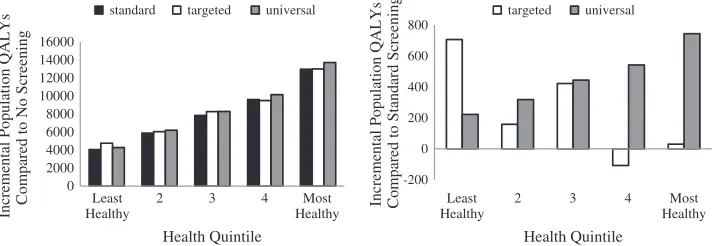
Figure 3a shows the changes to the population health distribution associated with each of our three screening strategies relative to no screening, and Figure 3b looks more closely at the impact of the two redesign strategies as compared with the standard screening programme.
[image:7.567.67.506.586.654.2]Compared with no screening, the screening programme in any of the three forms improves health across the distribution and widens health inequality in absolute terms, improving the health of the healthiest most and the least healthy least. Looking to Figure 3b, we see that compared with standard screening, the universal reminder is health improving across the distribution and further exacerbates absolute health inequality. By contrast, the targeted reminder as compared with standard screening reduces absolute health inequality by focussing additional benefits on the least healthy. It also reduces the health of some of the more healthy groups who benefit very little from the targeted reminder but still bear the health losses because of the opportunity cost of the strategy.
Table I. Standard cost-effectiveness results
Bowel cancer-related
cost (£) Life years QALYs
Incremental net health benefit (QALYs)a
No screening 278 793 874 50 577 384 41 762 818 —
Standard screening 350 872 069 50 634 273 41 806 794 40 372
Screening + targeted reminder 400 936 962 50 639 192 41 810 506 41 581
Screening + universal reminder 385 268 692 50 639 452 41 810 784 42 642
Combining the baseline health distribution and the estimated distribution of health changes associated with each of our screening strategies provides the overall health distribution associated with each strategy. Table II reports a range of absolute and relative inequality measures calculated for each strategy.
62.68
68.29 69.86 71.80
73.67
10 20 30 40 50 60 70 80
Least
Healthy 2 3 4 HealthyMost
Average Quality Adjusted Life
Expectancy (QALYs)
[image:8.567.170.396.85.227.2]Health Quintile
Figure 1. Baseline health distribution
40% 45% 50% 55% 60% 65% 70% 75% 80%
Least Healthy
2 3 4 Most
Healthy
gFOBT Uptake (%)
Health Quintile
[image:8.567.172.391.265.418.2]standard targeted universal
Figure 2. Guaiac fecal occult blood test (gFOBT) uptake distribution
0 2000 4000 6000 8000 10000 12000 14000 16000
Least
Healthy Healthy Incremental Population QALYs Compared to No Screening
Health Quintile
standard targeted universal
-200 0 200 400 600 800
Least Healthy
2 3 4 Most 2 3 4 Most
Healthy Incremental Population QALYs Compared to Standard Screening
Health Quintile
targeted universal
[image:8.567.106.462.467.590.2]All relative and absolute inequality measures calculated across a range of inequality aversion levels rank no screening as the least unequal and the universal reminder as the most unequal of the four strategies.
3.3. Social welfare results
We next combine our concerns for maximising health and minimising health inequality using social welfare analysis. We find that the estimated health distributions associated with both no screening and standard screening are generalised Lorenz dominated by those associated targeted and universal reminder strategies. This implies that both reminder strategies deliver more population health on average and a fairer distribution of health than the dominated strategies. Dominance does not apply between the targeted and universal reminder strategies, however, so we turn to our social welfare indices evaluated across a range of inequality aversion levels. The values of these indices are reported in Table III.
The social welfare indices show that where there is little or no concern for inequality, the universal reminder is the preferred strategy. However, as inequality aversion increases, the targeted reminder becomes the preferred strategy.
The results thus far have assumed an equal distribution of opportunity cost. Table IV reports the sensitivity of these results to alternative extreme assumptions. When all opportunity costs are borne by the least healthy subgroup, no screening and standard screening are no longer dominated.
[image:9.567.68.505.101.243.2]Although the distribution of opportunity cost does not impact mean health, it does impact the distribution of health, and this is reflected in the social welfare measures. This is particularly evident at intermediate levels of
Table II. Measures of inequality
Relative inequality indices No screening Standard Targeted reminder Universal reminder
Relative gap index (ratio) 0.17527a 0.17592 0.17586 0.17596
Relative index of inequality 0.18607a 0.18674 0.18668 0.18678
Gini index 0.03101a 0.03112 0.03111 0.03113
Atkinson index (ε= 1) 0.00171a 0.00172 0.00172 0.00172
Atkinson index (ε= 7) 0.01330a 0.01337 0.01337 0.01338
Atkinson index (ε= 30) 0.06253a 0.06281 0.06279 0.06283
Absolute inequality indices No screening Standard Targeted reminder Universal reminder
Absolute gap index (range) 10.98604a 11.03064 11.02726 11.03325
Slope index of inequality 12.88747a 12.94123 12.93691 12.94438
Kolm index (α= 0.025) 0.20281a 0.20430 0.20416 0.20439
Kolm index (α= 0.1) 0.87801a 0.88429 0.88371 0.88467
Kolm index (α= 0.5) 4.56391a 4.58739 4.58587 4.58883
ε= 1 represents low relative inequality aversion, whileε= 30 represents high relative inequality aversion. α= 0.025 represents low absolute inequality aversion, whileα= 0.5 represents high absolute inequality aversion.
a
Indicates the most equal strategy.
Table III. Measures of social welfare
Social welfare indices Targeted reminder Universal reminder
Mean health (ε=α=0) 69.30127 69.30233a
Atkinson EDE (ε= 1) 69.18238 69.18331a
Atkinson EDE (ε= 7) 68.37503 68.37510a
Atkinson EDE (ε= 30) 64.94991a 64.94796
Kolm EDE (α= 0.025) 69.09711 69.09794a
Kolm EDE (α= 0.1) 68.41756 68.41767a
Kolm EDE (α= 0.5) 64.71541a 64.71350
EDE, equally distributed equivalent.
[image:9.567.144.426.567.654.2]inequality aversion (ε= 7 orα= 0.1) where we see that the preferred screening strategy changes from standard
screening when all the opportunity cost is borne by the least healthy group, to universal reminder when opportunity cost is equally distributed, to targeted reminder where all the opportunity cost is borne by the healthiest group.
3.4. Adjustment for alternative social value judgements results
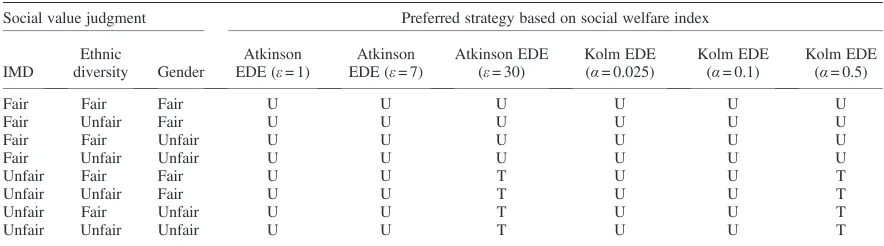
Our results so far have assumed all inequality is unfair; Table V reports the sensitivity of our results to all eight possible sets of social value judgements regarding which inequalities are deemed unfair that can be made in this example.
The sensitivity analysis suggests that in this example, value judgements around the fairness of variation associated with area level deprivation are pivotal in determining the preferred strategy.
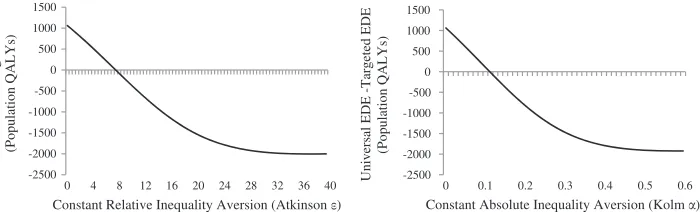
[image:10.567.63.504.101.222.2]Finally, we explore the sensitivity of our social welfare indices calculated for the nondominated strategies to the choice of inequality aversion level as shown in Figure 4a and b. Thesefigures show the difference between the EDE of the alternative strategies. The threshold level of inequality aversion at which the targeted reminder becomes the preferred strategy is eight for the Atkinson EDE and 0.12 for the Kolm EDE. At these levels of inequality aversion, a decision maker would be willing to sacrifice 1000 potential QALYs among the population of 1 million 30 year olds in order to achieve the more equal distribution of health offered by the targeted screening strategy.
Table IV. Sensitivity to opportunity cost distribution
All opportunity cost borne by least healthy subgroup
All opportunity cost borne by healthiest subgroup
Social welfare indices
No
screening Standard
Targeted reminder
Universal reminder
Targeted reminder
Universal reminder
Mean health 69.25969 69.30006 69.30127 69.30233a 69.30127 69.30233a
Atkinson EDE (ε= 1) 69.14152 69.18056 69.18147 69.18252a 69.18286 69.18373a Atkinson EDE (ε= 7) 68.33888 68.36800a 68.36610 68.36734 68.37799a 68.37769 Atkinson EDE (ε= 30) 64.92865a 64.91468 64.89302 64.89892 64.95627a 64.95350 Kolm EDE (α= 0.025) 69.05688 69.09486 69.09556 69.09660a 69.09793 69.09866a Kolm EDE (α= 0.1) 68.38168 68.41112a 68.40958 68.41074 68.42046a 68.42020 Kolm EDE (α= 0.5) 64.69578a 64.68086 64.65951 64.66532 64.72148a 64.71879
EDE, equally distributed equivalent. a
Indicates the strategy yielding the highest social welfare.
Table V. Sensitivity of preferred screening strategy decision to the choice of social value judgements
Social value judgment Preferred strategy based on social welfare index
IMD
Ethnic
diversity Gender
Atkinson EDE (ε= 1)
Atkinson EDE (ε= 7)
Atkinson EDE (ε= 30)
Kolm EDE (α= 0.025)
Kolm EDE (α= 0.1)
Kolm EDE (α= 0.5)
Fair Fair Fair U U U U U U
Fair Unfair Fair U U U U U U
Fair Fair Unfair U U U U U U
Fair Unfair Unfair U U U U U U
Unfair Fair Fair U U T U U T
Unfair Unfair Fair U U T U U T
Unfair Fair Unfair U U T U U T
Unfair Unfair Unfair U U T U U T
[image:10.567.62.504.540.663.2]4. DISCUSSION
4.1. Distributional cost-effectiveness analysis
The results from the model show that although the national BCSP has a small per person benefit, this benefit is sub-stantial at a population level. This is to be expected for a population health intervention such as this, where the ma-jority of people screened will not have bowel cancer, and some of the people who develop bowel cancer may not participate in screening. So despite large individual benefits accruing to people who participate in screening and have their bowel cancer detected early, these benefits accrue to only a relatively small number of people and are averaged across the whole population, giving a small expected per person benefit among the general population.
Targeted and universal reminder strategies to increase uptake of bowel cancer screening both appear to be worth-while in terms of improving population health. In the base case analysis, both would be viewed as welfare increasing compared with no screening or standard screening for a broad range of social welfare functions reflecting different views on health inequality. The universal reminder resulted in a greater population health improvement than the targeted reminder but was less attractive in terms of its impact on increasing health inequalities. In our base case anal-ysis, the universal reminder would be the preferred intervention at the lower end of the range of inequality aversion values considered, but the targeted reminder could become preferred at high levels of health inequality aversion.
Although all three configurations of the screening programme are health inequality increasing compared with no screening, augmenting the current screening programme with a targeted reminder reduces health inequality. By contrast, augmenting the current screening programme with a universal reminder slightly increases health inequality as compared with the standard screening programme alone. Some aspects of the inter-vention-generated inequality due to the screening programme arise because of inequalities in uptake of gFOBT and follow-up colonoscopy. However, some of the health inequality impact arises through differing rates of morbidity and other-cause mortality (not related to bowel cancer directly). Because we are interested in lifetime health, as measured here using QALE, detecting cancer earlier and thereby preventing a cancer-related fatality will inevitably deliver a larger health gain in social groups with relatively high QALE (Haucket al., 2002).
4.2. Sensitivity analyses
No screening and standard screening could be ruled out on the basis of generalised Lorenz dominance, but this was sensitive to an assumption about the distribution of the opportunity cost. The ranking produced by social welfare indices was sensitive to the type and level of inequality aversion. Furthermore, alternative social value judgements about the fairness of variation associated with the different population characteristics impact our choice of preferred strategy.
4.3. Other approaches
A number of methods have previously been proposed in the literature for including health inequality concerns in economic evaluation. These typically involve either weighting health gains differently for different groups in
-2500 -2000 -1500 -1000 -500 0 500 1000 1500
Universal EDE -Targeted EDE
(Population QALYs)
Constant Relative Inequality Aversion (Atkinson )
-2500 -2000 -1500 -1000 -500 0 500 1000 1500
0 4 8 12 16 20 24 28 32 36 40 Universal EDE -Targeted EDE 0 0.1 0.2 0.3 0.4 0.5 0.6
(Population QALYs)
Constant Absolute Inequality Aversion (Kolm )
[image:11.567.112.462.85.191.2]the population (Nordet al., 1999) or weighting overall health gains directly against overall changes in health in-equality in the context of ‘multicriteria decision analysis’ (Baltussen and Niessen, 2006). Both these types of method can be replicated using the DCEA framework by imposing the relevant restrictions on the fairness adjust-ment process and on the form and parameters of the social welfare function. We therefore see DCEA as encompassing these previous equity weighting methods within a more general framework that provides decision makers with more detailed information about health inequality impacts, rather than as a rival alternative approach. An important emerging source of empirical literature on incorporating health inequality impacts into economic evaluation in low and middle income countries is the‘extended CEA’framework (Verguetet al., 2014). This approach is similar in spirit to DCEA, although simplifies the analysis by (i) focusing on a single distributional variable (wealth quintile group) rather than analysing multiple distributional variables, (ii) setting aside the issue of opportunity costs falling on the health budget by assuming the intervention is funded by the tax system, and (iii) presenting results as a disaggregated‘dashboard’of costs and consequences by social group rather than using inequality indices and social welfare functions to explicitly analyse trade-offs between improving health and reducing unfair health inequality.
4.4. Conclusion
The DCEA framework outlined in this paper demonstrates how concerns for unfair health inequality can be taken into account when evaluating health care interventions funded within afixed health budget. Transparency about value judgements and sensitivity analysis to reflect alternative value judgements is a key feature of the proposed framework. This form of analysis is particularly relevant when considering redesign options for pre-ventive health care programmes to ameliorate intervention-generated inequalities, as in the case of the NHS BCSP. Data requirements for such analyses are nontrivial. However, credible DCEAs are currently feasible in at least some real-world settings, and further analyses will become possible in future as more evidence on distributional outcomes starts to emerge in the era of‘big data’. Evidence on distributional outcomes can be obtained through evidence synthesis research exploiting networks of patient-level trial datasets, as well as the application of heterogeneous treatment effect estimators to large observational datasets. Research is needed, for example, to synthesise evidence on the social distribution of the effects of different approaches for increas-ing the uptake of screenincreas-ing and other forms of preventive care, with a view to gaugincreas-ing how far estimates can be generalised from one setting to another. More empirical work is also required to determine a realistic distribu-tion of opportunity costs (plausibly reflecting the impact of likely disinvestment decisions in the health service) and to elicit reasonable ranges of values for societal levels of absolute and relative inequality aversion as well as social value judgements on what should be deemed as fair and unfair variations in health.
ACKNOWLEDGEMENTS
The authors would like to thank Tony Culyer, Mark Sculpher, Karl Claxton and Nigel Rice for their input as part of the project steering group, the participants in the two workshops held as part of the project and the health economics study group attendees (HESG) where this work was presented.
The work was undertaken by the authors as part of the Public Health Research Consortium. The Public Health Research Consortium is funded by the Department of Health Policy Research Programme. The views expressed in the publication are those of the authors and not necessarily those of the Department of Health. Information about the DCEA project is available at http://www.york.ac.uk/che/research/equity/d-c-e-a/phrc/, and information about the wider programme of the PHRC is available from http://www.phrc.lshtm.ac.uk.
REFERENCES
Baltussen R, Niessen L. 2006. Priority setting of health interventions: the need for multi-criteria decision analysis.Cost effectiveness and resource allocation: C/E, 4, p.14. Available at: http://www.pubmedcentral.nih.gov/articlerender. fcgi?artid=1560167&tool=pmcentrez&rendertype=abstract [Accessed January 29, 2014].
Cookson R, Drummond M, Weatherly H. 2009. Explicit incorporation of equity considerations into economic evaluation of public health interventions.Health economics, policy, and law4(Pt 2): 231–245. Available at: http://www.ncbi.nlm.nih. gov/pubmed/19216834 [Accessed February 3, 2011].
Drummond MF, Sculpher MJ, Torrance GW. 2005. Methods for the economic evaluation of health care programmes. Oxford University Press: Oxford, UK. Available at: http://books.google.com/books?id=xyPLJIiEn7cC&pgis=1 [Accessed May 12, 2011]. Fleurbaey M, Schokkaert E. 2009. Unfair inequalities in health and health care.Journal of health economics28(1): 73–90.
Available at: http://www.ncbi.nlm.nih.gov/pubmed/18829124 [Accessed November 15, 2010].
Hauck K, Shaw R, Smith PC. 2002. Reducing avoidable inequalities in health: a new criterion for setting health care capitation payments.Health economics11(8): 667–677. Available at: http://www.ncbi.nlm.nih.gov/pubmed/12457368 [Accessed March 6, 2013].
Hewitson P et al. 2008. Cochrane systematic review of colorectal cancer screening using the fecal occult blood test (hemoccult): an update.The American journal of gastroenterology103(6): 1541–1549.
Hewitson P et al. 2011. Primary care endorsement letter and a patient leaflet to improve participation in colorectal cancer screening: results of a factorial randomised trial. British journal of cancer 105(4): 475–480. Available at: http://www.pubmedcentral.nih.gov/articlerender.fcgi?artid=3170960&tool=pmcentrez&rendertype=abstract [Accessed September 6, 2012].
Kind P, Hardman G, Macran S. 1999. UK population norms for EQ-5D, Available at: http://www.york.ac.uk/media/che/ documents/papers/discussionpapers/CHE Discussion Paper 172.pdf [Accessed October 31, 2012].
Kolm S-C. 1976. Unequal inequalities. I.Journal of Economic Theory12(3): 416–442. Available at: http://linkinghub. elsevier.com/retrieve/pii/0022053176900375.
Logan RFAet al. 2012. Outcomes of the bowel cancer screening programme (BCSP) in England after thefirst 1 million tests. Gut61(10): 1439–1446. Available at: http://www.pubmedcentral.nih.gov/articlerender.fcgi?artid=3437782&tool= pmcentrez&rendertype=abstract [Accessed September 14, 2012].
Lorenc Tet al. 2012. What types of interventions generate inequalities? Evidence from systematic reviews.Journal of Epidemiology and Community Health8–11. Available at: http://www.ncbi.nlm.nih.gov/pubmed/22875078 [Accessed November 9, 2012].
Morris Set al. 2012. Socioeconomic variation in uptake of colonoscopy following a positive faecal occult blood test result: a retrospective analysis of the NHS bowel cancer screening programme.British journal of cancer107(5): 765–771. Available at: http://www.ncbi.nlm.nih.gov/pubmed/22864455 [Accessed September 12, 2012].
National Cancer Intelligence Network. 2004. Cancer incidence by deprivation, 1995–2004, Available at: http://www.ncin. org.uk/view.aspx?rid=73.
Nord Eet al. 1999. Incorporating societal concerns for fairness in numerical valuations of health programmes. Health economics8(1): 25–39. Available at: http://www.ncbi.nlm.nih.gov/pubmed/10082141.
ONS. 2007. Longitudinal study age-specific mortality data 1972–2005 (supplementary tables), Available at: http://www.ons. gov.uk/ons/rel/health-ineq/health-inequalities/trends-in-life-expectancy-by-social-class-1972-2005/longitudinal-study-age-specific-mortality-data-1972-2005--supplementary-tables-.xls.
ONS. 2012. Cancer incidence and mortality in the UK, 2007–2009, Available at: http://www.ons.gov.uk/ons/ dcp171778_259504.pdf.
Shankaran Vet al. 2007. Costs and cost-effectiveness of a low-intensity patient-directed intervention to promote colorectal cancer screening.Journal of clinical oncology : official journal of the American Society of Clinical Oncology25(33): 5248–5253. Available at: http://www.ncbi.nlm.nih.gov/pubmed/18024871 [Accessed October 30, 2012].
Shorrocks AF. 1983. Ranking income distributions. Economica 50(197): 3. Available at: http://links.jstor.org/sici? sici=0013-0427(198302)2:50:197<3:RID>2.0.CO;2-I&origin=crossref.
Smith M, Olatunde O, White C. 2010. Inequalities in disability-free life expectancy by area deprivation: England, 2001–04 and 2005–08.Health Statistics Quarterly48(48): 36–57.
Tappenden Pet al. 2007. Option appraisal of population-based colorectal cancer screening programmes in England.Gut56(5): 677–684. Available at: http://www.pubmedcentral.nih.gov/articlerender.fcgi?artid=1942136&tool=pmcentrez& rendertype=abstract [Accessed September 18, 2012].
Verguet S, Laxminarayan R, Jamison DT. 2014. Universal publicfinance of tuberculosis treatment in India: an extended cost-effectiveness analysis.Health Economics. doi: 10.1002/hec.3019
Von Wagner Cet al. 2011. Inequalities in participation in an organized national colorectal cancer screening programme: results from thefirst 2.6 million invitations in England.International journal of epidemiology40(3): 712–718. Available at: http://www.ncbi.nlm.nih.gov/pubmed/21330344 [Accessed July 27, 2012].
Weller D. 2009. Evaluation of the 3rd round of the English bowel cancer screening pilot report to the NHS cancer screening programmes, Available at: http://www.cancerscreening.nhs.uk/bowel/pilot-3rd-round-evaluation.pdf.
Whyte S, Walsh C, Chilcott J. 2011. Bayesian calibration of a natural history model with application to a population model for colorectal cancer.Medical decision making : an international journal of the Society for Medical Decision Making
31(4): 625–641. Available at: http://www.ncbi.nlm.nih.gov/pubmed/21127321 [Accessed October 4, 2013]. Whyte S, Chilcott J, Halloran S. 2012. Reappraisal of the options for colorectal cancer screening in England.Colorectal