This is a repository copy of Stream ecosystem responses to an extreme rainfall event across multiple catchments in southeast Alaska.
White Rose Research Online URL for this paper: http://eprints.whiterose.ac.uk/88077/
Version: Accepted Version
Article:
Robertson, AL, Brown, LE, Klaar, MJ et al. (1 more author) (2015) Stream ecosystem responses to an extreme rainfall event across multiple catchments in southeast Alaska. Freshwater Biology, 60 (12). 2523 - 2534. ISSN 1365-2427
https://doi.org/10.1111/fwb.12638
[email protected] https://eprints.whiterose.ac.uk/
Reuse
Unless indicated otherwise, fulltext items are protected by copyright with all rights reserved. The copyright exception in section 29 of the Copyright, Designs and Patents Act 1988 allows the making of a single copy solely for the purpose of non-commercial research or private study within the limits of fair dealing. The publisher or other rights-holder may allow further reproduction and re-use of this version - refer to the White Rose Research Online record for this item. Where records identify the publisher as the copyright holder, users can verify any specific terms of use on the publisher’s website.
Takedown
If you consider content in White Rose Research Online to be in breach of UK law, please notify us by
1
Stream ecosystem responses to an extreme rainfall event across multiple
1
catchments in southeast Alaska
2
3
Anne L. Robertson*1, Lee E. Brown2, Megan J. Klaar3 and Alexander M. Milner3,4
4
1*Department of Life Sciences, University of Roehampton, Holybourne Avenue, 5
London SW15 4JD, UK. [email protected]
6
2School of Geography/Water@leeds, University of Leeds, Woodhouse Lane, Leeds, 7
LS2 9JT, UK.
8
3School of Geography, Earth and Environmental Sciences, University of 9
Birmingham, Edgbaston, Birmingham B15 2TT, UK.
10
4Institute of Arctic Biology, University of Alaska, Fairbanks. AL 99775, USA. 11
*corresponding author
12
13
Abbreviated title: Stream responses to extreme rainfall across multiple catchments
14
15
Keywords: Floods, climate change, glacial recession, channel geomorphology,
16
invertebrates.
17
2
SUMMARY
19
1. Floods are a key component of the flow regime of many rivers and a major
20
structuring force of stream communities. Climate change is predicted to
21
increase the frequency of extreme rainfall (i.e. return intervals > 100 years)
22
leading to extensive flooding, but the ecological effects of such events are not
23
well understood. Comparative studies of flood impacts are scarce, despite the
24
clear need to understand the potentially contingent responses of multiple
25
independent stream systems to extreme weather occurring at meso- and
26
synoptic spatial scales.
27
2. We describe the effect of an extreme rainfall event affecting an area >100,000
28
km2 that caused extensive flooding in SE Alaska. Responses of channel
29
morphology and three key biological groups (meiofauna, macroinvertebrates
30
and fish) were assessed in four separate and recently deglaciated stream
31
catchments of contrasting age (38-180 years) by comparing samples taken
32
before and after the event.
33
3. Ecological responses to the rainfall and subsequent flooding differed markedly
34
across the four catchments in response to variations in rainfall intensity and to
35
factors such as channel morphology, stream sediment composition and
36
catchment vegetation type and cover, which were themselves related to
37
stream age.
38
4. Our study demonstrates the value of considering multiple response variables
39
when assessing the effects of extreme events, and highlights the potential for
40
contrasting biological responses to extreme events across catchments. We
41
advocate more comparative studies to understand how extreme rainfall and
42
flooding affects ecosystem responses across multiple catchments.
43
3 Introduction
45
Floods are a significant feature of the flow regime of many rivers (Poff et al., 1997),
46
and a major force structuring stream communities (Lake, 2000; Jones, 2013).
47
Extensive precipitation and/or snow melt can cause floods, but flow responses can
48
vary markedly in space and time depending on antecedent conditions, catchment
49
characteristics such as geology and relief, and human activities. Pluvial floods vary
50
in magnitude and predictability as a result of the natural variability of precipitation,
51
both within and between years, but a changing climate is expected to alter the
52
frequency, intensity, spatial extent, duration and timing of extreme weather events
53
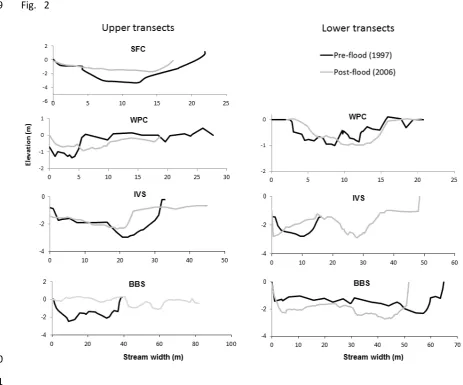
(IPCC, 2013), and may result in unprecedented effects on river flow and associated
54
riverine communities. Extreme or great floods can be defined as having discharges
55
exceeding 100-year return intervals (Milly et al., 2002). As such events are
56
infrequent and unpredictable, knowledge of their ecological effects is incomplete, yet
57
there is a growing need to improve understanding of their impact on river
58
ecosystems as the climate changes.
59
The response of stream communities to flooding has been researched extensively
60
over the past three decades (Niemi et al., 1990; Yount & Niemi, 1990; Stanley et al., 61
2010) yet there remain relatively few studies of extreme flooding. Floods can affect
62
riverine ecosystems directly, as disturbance alters biodiversity, abundances and
63
standing biomass, and indirectly, via changes to river channel and floodplain
64
hydrology, geomorphology and biogeochemistry (Poff, 1997). Extreme floods may
65
have particularly deleterious effects on stream benthic communities because they
66
scour and redeposit sediments, and incise channels, potentially reducing habitat
67
heterogeneity and the availability of flow refugia for biota (Death, 1997).
4
Responses to flooding may depend on channel morphology, sediment composition
69
and habitat complexity (e.g. the presence of backwaters, pools and debris dams)
70
which dictates the extent of in-stream refugia. These factors may vary between
71
catchments, with those in earlier successional stages tending to have less complex,
72
more unconsolidated glacial deposits than those that are older and/or less modified
73
(Milner et al., 2000, 2013). Thus stream communities in different catchments could
74
vary in their responses to flooding. Flood responses may also be modulated by the
75
precipitation history and nature of the catchment (e.g. vegetation type and cover)
76
and the resultant hydrological history of the river because the flow regime is a major
77
ecological filter (sensu Poff, 1997), influencing the composition of the local
78
community and ‘selecting’ species with appropriate traits from the regional species
79
pool.
80
In a typical flood, a large volume of fast-flowing water moves rapidly downstream,
81
creating high channel shear stress. Organisms are dislodged, crushed by moving
82
substrata or forced to migrate from the channel (Death, 2010). Invertebrate and fish
83
communities often exhibit low resistance to floods and total abundance is usually
84
reduced significantly (e.g. Vieira et al., 2004; Kroon & Ludwig, 2010; McMullen &
85
Lytle, 2012) but populations are frequently resilient and recover rapidly if pools of
86
colonists remain within the system or in nearby areas (Milner et al., 2013). Some
87
individuals move actively or passively into high-flow refugia such as river margins,
88
floodplains and possibly the hyporheic zone, returning to the main channel after flow
89
recedes (e.g. Robertson et al., 1995; Dole-Olivier, 2011; Sueyoshi et al., 2014).
90
Thus, habitat heterogeneity and connectivity are important for assemblage resilience
91
(Matthews, 1998). The response of river biota to flooding may be taxon-specific,
92
although few studies have considered a wide range of organismal groups (but see
5
Milner et al. 2013). Species responses can also be age-specific, for example, floods
94
remove fine sediment thereby favouring gravel-nesting fish (e.g. Kroon & Ludwig,
95
2010; Matthews et al., 2013), whereas , scouring and sediment deposition during
96
floods can kill fish eggs. Additionally flood waters displace juvenile salmonids
97
downstream unless they are able to find flow refuges (e.g. Harvey, 1987).
98
The impact of flooding on riverine communities is usually assessed within individual
99
catchments (e.g. Olsen et al., 2010; Stanley et al., 2010; Mesa, 2010; Milner et al., 100
2013) and there is a notable paucity of studies comparing the effects of floods on
101
aquatic invertebrates across rivers and catchments (Death, 2007) with the exception
102
of some patch-scale experimental manipulations (e.g. Gjerløv et al., 2003; Melo et 103
al., 2003). However, adjacent catchments may be expected to differ in vegetation
104
extent and type, and the rivers within them to differ in channel morphology, sediment
105
composition and the degree of habitat complexity. In turn these differences may
106
modulate ecosystem responses to extreme rainfall and subsequent flooding,
107
highlighting the need to understand how independent systems respond during
broad-108
scale extreme events and emphasising the importance of incorporating multiple
109
catchments into studies of high flow impacts. By doing so we can begin to unpick
110
the myriad of factors influencing community responses (Olden et al., 2014).
111
This paper focuses on the effect of an extreme climatic event which led to extensive
112
flooding of streams of differing habitat complexities in Glacier Bay, southeast Alaska.
113
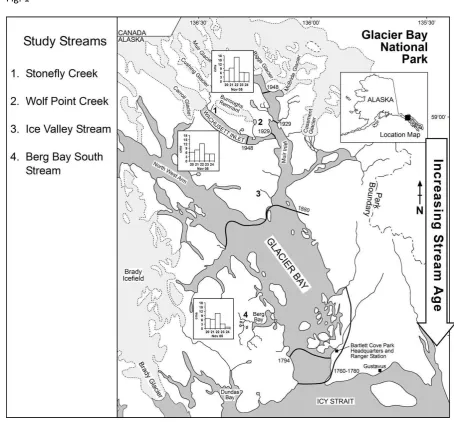
Over 400mm of rain fellover a 4-day period (21st – 24th November 2005) including >
114
130mm on a single day (Fig. 1). The intensity of the rainfall over 24 h indicated that
115
this event had a return interval of > 100 years and its severity was compounded by
116
the duration of the storm and extensive catchment snow cover(Milner et al., 2013).
117
Furthermore, rainfall intensity varied across the study area, being higher in the north
6
(170mm on 22nd November 2005) and lower in the south (110mm on 22nd November
119
2005) (Fig. 1). We assessed ecosystem response to this extreme rain and flooding
120
event using three biological groups (meiofauna, macroinvertebrates and fish) from
121
four streams at differing stages of development following glacial recession in Glacier
122
Bay.
123
124
Our primary aim was to examine the impact of an extreme rainfall event leading to
125
extensive flooding on stream ecosystems in multiple catchments across an 11,000
126
km2 study area. We hypothesised that the flood event would have the following
127
effects:
128
1. Stream geomorphology will be modified across the streams, with channel
129
reconfiguration leading to reduced habitat heterogeneity.
130
2. Community total abundance will decline whereas taxon richness may increase
131
or decrease depending on the habitat preferences of individual taxa. Stream
132
communities will converge post-flood, as formerly contrasting communities
133
‘reset’ to an earlier stage of development.
134
3. Streams subjected to the highest rainfall intensity, and greatest flooding,
135
should exhibit the biggest shifts in invertebrate community structure.
136
4. Responses to flooding will differ among the three organismal groups
137
(meiofauna, macroinvertebrates and fish) depending on traits and/or timing of
138
the flood with respect to life cycle stage.
139
Methods 140
Glacier Bay National Park and Preserve (GBNP) is located west of Juneau in
141
southeast Alaska (58 10- 59 15 N; 135 15- 138 10W). Glacial recession has created
7
a deglaciated landscape, with a temporal scale of 220 years and a spatial scale of
143
11,000 km2. The climate of Glacier Bay is temperate maritime, with mean annual
144
temperature of 5 °C (mean monthly range - 3 °C to 13 °C) and average annual
145
precipitation of 1400 mm. A Neoglacial ice sheet once covered the majority of
146
GBNP, reaching a maximum around AD 1700. A change in local climate c.250 years
147
ago led to recession of the ice sheet (Chapin et al., 1994). Detailed historical and
148
geological information provides accurate information on the rate of glacial recession
149
within GBNP, from which stream age can be estimated. Stream and catchment ages
150
were defined as the time since ice recession from the stream mouth (Milner et al., 151
2000).
152
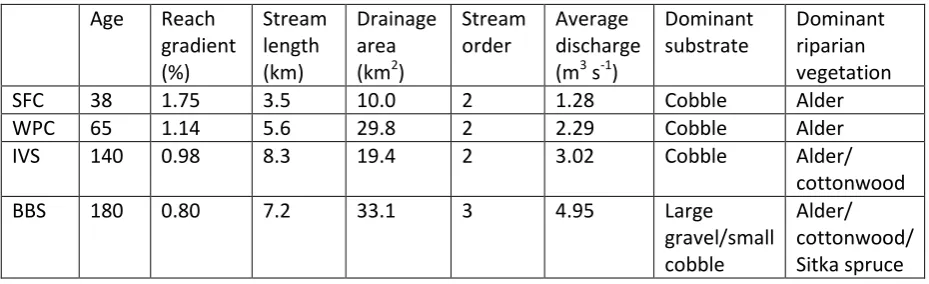
Four streams (Table 1) were selected to represent c.180 years of catchment
153
development following glacial recession (Milner et al., 2000). The catchments of the
154
older streams (140 - 180 years) had extensive forest cover, while those of the
155
younger streams (38 - 65 years) possessed more intermittent and less complex
156
vegetation.
157
To determine changes in stream channel cross-sections following the flood,
158
tachometry channel cross-section data were collected in 1997 using a Sokkia dumpy
159
level (Topcon, Tokyo, Japan) with tripod and staff. Measurements were taken at two
160
separate locations within each study reach, at a maximum of 100 m apart, and
161
located a maximum of 1 km from the stream mouth, hereafter termed ‘upper’ and
162
‘lower’ cross-sections. Annual observations demonstrated that these cross-sections
163
did not change markedly prior to the extreme rain and flooding event in late 2005.
164
GPS fixes at the floodplain terrace on both banks of the channel cross-sections
165
facilitated re-surveying in 2006 to provide information on channel change. Floodplain
166
area, bankfull width and detailed channel bed measurements were taken, allowing
8
entrenchment ratios (width of flood-prone area/ width at bankfull) to be estimated.
168
Only the upper cross-section could be re-surveyed in 2006 at Stonefly Creek. The
169
percentage of pools in the habitat was determined before (Milner et al. 2000) and
170
after the flood (Klaar et al. 2009).
171
For macroinvertebrates, samples collected in the same summer month before (2005)
172
and after (2006) the flood were compared, excepting Berg Bay South stream where
173
samples collected in July 2005 were compared with September 2006. For
174
meiofauna, comparisons were made between samples collected in summer 2004
175
(before flood) and summer 2006 (after flood). For meiofauna four additional sets of
176
samples (two in 2006 and two in 2007) were used to examine the recovery
177
trajectory.
178
Meiofauna were collected in summer (June – August) from a representative
179
sampling station located c. 0.5 - 1 km from the mouth of each stream using a Surber
180
net (five replicates; 63 m mesh). Meiofauna are organisms which pass through a
181
1mm sieve but are retained by a 63µm sieve (Giere 1993) and usually incorporate
182
the small instars of macroinvertebrates, as well as taxa such as copepods which
183
remain in this size category throughout their life cycle. Macroinvertebrates were also
184
collected from the same reaches using a Surber net (5 - 10 replicates; 330 m mesh).
185
Both size fractions were preserved in 70% ethanol and later separated in the
186
laboratory from detritus and inorganic matterbefore enumeration.
187
Macroinvertebrates were identified using Merritt et al. (2008). Meiofauna were
188
identified using Thorp & Covich (2009) and Smith (2001). Macroinvertebrates < 1
189
mm were typically identified to order because their immaturity precluded assignment
190
to genus and/or species.
9 192
Numbers of adult pink salmon (Oncorhynchus gorbuscha) spawners were estimated
193
using the average of counts by two observers walking the length of the stream, and
194
juvenile coho salmon (Oncorhynchus kisutch) densities (Catch Per Unit Effort -
195
CPUE) with minnow traps baited with salmon eggs soaked previously in Betadyne
196
iodine and fished for 2h (Milner et al., 2000).
197
Data analysis 198
Pre- and post-flood data (based on mean densities from replicate Surber samples in
199
each stream) were ordinated using non-metric multidimensional scaling (NMDS)
200
using Bray-Curtis dissimilarity matrices.. One-way ANOSIM tested the null
201
hypothesis that the taxonomic composition of meiofaunal and macroinvertebrate
202
communities were unaffected by the flood. ANOSIM was conducted on individual
203
replicates using Bray-Curtis dissimilarity scores with 10,000 permutations and
204
Bonferroni-corrected significance values. A similarity of percentages (SIMPER)
205
routine was used to identify five taxa contributing most to community dissimilarity
206
before and after the flood in each stream. One-way ANOVA was then used to
207
determine the significance of these taxonomic differences. All analyses were
208
conducted on log10(x+1) transformed data) and statistical tests were undertaken 209
using SPSS v19. NMDS, ANOSIM and SIMPER were undertaken using PAST v3.0.
210
211
Results 212
The effect of the flooding on channel cross-sections varied markedly among the four
213
study streams (Fig. 2; Table 2). At Stonefly Creek, infilling reduced channel width by
214
21% whereas at Wolf Point Creek the flood scoured the bed and banks, and
215
increased channel entrenchment. However, the highest degree of channel change
10
occurred at Ice Valley Stream, where depth (+17.2%) and width (+37.5%) increased
217
and entrenchment decreased (Table 2). Channel migration was also evident in the
218
lower transect profile (Fig. 2). The channel response at Berg Bay South Stream
219
varied among transects, but generally, channel depth decreased as a result of
220
infilling (47.5% and 3.4% decrease in channel depth post-flooding at the upper and
221
lower transects respectively), and channel width increased. The occurrence of pool
222
habitat - a measure of channel heterogeneity - was unaffected by the flood in
223
Stonefly Creek and Ice Valley Stream, but declined in Wolf Point Creek, and
224
increased in Berg Bay South Stream.
225
Flooding significantly reduced the taxon richness and total abundance of meiofauna
226
in all streams except Ice Valley (Table 3). Declines in meiofaunal abundance ranged
227
from 84 – 90% in Stonefly Creek, Wolf Point Creek and Berg Bay South. In Stonefly
228
Creek, meiofaunal-sized Plecoptera and Ephemeroptera, Ostracoda and
229
Acanthocyclops vernalis were absent from post-flood assemblages. In Wolf Point
230
Creek absentees were Oligochaeta and Cyclops scutifer, and in Berg Bay South
231
stream, these were meiofaunal-sized Plecoptera, Ephemeroptera and Simulium sp.,
232
Tardigrada, Chaetogaster spp., other Oligochaeta, Ostracoda, Bryocamptus 233
zschokkei and Cyclops scutifer. Despite the immediate post-flood decline,
234
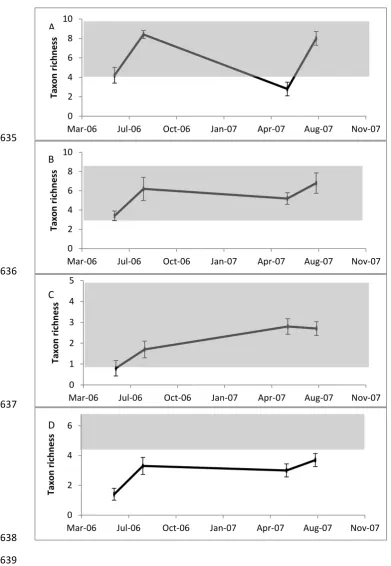
meiofaunal taxon richness in Stonefly Creek, Wolf Point Creek and Ice Valley
235
recovered later in 2006 and 2007 to fall within the range of pre-flood taxon richness
236
(Fig. 3). In Berg Bay South meiofaunal taxon richness in 2006 and 2007 remained
237
lower than that in pre-flood samples, however, all taxa collected before the flood
238
were found in at least one post-flood sample suggesting that pre-flood taxa persisted
239
within the stream albeit at low levels of abundance.
11
ANOSIM indicated that meiofaunal community composition was significantly affected
241
by the flood in Stonefly Creek (ANOSIM r2 = 0.76, P<0.01), Wolf Point Creek
242
(ANOSIM r2= 0.99, P<0.01) and Berg Bay South Stream (ANOSIM r2 = 0.95,
243
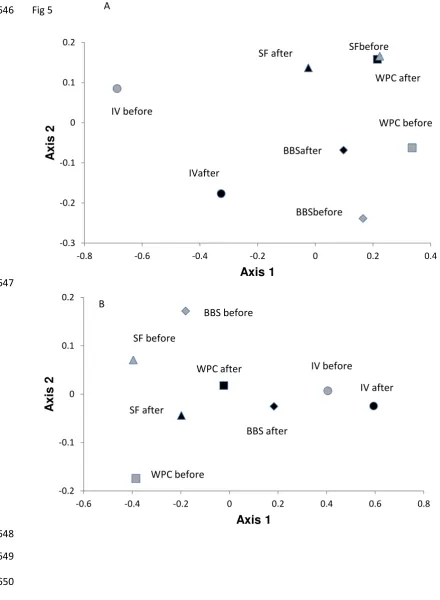
P<0.01) but not in Ice Valley. NMDS showed that Berg Bay South, Stonefly and Wolf
244
Point Creek communities clustered together more closely post-flood, suggesting
245
more similar meiofaunal communities in these disturbed streams (Fig. 5b).
246
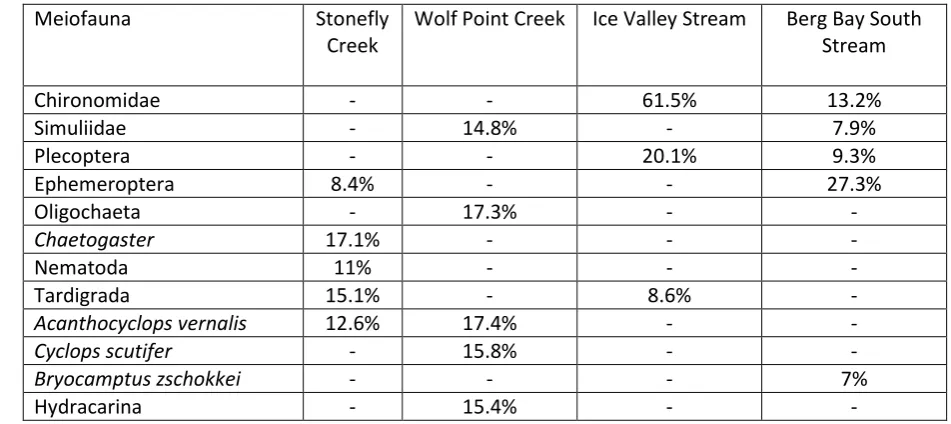
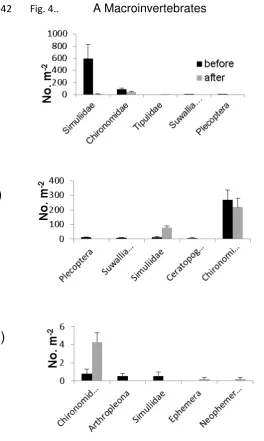
SIMPER revealed that the identity of five taxa contributing most to pre- vs. post-flood
247
community dissimilarity differed among streams, especially for meiofauna (Fig.
248
4b,Table 5). Abundances of these key taxa largely declined following the flood,
249
although the cyclopoid copepod Acanthocyclops vernalis significantly increased in
250
Wolf Point Creek (Fig. 4b).
251
The total abundance of macroinvertebrates declined following the flood in all streams
252
except Ice Valley, but effects were statistically significant only in Stonefly Creek (F1,8 253
= 33.25, P <0.001). Macroinvertebrate taxon richness was only significantly reduced
254
by flooding at Wolf Point Creek (F1,8 = 11.94, P <0.01). In this stream,
255
macroinvertebrate taxa absent in post-flood samples were Coleoptera, Ephemera,
256
Ephemerellidae, Hydracarina, Suwallia forcipata, and Trichoptera. For
257
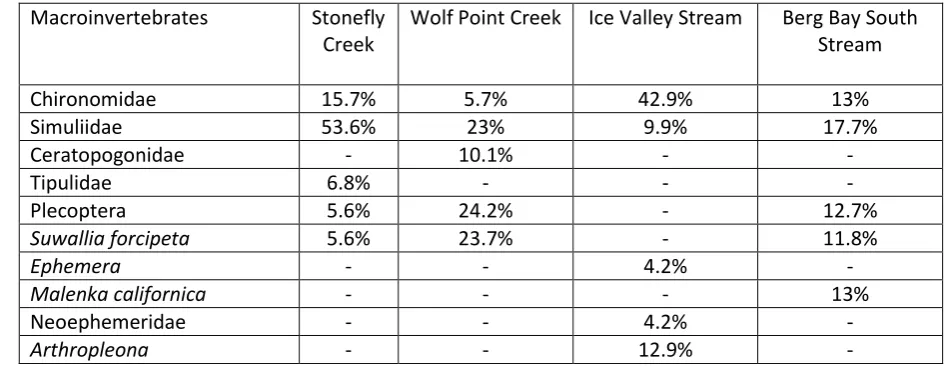
macroinvertebrates, SIMPER revealed that shifts in the abundance of Chironomidae
258
and Simuliidae were observed in all streams pre- versus post-flood (Fig. 4a, Table
259
4), and that responses of some Plecoptera (Suwallia forcipeta) accounted for
260
community change in Stonefly Creek, Wolf Point Creek and Berg Bay South Stream
261
(Table 4). Abundances of these key taxa generally declined following the flood, but
262
Chironomidae and Ephemera in Ice Valley Stream and Simuliidae and Suwallia 263
forcipata in Berg Bay South Stream increased post-flood (Fig. 4a).
12
Macroinvertebrate community composition was significantly altered by the flood in
265
the two younger streams Wolf Point Creek (ANOSIM r2 = 0.868, P < 0.01) and
266
Stonefly Creek (ANOSIM r2 = 0.868, P < 0.01) but not in the older Ice Valley and
267
Berg Bay South streams (Fig. 1). NMDS sample scores were more tightly clustered
268
post-flood reflecting increased similarity among macroinvertebrate assemblages
269
simplified by disturbance (Fig. 5a).
270
The highest abundance of spawning adult pink salmon and CPUE for juvenile coho
271
were recorded in Wolf Point Creek, prior to the flood and densities in this stream also
272
declined most strongly post-flood, with an eight-fold decline in returning spawning
273
adult pink salmon and a fifteen-fold fall in coho juvenile CPUE (Table 2). In contrast,
274
returns of adult pink salmon declined three-fold in Berg Bay South Stream after the
275
flood and there was a slight increase in juvenile coho CPUE. In Ice Valley Stream,
276
low numbers of returning pink salmon were recorded in both the pre- and post-flood
277
years and juvenile coho CPUE declined three-fold following the flood (Table 2).
278
279
Discussion 280
Predicting how extreme rainfall and flooding will affect river ecosystems as the
281
climate changes requires an understanding of how flood impacts vary across
282
multiple catchments in response to factors such as rainfall severity, channel
283
morphology and channel complexity, and, how different organismal groups respond
284
to high flows.This study revealed that the effects of flooding caused by a single
285
rainstorm varied markedly across our study streams in southeast Alaska. Several
286
factors may account for the contrasting responses to this extreme climatic event
13
observed among stream catchments, including stream geomorphology and
288
catchment vegetation cover.
289
Geomorphic responses to the extreme rainfall and flooding event varied between the
290
study streams [H1]. In the two younger streams, Stonefly Creek and Wolf Point
291
Creek, where the highest rainfall occurred (>400mm in 4 days), there was a similar
292
response of channel incision and increasing entrenchment due to channel bed and
293
bank scouring. However, in the two older streams, Ice Valley and Berg Bay South,
294
where rainfall was less intense (<300mm over 4 days), channel entrenchment
295
decreased and the stream channels generally widened and decreased in depth.
296
These variable responses may result in part from differences in channel bed
297
sediment structure associated with stream age, which varied from 38 – 180 years
298
(Stover & Montgomery, 2001; Sipos et al., 2008). Younger streams (i.e. 38 - 65
299
years) are often dominated by unconsolidated glacial material which is more likely to
300
be scoured from channel banks and bed during high flows (Carrivick et al., 2013;
301
Milner et al., 2013), resulting in a more defined, incised channel. However, older
302
streams (140 - 180 years) tend to have larger (Klaar et al., 2011), and more stable
303
bed substrates, as unconsolidated material has generally already been transported
304
from the channel. In these older stable streams, flood water is more likely to spill out
305
onto the floodplain, increasing channel width and decreasing channel depth as
306
material transported from terrestrial and upstream locations is deposited further
307
downstream.
308
The variable responses of the study streams to the extreme rainfall and flooding
309
event may also result from differences in vegetation cover in the catchments. Older
310
stream catchments are covered by more mature forest which may attenuate the
311
effects of extreme rainfall, whereas younger catchments are more sparsely
14
populated by less complex vegetation (e.g. Chapin et al., 1994; Fastie, 1995; Milner
313
et al., 2007). Engstrom et al. (2000) suggested that catchment development over
314
time can change soil structure, leading to greater surface runoff, which can in turn
315
modify stream hydrology. Sediment structure, catchment vegetation (both of which
316
vary with stream age) and rainfall intensity may interact to impact stream channel
317
morphology following an extreme event, but more detailed geomorphological data
318
collection would be required to untangle this further.
319
Changes in the meiofauna partially supported our second hypothesis, that
320
community composition would change markedly in the months following the flood.
321
Meiofaunal total abundance, taxon richness and community composition differed
322
significantly in three of the four streams and became more similar post-flood,
323
probably because the communities were reset to earlier stages of development
324
(sensu Milner et al., 2013) as a result of channel morphology change. Meiofauna are
325
small and their resultant vulnerability to high flows is well documented (e.g.
326
Robertson et al., 1995); however, they can be persistent in streams (Robertson,
327
2000) as demonstrated by our finding that post-flood taxon richness either fell within
328
the envelope of pre-flood (2000-2004) taxon richness, or that pre-flood taxa were
329
recorded in at least one post-flood sample. The abundance of most taxa declined
330
following the flood, but in Wolf Point Creek, that of the predatory cyclopoid copepod
331
Acanthocyclops vernalis increased markedly, possibly as a result of predatory/
332
competitive release (Gendron & Laville, 2000; Anderson & Ferrington, 2013) or the
333
removal of fine sediments (Robertson & Milner, 2006).
334
Our results indicate that, for meiofauna, lower rainfall intensity did not necessarily
335
cause a lesser community response because meiofaunal community composition
336
differed significantly in Berg Bay South (experiencing lower rainfall intensity) as well
15
as Stonefly and Wolf Point Creek (higher intensities) and the percent decline in
338
abundance was similar in all three streams. Thus, for the meiofauna, our third
339
hypothesis, thathigher rainfall will lead to larger community response, was
340
unsupported. Meiofauna have a low threshold of entrainment into the water column
341
(Palmer et al., 1992) and thus washout may occur at relatively low flows.
342
Macroinvertebrate community composition changed significantly in some streams
343
but not others and NMDS suggested that communities in three streams became
344
more similar after the flood than before, providing further partial support for our
345
second hypothesis. As has been found in many other studies, invertebrate total
346
abundance and taxon richness generally declined following the floods (e.g. McCabe
347
& Gotelli, 2000; Fritz & Dodds, 2004; Stanley et al., 2010), although this was
348
statistically significant only for some groups and some streams. Macroinvertebrate
349
taxa absent from Wolf Point Creek and Stonefly Creek tended to be those favouring
350
slow flowing/ depositional areas of streams thereby reflecting the reduction of these
351
habitats post-flood (Milner et al. 2012). Significant changes in macroinvertebrate
352
community composition following the floods were found only in the least stable,
353
younger channels of Wolf Point and Stonefly Creeks where the most intense rainfall
354
occurred. These streams were the only ones showing significant changes in total
355
abundance (Stonefly Creek) and taxon richness (Wolf Point Creek), providing some
356
support for our third hypothesis that streams experiencing the greatest rainfall would
357
show the greatest changes in invertebrate communities. The response of juvenile
358
coho salmon to flooding was also distinctive; CPUE declined post-flood in Wolf Point
359
Creek but increased in Berg Bay South Stream, perhaps in response to the greater
360
percentage of pools in the post-flood stream (Rosenfeld et al., 2000; Roni, 2002).
361
The number of adult pink salmon spawners decreased markedly in Wolf Point Creek
16
and Berg Bay South Stream but recovered rapidly in the former in 2009 and 2011
363
(Milner et al., 2013).
364
365
We found differences in the response of the three organismal groups to extreme
366
flooding, for example, the meiofauna showed a greater response to the flood than
367
macroinvertebrates, providing partial support for our fourth hypothesis. Our finding
368
highlights the importance of considering the responses of multiple organismal groups
369
to fully capture the effects of extreme events on stream communities.
370
Invertebrates in Ice Valley stream were apparently not affected by the flood, despite
371
this stream experiencing the greatest degree of channel change. Here, abundance
372
and taxon richness were both low prior to the flood, perhaps reflecting low channel
373
stability and the higher proportion of bedrock in the channel (Barnes et al., 2013),
374
and the invertebrate community was dominated by Chironomidae, a group thought to
375
be resilient to flooding events (Death, 2007; Collier & Quinn, 2003).
376
We examined stream community response to a synoptic-scale extreme rainfall event
377
across several independent catchments. Multiple interacting factors determined
378
community response to these events. Rainfall intensity varied across catchments
379
and stream community response also differed among streams, perhaps in response
380
to this variation. The stream catchments also differed in developmental stage leading
381
to variation in channel morphologies, sediment composition and catchment
382
vegetation cover and type. These differences undoubtedly modulated the effect of
383
the rainfall on the stream communities. Our findings are consistent with those of
384
Collier & Quinn (2003), who found that streams draining catchments with less
385
complex vegetation (pasture) were more affected by flooding than those draining
17
forested catchments, and Death & Zimmermann (2005) reported that the effects of
387
flood on invertebrate diversity were less in forested reaches than in downstream
388
pasture reaches because communities in forests were not reliant on recovery of the
389
periphyton food base. There were also significant hydrological contrasts among
390
catchments under different vegetation cover (e.g. Schoonover et al., 2006; Germer
391
et al., 2010; Brown et al., 2010) which can undoubtedly affect the composition and
392
dynamics of constituent biological groups of streams in these environments.
393
Predicting the ecological effects of extreme events across different catchments will
394
undoubtedly require a more detailed understanding of how these systems function
395
hydrologically.
396
Our study highlights the difficulties that arise when examining cross-catchment
397
responses to disturbance. Potentially, ecosystem responses to extreme rainfall and
398
subsequent flooding were ‘confounded’ by differences in rainfall and age across the
399
catchments. Disentangling these interactions requires investment in spatially
400
distributed, long-term monitoring networks to capture multiple events across a variety
401
of river systems, and/or to continue with opportunistic sampling of extreme events so
402
that future meta-analyses can extract information on common responses (Olden et 403
al., 2014). Regrettably, both of these options are limited by both time and resources.
404
There is an emerging consensus that extreme events will increase in frequency and
405
magnitude over coming decades as the climate changes and thus identifying and
406
implementing strategies to manage this change is of primary importance, tasks that
407
are currently hampered by our lack of knowledge and understanding regarding
408
ecosystem responses to extreme flooding across multiple catchments.
409
18 Acknowledgments
411
We thank Mike McDermott and Sarah Hainie for assistance in the field. Justin Smith
412
of the mv Capelin provided access to the streams. Numerous others in the National
413
Park Service provided logistic support. Research has been supported by various
414
bodies including NERC (GR9/2913, NE/E003729/1, NE/E004539/1 and
415
NE/E004148/1), the Royal Society and the Universities of Roehampton, Birmingham,
416
Worcester and Leeds. We thank Erik Knudsen for providing pre-flood data. The
417
comments of two anonymous reviewers improved an earlier version of the
418
manuscript.
419
420
References 421
Barnes, J.B., Vaughan, I.P. & Ormerod, S.J. (2013) Reappraising the effects of
422
habitat structure on river macroinvertebrates. Freshwater Biology, 58, 2154-2167.
423
Brown, L.E., Cooper, L., Holden, J. & Ramchunder, S. (2010) A comparison of
424
stream water temperature regimes from open and afforested moorland, Yorkshire
425
Dales, northern England. Hydrological Processes, 24, 3206-3218.
426
Carrivick, J.L., Geilhausen, M., Warburton, J., Dickson, N.E., Carver, S.J., Evans,
427
A.J., et al. (2013) Contemporary geomorphological activity throughout the proglacial
428
area of an alpine catchment. Geomorphology, 188, 83-95.
429
Chapin, F. S., Walker, L.R., Fastie, C.L. & Sharman L.C. (1994) Mechanisms of
430
primary succession following deglaciation at Glacier Bay, Alaska. Ecological 431
Monographs, 64, 149–75.
19
Collier, K.J. & Quinn, J.M. (2003) Land-use influences macroinvertebrate community
433
response following a pulse disturbance. Freshwater Biology,48, 1462-1481.
434
Death, R.G. (2007) The effects of floods on aquatic invertebrate communities. In
435
Aquatic Insects: Challenges to Populations (Eds. J. Lancaster & R.A. Briers). Pp.
436
103-121. CABI, Wallingford.
437
Death, R.G. (2010) Disturbance and riverine benthic communities: What has it
438
contributed to general ecological theory? River Research and Applications, 26,
15-439
25.
440
Death, R.G. & Zimmermann, E.M. (2005) Interaction between disturbance and
441
primary productivity in determining stream invertebrate diversity. Oikos,111,
392-442
402.
443
Dole-Olivier, M-J. (2011) The Hyporheic Refuge Hypothesis reconsidered: a review
444
of hydrological aspects. Marine and Freshwater Research, 62, 1281-1302.
445
Engstrom, D. R., Fritz, S. C., Almendinger, J. E. & Juggins, S. (2000) Chemical and
446
biological trends during lake evolution in recently deglaciated terrain. Nature, 408,
447
161–166.
448
Fastie, C.L. (1995) Causes and ecosystem consequences of multiple pathways of
449
primary succession at Glacier Bay, Alaska. Ecology, 76, 1899–1916.
450
Fritz, K.M. & Dodds W.K. (2004) Resistance and resilience of macroinvertebrate
451
assemblages to drying and flood in a tallgrass prairie stream system. Hydrobiologia,
452
527, 99-112.
20
Gendron, J. M. & Laville, H. (2000) Impact of a catastrophic flood on the chironomid
454
populations (Diptera: Chironomidae) of the hyporhithral (4th order) zone of the river
455
Aude (Eastern Pyrenees). In: Late 20th Century Research on Chironomidae: An 456
Anthology from the 13th International Symposium on Chironomidae (Ed. O.
457
Hoffrichter) Shaker Verlag, Aachen: pp. 383–391.
458
Giere, O. (1993) Meiobenthology: The Microscopic Fauna in Aquatic Sediments.
459
Springer-Verlag Berlin.
460
Germer, S., Neill, C., Krusche, A.V., & Elsenbeer, H. (2010) Influence of land-use
461
change on near-surface hydrological processes: Undisturbed forest to pasture.
462
Journal of Hydrology, 380, 473-480.
463
Gjerløv, C., Hildrew, A.G. & Jones, J.I. (2003) Mobility of stream invertebrates in
464
relation to disturbance and refugia: a test of habitat templet theory. Journal of the 465
North American Benthological Society, 22, 207-223.
466
Harvey, B.C. (1987) Susceptibility of young-of-the-year fishes to downstream
467
displacement by flooding. Transactions of the American Fisheries Society, 116, 851–
468
855.
469
IPCC (2013) IPCC Fifth Assessment Report Climate Change 2013: the physical
470
science basis summary for policymakers. Cambridge University Press, Cambridge,
471
United Kingdom and New York, NY, USA.
472
473
Jones J.I. Ed. (2013) The Impact of Extreme Events on Freshwater Ecosystems.
474
Ecological Issues. British Ecological Society.
475
http://www.britishecologicalsociety.org/wp-content/uploads/small_single-pages.pdf
476
477
Klaar, M. J., Maddock, I. & Milner, A. M. (2009) The development of hydraulic and
478
geomorphic complexity in recently formed streams in Glacier Bay National
21
Park, Alaska. River Research and Applications, 25, 1331-1338.
480
Kroon, F.J. & Ludwig, J.A. (2010) Response and recovery of fish and invertebrate
481
assemblages following flooding in five tributaries of a sub-tropical river. Marine and 482
Freshwater Research, 61, 86-96.
483
Lake, P.S. (2000) Disturbance, patchiness and diversity in streams. Journal of the 484
North American Benthological Society, 19, 573-592.
485
Matthews, W.J. (1998) Patterns in Freshwater Fish Ecology. Chapman and Hall,
486
New York.
487
Matthews, W.J., Marsh-Matthews, E., Cashner, R.C. & Gelwick, F. (2013)
488
Disturbance and trajectory of change in a stream fish community over four decades.
489
Oecologia, 173, 955-969.
490
McCabe, D. J. & Gotelli, N.J. (2000) Effects of disturbance frequency, intensity, and
491
area on assemblages of stream macroinvertebrates. Oecologia, 124, 270–279.
492
McMullen, L.E. & Lytle, D.A. (2012) Quantifying invertebrate resistance to floods: a
493
global-scale meta-analysis. Ecological Applications, 22, 2164-2175.
494
Melo, A.S., Niyogi, D.K., Matthaei, C.D. & Townsend, C.R. (2003) Resistance,
495
resilience and patchiness of invertebrate assemblages in native tussock and pasture
496
streams in New Zealand after a hydrological disturbance. Canadian Journal of 497
Fisheries and Aquatic Sciences, 60, 731-739.
498
Merritt, R.W., Cummins, K.W., & Berg, M.B. (2008) An Introduction to the Aquatic 499
Insects of North America (4th edn), 862 p. Kendall/Hunt Publishing Company,
500
Dubuque, IA.
22
Mesa, L.M. (2010) Effect of spates and land use on macroinvertebrate community in
502
Neotropical Andean streams. Hydrobiologia, 641, 85-95.
503
Milly, P.C.D., Wetherald, R.T., Dunne, K.A. & Delworth, T.L. (2002) Increasing risk
504
of great floods in a changing climate. Nature, 415, 514-517.
505
Milner, A.M., Knudsen, E.E,, Soiseth, C.R., Robertson, A.L., Schell, D.M., Phillips,
506
I.T., et al. (2000) Colonization and development of stream communities across a
507
200-year gradient in Glacier Bay National Park, Alaska, USA. Canadian Journal of 508
Fisheries and Aquatic Sciences, 57, 2319–2335.
509
Milner, A.M., Fastie, C.L., Chapin, F.S., Engstrom, D.R. & Sharman, L.C. (2007)
510
Interactions and linkages among ecosystems during landscape evolution.
511
BioScience, 57, 237–247.
512
Milner, A.M., Robertson, A., McDermott, M.J. Klaar, M. & Brown, L.E. (2013) Major
513
flood disturbance alters river ecosystem evolution. Nature Climate Change, 3,
137-514
141.
515
Niemi, G.I., Devore, P., Detenbeck, N., Taylor, D., Lima, A., Pastor, J., et al. (1990)
516
Overview of case studies on recovery of aquatic systems from disturbance.
517
Environmental Management, 14, 571-587.
518
Olden, J.D., Konrad, C.P., Melis, T.S., Kennard, M.J., Freeman, M.C. Mims M.C., et 519
al. (2014) Are large-scale flow experiments informing the science and management
520
of freshwater ecosystems? Frontiers in Ecology and the Environment, 12, 176-185.
521
Olsen, D.A., Matthaei, C.D. &Townsend, C.R. (2010) Effects of a depositional flood
522
event on the hyporheos of a New Zealand stream. Fundamental and Applied 523
Limnology, 176, 337-348.
23
Palmer, M. A., Bely, A.E., & Berg, K.E. (1992) Response of invertebrates to lotic
525
disturbances: A test of the hyporheic refuge hypothesis. Oecologia,89, 182–194
526
Poff, N.L. (1997) Landscape filters and species traits: towards mechanistic
527
understanding and prediction in stream ecology. Journal of the North American 528
Benthological Society, 16, 391–409.
529
Robertson, A.L., Lancaster, J., & Hildrew, A.G. (1995) Stream hydraulics and the
530
distribution of microcrustacea: A role for refugia? Freshwater Biology, 33, 469–484.
531
Robertson, A.L. (2000) Lotic meiofaunal community dynamics: colonisation, 532
resilience and persistence in a spatially and temporally heterogeneous environment. 533
Freshwater Biology, 44, 135-148.
534
Robertson, A.L. & Milner, A.M. (2006) The influence of stream age and
535
environmental variables on structuring meiofaunal communities in recently
536
deglaciated streams. Limnology and Oceanography, 51, 1454-1465.
537
Roni, P. (2002) Habitat use by fishes and pacific giant salamanders in small western
538
Oregon and Washington streams. Transactions of the American Fisheries Society,
539
131, 743-761.
540
Rosenfeld, J., Porter, M. & Parkinson, E. (2000) Habitat factors affecting the
541
abundance and distribution of juvenile cutthroat trout (Oncorhynchus clarki) and
542
coho salmon (Oncorhynchus kisutch). Canadian Journal of Fisheries and Aquatic 543
Sciences, 57, 766-774. 544
Schoonover, J.E., Lockaby, B.G. & Helms B.S. (2006)Impacts of land cover on
545
stream hydrology in the West Georgia Piedmont, USA. Journal of Environmental 546
Quality, 35, 2123-2131.
24
Sipos, G., Fiala, K. & Kiss, T. (2008) Changes of cross sectional morphology and
548
channel capacity during an extreme flood vent, lower Tisza and Maros rivers,
549
Hungary. Journal of Environmental Geography, 1, 41-51.
550
Smith, D. G. (2001) Pennak’s Freshwater Invertebrates of the United States: Porifera 551
to Crustacea. Fourth edn. John Wiley and Sons, New York, New York, USA.
552
Stanley, E.H., Powers, S.M. & Lottig, N.R. (2010) The evolving legacy of disturbance
553
in stream ecology : concepts, contributions and coming challenges. Journal of the 554
North American Benthological Society, 29, 67-83.
555
Stover, S.C., & Montgomery, D.R. (2001) Channel change and flooding, Skokomish
556
River, Washington. Journal of Hydrology, 243, 272-286.
557
Sueyoshi, M., Nakano, D. & Nakamura, F. (2014) The relative contributions of
558
refugium types to the persistence of benthic invertebrates in a seasonal snowmelt
559
flood. Freshwater Biology, 59, 257-271.
560
Thorp, J. H., & Covich, A.P. (Eds) (2009) Ecology and Classification of North 561
American Freshwater Invertebrates (3rd edn). Academic Press, San Diego,
562
California, USA.
563
Vieira, N.K.M., Clements, W.H., Guevara, L.S., & Jacobs, B.F. (2004) Resistance
564
and resilience of stream insect communities to repeated hydrologic disturbances
565
after a wildfire. Freshwater Biology, 49, 1243-1259.
566
Yount, J.D. & Niemi, G.J. (1990) Recovery of lotic communities and ecosystems
567
from disturbance – a narrative review of case studies. Environmental Management,
568
14, 547-569.
569
25 571
26 573
FIGURES.
574
Fig. 1 Map of Glacier Bay showing location of the four streams (1. Stonefly Creek, 2.
575
Wolf Point Creek, 3. Ice Valley Stream, 4. Berg Bay South Stream). Inset bar charts
576
show daily rainfall (cm) recorded over 5 days in November 2005 near Wachusett
577
Inlet and Berg Bay.
578
Fig. 2 Channel cross-sections for the four streams, showing channel morphology
579
before and after the 2005 flood. SFC Stonefly Creek, WPC Wolf Point Creek, IVS Ice
580
Valley Stream, BBS Berg Bay South Stream. Note both axes are scaled to data.
581
Fig. 3 Taxon richness of the post-flood meiofaunal community ( +1SE) in (a)
582
Stonefly Creek, (b) Wolf Point Creek, (c) Ice Valley Stream and (d) Berg Bay South
583
Stream. The hatched rectangle shows the range of taxon richness in pre-flood
584
samples (2000-2004). The y-axis is scaled to data.
585
Fig. 4 Abundance m-2 ( SE of the five taxa contributing most to dissimilarity of
586
(a) macroinvertebrate and (b) meiofaunal communities before and after the flood in
587
(i) Stonefly Creek, (ii) Wolf Point Creek, (iii) Ice Valley Stream and (iv) Berg Bay
588
South Stream. The y-axis is scaled to data.
589
Fig. 5 NMDS plots of (a) macroinvertebrates in summer 2005 and 2006 and (b)
590
meiofaunal communities in summer 2004 and 2006. SF Stonefly Creek, WPC Wolf
591
Point Creek, IV Ice Valley Stream, BBS Berg Bay South Stream.
592
27
Table 1. Characteristics of Stonefly Creek (SFC), Wolf Point Creek (WPC), Ice Valley Stream (IVS) and 594
Berg Bay South Stream (BBS), Glacier Bay. 595
Age Reach gradient (%)
Stream length (km)
Drainage area (km2)
Stream order
Average discharge (m3 s-1)
Dominant substrate
Dominant riparian vegetation
SFC 38 1.75 3.5 10.0 2 1.28 Cobble Alder
WPC 65 1.14 5.6 29.8 2 2.29 Cobble Alder
IVS 140 0.98 8.3 19.4 2 3.02 Cobble Alder/
cottonwood
BBS 180 0.80 7.2 33.1 3 4.95 Large
gravel/small cobble
Alder/ cottonwood/ Sitka spruce 596
28
Table 2. Channel entrenchment ratios, percentage of pools in the study reaches and
598
coho (Oncorhynchus kisutch) juvenile fish CPUE in Stonefly Creek (SFC), Wolf Point
599
Creek (WPC), Ice Valley Stream (IVS) and Berg Bay South Stream (BBS), Glacier
600
Bay before (summer 2005) and after (summer 2006) extreme flooding in the winter
601
of 2005. Pre-flood adult pink salmon (Oncorhynchus gorbuscha) counts are for
602
summer 2005 and post flood are summer 2007. Fish data not available (-) for
603
Stonefly Creek.
604
Entrenchment ratio
% pool Coho CPUE Adult Pink Salmon
Pre- flood
Post- flood
Pre- flood
Post- flood
Pre- flood
Post- flood
Pre-flood
Post-flood
SFC 1.3 1.4 0 0 - - - -
WPC 3.4 2.4 0.2 0 9.3 0.6 13000 1500
IVS 1.9 2.2 3.8 3.7 5.3 1.6 <100 <100
BBS 1.1 3.0 2.2 5.6 5.5 8.3 7000
1500-2500 605
29 607
608
Table 3: One-Way ANOVA testing the effect of the flood on the meiofaunal
609
community in four study streams. N.S., non significant (P>0.05).
610
Total abundance Taxon richness
F value P F value P
Stonefly Creek F(1,8) = 33.01 0.001 F(1,8) =18.75 0.003
Wolf Point Creek F(1,8) = 31.22 0.001 F(1,8) = 14.5 0.005
Ice Valley Stream F(1,8) = 0.77 N.S. F(1,8) = 1.44 N.S.
Berg Bay South Stream F(1,8) =22.78 0.001 F(1,8) = 43.63 <0.001
30
Table 4. SIMPER results for five taxa contributing most to pre- vs. post-flood
612
macroinvertebrate assemblage dissimilarity in four streams in Glacier Bay, Alaska.
613
Mean community dissimilarity before and after flooding: Stonefly 86.7%, Wolf Point
614
23.2%, Ice Valley 79%, Berg Bay South 46.2%.
615
(a)
616
Macroinvertebrates Stonefly Creek
Wolf Point Creek Ice Valley Stream Berg Bay South Stream
Chironomidae 15.7% 5.7% 42.9% 13%
Simuliidae 53.6% 23% 9.9% 17.7%
Ceratopogonidae - 10.1% - -
Tipulidae 6.8% - - -
Plecoptera 5.6% 24.2% - 12.7%
Suwallia forcipeta 5.6% 23.7% - 11.8%
Ephemera - - 4.2% -
Malenka californica - - - 13%
Neoephemeridae - - 4.2% -
Arthropleona - - 12.9% -
617
31
Table 5. SIMPER results for five taxa contributing most to pre- vs. post-flood
619
meiofaunal assemblage dissimilarity in four streams in Glacier Bay, Alaska. Mean
620
community dissimilarity before and after flooding: Stonefly 52.2%, Wolf Point 63%,
621
Ice Valley 62.4%, Berg Bay South 62.8%.
622
623
Meiofauna Stonefly
Creek
Wolf Point Creek Ice Valley Stream Berg Bay South Stream
Chironomidae - - 61.5% 13.2%
Simuliidae - 14.8% - 7.9%
Plecoptera - - 20.1% 9.3%
Ephemeroptera 8.4% - - 27.3%
Oligochaeta - 17.3% - -
Chaetogaster 17.1% - - -
Nematoda 11% - - -
Tardigrada 15.1% - 8.6% -
Acanthocyclops vernalis 12.6% 17.4% - -
Cyclops scutifer - 15.8% - -
Bryocamptus zschokkei - - - 7%
Hydracarina - 15.4% - -
624
32 Fig. 1
626
33 Fig. 2
629
630
631
34 Fig. 3 633 634 635 636 637 638 639 640 641 0 2 4 6 8 10
Mar-06 Jul-06 Oct-06 Jan-07 Apr-07 Aug-07 Nov-07
T a x o n r ic h n e s s 0 2 4 6 8 10
Mar-06 Jul-06 Oct-06 Jan-07 Apr-07 Aug-07 Nov-07
T a x o n r ic h n e s s B 0 1 2 3 4 5
Mar-06 Jul-06 Oct-06 Jan-07 Apr-07 Aug-07 Nov-07
T a x o n r ic h n e s s C 0 2 4 6
Mar-06 Jul-06 Oct-06 Jan-07 Apr-07 Aug-07 Nov-07
35
Fig. 4.. A Macroinvertebrates B Meiofauna
642
643
644
645
(i)
(ii)
(iii)
36 Fig 5
646
647
648
649
650
651
652
-0.3 -0.2 -0.1 0 0.1 0.2
-0.8 -0.6 -0.4 -0.2 0 0.2 0.4
A
x
is
2
Axis 1 IVafter
BBSbefore BBSafter
WPC before WPC after SFbefore SF after
-0.2 -0.1 0 0.1 0.2
-0.6 -0.4 -0.2 0 0.2 0.4 0.6 0.8
A
xi
s
2
Axis 1 BBS before
SF before
SF after
WPC after
BBS after
WPC before
IV before
IV after IV before
A