promoting access to White Rose research papers
White Rose Research Online
[email protected]
Universities of Leeds, Sheffield and York
http://eprints.whiterose.ac.uk/
This is a copy of the final published version of a paper published via gold open access
in
Current Biology
.
This open access article is distributed under the terms of the Creative Commons
Attribution Licence (http://creativecommons.org/licenses/by/3.0), which permits
unrestricted use, distribution, and reproduction in any medium, provided the
original work is properly cited.
White Rose Research Online URL for this paper:
http://eprints.whiterose.ac.uk/79426
Published paper
phytochrome B Is Required
for Light-Mediated Systemic Control
of Stomatal Development
Stuart A. Casson1,*and Alistair M. Hetherington2 1Department of Molecular Biology and Biotechnology,
University of Sheffield, Firth Court, Western Bank, Sheffield S10 2TN, UK
2School of Biological Sciences, University of Bristol,
Woodland Road, Bristol BS8 1UG, UK
Summary
Stomata are pores found on the surfaces of leaves, and they regulate gas exchange between the plant and the envi-ronment [1]. Stomatal development is highly plastic and is influenced by environmental signals [2]. Light stimulates stomatal development, and this response is mediated by plant photoreceptors [3–5], with the red-light photoreceptor phytochrome B (phyB) having a dominant role in white light [3]. Light also regulates stomatal development systemically, with the irradiance perceived by mature leaves modulating stomatal development in young leaves [6, 7]. Here, we show that phyB is required for this systemic response. Using a combination of tissue-specific expression and an induc-ible expression system in the loss-of-function phyB-9 mutant [8], we show that phyB expression in the stomatal lineage, mesophyll, and phloem is sufficient to restore wild-type stomatal development. Induction of PHYB in mature leaves also rescues stomatal development in young untreated leaves, whereasphyBmutants are defective in the systemic regulation of stomatal development. Our data show that phyB acts systemically to regulate cell fate deci-sions in the leaf epidermis.
Results
Plants regulate gas exchange in the short term by adjusting the aperture of the stomatal pore in response to biotic and abiotic signals [1]. In addition, plants regulate the number of stomata that develop on leaves [2]. This involves changes in epidermal cell fate that result in alterations to the stomatal index (SI; the ratio of the number of stomata in a given area divided by the total number of stomata and other epidermal cells in that area) and changes in stomatal density (SD). Genes involved in the basal signaling pathway underlying stomatal develop-ment include the basic-helix-loop-helix (bHLH) transcription
factorsSPEECHLESS(SPCH),MUTE, andFAMA, which
con-trol consecutive steps in the differentiation of mature guard
cells, and various peptides such as STOMAGEN [9–12].
Increased expression of these factors during the early stages of leaf development leads to increased recruitment of epidermal cells into the stomatal lineage and changes in SI and SD [9–12]. Light regulates plant development [13], and increased photon irradiances, regulated by plant photorecep-tors, result in increases in SI [3–5]. phyB has a dominant role in
white light, with phyB mutants having reduced SI at higher photon irradiances [3, 4].phyBis expressed widely throughout the life cycle ofArabidopsisand throughout the leaf, including in early stomatal lineage cells, guard cells, and pavement cells [5, 14]. Although this would suggest that phyB can act cell autonomously to regulate phyB-dependent responses, meso-phyll-specific expression was found to be sufficient to sup-press flowering, indicating that some phyB responses are regulated non-cell autonomously [15]. To investigate in which tissues and cells phyB is required to mediate stomatal devel-opment, we used tissue-specific promoters to drive the expression of a PHYB-YFP fusion protein (Figure S1A available online). They included a promoter that drives expression within the stomatal lineage, a promoter that directs expression within nonepidermal leaf tissues, and a constitutive promoter.
Constructs were stably introduced into the phyB-9 mutant
(Col-0 background) byAgrobacterium tumefaciens-mediated
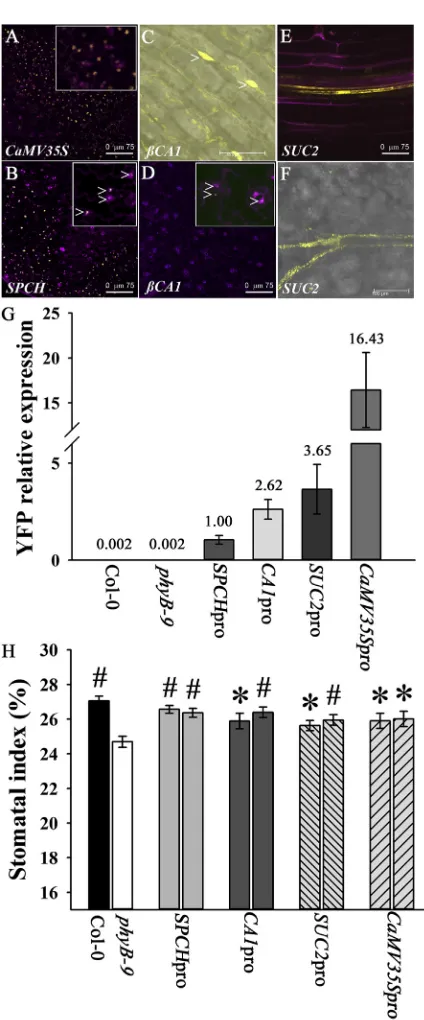
transformation, and two independent transformed lines were analyzed per promoter construct and gave similar expression patterns. The spatial expression of the PHYB-YFP fusion protein was determined by confocal microscopy in the first pair of true leaves of 7-day-old soil-grown seedlings (Figures 1A–1F). For representative lines, the level of transgene expres-sion was also determined by quantitative PCR (qPCR) using primers specific toYFP(Figure 1G). The phenotype of mature plants is shown inFigure S1B.
PHYB-YFP Expression within the Stomatal Lineage Complements thephyB-Deficient Stomatal Development Phenotype
When grown in white light at a photon irradiance of 250 mmol m22 s21, mature leaves of the loss-of-function phyB-9mutant had a significantly reduced SI compared with the Col-0 control (Figure 1H). Under these conditions, SD was also significantly reduced (Col-0 SD: 228.3 mm26 SEM 4.7; phyB-9SD: 201.8 mm26SEM 5.4; p = 0.0005). This reduced
SI phenotype could be rescued when the PHYB-YFP fusion protein was expressed constitutively in thephyB-9background
using the CaMV35S promoter, which included epidermal
expression (Figures 1A and 1H). To determine whether the expression of PHYB within the stomatal lineage is required for ensuring that the appropriate SI is achieved, we expressed the PHYB-YFP fusion protein using theSPCHpromoter ( Fig-ures 1B andS1A) that directs expression throughout the stoma-tal lineage [9]. The presence of the PHYB-YFP fusion protein (Figure 1B;SPCHpromoter) resulted in rescue of thephyB-9
stomatal mutant phenotype (Figure 1H). Expression of PHYB-YFP using thebCA1promoter also rescued thephyB-9 stoma-tal mutant phenotype. This promoter directed PHYB-YFP expression most strongly in mesophyll cells; however, weak expression was also detected in guard cells [16] (Figures 1C, 1D, and 1H). Analysis of promoterPHYB::YFPtransgenic lines indicated that SI was not directly associated with transgene level; for example,SPCHproPHYB::YFPandCaMV35Spro PHY-B::YFP lines have almost identical SIs, and, yet, transgene
expression is 16-fold higher in the CaMV35SproPHYB::YFP
line (Figure 1G). Furthermore, although tissue-specific expres-sion ofPHYB::YFPled to changes in leaf size (Figure S1B), these
*Correspondence:[email protected]
changes did not correlate with the ability to rescue the SI defect ofphyB-9plants. This agrees with recent work showing that differentiation in the stomatal lineage is independent of pave-ment cell expansion, which makes the major contribution to overall leaf size [17].
PHYB-YFP Expression in the Phloem Rescues thephyB Mutant Stomatal Development Phenotype
phyB can act in a non-cell-autonomous manner to regulate flowering inArabidopsis[15]. To determine whether this is the case for stomatal development, we expressed PHYB-YFP in nonepidermal cells using theSUC2promoter (phloem compan-ion cells;Figures 1E and 1F). Confocal microscopy confirmed that PHYB-YFP expression was not observed in the epidermis (including guard cells) and was restricted to the phloem ( Fig-ure 1F), whereas leaf impressions revealed that expression of PHYB-YFP in the phloem is sufficient to rescue stomatal development in thephyB-9mutant (Figure 1H).
phyB Acts Systemically to Control Stomatal Development
Although the analysis of tissue-specificPHYB::YFPlines re-veals the spatial requirement for phyB during stomatal devel-opment, it does not distinguish between a local requirement within a developing leaf and a systemic role in existing mature
leaves. To address this issue, an inducible PHYB system
was constructed in the phyB-9 mutant background. A line
(i-PHYB) was chosen that was phenotypically indistinguish-able from thephyB-9mutant (indicating that if there was any leaky PHYB expression in this line, it was insufficient to
complement the mutant phenotype; Figures S2A and 2A,
untreated). To test for functionality, we sprayed all leaves of i-PHYBplants with 5mMb-estradiol. This resulted in increased
PHYBexpression and rescue of both the grossphyB-9mutant phenotype and stomatal development (Figures S2A, S2B, and 2A).b-estradiol treatment alone did not significantly alter sto-matal development of Col-0 andphyB-9plants (Figure S2C).
The b-estradiol-inducible expression system shows tight
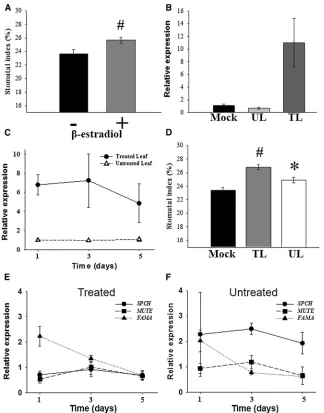
spatial regulation of transgene induction [18].PHYB expres-sion was monitored by qPCR, and this confirmed that the induction ofphyBexpression was restricted to leaves treated withb-estradiol (and that this treatment did not result in induc-tion or spread ofPHYBexpression in nontreated tissue; Fig-ures 2B and 2C).
[image:3.603.68.280.73.583.2]To determine whether phyB can act systemically to influ-ence stomatal development, we treated leaves (L) 1–12 daily by applying b-estradiol to them. This treatment began once leaves were greater than 5 mm in length (7 days postgermina-tion for L1) and continued for another 3 weeks as new leaves
Figure 1. Tissue-Specific Expression of phyB
Confocal microscope images of tissue-specificPHYB::YFPlines. (A and B) Overlaid images. YFP is shown in the yellow channel; tissue was counterstained with propidium iodide (magenta channel).
(A)CaMV35sproPHYB::YFP; abaxial epidermis (the scale bar represents 75mm). Inset shows epidermal cells expressingCaMV35sproPHYB::YFP. (B)SPCHproPHYB::YFP; abaxial epidermis 7 days postgermination (dpg) (the scale bar represents 75mm). Inset shows stomatal lineage cells ex-pressingSPCHproPHYB::YFP(arrowheads).
(C)bCA1proPHYB::YFP; palisade cells 7 dpg; YFP channel only (the scale bar represents 50mm). Arrowheads highlight YFP expression in palisade cells. YFP is shown in the yellow channel overlying the bright-field image. (D and E) Overlaid images. YFP is shown in the yellow channel; tissue was counterstained with propidium iodide (magenta channel).
(D)bCA1proPHYB::YFP; abaxial epidermis 7 dpg (the scale bar represents 75mm). Inset shows guard cells expressingbCA1proPHYB::YFP (arrow-heads).
(E)Suc2proPHYB::YFP; seedling root shows companion cell expression surrounding the vascular tissue (7 dpg; the scale bar represents 75mm). (F)Suc2proPHYB::YFP; subepidermal tissue. YFP expression in companion cells surrounding vascular tissue (7 dpg; the scale bar represents 100mm). YFP is shown in the yellow channel overlying the bright-field image. (G) Relative expression ofPHYB-YFPas determined by qPCR in selected lines using YFP-specific primers. RNA was extracted from 2-week-old seed-lings. Number above each column indicates expression calculated relative to that ofSPCHproPHYB::YFP. Error bars indicate mean6SEM from three biological replicates.
(H) SI of mature leaves (L11–13) of tissue-specificPHYB::YFPlines grown at 250mmol m22
s21
. Mean values are shown for two independent trans-formed lines per construct with error bars indicating mean6SEM. Symbols indicate significant difference in SI compared to phyB-9; *p < 0.05, #p < 0.005.
See alsoFigure S1. Light Control of Systemic Stomatal Development
developed. Young leaves were left untreated (Figure S2D). SI was measured in both theb-estradiol-treated leaves (L10– 12) and the younger untreated leaves (L13–15). Both the treated leaves (TL) and the young untreated leaves (UL) showed significant increases in SI compared with the mock-treated control (Mock) (Figure 2D).
The expression of several genes known to be involved in the control of stomatal developmental is reduced inphyB mu-tants [4, 5]. To determine whether the changes in SI in i-PHYB
plants are due to changes in the expression of one or more positive regulators of stomatal development, we analyzed the expression of the transcription factorsSPCH,MUTE, and
FAMA[9–11] by qPCR followingb-estradiol treatment in both TL and young UL from the same plants. Compared with
equiv-alent mock-treated plants, FAMA expression was elevated
in TL, whereasSPCHexpression increased in new leaves ( Fig-ures 2E and 2F).
phyBMutants Are Defective in Systemic Regulation of Light-Induced Stomatal Development
Mature leaves can signal to developing leaves to regulate stomatal development in response to light and CO2 [6, 7].
Both the tissue-specific expression of PHYB-YFP and
induc-ible expression of PHYB reported here support a role for
phyB in the systemic regulation of stomatal development.
We therefore investigated whether thephyB-9mutant shows
defects in this process. Wild-type (WT) and phyB-9 were
grown at high light (250mmol m22s21) until the initiation of
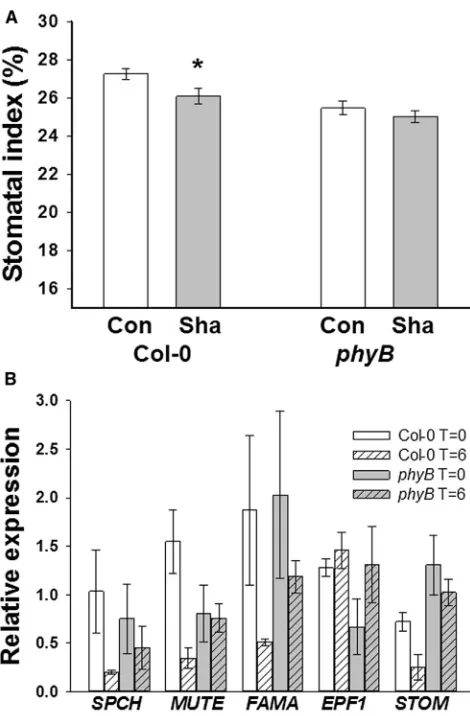
L14 primordia. Maturing L1–13 were then shaded using a neutral density filter, (resulting in a photon irradiance of 50mmol m22s2), while L14 was exposed to and continued to develop at high light (250mmol m22s21;Figure S3A). Consis-tent with similar experiments [6, 7], L14 of Col-0 plants had a reduced SI compared with equivalent high-light-grown leaves (Figure 3A). In contrast, there was no significant reduction of SI of L14 inphyB-9mutants, indicating thatphyB-9mutants are defective in this systemic signaling pathway. Gene expres-sion in L14 was compared with the equivalent leaf from plants grown at high light (250mmol m22s21). At 6 hr after the shading of mature leaves, the expression of the positive regulators of
stomatal developmentSPCH,MUTE,FAMA, andSTOMAGEN
(STOM) [9–12] was reduced in the exposed L14 of Col-0 plants.
[image:4.603.56.380.81.494.2]phyB-9 mutants did not show equivalent reductions in the expression of these key regulators (Figure 3B).
Figure 2. Inducible Expression of phyB (A) SI of i-PHYBplants grown at 250mmol m22
s21 . Whole plants were sprayed daily with either a mock treatment (2) or 5mMb-estradiol (+). Mean values are shown with error bars indicating mean 6SEM. Symbols indicate significant difference in SI compared to the control (2); #p < 0.005. (B) PHYB expression determined by qPCR in i-PHYB leaves. 5 mM b-estradiol was applied to individual leaves with a paintbrush, and
PHYBexpression was monitored 48 hr later on both treated (TL) and untreated (UL) leaves on the same plant. Expression is relative to mock-treated i-PHYBplants (Mock). Error bars indicate mean6SEM.
(C)PHYBexpression determined by qPCR in both TL and UL of i-PHYBplants. 5mMb-estradiol was applied daily to individual leaves with a paint-brush, andPHYB expression was monitored in both the TL (L1–12;d) and young UL (L13–15;D) from the same plant over a time course (1, 3, and 5 days from first treatment). Expression is relative to the equivalent leaves (L1–12 for treated and 13–15 for untreated) from mock-treated i-PHYB
plants. Error bars indicate mean6SEM from three biological replicates.
(D) The SI of i-PHYBplants grown at 250mmol m22 s21
Discussion
Previous work showed that light controls stomatal develop-ment [3, 5–7] and that this involves phyB [3, 4]. It was also known that this is a systemic response [6, 7]. Here, we demon-strate that phyB acts both within the stomatal lineage and in nonepidermal tissue to regulate cell fate changes during stomatal development. phyB also acts in the systemic path-way to modulate stomatal development in young leaves in response to light signals perceived by mature leaves.
As expression throughout the stomatal lineage rescues
the reduced SI phenotype of thephyB-9 mutant, phyB may
therefore act locally at the earliest stages of stomatal develop-ment to modulate epidermal cell fate decisions. Changes in stomatal number correlate with leaf transpiration rate, suggesting that perturbations in guard cell function can affect stomatal development [19]. In this context, it is important to note that phyB is required for red-light-induced stomatal opening [20]. It is possible, therefore, that the reduced SI in
phyB-9 mutants is the result of reductions in stomatal aperture at high light, a phenotype that is likely comple-mented in theSPCHproPHYB::YFP,bCA1proPHYB::YFP, and
CaMV35SproPHYB::YFP lines, which all direct PHYB::YFP
expression in guard cells (as well as in other cell types). However, such a possibility is not consistent with the ability
of phloem-expressed PHYB-YFP to complement thephyB-9
phenotype (Figure 1H). Instead, our data suggest that there is phyB-mediated intertissue signaling that regulates cell fate changes in the epidermis.
To determine whether phyB is part of a systemic signaling
pathway, we engineered the phyB-9 mutant to express WT
PHYBinducibly (i-PHYBplants). The induction ofPHYBled to an initial increase in FAMAexpression in TL (Figure 2E), consistent with previous reports showing that phyB regulates
FAMA expression [4]. In the epidermis of phyB-9 leaves
grown at high light (250 mmol m22 s21), some amplifying divisions are seen to terminate prematurely without differ-entiating into satellite stomata (Figures S3B and S3C). This would be consistent with a defect in the latter stages of stomatal development, which are regulated by FAMA. Given the experimental timescale (6 hr posttreatment), phyB-mediated signaling may directly control an upstream regu-lator ofFAMAexpression.
Treatment of only the mature leaves of i-PHYBplants with
b-estradiol resulted in significant increases in SI of the
young UL (Figure 2D) and increased SPCH expression in
young UL (Figure 2F). Because SPCH is required for initia-tion of stomatal development [9], these data indicate that changes in stomatal development in young leaves are likely to occur de novo in response to a phyB-mediated signal from mature leaves. When mature leaves of WT plants are shaded, young leaves develop with reduced SI compared with high-light-grown plants (Figure 3A) [6, 7]. This reduction in SI correlated with downregulated expression of the
positive regulators of stomatal development SPCH,MUTE,
FAMA, and STOMAGEN. EPF1, like STOMAGEN, is a
member of the EPIDERMAL PATTERNING FACTOR-LIKE
(EPFL) family and regulates one-cell spacing [21]. The expression ofEPF1was not significantly affected. This result might reflect differences in the function of individual genes influenced by the systemic signaling pathway or may be due to the sampling time series chosen for this experiment. In contrast, phyB-9 mutant young leaves are indistinguish-able from high-light-grown controls and do not show down-regulation in expression of these positive regulators of stomatal development (Figure 3B). Taken together with the i-PHYBdata, our results demonstrate that phyB is required for light-mediated systemic regulation of stomatal develop-ment, and this systemic mechanism is likely dependent on changes in the expression of stomatal development genes in young leaves.
[image:5.603.58.293.80.438.2]A question remains as to the nature of the systemic signal generated in response to light perception by phyB. It has been reported that phyB acts upstream of the MAPK signaling
Figure 3. phyB Is Required for the Systemic Regulation of Stomatal Development
(A)phyB-9mutants do not respond to shading. Plants were germinated at a photon irradiance of 250mmol m22
s21
, and on emergence of L14, devel-oped leaves were shaded with neutral density filters to a photon irradiance of 50mmol m22
s21
, with L14 exposed to 250mmol m22 s21
(Sha). Control SI of the equivalent leaf from plants grown 250mmol m22
s21
are shown for comparison (Con). Mean values are shown with error bars indicating mean6SEM. Symbols indicate significant difference in SI compared to the control (250); *p < 0.05.
(B) Quantitative gene expression analysis of stomatal developmental genes in Col-0 andphyB-9mutants following shading. Plants were grown as in (A), and RNA was extracted from L14 at t = 0 and t = 6 hr postshading of mature leaves. Expression is relative to L14 from unshaded plants (Col-0 orphyB-9, respectively) at the equivalent time points. Error bars indicate mean6SEM from three biological replicates (Student’s t test p values for t = 0 compared with t = 6;SPCH: Col-0 = 0.12,phyB-9= 0.51;MUTE: Col-0 = 0.02,phyB-9= 0.89;FAMA: Col-0 = 0.15,phyB-9= 0.39;STOM: Col-0 = 0.09,phyB-9= 0.39).
See alsoFigure S3.
cascade headed by the MAPKKK YDA [5, 22] that targets the
SPCH protein and potentially MUTE and FAMA [23, 24].
Although the data presented here show that transcriptional
changes inSPCH,MUTE, andFAMAoccur in young leaves
during systemic signaling, our data do not exclude additional posttranscriptional regulatory signaling mechanisms. Integra-tion of signals through the MAPK module is emerging as a common mechanism for regulating stomatal development with YODA and SPCH targeted by brassinosteroid [25, 26]. It will therefore be interesting to investigate whether phyB operates through this module, and if it does, whether it forms part of the systemic system investigated here. Interestingly, PHYTOCHROME-INTERACTING FACTOR 4 (PIF4) acts with phyB to mediate light-regulated changes in stomatal develop-ment [3]. PIF4 interacts with the brassinosteroid-activated transcription factor BZR1 [27]; however, the integration point between brassinosteroid signaling and stomatal development is both upstream and independent of BZR1 [25, 26]. PIF4 also regulates auxin biosynthesis [28], and auxin has recently been shown to be required for correct stomatal development [29]. Although PIF4 regulation of auxin biosynthesis presents a potential mechanism by which light may mediate changes in stomatal development, this requires further work.
Experimental Procedures
PHYBInduction
For induciblePHYBexperiments,phyB-9plants containing pMDC150-35S and pMDC221-PHYBwere treated with 5mMb-estradiol (Sigma-Aldrich) dissolved in water containing 0.01% (v/v) Silwet L-77 (Lehle Seeds). For
Figures 2A andS2A–S2C, whole plants were treated by spraying leaves from 7 days postgermination for 3 weeks. ForFigure 2B, 5mMb-estradiol was applied to mature leaves (TL; L1–12) of 3-week-old plants with a fine paintbrush, andPHYBexpression was monitored 48 hr later on both TL and UL on the same plant. ForFigures 2C, 2E, and 2F, 5mMb-estradiol was applied daily for 5 days to mature leaves (TL; L1–12) of 3-week-old plants with a fine paintbrush, with gene expression analysis performed on both treated (L1–12) and untreated (L13–15) leaves at 1, 3, and 5 days after treatment. ForFigure 2D, 5mMb-estradiol was applied to mature leaves (TL; L1–12) once a leaf was >5 mm in length (7 days postgermination for L1). Treatment was continued daily as new leaves developed for 3 weeks. Mock treatments were performed with 0.01% Silwet L-77. Treatments were applied 30 min predawn (Figure S2A).
Shading Experiments
Plants were germinated at a photon irradiance of 250mmol m22 s21
. Once L14 primordia were visible (<2 mm), existing leaves (greater than 5 mm; designated mature) were shaded to 50mmol m22
s21
using neutral density filters (Lee Filters), with L14 exposed to 250mmol m22
s21
(Figure S3A). Equivalent leaves (L14) from unshaded plants were used as controls.
Supplemental Information
Supplemental Information includes Supplemental Experimental Procedures and three figures and can be found with this article online athttp://dx.doi. org/10.1016/j.cub.2014.03.074.
Acknowledgments
The authors would like to thank Kerry Franklin (University of Bristol) and Julie Gray (University of Sheffield) for comments on the manuscript. S.A.C. and A.M.H. acknowledge support from the BBSRC, grant BB/ J002364. S.A.C. acknowledges support from the University of Sheffield.
Received: December 9, 2013 Revised: February 21, 2014 Accepted: March 28, 2014 Published: May 15, 2014
References
1. Hetherington, A.M., and Woodward, F.I. (2003). The role of stomata in sensing and driving environmental change. Nature424, 901–908. 2. Casson, S., and Gray, J.E. (2008). Influence of environmental factors on
stomatal development. New Phytol.178, 9–23.
3. Casson, S.A., Franklin, K.A., Gray, J.E., Grierson, C.S., Whitelam, G.C., and Hetherington, A.M. (2009). Phytochrome B and PIF4 regulate sto-matal development in response to light quantity. Curr. Biol.19, 229–234. 4. Boccalandro, H.E., Rugnone, M.L., Moreno, J.E., Ploschuk, E.L., Serna, L., Yanovsky, M.J., and Casal, J.J. (2009). Phytochrome B enhances photosynthesis at the expense of water-use efficiency in Arabidopsis. Plant Physiol.150, 1083–1092.
5. Kang, C.Y., Lian, H.L., Wang, F.F., Huang, J.R., and Yang, H.Q. (2009). Cryptochromes, phytochromes, and COP1 regulate light-controlled stomatal development in Arabidopsis. Plant Cell21, 2624–2641. 6. Lake, J.A., Quick, W.P., Beerling, D.J., and Woodward, F.I. (2001). Plant
development. Signals from mature to new leaves. Nature411, 154. 7. Thomas, P.W., Woodward, F.I., and Quick, P.W. (2003). Systemic
irradi-ance signalling in tobacco. New Phytol.161, 193–198.
8. Reed, J.W., Nagpal, P., Poole, D.S., Furuya, M., and Chory, J. (1993). Mutations in the gene for the red/far-red light receptor phytochrome B alter cell elongation and physiological responses throughout Arabidopsis development. Plant Cell5, 147–157.
9. MacAlister, C.A., Ohashi-Ito, K., and Bergmann, D.C. (2007). Transcription factor control of asymmetric cell divisions that establish the stomatal lineage. Nature445, 537–540.
10. Pillitteri, L.J., Sloan, D.B., Bogenschutz, N.L., and Torii, K.U. (2007). Termination of asymmetric cell division and differentiation of stomata. Nature445, 501–505.
11. Ohashi-Ito, K., and Bergmann, D.C. (2006). Arabidopsis FAMA controls the final proliferation/differentiation switch during stomatal develop-ment. Plant Cell18, 2493–2505.
12. Sugano, S.S., Shimada, T., Imai, Y., Okawa, K., Tamai, A., Mori, M., and Hara-Nishimura, I. (2010). Stomagen positively regulates stomatal density in Arabidopsis. Nature463, 241–244.
13. Chen, M., Chory, J., and Fankhauser, C. (2004). Light signal transduction in higher plants. Annu. Rev. Genet.38, 87–117.
14. Somers, D.E., and Quail, P.H. (1995). Temporal and spatial expression patterns of PHYA and PHYB genes in Arabidopsis. Plant J.7, 413–427. 15. Endo, M., Nakamura, S., Araki, T., Mochizuki, N., and Nagatani, A. (2005). Phytochrome B in the mesophyll delays flowering by suppress-ing FLOWERING LOCUS T expression in Arabidopsis vascular bundles. Plant Cell17, 1941–1952.
16. Hu, H., Boisson-Dernier, A., Israelsson-Nordstro¨m, M., Bo¨hmer, M., Xue, S., Ries, A., Godoski, J., Kuhn, J.M., and Schroeder, J.I. (2010). Carbonic anhydrases are upstream regulators of CO2-controlled sto-matal movements in guard cells. Nat. Cell Biol.12, 87–93, 1–18. 17. Andriankaja, M., Dhondt, S., De Bodt, S., Vanhaeren, H., Coppens, F.,
De Milde, L., Mu¨hlenbock, P., Skirycz, A., Gonzalez, N., Beemster, G.T., and Inze´, D. (2012). Exit from proliferation during leaf development in Arabidopsis thaliana: a not-so-gradual process. Dev. Cell22, 64–78. 18. Brand, L., Ho¨rler, M., Nu¨esch, E., Vassalli, S., Barrell, P., Yang, W., Jefferson, R.A., Grossniklaus, U., and Curtis, M.D. (2006). A versatile and reliable two-component system for tissue-specific gene induction in Arabidopsis. Plant Physiol.141, 1194–1204.
19. Lake, J.A., and Woodward, F.I. (2008). Response of stomatal numbers to CO2 and humidity: control by transpiration rate and abscisic acid. New Phytol.179, 397–404.
20. Wang, F.F., Lian, H.L., Kang, C.Y., and Yang, H.Q. (2010). Phytochrome B is involved in mediating red light-induced stomatal opening in Arabidopsis thaliana. Mol. Plant3, 246–259.
21. Hara, K., Kajita, R., Torii, K.U., Bergmann, D.C., and Kakimoto, T. (2007). The secretory peptide gene EPF1 enforces the stomatal one-cell-spacing rule. Genes Dev.21, 1720–1725.
22. Bergmann, D.C., Lukowitz, W., and Somerville, C.R. (2004). Stomatal development and pattern controlled by a MAPKK kinase. Science304, 1494–1497.
23. Lampard, G.R., Macalister, C.A., and Bergmann, D.C. (2008). Arabidopsis stomatal initiation is controlled by MAPK-mediated regula-tion of the bHLH SPEECHLESS. Science322, 1113–1116.
cell fate revealed by cell type-specific manipulations. Plant Cell21, 3506–3517.
25. Gudesblat, G.E., Schneider-Pizon, J., Betti, C., Mayerhofer, J., Vanhoutte, I., van Dongen, W., Boeren, S., Zhiponova, M., de Vries, S., Jonak, C., and Russinova, E. (2012). SPEECHLESS integrates brassi-nosteroid and stomata signalling pathways. Nat. Cell Biol.14, 548–554. 26. Kim, T.W., Michniewicz, M., Bergmann, D.C., and Wang, Z.Y. (2012). Brassinosteroid regulates stomatal development by GSK3-mediated inhibition of a MAPK pathway. Nature482, 419–422.
27. Oh, E., Zhu, J.Y., and Wang, Z.Y. (2012). Interaction between BZR1 and PIF4 integrates brassinosteroid and environmental responses. Nat. Cell Biol.14, 802–809.
28. Franklin, K.A., Lee, S.H., Patel, D., Kumar, S.V., Spartz, A.K., Gu, C., Ye, S., Yu, P., Breen, G., Cohen, J.D., et al. (2011). Phytochrome-interacting factor 4 (PIF4) regulates auxin biosynthesis at high temperature. Proc. Natl. Acad. Sci. USA108, 20231–20235.
29. Le, J., Liu, X.G., Yang, K.Z., Chen, X.L., Zou, J.J., Wang, H.Z., Wang, M., Vanneste, S., Morita, M., Tasaka, M., et al. (2014). Auxin transport and activity regulate stomatal patterning and development. Nat Commun
5, 3090.