City, University of London Institutional Repository
Citation
:
Cherla, S., Weyde, T., Garcez, A. and Pearce, M. (2013). Learning Distributed
Representations for Multiple-Viewpoint Melodic Prediction. Paper presented at the 14th
International Society for Music Information Retrieval Conference, 4 - 8 Nov 2013, Curtiba,
PR, Brazil.
This is the unspecified version of the paper.
This version of the publication may differ from the final published
version.
Permanent repository link:
http://openaccess.city.ac.uk/2969/
Link to published version
:
Copyright and reuse:
City Research Online aims to make research
outputs of City, University of London available to a wider audience.
Copyright and Moral Rights remain with the author(s) and/or copyright
holders. URLs from City Research Online may be freely distributed and
linked to.
A DISTRIBUTED MODEL FOR MULTIPLE-VIEWPOINT MELODIC
PREDICTION
Srikanth Cherla
1,2
, Tillman Weyde
1,2, Artur d’Avila Garcez
2and Marcus Pearce
3 1Music Informatics Research Group, Department of Computer Science, City University London
2Machine Learning Group, Department of Computer Science, City University London
3Centre for Digital Music, Queen Mary University of London
{
srikanth.cherla.1, t.e.weyde, a.garcez
}
@city.ac.uk
[email protected]
ABSTRACT
The analysis of sequences is important for extracting in-formation from music owing to its fundamentally temporal nature. In this paper, we present a distributed model based on the Restricted Boltzmann Machine (RBM) for melodic sequences. The model is similar to a previous successful neural network model for natural language [2]. It is first trained to predict the next pitch in a given pitch sequence, and then extended to also make use of information in se-quences of note-durations in monophonic melodies on the same task. In doing so, we also propose an efficient way of representing this additional information that takes ad-vantage of the RBM’s structure. Results show that this RBM-based prediction model performs better than previ-ously evaluatedn-gram models in many cases. It is able to make use of information present in longer contexts more effectively thann-gram models, while scaling linearly in the number of free parameters required.
1. INTRODUCTION
Sequential structure in music influences our notions of mu-sical style, similarity and the emotions we associate with it. The analysis of sequences in musical scores and equiv-alent symbolic representations of music is an integral part of Music Information Retrieval, with applications such as music classification [6], computational musicology [26], music creation [19], and music source separation [10]. In the past, this analysis has often been carried out using mu-sic generation systems [1, 4, 8, 13, 18].
The present research is based around previous work that adopted ideas proposed in information theory to music [7]. There, Multiple-viewpoint Systems for Music Prediction
were introduced as a detailed re-interpretation of the key ideas of information theory [22] in music, through an anal-ogy between language and musical style. In that work and what followed [21], Markov models were employed for
Permission to make digital or hard copies of all or part of this work for personal or classroom use is granted without fee provided that copies are not made or distributed for profit or commercial advantage and that copies bear this notice and the full citation on the first page.
c
2013 International Society for Music Information Retrieval.
learning melodic subsequences. While this is a reason-able choice, Markov models are often faced with a prob-lem related to data sparsity known as thecurse of dimen-sionality. This refers to the exponential rise in the number of model parameters with the length of the modelled sub-sequences. Recent research in Language Modelling has demonstrated that neural networks can be a suitable al-ternative to more widely usedn-gram and variable-order Markov models [2, 5, 17]. There have been some initial results on the success of such models in music [3, 24].
In this paper, we present a model for melody predic-tion based on one such neural network — the Restricted Boltzmann Machine (RBM) [23]. The choice is motivated by the following. Firstly, the inherent non-linearity of the RBM makes it a suitable candidate for learning complex structures in data, such as those occurring in musical se-quences. There exist efficient algorithms for training this model [11, 25]. The RBM, with its straightforward exten-sibility to deep networks [12], has become a vital building block for creating models that are capable of learning fea-tures from the data at multiple levels of abstraction.
We describe here a model for fixed-length subsequences of musical pitch, which compares favourably to n-gram models that were previously evaluated with a prediction task on a corpus of monophonic MIDI melodies [21]. This pitch-only version of the model is then adapted to also make use of note-durations in the melodies, on the same pitch-prediction task. In doing so, we also propose an effi-cient way to represent this additional information, which takes advantage of the RBM’s structure and thus limits model complexity. The structure of the proposed model ensures that it scales only linearly with the length of sub-sequences to be learned and with the number of symbols in the data. We demonstrate an improvement of results by combining the two models in a manner similar to [7] us-ing the arithmetic mean of their individual probability es-timates. An implementation of the model in Python, along with scripts used to generate the results in this paper, are available upon request.
in this paper. This is followed by a description of the model itself in Section 4. An evaluation of the the model and its comparison with previously evaluated n-gram models is presented in Section 5, followed by discussion on possible directions for future research in Section 6.
2. MUSIC PREDICTION WITH MULTIPLE-VIEWPOINT SYSTEMS
In order to explain music prediction with multiple view-points, the analogy to natural language is used here. In statistical language modelling, the goal is to build a model that can estimate the joint probability distribution of subse-quences of words occurring in a languageL. A statistical language model (SLM) can be represented by the condi-tional probability of the next wordwT given all the previ-ous ones[w1, . . . , w(T−1)](written here asw
(T−1) 1 ), as
P(wT1) =
T
Y
t=1
P(wt|w
(t−1)
1 ). (1)
The most commonly used SLMs aren-grammodels, which rely on the simplifying assumption that the probability of a word in a sequence depends only on the immediately pre-ceding(n−1)words [16]. This is known as the Markov assumption, and reduces (1) to
P(wT1) =
T
Y
t=1
P(wt|w
(t−1)
(t−n+1)). (2)
Following this approach, musical styles can be inter-preted as vast and complex languages [7]. In music pre-diction, one is interested in learning the joint distribution ofmusical event sequencessT
1 in amusical languageS.
Much in the same way as an SLM, a system for music pre-diction models the conditional distributionp(st|s
(t−1) 1 ), or
under the Markov assumption p(st|s( t−1)
(t−n+1)). For each
prediction, context information is obtained from the events
s((tt−−1)n+1)immediately precedingst. Musical events have a rich internal structure and can be expressed in terms of di-rectly observable or derived musical features such as pitch, note duration, inter-onset interval, or a combination of two or more such features. The framework of multiple-view-point systems for music prediction [7] was proposed in or-der to efficiently handle this rich internal structure of mu-sic by exploiting information contained in these different musical feature sequences, while at the same time limiting the dimensionality of the models using these features. In the interest of brevity, we limit ourselves to an informal discussion of multiple-viewpoint systems for monophonic music prediction and refer the reader to [7] for the under-lying mathematical formulation.
A musical eventsrefers to the occurrence of a note in a melody. A viewpoint type(henceforth written astype)
τ refers to any of a set of musical features that describe an event. The domain of atype, denoted by|τ|is the set of possible values of that type. Abasic typeis a directly observable or given feature such as pitch, note duration,
h1 h2 h
v1 v2 v3 v4 v
W
Figure 1. A simple Restricted Boltzmann Machine with four visible, two hidden, and no bias units.
key-signatureortime-signature. Aderived typecan be de-rived from any of the basic types or other dede-rived types. Alinked viewpoint typeis created by taking the Cartesian product over two or more types, thus “linking” them.
A multiple-viewpoint system (MVS) is a set of mod-els, each of which is trained on subsequences of onetype, whose individual predictions are combined in some way to influence the prediction of the next event in a given event sequence. Given a contexts((tt−−1)n+1)and an eventst, each viewpointτ in an MVS must compute the probabil-itypτ(st|s
(t−1)
(t−n+1)). While originallyn-gram models were
proposed to be used with the multiple viewpoints frame-work, we demonstrate how a distributed model such as the RBM used here can serve as a scalable alternative.
3. RESTRICTED BOLTZMANN MACHINE
The Restricted Boltzmann Machine (RBM) is an undirected graphical model consisting of a set ofrvisible unitsvand a set ofqhidden unitsh. These make up the visible and hidden layers of the RBM respectively. The two layers are fully inter-connected but there exist no connections be-tween any two hidden units, or any two visible units. In its original form, the RBM has binary, logistic units in both layers. Additionally, the units of each layer are connected to a bias unit whose value is always 1.
The edge between theithvisible node and thejth hid-den node is associated with a weightwji. All these weights are together represented in aweight matrixWof sizeq×r. The weights of connections between visible units and the bias unit are contained in an r-dimensional visible bias
vectorb. Likewise, for the hidden units there is aq -dimen-sionalhidden biasvectorc. The RBM is fully character-ized by the parametersW,bandc. Figure 1 shows a sim-ple RBM with four visible and two hidden units, without the bias unit to better illustrate its bipartite structure.
The activation probabilities of the units in the hidden layer given the visible layer (and vice versa) are given by the logistic sigmoid function asp(hj = 1|v) = σ(cj +
Wj·v), andp(vi= 1|h) =σ(bi+Wi′·h)respectively. Due
to the RBM’s bipartite structure, the activation probabili-ties of the nodes within one of the layers are independent, if the activation of the other layer is given, i.e.
p(h|v) =
q
Y
j=1
p(hj|v) (3)
p(v|h) =
r
Y
i=1
The RBM is a special case of the Boltzmann Machine, which is an energy-based model for representing probabil-ity distributions [15]. In such energy-based models, prob-ability is expressed in terms of an energy function. In the case of the RBM, this function is expressed as
Energy(v,h) =−b⊤v−c⊤h−h⊤Wv. (5)
Learning in energy-based models can be carried out in a
generativefashion, by updating the weights and biases in order to minimize the overall energy of the system with re-spect to the training data. This amounts to maximizing the log-likelihood function of the joint probability distribution
p(v), which is given by
p(v) =e
−F reeEnergy(v)
Z , (6)
withZ=Pve
−F reeEnergy(v), where
F reeEnergy(v) =−logX h
e−Energy(v,h). (7)
While computing the exact gradient of the log-likeli-hood function forp(v)is not tractable, an approximation of this gradient called the Contrastive Divergence (CD) gradient has been found to be a successful update rule for training RBMs [11]. With the CD update, the RBM can be trained efficiently.
The RBM described above models the joint probability
p(v)of the set of visible unitsv. However, as described in Section 2, we are interested in a conditional distribution of the formp(y|x). It has been demonstrated in [14] how an RBM can be used for adiscriminativetask such as classifi-cation. The posterior class probability distribution of such an RBM has the form
p(y=ec|x) =
X
h
p(y=ec,h|x) (8)
= e
−F reeEnergy(x,ec)
P
c′=1...Ce−F reeEnergy(
x,e
c′)
(9)
wherexis the input vector, andyis a vector that is a
1-of-C representation of the class (also known asone-hot en-coding), withCbeing the number of classes. Ifxbelongs to a classc, theny=ec, whereecis a vector with all val-ues set to0except at positionc. With respect to the RBM,
xandytogether make up the visible layerv.
Assuming a training setDtrain ={(xi, yi)}wherexi andyi ∈ {1, . . . , C} are thei-th input vector and target class respectively, training the RBM generatively involves minimizing the negative log-likelihood
Lgen(Dtrain) =−
|DXtrain|
i=1
logp(xi,yi). (10)
The RBM thus used in a discriminative manner, forms the basis of the prediction model described in the next sec-tion.
4. A DISTRIBUTED MODEL FOR USE WITH MULTIPLE VIEWPOINTS
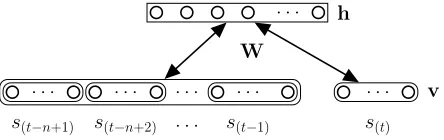
The prediction model we present in this paper models the conditional distribution p(st|s(
t−1)
(t−n+1)). It places no
re-strictions on thetypesassociated with events in the con-texts((nt−−n1)+1)(input type), or the predicted eventst(target type). In the simplest case, both are the same. In the case where they are different, the performance of the model de-pends on how informative the input types are of the target type. In the present work, we demonstrate this model with two cases where (1) both the input and target viewpoint types are musical pitch, and (2) the input types are pitch and duration, and the target type pitch. The choice of the additional input type in the second case was motivated by simplicity and to lay emphasis on the representation.
For each monophonic melody (in MIDI format) in a given dataset, sequences of the relevant input and target types are first extracted using the MIDI Toolbox [9]. These values are encoded as binary1-of-|τ|vectors, where|τ|is the size of the domain of typeτ. In the case where more than one input type exists, their corresponding vectors are simply concatenated. Such an idea is similar to that of the linked viewpoint type proposed in [7]. There are however, two important distinctions between the two. Firstly, the input and target types must be identical in the case of the
n-gram models originally proposed for use with multiple-viewpoint systems, whereas this is not a requirement for the RBM model. Secondly, a linked viewpoint between two arbitrary typesτ1andτ2of domain sizes|τ1|and|τ2|
respectively, would have a domain of size |τ1| × |τ2| in
the case of then-gram models. Thus, for subsequences of lengthn, the number of free parameters to be estimated are(|τ1| × |τ2|)nin the worst case. In contrast, the number
to be estimated in case of the RBM model, with q hid-den units andr visible units, is(q×r) +q+r, where
r= (n−1)×[(|τ1|+ 1) + (|τ2|+ 1)] +|τ3|, andτ3the
tar-get type. The additional visible unit added to those of each of the types in the context (τ1andτ2) is1 when the
cor-responding context event is absent at the start of a melody. Such a model only scales linearly with the length of the learned subsequences as well as the domain size of each of the involved viewpoint types (assumingqis constant). Its structure is depicted in Figure 2. Here we considered only those cases with a single target type.
. . . h
. . . v
s(t−n+1) s(t−n+2) . . . s(t−1) s(t)
[image:4.612.314.536.620.690.2]W
To train the model generatively, a subsequencest
(t−n+1)
is clamped to all the nodes in the visible layer. Training is done using the first instantiation of the Contrastive Di-vergence learning algorithm (CD-1). This simply means that the model parameters are updated after a single step of Gibbs sampling [11]. During prediction, the probabil-ity of each of the possible pitches in the prediction space is determined using (9). The distribution generated in this way does not require any kind of smoothing operation for unseen subsequences unliken-gram models, where in [21] an empirical evaluation of different smoothing techniques was found necessary to establish the most reliable one.
5. EVALUATION
In order to evaluate the proposed prediction model, we make a comparison to a previous study ofn-gram models for music prediction in [21]. There,cross-entropywas used to measure the information content of the models. This quantity is related toentropy, which is defined as
H(p) =−X
s∈S
p(s) log2p(s). (11)
wherep(s∈S) =p(χ=s)is the probability mass func-tion of a random variableχdistributed over a discrete al-phabetS = {s1, . . . , sk} such that the individual proba-bilities are independent and sum to 1. The value of en-tropy, with reference to a prediction model, is a measure of the uncertainty of its predictions. A higher value reflects greater uncertainty. In practice, one rarely knows the true probability distribution of the stochastic process and uses a model to approximate the probabilities in (11). An es-timate of the goodness of this approximation can be mea-sured using cross-entropy (Hc) which represents the diver-gence between the entropy calculated from the estimated probabilities and the source model. This quantity can be computed over all the subsequences of lengthnin the test dataDtest, as
Hc(pmod,Dtest) =
−Psn
1∈Dtestlog2pmod(sn|s
(n−1) 1 )
|Dtest|
(12) wherepmodis the probability assigned by the model to the last pitch in the subsequence given its preceding context. Cross-entropy approaches the true entropy as the number of test samples (|Dtest|) increases.
Evaluation was carried out on a corpus of monophonic MIDI melodies that cover a range of musical styles. The corpus is a collection of 8 datasets containing a total of
54,308musical events and was also used to evaluaten -gram models for music prediction in [21]. There, two dif-ferent models were evaluated both individually and in com-bination. The first of these was a Long-Term Model (LTM), that was governed by structure and statistics induced from a large corpus of sequences from the same musical style. And the other was a Short-Term Model (STM) which re-lied on structure and statistics particular to the melody be-ing predicted. The prediction model presented here deals
only with long-term effects that are induced from a cor-pus, and is thus compared with the two best performing LTMs in [21] of unbounded order (labelled there asC*I) and order bound2respectively. To facilitate a direct com-parison between the two approaches, the melodies are not transposed to a default key.
For the RBM model, different hyperparameters were evaluated through a grid search over the learning rateλ= {0.01,0.05}, the number of hidden unitsnhid = {100,
200,400}, and the weight-costwcost ={0.0001,0.0005}. Each model was trained using mini-batch gradient descent over 500epochs with a batch size of100samples. The momentumµ, was set to0.5 during the first five epochs and then increased to0.9for the rest of the training. Each model was evaluated with10-fold cross-validation.
We carry out three types of evaluation. The first mea-sures the information content of the pitch-only version of the proposed model using cross-entropy, and compares it to the n-gram models of [21]. It was observed that the RBM model compares favourably with the best of then -gram models by making better use of information in longer contexts. In the second evaluation, we compare a variant of the model with input types pitch and duration and tar-get type pitch to its pitch-only counterpart. And lastly, we combine these two models using mixture-of-experts and demonstrate how this can further improve the model per-formance in comparison to the individual models.
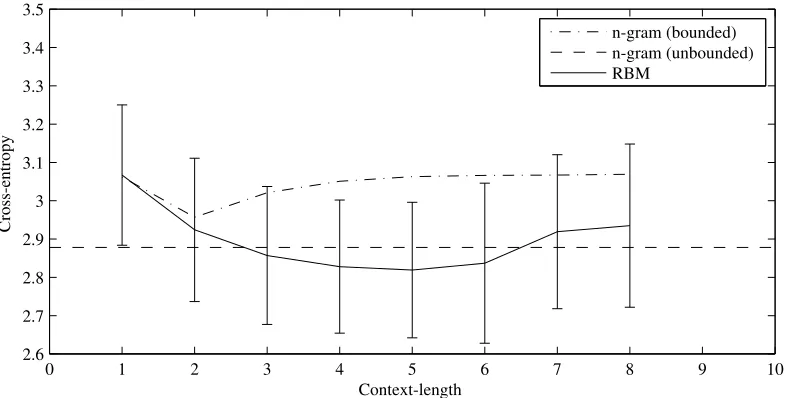
The first evaluation is carried out with cross-validation separately for each of the individual datasets. The con-text length is varied between1 and8. It was found that the RBM models with context length greater than2 per-form better than correspondingn-gram models on aver-age. This is illustrated in Figure 3. An RBM model of suitable context length perform marginally better than the best-performingn-gram model — that of unbounded or-der. The same is the case with the best bounded-ordern -gram model (of context length2) and the RBM model of the same context length. While it was found that the perfor-mance of bounded ordern-gram models tends to worsen on further increasing the context length, the performance of RBM models continues to improve until a context length of4. The value ofnwhere the RBM model performs better than then-gram models of unbounded order is different on different datasets, and typically occurs betweenn= 3and
n = 7. The best average model cross-entropy of2.819is reached for a context length of4. For models using longer contexts an increase in training performance was accom-panied by a slight worsening of test performance, indicat-ing overfittindicat-ing. We suspect that the overall performance of the RBM models can be further improved with an op-timized grid-search strategy in the hyper-parameter space, but leave this to be explored in the future. The optimal number of hidden units in our search was100across all datasets for almost all context lengths, leading to a linear increase in model size with context length.
0 1 2 3 4 5 6 7 8 9 10 2.6
2.7 2.8 2.9 3 3.1 3.2 3.3 3.4 3.5
Context-length
Cross-entropy
[image:6.612.101.495.60.259.2]n-gram (bounded) n-gram (unbounded) RBM
Figure 3. Variation in average cross-entropy of the prediction models with context lengthl(with standard deviation across folds for the RBM model). The cross-entropy of the RBM models progressively decreases untill = 4, while that of the
n-gram models evaluated in [21] is minimal atl = 2and increases thereafter. The performance of then-gram model of unbounded order is indicated by the dashed line.
(pitch), on the Bach chorale subset of the corpus. The re-sults are shown in Table 1. The choice of adding duration was motivated by simplicity but the results show that it was not ideal for improving predictions. This conclusion is also supported by a similar trend observed withn-gram models, where a small deterioration in performance was observed on adding duration. The RBM model shows small per-formance improvements for some context lengths. This indicates that the representation for multiple input types proposed in Section 4 as an alternative to the linked view-points may indeed be effective.
l 1 2 3 4
n-gram (p) 2.737 2.565 2.505 2.473
n-gram (p + d) 2.761 2.562 2.522 2.502
RBM (p) 2.698 2.530 2.490 2.470
RBM(p + d) 2.660 2.512 2.481 2.519
[image:6.612.61.283.502.581.2]RBM (combined) 2.663 2.486 2.462 2.413
Table 1. Cross-entropies of the single (pitch) and mul-tiple (pitch, duration) input type RBM models and their combination over a range of context lengthslon the Bach chorales dataset. The individual RBM models compare favourably with correspondingn-gram models.
To illustrate the application of the proposed RBM model to multiple viewpoints for music prediction, we combine the pitch-only and the pitch & duration models. We use a simple mixture-of-experts model, i.e., take the arithmetic mean of the distributions each of the two models predicts for pitch. The results of this are listed in the third row of Table 1 and show an improvement over individual models.
6. CONCLUSIONS & FUTURE WORK
We presented a distributed model based on the Restricted Boltzmann Machine for multiple-viewpoint music predic-tion. It was demonstrated how such a model can be a scalable alternative ton-gram models for simultaneously modelling sequences of multiple musical features. The proposed model was evaluated in comparison withn-gram models and was found to compare favourably with them. It is able to make better use of information in longer event contexts thann-gram models, and also scales linearly with context length.
In the future, we would first like to address some of the issues left open in the present research. These include ex-periments with more promising viewpoint-type combina-tions as reported in [7] and [20], the use of alternative data fusion techniques like the weighted mixture- and product-of-experts [20], and further optimization of the existing model parameters. Previous research suggests that com-bining the LTM and STM improves prediction performance [7, 20] and, in fact, the combined n-gram model reported in [20] (mean cross-entropy: 2.479for all datasets;2.342
7. ACKNOWLEDGEMENTS
Srikanth Cherla is supported by a Ph.D. studentship from City University London. The authors would like to thank Son Tran for many useful discussions on RBMs, and the reviewers for their valuable feedback on the paper.
8. REFERENCES
[1] Charles Ames. The Markov Process as a Compo-sitional Model: A Survey and Tutorial. Leonardo, 22(2):175–187, 1989.
[2] Yoshua Bengio, R´ejean Ducharme, Pascal Vincent, and Christian Jauvin. A Neural Probabilistic Lan-guage Model.Journal of Machine Learning Research, 3:1137–1155, 2003.
[3] Greg Bickerman, Sam Bosley, Peter Swire, and Robert Keller. Learning to Create Jazz Melodies using Deep Belief Nets. InInternational Conference On Computa-tional Creativity, 2010.
[4] John Biles. Genjam: A genetic algorithm for gener-ating jazz solos. In Proceedings of the International Computer Music Conference, pages 131–131, 1994.
[5] Ronan Collobert, Jason Weston, L´eon Bottou, Michael Karlen, Koray Kavukcuoglu, and Pavel Kuksa. Natural language processing (almost) from scratch.The Jour-nal of Machine Learning Research, 12:2493–2537, 2011.
[6] Darrell Conklin. Multiple viewpoint systems for mu-sic classification. Journal of New Music Research, 42(1):19–26, 2013.
[7] Darrell Conklin and Ian H Witten. Multiple viewpoint systems for music prediction. Journal of New Music Research, 24(1):51–73, 1995.
[8] David Cope.Experiments in musical intelligence, vol-ume 12. AR Editions Madison, WI, 1996.
[9] Tuomas Eerola and Petri Toiviainen. MIR in Matlab: The Midi Toolbox. InProceedings of the International Conference on Music Information Retrieval, pages 22– 27. Universitat Pompeu Fabra Barcelona, 2004.
[10] Joachim Ganseman, Paul Scheunders, Gautham J Mysore, and Jonathan S Abel. Evaluation of a Score-informed Source Separation System. InInternational Society for Music Information Retrieval Conference (ISMIR), pages 219–224, 2010.
[11] Geoffrey E Hinton. Training products of experts by minimizing contrastive divergence. Neural computa-tion, 14(8):1771–1800, 2002.
[12] Geoffrey E Hinton, Simon Osindero, and Yee-Whye Teh. A Fast Learning Algorithm for Deep Belief Nets.
Neural Computation, 18:1527–1554, 2006.
[13] Robert M Keller and David R Morrison. A Grammat-ical Approach to Automatic Improvisation. In Sound and Music Computing Conference, pages 11–13, 2007.
[14] Hugo Larochelle and Yoshua Bengio. Classification using discriminative restricted Boltzmann machines. In International Conference on Machine Learning (ICML), pages 536–543. ACM Press, 2008.
[15] Yann LeCun, Sumit Chopra, Raia Hadsell, M Ranzato, and F Huang. A tutorial on energy-based learning. Pre-dicting Structured Data, 2006.
[16] Christopher D Manning and Hinrich Sch¨utze. Founda-tions of statistical natural language processing. MIT press, 1999.
[17] Andriy Mnih and Geoffrey E Hinton. A scalable hierar-chical distributed language model. InAdvances in neu-ral information processing systems, pages 1081–1088, 2008.
[18] Michael C Mozer. Connectionist music composition based on melodic, stylistic and psychophysical con-straints. Music and connectionism, pages 195–211, 1991.
[19] Francois Pachet. The continuator: Musical interaction with style.Journal of New Music Research, 32(3):333– 341, 2003.
[20] Marcus Pearce. The Construction and Evaluation of Statistical Models of Melodic Structure in Music Per-ception and Composition. PhD thesis, 2005.
[21] Marcus Pearce and Geraint Wiggins. Improved meth-ods for statistical modelling of monophonic music.
Journal of New Music Research, 33(4):367–385, 2004.
[22] Claude E. Shannon. A Mathematical Theory of Communication.The Bell System Techincal Journal, 27(July):379–423, 623–656, 1948. Reprinted inACM SIGMOBILE Mobile Computing and Communications Review, 5(1):3–55, 2001.
[23] Paul Smolensky. Parallel distributed processing: ex-plorations in the microstructure of cognition, vol. 1. chapter Information processing in dynamical systems: foundations of harmony theory, pages 194–281. MIT Press, Cambridge, MA, USA, 1986.
[24] Athina Spiliopoulou and Amos Storkey. Compar-ing probabilistic models for melodic sequences. In
Machine Learning and Knowledge Discovery in Databases, pages 289–304. 2011.
[25] Tijmen Tieleman. Training restricted boltzmann ma-chines using approximations to the likelihood gradient. InProceedings of the 25th international conference on Machine learning, pages 1064–1071. ACM, 2008.