Copyright C1977 AmericanSociety forMicrobiology Printedin U.S.A.
Increased Length of DNA Made by Virions of Murine
Leukemia
Virus
at
Limiting
Magnesium Ion Concentration
ELLEN ROTHENBERG AND DAVID BALTIMORE*
Department of Biology and Center for Cancer Research, MassachusettsInstituteofTechnology,Cambridge, Massachusetts02139
Receivedforpublication 23June 1976
Conditions have been developed for reverse transcription by
detergent-dis-rupted virions of Moloney murine leukemia virus which permit synthesis of molecules that appearto be complete transcripts of the35SRNA subunits. At
limiting Mg2+ concentration, DNA is synthesized ingood yield, up to a maxi-mumsize of about 2.4 x 10⁶ daltons. DNA larger than 2 x 10⁶ daltons, taken from alkaline sucrose gradients, has no detectable self-complementarity and wasprotected fromdigestionby
S,
nucleasetoanextentof 90%by annealing to70SRNA. Allsize classes of DNA madeinthese reactionsareprimedwithRNA, because allareinitiated withapApdA junction. To producesuchlong molecules,
itisnecessarytokeep the concentration ofMg2+ in the reactionmixturebelow the total concentration ofdeoxyribonucleosidetriphosphates. Underthese condi-tions, degradation of the RNA template isminimized. The rate of DNA synthe-sis is also slowed by30 to50%,butproductslonger than 5,000 nucleotides, which
arenotfound otherwise, arecompleted between3 and 6 h ofreaction. Anincreasingbody of evidenceindicatesthat
the RNA-dependent DNApolymerases of RNA
tumorviruses (18) arecompetent tosynthesize high-molecular-weight DNAtranscripts ofthe
viral RNA genome withouttheinvolvement of cellular factors (2, 10, 14). These large
mole-culesare madeby detergent-treated virions of
murine leukemiavirus (MuLV) whenthe con-centration of each deoxynucleoside triphos-phate inthe reaction is at least 10-foldhigher than the reportedKm ofpurified reverse
tran-scriptase (6, 12). Even at very high substrate concentrations, however, we were previously unableto demonstrate synthesis of full-length
transcripts of the MuLV genome (14), in con-trast to results of Junghans et al. with Rous
sarcoma virus (10).
Inthispaper, we reportthatDNAmolecules
ofincreased lengthcanbe synthesized by viri-ons ofMoloneyMuLV in the presence of
rate-limitingconcentrations ofMg2+ ion. The prod-ucts are made in significant yield up to a de-fined limit-length, which is large enough to representtranscriptionof an entire 35S subunit of the 70S RNA genome. All size-classes of DNA synthesized in these reactions are initi-ated with a pApdA bond. Thus, a common
mechanismofinitiation appears to exist for the
limit-length DNA transcripts as well as the smaller DNAproducts previouslyshown to ini-tiate at an unique site (W. A. Haseltine, D. Kleid, A. Panet, E. Rothenberg, and D.
Balti-more, J. Mol. Biol., in press). Atleastpart of the effect of restricting the Mg2+ concentration is to stabilize the RNA template during the
course of the incubation.
MATERIALS AND METHODS
Virus. The virus used in these studies was the clone 1 strain of Moloney MuLV (5). Both virus harvestedat 3- to4-hintervalsand virus harvested after 12 h wereused,withinterchangeable results. Virus and viral RNA were purified as described previously (14).
Endogenous reverse transcriptase reaction. The endogenous polymerasereactionconditionswere
es-sentially as described previously (14). Detergent-disruptedvirionsof Moloney MuLV were incubated at37°C in the presence of100
gg
of actinomycin D per ml, 50 mM Tris-hydrochloride, 10 to 20 mM dithiothreitol,60 mMNaCl, and 0.01% NonidetP-40(Shell). Deoxyribonucleoside triphosphates (dNTP's) and magnesium acetate were addedatthe concen-trations indicated in the text and figure legends. All unlabeled dNTP stock solutions were neutral-ized, treated with Chelex 100 resin, and
quanti-tated by absorbance at
Xma,.
[3H]dCTP and [a-32P]dATPwereobtainedfrom New England Nuclear Corp. The reaction products were purified as de-scribed (14), except that theSephadex G-50 chroma-tography step was omitted for all but preparative samples.Alkaline sucrose gradients. Alkaline sucrose gra-dients and sampleswereprepared as described pre-viously (14). Conditions of centrifugation were as described in the figure legends. For direct soluble 168
on November 10, 2019 by guest
http://jvi.asm.org/
REVERSE TRANSCRIPTION WITH LIMITING Mg2+ 169
counting, fractions were diluted, neutralized, and
countedinHandifluorasdescribed(14);for
prepara-tivegradientsorforacid-precipitated samples,
0.36-ml fractions wereneutralized with0.5 ml of0.1 M
Tris-0.2MCH3COOH.
SDS-sucrose gradients. RNA samples were
cen-trifuged through 15to 30% sucrose gradients
con-taining 0.5% sodium dodecyl sulfate (SDS) as
de-scribed previously (4). Viral 70S RNA was
dena-tured by heatingto78°C for2minin 10mMTris,pH
7.5, 2mMEDTA, and0.5%SDS, andquick-chilling. Polyacrylamide gel electrophoresis. Preparation
ofsamples and conditions for electrophoresiswereas
described (Haseltine etal., inpress).
Agarosegel electrophoresis. Samples tobe sub-jectedtoelectrophoresis throughagarosegelswere
firstethanol-precipitatedinplasticBrinkmann
mi-crotesttubes. Thepelletsweredriedinalyophilizer,
dissolved in 15
gl
of 0.1 NNaOH, and incubated for10to 30min at 37°C to denature double-stranded nucleic acids andtopartially degrade residual
tem-plate RNA. Theywere then chilled on iceand
di-lutedwith30,ul ofice-cold 2 mM EDTA. Five to ten
microliters ofbromophenol blue tracking dyein60%
sucrose or 50%glycerol was addedto each sample immediately before loadingonto a3-mm-thick slab
gel of1.4%agarose in 40 mM Tris-acetate, 50mM
Naacetate, 1 mM EDTA(pH 8.3) (E' buffer). The upperbufferchamber ofthegelapparatuswasfilled just before loading with E' buffer that had been
chilledto 0°C. The sampleswere initiallyrun into the gel for5 min at 100 V while supplemental ice wasaddedasneededtotheupperbufferchamberto
keepitcold. Then electrophoresiswascarriedoutfor 10to12hat20 V (about2V/cm)withrecirculation
of buffer. Under these conditions, single-strand DNA migratedas alinearfunction of thelogarithm
of its molecular weight (Fig. 5; unpublished data of D. Donoghue and E. Rothenberg; also refer-ence8).Thedenatured double-strandDNAsusedas
markersappearedasdoubletsinsome cases,but the error contributed was not more than 5 to 10% in mostcases. Uniformity of salt concentrationamong
thesampleswas,ofcourse,crucialfor accurate
com-parisonsof their mobilities.
Tritium fluorography was carried out as de-scribed(11).UnincorporateddNTPwaselutedfrom
thegelin thecourseof thefluorographyprocedure. Forthepreparative gel showninFig. 9A,a 1-mm-thickagaroseslabwascastonaplugof 15% acryl-amide-0.75% N,N-methylene bisacrylamide in E'
buffer.Glycerol wasaddedto 10%concentration in
the thin slab to improve handling. The DNA of
appropriate size was located by autoradiography, and the slicescontainingthe DNAwereexcisedwith a razor blade. DNA was eluted from the gel as follows. The gel slices were placed in Brinkmann microtest tubes and weighed, and 1.25 ml of 5 M
NaClO4wasaddedpergofgel,inthiscase0.2to0.3 g. The tubes were then incubated 7 min at 67°C, whichwassufficienttodissolve theagarose.Sodium
phosphatebufferatneutralpHwasthenaddedtoa
final concentrationof 10mM, andapproximately30
,ugofhydroxylapatite (Bio-Gel HTP, Bio-Rad) was
mixed with eachsampleand incubated for30minat
37°C with occasional agitation. After a brief low-speed centrifugation, the hydroxylapatite pellet was washed twice with 1 ml of 10 mM phosphate buffer, and nucleicacidwasfinally eluted from the pellet with two 0.5-mlwashes of 0.48 M phosphate buffer at 67°C. The DNA wasdesalted by passage over a Sephadex G-50 column in water and concentrated by lyophilization. The yield was 50 to 70% of the radioactivity in the excised gel band.
Alkaline hydrolysis andhigh-voltage electropho-resis. The RNA moieties of reverse transcriptase products were hydrolyzed tomononucleotides by in-cubation in 10% (vol/vol) piperidine for 24 h at 55°C. The samples were thenlyophilized to dryness, redis-solvedin20 to 25 p.lof0.1mMEDTA with the four 2',3'-ribonucleotides as markers, and applied to a sheet of Whatman 3MM paper. The samples were subjected to electrophoresis for 1.5 h at 2,500V in
pyridine-acetic acid buffer (pH 3.5) (22). The markers were located by visualization under short-waveultraviolet light.
Preparation of DNA markers. Conditions for cleavage with EcoRI restriction endonuclease (13) were 10 mMTris-hydrochloride, pH 7.6, and 10 mM MgCl2 and with orwithout 100 mM KClat 37°C for 20 to 60 min. Supercoiled simian virus 40 (SV40) DNA labeled with ['4C]thymidine was isolated by cesium chloride-ethidium bromide banding. The SV40marker showninFig.4wastheproduct of an incomplete digestion; single-strand circles are visi-ble as aband of lesser intensity above the doublet of thelinearstrands. In other cases digestion was com-plete. DNAs from the bacteriophages Xgt-XC (19; molecular weights as revised in 20) and P22 were generousgifts of Daniel Donoghue, who performed someof theendonuclease digestions. A fragment of molecular weight 4.5 x 10⁶ (9), obtained by EcoRI digestionofP22DNA, was found to contain a single-strandbreakagesuchthat itproduced fragments of 2.3 x 10⁶, 1.6 x 10⁶, and 0.7 x 10⁶ daltons upon denaturation (D. Donoghue and E. Rothenberg, un-publisheddata). These molecular weights were veri-fied by electron microscopy with single-strand
OX
DNA as astandard.
Nucleic acid hybridization. Conditions were es-sentially as described previously (14). Samples were boiled for3min todenature beforeaddition of LiCl to a final concentration of 0.9 M. The extent of hybridization was determined by resistance to
SI
nuclease (4).
RESULTS
Effect of Mg2+ concentration on DNA
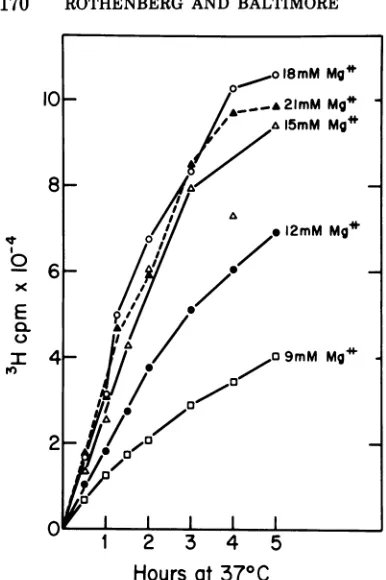
syn-thesis. The kinetics ofreversetranscriptionby detergent-disrupted virions ofMoloney MuLV weremeasuredinthepresence of different con-centrations ofMg acetate, 0.2 mM
[3H]dCTP,
and 5 mM each
dATP,
dGTP, and dTTP. Themaximal rate of DNAsynthesis occurred when the concentration of Mg acetate equaled or
slightly exceeded the total nucleotide concen-tration of 15.2 mM (Fig. 1). WithMg2+present at 12 mM, the incorporation of[3H]dCMP was VOL. 21,1977
on November 10, 2019 by guest
http://jvi.asm.org/
6
-I 4 /~~~~~~
E
00
12
3
4
5
Hours
at
37°C
FIG. 1. Effect of magnesiumacetateconcentration onthekineticsofDNAsynthesis byvirionsofMuLV.
Virions wereincubated in200p1 ofendogenous re-verse transcriptase reaction mixtures containing 5 mMeach ofdATP, dGTP, and dTTPand 0.2 mM
[3H]dCTP.Magnesiumacetate waspresent at9, 12, 15,18,and21 mMinthe different mixtures. At the indicated times, portions of 20 p were taken and
diluted into 0.5mlof0.1 Msodiumpyrophosphate containing20 mM EDTAandcarrier RNA.
Trichlo-roacetic acid-precipitable material was collectedon filters and theradioactivitywasdetermined by
scin-tillationcounting.
reduced to about 70% ofmaximum; at 9 mM
Mg2+, therate of DNA synthesis wasreduced
bymorethan50%.
When thesizesof the DNAproductsmade at differentMg2+concentrationswereanalyzed by
electrophoresis through 1.4% agarose gels, it was found that DNA made in the presence of lower concentrationsofMg2+wassignificantly
longer than DNA made in conditions ofMg2+
excess (Fig. 2). The DNA made with limiting Mg2+ after5hnotonly hadagreatermaximum
length, but also showedareducedproportionof
molecules smaller than about 300,000 daltons (arrow onFig. 2). Net elongation wassoslow,
however, that the longest molecules only
ap-pearedreproduciblyafter 3 to 6 h ofsynthesis. Because the total amount of DNA synthesis withlimiting Mg2+wasless than that madein
Mg2+excess,it appearsthat an initiationevent at low Mg2+ concentration was more likely to
yield alongDNA molecule than aninitiation
event inMg2+ excess.
In previous work (14), extremely high con-centrations ofdNTP had been foundtopromote the synthesis of long, but still incomplete, DNA transcripts. To compare the effects of varying both the dNTP concentration and the amount of free Mg2+, virions were incubated at different
Mg2+ concentrations with dATP, dGTP, and dTTPeach at 1 mM or at 5 mMand [3H]dCTP
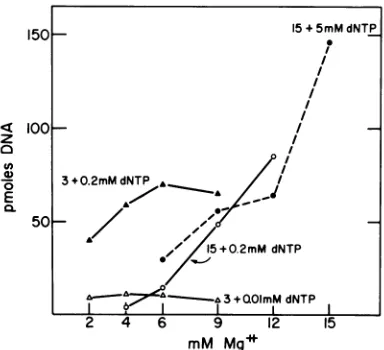
[image:3.505.65.258.51.341.2]at 0.01, 0.2, or 5 mM. DNA was purified from the reactionmixtures after 6 h of synthesis and analyzed by electrophoresis through agarose slab gels. The Mg2+ concentrations tested spanned theincorporation optima for the 3.01 and3.2 mM dNTP reactions, but were all below the nucleotide concentrations and incorpora-tionoptima for the 15.2 and 20 mM dNTP reac-tions (Fig. 3). Thesizes oftheproducts shownin Fig. 4 thusreflected three effects: the enhance-ment of the rate of DNA synthesis by high substrate levels, the slowing of DNAsynthesis
in limiting Mg2+, and the increased length of DNAmolecules madeatlimiting Mg2+ concen-tration.
Thehighestproportion of very large DNA, as well as thelargest absolute amount, was made inthereaction mixture containingthe highest
nucleotide concentration (20mM) andtheleast severely restricted Mg2+ concentration (15 mM; Fig. 4, lane 15). Further reductions in Mg2+ concentration appeared to decreasethe propor-tion ofvery long DNA products, probably be-causeelongation was sosluggish (Fig. 4, lanes 13, 14; also cf. lanes 10 to 12). On the other
hand, high nucleotide levels were not abso-lutelynecessaryforthe synthesis ofverylarge
DNA: as long as the Mg2+ concentration was
slightlybelowthatofthesubstrates, longDNA was made even at moderate dNTP concentra-tions (lanes 1 and 5, Fig. 4). In the reactions
analyzedinlanes1through4, Fig.4,although
.dCTP
wassharply limitingat 0.01 M andover-all DNAsynthesiswasveryinefficient(Fig. 3), molecules as long as 1.0 x 10⁶ to 1.2 x 10⁶
daltonscould be found when the Mg2+ concen-tration waskept below the nucleotide concen-tration (Fig. 4, lane 1). This was in contrast withpreviousresultsinMg2+excess(14), when
products longer than 0.4 x 10⁶ to 0.5 x 10⁶
daltons were not detectable in low-substrate
reactions.
Limit-lengthproduct. Thelongest DNA mol-eculessynthesizedat12mMMg2+and15.2mM
nucleotides were examinedby alkaline sucrose
gradient sedimentation and electrophoresis in
on November 10, 2019 by guest
http://jvi.asm.org/
REVERSE TRANSCRIPTION WITH LIMITING Mg2+
9
12
15
SV40
18
21
mM
Mg*
_u
-1.62
x
106
-
0.7
x
106
A..
JUL
i.s
J
J
[image:4.505.54.444.64.315.2].
FIG. 2. Effect of magnesiumacetateconcentrationonthe sizeofDNA madeby virionsofMuLV.Samples from the reactions described in the legend toFig. 1 were taken after 5 h of synthesis. Portions of each containing20,000to24,000 3H cpmweredenatured andsubjectedtoelectrophoresis througha1.4%agarose slabgel for 10 hat20 V.Fromlefttoright, thesamplesaretheproducts ofreactionscontaining9mM, 12 mM, and15 mMMg2+,respectively;EcoRI-cleaved SV40DNA;andproducts of reactions containing18and21
mMMg2+.Some reassociated SV40 double-stranded DNA is visible above the major doublet. A nonradio-activefragmentofP22phageDNA cleaved with EcoRIof single-strand molecularweight0.7 x 106(9)was runas anadditional marker. Forfluorography, thefilmwasexposedat -70°C for3 days.
2 4 6 9
mM Mg*
12 15
1.4% agarose gelswith markers of known size.
Agarose gelswere usedbecause theycould
re-solve single-strand DNA molecules larger than the RNAtumor virusgenome andprovide accu-ratesizesfor them (8). The pattern of bands of reverse transcriptase products was, however,
less sharply defined than on polyacrylamide
gels
(Haseltine et al., in press). Under theelectrophoresis conditions used, themobilityof
single-strand
DNAwas linearlyrelated tothelogarithm ofitsmolecular weight (Fig. 5). As
shown inFig. 2 and 4, the largestDNA
prod-ucts made by the MuLVpolymerase migrated at adefined limitsize. This bandcontained4%
of thetotal radioactivity of the sample shownin
Fig.4, lane 15, as calculated from a scan of the
fluorograph. The molecular weight of the
larg-FIG. 3. Effect onDNA synthesis of varying both Mg2+ and dNTP concentrations. Virionswere
incu-bated inendogenous reactionscontainingMg2+atthe indicated concentrations and the following
concen-trationsofnucleotides:1mM each dA TP, dGTP,and
dTTP with [3H]dCTP at0.01 mM (3 + 0.01 mM
dNTP) or0.2 mM (3 + 0.2 mMdNTP);or 5 mM
eachdATP,dGTP,and dTTP with [3H]dCTPat0.2
mM (15 + 0.2 mM dNTP) or 5 mM(15 + 5 mM
dNTP). Five-microliterportions ofthe reaction
mix-tures wereacid-precipitated after6 hofincubation.
Incorporated radioactivity was converted to
pico-molesofDNA synthesized usingthe known specific
activity oftheprecursors and assuming equimolar incorporation ofallfourdNTP's.
I
150
z 0
0n
61)
0 E
1oo_
50-15+5mM dNTP
/
3+0.2mMdNTP^ . J
/5+0.2mMdNTP
&---. -- 3+QOlmM dNTP
171
VOL. 21, 1977
on November 10, 2019 by guest
http://jvi.asm.org/
[image:4.505.50.242.407.582.2]... -, "....I... 1- - .... I
I I-
T,
op
.-.I
_j -h7
8
9
10
i
12 13,
A
15
qbp-- -2. 3 x ,(t"
-0.7x
O(D
L.Dye
FIG. 4. Sizeof productsmade at different dNTP andMg2+concentrations. DNA waspurified from the reaction mixturesdescribed in thelegendtoFig.3.Portionsofeachsample containing10,000to13,1000 3II
cpmweredenaturedandsubjectedtoelectrophoresisthrougha1.4%agaroseslabgel.Electrophoresiswasfor
10hat15 V.Lanes 1-4: DNA madeat(3 + 0.01) mMdNTP with 2 MM,4 MM, 6MM,and 9 MMMg2+,
respectively.Lanes 5-8: DNAmadeat(3 +0.2)mM dNTP with 2MM,4MM,6MM,and 9 MMMg2+.Lane 9:EcoRIendonuclease-cleavedSV40DNA,includingsomecircularmolecules, duetoincompletedigestion, migratingslowerthan thedoubletoflinear strands. Lanes 10-12: DNA madeat(15 + 0.2)mMdNTP with 6
MM,9MM,and 12 MMMg2+.Lanes 13-15: DNA madeat(15 +5) mMdNTP with 9MM,12 MM,and 15 MMMg2+. Unlabeled markers ofdenatured P22 DNA of2.3 106,1.6 106 and 0.7 X 10⁶daltons were locatedbyethidium bromide staining.Fluorography wasat -70'Cfor7days.
2 3
cm migrated
4 5
FIG. 5. Sizing oflimit-length polymerase product
on agarose gels. Theproduct ofa 3-h reaction as described in the text was freed of unincorporated substrateby Sephadex G-50chromatography,
dena-tured, andsubjected to electrophoresis through an agaroseslabgel.Identicallytreated markersofSV40
['4C1DNA digestedwithEcoRI, nonradioactive
bac-teriophage Xgt-XCcleaved withEcoRI, anda nonra-dioactive EcoRI fragment of bacteriophage P22
DNA,as described in Materials andMethods, were also analyzedon thegel. Nonradioactive DNA and
estmaterial wasestimated tobe 2.4 x 10⁶
dal-tons (arrow in Fig. 5). Thus, the molecules
appeared to have achieved a limit-length,
which may be long enough to represent
com-plete transcriptionofa358 RNAsubunit of the viral RNA.
Onalkaline sucrosegradients, theproductof
a3-hendogenousreactioncontainedsomeDNA
sedimentingfaster than linearSV40DNA(Fig. 6A); this represented 4% of the total. Resedi-mentation of this DNA through alkaline su-crose(Fig. 6B) showed that itwastrulylarger
than the SV40 DNA, with a mean calculated molecularweightof 2.3 x 10⁶to2.5 x 106(16).
ThelongestDNAmoleculeswereshowntobe faithful transcripts of the RNA template by annealing them to 708 Moloney MuLV virion RNA. Portions of the pooled limit-length SV40 DNA were visualized by ethidium bromide
staining.Radioactive DNAswerelocatedby
fluorog-raphy.Distancemigratedwasplottedagainst molec-ularweight forthe marker DNAs. Thepositionofthe
limit-length polymerase product is indicated by an arrow.
401
I0) 0
20
I0 8 6
X,gt-XC
cDNA
P220 c\V40
P22
on November 10, 2019 by guest
http://jvi.asm.org/
[image:5.505.73.464.59.306.2] [image:5.505.70.262.413.551.2]REVERSE TRANSCRIPTION WITH LIMITING Mg2+
3000 200C .1000 I
E 0.
In
800 600 400 200
10 20
Fraction number 30
1200 800 400
C)t
3
o
FIG. 6. Maximum reverse transcriptase product sizeonalkalinesucrosegradients. (A) Aportion of
the endogenous reaction product described in the
legendtoFig.5wascentrifuged througha5to20% alkaline sucrosegradient for17 hat35,500rpmin
the SW41 rotorat4°C.Fractions were neutralized, and 1/8 portions ofeach were counted in 10 ml of
Handifluorwith1 mlofwater.The14C-labeledDNA
marker ofSV40cleaved with EcoRIwascentrifuged inaparallel gradient.Thedirectionofsedimentation wasfrom righttoleft. (B)Thefractionsindicatedin
(A)werepooledandethanol-precipitated. One-halfof
thepooledDNAwassubjectedtocentrifugationon a 15 to 30% alkaline sucrose gradient, for 18 h at
35,000 in theSW41 rotor at220C. SV40 [14CIDNA
was runinaparallel gradient.
[3H]DNA from the alkaline sucrose gradient
showninFig. 6Aweredenaturedat 100°Cand thenincubated at67°C with and withoutviral RNA. More than 90% of the [3H]DNA was
re-sistanttodigestion by
S,
nuclease after anneal-ing with viral RNA, whereas less than 1%wasresistant when annealed without RNA (Table 1). Thus, atleast 90% ofthe limit-lengthDNA
wascomplementarytothevirionRNA, andno
self-complementaritywasdetectable.
Initiation of DNA synthesis in limiting
Mg2+. It is known that the initial sequenceof DNAcopied from the MoloneyMuLVtemplate under conventional polymerase conditions is the sequence d-AATGAAAGA, which is
cova-lently linked to the 3'-terminal riboadenylic acid ofproline tRNA (W. A. Haseltine and D.
Baltimore, in A. S. Huang, D. Baltimore, and C. F. Fox, ed., Animal Virology, in press). Therefore, the mechanism of initiation of the synthesis oflongDNA molecules made at low Mg2+ concentration couldbestudiedby examin-ing the fate of32pfrom [a-32P]dATPina
pulse-chase experiment. Virions were incubated in
TABLE 1. Hybridization of limit-length DNAa
cpm
Fraction
Ilnu-
(acid-
(%)SSample cleas pre-
resist-cipita- able) ant
[3H]DNA, incubated - 368 (100) [3H]DNA, unincubated + 18 1.3
[3H]DNA, incubated + 14 0.2
[3H]DNA, incubated with + 336 91 RNA
Filter background 15, 12
a
[3H]DNA
(approximately 0.3 ng) from thepooledalkaline sucrose gradient fractions shownin
Fig. 6A was incubated for 3 h in 0.9 M LiCl at 68°C in the presence or absence of 4
gg
of 70S Moloney MuLV virion RNA per ml. Equivalent Crt value attained with RNA was 0.75. Thehybrids were ana-lyzed by resistance toS1nuclease.appropriate salts and detergent at 37°C for 15 minwith only4to 5
AM
[a-32P]dATPpresent.The labelwasthen chased by diluting the
sam-pleinto a fivefold larger reaction volume con-taining a5,000-foldexcess of unlabeled dATP as
well as the other dNTP's, actinomycin D, and
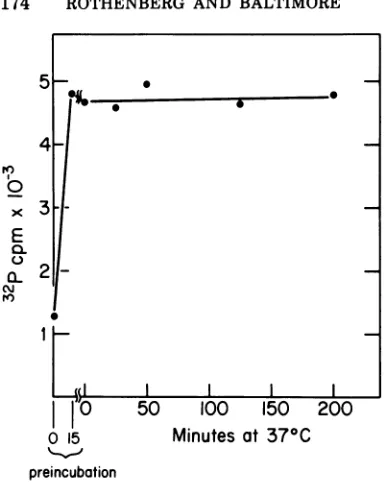
Mg2+. During the chase, incorporation of fur-ther32pwasdrastically reduced(Fig. 7).
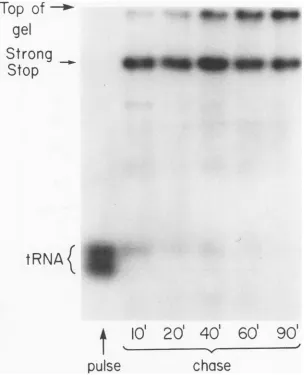
All ofthe label incorporated during the pulse migrated with the tRNA fraction during
elec-trophoresis through a 10% polyacrylamide gel (Fig. 8). For unknown reasons, the label
ap-peared as a diffuse doublet. Duringthe chase, all the 32p originally attached to tRNA was
movedinto largermolecules. The first and
ma-jor speciesof DNA into whichlabel was chased was the 135-nucleotide "strong stop" DNA
linked to its tRNA primer, which was
previ-ously characterized by Haseltine et al. (in press). As the chase period was extended,
in-creasingamountsofradioactivitywerefoundin
DNAthat couldnotpenetratethe 10%gel, but
evenafter90min,one-half of thelabeled mole-cules
migrated
as"strong stop" DNA.To furthercharacterize the longest DNA mol-ecules labeledby this pulse-chase protocol, mol-ecules labeled after25and200minof chaseat
limiting Mg2+ concentration were fractionated by electrophoresis throughagarosegels aftera
briefalkalitreatment todegrade the template (Fig. 9). 32Plabel appearedinallsize-classes of DNAincludinglimit-length DNA. Moleculesof differentsizes were eluted from the gel, and the RNA moieties werecompletelyhydrolyzedwith
piperidine. The hydrolysate was thenanalyzed
by
paperelectrophoresistodetect any 32pthat had been transferred to ribonucleotides. AsshowninFig. 9B,transfer of the 32pinitiallyin
[a-32P]dATP torAMP wasdemonstrable inall size-classes ofreverse-transcribed DNA. A
N.5*
-
II~
_
....
FPool ,*-.1 _.
B
_ 0
.
173
VOL. 21, 1977
on November 10, 2019 by guest
http://jvi.asm.org/
[image:6.505.49.238.48.254.2] [image:6.505.252.447.73.181.2] [image:6.505.247.445.73.181.2]x 3
-El
No
r4)
| 0
50
100
150 2000 I5 Minutes at
37°C
preincubation
FIG. 7. Incorporation of[a-32P]dATP ina pulse-chaseexperiment.Topulse-labeltheviralpolymerase product, virions were incubated in an endogenous
reaction at370C with onlyone substrate, 5 1.M
[a-32P]dATP,and 6 mMMg2+.NoactinomycinD was presentinitially,and the reaction wassupplemented by10 mMcreatinephosphate and 5 pgofcreatine
phosphokinaseper ml inafinal volumeof0.5 ml.
After15min,the label waschasedbyincreasingthe
reaction volumefivefoldto2.5 ml andadjustingit to
5mM eachdATP, dGTP,anddTTP,0.2 mMdCTP,
100pgof actinomycinDper ml,and12mMMg2+. Incubation wasthen continued for200 min.At the
indicated times, 5-p] portions were taken from the
"pulse"mixture and25-pl portions weretakenfrom
the "chase" mixture, andacid-precipitable
radioac-tivitywasdetermined.
Itmaybe notedinFig. 9Bthatthe ratio of32P
inrAMPto32pinDNAatthe origin decreased with increasing length of the DNA. This was
not unexpected, since in such an experiment
longer DNA molecules are morelikely to
con-tain ininternal positions any32p that was
in-corporated after the chase. Furthermore, a
cer-tainamountof materialatthe originmayhave
been trapped there nonspecifically. These ef-fects makeprecise quantitation difflctilt, butit is clear that every size-class of DNA
synthe-sizedinthe lowMg2+ polymerase reaction
con-tained molecules with an initial pApdA
link-age, consistent with the tRNAPr° initiation mechanismdemonstratedinmorelimited
reac-tions.
Effect of Mg2+ on nucleic acid stability.
Because the long DNA molecules synthesized underlimiting Mg2+ conditions appeared tobe initiatedinthesame way asshortermolecules
made in Mg2+ excess, it appeared that excess Mg2+ somehow inhibits complete transcription of the35S RNA subunit. Thismight be due to
destructionof theproductortemplate in excess Mg2+ or to some other mechanism, such as al-terationof the template conformation or of the
binding ofthepolymerasetothetemplate. Tostudy possible activation of DNaseinside thevirionby free Mg2+, excessMg2+wasadded during the course of an endogenous reaction
and thesize of theresultingDNAwasanalyzed by sedimentation throughalkaline sucrose gra-dients (Fig. 10). After 90 min in limiting Mg2+, the largest DNA was about 5,000 nucleotides
long, or 1.6 x 10⁶ daltons (Fig. 10A, closed
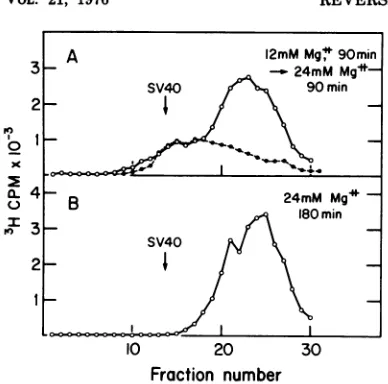
symbols). If incubation was continued, some-what more large DNA was formed (Fig. 6A). In asample incubated90min inlimiting Mg2+and then90 min morewith excess Mg2+, the longest molecules made before the shift remained in-tact; the additional radioactivity incorporated was almost all inmolecules shorter than 1,000
nucleotides long (Fig. 10A, open symbols).
In-cubation with excess Mg2+ for the entire 180 minyielded only molecules shorter thanSV40
DNA (Fig. lOB). Therefore, the effect of the
high Mg2+ concentration was not to destroy DNAthat was already made, but to stimulate
synthesis of molecules that could only be elon-gatedto alimitedextent.
In an attempt to explain the formation of
shortDNA in excess Mg2+, the stability of the
template RNA in the presence of different con-centrations ofMg2+ was examined. Virions
la-beled with [3H]uridine were incubated with 5 mM each dATP, dGTP, and dTTP and 12 or 18 mM Mg acetate. The fourth nucleotide,
dCTP, was omitted so that DNA could not be made and the template RNA would not be
de-graded by theRNase H activity of the polymer-ase(21). After0 or 4h of incubation, RNA was
extracted and subjectedto neutral sucrose
gra-dient centrifugation. The sedimentation
pro-files of thenativeRNA samples were identical
(data
not shown). RNA pooled from the 70Sregionof each gradientwas then denatured by a brief heat treatment and then centrifuged
through a second sucrose gradient (Fig. 11). Both incubated samples (Fig. 11A) were more
degraded than the control (Fig. llB), but the extentof thedegradationwas clearly greater in the sample incubated in excess Mg2+. In limit-ing Mg2+ some full-length 35S RNA was still present at 4h,butinexcessMg2+ virtuallyno
full-length molecules remained intact.
There-fore,itappearsthat at least part of the effect of excessMg2+ was to promote the degradation of the template. Mg2+-activated degradation of the template may, however, not be a complete
on November 10, 2019 by guest
http://jvi.asm.org/
[image:7.505.66.258.53.294.2]VOL. 21, 1977
Top of
gel
Strong
Stop
REVERSE TRANSCRIPTION WITH LIMITING Mg2+
S_. _
tRNA{
I0'
pulse
20'
40'
60'
9o0
chase
FIG. 8. Size ofpulse-labeled materialon10%acrylamide gels. Pulse-labeled DNA was made asinthe legend toFig. 7, with the following differences. Initially, 3.7pM[a-32P]dATP waspresent ina reaction volumeof0.25ml;afterthe chase, thereactioncontained 5 mM each dATP, dCTP, anddTTP,1mMdGTP, and26 mMMg2+ (excess Mg2+)in afinal volumeof 1.25 ml. Portionsof0.2mlweretaken fromthereaction mixture at0, 10, 20, 40, 60,and 90 min after addition of the chase mixture. DNA wasextracted, freed of unincorporated nucleotides by Sephadex G-50chromatography, and subjectedtoelectrophoresison aslab gel of9.5%polyacrylamide-0.5% bisacrylamideasdescribed by Haseltineetal.(in press).Electrophoresiswasfor
3 hat400V inawater-cooled EC-140apparatus.
explanation of the effectofMg2+on DNAsize,
because increased Mg2+ seemed to limit DNA sizemoreseverely (Fig. 10A and B) than would
bepredicted from itseffectonRNA (Fig. 11).
DISCUSSION
Detergent-disrupted virions of Moloney MuLV arecompetent tosynthesize transcripts of the 35S subunit of the virion RNA upto a
definedlimit-length. At leastpartof thecause
ofabortive transcription is the degradation of thetemplate RNAinthecourseof the reaction.
Thisdegradation is minimized if the
concentra-tion of Mg2+ in the reaction mixture is lower than the concentration of nucleotides, so that
essentially all the Mg2+ ischelated into1:1 Mg-dNTPcomplexes (17). The kinetics of DNA
syn-thesis areslower when Mg2+ is made limiting,
but longer products can ultimately be made.
Molecules uptohalf themaximumlength are
made even in very low dNTP concentrations
(Fig. 4, lane 1). The mechanism of the
Mg2+-enhanced RNAdegradation is notknown;
con-taminating RNases in thevirions maybe
acti-vated, oxidative breakage, perhaps involving dithiothreitol (1), may be accelerated in the
175
on November 10, 2019 by guest
http://jvi.asm.org/
[image:8.505.101.405.60.435.2]176 ROTHENBERG AND
BALTIMORE
A
A
AVG0'
>~~~~~~~~~~~~~~~~~~~~~~~~~~~~~~~~~~~~~~~~~~.
,(4
0
I
iff
4-
Top
2 3
,4.~
V
i.V
iv
1W
I7
-N. yB
a
AWi
&
tc: I11
I
I .
-f N
II
Jo
-t -'r
on November 10, 2019 by guest
http://jvi.asm.org/
REVERSE TRANSCRIPTION WITH LIMITING Mg2+
o-
424mM
Mg*
B 180min
20SV40,/d;V4
10 20 30
Fraction number
FIG. 10. Effect ofMg2+concentration on reverse
transcriptase product stability. Virions were incu-batedinendogenousreactionswith 15.2 mM nucleo-tides,[3H]dCTP limiting,at12mMMg2+ for90min
(A, closedsymbols),at12mMMg2+ for90min, and thenat24 mMMg2+foranadditional 90 min (A, open symbols),or at24 mMMg2+ for180min (B). DNA was extracted from each and centrifuged through alkalinesucrosegradients for17hat35,000 rpm,24°C,in anSW41rotor.LinearSV40 DNAwas
centrifugedon aparallel gradientas amarker. Frac-tions were acid-precipitated for scintillation
count-ing.
presence of free Mg2+, or a combination of ef-fects may be responsible.
The effect ofMg2+ on the rate of DNA synthe-sis maybepartly duetochangesinthelevel of availableMg-dNTP substrate (3), but this
can-notbe the sole factor. InFig. 3, less DNA was
made with 20 mM dNTP and 6 mM Mg2+, wherethe concentration of Mg-dNTP was about
6mM,thaninthereaction containingonly3.2 mM dNTPand 6 mM Mg2+, where the concen-trationofMg-dNTPwas no morethan 3.2mM.
It is probable that the enzyme needs a small
amountof freeMg2+eithertomaintain itsown
conformation or to bind the template effl-ciently.
In the polymerase reactions with slightly
limiting Mg2+, the products have a defined
maximum size. The limit-length appears to be
2.4 x 10⁶ daltons, by alkaline sucrose gradient
sedimentation and agarose gel electrophoresis.
This number is probably accurate toabout10%:
in the case of the alkaline sucrose gradient centrifugation, it reflects the weight-average
A 28S 18S 4hr at37°C
'5-8mMMg
101
012mMMg*'
a.
o B
Unincubated
If) 28S 18S
30_
20-
10-~~~~~~-10 20 30
Fraction number
FIG. 11. Size oftemplate RNA after incubation
at excess and limiting Mg2+ concentrations. [3H]uridine-labeledvirions wereincubatedin endog-enousreactions with5mM eachdATP,dGTP,and dTTPand12 or 18mMMg2+.After4hat37°C,RNA
was extracted from the incubated samples and an
unincubated control by the SDS-phenol-chloroform method (4) and centrifuged on 11-ml 0.5%
SDS-sucrosegradients for2hat35,000rpm,22°C,inan
SW41rotor. Thefractions containing70S RNAwere
pooled,ethanol-precipitated,denaturedat78°C,and centrifugedon11-ml 0.5%SDS-sucrosegradientsas
before for 4 h at 40,000 rpm. The nonradioactive internal markers ofHeLa 28Sand 18S RNA were
located by absorbance at 260 nm. Fractions were
counteddirectlyinHandifluor. (A)RNA incubated for4hin12mMMg2+ (a)or18mMMg2+ (0). (B)
Unincubated control.
FIG. 9. Covalent linkage of pulse-labeled DNA to an RNA primer. (A) Autoradiogram of preparative agarosegel. DNA was prepared from 0.5- and 2.0-ml portions of the reaction mixture described in the legend
toFig. 7after 25 min and 200min of chase, respectively, and passed over Sephadex G-50. The samples from the25- and 200-min incubations were denatured and diluted to 50 and 100
p.l,
respectively. The25-min sample wassubjectedto electrophoresis in lane 1, and the200-min sample was divided between lanes 2 and 3, withdenatured linear SV40 DNA as a marker in another lane. After electrophoresis at 20V,themarker was located by ethidium bromide staining. (B) High-voltage electrophoresis of pulse-labeled DNA after alkaline hydrolysis. Portions of the agarose gel indicated with brackets in (A) were excised from lanes 2 and 3, except for fraction I, which was taken from lane 1. The approximate molecular weights of the material in the fractionswere:I,<2, x105; II,3-4 x10⁵; III, 8 x10⁵;IV, 1.7x10⁶;and V, 2.4x10⁶.The nucleic acids were eluted, treated withpiperidine, and subjected to high-voltage electrophoresis on Whatman 3MM paper at pH 3.5. The 2',3'-ribonucleotidemarkers were located under UV light and their positions were marked inradioactive ink.
Autoradiography was for 5 weeks.
VOL. 21, 1976 177
on November 10, 2019 by guest
http://jvi.asm.org/
[image:10.505.46.240.56.248.2] [image:10.505.255.447.154.376.2]sedimentation rateof the population of all mol-eculeslarger than linear SV40DNA, andinthe
case ofthe agarosegel analysis the migration
rate issomewhatsubjecttoeffects ofbase
com-position (20)that have notbeentaken into ac-count.The expected molecular weight ofa
com-plete single-strand transcript would be about
2.7 x 10⁶daltons, basedonelectron microscopy and gel
electrophoresis
of the closed-circular and linear infectious proviral DNAs made in vivo (7, 15).The limit-length product is more than 90%
complementary to virion
RNA, by
S1 nuclease resistance after hybridization, and has no de-tectable hairpin structure that would self-hy-bridize with zero-order kinetics(Table
1).Fur-thermore, limit-length aswellasshorter mole-cules can be initiated on a polyribonucleotide primer, presumably tRNA"ro
(Haseltine
and Baltimore, inpress), to give aninitial pApdA bond.Thus, thelongest DNA molecules appear to
be faithful copies of thetemplate initiated by a
specific mechanism. Given the uncertainty in
sizing, thelimit-length
product
wouldappear tobe the transcript ofacomplete 35S RNA
sub-unit. This interpretation is supported by the
recentdemonstration that polymeraseproducts synthesized under similar in vitro conditions
containinfectious DNA molecules (Rothenberg and D.Smotkin, manuscriptinpreparation).
ACKNOWLEDGMENTS
Wearegrateful to DanielDonoghueandPhillipSharp
for theirvaluable adviceandgenerousgiftsofphageDNAs
andrestrictionenzymes. William Haseltinekindlyhelped performtheelectrophoresisonpolyacrylamidegels.
This research wassupportedbya contractfrom the Virus Cancer Program of the National Cancer Institute and grants CA-12174and CA-14051 from the National Institutes ofHealth. E.R. wasa predoctoralfellow of theNational Science Foundation. D.B. isanAmerican CancerSociety
Professor ofMicrobiology.
LITERATURE CITED
1. Bode, V. C. 1967. Single-strand scissions induced in circularandlinearADNAbythepresenceof dithio-threitol and other reducing agents. J. Mol. Biol. 26:125-129.
2. Collett, M. S., and A. J. Faras.1975. In vitro transcrip-tionof DNA from the 70S RNA of Roussarcomavirus: identification and characterization ofvarious size classes of DNAtranscripts. J. Virol. 16:1220-1228. 3. Englund, P.T.,J. A. Huberman, T. M. Jovin, and A.
Kornberg.1969.Enzymatic synthesis of
deoxyribonu-cleicacid.XXX.Bindingoftriphosphatesto
deoxyri-bonucleicacidpolymerase.J.Biol. Chem. 244:3038-3044.
4. Fan,H., and D. Baltimore. 1973.RNAmetabolism of murine leukemia virus: detection of virus-specific
RNAsequencesininfected anduninfected cellsand identification of virus-specific messenger RNA. J. Mol. Biol. 80:93-117.
5. Fan, H., and M. Paskind. 1974. Measurement ofthe
complexity of cloned Moloney murine leukemia virus 60 to70S RNA: evidence for a haploid genome. J. Virol. 14:421-429.
6. Faras, A.J., J. M. Taylor, J. P. McDonnell, W. E. Levinson, and J. M. Bishop. 1972. Purification and
characterization of the deoxyribonucleic acid polym-eraseassociated with Rous sarcoma virus. Biochemis-try 11:2334-2342.
7. Gianni, A. M., J. R. Hutton, D. Smotkin, and R. A. Weinberg. 1976. Proviral DNA of Moloney leukemia virus: purificationand visualization. Science 191:569-571.
8. Hayward, G. S., and M. C. Smith. 1972. The chromo-someof bacteriophage T5. I. Analysis of the single-stranded DNAfragments by agarose gel electropho-resis.J. Mol.Biol. 63:383-395.
9. Helling, R. B., H. M. Goodman, and H. W. Boyer.
1974.Analysis of endonuclease R- EcoRI fragments of DNA from lambdoid bacteriophages and other vi-ruses by agarose gel electrophoresis. J. Virol. 14:1235-1244.
10. Junghans, R. P., P. H. Duesberg, and C. A. Knight.
1975. In vitro synthesis of full-length DNA tran-scripts ofRous sarcoma virus RNAby viralDNA polymerase. Proc. Natl. Acad. Sci. U.S.A. 72:4895-4899.
11. Laskey, R. A., A. D. Mills, and J. S. Knowland. 1975. Revisions and extensions of existing fluorographic procedures. Appendix to R. A. Laskey and A. D. Mills, Quantitative film detection of 3H and 14C in polyacrylamide gels by fluorography. Eur. J. Bio-chem.56:335-341.
12. Leis, J. P., and J. Hurwitz. 1974.RNA-dependent DNA
polymerasefrom avianmyeloblastosis virus, p. 143-150.In L. Grossmanand K. Moldave (ed.), Methods inenzymology, vol. 29E. Academic Press Inc., New York.
13. Morrow, J. F., and P. Berg. 1972. Cleavage ofSimian virus40 DNA at a unique site by a bacterial restric-tionenzyme. Proc. Natl. Acad.Sci. U.S.A. 69:3365-3369.
14. Rothenberg, E., and D. Baltimore. 1976. Synthesis of
long,representative DNA copies of the murine RNA tumorgenome. J.Virol. 17:168-174.
15. Smotkin, D., A. M. Gianni, S. Rozenblatt, and R. A.
Weinberg.1975.Infectiousviral DNAof murine leu-kemia virus. Proc. Natl. Acad. Sci. U.S.A. 72:4910-4913.
16. Studier, W. 1965. Sedimentation studies of the size and shape of DNA. J. Mol. Biol. 11:373-390.
17. Taqui Rhan, M. M., and A. E. Martell. 1966.
Thermo-dynamicquantitiesassociated with the interaction of adenosine triphosphate with metal ions. J. Am. Chem. Soc. 88:668-671.
18. Temin, H., and D. Baltimore. 1972. RNA-directed DNA
synthesisand RNA tumorviruses, p. 129-186. In K. M.Smith and M. A. Lauffer (ed.), Advances in virus research, vol. 17. Academic Press Inc., New York. 19. Thomas, M., J. R. Cameron, and R. W. Davis. 1974.
Viable molecular hybrids of bacteriophage lambda andeukaryoticDNA. Proc. Natl. Acad.Sci. U.S.A. 71:4579-4583.
20. Thomas, M., and R. W. Davis. 1975. Studies on the
cleavage ofbacteriophage lambda DNA with EcoRI restrictionendonuclease. J. Mol. Biol. 91:315-328. 21. Verma, I. M. 1975. Studies on reverse transcriptase of
RNA tumorviruses. III. Properties of purified Molo-ney murine leukemia virus DNA polymerase and associatedRNase H. J. Virol. 15:843-854.
22. Verma, I. M., N. L. Meuth, and D. Baltimore. 1972. The covalentlinkage between RNA primer and DNA product ofthe avianmyeloblastosis virus DNA
po-lymerase.J. Virol. 10:622-627.