Copyright01975AmericanSocietyforMicrobiology Printed in U.S.A.
Screening Procedure
for
Complementation-Dependent
Mutants
of
Vesicular
Stomatitis
Virus
CARL W. RETTENMIER,I RAYMONDE DUMONT2 AND DAVID BALTIMORE*
DepartmentofBiology, MassachusettsInstituteofTechnology, Cambridge, Massachusetts 02139 Received for publication 11September 1974
To isolatenewtypes ofvesicular stomatitis virus (VSV)mutants, afour-stage
screen was developed which identifies and characterizes mutants capable of
complementingthedefectintheVSV temperature-sensitive mutanttsGll.Two
typesofmutantsofVSV, Indianaserotype,have been foundby usingthescreen;
they are new temperature-sensitive mutants which are, of necessity, not in
complementation group I and mutants which do not produce plaques under
conditionsofsingle infection at31 C (thenormal permissive temperature) and
are, therefore, called complementation-dependentmutants.The newlyisolated,
temperature-sensitive mutants fall into three complementation groups, two of
which arecongruentwith known complementationgroups; the newly identified
groupextendstosix the numberofcomplementationgroupsof VSVIndiana. The
natureofthecomplementation-dependentmutantshasnotbeenestablished, but
one wasshownto not containasignificant deletion in itsnucleic acid.
Temperature-sensitive mutants of vesicular
stomatitis virus (VSV), as well as host-range
mutants, have been isolated in a number of
laboratories (4, 6-9, 11, 13, 16). Of the fiye
complementation groups of mutants in the
Indianaserotype,complementationgroup I
con-tains most of the mutants which have been
isolated; it presumably corresponds to the vi-rion-associated transcriptase which is the L
(large)protein (2, 5, 12, 18). Group V appears to
represent the envelope-associated G protein
(21). Groups II, III, and IV have less certain
associations. Mutants of the NewJersey
sero-type of VSV fall into six complementation
groups (14).
To increase the catalog ofVSV mutants, we
initiated a program ofisolation ofconditional
lethal mutants which would not necessarily
depend onhightemperature asthe nonpermis-sive condition. A way was especially sought which would allow the isolation of possible
amber mutants and complementing deletions
(as opposed to defective, interfering particles
whichdo not appear to complement; 15). As the
procedure developed, it also automatically
eliminated
group I ts mutants and thereforegenerated new mutants inthe othergroups.
The conditional system involved
identifica-tion ofmutants able to grow by
complementa-lPresentaddress:TheRockefellerUniversity,NewYork, N.Y. 10021.
"Present address: Boston City Hospital, Boston, Mass 02118.
41
tion with a known ts mutant at high
tempera-ture but unable to grow by themselves at high
temperature. The mutants were screened by
infecting cells at ahighmultiplicityofinfection
(MOI) with the ts mutant, co-infecting with
mutagenized VSV at a low MOI, and plating
the infected cells for infective centers at high
temperatureonamonolayerofuninfected cells.
All mutants isolated this way can be called
complementation dependent, but we have
re-served the notation cd for mutants which
ap-peared to be complementation-dependent but
not temperation sensitive.
The details of the screen and some mutants
which havebeen selected with it are described
here. Wecaution investigators who wish to use
the methods that the procedures work well as
described, but that even small variations in
parameters such as temperature or MOI can
lead to problems.
MATERIALS AND METHODS
Cells and media. Mouse L cells were grown in -ontinuous suspension cultureat 5 x 10, to 1 x 10⁶ cells/ml in Joklik-modified minimal essential me-dium (GIBCO) with added 7% fetal bovine serum.
Monolayercultureswerepreparedbyseeding5 x 106 L cells per 5-cm plastic tissue culture plate 1 to several hoursbefore use. These cultures were main-tainedinmediumsupplemented with1.8mMCaCl,,
and incubations were conducted at the indicated temperaturesinahumidified atmosphere of 5% CO,. Purified virus stocks, free of interfering DI-T parti-cles, were prepared onChinese hamster ovary cells as
on November 10, 2019 by guest
http://jvi.asm.org/
described previously (17).
Viruses. Thewild-typestrainofVSV used in these experiments was the large-plaque variant of the Indiana serotypeisolatedanddescribedby Wagneret al. (19).Plaqueassays werecarriedout aspreviously described (19), with appropriate medium and serum forL-cellmonolayers.All VSV temperature-sensitive (ts) mutantsof theG(Glasgow)seriesandtsO45(from the Orsay collection) werekindly supplied by C. R.
Pringle.
Preparation of mutagenizedvirus stocks. Puri-fiedwild-type stocksofVSVweretreated as described
withoneofthe followingmutagens.
(i) 5-Fluorouracil.Asuspensioncultureof 5x 10⁷
Lcells in 10mlofmedium with 1.8 mM CaCl,was infected withwild-type VSVat aninputMOIof 0.5.
After an adsorption period of 30 min at 31 C, the
sampleswerecentrifugedto removeunadsorbed virus
and suspended in 10 ml ofmedium plus 4% serum containing 0.3 to 1.0 mg of5-fluorouracilperml. The
infectedcells wereincubatedinsuspension for 8h at 31C, after which time the supernatants were col-lected, dialyzed against the medium, and stored at -70C. Virus yieldswere 1.5 x 10⁻¹ to 1.3 x 10-' of thoseobtainedinthe absence of mutagen.
(ii) N-methyl-N'-nitro-N-nitrosoguanidine. Pu-rified stock suspensions of VSV were incubated at roomtemperature for 15 min in 1.0 mg of
nitrosoguani-dineperml by themethod ofBurgeandPfefferkorn
(1).Afterdialysisagainstfreshmedium, the samples
werestored at -70C. Survival ofthe virus was 2 x 10⁻⁴.
(iii) Nitrous acid. By the procedure of Granoff (10),VSVstockswereincubatedat roomtemperature with 1 MNaNO2in 0.25M sodiumacetatebuffer(pH
4.8). At 1-min intervals, samples wereremoved, and the reactionswereterminatedby1:100dilutions into
phosphate-buffered saline.
Complementation by infective center assay.
Complementation between tsGll and other ts mu-tants inindividual, mixedly infectedcells wasassayed by plating infected cells on confluent L-cell
mono-layers under plaque assay conditions and then
incubating the plates atthe nonpermissive tempera-ture. Suspensionculture Lcellswereconcentratedto 5 x 10⁶cells/ml and infected at a multiplicityof 5
PFU/cell with tsGll (the helper) and0.1 PFU/cell
with the mutanttobe tested(calledtsXbelow).Cells infected with tsX alone also received 0.1 PFU/cell.
After a 45-min adsorption period at the permissive
temperature (31 C), the infected cells were washed twice with medium by centrifugation to remove unadsorbed virus and finally resuspended in the
original volume with fresh medium. Recovery of
infected cells after the centrifugation steps was ap-proximately 50 to 60% by direct count. Appropriate dilutionsweremade, and 0.2-ml samples of cellswere plated on confluent monolayers of uninfected L cells. Forty minutes at 31 C was allowed for attachment of the infected cells, and then an overlay consistingof 0.9% agar in medium containing 1.8 mM CaCl2,
nonessential amino acids, and 2.0% fetal calfserum was added. Theplates were incubated for 2daysat either31 Cor38.5C,asappropriate, and the
appear-ance ofplaques at 38.5 C on the monolayers seeded with mixedly infected cells was interpreted as evi-dence for complementation in single infective centers. The results are expressed as the complementation efficiency coefficient:
Complementation efficiency coefficient for tsX
Ft8G
11plustsXl_tX3.Cttr
L38.5 C titer j [tsX38.5 C titer] [tsX 31 C titer] - [tsX 38.5 C titer] The term subtracted from both numerator and de-nominator corrects for the presence oftsX revertants, generally a negligible number. L cells infected with tsG1l at an MOI of 5 and plated as infective centers at 38.5C demonstrated that the complementation re-sults were not due totsGl1 revertants or background growth at the nonpermissive temperature.
Examination of virus in complementation
plaques(stage IV; Fig. 1). To examine the content of complementation plaques, the agar over such
plaques was collected in a capillary tube, and the virus was released into 1 ml of medium as described (17). The virus was plated on L-cell monolayers which wereincubated for 2 days at 31 C, and well-isolated
plaques were then analyzed to determine if they containedtsGll,a new ts mutant, or something else.
For the analysis, plates containing L cells
sus-pendedinagar were used (3). For these, a 15-ml agar
base layerwas prepared in plastic petri dishes (15 by 100mm); it consisted of 0.9% agar, medium, 1.8 mM
CaCl,, nonessential amino acids, and 2% fetal calf
serum. Over this base layer was poured a suspension of 107 L cells in the same agar medium which was
allowedtosolidify. Some plates were also seeded with 4 x 10⁶LcellsfreshlyinfectedwithtsGllat anMOI
of 5inthe top layer in addition to the uninfected cells. Theplaques to be tested were stabbed with a sterile
toothpick, and the toothpick was then stabbed into
identical positions on three plates of L cells in agar suspension, the last plate containing tsGll-infected cells.After a number of plaques had been replicated ontothethree plates, one plate was incubated at 31 C, one wasincubatedat 38.5C, and the tsGll-contain-ingplatewas incubated at 38.5 C. After 2 days, the plates were scored for growth, and the results for any onetested plaque were recorded as (+) or (-) for each ofthe three plates. These were incorporated into a
three-place code where growth at 31C, 38.5C, and 38.5 Cplus helper were serially represented. A result of(+ - -) was indicative of tsGll and a result of
(+ - +) indicated a new ts mutant. The (+ + +) result isdiscussed below.
The newtsmutants were harvested from the31C replica plates and cloned twice, and then purified
stocks free of defective, interfering particles were prepared (17).
Complementation in high-MOI-infected mono-layer cultures. The complementation groups of ts mutants were determined by a modification ofthe method of Cormack et al. (4). Monolayercultures of 2.5x 10' Lcellsweremixedly infected withpairsofts mutants, each at an input MOI of 5. However, an MOI of 1 was used in these studies for tsG22 and
on November 10, 2019 by guest
http://jvi.asm.org/
SCREENING VSVMUTANTS
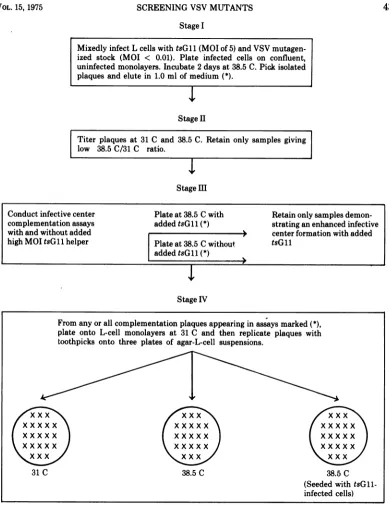
StageI
Mixedly infect L cellswith tsG1l(MOIof5) andVSV mutagen-ized stock (MOI < 0.01). Plate infected cells on confluent,
uninfectedmonolayers. Incubate 2daysat38.5C. Pick isolated plaques and elute in 1.0ml ofmedium (*).
4
StageII
Titer plaques at 31 C and 38.5C. Retain onlysamples giving low 38.5C/31 C ratio.
StageIll
Conductinfectivecenter Plate at 38.5 C with Retainonlysamples
demon-complementationassays addedtsG1l (*) strating anenhanced infective
withand without added center formationwith added
highMOItsG11helper Plate at 38.5 C without tsGll addedtsGll(*)
4
Stage IV
From any or all complementation plaques appearing in assays marked (*),
plate onto L-cell monolayers at 31C and then replicate plaques with
toothpicks onto three plates of agar-L-cell suspensions.
x x
xx
xxx xx xxxxxx xxxxx
xxxxx
xxxxx \ x
xx
XXxxxx
xxxx
31C 38.5C 38.5C
(Seeded with tsGll-infectedcells)
FIG. 1. Screening procedure used to select potential complementation-dependent mutants. Asterisks (*)
indicateplaces in thescreen where 38.5Ccomplementation plaqueswerepickedandexamined instageIVof the assay.
tsG41because of the high background yields obtained with these mutants. Controls for each member of a testedpair of mutants were singly infected attwice the MOI usedinthe mixed infection. Thirtyminutes wasallowed foradsorption at 39 C (39C was used for this assay rather than 38.5C because of the high background yield at the lower temperature). The
monolayers were washed twice with 5.0 mlofmedium toremoveunadsorbed virus and then covered with5.0 ml of medium with 1.8 mM CaCl,, nonessential amino acids, and 2.5% fetal bovine serum. The medium was changed 90 min later to remove any virus which may have eluted from the infected cells. The
supernatants were harvested 5.5 h after infection, VOL.
on November 10, 2019 by guest
http://jvi.asm.org/
[image:3.504.64.453.59.568.2]RETTENMIER,DUMONT, AND
centrifuged to remove anyfloating cells, and titered at 31 C. Results are expressed as a complementation index,calculated as the ratio
Yield(tsA + tsB)during39C mixed infection Yield tsA during 39 C single infection where tsA and tsB are any pair of ts mutants and the
yield
oftsAat 39C exceeds that of tsB.RESULTS
Complementation between ts mutants by infective center assay. Previous studies of complementation by VSV
temperature-sensi-tivemutants have involvedmixed infections at
high multiplicities in mass cultures (4, 9).
Because our strategy for isolation ofnew
mu-tants involved infection of all members of a
population of cells by ahelper mutant, infection
of some cells by a single particle of a new
mutant, and then determination of productive
infective centers as an assay for
complementa-tion, the feasibility of this methodology was
established by using known
temperature-sensi-tiveVSVmutants.
MutanttsGll acted as an efficient helper for
complementation in the infective center assay
with mutants from groups II, III, IV, and V.
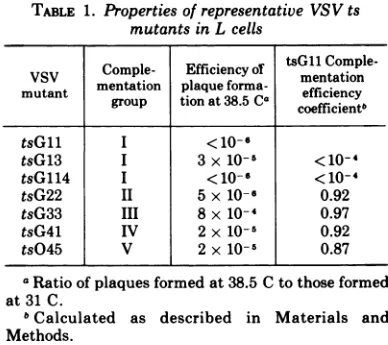
Table 1 shows the relative plating efficiency of the tested mutants at 38.5 C (nonpermissive
temperature) and 31 C (permissive
tempera-ture) along with a coefficient which measures
their ability to complement tsGll (calculated
as described in the Materials and Methods).
Mutant tsGll complements tsG22, tsG33, tsG41, and tsO45 efficiently enough that almost
all ofthe particlesable to form plaques at 31 C
can be detected by complementation in the
infective center assay. The data also confirm
TABLE 1. Propertiesof representative VSVts mutantsin L cells
VSV Comple- Efficiencyof tsG11
Comple-mutant mentation plaqueforma-efficn
mutant group tionat38.5Ca
efficiency
tsG1l I <10-6
tsG13 I 3x 10⁻⁵ <1-4
tsG114 I <10-6 <10-4
tsG22 II 5 x 10⁻⁶ 0.92
tsG33 III 8x10⁻⁴ 0.97
tsG41 IV 2x 10⁻⁵ 0.92
ts045 V 2x 10⁻⁵ 0.87
aRatio ofplaques formed at 38.5 C to those formed
at 31C.
Calculated as described in Materials and Methods.
that tsGll, tsG13, and tsG114 are all in the
samecomplementation group.
Todetermine if the complementation plaques
arising in the infective center assay contained
any recombinant progeny, the plaques were
assayed for wild-type virus. More than 99% of
the virus in theseplaqueswasstill temperature
sensitive. A fewparticlesable to form plaques at
38.5C were detected, but further replating of
these plaques did not yield stable
recombi-nants. We conclude that thecomplementation
plaques contain mainly the ts parent viruses
plus a few aggregated particles or
heteropoly-ploid particles in which the genomes of both
parents areenclosed in a single envelope. Such
particles have been previously implicated in
geneticstudies withVSVtsmutants (20).
Mutants in group Iareespecially well-suited
ashelpersinthiscomplementation testbecause
athigh MOI they give little or nobackground
growth in the infective center assay by
them-selves. Mutants from other groups were less
suitable as helpers; tsG22 gave too high a background at38.5 C; tsG41 gaveonlyminute
complementation plaquesat 38.5 C, and tsG22
gave acomplementation efficiencycoefficient of
0.1 to 0.5.Wetherefore usedtsGllasthehelper
virus in attempts to isolate complementation
dependent mutants.
Mutantscreen.Theprocedureusedtoscreen
for complementation-dependent mutants is
outlined in Fig. 1. In stage I, L cells were
infected at anMOI of 5 with tsGll and at an
MOI of 0.01 with mutagenized wild-type VSV.
These mixedly infected cells were then plated
ontoconfluentL cellmonolayers andincubated at 38.5 C (infective center assay described above). Plaques which formed would be due
either to residual wild-typevirus in the
muta-genized stock or tocomplementation betweena
mutant and thetsGll helper.
To distinguish wild-typevirus from new
mu-tants,isolatedplaquesfromthe infectivecenter
assaywereeluted into1ml ofmedium. In stage
II of the screen (Fig. 1), assays of 50
gliters
ofthe plaque eluates at 31 C and 38.5 C were performed. Only samples exhibitingavery low
ratioofplaquesat 38.5 C tothoseat31 C were
retained. Suchsamples could have tsGllplusa
new tsmutant, tsGll plusa true cdmutant or
tsGll alone. With the three mutagens used,
about 5 to 10% of the stage I plaques were
considered suitable forfurtheranalysis.
Those plaques retained for further analysis
werethensubjectedtostageIII ofthescreen to
select samples containing a mutant asidefrom
tsGll which would efficiently complement
on November 10, 2019 by guest
http://jvi.asm.org/
[image:4.504.59.253.489.662.2]SCREENING VSV MUTANTS
tsGll. ForstageIII, 0.1mlofthe original plaque
eluates from stage I were assayed for infective
center formation at 38.5 C with and without
added tsGll. Those samples showingatleastan
eightfold enhancement of plaque formation at
38.5C by tsGllwereselectedforfurther
analy-sis. About one-third of the
5-fluorouracil-treated virus which passed stageIIalso passed
stage m (8 out of 26), 1 of 15 plaques from
nitrosoguanidine-treated viruspassed stageIII,
and 1 of 4 plaques from nitrous acid-treated
viruswasretained.
Stage IV oftheassay wasdesignedto
distin-guishnew ts mutants from cd mutants andto
allow isolation of thenew tsmutants.
Individ-ual plaques arising at 38.5C, from assays
marked in Fig. 1 withan asterisk, werepicked
andplated at31 C. Isolatedplaques from these
plates werethen picked with sterile toothpicks
and transferred togrid positionsonthree
sepa-rate plates each containing L-cell suspensions
inagar.One of these plateswasalsoseeded with
tsGll-infected cells. The tsGll-containing
plate along with one of the other two were
incubated at 38.5C; the third plate was
incu-bated at 31 C. The pattern ofgrowth of virus
fromonetestedplaquewasscoredas(+)or(-)
on each of the three plates and recorded as a
three-place code.
All plaques submitted to stage IV analysis
had anexcessof tsGll virusbecausetheyarose
due to complementation by tsGll. Therefore,
the most frequent result at stage IV was
(+ - -). In someof theplaques, apercentage
ofthe virus gave a(+ - +) result. Thesewere
classed asnon-groupI,tsmutantsbecausethey
could grow by themselves at 31C but not at
38.5C, and they were able to grow at 38.5 C
when complemented by tsGll. For such
mu-tants, the plaques on the 31 C stage IV plate
werepicked, the viruswasrecloned 2or3times
at 31 C, and a stock was prepared. Further
analysis of such plaques is given below.
The proportion ofnew ts mutantvirus in an
initial 38.5 C plaquewas determined from the
ratio ofplaques at38.5 C with added tsGllto
plaques at31 C and depended onthe point on
thescreenfrom which theplaquewasobtained.
StageIplaques, orstageIIIplaqueswith added
tsGll virus, generally contained at most 5 to
10% of the new ts mutants. Stage III plaques
obtained without added tsGll at 38.5C often
containedasmuchas50%ofthenewtsmutant.
Presumably, such plaques were formed either
by simultaneous infection with two single
vi-ruses or, more likely, by infection witha
bipa-rental aggregate or aheteropolyploidvirion. In
such a case, the initial equal MOI for the two
viruses might have caused the yield to be close
toequal.
Stage IV results indicating true cd mutants willbedescribedbelow.
Characterization of new
temperature-sen-sitive mutants. Thenewseries ofmutantshave
been designated as M mutants to denote their
origin inMassachusetts,inaccordance with the
recommendations for a uniform VSV ts mutant
nomenclature (4). After the complementation
analysiswascompleted, the tsM mutants were assignednumbers inafashion similartothat of Pringle (13) where the first numeral denotes the
complementation groups, whereas the lasttwo
numerals indicate the number of the mutant
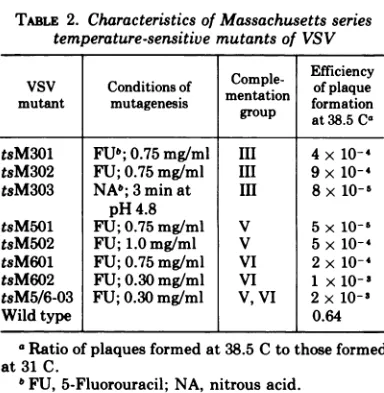
within the group.Table2presentsthe names of
the mutants, themutagenesis conditions which
caused them, and their relative efficiency of
plating at 38.5 Ctothatat 31C.The diameter
ofplaques formed by these mutants wasabout equal to that of wild type after 48 h at 31 C
except for tsM601 and tsM502 which required
60to 72h to form plaquesofcomparable size.
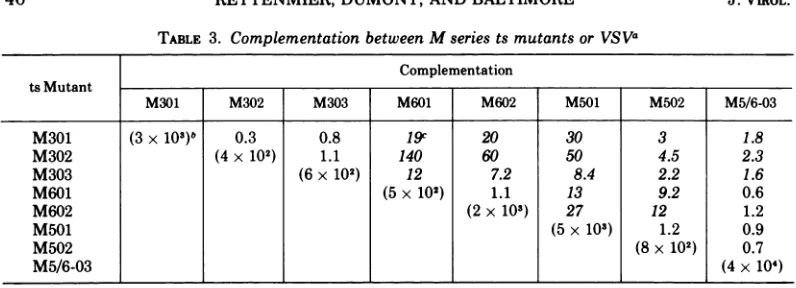
Cross-complementation of the M series of
mutants was performed accordingto Cormack
etal. (4; Table3).Theycould be classified into
three distinct complementation groups with
ts5/6-03 'apparently representing a double
mu-tant.
Complementation of the M mutants with
representative group I, II, III, IV, and V
mu-tants from the Glasgow and Orsay collections
wasalso carriedout(Table4).Mutants tsM301
and tsM302 failed to complement only tsG33
and therefore appeared to be in group III.
Similarly, tsM501andtsM502couldnotsupply
TABLE 2. Characteristics of Massachusettsseries
temperature-sensitivemutantsof VSV
VSV Conditionsof Comple- Eofplaque
mutant mutagenesis group formation
tsM301 FUb;0.75mg/ml III 4x 10⁻⁴
tsM302 FU;0.75mg/ml III 9x 10⁻⁴
tsM303 NA";3minat III 8x10⁻⁵
pH4.8
tsM501 FU;0.75mg/ml V 5x10⁻⁵ tsM502 FU;1.0mg/ml V 5x 10⁻⁴ tsM601 FU;0.75mg/ml VI 2x10⁻⁴
tsM602 FU;0.30mg/ml VI 1 x10⁻³
tsM5/6-03 FU;0.30mg/ml V,VI 2x lo-3
Wildtype 0.64
aRatioofplaques formedat38.5Ctothose formed at 31 C.
b FU,5-Fluorouracil; NA, nitrous acid.
45 VOL.15,1975
on November 10, 2019 by guest
http://jvi.asm.org/
[image:5.504.256.448.466.663.2]TABLE 3. Complementation between M series ts mutants or VSVa Complementation
tsMutant
M301 M302 M303 M601 M602 M501 M502 M5/6-03
M301 (3 x 10³)b 0.3 0.8 19? 20 30 3 1.8
M302 (4x 10²) 1.1 140 60 50 4.5 2.3
M303 (6 x 10²) 12 7.2 8.4 2.2 1.6
M601 (5 x 10²) 1.1 13 9.2 0.6
M602 (2 x 10³) 27 12 1.2
M501 (5 x 10³) 1.2 0.9
M502 (8 x 10²) 0.7
M5/6-03 (4 x 10⁴)
aValues in the table areexpressed as a complementation index (the ratio of the mixed infection yield to the
yield of the more leaky parent), and are the means from duplicate platings in onetothreeexperiments. bValues inparentheses are the virus yields obtained in single infections at 39 C in PFU/ml. Wild-type VSV gave a yield of 5 x 10⁶ PFU/mlundertheseconditions.
cItalicizedvalues are greater than 1.5 and represent significantcomplementationbetween the two mutants.
TABLE 4. Complementation between VSV ts mutantsderivedfrom differentwild-type strainsa Complementation
ts
Mutant I H III IV V III III V V VI VI V
Gil G22 G33 G41 045 M301 M302 M501 M502 M601 M602 M5/6-03
Gll (6x10⁴)b 8.C 34 6.8 42 210 186 285 11 10 57 130
G22 (5x10') 2.3 1.9 10 3.2 2.4 5.2 3.8 3.7 10 20
G33 (1x10⁴) 2.1 3.2 0.9 1.0 650 166 15 10 7.0
G41 (3x10⁶) 3.1 1.7 2.1 4.8 0.3 0.4 1.7 4.1
045 (3x10') 18 10 0.3 0.2 8.9 4.2 1.0
aValuesexpressedas acomplementationindex asdescribedinMaterialsand Methods.
bValuesinparenthesesareyieldsobtained fromsinglyinfectedcontrolsat39C.
cItalicizedvalues aregreater than 1.5 and represent significantcomplementationbetween the two mutants.
the missing function to tsO45 and therefore
appeared to be group V mutants. Mutant
tsM502didnotcomplement tsG41, but the data clearly place tsM502 in the same group as tsM501 (Table 3). Mutant tsG41 complements poorly and tsM502growspoorlyevenat31 Cso
their lack ofcomplementation is
understanda-ble.
It was not possible to associate mutants
tsM601, tsM602, and tsM5/6-03 with known complementation groups. Mutant tsM602 ap-pears to belongtoa separatecomplementation
group from those already characterized; we
consider itgroupVI. The dataontsM601(Table
4) suggestthat itmightbe ingroupIV, but its
association with tsM602 (Table 3) and its slow
growth at31 C make this designation unlikely. Mutant tsM5/6-03 complements tsG41 quite well; in spite of its beingadouble mutant, it is
the best argument that group VI is different
from groupIV.
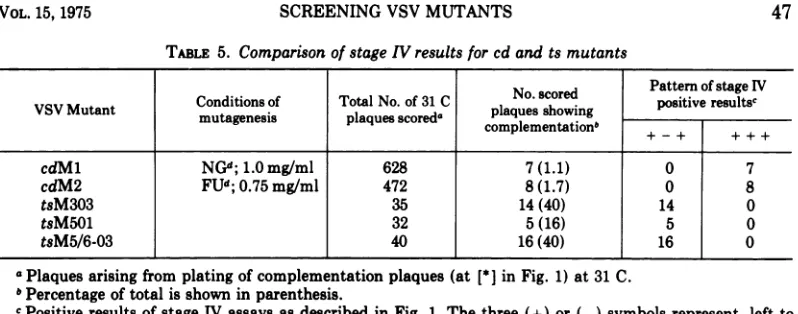
Properties oftheedmutants. Two plaques derivedfrom stage I of thescreencontained5to
20%of viruscapable ofcomplementingtsGllat
stage III (compared with their titers at 31 C),
butnoplaquesgivinga(+ - +)resultat stage
IV. Thesetwo mutants have been called cdMl
andcdM2. Table5 presentstheir history along
witha comparison oftheir behaviorinstage IV
assays tothat of thenew tsmutants. Whenover
1,000 clones derived from complementation
plaques were analyzed, about 1.5% gave a
(+ + +) result. Between 16 and 40% of clones
derived from the ts mutant complementation
plaques gave a (+ - +); none gave the
(+ + +) result, but only 107 wereanalyzed.
Clones scoring as(+ + +)at stage IV forthe
cd mutants might be thought to be wild-type
virus,butrecloningofthevirusgrowing without
added helper at 38.5C gave almost entirely ts
viruswith,again, anoccasional(+ + +) result.
Even a third serial analysis revealed nostable
wild-type virus. We conclude that 1.5% of the virus in complementation plaques of the cd mutants are heteropolyploids or aggregates which grow at 38.5C in the absence of helper.
Aside from these rare particles, the plaques
containtsGll plus5to 20% ofa cd virus which
on November 10, 2019 by guest
http://jvi.asm.org/
[image:6.504.66.464.66.210.2]TABLE 5. Comparison ofstageIVresultsforcdandtsmutants
VSV Mutant Conditions of TotalNo.of 31 C d
aNo.
scored
paositive
resultsa
mutagenesis plaquesscoreda complementationplaques showing5 + - + ++ +cdMl NGCd 1.0mg/ml 628 7(1.1) 0 7
cdM2 FU";0.75mg/ml 472 8(1.7) 0 8
tsM303 35 14(40) 14 0
tsM501 32 5(16) 5 0
tsM5/6-03 40 16(40) 16 0
aPlaquesarising fromplatingofcomplementationplaques (at[*] inFig. 1) at 31C.
bPercentageoftotalisshown inparenthesis.
cPositive results of stage IV assays asdescribedinFig. 1.Thethree (+) or(-)symbolsrepresent, left to right, assays at 31, 38.5, and 38.5C withadded tsGll. All other testedplaques showed a (+ - -) pattern indicative of atsGllplaque.
dNG,N-methyl-N'-nitro-N-nitrosoguanidine; and
FU,
5-fluorouracil.doesnotgrowbyitselfat31 Cor38.5C butwill
grow in cells which areco-infected by tsGll.
Physical properties of mutant cdMi. To
produce a stock ofVSV containing as high as
possible a percentage of
cdMl,
a plaqueorigi-nating fromsingleinfectionby tsGll and cdMl
was chosen. Such plaquesareformedby
aggre-gatesorheteropolyploidsand ariseduringstage
IVassays onplates incubatedat38.5C without
added tsGll. One such plaque was eluted and
mixed vigorously to disaggregate clumps, and
its contents were analyzed by sedimentation
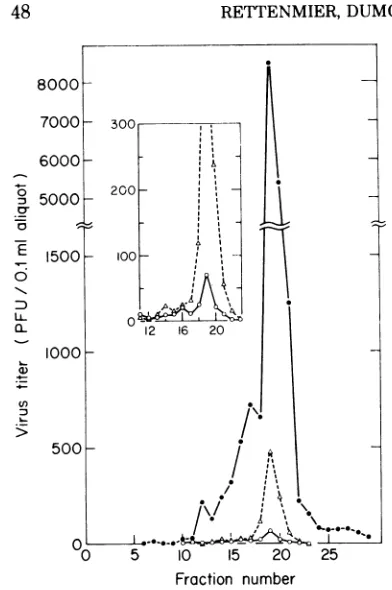
through a sucrose gradient. Portions of the fractionated gradientwere
analyzed
forVSVat31 C and 38.5C. Aportionwasalso
assayed
forits ability tocomplement tsGll inan infective
center assay. Mutant
cdMl,
detected ascom-plementing virus, cosediments with
tsGll,
de-tectedat 31C (Fig. 2). MutantcdMl therefore
does not contain a
large
deletion of the VSVgenome.
Virus able to grow at 38.5C without added
helper was found in two regions ofthe sucrose gradient (Fig. 2). Some cosedimented with the
main peak of tsGll; it
probably
representssimultaneous infections of cells in the plaque
assay monolayer
by
tsGll and cdMl in thepeak, because dilutions of the
peak
fractionshowed nonlinearityof
plaque
numberat38.5Cwith dilution. Of more interest is the virus
detected at 38.5 C which sedimented ahead of
the main peak. In this region of the sucrose
gradient, approximately equal numbers of
plaques weredetected withor withouttsGll at
38.5 C, indicating that aggregates or
hetero-polyploidswerepresent(inserttoFig. 2).
DISCUSSION
We havedescribeda new method forselecting
VSV conditional lethal mutants for which the
permissive condition is complementation by
tsGll. In principle, the system could be used
with other ts mutants as the helper in
com-plementation, but none of the mutants we
tested couldbeusedbecause theywere
unsatis-factory in stage I ofthe screen.
With tsGll, new mutants wereisolated after
various mutagenesis procedures. Most of these
were new ts mutants in complementation
groupsother than group I. Two mutantsshowed
no detectable new ts virus and were therefore
designated cd mutants todenote theirobligate complementation dependence.
The new ts mutants were isolated as
com-plementation-dependent mutants and,
presum-ably becauseofthemethodofisolation,they all
hadverylittlevirus abletogrowat 38.5C, and
they all complementedwell. Theyfell into three
complementation groups when compared
amongthemselvesforcomplementation.One of
them appeared to be in two complementation
groupsandwasassumed tobeadoublemutant.
When the new ts mutants were compared to theexistingGlasgowandOrsay mutants, two of
the complementation groups of the new
mu-tants werecongruentwith the standard groups.
Oneof thecomplementation groups ofthe new
mutants appeared to complement mutants
from all ofthe existing groups; this group was
therefore designatedgroupVI, and its mutants wereassigned numbersbeginning with a 6. The
New-Jerseyserotype of VSV contains six known
complementation groups (14), but up to now VSV Indiana has had only five. There are only
five well-established VSV Indiana proteins, so
either a sixth protein exists or two of the
complementation groups correspond to one
pro-tein.
The two mutants designated cd are clearly
distinguishable
from ts mutants in stage IV of the screen. Complementation plaques of cdVOL. 47
on November 10, 2019 by guest
http://jvi.asm.org/
[image:7.504.55.454.58.215.2]48 RETTENMIER, DUMOI}
8000 7000- 300
6000
o
200- 5000--B
E 1500 100L
:DA.
CL. 12 16 20
1000
500
I-O S 10 15 20 25
[image:8.504.53.249.57.352.2]Fraction number
FIG. 2. Sedimentation properties of infectious
virusfrom a cd mutant complementationplaque. A plaque containing cdMl, which arose on a 38.5 C plate not seeded with helper in the stage IV assay
(Fig. 1), waseluted in 1.0 mlofmedium. This plaque eluate was layered onto 36 ml ofa 5 to 40% sucrose
gradientinphosphate-bufferedsaline andcentrifuged
at 21,000 rpm for50 min at4C in an SW27 rotor.
Sedimentation was from right to left. A hollow rod attached totubing was inserted to the bottom of the
gradient,and a Buchlerpolystalticpump was used to collect 1.2-mlfractionswhich weretitered by plaque assay at 31C and 38.5 C. Inaddition, 0.1-mlsamples
ofeachgradient fractionwereassayedfor the presence of virus capable of complementing tsGll by an
infective center complementation assay. The insert showsfractions 11 to 23with a moresensitive scale.
Symbols: 0, 31 C titer; 0, 38.5C titer; A, titer of complementing virus.
mutants never gave rise to virus other than
tsGll whichwascapable ofgrowth at31 C but
not at 38.5 C (Table 5). Rare progeny from
complementation plaques are able to grow at
31 C and at 38.5C in the absence of helper
tsGll. These progeny appear to arise from mixed particlescontainingatsGllgenome and a cd mutant genome; they are not wild-type
virusbecause theynever breed true.
The existence ofparticles with two genomes
has previously been observed with VSV (20).
They could be aggregates but are more likely
4T, VIROL.
trueheteropolyploidsinwhichtwogenomesare
enveloped by a single membrane. Their
exist-ence is demonstrated (Fig. 2) as particles
sedi-menting faster than virions which score with
approximatelyequal efficiencyat38.5 Cwith or
without added helper.
The nature of the cd mutants has not been established. Theonewhichwas studiedis not a
large deletion mutant because it sediments at
thesame rate asstandard VSV. Inprinciple, cd
mutants could be missense, nonsense,
frame-shift or deletion mutants. To study them in
detail at this time would be difficult because
thecd stocks contain80 to95% oftsGll.Their
studywilldependonthe isolationofcd mutant
stocks which contain less tsGll orthe
develop-ment of a conditionalstatewherethey can grow
by themselves. Suppressor cells growing
non-sense mutantswould be sucha condition.
ACKNOWLEDGMENTS
WethankNora Meuth forexcellent technical help. C. W. R. wassupported by a National Science Foundation Summer UndergraduateProgram; R. D. wassupported by a Research TrainingFellowshipawardedby theInternational Agency for Research on Cancer; D. B. was an American Cancer Society Research Professor.
This work was supported by grant VC-4E from the AmericanCancer Society.
LITERATURE CITED
1. Burge, B. W., and E. R. Pfefferkorn. 1966. Isolation and characterizationofconditional-lethalmutantsof sind-bis virus.Virology30:204-213.
2. Cairns,J.E.,A.F.Holloway,and D. V.Cormack.1972. Temperature-sensitivemutants ofvesicular stomatitis virus: in vitrostudiesofvirion-associatedpolymerase. J.Virol. 10:1130-1135.
3. Cooper, P. D. 1955. Amethod forproducingplaquesin agarsuspensionsofanimalcells.Virology1:397-401.
4. Cormack,D.V.,A. F.Holloway, andC. R.Pringle.1973. Temperature-sensitive mutantsofvesicular stomatitis virus: homology and nomenclature. J. Gen. Virol. 19:295-300.
5. Emerson, S. U., and R. R. Wagner. 1973. L protein requirement for in vitro RNAsynthesis by vesicular stomatitis virus. J. Virol. 12:1325-1335.
6. Farmilo, A. J., and C. P. Stanners. 1972. Mutant of vesicular stomatitis virus which allows deoxyribonu-cleicacidsynthesisanddivision incellssynthesizing viralribonucleic acid. J. Virol.10:605-613.
7. Flamand,A.1969.Etudedes mutantsthermosensiblesdu virus de la stomatitevesiculaire. Mise au point d'un test de complementation. C. R. Acad. Sci. Ser. D. 268:2305-2308.
8. Flamand, A. 1970. Etude g6netique du virus de la stomatitevesiculaire: classement de mutants thermo-sensiblessponten6sengroupes decomplementation.J. Gen.Virol. 8:187-195.
9. Flamand, A., and C. R. Pringle.1971. Thehomologiesof
spontaneous and induced temperature-sensitive
mu-tants of vesicular stomatitis virus. J. Gen. Virol.
11:81-85.
10. Granoff, A. 1961. InductionofNewcastle disease virus
mutantswithnitrousacid.Virology 13:402-408. N
on November 10, 2019 by guest
http://jvi.asm.org/
SCREENING VSV MUTANTS
11. Holloway, A. F., P. K. Y. Wong, and D. V. Cormack. 1970. Isolation and characterization of
temperature-sensitivemutantsof vesicular stomatitis virus.
Virol-ogy42:917-926.
12. Hunt, D.M., and R. R. Wagner. 1974. Location ofthe transcription defect in group I temperature-sensitive
mutants of vesicular stomatitis virus. J. Virol.
13:28-35.
13. Pringle, C. R. 1970. Genetic characterization of condi-tional lethal mutants of vesicular stomatitis virus induced by 5-fluorouracil, 5-azacytidine and ethyl methanesulphonate. J. Virol. 5:559-567.
14. Pringle, C. R., I. B. Duncan, and M. Stevenson. 1971.
Isolation and characterization of temperature-sensitive
mutants of vesicular stomatitis virus, New Jersey
serotype. J.Virol. 8:836-841.
15. Reichmann, M. E., C. R. Pringle, and E. A. C. Follett. 1971. Defective particles in BHK cells infected with temperature-sensitive mutantsofvesicularstomatitis
virus.J.Virol. 8:154-160.
16. Simpson, R. W., and J. F. Obijeski. 1974.Conditional lethalmutantsofvesicularstomatitisvirus. 1.
Pheno-typic characterization of singleand double mutants exhibiting hostrestrictionandtemperaturesensitivity. Virology57:357-368.
17. Stampfer, M., D. Baltimore, and A. S. Huang. 1971. Absence of interferenceduring high-multiplicity infec-tionbyclonally purifiedvesicular stomatitis virus. J. Virol.7:409-411.
18. Szilagyi, J. F., and C. R. Pringle. 1972. Effect of temperature-sensitive mutations on the
virion-associatedRNAtranscriptase of vesicular stomatitis virus. J.Mol. Biol. 71:281-291.
19. Wagner,R.W.,A. H.Levy, R. M. Snyder, G. A.Ratcliff, andD. F.Hyatt.1963.Biologic properties oftwoplaque variants of vesicular stomatitis virus (Indiana
sero-type).J.Immunol. 91:112-122.
20. Wong, P. K. Y., A. F. Holloway, and D. V. Cormack. 1971.Asearch for recombination between
temperature-sensitivemutantsofvesicular stomatitis virus. J. Gen. Virol. 13:477-479.
21. Zavada,J. 1972. Pseudotypes of vesicular stomatitis virus with the coat of murine leukaemia and of avian myeloblastosis viruses. J. Gen. Virol 15:183-191.
49
on November 10, 2019 by guest
http://jvi.asm.org/