City, University of London Institutional Repository
Citation
:
Jarzabkowski, P., Le, J. K. & Feldman, M. S. (2012). Toward a theory of coordinating: Creating coordinating mechanisms in practice. Organization Science, 23(4), pp. 907-927. doi: 10.1287/orsc.1110.0693This is the accepted version of the paper.
This version of the publication may differ from the final published
version.
Permanent repository link:
http://openaccess.city.ac.uk/13630/Link to published version
:
http://dx.doi.org/10.1287/orsc.1110.0693Copyright and reuse:
City Research Online aims to make research
outputs of City, University of London available to a wider audience.
Copyright and Moral Rights remain with the author(s) and/or copyright
holders. URLs from City Research Online may be freely distributed and
linked to.
Toward a Theory of Coordinating:
Creating Coordinating Mechanisms in Practice
1Paula A. Jarzabkowski
Aston Business SchoolAston University Birmingham, B4 7ET
United Kingdom [email protected]
Jane K. Lê
The University of SydneyBusiness School N305, Institute H03 Sydney, NSW 2006
Australia [email protected]
Martha S. Feldman
University of California, Irvine Department of Planning, Policy and Design226 G Social Ecology 1 School of Social Ecology
Irvine, CA 92697-7075 [email protected]
This paper has been accepted for publication in Organization Science and may be cited as
forthcoming
1 The authors gratefully acknowledge funding fro m the following research councils:Economic & Social Research
ABSTRACT
This paper uses a practice perspective to study coordinating as dynamic activities that are continuously
created and modified in order to enact organizational relationships and activities. It is based on the case
of Servico, an organization undergoing a major restructuring of its value chain in response to a change in
government regulation. In our case, actors iterate between the abstract concept of a coordinating
mechanism referred to as end-to-end management and its performance in practice. They do this via five
performative-ostensive cycles: (1) enacting disruption, (2) orienting to absence, (3) creating elements,
(4) forming new patterns, and (5) stabilizing new patterns. These cycles and the relationships between
them constitute a process model of coordinating. This model highlights the importance of absence in the
coordinating process and demonstrates how experiencing absence shapes subsequent coordinating
activity.
Keywords: Organizing, practice, performative, ostensive, coordination, coordinating
Acknowledgements. The authors are indebted to Senior Editor Deborah Doherty and three excellent anonymous reviewers. Their exemplary engagement with our work and helpful feedback on our
manuscript has greatly enhanced the clar ity and accessibility of our contribution. We acknowledge
helpful comments from participants at the 2008 European Group for Organizational Studies Colloquium
INTRODUCTION
This paper is about the process of coordinating. We show that coordinating mechanisms are
dynamic social practices that are under continuous construction. Despite some preoccupation in the
literature with specifying the standards, rules and schedules that comprise coordinating mechanisms,
organization theorists have long noted that these mechanisms are not stable entities (e.g. Galbraith 1977;
Lawrence and Lorsch, 1967; March and Simon 1958; Thompson 1967). Indeed, scholars have shown that
they fluctuate to adapt to conditions of uncertainty, novelty and change, when existing ways of organizing
activities are disrupted and must be accomplished in new ways (Adler, 1995; Argote, 1982; Crowston,
1997; Feldman, 2000, 2003; Pentland, 1992). There are thus increasing calls for research to examine the
dynamic nature of coordinating mechanisms as they are constructed within the activities of interdependent
actors as they perform organizational tasks over time (Adler, 1995; Ching et al, 1992; Jarzabkowski, 2004;
Malone and Crowston, 1994; Okhuysen and Bechky, 2009). By shifting the analytic focus from
coordinating mechanisms as reified standards, rules and procedures to coordinating as a dynamic social
practice, our research provides insight into the micro-processes involved in coordinating.
We study the coordinating of a major structural change at Servico, a Financial Times Stock
Exchange (FTSE) 100 company, through the performance of a specific coordinating mechanism,
end-to-end management (E2E). Drawing on performative and ostensive concepts as developed in the literature on
organizational routines (e.g. Feldman, 2000; Feldman & Pentland, 2003; Pentland & Feldman, 2005;
Howard-Grenville, 2005; Levinthal & Rerup, 2006; Rerup & Feldman, in press; Zbaracki & Bergen, in
press) we examine how actors iterate between the abstract concept of end-to-end management and their
performance of it in practice. We explain how these performances enact what the actors come to identify
as end-to-end management and how they employ it as part of accomplishing a major coordinating task:
restructuring the core wholesale product Connectif. We then develop an empirically-grounded process
model that shows five performative-ostensive cycles that underpin coordinating. This forms the basis of
our contribution to a theory of coordinating.
Our study develops three key insights. First, we show that coordinating mechanisms do not arise
cycles that actors enact to create a coordinating mechanism: enacting disruption of coordinating, orienting
to absences in coordinating, creating elements of coordinating, forming patterns of coordinating, and
stabilizing patterns of coordinating. Third, our study emphasizes the significance of enacting disruption
and orienting to absences as part of coordinating. We thus advance a way of understanding coordinating
that shows how the actions of people doing the coordinating enact coordinating mechanisms.
THEORETICAL BACKGROUND: FROM COORDINATION TO COORDINATING The concept of coordination mechanism has long been the focus of organizations theorists
concerned with the alignment of interdependent organizational activities in order to accomplish collective
organizational tasks (e.g. Barnard, 1938; Galbraith 1977; Lawrence and Lorsch, 1967; March and Simon
1958; Thompson 1967). In their recent review of the literature, Okhuysen & Bechky (2009: 469)
summarize the role of coordination mechanisms within organizations; “The multiple definitions ... embody
evident commonalities: (1) people work collectively; (2) the work is interdependent; and (3) a goal, task,
or piece of work is achieved.” Despite a tendency in this literature to focus on coordination mechanisms as
the standards, rules, schedules and procedures through which interdependent tasks are achieved
(Okhuysen & Bechky, 2009), it has been recognized that there is no one best way to organize (Adler,
1995; Malone and Crowston, 1994; Thompson, 1967). Indeed, coordination mechanisms need to have
sufficient flexibility to cope with the uncertainty (Argote, 1982; Thompson, 1967), novelty (Adler, 1995)
and problem complexity (Adler, 1995; Ching et al, 1992; Crowston, 1997) of the organizational activities
and outputs that they are intended to organize. In recognition of the dynamic nature of these coordination
mechanisms, we refer to them from this point on as coordinating mechanisms.
Dynamic Nature of Coordinating Mechanisms
Because coordinating mechanisms are not a single way to organize, but rather have to adapt to the
interdependent working of actors, there is a tension in the coordination literature between their reification
as standardized procedures and the way that they are enacted in practice. For example, various typologies
identify both structural and enacted dimensions of coordinating mechanisms. This includes programmed
versus non-programmed means of coordinating, which examines the extent to which activities can be
bureaucratic versus less bureaucratic task assignment, in which less bureaucracy requires gre ater
flexibility in coordinating mechanisms (Ching et al, 1992). This suggests tension between the standardized
nature of tasks with rules to govern each activity, and the mutual adjustment, informal communication and
improvisation that occurs between actors to achieve tasks (Adler, 1995; Malone and Crowston, 1994;
Orlikowski, 1996; Thompson, 1967). The enacted nature of coordinating mechanisms is also referenced
by research focusing on how novelty and change reconfigure standardized rules and procedures (Ching et
al, 1992). For instance, Adler‟s (1995) typology of coordinating mechanisms based on the novelty of fit
between interdependent departments and the analyzability of the problem that they are solving is explicitly
processual. He proposes that when actors in organizations face low analyzability problems, the ir mental
schema of coordinating and how it works is challenged by the empirical reality of their tasks, prompting
them to enact richer schema for coordinating activities.
The rather static view of coordinating mechanisms adopted in much research thus has a number of
limitations (Adler, 1995; Bate et al., 2000; Okhuysen & Bechky, 2009). First, hierarchy and rule-based
systems have been found less useful in uncertain situations, such as those encountered during major
change, where people rely more on informal, interpersonal communication in order to coordinate
collective organizational outputs (Argote, 1982; Ching et al, 1992; Crowston, 1997). Second, this problem
with coordinating mechanisms is exacerbated in service-based and technological organizations, because
the way that a service or technology is delivered through task coordinating is uncertain and hard to define
and formalize (Faraj & Xiao, 2006). Rather, people experiment in order to find a way to coordinate a
technology or service and provide it as a collective organizational output (Faraj & Sproull, 2000;
Orlikowski, 1996). Third, the literature on coordination has tended to overlook the processual way that
people perform activities on an ongoing basis in order to cope with the challenges of coordinating tasks
that may change over time (Adler, 1995; Bate et al, 2000; Thompson, 1967). Research has focused on
those activities that can be measured and formalized at a point in time, rather than examining how such
activities emerge as actors attempt to perform coordinated organizational outputs over time (Okhuysen &
constitute coordinating and how actors accomplish the interdependence of tasks necessary for collective
organizational outputs, particularly under condit ions of uncertainty, novelty or change.
Just as Weick (1979) emphasized the use of verbs and gerunds to shift focus from organization to
organizing, so do many authors note the dynamic nature of coordinating mechanisms, using verbs and
gerunds to describe them. For example, Argote (1982: 423) proposes that coordinating involves “fitting
together the activities of organization members,” while Ching et al (1992) suggest that coordinating occurs
in a context of ongoing and concurrent problem-solving tasks. Okhuysen and Bechky (2009) suggest that
coordinating mechanisms are not fixed entities but emerge through the accomplishment of three
conceptually discrete but practically intertwined characteristics of interdependent organizational activity:
accountability, predictability and common understanding. Accountability emerges from people‟s efforts to
identify who is responsible for what task within the organizational output. Predictability emerges as actors
anticipate the elements of an output and know when they are likely to occur within a pattern or sequence
of tasks. Finally, common understanding is accomplished when actors develop some shared perspective on
the goals and outputs of work. Adler (1995: 164) goes further in advocating a research agenda to “address
the complex organizational processes through which in practice the nature of interdepartmental
interdependence is identified and coordination mechanisms adopted.”
We respond to this call by using a practice theory approach to shift attention to the question of how
stabilized coordinating mechanisms are created through coordinating. Our theory of coordinating reveals
the practices through which coordinating mechanisms are socially accomplished over time and examines
the reciprocal relationship between the structural properties of something that is recognized and
designated as a coordinating mechanism (Jarzabkowski, 2004; Seidl, 2007), and the way that actors
construct and reconstruct that mechanism through the activities of coordinating.
Practice Theory and Coordinating
A practice theory perspective constitutes an ontological reversal from an understanding of
coordinating mechanisms as largely stable entities, comprising specified roles and relationships
between actors and activities that change from time to time, to an understanding of the continuous
(Jarzabkowski, 2005; Seidl, 2007; Feldman and Orlikowski, in press). These interactions bring
coordinating mechanisms into being and give them validity and meaning within a given context
(Zbaracki, 1998). Through repetition of particular patterns of interaction, actors attribute a factual
quality to their actions that gives them a taken-for-granted structural status as a set of rules and
procedures (Giddens, 1984). Such ostensive patterns may appear to be explanations (Latour, 1986,
2005). From a practice theory perspective, however, the appearance of a stabilized pattern is what
needs to be explained. Though patterns for performing actions assume a relative stability that is
recognized as a coordinating mechanism, these patterns are socially produced and reproduced
through interaction (Garfinkel, 1967). Coordinating is thus an active accomplishment between
actors, which is also potentially subject to endogenous change because of the infinite variations
through which actors can interact (Feldman, 2000). For example, traffic lights2, a mechanism for
coordinating drivers with one another and with pedestrians, are socially enacted, as people must
attend to and enact the color code. Even such widely understood coordinating mechanisms are far
from being rigid in their production, as shown by the occurrence of drivers running red lights late at
night when intersections appear to be deserted, and by the gradual changes in North America such
as turning right on red lights and more recently turning left on red onto one-way streets. Thus even
relatively structured coordinating mechanisms are continuously produced as they coordinate
activity and expectations.
Coordinating mechanisms and routines: The association between the ongoing activities of coordinating and the way that they come to attain apparently stable patterns of coordinating has caused
some authors to liken coordinating mechanisms to routines. For example, Stene (1940) argues that
routines are fundamental to organizations because they represent the continuity of coordination required
for organizing. While Stene associates routines with regular and recurring activities, without the need for
continuous conscious effort, he does not infer stasis. Rather, he states that, “an organization may adjust
itself to certain irregularities with the result that a new sequence of interaction becomes routine” (ibid:
1130). More recently, Okhuysen and Bechky (2009) suggest that routines are one category of
2
coordinating mechanism that enables us to conceptualize how interdependent parties accomplish a task.
Consistent with a common definition of organizational routine as “a repetitive, recognizable pattern of
interdependent actions, involving multiple actors” (Feldman & Pentland, 2003: 96), coordinating
mechanisms are processes for accomplishing work that are constituted of interdependent actions taken by
multiple actors (Okhuysen & Bechky, 2009). Thus, the theory of organizational routines as generative
systems (Feldman & Pentland, 2003; Pentland & Feldman, 2005), based in practice theories, provides a
conceptual apparatus for analyzing how coordinating mechanisms are constituted as they are enacted.
Drawing upon practice theories of the mutually constitutive relationship between structure and action
(Bourdieu, 1977; 1990; Giddens, 1984; Orlikowski, 1992; Ortner, 1984), Feldman and Pentland (2003)
conceptualize organizational routines as practices that are continuously generated and modified as they
are enacted. As practices, routines are constituted of actions that are carried out against a background of
rules and expectations, but the particular courses of action actors choose are always, to some extent,
novel. The empirical work of Feldman (2000), Hutchins (1995), Orlikowski (2000), Suchman (1983) and
Weick and Roberts (1993) illustrates the inherently improvisatory nature of performing organizational
routines.
Performative and ostensive: Routines are conceptualized as consisting of mutually constitutive
parts that produce the potential for change as well as stability (Pentland & Feldman, 2005; Feldman &
Pentland, 2008). Performances are the specific actions taken by specific people at specific times when
they are engaged in accomplishing an organizational routine. The ostensive aspects of routines are abstract
patterns created through these performances. The concept of the ostensive is drawn from work by
Wittgenstein (1953) and Latour (Latour 1986, Sevon, 1996) who discuss the ostensive definition as
constituted of „things‟ to which we can refer (Wittgenstein, 1953: 30-31) and which can come to have a
conceptual existence of their own (Latour, 1986). The ostensive aspect of routines includes the task that
people are trying to accomplish as well as the abstract pattern of events enacted to accomplish that task.
The ostensive aspects are multiple, in part, because they are different from different perspectives.
Engaging in the task of hiring personnel, for example, may be substantially different for people in
recognized by these people as „the way we do hiring‟. Ostensive and performative aspects of routines are
mutually constitutive: “The ostensive aspect enables people to guide, account for, and refer to specific
performances of a routine, and the performative aspect creates, maintains, and modifies the ostensive”
(Feldman & Pentland, 2003: 94). The ostensive aspects of coordinating mechanisms constitute abstract
patterns that develop through the enactment of actions, many of which are performed in the name of a
particular coordinating mechanism. While these patterns may be codified into mechanisms with specific
metrics, activities and tasks, they are brought into being within specific organizational contexts in ways
that may bear little resemblance to their formal codifications (Jarzabkowski & Wilson, 2006; Seidl, 2007;
Zbaracki, 1998). One such example is end-to-end management, which arose as an important coordinating
mechanism within our case organization.
End-to-End Coordinating Mechanism
End-to-end management is a term that originates in the supply chain literature and refers to the
process of moving a service or product from its initiation in an organization to its delivery; that is,
managing all aspects between end points (Cohen & Roussel, 2004). End-to-end management requires
extensive coordinating, in order to connect the elements of a product or a service across the different
divisions of an organization through to delivery to a customer (Cohen & Roussel, 2004; Foster, Fidler,
Roy, Sander & Winkler, 2004). For example, in order for a car manufacturer to provide a customer with a
new car, it is important to coordinate the assembly of components like airbags, doors and engine parts, and
processes like quality control and customer sales between some initial „end point‟ of organizational entry
and a final „end point‟ of a car in a showroom. End-to-end management is thus an abstract coordinating
concept that must be populated with various performances that are enacted as the product or service is
accomplished across different parts of an organization. The activities involved in coordinating a product or
service end-to-end derive meaning in a particular context through the way they are performed.
One way to observe the association between coordinating and coordinating mechanism is to study a
period of organizational restructuring, as relationships between people, processes and activities are
reformed to accomplish new organizational configurations. During these periods, terms like “end-to-end
means simultaneously enacting the process of coordinating and the ostensive pattern of the coordinating
mechanism. In other words, actors‟ performances enact the coordinating mechanism (the ostensive
pattern) by doing coordinating in practice and, in the process, produce a restructured organization.
Drawing upon these ideas, this paper addresses the following research questions: 1)how do actors iterate
between the abstract concepts of coordinating mechanisms and their performance of those mechanisms in
practice?; 2) what are the implications of those iterations for the way coordinating mechanisms are
realized in new relationships and activities that accomplish restructuring?
RESEARCH DESIGN Case Selection
We chose a case suitable to the phenomena under investigation (Eisenhardt, 1989; Yin, 1994) :
Servico, a FTSE 100 company, undergoing major organizational restructuring as it implemented a new
Regulatory Framework based on „equivalence‟. Equivalence was a regulatory term, meaning to treat all
industry players in a fair and transparent way. Accomplishing this required Servico to place its distribution
networks in a separate transparent business division. This new division, „Distribution‟, would remain part
of the corporate Servico structure but operate independently, providing equal access to the distribution
network to all industry players without favoring downstream Servico businesses. Achieving equivalence
had two critical points. First, Distribution should be independent, neither sharing any commercial
information with downstream Servico businesses nor allowing its decision-making to be affected by
Servico commercial objectives. This meant that an information-sharing barrier had to be established
between Distribution and other Servico divisions, which required them to have different access codes,
information systems and technological platforms. Second, Servico was to separate all the
products/services that it currently offered in an integrated way, so that these could be traded on a
transparent market basis between Distribution and other Servico divisions. Figure 1 provides a simple
diagram of the restructuring within Servico.
This major restructuring involved a total reformation of existing relationships and activities in order
to enable existing products and services to be separated and traded across the barrier between divisions.
One Servico senior manager summarized it as follows:
“It wasn‟t like you were starting in a fresh Greenfield company… you adopted a lot of the
baggage of the business that had been run. But at the same time, you had wrenched it away from a
lot of the things that it was used to being close to. So we found we had quite a lot of broken
processes. … Separating assets and products and people is fine, but if you don‟t at the same time
understand how that fractures your processes and find a way of gluing them together in a
transparent and appropriate way [that‟s a problem]. So I think we suffered quite a lot from process
breakdown, in a way we didn‟t envisage.”
This paper focuses upon this restructuring of the relationship between the Distribution and
Wholesale divisions in order to deliver their major product, Connectif. Achieving equivalence required
Distribution to provide Connectif, which was the basis of the wholesale market, to all industry players in
the same way that it was provided to Wholesale. Failure to achieve this goal by a set date would result in
potential legal action against the company. The restructuring was difficult because Servico‟s delivery of
Connectif had always been vertically integrated. Further, Connectif is a complex technology, service and
process bundle, which had grown historically, so that no one was quite sure how to separate Connectif or
what aspects would be offered in which part of Servico after the separation.
Implementing an equivalent Connectif thus also constituted a major restructuring of Servico. Given
the complexity of Connectif, Distribution developed serial releases of its technological platform (TP),
each incorporating more features to meet industry needs. In order to ensure the timely use of these
releases, it was important for Distribution and industry players, including Wholesale, to coordinate their
design efforts. If industry players were unaware of changes Distribution was making to releases, they
could not adjust their systems, processes and services in line with the changes. This was especially critical
for Wholesale which, unlike the external industry players, had to meet two legally-binding regulatory
deadlines; one to start using Connectif by month six and the other to service their entire customer base
with the equivalent product by month 12. This meant moving several million customers by the final
Implementing this goal required coordinating the activity of people from product, technology,
process, consumer and regulatory parts of the different business divisions. A project team was assembled
in order to manage the process end-to-end. While E2E was conceptualized as a management process for
coordinating activities to deliver tasks, it quickly became apparent that it was not a „one size fits all‟
solution for restructuring activities. Rather, as unanticipated aspects emerged and perceptions of what
might constitute an acceptable achievement of the Connectif goal kept changing, E2E itself had to be
reconstructed continuously in response to the new challenges and recurrent problems with Connectif. In
addition, the process was complicated by the fact that actors in the different divisions conceptualized and
understood E2E in different ways. In particular, they struggled to understand how Connectif had been
coordinated in the past and how to use E2E to restructure their relationships and activities to deliver
Connectif on an equivalent basis.
Data Collection
Longitudinal qualitative data were collected over 24 months, tracing in real-time the restructuring of
Connectif from inception to resolution. In order to avoid potential bias from a single data source or
informant (Eisenhardt, 1989; Yin, 1994), we used a range of field methods. Specifically, we conducted 84
open-ended interviews with key operational, middle and senior managers in the Distribution and
Wholesale divisions and at the Center. Of these, 44 were sequel interviews with 15 key actors, conducted
over time to trace evolving perceptions of the Connectif process. These interviews, which were typically
an hour long and transcribed verbatim, asked participants to recount their current experience of the
restructuring. While participants‟ personal reflections on their experience are valuable and appropriate
from a practice perspective (Alvesson, 2000; Balogun et al, 2003; Fontana & Frey, 1994) , we used
observation as the key data collection method to surmount some of the limitations of interviews for
accessing practice (Alvesson, 2000). Non-participant observation was conducted in 137 audio-recorded
meetings that dealt with Connectif as part or all of their agenda. The meetings were held weekly,
fortnightly or monthly, and ranged from 20 minutes to three hours in length and occurred within and
across the Distribution and Wholesale divisions and at the corporate Center. Extensive field notes were
pertaining specifically to Connectif. See Appendix A for an overview of meeting and interview data. We
also engaged in other interactions with participants, such as pre-and post-meeting observations, workplace
observation, discussion, feedback sessions, and social functions. Detailed field notes were written up
within 24 hours, as recommended by Yin (1994). Additionally, we made notes on pertinent documents
associated with the restructuring of Connectif and incorporated them into the dataset. All data were
imported into NVivo for coding.
Coding and analysis: In order to make sense of these mass data, analysis progressed in five stages. First, the authors who collected the data wrote a rich chronological case story of restructuring Connectif
(Langley, 1999), employing a thick description mode of analysis (Geertz, 1973). We presented this story
to the different groups working on Connectif in order to validate its veracity and enhance the
trustworthiness of the analysis (Lincoln & Guba, 1985).
Second, the three authors discussed this rich story, noting that actors used the term „end-to-end
management‟ when discussing coordinating efforts. We thus began examining the thick description in
light of the research questions. Specifically, we looked at how actors iterated between the abstract concept
of E2E and their emerging performance of E2E in practice, and the implications of that performance for
the restructuring of relationships and activities in order to deliver an equivalent Connectif. To support our
analysis, we searched the meeting data for all references to E2E by actors during the restructuring of
Connectif; extracting all data on the terms “end-to-end”, “end to end”, “end2end”, “end-2-end”, “E2E”,
“E-2-E”, “end-to” and “end to”. We chose meeting data to create a real-time chronological account of how
E2E was accomplished because interviewees can obscure chronology. Once we had established the
chronological account, we searched the entire database using the same terms to check our analysis and
gain additional data on participants‟ experiences of E2E. Initially constraining the dataset to actors‟
references to E2E enabled us to explore how actors talked about and performed the concept of E2E, which
we then placed in the wider context of the overall restructuring by referring to the case story written in
stage 1.
Third, after reading and discussing these data, we iteratively devised and revised a coding scheme
began with empirical codes. These categorized the specific aspects of coordinating that actors were
enacting with things such as technologies, business processes and services as they endeavored to work
E2E in delivering Connectif. We also coded the intended and unintended outcomes that they experienced
as they tried different activities for coordinating these things E2E. At each revision of the codes the first
two authors cross-checked and discussed the coding schema to ensure that data were particular to a
specific code and that data were not taken out of context. The third author, who was not involved in data
collection, acted as an „outsider‟ in querying and challenging emerging codes (Evered & Louis, 1981). See
Appendix B for descriptions and examples of our codes, including technology, external players, service,
and business processes, and how they were identified in the data.
Fourth, based on these empirical codes and our first research question, we developed interpretive
codes. In investigating the relationship between specific performances of E2E and its enactment as an
abstract concept, we found the notions of performative and ostensive useful (see Feldman & Pentland,
2003; Pentland & Feldman, 2005). We thus identified performative and ostensive elements of E2E in our
dataset (see Appendix B). Herein, we followed others who have examined the relationship between
performative and ostensive (e.g. Feldman & Pentland, 2003; Howard-Grenville, 2005; Levinthal and
Rerup, 2006; Pentland & Feldman, 2005; Rerup & Feldman, in press). We identified performances as
specific actions that people engaged in as E2E; this linked to our empirical „elements‟ code (see Appendix
B). For example, we identified how people were performing activities associated with technology, even
where these activities did not actually result in coordinating, but rather made actors aware that they had no
E2E technologies for coordinating Connectif. The consistent patterns enacted within Servico were coded
as ostensive; these were patterns of performing activities through which actors arrived at particular
coordinating outcomes, such as disrupting links between technological platforms, or finding gaps in
service provision or creating elements of new business processes. This linked to our „elements‟ and
„outcomes‟ codes (see Appendix B).
Fifth, we analyzed the relationship between the performative and ostensive codes to understand how
the abstract concept of E2E management developed as it was performed by actors. We found that repeated
pattern of doing E2E. Thus, as actors performed specific actions in their efforts to restructure coordinating
throughout Servico, these performances began to be recognized by actors as E2E, thus developing a cyclic
relationship between the performances aimed at creating E2E and the ostensive pattern that was eventually
instantiated as E2E. This analysis uncovered a series of iterative cycles in the relationship between the
performative and ostensive aspects of E2E, each progressively emerging another layer of activities for
coordinating Connectif by coordinating the activities between Distribution and Wholesale. The five cycles
were: (1) enacting disruption, (2) orienting to absence, (3) creating elements, (4) forming patterns, and (5)
stabilizing patterns. In the first performative-ostensive cycle, actors enacted the disruption brought about
by the imposition of the regulatory wall; a wall they enacted with their performances and which severed
the existing E2E. In Cycle 2, they began to orient to the absence of E2E through their attempts to
reorganize Connectif. Initially, performances showed actors those aspects that they used to rely upon,
which were now absent. Recognizing specific absences, such as absences in technological connections, or
service handovers, led them to focus on creating new elements to replace the old ways of enacting E2E.
This third performative-ostensive cycle culminated in the presence of rudimentary building blocks of E2E,
like ways to perform an element of technology or service. Cycle 4, forming patterns, was characterized by
building upon these rudimentary elements and refining them as issues emerged. It included using the
elements of end-to-end management and developing specific tools to strengthen the pattern that was being
created through use. The final cycle, stabilizing E2E, was characterized by completin g the Connectif task
and creating specific governance patterns within Servico that embedded the restructured divisional
relationships into recognized ways of working E2E. We present our findings around these cycles.
FINDINGS
As it is not possible to offer detailed examples of all performances we found, we use representative
data and vignettes to illustrate the five cycles, explaining how specific performances enriched and further
defined the ostensive patterns of E2E throughout these cycles. Although there is a temporal relationship
between these processes, they should not be seen as having a simple linear relationship. This is
particularly true for the first three cycles, enacting disruption, orienting to absences, and creating new
Cycles 1-3: Enacting Disruption, Orienting to Absence, Creating New Elements
In our case, new regulatory guidelines mandated organizational members to enact an
information-sharing barrier between the Distribution and Wholesale divisions; enacting this barrier disrupted existing
ways of working end-to-end:
“There was something in [the Framework] where we‟re not supposed to speak to Wholesale about
certain things but the way it was written basically prevented us from talking to them about almost
anything… The line has been drawn between Distribution and the rest of the business in a pretty
hard place to administer… you end up in a few situations where… you‟re bouncing backwards
and forwards between yourselves several times before you actually deliver something.”
(Distribution Regulatory Lead, Interview).
As members of the organization took action and tried to accomplish the task of creating Connectif
in the context of the information-sharing barrier, specific absences emerged and helped to define the
meaning of the disruption. Members of the organization a ltered their actions as they oriented to these
absences and created new patterns of action to fill in what was missing. These actions created new
elements of E2E and also enabled members to orient to additional absences that emerged through efforts
by members to enact E2E. The following two vignettes illustrate these three interlinked cycles and
demonstrate how actors iteratively began coordinating the delivery of old elements of E2E in new ways,
as well as coordinating new elements of E2E. Text denoted in bold indicates particular elements that were
identified as missing and created as new elements, such as technology, relationships with external parties,
service, and business processes (see also Appendix B).
Vignette 1: Engineering Appointment Books. Allocating engineer appointments illustrates the
process of coordinating in a new way something Servico used to do. Prior to the change, Wholesale
customer advisors had access to the Servico electronic appointment books and could directly schedule
engineering visits for their customers, whereas external industry players had to request appointments by
contacting Servico. Under the old regime, “if you are a Servico customer, when you phone up the
operator, he can go into all of the engineering appointment books, and say „right, I am going to send an
(Distribution Delivery Manager, Interview). Under the new regulation, this inequity between Servico‟s
Wholesale unit and other industry players was not permissible. The engineering fleet would now be in
Distribution, which was required to provide the same service to all its customers. Distribution thus either
had to remove the capability from Wholesale or provide it to all of industry. Tight deadlines meant there
was no time to agree or design an industry-wide solution. The capability was thus removed and all
industry players, including Wholesale, had to email Distribution to schedule engineering visits.
Enacting Disruption: When Distribution took away direct access, Wholesale could no longer easily
schedule engineering visits for its customers. Wholesale staff initially tried to circumvent this condition by
taking action, calling Distribution engineers directly to schedule appointments. However, engineers
rebuffed these informal processes that had been widely accepted in the past. Their interpretation of the
mandate was, “If one person‟s got a little black book with a name of an engineer in and they ring them up
and get one person to do something for them, that‟s a breach… If they know they shouldn‟t have done it
and they‟ve done it, then they will get some kind of disciplinary action.” (Distribution Manager,
Interview). Such interpretations of what it meant to erect an information barrier between two units were
important to enacting the disruption, which occurred as people took or proposed action, and as others
responded to these actions, in ways that did not coordinate activity. Through these acts participants thus
identified absences in their ability to achieve E2E. As people tried to schedule appointments, they realized
that certain features were missing that had previously been in place. In short, they experienced disruptions
that meant they could no longer coordinate activity in expected ways.
Orienting to Absence: As part of their efforts at coordinating Connectif E2E, Distribution actors tried to surmount the disruption of their appointment scheduling capability. In so doing, they oriented to
specific absences or missing elements of E2E that had become problematic because of the disruption to
coordinating. That is, these absences arose as they enacted the disruption; as they experienced things that
were no longer permitted or no longer coordinated in expected ways they oriented their activities
specifically towards those things in their efforts at coordinating E2E.
The first such missing element, or absence, they noted was the old technological system: “You
absent system because they could no longer access it. Losing system access meant that previous
performances did not coordinate activity in expected ways; that is Wholesale operators could no longer
schedule appointments via the system. A second absence followed on from this absence: Servico
(Wholesale and Distribution) could no longer provide the same level of service to Servico customers.
“Servico is about good customer service - I don‟t know how I can do my job anymore” (Observation, Call
Centre). The inability to provide a scheduling capacity would lower Wholesale‟s service level and so
oriented actors towards an absence in service. Because of the new mandate for equivalence, the inability
to provide service oriented Servico actors towards a third specific absence, relationships with external
industry players. As Distribution tried to reconnect with Wholesale, they noted that they had no way to interface with the rest of industry. This absence was different from the old technological system that had
been removed, as the connections to other industry players had never existed in Servico systems.
However, equivalence meant that in order to interact with Wholesale, Distribution would need to find a
way to interact with other industry players. Distribution actors thus oriented towards an absence in their
appointment scheduling capacity for external industry players. The fourth absence they identified was the
lack of processes to support these systems, relationships and service requirements. There were no
processes that linked into systems, no processes to support the new relationship with external industry
players, and no processes to assess and ensure service levels. Actors‟ activities thus highlighted the
absence of various aspects of coordinating Connectif E2E, including technology, relationships with
industry players, service, and business processes.
Creating Elements: Orienting towards specific absences enabled organizational actors to direct their
efforts towards filling these absences with new elements. Specific actions oriented people in the divisions
to what was missing and linked their experience of the disruption to possible actions that could be taken to
reconnect the broken E2E coordinating mechanism. They worked out ways of coordinating particular
elements of the delivery through iterative performances targeted at the specific absences:
things that are really significantly different… it‟s a major change, particularly on the systems fronts”
(Distribution Manager, Interview).
After much discussion with industry players and Wholesale, Distribution decided to provide the capability
to book appointments to all of industry. Allowing all industry players to access the engineering
appointment books, however, required significant work on technological systems to provide an
equivalent platform that would be accessible by all of industry. Similarly, actors had to create new
relationships with external industry players so that they could interface with Distribution in the same way as Wholesale. Further, Distribution needed to create new processes to ensure that systems and
relationships with industry, including Wholesale, could be managed properly. This meant creating
processes to underpin the appointments scheduling capacity by connecting systems and relationships
seamlessly. All of these factors impacted the ability to provide service, which was an essential part of
end-to-end product delivery, as engineering appointments formed an integral part of this service capacity.
Absences thus influenced the creation of new elements as actions were taken to address gaps that actors
experienced in E2E coordinating of Connectif.
Given the extent of technological work involved, the necessity to consult external industry players,
and the tight deadlines, there were limits to what Distribution could provide. In consequence, the revised
version of the electronic engineering appointment book made available to all Distribution customers had
two daily appointment slots instead of four:
“We did have a couple of meetings of „it‟s got to be two hours‟, „no, it‟s got to be four‟, „it‟s got to be two‟, „it‟s got to be four‟… Let‟s find a way to resolve this; which was things such as write down
exactly what you want, put it in a statement of requirement, in technical terms. And you respond with the
true cost impact of deliver ing Connectif in two- rather than four-hour appointments.” (Center Manager,
Interview).
This compromise was part of the changes in processes that enabled all industry players to have access:
“Appointment books are now visible to all industry players” (Distribution Manager, Distribution
Meeting). Creating elements was not only a response to but also a source of absences. As actors created
“There are still several hundred bugs in the system… For example, Distribution might miss an
appointment. If they send us an automated message, that then goes into a queue for somebody to contact
the customer and rearrange the appointment… What we‟re finding is, because of the bugs, lots of information is not being passed on” (Wholesale Manager, Center Meeting).
Vignette 2: Legally Valid Internal Trading Models. The requirement of providing Connectif
equally to all industry players meant that Servico had to show how Distribution traded with Wholesale.
However, no explicit trading model had existed previously; as both divisions were part of Servico, they
had traded in a vertically integrated way. Services had been exchanged without the need for formal trading
accounts between divisions for years. This changed with the regulatory requirement of equivalence.
Distribution had to prove that it traded with Wholesale in the same way that it traded with external
industry players. Developing a legally valid internal trading model thus involved recognizing what had
been traded and what would need to traded in future.
Enacting Disruption: The old trading relationship and its associated processes were disrupted by the
creation of the information-sharing barrier. Under equivalence it was no longer permissible to interact in a
vertically integrated way, yet no new trading relationship had been established or legally formalized. As
actors did not know how to engage with each other to trade Connectif under the new Framework, they
enacted disruption by avoiding most interaction.
“We can no longer give Wholesale those components. The end game is for Distribution to supply everyone equivalently… we can‟t do something special for Wholesale. If it was another industry player, we‟d say „get your own components‟” (Distribution Manager, Interview).
This disruption affected Servico‟s capacity to deliver Connectif E2E by hampering its ability to construct
a functional business relationship. Without formulating and legally formalizing their trading relationship,
Distribution and Wholesale would be unable to trade Connectif.
Orienting to Absence: Actors noticed the absence of a trading relationship and a formal working
group was created to plan, write and deploy a new trading model. Through interaction, actors found that,
because of their history of operating as part of a vertically integrated company, no one really knew what
years, there was no record of the relationship. The divisions neither knew which specific products or
services they traded under the old structure, nor which specific systems were used to trade them. In order
to identify what and how they would trade under the new Framework, they oriented to their historic
relationship and requirements:
“It is clearly a complete crock that we are attempting to sign up to a reciprocal trading arrangement when we haven‟t got a bloody clue what we buy from each other and what service levels we could
theoretically or realistically commit to” (Distribution Manager, Distribution-Wholesale Meeting).
In particular, they looked to systems for clues about the relationship. The removal of old systems meant
that there was no system that could provide Connectif. This had disrupted the trading relationship between
Wholesale and Distribution. If they could understand what was absent without these previous systems,
they would be better able to understand and enact a new working relationship. This would also enable
them to make the new trading relationship comparable to the relationship needed to provide for external
industry parties. This was another absence because they had to define the relationship with external players in order to create an equivalent relationship with Wholesale. Similarly, there were no processes
initially that would support any trading agreement, and even those that were developed were problematic:
“There are process gaps in the E2E business process” (Center Manager, Center Meeting).
As in the previous vignette, orienting to absences in the performance of systems, external industry,
service, and processes helped to define the experience of the disruption. Similarly, disrupted elements
highlighted absences and were singled out for additional attention and activity. Absences were thus
identified through the efforts people took to enact E2E. Specifically, the divisions produced many versions
of the trading model as they iteratively and interactively worked out the missing elements, which needed
to be included in the Connectif contract in order to be an equivalent, commercially viable and legally
acceptable agreement. They tried to fill these absences by creating elements that became part of the
emerging E2E coordinating mechanism.
Creating elements: As the divisions had never had a trading agreement, they had to create new elements
rather than just modifying existing ones. Divisional managers got together to work out the intricate details
interface: “We‟re negotiating the details of the E2E Connectif deal.” (Discussion, Distribution-Wholesale Meeting). This led to efforts to design an equivalent systems solution. Setting up the trading model was an
iterative and complex process, during which different level managers and frontline staff were consulted
about how parts of Connectif needed to work in order to trade the product operationally and commercially.
Similarly, the relationship with external industry players was critical; Distribution had to figure out its
relationship with all industry parties in order to engage equivalently with Wholesale. In real terms this
meant Distribution trading managers working out costs, setting prices and charging parties, which required
them to create elements of E2E that had not been necessary in the former organizing of Connectif:
“This is actually commercial pric ing. And of course that‟s the point when there‟s a sharp intake of breath
because I have to charge Wholesale exactly the same as I would charge any other operators.”
(Distribution Manager, Interview).
Such elements emerged out of multiple performances, as actors worked iteratively upon the trading model:
“This is crap and it needs to be improved in these areas, keeping in mind it isn‟t EVER an agreement that we would sign with an outside industry player… I want something that is commercially viable. I would never sign this; we would be a laughing stock!” (Distribution Regulatory Manager,
Distribution-Wholesale Meeting).
In enacting these performances, actors sought to fill absences and create a working trading agreement.
Much time was spent iteratively drafting versions of a trading agreement by sending documents back and
forth between divisions. Drafts were disputed on the basis of forecasting, modeling and trialing the effects
of different versions, particularly with regard to agreed service levels. Trialing potential agreements
helped to identify further absences in technological and business processes, as mismatches between the
systems solutions and the trading model became apparent. For instance, regardless of trading model,
certain systems solutions were not possible, others too expensive, and still ot hers could not be delivered
on time, necessitating contingencies and manual workarounds: “The current situation is still manual and,
without this system, we cannot manage scale because we cannot automate” (Wholesale Program
Manager, Distribution-Wholesale Meeting). Eventually, Distribution managers worked out a commercial
up rough about these costs” (Discussion, Center Meeting). Although a working version was signed off by
both parties in Month 8, the agreement remained fluid throughout the period of observation, with
continuous alterations to adjust to changes in Connectif as new absences emerged; for example, wording
was changed, contract managers employed and confidentiality agreements introduced as business
processes, service levels, and technological specifications became clearer.
Cycle 4: Forming a Pattern of E2E
In the previous cycles, E2E performances were motivated by absence and focused upon
coordinating specific elements of activity, such as technology, external players, service, and business
processes into the emerging concept of E2E. By cycle 4, people had stopped querying what constituted
E2E and began connecting its elements into a coordinating mechanism that could organize activity. That
is, the various elements of E2E that had been introduced and developed in earlier cycles could now be
connected to form an ostensive pattern of E2E as a way of organizing Connectif.
At this point in coordinating the delivery of Connectif, people in Servico had created parts of E2E
but these were not yet well connected in a pattern of activities: “We were in a 2-hour meeting with [the
Servico CEO] yesterday about E2E management of Connectif … we have been tearing apart the
complaints that are landing in her inbox. It is the best E2E thing I have been involved in but it‟s pretty
bloody too” (Wholesale Manager, Distribution-Wholesale Meeting). The processes and procedures
created for coordinating elements of Connectif in an E2E manner were not always successful; “I‟m not
sure there‟s sufficiently strong E2E management still… things have improved on that front but they‟re not
perfect” (Divisional Manager, Interview). Actors coordinating Connectif felt that E2E remained
problematic, referring to blockages in moving different parts of service, technology and processes between
divisions; “Connectif looks like a snake that swallowed an elephant” (Wholesale Manager,
Distribution-Wholesale Meeting).
One of the ways of moving the process of coordinating forward was to develop project management
tools, such as interlocked work plans to integrate elements of E2E. These tools supported coordinating by
making the patterns of connection among elements more visible, which in turn helped people further
managing and monitoring the process brought visibility to areas that needed ongoing work; “Gradually
people are realizing that you can‟t tackle this in any other way apart from looking at it in a coordinated
E2E fashion. Otherwise it‟s not just sub-optimal – It just won‟t work and it won‟t get there” (Center IT
Manager, Interview).
One of the core tools that allowed them to see where connections between elements needed to be
made to create E2E coordinating and increase accountability for the Connectif deadline was the transfer
dashboard, a communicative planning tool used to track progress on different parts of the E2E program
created in Cycle 3 (i.e. technology, relationship with external industry players, service, and process). “The
program has a detailed dashboard of measures in place on which to agree each further step in the transfer
plan” (Senior Management Report). Frequent meetings between divisional managers and individuals on
the program were held, using the dashboard and its system of „traffic lights‟ to identify problem areas
(red), areas that were progressing but needed work (amber), and areas that were on track for the deadline
(green). The dashboard and its color coding made E2E visible, enabling team members to monitor the
status of their activities and to coordinate the broader project and deadline; “The Connectif dashboard, it‟s
getting greener but assurance performance remains a key area… especially the reliability and stability of
the E2E technology platform” (Discussion, Distribution-Wholesale meeting).
Based on their performances of E2E within the dashboard, managers in the two divisions
recognized that they were unlikely to meet the regulatory deadline: “This ain‟t gonna work by [the
deadline] guys, so wake up and smell the coffee” (Senior Wholesale Manager, Distribution-Wholesale
meeting). This information was used to report the problems to the Servico CEO and top management, and
to prepare the regulator for a possible renegotiation of the date:
Thus, even as the pattern of the E2E coordinating mechanism was becoming evident, new absences were
identified and the nature of the disruption redefined. Indeed, actors felt that E2E could only be developed
and improved by using it, or as the senior project manager below says, „shoving volume through‟:
“It really all evolved around the speed with which we restored the level and ability of the E2E process
because it was broken not only in the Distribution space, it was broken in the Wholesale space. And it
took us quite a long while to get down to the true underlying problems. And you only got there as we
started to shove real volume through.” (Wholesale Connectif Manager, Interview).
Cycle 5: Stabilizing E2E
The last cycle took place as the transfer deadline was achieved and the Connectif restructuring was
complete. All customers were transferred onto the new bundle of technology, product, service, and
process that comprised Connectif. This restructuring was formalized with the development of an
overarching governance program that subsumed the Connectif program and the relationship between
Distribution and Wholesale. This program specified particular procedures, trading arrangements, modes of
interaction, project tools , and metrics for relationships between divisions:
“[The new governance program] allows us to pull program plans… across projects and also across the
different divisions. I think in doing this we will drive out many of the assumptions, dependencies,
problems, showstoppers - which we‟ve been struggling with over a period of time… I guess we‟re
working with some sweeping assumptions… At best we‟ll drive them forward and bring them in line with our program and at worst at least we‟ll know that other areas aren‟t going to progress those in a timely fashion.” (Program Manager, Divisional Meeting).
Embedding coordinating in specific procedures, roles and relationships marked the accomplishment
of relative predictability in the E2E process. The evolution of new procedures and patterns for doing E2E
activities within Servico had slowed to the point that they could be codified in specific tools, metrics,
processes, roles, and authority relationships. Actors could thus anticipate the elements involved in
performing Connectif E2E, knowing what activities were likely to occur, their relative interdepe ndence
with others involved in performing Connectif, and how these related to wider organizational processes.
Managers were able to tie the Connectif delivery into the formalized governance structures of Servico and
Distribution and Wholesale were performing their new customer-supplier relationship to deliver Connectif
and this was no longer referred to as restructuring: “Connectif is business-as-usual – We‟ve taken it out of
the Framework projects and report” (Wholesale manager).
E2E continued to be invoked frequently and, as with any enacted feature of social life, evolved
through its enactment. The most visible changes during this cycle, however, centered on the context
surrounding E2E and were more oriented toward stabilizing and maintaining than toward creating or
refining the coordinating mechanism. For example, in addition to the metrics, project tools and systems
for interacting, actors were designated to have specific responsibilities for coordinating activities E2E. A
Horizontal Team was responsible for using the tools, systems and metrics to enable business engagement
and to deliver products and services across functional areas within divisions. A Vertical Team had the
corresponding responsibility across divisions. These new responsibilities illustrate the process of
embedding the E2E coordinating mechanism into a set of newly created governance structures, with
specifically identified actors and business teams. This embedding both stabilized coordinating patterns and
guided future modifications of E2E:
“There‟s a kind of stabilization action, which is around bringing more people on board, making sure they‟re better trained…[looking at] the points of failure and what fixes do we need to make on both sides… such that the end-to-end journey works first time” (Center Manager, Interview)
These new E2E processes, roles and mechanisms reflected the taken-for-granted nature of the
restructured relationship between Distribution and Wholesale, which people now accomplished as a
predictable pattern of activities. For example, a Vertical Team member reflected on the way that project
tools were incorporated into the everyday delivery of Servico products and services;
“As a result of having an E2E program… and involving operational people at Servico, across Servico, as well as the systems people, there was a lot more transparency… So the [product/service delivery] graph
that we saw today with the systems side going up and the impact that it would then have on the repair and the assurance process, was something; we‟re talking about it today as if it‟s natural that one would
Embedding E2E within formally specified roles and procedures thus signaled that the restructuring
of Servico divisions into new relationships and activities had taken place, with the performing of E2E
activities consolidated in particular patterns as a matter of everyday coordinating. E2E had been brought
into being and was being used; specific procedures were enacted and incorporated into the norms that
made the new organizational relationships, activities and tasks meaningful. There was a strong perception
that most of the disruption brought about by the regulatory change had been surmounted and that Servico
had emerged in a reorganized E2E form: “There is a particular cultural thing in terms of people‟s remits
going true E2E… That‟s the only way you can do things like this; you need to have the real drive, you‟ve
got to have the desire to make it successful across the piece” (Center IT Manager, Interview). Despite this
relative stability, actors engaged continuously in modifying and refining E2E to ensure that the systems,
service capability and business processes continued to coordinate Connectif in the required way.
This paper set out to address two research questions that were theoretically motivated by a practice
perspective on organizing, and, particularly, the activities involved in restructuring existing organizational
structures, relationships and activities: 1)how do actors iterate between the abstract concepts of
coordinating mechanisms and their performance of those mechanisms in practice?; 2) what are the
implications of those iterations for the way coordinating mechanisms are realized in new relationships
and activities that accomplish restructuring? In this discussion we summarize our findings with respect to
the first question in the process summary, which we use to develop a process model of coordinating. We
address the second question in the section on implications , where we discuss the contributions our process
model makes to understanding coordinating and the creation of coordinating mechanisms.
DISCUSSION Process Summary
Our findings identify performative-ostensive cycles that iterative ly construct coordinating
mechanisms. Performances create and recreate abstract patterns that we refer to as ostensive patterns
because they come to be articulated and experienced as states of being. These ostensive patterns are
disruption, (2) orienting to absence, (3) creating elements, (4) forming new patterns, and (5) stabilizing
new patterns. In this section we describe the cyclical interplay between actors‟ performances of
coordinating and the ostensive patterns created through these performances. In this discussion we refer to
our case as an illustrative example of coordinating. We regard each of the performative-ostensive cycles
as a conceptual building block that we use as the basis to develop a model of the coordinating process,
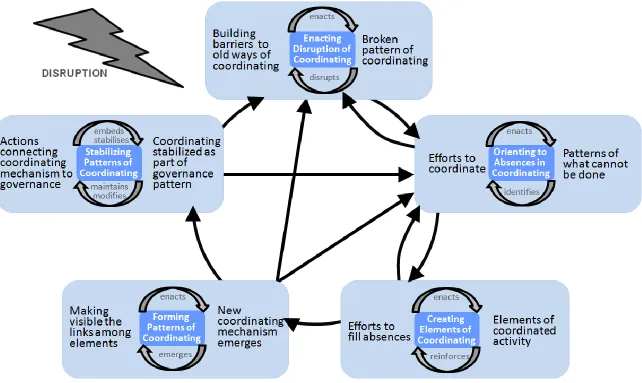
presented in Figure 2.
--Insert Figure 2--
The first cycle of enacting disruption consists of performances necessary for creating the
disruption. These disruptive performances create an ostensive pattern that constitutes the breaking of
previous patterns of end-to-end management so that coordinating is no longer possible. In our case, the
performances enacted an information barrier between divisions that disrupted previous ways of
coordinating Connectif. In other cases, these performances may enact disruptions caused by changes in
technologies or distributions of authority. This cycle that enacts the disruption of coordinating is a critical
building block in creating coordinating mechanisms because it breaks down existing interdependencies
and highlights the need to find new ways of coordinating, even while it is unclear what actually constitutes
effective coordinating.
The second cycle, orienting to absences, consists of performances by actors trying to coordinate
and discovering that elements of coordinating are missing. Specific performances orient actors towards
particular elements that they can no longer or cannot yet enact. These performances produce ostensive
patterns of absences. The specifics of what is missing and the resulting patterns of absence will vary from
one case to another. In our case, organizational members attempted to enact end-to-end management and
found that systems for making service appointments and models for trading were some of the specifics
that made up the pattern of absences. Orienting to absences is a critical building block in a process theory
of coordinating because these areas of absence become the focus of activity to create or recreate elements
of a coordinating mechanism in order to undertake interdependent organizational tasks.
The third cycle, creating elements, is characterized by performances that are efforts to produce