Rochester Institute of Technology
RIT Scholar Works
Theses Thesis/Dissertation Collections
11-1-2012
Evolutionary star-structured heterogeneous data
co-clustering
Amit Salunke
Follow this and additional works at:http://scholarworks.rit.edu/theses
This Thesis is brought to you for free and open access by the Thesis/Dissertation Collections at RIT Scholar Works. It has been accepted for inclusion in Theses by an authorized administrator of RIT Scholar Works. For more information, please [email protected].
Recommended Citation
Evolutionary Star-Structured Heterogeneous Data
Co-Clustering
by
Amit M. Salunke
A Thesis Submitted in Partial Fulfillment of the Requirements for the Degree of Master of Science in Computer Science
Supervised by
Dr. Manjeet Rege
Department of Computer Science
B. Thomas Golisano College of Computing and Information Sciences Rochester Institute of Technology
Rochester, New York November 2012
Approved By:
Dr. Manjeet Rege
Thesis Adviser, Department of Computer Science Primary Adviser
Dr. Xumin Liu
Committee Member, Department of Computer Science Reader
Dr. Aaron Deever
© Copyright 2012 by Amit M. Salunke
Abstract
A star-structured interrelationship, which is a more common type in real world data, has a
central object connected to the other types of objects. One of the key challenges in
evolu-tionary clustering is integration of historical data in current data. Traditionally, smoothness
in data transition over a period of time is achieved by means of cost functions defined
over historical and current data. These functions provide a tunable tolerance for shifts of
current data accounting instance to all historical information for corresponding instance.
Once historical data is integrated into current data using cost functions, co-clustering is
ob-tained using various co-clustering algorithms like spectral clustering, non-negative matrix
factorization, and information theory based clustering. Non-negative matrix factorization
has been proven efficient and scalable for large data and is less memory intensive
com-pared to other approaches. Non-negative matrix factorization tri-factorizes original data
matrix into row indicator matrix, column indicator matrix, and a matrix that provides
cor-relation between the row and column clusters. However, challenges in clustering evolving
heterogeneous data have never been addressed. In this thesis, I propose a new algorithm
for clustering a specific case of this problem, viz. the star-structured heterogeneous data.
The proposed algorithm will provide cost functions to integrate historical star-structured
heterogeneous data into current data. Then I will use non-negative matrix factorization to
cluster each time-step of instances and features. This contribution to the field will provide
Contents
Abstract . . . iii
1 Introduction. . . 1
2 Background and Related Work . . . 4
2.1 Evolutionary Clustering/Co-clustering . . . 4
2.2 Star-Structured Heterogeneous Data Co-Clustering . . . 6
2.3 Low-rank Matrix Approximation . . . 7
3 Evolutionary Star-Structured Heterogeneous Data Co-Clustering. . . 9
3.1 Evolutionary Star-Structured Heterogeneous Data . . . 9
3.2 Data dynamics and Low-rank Matrix Approximation . . . 9
3.3 Estimating the Number of Clusters . . . 12
3.4 Co-clustering using Non-negative Matrix Factorization . . . 12
4 Experiments. . . 16
4.1 Data Description and Preprocessing . . . 16
4.1.1 Synthetic Data . . . 16
4.1.2 Web-Service Community Formation . . . 17
4.1.3 Text Co-clustering . . . 17
4.1.4 Image Co-clustering . . . 19
4.2 Evaluation Method . . . 20
4.3 Experiment Results . . . 21
4.3.1 Synthetic Data . . . 21
4.3.2 Web-Service Community Formation . . . 26
4.3.3 Text Co-clustering . . . 27
4.3.4 Image Co-clustering . . . 28
List of Figures
2.1 The Star-Structured High-order Heterogeneous Data. . . 6
3.1 The Star-Structured Heterogeneous Data. . . 10
4.1 Image samples selected random from each image category . . . 20
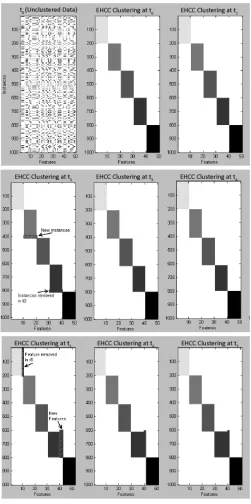
4.2 Visualization of Synthetic data clustering over period of time from t0 to t7 : At time-step t1, Gaussian noise of 50 instances was added per cluster. At time-step t2 10 more instances were added from distribution of C2. At time-step t3 10 instances were removed from cluster C4. At time-step t5, 2 features were added to C4. 1 feature was removed from C1 at time-step t6. t7is unchanged from t6. . . 22
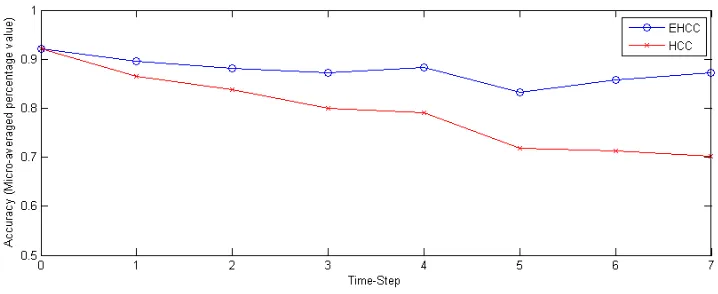
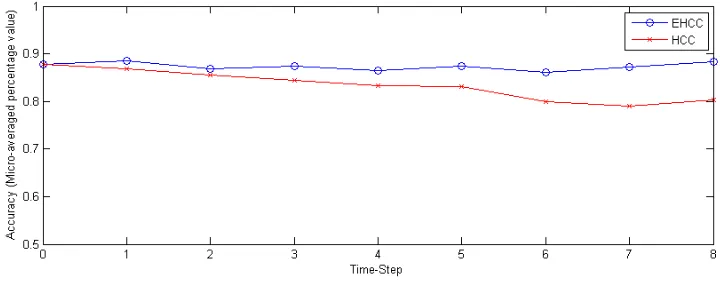
4.3 Comparison between accuracy of Evolutionary Higher order clustering(EHCC)
and Higher order Clustering(HCC) for Synthetic dataset . . . 23 4.4 Visualization of Synthetic data clustering over period of time from t0 to t7
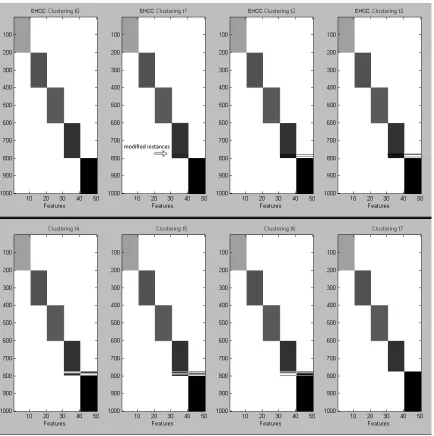
:t0 is the original data. Between time steps t1 - t6, instances shown drift from C4to C5. Finally, at time step t7, 20 instances moved from C4to C5. . 24 4.5 Visualization of Synthetic data clustering over period of time from t0 to t7
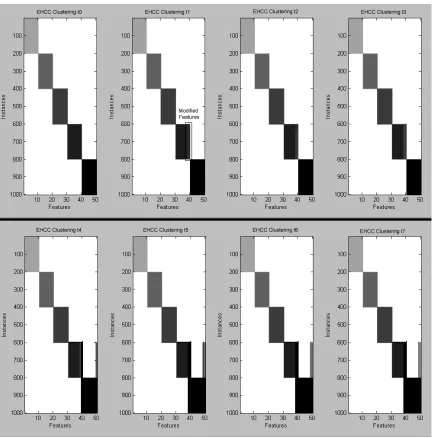
:t0is the original data. Between time steps t1 - t6, features shown drift from C4to new cluster C6. At time step t5, 2 features moved from C4to C6. Over next few time steps, C6became more homogeneous. . . 25
4.6 Comparison between accuracy of Evolutionary Higher order clustering(EHCC)
and Higher order Clustering(HCC) for Web-service dataset . . . 26
4.7 Comparison between accuracy of Evolutionary Higher order clustering(EHCC)
and Higher order Clustering(HCC) for Text dataset,England-Heart,re0 . . 27
4.8 Comparison between accuracy of Evolutionary Higher order clustering(EHCC)
and Higher order Clustering(HCC) for Text dataset,Graft-Phos,re0 . . . . 27
4.9 Comparison between accuracy of Evolutionary Higher order clustering(EHCC)
and Higher order Clustering(HCC) for Text dataset,ArachidonicAcids-Hematocrit,
4.10 Comparison between accuracy of Evolutionary Higher order clustering(EHCC)
and Higher order Clustering(HCC) for Text dataset,Enzyme-Infections,re0 28
4.11 Comparison between evolutionary higher order clustering algorithm (EHCC) and Static Higher order clustering algorithm (HCC), and comparison of performances of evolutionary algorithm with respect to trade-of factorα . . 29 4.12 Change in number of clusters over period of time, for evolutionary higher
order clustering algorithm (EHCC) and Static Higher order clustering algo-rithm (HCC); and comparison of performances of evolutionary algoalgo-rithm with respect to trade-of factorα . . . 30 4.13 Number of instances in 5th cluster over period of time, for evolutionary
List of Tables
1. Introduction
Rapid development in data acquisition technology has resulted in the generation of large
amounts of raw data, providing significant potential for the development of automatic data
retrieval, analysis and mining. Data clustering is a well-known and widely used data mining
technique that groups data objects into different groups (known as clusters) based on a
predefined criterion of similarity [19] [20]. In other words, objects in a cluster are similar to
each other, while being dissimilar from the ones in a different cluster. Traditional clustering
methods perform one dimensional clustering, i.e. clustering of instances alone, and fail to
extract any information from the features [42].
Data co-clustering not only clusters instances and features together, but also extracts
relationships between instances and features being clustered [2] [10] [11] [13]. In general,
co-clustering problems involve two types of data that are pair-wise heterogenous in nature
and need to be clustered together. Dhillon [10] modeled the problem of co-clustering as a
graph partitioning problem. He performed co-clustering on words and documents dataset
using an singular value decomposition based algorithm to partition a bipartite graph
be-tweenword-document. Rege et al. [29] proposed an isoperimetric co-clustering algorithm
that is again a bipartite partitioning-based co-clustering model. Recently, it has been shown
that Non-negative Matrix Factorization (NMF) algorithms are less memory intensive and
outperform graph-based methods like spectral clustering (SVD) and iso-perimetric
co-clustering (ICA) in achieving higher accuracy and efficiency [24] [40] [7] [33].
In the real world, data types in domains such as multimedia [4], biomedicine [12] [28]
[41], and web mining [30] [39] are multi-type in nature. For example, Web images that are
generally surrounded by text describing the image can be clustered using their low-level
words and documents but fails to extract relations in higher-order heterogeneous data like
Web images. Rege et al. (CIHC) [31] and Gao et al. (CBGC) [15] modeled such problems
of heterogeneous data co-clustering as tripartite graph partitioning problems. Long et al.
[23] proposed a spectral clustering-based approach for higher-order heterogeneous data
co-clustering. Recently, non-negative matrix factorization has been used in order to perform
heterogeneous data co-clustering [7].
However, all of these efforts have been limited to static data. Data extracted from
cer-tain domains like social networks and web-blogs are evolving in nature. In these domains,
data collected over a short time interval exhibit high similarity over data instances and
fea-tures. This can be effectively used to optimize data clustering since changes in clustering
are gradual [6]. None of the algorithms discussed above take into account the passage of
time and knowledge that can be gained by observing data as it evolves. Chakrabarti et
al. [6] and Chi et al. [8] have shown that incorporation of historic knowledge improves
the clustering accuracy. Wang et al. [38] proposed that evolutionary clustering can be
effectively done by the amalgamation of low-rank matrix approximation methods and
ma-trix factorization-based clustering. Recently, Green et al. [16] proposed an evolutionary
spectral co-clustering approach for evolutionary data.
In the case of data extracted from domains like social networks and web blogs, the data
is heterogeneous as well as evolutionary. In spite of efforts on heterogeneous co-clustering
and evolutionary co-clustering algorithms, the problem of co-clustering-evolving-heterogeneous
data has not been addressed. To the best of my knowledge, there are no contributions
to-ward an algorithm that performs co-clustering on evolving heterogeneous data. In this
thesis, I propose a novel algorithm designed for co-clustering of evolving heterogeneous
data. The proposed algorithm is entitled EHCC (Evolutionary star-structured
Heteroge-neous Co-Clustering), which will perform non-negative matrix factorization over multiple
time slices to handle evolving data. In order to perform co-clustering on evolutionary
het-erogeneous data, the current data is augmented by incorporating historical information by
obtain the desired co-clustering results for the star-structured evolutionary data [7].
The rest of the thesis is organized as follows. Chapter 2 discusses several
represen-tative backgrounds and related work. Chapter 3 presents the proposed Evolutionary
star-structured Heterogeneous Co-Clustering method, the core algorithm of this thesis, in detail.
Experiments and results appear in Chapter 4. Finally, Chapter 5 concludes the thesis and
2. Background and Related Work
In this chapter, I provide a review of related work. First I introduce Evolutionary
Clustering/Co-clustering. Then I briefly describe Star-Structured Heterogeneous Data Co-Clustering
al-gorithms in the literature. The chapter end with an overview of Low-rank Matrix
Approxi-mation.
2.1
Evolutionary Clustering/Co-clustering
Chakrabarti et al. [6] were among the first few to introduce the concept of evolutionary
clustering. They proposed evolutionary versions for widely used clustering algorithms,
viz., k-means and hierarchical clustering. They considered evolutionary clustering as an
optimization problem between two contrasting criteria; the first is that clustering should
reflect current data clustering, and the other is that, at any point in time, data clustering
should not differ drastically from previous time-step data. They presented current cost as
trade off between historic data and current data. The goal of the evolutionary clustering
algorithm is to minimize the overall cost - keeping the historic cost to a minimum (keeping
current data clustering similar to the previous clustering in the sequence) and current cost
to a maximum (providing high-quality current clustering of the data). Chakrabarti et al.
perform evolutionary k-means by integrating historic data in current data as follows 2.1.
Jcost =−α·fsq+ (1−α)·fhc (2.1)
In [8], Chi et al. make use of the spectral clustering algorithm to extend
evolution-ary clustering introduced in [6] by adding temporal smoothing through two evolutionevolution-ary
frameworks. The first framework, preserving cluster quality (PCQ), was designed to
mea-sure how well clusters appropriately accounted for historical data. The second framework,
preserving cluster membership (PCM), was designed to measure the difference between
the current clustering and the next previous clustering. In either case these measures were
the temporal cost of the current cluster choices. The temporal cost weighed into the quality
of the partitions. Authors define temporal smoothness as how effective clustering results on
data at current time step with respect to clustering results on historical data. The framework
makes use of same cost function used by Chakrabarti et al. [6]. They defined cost function
for PCQ (measuring how well clusters appropriately accounted for historical data) as,
CostN C =k−T r[XtT(αD
−1 2
t WtD
−1 2
t + (1−α)D
−1 2
t−1Wt−1D
−1 2
t−1)Xt] (2.2) wheretrefers to the current time step,W∈<n×mis bi-type relational data,Dis the diagonal
singular matrix for the relational dataW,kis number of clusters,X is a construct, andTr()
is a trace function.
Green et al. [16] extend the approach presented in [8] to spectral co-clustering. They
introduced evolutionary co-clustering. The proposed two approaches, Respect To the
Cur-rent (RTC) and Respect To Historical (RTH), perform co-clustering on evolving instances
as well as features. The constructXt, represents an evolutionary clustering for the bi-type
relational data with RTC as,
Xt =svd[αW −(1−α)D
−1 2
t−1Wt−1D
−1 2
t−1] (2.3)
Recently, Wang et al. [38] proposed a kernel matrix-based evolutionary clustering
al-gorithm for large-scale evolutionary data. Amalgamation of low-rank approximation to
compromising the accuracy of the clustering algorithm. They also propose clustering
us-ing non-negative matrix factorization, which is more scalable for large data and is more
accurate and efficient compared to other clustering approaches like spectral clustering.
[image:15.612.214.414.233.349.2]2.2
Star-Structured Heterogeneous Data Co-Clustering
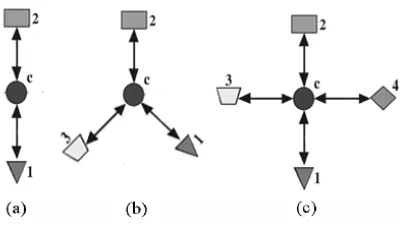
Figure 2.1: The Star-Structured High-order Heterogeneous Data.
In the case of a Star-Structured Heterogeneous Data, a central data object is connected to
other types to form a star structure of the interrelationships as shown in Figure 2.1. Gao et
al. [15] proposed Consistent Bipartite Graph Co-clustering (CBGC) for clustering this kind
of data. Long et al. [24] proposed a spectral-clustering-based approach for multi-type
rela-tional data that generalized the approach for higher-order heterogeneous data co-clustering.
In [31] [25], Rege et al. proposed the Consistent Isoperimetric High-order Co-clustering
(CIHC) framework for partitioning the star-structured graphs. The proposed algorithm
partitions fusion of bipartite graphs. The algorithm is quick since it obtains a solution to
a sparse system by solving linear equation simultaneously. Long et al. [23] formulated
heterogeneous co-clustering as collective factorization on related matrices and obtained
co-clustering by deriving sub-matrices by simultaneously clustering multi-type interrelated
data. This algorithm provides more flexibility toward heterogeneous co-clustering since
the framework is applicable for general case data interrelationship.
being positive. This can be difficult to interpret for applications like documents and
im-age clustering since they always have positive input. Matrix-factorization-based clustering
approaches have received increased attention due to their applicability to high dimensional
datasets. Chen et al. [7] proposed non-negative matrix factorization for heterogeneous data
co-clustering. They performed trifactorization using an iterative algorithm to obtain new
cluster indicator matrices and the correlation between interrelated data. They show that
non-negative factorization outperforms graph-based methods and is less memory intensive.
Hence, they are efficient and scalable for large data.
2.3
Low-rank Matrix Approximation
Low-rank approximation methods extract correlation and then remove redundancy from
data to obtain sparse data [1]. One way to make clustering algorithms computationally
efficient is to integrate a data mining algorithm with low-rank approximation methods.
Singular Value Decomposition (SVD) is widely used for low-rank approximation since it
optimally calculates approximation using the Frobenius norm. However, SVD does not
produce a sparse matrix that is computationally very effective. Berry et al. [3] proposed an
improved low-rank approximation approach (Algorithm 844) called
quasi-Gram-Schmidt-algorithm based on the classical Gram-Schmidt quasi-Gram-Schmidt-algorithm. They trifactorized the input
matrix into two full-rank matrices and a non-singular matrix that is more efficient in terms
of computational power and space storage than SVD. Petros et al. [14] aims to address the
problem of memory access time (seek-time) for a large data set using the family of CUR
algorithms, namely LINEARTIMECUR and CONSTANTTIMECUR, based on fast Monte
Carlo algorithms. The LINEARTIMECUR algorithm makes use of the original data matrix
with two passes over existing storage of the matrix in external memory without storing on
RAM. The other algorithm, CONSTANTTIMECUR, focuses on optimization of seek time.
The advantage of the CONSTANTTIMECUR algorithm approach over the
however, it requires additional pass-over main memory, and the new low-rank
approxima-tion matrix has an addiapproxima-tional error. SVD and CUR are capable of identifying the correlaapproxima-tion
and hidden structure in a data set, but they are not efficient enough to obtain
computation-ally efficient sparse matrix. Sun et al. [34] addressed this problem by proposing a new
approximation method, the Compact Matrix Decomposition (CMD), which focuses on
re-ducing the high memory usage and computational cost for large sparse graphs. The authors
express the association between two nodes of graph using the relational matrix such that
every element represents the degree of similarity between two nodes of the object. They
removed the redundancy of nodes by sampling and removing the null row or column
en-tries and projecting original data into new subspace. Pan et al. [27] proposed a framework
(CRD) that achieves a linear-time low-rank approximation by utilizing sampling-based
ma-trix decomposition methods and perform partition-based co-clustering on large data. The
proposed framework decomposed the original data matrix into subsets of rows and columns
and performs co-clustering using matrix decomposition using an approach like block-value
decomposition [24]. Since subspace is created using random sampling, re-sampling is
needed to avoid a case where the entire cluster is not sampled while random sampling.
Chebyshevs Inequality was used to detect such rows and columns and reduce the error rate
because of biased sampling. Low-rank algorithms like CUR and CMD focused on
preserv-ing sparsity in large-graph data by creatpreserv-ing a smaller subspace to represent original data
by sampling it. However, they were overly complicated and were not able to optimize the
sub-space calculation either with time or space. To address these issues, Tong et al. [36]
proposed two algorithms, Colibri-S and Colibri-D, for static and dynamic graphs,
respec-tively. They proposed solution in which they first performed bias sampling by creating an
initial subspace that consisted of linearly dependent columns or near duplicates. Then they
optimized subspace by iterative sampling and removing all dependent columns or
dupli-cates. The authors showed that proposed algorithms for static and dynamic graphs are very
3. Evolutionary Star-Structured
Het-erogeneous Data Co-Clustering
In this chapter, I present an evolutionary star-structured heterogeneous data co-clustering
algorithm. Specifically, I will discuss 1) how to incorporate historical data into current
data and 2) how to efficiently infer clusters of different data types simultaneously using
non-negative matrix factorization (NMF).
3.1
Evolutionary Star-Structured Heterogeneous Data
In the case of a Star-Structured Heterogeneous Data at a time stept, we represent multi-type
relational data of m-types using relational matrices with central data typecconnected top
other data types. The relation between every data type with central data type is represented
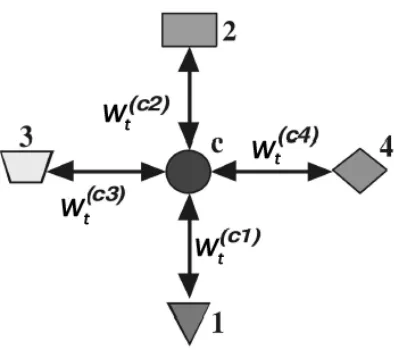
using relational matrix W(tci)∈<nc×ni. For example in Figure 3.1, central datacis connected
to four other data types, and we represent their relationship with central data type using
relational matrices W(tc1), W(tc2), W(tc3), and W(tc4), respectively.
3.2
Data dynamics and Low-rank Matrix Approximation
One of the challenges of evolutionary data is the dynamic nature of the data. Over a period
of time, we have changes in data size (changes in number of samples and features of data)
as well as changes in the structure of data (changes in number of clusters in the data).
Low-rank approximation methods extract correlation and then remove redundancy from data to
Figure 3.1: The Star-Structured Heterogeneous Data.
The family of Colibri methods [36], i.e., Colibri-S (Low-rank approximation method
for static data) and Colibri-D (Low-rank approximation for dynamic data), has proven more
efficient in terms of space and time compared to others like CRD [27], CMD [34], and CUR
[14]. Specifically, for dynamic data there is a gradual change in data between two
consec-utive time steps. Colibri-D takes leverage of the similarity between two consecconsec-utive time
steps to quickly update the approximating subspace. To integrate historic data into current
data, we make use of Colibri-D to obtain approximating historic subspace compatible with
respect to current data. First, we use the Colibri-S algorithm to calculate initial biased
sub-space [36]. Colibri-S iteratively constructs optimized subsub-space by eliminating redundant
columns. In the first stage, we simply follow the CUR [14] algorithm to sample a small
subset of columns from the data matrix with replacement, biased toward those with higher
norms. Then we initialize the output matrix with the first column of the data matrix and
then iteratively select a new column from biased subspace, which is linearly dependent on
the current columns. We finally obtain a matrix by removing all the redundant columns.
Colibri-D makes use of subspace calculated at timetto calculate subspace at timet-1. Since
the change in graph between two consecutive time steps is assumed to be reasonably small,
the overall edges affected between two time steps are far too less. Hence, for dynamic data,
a over period of time. So, authors have proposed a faster method to update output matrix
by sampling and comparing sampled edges between two time steps t andt-1. The output
thus obtained is compatible with respect to current data and is computationally efficient.
Before we apply low-rank approximation using the Colibri family to obtain sparse
com-patible historical data with respect to current data, we make sure the dimension of historical
data is larger than current data, so that when we apply Colibri-D, we get data dimensions
of historical data equal to that of current data. In the case where historical data has less
number of instances and/or features, we determine differences in instances and/or features
between historical data and current data, and we add those instances and/or features into the
historical data matrix. The inserted instance or feature receives the average of the whole
matrix at the current time step for each cell. We then apply Low-rank approximation to
project original dataW(tci)∈<nc×ni into subspace
f
Wt(ci)∈<nc×ni to improve computational efficiency of the algorithm in both time and space: clustering accuracy remains unaffected.
We define the overall cost function of EHCC (Evolutionary star-structured
Heteroge-neous Co-Clustering) as the sum of snapshot quality and historical cost. We solve this
problem by maximizing the clustering quality of the current snapshot and minimizing
the historical cost that provides clustering smoothness [6] [8] [38]. We propose an
op-timization equation to obtain EHCC for evolutionary higher-order relational data matrix
f
Wt
(ci)
∈<nc×ni andt= (t,t-1) as,
J =min
L((ct)),M((tci)),R((it))≥0[α· kWft (ci)
−L(tc)Mt(ci)Rt(i)k2
+(1−α)· kW]t−1 (ci)
−L((ct−)1)M((tci−)1)R((it)−1) k2] (3.1)
whereαis a trade off between historic data (historic quality) and current data (snapshot quality), and 0 ≤ α ≤ 1. L(tc)∈<nc×kc (row coefficient matrix) and R(i)
t ∈<ki×ni (column
coefficient matrix) are indicator matrices representing soft-clustering for instances and
that represents the co-clustering relation between central data type and each data type
con-nected with central data type at time stept[24] [40] [7].
We generalize the optimization equation (3.1) for multiple time step data represented
by,Wft(ci)∈<nc×ni fort={1, 2,..., S}, where isSlast time-step in data,
J =minL(c) (t),M
(ci) (t) ,R
(i) (t)≥0
PS
t=1α(1−α)
S−t· k
f
Wt
(ci)
−L(tc)Mt(ci)R(ti)k2 (3.2)
3.3
Estimating the Number of Clusters
In unsupervised learning methods, automatic estimation of number of clusters in data is
a challenging task [20]. For evolutionary data, the shape of data changes over a period
of time. We have change in the number of clusters over a period of time. For automatic
cluster estimation, we use six different well-known methods for cluster estimation, namely,
Silhouettes [32], Davies-Bouldin index [9], Calinski-Harabasz index [5], Krzanowski-Lai
index [21], and Hartigan [17] and weighted inter-to intra-cluster ratio with Homogeneity
and Separation index [35]. Because that data is gradually evolving, we make use of cluster
estimation on historical data to estimate the number of clusters in current data. The process
is faster since we need to estimate the number of clusters closer to the previously estimated
value only. We estimate the number of clusters using previously mentioned methods and
use the mode from the above estimation methods to decide the number of clusters in current
data.
3.4
Co-clustering using Non-negative Matrix Factorization
Since non-negative matrix-factorization-based co-clustering methods have been more
ef-ficient than graph-based methods in terms of efficiency and accuracy for large data sets
like document and image clustering, and they are easy to interpret, we use a non-negative
factorization-based method to obtain co-clustering. The minimization of (3.2) can be
optimization problem (3.2) through following the iterative solution to obtainL(Sc), R(Si) and
M(Sci)[38]. This iterative process seeks to the minimize equation as rules specified in
Algorithm 1Evolutionary Star-Structured Heterogeneous Data Co-Clustering
Input: A relational matrixWt(ci)∈<nc×ni fort={1, 2,..., S}
Output: L(tc)∈<nc×kc (row cluster indicator matrix) and R(i)
t ∈<ki×ni (column cluster
indicator matrix) andM(tci)∈<kc×ki (block value matrix)
1: fort←2, Sdo
2: fori←1, pdo{//If time-step Wt−1has less number of instances than Wt, add new instances to Wt−1 }
3: iflengthof(Wt(−ci1))< lengthof(Wt(ci))then 4: forj ←lengthof(Wt(−ci1)), lengthof(Wt(ci))do 5: insert⇐µ(Wt)
6: add instanceinserttoWt(−ci1)
7: end for
8: end if
{//If time-step Wt−1 has more number of instances than Wt, add new instances to
Wt−1 }
9: iflengthof(Wt(−ci1))> lengthof(Wt(ci))then
10: Use intermediate results from the Colibri method to get unique and
inde-pendent subspace fromWt(−ci1) equivalent to length ofWt(ci) 11: end if
{//If time-step Wt−1has fewer features than Wt, add new instances to Wt−1}
12: iff eaturelengthof(Wt(−ci1))< f eaturelengthof(Wt(ci))then 13: forj ←f eaturelengthof(Wt(−ci1)), f eaturelengthof(Wt(ci))do 14: insert⇐µ(Wt(ci))
15: add featureinserttoWt(−ci1)
16: end for
18: if f eaturelengthof(Wt(−ci1)) > f eaturelengthof(Wt(ci)) then {//If time-step Wt−1 has more features than Wt, add new instances to Wt−1}
19: Use intermediate results from the Colibri method to get unique and
inde-pendent subspace fromWt(−ci1) equivalent to feature length ofWt(ci) 20: end if
{//Use the Colibri-D method to obtain Low-rank approximation of Wt−1 with
respect toWt}
21: T EM P Wt(−ci1) ⇐Colibri−D(Wt(−ci1), Wt(ci)) 22: Wft
(ci)
⇐α·Wt(ci)+ (1−α)·T EM P Wt(−ci1))
23: end for 24: end for
25: Estimate number of cluster inWft
(ci)
using methods mentioned in section 3.3.
26: Obtain clustering using the following rules by applying recursive onWft
(ci)
L((cS))(ab)←L((cS))(ab)
Pp
i=1((
PS
t=1α(1−α)
S−t·W](ci) t )R
(i) (S)
T
M((Sci))T)ab
Pp
i=1(L (c) (S)M
(ci) (S)R
(i) (S)R
(i) (S)
T
M((Sci))T)ab
(3.3)
R((Si))(ab)←R((iS))(ab)(M
(ci) (S)
T
L((cS))T(PS
t=1α(1−α)
S−t·W](ci)
t ))ab
(M((Sci))TL((Sc))TL((cS))M((Sci))R((iS)))ab
(3.4)
M((Sci)()ab) ←M((Sci)()ab)(L
(c) (S)
T
(PS
t=1α(1−α)S
−t·W](ci) t )R
(i) (S)
T
)ab
(L((cS))TL((cS))M((Sci))R((iS))R((iS))T)ab
(3.5)
subject to the constraints∀ab: L
(c)
S ab≥0 and R
(i)
S ab≥0, wherek.kdenote Frobenius matrix norm, L(Sc)∈<n×k, M(ci)
S ∈<
k×l , R(i)
S ∈<
4. Experiments
In this chapter, we demonstrate the performance of EHCC. We evaluated proposed
algo-rithm on variety of datasets, synthetic as well as real world datasets. Section 4.1 describes
datasets and preprocessing information. In section 4.2, we describe experiment evaluation
method. Finally, in section 4.3, we explain experiment and results.
4.1
Data Description and Preprocessing
We performed two sets of experiments to determine validity of proposed algorithm. We
run first set of experiments on a synthetic dataset, generated to evaluate different proposed
functionalities of the algorithm. For the second set, we used real world datasets from
three different domains, viz. web-service data, publicly available text-datasets, and image
dataset.
4.1.1
Synthetic Data
We performed two different experiments on synthetic data to test different features of
pro-posed algorithm. The first experiment demonstrates the ability of the algorithm to
han-dle instance and/or feature evolution, addition of instances and/or features, removal of
instances and/or features as well as the consistency across similar time-steps. The
sec-ond experiment shows algorithm’s ability to handle cluster shift over period of time. The
experiment tests instance as well as feature drift.
We generated a synthetic dataset consisting 8 time-steps, with step having 5 clusters of
200 instances. For initial time-step, the 5 clusters were generated from 5 normal
each cluster Cn, the distribution is determined by equation,µn=µn−1+ 5·n+R, where R is an integer randomly selected from [0-100]. For all distribution, standard deviation, σ
is equal to 1.
4.1.2
Web-Service Community Formation
A WSDL document consists of five key components: types, messages, portType, binding,
and service. Inspired by information retrieval techniques [26], we model services and
op-erations as vectors of functional terms as these terms represent the functionalities that the
services or operations provide. We apply traditional data processing techniques, which
in-volve extraction, tokenization, stopword removal and stemming, to obtain the functional
terms from the five WSDL components. Extraction identifies the key terms in a WSDL
document. Since terms in WSDL documents are usually stored in composite format (e.g.,
groceryStoreFood), tokenization is used to derive simple terms (e.g., grocery, store, food).
Non-functional terms and WSDL specific keywords such as http, url, host are removed by
the means of stopword removal. Finally, stemming is applied to reduce different forms of
a term into a common root (e.g. write, writing, andwroteget reduced towrite). After data
processing is completed, each service and operation will be represented as a vector of their
respective functional terms. Using these vectors, we construct a term-by-service matrix
and an operation-by-termmatrix. The dataset represents a tri-type data environment with
terms as the central data type. Theterms-operations matrix consists of 384 terms and 72
operations. In the term-by-service matrix we have 384 terms and 97 services. Terms are
collected by processing WSDL files from 5 different domains, namely, Communication,
Education, Food, Medical and Travel. So, every data type has 5 clusters.
4.1.3
Text Co-clustering
In this section, we evaluate our proposed algorithm for word-document co-clustering by
Data Set No. of Docu-ments
No. of
Cate-gories
No. of Docu-ment clusters
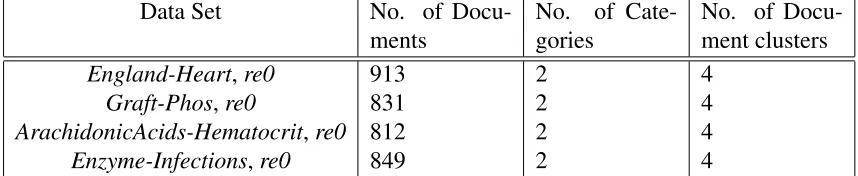
England-Heart,re0 913 2 4
Graft-Phos,re0 831 2 4
ArachidonicAcids-Hematocrit,re0 812 2 4
[image:27.612.95.524.104.192.2]Enzyme-Infections,re0 849 2 4
Table 4.1: Data sets for (word-document-category) co-clustering
OHSUMED collection [18]. Data setre0is subset of the Reuters-21578 text categorization
dataset [22]. We mix these datasets as below.
• Dataset England-Heart was created by mixing classes England and
Heart-Valve-Prosthesisfromoh0dataset.
• Classes Graft-Survival andPhospholipidsfrom oh5were mixed to form the
Graft-Phosdataset.
• ArachidonicAcids-Hematocrit was derived fromoh10using Arachidonic Acids and
Hematocritclasses.
• Enzyme ActivationandStaphylococcal Infectionswere mixed to obtain the
Enzyme-Infectionsdataset.
To analyze performance of the algorithm, we compared our results with [7] [13] [24].
We performed feature selection to select top 1,000 words. We construct document-category
matrix by calculating the probability of each document belonging to each category. For
each document, if any of the top 1,000 word occurs, then we considered word occurrence
1 else 0. Then, we calculated probability of one document belonging to a category as the
ratio of the sum of occurrence of selected top 1,000 words in this document to 1,000. We
mix dataset from OHSUMED collection withre0to form higher-order dataset. Tables 4.1
4.1.4
Image Co-clustering
For our experiments on image datasets, we chose images from Corel-CDs which contains
general-purpose images from different domains such as automobiles, landscape, animal,
automobiles, etc. For image co-clustering, we represented each image in the form of vector
of 45 color features, 42 texture features [43] [37]. 45 color features consist of color
chan-nels(RGB, 9 features, including mean, variance, and skewness of R, G, and B channels),
color coherence vector(CCV, 24 features), and color histogram (CH, 12 features). Gabor
wavelet based texture (Gab, 24 features), edge direction histogram (EDH, 9 features), and
edge direction coherence vector (EDCV, 9 features) were extracted from each image to
represent image using Texture features. We constructed two matrices, image-color and
image-texturerepresenting color and textures features respectively.
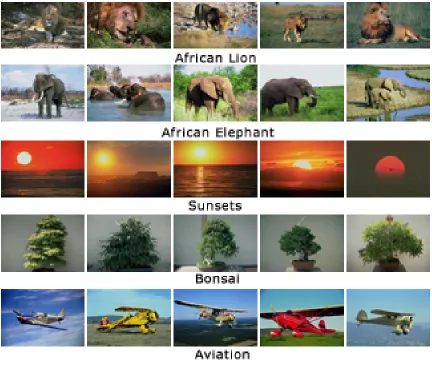
We selected 500 images from 5 different contents, namely,African Lion, African
Ele-phant, sunsets, bonsai, and aviation. Some examples from each category are shown in
Figure 4.1. In the proposed relevance feedback framework, we collect the users’ positive
feedback as samples to construct image-log matrix. Through feedback, the images marked
indicate that they are similar to each other according to user’s preference also called as a
log. In every log, user marks 3-5 similar images from 20 images randomly selected from
image pool. We mark similar images by 1 for rest images inlog-imagesvector we mark 0
Figure 4.1: Image samples selected random from each image category
4.2
Evaluation Method
We calculate clustering accuracy using micro-averaged precision value, given by,
AC =
Pn
i=1Φ(Xi, Yi)
n (4.1)
where n is number of instances in central data type, Φ(Xi, Yi) is equal to 1 if assigned label Yi and true label Xi for instanceiis same, else it is 0. Since the algorithm is solved
experiment 20 times and chose to average them [7] [24].
We evaluated performance of evolutionary algorithm by comparing its performance
against individual clustering at a time-steptwithout considering historic data.
4.3
Experiment Results
4.3.1
Synthetic Data
At time-step t1, Gaussian noise of 50 instances was added per cluster. At time-step t2
10 more instances were added from distribution of C2. At time-step t3 10 instances were
removed from cluster C4. At time-step t5, 2 features were added to C4. 1 feature was
removed from C1 at time-step t6. t7 is unchanged from t6. Figure 4.2 shows visualization
of data over period of time from t0 to t7. In Figure 4.3, we show evolutionary higher order
clustering out performs higher order clustering. As proposed, the algorithm is capable of
handling data dynamics over period of time. At time-step t1, despite of adding Gaussian
noise, clustering at t1, is almost unchanged. At time-steps t2additional instances from same
distribution of clusters were added to dataset, and algorithm is capable of appropriately
clustering them. Similarly, at t3, we removed 10 instances from a cluster, and algorithm
produced stable results opposing the process of removal of instance over period of time.
At t4, data as well clustering remained unchanged, indicating stability of the algorithm
when data is unchanged. At time-step t5, the algorithm has clustered added features C4.
Even though the accuracy of algorithm slightly decreased, however, it has performed well
than static higher order co-clustering. Similarly, when we removed feature from dataset,
algorithm has shown resistance to the change in clustering at time-step t6. Clustering at t7
Figure 4.2: Visualization of Synthetic data clustering over period of time from t0to t7 : At
time-step t1, Gaussian noise of 50 instances was added per cluster. At time-step t210 more
instances were added from distribution of C2. At time-step t3 10 instances were removed
from cluster C4. At time-step t5, 2 features were added to C4. 1 feature was removed from
Figure 4.3: Comparison between accuracy of Evolutionary Higher order clustering(EHCC)
and Higher order Clustering(HCC) for Synthetic dataset
To evaluate algorithm’s ability to handle instance drift, we augmented original dataset.
We chose and modified of 20 instances from cluster C4. At each time-step, we progressively
modified the distribution of those instances towards C5so that at time step t7those instances
originally from C4 have same distribution as those in C5. In other words, we progressively
moved them from C4 to C5 over period of time. From Figure 4.4 shows clustering of data
over period of time. We show instances are progressively drifted from C4to C5over period
Figure 4.4: Visualization of Synthetic data clustering over period of time from t0to t7:t0is
the original data. Between time steps t1 - t6, instances shown drift from C4 to C5. Finally,
at time step t7, 20 instances moved from C4 to C5.
To evaluate algorithm’s ability to handle feature drift, we augmented original dataset.
We chose and modified of 2 features from cluster C4. At each time-step, we progressively
modified the distribution of those features towards new cluster C6 so that at time step t7
words, we progressively moved them from C4 to C6 over period of time. A new cluster
started appearing at t4. At t5both features moved to same cluster to form C6. Over next few
[image:34.612.94.526.159.597.2]time steps, cluster has become more homogeneous. Figure 4.5 illustrate our observations.
Figure 4.5: Visualization of Synthetic data clustering over period of time from t0 to t7 :t0
is the original data. Between time steps t1- t6, features shown drift from C4 to new cluster
C6. At time step t5, 2 features moved from C4to C6. Over next few time steps, C6 became
4.3.2
Web-Service Community Formation
We augmented dataset into evolutionary one, by modifying instances and features. We
ob-tained distribution for each cluster and fort1andt2, we modified 5% instances and features
from each cluster using by randomly generating instances and features from distribution of
clusters they belong to. For t3 and t4, we modified 5% instances and features from each
cluster using by randomly generating instances and features from distribution of different
cluster. Att5, we added 5% new instances to cluster C3 generated from distribution of C3.
Similarly, At t6, we added 5% new features to C1 generated from distribution of C1. For
t7, we added 5% instances and features to instance and feature cluster C2 from instance
cluster C4 and feature cluster C5 respectively. At time-step t8, we removed 1% instances
[image:35.612.135.489.348.489.2]and features each instance and feature cluster.
Figure 4.6: Comparison between accuracy of Evolutionary Higher order clustering(EHCC)
and Higher order Clustering(HCC) for Web-service dataset
Similar to synthetic data, for web-service data algorithm shows ability to handle data
dynamics. Figure 4.6 underlines algorithm’s ability to resists data changes. At time-stept7,
where we added instances as well as features to the data, static algorithm fail to perform,
where as proposed algorithm has excellently handled data changes. Similarly for time-step
t8, when we removed instances and features from all clusters, our algorithm outperformed
4.3.3
Text Co-clustering
We augmented dataset into evolutionary one in similar way as we did for the web-service
[image:36.612.134.488.175.317.2]dataset in section 4.3.2.
Figure 4.7: Comparison between accuracy of Evolutionary Higher order clustering(EHCC)
and Higher order Clustering(HCC) for Text dataset,England-Heart,re0
Figure 4.8: Comparison between accuracy of Evolutionary Higher order clustering(EHCC)
[image:36.612.128.488.408.550.2]Figure 4.9: Comparison between accuracy of Evolutionary Higher order clustering(EHCC)
and Higher order Clustering(HCC) for Text dataset,ArachidonicAcids-Hematocrit,re0
Figure 4.10: Comparison between accuracy of Evolutionary Higher order
cluster-ing(EHCC) and Higher order Clustering(HCC) for Text dataset,Enzyme-Infections,re0
Through these experiments, we tried to test algorithm for text-datasets. Figures 4.7,
4.8, 4.9, and 4.10 further outline algorithm’s abilities to handle evolutionary data.
4.3.4
Image Co-clustering
For first experiment on image dataset, we increase the number of logs per category over the
period of timet0 tot10. We mark all clusters distinctly with logs, so over period of time,
[image:37.612.134.488.330.471.2]identified. Then, we compare results for evolutionary algorithm with two different values
[image:38.612.110.491.180.478.2]of trade off factorα, which equal to 0.8 and 0.2. This experiment also highlights algorithms ability of historic knowledge.
Figure 4.11: Comparison between evolutionary higher order clustering algorithm (EHCC) and Static Higher order clustering algorithm (HCC), and comparison of performances of evolutionary algorithm with respect to trade-of factorα
In Figure 4.11, we compare evolutionary with static version of higher order co-clustering.
As expected, evolutionary algorithm produces more accurate results than static version of
higher-order co-clustering algorithm. In stead, over period of time, evolutionary algorithm
produces more accurate results because of its capability of integration of historic
For second experiment, initially, we markedAfrican LionandAfrican Elephantbelong
to same clusters. Over the period of time t0 to t7, we marked them separately into two
clusters. We want to show, our proposed algorithm is able to handle cluster evolution over
period of time. Again, we performed experiment for two different values of trade-off values
[image:39.612.126.488.223.524.2]to understand significance of integration of historic data.
Figure 4.12: Change in number of clusters over period of time, for evolutionary higher order clustering algorithm (EHCC) and Static Higher order clustering algorithm (HCC); and comparison of performances of evolutionary algorithm with respect to trade-of factor
α
From Figure 4.12, we show that, algorithm resists change in data. Our algorithm
indi-cates new cluster, i.e. 5th cluster, is formed at time-step t
2, even though we have started
marking 5th from time-stept1. So, new cluster is not formed till we have enough number
gave more importance for historical data, cluster change occurred more gradually. Hence,
[image:40.612.113.492.162.455.2]the fifth image cluster was detected one time-step later att3.
Figure 4.13: Number of instances in 5thcluster over period of time, for evolutionary higher order clustering algorithm (EHCC) and Static Higher order clustering algorithm (HCC); and comparison of performances of evolutionary algorithm with respect to trade-of factor
α
In Figure 4.13, we show number of instances clustered into 5th. We can observe period
time 5th cluster has become more prominent over period of time. As shown earlier, when
5. Conclusion
I have proposed an evolutionary star-structured heterogeneous data co-clustering algorithm.
The research addresses unexplored avenues in clustering evolving star-structured
hetero-geneous data. The algorithm augment the current data with the historical data using cost
functions. Then it perform non-negative matrix factorization on the augmented current data
to obtain clustering. To evaluate the proposed work, I have applied our approach to diverse
domains: web-service community discovery, text mining and image clustering. Synthetic
and real world and publicly available text and image datasets validate the proposed
method-ology.
Further experimentation will be necessary to determine possible applications based on
my current research. An interesting direction would be tracking and analysis in social
gam-ing applications, blogs or a mashup of RSS feeds with daily updates, users, and words to be
clustered. Data dynamics has key effect on quality of the augmented matrix. So, additional
efforts are required to improve ability to handle data dynamics. In the proposed approach, I
have focused on a specific case of evolutionary heterogenous clustering. Further research is
necessary to improve ability of the algorithm to handle general case of heterogenous data.
The research will provide foundation for research on evolutionary heterogeneous data
clus-tering, hence opening many avenues for evolutionary clustering applications. This research
provides a road map for those that would venture to take on the endeavor of creating a novel
6. Acknowledgments
A grand thank you to Professor Rege, my committee, and Computer Science Department
and Rochester Institute of Technology for their assistance with this thesis. I would like to
take this opportunity to thank Hanghang Tong, Spiros Papadimitriou, Jimeng Sun, Philip
Yu, and Christos Faloutsos for making Colibri [36] implementation available for our
Bibliography
[1] Dimitris Achlioptas and Frank Mcsherry. Fast Computation of Low Rank Matrix Approximations. Journal of the ACM, 54(2):9–es, 2007.
[2] Arindam Banerjee, Inderjit Dhillon, Joydeep Ghosh, Srujana Merugu, and Dharmen-dra S Modha. A generalized maximum entropy approach to bregman co-clustering
and matrix approximation. Proceedings of the 2004 ACM SIGKDD international
conference on Knowledge discovery and data mining KDD 04, 8:509, 2004.
[3] Michael W. Berry, Shakhina A. Pulatova, and G. W. Stewart. Algorithm 844 :
Com-puting Sparse Reduced-Rank Approximations to Sparse Matrices. ACM Transactions
on Mathematical Software, 31(2):252–269, June 2005.
[4] Rui Cai, Lie Lu, and Alan Hanjalic. Unsupervised content discovery in composite
audio. Proceedings of the 13th annual ACM international conference on Multimedia
MULTIMEDIA 05, (december):628, 2005.
[5] T Calinski and J Harabasz. A dendrite method for cluster analysis. Communications
in Statistics Theory and Methods, 3(1):1–27, 1974.
[6] Deepayan Chakrabarti, Ravi Kumar, and Andrew Tomkins. Evolutionary clustering. In Proceedings of the 12th ACM SIGKDD international conference on Knowledge discovery and data mining - KDD ’06, page 554, New York, New York, USA, August
2006. ACM Press.
[7] Yanhua Chen Yanhua Chen, Lijun Wang Lijun Wang, and Ming Dong Ming Dong. Non-Negative Matrix Factorization for Semisupervised Heterogeneous Data Coclus-tering, 2010.
[8] Yun Chi, Xiaodan Song, Dengyong Zhou, Koji Hino, and Belle L Tseng. Evolutionary
spectral clustering by incorporating temporal smoothness. Proceedings of the 13th
ACM SIGKDD international conference on Knowledge discovery and data mining
[9] D L Davies and D W Bouldin. A cluster separation measure. IEEE Transactions on Pattern Analysis and Machine Intelligence, 1(2):224–227, 1979.
[10] Inderjit S Dhillon. Co-clustering documents and words using bipartite spectral graph
partitioning. Proceedings of the seventh ACM SIGKDD international conference on
Knowledge discovery and data mining KDD 01, pages(April 2006):269–274, 2001.
[11] Inderjit S Dhillon, Subramanyam Mallela, and Dharmendra S Modha. Information-theoretic co-clustering. Proceedings of the ninth ACM SIGKDD international confer-ence on Knowledge discovery and data mining KDD 03, 32(3):89, 2003.
[12] Chris Ding, Xiaofeng He, Richard F Meraz, and Stephen R Holbrook. A unified representation for multi-protein complex data for modeling protein interaction
net-works. PROTEINS: STRUCTURE, FUNCTION, AND BIOINFORMATICS, 57:99 –
108, 2004.
[13] Chris Ding, Tao Li, Wei Peng, and Haesun Park. Orthogonal nonnegative matrix
t-factorizations for clustering. Proceedings of the 12th ACM SIGKDD international
conference on Knowledge discovery and data mining KDD 06, 19(2):126, 2006.
[14] Petros Drineas, Ravi Kannan, and Michael W Mahoney. Fast Monte Carlo Algo-rithms for Matrices III: Computing a Compressed Approximate Matrix
Decomposi-tion. SIAM Journal on Computing, 36(1):184–206, 2006.
[15] Bin Gao, Tie-Yan Liu, Tao Qin, Xin Zheng, Qian-Sheng Cheng, and Wei-Ying Ma. Web image clustering by consistent utilization of visual features and surrounding
texts. In Proceedings of the 13th annual ACM international conference on
Multi-media, pages 112–121. ACM, ACM, 2005.
[16] Nathan Green, Manjeet Rege, Xumin Liu, and Reynold Bailey. Evolutionary spectral
co-clustering. The 2011 International Joint Conference on Neural Networks, pages
1074–1081, July 2011.
[17] J A Hartigan. Clustering Algorithms, volume 2 of Wiley Series in Probability and
Mathematical Statistics. John Wiley & Sons, 1975.
[18] William Hersh, Chris Buckley, T J Leone, and David Hickam. OHSUMED: An inter-active retrieval evaluation and new large test collection for research. In W Bruce Croft
SIGIR conference on Research and development in information retrieval, volume 17
ofSIGIR ’94, pages 192–201. Springer-Verlag New York, Inc., 1994.
[19] A K Jain, M N Murty, and P J Flynn. Data clustering: a review. ACM Computing
Surveys, 31(3):264–323, 1999.
[20] Anil K Jain. Data clustering: 50 years beyond K-means. Pattern Recognition Letters, 31(8):651–666, 2010.
[21] W J Krzanowski and Y T Lai. A Criterion for Determining the Number of Groups in a Data Set Using Sum-of-Squares Clustering. Biometrics, 44(1):23–34, 1988.
[22] David D Lewis, Yiming Yang, Tony G Rose, and Fan Li. RCV1: A New Benchmark Collection for Text Categorization Research. Corpus, 5:361–397, 2004.
[23] Bo Long, Zhongfei Mark Zhang, Xiaoyun W´u, and Philip S Yu. Spectral clustering for multi-type relational data. Proceedings of the 23rd international conference on Machine learning ICML 06, pp:585–592, 2006.
[24] Bo Long, Zhongfei Mark Zhang, and Philip S Yu. Co-clustering by block value
decomposition. Proceeding of the eleventh ACM SIGKDD international conference
on Knowledge discovery in data mining KDD 05, page 635, 2005.
[25] Manjeet Rege and Qi Yu. Efficient Mining of Heterogeneous Star-Structured Data.
International Journal Software and Informatics, 2(2):141–161, 2008.
[26] Christopher D Manning, Prabhakar Raghavan, and Hinrich Sch¨utze. Introduction to
Information Retrieval, volume 1. Cambridge University Press, 2008.
[27] Feng Pan, Xiang Zhang, and Wei Wang. A General Framework for Fast Co-clustering
on Large Datasets Using Matrix Decomposition.Proceedings / ACM-SIGMOD
Inter-national Conference on Management of Data. ACM-Sigmod InterInter-national Conference
on Management of Data, 24:1337–1339, April 2008.
[28] Ruggero G Pensa. Constrained Co-clustering of Gene Expression Data. Gene, pages
25–36, 2008.
[29] Manjeet Rege, Ming Dong, and Farshad Fotouhi. Co-clustering Documents and
Words Using Bipartite Isoperimetric Graph Partitioning. Sixth International
[30] Manjeet Rege, Ming Dong, and Farshad Fotouhi. Co-Clustering Image Features and
Semantic Concepts. In 2006 International Conference on Image Processing, pages
137–140. IEEE, 2006.
[31] Manjeet Rege, Ming Dong, and Jing Hua. Clustering web images with multi-modal
features. Proceedings of the 15th international conference on Multimedia -
MULTI-MEDIA ’07, page 317, 2007.
[32] P Rousseeuw. Silhouettes: A graphical aid to the interpretation and validation of
cluster analysis. Journal of Computational and Applied Mathematics, 20(1):53–65,
1987.
[33] Amit Salunke, Minh Nguyen, Xumin Liu, and Manjeet Rege. Web service
discov-ery using semi-supervised Block Value Decomposition. In2011 IEEE International
Conference on Information Reuse & Integration, pages 36–41. IEEE, August 2011.
[34] Jimeng Sun, Yinglian Xie, Hui Zhang, and Christos Faloutsos. Less is More: Sparse
Graph Mining with Compact Matrix Decomposition. Stat. Anal. Data Min., 1(1):6 –
22, 2008.
[35] Kadim Tas. A new cluster validity index for prototype based clustering algorithms based on inter- and intra-cluster density. Proc Int Joint Conf on Neural Networks, 2007(Ijcnn):12–17, 2007.
[36] Hanghang Tong, Spiros Papadimitriou, Jimeng Sun, Philip S Yu, and Christos Falout-sos. Colibri: fast mining of large static and dynamic graphs. Database, pages 686– 694, 2008.
[37] A Vailaya and A Jain. On image classification: city vs. landscape, 1998.
[38] Lijun Wang, Manjeet Rege, Ming Dong, and Yongsheng Ding. Low-Rank Kernel Matrix Factorization for Large Scale Evolutionary Clustering. IEEE Transactions on Knowledge and Data Engineering, 99(PrePrints):1–15, 2010.
[39] Guandong Xu, Yu Zong, Peter Dolog, and Yanchun Zhang. Co-clustering Analysis of
Weblogs Using Bipartite Spectral Projection Approach. KES, pages 398–407, 2010.
[40] Wei Xu, Xin Liu, and Yihong Gong. Document clustering based on non-negative
matrix factorization. Proceedings of the 26th annual international ACM SIGIR
[41] Sungroh Yoon, Luca Benini, and Giovanni De Micheli. Co-clustering: A Versatile Tool for Data Analysis in Biomedical Informatics. IEEE transactions on information technology in biomedicine a publication of the IEEE Engineering in Medicine and
Biology Society, 11(4):493–494, 2007.
[42] Qi Yu and Manjeet Rege. On Service Community Learning: A Co-clustering
Ap-proach. 2010 IEEE International Conference on Web Services, pages 283–290, 2010.
[43] Hongjiang Zhang, Hewlett-packard Laboratories, and Palo Alto. Benchmarking of
Image Features for Content-based Retrieval. Conference Record of Thirty-Second