City, University of London Institutional Repository
Citation:
Hoffman, Y., Perlman, A., Orr-Urtreger, B., Tzelgov, J., Pothos, E. M. & Edwards, D. J. (2016). Unitization of route knowledge. Psychological Research, doi: 10.1007/s00426-016-0811-0This is the accepted version of the paper.
This version of the publication may differ from the final published
version.
Permanent repository link:
http://openaccess.city.ac.uk/15345/Link to published version:
http://dx.doi.org/10.1007/s00426-016-0811-0Copyright and reuse: City Research Online aims to make research
outputs of City, University of London available to a wider audience.
Copyright and Moral Rights remain with the author(s) and/or copyright
holders. URLs from City Research Online may be freely distributed and
linked to.
--Manuscript
Draft--Manuscript Number: PRPF-D-16-00034R2
Full Title: Unitization of route knowledge
Article Type: Original Article
Corresponding Author: Yaakov S.G. Hoffman, Ph.D. Bar-Ilan University
Ramat - Gan, ISRAEL
Corresponding Author Secondary Information:
Corresponding Author's Institution: Bar-Ilan University
Corresponding Author's Secondary Institution:
First Author: Yaakov S.G. Hoffman, Ph.D.
First Author Secondary Information:
Order of Authors: Yaakov S.G. Hoffman, Ph.D.
Amotz Perlman, PhD
Ben Orr-Urtreger, MA
Joseph Tzelgov, PhD
Emmanuel M. Pothos, PhD
Darren J Edwards, PhD
Order of Authors Secondary Information:
Funding Information:
Abstract: There are many theories that explain how route knowledge is acquired. We examined here if the sequence of elements that are part of a route can become integrated into a single unit, to the extent that the processing of individual transitions may only be relevant in the context of this entire unit. In Experiments 1 and 2, participants learned a route for ten blocks. Subsequently, at test they were intermittently exposed to the same training route along with a novel route which contained partial overlap with the original training route. Results show that the very same stimulus, appearing in the very same location, requiring the very same response (e.g., left turn), was responded to
significantly faster in the context of the original training route than in the novel route. In Experiment 3 we employed a modified paradigm containing landmarks, two matched routes which were both substantially longer and contained a greater degree of overlap than the routes in Experiments 1 and 2. Results were replicated, namely, the same overlapping route segment, common to both routes, was performed significantly slower when appearing in the context of a novel than the original route. Furthermore, the difference between the overlapping segments was similar to the difference observed for the non-overlapping segments, i.e., an old route segment in the context of a novel route was processed as if it were an entirely novel segment. We discuss the results in relation to binding, chunking and transfer effects, as well as potential practical implications.
1
Route unitization
Unitization of route knowledge
*Yaakov Hoffman, Interdisciplinary Department of Social Sciences, Bar Ilan University
**Amotz Perlman, Department of Management, Bar Ilan University
Ben Orr-Urtreger, Department of psychology, Ben-Gurion University of the Negev
Joseph Tzelgov, Department of psychology, the Department of Brain and Cogntive
Sciences, and Zlotowski Center for Neuroscience Ben-Gurion University of the
Negev and the Department of Psychology Achva Academic College
Emmanuel M. Pothos, Department of psychology, City University London
Darren J. Edwards, Department of Interprofessional Health Studies, Swansea
University
**Please note that Amotz Perlman and Yaakov Hoffman contributed equally to this
publication (order of authorship for these authors was determined by coin toss).
*Address correspondence to: Yaakov Hoffman, Interdisciplinary Department of Social
Sciences, Bar-Ilan University, Ramat-Gan 52900 Israel, telephone-97235317931,
fax-97237374039, Email: [email protected]
Click here to view linked References
Abstract
There are many theories that explain how route knowledge is acquired. We
examined here if the sequence of elements that are part of a route can become
integrated into a single unit, to the extent that the processing of individual transitions
may only be relevant in the context of this entire unit. In Experiments 1 and 2,
participants learned a route for ten blocks. Subsequently, at test they were
intermittently exposed to the same training route along with a novel route which
contained partial overlap with the original training route. Results show that the very
same stimulus, appearing in the very same location, requiring the very same response
(e.g., left turn), was responded to significantly faster in the context of the original
training route than in the novel route. In Experiment 3 we employed a modified
paradigm containing landmarks and two matched routes which were both
substantially longer and contained a greater degree of overlap than the routes in
Experiments 1 and 2. Results were replicated, namely, the same overlapping route
segment, common to both routes, was performed significantly slower when appearing
in the context of a novel than the original route. Furthermore, the difference between
the overlapping segments was similar to the difference observed for the
non-overlapping segments, i.e., an old route segment in the context of a novel route was
processed as if it were an entirely novel segment. We discuss the resultsin relation to
binding, chunking and transfer effects, as well as potential practical implications.
Key words: Route learning, Implicit learning, Chunking, Sequence learning,
Unitization
Imagine the following scenario: a driver is driving down the same fixed route
for the past week, month or year. Due to road works, the route is diverted, so that for
the next several turns she must travel a new route which partially overlaps with the
original route; e.g., from BLOCK 1 three to BLOCK six the novel route is exactly the
same as the original route. While we expect that the driver will not show the same
level of proficiency on the new parts of the novel route, what about the old parts of the
novel route, those overlapping with segments of the old route? Will these overlapping
route sections, which are the same for both the old familiar route and the novel route,
be treated with the same proficiency? This possibility is intuitive, yet research into
chunking reveals an alternative, striking possibility. Namely once a (route) sequence
has been sufficiently learned and its representation is unitized, the individual elements
comprising it cease to play a role in performance (e.g., see Perlman, Hoffman,
Tzelgov, Pothos & Edwards, 2016). Accordingly, specific route information, e.g.,
"turn rightat this corner", may only exist in the context of a given familiar route and
cease to exist from a performance perspective when the very same information (e.g.,
making the same right turn at the same corner) is presented in the context of a
different route.
This question, in addition to having theoretical value as elaborated below,
applies to a multitude of route learners, who as opposed to e.g. taxi drivers, typically
follow a fixed route when going from point A to point B, such as mailmen, milkmen,
lorry drivers, or GPS guided driving. In such cases, the development of a cognitive
map, where the entire geographic area is represented, is less feasible. For example, the
first author recently visited London, where he asked a bus driver if he drives close to a
certain street, and the bus driver replied that he had "no idea". Fixed route learning
1BLOCK (upper-case) refers to a segment connecting two intersections, whilst block (lower-case)
refers to a group of experimental trials).
may involve different processes at the neural level as well. For example, London bus
drivers (fixed route) had smaller hippocampal volume than did taxi drivers (non-fixed
route), who were matched for mileage and stress (Maguire, Woollett, & Spiers, 2006).
Typically, route learning is assumed to occur by non-unitized item specific
information. Paths, edges, districts, landmarks etc. have been suggested as important
cues in route learning (Epstein, & Vass, 2014, Gillner & Mallot, 1998; Kuipers, 1978,
2000; Kuipers, Tecuci, & Stankiewicz, 2003; Meilinger, 2008, Meilinger,
Frankenstein, & Bülthoff, 2014; Werner, Krieg- Brückner, & Herrmann, 2000).
Additional information corresponds to direction-based strategies, which may rely on
information about angular direction at different locations to the final destination, has
also been shown to play a role in route learning (Bailenson, Shum, & Uttal, 2000;Fu,
Bravo, & Roskos, 2015; Hochmair & Frank, 2002; Sakellaridi, Christova,
Christopoulos, Vialard, Peponis, & Georgopoulos, 2015). Another plausible approach
was suggested by Newell and Simon (1972), whereby arriving at the intended location
involves incremental optimization, which is similar to cued recall, whereby one step
informs the next (Newell & Simon, 1972). While these theories have substantial
differences, they all focus on item specific information, such as a direction, an angle,
or a previous step informing a later response. Recently, the notion that route learning
is more complex than just simple stimulus response associations and may actually be
represented in a unitized manner has been noted (Strickrodt, O'Malley & Wiener,
2015; see also Klippel, Tappe, & Habel, 2003; Richter, & Klippel, 2005). Here we
extend this notion to empirically address if route unitization, like other forms of
unitization typical of the sequence learning domain, renders item-specific information
less relevant.
While in some of the reviewed studies participants were required to move
through space our task involved following a moving dot across a map. Accordingly
the spatial learning processes may not be exactly the same. Note, the current design is
no less ecological as it is typical of many current navigation applications (e.g., google
maps). Further note that this design is compatible with the current goal of addressing
if the motor sequence corresponding to spatial responses could be chunked into a
unitized representation.
Chunking, one of the most basic processes of the cognitive system (e.g.,
Boucher & Dienes, 2003; Goldstone, 2000; Knowlton, & Squire, 1996; Miller, 1956;
Rosenbaum, Hindorff, & Munro, 1987; Rosenbaum, Kenny, & Derr, 1983; Simon, &
Barenfeld, 1969), relates to how elementary units can be bound together in aggregate
chunks. In sequence learning (e.g., Cleeremans & McClelland, 1991), for example,
the notion of chunking is central and refers to a situation where adjacent stimuli in a
fixed sequence may eventually be chunked into a single unit. Chunking is a
hierarchical process, where individual items (e.g., A, B, C, & D) form sub units (e.g.,
AB, CD), which go on to form a single chunk (ABCD) representing an entire
sequence (Perlman, Pothos, Edwards & Tzelgov, 2010). Chunking, as a process,
necessitates a fixed order (Perlman, et al., 2010; 2015). The underlying assumption in
chunking is that, as elementary units co-occur, larger units build up. Such an analysis
is motivated from associative learning theory and has been embodied in important
research traditions, such as that of connectionism (e.g., Elman, 1990; Rumelhart &
McClelland, 1986).
When a fixed route is practiced repeatedly, we suggest that it may be viewed
as a sequence (e.g., Meilinger, 2008), in the simple sense that individual route
segments (e.g., turn right, go left, right and then right) form a sequence. In effect,
knowledge of this sequence constitutes route knowledge (Meilinger, et al. 2014).
Accordingly, as in other sequence learning paradigms (e.g.,Perlman, & Tzelgov
2006; see also Perlman et al., 2015), after learning is acquired, the emphasis may no
longer be on specific information, e.g., landmarks, individual turns or cues, but rather
on a process of sequential compression (or chunking). The spatial information of
represented route is compressed into a single unit of information. For example,
consider a route that requires three turns to arrive at a location. Initially, there are
three parts of information to process (i.e., turn right, turn left, turn right) whose
processing may well be aided by landmarks. Once the entire sequence is learned, the
information is compressed (or chunked) into a single unit of information (e.g., “route
X”). Showing that fixed-route learning follows the pattern of typical sequence
learning would indicate that it is an instance of a broader sequence learning domain.
Moreover, addressing route learning as a chunking process links such learning
with other basic processes of the cognitive system, such as development of expert
knowledge (e.g., Simon & Barenfeld, 1969), category learning (e.g., Goldstone, 2000;
Knowlton & Squire, 1996), working memory (e.g., Miller, 1956), motor control (e.g.,
Rosenbaum, Hindorff, & Munro, 1987; Rosenbaum, Kenny, & Derr, 1983) and
control of complex and dynamic situations (Vallacher & Wegner, 1987). Such a link
suggests that in route unitization, like other forms of chunking, participants cease to
make use of smaller units (Perlman, et al. 2010) e.g., making a specific left turn
following a previous right turn. That is, after unitization develops, such item-specific
route information would no longer play a role when traversing the route. Others
maintain that representation of smaller units actually may disappear or decay (see also
e.g., Giroux, & Rey, 2009; Perruchet, Vinter, Pacteau, & Gallego, 2002; Perlman et
al., 2015; Pothos & Wolff, 2006). In any case, these studies agree that item specific
information no longer plays a key role in performance after the learnt information
becomes unitized into a single representation. Thus even if full decay of item-specific
information does not ensue, for all intents and purposes such information is not
utilized in performance. Accordingly, our research question is: if once the entire fixed
route is learned, will the individual route parts become unitized, thereby rendering the
item specific information irrelevant to performance? Note, we do not suggest that
mapping, landmarks, angles, directions and cued recall are not part of a route mapping
process; they most clearly are. Rather, we ask whether a bias can arise in route recall,
from the extant theory on unitization, according to which the unitization of route
knowledge can eventually supersede representation of individual elements.
The present paradigm follows the theme outlined in the aforementioned
driving example. Namely, we measured performance on an overlapping route
segment, common to both a previously learned route (which always appears in red),
and to a novel route (which always appears in blue). In other words, both the original
red training route and the novel blue route contained the same overlapping route
section. Participants were randomly divided into two groups; the sequential group
who learned the entire route in sequence and the random group who learned
individual route segments not in sequence. We consider whether participants in the
sequential group would show different test performance for the very same
overlapping route segments when presented in different contexts, i.e., the context of
the old training route (red) and the new test route (blue).
Accordingly, we expect the following: First, test performance on the red
original route should be overall better in the sequential-group than in the
random-group. We further predict an overall advantage for the same overlapping route
segment when performed in the context of the red route versus the novel blue route.
We also critically predict a two-way interaction between Group (sequential vs.
random) and Route (original vs. novel), so that only participants in the sequential
group will demonstrate better performance on overlapping route segments performed
in the context of the red (original) route versus the blue (novel) route. This latter
interaction is compatible with a unitization account whereby the individual elements
cease to play a role.
While the aforementioned result pattern relates to overlapping stimuli, results
should be at least as robust in the non-overlapping BLOCKs. We focus on the
overlapping BLOCKs in Experiments 1 and 2 for two reasons: First, only analysis of
overlapping route segments can address unitization. Second, the non-overlapping
BLOCKs could not be compared as they comprised different stimuli and responses
(although see Experiment 3).
---
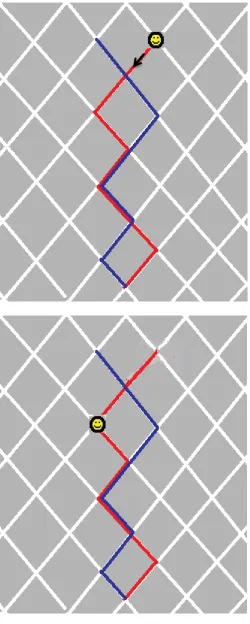
Insert Figure 1 about here
---
Experiment 1
Method
Participants
Thirty students (7 males, mean age=22.9) from introductory psychology
courses at Ben Gurion University participated in the experiment for course credit. All
participants reported normal or corrected-to-normal vision.
Apparatus
The experiment was conducted using IBM compatible Pentium III computers
with 17'' monitors. The screen was placed approximately 60 cm from the participants.
Participants responded by keyboard press. The onset of a stimulus started the timer;
the stimulus changed location (intersection) as soon as the participant responded.
Responses were indicated by pressing the 1/0 keys (arrows pointing right/left were
taped onto these keys). Participants were asked to use the index fingers of both hands
for key presses.
Stimuli and Procedure
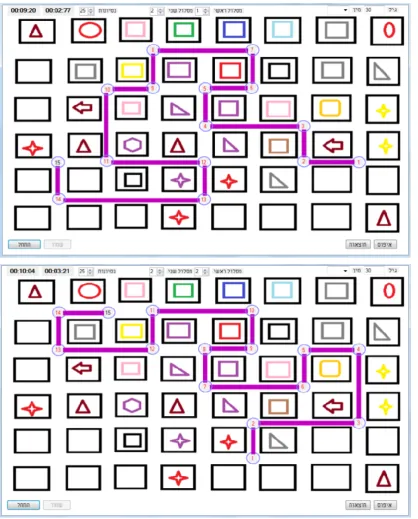
The stimuli were all based on two routes, that we call the red and the blue
routes. Each route comprises of BLOCKs, i.e., segments connecting two nearest
intersections. An 'intersection' is defined asa map location where one may make a
turn. As shown in Figure 1, there are 7 BLOCKs connected by 8 intersections in each
route. The routes were depicted on a city map (Figure 1) via a red line or blue line. At
all times, both red and blue lines, indicating the two routes, were present, regardless
of which route participants were responding to (this ensured saliency of the overlap
between the two routes). During training only the red route was performed, but during
test both the red and blue routes were performed. Indicating the route segments as
BLOCKs 1-2, 2-3, 3-4, 4-5, 6, 6-7 and 7-8, we note that two BLOCKs (4-5, and
5-6) were the same in both routes. BLOCK 4-5 began at intersection 4 and extended to
intersection 5, and BLOCK 5-6, began at intersection 5 and extended to intersection 6.
Traversing this same overlapping route segment required exactly the same response to
the same stimuli at the same location.
Training: Two groups of participants (sequential- vs. random-group)
underwent extensive training on the red route shown in Figure 1. Both groups were
instructed to follow the entire red route by monitoring the movement of a smil
ey and making the appropriate (left/right) response. Following each response,
the smiley would move to the next intersection. In the sequential group, the smiley
appeared at the beginning of the route and participants had to follow it by
arrow-response across the entire route in sequence. A Trial began with the smiley located at
the beginning of the training route (intersection 1, Figure 1), where the correct
response would be pressing the left-arrow key. A depiction of the third trial is shown
in Figure 1, lower panel, where after responding to the first two trials, the smiley
moves to the third intersection. The correct response for this trial would be the left
arrow which would move the smiley to intersection four, and so on. Once the smiley
reached the end of the route it returns to the beginning, and participants begun again.
The direction of movement was always from top to bottom.
In the random-group, participants were exposed during training to individual
BLOCKs along the red route, and never performed the entire route in sequence.
Namely, the smiley appeared at random intersections across the route, participants
made a single response (turn), upon which the smiley would randomly “jump” to
another intersection. Some learning should occur even for the random condition, as at
the very least, participants should gradually learn the correct responses to each
intersection.
Training was comprised of 10 blocks2, each consisting of 105 trials (traversing
7 BLOCKs 15 times). The response stimulus interval (RSI) separating each sequence
(of 7 responses) from each other was 1000 ms. During the RSI, the map appeared
with no smiley. Participants did not receive feedback; the smiley jumped to the next
intersection even after errors. Note that no feedback was necessary, since the red line,
2As explained above, block (lower-case) refers to a group of trials and not route segment (BLOCKS). 1
indicating the route, was continuously present on the screen and participants simply
had to make the correct responses, at different intersections (indicated by the smiley).
Test: While participants did not perform the blue route during training, it was
present, and thus participants during training saw that the overlapping route segment
was common to both the red and blue routes. After training, participants in both
groups proceeded to the same test, where they had to intermittently perform the old
route (red training route) and a blue novel route in a random order. Performance was
guided by the smiley which moved in a sequential manner from beginning to end. To
reiterate, the only difference between groups was at training, where the random-group
never performed the entire route in sequence. There were ten test blocks; each block
comprised a red and blue route each appearing once yielding 140 trials. After each
test route was performed, it was followed by an RSI of 1000 ms. During both training
and test trials, participants had to respond, as fast as possible, by pressing the
corresponding arrow key to the appearing smiley.
Results and discussion
The training results reveal improvement across training trials [F(9, 252)=
54.69, MSE= 13871, ήp2 = 0.66, p<.001]; from a mean of 612 ms to mean of 351 ms
in the experimental group and from a mean of 1008 ms to 699 ms in the control
group. These group differences were significant across all blocks [F(1, 28)= 335.29,
MSE= 217918, ήp2 = 0.92, p<.001], even in the last block [F(1, 28)= 321.00, MSE=
19814, ήp2 = 0.91, p<.001].
The key question of interest is whether a unitized representation developed, in
a way that individual route segments may no longer be relevant. To answer this
question we focused on the differences between overlapping route segments
performed in the context of the red and blue routes. Both RT and error data for all test
trials were recorded. Comparable analyses were run on both of these measures,
yielding similar results, except that some RT effects were not apparent in the error
data. There was no evidence of a speed-accuracy trade-off, thus, only RT data from
correct responses were included in the analysis and are presented in detail. Average
error rates were 3.3% for the sequential group and 2.4% for the control group.
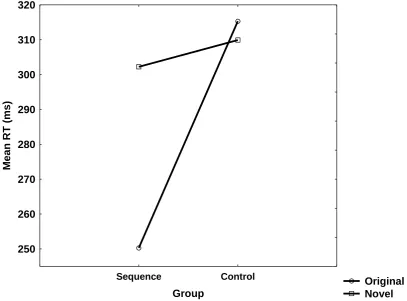
Test data: The median RT of each participant for each overlapping intersection
was calculated across blocks and averaged across participants, see Figure 2. These
medians were submitted to a two-way mixed analysis of variance (ANOVA) with
Route (original/novel) and Group (sequential/control) as between subject factors
(Figure 2).
---Insert Figure 2 about here
---
Performance on the original red route was faster than on the novel blue route
[F(1, 28)= 8.402, MSE= 968, ήp2 = 0.23, p<.01]. Overall performance of the
sequential group was marginally better than of the random group [F(1, 28)= 3.781,
MSE= 5241, ήp2 = 0.11, p<.07]. The critical Route by Group interaction was
significant [F(1, 28)= 12.734, MSE= 968, ήp2 = 0.31, p<.01]. Planned comparisons
revealed a significant difference within the sequential group, whereby latency was
faster when participants responded to the overlapping BLOCKs appearing in the
context of the original (red) route than when responding to these very same route
segments appearing in the context of the novel (blue) route [F(1, 28)= 20.799, MSE=
967.82, ήp2 = 0.42. p<.001]. No such effect was found in the random-group [F<1].
Please see Figure 2.
This main finding that RTs in the sequential group were shorter for thevery
same overlapping intersections (comprising BLOCKs 4-5 and 5-6) in the original
route than in the novel route, provides evidence for the type of unitization we
hypothesized (see also Perlman et al., 2015). This result suggests that item specific
information, which is necessary at least for initial performance, may be superseded,
when a unitized representation for the entire sequence emerges (see also Vallacher, &
Wegner, 1987).
It might be claimed that unitization was merely an efficient strategy in
Experiment 1, which resulted in enhanced performance at test. Responding using
individual item specific information for both the blue (novel) and red (original)
routes, would only benefit 2/7 responses (number of overlapping stimuli), while
responding on the basis of a unitized representation would benefit the remaining 5/7
responses in the original red route (number of non-overlapping stimuli).
Consequently, unitization rather than being obligatory may merely be a preferred
strategy employed only when there is no (cognitive) reason to utilize item-specific
information. Indeed, Perlman et al. (2010) showed that an increase in sequence
overlap renders unitization less likely. Yet Perlman et al.’s study concerned the
emergence of unitization and not the application of the corresponding knowledge
during test, after unitization was (presumably) generated. Nevertheless, motivated by
these ideas, we can ask a similar question: assuming a unitized representation has
already emerged, is it the case that it will be utilized when less efficient? Cognitively,
as the overlap between a learned sequence and a novel one increases, perhaps it would
make more sense to abandon a unitized representation and revert to item-specific
information. The converse possibility is that, once a unitized representation has
emerged, its use is obligatory, regardless of its efficiency in subsequent application of
the corresponding knowledge (Perlman, & Tzelgov, 2006). In Experiment 2 we
examine if the same result pattern would be observed when overlap increases to 3/7
(from 28% to 42%).
Experiment 2
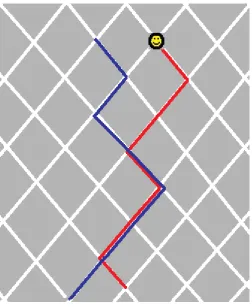
In Experiment 2 the degree of overlap between routes increased to include
intersections 4, 5 and 6 (BLOCKs 4-5, 5-6, and 6-7, see Figure 3). Observing the
same pattern of results as in Experiment 1 would suggest that a unitized
representation, once generated, will be employed in an obligatory way, such that it is
not possible to discard it, even if it becomes less efficient to utilize.
Method
Thirty university students (7 Males, Mean age=24.0) who did not take part in
Experiment 1, participated in Experiment 2. The map used in this experiment is
presented in Figure 3. Aside from increased overlap this experiment was identical to
Experiment 1.
---Insert Figure 3 about here
---
Results and discussion
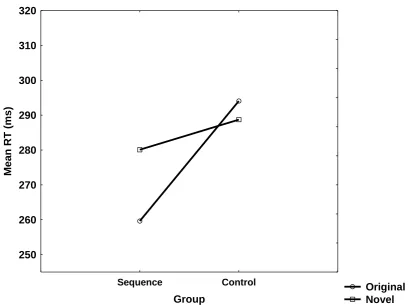
Visual inspection of the mean latencies in the various conditions presented in
Figure 4 show that the results of the experiment are broadly similar to those of
Experiment 1. As before, to address how sequential vs. random (control) training
affects performance, we focused on test performance. Regarding training, we briefly
mention that there was evidence for improvement [F(9, 243)= 27.01, MSE= 25146,
ήp2 = 0.50, p<.001], from a mean of 637 ms to a mean of 387 ms in the sequential
group and from a mean of 1148 ms to 726 ms in the control random group. These
differences between groups was also significant [F(1, 27)= 82.03, MSE= 1110335, ήp2
= 0.75, p<.001] even in the last block [F(1, 27)= 152.04, MSE= 39262, ήp2 = 0.84,
p<.001].
Both RT and error data for all test trials were recorded. Comparable analyses
were run on both of these measures, yielding similar results, except that some RT
effects were not apparent in the error data. As in Experiment 1, there was no evidence
of a speed-accuracy trade-off, thus, only the RT data are presented in detail. Average
error rates were 4% for both groups. Only RTs from correct responses were included
in the analysis.
As previously, for each participant, the median RT for each overlapping
intersection was calculated for all blocks and averaged across participants, see Figure
4. These medians were submitted to a two-way mixed analysis of variance (ANOVA)
with Route (original/novel) and Group as a between subjects factor (Figure 4). As
previously we focus on the interaction of Group by Route along with the
accompanying simple main effects. While the random group should show no
differences between performing the overlap route segments in the context of the two
routes (original-red/novel-blue), the sequential group should show better performance
for the overlapping BLOCKs in the context of the original route vs. the novel route.
---
Insert Figure 4 about here
---
The critical Route with Group interaction was significant [F(1, 28)= 5.717,
MSE= 437, ήp2 = 0.16. p<.05]. Planned comparisons reveal (see Figure 4) a
significant difference in the sequential group, where latency was faster when
participants responded to overlapping BLOCKs appearing in the context of the
original route than when responding to these very same BLOCKs when they appeared
in the context of the novel (blue) route, [F(1, 28)= 7.193, MSE= 4370, ήp2 = 0.20.
p<.05]. No such effect was found in the random group [F<1].
In both experiments, the sequential group responded faster to the very same
overlapping route segments when they appeared in the context of the original route
than when they appeared in the context of the novel route. Such results are consistent
with unitization of route learning occurring only in the sequential group. Showing this
same result pattern for increased overlap between routes where there is less utility for
a unitization strategy is consistent with unitization being less of a strategy and more of
an obligatory process that occurs regardless of overlap degree (Perlman, & Tzelgov,
2006). Once unitization develops, item specific information, such as specific
individual responses, may be less relevant to performance and execution of route
knowledge (see also Perlman et al., 2015).
In Experiments 1 and 2 a single route was employed at training and two routes
at test. Participants learned a specific given red training route, and at test, performance
of the same overlapping route segment was examined in both the context of this red
route and in the context of a novel blue route. It is possible (although unlikely) that
results may have been affected by this design. Also, having a single training route and
a single novel route in test rendered impossible the comparison between overlapping
and non-overlapping intersections. In Experiment 3 we ask whether the impairment in
performing the overlapping route segment in a novel context is similar in magnitude
to performing a new route segment (non-overlapping). In other words, is an old route
segment appearing in a new context treated it as if it were a new route segment?
Accordingly, Experiment 3 employed two counterbalanced routes, which were shown
to be equally difficult, enabling comparisons between non-overlapping segments.
In addition, we rectified some limitations of the first two experiments. First,
perhaps unitization effects are limited to relatively short routes comprising even
shorter overlapping segments. Unitization has been shown to be limited in sequence
learning paradigms to motor chunks involving only 4 or 5 elements (Ganor-Stern,
Plonsker, Perlman, & Tzelgov, 2013; Verwey, Shea, & Wright, 2015). Thus in
Experiment 3, route length was increased to 15 intersections comprising an
overlapping segment of six BLOCKs. Second, in Experiments 1 and 2 there were no
landmarks that could cue participants. It can be claimed that unitization in route
learning would be less necessary in the presence of landmarks, as learning can
develop by associating turns to landmarks (Epstein, & Vass, 2014). Would evidence
for unitization exist when landmarks are able to cue participants to familiar route
segments? Demonstrating similar results even in the presence of salient landmarks
would render the current claims more robust. Third, it might be claimed that showing
the whole route on the screen continuously (as in Experiments 1 and 2) facilitated
unitization. In Experiment 3, route presentation is limited by participants' progress.
Finally, it could be claimed that showing both routes across training, which on the one
hand is advantageous in rendering overlap more salient, may on the other hand have
been disadvantageous. For example it may have allowed for some passive learning of
the route intended as novel. In Experiment 3, only the route that was performed was
shown at any given time.
Experiment 3
The goal of Experiment 3 was to rectify the aforementioned points and to
examine if an old route segment that appears in the context of a novel route is
performed like a new (non-overlapping) route segment. Like previous experiments,
unitization would be demonstrated by comparing performance for the same
overlapping segments from the original and novel routes. If item specific information
is relevant to performance, participants would by definition recognize (at least show
benefit for) the relatively long overlapping segment comprising the same stimuli,
locations and response. Consequently, making the same response sequence to the
overlapping segment should be similar, regardless of route, even if it is not
consciously recognized as overlapping. Yet if item specific information is less
relevant after unitization, the overlapping route segments should be responded to
differently in the context of the training route than in the context of the novel route,
this would demonstrate unitization of the training sequence. If this difference is
similar to that observed between the non-overlapping segments of the original and
novel routes, it would suggest that an old route segment presented in the context of a
new route is akin to a novel stimulus.
Method
Participants
Thirty students (5 males, Mean age=25) from introductory psychology courses
at Bar Ilan University participated in the experiment for course credit. All participants
reported normal or corrected-to-normal vision.
Stimuli and Procedure
The experiment was programmed in C++, and conducted with IBM
compatible Pentium III computers and 17'' monitors. The screen was placed
approximately 60 cm from the participants. Participants responded by using the
computer mouse. The aim of the participant was to follow a target along a route as
shown in Figure 5. Response times were recorded.
Unlike Experiments 1 and 2, in this experiment the route was not shown
continuously during training, rather it was incrementally drawn, as participants
progressed through task. Note, such a procedure is ecological, as in guided route
navigation applications (e.g., Waze), the depicted route develops with one's progress.
The stimuli are shown in Figure 5a, 5b. The experiment was organized in 25 training
blocks and 5 test blocks. At training, participants received one of two routes. Both
routes comprised 15 intersections. Each of the two different routes (see Figure 5)
contained a common overlapping section comprising six BLOCKs. Half the
participants were trained on route A, and half were trained on route B. Each training
block consisted of 15 trials. Participants were instructed to follow a pink route-line by
moving the Microsoft mouse cursor to a circle at the end of the depicted route
segment (see Figure 6). Upon a response, the circle moved to the next intersection.
Accordingly, participants were required to "touch" the mouse cursor on the next
circle, for the target to move on to the following intersection. For example (see Figure
6), when moving from intersection 7 to 8, participants had to move the mouse along
the pink-line, when the cursor touches intersection 8, the pink-line begins moving to
intersection 9.
Two test routes, an original route and a novel route were presented
intermittently in a random order. As in training, at test as well, performance was
guided by tracking the route line with the mouse cursor (arrow, see Figure 5).
Participants were required to respond as fast as possible. Each route appeared 5 times
during test.
As opposed to both previous experiments where unitization was demonstrated
by a Group by Route interaction, in Experiment 3 there was only one group.
Accordingly, unitization should be demonstrated by a Route main effect (original vs.
new), which should be significant even for the overlapping segments. Namely, the
overlapping route segment in the context of a novel route should be performed
significantly slower than in the context of the original route.
---Insert Figure 5 about here
---
Results and discussion
We first checked that there were no overall differences in route difficulty:
there was no significant difference across the learning trials between each of the two
routes (F<1), indicating that both routes were comparable. Likewise, learning
performance for both the overlapping segments of these routes (F<1) and the
non-overlapping segments (F<1) was statistically the same.
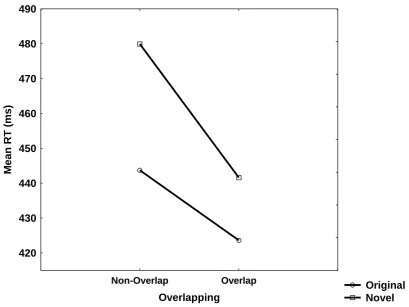
The mean RTs of each test block of responses were submitted to a two-way
analysis of variance (ANOVA) with Route (original-route/novel-route) and Overlap
(overlapping/non-overlapping) as within subject factors. The Overlap effect was
significant [F(1,29)= 21.077, MSE= 1215, ήp2 = 0.42, p<.0001], indicating that the
overlapping route segment was performed significantly faster than the
non-overlapping route segment. As expected, the critical Route effect was significant
[F(1,29)= 26.591, MSE= 829, ήp2 = 0.47, p<.0001], indicating that participants
performed significantly faster on the original route vs. the novel route. The Route by
Overlap interaction was not significant [F(1,29)= 1.561, MSE= 1596, ήp2 = 0.05,
p=0.22], indicating that the observed performance advantage for the original vs. novel
route evident in the non-overlapping condition was not statistically different than the
same performance advantage evident in the very same overlapping route segments.
Namely, performance of the non-overlapping route segment in the original route (443
ms) was faster than in the novel route (479 ms). Likewise, performing the overlapping
segment in the original route was faster (423 ms) than performance of this very same
segment in the novel route (441 ms). Furthermore, these differences were similar; the
difference between overlapping segments performed in the context of the old vs, new
route was similar to the difference observed between both routes in the
non-overlapping route segments.
Unitization in the current experiment was demonstrated even when the length
of the entire route and its overlapping segment was doubled. Demonstrating
unitization for a segment of six overlapping elements appears to extend previous
sequence learning findings where motor chunk size was limited to 4 or 5 elements
(Ganor-Stern, et al., 2013; Verwey, Shea, & Wright, 2015). In addition, unitization
occurred even when landmarks were available and could have been potentially used,
and thus learning could have relied on item-specific representations by associating
responses to landmarks (Epstein, & Vass, 2014). Note that landmark processing was
not part of task requirement (Strickrodt, et al., 2015) e.g., turn left at the "big oak".
Other studies however show that the mere presence of constant landmarks is sufficient
to allow their processing in a manner beneficial to route learning (Foo, Duchon,
Warren, & Tarr, 2007). Thus while it is likely that landmark processing occurred,
future research is required to discern if the obtained results apply to situations where
intentional and associational landmark processing are part of task requirement. Finally
results indicated that an old route segment in the context of a new route is performed
as if it were a completely new route segment.
--
---Insert Figure 6 about here
---
General discussion
It is typically the case that route learning is assumed to depend on item
specific information such as angles, direction or turns (Gillner & Mallot, 1998;
Kuipers, 1978, 2000; Werner, et al, 2000; Kuipers, et al, 2003; Meilinger, 2008).
Extending previous approaches (Strickrodt , et al., 2015), we have demonstrated here
that, after sufficient learning, a unitized representation for a fixed route can emerge.
That is, the sequence of elements comprising a route can be unitized. This unitized
representation of a route sequence may suffice to guide an individual across the route,
in an assumedly more efficient manner, compared to a disjointed non-unitized
representation. Similarly, the motor behavior literature also indicates that people have
the capacity to control short sequences of actions using chunks, whose elements can
be treated collectively (Rhodes, Bullock, Verwey, Averbeck & Page, 2004; Sakai,
Kitaguchi, & Hikosaka, 2003; Verwey, 1999, 2001; Verwey, Lammens & van Honk,
2002, Verwey, & Wright, 2014). Additionally, in contrast to typical sequence learning
paradigms where motor chunks represented subsequences with up to 4 or 5 elements
(Ganor-Stern, et al., 2013; Verwey, Shea, & Wright, 2015), Experiment 3
demonstrates unitization of a long sequence consisting of 15 segments. Accordingly,
unitization may be not as limited as previously supposed.
As mentioned, the current paradigm involving following a dot across a map
may involve different learning mechanisms than route learning in some of the
aforementioned route learning studies (e.g., Meilinger, et al., 2014), where one
actually moves through space. Thus additional research may be required before
concluding that the current results straightforwardly apply to all forms of route
navigation. In any event, this paradigm is ecological because it resembles navigation
applications (Google-maps, Waze) where one follows a moving dot across a map.
While a process of unitization is known to be relevant to other sequence
learning tasks (Perlman, et al., 2010), these experiments extend earlier results to the
domain of procedural route learning. These results suggest a new angle in route
learning and navigation, whereby route knowledge, similar to information from other
sequence learning paradigms, can be represented in a high density fashion, where all
item-specific information, e.g., a specific turn, is compressed into a single unit which
cannot be readily unpacked. Thus, as in other domains (Perlman et al., 2010; Perlman
et al., 2015), following unitization, the item specific information that preceded
learning may cease to be accessible or relevant. Consequently, individual elements no
longer appear familiar as indicated by the increased RT for exactly the same turns in
the overlapping segment when appearing in the novel route relative to the training
route. This suggests that item specific information of a given response (turn) may
exist only in the context of a given route, and thereby would only be helpful when
performing the same exact route.
Unitization may be advantageous because it reduces the amount of
information necessary for representation, i.e., instead of maintaining a representation
of seven or fifteen individual turns, one may represent an entire route as a single
representation, e.g., "route x", thereby reducing cognitive load. As the route becomes
unitized, it constitutes a single object in working memory and thus presumably its
representation is less demanding, as opposed to representing seven or fifteen
individual units of information. Research by Bo and Seidler (2009) as well as Seidler,
Bo, and Anguera (2012) support the link between unitization and working memory.
Another advantage of unitization is that the output, such as route navigation, may be
performed automatically; there is no need to consciously retrieve the relevant
information (see Ganor-Stern, et al., 2013 for such an account).
Viewing route learning as an automatic execution of a motor sequence does
not belittle the importance of item specific information. On the contrary, we believe,
in line with other prominent models such as the ACT-R (Adaptive Character of
Thought-Rational, Anderson, & Matessa, 1997) theory, that typical learning initially
relies on item specific declarative information ("at the big oak tree turn left", "when
you reach Macy's turn right"). However, with practice, a route sequence may
gradually become unitized and less reliant on item specific information, as is the case
with other types of skill learning (see Anderson, & Matessa, 1997). It is interesting to
note that, even in the superficially simple examples in the present experiments, an
algorithm that qualitatively reproduces our results would not be straightforward. Such
an algorithm would still need to be context-dependent, that is, allow for the fact that
exactly the same stimuli may be responded to differently in different contexts (for
illustration, in Appendix 1 we consider some simple examples of corresponding
algorithms).
Sequence learning may lead to sequence knowledge consisting of associations
between the stimuli (Mayr, 1996), responses (Willingham, Wells, Farrell, &
Stemwedel, 2000), response–stimulus compounds (Ziessler, 1998) or stimulus–
response compounds (Schwarb & Schumacher, 2010). The present results
demonstrate that these narrow associations consisting of two elements are not driving
current performance. Associations between two locations were not relevant to
performance, thus something more is needed in order to explain learning.
Accordingly, we would expect that drivers who drive along a fixed route may perform
their daily driving in an automatic fashion, and so they would not be confused by
changing landmarks (e.g., removal of the oak tree, or relocation of Macy's). Clearly,
there is a tradeoff between robustness of the route knowledge and inflexibility, in
cases when route variations are expected. Moreover, automaticity of a unitized
representation may also produce disadvantages in performance, as changes in a
sequence would be more difficult, once a route is unitized. For instance, think of a
situation where one frequently travels from X to Y via Route A in 80% of
circumstances, then one day wishes to travel from X to Y via Route B, but wrongly
takes the turn A instead. As the route sequence (X to Y via A) is a single unit (or
decision), more cognitive resources may be needed to be allocated for properly
traveling from X to Y via B (this extra processing is manifest through time latencies
in classic unitization studies).
In the current study, participants learned the route in a guided manner, a
manner of route learning that is highly relevant for everyday life, due to the increasing
popularity of navigation aids based on the global positioning system (GPS). Indeed
while guided learning may produce fewer errors than non-guided route learning, less
spatial awareness may ensue as a result of guided route learning (Li, Zhu, Zhang, Wu,
& Zhang, 2013). The implications of the current study pertain to fixed routes. Other
disadvantages have been documented for guided vs. non-guided walking (Ishikawa,
Fujiwara, Imai, & Okabe, 2008).
Along with the many advantages of a unitized route representation, the current
aforementioned possible disadvantage has implications for transfer. The rigidity of
unitized knowledge may generate a situation of non-transferable learning where
knowledge about an overlapping route section in one context will not transfer to
another route. Such skill learning may remain specific, as observed for example in
sequence learning (Sanchez, Yarnik, & Reber, 2014), perceptual tasks (e.g., Karni &
Sagi, 1991) or motor tasks (e.g., Pashler & Baylis, 1991). Conversely, a non-unitized
representation should transfer from one context to another, as in the cases of pilots
benefiting from a simulation of a flight experience (Gopher, Weil, & Bareket, 1994).
Transfer of learning has been a central theme in both cognitive psychology and
practical training courses. The current results can be viewed in this light, as an
absence of transfer, namely, knowledge of the overlapping same turns did not transfer
from the training route to the novel route. The current lack of transfer may differ from
that in related situations, namely, as everything about these overlapping stimuli in the
present experiments was identical (e.g., stimuli, location and responses), still the same
stimuli were responded to faster in the context of the familiar route versus the novel
route. Perhaps transfer would have occurred if the learning procedure varied, and thus
item specific information would not have been tied exclusively to a given context,
e.g., a given route (Perlman et al., 2015; see also Green, & Bavelier, 2008, for a
similar claim). Accordingly if from the beginning of training, turns along a given
route are equally traveled in the context of other routes, transfer may be more likely.
More research is needed to investigate this interesting topic.
Compliance with Ethical Standards
Funding: This study was not funded.
Conflict of interest: The authors declare that they have no conflict of interest.
Ethics: All procedures performed in the reported studies were in accordance with the institutional ethical committee and with the 1964 Helsinki declaration and its later amendments or comparable ethical standards
Informed consent: Informed consent was obtained from all individual participants included in the study.
References
Anderson, J. R., & Matessa, M. (1997). A production system theory of serial
memory. Psychological Review, 104(4), 728.
Bailenson, J. N., Shum, M. S., & Uttal, D. H. (2000). The initial segment
strategy: A heuristic for route selection. Memory & Cognition, 28(2), 306–318.
Bo, J., & Seidler, R. D. (2009). Visuospatial working memory capacity
predicts the organization of acquired explicit motor sequences. Journal of
Neurophysiology,101, .3125–3116
Boucher, L. & Dienes, Z. (2003). Two ways of learning associations.
Cognitive Science, 27, 807-842.
Cleeremans, A., & McClelland, J. L. (1991). Learning the structure of event
sequences. Journal of Experimental Psychology: General, 120, 235–253.
Dienes, Z., & Perner, J. (1999). A theory of implicit and explicit knowledge.
Behavioral and Brain Sciences, 22, 735–808.
Elman, J.L. (1990). Finding Structure in Time. Cognitive Science, 14, 179–
211.
Endsley, M.R. (1995). Toward a theory of situation awareness in dynamic
systems. Human Factors, 37, 32–64.
Epstein, R. A., & Vass, L. K. (2014). Neural systems for landmark-based
wayfinding in humans. Philosophical Transactions of the Royal Society B: Biological
Sciences, 369: 20120533.
Foo, P., Duchon, A., Warren Jr, W. H., & Tarr, M. J. (2007). Humans do not
switch between path knowledge and landmarks when learning a new
environment. Psychological research, 71(3), 240-251. 1
Fu, E., Bravo, M., & Roskos, B. (2015). Single-destination navigation in a
multiple-destination environment: a new “later-destination attractor” bias in route
choice. Memory & cognition, 1-13.
Ganor-Stern, D., Plonsker, R., Perlman, A., & Tzelgov, J. (2013). Are all
changes equal? Comparing early and late changes in sequence learning. Acta
Psychologica, 144(1), 180-189.
Gillner, S., & Mallot, H. A. (1998). Navigation and acquisition of spatial
knowledge in a virtual maze. Journal of Cognitive Neuroscience, 10, 445–463.
Giroux, I., & Rey, A. (2009). Lexical and sub-lexical units in speech
perception. Cognitive Science, 33, 260–272.
Gopher, D., Well, M., & Bareket, T. (1994). Transfer of skill from a
computer game trainer to flight. Human Factors: The Journal of the Human
Factors and Ergonomics Society, 36(3), 387-405.
Goldstone, R. L. (2000). Unitization during category learning. Journal of
Experimental Psychology: Human Perception and Performance, 26, 86-112.
Golledge, R. G. (Ed.). (1999). Wayfinding behavior: Cognitive mapping and
other spatial processes. Baltimore, MD, USA: Johns Hopkins University Press.
Green, C. S., & Bavelier, D. (2008). Exercising your brain: a review of human
brain plasticity and training-induced learning. Psychology and aging, 23(4), 692-701.
Hochmair, H. H., & Frank, A. U. (2002). Influence of estimation errors on
wayfinding-decisions in unknown street networks—analyzing the least angle strategy.
Spatial Cognition and Computation, 2(4), 283–313.
Ishikawa, T., Fujiwara, H., Imai, O., & Okabe, A. (2008). Wayfinding with a
GPS-based mobile navigation system: A comparison with maps and direct
experience. Journal of Environmental Psychology, 28(1), 74-82.
Karni, A., & Sagi, D. (1991). Where practice makes perfect in texture
discrimination: evidence for primary visual cortex plasticity. Proceedings of the
National Academy of Sciences, 88(11), 4966-4970.
Klippel, A., Tappe, H., & Habel, C. (2003). Pictorial representations of routes:
Chunking route segments during comprehension. In Spatial cognition III (pp. 11-33).
Springer Berlin Heidelberg.
Knowlton, B. J., & Squire, L. R. (1996). Artificial Grammar Learning Depends
on Implicit Acquisition of Both Abstract and Exemplar-Specific Information. Journal
of Experimental Psychology: Learning, Memory and Cognition, 22, 169-181.
Kuipers, B. (1978). Modeling spatial knowledge. Cognitive Science, 2, 129–
153.
Kuipers, B. (2000). The spatial semantic hierarchy. Artificial Intelligence, 19,
191–233.
Kuipers, B., Tecuci, D. G., & Stankiewicz, B. J. (2003). The skeleton in the
cognitive map: A computational and empirical exploration. Environment & Behavior,
35(1), 81–106.
Li, B., Zhu, K., Zhang, W., Wu, A., & Zhang, X. (2013). A Comparative
Study of Two Wayfinding Aids With Simulated Driving Tasks—GPS and a
Dual-Scale Exploration Aid. International Journal of Human-Computer Interaction, 29(3),
169-177. 1
Maguire, E. A., Woollett, K., & Spiers, H. J. (2006). London taxi drivers and
bus drivers: a structural MRI and neuropsychological analysis. Hippocampus, 16(12),
1091-1101.
Meilinger, T., Frankenstein, J., & Bülthoff, H. H. (2014). When in doubt
follow your nose–a wayfinding strategy. Frontiers in Psychology, 5, 1363.
Meilinger, T. (2008). The network of reference frames theory: A synthesis of
graphs and cognitive maps. In C. Freksa, N. Newcombe, P. Gärdenfors, & S. Wölfl
(Eds.), Spatial cognition VI: Learning, reasoning, and talking about space (pp. 44–
360). Berlin: Springer.
Mayr, U. (1996). Spatial attention and implicit sequence learning: Evidence
for independent learning of spatial and nonspatial sequences. Journal of Experimental
Psychology: Learning, Memory, and Cognition, 22, 350 –364.
Miller, G. A. (1956). The Magical Number Seven, Plus or Minus Two:
Some Limits on Our Capacity for Processing Information. The Psychological
Review, 63, 81-97.
Newell, A., & Simon, H. A. (1972). Human problem solving. Englewood
Cliffs, NJ: Prentice-Hall.
Pashler, H., & Baylis, G. C. (1991). Procedural learning: II. Intertrial
repetition effects in speeded-choice tasks. Journal of Experimental Psychology:
Learning, Memory, and Cognition, 17(1), 33-48.
Perlman, A., Hoffman, Y., Tzelgov, J., Pothos, E. M., & Edwards, D. J.
(2015). The notion of contextual locking: Previously learnt items are not accessible as
such when appearing in a less common context. The Quarterly Journal of
Experimental Psychology, 1-22.
Perlman, A., Pothos, E. M.. Edwards, D., Tzelgov, J., & (2010). Task-relevant
chunking in sequence learning. Journal of Experimental Psychology: Human
Perception & Performance. 36, 649-661.
Perlman, A., & Tzelgov, J. (2006). Interactions between encoding and retrieval
in the domain of sequence-learning. Journal of Experimental Psychology: Learning,
Memory, and Cognition, 32(1), 118-130.
Perruchet, P., & Vinter, A. (2002). The self-organizing consciousness
Behavioral and Brain Sciences, 25, 297–388.
Pothos, E. M. (2007). Theories of artificial grammar learning. Psychological
Bulletin, 133, 227–244.
Rhodes B. J., Bullock D., Verwey W. B., Averbeck B. B., & Page M. P. A.
(2004) Learning and production of movement sequences: behavioral,
neurophysiological, and modeling perspectives. Human Movement Science 23, 699–
746.
Richter, K.-F., and Klippel, A. (2005). “A model for context-specific route
directions.,” in Spatial Cognition IV. Reasoning, Action, Interaction, eds. C. Freksa,
M. Knauff, B. Krieg-Brückner, B. Nebel, and T. Barkowsky (Berlin: Springer), 58–
78.
Rosenbaum, D. A., Kenny, S. B., & Derr, M. A. (1983). Hierarchical control of
rapid movement sequences. Journal of Experimental Psychology: Human Perception
and Performance, 9, 86-102.
Rosenbaum, D. A., Hindorff, V., & Munro, E. M. (1987). Scheduling and
programming of rapid finger sequences: Tests and elaborations of the hierarchical
editor model. Journal of Experimental Psychology: Human Perception and
Performance, 13, 193-203.
Rumelhart, D. E. & McClelland J. L. (1986). Parallel Distributed
Processing, Vol. 1, Foundations. Cambridge, Mass: MIT Press.
Sakai, K., Kitaguchi, K., & Hikosaka, O. (2003). Chunking during human
visuomotor sequence learning. Experimental Brain Research, 152, 229–242.
Sakellaridi, S., Christova, P., Christopoulos, V. N., Vialard, A., Peponis,
J., & Georgopoulos, A. P. (2015). Cognitive mechanisms underlying instructed
choice exploration of small city maps. Frontiers in neuroscience, 1-12.
Sanchez, D. J., Yarnik, E. N., & Reber, P. J. (2014). Quantifying transfer
after perceptual-motor sequence learning: how inflexible is implicit learning?
Psychological research, 79(2), 327-343.
Schwarb, H., & Schumacher, E. H. (2010). Implicit sequence learning is
represented by stimulus–response rules. Memory & Cognition, 38, 677–688.
Seidler, R. D., Bo, J., & Anguera, J. A. (2012). Neurocognitive
contributions to motor skill learning: The role of working memory. Journal of
Motor Behavior, 44(6), 445–453.
Servan-Schreiber, E., Anderson, J. R. (1990). Learning Artificial
Grammars With Competitive Chunking, Journal of Experimental Psychology:
Learning Memory and Cognition, 16, 592-608.
Simon, H. A. & Barenfeld M. (1969), Information-Processing Analysis of
Perceptual Processes in Problem Solving. Psychological Review, 76, 473-483.
Strickrodt, M., O'Malley, M., & Wiener, J. M. (2015). This Place Looks
Familiar—How Navigators Distinguish Places with Ambiguous Landmark
Objects When Learning Novel Routes. Frontiers in psychology, 6.
Taatgen, N. A. (2002). A model of individual differences in skill acquisition in
the Kanfer-Ackerman air traffic control task. Cognitive Systems Research, 3, 103–
112.
Vallacher, R. R., & Wegner, D. M. (1987). What do people think they're doing?
Action identification and human behavior. Psychological review, 94(1), 3-15.
Verwey, W. B. (1999). Evidence for a multi-stage model of practice in a
sequential movement task. Journal of Experimental Psychology: Human Perception
and Performance, 25, 1693–1708.
Verwey, W. B. (2001). Concatenating familiar movement sequence: The
versatile cognitive processor. Acta Psychologica, 106, 69–95.
Verwey, W. B., Lammens, R., & van Honk, J. (2002). On the role of the SMA
in the discrete sequence production task. A TMS study. Neuropsychologia, 40, 1268–
1276.
Verwey, W. B., Shea, C. H., & Wright, D. L. (2015). A cognitive framework for
explaining serial processing and sequence execution strategies. Psychonomic bulletin
& review, 22(1), 54-77.
Verwey, W. B., & Wright, D. L. (2014). Learning a keying sequence you never
executed: Evidence for independent associative and motor chunk learning. Acta
psychologica, 151, 24-31.
Werner, S., Krieg-Brückner, B., & Herrmann, T. (2000). Modelling
navigational knowledge by route graphs. In C. Freksa, W. Brauer, C. Habel, & K. F.
Wender (Eds.), Spatial cognition II: Integrating abstract theories, empirical studies,
formal methods, and practical applications (pp. 295–316). Berlin, Heidelberg:
Springer.
Willingham, D. B., Wells, L. A., Farrell, J. M., & Stemwedel, M. E. (2000).
Implicit motor sequence learning is represented in response locations. Memory &
Cognition, 28, 366 –375.
Ziessler, M. (1998). Response– effect learning as a major component of
implicit serial learning. Journal of Experimental Psychology: Learning, Memory, and
Cognition, 24, 962–978.
Figure Captions
Fig. 1Upper panel: The stimuli employed in Experiment 1, which consisted of one
learning route (red) and two test routes (the same red route along with a novel blue
route). Navigation takes place from the upper part of the map downwards. Note that
while only one route is being performed at any given time, both routes are shown
throughout learning and test. Travel direction is indicated by the arrow. Lower panel:
An example of the third learning trial in Experiment 1. After participants have
responded twice via arrow press, the smiley moves to the third intersection. The
correct response for this third trial would be the left arrow.
Fig. 2Mean of median reaction times (RTs) for all test blocks of trials for the original
and novel routes, in each condition of Experiment 1.
Fig. 3The stimuli employed in Experiment 2.
Fig. 4 Mean of median reaction times (RTs) for all test blocks of trials for the original
and novel routes, in each condition of Experiment 2.
Fig. 5 The stimuli employed in Experiment 3 for Routes 1 (A) and 2 (B). Note that
the overlapping segment in Route A (intersections 3-9) and Route B (intersections
6-12) is exactly the same.
Fig. 6 Example of a learning trial for route 1 (Experiment 3). After responding to the
seventh learning intersection by moving the mouse, the subject must move the cursor
to the eighth intersection for the route to continue to intersection 9.
Fig. 7Mean of median reaction times (RTs) for all test blocks of trials for the original
and novel routes, in each condition of Experiment 3.
Appendix 1
Simple algorithms for modeling sequence learning: We ask what kind of
simple algorithms could, in principle, describe performance in our experiments and,
specifically, the key finding that the overlapping stimuli were responded to differently
in the practiced sequence than in isolation. These algorithms are clearly not cognitive
models, but still they may be useful in that they illustrate the algorithmic complexity
of the obtained results. For example, imagine one needs to program the order of
operations for a robot from 1 to n.This can be done in several ways, A-D.
A:
If 1 than 2
If 2 then 3
If 3 than 4
In this (A) situation after 1, 2 has to appear. Even when a robot performs Action 2
after (say) 6 rather than after the Action 1, it knows to proceed to Action 3. In B, if 2
appears, then 3 may not necessarily appear, rather, only if 1 and 2 appear in sequence
will 3 follow.
B:
If 1 than 2
If 1 & 2 than 3
If 1 & 2 & 3 than 4
C:
If 1 then 2
If 2 then 3
If 3 then 4
End if
End if
End if
D:
If x=1 then 2
Else if x<n then x+1
Else if x=n end
In C and D situations, Action 3 must appear after Action 2 that follows Action 1. In
Situation C for example, when the robot performs Action 2 after (say) Action 6 rather
than after the first action, it does not know that it has to continue to Action 3. If the
robot in situation D performs Action 6 and then 3, it will correctly infer Action 4. Yet
even in such a case the robot does not seem able to reproduce the obtained behavioral
results, as the overlapping segment is performed differently in the original and novel
routes. The very same route sequence is performed differently by the cognitive system
according to the route context it appears in.
One of the possibilities that arise from this study is that during training, there is a
transition from declarative memory of separate connections between the locations
from 1 to n, that is as in A, to procedural and automatic execution where Action 1
leads to Action 2 which leads to Action 3 which leads to 4 as in B, C and D. If one
preforms the route in an automatic manner as a unit, but at some point transfers to a
different route that partly overlaps with the old route, performance must revert again
to declarative memoryof separate connections between the locations.
Original Novel
Sequence Control
Group 250
260 270 280 290 300 310 320
M
e
an
RT
(
[image:43.595.95.503.100.401.2]Original Novel
Sequence Control
Group 250
260 270 280 290 300 310 320
M
e
an
RT
(
[image:45.595.94.504.116.421.2]