City, University of London Institutional Repository
Citation
: Maiden, N., Zachos, K., Lockerbie, J., Brock, G. & Traver, C. (2016). Developing
and Evaluating Digital Creativity Support in Google Docs for Journalists. Paper presented at
the British HCI Conference 2016, 11-15 July 2016, Bournemouth, UK.
This is the accepted version of the paper.
This version of the publication may differ from the final published
version.
Permanent repository link:
http://openaccess.city.ac.uk/15126/
Link to published version
:
Copyright and reuse:
City Research Online aims to make research
outputs of City, University of London available to a wider audience.
Copyright and Moral Rights remain with the author(s) and/or copyright
holders. URLs from City Research Online may be freely distributed and
linked to.
City Research Online:
http://openaccess.city.ac.uk/
[email protected]
Developing and Evaluating Digital Creativity
Support in Google Docs for Journalists
Neil Maiden City University
Lon-don Cass Business School, London
N.A.M.Maiden@ city.ac.uk
Konstantinos Zachos City University
Lon-don Cass Business School, London
kzachos@ soi.city.ac.uk
James Lockerbie City University
Lon-don Cass Business School, London
James.Lockerbie.1 @city.ac.uk
George Brock Department of
Jour-nalism City University
Lon-don
George.Brock.1@ city.ac.uk
Christopher Traver Cornell University Information Science
Department, Ithaca NY [email protected]
Although journalism is classified as one of the creative industries, there is little bespoke digital support for creative thinking by journalists. To fill the gap, this paper reports new research that led to the implementation and first evaluation of JUICE, a new digital prototype to support creative thinking by journalists during the early development of news stories. Emerging from a user-centred design process, JUICE is implemented as a simple Add-on Sidebar and Dialog Box in Google Docs that a journalist can invoke when developing news stories. Interviews with experi-enced journalists were used to elicit 6 strategies that JUICE uses to guide its users to generate dif-ferent angles on news stories using creative information searches and interactive creativity sup-port. In this paper we describe the information search algorithm and new interactive support to create news stories with one of these strategies – the individual human angle on the story – then report a first evaluation of JUICE implemented with the algorithm and support during its use by journalism students. Results revealed that most of these student journalists were able use JUICE to generate new news stories with individual human angles in a short period of time, but still used established web search tools to collect more detailed information about the angle in order to write the story. Journalist feedback was used to improve the usability of JUICE and design new interac-tive features.
Journalism; Digital Creativity Support; Human-Centred Creative Cognition; Formative Evaluation.
1. INTRODUCTION
The last decade has seen new forms of interactive digital support for human creativity emerge for use in creative industries, such as in film and television (Alaoui et al. 2015, Honauer & Hornecker 2015), and non-creative industries such as in manufactur-ing (Zachos et al. 2015) and the biological sciences (Wu et al. 2011). Development of these tools has been based on different creativity paradigms, from multi-sensory stimulation (Baas et al. 2008) and da-ta visualisation (Wu et al. 2011) to information search and discovery (Kerne et al. 2011), and tool evaluations have revealed their effectiveness in di-verse professional work settings (e.g. Zachos et al. 2013). However, although journalism is classified as one of the creative industries, and information search is an important activity when creating news stories, there is little digital support for journalists to think creatively during information search to devel-op novel news stories.
This paper reports research that led to the imple-mentation and first evaluation of one new form of
embed-ded in some of the daily work tools and practices of journalists.
The remainder of this paper is in 5 sections. Sec-tion 2 reviews related digital tools in journalism, lin-guistic creativity, and interactive creativity support. Sections 3 and 4 describe the user-centred process applied to design a first JUICE digital prototype, and the new interaction design and creative search algorithms that resulted from this process. Section 5 reports the method and results from a qualitative first evaluation of JUICE with journalism students – results that revealed that most of these trainee journalists were able use JUICE to generate news stories with individual human angles in a short pe-riod of time, but chose to still use established web search tools to find and collect more detailed infor-mation about the selected angle, to write the story. The paper ends with a discussion of these results, and outlines future plans to evolve then evaluate future versions of JUICE, and to roll it out in differ-ent news environmdiffer-ents.
2. RELATED WORK
The research adopted Sternberg’s (1999) definition of creativity – the ability to produce work that is novel and appropriate to the task – as prototypical of those reported. It also adopted the American Press Institute’s definition of journalism as the pro-cess of gathering, assessing, creating and present-ing news and information (API 2016). Therefore, the research undertaken in this paper defined crea-tive journalism that is supported by digital tools as the generation and presentation of information that is both useful and new to the journalist and the news consumer.
There have been surprisingly few bespoke digital tools to support creative thinking by journalists. As a workaround to this gap, some journalists have adapted general-purpose, standalone search tools to support the development of news stories. Exam-ples of these tools include import.io and
www.social-searcher.com, both web-based tools
that implement keyword searches of multiple social media channels such as websites and Twitter, pre-sent comparative results, and refine subsequent searches with extracted keywords and selected channels. However, neither tool is tailored to the tasks of journalists, only support syntactic keyword searches, and do not explicitly support idea gen-eration during story development. Some bespoke digital journalism tools that exploit artificial intelli-gence techniques have been reported. For
exam-ple Alchemy API (2016) has been applied to
sup-port journalists to make sense of unstructured natu-ral language data with end-user applications and deliver human insights using advanced text analy-sis and visualisation techniques, and the STEAM-ER prototype automatically searches large
text/video databases using algorithms to detect sentiment in news content, categorize news and lifestyle content, and detect events and trending topics. However, neither explicitly support computa-tional creative searches of news information nor human creative thinking with this information by journalists. The NewsReader research prototype also combines text analysis and artificial intelli-gence techniques to build structured event indexes of large volumes of financial and economic data for decision making from news content (e.g. Minard et al. 2015), but its focus is structured decision sup-port rather than early creative search or new idea generation. Major news organisations have also developed bespoke digital news search tools using advanced text analysis that are not in the public domain, and our analysis of them reveals no explic-it digexplic-ital support for journalist creativexplic-ity.
Most existing research to develop new forms of in-teractive digital support for human users to gener-ate creative outcomes has been targeted at do-mains in which people are trained to have creative skills, for example the performing arts, music, and film and television (e.g. Alaoui et al. 2015, Honauer & Hornecker 2015). Examples of this digital support include StoryCrate, a collaborative editing tool de-veloped to drive users’ creative workflows within a location based television production environment (Bartindale et al. 2013) and Trigger Shift, which ap-propriated commercial information technologies in-to performance art in theatre (Schofield et al. 2013). Studies of some of these digital tools have been shown to support creative thinking by their users (e.g. Jain et al. 2015). Although less widely implemented, digital creativity support has also been developed to support creative thinking in sci-ence and engineering, for example in the forms of new table top visualizations to support biological discoveries (Wu et al. 2011) and social media to support collaborative creativity in education (Ara-gon et al. 2009).
To align with the American Press Institute’s defini-tion of journalism that includes gathering and creat-ing news and information, our research adopts Kerne’s framing of creativity as an information dis-covery process that emphasizes idea generation over information finding (Kerne et al. 2008), and exploits the searching and browsing capabilities of digital technologies to support information finding and idea generation based on natural language processing. Examples of existing creativity support tools that exploit such framing include
CombinFor-mation (Kerne et al. 2008) and TweetBubble (Jain
software service design (Zachos & Maiden 2008) and the MEXICA model of automatic creative story-telling (Monfort et al. 2013). However, few of these digital tools that compute possible creative out-comes are designed to present these outout-comes to end-users to stimulate their cognitive creativity. Moreover, our recent experiences with digital tools to support creative professional work have revealed the need to integrate this digital creativity support into daily work practices, to avoid additional cogni-tive load and support pain-free exploration and ex-perimentation with the tools (Greene 2002). For example the Risk Hunting app, a digital tool that provides creativity support to employees on pro-duction lines to resolve health-and-safety risks in a manufacturing plant creatively (Zachos et al. 2015), was discovered to be more effective when it was in-tegrated tightly into daily work practices. The app was designed to replicate the paper-based process to be familiar to employees, who were then able to use it for daily risk recording when the creativity support was not required, and use of this support delivered not only guidance for creative thinking but also increases in productivity through use of auto-matically-generated ideas with which to resolve risks (Zachos et al. 2015).
However, the published creativity support tools that are available for use were not designed to fit the work practices of journalists. Indeed most, such as Combinformation (Kerne et al. 2008) and
Tweet-Bubble (Jain et al. 2015) are general-purpose and
search for information available to Internet search engines. A smaller number of domain-specific crea-tivity support tools have been adapted to fit to work practices of specific domains, for example the
Sto-ryCrate tool for television production (Bartingdale et
al. 2013), but none have been developed to sup-port journalism tasks. The resulting gap highlights a need for a new creativity support tool that searches for relevant news information and is adapted to the needs and work practices of journalists.
To conclude, although there is reported use of ad-vanced digital search tools by journalists, these dig-ital tools neither fit to the daily work practices and tools of journalists, nor implement search strategies associated with generating creative angles on news stories. The limited but successful uptake of digital tools to support human creativity in other creative industries reveals one possible form of new digital creativity support in journalism, as long as these tools are integrated into the tools and practices of daily professional work. Indeed, successful creativi-ty support tools are expected to support pain-free exploration and experimentation to promote active learning and discovery (Greene 2002), so one out-standing challenge for interaction designers is to deliver effective digital support for creative thinking that is embedded seamlessly in the practices of dif-ferent professions such as journalism.
3. THE USER-CENTRED DESIGN PROCESS
The digitalization of the production and distribution of news, and subsequent new patterns of reader behaviour and fragmentation of audiences, have rendered news businesses uncompetitive (Currah 2009). Declining circulations, rising costs and loss of advertising revenue to non-editorial search en-gines and social media have resulted in staff reduc-tions, content syndication and centralisation of core services (Sjøvaag 2014). Work processes in tradi-tional newsrooms are held in check by the conser-vational attitudes of journalists who, if their jobs are at risk, are unlikely to change practices (Ekdale et. al. 2015). As a consequence journalists tend to fo-cus on only a few available information sources and achieve only moderate success in their search efforts; indeed, the telephone remains an important research tool for many (Machill & Beiler 2009), and the demands in daily production are often so high that journalists can seldom develop new creative practices (Witschge & Nygren 2009).
fur-ther refinements and new features that were opera-tionalised by a small team of interaction designers.
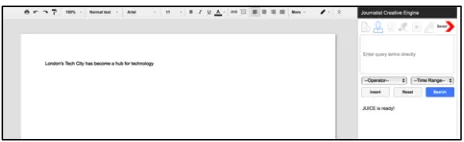
Figure 1: One example digital wireframe on the Add-on Sidebar validated during the design process
In parallel, the team ran semi-structured interviews with 6 experienced journalists and 2 leading digital experts in journalism to elicit strategies that these journalists use to explore and write creative angles on news stories, then validated the elicited strate-gies with other experienced journalists to extend and refine the strategies set. The interviews re-vealed 6 discrete strategies that were reported as effective for developing creative news angles: (i) Individuals: creatively explore different
hu-man angles in a news story based on the dif-ferent people and roles associated with the story;
(ii) Causal: creatively explore the background events that underpin a story to discover a new angle to the story from its background;
(iii) Quirky: creatively explore unusual or comical information about a story as a means of using wit to report serious news;
(iv) Quantifiable elements: creatively explore numerical and quantified information about a news story in order to back it up with evidence in new and useful ways;
(v) Ramifications: creatively explore information about the consequences of events and actions related to a news story, to generate new and useful stories about future consequences; (vi) Data visualizations: creatively explore
differ-ent data sets and visualisations to generate new and useful ways about how to display in-formation in a news story to encourage human insight.
Subsequent presentation of these strategies by the research team to audiences of journalists revealed little surprise, indicating that these 6 strategies are broadly understood if not explicitly codified in the profession.
Each of the 6 strategies was then designed in the form of a computerised algorithm to search for, re-trieve and present news information as recommen-dations to stimulate journalists to create new story angles that instantiate the strategy. To implement a first digital prototype of potential value to journal-ists, the team implemented 1 of these 6 strategies with full software support, to explore individual
human angles in a news story based on the differ-ent people and roles associated with the story.
4. THE JUICE DIGITAL PROTOTYPE
The digital prototype that resulted from the user-centred design was called JUICE – the JoUrnalIst
Creative Engine. JUICE is currently composed of 4
key software components depicted graphically in the architecture in Figure 2: (i) the interactive Side-bar and Dialog box that deliver retrieved and struc-tured information to the journalist to stimulate crea-tive thinking within the Google Docs editor; (ii) the JUICE creative search service that manipulates text from the Google Docs editor to generate search queries that form each input to the 6 imple-mented creative search strategies; (iii) the separate Juicer prototype news aggregation service, availa-ble from the BBC, which searches over 470 pri-marily English news sources using creative search queries generated by JUICE; (iv) the Twitter API, which searches for and retrieves more recent twit-ter content also using the same creative search queries generated by JUICE. JUICE also invokes software services to retrieve information from other online sources such as Wikipedia, as part of the creative search service.
A journalist interacts initially with JUICE through the single Add-on Sidebar on the right side of a Google Docs document editor. Due to this technical imple-mentation the Sidebar has a fixed width, but can be scrolled within the editor to present more infor-mation that can fit at any time on the editor page. Moreover, to present retrieved information to the journalist without needing to open another applica-tion, JUICE also implements a Google Docs Dialog Box inside the editor. JUICE does not have any other interactive software components.
Figure 2: The JUICE software architecture, components and information sources
[image:5.595.315.545.484.631.2]story – in this example, the first sentence that de-scribes the trigger to the story: the UK Government is committed to hold an in versus out referendum in
the current parliament) – then click the Insert button
[image:6.595.52.284.131.232.2]in the Sidebar.
Figure 3: Development of a new story about the EU ref-erendum vote in Google Docs opened with the empty
JUICE sidebar
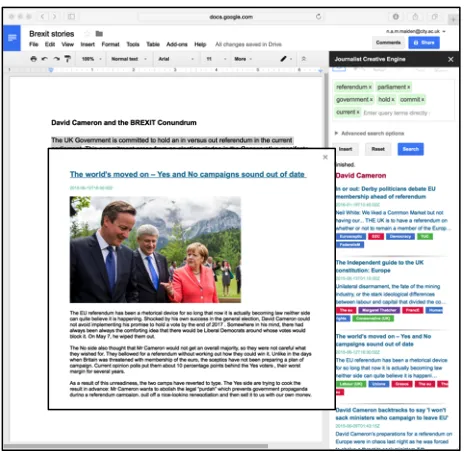
Figure 4: JUICE showing creative search results re-trieved for the inserted text (about David Cameron) in the
sidebar, and one story in the opened dialogue box
The JUICE creative search service manipulates the inserted text automatically to generate search que-ry terms that form the input to the creative searches – terms depicted in green at the top of the sidebar in Figure 4. The journalist can edit and delete these terms, as well as add new ones, before clicking the
Search button to invoke the Juicer and Twitter
software services to retrieve information using the query terms from news sites and Twitter feeds. In our example, the JUICE creative search service parses the input sentence to extract query terms that include stem nouns such as parliament and
referendum, and stem verbs such as commit, which
are displayed to the journalist in green at the top of the Sidebar. The service also generates logical structures composed of expanded query terms with similar meaning to each stem noun and stem verb, to generate the full creative search queries.
Return-ing to the example in Figure 4, one example of one such creative search query might be ["referendum" AND "parliament" AND ("government" OR "authori-ty" OR "regime") AND ("hold" OR "throw" OR "have" OR "make" OR "give") AND "commit" AND
“current"]. The project team decided not to include
these expanded terms in the Sidebar to avoid over-loading the journalist with related query terms that might not be recognised or understood by the jour-nalist.
Figure 4 also shows generated human creative an-gles from the query terms in the JUICE Sidebar – in this case about one of the more obvious of the 20 different generated human angles listed in Figure 4 – about David Cameron. The journalist can click on the person’s name to open a description of that person in the Dialog Box extracted from the per-son’s Wikipedia description. Unlike in traditional search websites, the Sidebar presents each crea-tive human angle, i.e. the name of an identified person, in a random order, to encourage the jour-nalist to explore creatively the information about these angles. The Sidebar depicted in Figure 4 presents 4 different retrieved news articles about
Cameron. To guide creative exploration, JUICE
al-so computes and presents different colour-coded concept categories for each article at the bottom of each retrieved article that define different places, things, people and organisations associated with the article. For example, concept categories related to the articles retrieved to support the angle David
Cameron include Referendum (thing), Alex
Salmond (person) and Bundestag (organisation).
By clicking on these categories, the journalist can add each directly to the query terms, to refine the creative search. The journalist can also click on the article name to view it in the Dialog Box shown in Figure 4 – the journalist has clicked on the 3rd arti-cle to open the artiarti-cle in the Dialog Box, to support further creative thinking about the selected human angle.
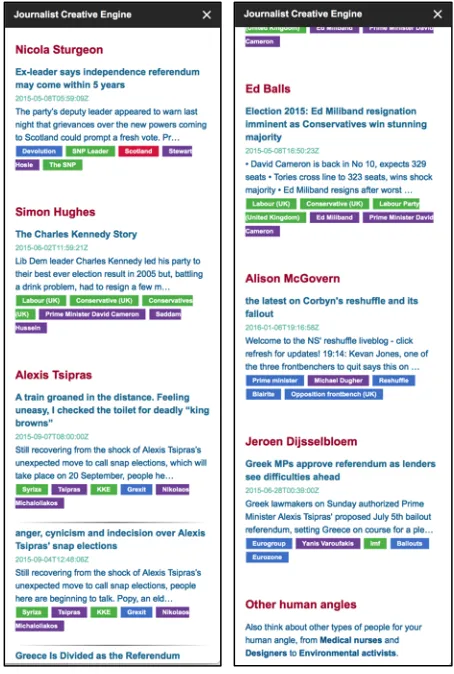
Other creative human angles from the 20 that were generated by JUICE are presented in the same scrolled Sidebar in Figure 5. Examples of the crea-tive human angles include UK politician Nicola
Sturgeon, Greek politician Alexis Tsipras and Dutch
[image:6.595.52.285.283.509.2]Figure 5: Examples of the JUICE sidebar for the same creative search information, highlighting different people
about which to create human angle stories
In addition, at the bottom of the Sidebar on the right side of Figure 5, JUICE also presents descriptions of human creative angles at the level of the role – roles such as designers and environmental activists
– to stimulate creative thinking using these roles. JUICE has been implemented with a database of over 60 such human role descriptions, and a ran-dom selection algorithm generates sentences to di-rect further creative thinking each time that the JUICE service is invoked by the journalist.
Figure 6 again shows the same JUICE sidebar, this time scrolled even further down to reveal another suggested human angle about the economist Mario
Draghi, President of the European Central Bank.
[image:7.595.316.549.69.292.2]To support creative thinking about a human angle based on Mario Draghi, the journalist can access background information about Draghi from Wikipe-dia and view the retrieved story about him in the Dialog Box. Based on the further retrieved infor-mation, the journalist can import this information di-rectly into the Google Docs editor as a starting point for further story development, as demonstrat-ed in Figure 6.
Figure 6: The updated story about the EU referendum vote, including new information about Mario Draghi, head
[image:7.595.318.545.343.528.2]of the European Central Bank
Figure 7: Results about further depth-first information searches about Mario Draghi using Google, for example
from the Wall Street Journal website
Moreover, having identified Mario Draghi as the new creative angle on the story, our journalist user can then use both the JUICE Dialog Box and more traditional information sources to research and de-velop the story further, such as with the discovered news webpage demonstrated in Figure 7.
pro-cedures to disambiguate each term by discovering its correct sense and tagging it with that sense us-ing context knowledge from other terms in the que-ry (e.g. defining a parliament to be a legislative
as-sembly in certain countries rather than a card
game) (McCarthy et al. 2004, Stevenson & Wilks 2001). The third implements different creative search strategies that expand each term with other terms that have similar meanings to the tagged sense to search for and retrieve news information (e.g. the term parliament is synonymous with the terms congress, senate and house are then also included in the query based on the creative strate-gy). These term senses are inferred automatically from WordNet, an on-line lexicon (Simpson 2005) that assigns senses to terms categorized as nouns, verbs, adjectives and adverbs. Each sense defines the meanings of a term, and WordNet organizes these senses into synonym sets that describe con-cepts with definitions or glosses, each of which contains a definition phrase composed of terms. The service uses this information about the disam-biguated meanings of English language terms to implement 3 different creative search strategies: (i) Synonym set expansion: each disambiguated
term is replaced with its synonym set, for exam-ple the verb commit is replaced with the syno-nym set for the disambiguated sense #1 [
perpe-trate, pull] and noun government replaced with
the set for the disambiguated sense #1 [
authori-ties, regime]. The strategy expands the query to
retrieve news information about each object or action described in the inserted text. For our UK referendum example, the service might retrieve news information about other forms of govern-ment committing to other types of action, for ex-ample the Canadian government’s commitment to repeal laws that allow the physical disciplining of children;
(ii) Hypernym expansion: each disambiguated term is augmented by its direct hypernym. For exam-ple, the hypernym of the disambiguated term
commit is act, so the revised query would
in-clude both terms. In our example, the service might retrieve news information about other forms of different government actions;
(iii) Gloss words expansion: each term is augment-ed with all terms in its gloss specifiaugment-ed in Word-Net. For example the sense #1 definition of the verb term commit is to perform an act, usually
with a negative connotation. Hence the terms
perform, act, negative and connotation are
ex-tracted and included in the extended query. In our example, the service might retrieve news in-formation about taboo stories, such as about mental health and challenges to feminism. Each time that the service is invoked, it applies all 3 strategies to match sense-tagged query terms to a similar set of terms that are passed to both the
BBC’s Juicer software service, to retrieve infor-mation from news webpages, and the Twitter API, to retrieve more up-to-date news information from published Tweets. The service has two different search modes – Strict and Relaxed – that the user can set using an interactive feature of the Sidebar during creative explorations. The default search mode is Strict, which generates queries composed of logical ANDs between all query terms shown at the top of the Sidebar. Relaxed mode generates queries composed of logical ORs between the terms at the top of the Sidebar, and returns a broader set of generated human angles. The Juicer service is a prototype news aggregation system that ingests over 400 English-language news sources. Whenever new news articles appear on the respective RSS feeds, the Juicer service anal-yses the text of the article (with the help of Wiki Da-ta) to annotate the people, places and organisa-tions that appear in the article text. The text itself and the annotations are stored in a format that al-lows for very quick and easy access via an API. Likewise JUICE applies the creative search queries to Twitter in 4 steps to discover information about individual people from retrieved news information from published Tweets: (1) it uses the Yahoo query language to search twitter for query terms such as hashtags; (2) it retrieves and compiles tweets that contain URLs to remove duplicates then records the user and tweet text; (3) it passes the set of unique URLs back into Yahoo query language to retrieve meta information such as page title and description from each webpage, and; (4) it merges the information and returns it to JUICE, to be shown to the journalist through the JUICE Sidebar and Dialog Box.
Demonstrations of this first version of JUICE’s digi-tal prototype to experienced journalists revealed its potential to stimulate creative thinking about indi-vidual human angles of stories, thus reinforcing the feedback from the earlier user-centred design pro-cess about the potential value of JUICE. However, we lacked evidence that hands-on use of JUICE could support journalists to generate creative an-gles on new stories. Therefore, the remainder of this paper reports results from a first evaluation of JUICE, to collect and analysis this evidence.
5. FIRST EVALUATIONS OF JUICE
experienced professional journalist in the depart-ment formulated the task to be prototypical of the length of such pieces, and challenging but realistic in terms of the time available to write the piece.
5.1. Formative Evaluation Method
The instruction given to each participant was:
“You are working for the Independent newspa-per. The editor wants a 300-400 word piece that revisits the Greek migrant crisis story that broke in spring 2015. The story should feature one or more unusual angles based on individuals as-sociated with the crisis.”
Each participant undertook the task as an individual in a quiet office on a desktop computer with a fast and reliable Internet connection. The computer had been set up with the Google Docs editor and JUICE Sidebar open in one browser window, and the separate Google search webpage in another window. At the start of each evaluation, the partici-pant sat at the desktop computer and the experi-menter asked him/her to confirm that s/he was fa-miliar with the desktop computer hardware and software, and the Google search website and Docs editor. The participant then watched a 3-minute video that described JUICE and how to use the JUICE Sidebar to discover new human angles on news stories. At the end of the viewing, the experi-menter asked whether each participant understood JUICE and to ask follow-up questions about it if needed that he then answered until the participant had received answers to his or her satisfaction. The experimenter then read the journalism task out loud to the participant and answered any clarification questions that were asked.
During the task, each participant had access to the time remaining to complete it via a clock on the desktop of the computer. The experimenter re-mained in the office with the participant, sat out of line of sight, but available to answer further ques-tions from the participant. At the end of the task, the experimenter asked the participant to complete a short printed questionnaire of 5 questions that re-quested 1-7 Likert scale responses about the per-ceived degree of challenge posed by the task in the time available, the perceived degrees of use of the JUICE Sidebar and Google search webpage during the task, and the perceived usefulness of the Side-bar and the Google search webpage during the task. Finally, the experimenter verbally asked a small number of questions about the source(s) for the human angle(s) for the written news piece, as well as about any problems that each participant faced during the task to use JUICE and the Google search webpage.
5.2. Formative Evaluation Results
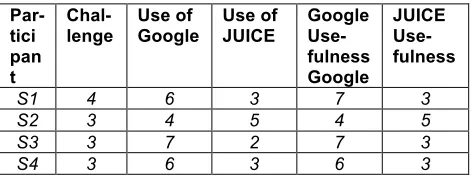
[image:9.595.317.548.244.573.2]The first participants were 3 students (S1, S2, S4) on the University’s Masters in International ism, and 1 student (S3) on its Bachelors in Journal-ism. All 4 participants successfully completed the task in the time required and wrote pieces that sat-isfied the remit, even if some were shorter than the required 300 words. These 4 pieces are summa-rised in Table 1. Three of them (from S1, S3 and S4) were based on angles of individual people – for example, a fisherman, a smuggler and members of a single migrant family – indicating that these 3 par-ticipants did complete the task as required.
Table 1: Summaries of news pieces written by the 4 evaluation participants
Participant Summary of participant’s news pieces
S1 A 315-word piece about the ordinary people, people such as fishermen, sol-diers and housewives, who do not typi-cally win Nobel Peace Prizes. The piece writes about the ordinary people in Rhodes saving lives – people such as Antonius Deligioris who saved 20 refu-gees from drowning when their boat hit rocks of the shoreline.
S2 A 233-word piece about Turkish people smugglers who explain that they are un-dertaking humanitarian work – God’s work – by helping refugees across the Aegean to the Greek islands. It reports the story from the perspective of an un-named 21 year-old smuggler.
S3 A 260-word piece about the fears and concerns held by the right-wing anti-austerity Independent Greeks party, and the views of its leader about the future of Greece as terrorism fears can hit its tour-ism industry.
S4 A 266-word piece about 2 angles that have humanised the migrant crisis and drawn people’s attention to it. The article described the consequences of the ac-tions of a Hungarian camerawoman filmed tripping a 7 year-old refugee, and a family that lost its cat during the flight from ISIS, which was found in Norway.
Table 2: Participant’s numeric responses on 1-7 Likert scales to the 5 post-task questions – higher scores
indi-cate greater challenge, use and usefulness
Par-tici pan t
Chal-lenge Use of Google Use of JUICE Google Use-fulness Google
JUICE Use-fulness
S1 4 6 3 7 3
S2 3 4 5 4 5
S3 3 7 2 7 3
S4 3 6 3 6 3
The content of each news piece and the source of each human angle were analysed. The most posi-tive about JUICE, participant S2, wrote a piece about smugglers who describe their activities to transport people across the Aegean to the Greek islands as humanitarian. She used JUICE to search for human angles based on terms such as Greece,
migrants and refugees, and JUICE’s first presented
human angle was about a people smuggler who claimed that he was doing God’s work, extracted from an article reported in the Irish Independent. This automatically generated angle was used di-rectly to provide the theme for the written piece – although the participant also reported that JUICE recommendations about George Clooney had of-fered a valuable alternative human angle on the story. The participant reported that finding creative and unusual angles was sometimes difficult in jour-nalism tasks, and JUICE appeared to have poten-tial to be helpful for this purpose. She singled out specific JUICE features, such as to add new query terms directly to the creative search, as valuable. The participant also proposed new features of JUICE, for example to save retrieved news articles to return to later, and to integrate with news di-gests.
Participant S1 was less positive than S2 about JUICE, and although JUICE did direct him to create the article about unsung humanitarian heroes, he reported using the Google search webpage more during the task. During his first creative searches with JUICE, S1 used different human roles rather than individuals presented by JUICE, such as the roles presented at the bottom of the Sidebar on the right side of Figure 5, to stimulate creative thinking. He first explored one of the presented roles –
pho-tographer – and entered the term into JUICE, but
was not inspired by the search results. He then ex-plored a second presented role – philanthropists – to discover and create the Nobel Prize theme for the migrant story. Based on this creative inspiration from JUICE, he then used the Google search webpage to generate more specific content for the piece. After the task the participant reported that JUICE had generated a disproportionately higher number of different human angles about politicians, and identified one desirable new feature – to be
able to refine creative searches using selected hu-man roles presented to the user by JUICE.
Participant S4 produced an article about 2 angles that humanised the migrant crisis in order to draw people’s attention to the crisis. Again, JUICE was perceived to be helpful, and supported this partici-pant to create the second human angle for the sto-ry, about the family that lost its cat fleeing from Isis. However, although it was reported to provide effec-tive support for idea generation, and the story pre-view feature shown in Figure 4 was reported to be useful, the participant reported that JUICE was less effective for gaining direct access to relevant arti-cles that JUICE retrieved to generate the creative angle. And although having generated new and creative story angles with JUICE, the participant reported that some of the generated angles and their ordering in the Sidebar were too random, which impeded the participant’s understanding of JUICE’s logic for retrieval and presentation.
In contrast, participant S3 reported a lower level of use of JUICE than did the other participants – a rat-ing that was consistent with the experimenter’s ob-servations of the participant, several interventions that the experimenter was required to make, and the participant’s responses to the interview ques-tions. At the start of the task the participant experi-enced a usability problem that stopped her from us-ing JUICE. Rather than use bespoke JUICE fea-tures to parse selected text from the editor to gen-erate keywords to search with, as depicted in Fig-ure 4, the participant directly entered longer strings of text directly into the single-keyword boxes at the top of the JUICE Sidebar, then pressed the Search
button – behaviour which resulted in JUICE return-ing no matches due to the complex terms that JUICE was seeking to expand and match. After several failed attempts to generate creative human angles with JUICE, the participant switched JUICE’s search from Strict to Relaxed mode – a change that did result in generated human angles for the input text, but the participant considered these angles to be too far removed from the input text and story. The participant became frustrated and abandoned use of JUICE, and generated the news piece using the Google search webpage. It is interesting to note that this news piece was the only one of the 4 not to make explicit references to indi-vidual people in the story.
journalists to create the stories, the journalists still used the Google search webpage to retrieve infor-mation with which to write the story. However, one trainee journalist did not use the Sidebar’s query term feature as it was designed, and rejected the use of JUICE for the task.
6. DISCUSSIONS AND FUTURE WORK
This paper reports the design, implementation and first evaluation of a new type of digital prototype, embedded in one tool frequently used by journal-ists, to provide creativity support for developing news stories quickly. JUICE is now a robust digital prototype available to several news and teaching institutions to experiment with and improve. First qualitative feedback reported in this paper reveals that it can support creative thinking in short periods of time to generate novel news stories. Of course, substantially more software development, testing and summative evaluation work is still needed, but the design and evaluation work so far provides evi-dence for the potential effectiveness of JUICE. Results from the evaluation have revealed several usability issues to resolve and identified new fea-tures that can enhance the tool’s usability and val-ue. JUICE is currently being extended with clearer instructions to direct users to import text from the Google Docs editor into the Sidebar prior to editing query terms in it, as well as new error-checking fea-tures to stop a user from entering query terms, such as a phrase or sentence, that are too com-plex. More generally, the Sidebar design will need to be reconsidered to discourage users from using JUICE as a web search engine. A new feature is being developed to provide contextualised advice to narrow, change and broaden creative searches and change search modes that is based on results returned earlier in the session, to direct the user to work more effectively with a complex search en-gine. The team is also adding most of the features directly requested by the participants, for example to save viewed/tagged news articles in JUICE, and to directly refine creative search terms by clicking on different generic human roles presented at the bottom of the Sidebar. The formative evaluations of new versions of JUICE supporting the Individuals
creative angle will continue, and we anticipate de-veloping a more usable, complete and stable ver-sion of JUICE.
The resulting, more complete and stable version of JUICE will become the focus of summative evalua-tions to investigate the hypothesis that use of JUICE by journalists will be associated with the generation of more creative news stories than use of existing digital tools and sources. A two-condition study will involve experienced journalists in blind rating of news stories for different attributes of a creative outcome – its novelty, its usefulness
and its surprise value (Maher et al. 2013) – using Likert scales, similar to creative outcome assess-ment reported in Hollis & Maiden (2013). The study will investigate JUICE support for both P-level and S-level creativity. P-level creativity is the generation of knowledge that is novel and useful to the individ-ual (Boden 1990), which for JUICE is the journalist developing a story. S-level creativity – social crea-tivity – is the generation of knowledge that is novel and useful to wider social groups, not only the in-tended readership for the journalist’s story, but also other journalists in the newsroom. Therefore, the study will be constructed of stories that will be writ-ten by journalists with and without the use of JUICE, each with Likert scales to indicate the per-ceived novelty and value of the story, which will be made available to 3 groups – a segment of the in-tended readership, peer professional journalists, and more experienced journalists who will bring domain and discipline expertise to rate each news story. In parallel the team will implement first ver-sions of the other 5 strategies for developing crea-tive news angles. The codification of support for the
Quantifiable elements strategy is complete. In parallel, user feedback about the bias some gener-ated creative guidance towards politicians is pro-voking a rethink of the information sources, such as the BBC’s Juicer service, that JUICE searches, to provide wider-ranging creative sources.
ACKNOWLEDGEMENTS
This research is funded by a Google European Computational Journalism Award.
7. REFERENCES
Alaoui S.F. Schlphorst T. Cuykendall S. Carlson K. Studd K. Bradley K. (2015) Strategies for Em-bodied Design: The Value and Challenges of Observing Movement. Proc. 10th ACM Conf. Creativity and Cognition, 121-130, ACM Press. Alchemy API (2016) Using AlchemyAPI for
Enter-prise-Grade Text Analysis. Retrieved at http://resources.alchemyapi.com/white-papers/ using-alchemyapi-for-enterprise-grade-text-analysis.
API (2011), What is journalism? https://www.americanpressinstitute.org/journalis m-essentials/what-is-journalism/. Retrieved 8th March 2016.
Aragon C.R. Poon S.S. Aragon A.D. (2009) A Tale of Two Online Communities: Fostering Collabo-ration and Creativity in Scientists and Children’. Proc. 7th ACM Conf. on Creativity and Cogni-tion, 9-18, ACM Press.
Using StoryCrate. Proc. 9th ACM Conf. Creativity and Cognition, 193-202, ACM Press.
Baas M. De Dreu C.K.W. & Nijstad B.A (2008) A Meta-Analysis of 25 years of Mood-Creativity Research: Hedonic Tone, Activation, or Regula-tory Focus?. Psychological Bulletin, 134, 779-806.
Brill E. (1992) A simple rule-based part of speech tagger. Proc., 3rd Conf. on Applied Natural Lan-guage Processing, ACL, Trento, Italy.
Currah A., 2009, ‘What’s Happening To Our News?’, Reuters Institute for the Study of Jour-nalism, Oxford.
Ekdale B., Singer J.B., Tully M. & Harmsen S., 2015, ‘Making Change: Diffusion of Technologi-cal, Relational, and Cultural Innovation in the Newsroom’, Journalism & Mass Communication Quarterly 92(4), 938-958.
Greene S.L. (2002) Characteristics of Applications that Support Creativity. Communications of ACM, 45(10), 100-104, ACM Press.
Jain A. Kupfer N. Qu Y. Linder R. Kerne A. Smith S.M. (2015) Evaluating TweetBubble with Idea-tion Metrics of Exploratory Browsing. Proc. 10th ACM Conf. on Creativity and Cognition, 53-62, ACM Press.
Hollis B. Maiden N.A.M. (2013) Extending Agile Processes with Creativity Techniques. IEEE Software 30(5), 78-84.
Honauer M. Hornecker E. (2015) Challenges for Creating and Staging Interactive Costumes for the Theatre Stage. Proc. 10th ACM Conf. on Creativity and Cognition, 13-22, ACM Press. Kerne A. Koh E. Smith S. M. Webb A. Dworaczyk
B. (2008) combinFormation: Mixed-Initiative Composition of Image and Text Surrogates Promotes Information Discovery. ACM Transac-tions on Information Systems, 27(1), 1-45. Machill M. & Beiler M., 2009, ‘The Importance of
the Internet for Journalistic Research: A Multi-Method Study of the Research Performed by Journalists Working for Daily Newspapers, Ra-dio, Television and Online’, in Jour-nalism Stud-ies 10 (2), 178-203.
Maher M.L., Fisher D. Brady K. (2013) Computa-tional Models of Surprise as a Mechanism for Evaluating Creative Design. Proc. 3rd Interna-tional Conf. on ComputaInterna-tional Creativity, Sydney June 2013, 147-151.
McCarthy D. Koeling R. Weeds J. Carroll J. (2004) Using Automatically Acquired Predominant Senses for Word Sense Disambiguation, Proc. ACL 2004 Senseval-3 Workshop Barcelona, Spain.
Minard A. Speranza M. Agirre E. Aldabe I. van Erp M. Magnini B. Rigau G, & Urizar R. (2015) SemEval-2015 Task 4: timeline: cross-document event ordering. in Proc. 9th International Work-shop on Semantic Evaluation, Denver, Colorado, 2015, 778-786.
Monfort N., Perez y Perez R., Fox Harrell D., Cam-pana A. (2013) Slant: A Blackboard System to Generate Plot, Figuration, and Narrative Dis-course Aspects of Stories’. Proc. 3rd International Conference on Computational Creativity, Sydney Australia, June 2013, 168-175.
Schofield T., Vines J., Higham T., Carter E., Atken M., Golding A. (2013) Trigger Shift: Participatory Design of an Augmented Theatrical Performance with Young People, Proc. 9th ACM Conf. Crea-tivity and Cognition, 203-212, ACM Press. Simpson, T. (2005) Wordnet.net.
open-source.ebswift. com/WordNet.Net.
Sjøvaag, H., 2014, ‘Homogenisation or Differentia-tion? The Effects of Consolidation in the Region-al Newspaper Market’, JournRegion-alism Studies 15(5), 511-521.
Sternberg, R. J. (1999) Handbook of Creativity. New York, Cambridge University Press.
Stevenson M. Wilks Y (2001) The Interaction of Knowledge Sources in Word Sense Disambigua-tion. Computational Linguistics, 27(3), 321-349. Witschge T. & Nygren G., 2009, ‘Journalism: a
pro-fession under pressure? Journal of Media Busi-ness Studies, 6(1), 37-59.
Wu A. Yim J.B. Caspary E. Mazalek A. Chandra-sekharan S. Nersessian N.J. (2011) Kinesthetic Pathways: A Tabletop Visualization to Support Discovery in Systems Biology. Proc. 8th ACM Conference on Creativity and Cognition, 21-30, ACM Press.
Zachos K. Maiden N.A.M. (2008) Inventing Re-quirements from Software: An Empirical Investi-gation with Web Services. Proc. 16th IEEE In-ternational Conference on Requirements Engi-neering, 145-154, IEEE Computer Society Press.
Zachos K. Maiden N.A.M. Pitts K. Jones S. Turner I. Rose M. Pudney K. MacManus J. (2013) A Software App to Support Creativity in Dementia Care. Proc. 9th ACM Creativity and Cognition Conference, 124-131, ACM Press.