1
Sharing ‘happy’ information
Fiona Tinto
University of Stirling Stirling
United Kingdom
Ian Ruthven*
Department of Computer and Information Sciences University of Strathclyde
Glasgow
United Kingdom G1 1XH
[email protected], [email protected] *corresponding author
Abstract
This study focusses on the sharing of ‘happy’ information; information that creates a sense of happiness within the individual sharing the information. We explore the range of factors motivating and impacting upon individuals' happy information sharing behaviour within a casual leisure context through 30 semi-structured interviews. The findings reveal that the factors influencing individuals’ happy information sharing behaviour are numerous, and impact upon each other. Most individuals considered sharing happy information important to their friendships and relationships. In various contexts the act of sharing happy information was shown to enhance the sharer’s happiness.
1
Introduction
The development of the internet since the 1990s has been accompanied by a growth in the levels of content which people experience purely for pleasure rather than for the purpose of satisfying a specific information need. The advancement of online means of communication (including email, social networks, tagging facilities etc.) combined with offline methods (such as telephone conversations and face-to-face interaction) offer individuals a greater range of ways to share information than ever before. However, little research has been conducted investigating the information sharing of non-task-related information within a leisure environment. Furthermore, compared to research into the cognitive aspects of individuals' information behaviour, comparatively little study has focussed on the affective element of information sharing.
2
recent years, the economic and social conditions of many countries have been characterised by recession and unemployment. In the UK, the location of this study, prescription of anti-depressants has risen, with many areas facing long waiting lists for alternative counselling and psychological treatments (Easton, 2013; Griffith, 2013; and The Herald, 2014). In such a climate, many are searching for alternative ways to increase happiness. The initiative 'Poetry on Prescription' was formed in response to “a queue of people asking for poetry suggestions that would help cheer people up” (CILIPUpdate, 2013) and the United Nations in 2013 celebrated the launch of International Day of Happiness, seeking to “spread happiness to millions of people” (Action for Happiness and Cheers, 2013). One way in which happiness can be increased within the course of individuals' everyday lives is by sharing information that creates a sense of happiness within the individual sharing the information, referred to throughout this paper as 'happy’ information.
The purpose of the research is to explore information sharing behaviour focussing specifically on such happy information. To this end, the research focusses specifically on information within a 'casual leisure' environment (Stebbins, 1997), excluding information which is work-related, study-related or responding to a particular cognitive goal or information need.
The central research question addressed in this study is: what are the factors that motivate and impact upon individuals’ sharing behaviour of happy information?
This question is investigated through the following research questions:
How do individuals share happy information: what do they share or not share; with whom; and by which methods?
What are the factors that motivate and impact upon individuals' decisions: to share/not share this information; to share with which people; to share by which methods?
How does individuals' happy information sharing behaviour correspond to their affective states?
2
Literature Review
In this section we review important studies of information sharing; approaches and methodologies commonly used in studies of information sharing and which influenced our own approach; and factors highlighted as influential in information sharing.
2.1
Areas of research focus and research gaps in information sharing studies
3
and 2009b), Elsweiler, Wilson and Kirkegaard Lunn (2011) and Stebbins (2009). The term 'casual leisure' is used by Stebbins (1997, p.18) to describe those leisure activities which are “immediately, intrinsically rewarding, relatively short-lived pleasurable activit[ies] requiring little or no special training to enjoy”. The majority of LIS research concerning information behaviour in leisure has focussed on serious leisure (challenging and complex hobbies or amateur pursuits), with casual leisure typically viewed as more frivolous, trivial and banal (Stebbins, 2009, pp.618-619). As observed by Burnett (2009, p.708), however, “materials perceived to be trivial or unimportant by some may be extraordinarily important and meaningful for others”. These very characteristics of casual leisure contribute to its prevalence: “Many more people participate in it than in serious leisure […and] enjoy and therefore value their casual leisure” (Stebbins, 1997, p.18).
Citing Hansen and Järvelin (2005), Talja and Hansen (2006, p.116) note that collaborative information behaviours must be studied in context to correctly understand real-life practices. In order to understand the full spectrum of information sharing behaviour it is essential that research into everyday life information sharing is not neglected from information behaviour research. Furthermore, as found by Marshall and Bly (2004, p.218), information sharing in everyday activities is often non-task-related and frequently deals with serendipitously 'encountered' information (a term used by Erdelez, 1996). Similarly, Talja and Hansen (2006, p.114) observe that information sharingincorporates less 'goal oriented exchanges' than information seeking and retrieval. Stating that much of the research into information behaviour has been grounded in task-orientated 'user needs', Marshall and Bly (2004, p.226) advocate further research be conducted on a wider scope to encompass those elements of information behaviour which do not stem from a goal-seeking or cognitive information need.
4
Doiron and Mai (2011, p.7) positive Twitter messages were found to be more numerous and likely to be shared than negative messages. Chua, Goh and Lee (2012, p.15) also acknowledge the importance of the affective dimension, investigating both functional and affective motivational factors of mobile content sharing.
As voiced by various researchers, there is a need for further research into the study of information sharing in a non-work context (Savolainen, 2007, p.1); leisure (Hartel, 2003); information behaviour concerning “nongoal oriented information” (Ross, 1999, pp.784-785) and positive affect in information behaviour (Fulton, 2009b, p.247).
2.2
Approaches and methodologies
The majority of the empirical studies on information behaviour use qualitative research techniques, however quantitative research is also found, as in Bao and Bouthillier's (2007) study which measures levels of information sharing in supply chains via surveying, using an index comprising formative indicators of information sharing, as determined by literature review. Among the qualitative research, interviewing is the most prominent research technique, as in Ross's (1999) study of 'the information encounter in the context of reading for pleasure'; Marshall and Bly's (2004) work on participants' information sharing habits related to electronic and offline 'clippings', both at home and in the workplace; Savolainen's (2007) study of environmental activists' information sharing behaviour; Fulton's (2009a and 2009b) research into information behaviour of amateur genealogists; and Chang's (2009) investigation of backpackers' information seeking behaviour from an everyday life information seeking perspective. Interviews are primarily used in order to gain rich pictures of participants' experiences, the data from which can expand our understanding of information behaviour.
2.3
Influential factors in information sharing
5
maintaining communication and contact with the recipient. Various studies have found that information sharing is affected by the strength of relationships, either within groups (Haythornthwaite, 1996, pp.327-328) or between individuals (Hall, Widén and Paterson, 2010, p.141), with factors such as levels of friendship (Allen, 1970, cited in Rioux, 2004, p.26) or the 'socially contagious' nature of tagging (Ames and Naaman, 2007, p.978) influencing sharing.
Social norms and expectations can also influence sharing, both positively and negatively. Factors such as distrust of others (Savolainen, 2007, p.10), perceived lack of interest by others (Goh et al., 2009, p.196) and organisational rules or structures (Haythornthwaite, 1996, p.336) can constrain interactions by creating barriers to information sharing. Social expectations can affect the way in which individuals share information, for example by influencing the specific tags a person chooses to annotate their media (Ames and Naaman, 2007, p.979). Sharing within a community can in certain structures be considered a moral obligation (Wasko and Faraj, 2000, p.168; 2005, p.42), although the same authors report that relational capital was not found to be a strong factor in electronic communities of practice and further suggest that reciprocity may be generalized across a group, rather than obligations being assumed by specific individuals (2005, p.51). Contrary to Wasko and Faraj, Hall, Widén and Paterson (2010, p.13) and Goh et al. (2009, p.203) mention expectations of reciprocity as a strong influence on information sharing, with many study participants expressing awareness of the emotional effects of receiving or not receiving a response to information shared online. Hall, Widén and Paterson (2010, p.11) report the need for validation of quality, as does Talja, who also mentions membership within the group (2002, p.7) as being extremely important to some individuals. Fulton (2009a, pp.756-757), also cites reciprocity as a crucial element to developing communities of sharing.
Savolainen (2007, p.9) did not find reciprocity to be a primary motive for information sharing among environmental activists; attributing this to the high levels of altruistic information sharing within this community, which lowered the need for reciprocal exchange (p.11). This type of ‘gift-giving’ has been observed in information sharing behaviour (Van House et al., 2005, p.1855; Hall, Widén and Paterson, 2010, p.13) and may be linked to the experience of pleasure in the act of sharing (Rioux, 2004, p.19; Wasko and Faraj, 2005, p.53). In particular, the 'super-sharer' (Talja, 2002, p.4; Fulton, 2009a, pp.764-766) enjoys and is strongly motivated by the pleasure of sharing. While 'altruistic' behaviour is frequently reported in studies of information sharing, self-expression and self-promotion are also commonly mentioned as influential factors, particularly within social networking or social media sharing environments (Wasko and Faraj, 2000, p.166; Ames and Naaman, 2007, p.977; Olsson, Soronen and Väänänen-Vainio-Mattila, 2008, p.274; Chua, Goh and Lee, 2012, p.17). Nov and Ye (2010, p.129) emphasise the influence which the idea of a “social presence [...] - actual, imagined or implied,” has on individuals' ways of portraying themselves in online
6
tagging networks. Other factors mentioned include the perceived usefulness of other individuals influencing the benefits of sharing information with them (Fulton, 2009a, p.756); information content and quality (Chung and Kim, 2008, p.299; Olsson, Soronen and Väänänen-Vainio-Mattila, 2008, p.279; Chua, Goh and Lee, 2012, pp.17-18); convenience and access (Chua, Goh and Lee, 2012, pp.17-18, Fulton, 2009b, p.255); and familiarity with the environment (Hall, Widén and Paterson, 2010, p.15).
Many of the reviewed studies examine sharing within a very specific context, for example Talja's (2002) study focusses on academic groups; Fulton (2009a and 2009b) investigates amateur genealogists; and Gruzd, Doiron and Mai (2011, p.5) emphasise that their study relates to Twitter behaviour surrounding a sporting event and cannot claim to be representative of sharing behaviour of general news. Furthermore, a large percentage of the suggested motivations relate to task-related behaviour, such as sharing in connection with information seeking (Savolainen, 2007; Fulton, 2009b), or the functional elements of image tagging, such as personal organisation for later retrieval (Ames and Naaman, 2007, p.976). Chua, Goh and Lee (2012, p.20), in separating content contribution and content retrieval, found that perceived gratification factors differed for the two, thus giving strength to the premise that people treat different types of information differently (Constant, Kiesler and Sproull, 1994, p.405) and that different aspects of information behaviour have different qualities and merit investigation in their own right. It has been stressed that the reasons for using different types of media vary (Katz, Blumler, & Gurevitch, 1974, cited in Chung and Kim, 2008, p.298), and that individuals' information sharing behaviour is influenced by both emotional and social factors (Goh et al., 2009, p.204); 'social or personal', and 'affective or functional' factors (Ames and Naaman, 2007, p.975; Goh et al., 2009, p.196); and is driven by a combination of 'personal/internal factors' and 'external/environmental factors' (Rioux, 2004, p.102). It is of interest, therefore, to examine the extent to which these concepts and factors appearing in studies of information sharing in different areas are comparable to individuals' sharing behaviour within the context of non-task-orientated 'happy’ information within a casual leisure environment.
3
Methodology
3.1
Methodology overview
7
3.2
Participants
Participants were recruited using notices disseminated via Facebook, the University email network and the researchers’ personal contacts. Facilities to offer interviews via Skype allowed participation of individuals based outwith the local area. We decided to focus on interviewees aged 18 or over, due to possible differences between information sharing behaviours of children and adults. Participants were also required to be regular internet users to permit a balanced investigation of both offline and online habits
We chose a sample size of 30 participants, deemed an appropriate number based on previous studies, to allow broad exploratory research, without minority behaviours of select individuals impacting on the findings too heavily. As the study intended to investigate individuals' behaviour, and was not attempting to represent any specific demographic, non-representative sampling from those who volunteered to participate was used. One exception to this was the deliberate effort to maintain an equal number of male and female participants.
Of the 30 individuals comprising the data sample, 15 were male and 15 female. Participants ranged in age from 18 to 63 years old, 11 participants being aged 25-29; seven aged 21-24; four aged 30-34; three aged 35-39; two aged 18-20; one aged 40-44; one aged 45-49 and one aged 60-64 years old. They worked in a range of occupations. Twelve participants were students, including a mixture of undergraduate and postgraduate students in a variety of subjects; three described their status as ‘recent graduate’; three communications officers; two actors; two teachers; two business analysts; one librarian; one carpenter; one contaminated land expert; one retired psychologist; one office co-ordinator and one unemployed. Four participants were from North America, the remainder from Western Europe. Eleven participants had moved abroad and were currently living away from their families in a country other than their place of birth.
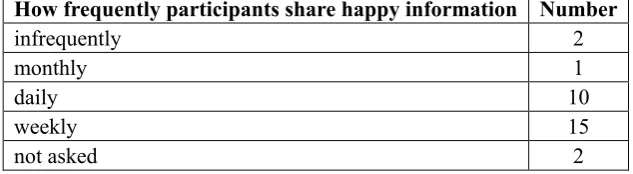
At the beginning of interviews participants were asked to give an approximate idea of how frequently they shared happy information2. This was the only question in which participants were asked to respond to a pre-defined set of options. The responses are presented in Table 1 and show that most participants shared happy information on at least a weekly basis and so could be expected to provide useful data on their information sharing behaviour.
How frequently participants share happy information Number
infrequently 2
monthly 1
daily 10
weekly 15
[image:7.595.79.396.620.707.2]not asked 2
Table 1: Participants’ frequency of happy information sharing
8
3.3
Design of research tool
We selected semi-structured interviews as the most suitable method for allowing the open-ended questions necessary to “stimulate reflection and exploration” (Davies, 2007, p.29) and allow insights from participants to appear.
Whilst carrying out pilot interviews, we noted that all participants were able to come up with examples of happy information from recall. Participants were requested prior to the interview to consider examples which could be used in discussion. Where participants were struggling to provide instances of happy information sharing, they were allowed to access any site which they normally used to share happy information. Accordingly, the research investigates individuals' information sharing based primarily on recall of their behaviour.
Prior to the interview, participants were emailed an information sheet which included a brief explanatory section describing the type of information relevant to the study. This contained only an explanation that the study was concerned with information that makes individuals happy, and that this information should not be work-related, study-related, or task-based. To clarify the concept of 'task-based' information, an example was provided of task-based information which would not be relevant. It was deemed important to “[treat] interviewees as knowledgeable informants on their life situation” (Dervin and Reinhard, 2007, p.53) in order to explore individuals' real behaviours; rather than being too constrained or prescriptive in the discussion and, as noted in section 3.1, there were no solid definitions or extensive prior research into happy information to guide us to a concrete definition of ‘happy’. Consequently, it was left to participating individuals to determine what they considered to be information that makes them happy and, through the discussions, learn what types of information people considered as ‘happy’ information.
A semi-structured interview framework was developed, which included four key themes to be covered during each interview, but allowed discussion to be led according to interviewees' specific examples of happy information sharing.
The four key themes were:
1 What influences individuals' choice of recipients? 2 What influences individuals' choice of sharing medium? 3 The concept of experiencing a 'need to share'.
4 How the act of sharing impacts on the sharer’s happiness.
9
3.4
Data collection and analysis
Of the 30 interviews used in the data sample, 18 were conducted face-to-face, and 12 via Skype. The majority of interviews lasted approximately 30-45 minutes, with three longer interviews. In these latter cases the interviewee was either a particularly prolific sharer of happy information, or provided deeply analytical accounts of his or her behaviour. All interviews were audio-recorded for subsequent transcription and analysis.
To analyse the data, the original interview questions were considered as a basic coding tool. Since, however, the research was intended to be exploratory and encourage new findings to develop through the interviews, it was decided that attempting to organise and analyse the data in relation to pre-conceived ideas would be too restrictive. Instead, each transcript was summarised noting responses to the key themes, details of the examples of happy information sharing (particularly how, why and with whom the participants shared information) and responses that seemed particularly interesting or significant. ‘Interesting or significant’ data consisted of behaviour which was strongly consistent or widely varied across the sample, data corresponding to findings in the literature reviewed, and unexpected behaviours and factors which appeared.
The data was then collated together and organised using an inductive approach, sorting associated data together into the following groups which naturally emerged:
General motivations for sharing and not sharing happy information Recipients and relationships
Choice of medium
Act of sharing increasing happiness
Two additional themes, namely ‘reactions to responses from information sharing behaviour’ and ‘how people use happy information to portray representations of themselves’, also arose in the analysis. These complex issues are dealt with separately in (Tinto and Ruthven, 2014). A note was kept of which interviewees had demonstrated each point, allowing calculation of the corresponding number of interviewees in relation to each factor.
4
Results
4.1
Results overview
10
participants may also have been motivated in this way but did not explicitly mention this factor. Furthermore, the figures do not represent the importance placed on any factors by individuals, nor how commonly the factors influenced their sharing behaviour.
4.2
Content shared and frequency of sharing
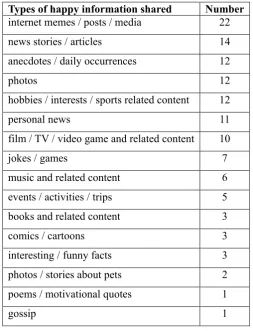
From the examples provided by interviewees, data was gathered regarding the nature of the happy information participants shared (Table 2). Numbers represent the number of participants who provided an instance of sharing the type of content, not the frequency with which individuals shared types of content. The categories include content related to that category, e.g. the category ‘books’ would include recommendations and discussion of books. As can be seen in Table 2, ephemeral data dominated the types of information shared, with internet data being shared by almost 75% of participants, and news and daily occurrences being common items to share. Much of this shared information is information that was ‘encountered’ as part of daily life; information that participants came across whilst interacting with the world. Most of it, with the exception of personal news, is not significant in itself and it became clear in the interviews that the act of sharing was often more important than the information itself.
Types of happy information shared Number
internet memes / posts / media 22
news stories / articles 14
anecdotes / daily occurrences 12
photos 12
hobbies / interests / sports related content 12
personal news 11
film / TV / video game and related content 10
jokes / games 7
music and related content 6
events / activities / trips 5
books and related content 3
comics / cartoons 3
interesting / funny facts 3
photos / stories about pets 2 poems / motivational quotes 1
[image:10.595.171.425.349.681.2]gossip 1
Table 2: Types of happy information shared by participants
4.3
General motivations for sharing and not sharing happy information
4.3.1
Range of general motivations for sharing/not sharing happy information
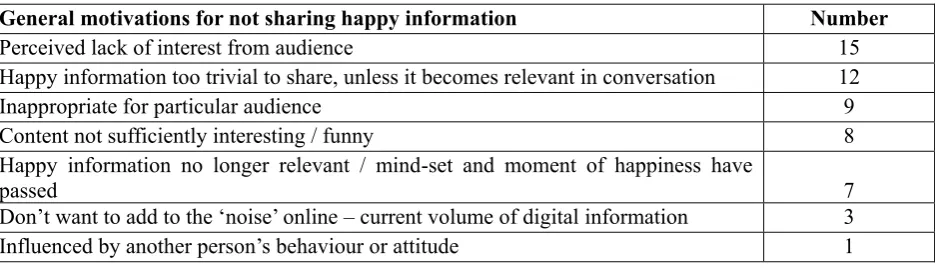
11 sharing, summarised in Tables 3 and 4.
The motivation of all 30 participants to share had at some point been based on perceived relevance; either to a situation, or a particular recipient. Many participants described the process of determining relevance between content and person as an experience whereby information triggered an association or a memory of a particular person. This suggests that motivation for sharing often begins at a sub-conscious level. Rioux (2004, p.62) found that “there is relatively low top-of-mind awareness of the cognitive states [individuals] experience as they mentally “store” and recall what they believe are the information needs of others”. This research specifically examined non-task-orientated information, thus removing the connection with an articulated information seeking need, however the findings reveal a comparable process occurring in both situations. The decisions on not sharing, Table 4, appear to be filtering decisions: not sharing because of perceived lack of interest, lack of significance or inappropriateness of the information, or not sharing because the moment for sharing has passed.
General motivations for sharing happy information Number
General perceived interest or appreciation from recipient 30
Feeling a ‘need to share’ 27
Shared interests or experience 19
Content perceived to have connection with recipient 19
Sharing occurring naturally in conversation 10
Reciprocating with information in kind / habit of sharing with recipient on topic or
theme 8
To make people happy or give them hope 8
Relevance to a current or previous discussion or topic 7 Sharer seeking validation of own enjoyment in the information 6
Shared sense of humour 5
Desire to discover recipient’s interests or opinions regarding information 5 Desire to generate wider interest or awareness of information 4 To create a feeling of interaction when experiencing information alone 4 Influenced or encouraged by other people to post information online 3 To provoke someone who you know will not enjoy the information (e.g. sports
[image:11.595.74.519.312.580.2]results) 2
Table 3: General motivations for sharing happy information
General motivations for not sharing happy information Number
Perceived lack of interest from audience 15
Happy information too trivial to share, unless it becomes relevant in conversation 12
Inappropriate for particular audience 9
Content not sufficiently interesting / funny 8
Happy information no longer relevant / mind-set and moment of happiness have
passed 7
Don’t want to add to the ‘noise’ online – current volume of digital information 3
Influenced by another person’s behaviour or attitude 1
[image:11.595.57.525.610.744.2]12
4.3.2
Experiencing 'need to share'
Twenty-nine participants were asked whether they had ever experienced a feeling of ‘needing to share’ information. Twenty-seven participants could recall such an occasion, generally when experiencing great excitement or happiness; and 25 had experienced ‘needing to share’ with a specific person. Where participants described the experience of ‘needing to share’ with 'somebody' (i.e. needing to share but not with a particular person), this often led to public sharing on Facebook, or sharing with the next acquaintance they happened to meet. Individual preferences, the level of excitement concerning the happy information, and the extent to which participants preferred to target information only to those with perceived interest, influenced how likely the participants would be to tell particular people when they experienced a general ‘need to share’. Three participants mentioned having a close friend or relative who they knew would always show interest. As Joyce3 explained, “if I really want to share it and I can't think of anyone specifically that I want to share it with, I know that my mum will always listen to whatever I've got to say...”
Some participants also provided examples where multiple factors motivated their desire to share happy information. Jessica described an encounter with a stranger in a bar, which she had found funny:
…after he left I went up to the bar and I was like, 'oh my God,' ... to the random person next to me ...and then as I was leaving, I was like, .. I can't get over what just happened!' so I texted the entire story – which was a really long story – to a friend of mine because I
had to tell someone else immediately, and then as soon as I got home I told [my room-mates] the story, so I told the story multiple times […] so in that case I specifically didn't want to text the story to [my room-mate], because I knew it would be more entertaining in person...
Three distinct motivating factors impacted on Jessica's desire to share this story. She shared the experience with a present stranger, seeking validation of her view that the situation was out of the ordinary; felt the need specifically to share this story with her room-mates who she knew would appreciate it, and purposefully waited until she could see them to share the story with maximum effect in person; and also experienced the need to share the story immediately, and went to the effort of texting (Jessica rarely phones people for fear of inconveniencing them) a particularly long message to a separate friend in order to do so. These different needs were satisfied by sharing with different recipients, using a combination of purposefully selected mediums for communication.
13
4.4
Recipients and relationships
4.4.1
Recipients of happy information sharing
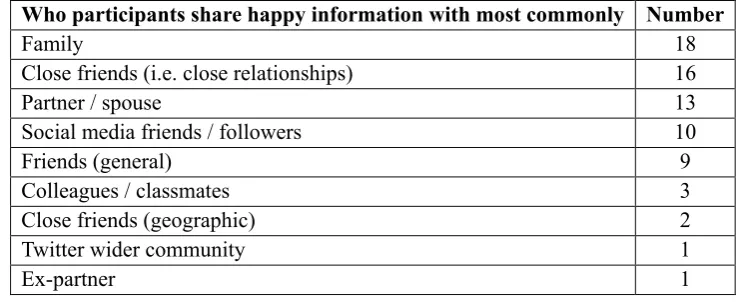
All participants were asked with whom they shared happy information most commonly. Responses have been categorised and presented in Table 5. Our participants were not questioned in detail and interviewees responded with varying degrees of specificity, thus the categories of friends (general), close friends (relationships) and close friends (geographic) should not be interpreted as absolutes. The close friends (geographic) category reflects the participants who responded that the people they shared with most often were local friends they saw most frequently. The findings reveal a strong link between closeness of relationships and the frequency of happy information sharing.
Who participants share happy information with most commonly Number
Family 18
Close friends (i.e. close relationships) 16
Partner / spouse 13
Social media friends / followers 10
Friends (general) 9
Colleagues / classmates 3
Close friends (geographic) 2
Twitter wider community 1
[image:13.595.111.481.240.391.2]Ex-partner 1
Table 5: Who participants share happy information with most commonly
4.4.2
Sharing and strong relationships
Twenty-seven of the 30 participants felt that sharing happy information is important for building, maintaining or strengthening relationships. Exploring why sharing occurred more frequently amongst people with whom one has a stronger relationship, 14 participants felt there were fewer barriers to sharing information with this group and less risk of judgment, ridicule or accidentally causing offence whilst sharing. Seven participants commented on the importance of feeling that you can share happy information with your friends, with John explaining “I think if you can't share things that make you happy with a friend, then you have to wonder whether or not you're friends”. Other reasons for more frequent sharing between people with stronger relationships included greater levels of shared interests (eight participants); greater frequency of communication leading to more sharing activity (eight participants); and the knowledge that recipients of shared information are more interested in the sharer and what makes them happy (eight participants). Although the research did not attempt to establish causality between strength of relationships and frequency of sharing, the findings suggest a reciprocal connection between the two factors.
4.4.3
Sharing as a means of maintaining contact
14
geographically, with whom he shared more topical happy information, compared to friends further afield with whom happy information shared was more specifically tailored to their known interests and tastes. Mary revealed that she was unlikely to contact friends at home with small happy information, however for bigger news she said, “I will put myself in touch with my best friend, wherever she is”. Five participants said that the people they shared with most commonly were the people they saw most frequently – including local friends or colleagues. Contrastingly, one ex-patriot participant living in a different country from his partner purposefully shared with her more often, as means of maintaining regular contact. Stewart attributed their frequency of communication to a, “combination of closeness and not seeing each other very often”.
Although it was not commonly volunteered among participants as a reason why they would choose to share happy information, ten participants felt that sharing happy information was a good way to keep in touch. Sharing more trivial happy information was also listed by five participants as a good way of re-connecting if there had been a break in contact with the person. More 'trivial' happy information sent in a 'saw this and thought of you' manner was described as 'easy-ended', a 'soft-contact' and an 'ice-breaker'.
4.4.4
Importance of sharing trivial happy information in relationships
Many of the examples of happy information sharing involved 'trivial' content. In one example, having previously stated that the content was trivial and of little importance, Erica proceeded to describe the positive emotions generated when able to share these items with a like-minded individual:
sometimes it can be quite sort of difficult to connect a lot, all the time, and when you do have that moment of connection then ... it enforces that it is a good thing to put effort into relationships, and it is a good thing to have conversations and you're not alone
Another participant described a yearly 'Oscars Competition' with her dad, which was something they enjoyed together and looked forward to, also sharing related content throughout the year. Lisa considered such 'silly' shared activities significant in strengthening their relationship. To Jennifer, the ability to share happy information of this nature was vital:
so important I think, that sometimes if I have been, say out on a date with somebody, and I'm making all these references to quotes and things, and they don't understand, I'd be like, 'They don't get me! They don't understand me!'
From this can be seen that to certain individuals 'trivial' happy information can not only provide that common ground underpinning relationships, but can also be fundamentally important to a close relationship.
15
(e.g. major life events such as big achievements, weddings, babies), close friends and family 'deserved' to be told first and by a 'more personal' medium such as in person or by the phone. Three participants further expressed the opinion that this was important to prevent people's feelings getting hurt, and considered sharing such happy information in this way a significant means of demonstrating those people's importance in your life.
4.5
Choice of Medium
4.5.1
Mediums used for sharing happy information
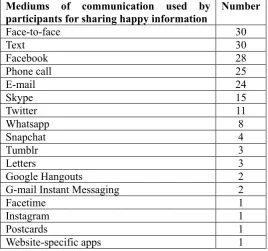
At the beginning of each interview, participants were asked which means of communication they would use for sharing happy information. The interviewer would then run through a list of common mediums and enquire if there were any other methods the participant would use for sharing happy information. The data is presented in Table 6. As can be seen face-to-face communication and texting were used by all participants with traditional communication methods, such as phones and email, being popular. Facebook was very popular amongst participants and newer applications, such as Tumblr, Whatsapp and Snapchat, were also mentioned. Electronic methods of communication dominated participants’ responses with physical methods of communication, such as letters and postcards, only mentioned by a small number of participants.
Mediums of communication used by participants for sharing happy information
Number
Face-to-face 30
Text 30
Facebook 28
Phone call 25
E-mail 24
Skype 15
Twitter 11
Whatsapp 8
Snapchat 4
Tumblr 3
Letters 3
Google Hangouts 2
G-mail Instant Messaging 2
Facetime 1
Instagram 1
Postcards 1
[image:15.595.164.433.374.625.2]Website-specific apps 1
Table 6: Mediums of communication used by participants for sharing happy information
4.5.2
Factors affecting choice of medium
16
Across all participants, in every example described whereby happy information was directed at specific people, the primary criterion affecting choice of medium was that it could convey the information to the intended recipient. As Joyce commented, she would, “determine who I would then share it with. And that then determines what medium I share it through as well”. As can be seen in Table 7, numerous other factors also affect the choice of medium.
As anticipated, convenience was a prominent factor, with examples such as the ease of Facebook and email for sharing media content, and the close proximity of mobile phones commonly mentioned. Seven participants mentioned that they would only use Skype for a fuller conversation or catch-up, and would not use it as a means of contacting a person specifically to share happy information.
Lisa explained that to share happy information with her mum she would be more likely to phone than use FaceTime, primarily through habit (a consistent factor in her choice of medium throughout the interview). From Lisa's mum's perspective, FaceTime was a convenient method because of Lisa's general availability via this platform. The design of FaceTime (being 'built into the iPad' into which Lisa is constantly logged-in and available for alerts) makes it a more convenient platform than Skype and resultantly more frequently used by these individuals.
Factors affecting participants’ choice of medium Number
Using medium that will allow sharer to reach intended recipient 30 Using medium best suited to the content i.e. will allow recipient to experience information in
same way sharer has, or will have the most impact
22
Convenience / ease / practicality 21
Sharing in person or via phone due to need for physical interaction, emotional element or in-depth discussion
18
Sharer’s knowledge or perception of mediums available to recipient / how regularly recipient may access a medium
17
Immediacy 17
Privacy / not wanting to share something publicly 15
Medium that seems most ‘socially appropriate’ for the content 15
Personal preference of medium 15
Desire to reach widest possible audience 13
Reluctance to inconvenience people 11
Frustration or unfamiliarity with a medium / old technology (barriers to using certain mediums) 11
Habit (of communicating with a person in a certain way) 10
Cost 10
Perception of recipient’s availability 8
Geography: location and time difference 7
Recipient’s preference of medium 7
[image:16.595.48.545.415.746.2]Importance of sharing ‘big’ news with close friends and family in person or over phone 6 Continuation of on-going topic / reciprocating via same medium 5
17
4.5.3
Sharing in person
A common feature mentioned of face-to-face communication (and to a lesser degree Skype and phone-calls) was the richer quality of verbal communication compared to electronic messaging. Twenty participants commented that the former mediums offered an enhanced emotional experience, while seven participants mentioned that a significant disadvantage of electronic communications was the inability to convey nuanced tone and emotion, leaving communication more open to ambiguity and misunderstanding. Many participants felt that verbal mediums offered a more emotional experience; however five interviewees described occasions where they had shared happy information both in person and by another medium, and experienced equal levels of happiness.
For other participants, such as Mary, sharing in person always offered an enhanced experience - “you can't really substitute the- the human interaction. It is very difficult to share a laugh when you can't hear the other person laughing”. The findings reveal that the nature of the content and individual preferences both impact on whether sharing in person offers a happier experience.
A common incentive mentioned by participants for waiting to share happy information in person, was for the sharing of significant life events, such as engagements, with relatives or partners. However, because this medium was not an option for many participants due to geographical distance, this motivation could not be compared consistently across participants. For this reason, numerical data concerning the sharing of significant events has been removed from Table 8.
Factors affecting whether individuals would wait to share happy information in person Number Incentives to wait until see recipient in person
Enhanced emotional experience 8
Sharing more complex information requires in-depth discussion 7 Saving up information so have things to discuss when see person 5
General preference for face-to-face communication 4
Not sufficiently important to share immediately (which would require recipient take time out of their day to process)
4
Easier to wait than go to the effort of messaging 2
Seems more socially appropriate to wait, rather than making deliberate contact with the person
2
Habit of sharing in person with certain people 1
Recipient has no suitable means of receiving information other than communicating in person
1
Reasons not to wait until see recipient in person
Desire for immediacy – to share and receive response as soon as possible 14 Information too trivial to merit waiting until see the person 12
Danger of forgetting information 6
18
Initial excitement will wear off over time / won’t be in same mind-set to enjoy if wait 3 Accustomed to sharing everything instantly due to smartphone technology 2
Table 8: Factors affecting whether individuals would wait to share happy information in person
Five participants mentioned instances of having purposefully saved up information to provide topics of conversation in person, with two participants specifically mentioning a dislike of 'wasting' potential conversation by sharing it via electronic mediums. These two examples are interesting to compare. Both interviewees had an interest in acting – Jonathan a professional actor, and Nicholas heavily involved in amateur dramatics – and both highlighted the impact of telling a story, and audience reaction. Jonathan said:
there have been times where I've thought I would enjoy the evening telling her these things now, as opposed to reiterating them in the text […] when the punchline's gone
and Nicholas:
it's almost something that annoys me about Facebook that I have sometimes already shared something that would have been an interesting conversation with a group of actual people [laughs] and I've already kind of wasted it by putting it on Facebook […] it's like, people already know about something, that you could have surprised them with, and made them happy, and seen the reaction – and you've already put it up on Facebook, and their reaction is the second-hand, I already know about it, 'oh yeah...' - it's not the kind of 'Wah!' you might have got...
Although both participants expressed the same views, the degree to which this feeling impacted on them varied, with Jonathan being extremely unlikely to share something electronically that would benefit from discussion or personal interaction, whereas Nicholas, despite a preference for face-to-face communication, confessed that he 'wasn't very good' at waiting to see people before sharing things. Nicholas also explained that his job involved a lot of social media use on topics that were of little personal interest to him. Accordingly, he compensated for this by using his own social media platforms as a way of communicating the things that he would otherwise share, had he free rein - “So it's almost...practice for when I actually manage to find a job where I can share things that I find interesting [laughs]”. Jonathan, on the other hand, would frequently wait to see people before sharing happy information. This was strongly influenced by a hyper-awareness of others' availability and not wanting to inconvenience them if they were busy. Eight other participants also mentioned reluctance to phone people for fear of bothering them, preferring instead to send a text which the recipient could read in their own time.
19
4.5.4
Impact of 'social norms' on choice of medium
Four participants commented that for more trivial happy information they would use text or Facebook, because this seemed like the most suitable method; whereas phone-calls or emails seemed more purposeful and direct, accordingly implying greater importance. Graham explained that for trivial happy information he would, “send it more than likely by Facebook because it's not cluttering up somebody's email”. In addition to not wanting to irritate people with such behaviour, participants also revealed awareness of social norms, voicing opinions that recipients would think it 'odd' to receive an email or a phone-call for a piece of information consisting of only several lines worth of content. Furthermore, 12 participants described occasions where information was deemed too trivial to directly contact a person and they would either wait until communicating with the person anyway, or would only mention it at all if it happened to become relevant in conversation or interaction. Therefore, decisions on sharing are affected by the significance of the information; choosing the means that will allow the information to be conveyed with maximum impact; and also by participants' perception of via what means it is 'socially appropriate' or 'normal' to share certain content.
Comparing her behaviour to others', Sandra reflected:
I think my personality shuns the kind of exhibitionism that something like Facebook can allow […] if I post that generally to everyone, I feel like it's a kind of a statement almost. So, while I'll do it occasionally, I wouldn't do it regularly.
When sharing with specific individuals, Sandra would also share more commonly via Facebook private messages than publicly on recipients’ walls, even if the content of the happy information did not require privacy. This idea of over-sharing was also explored in Arnott (Arnott, 2012) whose participants often deliberately avoided sharing too widely to avoid being viewed negatively by friends.
Perceptions of what was deemed 'normal' were also apparent in Tim's comments that whereas it would be normal to gather together to watch a film, it would be extremely unnatural to purposefully gather people together to crowd round a screen and share something small such as an online video clip or gif. Furthermore, Tim felt that while human interaction would increase the happiness of watching a comedy film, the happiness of experiencing something like a video clip would not be similarly enhanced by sharing this in person. In this instance Tim felt that the convenience of being able to enjoy the information in the comfort of your own space was more important.
20
desire to experience the music in person with his friends. It is significant that in this situation the dynamic of the group dictates that, despite the ease with which music can now be shared easily and instantly online, waiting to share this type of happy information in person is 'normal'. Comparison of these examples suggests that not only do 'social norms' affect how happy information is shared, but also that these 'norms' may vary between different groups.
4.6
Act of sharing increasing happiness
4.6.1
Ways in which sharing happy information increases happiness
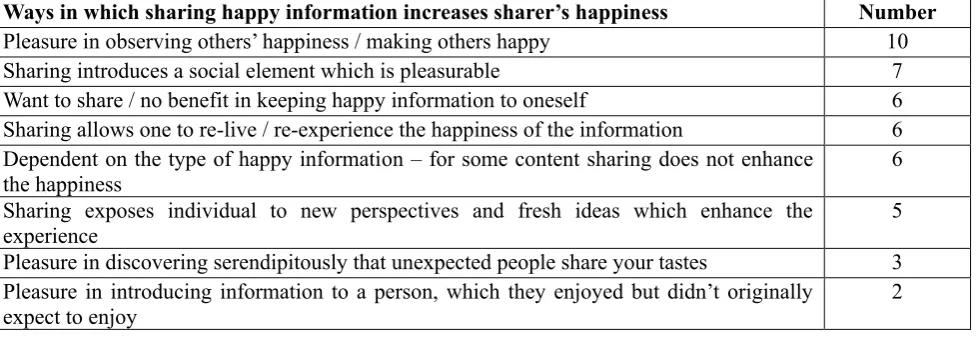
The final theme investigated whether the act of sharing happy information increases the individual's happiness. Twenty-five participants were asked, “do you feel that the act of sharing happy information increases your happiness?” Either in response to this question, or in relation to an example provided during the interview, all 30 participants described an instance of their happiness being enhanced by the act of sharing the happy information. The figures in Table 9 below represent combined numbers of answers given in response to this specific question and comments mentioned throughout the interview. Some participants responded that the degree to which happiness was increased depended on the nature of the response, if one was received. Responses to sharing and how these impacted on sharing behaviour are dealt with in (Tinto and Ruthven, 2014) and not reported further in this paper.
Ways in which sharing happy information increases sharer’s happiness Number
Pleasure in observing others’ happiness / making others happy 10 Sharing introduces a social element which is pleasurable 7 Want to share / no benefit in keeping happy information to oneself 6 Sharing allows one to re-live / re-experience the happiness of the information 6 Dependent on the type of happy information – for some content sharing does not enhance
the happiness
6
Sharing exposes individual to new perspectives and fresh ideas which enhance the experience
5
Pleasure in discovering serendipitously that unexpected people share your tastes 3 Pleasure in introducing information to a person, which they enjoyed but didn’t originally
expect to enjoy
[image:20.595.55.544.393.562.2]2
Table 9: Ways in which sharing happy information increases sharer’s happiness
4.6.2
Sharing widely vs. restricting sharing to select group
21
To certain people, having 'our thing' was an important aspect of their relationship with that person, whereas other people explained that while they enjoyed the exclusivity, they wouldn't go to the extent of excluding people. Nine participants felt that it was not important to restrict information to a small group, with five participants further mentioning that sharing happy information with other people did not undermine the act of sharing with the original person, and four participants expressing sentiments of 'the more the merrier', explaining that sharing more widely enhanced the happiness by providing additional people you could interact with regarding that information. Five participants, however, felt that 'sharing widely' did not necessarily enhance the happiness, and it depended on the further parties' motivation for wishing to be included, and what they could add to the experience. Eleven participants commented that (where another party expressed interest) they would only restrict wider sharing when it was impossible or required too much effort to provide the background knowledge necessary to appreciate the happy information.
Two participants were particularly conscious of the desire not to exclude others, one through dislike of being on the receiving end of such treatment, and another because he disliked a tendency towards 'protectiveness' of content within fan-culture. Both of these participants described instances of deliberately attempting to share minority or niche interests more widely in order to generate further interest, which would hopefully support the production of their comic or show, and also establish other people with whom relevant happy information could be shared and enjoyed.
4.6.3
Ownership and protectiveness over happy information
The concept of 'protectiveness' or ownership of content was exhibited on several occasions throughout the interviews. The participants included two flatmates, both of whom discussed the same example of shared happy information (a YouTube video of goats screaming like humans) during the interviews. The following conversation occurred with Michelle:
Interviewer: ...and there's no-one else you share the goat things with – that's just Rita? Michelle: No-one else finds it as funny! [laughs] I've tried – I've tried!
Michelle proceeded to reveal, “I think it's nice that we have those things [that we share just between us],” however, her behaviour suggests that this happy information was something she would also have enjoyed sharing more widely. Rita expressed a slightly different emotional reaction to the instances where they shared this with other people:
I didn't expect them to kinda jump on board and be like, 'oh this is great!' and join in with it as well. I think, if they'd done that I probably would have had the opposite reaction, I probably would have felt a bit like 'aw, this is our thing!'
22
While the concept of 'our thing' was in this case linked to a special relationship between two people, Tina demonstrated this on a wider scale. Discussing her reasons for sharing things directly with people rather than posting them on her own Facebook wall, Tina commented:
there has [sic.] been times when I've gone 'I'm not sharing- I'm not putting it up on my timeline' because somebody else'll go into it and find it, and then they'll use it and they'll share it, and I'll think [laughs] 'I don't want you to share it'...
Although Tina described herself as a very sharing person, to whom the act of sharing gave great enjoyment, she also at times felt a desire to restrict that enjoyment to her own circle of friends, without allowing the happiness to spread more widely. Another participant, Tim, felt that the greatest advantage of the internet was allowing information to be shared more easily and widely, and that, “it's good to be part of that”. While Tim didn't mind information being re-shared, he wanted to be credited when this happened. Describing a video-game trailer he had shared on his own page, Tim commented:
there's one or two people that stole it. Just like, I was like, 'pfff – that's pretty mean' … it's all about internet kudos. Like that's- that's half the reason people post stuff on- like, on Facebook.
Facebook has the facility to 're-share' content, which allows you to re-post content on your own or a friend's wall, but states 'X person shared a link via X person', thus acknowledging the source. If a person simply copies and pastes a link, this message will not appear. Tim felt that having sourced this content initially, for others to be re-posting this without crediting him robbed him of the respect or 'internet kudos' he was due, should other people enjoy this item. One other participant made a related comment that his estimation of people increased if they posted something he deemed 'cool', and reasoned that a desire for others to view him in this light probably motivated his own sharing on a sub-conscious level. It can be seen from these examples that feelings of ownership or protectiveness over happy information can cause barriers to sharing.
5
Limitations
23
Whilst we have provided quantitative data based on occurrence of mentions of various factors, we have not attempted to quantify the importance of these factors. For example, although more people reported sharing photographs than jokes, this does not mean that they regarded it as more important to share photographs, simply that they mentioned these more often. Quantifying these aspects of information sharing were outside the current study.
While the research did not seek to demonstrate trends within any particular group or demographic several findings suggested that behaviours differ among different groups. Future research comparing the behaviours of specific groups (e.g. different age ranges, professions, hobbies) could investigate whether these vary between different demographics.
As demonstrated by Chua, Goh and Lee (2012), the acts of giving and receiving constitute different behaviours. This research focussed only on the giving aspect of happy information sharing; however individuals' behaviour regarding receiving happy information shared by others also requires investigation. The findings of this research reveal that in many situations happiness can be increased by the act of sharing happy information; however this was not always necessarily the case. Further research is required to better understand how and in what circumstances happiness can be enhanced through the sharing of happy information.
6
Discussion
This study is firmly placed within a casual leisure setting. As described in section 2.1 such activities are often seen as trivial by the outsider but meaningful to those engaged in them. Casual leisure was viewed as a useful framework for thinking about this form of information sharing due to the emphasis on hedonic aspects of information and information use. Due to the lack of work on information sharing within casual leisure environments we felt it appropriate to conduct exploratory research on this topic which was informed, but not driven, by existing work from casual leisure and information sharing in settings other than casual leisure. In this section we will reflect on the major findings from our study and how they relate to existing work in other information sharing contexts and casual leisure research. In both cases there are similarities to known findings and differences.
24
demonstrated in our study, whereby appropriateness, relevance and quality of content (i.e. is this sufficiently funny or interesting to merit sharing) affected the likelihood of sharing. Certain studies explored pleasure in sharing, and 'super-sharers' who share more frequently due to enjoyment of the experience; however none of the studies in the literature review explored the specific concept of a 'need to share'.
Experiencing a need to share was a very common motivation for sharing in our study and, from the interviews, it appeared that a subconscious association between content and recipient can in itself motivate information sharing, as can experiencing a feeling of ‘needing to share’. The need to share with individuals revealed the importance of information sharing in maintaining, developing and creating relationships. From our findings, the sharing of small items of ‘happy’ information can be seen as information probes; small, easily shared and easily consumed items of information that can be used to probe relationships either to reconnect after a break in a relationship, to test relationships by observing reactions to shared information or even to tease others to stimulate a reaction. These probes can also lead to unexpected discoveries of similar tastes which may lead to a deepening relationship and were used heavily by participants to maintain relationships. The ‘small’ nature of the information being shared also means we can potentially probe frequently without overwhelming others with our sharing.
Many of the studies referenced in the literature review reported instances of sharing in connection with maintenance and strengthening of social bonds. The studies of Haythornthwaite (1996) and Hall, Widén and Paterson (2010) revealed sharing to occur more frequently where strong relationships were present. These findings are consistent with the behaviours demonstrated by our interviewees; however frequent contact (rather than strength of relationship) was reported by some participants as encouraging greater information sharing.
Most of the information sharing reported here was not significant in the sense of passing on significant items of information. Rather the act of sharing itself was more important than what was being shared. The experience of pleasure in the act of sharing was reported by Rioux (2004) and Wasko and Faraj (2005). Additionally, the concept of 'super-sharers' present in the studies of Talja (2002) and Fulton (2009a) was related to specific individuals who took particular pleasure in the act of sharing. The pleasure in making others happy demonstrated by some participants is particularly reflective of the 'gift-giving' behaviour reported by Van House et al. (2005) and Hall, Widén and Paterson (2010). The findings revealed all participants have experienced pleasure in the act of sharing happy information. There was variation among participants as to whether they attributed this to their individual personality or a universal human trait. We did not attempt to formally assess personality types as a variable within our study but it became an important latent concept used by our participants to explain their behaviour, and future research involving comparison of personality types could explore this further.
25
group, within the context of sharing happy information. This is relevant to Stebbins’s discussion on why casual leisure is not synonymous with mass leisure: we don’t all access the same leisure information but often form groups or ‘tribes’ around certain types of casual leisure (Stebbins, 1997, p.23). Interviewees often had distinct types of information that they would share and having ‘our thing’ was important to several participants: deliberately sharing certain types of leisure information to make a relationship unique.
As anticipated, the most commonly cited factors affecting choice of medium related to convenience and access. These were also revealed to be significant in the studies of Olsson, Soronen and Väänänen-Vainio-Mattila (2008) and Fulton (2009a and b). Variation in usage of different social media platforms was interesting, and reveals that individuals' desire to tailor platforms to their own needs occurs in leisure contexts as well as work-based scenarios. The capacity of more personal and interactive mediums (in person, Skype, phone) to enhance the emotional experience also impacted many participants' information sharing. The presence of 'social norms' and the 'contagious' element of escalating Snapchat sharing have connections with the findings of Ames and Naaman (2007). It was interesting that the impact of 'social norms' affected not only the content shared within certain audiences, but also the medium by which happy information was shared. This involvement of social norms, section 4.5.4, reinforces the impression that the social act of sharing was more important than the information being shared. In their study of information seeking in casual leisure, Elsweiler, Wilson and Kirkegaard Lunn (2011, p.227) claimed the experience of finding information was more important than the information itself and we found parallels to this claim in our study of sharing information.
In his 1997 article Stebbins characterised six types of causal leisure, one of which was social conversation which he described as being conducted because of its intrinsic value and containing a strongly playful nature. This particular characterisation fits well with the kinds of information sharing we found in this study. We have focussed on sharing of happy information which often has a ‘play’ aspect, particularly in its expressive nature, lack of seriousness and pleasure taken in its sharing. However there are differences. As we explore in (Tinto and Ruthven, 2014), responses to information sharing are not always conversational. Stebbins characterised social conversation as ‘a democratic activity in that the pleasure of one person is dependent on the other people in the exchange’ (p.20). Our findings in (Tinto and Ruthven, 2014) showed that the happiness of information sharing is not contingent on the reactions of others. Sometimes it is, sometimes it is not. Often the act of sharing itself is enough to gain pleasure and ‘gift-giving’, which is not dependent on reactions to the giving, was a common behaviour. Neither do we strictly agree that such conversations are non-instrumental. The probing behaviour we described earlier is often instrumental, using information to make, maintain, or deepen relationships.
26
quickly based on a need to share, and shared based on an (often unconscious) association between the information and their social groups. These findings also fit conceptually with Heinström’s claim that ‘Positive moods are therefore likely to result in faster, simpler and easier information processing’ (2010, p.114).
In this study we focussed specifically on happy information. In their 2011 chapter Spink and Heinström argued that information behaviour research needs to explore “new concepts and contexts” (p.291) in order to move towards a “holistic understanding of information behaviour” (p.291) and so ours was a conscious effort to focus on positive information which we felt was under-explored within information science. The exploration of positive information is particularly relevant to Kari and Hartel’s manifesto for seeking new research directions in the less-explored positives of information behaviour (2007). The sharing behaviours we uncovered mostly fall within the ‘pleasurable’ category of ‘things’ (p.1133) reflecting motivations such as ‘hedonism’, ‘humor’, ‘entertainment’ and ‘fun’, however the purpose of the sharing, and its cumulative effect, is often directed towards more ‘profound’ (p.1133) states such as ‘altruism’ through gift-giving, or ‘meaning of or purpose in life’ through enhanced relationships. This focus on positive information means we cannot make claims as to how sharing happy information differs from sharing negative or neutral information, but we have been able to uncover how our interviewees valued small acts of information sharing as part of long-term relationships.
7
Conclusion
The goal of this research was to investigate the factors motivating and impacting upon individuals' sharing of non-task-orientated happy information. Additionally, the research aimed to investigate the affective states involved in individuals' happy information sharing. These were investigated within the context of a casual leisure environment. The areas of investigation involved the factors impacting on why individuals choose to share such information, with whom, and via which methods. The research also examined the relationship between individuals' happy information sharing and their emotions.
The research uncovered a range of factors motivating and impacting on individuals' happy information sharing behaviour, which are presented in the findings. Overall, the most prominent finding is that the different aspects of happy information sharing behaviour (why, how and with whom individuals share) are all interlinked, impacting on each other. Additionally, the findings revealed that most individuals do consider sharing happy information important to their friendships and relationships, and that in many cases the act of sharing happy information invokes or increases happiness. The primary contribution of these findings to LIS research on information behaviour is the establishment of the list of factors motivating individuals' information sharing behaviour of non-task-orientated happy information within a casual leisure environment.