White Rose Research Online URL for this paper:
http://eprints.whiterose.ac.uk/139877/
Version: Published Version
Monograph:
Mason, A. orcid.org/0000-0002-5823-3064, Miraldo, M., Siciliani, L.
orcid.org/0000-0003-1739-7289 et al. (2 more authors) (2008) Establishing a fair playing
field for payment by results. Working Paper. CHE Research Paper . Centre for Health
Economics, University of York , York, UK.
Reuse
Items deposited in White Rose Research Online are protected by copyright, with all rights reserved unless indicated otherwise. They may be downloaded and/or printed for private study, or other acts as permitted by national copyright laws. The publisher or other rights holders may allow further reproduction and re-use of the full text version. This is indicated by the licence information on the White Rose Research Online record for the item.
Takedown
If you consider content in White Rose Research Online to be in breach of UK law, please notify us by
Establishing a Fair Playing Field for
Payment by Results
Establishing a Fair Playing Field for
Payment by Results
Anne Mason
Marisa Miraldo
Luigi Siciliani
Peter Sivey
Andrew Street
Centre for Health Economics, University of York, UK.
CHE Discussion Papers (DPs) began publication in 1983 as a means of making current research material more widely available to health economists and other potential users. So as to speed up the dissemination process, papers were originally published by CHE and distributed by post to a worldwide readership.
The new CHE Research Paper series takes over that function and provides access to current research output via web-based publication, although hard copy will continue to be available (but subject to charge).
Acknowledgements
We would like to thank David Epstein of the University of York for his help understanding the complexities of capital costs. Thanks are also due to Thomas Allan, Lesley Boyes, Susannah Burton, Susan Devlin, Alan Glanz, Sebastian Habibi, Tanveer Hussain, Graham Kendall, Nadia Koh, David Lighterness, David Loasby, Andrea Longhi, Jonathan Low, Martin Orton, Richard Owen, Caroline Page-Brown, Declan Millin, Rob Moorhead, Katrina Pattison, Eileen Robertson, Amanda Rossiter, Julia Scott, Sharon Spence, Paul Whitbourn and members of the DH steering group for their input to the project.
We also thank Chris Gardner, Mark Chessum, Dave Sahman, John Loftus, Gary Sired, Jonathan Storey, Martin Mcdowell, Steven Bliss, Julie Renfrew, Nikki Woodward, Zoe Hawkesworth, Pippa Moger, Elizabeth O‟Mahony, Helen Vinters, Andrea Nash, Jane Hazelgrave, and Yasmin Stammers for providing details of IS locations.
The project was funded by the Department of Health in England as part of a programme of policy research at the Centre for Health Economics, University of York. The views expressed are those of the authors and may not reflect those of the funder.
Disclaimer
Papers published in the CHE Research Paper (RP) series are intended as a contribution to current research. Work and ideas reported in RPs may not always represent the final position and as such may sometimes need to be treated as work in progress. The material and views expressed in RPs are solely those of the authors and should not be interpreted as representing the collective views of CHE research staff or their research funders.
Further copies
Copies of this paper are freely available to download from the CHE website http://www.york.ac.uk/inst/che/publications/index.htm Access to downloaded material is provided on the understanding that it is intended for personal use. Copies of downloaded papers may be distributed to third-parties subject to the proviso that the CHE publication source is properly acknowledged and that such distribution is not subject to any payment.
Printed copies are available on request at a charge of £5.00 per copy. Please contact the CHE Publications Office, email [email protected], telephone 01904 321458 for further details.
Centre for Health Economics Alcuin College
University of York York, UK
www.york.ac.uk/inst/che
Table of contents
Glossary ... ii
Executive Summary ... v
1. Introduction ... 1
2. The Independent Sector and the NHS: recent history ... 2
2.1 Procurement methods for ISTCs ... 2
2.2 Payment terms ... 4
3. Plurality and PbR ... 7
3.1 The grounds for making differentiated payments between IS and NHS providers .. 7
3.2 The form of compensating payments ... 8
3.3 Price adjustment ... 9
3.4 Specific payments ... 9
3.5 The Market Forces Factor ... 10
3.6 Summary... 11
4. Regulatory factors ... 13
4.1 Corporation tax ... 13
4.2 VAT ... 14
4.3 Monitoring and performance management regime ... 15
4.3.1 Registration and inspection requirements ... 16
4.3.2 Reporting requirements ... 16
4.4 Contracting issues ... 17
4.4.1 Contractual process ... 17
4.4.2 Payment timing ... 18
5. Production process factors ... 19
5.1 Introduction ... 19
5.2 Cost of capital ... 19
5.2.1 Ease of access to capital ... 19
5.2.2 Cost of accessing capital ... 21
5.2.3 Implications for Payment by Results ... 22
5.3 Costs of labour ... 23
5.3.1 Recruitment costs ... 23
5.3.2 Rates of pay ... 24
5.3.3 Pension contributions ... 25
5.4 Geographical variation in input prices - Market Forces Factor ... 26
5.5 Economies of scale and scope ... 27
5.6 NHS monopsony power – access to cheaper inputs ... 30
5.6.1 NHS Litigation Authority ... 30
5.6.2 NHS Purchasing and Supply Agency ... 30
5.6.3 Connecting for Health: IM&T ... 31
5.6.4 Other Arms Length Bodies ... 32
5.7 Production of other outputs/services: R&D, teaching and training ... 32
5.7.1 Research & development ... 32
5.7.2 Teaching (training for qualification) ... 32
5.7.3 Training ... 33
5.7.4 Implications for Payment by Results ... 33
6. Differences in casemix ... 34
6.1 Introduction ... 34
6.2 Exclusion criteria ... 34
6.3 Empirical analysis of HES data... 35
6.3.1 Methodology ... 37
6.3.2 Results ... 38
6.3.3 Summary ... 41
7. Discussion and conclusions ... 43
8. References ... 48
Appendix 1 ... 51
Glossary
Affordability An HMT criterion used to approve ISTC bids: the financial ability of the health economy to support the scheme/ programme
ALB Arm‟s Length Body
ASA American Society of Anaesthesiologists (physical status grade) ASC Ambulatory Surgical Centre (US)
AT Acute Trust
BMI Body mass index
CATS Clinical Assessment and Treatment Services
CfH Connecting for Health
CNST Clinical Negligence Scheme for Trusts
DRG Diagnostic related group (similar to HRG) DNA Did not attend
Dual tariff Payment made /received by SoS to/from ISTC providers equal to the difference between PCT payments and the contract price
ECN Extended Choice Network
ESA Electives Services Agreement FCE Finished consultant episode
FT NHS Foundation Trust FTFF FT Financing Facility
GFV Guaranteed Fixed Value (Guaranteed percentage x Contracted Base Costs) HCC Healthcare Commission
HMT Her Majesty‟s Treasury
HOPD Hospital outpatient department (US) HRG Healthcare resource group
IDPI Immediate deduction performance indicator IM&T Information Management and Technology
IMD Index of Multiple Deprivation IS Independent sector
ISTC Independent sector treatment centre ITN Invitation to Negotiate
ITU Intensive therapy unit
LT Long term
MFF Market Forces Factor
Monitor The independent regulator of NHS Foundation Trusts
Need An HMT criterion used to approve ISTC bids: the requirement of the health economy for the scheme/programme as assessed by Strategic Health Authority (SHA) capacity mapping exercises.
NHS Equivalent Cost
The cost that would be incurred by an averagely efficient NHS Trust delivering the identical activity at the same location (as compared to an Independent Sector provider)
NHSPN NHS Partners Network
PAYG Pay-as-you go (pension scheme)
PBC Prudential Borrowing Code that governs FT borrowing
PBL Prudential Borrowing Limit, specified in the PBC
PbR Payment by Results PCT Primary care trust
PDC Public dividend capital
PFI Private finance initiative PwC PriceWaterhouseCoopers
SHA Strategic Health Authority SoS Secretary of State
ST Short term
VfM An HMT criterion used to approve ISTC bids: Value for Money is assessed by the percentage variation between NHS Equivalent Cost and the bidder price
WACC Weighted average cost of capital, a method of calculating rate of return
Executive Summary
Overview
A key element of the reform agenda for the health service has been to encourage a plurality of provision for NHS patients and so improve the quality of care. In introducing plurality, the Department of Health is committed to establishing a „fair playing field‟. This means that the objective of competitive neutrality across NHS and Independent Sector (IS) providers of NHS services („a levelplaying field‟)
is tempered by the obligation upon the public sector to act in the public interest. This fair playing field must be supported by the system of reimbursement – called Payment by Results (PbR) – that is being implemented to fund NHS patients. PbR is a prospective payment system in which prices for treating particular types of patients are fixed in advance by the Department of Health rather than being negotiated locally. As prices are fixed, any competition between providers should be on the basis of the quality of services, rather than their cost. Fixed pricing regimes require that:
1. The unit of service / treatment is defined accurately. 2. Prices are determined on a fair basis.
Why might NHS and IS providers be eligible for different payments?
In general, there are three grounds on which IS providers might be subject to differing financial arrangements than NHS providers under a fixed pricing regime:
1. To encourage entry and participation by IS providers;
2. Because NHS and IS providers face different unavoidable costs; 3. Because NHS and IS providers are delivering different services.
Differential arrangements to encourage participation might be justified if NHS and IS providers face different barriers to entry. These arrangements are not likely to persist once entry has been achieved and hence do not have implications for the design of PbR. Consequently this issue is not considered at length.
The second justification for differential payments is that NHS and IS providers may face different operating constraints that are beyond their control (i.e. unavoidable) which impact on their costs of production. These different constraints imply that providers will incur different costs in providing the same services – even if they are equally efficient. Broadly these constraints fall into two categories:
Regulatory constraints
Production process constraints
In sections 4 to 5, we identify and examine the nature of each potential constraining factor on NHS and IS providers, and recommend how these might be addressed to ensure a fair playing field. To this end, we ask two questions:
What is the differential impact of each unavoidable factor on NHS and IS providers?
Should these unavoidable factors be accounted for within a fixed pricing regime, and if so, how?
The third justification arises if NHS and IS providers treat different types of patients, and the classification system used to define a „unit‟ of service is insufficiently refined to identify these differences. This would not be a problem if differences were random, where it is a matter of chance whether any particular patient is more or less expensive than the average patient in the service category to which they are classified. With sufficiently large volumes, these differences cancel out. Problems arise if the differences across providers are systematic, with one type of provider more likely to treat low-cost patients and another to treat more high-cost patients.
which payments are based. There are two elements to this analysis. First, we consider the extent to which explicit exclusion criteria have been adopted by IS providers. Second, we undertake empirical analysis of HES data to identify differences in patients in specific HRGs across IS providers, NHS treatments centres and NHS hospitals.
How might differential payments be made under PbR?
Financial arrangements under PbR can be modified in two ways if there is evidence that providers face different unavoidable costs or provide different services:
Price adjustment. This involves allowing price to vary in line with the collective influence of the unavoidable factors or to be adjusted to compensate for inaccurate service descriptions.
Specific payments. This would involve making specific payments (charges or rebates) to compensate for the influence of each specific unavoidable cost factor.
Price adjustment to correct for unavoidable constraints is not recommended because it undermines the integrity of a fixed pricing regime and distorts purchasing behaviour.
Specific payments for unavoidable costs have the advantage of greater transparency and allow adjustments to be factor-specific rather than based on provider characteristics, such as ownership type. The form of these payments will vary according to the factor under consideration and the amount will be provider specific.
Where there is evidence that different types of service are being provided and this is not accurately reflected by the classification system used to define services, price adjustment is recommended.
Which factors drive cost differences between NHS and IS providers?
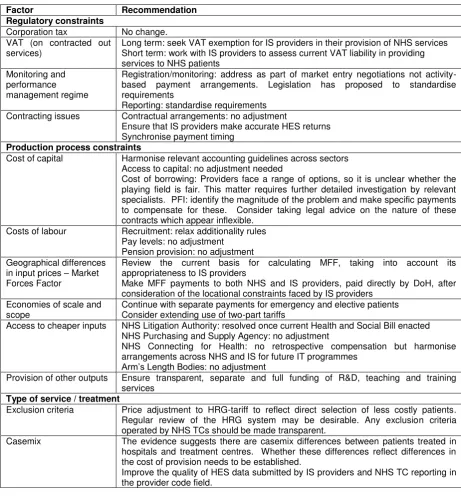
We investigate each factor hypothesised to drive cost differences between NHS and IS providers, in order to assess the extent to which these can be considered unavoidable or provide evidence of the provision of different types of service. Factors that are within the provider‟s control are not candidates for compensatory arrangements under PbR. Each factor investigated is listed in Table 1, together with a summary of how these might be addressed – if at all – under a PbR regime.
Our analysis allows us to categorise each factor into one of five classes:
Those factors which are not unavoidable – these are not exogenous constraints and do not imply an unfair or uneven playing field. As such no correction is required under PbR. Examples are corporation tax and pension contributions.
Those factors which are unavoidable, but where correction is best made through standardisation of regulatory arrangements, rather than by financial compensation. Examples are inspection regimes and access to the indemnity arrangements (NHS Litigation Authority). Those factors that require specific payments to be made. We recommend only four types of specific payments – VAT, MFF, capital costs for PFI and payments for R&D, teaching and training. These payments will be provider-specific, and will depend on what VAT is incurred in providing NHS care, where the provider is located, the net additional cost of PFI payments, and how much R&D, teaching and training is undertaken.
Those factors that are best handled by introducing two-part tariffs, so that there is better risk sharing between providers and purchasers in the context of demand volatility. The requirement upon the NHS to have capacity available on stand-by necessitates such arrangements. The form of such arrangements needs to be assessed on a service by service basis.
Table 1: Summary of recommendations
Factor Recommendation
Regulatory constraints
Corporation tax No change. VAT (on contracted out
services)
Long term: seek VAT exemption for IS providers in their provision of NHS services Short term: work with IS providers to assess current VAT liability in providing services to NHS patients
Monitoring and performance
management regime
Registration/monitoring: address as part of market entry negotiations not activity-based payment arrangements. Legislation has proposed to standardise requirements
Reporting: standardise requirements Contracting issues Contractual arrangements: no adjustment
Ensure that IS providers make accurate HES returns Synchronise payment timing
Production process constraints
Cost of capital Harmonise relevant accounting guidelines across sectors Access to capital: no adjustment needed
Cost of borrowing: Providers face a range of options, so it is unclear whether the playing field is fair. This matter requires further detailed investigation by relevant specialists. PFI: identify the magnitude of the problem and make specific payments to compensate for these. Consider taking legal advice on the nature of these contracts which appear inflexible.
Costs of labour Recruitment: relax additionality rules Pay levels: no adjustment
Pension provision: no adjustment Geographical differences
in input prices – Market Forces Factor
Review the current basis for calculating MFF, taking into account its appropriateness to IS providers
Make MFF payments to both NHS and IS providers, paid directly by DoH, after consideration of the locational constraints faced by IS providers
Economies of scale and scope
Continue with separate payments for emergency and elective patients Consider extending use of two-part tariffs
Access to cheaper inputs NHS Litigation Authority: resolved once current Health and Social Bill enacted NHS Purchasing and Supply Agency: no adjustment
NHS Connecting for Health: no retrospective compensation but harmonise arrangements across NHS and IS for future IT programmes
Arm‟s Length Bodies: no adjustment
Provision of other outputs Ensure transparent, separate and full funding of R&D, teaching and training services
Type of service / treatment
Exclusion criteria Price adjustment to HRG-tariff to reflect direct selection of less costly patients. Regular review of the HRG system may be desirable. Any exclusion criteria operated by NHS TCs should be made transparent.
Casemix The evidence suggests there are casemix differences between patients treated in hospitals and treatment centres. Whether these differences reflect differences in the cost of provision needs to be established.
Improve the quality of HES data submitted by IS providers and NHS TC reporting in the provider code field.
Conclusions
Differentiated payments under PbR are justified on the grounds that providers face different operating constraints, which imply that providers will incur different costs in providing the same services.
Ownership status is not necessarily a sound basis for making differentiated adjustments for unavoidable factors. Instead, provider-specific adjustments should be related to each constraining
factor according to the degree to which the factor impacts each provider‟s costs. Of course, the
average net effect of these factors may differ significantly between IS and NHS providers, but this will be because of the association of these factors with ownership type.
These specific payments should be made directly by the Department of Health, rather than via PCTs so that purchasing behaviour is not distorted.
exclusion criteria) are paid a lower price for the services they provide when exclusion criteria are in place. This price reduction will be provider-specific, varying to the extent to which exclusion criteria are adopted.
If tariffs are to continue to be based on average costs, consideration should be given to extending the Reference Cost collection to IS providers so that the costs incurred by these providers can inform the price. This is particularly important for services where a large proportion of activity is undertaken by IS providers.
1. Introduction
A key element of the reform agenda for the health service has been to encourage a plurality of provision for NHS patients. The intentions are to drive up quality through an expansion of the options available to patients wishing to exercise choice, to increase the amount of capacity available to NHS patients, to reward efficiency and to foster innovative and alternative ways of organising and providing health care.
In pursuing the aim of allowing care for NHS patients to be delivered by the independent and voluntary (or „Third‟) sectors, the Department of Health is committed to establishing a „fair playing field‟. This means that an objective of competitive neutrality across the public and private sectors (achieving a „level‟ playing field) should be tempered by the need to meet the NHS‟ social objectives. These social objectives constrain NHS providers to reinvest surpluses and to offer universal access, so they cannot be selective about whom they treat and are obliged to offer a broad range of services, including accident & emergency.
The method by which care for NHS patients is funded is central to achieving both competitive neutrality and social objectives. Funding arrangements in the NHS are being reformed under
„Payment by Results‟ (PbR), the core principle of which is „equal pay for equal work‟, irrespective of where that work is undertaken. Initially, PbR was applied to the NHS hospital sector. But it is being introduced progressively, so that it will apply to all providers of care to NHS patients and to an increasing range of services. Essentially, PbR amounts to a „fee-for-service‟ funding arrangement, where there are two key questions for consideration:
1. How should the service be defined? Health care services are difficult to define and patients have very different care requirements. This makes it difficult to agree service definitions and to determine whether different providers really are doing „equal work‟.
2. How should the fee be determined? The Department of Health wants payments to be „fair‟, and recognises that providers may face unavoidable costs in providing services and meeting social obligations that ought to be taken into account when determining what constitutes
„equal pay‟.
The Department has commissioned research to investigate these matters in relation to the promotion of plurality of provision. Specifically, research was required to:
establish which factors drive significantly different cost structures for the different types of organisation;
on a quantified basis, produce a set of weighted factors that any new tariff system would need to take into account (the work should quantify factors but should not produce a revised tariff);
identify potentially perverse incentives either with the current system or with the proposed solution;
identify any anticipated changes in the economic factors over time;
consider whether it is appropriate to apply the Market Forces Factor (MFF) to organisations outside the NHS; and
consider the implications of casemix differences in a separate, but related, phase of work.
This report is structured as follows. In the next section, we provide a descriptive account of the recent involvement of the IS sector in providing care to NHS patients. We then consider the grounds on which funding arrangements might be differentiated between the NHS and IS, and how these payments might be incorporated into Payment by Results.
2. The Independent Sector and the NHS: recent history
Historically, independent sector provision of health care for NHS patients was commissioned on a locally-negotiated, „spot purchasing‟ basis. However, in 2002, the process for national commissioning was initiated. Informed by a national capacity planning exercise, the Independent Sector Treatment Centres (ISTC) Programme was introduced to create targeted additional capacity for NHS patients (Department of Health, 2002). The stated aims are to achieve local and national NHS targets (e.g. waiting times), broaden the choice for patients, promote innovative delivery models, support the shift from secondary into primary care and promote efficiency through increased competition (Department of Health, 2002). Originally, the programme was expected to provide around half a million procedures annually at a cost of over £5 billion (Barron and House of Commons Health Committee, 2006). To date, around 600,000 patients have benefited from this additional capacity delivered in various settings such as mobile units, newly built facilities, refurbished NHS facilities or existing independent sector facilities.1 Recently, the government appears to have scaled back its plans to expand the use of IS providers for NHS patients (Timmins, 2007).
The programme has been implemented in two phases: Wave 1 and Wave 2 (Phase 2). Wave 1, for which bidders were announced in September 2003, is expected to provide up to 171,000 episodes annually over five years with investment of approximately £1.6 billion (Brailsford, 2006). Over the five-year period, Wave 1 also plans to deliver over 600,000 MRI scans delivered by 12 mobile MRI scanning units.2 In March 2005, a further £3.75 billion investment was announced under Phase 2 to commission elective surgery (17 schemes) and diagnostic capacity (7 schemes) expected to provide up to 250,000 elective procedures and 1.5 million diagnostics annually.3 This second wave also introduced an Extended Choice Network (ECN) of IS providers expected to deliver up to 150,000 procedures annually on an ad hoc basis (Barron and House of Commons Health Committee, 2006, Healthcare Commission, 2007a).
Specialities covered by Phase 2 Electives include ENT, General Surgery, Gynaecology, Ophthalmology, Trauma and Orthopaedics, and Urology.4 In addition, Phase 2 Electives includes Clinical Assessment and Treatment Services (CATS), which offer integrated care in the form of triage, assessment, diagnosis and treatment (Barron et al., 2006b, Department of Health, 2007d). As well as ECG, MRI scans and endoscopies, ISTC Phase 2 Diagnostics covers the national Positron Emission Tomography/Computed Tomography Procurement, which is expected to deliver 20,000 procedures annually.5
2.1 Procurement methods for ISTCs
The central IS procurement method has evolved and the process reported here is for Phase 2 electives. Bidders expressing an interest in the procurement announcement are required to provide specific data. Informed by these data, the DoH then shortlists the bidders who receive an Invitation to
Negotiate (ITN). Bidders that sign the ITN then enter the „Bid Evaluation Phase‟ (Barron et al., 2006b), in which Bidders supply specific financial and pricing information, including financial models incorporating a series of deterministic sensitivity analyses (Department of Health and Central Clinical Procurement Programme team, 2007):
Stage 1: Bid Receipt Stage 2: Evaluation Stage 3: Clarification
Stage 4: Bidder Convergence Stage 5: Final Evaluation
Stage 6: Preferred Bidder Selection Stage 7: Finalization: Contract signed
1
http://www.treatmentcentres.org.uk/default/patients.aspx, accessed 10/09/07 2
http://www.treatmentcentres.org.uk/default/shaspcts/programmes/wave1.aspx accessed 10/09/07 3
http://www.treatmentcentres.org.uk/default/providers.aspx, , accessed 10/09/07 4
http://www.treatmentcentres.org.uk/default/providers/electivesprocurementstatus.aspx, accessed 10/09/07 5
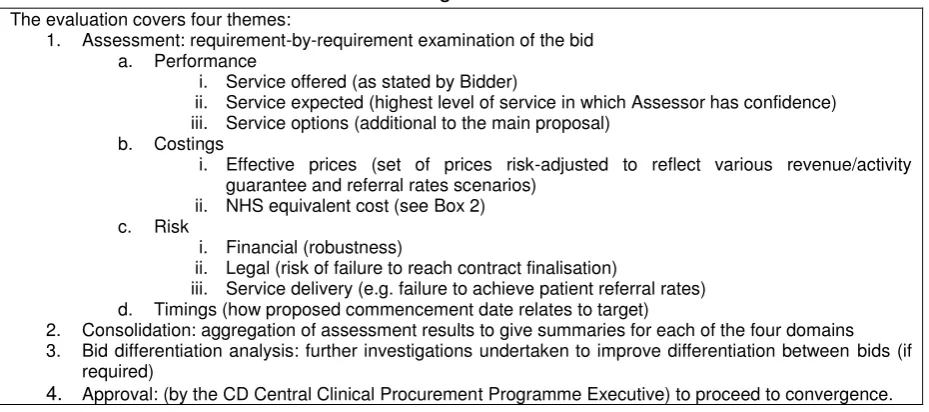
Box 1: Overview of the evaluation /clarification stages
An overview of the evaluation /clarification process is presented in Box 1. Of primary interest for this report is the assessment theme, which contains four dimensions known as „primary procurement
parameters‟ (Department of Health and Central Clinical Procurement Programme team, 2006). Based on the evaluation results, two to four Bidders are selected who then progress to the
„Convergence‟ stage. Convergence involves “difficult and resource-intensive negotiations” (§5.4.6),
and “the evaluation methodology (…) is designed to be useful for convergence and later stages of negotiations” (Department of Health and Central Clinical Procurement Programme team, 2006) (§3). Further reductions in contract price may be secured during negotiations to commercial close (Department of Health and Central Clinical Procurement Programme team, 2007).
HM Treasury uses three criteria to approve Phase 2 ISTC bids (Department of Health, 2007b): 1. Affordability, the financial ability of the health economy to support the scheme/programme.
This is informed by the „Effective price‟ assessment (see Box 1)
2. Value for Money (VfM), assessed by the percentage variation between NHS Equivalent Cost and the bidder price
3. Need, the requirement of the health economy for the scheme/programme as assessed by Strategic Health Authority (SHA) capacity mapping exercises.
The NHS Equivalent Cost Methodology shows how the DoH takes into account a range of factors that explain why bidder price and tariff may diverge. The methodology (see Box 2) is applied to “create a level playing field cost comparator” for clinical activity in the NHS and IS:
[image:18.595.67.532.81.287.2]If the price bid by an IS provider is equal to the NHS Equivalent Cost, then that price should reflect the cost that would be incurred by an averagely efficient NHS Trust delivering the identical activity at the same location (Department of Health, 2005a).
Table 2: Quantified economic/ cost adjustments
Adjustment Scheme with Capital
Development
Scheme without Capital Development
Direct Tax + 4 % + 2%
VAT + 3.5 % +3.5%
CNST -1% -1%
Total Generic +6.5% +4.5%
Scheme Specific +/- Specific Adjustment +/- Specific Adjustment
Source: Department of Health. Independent Sector Procurement Programme - Wave 2 NHS Equivalent Cost Methodology. London: Commercial Directorate, 2005 (Department of Health, 2005a) (Annex 4)
The DoH has produced quantified estimates of the generic economic adjustments (point 2 in Box 2), which are made on a global basis across all HRGs in all schemes (Table 2). Specific adjustments are provider-specific and made on a scheme-by-scheme basis. These adjustments are made for the
The evaluation covers four themes:
1. Assessment: requirement-by-requirement examination of the bid a. Performance
i. Service offered (as stated by Bidder)
ii. Service expected (highest level of service in which Assessor has confidence) iii. Service options (additional to the main proposal)
b. Costings
i. Effective prices (set of prices risk-adjusted to reflect various revenue/activity guarantee and referral rates scenarios)
ii. NHS equivalent cost (see Box 2) c. Risk
i. Financial (robustness)
ii. Legal (risk of failure to reach contract finalisation)
iii. Service delivery (e.g. failure to achieve patient referral rates) d. Timings (how proposed commencement date relates to target)
2. Consolidation: aggregation of assessment results to give summaries for each of the four domains 3. Bid differentiation analysis: further investigations undertaken to improve differentiation between bids (if
required)
purposes of evaluating the Value for Money of the bid; they do not represent actual changes to the tariff paid to providers by PCTs.
Box 2: NHS Equivalent Cost Methodology (Phase 2)
NHS Tariff as baseline
1. Adjustment for patient pathway, so that entry/exit points are matched and the patient cohort is similar a. To reflect the cost PCTs would pay for services outside of the Tariff procedure for additional
services such as physiotherapy
b. Where a provider is delivering all, or a discrete part, of the case mix as day case only, a downward adjustment is made to reflect the reduced cost.
2. Adjustment for economic conditions (see Table 2) a. Generic economic adjustments: tax, CNST b. Cost-base adjustment: provider-specific factors *
i. payments made on behalf of the provider; ii. costs of complying with CfH;
iii. capital charges incurred by NHS bodies for ISTCs; iv. specific risk taken by ISTC from the NHS;
v. patient transport costs, where these provided by the NHS for clinical reasons 3. Adjustment for geographic cost differences: application of MFF to:
a. HRG tariff for main procedure plus b. pathway adjustment plus
c. economic adjustments 4. Adjustment for Tariff inflation
5. Adjustment to Net Present Value (if appropriate)
NHS Equivalent Cost
VfM = (bid price – NHS equivalent cost) x 100 NHS equivalent cost
Sources: Department of Health. Independent Sector Procurement Programme - Wave 2 NHS Equivalent Cost Methodology. London: Commercial Directorate, 2005 (Department of Health, 2005a); Department of Health. Independent Sector Programme Phase 2: Electives. Full Business case for scheme X. 2007 (Department of Health and Central Clinical Procurement Programme team, 2007).
* we understand from the DoH that the use of cost-base adjustments has not, in practice, been applied to phase 2
The VfM methodology takes no account of factors such as profit, risk transfer, contract management costs, residual value or some capital charges (where these relate to ISTCs located on NHS-owned sites) (Department of Health, 2005a). However, bidders involving a Public Sector Relevant Organisation are required to adjust their bids to take account of any potential cross subsidisation (Department of Health, Unpublished, Department of Health, 2006e). Some contracts may include provision for Residual Value (RV) payment, especially if the asset is newly acquired. RV may be taken into account in the VfM assessment if the RV is not deemed to be fair. Where no NHS tariff exists (e.g. for diagnostics or CATS), an independent cost review assesses VfM and the price is confirmed with PCTs. Sensitivity analyses are undertaken to explore the risk of under-referrals (relative to contracted volumes); changes to the retail price index; and varying tariff inflation rates (Department of Health and Central Clinical Procurement Programme team, 2007).
The Department of Health estimates that the ISTC programme under Wave 1 was about 11.2% above
the NHS Equivalent Cost, whereas VfM under Phase 2 is expected to be 10.2% under NHS Equivalent Cost (Department of Health, 2007b).
2.2 Payment terms
There have been three contract types for IS providers with varying payment terms (Table 3).
Contracts for Wave 1 IS providers included a revenue stream that was guaranteed for five years and
settled on a „Take or Pay‟ basis, meaning that a minimum level of revenue („Minimum Take‟) is
and help them manage changing local healthcare requirements during the life of the contract (Department of Health, 2006b).
Table 3: Payment terms for ISTC providers, by contract type Contract
type
Price determinant Comment
Wave 1 ISTCs
Price ≈ tariff + provider-specific adjustment; Guaranteed volume
Tariff adjustment justified as reward to early entrants for signing up. Activity guaranteed so that IS providers could secure funding from banks
Phase 2 ISTCs
Price ≈ tariff + care pathway amounts + MFF + GFV + other net deficits (contracted revenues less PCT payments)
In addition to the standard HRG tariff, PCTs may make a payment to reflect the actual pathway procedures used where these differ from the tariff procedure (e.g. outpatient
appointments or physiotherapy services). MFF payable is based on both tariff and care pathway amount.
The Guaranteed Fixed Value (GFV) is contractually payable by the SoS for Health where PCTs fail to meet referral
commitments. It is based only on IS provider fixed costs („Base Cost‟) and is payable on a reducing basis over the contract term.
Finally, the SoS pays any remaining shortfall in the contracted revenues, such as CNST payments and VAT.
IS-ECN Price= tariff Introduced because more activity was being undertaken on a spot contract basis, which was hard to track centrally. ECN is capped at £200m
Sources:
Street A. Interview with David Lighterness, Commercial Directorate, 23/4/07 (Street, 2007).
Department of Health. Independent Sector Programme Phase 2: Electives. Full Business case for scheme X. 2007 (Department of Health and Central Clinical Procurement Programme team, 2007)
Under Phase 2, provider prices are calculated by bidders and based on expected costs. Those meeting the VfM criterion outlined above are candidates for approval and the contract price is agreed by negotiation between the DoH and provider. The payment mechanism for Phase 2 is as follows (Department of Health and Central Clinical Procurement Programme team, 2007):
PCTs pay the NHS tariff price for activity and any additional care pathways actually provided
by the IS Provider. This „PCT Payment‟ is paid into a central DoH Clearing Account and then distributed to providers.
The DoH is responsible for meeting the contract payments due. Therefore, the SoS for Health benefits from, or funds, the differences arising from the PCT Payment and the IS Provider contract prices (the „Dual Tariff‟)
a. The MFF, paid from the DoH clearing account
b. The Guaranteed Fixed Value‟ (GFV), a proportion of the contracted price for
guaranteed contracted volumes. This is funded from a „Risk Pool‟ (surpluses from the
clearing account)
c. Other factors that are implicit in the contract price but excluded from the PCT payment. These are also centrally funded from the Risk Pool and include CNST contribution, economic adjustments (tax, VAT) and cost base adjustments. Performance Indicators (Immediate Deduction Performance Indicator, „IDPI‟) have been introduced into the ESA (Electives Services Agreement). These are a range of non-clinical performance indicators, breach of which will result in instant deductions from payments due to the Provider.
Because the PCTs are not signatories to the contract they have no obligation to make referrals – and hence payments – at the contracted volumes. PCTs therefore have less incentive to refer up to contracted levels.
– those established under Phase 2 – must be registered with the Healthcare Commission (HCC); fulfil the IM&T requirements; report specific data; be approved by the CNST administrator; and meet agreed service standards (Department of Health, 2006f).
3. Plurality and PbR
3.1 The grounds for making differentiated payments between IS and NHS providers
In general, there are three grounds on which the independent sector might be subject to differing financial arrangements than NHS providers under a fixed pricing regime:
1. To encourage entry and participation by IS providers;
2. Because NHS and IS providers face different unavoidable costs; 3. Because NHS and IS providers are delivering different services.
First, the government may think it necessary to pay a premium for participation if NHS and IS providers face different barriers to entry. These arrangements are not likely to persist once entry has been achieved and hence do not have implications for the design of PbR.
Entry premium payments might reflect start-up costs associated with entering the market, such as investment in facilities and IT and staff recruitment, and recognise that initial levels of activity may be insufficient to cover these costs. This is of particular concern given that market entry is being encouraged to address excess demand in an area, evidenced by waiting lists. This may limit the amount of activity that IS providers are able to attract away from existing NHS providers. The premium might be weighted in favour of early entrants, and phased out as providers became established. Such premiums were paid to Wave 1 IS providers.
That said, premiums are not the only mechanism by which participation can be encouraged. An alternative would be for the Department of Health to offer guaranteed payments in recognition that initial levels of activity may be lower than expected for reasons that are not fully within the control of IS providers. In the current climate, the most obvious reason is because GP referral patterns are slow to change which, in part, may be due to delayed take-up of Choose & Book. Guaranteed payments reduce the exposure of IS providers to financial risk if referrals are not forthcoming. These arrangements have been introduced for Wave 1 IS providers (with revenues underwritten by the PCTs) and for Phase 2 providers (under the GFV). However, there is no entitlement to a guaranteed level of income or volume of demand for services provided under the ECN (Department of Health, 2006f) and we understand that no further significant central procurement of IS activity is planned.
The second justification of differential payments is that NHS and IS providers may face different operating constraints that are beyond their control (i.e. unavoidable) which impact on their costs of production. An objective of the Department of Health should be to design incentives for providers to strive for efficiency, allowing for the different operating constraints that they face. The implications of these constraints are that, for providers that fully efficient, either they face different production possibility frontiers or they face different costs of attaining the same production possibility frontier. Broadly, these unavoidable constraints fall into two categories:
Regulatory constraints, such as different tax regimes;
Production process constraints, which impact on the costs of inputs
Table 4 lists the potential constraining factors that we have identified. The degree to which the cost consequences of these constraints should be compensated for through the payment systems depends on the extent to which they are unavoidable. Some constraints, such as the tax regime,
might be completely beyond the provider‟s control. It may be possible for providers to limit their
Table 4: Taxonomy of unavoidable factors potentially effecting cost differentials between NHS and IS providers
Category of Factor Factors Topics included Regulatory regime Corporation tax
VAT
Monitoring and performance management regime
1. registration and inspection 2. reporting requirements Nature / history of contracts with NHS
commissioners
1. contractual arrangements 2. payment timing
Production process
Cost of capital 1. ease of access
2. cost of access
Costs of labour 1. recruitment costs
2. rates of pay
3. pension contributions Geographical differences in input prices –
Market Forces Factor
Economies of scale and scope
NHS monopsony power – access to cheaper inputs
1. contributions to the NHS Litigation Authority (CNST)
2. NHS PASA 3. CfH
4. other arms length bodies Production of other outputs/services 1. R&D
2. teaching 3. training
Differences in casemix
Casemix Ability to engage in patient selection
- exclusion criteria - quantitative analysis
In sections 4 to 5, we identify and examine the nature of each constraining factor on NHS and IS providers, and recommend how these might be addressed to ensure competitive neutrality. To this end, we ask two questions:
1. What is the differential impact of each unavoidable factor on NHS and IS providers?
2. Should these unavoidable factors be accounted for within a fixed pricing regime and, if so, how?
Third, the NHS and IS providers may treat different types of patients, and the classification system
used to define a “unit” of service may be insufficiently refined to identify these differences. This would
not be a problem if differences were random, where it is a matter of chance whether any particular patient is more or less expensive than the average patient in the service category to which they are classified. With sufficiently large volumes, these differences cancel out. Problems arise if the differences across providers are systematic, with one type of provider more likely to treat low-cost patients and another treating more high-cost patients.
Section 6 considers whether there is evidence of systematic differences in the type of activities undertaken by NHS and IS providers that are not recognised by the definitions of services (HRGs) on which payments are based. There are two elements to this analysis. First, we consider the extent to which explicit exclusion criteria have been adopted by IS providers. Second, we undertake empirical analysis of HES data to identify differences in patients in specific HRGs across IS providers, NHS treatments centres and NHS hospitals.
3.2 The form of compensating payments
There are several potentially unavoidable factors that give rise to some providers facing different costs to other providers. For instance, NHS providers face different factor prices because of local market conditions, which are corrected by means of the Market Forces Factor (MFF). Similar constraints may apply to IS providers.
There may be further unavoidable factors that are related to the ownership status of the provider – i.e. whether it is an NHS or IS provider. Failure to account for the unavoidable cost factors through the reimbursement mechanism would mean that NHS and IS providers are not competing on an equal basis. There are two broad approaches to refining PbR arrangements in order to compensate providers for differences in the unavoidable costs that they face.
1. Price adjustment. This involves allowing price to vary in line with the collective influence of the unavoidable factors.
2. Specific payments. This would involve making specific payments (charges or rebates) to compensate for the influence of each specific unavoidable cost factor.
In Technical Appendix 1 we demonstrate formally that these approaches provide equivalent incentives to providers, and that equivalence holds under different assumptions about the form of the production function.
3.3 Price adjustment
The first option is make an adjustment to the tariffs (prices) for each HRG to reflect the differential costs faced by NHS and IS providers (Department of Health, 2005a). There are two key problems with using this approach under a fixed pricing regime.
First, taken to its extreme, price-adjustment entails that prices are provider-specific. In other words, this fundamentally undermines the integrity of a fixed price regime.
Suppose there are two providers, an NHS provider (k=1) and IS provider (k=2). Under a system of fixed national tariffs, the activity related revenue (R) of a provider k takes the form:
k j jk
J
R
p Q
where
p
j is the national tariff for service j andQ
jkis the amount of activity of service j provided by provider k. Here the difference in revenue received by providers is solely a function of the amount and mix of activity performed – not of the unit price.If differential prices are offered according to the ownership status of the provider, the revenue function becomes:
k jk jk
J
R
p Q
In a system with only two providers, this is equivalent to provider specific pricing – which, by definition, is at odds with a fixed pricing regime.
Second, and consequently, price adjustment distorts purchasing behaviour toward providers with lower adjusted prices. This is demonstrated formally in Technical Appendix 2. We show that this distortion holds irrespective of whether compensation is made by adjusting prices or by making specific payments via PCTs. This is undesirable given that the intention is to remove the influence of
unavoidable cost differences from the purchaser‟s decision.
3.4 Specific payments
than other provider characteristics (such as ownership status). It would also allow consistency with MFF adjustments, provided that current arrangements are retained (see discussion in section 3.5).
Second, the basis for making specific payments can be specific to each factor, set out in a transparent fashion, and easily updated on a periodic basis.
Under a system of specific payments, the provider revenue function would become:
k j jk k
J
R
p Q
Z
Where
Z
k is a vector of payments to provider k for each unavoidable cost factor. The tariffp
j wouldbe reduced by a proportion reflecting the share of total funds to be distributed on the basis of activity and that funded through direct payments. The bulk of this report is devoted to determining what payments should be included in this vector.
There are two ways in which these compensatory payments can be made to providers:
1. Specific payments can be made directly by the Department of Health to the provider. This would entail top-slicing the sum of money that is allocated to PCTs through the resource allocation formula.
2. The PCT could be instructed to „top-up‟ the price paid for services to each specific provider according to the extent to which they are subject to each unavoidable factor.
Both approaches require calculation of how much money is to be disbursed on the basis of specific payments and how much on the basis of activity. But we believe that direct payments by the Department of Health have the advantage of greater transparency and lower transaction costs. This type of arrangement is consistent with international practice (Street et al., 2007, Aballea et al., 2006).
There are two disadvantages with the second approach. First, as already mentioned and demonstrated in Technical Appendix 2, payments made via PCTs risk distorting their purchasing behaviour. Second, there is also a risk of „gaming‟ if PCTs are allocated funds on the basis of predicted rather than actual flows. There must be some means to ensure that once adjustment monies have been received, the PCT spends them as anticipated rather than seeing them as a potential source of cost saving, realised by referring fewer patients than expected to providers with high adjusted prices.
3.5 The Market Forces Factor
As mentioned, the cost influences of unavoidable factors faced by NHS providers are currently corrected by means of the Market Forces Factor. We believe that any form of compensatory payments that are made on the basis of ownership type should be consistent with how MFF payments are made at present, so these deserve consideration at this point.
At present, the MFF corrections under Payment by Results take the form of specific payments to providers made directly by the Department of Health:
The MFF adjustment is paid directly from DoH to providers although the money is top-sliced from PCT allocations to „neutralise‟ the impact on PCT budgets of patients exercising choice of provider. So, PCTs pay the same tariff regardless of the location of the provider but the provider receives the equivalent of tariff adjusted by the MFF (Department of Health, 2006c)(§3.61)
We believe this arrangement should be retained, and to serve as the model for any payments that are made in order to ensure a fair playing field.
However, the Department of Health is considering “reverting to the position where PCTs pay the tariff
x MFF”. The DoH suggest that this would introduce greater simplicity and transparency in the
However, the basis on which these claims are made is not laid out. We believe the reverse to be the case.
The information requirements for calculating MFF (and any other) payments are the same, irrespective of whether payments are made directly to providers or indirectly via PCTs.
Making price adjustments (e.g. in the form „tariff x MFF‟) is straightforward only when the extent of exposure is proportional to activity. For many unavoidable costs this is unlikely to be the case, so forcing these into an activity-based pricing adjustment would be a complicated undertaking. Exposure to unavoidable costs should be quantified on the basis of their cost drivers and compensated accordingly.
A system of direct payments is more transparent than one in which each HRG price has to be
adjusted according to each provider‟s exposure to the collective influence of the unavoidable
factors. Rather than transparency, this promises opacity because the resulting adjusted price cannot easily be disentangled by third parties. For an example of the transparency of specific payments, see the current funding arrangements for Victorian hospitals, where the size of each grant to each hospital is reported.6
It is not apparent why the DoH believes why „tariff x MFF‟ would introduce more effective efficiency incentives around non-elective – or indeed any types of – services. We demonstrate formally (Technical Appendix 1) that price adjustment (eg „price x MFF‟) and specific payments provide equivalent incentives to providers.
Rather than better aligning incentives for PCTs, „tariff x MFF‟ is likely to distort PCT
commissioning behaviour. If implemented, price adjustment would be specific to each provider, taking the form k. This would mean that, for hospital k, the actual unit payment would differ from the national price, so the price paid for service j provided by hospital k would be k
p
j. It is easy to see that this leads to a breakdown of the fixed pricing regime, byintroducing provider specific prices equivalent to
p
jk kp
j. Essentially, local pricing would have been re-introduced by the back door. As we have demonstrated (Technical Appendix 2), this risks distorting PCT behaviour on the fairly benign assumption that they would respond to price signals.For these reasons, we believe that the current system under which the DoH makes direct MFF payments to providers should be retained, and extended should other specific payments be merited to ensure a fair playing field.
3.6 Summary
This section has explored the grounds on which differentiated payments might be made. While „entry premiums‟ made be justified to encourage market entry, these do not imply that changes need to be made to the funding regime.
Ongoing differentiated payments are justified on the grounds that providers face different operating constraints, which imply that efficient providers will incur different costs in providing the same services.
Under Payment by Results, financial compensation for these unavoidable factors should be made in the form specific compensatory payments. The form of these payments will vary according to the factor under consideration and the amount will be provider specific. This is in line with international practice and has advantages of simplicity and transparency compared to price adjustment.
Ownership status is not necessarily a sound basis for making differentiated adjustments. Instead, provider-specific adjustments should be related to each constraining factor according to the degree to
which the factor impacts each provider‟s costs. Of course, the average net effect of these factors may
differ significantly between IS and NHS providers, but this will be because of the association of these factors with ownership type.
6
Payments should be made directly by the Department of Health, rather than via PCTs so that purchasing behaviour is not distorted.
4. Regulatory factors
4.1 Corporation tax
Currently, both for-profit and not-for profit IS providers with corporate status are required to pay corporation tax, with the tax rate varying by profit level. From April 2008, the main rate fell to 28%.7 Asymmetric tax rules between the public and private sectors can be considered a form of state aid equivalent to an indirect subsidy (Office of Fair Trading, 2004). To reflect this taxation asymmetry, the NHSPN (Kendall and NHS Partners Network, 2007a) has suggested that the IS tariff should be upwardly adjusted by 5%. The approach currently used by the Commercial Directorate when evaluating the private sector bids is akin to a form of price adjustment. PwC (Department of Health, 2005a) has recommended that the size of the adjustment to the price should vary according to the extent of capital development:
4% adjustment in the case of new build
2% adjustment if there is negligible capital expenditure
We begin our assessment with a review of the current rates of corporation tax, which are reported in Table 5.
Table 5: Levels of corporation tax
Rates limits and fractions Financial year starting 01/04/2006
Financial year starting 01/04/2007
Main rate of corporation tax* 30% 30%
Small companies‟ rate (SCR)** 19% 20%
Marginal small companies‟ relief (MSCR)
lower limit ***
£300,000 £300,000
MSCR upper limit *** £1,500,000 £1,500,000
MSCR fraction 11/400 1/40
Special rate for unit trusts and open-ended investment companies
20% 20%
* The 30% rate applies to the whole profit. The main rate of corporation tax applies when profits (including ring fence profits) are at a rate exceeding £1,500,000, or where there is no claim to another rate, or where another rate does not apply.
** SCR can be claimed by qualifying companies with profits at an annual rate not exceeding £300,000.
For companies with ring fence profits the small companies‟ rate of tax on those profits remains at 19% and the MSCR fraction
11/400 for financial year starting 1 April 2007. Ring fence profits mean the income and gains from oil extraction activities or oil rights in the UK and UK Continental Shelf.
*** in effect, profits within these bands are charged at a marginal rate of tax of 32.75%
Sources:
http://www.hmrc.gov.uk/rates/corp.htm, accessed 26/11/07
http://www.ukincorp.co.uk/s-A5-uk-corporation-tax.html, accessed 26/11/07
In principle, there are three grounds on which differential tax exemptions might be granted:
1. Taxation subsidies might be provided to public providers to compensate them for difficulties in raising capital (Hansmann, 1981). However, this is probably best dealt with directly through harmonisation of arrangements regarding capital funding. We shall return to this issue in section 5.2.
2. Public and not-for-profit providers are constrained to reinvest any surpluses they make whereas for-profit providers are able to distribute profits among shareholders, justified as a return on investment.
3. Public providers have to meet broader social objectives, such as guaranteeing universal access, which are not required of IS providers.
Given that corporation tax is levied as a proportion of profits, it does not distort decisions about how to organise production because a company‟s aim to maximise profits is not affected by the imposition of
7
a tax on profits. However, it could impact upon IS investment decisions, because corporation tax lowers the returns to private investment, and this may induce lower levels of investment in delivering care to NHS patients than is desirable. But whether this makes any practical difference depends on the gains that might be made from alternative use of the investment funds. This alternative is likely to be in an area that is also subject to corporation tax. If that is the case, current arrangements with respect to corporation tax are non-distortionary. If, however, IS providers are to be exempt from paying corporation tax on their NHS activities, this would introduce investments distortions by increasing the returns from NHS-related activities relative to alternative investment opportunities.
The position of for-profit IS providers is that they have obligations to their shareholders but are otherwise unconstrained regarding how profits are spent. However, some IS providers, such as BUPA8 or the Nuffield hospitals, are not-for-profit companies. BUPA is a company limited by guarantee which means it has no share capital. A company limited by guarantee has members, rather than shareholders. The members of the company guarantee/undertake to contribute a predetermined sum to the liabilities of the company which become due in the event of the company being wound up. This means that its profits are not distributed to its members but are retained to be used for the purposes of the guarantee. The company cannot distribute its profits to its members, and is therefore eligible to apply for charitable status, but it may instead choose to retain its corporate status (as BUPA has done). If there are any surpluses, a charity will not be charged corporation tax, while a non-charitable company limited by guarantee may be.9 Publicly available BUPA accounts for 2006 confirm that the company did indeed pay tax on these surpluses and that it reinvested taxed surpluses in the company (BUPA, 2007).
To be granted charitable status, an organisation is required under the Charities Act (2006) to demonstrate that it has charitable purposes which are for the public benefit; guidance on what this involves for fee-charging organisations, such as healthcare providers, is expected later in 2008.10 Some IS not-for-profit healthcare providers already have charitable status. For example, the London clinic,11 a leading private hospital, receives an estimated £4 million in tax breaks thanks to its charitable status.12 Our understanding is that not-for-profit providers that have elected to retain their corporate status could apply for charitable status. Therefore, the payment of corporation tax is a choice – is not unavoidable – and so does not require an adjustment to tariff or a lump sum compensation payment.
In summary, then, corporation tax is unlikely to distort either investment or production decisions, and IS providers can avoid corporation tax by adopting charitable status. This implies that, even though some IS providers are liable for corporation tax, this does not constitute grounds for special arrangements to be made to the PbR funding regime.
Factor Recommendation
Corporation tax No change.
4.2 VAT
In common with NHS providers, IS providers do not have to pay VAT in the provision of clinical services to NHS patients. However, NHS providers can claim back VAT on certain contracted-out services (e.g. catering, childcare, laundry, purchasing and procurement services) whereas IS providers cannot reclaim this cost (Department of Health, Unpublished, CBI and Serco Institute, 2006, PriceWaterhouseCoopers LLP, 2005b). This has lead to charges of “major inconsistencies”, with IS providers facing higher levels of irrecoverable VAT than the NHS (PriceWaterhouseCoopers LLP, 2005a).
Based on audited figures from members of the NHS Partners Network covering the last three years, the NHSPN estimate that VAT charged to IS providers adds about 6% to the price (Kendall and NHS Partners Network, 2007b). In a report published in July 2005, PriceWaterhouseCoopers (PwC)
8
In autumn 2007, BUPA sold 25 hospitals to a private equity firm. BUPA is therefore no longer an IS provider for NHS patients. http://business.timesonline.co.uk/tol/business/industry_sectors/health/article2441744.ece, accessed 12/12/07
9
http://www.ukincorp.co.uk/s-18-uk-guarantee-company-formation.html, accessed 26/11/07 10
http://www.charitycommission.gov.uk/news/pbnewsindex.asp, accessed 04/12/07 11
http://www.thelondonclinic.co.uk/patients/about_the_london_clinic/our_charitable_status.aspx, accessed 04/12/07 12
recommended that the DoH request data from the Treasury on VAT reclaimed by Trusts to inform their estimate (PriceWaterhouseCoopers LLP, 2005a). In assessing value for money, the DoH uses a figure of 3.5% above tariff to take account of the cost differential (see Table 2). This figure appears to be based on a subsequent analysis by PwC to which we do not have access (Department of Health, 2005a).13
Current policy by the Department of Health states that if irrecoverable VAT were to be incurred, then
“there will be no revision to the Service Charge or any additional amount payable for the Appointed Services” (Department of Health, 2006f). However, under Phase 2 of the ISTC programme, VAT charges are taken into account in the assessment of whether the IS bidder price represents value for money.
The application of differential VAT rules by ownership type is anti-competitive. As such, efforts should be made to ensure that NHS and IS face a level playing field by allowing for this exogenous imposition on IS providers. There are three main options for adjusting for VAT liabilities:
1. Harmonisation of tax rules.
2. Adjust the tariff to reflect differential VAT rules.
3. Make specific compensatory payments to IS providers.
The simplest way to achieve tax neutrality is by harmonization of tax rules by enabling IS providers to reclaim VAT on contracted out services where these relate to care for NHS patients. This approach would level the playing field at the source of the problem, without introducing potential inefficiencies and obviates the need for adjustments to tariff (both actual adjustments and those undertaken as part of the VfM procurement exercise). This would require approval from HM Treasury.
The information demands of the second option are substantial. In order to quantify the impact of VAT upon tariff, we would need information for each HRG on the mean amount of VAT incurred by IS providers that relates to services on which the NHS is VAT-exempt (catering, laundry, purchasing and procurement services etc). A percentage increase in tariff that would compensate IS providers for this factor could then be estimated. IS hospital accounting systems would almost certainly include some figures on VAT but access to this information is likely to be limited. Even if data were available, the imposition of VAT is unlikely to be reported separately by service and (even less likely) allocated down to HRG level. The alternative is to use estimates based on commercial data, such as those provided by the NHS Partners Network (Kendall and NHS Partners Network, 2007a). However, if the data underpinning these estimates are not transparent, they should not be used to inform quantified estimates.
The third approach requires less information, as a global (rather than HRG-specific) re-payment to cover VAT can be made. The size of the re-payment would need to be based on audited accounts, and would require the Department of Health to work with IS providers to assess their VAT liability in providing services to NHS patients.
Factor Recommendation
VAT (on contracted out services)
LT: seek VAT exemption for IS providers in their provision of NHS services
ST: work with IS providers to assess current VAT liability in providing services to NHS patients
4.3 Monitoring and performance management regime
The CBI and the Serco Institute have advocated „regulation neutrality‟, with public organisations
subject to the same regulatory environment as their private and voluntary sector competitors (CBI and Serco Institute, 2006). At present, it is argued that there are “major inconsistencies in the way in
which government regulation… [applies] to public, private and voluntary providers” (CBI and Serco Institute, 2006). The Health and Social Care Bill proposes that the same requirements apply to all providers whether in the public or independent sectors (Department of Health, 2007a), to be overseen by a single regulator, the Care Quality Commission. It is anticipated that these requirements will be fully implemented by April 2010.
13