Research and Information Service
Research Paper
Research and Information Service briefings are compiled for the benefit of MLAs and their support staff. Authors are available to discuss the contents of these papers with Members and their staff but cannot advise members of the general public. We do, however,
welcome written evidence that relate to our papers and these should be sent to the Research and Information Service, Northern Ireland Assembly, Room 139, Parliament Buildings, Belfast BT4 3XX or e-mailed to [email protected]
August 2011
Caroline Perry
School councils
NIAR 397-11
This paper considers the potential benefits of school councils, issues and challenges
around their effective implementation, and the factors and attributes of successful
councils. It finds that while the effectiveness of school councils varies, they have the
potential to deliver positive outcomes for students and schools. Their effectiveness
depends on a number of factors, for example, the extent to which they are situated
within wider democratic structures and practices.
Northern Ireland Assembly, Research and Information Service 1
Key Points
A school council is a group of pupils within a school elected by their peers to represent them and their views;
The Department of Education states that it is keen to support all schools to establish a council using the Democra School programme which aims to support the practice of democracy in the school environment;
Evidence suggests that school councils vary widely in their effectiveness; However, it is thought that they have the potential to have positive outcomes for
students and for schools, including increased self-confidence and learning outcomes for pupils; increased participation in school life; improvements in discipline and behaviour; and improved school ethos;
School councils can face a number of issues, for example a lack of clarity on the council‟s purpose, inadequate engagement from staff and ensuring representation of pupils of different ages, abilities, disabilities and backgrounds;
For councils to be successful, the literature suggests that they must deal with matters central to daily life in school and be situated within wider structures and practices that support participation;
As such, „democratic schools‟ should demonstrate core values including cooperation, mutual respect and a commitment to diversity and equity; Areas for consideration could include undertaking a baseline analysis of the
number of school councils in Northern Ireland and exploring the views and experiences of participants;
In addition, other areas that could be explored include:
o The influence and effectiveness of school councils in NI;
o The extent to which schools have an ethos that supports participation; o The availability, form and content of training for pupils and teachers involved
in councils;
o The extent to which councils are representative; and
NIAR 397-11 School councils
Northern Ireland Assembly, Research and Information Service 4
Executive Summary
Background and policy context
A school council is a group of pupils within a school elected by their peers to represent them and their views. In Northern Ireland, the Department of Education (the
Department) states that it is keen to support all schools to establish a council using the Democra School programme, which has been designed by the Commissioner for Children and Young People (NICCY), and aims to support the practice of democracy in the school environment.
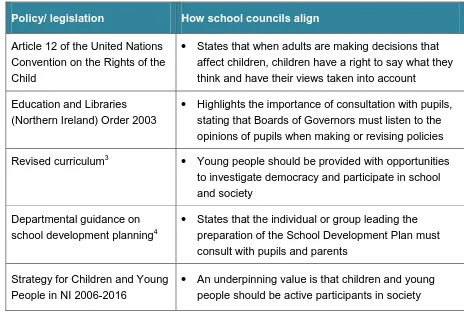
A number of policies and pieces of legislation highlight the importance of children and young people having a right to have their opinions heard when adults are making a decision that affects them. These include Article 12 of the United Nations Convention on the Rights of the Child, the Education and Libraries (Northern Ireland) Order 2003 and the Department‟s guidance on school development planning.
Potential impacts and benefits
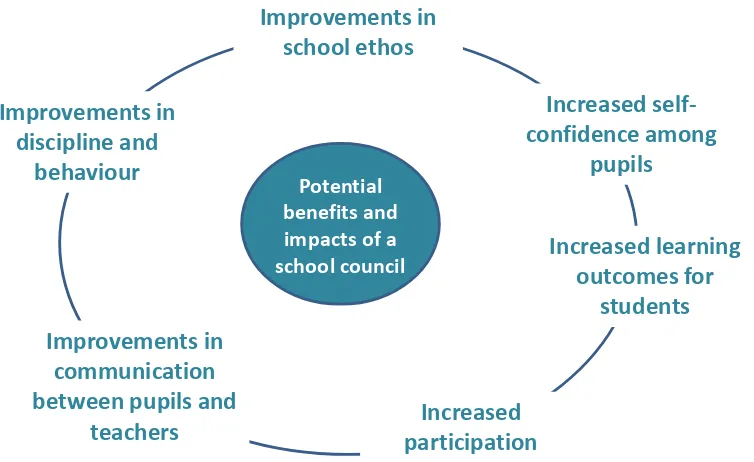
School councils are known to vary widely in their effectiveness. However, there is agreement in the literature that they have the potential to have positive outcomes for students and for schools. Among the key potential benefits are the following:
Increased self-confidence and learning outcomes for pupils;
Increased participation in school life and improved communication between pupils and teachers;
Improvements in discipline and behaviour; and Improvements in school ethos.
Issues and challenges
A number of issues and challenges have been identified in previous research that have the potential to have an impact on the efficacy of school councils. These centre around a lack of clarity about the purpose of the council, insufficient engagement or „buy in‟ from staff, and maintaining momentum once the council is established. Other important issues include the provision of training to support pupils and staff and ensuring
representation on the council of pupils of different ages, abilities, disabilities and backgrounds.
Factors and attributes for effective school councils
Northern Ireland Assembly, Research and Information Service 5
in „tokenistic‟ activities. In addition, it should have a formal constitution setting out how the council is to be run, including detailing specific roles and responsibilities.
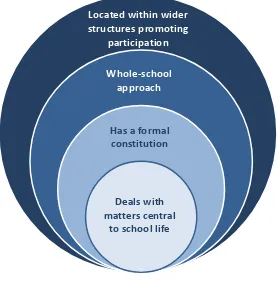
Other important factors that have been identified in this regard include ensuring that the council is whole-school, rather than simply class- or year-based, and making sure that it is located within wider structures and practices that support pupil participation. In this context, truly „democratic schools‟ should demonstrate values including cooperation, mutual respect, justice and a commitment to diversity and equity.
Conclusion
It is evident that school councils have the potential to have positive outcomes for pupils and for schools. However, in order to do this, it is crucial that they are situated within wider practices that promote pupil participation in schools, and that they deal with issues relevant to the daily life of students.
NIAR 397-11 School councils
Northern Ireland Assembly, Research and Information Service 8
Contents
Key Points ... 1
Executive Summary ... 4
Contents 1 Introduction ... 9
2 Policy context ... 9
3 Potential impacts and benefits of school councils ... 10
4 Issues and challenges around school councils ... 12
5 Factors and attributes of successful school councils ... 16
6 UK Parliament school council awards ... 18
Northern Ireland Assembly, Research and Information Service 9
1
Introduction
A school council is a group of pupils within a school elected by their peers to represent them and their views. A school council may be a student‟s first experience of
democratic values and practices.1
The Department of Education (the Department) is keen to support all schools in Northern Ireland to establish a school council using the Democra School programme, designed by the Commissioner for Children and Young People (NICCY).This
programme aims to support and encourage the development of meaningful school councils and the practice of democracy in the school environment.2
2
Policy context
[image:11.595.65.529.367.684.2]School councils align with a number of policies and pieces of legislation relating to young people‟s participation in society and in the decisions that affect their lives. The key areas are outlined in the following table.
Table 1: Policies and legislation that school councils align to
Policy/ legislation How school councils align
Article 12 of the United Nations Convention on the Rights of the Child
States that when adults are making decisions that affect children, children have a right to say what they think and have their views taken into account
Education and Libraries (Northern Ireland) Order 2003
Highlights the importance of consultation with pupils, stating that Boards of Governors must listen to the opinions of pupils when making or revising policies Revised curriculum3 Young people should be provided with opportunities
to investigate democracy and participate in school and society
Departmental guidance on school development planning4
States that the individual or group leading the preparation of the School Development Plan must consult with pupils and parents
Strategy for Children and Young People in NI 2006-2016
An underpinning value is that children and young people should be active participants in society
1
Parliament Education Service (2010) The Year Book 2009-2010 Celebrating school councils and their achievements
2Democra School – School Councils
[online] Available at: http://www.deni.gov.uk/index/85-schools/5-school-management/school-councils-2.htm
3
The Education (Curriculum Minimum Content) Order (Northern Ireland) 2007 UK: The Stationery Office
4
NIAR 397-11 School councils
Northern Ireland Assembly, Research and Information Service 10
Statutory or voluntary?
There have been calls for school councils to be made a statutory requirement for schools, for example as recommended by the Select Committee on Education and Skills in its review of citizenship education in 2006-07. Some authors suggest that making councils compulsory would underline the importance the Government gives to the role of citizenship in schools.5 However, the Government‟s response to the Select Committee report highlighted a preference for schools to retain flexibility in how they choose to engage pupils.6
School councils have been compulsory in all primary, secondary and special schools in Wales since 2006. However, a report from the Welsh inspectorate in 2008 found that schools still needed to engage all pupils more broadly in decisions about teaching and learning. It found that in a few cases, pupils had been involved in the appointment of senior members of staff, influencing how money is spent and developing policies such as recycling and anti-bullying.7
NICCY advocates a more consensual approach, whereby everyone within the school community agrees that a council is important, and values and supports its
establishment. The Democra School literature states that there needs to be a sense of ownership from the whole school so that the council can draw support from pupils and staff.8
3
Potential impacts and benefits of school councils
The literature highlights a number of key benefits and potential outcomes for schools and pupils that have a school council. Overall, they are thought to help and improve many aspects of school life, and one author suggests that there is almost no part of school life which school councils do not have the potential to improve.9
However, individual school councils are known to vary greatly in their effectiveness.10 One study examining the impact of school councils found that they had weak levels of influence on both schools and classrooms. Nonetheless it concluded that, under certain conditions, councils can be a positive, if moderate, force for school and classroom change.11 The key potential benefits of councils highlighted in the literature are outlined in Figure 1 and considered in more detail in the subsequent paragraphs.
5
Inman, S. and Burke, H. (2002) School councils: an apprenticeship in democracy? London: Association of Teachers and Lecturer, Whitty, G. and Wisby, E. (2007) Real Decision Making? School Councils in Action London: Institute of Education
6
House of Commons Education and Skills Committee (2007) Citizenship Education: Government Response to the Committee’s
Second Report of Session 2006-07 London: The Stationery Office
7 “Welsh inspectorate criticises pupil engagement in schools” (2008)
Education Issue 300 p.4
8Democra School – School Councils
[online] Available at: http://www.deni.gov.uk/index/85-schools/5-school-management/school-councils-2.htm
9
Rowe, D. (2003) The Business of School Councils: An investigation into democracy in schools London: Citizenship Foundation
10 Mould, D. (2011) “The Requirements of Representation”
Ethos Vol. 19, No. 1
11 Parker, K., Leithwood, K. (2000) “School Councils‟ Influence on School and Classroom Practice”
Northern Ireland Assembly, Research and Information Service 11
Figure 1: Key benefits and impacts of having an effective school council
Increased self-confidence among pupils
The evidence points to improvements in self-confidence for students who take part in school councils. This is thought to be a result of getting recognition for good work, seeing suggestions being carried out, having their opinions respected, acting as advocates and having a greater sense of pride or ownership. Collaborative working was also thought to play a role in increasing self-esteem.12
A study of school councils in special schools found increased self-confidence among students and improved relationships with staff. This had, in turn, led to pupils being more likely to ask questions or ask for help if they were having trouble understanding in class.13
Increased learning outcomes for students
Evidence suggests that student councillors often demonstrate improved learning outcomes, particularly around communication skills, experience of meetings, leadership, political grounding and taking increased responsibility. In terms of
grounding in democratic processes, students can learn how to ask others‟ views, be a representative, argue a point of view and take different things into account in decision making.14
12
Davies, L., Yamashita, H. (2007) School Councils – School Improvement.The London Secondary School Councils Action Research Project University of Birmingham
13
Simon, J. and Stone, J. (2005) School Councils for All: Including disabled pupils and pupils with special educational needs
London: School Councils UK
14
Taylor, M. and Johnson, R. (2002) School councils: their role in citizenship and personal and social education Slough: NFER
Increased
self-confidence among
pupils
Increased
participation
Improvements in
school ethos
Improvements in
communication
between pupils and
teachers
NIAR 397-11 School councils
Northern Ireland Assembly, Research and Information Service 12
Increased participation
School councils have been found to increase participation in school life, leading to a sense of greater responsibility and ownership.15 They can facilitate pupil involvement in decisions about and implementation of policies and practices, supporting what is often referred to as the „student voice‟. A representative school council therefore has the potential to involve students in important decisions and lead to greater participation in school life.16
Improvements in communication between pupils and teachers
Linked to increased participation in school life, a number of studies have found that school councils can also result in improved communication between students and teachers. In some cases, a school council can be viewed as a vehicle for facilitating this communication and to contribute to the smooth running of the school.17
Improvements in discipline and behaviour
The literature suggests that school councils can play a role in improving behaviour in schools. One innovative approach within the London Secondary School Councils Action Research Project involved students taking part in teaching and learning
committees observing lessons and providing feedback to teachers on various aspects of teaching. In addition, a behaviour sub-council identified areas of classroom
disruption and then worked directly with specific disruptive students to improve behaviour, with positive results.18
Improvements in school ethos
Many advantages of school councils in relation to school ethos have been reported in the literature. For example, they are thought to promote a positive school atmosphere and a caring school environment that is supportive and inclusive.19 One report states that schools must be willing to change their ethos and structures if necessary in order to support the establishment of credible school councils.20
4
Issues and challenges around school councils
The research has also identified a number of potential issues and challenges around establishing an effective school council. These include the following:
15
Davies, L., Yamashita, H. (2007) School Councils – School Improvement.The London Secondary School Councils Action Research Project University of Birmingham
16 Mould, D. (2011) “The Requirements of Representation”
Ethos Vol. 19, No. 1
17
Keogh, A.F., Whyte, J. (2005) Second Level Student Councils in Ireland: A study of enablers, barriers and supports Dublin: The Stationery Office
18
Davies, L., Yamashita, H. (2007) School Councils – School Improvement.The London Secondary School Councils Action Research Project University of Birmingham
19
Keogh, A.F., Whyte, J. (2005) Second Level Student Councils in Ireland: A study of enablers, barriers and supports Dublin: The Stationery Office
20
Northern Ireland Assembly, Research and Information Service 13
Lack of clarity around the purpose of the council; Lack of staff engagement with the school council;
The provision of training to enable pupils to chair and participate in meetings effectively;
Ensuring that pupils are representative of different ages, abilities, disabilities and socio-economic backgrounds;
Maintaining momentum; and
Other issues such as a lack of organisation, excessive bureaucracy or a lack of effective leadership.
Lack of clarity around the purpose of the council
Research has shown that in some cases, there is a weak interpretation or
understanding of the purpose of the school council. Indeed, the importance of clarifying the purpose of a school council has been highlighted in the literature. For example, concerns have been raised that schools will become preoccupied with the processes around a school council rather than its purpose.21
Democra School guidance states that pupils must be clear about what they want to achieve before attempting to set up a school council, and have prepared an action plan. The guidance also states that it is vital to have a set of clear guidelines and rules in a single document, usually called a constitution, providing a framework for how the council should be run. This framework should ensure that the council is educational, democratic, open and transparent and worthwhile.22
Lack of staff engagement
Some studies have found a lack of staff involvement in the school council, whereby the principal played a significant role in its running, but other staff remained marginal to its work.23 It has also been suggested that some adults do not „buy in‟ to an ethos and practice of pupil empowerment.24 Other concerns for teachers that have been cited include workload, already busy timetables and a fear of the unknown.25
One study found that more influential councils had facilitative principals who supported and endorsed the councils, and provided information, knowledge and skills to council
21 Veitch (2009) „Participation in practice: an evaluation of the primary school council as a participatory tool‟
Childhoods Today
and Whitty, G. and Wisby, E. (2007) Real Decision Making? School Councils in Action London: Institute of Education
22
Democra School [online] Available at: http://www.niccy.org/Publications/democra2 23
Keogh, A.F., Whyte, J. (2005) Second Level Student Councils in Ireland: A study of enablers, barriers and supports Dublin: The Stationery Office
24
Inman, S. and Burke, H. (2002) School councils: an apprenticeship in democracy? London: Association of Teachers and Lecturers
25
NIAR 397-11 School councils
Northern Ireland Assembly, Research and Information Service 14
members. The principals also worked closely with the chair of the council and helped the council to build connections with the school staff.26
Some authors suggest that there is a strong case for finding strategies that engage all staff in the work of the school council.27 Indeed, NICCY recommends that there is a named teacher with direct access to senior management working with the school council and supporting its establishment. It also suggests that senior management need to provide space and time for the council within the school day.
Training for pupils and staff
There is broad agreement in the literature that participants in school councils, including pupils and teachers, require training for successful outcomes. Systematic training is believed to be important, and it has been suggested that this training could be part of the curriculum in terms of citizenship.28
A report on the London Secondary School Councils Action Research Project found that support and training were viewed very positively by students and staff. Training for school councils involved in the projects was extensive, including giving insights into elections, running meetings, being a representative and engaging with staff. More specialist training was also provided, for example to behaviour sub-councils, on conflict resolution techniques, mediation theory and research skills.29
Guidance for the Democra School initiative states that training must be provided for staff and pupils, and that this could be internal or external, and provided by existing staff within the school. With regard to training for pupils, it suggests that it should aim to:30
Give real examples of how school councils can make a difference; Identify what personal and life skills can be attained;
Ensure that pupils have knowledge of their right to have their voice heard; and Develop an understanding of how young people can have a peer leadership
and peer support role within their school. Ensuring representation
Ensuring that school councils include a broad range of pupils, across different ages, abilities and socio-economic backgrounds, is another important challenge for schools.
26 Parker, K., Leithwood, K. (2000) “School Councils‟ Influence on School and Classroom Practice”
Peabody Journal of Education, 75, pp. 37-65 Ontario
27
Inman, S. and Burke, H. (2002) School councils: an apprenticeship in democracy? London: Association of Teachers and Lecturers
28
Inman, S. and Burke, H. (2002) School councils: an apprenticeship in democracy? London: Association of Teachers and Lecturers
29
Davies, L., Yamashita, H. (2007) School Councils – School Improvement.The London Secondary School Councils Action Research Project University of Birmingham
30
Northern Ireland Assembly, Research and Information Service 15
There is evidence to suggest that the procedures used to run school councils, which are based on representative democratic practice, require high levels of literacy, which can discriminate against younger or less literate children.31
One article describes the use of alternative visual strategies in school councils, aimed at encouraging involvement by more children and enabling them to participate. These included the use of mapping, drawing, card ranking and time lines to facilitate
discussion. A study found that these strategies led to greater participation than might be achieved through more conventional, adult-style approaches, and thus supported greater inclusion.32 Another author states that using a range of processes based on children‟s competences can help children to experience democracy, rather than simply learning about democratic practice for the future.33
The Institute of Education notes that pupils with special educational needs may require particular support to participate in school councils, and that schools would benefit from greater support in designing provision for pupil voice that can accommodate a wide range of abilities and disabilities.34
Another important aspect of representation relates to including the views and opinions of students who are not council members. A study in the Republic of Ireland found that students who were not members of the council generally did not have a good opinion of it, and felt that junior students were not represented adequately.35 One author outlines three elements of representation that play a role in ensuring that the democratic process is legitimate:36
The representative is asked by their peers to act as a representative;
The representative has a mechanism to accurately collect the opinions of those he or she aims to represent; and
The representative proactively reports back to those students during and after the process.
Maintaining momentum
Research from the National Foundation for Educational Research (NFER) has highlighted challenges around keeping momentum going within a school council, as well as pupil disillusionment about the pace of change.37
31 Veitch (2009) „Participation in practice: an evaluation of the primary school council as a participatory tool‟
Childhoods Today
32 Cox, S., Robinson-Pant, A. (2006) “Enhancing participation in primary school and class councils through visual
communication” Cambridge Journal of Education Vol. 36, No. 4, pp515-132
33 Veitch (2009) „Participation in practice: an evaluation of the primary school council as a participatory tool‟
Childhoods Today
34
Whitty, G. and Wisby, E. (2007) Real Decision Making? School Councils in Action London: Institute of Education
35
Keogh, A.F., Whyte, J. (2005) Second Level Student Councils in Ireland: A study of enablers, barriers and supports Dublin: The Stationery Office
36 Mould, D. (2011) “The Requirements of Representation”
Ethos Vol. 19, No. 1
37
NIAR 397-11 School councils
Northern Ireland Assembly, Research and Information Service 16
NICCY guidance highlights the importance of regular and comprehensive self-evaluation by the school council to reaffirm that it is effective, and give further confidence to move ahead. One article suggests cultivating a school ethos in which being a councillor is regarded as a respected and sought-after role could play a useful part in maintaining momentum. Inviting political representatives to observe council meetings is suggested as one potential way of doing this.38
Other issues
Other challenges reported include lack of organisation, the timing of meetings, the provision of feedback to peers, teachers and other staff and excessive bureaucracy.39 In addition, recruiting members to school councils, educating the wider school about its purpose and tensions about roles and responsibilities in schools with a prefect system were also found to be potential issues.40
5
Factors and attributes of successful school councils
[image:18.595.147.425.419.702.2]The following figure illustrates some of the key structural attributes of an effective school council that are cited in the literature; these are considered further in the subsequent paragraphs.
Figure 2: Key structural attributes of an effective school council
38
Taylor, M. and Johnson, R. (2002) School councils: their role in citizenship and personal and social education Slough: NFER
39
Taylor, M. and Johnson, R. (2002) School councils: their role in citizenship and personal and social education Slough: NFER
40
Keogh, A.F., Whyte, J. (2005) Second Level Student Councils in Ireland: A study of enablers, barriers and supports Dublin: The Stationery Office
Deals with matters central
to school life Has a formal constitution
Whole-school approach Located within wider structures promoting
Northern Ireland Assembly, Research and Information Service 17
A key factor in ensuring that a school council is effective is that pupils must have influence in matters that are central to their daily life in school. Examples could include the school council having a say on teaching methods, school policies, term planning and the recruitment of staff.41 The literature warns against school councils simply taking charge of areas such as running events and fundraising, as this can quickly overshadow the purpose of the school council.42
As discussed previously, having a formal constitution providing a framework for how the council should be run is also important. NICCY states that an effective constitution will help the school council to operate in a professional manner and foster an inclusive approach. The constitution:43
Should be developed by pupils with the support of the teaching staff; Should set out the roles and responsibilities of the council and the rules it
needs to have in place;
Should detail who can be a member of the council and the election procedures to be used; and
Should discuss the administration and planning of the council.
In addition, the school council should take a whole-school approach (not simply class- or year-based) and be located within wider structures and practices within schools that promote pupil participation. For example, one report indicates that it is within the context of „democratic schools‟ that councils can most effectively make a contribution, and states that the core values of such schools include cooperation, mutual respect, justice and a commitment to diversity and equity. In particular, the authors suggest that institutions need to have a genuine and consistent commitment to pupil participation demonstrated through whole school structures and practices, for school councils to achieve their potential.44
In order to do this, schools should review and evaluate the opportunities available for pupils to make their voice heard and regularly review their core values and ethos to ensure they are supportive of participation.45 It is also important for school leaders to be clear that they are willing to involve pupils in decision making, listen to their views and act on those views where appropriate. One report notes that the extent to which a school council is involved in the routine business of a school, such as the drafting of
41
Bäckman, E. and Trafford, B. (2007) Democratic governance of schools Strasbourg: Council of Europe publishing
42 Mould, D. (2011) “The Requirements of Representation”
Ethos Vol. 19, No. 1
43
Democra School [online] Available at: http://www.niccy.org/Publications/democra2 44
Inman, S. and Burke, H. (2002) School councils: an apprenticeship in democracy? London: Association of Teachers and Lecturers
45
NIAR 397-11 School councils
Northern Ireland Assembly, Research and Information Service 18
behaviour policies, gives an indication of the seriousness with which pupil voice is taken.46
The literature also highlights a number of operational characteristics that are important in supporting an effective school council, including the following:47
Meetings are formally run with agendas and minutes;
There are explicit representation and reporting mechanisms; Scope of the agenda can be determined by pupils as well as staff; Council is formally consulted about major policy decisions;
Children and adults are clear on what they mean by participation (in particular, that it is not simply listening to children); and
The council is under the direct oversight of the principal.
6
UK Parliament school council awards
The Speaker of the House of Commons holds awards to celebrate excellence in school councils. All schools, including those in Northern Ireland, are invited to nominate
projects for the awards. These are then assessed by a team of expert judges and four schools receive a trophy and a prize from the Speaker. Every school that enters receives a certificate to recognise the work they achieve.48
The awards look for school council projects that have helped to include everyone, for example in a school or a community; have made a real change; and are student-led. The projects are judged within the following categories:
How people get on;
School building and environment; Getting more people involved; Things outside the school; and Teaching and learning.
The yearbook for the school council awards 2009-2010 examines themes emerging from school councils within particular age categories. For example, in the 4-7 age category, a key theme was pupils wanting to share their learning with others and
46
Whitty, G. and Wisby, E. (2007) Real Decision Making? School Councils in Action London: Institute of Education
47
Inman, S. and Burke, H. (2002) School councils: an apprenticeship in democracy? London: Association of Teachers and Lecturers and Veitch (2009) „Participation in practice: an evaluation of the primary school council as a participatory tool‟
Childhoods Today
48
Northern Ireland Assembly, Research and Information Service 19
collaborating with teachers, other students and adults to transform how they were learning.
In the 11-16 age group, „understanding identity‟ was a key theme, whereby councils became aware that other students were having problems with issues affecting their sense of belonging and progress, and sought to find a solution.
7
Conclusion
This paper has considered the potential benefits of school councils, issues and challenges around their effective implementation, and the factors and attributes of successful councils. It has found that while the effectiveness of school councils varies, councils have the potential to have positive outcomes both for students and schools. Their effectiveness depends on a number of factors: in particular, they must be situated within wider structures promoting participation, and deal with matters central to daily school life, rather than simply „tokenistic‟ activity.
There are a number of areas pertaining to school councils that could be considered by the Education Committee in its forward work programme. These could include
undertaking a baseline analysis of the numbers of school councils in Northern Ireland, and whether they are more prevalent in particular school phases and sectors. In addition, consideration could be given to visiting school councils and taking evidence from their participants, including students, teachers and principals. Others areas for consideration could include:
The influence and effectiveness of school councils here;
The benefits and outcomes of school councils for participants in NI schools; The extent to which schools have a wider ethos of participation and democracy
and the impact of this on the school council;
The availability, form and content of training and support for pupils to support their participation in school councils, including pupils with special educational needs;
The extent to which school councils are inclusive and representative of young people of different ages, abilities, disabilities and backgrounds;